

The echo chamber effect on social media
Open accessThe DOI matches its Crossref record; 68 of the 69 references it cites were found in a registry or an index; 16 of the 38 sources its claims cite were checked for support.
Abstract
Significance: We explore the key differences between the main social media platforms and how they are likely to influence information spreading and the formation of echo chambers. To assess the different dynamics, we perform a comparative analysis on more than 100 million pieces of content concerning controversial topics (e.g., gun control, vaccination, abortion) from Gab, Facebook, Reddit, and Twitter. The analysis focuses on two main dimensions: 1) homophily in the interaction networks and 2) bias in the information diffusion toward like-minded peers. Our results show that the aggregation in homophilic clusters of users dominates online dynamics. However, a direct comparison of news consumption on Facebook and Reddit shows higher segregation on Facebook.
Overview
CoChat Summary
TL;DR
This paper compares echo-chamber dynamics across Gab, Facebook, Reddit, and Twitter using more than 100 million pieces of content and more than 1 million active users. It finds homophilic clustering dominates online dynamics, with Facebook and Twitter showing stronger segregation and like-minded information diffusion than Reddit and Gab, and Facebook showing higher news-consumption segregation than Reddit.
Key findings
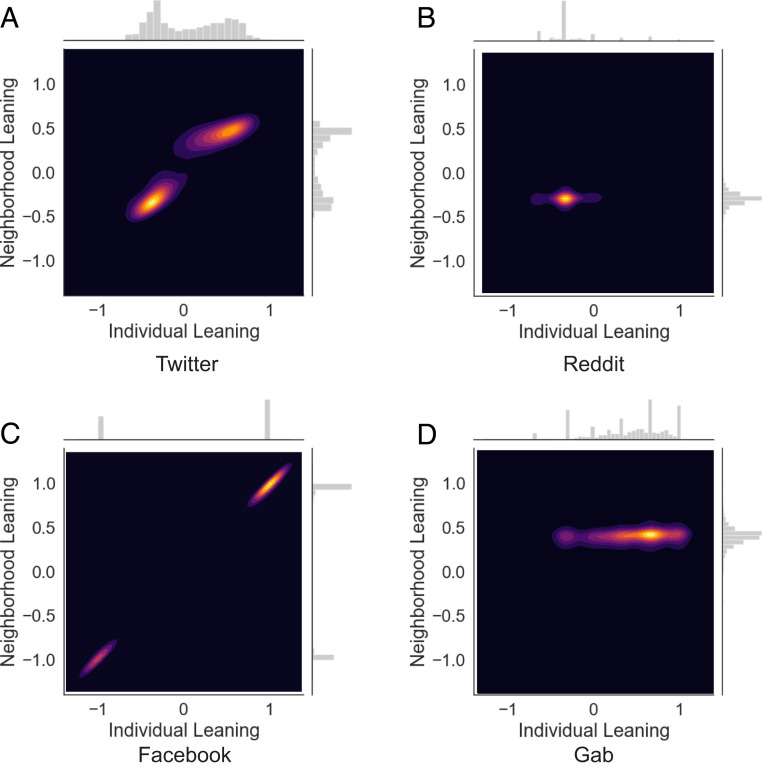
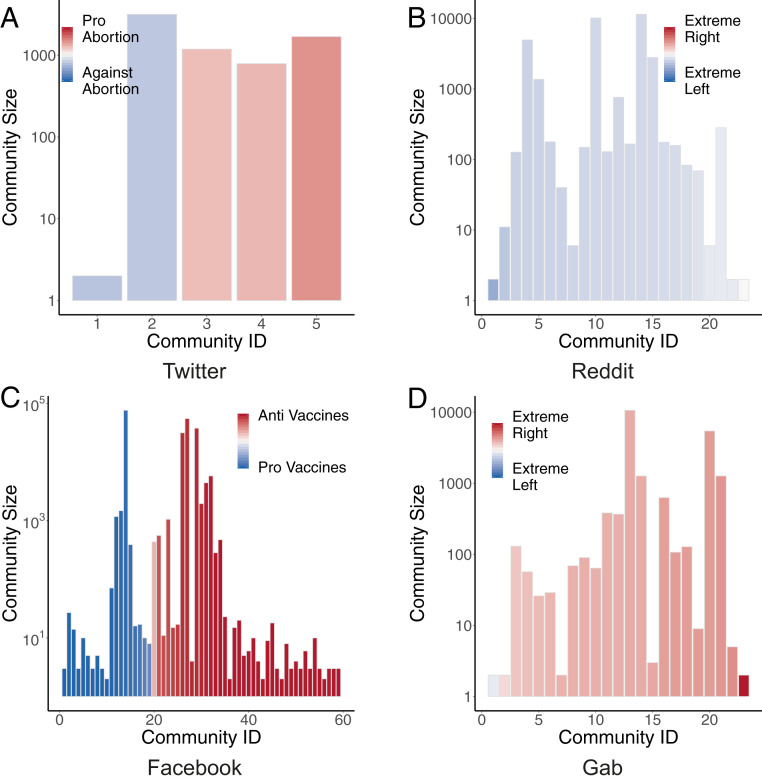
- Across the four platforms, “aggregation in homophilic clusters of users dominates online dynamics,” but platforms differ: Facebook and Twitter show homophilic clustering, while Reddit and Gab form a single community biased left or right rather than two opposing clusters.
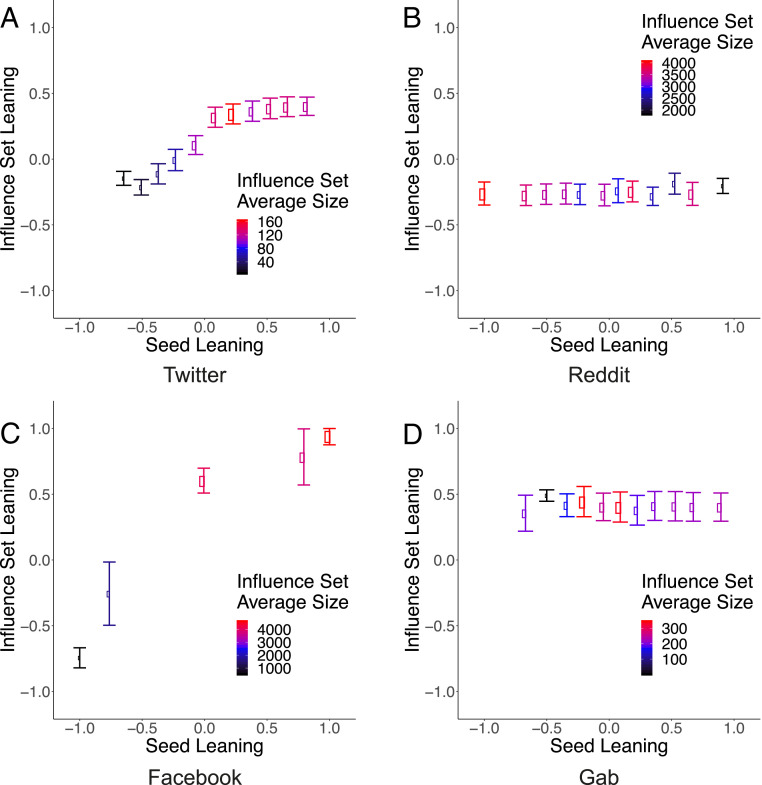
- Information diffusion is biased toward like-minded users on Facebook and Twitter, where the average leaning of a user’s influence set approximates the seed user’s leaning; on Reddit and Gab, the average leaning of the influence set does not depend on the seed user’s leaning.
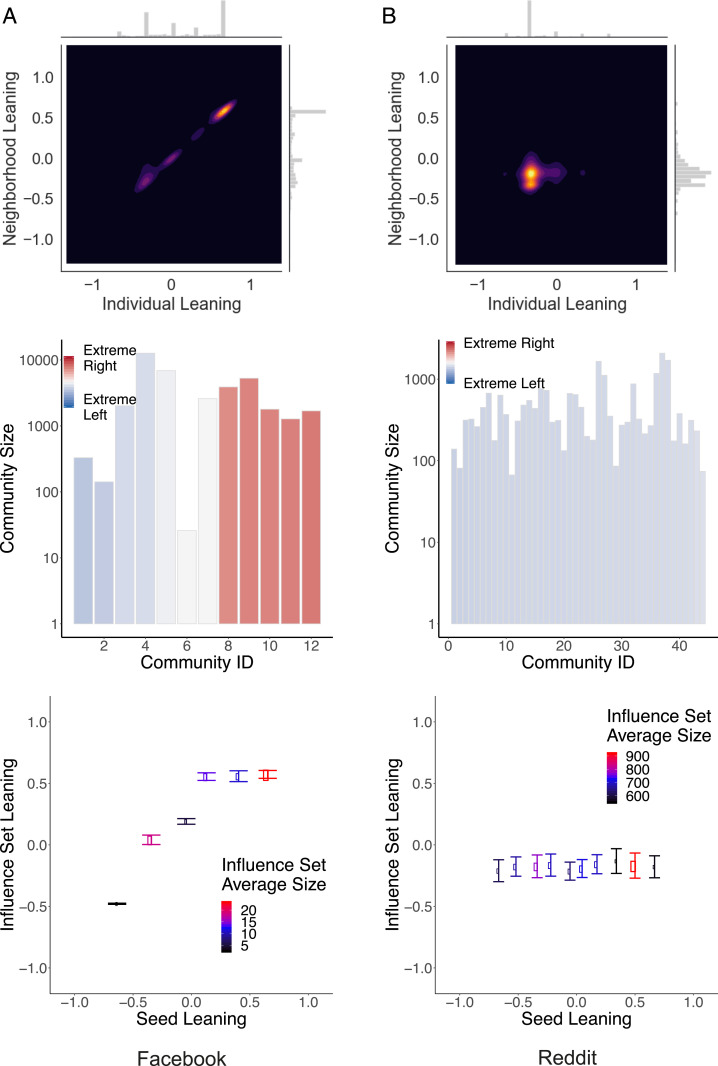
- In a direct comparison on news consumption, Facebook shows higher segregation than Reddit across all three measures: user-neighbor leaning correlation, community leaning, and SIR influence-set leaning.
- The study analyzes more than 100 million unique pieces of content and more than 1 million active users, with news outlets labeled using 2,190 media sources from Media Bias/Fact Check.
Methods
- Comparative analysis of Gab, Facebook, Reddit, and Twitter datasets on controversial topics including gun control, Obamacare, abortion, vaccines, science versus conspiracy, and news; main selected datasets were Abortion (Twitter), Vaccines (Facebook), Politics (Reddit), and Gab as a whole.
- Echo chambers were operationalized through two dimensions: homophily in interaction networks and bias in information diffusion toward like-minded peers. User leaning was inferred from linked news outlets, likes, or content, and interaction networks were built from follows, comments, cocomments, submissions, or replies depending on platform.
- Analyses included correlation between user leaning and average neighbor leaning, Louvain community detection, and SIR simulations to measure influence sets; SIR recovery rate was fixed at ν = 0.2, with dataset-specific infection ratios.
Limitations
- The paper states that the next envisioned step is to address the temporal dimension of echo chambers and how platform-specific social feedback mechanisms impact their formation.
- Evident from the text: leaning coverage varies strongly by platform, from 0.90–1.00 for Twitter/Facebook datasets to 0.15–0.20 for Reddit and 0.13 for Gab, so leaning-based conclusions for Reddit and Gab rest on a small classified fraction of users.
- Evident from the text: datasets differ by platform and topic, and the direct cross-platform comparison on a common topic is limited to news consumption on Facebook and Reddit; the authors also note that Reddit/Gab results could mean either no echo-chamber effect or observation inside a single echo chamber.
Model-written summary. Check it against the paper before relying on it.
Integrity signals
Registry
Cites
Statistics
Figures
Verification
Claims the paper makes
8 Valid · 1 Not valid · 7 Not checked · 38 Own results and interpretations
The cited sources support only part of this claim — read each source’s verdict below.
In the paper
“Selective exposure (19) and confirmation bias (20) (i.e., the tendency to seek information adhering to preexisting opinions) may explain the emergence of echo chambers on social media (1, 17, 21, 22).”
§ The echo chamber effect on social media > Abstract
What the sources say
- Supportedcites [1] M. Del Vicario, The spreading of misinformation online. Proc. Natl. Acad. Sci. U.S.A. 113, 554– 559 (2016). 26729863 PMC4725489 source
The Abstract says selective exposure generates homogeneous clusters, which it calls echo chambers. The Results and Discussion section says users select content matching a narrative and suggests confirmation bias determines echo-chamber formation. Page numbers are not provided in our copy. (LLM, conf=0.94)
- Partly supportedcites [17] K. Garimella, G. De Francisci Morales, A. Gionis, M. Mathioudakis, “ The effect of collective attention on controversial debates on social media” in WebSci ’17: 9th International ACM Web Science Conference (Association for Computing Machinery, New York, NY, 2017), pp. 43– 52. sourceExperimental — accuracy not yet measured
The Introduction reports that users mostly interact within their own side and endorse opinions from that side’s core. Related Work reports that users spread information faster when it agrees with their position. These passages are consistent with selective exposure, but the paper does not identify confirmation bias or establish that either tendency causes echo chambers to emerge. (LLM, conf=0.82)
- Supportedcites [21] M. Del Vicario, Echo chambers: Emotional contagion and group polarization on Facebook. Sci. Rep. 6, 37825 (2016). 27905402 PMC5131349 source
The Abstract says social-media disintermediation encourages users to select information that fits their beliefs (confirmation bias) and form like-minded groups (echo chambers). The Conclusions likewise describe Facebook as suited to the emergence of echo chambers. This supports the proposed explanation, without claiming it is the only cause. (LLM, conf=0.93)
- Supportedcites [22] A. Bessi, Science vs conspiracy: Collective narratives in the age of misinformation. PloS One 10, e0118093 (2015). 25706981 PMC4338055 source
The Introduction (page unavailable) says users consuming opposing information tend to form isolated clusters and describes polarized users whose likes are almost exclusively on one category of pages. The Conclusions (page unavailable) link information evaluation to existing beliefs. Together, these passages support the hedged explanation that selective exposure and confirmation bias may contribute to echo chambers. (LLM, conf=0.86)
hedgedstates a possible cause- Asserted: passes — The authors put it forward as true.
- Checkable: passes — It can be checked against evidence.
- Load-bearing: passes — The paper’s conclusions depend on it.
- Based: passes — The paper gives a reason why it holds.
- Supported
The cited sources support only part of this claim — read each source’s verdict below.
In the paper
“Our attention span remains limited (9, 10), and feed algorithms might limit our selection process by suggesting contents similar to the ones we are usually exposed to (11–13).”
§ The echo chamber effect on social media > Abstract
What the sources say
- Not checked — no full text of the sourcecites [11] A. L. Schmidt, Anatomy of news consumption on Facebook. Proc. Natl. Acad. Sci. U.S.A. 114, 3035– 3039 (2017). 28265082 PMC5373354 source
- Partly supportedcites [12] M. Cinelli, The COVID-19 social media infodemic. Sci. Rep. 10, 16598 (2020). 33024152 PMC7538912 sourceExperimental — accuracy not yet measured
The Introduction (page not provided) says algorithms take users’ preferences and attitudes into account when promoting content, and that users tend to seek information aligned with their worldviews. It does not say that feed algorithms suggest content similar to what users have previously seen or thereby limit their selection. (LLM, conf=0.82)
- Not checked — no full text of the sourcecites [13] E. Bakshy, S. Messing, L. A. Adamic, Exposure to ideologically diverse news and opinion on Facebook. Science 348, 1130– 1132 (2015). 25953820 source
hedgedstates a possible cause- Asserted: passes — The authors put it forward as true.
- Checkable: passes — It can be checked against evidence.
- Load-bearing: passes — The paper’s conclusions depend on it.
- Based: passes — The paper gives a reason why it holds.
Every source the paper cites for this claim was checked and supports it.
In the paper
“Online polarization, for instance, may foster misinformation spreading (1, 8).”
§ The echo chamber effect on social media > Abstract
What the sources say
- Supportedcites [1] M. Del Vicario, The spreading of misinformation online. Proc. Natl. Acad. Sci. U.S.A. 113, 554– 559 (2016). 26729863 PMC4725489 source
The Significance section says that homogeneity and polarization are main determinants of rumor-cascade size. The Conclusions also link polarized communities with the proliferation of narratives fueled by unsubstantiated rumors, supporting the hedged claim that online polarization may foster misinformation spreading. (LLM, conf=0.91)
- Supportedcites [8] M. D. Vicario, W. Quattrociocchi, A. Scala, F. Zollo, Polarization and fake news: Early warning of potential misinformation targets. ACM Trans. Web 13, 1– 22 (2019). source
The Introduction states that misinformation spreading on social media is directly related to increasing user polarization and segregation. This supports the citing sentence’s hedged claim that online polarization may foster misinformation spreading. (LLM, conf=0.94)
hedgedstates a possible cause- Asserted: passes — The authors put it forward as true.
- Checkable: passes — It can be checked against evidence.
- Load-bearing: unclear — It is unclear whether the paper’s conclusions depend on it.
- Based: passes — The paper gives a reason why it holds.
- Supported
Every source the paper cites for this claim was checked and supports it.
In the paper
“In network terms, this translates into a node i with a given leaning xi more likely to be connected with nodes with a leaning close to xi (18).”
§ The echo chamber effect on social media > Comparative Analysis > Polarization and Homophily in the Interaction Networks.
What the sources say
- Supportedcites [18] W. Cota, S. C. Ferreira, R. Pastor-Satorras, M. Starnini, Quantifying echo chamber effects in information spreading over political communication networks. EPJ Data Sci. 8, 35 (2019). source
The paper’s “Topological evidence of echo chambers” section says that a node with political position Pᵢ is connected with nodes whose positions are close to Pᵢ. It also reports a strong correlation between users’ positions and their neighbors’ average positions, supporting the citing sentence’s probabilistic paraphrase. (LLM, conf=0.94)
hedgedstates an association- Asserted: passes — The authors put it forward as true.
- Checkable: passes — It can be checked against evidence.
- Load-bearing: passes — The paper’s conclusions depend on it.
- Based: passes — The paper gives a reason why it holds.
- Supported
A result the paper reports from its own data — it cites no other source for it, so there is none to check. The quote shows it is in the paper.
In the paper
“Furthermore, the almost total absence of communities with leaning very close to 0 confirms the polarized state of the systems.”
§ The echo chamber effect on social media > Comparative Analysis > Polarization and Homophily in the Interaction Networks.
boostedstates a cause- Asserted: passes — The authors put it forward as true.
- Checkable: passes — It can be checked against evidence.
- Load-bearing: passes — The paper’s conclusions depend on it.
- Based: passes — The paper gives a reason why it holds.
- Rests on 4 assumptions not shown here.
32 more claims
Create a free account to see all 54 claims and to verify the 2 references still open.
- It may state two separate claims as one. 9
- Probably not a substantial claim. 9
Claims other papers make about this one
Each is checked against this paper’s own text: does it say what the citing paper says it does?
The source backs part of the claim, not all of it — or backs it for a different population, condition or comparison.
In the citing paper
“engagement with political content online is generally associated with high levels of ingroup bias; that is, it is far more likely to be shared within the political ingroup than in the outgroup (18, 19, 16).”
From Troll and divide: the language of online polarization (2022) · cites this paper as [16]
Experimental — accuracy not yet measuredThe source backs part of the claim, not all of it — or backs it for a different population, condition or comparison.
In the citing paper
“This challenge is reflected in research on”
From Machine culture (2023) · cites this paper as [142]
Experimental — accuracy not yet measuredThe source backs part of the claim, not all of it — or backs it for a different population, condition or comparison.
In the citing paper
“Thus, combating social media's echo chamber effect through an active exposure to diverse perspectives and networks also represents a viable individual-level strategy for addressing the deepfake problem (Cinelli et al., 2021; Gillani et al., 2018).”
From Deepfakes: Deceptions, mitigations, and opportunities (2023) · cites this paper as Cinelli et al., 2021
Experimental — accuracy not yet measuredThe source backs part of the claim, not all of it — or backs it for a different population, condition or comparison.
In the citing paper
“Even without being designed to shift opinions, it has been found that algorithms may contribute to political polarization by reinforcing divisive opinions [9, 24, 32].”
From Co-Writing with Opinionated Language Models Affects Users’ Views (2023) · cites this paper as [32]
Experimental — accuracy not yet measuredThe source backs part of the claim, not all of it — or backs it for a different population, condition or comparison.
In the citing paper
“On Reddit, studies find minimal evidence of echo chambers due to platform features encouraging cross-cutting exposure [17,61,63].”
From A systematic review of echo chamber research: comparative analysis of conceptualizations, operationalizations, and varying outcomes (2025) · cites this paper as [17]
Experimental — accuracy not yet measured
5 more claims about this paper
Create a free account to see every claim other papers make about this one.
Citations
Cites
Fast unfolding of communities in large networks
Blondel, V. D., Guillaume, J.-L., Lambiotte, R., & Lefebvre, E. (2008) · Journal of Statistical Mechanics: Theory and Experiment · doi:10.1088/1742-5468/2008/10/p10008 · Cited by 21,424 · cited 1×
“We detected communities by applying the Louvain algorithm (41), removing singleton communities with only one user.”
MethodThe spread of true and false news online
Vosoughi, S., Roy, D., & Aral, S. (2018) · Science · doi:10.1126/science.aap9559 · Cited by 8,847 · cited 1×
“A recent study (7) limited to Twitter claimed that fake news travels faster than real news.”
BackgroundConfirmation Bias: A Ubiquitous Phenomenon in Many Guises
Nickerson, R. S. (1998) · Review of General Psychology · doi:10.1037/1089-2680.2.2.175 · Cited by 7,267 · cited 1×
“Selective exposure (19) and confirmation bias (20) (i.e., the tendency to seek information adhering to preexisting opinions) may explain the emergence of echo chambers on social media (1, 17, 21, 22).”
BackgroundInfectious Diseases of Humans: Dynamics and Control
Anderson, R. M., & May, R. M. (1991) · doi:10.1093/oso/9780198545996.001.0001 · Cited by 6,179
Lazer, D. M. J., Baum, M. A., Benkler, Y., Berinsky, A. J., Greenhill, K. M., Menczer, F., Metzger, M. J., Nyhan, B., Pennycook, G., Rothschild, D., et al. (2018) · Science · doi:10.1126/science.aao2998 · Cited by 4,160
Degroot, M. H. (1974) · Journal of the American Statistical Association · doi:10.1080/01621459.1974.10480137 · Cited by 4,004 · cited 1×
“For instance, if opinions are assumed to be embedded in a onedimensional space (38), x ∈ [−1,+1] without loss of generality, as usual for controversial topics, then polarization is characterized by two well-separated peaks in P(x ), for positive and negative opinions.”
BackgroundExposure to ideologically diverse news and opinion on Facebook
Bakshy, E., Messing, S., & Adamic, L. A. (2015) · Science · doi:10.1126/science.aaa1160 · Cited by 3,245 · cited 2×
“Our attention span remains limited (9, 10), and feed algorithms might limit our selection process by suggesting contents similar to the ones we are usually exposed to (11–13).”
BackgroundThe spreading of misinformation online
Del Vicario, M., Bessi, A., Zollo, F., Petroni, F., Scala, A., Caldarelli, G., Stanley, H. E., & Quattrociocchi, W. (2016) · Proceedings of the National Academy of Sciences · doi:10.1073/pnas.1517441113 · Cited by 2,407 · cited 2×
“, the tendency to seek information adhering to preexisting opinions) may explain the emergence of echo chambers on social media (1, 17, 21, 22).”
BackgroundSelf-citationThe COVID-19 social media infodemic
Cinelli, M., Quattrociocchi, W., Galeazzi, A., Valensise, C. M., Brugnoli, E., Schmidt, A. L., Zola, P., Zollo, F., & Scala, A. (2020) · Scientific Reports · doi:10.1038/s41598-020-73510-5 · Cited by 2,313
Self-citationFilter Bubbles, Echo Chambers, and Online News Consumption
Flaxman, S., Goel, S., & Rao, J. M. (2016) · Public Opinion Quarterly · doi:10.1093/poq/nfw006 · Cited by 1,992
Reuters Institute Digital News Report 2015
Newman, N., Levy, D. A. L., & Nielsen, R. K. (2015) · SSRN Electronic Journal · doi:10.2139/ssrn.2619576 · Cited by 1,890
Tweeting From Left to Right: Is Online Political Communication More Than an Echo Chamber?
Barberá, P., Jost, J. T., Nagler, J., Tucker, J. A., & Bonneau, R. (2015) · Psychological Science · doi:10.1177/0956797615594620 · Cited by 1,472
The Effects of Mass Communication
Hazard, P. D., & Klapper, J. T. (1962) · American Quarterly · doi:10.2307/2710239 · Cited by 1,415
The law of group polarization.
Sunstein, C. R. (2002) · Journal of Political Philosophy · doi:10.1111/1467-9760.00148 · Cited by 1,371
Echo Chamber: Rush Limbaugh and the Conservative Media Establishment
(2009) · Choice Reviews Online · doi:10.5860/choice.47-0104 · Cited by 1,256 · cited 1×
“Furthermore, users show a tendency to favor information adhering to their beliefs and join groups formed around a shared narrative, that is, echo chambers (1, 14–18).”
BackgroundPolitical Polarization on Twitter
Conover, M., Ratkiewicz, J., Francisco, M., Goncalves, B., Flammini, A., & Menczer, F. (2011) · Zenodo · doi:10.5281/zenodo.4589064 · Cited by 1,254
The spread of low-credibility content by social bots
Shao, C., Ciampaglia, G. L., Varol, O., Yang, K.-C., Flammini, A., & Menczer, F. (2018) · Nature Communications · doi:10.1038/s41467-018-06930-7 · Cited by 1,125
The Effects of Mass Communication
Barrett, D. N., & Klapper, J. T. (1961) · The American Catholic Sociological Review · doi:10.2307/3709128 · Cited by 1,102
Dynamical Interplay between Awareness and Epidemic Spreading in Multiplex Networks
Granell, C., Gómez, S., & Arenas, A. (2013) · Physical Review Letters · doi:10.1103/physrevlett.111.128701 · Cited by 1,064 · cited 1×
“Classical epidemic models such as the susceptible–infected–recovered (SIR) model (44) have been used to study the diffusion of information, such as rumors or news (45–47).”
MethodThe echo chamber is overstated: the moderating effect of political interest and diverse media
Dubois, E., & Blank, G. (2018) · Information, Communication & Society · doi:10.1080/1369118x.2018.1428656 · Cited by 1,055 · cited 1×
“However, recently, the effects and the very existence of echo chambers have been questioned (2, 27, 32).”
BackgroundEcho chambers online?: Politically motivated selective exposure among Internet news users
Garrett, R. K. (2009) · Journal of Computer-Mediated Communication · doi:10.1111/j.1083-6101.2009.01440.x · Cited by 1,040
Origins of Homophily in an Evolving Social Network
Kossinets, G., & Watts, D. J. (2009) · American Journal of Sociology · doi:10.1086/599247 · Cited by 908 · cited 1×
“Homophily in social interactions can be quantified by representing interactions as a social network and then analyzing its structure concerning the opinions of the users (18, 39, 40).”
BackgroundInfluence of fake news in Twitter during the 2016 US presidential election
Bovet, A., & Makse, H. A. (2019) · Nature Communications · doi:10.1038/s41467-018-07761-2 · Cited by 701
Science vs Conspiracy: Collective Narratives in the Age of Misinformation
Bessi, A., Coletto, M., Davidescu, G. A., Scala, A., Caldarelli, G., & Quattrociocchi, W. (2015) · PLOS ONE · doi:10.1371/journal.pone.0118093 · Cited by 645 · cited 1×
“Selective exposure (19) and confirmation bias (20) (i.e., the tendency to seek information adhering to preexisting opinions) may explain the emergence of echo chambers on social media (1, 17, 21, 22).”
BackgroundSelf-citationGollwitzer, A., Martel, C., Brady, W. J., Pärnamets, P., Freedman, I. G., Knowles, E. D., & Van Bavel, J. J. (2020) · Nature Human Behaviour · doi:10.1038/s41562-020-00977-7 · Cited by 609 · cited 1×
“As recently shown in the case of selective exposure to news outlets, studies considering multiple platforms can offer a fresh view on long-debated problems (34).”
BackgroundEcho Chambers: Emotional Contagion and Group Polarization on Facebook
Del Vicario, M., Vivaldo, G., Bessi, A., Zollo, F., Scala, A., Caldarelli, G., & Quattrociocchi, W. (2016) · Scientific Reports · doi:10.1038/srep37825 · Cited by 576 · cited 1×
“, the tendency to seek information adhering to preexisting opinions) may explain the emergence of echo chambers on social media (1, 17, 21, 22).”
BackgroundSelf-citationPolitical News in the News Feed: Learning Politics from Social Media
Bode, L. (2016) · Mass Communication and Society · doi:10.1080/15205436.2015.1045149 · Cited by 545
Himelboim, I., McCreery, S., & Smith, M. (2013) · Journal of Computer-Mediated Communication · doi:10.1111/jcc4.12001 · Cited by 511 · cited 1×
“Some studies point out echo chambers as an emerging effect of human tendencies, such as selective exposure, contagion, and group polarization (13, 23, 29–31).”
BackgroundQuantifying controversy on social media
Garimella, K., Morales, G. D. F., Gionis, A., & Mathioudakis, M. (2018) · ACM Transactions on Social Computing · doi:10.1145/3140565 · Cited by 472
Self-citationModeling echo chambers and polarization dynamics in social networks
Baumann, F., Lorenz-Spreen, P., Sokolov, I. M., & Starnini, M. (2020) · Physical Review Letters · doi:10.1103/physrevlett.124.048301 · Cited by 427 · cited 1×
“Some studies point out echo chambers as an emerging effect of human tendencies, such as selective exposure, contagion, and group polarization (13, 23, 29–31).”
BackgroundSelf-citationPolarization of the vaccination debate on Facebook
Schmidt, A. L., Zollo, F., Scala, A., Betsch, C., & Quattrociocchi, W. (2018) · Vaccine · doi:10.1016/j.vaccine.2018.05.040 · Cited by 403
Self-citationQuattrociocchi, W., Scala, A., & Sunstein, C. R. (2016) · SSRN Electronic Journal · doi:10.2139/ssrn.2795110 · Cited by 389 · cited 1×
“Echo chambers have been shown to exist in various forms of online media such as blogs (24), forums (25), and social media sites (26–28).”
BackgroundSelf-citationHow people decide what they want to know
Sharot, T., & Sunstein, C. R. (2020) · Nature Human Behaviour · doi:10.1038/s41562-019-0793-1 · Cited by 383
Social Media, Echo Chambers, and Political Polarization
Barberá, P. (2020) · Social Media and Democracy · doi:10.1017/9781108890960.004 · Cited by 373 · cited 1×
“This issue is also fueled by the scarcity of comparative studies on social media, especially concerning news consumption (33).”
BackgroundSunstein, C. (2003) · Debating Deliberative Democracy · doi:10.1002/9780470690734.ch4 · Cited by 356
Political Discourse on Social Media: Echo Chambers, Gatekeepers, and the Price of Bipartisanship
Garimella, K., De Francisci Morales, G., Gionis, A., & Mathioudakis, M. (2018) · Proceedings of the 2018 World Wide Web Conference on World Wide Web - WWW '18 · doi:10.1145/3178876.3186139 · Cited by 335 · cited 1×
“For Twitter, we used tweets regarding three topics collected by Garimella et al. (16), namely Gun control, Obamacare, and abortion.”
MethodAnatomy of news consumption on Facebook
Schmidt, A. L., Zollo, F., Del Vicario, M., Bessi, A., Scala, A., Caldarelli, G., Stanley, H. E., & Quattrociocchi, W. (2017) · Proceedings of the National Academy of Sciences · doi:10.1073/pnas.1617052114 · Cited by 305 · cited 1×
“Our attention span remains limited (9, 10), and feed algorithms might limit our selection process by suggesting contents similar to the ones we are usually exposed to (11–13).”
BackgroundSelf-citationUsers Polarization on Facebook and Youtube
Bessi, A., Zollo, F., Del Vicario, M., Puliga, M., Scala, A., Caldarelli, G., Uzzi, B., & Quattrociocchi, W. (2016) · PLOS ONE · doi:10.1371/journal.pone.0159641 · Cited by 285
Self-citationPolarization and Fake News: Early Warning of Potential Misinformation Targets
Vicario, M. D., Quattrociocchi, W., Scala, A., & Zollo, F. (2019) · ACM Transactions on the Web · doi:10.1145/3316809 · Cited by 280 · cited 1×
“Online polarization, for instance, may foster misinformation spreading (1, 8).”
BackgroundSelf-citationSIR rumor spreading model in the new media age
Zhao, L., Cui, H., Qiu, X., Wang, X., & Wang, J. (2013) · Physica A: Statistical Mechanics and its Applications · doi:10.1016/j.physa.2012.09.030 · Cited by 263
Information cascades in complex networks
Jalili, M., & Perc, M. (2017) · Journal of Complex Networks · doi:10.1093/comnet/cnx019 · Cited by 248 · cited 1×
“Classical epidemic models such as the susceptible–infected–recovered (SIR) model (44) have been used to study the diffusion of information, such as rumors or news (45–47).”
MethodNetwork reachability of real-world contact sequences
Holme, P. (2005) · Physical Review E · doi:10.1103/physreve.71.046119 · Cited by 213 · cited 1×
“The set of nodes in a recovered state at the end of the dynamics started with user i as a seed of infection, that is, those that become aware of the information initially propagated by user i , form the set of influence of user i , Ii (48).”
BackgroundSocial influence and unfollowing accelerate the emergence of echo chambers
Sasahara, K., Chen, W., Peng, H., Ciampaglia, G. L., Flammini, A., & Menczer, F. (2021) · Journal of Computational Social Science · doi:10.1007/s42001-020-00084-7 · Cited by 211
What is Gab: A Bastion of Free Speech or an Alt-Right Echo Chamber
Zannettou, S., Bradlyn, B., De Cristofaro, E., Kwak, H., Sirivianos, M., Stringini, G., & Blackburn, J. (2018) · Companion of the The Web Conference 2018 on The Web Conference 2018 - WWW '18 · doi:10.1145/3184558.3191531 · Cited by 209 · cited 1×
“For these reasons, it has been repeatedly suspended by its service provider, and its mobile app has been banned from both App and Play stores (36).”
BackgroundRoitberg, B. D. (1993) · Mathematical Biosciences · doi:10.1016/0025-5564(93)90068-l · Cited by 209
Measuring Online Social Bubbles
Nikolov, D., Oliveira, D. F. M., Flammini, A., & Menczer, F. (2015) · PeerJ Computer Science · doi:10.48550/arxiv.1502.07162 · Cited by 206
Measuring online social bubbles
Nikolov, D., Oliveira, D. F. M., Flammini, A., & Menczer, F. (2015) · PeerJ Computer Science · doi:10.7717/peerj-cs.38 · Cited by 205
What is Gab? A Bastion of Free Speech or an Alt-Right Echo Chamber?
Zannettou, S., Bradlyn, B., Cristofaro, E. D., Kwak, H., Sirivianos, M., Stringhini, G., & Blackburn, J. (2018) · Singapore Management University Institutional Knowledge (InK) (Singapore Management University) · doi:10.48550/arxiv.1802.05287 · Cited by 202 · cited 1×
“For these reasons, it has been repeatedly suspended by its service provider, and its mobile app has been banned from both App and Play stores (36).”
BackgroundGolovchenko, Y., Buntain, C., Eady, G., Brown, M. A., & Tucker, J. A. (2020) · The International Journal of Press/Politics · doi:10.1177/1940161220912682 · Cited by 179 · cited 1×
“Different platforms offer different interaction paradigms to users, ranging from retweets and mentions on Twitter to likes and comments in groups on Facebook, thus triggering very different social dynamics (35).”
BackgroundSociology of Mass Communication
KLAPPER, J. T. (1960) · Contemporary Psychology: A Journal of Reviews · doi:10.1037/006189 · Cited by 171
Reducing Controversy by Connecting Opposing Views
Garimella, K., De Francisci Morales, G., Gionis, A., & Mathioudakis, M. (2017) · Proceedings of the Tenth ACM International Conference on Web Search and Data Mining · doi:10.1145/3018661.3018703 · Cited by 165 · cited 1×
“Simple models of information spreading can gauge the presence of echo chambers: Users are expected to be more likely to exchange information with peers sharing a similar leaning (18, 42, 43).”
BackgroundThe emergence of consensus: a primer
Baronchelli, A. (2018) · Royal Society Open Science · doi:10.1098/rsos.172189 · Cited by 161 · cited 1×
“Our attention span remains limited (9, 10), and feed algorithms might limit our selection process by suggesting contents similar to the ones we are usually exposed to (11–13).”
BackgroundQuantifying echo chamber effects in information spreading over political communication networks
Cota, W., Ferreira, S. C., Pastor‐Satorras, R., & Starnini, M. (2019) · LA Referencia (Red Federada de Repositorios Institucionales de Publicaciones Científicas) · Cited by 152
Self-citationQuantifying Controversy in Social Media
Garimella, K., De Francisci Morales, G., Gionis, A., & Mathioudakis, M. (2016) · Proceedings of the Ninth ACM International Conference on Web Search and Data Mining · doi:10.1145/2835776.2835792 · Cited by 147
Quantifying echo chamber effects in information spreading over political communication networks
Cota, W., Ferreira, S. C., Pastor-Satorras, R., & Starnini, M. (2019) · EPJ Data Science · doi:10.1140/epjds/s13688-019-0213-9 · Cited by 146 · cited 3×
“Simple models of information spreading can gauge the presence of echo chambers: Users are expected to be more likely to exchange information with peers sharing a similar leaning (18, 42, 43).”
BackgroundSelf-citationSelective exposure shapes the Facebook news diet
Cinelli, M., Brugnoli, E., Schmidt, A. L., Zollo, F., Quattrociocchi, W., & Scala, A. (2020) · PLOS ONE · doi:10.1371/journal.pone.0229129 · Cited by 130 · cited 1×
“Our attention span remains limited (9, 10), and feed algorithms might limit our selection process by suggesting contents similar to the ones we are usually exposed to (11–13).”
BackgroundSelf-citationFalling into the Echo Chamber: The Italian Vaccination Debate on Twitter
Cossard, A., De Francisci Morales, G., Kalimeri, K., Mejova, Y., Paolotti, D., & Starnini, M. (2020) · Proceedings of the International AAAI Conference on Web and Social Media · doi:10.1609/icwsm.v14i1.7285 · Cited by 126
Self-citationBlogs are Echo Chambers: Blogs are Echo Chambers
(2009) · 2009 42nd Hawaii International Conference on System Sciences · doi:10.1109/hicss.2009.91 · Cited by 121 · cited 1×
“Echo chambers have been shown to exist in various forms of online media such as blogs (24), forums (25), and social media sites (26–28).”
BackgroundHomophily and polarization in the age of misinformation
Bessi, A., Petroni, F., Vicario, M. D., Zollo, F., Anagnostopoulos, A., Scala, A., Caldarelli, G., & Quattrociocchi, W. (2016) · The European Physical Journal Special Topics · doi:10.1140/epjst/e2015-50319-0 · Cited by 114 · cited 1×
“Homophily in social interactions can be quantified by representing interactions as a social network and then analyzing its structure concerning the opinions of the users (18, 39, 40).”
BackgroundSelf-citation(2017) · QUT ePrints (Queensland University of Technology) · Cited by 90
Political Discourse on Social Media: Echo Chambers, Gatekeepers, and the Price of Bipartisanship
Garimella, K., Morales, G. D. F., Gionis, A., & Mathioudakis, M. (2018) · arXiv (Cornell University) · doi:10.48550/arxiv.1801.01665 · Cited by 76
‘Echo Chambers’: Partisan Facebook Groups during the 2014 Thai Election
Grömping, M. (2014) · Asia Pacific Media Educator · doi:10.1177/1326365x14539185 · Cited by 61
Polarization and Fake News: Early Warning of Potential Misinformation Targets
Vicario, M. D., Quattrociocchi, W., Scala, A., & Zollo, F. (2018) · arXiv (Cornell University) · doi:10.48550/arxiv.1802.01400 · Cited by 60
Self-citationThe Effect of Collective Attention on Controversial Debates on Social Media
Garimella, K., De Francisci Morales, G., Gionis, A., & Mathioudakis, M. (2017) · Proceedings of the 2017 ACM on Web Science Conference · doi:10.1145/3091478.3091486 · Cited by 56 · cited 1×
“Selective exposure (19) and confirmation bias (20) (i.e., the tendency to seek information adhering to preexisting opinions) may explain the emergence of echo chambers on social media (1, 17, 21, 22).”
BackgroundNguyen, A., & Vu, H. T. (2019) · First Monday · doi:10.5210/fm.v24i6.9632 · Cited by 48
Edwards, A. (2013) · Journal of Argumentation in Context · doi:10.1075/jaic.2.1.06edw · Cited by 36 · cited 1×
“Echo chambers have been shown to exist in various forms of online media such as blogs (24), forums (25), and social media sites (26–28).”
BackgroundReducing Controversy by Connecting Opposing Views
Garimella, K., De Francisci Morales, G., Gionis, A., & Mathioudakis, M. (2018) · Proceedings of the Twenty-Seventh International Joint Conference on Artificial Intelligence · doi:10.24963/ijcai.2018/731 · Cited by 35
Self-citationQuantifying Controversy in Social Media
Garimella, K., Morales, G. D. F., Gionis, A., & Mathioudakis, M. (2015) · arXiv · Cited by 7
Echo Chamber? What Echo Chamber?
Bruns, A. (2016) · doi:10.64628/aa.t5x9eq6ue · Cited by 3
Research works printed but not linked: 2
- R. M. Anderson, R. M. May, Infectious Diseases in Humans (Oxford University Press, Oxford, United Kingdom, 1992).
- M. Cinelli, G. De Francisci Morales, A. Galeazzi, W. Quattrociocchi, M. Starnini, The echo chamber effect on social media. Open Science Framework. https://osf.io/x92br/?view_only=cdcc87d30e404e01b6ae316db15e3375. Deposited 22 January 2021. PMC7936330 33622786
Cited by
Chater, N., & Loewenstein, G. (2023) · Behavioral and Brain Sciences · doi:10.1017/s0140525x22002023 · Cited by 710
OECD (2022) · Building Trust in Public Institutions · doi:10.1787/b407f99c-en · Cited by 661
Jusup, M., Holme, P., Kanazawa, K., Takayasu, M., Romić, I., Wang, Z., Geček, S., Lipić, T., Podobnik, B., Wang, L., et al. (2022) · Physics Reports · doi:10.1016/j.physrep.2021.10.005 · Cited by 643
(2021) · OECD Working Papers on Public Governance · doi:10.1787/b6c5478c-en · Cited by 622
Out-group animosity drives engagement on social media
Rathje, S., Van Bavel, J. J., & van der Linden, S. (2021) · Proceedings of the National Academy of Sciences · doi:10.1073/pnas.2024292118 · Cited by 560
“A large portion of this work has centered on the position that social media sorts us into “ echo chambers ” or “ filter bubbles ” that selectively expose people to content that aligns with their preexisting beliefs (6 – 11).”
Metadata
- Authors
- Cinelli, M., De Francisci Morales, G., Galeazzi, A., Quattrociocchi, W., & Starnini, M.
- Affiliations
- Ca' Foscari University of Venice (IT)
- Institute for Scientific Interchange (ISI) Foundation, 10126 Torino, Italy;
- University of Brescia (IT)
- University of Oslo (NO)
- Institute for Scientific Interchange (IT)
- Corresponding author
- Quattrociocchi, Walter
- ORCID
- Venue
- Proceedings of the National Academy of Sciences
- Publisher
- National Academy of Sciences
- Published
- 2021-02-23
- Volume
- 118
- Issue
- 9
- ISSN
- 0027-8424 (ISSN-L)
- 1091-6490
- PMC
- PMC7936330
- OpenAlex
- W3133423348
- Cited by
- 2,092
- References
- 62
- Citations by year
- 2026: 488 · 2025: 516 · 2024: 387 · 2023: 351 · 2022: 256 · 2021: 90
- FWCI
- 375.62
- Type
- journal article
- Language
- en
- Open access
- hybrid
- doi.org
- Licence
- Locations
- Proceedings of the National Academy of Sciences (publishedVersion, cc-by)
- PubMed Central (publishedVersion, cc-by)
- PubMed (publishedVersion)
- UPCommons institutional repository (Universitat Politècnica de Catalunya) (submittedVersion, cc-by)
- IRIS Research product catalog (Sapienza University of Rome) (submittedVersion)
- Padua Research Archive (University of Padova) (submittedVersion, cc-by)
- Topics
- Social Sciences › Sociology and Political Science › Misinformation and Its Impacts
- Social Sciences › Communication › Social Media and Politics
- Physical Sciences › Physics and Astronomy › Statistical and Nonlinear Physics › Complex Network Analysis Techniques
- Keywords
- echo chambers, social media, homophily, information dissemination, algorithmic curation, controversial issues, Facebook, Twitter, Reddit, Gab, news consumption
- MeSH terms
- Abortion, Legal, Gun Violence, Communication, Humans, Politics, Social Change, Vaccination, Bias, Information Dissemination, Narration, Patient Protection and Affordable Care Act, Social Networking, Social Media
About these checks
Registry, retraction, Cites and statistics results are computed, not judged, with one exception: a printed reference that no index lists is read once by a model before it counts as a citation error. Claims are extracted by a model and kept only when their quote appears verbatim in the text; each cited source is then checked, with a model’s help, for whether it says what the claim relies on. Those verdicts can be wrong — read the claim’s quote and the cited source before relying on one.
The claim verdicts this report counts are experimental: their accuracy is not yet measured.
A language model drew the claims from the paper on 2026-10-10, under version 3 of the claim definition (model deepseek-v4.1-flash, prompt extract-v3).
A second model labelled each claim on 2026-10-10 (model jev-1.13-20260917, definition revision gold-guideline-v0.2).
Cited sources are checked with a language model’s help (gpt-6-sol).
Statistics and arithmetic are recomputed, not judged.
Confidence bands are shown only for fields calibrated on our annotated test set. None is calibrated yet, so no band is shown.
What counts as a claim ›How we measure confidence ›How we check this ›
Are you an author, or do you see a problem with this page? Request a review
Data sources
Bibliographic data: Semantic Scholar, OpenAlex, Crossref.
Contains information from the Semantic Scholar Academic Graph Datasets, made available under the ODC Attribution License (ODC-BY 1.0).
Semantic Scholar’s data is described in: Kinney, R., et al. (2023). The Semantic Scholar Open Data Platform. arXiv:2301.10140.
