

The echo chamber effect on social media
Open accessThe DOI matches its Crossref record; 68 of the 69 references it cites were found in a registry or an index; 16 of the 38 sources its claims cite were checked for support.
Abstract
Significance: We explore the key differences between the main social media platforms and how they are likely to influence information spreading and the formation of echo chambers. To assess the different dynamics, we perform a comparative analysis on more than 100 million pieces of content concerning controversial topics (e.g., gun control, vaccination, abortion) from Gab, Facebook, Reddit, and Twitter. The analysis focuses on two main dimensions: 1) homophily in the interaction networks and 2) bias in the information diffusion toward like-minded peers. Our results show that the aggregation in homophilic clusters of users dominates online dynamics. However, a direct comparison of news consumption on Facebook and Reddit shows higher segregation on Facebook.
Overview
CoChat Summary
TL;DR
This paper compares echo-chamber dynamics across Gab, Facebook, Reddit, and Twitter using more than 100 million pieces of content and more than 1 million active users. It finds homophilic clustering dominates online dynamics, with Facebook and Twitter showing stronger segregation and like-minded information diffusion than Reddit and Gab, and Facebook showing higher news-consumption segregation than Reddit.
Key findings
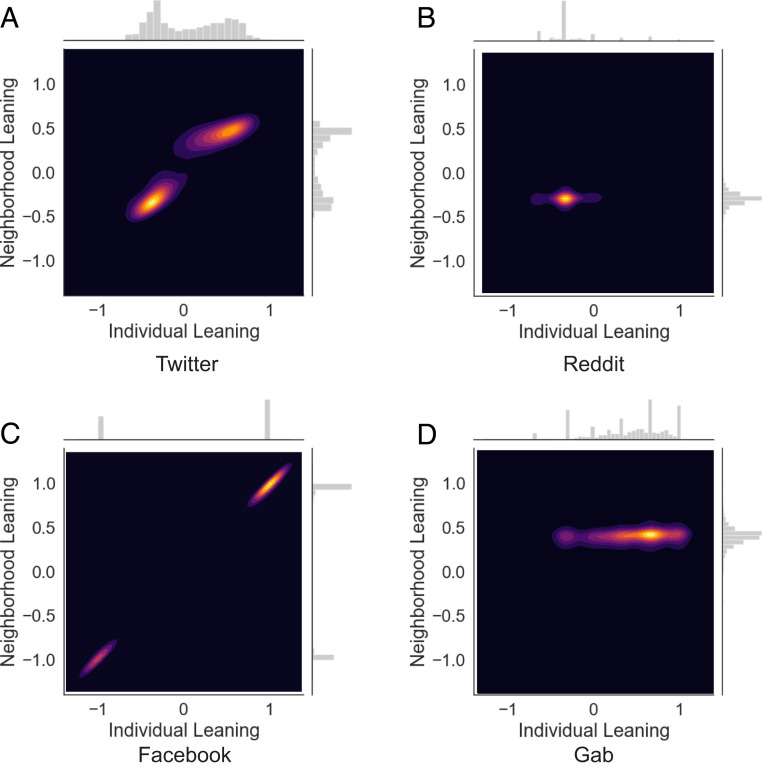
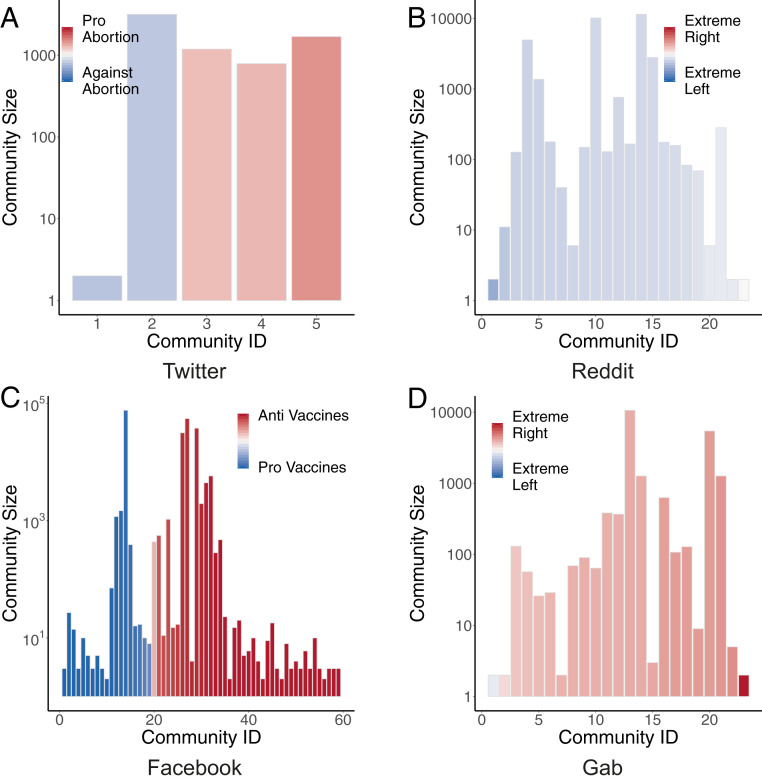
- Across the four platforms, “aggregation in homophilic clusters of users dominates online dynamics,” but platforms differ: Facebook and Twitter show homophilic clustering, while Reddit and Gab form a single community biased left or right rather than two opposing clusters.
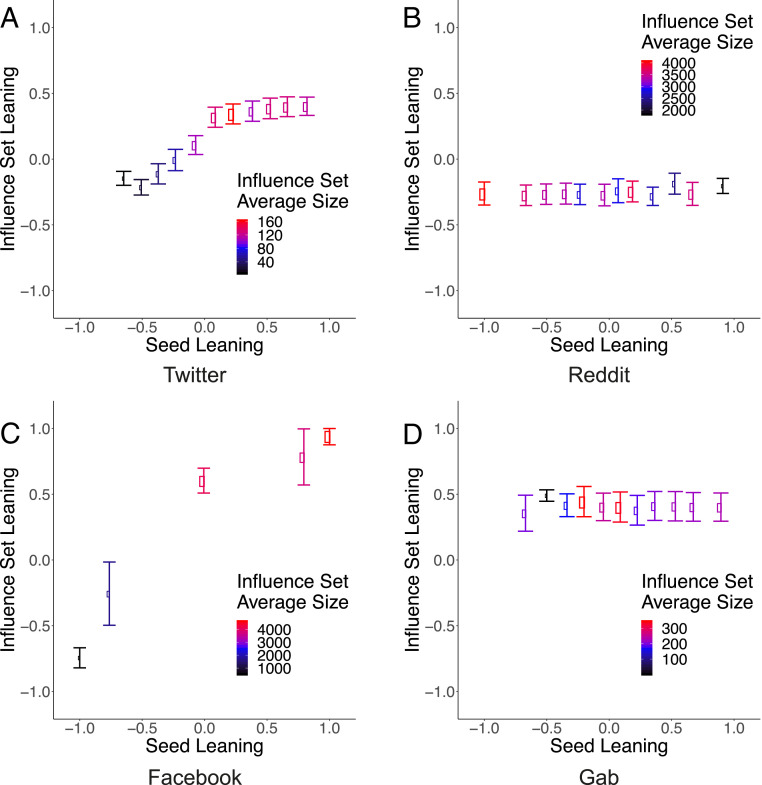
- Information diffusion is biased toward like-minded users on Facebook and Twitter, where the average leaning of a user’s influence set approximates the seed user’s leaning; on Reddit and Gab, the average leaning of the influence set does not depend on the seed user’s leaning.
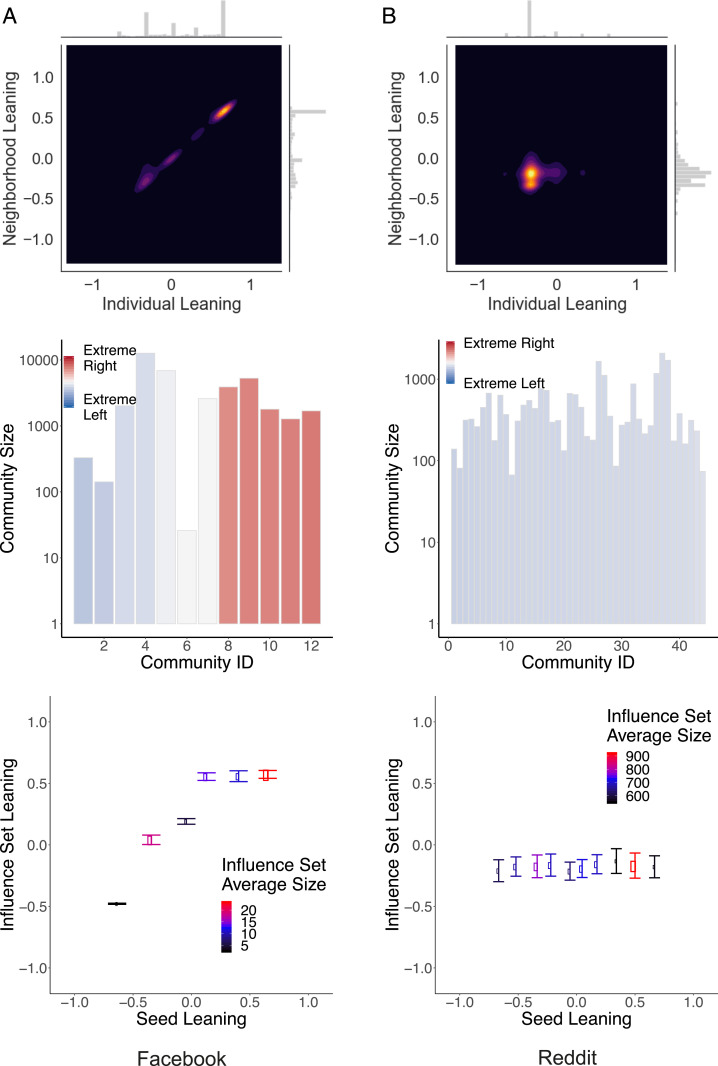
- In a direct comparison on news consumption, Facebook shows higher segregation than Reddit across all three measures: user-neighbor leaning correlation, community leaning, and SIR influence-set leaning.
- The study analyzes more than 100 million unique pieces of content and more than 1 million active users, with news outlets labeled using 2,190 media sources from Media Bias/Fact Check.
Methods
- Comparative analysis of Gab, Facebook, Reddit, and Twitter datasets on controversial topics including gun control, Obamacare, abortion, vaccines, science versus conspiracy, and news; main selected datasets were Abortion (Twitter), Vaccines (Facebook), Politics (Reddit), and Gab as a whole.
- Echo chambers were operationalized through two dimensions: homophily in interaction networks and bias in information diffusion toward like-minded peers. User leaning was inferred from linked news outlets, likes, or content, and interaction networks were built from follows, comments, cocomments, submissions, or replies depending on platform.
- Analyses included correlation between user leaning and average neighbor leaning, Louvain community detection, and SIR simulations to measure influence sets; SIR recovery rate was fixed at ν = 0.2, with dataset-specific infection ratios.
Limitations
- The paper states that the next envisioned step is to address the temporal dimension of echo chambers and how platform-specific social feedback mechanisms impact their formation.
- Evident from the text: leaning coverage varies strongly by platform, from 0.90–1.00 for Twitter/Facebook datasets to 0.15–0.20 for Reddit and 0.13 for Gab, so leaning-based conclusions for Reddit and Gab rest on a small classified fraction of users.
- Evident from the text: datasets differ by platform and topic, and the direct cross-platform comparison on a common topic is limited to news consumption on Facebook and Reddit; the authors also note that Reddit/Gab results could mean either no echo-chamber effect or observation inside a single echo chamber.
Model-written summary. Check it against the paper before relying on it.
Integrity signals
Registry
Cites
Statistics
Figures
Verification
Claims the paper makes
8 Valid · 1 Not valid · 7 Not checked · 38 Own results and interpretations
The cited sources support only part of this claim — read each source’s verdict below.
In the paper
“Selective exposure (19) and confirmation bias (20) (i.e., the tendency to seek information adhering to preexisting opinions) may explain the emergence of echo chambers on social media (1, 17, 21, 22).”
§ The echo chamber effect on social media > Abstract
What the sources say
- Supportedcites [1] M. Del Vicario, The spreading of misinformation online. Proc. Natl. Acad. Sci. U.S.A. 113, 554– 559 (2016). 26729863 PMC4725489 source
The Abstract says selective exposure generates homogeneous clusters, which it calls echo chambers. The Results and Discussion section says users select content matching a narrative and suggests confirmation bias determines echo-chamber formation. Page numbers are not provided in our copy. (LLM, conf=0.94)
- Partly supportedcites [17] K. Garimella, G. De Francisci Morales, A. Gionis, M. Mathioudakis, “ The effect of collective attention on controversial debates on social media” in WebSci ’17: 9th International ACM Web Science Conference (Association for Computing Machinery, New York, NY, 2017), pp. 43– 52. sourceExperimental — accuracy not yet measured
The Introduction reports that users mostly interact within their own side and endorse opinions from that side’s core. Related Work reports that users spread information faster when it agrees with their position. These passages are consistent with selective exposure, but the paper does not identify confirmation bias or establish that either tendency causes echo chambers to emerge. (LLM, conf=0.82)
- Supportedcites [21] M. Del Vicario, Echo chambers: Emotional contagion and group polarization on Facebook. Sci. Rep. 6, 37825 (2016). 27905402 PMC5131349 source
The Abstract says social-media disintermediation encourages users to select information that fits their beliefs (confirmation bias) and form like-minded groups (echo chambers). The Conclusions likewise describe Facebook as suited to the emergence of echo chambers. This supports the proposed explanation, without claiming it is the only cause. (LLM, conf=0.93)
- Supportedcites [22] A. Bessi, Science vs conspiracy: Collective narratives in the age of misinformation. PloS One 10, e0118093 (2015). 25706981 PMC4338055 source
The Introduction (page unavailable) says users consuming opposing information tend to form isolated clusters and describes polarized users whose likes are almost exclusively on one category of pages. The Conclusions (page unavailable) link information evaluation to existing beliefs. Together, these passages support the hedged explanation that selective exposure and confirmation bias may contribute to echo chambers. (LLM, conf=0.86)
hedgedstates a possible cause- Asserted: passes — The authors put it forward as true.
- Checkable: passes — It can be checked against evidence.
- Load-bearing: passes — The paper’s conclusions depend on it.
- Based: passes — The paper gives a reason why it holds.
- Supported
The cited sources support only part of this claim — read each source’s verdict below.
In the paper
“Our attention span remains limited (9, 10), and feed algorithms might limit our selection process by suggesting contents similar to the ones we are usually exposed to (11–13).”
§ The echo chamber effect on social media > Abstract
What the sources say
- Not checked — no full text of the sourcecites [11] A. L. Schmidt, Anatomy of news consumption on Facebook. Proc. Natl. Acad. Sci. U.S.A. 114, 3035– 3039 (2017). 28265082 PMC5373354 source
- Partly supportedcites [12] M. Cinelli, The COVID-19 social media infodemic. Sci. Rep. 10, 16598 (2020). 33024152 PMC7538912 sourceExperimental — accuracy not yet measured
The Introduction (page not provided) says algorithms take users’ preferences and attitudes into account when promoting content, and that users tend to seek information aligned with their worldviews. It does not say that feed algorithms suggest content similar to what users have previously seen or thereby limit their selection. (LLM, conf=0.82)
- Not checked — no full text of the sourcecites [13] E. Bakshy, S. Messing, L. A. Adamic, Exposure to ideologically diverse news and opinion on Facebook. Science 348, 1130– 1132 (2015). 25953820 source
hedgedstates a possible cause- Asserted: passes — The authors put it forward as true.
- Checkable: passes — It can be checked against evidence.
- Load-bearing: passes — The paper’s conclusions depend on it.
- Based: passes — The paper gives a reason why it holds.
Every source the paper cites for this claim was checked and supports it.
In the paper
“Online polarization, for instance, may foster misinformation spreading (1, 8).”
§ The echo chamber effect on social media > Abstract
What the sources say
- Supportedcites [1] M. Del Vicario, The spreading of misinformation online. Proc. Natl. Acad. Sci. U.S.A. 113, 554– 559 (2016). 26729863 PMC4725489 source
The Significance section says that homogeneity and polarization are main determinants of rumor-cascade size. The Conclusions also link polarized communities with the proliferation of narratives fueled by unsubstantiated rumors, supporting the hedged claim that online polarization may foster misinformation spreading. (LLM, conf=0.91)
- Supportedcites [8] M. D. Vicario, W. Quattrociocchi, A. Scala, F. Zollo, Polarization and fake news: Early warning of potential misinformation targets. ACM Trans. Web 13, 1– 22 (2019). source
The Introduction states that misinformation spreading on social media is directly related to increasing user polarization and segregation. This supports the citing sentence’s hedged claim that online polarization may foster misinformation spreading. (LLM, conf=0.94)
hedgedstates a possible cause- Asserted: passes — The authors put it forward as true.
- Checkable: passes — It can be checked against evidence.
- Load-bearing: unclear — It is unclear whether the paper’s conclusions depend on it.
- Based: passes — The paper gives a reason why it holds.
- Supported
Every source the paper cites for this claim was checked and supports it.
In the paper
“In network terms, this translates into a node i with a given leaning xi more likely to be connected with nodes with a leaning close to xi (18).”
§ The echo chamber effect on social media > Comparative Analysis > Polarization and Homophily in the Interaction Networks.
What the sources say
- Supportedcites [18] W. Cota, S. C. Ferreira, R. Pastor-Satorras, M. Starnini, Quantifying echo chamber effects in information spreading over political communication networks. EPJ Data Sci. 8, 35 (2019). source
The paper’s “Topological evidence of echo chambers” section says that a node with political position Pᵢ is connected with nodes whose positions are close to Pᵢ. It also reports a strong correlation between users’ positions and their neighbors’ average positions, supporting the citing sentence’s probabilistic paraphrase. (LLM, conf=0.94)
hedgedstates an association- Asserted: passes — The authors put it forward as true.
- Checkable: passes — It can be checked against evidence.
- Load-bearing: passes — The paper’s conclusions depend on it.
- Based: passes — The paper gives a reason why it holds.
- Supported
A result the paper reports from its own data — it cites no other source for it, so there is none to check. The quote shows it is in the paper.
In the paper
“Furthermore, the almost total absence of communities with leaning very close to 0 confirms the polarized state of the systems.”
§ The echo chamber effect on social media > Comparative Analysis > Polarization and Homophily in the Interaction Networks.
boostedstates a cause- Asserted: passes — The authors put it forward as true.
- Checkable: passes — It can be checked against evidence.
- Load-bearing: passes — The paper’s conclusions depend on it.
- Based: passes — The paper gives a reason why it holds.
- Rests on 4 assumptions not shown here.
32 more claims
Create a free account to see all 54 claims and to verify the 2 references still open.
- It may state two separate claims as one. 9
- Probably not a substantial claim. 9
Claims other papers make about this one
Each is checked against this paper’s own text: does it say what the citing paper says it does?
The source backs part of the claim, not all of it — or backs it for a different population, condition or comparison.
In the citing paper
“engagement with political content online is generally associated with high levels of ingroup bias; that is, it is far more likely to be shared within the political ingroup than in the outgroup (18, 19, 16).”
From Troll and divide: the language of online polarization (2022) · cites this paper as [16]
Experimental — accuracy not yet measuredThe source backs part of the claim, not all of it — or backs it for a different population, condition or comparison.
In the citing paper
“This challenge is reflected in research on”
From Machine culture (2023) · cites this paper as [142]
Experimental — accuracy not yet measuredThe source backs part of the claim, not all of it — or backs it for a different population, condition or comparison.
In the citing paper
“Thus, combating social media's echo chamber effect through an active exposure to diverse perspectives and networks also represents a viable individual-level strategy for addressing the deepfake problem (Cinelli et al., 2021; Gillani et al., 2018).”
From Deepfakes: Deceptions, mitigations, and opportunities (2023) · cites this paper as Cinelli et al., 2021
Experimental — accuracy not yet measuredThe source backs part of the claim, not all of it — or backs it for a different population, condition or comparison.
In the citing paper
“Even without being designed to shift opinions, it has been found that algorithms may contribute to political polarization by reinforcing divisive opinions [9, 24, 32].”
From Co-Writing with Opinionated Language Models Affects Users’ Views (2023) · cites this paper as [32]
Experimental — accuracy not yet measuredThe source backs part of the claim, not all of it — or backs it for a different population, condition or comparison.
In the citing paper
“On Reddit, studies find minimal evidence of echo chambers due to platform features encouraging cross-cutting exposure [17,61,63].”
From A systematic review of echo chamber research: comparative analysis of conceptualizations, operationalizations, and varying outcomes (2025) · cites this paper as [17]
Experimental — accuracy not yet measured
5 more claims about this paper
Create a free account to see every claim other papers make about this one.
Citations
Cites
Fast unfolding of communities in large networks
Blondel, V. D., Guillaume, J.-L., Lambiotte, R., & Lefebvre, E. (2008) · Journal of Statistical Mechanics: Theory and Experiment · doi:10.1088/1742-5468/2008/10/p10008 · Cited by 21,424 · cited 1×
“We detected communities by applying the Louvain algorithm (41), removing singleton communities with only one user.”
MethodThe spread of true and false news online
Vosoughi, S., Roy, D., & Aral, S. (2018) · Science · doi:10.1126/science.aap9559 · Cited by 8,847 · cited 1×
“A recent study (7) limited to Twitter claimed that fake news travels faster than real news.”
BackgroundConfirmation Bias: A Ubiquitous Phenomenon in Many Guises
Nickerson, R. S. (1998) · Review of General Psychology · doi:10.1037/1089-2680.2.2.175 · Cited by 7,267 · cited 1×
“Selective exposure (19) and confirmation bias (20) (i.e., the tendency to seek information adhering to preexisting opinions) may explain the emergence of echo chambers on social media (1, 17, 21, 22).”
BackgroundInfectious Diseases of Humans: Dynamics and Control
Anderson, R. M., & May, R. M. (1991) · doi:10.1093/oso/9780198545996.001.0001 · Cited by 6,179
Lazer, D. M. J., Baum, M. A., Benkler, Y., Berinsky, A. J., Greenhill, K. M., Menczer, F., Metzger, M. J., Nyhan, B., Pennycook, G., Rothschild, D., et al. (2018) · Science · doi:10.1126/science.aao2998 · Cited by 4,160
Degroot, M. H. (1974) · Journal of the American Statistical Association · doi:10.1080/01621459.1974.10480137 · Cited by 4,004 · cited 1×
“For instance, if opinions are assumed to be embedded in a onedimensional space (38), x ∈ [−1,+1] without loss of generality, as usual for controversial topics, then polarization is characterized by two well-separated peaks in P(x ), for positive and negative opinions.”
BackgroundExposure to ideologically diverse news and opinion on Facebook
Bakshy, E., Messing, S., & Adamic, L. A. (2015) · Science · doi:10.1126/science.aaa1160 · Cited by 3,245 · cited 2×
“Our attention span remains limited (9, 10), and feed algorithms might limit our selection process by suggesting contents similar to the ones we are usually exposed to (11–13).”
BackgroundThe spreading of misinformation online
Del Vicario, M., Bessi, A., Zollo, F., Petroni, F., Scala, A., Caldarelli, G., Stanley, H. E., & Quattrociocchi, W. (2016) · Proceedings of the National Academy of Sciences · doi:10.1073/pnas.1517441113 · Cited by 2,407 · cited 2×
“, the tendency to seek information adhering to preexisting opinions) may explain the emergence of echo chambers on social media (1, 17, 21, 22).”
BackgroundSelf-citationThe COVID-19 social media infodemic
Cinelli, M., Quattrociocchi, W., Galeazzi, A., Valensise, C. M., Brugnoli, E., Schmidt, A. L., Zola, P., Zollo, F., & Scala, A. (2020) · Scientific Reports · doi:10.1038/s41598-020-73510-5 · Cited by 2,313
Self-citationFilter Bubbles, Echo Chambers, and Online News Consumption
Flaxman, S., Goel, S., & Rao, J. M. (2016) · Public Opinion Quarterly · doi:10.1093/poq/nfw006 · Cited by 1,992
Research works printed but not linked: 2
- R. M. Anderson, R. M. May, Infectious Diseases in Humans (Oxford University Press, Oxford, United Kingdom, 1992).
- M. Cinelli, G. De Francisci Morales, A. Galeazzi, W. Quattrociocchi, M. Starnini, The echo chamber effect on social media. Open Science Framework. https://osf.io/x92br/?view_only=cdcc87d30e404e01b6ae316db15e3375. Deposited 22 January 2021. PMC7936330 33622786
Cited by
Items 1,901–2,000 of 2,063
Opinion Polarisation in Social Networks
Maksymov, I. S. (2026) · Springer eBooks · doi:10.1007/978-3-032-25965-3_2
Maksymov, I. S. (2026) · Springer eBooks · doi:10.1007/978-3-032-25965-3_1
Kiddle, R., Kroon, A. C., Welbers, K., & Trilling, D. (2026) · New Media & Society · doi:10.1177/14614448261445423 · Cited by 2
Anadolu Ajansı Örneğinde Finansal Okuryazarlığın Haberleştirilmesi
Maral, T. (2026) · Mersin Üniversitesi Sosyal Bilimler Enstitüsü Dergisi · doi:10.55044/meusbd.1936559
Yerlanov, M., & Rodríguez, N. (2026) · Nonlinear Analysis Real World Applications · doi:10.1016/j.nonrwa.2026.104698
Dijital Kamusal Alanda İsrail–Filistin Çatışmasının Ekşi Sözlük Üzerinden Söylemsel Analizi
Yurt, D. (2026) · Intermedia International e-journal · doi:10.56133/intermedia.1887043
The new search engine? Unpacking impulsive buying behavior in deal proneness Gen Z consumers
Yen, P. N. H., Kim, A. D., Truong, P. H., & Hoang, S. D. (2026) · Italian Journal of Marketing · doi:10.1007/s43039-026-00137-1 · Cited by 1
“Additionally, TikTok’s algorithm curates content based on user behavior, reinforcing selective exposure that may limit content diversity and foster echo chambers (Cinelli et al., 2021 ).”
Amplification Chambers and Belief Persistence in Commercial Health Communication
Elden, Å., Goth, U. S., & Ardigò, L. P. (2026) · Journal of Health Communication · doi:10.1080/10810730.2026.2693890
Chen, X., Lin, J., & Zhong, Z. (2026) · Online Social Networks and Media · doi:10.1016/j.osnem.2026.100351
Agbeve, A. S., Niyomugabo, C., Hakizimana, C., Fiaveh, D. Y., Ugboji, A. Y.-E., Pukall, C. F., & Anto‐Ocrah, M. (2026) · JMIR Infodemiology · doi:10.2196/91422 · Cited by 2
Wang, J., Liu, K., Guo, W., Jiang, Y., Guo, J., Liu, X., Lu, H., Zhang, W., & Lü, W. (2026) · International Conference on Computer Supported Cooperative Work in Design (CSCWD) · doi:10.1109/cscwd68734.2026.11582337
“…repetition of information often intensify health anxiety, leading people to become trapped in an ”information echo chamber,” where they repeatedly encounter evidence that supports their existing health concerns, thereby amplifying their subjective perception of the severity of certain diseases [4].”
Ciodaro, T., do Carmo, V., Ferreira, F., Lago, M., Salles, D., & Santini, R. M. (2026) · Applied Network Science · doi:10.1007/s41109-026-00810-6
“Characterizing these topological structures as regions of influence supported the analysis of internal network dynamics and highlighted patterns consistent with echo chambers, filter bubbles and retweet cascades (Cinelli et al. 2021; Rao et al. 2024).”
Sjöberg, M. (2026) · International Convention on Information and Communication Technology, Electronics and Microelectronics · doi:10.1109/mipro70003.2026.11591509
Social Media as a Tool for Integration Policies
Gozzo, S., & Fragapane, S. (2026) · IGI Global eBooks · doi:10.4018/979-8-2600-3048-6.ch007
Tao, S., Zhao, Y., & Hong, T. (2026) · Systems · doi:10.3390/systems14070817
Muslim, R. (2026) · International Journal of Modern Physics C · doi:10.1142/s0129183127501269 · Cited by 1
Pre-Dialogic Agonism: Adult Learning, Hegemony, and the Epistemic Crisis of Post-Truth
Borders, D. (2026) · Adult Education Quarterly · doi:10.1177/07417136261449815
Disinformation as a Tool of Hybrid Warfare: A Strategic Analysis of National Security in the Balkans
Hadzhipetrova-Lachova, M. (2026) · International conference KNOWLEDGE-BASED ORGANIZATION · doi:10.2478/kbo-2026-0021
“…national security, disinformation is defined as the intentional conduct of malicious actors that create deceptive narratives with specific geopolitical objectives even through social media [18], as using documentary formats or legitimate news to create strategic deception and undermine democracy.”
The role of critical thinking and media literacy in enhancing fake news detection among students
Nerantzaki, K., & Meladianos, P. (2026) · Media Practice and Education · doi:10.1080/25741136.2026.2699573
Qomaria, R. A., Nazirah, F., Ningtyas, L. N., Putri, N. S., & Surawan, S. (2026) · ANALITIKA · doi:10.31289/analitika.v18i1.17586
Κουτσουπιάς, Ν., & Nosios, M. (2026) · Peace Studies · doi:10.3390/peacestud1030008
KARANFİLOĞLU, M., & Kulaklıkaya, K. (2026) · Springer eBooks · doi:10.1007/978-981-95-8553-3_2
Yang, L. (2026) · SN Social Sciences · doi:10.1007/s43545-026-01581-8
“…on social media ecosystems shows that online publics can fragment into competing interpretive communities even in open media systems (Benkler et al. 2018; Cinelli et al. 2021; Guess et al. 2019; Marwick and Lewis 2017; Ogan et al. 2014; Sunstein 2018; Tucker et al. 2018; Vosoughi et al. 2018).”
Prachumrasee, K., & Setthasuravich, P. (2026) · Journal of Asian Public Policy · doi:10.1080/17516234.2026.2704016
The Habeas Mentem Principle. Reframing Neurorights in the Digital Age
Giacomini, G. (2026) · Neuroethics · doi:10.1007/s12152-026-09661-5 · Cited by 1
“Within this context, phenomena commonly described as echo chambers emerge: informational environments in which users predominantly encounter content consistent with their prior preferences [98].”
Misuraca, M., D’Aniello, L., & Spano, M. (2026) · Sustainability · doi:10.3390/su18147295
ThemeScope: A quantitative thematic analysis for depicting social representations in digital arenas
Misuraca, M., Spano, M., & D’Aniello, L. (2026) · Journal of Information Science · doi:10.1177/01655515261454276 · Cited by 2
Ansah, R. K., Boadi, R. K., Tawiah, K., & Addo, D. (2026) · Journal of Statistical Mechanics Theory and Experiment · doi:10.1088/1742-5468/ae8436
Johnston, E., & Liu, X. (2026) · Computers in Human Behavior Reports · doi:10.1016/j.chbr.2026.101214
YSocial: An artificial intelligence powered social media virtual twin
Rossetti, G., Stella, M., Cazabet, R., Abramski, K., Citraro, S., Cau, E., Failla, A., Morini, V., & Pansanella, V. (2026) · Big Data & Society · doi:10.1177/20539517261431576 · Cited by 4
Canthiya, L., Wang, M., Bouriayee, A., Qamar, R., Acai, A., & Preti, B. T. B. (2026) · The Clinical Teacher · doi:10.1111/tct.70478
“While these spaces may foster support and community, they may also amplify unverified advice through ‘echo chamber’ effects [17].”
Wei, Q., Li, J., Xiao, L., Rao, N., Wu, Y., & Zhang, Y. (2026) · Communications in computer and information science · doi:10.1007/978-981-92-3734-0_12
Sahlan, M. (2026) · International Journal of Research and Review · doi:10.52403/ijrr.20260720
Noufal, Z. M., Ali, E. A. M., Alazmi, M. Q., Al-Taii, A., & Ashour, K. (2026) · Frontiers in Sociology · doi:10.3389/fsoc.2026.1877494
“False or manipulative content may be amplified through selective exposure, peer sharing, and algorithmically reinforced attention patterns, thereby shaping how users interpret public issues and evaluate social risk (Cinelli et al., 2021; Guess et al., 2019; Wardle and Derakhshan, 2017).”
Moral, P., & Torres-Soriano, M. R. (2026) · Journal of Information Technology & Politics · doi:10.1080/19331681.2026.2706787
The quasi-gods of algorithmic providence: recommender systems and religious frameworks
Bojić, L., Coeckelbergh, M., Ženko, E., Stevanović, P., & Guzek, D. (2026) · AI & Society · doi:10.1007/s00146-026-03103-9
“Research on echo chamber formation indicates that two conditions enable their creation: the expression of opinions by online entities, which are then shared by communities and amplified by recommender systems (Cinelli et al. 2021).”
Oh, J., & Baek, K. (2026) · Asian Journal of Communication · doi:10.1080/01292986.2026.2707528
Cerro, C. C. D. (2026) · Information Communication & Society · doi:10.1080/1369118x.2026.2695177
Dragić, L., & Chan, M. (2026) · The International Journal of Press/Politics · doi:10.1177/19401612261468858
From Zoon Politikon to Digi Zoon: A Pedagogy of Disquiet for Critical Digital Citizenship
Novoa, A. G., Luis, M. L. C. G., Méndez, P. P., & Hurtado, M. D. M. (2026) · Springer eBooks · doi:10.1007/60490_2026_31
A Comparative Study of LDA and BERT-Based Topic Modeling on Indonesian YouTube Protest Discourse
Lianardi, C., Gunawan, A. A. S., Tedjasulaksana, J. J., et al. (2026) · IEEE International Conference on Industry 4.0, Artificial Intelligence, and Communications Technology (IAICT) · doi:10.1109/iaict71158.2026.11620901
“Quantitative measures will use Topic Coherence score (C_v) to evaluate the semantic consistency of topic terms[1].”
YAŞA, A. G. (2026) · İstanbul Üniversitesi Sosyoloji Dergisi / İstanbul University Journal of Sociology · doi:10.26650/sj.2025.46.1.1106
Learning About Polarization from Simulation: A Comparative Analysis of Four Models
Baillie, E., Smith, W., & Geard, N. L. (2026) · Springer proceedings in complexity · doi:10.1007/978-3-032-31712-4_1
Greipl, S., Schmid, U. K., & Rieger, D. (2026) · Frontiers in Psychology · doi:10.3389/fpsyg.2026.1843078 · Cited by 1
Exploring Young People's Social Media Engagement and Digital Resilience
Turhan, Z., & Arslan, S. (2026) · Toplum ve sosyal hizmet(Online)/Toplum ve sosyal hizmet · doi:10.33417/tsh.1817205
Echoes across the divide: incivility and the fragmentation of issue publics in immigration discourse
Li, Y., & Yang, A. (2026) · Information Communication & Society · doi:10.1080/1369118x.2026.2716778
Contreras, S., Dönges, P., Müller, L., Mallick, P., Paltra, S., Hvid, U., Kettlitz, R., Reitenbach, A., Lind, R. A., Aguiar, M., et al. (2026) · EClinicalMedicine · doi:10.1016/j.eclinm.2026.104101 · Cited by 1
“For example, online studies reported increased network segmentation and hardened echo chambers, 68–70 with severe consequences for real-world contact networks - but the evidence is still emerging.”
Análisis del populismo en líderes latinoamericanos en un corpus de X
Duhalde, N., Santamaría, A. M. G., Roca, M. A., Biglieri, J. A., & Jaume, L. C. (2026) · Global Media Journal México · doi:10.29105/gmjmx23.45-567
Rana, A., Ahuja, G., Nainwal, S., Shishodia, S., Gupta, P. K., & Gupta, S. (2026) · Lecture notes in networks and systems · doi:10.1007/978-3-032-25631-7_10
Aissani, R. A., Shabaneh, H. M., Kanaan, H., & Elshenawy, I. I. (2026) · Journalism and Media · doi:10.3390/journalmedia7030162 · Cited by 2
“Algorithmic systems may generate “information bubbles,” which constrain content diversity and shape audience perceptions of information, with potential adverse effects on trust in the absence of deliberate governance of this interactive environment (Cinelli et al., 2021).”
Toward a nuanced understanding of internet use and trust in local government in the Chinese context
Liu, C., & Liu, H. (2026) · Telecommunications Policy · doi:10.1016/j.telpol.2026.103297
Yan, Z., Du, R., Fan, W., Zhou, X., & Wang, H. (2026) · Electronic Markets · doi:10.1007/s12525-026-00924-w
“Social media further amplify the speed and reach of misinformation diffusion, magnifying its societal consequences (Cinelli et al., 2021; Gordon et al., 2020).”
Yamamoto, H., Suzuki, T., Ogawa, Y., & Umetani, R. (2026) · Scientific Reports · doi:10.1038/s41598-026-57049-5
Aligning social media design with adolescent brain development: rationale and recommendations
Garg, Y., Siriudomsait, J., & Chidiac, B. (2026) · Frontiers in Digital Health · doi:10.3389/fdgth.2026.1880395
Choudhury, S. N., Kolya, A. K., Verma, A. K., Kar, S., & Ekbal, A. (2026) · Journal of Engineering Research · doi:10.1016/j.jer.2026.07.012
Musoke, P. K., Frohwirth, L. F., Baquero, M., & Gould, L. H. (2026) · International Journal of Qualitative Methods · doi:10.1177/16094069261464498
Khrennikov, A. Y., Aspalter, C., & Zhan, L. (2026) · Frontiers in Human Neuroscience · doi:10.3389/fnhum.2026.1882642
Upon the moral pedestal: How self-image and self-beliefs fuel social action
Webb, C., Kelley, N. J., Juhl, J., & Sedikides, C. (2026) · Self and Identity · doi:10.1080/15298868.2026.2710919
Quality assessment of ADHD-related short videos on Chinese social media: A cross-sectional study
Zou, P., Chen, S., Xiang, J., Zhou, W., & 杨晓蓉 (2026) · Medicine · doi:10.1097/md.0000000000050044
“[13,39] It is worth noting that the Bilibili platform showed significantly better video quality in this evaluation.”
Yang, J., Chen, L., & Song, L. (2026) · Sustainability · doi:10.3390/su18168062
Gao, H., Zheng, Y., & Yang, Z. (2026) · Public Understanding of Science · doi:10.1177/09636625261469059
Fake news detection via wisdom of synthetic and representative crowds
t'Serstevens, F., Cerina, R., & Piccillo, G. (2026) · Journal of the Royal Statistical Society Series A (Statistics in Society) · doi:10.1093/jrsssa/qnag095 · Cited by 3
Vergara, J. S. (2026) · Roczniki Nauk Społecznych · doi:10.18290/rns2026.0030
Gao, J., & Windett, J. H. (2026) · Frontiers in Digital Health · doi:10.3389/fdgth.2026.1883403
“This interpretation is consistent with research showing that social media can facilitate content sharing, selective exposure, ideologically aligned interaction, and reciprocal information flows among citizens, political actors, and news organizations (41, 42, 48, 49).”
Crowdsourcing, Community Notes, and Participatory Verification: Distributed Epistemics
Shin, D. (2026) · Oxford University Press eBooks · doi:10.1093/9780197849644.003.0010
Disciplining the digital public: Platform mechanisms and the dynamics of emotional polarization
Lu, C., Qin, D., Huang, J., & Pang, B. (2026) · PLoS ONE · doi:10.1371/journal.pone.0342143 · Cited by 1
“Work on affective contagion and affective publics demonstrates how emotionally charged content diffuses through networks and binds communities together [10,28,37].”
InfluentialBest Practices and Ethical Challenges in AI-Augmented Social Media Marketing
Tyagi, M., Srivastava, P., & Tyagi, S. (2026) · Advances in computational intelligence and robotics book series · doi:10.4018/979-8-3373-8084-1.ch013
Bestärkung und Verstärkung von Meinungen und Verhalten
Knobloch‐Westerwick, S., & Westerwick, A. (2026) · Springer eBooks · doi:10.1007/978-3-658-46851-4_10-1
The Echo-Chamber Trap: Symbolic Self-Completion and the Stagnation of Digital Activism
Sciara, S., Contu, F., & Gollwitzer, P. M. (2026) · Social Sciences · doi:10.3390/socsci15080553
“Slacktivism is a form of virtue signaling aimed at demonstrating good character and morality, usually to homogeneous, agreeing audiences, within a non-dissenting closed community (e.g., friends, followers; Cinelli et al. 2021).”
Nguyen, Q., & Truong, N. B. (2026) · Frontiers in Physics · doi:10.3389/fphy.2026.1896122
Paid attention: Mapping political and news advertising strategies on social media across Europe
Zollo, S., Marco, N. D., Cerqueti, R., Quattrociocchi, W., & Cinelli, M. (2026) · Information Processing & Management · doi:10.1016/j.ipm.2026.105090
Self-citationLidskog, R., & Sundqvist, G. (2026) · Springer eBooks · doi:10.1007/978-3-032-27059-7_10
Multi-meme spreading dynamics based on users’ memory-based interest preferences
Wu, Q., Liu, Y., Liu, Z., & Tang, M. (2026) · International Journal of Modern Physics C · doi:10.1142/s0129183127501415
Kula, S., Güler, A., & Boke, K. (2026) · Behavioral Sciences of Terrorism and Political Aggression · doi:10.1080/19434472.2026.2718152 · Cited by 1
Lu, Y., & Zhou, Y. (2026) · SHS Web of Conferences · doi:10.1051/shsconf/202623603007
“These divisions [1, 10] are then magnified by algorithms.”
InfluentialDo Cultural Exports Shape Country Image? Evidence From Chinese Film Releases and Global Media Data
Liu, F., Zheng, M., Wu, X., et al. (2026) · World Economy · doi:10.1111/twec.70141
Zhang, X., Li, X., & Liu, Q. (2026) · Systems Research and Behavioral Science · doi:10.1002/sres.70140
Wang, J., Feng, Y.-F., & Zhang, Z.-B. (2026) · Frontiers in Public Health · doi:10.3389/fpubh.2026.1829734
“…Likert scale); primary platform (Douyin, Kuaishou, Bilibili, WeChat Channels, or other); self-reported source type (professional organization, verified health professional, patient or peer, or uncertain); and whether family members or primary caregivers were exposed to similar content (21).”
InfluentialKawahata, Y., & Hatadani, S. (2026) · Games · doi:10.3390/g17050045 · Cited by 1
“Cinelli et al. (2021) cross-analyzed multiple platforms with different algorithms and identified that interactions based on user homophily strongly drive echo chambers as a universal mechanism regardless of environmental differences.”
Fernández‐Pérez, D. (2026) · Crime Media Culture An International Journal · doi:10.1177/17416590261480060
Optimal Influence in Markovian Opinion NetworksPreprint
Pasiphol, S., Li, R., & Rujeerapaiboon, N. (2026) · SSRN Electronic Journal · doi:10.2139/ssrn.7352339
Redes sociais e radicalização do discurso político
Brito, E. B. (2026) · IVY ENBER SCIENTIFIC JOURNAL · doi:10.57108/iesj.2026.6-2.12
Disruptive Horizons: Emerging AI Technologies Poised to Reshape the Global Media Industry
Vukanović, Z. (2026) · Springer eBooks · doi:10.1007/978-3-032-28082-4_29
Pradila, D. A., Lubis, A. M., & Ikhsan, R. (2026) · Indonesian Journal of Innovation Multidisipliner Research · doi:10.69693/ijim.v4i3.2230
“Penelitian (Cinelli et al., 2021) mengenai echo chamber dan Bail et al. (2018) mengenai polarisasi informasi digital menegaskan bahwa paparan opini yang homogen di media sosial dapat memperkuat bias konfirmasi pengguna jika tidak disertai kemampuan evaluasi kritis yang kuat.”
Dong, W., Wang, W., Zhong, W., Tong, Y., Wang, W., & Gan, C. (2026) · Information & Management · doi:10.1016/j.im.2026.104430 · Cited by 1
Han, L., & Zhang, X. (2026) · International Journal of Ethics and Systems · doi:10.1108/ijoes-04-2026-0314
News is Becoming Similar? A Diachronic Text Mining Exploration of News Convergence in Chinese Media
Qian, J., & Zhong, Z.-J. (2026) · Journalism Studies · doi:10.1080/1461670x.2026.2719575
Levin, S. H., Wang, R., Seo, J. M., Leong, Y. Y., Bennett, E., Yang, D., Yang, Z., Chen, M., Zhang, Y., & Suk, J. (2026) · Political Communication · doi:10.1080/10584609.2026.2717428
Anti-Vaccinationism: Parental Viewpoint
Wilson-Mifsud, B., & Johnson, A. M. (2026) · Springer eBooks · doi:10.1007/978-1-0716-5464-4_6
From Participation to Agonism: Rethinking European Citizenship Education for the Digital Era
Schön‐Quinlivan, E. (2026) · Social Sciences · doi:10.3390/socsci15090592
“The digital public sphere rewards agreement and penalises dissent, producing echo chambers and platform-amplified polarisation in which opponents are cast as enemies rather than adversaries (Cinelli et al. 2021; Van Bavel et al. 2021).”
InfluentialDigital Media Bias in a Polarized US Society: The First 100 Days of Trump’s Second Presidency
Strelets, I. E., & Panesh, A. A. (2026) · Comparative Politics Russia · doi:10.46272/2221-3279-2025-4-16-3
Toward an integrated and globally equitable understanding of political polarization
Falkenberg, M., Cinelli, M., Galeazzi, A., Bail, C. A., Benito, R. M., Bruns, A., Gruzd, A. A., Lazer, D., Lee, J. K., McCoy, J., et al. (2026) · Nature Communications · doi:10.1038/s41467-026-76110-5 · Cited by 16
“These patterns are considered to be indicative of an epistemic bubble, or echo chamber 123,133,134 , driving greater ideological isolation, limiting out-group exposure, and thereby generating greater out-group affect 135 .”
Self-citationDong, B., Zhang, Q., & Liang, Z. (2026) · Chaos An Interdisciplinary Journal of Nonlinear Science · doi:10.1063/5.0337453
Martín, K. G. (2026) · Street Art & Urban Creativity · doi:10.62161/sauc.v12.6398
Internet use and welfare attitudes in East Asia: how Confucian culture matters?
Liu, H., Liu, C., & Kang, J. (2026) · Journal of Asian Public Policy · doi:10.1080/17516234.2026.2727639
Misuraca, M., Spano, M., & D’Aniello, L. (2026) · Energy Research & Social Science · doi:10.1016/j.erss.2026.104945 · Cited by 1
Iwanowska, M., Stan, R., & Zawadzka, A. M. (2026) · Cyberpsychology Journal of Psychosocial Research on Cyberspace · doi:10.5817/cp2026-4-15
Metadata
- Authors
- Cinelli, M., De Francisci Morales, G., Galeazzi, A., Quattrociocchi, W., & Starnini, M.
- Affiliations
- Ca' Foscari University of Venice (IT)
- Institute for Scientific Interchange (ISI) Foundation, 10126 Torino, Italy;
- University of Brescia (IT)
- University of Oslo (NO)
- Institute for Scientific Interchange (IT)
- Corresponding author
- Quattrociocchi, Walter
- ORCID
- Venue
- Proceedings of the National Academy of Sciences
- Publisher
- National Academy of Sciences
- Published
- 2021-02-23
- Volume
- 118
- Issue
- 9
- ISSN
- 0027-8424 (ISSN-L)
- 1091-6490
- PMC
- PMC7936330
- OpenAlex
- W3133423348
- Cited by
- 2,092
- References
- 62
- Citations by year
- 2026: 488 · 2025: 516 · 2024: 387 · 2023: 351 · 2022: 256 · 2021: 90
- FWCI
- 375.62
- Type
- journal article
- Language
- en
- Open access
- hybrid
- doi.org
- Licence
- Locations
- Proceedings of the National Academy of Sciences (publishedVersion, cc-by)
- PubMed Central (publishedVersion, cc-by)
- PubMed (publishedVersion)
- UPCommons institutional repository (Universitat Politècnica de Catalunya) (submittedVersion, cc-by)
- IRIS Research product catalog (Sapienza University of Rome) (submittedVersion)
- Padua Research Archive (University of Padova) (submittedVersion, cc-by)
- Topics
- Social Sciences › Sociology and Political Science › Misinformation and Its Impacts
- Social Sciences › Communication › Social Media and Politics
- Physical Sciences › Physics and Astronomy › Statistical and Nonlinear Physics › Complex Network Analysis Techniques
- Keywords
- echo chambers, social media, homophily, information dissemination, algorithmic curation, controversial issues, Facebook, Twitter, Reddit, Gab, news consumption
- MeSH terms
- Abortion, Legal, Gun Violence, Communication, Humans, Politics, Social Change, Vaccination, Bias, Information Dissemination, Narration, Patient Protection and Affordable Care Act, Social Networking, Social Media
About these checks
Registry, retraction, Cites and statistics results are computed, not judged, with one exception: a printed reference that no index lists is read once by a model before it counts as a citation error. Claims are extracted by a model and kept only when their quote appears verbatim in the text; each cited source is then checked, with a model’s help, for whether it says what the claim relies on. Those verdicts can be wrong — read the claim’s quote and the cited source before relying on one.
The claim verdicts this report counts are experimental: their accuracy is not yet measured.
A language model drew the claims from the paper on 2026-10-10, under version 3 of the claim definition (model deepseek-v4.1-flash, prompt extract-v3).
A second model labelled each claim on 2026-10-10 (model jev-1.13-20260917, definition revision gold-guideline-v0.2).
Cited sources are checked with a language model’s help (gpt-6-sol).
Statistics and arithmetic are recomputed, not judged.
Confidence bands are shown only for fields calibrated on our annotated test set. None is calibrated yet, so no band is shown.
What counts as a claim ›How we measure confidence ›How we check this ›
Are you an author, or do you see a problem with this page? Request a review
Data sources
Bibliographic data: Semantic Scholar, OpenAlex, Crossref.
Contains information from the Semantic Scholar Academic Graph Datasets, made available under the ODC Attribution License (ODC-BY 1.0).
Semantic Scholar’s data is described in: Kinney, R., et al. (2023). The Semantic Scholar Open Data Platform. arXiv:2301.10140.
