

The echo chamber effect on social media
Open accessThe DOI matches its Crossref record; 68 of the 69 references it cites were found in a registry or an index; 16 of the 38 sources its claims cite were checked for support.
Abstract
Significance: We explore the key differences between the main social media platforms and how they are likely to influence information spreading and the formation of echo chambers. To assess the different dynamics, we perform a comparative analysis on more than 100 million pieces of content concerning controversial topics (e.g., gun control, vaccination, abortion) from Gab, Facebook, Reddit, and Twitter. The analysis focuses on two main dimensions: 1) homophily in the interaction networks and 2) bias in the information diffusion toward like-minded peers. Our results show that the aggregation in homophilic clusters of users dominates online dynamics. However, a direct comparison of news consumption on Facebook and Reddit shows higher segregation on Facebook.
Overview
CoChat Summary
TL;DR
This paper compares echo-chamber dynamics across Gab, Facebook, Reddit, and Twitter using more than 100 million pieces of content and more than 1 million active users. It finds homophilic clustering dominates online dynamics, with Facebook and Twitter showing stronger segregation and like-minded information diffusion than Reddit and Gab, and Facebook showing higher news-consumption segregation than Reddit.
Key findings
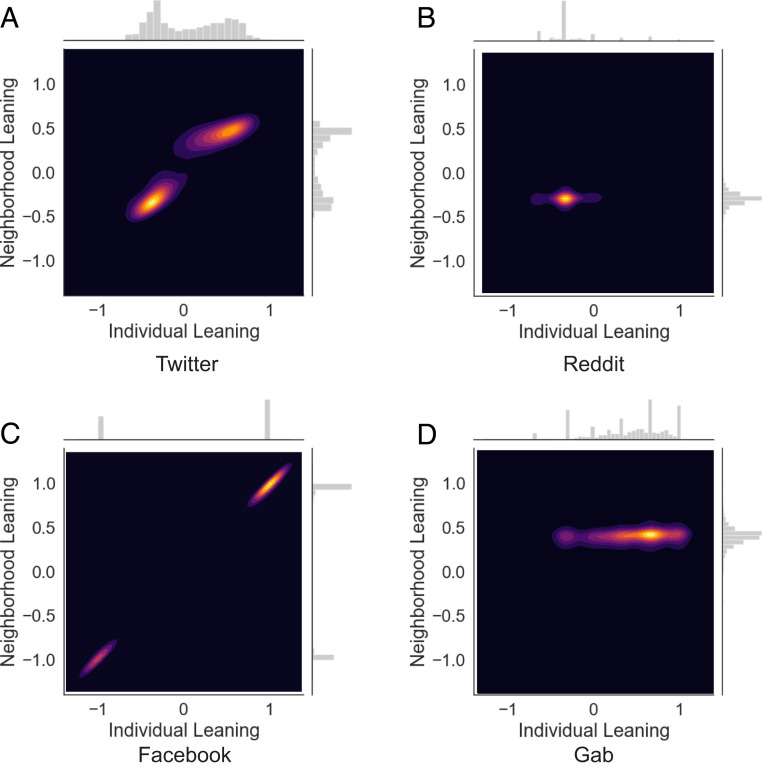
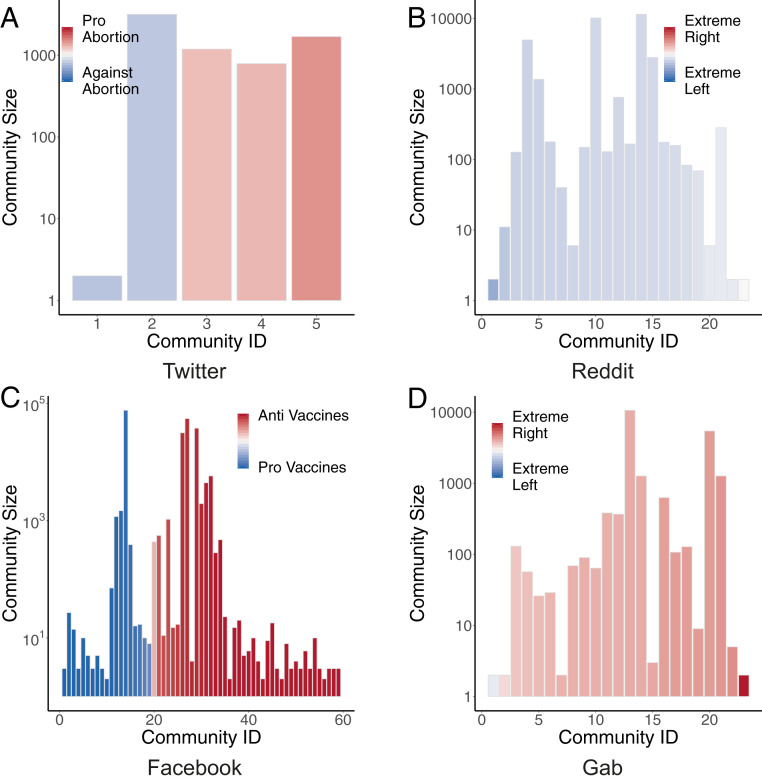
- Across the four platforms, “aggregation in homophilic clusters of users dominates online dynamics,” but platforms differ: Facebook and Twitter show homophilic clustering, while Reddit and Gab form a single community biased left or right rather than two opposing clusters.
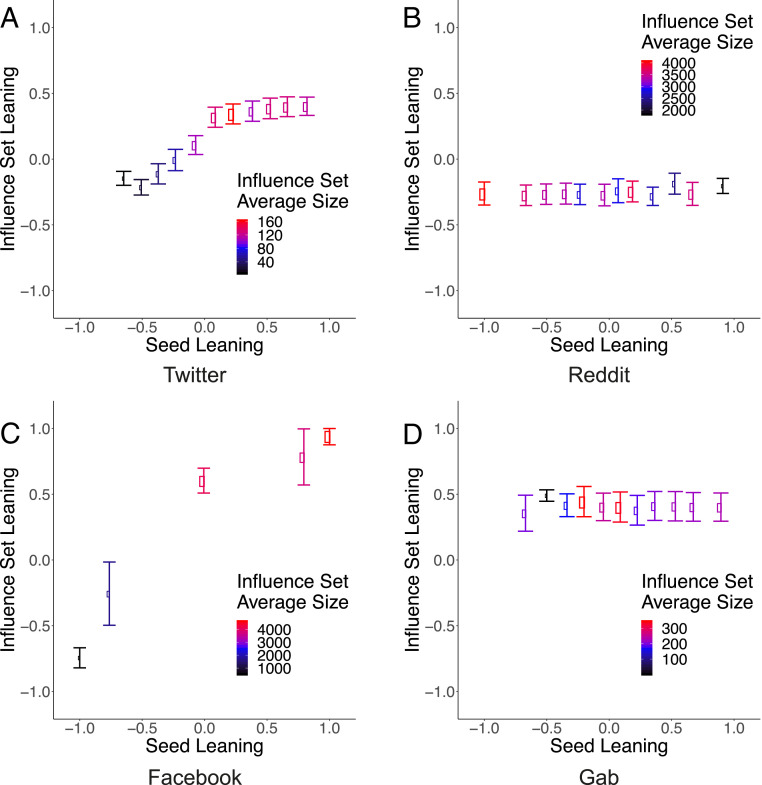
- Information diffusion is biased toward like-minded users on Facebook and Twitter, where the average leaning of a user’s influence set approximates the seed user’s leaning; on Reddit and Gab, the average leaning of the influence set does not depend on the seed user’s leaning.
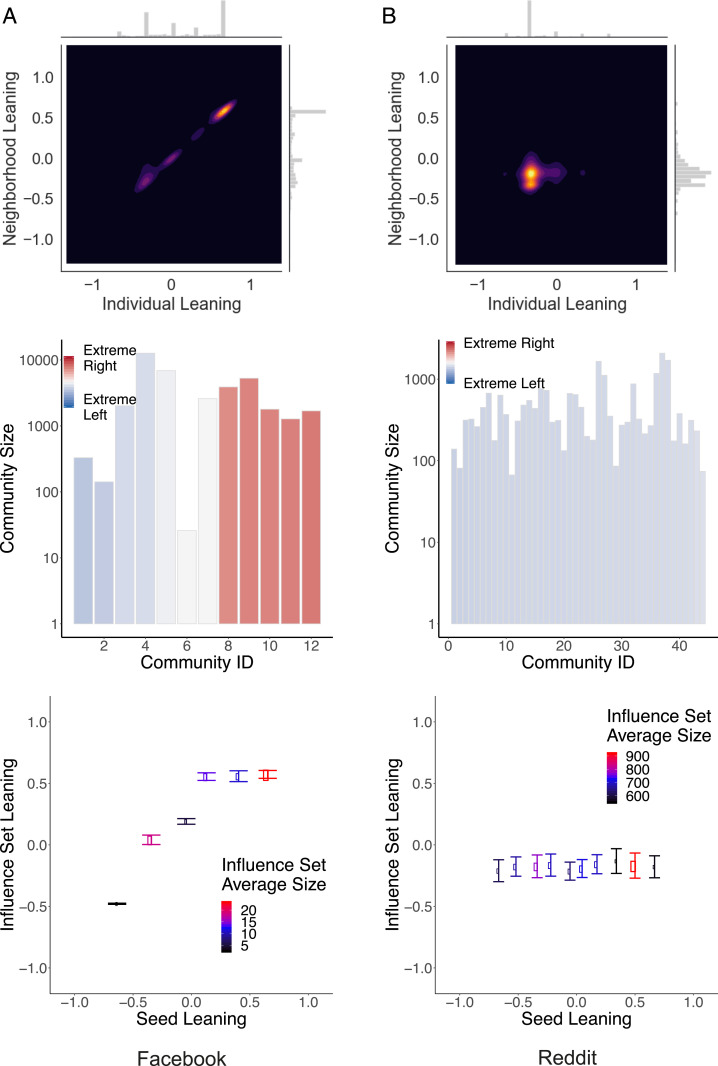
- In a direct comparison on news consumption, Facebook shows higher segregation than Reddit across all three measures: user-neighbor leaning correlation, community leaning, and SIR influence-set leaning.
- The study analyzes more than 100 million unique pieces of content and more than 1 million active users, with news outlets labeled using 2,190 media sources from Media Bias/Fact Check.
Methods
- Comparative analysis of Gab, Facebook, Reddit, and Twitter datasets on controversial topics including gun control, Obamacare, abortion, vaccines, science versus conspiracy, and news; main selected datasets were Abortion (Twitter), Vaccines (Facebook), Politics (Reddit), and Gab as a whole.
- Echo chambers were operationalized through two dimensions: homophily in interaction networks and bias in information diffusion toward like-minded peers. User leaning was inferred from linked news outlets, likes, or content, and interaction networks were built from follows, comments, cocomments, submissions, or replies depending on platform.
- Analyses included correlation between user leaning and average neighbor leaning, Louvain community detection, and SIR simulations to measure influence sets; SIR recovery rate was fixed at ν = 0.2, with dataset-specific infection ratios.
Limitations
- The paper states that the next envisioned step is to address the temporal dimension of echo chambers and how platform-specific social feedback mechanisms impact their formation.
- Evident from the text: leaning coverage varies strongly by platform, from 0.90–1.00 for Twitter/Facebook datasets to 0.15–0.20 for Reddit and 0.13 for Gab, so leaning-based conclusions for Reddit and Gab rest on a small classified fraction of users.
- Evident from the text: datasets differ by platform and topic, and the direct cross-platform comparison on a common topic is limited to news consumption on Facebook and Reddit; the authors also note that Reddit/Gab results could mean either no echo-chamber effect or observation inside a single echo chamber.
Model-written summary. Check it against the paper before relying on it.
Integrity signals
Registry
Cites
Statistics
Figures
Verification
Claims the paper makes
8 Valid · 1 Not valid · 7 Not checked · 38 Own results and interpretations
The cited sources support only part of this claim — read each source’s verdict below.
In the paper
“Selective exposure (19) and confirmation bias (20) (i.e., the tendency to seek information adhering to preexisting opinions) may explain the emergence of echo chambers on social media (1, 17, 21, 22).”
§ The echo chamber effect on social media > Abstract
What the sources say
- Supportedcites [1] M. Del Vicario, The spreading of misinformation online. Proc. Natl. Acad. Sci. U.S.A. 113, 554– 559 (2016). 26729863 PMC4725489 source
The Abstract says selective exposure generates homogeneous clusters, which it calls echo chambers. The Results and Discussion section says users select content matching a narrative and suggests confirmation bias determines echo-chamber formation. Page numbers are not provided in our copy. (LLM, conf=0.94)
- Partly supportedcites [17] K. Garimella, G. De Francisci Morales, A. Gionis, M. Mathioudakis, “ The effect of collective attention on controversial debates on social media” in WebSci ’17: 9th International ACM Web Science Conference (Association for Computing Machinery, New York, NY, 2017), pp. 43– 52. sourceExperimental — accuracy not yet measured
The Introduction reports that users mostly interact within their own side and endorse opinions from that side’s core. Related Work reports that users spread information faster when it agrees with their position. These passages are consistent with selective exposure, but the paper does not identify confirmation bias or establish that either tendency causes echo chambers to emerge. (LLM, conf=0.82)
- Supportedcites [21] M. Del Vicario, Echo chambers: Emotional contagion and group polarization on Facebook. Sci. Rep. 6, 37825 (2016). 27905402 PMC5131349 source
The Abstract says social-media disintermediation encourages users to select information that fits their beliefs (confirmation bias) and form like-minded groups (echo chambers). The Conclusions likewise describe Facebook as suited to the emergence of echo chambers. This supports the proposed explanation, without claiming it is the only cause. (LLM, conf=0.93)
- Supportedcites [22] A. Bessi, Science vs conspiracy: Collective narratives in the age of misinformation. PloS One 10, e0118093 (2015). 25706981 PMC4338055 source
The Introduction (page unavailable) says users consuming opposing information tend to form isolated clusters and describes polarized users whose likes are almost exclusively on one category of pages. The Conclusions (page unavailable) link information evaluation to existing beliefs. Together, these passages support the hedged explanation that selective exposure and confirmation bias may contribute to echo chambers. (LLM, conf=0.86)
hedgedstates a possible cause- Asserted: passes — The authors put it forward as true.
- Checkable: passes — It can be checked against evidence.
- Load-bearing: passes — The paper’s conclusions depend on it.
- Based: passes — The paper gives a reason why it holds.
- Supported
The cited sources support only part of this claim — read each source’s verdict below.
In the paper
“Our attention span remains limited (9, 10), and feed algorithms might limit our selection process by suggesting contents similar to the ones we are usually exposed to (11–13).”
§ The echo chamber effect on social media > Abstract
What the sources say
- Not checked — no full text of the sourcecites [11] A. L. Schmidt, Anatomy of news consumption on Facebook. Proc. Natl. Acad. Sci. U.S.A. 114, 3035– 3039 (2017). 28265082 PMC5373354 source
- Partly supportedcites [12] M. Cinelli, The COVID-19 social media infodemic. Sci. Rep. 10, 16598 (2020). 33024152 PMC7538912 sourceExperimental — accuracy not yet measured
The Introduction (page not provided) says algorithms take users’ preferences and attitudes into account when promoting content, and that users tend to seek information aligned with their worldviews. It does not say that feed algorithms suggest content similar to what users have previously seen or thereby limit their selection. (LLM, conf=0.82)
- Not checked — no full text of the sourcecites [13] E. Bakshy, S. Messing, L. A. Adamic, Exposure to ideologically diverse news and opinion on Facebook. Science 348, 1130– 1132 (2015). 25953820 source
hedgedstates a possible cause- Asserted: passes — The authors put it forward as true.
- Checkable: passes — It can be checked against evidence.
- Load-bearing: passes — The paper’s conclusions depend on it.
- Based: passes — The paper gives a reason why it holds.
Every source the paper cites for this claim was checked and supports it.
In the paper
“Online polarization, for instance, may foster misinformation spreading (1, 8).”
§ The echo chamber effect on social media > Abstract
What the sources say
- Supportedcites [1] M. Del Vicario, The spreading of misinformation online. Proc. Natl. Acad. Sci. U.S.A. 113, 554– 559 (2016). 26729863 PMC4725489 source
The Significance section says that homogeneity and polarization are main determinants of rumor-cascade size. The Conclusions also link polarized communities with the proliferation of narratives fueled by unsubstantiated rumors, supporting the hedged claim that online polarization may foster misinformation spreading. (LLM, conf=0.91)
- Supportedcites [8] M. D. Vicario, W. Quattrociocchi, A. Scala, F. Zollo, Polarization and fake news: Early warning of potential misinformation targets. ACM Trans. Web 13, 1– 22 (2019). source
The Introduction states that misinformation spreading on social media is directly related to increasing user polarization and segregation. This supports the citing sentence’s hedged claim that online polarization may foster misinformation spreading. (LLM, conf=0.94)
hedgedstates a possible cause- Asserted: passes — The authors put it forward as true.
- Checkable: passes — It can be checked against evidence.
- Load-bearing: unclear — It is unclear whether the paper’s conclusions depend on it.
- Based: passes — The paper gives a reason why it holds.
- Supported
Every source the paper cites for this claim was checked and supports it.
In the paper
“In network terms, this translates into a node i with a given leaning xi more likely to be connected with nodes with a leaning close to xi (18).”
§ The echo chamber effect on social media > Comparative Analysis > Polarization and Homophily in the Interaction Networks.
What the sources say
- Supportedcites [18] W. Cota, S. C. Ferreira, R. Pastor-Satorras, M. Starnini, Quantifying echo chamber effects in information spreading over political communication networks. EPJ Data Sci. 8, 35 (2019). source
The paper’s “Topological evidence of echo chambers” section says that a node with political position Pᵢ is connected with nodes whose positions are close to Pᵢ. It also reports a strong correlation between users’ positions and their neighbors’ average positions, supporting the citing sentence’s probabilistic paraphrase. (LLM, conf=0.94)
hedgedstates an association- Asserted: passes — The authors put it forward as true.
- Checkable: passes — It can be checked against evidence.
- Load-bearing: passes — The paper’s conclusions depend on it.
- Based: passes — The paper gives a reason why it holds.
- Supported
A result the paper reports from its own data — it cites no other source for it, so there is none to check. The quote shows it is in the paper.
In the paper
“Furthermore, the almost total absence of communities with leaning very close to 0 confirms the polarized state of the systems.”
§ The echo chamber effect on social media > Comparative Analysis > Polarization and Homophily in the Interaction Networks.
boostedstates a cause- Asserted: passes — The authors put it forward as true.
- Checkable: passes — It can be checked against evidence.
- Load-bearing: passes — The paper’s conclusions depend on it.
- Based: passes — The paper gives a reason why it holds.
- Rests on 4 assumptions not shown here.
32 more claims
Create a free account to see all 54 claims and to verify the 2 references still open.
- It may state two separate claims as one. 9
- Probably not a substantial claim. 9
Claims other papers make about this one
Each is checked against this paper’s own text: does it say what the citing paper says it does?
The source backs part of the claim, not all of it — or backs it for a different population, condition or comparison.
In the citing paper
“engagement with political content online is generally associated with high levels of ingroup bias; that is, it is far more likely to be shared within the political ingroup than in the outgroup (18, 19, 16).”
From Troll and divide: the language of online polarization (2022) · cites this paper as [16]
Experimental — accuracy not yet measuredThe source backs part of the claim, not all of it — or backs it for a different population, condition or comparison.
In the citing paper
“This challenge is reflected in research on”
From Machine culture (2023) · cites this paper as [142]
Experimental — accuracy not yet measuredThe source backs part of the claim, not all of it — or backs it for a different population, condition or comparison.
In the citing paper
“Thus, combating social media's echo chamber effect through an active exposure to diverse perspectives and networks also represents a viable individual-level strategy for addressing the deepfake problem (Cinelli et al., 2021; Gillani et al., 2018).”
From Deepfakes: Deceptions, mitigations, and opportunities (2023) · cites this paper as Cinelli et al., 2021
Experimental — accuracy not yet measuredThe source backs part of the claim, not all of it — or backs it for a different population, condition or comparison.
In the citing paper
“Even without being designed to shift opinions, it has been found that algorithms may contribute to political polarization by reinforcing divisive opinions [9, 24, 32].”
From Co-Writing with Opinionated Language Models Affects Users’ Views (2023) · cites this paper as [32]
Experimental — accuracy not yet measuredThe source backs part of the claim, not all of it — or backs it for a different population, condition or comparison.
In the citing paper
“On Reddit, studies find minimal evidence of echo chambers due to platform features encouraging cross-cutting exposure [17,61,63].”
From A systematic review of echo chamber research: comparative analysis of conceptualizations, operationalizations, and varying outcomes (2025) · cites this paper as [17]
Experimental — accuracy not yet measured
5 more claims about this paper
Create a free account to see every claim other papers make about this one.
Citations
Cites
Fast unfolding of communities in large networks
Blondel, V. D., Guillaume, J.-L., Lambiotte, R., & Lefebvre, E. (2008) · Journal of Statistical Mechanics: Theory and Experiment · doi:10.1088/1742-5468/2008/10/p10008 · Cited by 21,424 · cited 1×
“We detected communities by applying the Louvain algorithm (41), removing singleton communities with only one user.”
MethodThe spread of true and false news online
Vosoughi, S., Roy, D., & Aral, S. (2018) · Science · doi:10.1126/science.aap9559 · Cited by 8,847 · cited 1×
“A recent study (7) limited to Twitter claimed that fake news travels faster than real news.”
BackgroundConfirmation Bias: A Ubiquitous Phenomenon in Many Guises
Nickerson, R. S. (1998) · Review of General Psychology · doi:10.1037/1089-2680.2.2.175 · Cited by 7,267 · cited 1×
“Selective exposure (19) and confirmation bias (20) (i.e., the tendency to seek information adhering to preexisting opinions) may explain the emergence of echo chambers on social media (1, 17, 21, 22).”
BackgroundInfectious Diseases of Humans: Dynamics and Control
Anderson, R. M., & May, R. M. (1991) · doi:10.1093/oso/9780198545996.001.0001 · Cited by 6,179
Lazer, D. M. J., Baum, M. A., Benkler, Y., Berinsky, A. J., Greenhill, K. M., Menczer, F., Metzger, M. J., Nyhan, B., Pennycook, G., Rothschild, D., et al. (2018) · Science · doi:10.1126/science.aao2998 · Cited by 4,160
Degroot, M. H. (1974) · Journal of the American Statistical Association · doi:10.1080/01621459.1974.10480137 · Cited by 4,004 · cited 1×
“For instance, if opinions are assumed to be embedded in a onedimensional space (38), x ∈ [−1,+1] without loss of generality, as usual for controversial topics, then polarization is characterized by two well-separated peaks in P(x ), for positive and negative opinions.”
BackgroundExposure to ideologically diverse news and opinion on Facebook
Bakshy, E., Messing, S., & Adamic, L. A. (2015) · Science · doi:10.1126/science.aaa1160 · Cited by 3,245 · cited 2×
“Our attention span remains limited (9, 10), and feed algorithms might limit our selection process by suggesting contents similar to the ones we are usually exposed to (11–13).”
BackgroundThe spreading of misinformation online
Del Vicario, M., Bessi, A., Zollo, F., Petroni, F., Scala, A., Caldarelli, G., Stanley, H. E., & Quattrociocchi, W. (2016) · Proceedings of the National Academy of Sciences · doi:10.1073/pnas.1517441113 · Cited by 2,407 · cited 2×
“, the tendency to seek information adhering to preexisting opinions) may explain the emergence of echo chambers on social media (1, 17, 21, 22).”
BackgroundSelf-citationThe COVID-19 social media infodemic
Cinelli, M., Quattrociocchi, W., Galeazzi, A., Valensise, C. M., Brugnoli, E., Schmidt, A. L., Zola, P., Zollo, F., & Scala, A. (2020) · Scientific Reports · doi:10.1038/s41598-020-73510-5 · Cited by 2,313
Self-citationFilter Bubbles, Echo Chambers, and Online News Consumption
Flaxman, S., Goel, S., & Rao, J. M. (2016) · Public Opinion Quarterly · doi:10.1093/poq/nfw006 · Cited by 1,992
Research works printed but not linked: 2
- R. M. Anderson, R. M. May, Infectious Diseases in Humans (Oxford University Press, Oxford, United Kingdom, 1992).
- M. Cinelli, G. De Francisci Morales, A. Galeazzi, W. Quattrociocchi, M. Starnini, The echo chamber effect on social media. Open Science Framework. https://osf.io/x92br/?view_only=cdcc87d30e404e01b6ae316db15e3375. Deposited 22 January 2021. PMC7936330 33622786
Cited by
Items 1,101–1,200 of 2,063
Teachers’ perceived stressors and stress from Instagram use
Meyer, A., Richter, E., Carpenter, J. P., Richter, D., & Kempert, S. (2025) · Journal of Research on Technology in Education · doi:10.1080/15391523.2025.2571163 · Cited by 3
Mercy Consent and Contained Resistance: Grievance Systems in Chinese Food‐Delivery Platforms
Liu, Z., & Wei, W. (2025) · New Technology Work and Employment · doi:10.1111/ntwe.70012 · Cited by 4
“This creates a systemic ‘ echo chamber ’ (Cinelli et al. 2021), reinforced by managerial narratives promoting a sense of ‘ white ‐ collar pride ’ : Our group leader often reminds us: ‘ Being a rider requires nothing as long as you're human.”
Efficient quantification on large-scale networks
Micheli, A., Moreo, A., Podda, M., Sebastiani, F., Simoni, W., & Tortorella, D. (2025) · Machine Learning · doi:10.1007/s10994-025-06915-w · Cited by 2
“However, they also present significant challenges, includ - ing the spread of misinformation (Del Vicario et al., 2016), the formation of echo chambers (Cinelli et al., 2021), and the manipulation of online narratives through automated bots (Stella et al., 2019).”
Does the Digital Economy Promote Dietary Diversity Among Chinese Residents?
Fan, H., Xu, Q., Wang, J., & Du, M. (2025) · Foods · doi:10.3390/foods14223873 · Cited by 1
“On the other hand, targeted promotions and precise identification on the Internet have created an isolated information environment for consumers [11], inadvertently resulting in overreliance on digital platforms for information access and potentially homogenizing individual food options.”
AI-Driven Disinformation and Political Influence on WhatsApp in South Africa’s 2024 Elections
Gondwe, G. (2025) · The International Journal of Press/Politics · doi:10.1177/19401612251395434 · Cited by 7
Bassolas, A., Massachs, J., Cozzo, E., & Vicens, J. (2025) · Royal Society Open Science · doi:10.1098/rsos.241974 · Cited by 9
User perceptions of misgendering algorithms
Fosch‐Villaronga, E., Mut-Piña, A., Verhoef, T., Poulsen, A., Søraa, R. A., Drukarch, H., Noel, A., Tunney, S., & Custers, B. H. M. (2025) · Big Data & Society · doi:10.1177/20539517251398719 · Cited by 3
Park, C. S., & Molla, M. A. M. (2025) · Howard Journal of Communications · doi:10.1080/10646175.2025.2587082 · Cited by 2
“Algorithmic systems learn from users’ behavioral data to fine-tune content delivery and reinforce echo chambers of emotionally charged narratives (Cinelli et al., 2021).”
Solis, R. J. C., Figueroa, P. D., Liwag-Lomibao, M. A. L., & Agonos, M. J. (2025) · Asian Journal of Communication · doi:10.1080/01292986.2025.2596730 · Cited by 1
“Furthermore, social media tends to deepen polarization through its algorithms, as manifested in the emergence of online echo chambers (Cinelli et al., 2021).”
Media bias and polarization through the lens of a Markov switching latent space network model
Casarin, R., Peruzzi, A., & Steel, M. F. J. (2025) · The Annals of Applied Statistics · doi:10.1214/25-aoas2069 · Cited by 6
Yan, W., Wang, Y., Song, J., & Zhang, Y. (2025) · Information Processing & Management · doi:10.1016/j.ipm.2025.104546 · Cited by 1
Dynamics of temporal influence in polarised networks
Pena, C. B., O’Sullivan, D. J. P., MacCarron, P., & Saxena, A. (2025) · PLoS ONE · doi:10.1371/journal.pone.0337753 · Cited by 1
Adversarial Perturbations Maximization in Online Social Networks
Mao, D., Wu, W., & Du, D. (2025) · IEEE Transactions on Networking · doi:10.1109/ton.2025.3646453 · Cited by 1
“Existing controversial phenomenon within online social network like echo chamber [11], [12], inside which like-minded individuals’ posts dominate users’ information exposure, and filter bubble [13], [14], where recommendation algorithms designed and trained by social media platforms for maximizing…”
Peng, Y., Li, H., & Li, X. (2025) · Social Network Analysis and Mining · doi:10.1007/s13278-025-01548-2 · Cited by 1
“However, this openness and con - venience are also accompanied by many challenges(Cinelli et al. 2021; Muhammed and Mathew 2022 ; Liu et al. 2021; public opinion dissemination.”
Large AI Models Have a Prioritization Problem: Policy Implications and Solutions
Jackson, J. C., Liu, Y., Wang, Z., & Brady, W. J. (2025) · Policy Insights from the Behavioral and Brain Sciences · doi:10.1177/23727322251408311 · Cited by 2
“This dynamic helps explain phenomena such as fi lter bubbles and echo chambers, where users are repeatedly exposed to similar content and gradually lose sight of the broader range of perspectives (Berman & Katona, 2020; Cinelli et al., 2021).”
When health meets politics: Selective gatekeeping of health experts in Chinese media during COVID-19
Zhang, K., & Wang, B. (2025) · Social Science & Medicine · doi:10.1016/j.socscimed.2025.118916 · Cited by 1
Younis, B., Makhamra, K., & Harb, M. A. (2026) · Journal of Information Communication and Ethics in Society · doi:10.1108/jices-07-2025-0161 · Cited by 3
Chai, S., Chang, Y., Yan, J., & Li, Y. (2025) · International Journal of Consumer Studies · doi:10.1111/ijcs.70165 · Cited by 1
Gopalakrishna, V., Venugopal, K., & Gudla, S. P. K. (2025) · IGI Global eBooks · doi:10.4018/979-8-3373-5307-4.ch002 · Cited by 1
Perceptions of Consent for Operative Vaginal Delivery: A Service Evaluation
Hand, F., Wilbourne, M., McAllister, S., Muspratt-Tucker, N., Herring, J., Chakravarti, S., & Bhatia, D. M. (2026) · The Joint Commission Journal on Quality and Patient Safety · doi:10.1016/j.jcjq.2025.12.002 · Cited by 2
Piatek, S. J., Szczepaniak, K., Artunkal, J., Dryja, A., & Larson, H. J. (2026) · Journal of Public Policy & Marketing · doi:10.1177/07439156261417624 · Cited by 2
The Effect of Downvotes on Content Creation: Evidence from Social Media
Deolankar, V., Fong, J., & Sriram, S. (2026) · Journal of Marketing Research · doi:10.1177/00222437261417657 · Cited by 14
“These issues have garnered interest amid growing concerns that social media platforms contribute to ideological segregation and extreme discourse (Cinelli et al. 2021; Ross Arguedas et al. 2022).”
Xu, J., Liu, C., & Lu, L. (2026) · Behavioral Sciences · doi:10.3390/bs16010112 · Cited by 2
“These interactions often give rise to emotionally aligned clusters, where individuals primarily encounter opinions and sentiments that reinforce their existing views (Garrett, 2009; Cinelli et al., 2021).”
Neural mechanisms of cognitive conflict: processing COVID-19 vaccine misinformation
McClellan, M. C., Kirwan, C. B., & Ashby, S. R. (2026) · Frontiers in Neuroscience · doi:10.3389/fnins.2025.1661523 · Cited by 1
“Thus, social media feeds frequently reinforce users’ prior biases and decreases the likelihood of encountering corrective information (Cinelli et al., 2021; Del Vicario et al., 2016), laying the perfect foundation for misinformation to take root in memory and influence decision-making.”
Homophily in a multi-group vaccination game and its impact on disease dynamics
He, Z., Manfredi, P., d’Onofrio, A., & Bauch, C. T. (2026) · Proceedings of the Royal Society B Biological Sciences · doi:10.1098/rspb.2025.2530 · Cited by 2
Kahraman, Ö. F. (2026) · Erciyes İletişim Dergisi · doi:10.17680/erciyesiletisim.1755706 · Cited by 1
Aamir, A., Munir, S., Hafsa, H., & Khalid, W. (2026) · Annals of Medicine and Surgery · doi:10.1097/ms9.0000000000004677 · Cited by 4
“This algorithmic stratification diminishes cognitive diversity, weakens empathy, and fosters a collective intolerance for ambiguity [ 11 , 12 ] .”
Mu, W., Chen, Q., Cheng, W., & Jiang, L. (2026) · Sexuality Research and Social Policy · doi:10.1007/s13178-026-01295-9 · Cited by 1
Zhang, T. (2026) · International Journal of e-Collaboration · doi:10.4018/ijec.401344 · Cited by 3
Pu, Z., Yuan, X., & Zhang, Y. (2026) · Humanities and Social Sciences Communications · doi:10.1057/s41599-026-06661-x · Cited by 2
Engineering collective attention in the age of artificial intelligence
Zhu, R. (2026) · Discover Artificial Intelligence · doi:10.1007/s44163-026-01084-8 · Cited by 2
Theodorakopoulos, L., & Theodoropoulou, A. (2026) · Electronics · doi:10.3390/electronics15071405 · Cited by 1
Yunkaporta, T., Bancroft, J. M., Beck, S., & Jagdish, P. P. (2026) · Complexity · doi:10.1155/cplx/5554866 · Cited by 1
Fang, W., Li, L., Shi, K., Yang, Y., & Zhang, J. (2026) · International World Wide Web Conference (WWW) · doi:10.1145/3774904.3792976 · Cited by 2
Investigation of Misleading Techniques Used in Online Fluoride Misinformation
Lotto, M., Sampaio, C., Jorge, O. S., Pessan, J. P., & Cruvinel, T. (2026) · International Journal of Dental Hygiene · doi:10.1111/idh.70053 · Cited by 1
Modeling emotional signatures to detect conspiratorial communities on social media
Lomasto, L., Lettieri, N., Malandrino, D., Mosca, V., & Zaccagnino, R. (2026) · Neural Computing and Applications · doi:10.1007/s00521-026-12038-7 · Cited by 2
Collaborative reasoning and problem-solving in early childhood
Köymen, B., & Waddington, O. R. (2026) · Philosophical Transactions of the Royal Society B Biological Sciences · doi:10.1098/rstb.2024.0447 · Cited by 3
A survey on opinion dynamics: From rule-based models to data-driven and hybrid approaches
Wang, J., Zhang, J., Dong, Z., & Jin, L. (2026) · Neurocomputing · doi:10.1016/j.neucom.2026.133705 · Cited by 1
The stability of bi-polarization on dynamical directed graphs: An emergent game perspective
Wang, Y., Liu, Y., & Wu, B. (2026) · Automatica · doi:10.1016/j.automatica.2026.112992 · Cited by 2
Opinion dynamics: Statistical physics and beyond
Starnini, M., Baumann, F., Galla, T., Garcia, D., Íñiguez, G., Karsai, M., Lorenz, J., & Sznajd-Weron, K. (2026) · Reviews of Modern Physics · doi:10.1103/j1zg-ddqv · Cited by 73
Self-citationPolitical Communication Special Issue Introduction: Multi-Platform Research
Lukito, J., Pruden, M. L., Suk, J., Yang, Y., & Zhong, W. (2026) · Political Communication · doi:10.1080/10584609.2026.2649632 · Cited by 2
“One especially consequential form of segmentation is ideological segmentation, which may reinforce political polarization (Cinelli et al., 2021; Kligler-Vilenchik et al., 2020).”
Unequal penalties: user status dynamics in the spread of social media misinformation
Bae, S. Y., & DeFranza, D. (2026) · Journal of Computer-Mediated Communication · doi:10.1093/jcmc/zmag005 · Cited by 2
Kawahata, Y. (2026) · Computation · doi:10.3390/computation14050100 · Cited by 1
“This “silent assimilation process” demonstrates how minority opinions can be absorbed into the gravitational pull of social norms [13,21].”
Echo chambers can emerge without algorithmic personalization or a preference for homogeneity
Törnberg, P. (2026) · PLoS ONE · doi:10.1371/journal.pone.0347207 · Cited by 3
“Empirical studies show that users’ information environments on platforms such as Facebook, Twitter/X, and YouTube are often skewed toward like-minded content, yet the strength and pervasiveness of such “echo chambers” remain contested [11–17].”
Guido, G. (2026) · Management Review Quarterly · doi:10.1007/s11301-026-00584-2 · Cited by 3
Wu, T., & Yan, G. (2026) · Review of Policy Research · doi:10.1111/ropr.70103 · Cited by 1
Algorithmic recommendations and echo chambers: User awareness in the UAE
Abdelhamid, A. M. M., & Ali, M. S. M. (2026) · Social Sciences & Humanities Open · doi:10.1016/j.ssaho.2026.102930 · Cited by 2
Who Follows Whom? The Role of Geography and Similarity in Online Attention Networks
Quintana, A., Guo, Z., Grinberg, N., & Lazer, D. M. J. (2026) · Cambridge University Press eBooks · doi:10.1017/9781009695923 · Cited by 1
Sönmez, T. G., & Fidancı, İ. (2026) · Medicine · doi:10.1097/md.0000000000049173 · Cited by 2
From passive consumers to critical evaluators: promoting media literacy in animal science
Bowhay, C. M. (2026) · Translational Animal Science · doi:10.1093/tas/txag073 · Cited by 1
“Research has shown that personalized content curation in digital media can reinforce existing beliefs and limit exposure to contradictory perspectives (Pariser 2011; Cinelli et al. 2021).”
Pham, J., Carmichael, J., Sampson, C., & López, R. M. (2026) · AERA Open · doi:10.1177/23328584261458838 · Cited by 1
Quantifying opinion homophily in online social networks from a bounded confidence perspective
Luan, Y., Ancona, C., Bernardo, C., Pansanella, V., Iudice, F. L., Rossetti, G., Vasca, F., Wu, X., & Altafini, C. (2026) · Communications Physics · doi:10.1038/s42005-026-02760-y · Cited by 2
Cognitive, discursive mechanisms of digital democracy in Indonesia: from sentiment to ideology
Nurhadi, J., Lushinta, I. P., Wulandari, D., Tabga, Y., Fitria, S., & Sudaryat, Y. (2026) · Frontiers in Political Science · doi:10.3389/fpos.2026.1721896 · Cited by 1
Does Committing to Green Goals Always Lead to Impactful Action? An Identity‐Goal Perspective
Byrka, K., Sciara, S., Doerflinger, J. T., & Gollwitzer, P. M. (2026) · Annals of the New York Academy of Sciences · doi:10.1111/nyas.70363 · Cited by 1
“Also unfortunate, a like-minded audience will be preferred, since being confronted with people who speak up would not effectively achieve the more immediate goal of a person in a state of incompleteness— reestablishing completeness as fast as possible (see the research on echo-chambers [ 54 ]).”
Rudianto, R., Margolang, A. H., & Khairina, S. L. (2026) · Frontiers in Communication · doi:10.3389/fcomm.2026.1904436 · Cited by 1
Adly, A. S., Adly, M. S., & Adly, A. S. (2022) · Journal of Medical Internet Research · doi:10.2196/37413 · Cited by 1
The power of algorithms and keys of participation
Esteves, J. (2022) · Routledge eBooks · doi:10.4324/9781003134176-4 · Cited by 3
Exploring the echo chamber concept: A linguistic perspective
Bondi, M., & Sanna, L. (2022) · Discourse approaches to politics, society and culture · doi:10.1075/dapsac.98.07bon · Cited by 5
Cruz, L. C., Cruz, J. N. D., Maglangit, S. F., Magtira, M. C., Imperial, J. M., & Rodriguez, R. (2022) · International Conference on Asian Language Processing · doi:10.1109/ialp57159.2022.9961305 · Cited by 2
“can provide users with diverse perspectives from different people [2], [5].”
BackgroundCo-Activity Maximization in Online Social Networks
Mao, D., Wu, W., & Du, D. (2022) · IEEE Transactions on Computational Social Systems · doi:10.1109/tcss.2022.3213260 · Cited by 2
“Many studies have been done on the effect of echo chamber [5], [6] and filter bubble [7], [8] that may contribute to polarization.”
BackgroundMethodInfluentialMarcinkowski, F., & Philipps, G. (2022) · Springer eBooks · doi:10.1007/978-3-658-30071-5_11 · Cited by 1
Garzonio, E. (2022) · Frontiers in sociology and social research · doi:10.1007/978-3-031-11756-5_10 · Cited by 3
Hass im Netz – Aggressivität und Toxizität von Hasskommentaren und Postings, Detektion und Analyse
Demus, C., Schütz, M., Probol, N., Pitz, J., Siegel, M., & Labudde, D. (2022) · Springer eBooks · doi:10.1007/978-3-658-35450-3_13-1 · Cited by 3
Harms to the Civic Body from False Information Online
Bakir, V., & McStay, A. (2022) · Springer eBooks · doi:10.1007/978-3-031-13551-4_7 · Cited by 2
The Invisible Political Officer: How Personalization Algorithms Shape Public Opinion
Toloknev, K. A. (2022) · The Journal of Political Theory Political Philosophy and Sociology of Politics Politeia · doi:10.30570/2078-5089-2022-107-4-63-82 · Cited by 3
Mesoscopic analytical approach in a three state opinion model with continuous internal variable
Pedraza, L., Pinasco, J. P., Semeshenko, V., & Balenzuela, P. (2023) · Chaos Solitons & Fractals · doi:10.1016/j.chaos.2023.113135 · Cited by 4
“[9, 10], data analysis [11], and statistical physics [12–20].”
The effect of Collaborative-Filtering based Recommendation Algorithms on Opinion Polarization
Bellina, A., Castellano, C., Pineau, P., et al. (2023) · PubMed · doi:10.48550/arxiv.2303.13270 · Cited by 1
“Filter bubbles, occurring when users are mainly exposed to news and content aligned to their beliefs, are similar to the much investigated “echo chambers” [16–18].”
ResultAn Inverse Propensity Score Framework for Breaking Filter Bubble Recommendation
Zhang, C., Li, Z., & Zhang, K. (2023) · IEEE International Conference on Control, Electronics and Computer Technology (ICCECT) · doi:10.1109/iccect57938.2023.10140423 · Cited by 2
Political Sectarianism Within America: The Rise of Political Division
Suresh, S., & Middleton, D. (2023) · Journal of Student Research · doi:10.47611/jsrhs.v12i2.4376 · Cited by 1
“Algorithmically-generated “echo chambers” on social media platforms show the users exactly what they want to see which further contributes to rising sectarianism (Cinelli et al., 2021).”
BackgroundChapitre 16. Participation citoyenne
Bouchard-Bastien, E., Brisson, G., Goupil‐Sormany, I., & Parent, A.-A. (2023) · Cairn.info · doi:10.3917/ehesp.goupi.2023.01.0433
Análisis del uso de medios y creación de comunidades virtuales alrededor del caso #Frena en México
Robles, A. D. J. L. (2023) · Contratexto · doi:10.26439/contratexto2023.n39.6060 · Cited by 2
Characterizing Controversiality of Topics Utilizing Eccentricity of Opinions
Pandey, S., & Sayama, H. (2023) · Northeast Journal of Complex Systems · doi:10.22191/nejcs/vol5/iss1/2 · Cited by 1
The Effect of Increasing Number of Topics to Polarization and Echo Chambers on SNS
Nagura, T., & Akiyama, E. (2023) · Transactions of the Japanese Society for Artificial Intelligence · doi:10.1527/tjsai.38-4_b-n11 · Cited by 1
Gradwohl, N., Strandburg‐Peshkin, A., & Giese, H. (2023) · Scientific Reports · doi:10.1038/s41598-023-38353-w · Cited by 2
“The supposed formation of clusters or echo-chambers based on individuals’ opinions 8,21,36–38 does not generalize to our consensus formation task, echoing previous work questioning the relevance of echo chambers 12,13 .”
Science Communication and Biomedical Visualization: Two Sides of the Same Coin
Organ, J. M., & Taylor, A. M. (2023) · Advances in experimental medicine and biology · doi:10.1007/978-3-031-30379-1_1 · Cited by 1
BRIDGING THE EMPATHY GAP: IMPROVING DESIGN EMPATHY ACROSS CULTURAL BARRIERS
Underwood, G. S., & Powell, J. (2023) · International Conference on Engineering and Product Design Education (EPDE) · doi:10.35199/epde.2023.46 · Cited by 2
“The widespread recognition of the “echo chamber” effect of social media [18] appears to confirm that it has a role in confirming – rather than contradicting – the problematic “preconceived ideas” identified by Rosling as a barrier to empathy [1].”
BackgroundDevrim-Lanpir, A., & Güzeldere, H. K. B. (2023) · Acibadem Universitesi Saglik Bilimleri Dergisi · doi:10.31067/acusaglik.1239014 · Cited by 2
“Following or interacting with like-minded individuals using social media can lead to an echo chamber effect, which reinforces the correctness of their point of view regarding eating behaviors by constantly underlining common views (28).”
BackgroundButuroiu, R., Corbu, N., & Boţan, M. (2023) · Springer studies in media and political communication · doi:10.1007/978-3-031-41954-6_6 · Cited by 1
Lim, Y. J., & Guerra, L. L. (2023) · The language of politics. · doi:10.1007/978-981-99-5110-9_5 · Cited by 2
ANALYSIS OF THE INFLUENCE OF CONSUMER PURCHASE INTENTIONS ON GREEN PRODUCT PURCHASE
Ferdiansyah, Y., & Pratomo, L. A. (2023) · Jurnal Ekonomi Trisakti · doi:10.25105/jet.v3i2.17410 · Cited by 7
“These results are in line with Pop & Zsuzsa (2020) and Cinelli et al (2021) which led to the research social media marketing influence to subjective norms.”
ResultA Digital Personal Health Library for the Management of Abortion-Related Care via Telemedicine
Kumsa, F. A., White, B. M., Singh, N., Ammar, N., & Shaban‐Nejad, A. (2023) · Studies in health technology and informatics · doi:10.3233/shti230728 · Cited by 1
Using virtual teacher PD to support implementation of a historical literacy curriculum
Paz, S. D. L., Otarola, J., & Butler, C. M. (2023) · Social Studies Research and Practice · doi:10.1108/ssrp-08-2023-0044 · Cited by 2
Mendonça, R. F., Filgueiras, F. D. B., & Almeida, V. A. F. (2023) · Oxford University Press eBooks · doi:10.1093/oso/9780192870070.003.0002 · Cited by 3
Mendonça, R. F., Filgueiras, F. D. B., & Almeida, V. A. F. (2023) · Oxford University Press eBooks · doi:10.1093/oso/9780192870070.003.0004 · Cited by 1
Mendonça, R. F., Filgueiras, F. D. B., & Almeida, V. A. F. (2023) · Oxford University Press eBooks · doi:10.1093/oso/9780192870070.003.0006 · Cited by 1
Liveable Cities: A Conceptual Modeling Approach
Broitman, D., & Czamanski, D. Z. (2023) · Footprints of regional science · doi:10.1007/978-3-031-37466-1_2 · Cited by 1
Digitization and the Shaping of Society – A Soft Systems Study
Stowell, F. A. (2024) · Systemic Practice and Action Research · doi:10.1007/s11213-023-09667-7 · Cited by 1
“Digitisation has enabled a fantasy world to be created and tailored to individual personal choices (e.g., Cinelli et al. (2021).”
How article category in Wikipedia determines the heterogeneity of its editors
Oeberst, A., & Ridderbecks, T. (2024) · Scientific Reports · doi:10.1038/s41598-023-50448-y · Cited by 3
“Cortina de Fumaça” - Negacionismo ambiental e imaginário colonial no YouTube
Santos, C. D., Michelotti, A., & Mendonça, R. F. (2024) · Revista Mídia e Cotidiano · doi:10.22409/rmc.v18i1.59776 · Cited by 5
Computing Beneficence: a Study of Pro-Social Attitudes in Comments of Online Social Media Users
Mancini, M., Cinelli, M., Etta, G., Ciurla, P., Niewiadomski, R., Quattrociocchi, W., & Franzoni, V. (2023) · International Conference on Affective Computing and Intelligent Interaction Workshops and Demos (ACIIW) · doi:10.1109/aciiw59127.2023.10388215 · Cited by 1
“On the other hand, it is common to observe “echo chambers”, clusters of users that have the same opinion and reinforce their shared beliefs [5].”
BackgroundMethodSelf-citationSawicki, J., Ganzha, M., Paprzycki, M., & Watanobe, Y. (2024) · Applied Sciences · doi:10.3390/app14051696 · Cited by 3
The Duty to Promote Digital Minimalism in Group Agents
Aylsworth, T., & Castro, C. (2024) · Springer eBooks · doi:10.1007/978-3-031-45638-1_7 · Cited by 2
Dauphin, F. (2024) · Les Enjeux de l information et de la communication · doi:10.3917/enic.hs13.0031 · Cited by 6
Krebs, A. K. (2024) · De Gruyter eBooks · doi:10.1515/9783111349558-009 · Cited by 1
Fake news virality: Relational niches and the diffusion of COVID-19 vaccine misinformation
Hong, C.-S. (2024) · Social Science Research · doi:10.1016/j.ssresearch.2024.103004 · Cited by 2
Model development of the system for avoiding echo chambers in social networks
Stetsyk, O., & Terenchuk, S. (2024) · Management of Development of Complex Systems · doi:10.32347/2412-9933.2024.57.77-82 · Cited by 1
Beyond the Myths: Misinformation and Its Effect on Taxpayer Behaviour
Oluka, A. (2024) · International Journal of Applied Research in Business and Management · doi:10.51137/ijarbm.2024.5.1.5 · Cited by 3
Intents and Motivations to Like, Comment and Share Posts With Warnings of Misinformation
Lim, G., & Perrault, S. T. (2023) · Australian Conference on Computer-Human Interaction (OzCHI) · doi:10.1145/3638380.3638390 · Cited by 1
“This reduces the exposure to alternative views and leads to an illusion of a conflated agreement of the society with one’s perspective [4].”
BackgroundEffect of recommending users and opinions on the network connectivity and idea generation process
Pandey, S., & Sayama, H. (2024) · Northeast Journal of Complex Systems · doi:10.22191/nejcs/vol6/iss1/1/ · Cited by 1
Metadata
- Authors
- Cinelli, M., De Francisci Morales, G., Galeazzi, A., Quattrociocchi, W., & Starnini, M.
- Affiliations
- Ca' Foscari University of Venice (IT)
- Institute for Scientific Interchange (ISI) Foundation, 10126 Torino, Italy;
- University of Brescia (IT)
- University of Oslo (NO)
- Institute for Scientific Interchange (IT)
- Corresponding author
- Quattrociocchi, Walter
- ORCID
- Venue
- Proceedings of the National Academy of Sciences
- Publisher
- National Academy of Sciences
- Published
- 2021-02-23
- Volume
- 118
- Issue
- 9
- ISSN
- 0027-8424 (ISSN-L)
- 1091-6490
- PMC
- PMC7936330
- OpenAlex
- W3133423348
- Cited by
- 2,092
- References
- 62
- Citations by year
- 2026: 488 · 2025: 516 · 2024: 387 · 2023: 351 · 2022: 256 · 2021: 90
- FWCI
- 375.62
- Type
- journal article
- Language
- en
- Open access
- hybrid
- doi.org
- Licence
- Locations
- Proceedings of the National Academy of Sciences (publishedVersion, cc-by)
- PubMed Central (publishedVersion, cc-by)
- PubMed (publishedVersion)
- UPCommons institutional repository (Universitat Politècnica de Catalunya) (submittedVersion, cc-by)
- IRIS Research product catalog (Sapienza University of Rome) (submittedVersion)
- Padua Research Archive (University of Padova) (submittedVersion, cc-by)
- Topics
- Social Sciences › Sociology and Political Science › Misinformation and Its Impacts
- Social Sciences › Communication › Social Media and Politics
- Physical Sciences › Physics and Astronomy › Statistical and Nonlinear Physics › Complex Network Analysis Techniques
- Keywords
- echo chambers, social media, homophily, information dissemination, algorithmic curation, controversial issues, Facebook, Twitter, Reddit, Gab, news consumption
- MeSH terms
- Abortion, Legal, Gun Violence, Communication, Humans, Politics, Social Change, Vaccination, Bias, Information Dissemination, Narration, Patient Protection and Affordable Care Act, Social Networking, Social Media
About these checks
Registry, retraction, Cites and statistics results are computed, not judged, with one exception: a printed reference that no index lists is read once by a model before it counts as a citation error. Claims are extracted by a model and kept only when their quote appears verbatim in the text; each cited source is then checked, with a model’s help, for whether it says what the claim relies on. Those verdicts can be wrong — read the claim’s quote and the cited source before relying on one.
The claim verdicts this report counts are experimental: their accuracy is not yet measured.
A language model drew the claims from the paper on 2026-10-10, under version 3 of the claim definition (model deepseek-v4.1-flash, prompt extract-v3).
A second model labelled each claim on 2026-10-10 (model jev-1.13-20260917, definition revision gold-guideline-v0.2).
Cited sources are checked with a language model’s help (gpt-6-sol).
Statistics and arithmetic are recomputed, not judged.
Confidence bands are shown only for fields calibrated on our annotated test set. None is calibrated yet, so no band is shown.
What counts as a claim ›How we measure confidence ›How we check this ›
Are you an author, or do you see a problem with this page? Request a review
Data sources
Bibliographic data: Semantic Scholar, OpenAlex, Crossref.
Contains information from the Semantic Scholar Academic Graph Datasets, made available under the ODC Attribution License (ODC-BY 1.0).
Semantic Scholar’s data is described in: Kinney, R., et al. (2023). The Semantic Scholar Open Data Platform. arXiv:2301.10140.
