

The echo chamber effect on social media
Open accessThe DOI matches its Crossref record; 68 of the 69 references it cites were found in a registry or an index; 16 of the 38 sources its claims cite were checked for support.
Abstract
Significance: We explore the key differences between the main social media platforms and how they are likely to influence information spreading and the formation of echo chambers. To assess the different dynamics, we perform a comparative analysis on more than 100 million pieces of content concerning controversial topics (e.g., gun control, vaccination, abortion) from Gab, Facebook, Reddit, and Twitter. The analysis focuses on two main dimensions: 1) homophily in the interaction networks and 2) bias in the information diffusion toward like-minded peers. Our results show that the aggregation in homophilic clusters of users dominates online dynamics. However, a direct comparison of news consumption on Facebook and Reddit shows higher segregation on Facebook.
Overview
CoChat Summary
TL;DR
This paper compares echo-chamber dynamics across Gab, Facebook, Reddit, and Twitter using more than 100 million pieces of content and more than 1 million active users. It finds homophilic clustering dominates online dynamics, with Facebook and Twitter showing stronger segregation and like-minded information diffusion than Reddit and Gab, and Facebook showing higher news-consumption segregation than Reddit.
Key findings
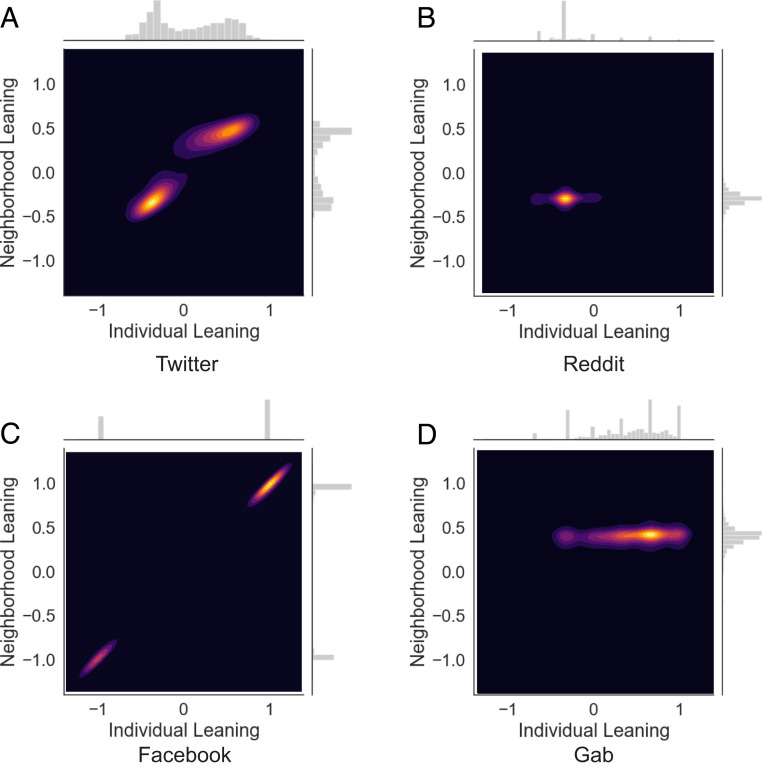
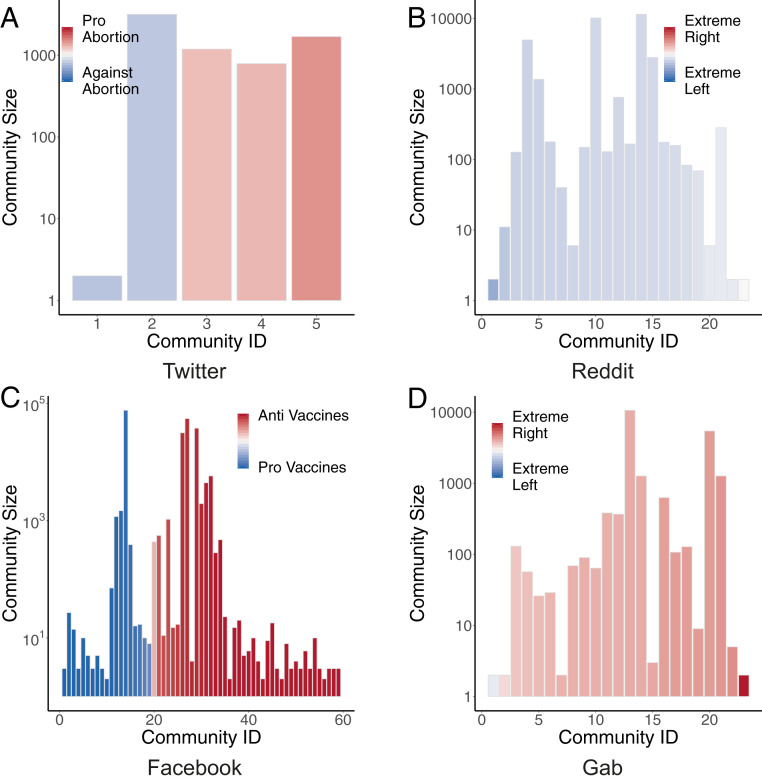
- Across the four platforms, “aggregation in homophilic clusters of users dominates online dynamics,” but platforms differ: Facebook and Twitter show homophilic clustering, while Reddit and Gab form a single community biased left or right rather than two opposing clusters.
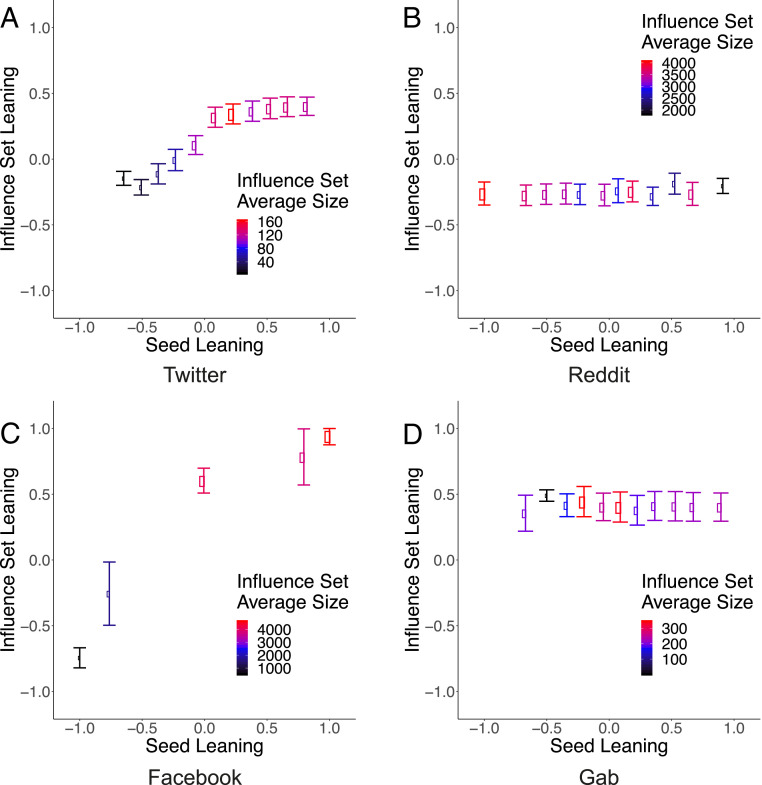
- Information diffusion is biased toward like-minded users on Facebook and Twitter, where the average leaning of a user’s influence set approximates the seed user’s leaning; on Reddit and Gab, the average leaning of the influence set does not depend on the seed user’s leaning.
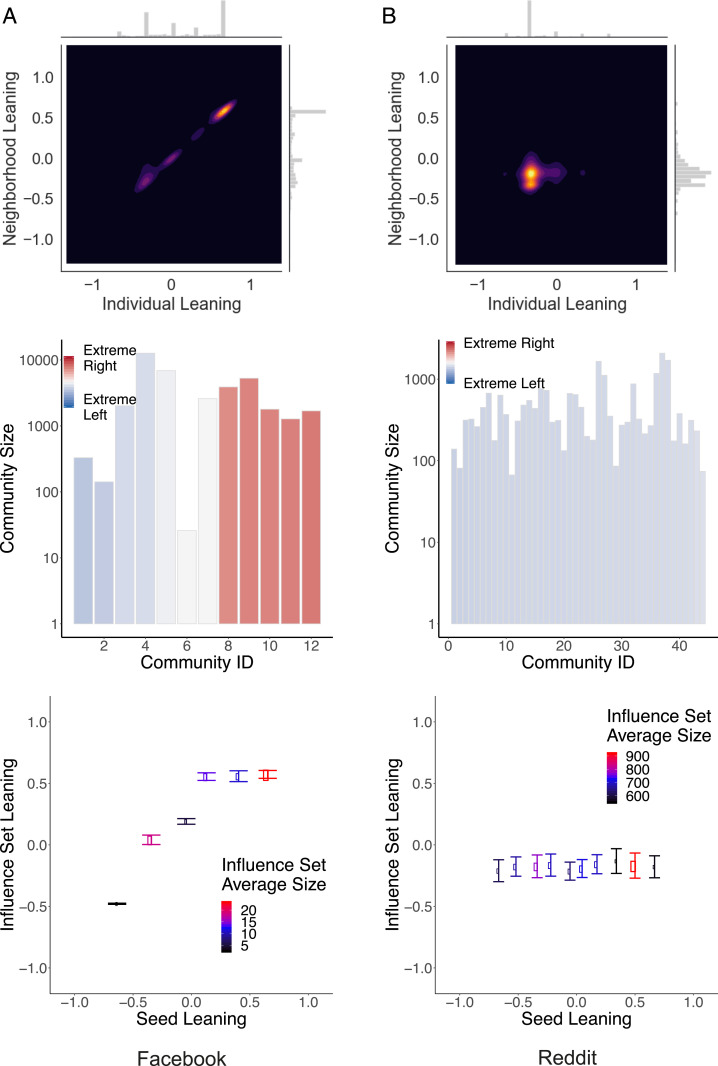
- In a direct comparison on news consumption, Facebook shows higher segregation than Reddit across all three measures: user-neighbor leaning correlation, community leaning, and SIR influence-set leaning.
- The study analyzes more than 100 million unique pieces of content and more than 1 million active users, with news outlets labeled using 2,190 media sources from Media Bias/Fact Check.
Methods
- Comparative analysis of Gab, Facebook, Reddit, and Twitter datasets on controversial topics including gun control, Obamacare, abortion, vaccines, science versus conspiracy, and news; main selected datasets were Abortion (Twitter), Vaccines (Facebook), Politics (Reddit), and Gab as a whole.
- Echo chambers were operationalized through two dimensions: homophily in interaction networks and bias in information diffusion toward like-minded peers. User leaning was inferred from linked news outlets, likes, or content, and interaction networks were built from follows, comments, cocomments, submissions, or replies depending on platform.
- Analyses included correlation between user leaning and average neighbor leaning, Louvain community detection, and SIR simulations to measure influence sets; SIR recovery rate was fixed at ν = 0.2, with dataset-specific infection ratios.
Limitations
- The paper states that the next envisioned step is to address the temporal dimension of echo chambers and how platform-specific social feedback mechanisms impact their formation.
- Evident from the text: leaning coverage varies strongly by platform, from 0.90–1.00 for Twitter/Facebook datasets to 0.15–0.20 for Reddit and 0.13 for Gab, so leaning-based conclusions for Reddit and Gab rest on a small classified fraction of users.
- Evident from the text: datasets differ by platform and topic, and the direct cross-platform comparison on a common topic is limited to news consumption on Facebook and Reddit; the authors also note that Reddit/Gab results could mean either no echo-chamber effect or observation inside a single echo chamber.
Model-written summary. Check it against the paper before relying on it.
Integrity signals
Registry
Cites
Statistics
Figures
Verification
Claims the paper makes
8 Valid · 1 Not valid · 7 Not checked · 38 Own results and interpretations
The cited sources support only part of this claim — read each source’s verdict below.
In the paper
“Selective exposure (19) and confirmation bias (20) (i.e., the tendency to seek information adhering to preexisting opinions) may explain the emergence of echo chambers on social media (1, 17, 21, 22).”
§ The echo chamber effect on social media > Abstract
What the sources say
- Supportedcites [1] M. Del Vicario, The spreading of misinformation online. Proc. Natl. Acad. Sci. U.S.A. 113, 554– 559 (2016). 26729863 PMC4725489 source
The Abstract says selective exposure generates homogeneous clusters, which it calls echo chambers. The Results and Discussion section says users select content matching a narrative and suggests confirmation bias determines echo-chamber formation. Page numbers are not provided in our copy. (LLM, conf=0.94)
- Partly supportedcites [17] K. Garimella, G. De Francisci Morales, A. Gionis, M. Mathioudakis, “ The effect of collective attention on controversial debates on social media” in WebSci ’17: 9th International ACM Web Science Conference (Association for Computing Machinery, New York, NY, 2017), pp. 43– 52. sourceExperimental — accuracy not yet measured
The Introduction reports that users mostly interact within their own side and endorse opinions from that side’s core. Related Work reports that users spread information faster when it agrees with their position. These passages are consistent with selective exposure, but the paper does not identify confirmation bias or establish that either tendency causes echo chambers to emerge. (LLM, conf=0.82)
- Supportedcites [21] M. Del Vicario, Echo chambers: Emotional contagion and group polarization on Facebook. Sci. Rep. 6, 37825 (2016). 27905402 PMC5131349 source
The Abstract says social-media disintermediation encourages users to select information that fits their beliefs (confirmation bias) and form like-minded groups (echo chambers). The Conclusions likewise describe Facebook as suited to the emergence of echo chambers. This supports the proposed explanation, without claiming it is the only cause. (LLM, conf=0.93)
- Supportedcites [22] A. Bessi, Science vs conspiracy: Collective narratives in the age of misinformation. PloS One 10, e0118093 (2015). 25706981 PMC4338055 source
The Introduction (page unavailable) says users consuming opposing information tend to form isolated clusters and describes polarized users whose likes are almost exclusively on one category of pages. The Conclusions (page unavailable) link information evaluation to existing beliefs. Together, these passages support the hedged explanation that selective exposure and confirmation bias may contribute to echo chambers. (LLM, conf=0.86)
hedgedstates a possible cause- Asserted: passes — The authors put it forward as true.
- Checkable: passes — It can be checked against evidence.
- Load-bearing: passes — The paper’s conclusions depend on it.
- Based: passes — The paper gives a reason why it holds.
- Supported
The cited sources support only part of this claim — read each source’s verdict below.
In the paper
“Our attention span remains limited (9, 10), and feed algorithms might limit our selection process by suggesting contents similar to the ones we are usually exposed to (11–13).”
§ The echo chamber effect on social media > Abstract
What the sources say
- Not checked — no full text of the sourcecites [11] A. L. Schmidt, Anatomy of news consumption on Facebook. Proc. Natl. Acad. Sci. U.S.A. 114, 3035– 3039 (2017). 28265082 PMC5373354 source
- Partly supportedcites [12] M. Cinelli, The COVID-19 social media infodemic. Sci. Rep. 10, 16598 (2020). 33024152 PMC7538912 sourceExperimental — accuracy not yet measured
The Introduction (page not provided) says algorithms take users’ preferences and attitudes into account when promoting content, and that users tend to seek information aligned with their worldviews. It does not say that feed algorithms suggest content similar to what users have previously seen or thereby limit their selection. (LLM, conf=0.82)
- Not checked — no full text of the sourcecites [13] E. Bakshy, S. Messing, L. A. Adamic, Exposure to ideologically diverse news and opinion on Facebook. Science 348, 1130– 1132 (2015). 25953820 source
hedgedstates a possible cause- Asserted: passes — The authors put it forward as true.
- Checkable: passes — It can be checked against evidence.
- Load-bearing: passes — The paper’s conclusions depend on it.
- Based: passes — The paper gives a reason why it holds.
Every source the paper cites for this claim was checked and supports it.
In the paper
“Online polarization, for instance, may foster misinformation spreading (1, 8).”
§ The echo chamber effect on social media > Abstract
What the sources say
- Supportedcites [1] M. Del Vicario, The spreading of misinformation online. Proc. Natl. Acad. Sci. U.S.A. 113, 554– 559 (2016). 26729863 PMC4725489 source
The Significance section says that homogeneity and polarization are main determinants of rumor-cascade size. The Conclusions also link polarized communities with the proliferation of narratives fueled by unsubstantiated rumors, supporting the hedged claim that online polarization may foster misinformation spreading. (LLM, conf=0.91)
- Supportedcites [8] M. D. Vicario, W. Quattrociocchi, A. Scala, F. Zollo, Polarization and fake news: Early warning of potential misinformation targets. ACM Trans. Web 13, 1– 22 (2019). source
The Introduction states that misinformation spreading on social media is directly related to increasing user polarization and segregation. This supports the citing sentence’s hedged claim that online polarization may foster misinformation spreading. (LLM, conf=0.94)
hedgedstates a possible cause- Asserted: passes — The authors put it forward as true.
- Checkable: passes — It can be checked against evidence.
- Load-bearing: unclear — It is unclear whether the paper’s conclusions depend on it.
- Based: passes — The paper gives a reason why it holds.
- Supported
Every source the paper cites for this claim was checked and supports it.
In the paper
“In network terms, this translates into a node i with a given leaning xi more likely to be connected with nodes with a leaning close to xi (18).”
§ The echo chamber effect on social media > Comparative Analysis > Polarization and Homophily in the Interaction Networks.
What the sources say
- Supportedcites [18] W. Cota, S. C. Ferreira, R. Pastor-Satorras, M. Starnini, Quantifying echo chamber effects in information spreading over political communication networks. EPJ Data Sci. 8, 35 (2019). source
The paper’s “Topological evidence of echo chambers” section says that a node with political position Pᵢ is connected with nodes whose positions are close to Pᵢ. It also reports a strong correlation between users’ positions and their neighbors’ average positions, supporting the citing sentence’s probabilistic paraphrase. (LLM, conf=0.94)
hedgedstates an association- Asserted: passes — The authors put it forward as true.
- Checkable: passes — It can be checked against evidence.
- Load-bearing: passes — The paper’s conclusions depend on it.
- Based: passes — The paper gives a reason why it holds.
- Supported
A result the paper reports from its own data — it cites no other source for it, so there is none to check. The quote shows it is in the paper.
In the paper
“Furthermore, the almost total absence of communities with leaning very close to 0 confirms the polarized state of the systems.”
§ The echo chamber effect on social media > Comparative Analysis > Polarization and Homophily in the Interaction Networks.
boostedstates a cause- Asserted: passes — The authors put it forward as true.
- Checkable: passes — It can be checked against evidence.
- Load-bearing: passes — The paper’s conclusions depend on it.
- Based: passes — The paper gives a reason why it holds.
- Rests on 4 assumptions not shown here.
32 more claims
Create a free account to see all 54 claims and to verify the 2 references still open.
- It may state two separate claims as one. 9
- Probably not a substantial claim. 9
Claims other papers make about this one
Each is checked against this paper’s own text: does it say what the citing paper says it does?
The source backs part of the claim, not all of it — or backs it for a different population, condition or comparison.
In the citing paper
“engagement with political content online is generally associated with high levels of ingroup bias; that is, it is far more likely to be shared within the political ingroup than in the outgroup (18, 19, 16).”
From Troll and divide: the language of online polarization (2022) · cites this paper as [16]
Experimental — accuracy not yet measuredThe source backs part of the claim, not all of it — or backs it for a different population, condition or comparison.
In the citing paper
“This challenge is reflected in research on”
From Machine culture (2023) · cites this paper as [142]
Experimental — accuracy not yet measuredThe source backs part of the claim, not all of it — or backs it for a different population, condition or comparison.
In the citing paper
“Thus, combating social media's echo chamber effect through an active exposure to diverse perspectives and networks also represents a viable individual-level strategy for addressing the deepfake problem (Cinelli et al., 2021; Gillani et al., 2018).”
From Deepfakes: Deceptions, mitigations, and opportunities (2023) · cites this paper as Cinelli et al., 2021
Experimental — accuracy not yet measuredThe source backs part of the claim, not all of it — or backs it for a different population, condition or comparison.
In the citing paper
“Even without being designed to shift opinions, it has been found that algorithms may contribute to political polarization by reinforcing divisive opinions [9, 24, 32].”
From Co-Writing with Opinionated Language Models Affects Users’ Views (2023) · cites this paper as [32]
Experimental — accuracy not yet measuredThe source backs part of the claim, not all of it — or backs it for a different population, condition or comparison.
In the citing paper
“On Reddit, studies find minimal evidence of echo chambers due to platform features encouraging cross-cutting exposure [17,61,63].”
From A systematic review of echo chamber research: comparative analysis of conceptualizations, operationalizations, and varying outcomes (2025) · cites this paper as [17]
Experimental — accuracy not yet measured
5 more claims about this paper
Create a free account to see every claim other papers make about this one.
Citations
Cites
Fast unfolding of communities in large networks
Blondel, V. D., Guillaume, J.-L., Lambiotte, R., & Lefebvre, E. (2008) · Journal of Statistical Mechanics: Theory and Experiment · doi:10.1088/1742-5468/2008/10/p10008 · Cited by 21,424 · cited 1×
“We detected communities by applying the Louvain algorithm (41), removing singleton communities with only one user.”
MethodThe spread of true and false news online
Vosoughi, S., Roy, D., & Aral, S. (2018) · Science · doi:10.1126/science.aap9559 · Cited by 8,847 · cited 1×
“A recent study (7) limited to Twitter claimed that fake news travels faster than real news.”
BackgroundConfirmation Bias: A Ubiquitous Phenomenon in Many Guises
Nickerson, R. S. (1998) · Review of General Psychology · doi:10.1037/1089-2680.2.2.175 · Cited by 7,267 · cited 1×
“Selective exposure (19) and confirmation bias (20) (i.e., the tendency to seek information adhering to preexisting opinions) may explain the emergence of echo chambers on social media (1, 17, 21, 22).”
BackgroundInfectious Diseases of Humans: Dynamics and Control
Anderson, R. M., & May, R. M. (1991) · doi:10.1093/oso/9780198545996.001.0001 · Cited by 6,179
Lazer, D. M. J., Baum, M. A., Benkler, Y., Berinsky, A. J., Greenhill, K. M., Menczer, F., Metzger, M. J., Nyhan, B., Pennycook, G., Rothschild, D., et al. (2018) · Science · doi:10.1126/science.aao2998 · Cited by 4,160
Degroot, M. H. (1974) · Journal of the American Statistical Association · doi:10.1080/01621459.1974.10480137 · Cited by 4,004 · cited 1×
“For instance, if opinions are assumed to be embedded in a onedimensional space (38), x ∈ [−1,+1] without loss of generality, as usual for controversial topics, then polarization is characterized by two well-separated peaks in P(x ), for positive and negative opinions.”
BackgroundExposure to ideologically diverse news and opinion on Facebook
Bakshy, E., Messing, S., & Adamic, L. A. (2015) · Science · doi:10.1126/science.aaa1160 · Cited by 3,245 · cited 2×
“Our attention span remains limited (9, 10), and feed algorithms might limit our selection process by suggesting contents similar to the ones we are usually exposed to (11–13).”
BackgroundThe spreading of misinformation online
Del Vicario, M., Bessi, A., Zollo, F., Petroni, F., Scala, A., Caldarelli, G., Stanley, H. E., & Quattrociocchi, W. (2016) · Proceedings of the National Academy of Sciences · doi:10.1073/pnas.1517441113 · Cited by 2,407 · cited 2×
“, the tendency to seek information adhering to preexisting opinions) may explain the emergence of echo chambers on social media (1, 17, 21, 22).”
BackgroundSelf-citationThe COVID-19 social media infodemic
Cinelli, M., Quattrociocchi, W., Galeazzi, A., Valensise, C. M., Brugnoli, E., Schmidt, A. L., Zola, P., Zollo, F., & Scala, A. (2020) · Scientific Reports · doi:10.1038/s41598-020-73510-5 · Cited by 2,313
Self-citationFilter Bubbles, Echo Chambers, and Online News Consumption
Flaxman, S., Goel, S., & Rao, J. M. (2016) · Public Opinion Quarterly · doi:10.1093/poq/nfw006 · Cited by 1,992
Research works printed but not linked: 2
- R. M. Anderson, R. M. May, Infectious Diseases in Humans (Oxford University Press, Oxford, United Kingdom, 1992).
- M. Cinelli, G. De Francisci Morales, A. Galeazzi, W. Quattrociocchi, M. Starnini, The echo chamber effect on social media. Open Science Framework. https://osf.io/x92br/?view_only=cdcc87d30e404e01b6ae316db15e3375. Deposited 22 January 2021. PMC7936330 33622786
Cited by
Chater, N., & Loewenstein, G. (2023) · Behavioral and Brain Sciences · doi:10.1017/s0140525x22002023 · Cited by 710
OECD (2022) · Building Trust in Public Institutions · doi:10.1787/b407f99c-en · Cited by 661
Jusup, M., Holme, P., Kanazawa, K., Takayasu, M., Romić, I., Wang, Z., Geček, S., Lipić, T., Podobnik, B., Wang, L., et al. (2022) · Physics Reports · doi:10.1016/j.physrep.2021.10.005 · Cited by 643
(2021) · OECD Working Papers on Public Governance · doi:10.1787/b6c5478c-en · Cited by 622
Out-group animosity drives engagement on social media
Rathje, S., Van Bavel, J. J., & van der Linden, S. (2021) · Proceedings of the National Academy of Sciences · doi:10.1073/pnas.2024292118 · Cited by 560
“A large portion of this work has centered on the position that social media sorts us into “ echo chambers ” or “ filter bubbles ” that selectively expose people to content that aligns with their preexisting beliefs (6 – 11).”
Misinformation: susceptibility, spread, and interventions to immunize the public
van der Linden, S. (2022) · Nature Medicine · doi:10.1038/s41591-022-01713-6 · Cited by 570
Growing polarization around climate change on social media
Falkenberg, M., Galeazzi, A., Torricelli, M., Di Marco, N., Larosa, F., Sas, M., Mekacher, A., Pearce, W., Zollo, F., Quattrociocchi, W., et al. (2022) · Nature Climate Change · doi:10.1038/s41558-022-01527-x · Cited by 367
“The appearance of two clusters with minimal inter-cluster density reveals the presence of “echo chambers” on social media [21], an environment in which users reinforce their opinions through repeated interactions with content adherent to their beliefs [21].”
BackgroundInfluentialSelf-citationA systematic review of worldwide causal and correlational evidence on digital media and democracy
Lorenz-Spreen, P., Oswald, L., Lewandowsky, S., & Hertwig, R. (2022) · Nature Human Behaviour · doi:10.1038/s41562-022-01460-1 · Cited by 348
Misinformation About COVID-19 Vaccines on Social Media: Rapid Review
Skafle, I., Nordahl-Hansen, A., Quintana, D. S., Wynn, R., & Gabarron, E. (2022) · Journal of Medical Internet Research · doi:10.2196/37367 · Cited by 347
“We also did not discuss how social media algorithms partake in creating echo chambers [78].”
Co-Writing with Opinionated Language Models Affects Users’ Views
Jakesch, M., Bhat, A., Buschek, D., Zalmanson, L., & Naaman, M. (2023) · Proceedings of the 2023 CHI Conference on Human Factors in Computing Systems · doi:10.1145/3544548.3581196 · Cited by 265
“Even without being designed to shift opinions, it has been found that algorithms may contribute to political polarization by reinforcing divisive opinions [9, 24, 32].”
BackgroundHow variability shapes learning and generalization
Raviv, L., Lupyan, G., & Green, S. C. (2022) · Trends in Cognitive Sciences · doi:10.1016/j.tics.2022.03.007 · Cited by 206
“Recent studies focusing on social networks formed by social media algorithms, which tend to pair users with like-minded users, show that doing so leads to echo chambers [187] with the power to further polarize people’s opinions [188].”
BackgroundLink recommendation algorithms and dynamics of polarization in online social networks
Santos, F. P., Lelkes, Y., & Levin, S. A. (2021) · Proceedings of the National Academy of Sciences · doi:10.1073/pnas.2102141118 · Cited by 208
“Finally, we note that recent work points out that an important distinction among social media platforms is providing the opportunity for users to tweak their newsfeed algorithm: Reddit offers that option and may be one reason to explain why this platform reveals less segregation than Facebook (90).”
BackgroundDeepfakes: Deceptions, mitigations, and opportunities
Mustak, M., Salminen, J., Mäntymäki, M., Rahman, A., & Dwivedi, Y. K. (2023) · Journal of Business Research · doi:10.1016/j.jbusres.2022.113368 · Cited by 209
Zuboff, S. (2022) · Organization Theory · doi:10.1177/26317877221129290 · Cited by 209
“…researchers have closely examined many of the dynamics identified in this discussion and their causal role in rising societal polarization and diminished social resilience (Cinelli et al., 2021; R. Levy, 2021; Rathje et al., 2021; Santos et al., 2021; Tokita et al., 2021; Vasconcelos et al., 2021).”
BackgroundRuggeri, K., Tutuska, O. S., Ladini, G. A. R., Al-Zahli, N., Alexander, N., Andersen, M., Bibilouri, K., Chen, J., Doubravová, B., Dugue, T. M., et al. (2022) · Behavioral and Brain Sciences · doi:10.2139/ssrn.4046264 · Cited by 512
Diaz Ruiz, C., & Nilsson, T. (2023) · Journal of Public Policy & Marketing · doi:10.1177/07439156221103852 · Cited by 161
“The fragmented nature of online culture, the importance of collective identity construction, and the argumentative nature of online controversies generate echo chambers in which participants encounter self-reinforcing beliefs (Cinelli et al. 2021; Jamieson and Cappella 2008; Nguyen 2020).”
BackgroundFake news detection: A survey of graph neural network methods
Phan, H. T., Nguyên, N. T., & Hwang, D. (2023) · Applied Soft Computing · doi:10.1016/j.asoc.2023.110235 · Cited by 216
“• Echo chamber effect: Echo chambers [30] can be broadly defined as environments focusing on the opinions of users who have the same political leaning or beliefs about a topic.”
BackgroundNew explainability method for BERT-based model in fake news detection
Szczepański, M., Pawlicki, M., Kozik, R., & Choraś, M. (2021) · Scientific Reports · doi:10.1038/s41598-021-03100-6 · Cited by 196
Infodemics: a new challenge for public health
Briand, S. C., Cinelli, M., Nguyen, T., Lewis, R., Prybylski, D., Valensise, C. M., Colizza, V., Tozzi, A. E., Perra, N., Baronchelli, A., et al. (2021) · Cell · doi:10.1016/j.cell.2021.10.031 · Cited by 125
“Therefore networks of interaction, such as those underlying social media, are beyond any geographical boundary and reshape continuously around new topics with users segregating in echo chambers (where questionable information proliferates with more ease) and with recommendation algorithms that may reinforce shared nar…”
Social media and the spread of misinformation: infectious and a threat to public health
Denniss, E., & Lindberg, R. (2025) · Health Promotion International · doi:10.1093/heapro/daaf023 · Cited by 263
“Social media algorithms give rise to echo chambers (i.e. communities of people with similar views) (Bessi et al. 2015, 2016, Zimmer et al. 2019, Cinelli et al. 2021), and social network modelling has shown that misinformation spreads more rapidly within these conditions (Törnberg 2018).”
Two centuries of vaccination: historical and conceptual approach and future perspectives
Montero, D. A., Vidal, R. M., Velasco, J., Carreño, L. J., Torres, J. P., O., M. A. B., Tovar-Rosero, Y.-Y., Oñate, A. A., & O’Ryan, M. (2024) · Frontiers in Public Health · doi:10.3389/fpubh.2023.1326154 · Cited by 227
Generative Echo Chamber? Effect of LLM-Powered Search Systems on Diverse Information Seeking
Sharma, N., Liao, Q. V., & Xiao, Z. (2024) · Proceedings of the CHI Conference on Human Factors in Computing Systems · doi:10.1145/3613904.3642459 · Cited by 132
Algorithm-mediated social learning in online social networks
Brady, W. J., Jackson, J. C., Lindström, B., & Crockett, M. J. (2023) · Trends in Cognitive Sciences · doi:10.1016/j.tics.2023.06.008 · Cited by 132
“In many cases, social media algorithms expose people to ingroup values and opinions that are even stronger than their own positions [58,59].”
The Algorithmic Crystal: Conceptualizing the Self through Algorithmic Personalization on TikTok
Lee, A. Y., Mieczkowski, H., Ellison, N. B., & Hancock, J. T. (2022) · Proceedings of the ACM on Human-Computer Interaction · doi:10.1145/3555601 · Cited by 132
“In this way, diffracted belonging can be seen as a counterpoint to conceptualizations of algorithmic filter bubbles as stationary, unidimensional echo chambers [13, 47] and a novel extension to psychological theory on mere belonging effects [66].”
BackgroundBrinkmann, L., Baumann, F., Bonnefon, J.-F., Derex, M., Müller, T. F., Nussberger, A.-M., Czaplicka, A., Acerbi, A., Griffiths, T. L., Henrich, J., et al. (2023) · Nature Human Behaviour · doi:10.1038/s41562-023-01742-2 · Cited by 132
“The algorithmic amplification of such content may then feed back into human social learning—for instance, inflating beliefs about the normative value of expressing moral out-rage 138,139 , increasing outgroup animosity 140 or creating echo chambers and filter bubbles 141–143 .”
BackgroundUsers choose to engage with more partisan news than they are exposed to on Google Search
Robertson, R. E., Green, J., Ruck, D. J., Ognyanova, K., Wilson, C., & Lazer, D. (2023) · Nature · doi:10.1038/s41586-023-06078-5 · Cited by 126
Zhang, R., Li, H., Meng, H., Zhan, J., Gan, H., & Lee, Y.-C. (2025) · Proceedings of the 2025 CHI Conference on Human Factors in Computing Systems · doi:10.1145/3706598.3713429 · Cited by 123
“This constant affirmation can amplify users’ existing beliefs, reduce critical thinking, and foster echo chambers [18, 83], potentially impairing communication skills such as perspective-taking, active listening, and conflict resolution.”
Conspiracy theories and social media platforms
Cinelli, M., Etta, G., Avalle, M., Quattrociocchi, A., Marco, N. D., Valensise, C. M., Galeazzi, A., & Quattrociocchi, W. (2022) · Current Opinion in Psychology · doi:10.1016/j.copsyc.2022.101407 · Cited by 176
Self-citationKirk, H. R., Vidgen, B., Röttger, P., & Hale, S. A. (2024) · Nature Machine Intelligence · doi:10.1038/s42256-024-00820-y · Cited by 122
“Personalized LLMs could entrench individual biases, risking polarization and breakdown of shared social cohesion 124–126 .”
Persistent interaction patterns across social media platforms and over time
Avalle, M., Marco, N. D., Etta, G., Sangiorgio, E., Alipour, S., Bonetti, A., Alvisi, L., Scala, A., Baronchelli, A., Cinelli, M., et al. (2024) · Nature · doi:10.1038/s41586-024-07229-y · Cited by 225
Self-citationAccuracy and Political Bias of News Source Credibility Ratings by Large Language Models
Yang, K.-C., & Menczer, F. (2023) · arXiv · doi:10.48550/arxiv.2304.00228 · Cited by 115
Van Bavel, J. J., Robertson, C. E., del Rosario, K., Rasmussen, J., & Rathje, S. (2024) · Annual Review of Psychology · doi:10.1146/annurev-psych-022123-110258 · Cited by 121
Flamino, J., Galeazzi, A., Feldman, S., Macy, M. W., Cross, B., Zhou, Z., Serafino, M., Bovet, A., Makse, H. A., & Szymanski, B. K. (2023) · Nature Human Behaviour · doi:10.1038/s41562-023-01550-8 · Cited by 113
Self-citationDo social media undermine social cohesion? A critical review
González‐Bailón, S., & Lelkes, Y. (2022) · Social Issues and Policy Review · doi:10.1111/sipr.12091 · Cited by 207
The benefits and dangers of anthropomorphic conversational agents
Peter, S., Riemer, K., & West, J. D. (2025) · Proceedings of the National Academy of Sciences · doi:10.1073/pnas.2415898122 · Cited by 110
Echo chamber effects on short video platforms
Gao, Y., Liu, F., & Gao, L. (2023) · Scientific Reports · doi:10.1038/s41598-023-33370-1 · Cited by 109
“Then the individual sentiment/stance polarity of user i can be defined as the average of the polarities of produced contents 65 , Homophily.”
Dynamics of online hate and misinformation
Cinelli, M., Pelicon, A., Mozetič, I., Quattrociocchi, W., Novak, P. K., & Zollo, F. (2021) · Scientific Reports · doi:10.1038/s41598-021-01487-w · Cited by 107
“Furthermore, in 37 authors modelled the hate speech task using the Italian pre-trained language model AlBERTo, achieving state-of-the-art results on Facebook and Twitter datasets.”
BackgroundSelf-citation“This is a political movement, friend”: Why “incels” support violence
O'Donnell, C., & Shor, E. (2022) · The British Journal of Sociology · doi:10.1111/1468-4446.12923 · Cited by 105
“The dominance of support for violence in our analysis suggests that the incel community may be operating as an echo chamber, where shared narratives and beliefs are reinforced through repeated interactions with peers who also have similar attitudes (Cinelli et al., 2021).”
BackgroundMaertens, R., Götz, F. M., Golino, H. F., Roozenbeek, J., Schneider, C. R., Kyrychenko, Y., Kerr, J. R., Stieger, S., McClanahan, W. P., Drabot, K., et al. (2023) · Behavior Research Methods · doi:10.3758/s13428-023-02124-2 · Cited by 104
Social media behavior is associated with vaccine hesitancy
Rathje, S., He, J. K., Roozenbeek, J., Van Bavel, J. J., & van der Linden, S. (2022) · PNAS Nexus · doi:10.1093/pnasnexus/pgac207 · Cited by 100
“Social media also tends to reflect “echo chambers” in which people are selectively exposed to like-minded opinions (3, 23) and form social ties with likeminded others (24).”
BackgroundHuman–AI adaptive dynamics drives the emergence of information cocoons
Piao, J., Liu, J., Zhang, F., Su, J., & Li, Y. (2023) · Nature Machine Intelligence · doi:10.1038/s42256-023-00731-4 · Cited by 137
“Exposure to homogeneous information not only deprives humans of the diversity of information available for informed decision-making 10–12 but also exacerbates social polarization 13,14 and reinforces biases 4,15 .”
BackgroundInfluentialNo echo in the chambers of political interactions on Reddit
De Francisci Morales, G., Monti, C., & Starnini, M. (2021) · Scientific Reports · doi:10.1038/s41598-021-81531-x · Cited by 161
Self-citationThe COVID‐19 pandemic and the search for structure: Social media and conspiracy theories
Dow, B. J., Johnson, A. L., Wang, C. S., Whitson, J., & Menon, T. (2021) · Social and Personality Psychology Compass · doi:10.1111/spc3.12636 · Cited by 134
“…of content social media users, guided by their cognitive biases and pre-existing beliefs (Bessi et al., 2015; Cinelli, Brugnoli, et al., 2020; Cinelli et al., 2021), tend to seek out information that is consistent with their existing views and ignore or reject contrary information (Brugnoli…”
Ruffo, G., Semeraro, A., Giachanou, A., & Rosso, P. (2022) · Computer Science Review · doi:10.1016/j.cosrev.2022.100531 · Cited by 148
“It happens on Facebook [19], Twitter [54], Youtube [33], Reddit and Gab [52].”
BackgroundFake news: Why do we believe it?
Beauvais, C. (2022) · Joint Bone Spine · doi:10.1016/j.jbspin.2022.105371 · Cited by 157
Implications of Revenue Models and Technology for Content Moderation Strategies
Liu, Y., Yıldırım, P., & Zhang, Z. J. (2021) · Marketing Science · doi:10.1287/mksc.2022.1361 · Cited by 118
Troll and divide: the language of online polarization
Simchon, A., Brady, W. J., & Van Bavel, J. J. (2022) · PNAS Nexus · doi:10.1093/pnasnexus/pgac019 · Cited by 85
“Engagement of polarized language is an important metric because engagement with political content online is generally associated with high levels of ingroup bias; that is, it is far more likely to be shared within the political ingroup than in the out-group (18, 19, 16).”
Desai, A. N., Ruidera, D., Steinbrink, J. M., Granwehr, B., & Lee, D. H. (2022) · Clinical Infectious Diseases · doi:10.1093/cid/ciac109 · Cited by 82
“Many social media platforms inherently support the formation of “echo chambers,” or environments in which a user’s existing opinions are reinforced due to interactions with like-minded sources or individuals [21].”
BackgroundAccuracy and Political Bias of News Source Credibility Ratings by Large Language Models
Yang, K.-C., & Menczer, F. (2025) · Proceedings of the 17th ACM Web Science Conference 2025 · doi:10.1145/3717867.3717903 · Cited by 81
“When handling political information, the inherent partisan biases in LLMs could exacerbate echo chambers and polarization (Cinelli et al. 2021; Conover et al. 2021).”
"How over is it?" Understanding the Incel Community on YouTube
Papadamou, K., Zannettou, S., Blackburn, J., De Cristofaro, E., Stringhini, G., & Sirivianos, M. (2021) · Proceedings of the ACM on Human-Computer Interaction · doi:10.1145/3479556 · Cited by 80
“This effect entails a viewer who begins to engage with this type of content and likely falls into an algorithmic rabbit hole, with recommendations becoming increasingly dominated by such harmful content and beliefs, which also becomes increasingly extreme [16, 53, 56, 65, 68].”
BackgroundResultIshizumi, A., Kolis, J., Abad, N., Prybylski, D., Brookmeyer, K. A., Voegeli, C., Wardle, C., & Chiou, H. (2024) · The Lancet Public Health · doi:10.1016/s2468-2667(24)00031-8 · Cited by 79
Firth, J., Torous, J., López‐Gil, J. F., Linardon, J., Milton, A., Lambert, J., Smith, L., Jarić, I., Fabian, H., Vancampfort, D., et al. (2024) · World Psychiatry · doi:10.1002/wps.21188 · Cited by 80
“This can lead to social echo chambers and result in online social movements that transcend into the real world 137,138 .”
BackgroundMantello, P. A., Ho, T. M., Nguyen, M., & Vuong, Q. (2023) · Humanities and Social Sciences Communications · doi:10.1057/s41599-023-01837-1 · Cited by 110
Quantifying ideological polarization on a network using generalized Euclidean distance
Hohmann, M., Devriendt, K., & Coscia, M. (2023) · Science Advances · doi:10.1126/sciadv.abq2044 · Cited by 74
Modelling how social network algorithms can influence opinion polarization
de Arruda, H. F., Cardoso, F. M., de Arruda, G. F., Hernández, A. R., Costa, L. D. F., & Moreno, Y. (2021) · Information Sciences · doi:10.1016/j.ins.2021.12.069 · Cited by 96
Rao, A., Morstatter, F., Hu, M., Chen, E., Burghardt, K., Ferrara, E., & Lerman, K. (2021) · Journal of Medical Internet Research · doi:10.2196/26692 · Cited by 70
“Cinelli et al [14] and Weld et al [15] showed that sharing of URLs annotated by Media Bias/Fact Check is a reliable proxy of one’s political polarity.”
BackgroundCharacterizing the mechanisms of social connection
Delgado, M. R., Fareri, D. S., & Chang, L. J. (2023) · Neuron · doi:10.1016/j.neuron.2023.09.012 · Cited by 98
“199 Thus, social media has afforded new possibilities of connecting with others but may also inadvertently create feelings of isolation via unrealistic social comparisons, 200 fear of missing out, 201 or poor-quality interactions that are insufficient substitutes for real-life interactions.”
BackgroundLiao, M. (2024) · Frontiers in Psychology · doi:10.3389/fpsyg.2024.1391204 · Cited by 98
“As network social services continue to diversify, various online platforms offer different functions, cater to distinct user groups, and operate under varying social modes (Cinelli et al., 2021).”
BackgroundMahl, D., Zeng, J., & Schäfer, M. S. (2021) · Social Media + Society · doi:10.1177/20563051211017482 · Cited by 67
“In addition, research suggests the existence of highly polarized and homogeneous communities around conspiracy and scientific topics on Facebook and YouTube (Bessi et al., 2016; Cinelli et al., 2021).”
BackgroundInterian, R., G. Marzo, R., Mendoza, I., & Ribeiro, C. C. (2023) · International Transactions in Operational Research · doi:10.1111/itor.13224 · Cited by 67
“[23], echo chambers are environments in which the opinions or beliefs of people about some topic are reinforced due to repeated interactions with peers or sources having similar tendencies and attitudes.”
BackgroundMethodAn image and text-based multimodal model for detecting fake news in OSN’s
Uppada, S. K., Patel, P. K., & Sivaselvan, B. (2022) · Journal of Intelligent Information Systems · doi:10.1007/s10844-022-00764-y · Cited by 90
“The echo chamber effect has a significant impact on users believing in the news coming from specific sources (Cinelli et al., 2021).”
BackgroundBallantyne, N., Celniker, J. B., & Dunning, D. A. (2022) · Social Epistemology · doi:10.1080/02691728.2022.2146469 · Cited by 90
“Although the extent to which people selectively seek out content that fits their desires and beliefs remains contested (Cinelli et al. 2021) partisans’ tendencies to engage with attitude-consistent media appear to be increasing across the political spectrum (Rodriguez et al. 2017).”
BackgroundThe Effect of People Recommenders on Echo Chambers and Polarization
Cinus, F., Minici, M., Monti, C., & Bonchi, F. (2022) · Proceedings of the International AAAI Conference on Web and Social Media · doi:10.1609/icwsm.v16i1.19275 · Cited by 65
“Finally, Cinelli et al. (2021) found evidence of echo chambers on Facebook, but not on Reddit, showing that there exist differences between different social media platforms that might depend on different content recommendation mechanisms.”
BackgroundCognitive Biases in Fact-Checking and Their Countermeasures: A Review
Soprano, M., Roitero, K., Barbera, D. L., Ceolin, D., Spina, D., Demartini, G., & Mizzaro, S. (2024) · Information Processing & Management · doi:10.1016/j.ipm.2024.103672 · Cited by 87
Kasemsarn, K., & Nickpour, F. (2025) · Heritage · doi:10.3390/heritage8060200 · Cited by 165
Mapping Exposure Diversity: The Divergent Effects of Algorithmic Curation on News Consumption
Jürgens, P., & Stark, B. (2022) · Journal of Communication · doi:10.1093/joc/jqac009 · Cited by 89
Willingness to pay a premium price for green products: does a reference group matter?
Shi, J., & Jiang, Z. (2022) · Environment Development and Sustainability · doi:10.1007/s10668-022-02419-y · Cited by 84
“This reinforcement process is understood as the echo chamber effect (Cinelli et al., 2021).”
BackgroundInfluentialZhang, Y., Chen, F., & Lukito, J. (2022) · Political Communication · doi:10.1080/10584609.2022.2113844 · Cited by 89
“Though different elites advance competitive narratives (Chong & Druckman, 2007; Green et al., 2020), social media users mainly reside in information and communication cocoons (Cinelli et al., 2021).”
BackgroundBroniatowski, D. A., Simons, J. R., Gu, J., Jamison, A. M., & Abroms, L. C. (2023) · Science Advances · doi:10.1126/sciadv.adh2132 · Cited by 62
“Other studies have suggested that social media platforms ’ algorithms facilitate the creation of “ echo chambers ” ( 31 , 32 ), which increase exposure to content from like-minded individuals.”
BackgroundHartmann, D., Wang, S. M., Pohlmann, L., & Berendt, B. (2025) · Journal of Computational Social Science · doi:10.1007/s42001-025-00381-z · Cited by 59
“Some studies have conducted a network analysis based on data from social networks [50], while others have interviewed Twitter/X users after they were exposed to the contents of a social media bot [7].”
BackgroundInfluentialYu, J., Bekerian, D. A., & Osback, C. (2024) · Encyclopedia · doi:10.3390/encyclopedia4040109 · Cited by 135
Anthropomorphization of AI: Opportunities and Risks
Deshpande, A., Rajpurohit, T., Narasimhan, K., & Kalyan, A. (2023) · Proceedings of the Natural Legal Language Processing Workshop 2023 · doi:10.18653/v1/2023.nllp-1.1 · Cited by 57
The implications of digital visual media for human–nature relationships
Silk, M. J., Correia, R. A., Veríssimo, D., et al. (2021) · People and Nature · doi:10.1002/pan3.10284 · Cited by 57
The simulation of judgment in LLMs
Loru, E., Nudo, J., Di Marco, N., Santirocchi, A., Atzeni, R., Cinelli, M., Cestari, V., Rossi-Arnaud, C., & Quattrociocchi, W. (2025) · Proceedings of the National Academy of Sciences · doi:10.1073/pnas.2518443122 · Cited by 57
“In online spaces where information spreads fast and users are split into echo chambers [11–15], judging source credibility as well as their biases is a core problem [16–18].”
Self-citationThe Social Media Industry as a Commercial Determinant of Health
Zenone, M. A., Kenworthy, N., & Maani, N. (2022) · International Journal of Health Policy and Management · doi:10.34172/ijhpm.2022.6840 · Cited by 89
“COM 4 users to content that reinforces their perspectives or confirmation biases.(11) Advocates have”
BackgroundGarcía‐Mingo, E., Díaz‐Fernández, S., & Tomás, S. (2022) · Política y Sociedad · doi:10.5209/poso.80369 · Cited by 109
Cancer misinformation on social media
Loeb, S., Langford, A. T., Bragg, M. A., Sherman, R. F., & Chan, J. M. (2024) · CA A Cancer Journal for Clinicians · doi:10.3322/caac.21857 · Cited by 106
Conspiracy theories and social movements studies: A research agenda
Bertuzzi, N. (2021) · Sociology Compass · doi:10.1111/soc4.12945 · Cited by 74
Hate speech and social acceptance of migrants in Europe: Analysis of tweets with geolocation
Calderón, C. A., Holgado, P. S., Quintana-Moreno, C., Amores, J. J., & Blanco‐Herrero, D. (2022) · Comunicar · doi:10.3916/c71-2022-02 · Cited by 86
“…so-called “echo chamber effect” on social media, aimed at explaining how social media users seek or avoid information based on their ideological background whilst seeking like-minded users framing and reinforcing a shared narrative and thus affecting their offline behavior (Cinelli et al, 2021).”
BackgroundThe persuasive effects of social cues and source effects on misinformation susceptibility
Traberg, C. S., Harjani, T., Roozenbeek, J., & van der Linden, S. (2024) · Scientific Reports · doi:10.1038/s41598-024-54030-y · Cited by 90
“Given the existence of echo-chambers 54 , where users mainly interact with and are exposed to information from likeminded others, this could undermine the wisdom of crowds effect by reducing the diversity of viewpoints and creating “misinformation bubbles”, leaving some social media users more…”
BackgroundSurjatmodjo, D., Unde, A. A., Cangara, H., & Sonni, A. F. (2024) · Social Sciences · doi:10.3390/socsci13080418 · Cited by 153
“The “echo chamber” phenomenon on social media, as studied by Cinelli et al. (2021) and Quattrociocchi et al. (2016), reinforces preexisting beliefs and political polarization.”
BackgroundZhang, Y., Chen, F., & Rohe, K. (2021) · Journal of Computer-Mediated Communication · doi:10.1093/jcmc/zmab021 · Cited by 76
“Another key feature of social media public opinion is its embeddedness in various homogeneous networks, where like-minded individuals interact with each other and reinforce opinions (Cinelli, Morales, Galeazzi, Quattrociocchi, & Starnini, 2021; Colleoni, Rozza, & Arvidsson, 2014).”
BackgroundThe Dawn of the Human-Machine Era: A forecast of new and emerging language technologies
Sayers, D., Sousa‐Silva, R., Höhn, S., Ahmedi, L., Allkivi-Metsoja, K., Anastasiou, D., Beňuš, Š., Bowker, L., Bytyçi, E., Catalá, A., et al. (2021) · doi:10.17011/jyx/reports/20210518/1 · Cited by 88
Just Say No: Analyzing the Stance of Neural Dialogue Generation in Offensive Contexts
Baheti, A., Sap, M., Ritter, A., & Riedl, M. (2021) · Proceedings of the 2021 Conference on Empirical Methods in Natural Language Processing · doi:10.18653/v1/2021.emnlp-main.397 · Cited by 50
“This trend could be explained by the tendency of social- media users to form echo-chambers (Cinelli et al., 2021; Soliman et al., 2019).”
BackgroundThe Dual Role of Artificial Intelligence in Developing Smart Cities
Zamponi, M. E., & Barbierato, E. (2022) · Smart Cities · doi:10.3390/smartcities5020038 · Cited by 50
Fighting False Information from Propagation Process: A Survey
Sun, L., Rao, Y., Wu, L., Zhang, X., Lan, Y., & Nazir, A. (2023) · ACM Computing Surveys · doi:10.1145/3563388 · Cited by 68
“Through analysis of multiple cases across four social platforms (Facebook, Twitter, Reddit, and Gab), Cinelli et al. [39] observed that platforms organized around social networks and news feed algorithms, such as Facebook and Twitter, are more conducive to the development of echo chambers.”
BackgroundThe COVID-19 pandemic and energy transitions: Evidence from low-carbon power generation in China
Li, K., Qi, S., & Shi, X. (2022) · Journal of Cleaner Production · doi:10.1016/j.jclepro.2022.132994 · Cited by 48
Epistemic Communities under Active Inference
Albarracin, M., Demekas, D., Ramstead, M. J. D., & Heins, C. (2022) · Entropy · doi:10.3390/e24040476 · Cited by 60
Chi, H., & Liao, B. (2022) · Knowledge-Based Systems · doi:10.1016/j.knosys.2022.108378 · Cited by 53
Toward a Standard Approach for Echo Chamber Detection: Reddit Case Study
Morini, V., Pollacci, L., & Rossetti, G. (2021) · Applied Sciences · doi:10.3390/app11125390 · Cited by 85
“Several works focusing on political EC [19,21,23] rely on the media slant consumed or shared by a user to infer its ideology.”
BackgroundInfluentialKauk, J., Kreysa, H., & Schweinberger, S. R. (2021) · PLoS ONE · doi:10.1371/journal.pone.0256179 · Cited by 61
“[11]) that individuals in social networks aggregate within homogeneously mixed clusters.”
BackgroundOCDE (2022) · Building trust in public institutions · doi:10.1787/f6a31728-fr · Cited by 58
AI alignment: Assessing the global impact of recommender systems
Bojić, L. (2024) · Futures · doi:10.1016/j.futures.2024.103383 · Cited by 80
Kar, A. K., Tripathi, S. N., Malik, N., Gupta, S., & Sivarajah, U. (2022) · Annals of Operations Research · doi:10.1007/s10479-022-04997-6 · Cited by 53
“…irrational panic buying and hoarding, contrasting spending intentions, compensatory consumption, decreasing trust, demand for personalized buying experience, logistics and transportation bottlenecks, labor shortage and the bullwhip effect in supply chains (Tornberg, 2018; Cinelli et al., 2021).”
BackgroundEmergence of Polarization in Coevolving Networks
Liu, J., Huang, S., Aden, N. M., Johnson, N. F., & Song, C. (2023) · Physical Review Letters · doi:10.1103/physrevlett.130.037401 · Cited by 69
Echo Chambers in Online Social Networks: A Systematic Literature Review
Mahmoudi, A., Jemielniak, D., & Ciechanowski, L. (2024) · IEEE Access · doi:10.1109/access.2024.3353054 · Cited by 79
“…editor coordinating the review of this manuscript and approving it for publication was Essam A. Rashed . chambers, as per the group polarization theory, typically form in OSNs, when like-minded users predominantly interact amongst themselves, rather than engaging with a broader user base [6].”
BackgroundEvaluating Twitter’s algorithmic amplification of low-credibility content: an observational study
Corsi, G. (2024) · EPJ Data Science · doi:10.1140/epjds/s13688-024-00456-3 · Cited by 45
“The emergence of social media platforms has brought about a significant transformation in global patterns of information dissemination and consumption, as a large number of internet users now rely on these channels as their primary sources of information acquisition [1, 2, 3, 4].”
Partisan asymmetries in exposure to misinformation
Rao, A., Morstatter, F., & Lerman, K. (2022) · Scientific Reports · doi:10.1038/s41598-022-19837-7 · Cited by 88
“Interestingly, they find that those platforms that allow users to adjust their feed (e.g., Reddit) afford more balanced media consumption than those that don’t (e.g., Twitter and Facebook).”
BackgroundResultInfluentialde Zúñiga, H. G., Cheng, Z., & González-González, P. (2022) · Journal of Communication · doi:10.1093/joc/jqac025 · Cited by 61
Organization and evolution of the UK far-right network on Telegram
Bovet, A., & Grindrod, P. (2022) · Applied Network Science · doi:10.1007/s41109-022-00513-8 · Cited by 58
“…we discovered can be seen as an “echo chamber”, i.e. an environment in which the opinion, political leaning, or belief of users about a topic gets reinforced due to repeated circular or reciprocated interactions with peers or sources having similar tendencies and attitudes (Cinelli et al. 2021).”
Background
Metadata
- Authors
- Cinelli, M., De Francisci Morales, G., Galeazzi, A., Quattrociocchi, W., & Starnini, M.
- Affiliations
- Ca' Foscari University of Venice (IT)
- Institute for Scientific Interchange (ISI) Foundation, 10126 Torino, Italy;
- University of Brescia (IT)
- University of Oslo (NO)
- Institute for Scientific Interchange (IT)
- Corresponding author
- Quattrociocchi, Walter
- ORCID
- Venue
- Proceedings of the National Academy of Sciences
- Publisher
- National Academy of Sciences
- Published
- 2021-02-23
- Volume
- 118
- Issue
- 9
- ISSN
- 0027-8424 (ISSN-L)
- 1091-6490
- PMC
- PMC7936330
- OpenAlex
- W3133423348
- Cited by
- 2,092
- References
- 62
- Citations by year
- 2026: 488 · 2025: 516 · 2024: 387 · 2023: 351 · 2022: 256 · 2021: 90
- FWCI
- 375.62
- Type
- journal article
- Language
- en
- Open access
- hybrid
- doi.org
- Licence
- Locations
- Proceedings of the National Academy of Sciences (publishedVersion, cc-by)
- PubMed Central (publishedVersion, cc-by)
- PubMed (publishedVersion)
- UPCommons institutional repository (Universitat Politècnica de Catalunya) (submittedVersion, cc-by)
- IRIS Research product catalog (Sapienza University of Rome) (submittedVersion)
- Padua Research Archive (University of Padova) (submittedVersion, cc-by)
- Topics
- Social Sciences › Sociology and Political Science › Misinformation and Its Impacts
- Social Sciences › Communication › Social Media and Politics
- Physical Sciences › Physics and Astronomy › Statistical and Nonlinear Physics › Complex Network Analysis Techniques
- Keywords
- echo chambers, social media, homophily, information dissemination, algorithmic curation, controversial issues, Facebook, Twitter, Reddit, Gab, news consumption
- MeSH terms
- Abortion, Legal, Gun Violence, Communication, Humans, Politics, Social Change, Vaccination, Bias, Information Dissemination, Narration, Patient Protection and Affordable Care Act, Social Networking, Social Media
About these checks
Registry, retraction, Cites and statistics results are computed, not judged, with one exception: a printed reference that no index lists is read once by a model before it counts as a citation error. Claims are extracted by a model and kept only when their quote appears verbatim in the text; each cited source is then checked, with a model’s help, for whether it says what the claim relies on. Those verdicts can be wrong — read the claim’s quote and the cited source before relying on one.
The claim verdicts this report counts are experimental: their accuracy is not yet measured.
A language model drew the claims from the paper on 2026-10-10, under version 3 of the claim definition (model deepseek-v4.1-flash, prompt extract-v3).
A second model labelled each claim on 2026-10-10 (model jev-1.13-20260917, definition revision gold-guideline-v0.2).
Cited sources are checked with a language model’s help (gpt-6-sol).
Statistics and arithmetic are recomputed, not judged.
Confidence bands are shown only for fields calibrated on our annotated test set. None is calibrated yet, so no band is shown.
What counts as a claim ›How we measure confidence ›How we check this ›
Are you an author, or do you see a problem with this page? Request a review
Data sources
Bibliographic data: Semantic Scholar, OpenAlex, Crossref.
Contains information from the Semantic Scholar Academic Graph Datasets, made available under the ODC Attribution License (ODC-BY 1.0).
Semantic Scholar’s data is described in: Kinney, R., et al. (2023). The Semantic Scholar Open Data Platform. arXiv:2301.10140.
