

The echo chamber effect on social media
Open accessThe DOI matches its Crossref record; 68 of the 69 references it cites were found in a registry or an index; 16 of the 38 sources its claims cite were checked for support.
Abstract
Significance: We explore the key differences between the main social media platforms and how they are likely to influence information spreading and the formation of echo chambers. To assess the different dynamics, we perform a comparative analysis on more than 100 million pieces of content concerning controversial topics (e.g., gun control, vaccination, abortion) from Gab, Facebook, Reddit, and Twitter. The analysis focuses on two main dimensions: 1) homophily in the interaction networks and 2) bias in the information diffusion toward like-minded peers. Our results show that the aggregation in homophilic clusters of users dominates online dynamics. However, a direct comparison of news consumption on Facebook and Reddit shows higher segregation on Facebook.
Overview
CoChat Summary
TL;DR
This paper compares echo-chamber dynamics across Gab, Facebook, Reddit, and Twitter using more than 100 million pieces of content and more than 1 million active users. It finds homophilic clustering dominates online dynamics, with Facebook and Twitter showing stronger segregation and like-minded information diffusion than Reddit and Gab, and Facebook showing higher news-consumption segregation than Reddit.
Key findings
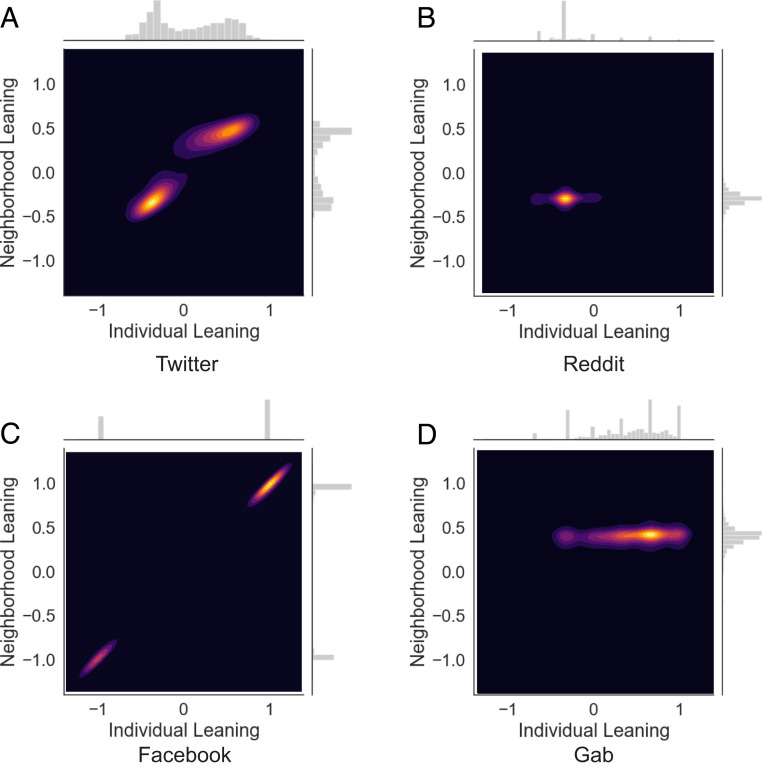
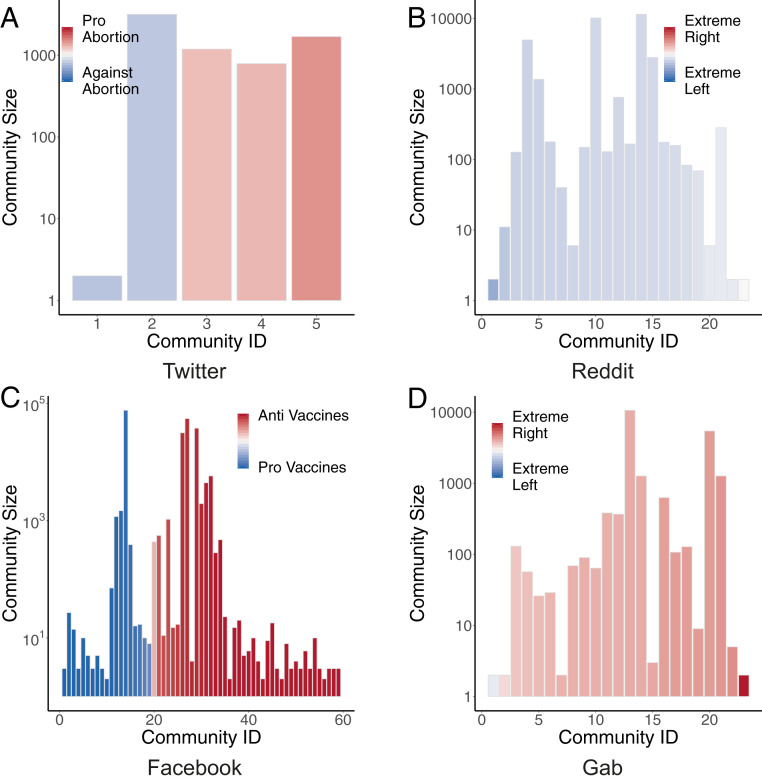
- Across the four platforms, “aggregation in homophilic clusters of users dominates online dynamics,” but platforms differ: Facebook and Twitter show homophilic clustering, while Reddit and Gab form a single community biased left or right rather than two opposing clusters.
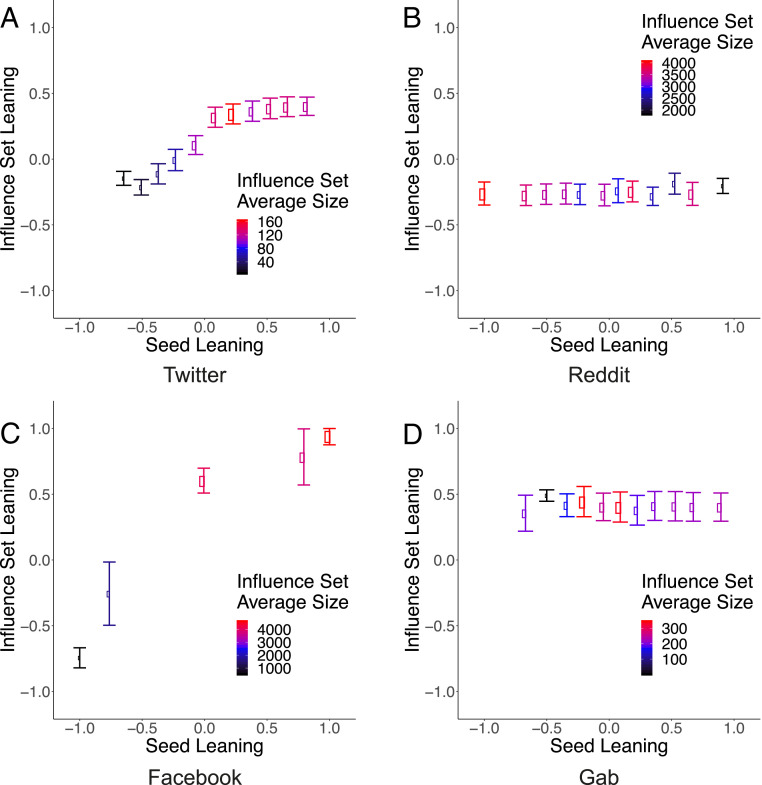
- Information diffusion is biased toward like-minded users on Facebook and Twitter, where the average leaning of a user’s influence set approximates the seed user’s leaning; on Reddit and Gab, the average leaning of the influence set does not depend on the seed user’s leaning.
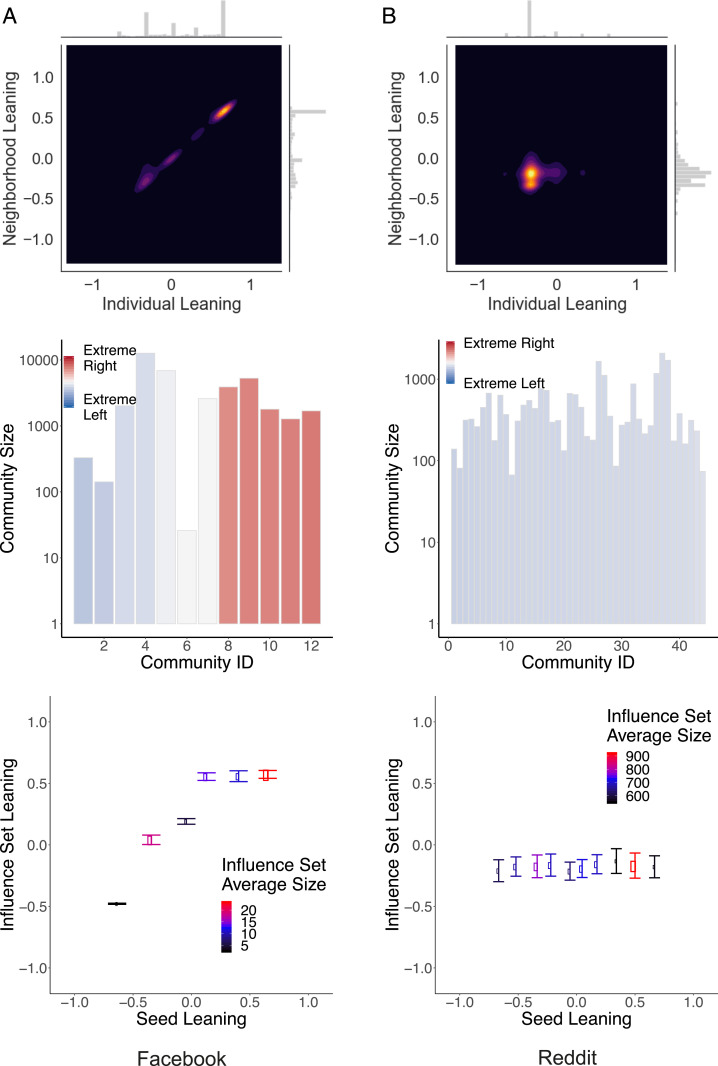
- In a direct comparison on news consumption, Facebook shows higher segregation than Reddit across all three measures: user-neighbor leaning correlation, community leaning, and SIR influence-set leaning.
- The study analyzes more than 100 million unique pieces of content and more than 1 million active users, with news outlets labeled using 2,190 media sources from Media Bias/Fact Check.
Methods
- Comparative analysis of Gab, Facebook, Reddit, and Twitter datasets on controversial topics including gun control, Obamacare, abortion, vaccines, science versus conspiracy, and news; main selected datasets were Abortion (Twitter), Vaccines (Facebook), Politics (Reddit), and Gab as a whole.
- Echo chambers were operationalized through two dimensions: homophily in interaction networks and bias in information diffusion toward like-minded peers. User leaning was inferred from linked news outlets, likes, or content, and interaction networks were built from follows, comments, cocomments, submissions, or replies depending on platform.
- Analyses included correlation between user leaning and average neighbor leaning, Louvain community detection, and SIR simulations to measure influence sets; SIR recovery rate was fixed at ν = 0.2, with dataset-specific infection ratios.
Limitations
- The paper states that the next envisioned step is to address the temporal dimension of echo chambers and how platform-specific social feedback mechanisms impact their formation.
- Evident from the text: leaning coverage varies strongly by platform, from 0.90–1.00 for Twitter/Facebook datasets to 0.15–0.20 for Reddit and 0.13 for Gab, so leaning-based conclusions for Reddit and Gab rest on a small classified fraction of users.
- Evident from the text: datasets differ by platform and topic, and the direct cross-platform comparison on a common topic is limited to news consumption on Facebook and Reddit; the authors also note that Reddit/Gab results could mean either no echo-chamber effect or observation inside a single echo chamber.
Model-written summary. Check it against the paper before relying on it.
Integrity signals
Registry
Cites
Statistics
Figures
Verification
Claims the paper makes
8 Valid · 1 Not valid · 7 Not checked · 38 Own results and interpretations
The cited sources support only part of this claim — read each source’s verdict below.
In the paper
“Selective exposure (19) and confirmation bias (20) (i.e., the tendency to seek information adhering to preexisting opinions) may explain the emergence of echo chambers on social media (1, 17, 21, 22).”
§ The echo chamber effect on social media > Abstract
What the sources say
- Supportedcites [1] M. Del Vicario, The spreading of misinformation online. Proc. Natl. Acad. Sci. U.S.A. 113, 554– 559 (2016). 26729863 PMC4725489 source
The Abstract says selective exposure generates homogeneous clusters, which it calls echo chambers. The Results and Discussion section says users select content matching a narrative and suggests confirmation bias determines echo-chamber formation. Page numbers are not provided in our copy. (LLM, conf=0.94)
- Partly supportedcites [17] K. Garimella, G. De Francisci Morales, A. Gionis, M. Mathioudakis, “ The effect of collective attention on controversial debates on social media” in WebSci ’17: 9th International ACM Web Science Conference (Association for Computing Machinery, New York, NY, 2017), pp. 43– 52. sourceExperimental — accuracy not yet measured
The Introduction reports that users mostly interact within their own side and endorse opinions from that side’s core. Related Work reports that users spread information faster when it agrees with their position. These passages are consistent with selective exposure, but the paper does not identify confirmation bias or establish that either tendency causes echo chambers to emerge. (LLM, conf=0.82)
- Supportedcites [21] M. Del Vicario, Echo chambers: Emotional contagion and group polarization on Facebook. Sci. Rep. 6, 37825 (2016). 27905402 PMC5131349 source
The Abstract says social-media disintermediation encourages users to select information that fits their beliefs (confirmation bias) and form like-minded groups (echo chambers). The Conclusions likewise describe Facebook as suited to the emergence of echo chambers. This supports the proposed explanation, without claiming it is the only cause. (LLM, conf=0.93)
- Supportedcites [22] A. Bessi, Science vs conspiracy: Collective narratives in the age of misinformation. PloS One 10, e0118093 (2015). 25706981 PMC4338055 source
The Introduction (page unavailable) says users consuming opposing information tend to form isolated clusters and describes polarized users whose likes are almost exclusively on one category of pages. The Conclusions (page unavailable) link information evaluation to existing beliefs. Together, these passages support the hedged explanation that selective exposure and confirmation bias may contribute to echo chambers. (LLM, conf=0.86)
hedgedstates a possible cause- Asserted: passes — The authors put it forward as true.
- Checkable: passes — It can be checked against evidence.
- Load-bearing: passes — The paper’s conclusions depend on it.
- Based: passes — The paper gives a reason why it holds.
- Supported
The cited sources support only part of this claim — read each source’s verdict below.
In the paper
“Our attention span remains limited (9, 10), and feed algorithms might limit our selection process by suggesting contents similar to the ones we are usually exposed to (11–13).”
§ The echo chamber effect on social media > Abstract
What the sources say
- Not checked — no full text of the sourcecites [11] A. L. Schmidt, Anatomy of news consumption on Facebook. Proc. Natl. Acad. Sci. U.S.A. 114, 3035– 3039 (2017). 28265082 PMC5373354 source
- Partly supportedcites [12] M. Cinelli, The COVID-19 social media infodemic. Sci. Rep. 10, 16598 (2020). 33024152 PMC7538912 sourceExperimental — accuracy not yet measured
The Introduction (page not provided) says algorithms take users’ preferences and attitudes into account when promoting content, and that users tend to seek information aligned with their worldviews. It does not say that feed algorithms suggest content similar to what users have previously seen or thereby limit their selection. (LLM, conf=0.82)
- Not checked — no full text of the sourcecites [13] E. Bakshy, S. Messing, L. A. Adamic, Exposure to ideologically diverse news and opinion on Facebook. Science 348, 1130– 1132 (2015). 25953820 source
hedgedstates a possible cause- Asserted: passes — The authors put it forward as true.
- Checkable: passes — It can be checked against evidence.
- Load-bearing: passes — The paper’s conclusions depend on it.
- Based: passes — The paper gives a reason why it holds.
Every source the paper cites for this claim was checked and supports it.
In the paper
“Online polarization, for instance, may foster misinformation spreading (1, 8).”
§ The echo chamber effect on social media > Abstract
What the sources say
- Supportedcites [1] M. Del Vicario, The spreading of misinformation online. Proc. Natl. Acad. Sci. U.S.A. 113, 554– 559 (2016). 26729863 PMC4725489 source
The Significance section says that homogeneity and polarization are main determinants of rumor-cascade size. The Conclusions also link polarized communities with the proliferation of narratives fueled by unsubstantiated rumors, supporting the hedged claim that online polarization may foster misinformation spreading. (LLM, conf=0.91)
- Supportedcites [8] M. D. Vicario, W. Quattrociocchi, A. Scala, F. Zollo, Polarization and fake news: Early warning of potential misinformation targets. ACM Trans. Web 13, 1– 22 (2019). source
The Introduction states that misinformation spreading on social media is directly related to increasing user polarization and segregation. This supports the citing sentence’s hedged claim that online polarization may foster misinformation spreading. (LLM, conf=0.94)
hedgedstates a possible cause- Asserted: passes — The authors put it forward as true.
- Checkable: passes — It can be checked against evidence.
- Load-bearing: unclear — It is unclear whether the paper’s conclusions depend on it.
- Based: passes — The paper gives a reason why it holds.
- Supported
Every source the paper cites for this claim was checked and supports it.
In the paper
“In network terms, this translates into a node i with a given leaning xi more likely to be connected with nodes with a leaning close to xi (18).”
§ The echo chamber effect on social media > Comparative Analysis > Polarization and Homophily in the Interaction Networks.
What the sources say
- Supportedcites [18] W. Cota, S. C. Ferreira, R. Pastor-Satorras, M. Starnini, Quantifying echo chamber effects in information spreading over political communication networks. EPJ Data Sci. 8, 35 (2019). source
The paper’s “Topological evidence of echo chambers” section says that a node with political position Pᵢ is connected with nodes whose positions are close to Pᵢ. It also reports a strong correlation between users’ positions and their neighbors’ average positions, supporting the citing sentence’s probabilistic paraphrase. (LLM, conf=0.94)
hedgedstates an association- Asserted: passes — The authors put it forward as true.
- Checkable: passes — It can be checked against evidence.
- Load-bearing: passes — The paper’s conclusions depend on it.
- Based: passes — The paper gives a reason why it holds.
- Supported
A result the paper reports from its own data — it cites no other source for it, so there is none to check. The quote shows it is in the paper.
In the paper
“Furthermore, the almost total absence of communities with leaning very close to 0 confirms the polarized state of the systems.”
§ The echo chamber effect on social media > Comparative Analysis > Polarization and Homophily in the Interaction Networks.
boostedstates a cause- Asserted: passes — The authors put it forward as true.
- Checkable: passes — It can be checked against evidence.
- Load-bearing: passes — The paper’s conclusions depend on it.
- Based: passes — The paper gives a reason why it holds.
- Rests on 4 assumptions not shown here.
32 more claims
Create a free account to see all 54 claims and to verify the 2 references still open.
- It may state two separate claims as one. 9
- Probably not a substantial claim. 9
Claims other papers make about this one
Each is checked against this paper’s own text: does it say what the citing paper says it does?
The source backs part of the claim, not all of it — or backs it for a different population, condition or comparison.
In the citing paper
“engagement with political content online is generally associated with high levels of ingroup bias; that is, it is far more likely to be shared within the political ingroup than in the outgroup (18, 19, 16).”
From Troll and divide: the language of online polarization (2022) · cites this paper as [16]
Experimental — accuracy not yet measuredThe source backs part of the claim, not all of it — or backs it for a different population, condition or comparison.
In the citing paper
“This challenge is reflected in research on”
From Machine culture (2023) · cites this paper as [142]
Experimental — accuracy not yet measuredThe source backs part of the claim, not all of it — or backs it for a different population, condition or comparison.
In the citing paper
“Thus, combating social media's echo chamber effect through an active exposure to diverse perspectives and networks also represents a viable individual-level strategy for addressing the deepfake problem (Cinelli et al., 2021; Gillani et al., 2018).”
From Deepfakes: Deceptions, mitigations, and opportunities (2023) · cites this paper as Cinelli et al., 2021
Experimental — accuracy not yet measuredThe source backs part of the claim, not all of it — or backs it for a different population, condition or comparison.
In the citing paper
“Even without being designed to shift opinions, it has been found that algorithms may contribute to political polarization by reinforcing divisive opinions [9, 24, 32].”
From Co-Writing with Opinionated Language Models Affects Users’ Views (2023) · cites this paper as [32]
Experimental — accuracy not yet measuredThe source backs part of the claim, not all of it — or backs it for a different population, condition or comparison.
In the citing paper
“On Reddit, studies find minimal evidence of echo chambers due to platform features encouraging cross-cutting exposure [17,61,63].”
From A systematic review of echo chamber research: comparative analysis of conceptualizations, operationalizations, and varying outcomes (2025) · cites this paper as [17]
Experimental — accuracy not yet measured
5 more claims about this paper
Create a free account to see every claim other papers make about this one.
Citations
Cites
Fast unfolding of communities in large networks
Blondel, V. D., Guillaume, J.-L., Lambiotte, R., & Lefebvre, E. (2008) · Journal of Statistical Mechanics: Theory and Experiment · doi:10.1088/1742-5468/2008/10/p10008 · Cited by 21,424 · cited 1×
“We detected communities by applying the Louvain algorithm (41), removing singleton communities with only one user.”
MethodThe spread of true and false news online
Vosoughi, S., Roy, D., & Aral, S. (2018) · Science · doi:10.1126/science.aap9559 · Cited by 8,847 · cited 1×
“A recent study (7) limited to Twitter claimed that fake news travels faster than real news.”
BackgroundConfirmation Bias: A Ubiquitous Phenomenon in Many Guises
Nickerson, R. S. (1998) · Review of General Psychology · doi:10.1037/1089-2680.2.2.175 · Cited by 7,267 · cited 1×
“Selective exposure (19) and confirmation bias (20) (i.e., the tendency to seek information adhering to preexisting opinions) may explain the emergence of echo chambers on social media (1, 17, 21, 22).”
BackgroundInfectious Diseases of Humans: Dynamics and Control
Anderson, R. M., & May, R. M. (1991) · doi:10.1093/oso/9780198545996.001.0001 · Cited by 6,179
Lazer, D. M. J., Baum, M. A., Benkler, Y., Berinsky, A. J., Greenhill, K. M., Menczer, F., Metzger, M. J., Nyhan, B., Pennycook, G., Rothschild, D., et al. (2018) · Science · doi:10.1126/science.aao2998 · Cited by 4,160
Degroot, M. H. (1974) · Journal of the American Statistical Association · doi:10.1080/01621459.1974.10480137 · Cited by 4,004 · cited 1×
“For instance, if opinions are assumed to be embedded in a onedimensional space (38), x ∈ [−1,+1] without loss of generality, as usual for controversial topics, then polarization is characterized by two well-separated peaks in P(x ), for positive and negative opinions.”
BackgroundExposure to ideologically diverse news and opinion on Facebook
Bakshy, E., Messing, S., & Adamic, L. A. (2015) · Science · doi:10.1126/science.aaa1160 · Cited by 3,245 · cited 2×
“Our attention span remains limited (9, 10), and feed algorithms might limit our selection process by suggesting contents similar to the ones we are usually exposed to (11–13).”
BackgroundThe spreading of misinformation online
Del Vicario, M., Bessi, A., Zollo, F., Petroni, F., Scala, A., Caldarelli, G., Stanley, H. E., & Quattrociocchi, W. (2016) · Proceedings of the National Academy of Sciences · doi:10.1073/pnas.1517441113 · Cited by 2,407 · cited 2×
“, the tendency to seek information adhering to preexisting opinions) may explain the emergence of echo chambers on social media (1, 17, 21, 22).”
BackgroundSelf-citationThe COVID-19 social media infodemic
Cinelli, M., Quattrociocchi, W., Galeazzi, A., Valensise, C. M., Brugnoli, E., Schmidt, A. L., Zola, P., Zollo, F., & Scala, A. (2020) · Scientific Reports · doi:10.1038/s41598-020-73510-5 · Cited by 2,313
Self-citationFilter Bubbles, Echo Chambers, and Online News Consumption
Flaxman, S., Goel, S., & Rao, J. M. (2016) · Public Opinion Quarterly · doi:10.1093/poq/nfw006 · Cited by 1,992
Research works printed but not linked: 2
- R. M. Anderson, R. M. May, Infectious Diseases in Humans (Oxford University Press, Oxford, United Kingdom, 1992).
- M. Cinelli, G. De Francisci Morales, A. Galeazzi, W. Quattrociocchi, M. Starnini, The echo chamber effect on social media. Open Science Framework. https://osf.io/x92br/?view_only=cdcc87d30e404e01b6ae316db15e3375. Deposited 22 January 2021. PMC7936330 33622786
Cited by
Items 1,201–1,300 of 2,063
Menganalisis Jaringan Sosial Penggemar Blackpink Saat Konser di Jakarta
Anggorosuryo, I., Berto, A. R., & eko, B. S. (2024) · Jurnal Komunikasi Profesional · doi:10.25139/jkp.v8i1.7634 · Cited by 1
Duskin, K. (2024) · ACM Web Science Conference (WebSci) · doi:10.1145/3630744.3658615 · Cited by 2
“Some studies have focused on political echo chambers [11, 23], and their relationship to online political polarization [14, 22, 24, 33] while others have focused on the spread of misinformation [17, 36].”
BackgroundRek, M. (2024) · Contributions to political science · doi:10.1007/978-3-031-56045-3_8 · Cited by 8
Unveiling the reproduction number scaling in characterizing social contagion coverage
Wang, X., Hou, H., Lu, D. Z., Wu, Z., & Moreno, Y. (2024) · Chaos Solitons & Fractals · doi:10.1016/j.chaos.2024.115119 · Cited by 2
Barański, J., & Smereka, J. (2024) · Kwartalnik Historii Nauki i Techniki · doi:10.4467/0023589xkhnt.24.013.19818 · Cited by 1
Positive Communities on Signed Graphs That Are Not Echo Chambers: A Clique-Based Approach
Zhou, A., Wang, Y., Chen, L., & ÖZSU, M. T. (2024) · IEEE International Conference on Data Engineering (ICDE) · doi:10.1109/icde60146.2024.00199 · Cited by 4
“From the other perspective, let us consider the concept of an ‘echo chamber’ [10] (potentially found through ‘polarised community’ search [9], [46]).”
BackgroundIrreversibility in belief dynamics: Unraveling the link to cognitive effort
Vodret, M. (2024) · Physical review. E · doi:10.1103/physreve.110.014304 · Cited by 1
Screen Time and Identity Formation: A Digital Dilemma
BAYDİLİ, I. (2024) · Advances in human and social aspects of technology book series · doi:10.4018/979-8-3693-3350-1.ch023 · Cited by 1
The Role of New Media Technologies in Epidemics -- Taking the 2014 Ebola outbreak as an example
Yao, Y. (2024) · Highlights in Science Engineering and Technology · doi:10.54097/whrnhe60 · Cited by 1
“…to misbehavior in the general population, especially in those who cannot easily identify misinformation and distinguish between misleading information and health facts, such as panic buying and unprotected mass gatherings [23], and the action to drink saline and bleach to fight against the virus.”
BackgroundKahn, M., Whittall, H., & Tikotzky, L. (2024) · Elsevier eBooks · doi:10.1016/b978-0-323-82759-1.00023-0 · Cited by 1
RumorMixer: Exploring Echo Chamber Effect and Platform Heterogeneity for Rumor Detection
Xu, H., Gao, C., Li, X., & Wang, Z. (2024) · Lecture notes in computer science · doi:10.1007/978-3-031-70341-6_2 · Cited by 1
Infodemic: Social Media and the Amplification of the COVID-19 Crisis in Canada
Banyongen, S. (2024) · Open Journal of Social Sciences · doi:10.4236/jss.2024.129015 · Cited by 1
From Mass Media to Social Media: Political Persuasion in the Field of Communication
Jordá, B., & Holbert, R. L. (2024) · Springer eBooks · doi:10.1007/978-3-031-70231-0_11 · Cited by 4
Maximizing diversity and persuasiveness of opinion articles in social networks
Du, L., Yang, W., & Gao, S. (2024) · Journal of Combinatorial Optimization · doi:10.1007/s10878-024-01226-7 · Cited by 1
“Recent years have witnessed a number of studies on the effects of echo chambers and opinion polarization (Cinelli et al. 2021; Sunstein 2002; Esteve Del Valle and Borge Bravo 2018; Xing et al. 2022; Balietti et al. 2021; Currin et al. 2022; Wu et al. 2023; Sobkowicz 2023).”
Weintraub, L. (2024) · Communications in computer and information science · doi:10.1007/978-3-031-76332-8_21 · Cited by 2
Elnur, A. (2024) · Yegah Müzikoloji Dergisi · doi:10.51576/ymd.1561980 · Cited by 3
Analyst cliques coverage and the speed of leverage adjustment: Evidence from China
Ouyang, H., Liu, X., & Huang, K. (2024) · International Review of Economics & Finance · doi:10.1016/j.iref.2024.103731 · Cited by 3
Problem Channel Dakwah Melalui Media Sosial dalam Memupuk Toleransi Beragama di Indonesia
Azharghany, R., Agustin, L. K., & Andina, E. E. P. (2024) · J-KIs Jurnal Komunikasi Islam · doi:10.53429/j-kis.v5i2.1145 · Cited by 1
“Lebih lanjut, algoritma media sosial yang cenderung memperlihatkan konten yang serupa dengan preferensi pengguna dapat memperkuat bias dan membentuk "echo chamber" yang mempersempit pandangan (Cinelli et al., 2021).”
Nostalgia as a Critique of Europe: Reflections from Contemporary Greece
Zestanakis, P. (2024) · European Review · doi:10.1017/s1062798724000243 · Cited by 1
Santavicca, T., Vanier-Clément, A., Arnaud, P. S., Hassan, G., & Rousseau, C. (2025) · International Journal of Child and Adolescent Resilience · doi:10.54488/ijcar.2024.355 · Cited by 4
Toxic language based echo chambers on the Incels.net community: A network analysis approach
Janssen, M., Zucca, C., Cascavilla, G., & Cuzzocrea, A. (2024) · IEEE International Conference on Big Data (BigData) · doi:10.1109/bigdata62323.2024.10825922
Combating Echo Chambers in Online Social Network by Increasing Content Diversity in Recommendation
Alam, M. J., Hossain, I., Puppala, S., & Talukder, S. K. (2025) · Lecture notes in computer science · doi:10.1007/978-3-031-78554-2_16 · Cited by 2
A Probabilistic Reasoning Framework to Detect Fake News on Social Media
Rashid, M., Anber, F., Samiullah, M., Ahmed, C. F., Leung, C. K.-S., & Pazdor, A. G. M. (2025) · International Conference on Ubiquitous Information Management and Communication (IMCOM) · doi:10.1109/imcom64595.2025.10857565 · Cited by 2
Redden, S. M., & Way, A. K. (2025) · Western Journal of Communication · doi:10.1080/10570314.2025.2453719 · Cited by 3
“Given the personalized nature of social media algorithms and the phenomenon of echo chambers, people may be surrounded by content that is tailored to them or echoes their own opinions (Cinelli et al., 2021).”
Ramírez‐Cifuentes, D., Baeza-Yates, R. A., Lozano, M., & Freire, A. (2025) · PLoS ONE · doi:10.1371/journal.pone.0312766 · Cited by 2
Yang, G. H., Zhao, L., Liang, Y., & Wang, Z. (2025) · Journalism Practice · doi:10.1080/17512786.2025.2464192 · Cited by 1
“As the push algorithm of SMPs continuously aggravates the echo chamber effect (Cinelli et al. 2021), it strengthens the overlap of the cognitive framework between the individuals in misinformation cocoons and the bloggers who are disseminating the misinformation (Entman 1993; Scheufele and…”
Good and Bad Science? Spanish-Speaking YouTube Users’ Comments on Science Content
Serrano-Contreras, I.-J., Marin, J. G., & Luengo, Ó. G. (2024) · International Journal of Public Opinion Research · doi:10.1093/ijpor/edae045 · Cited by 1
An Innovative Study of the Role of Public Diplomacy in Examining the ‘Anti‐Korean Wave’ on YouTube
Park, J. C., & Park, H. W. (2025) · Asia Pacific Viewpoint · doi:10.1111/apv.12443 · Cited by 3
Knowledge Sharing in Security-Sensitive Communities
Rusho, Y., Raban, D. R., Siman-Tov, D., & Ravid, G. (2025) · Future Internet · doi:10.3390/fi17040144 · Cited by 2
Investigating Jurors’ Lay Theories About Hate Crimes, Offenders, and Victims: Do They Match the Law?
Giannetta, T. S., Cunius, M. K., & Miller, M. K. (2025) · Advances in psychology and law · doi:10.1007/978-3-031-82806-5_7 · Cited by 1
Turska–Kawa, A., & Pilch, I. (2025) · Communication Today · doi:10.34135/communicationtoday.2025.vol.16.no.1.8 · Cited by 2
Jung, Y.-H., & Wang, A. H. (2025) · Information Communication & Society · doi:10.1080/1369118x.2025.2492578 · Cited by 1
“For clarity, we de fi ne echo chambers as ‘ environments in which the opinion, political leaning, or belief of users about a topic gets reinforced due to repeated interactions with peers or sources having similar tendencies and attitudes ’ (Cinelli et al., 2021, p. 1).”
Thota, B. K., & Liu, X. F. (2025) · Social Network Analysis and Mining · doi:10.1007/s13278-025-01422-1 · Cited by 3
“…made concerning different aspects of online discourse such as echo chambers (Karlsen et al 2017; Orbach et al 2020; Terren and Borge-Bravo 2021; Cinelli et al 2021), where only like-minded users discuss ideas with one another which isolates them from diverse opinions, viewpoints, and ideas,…”
Cooper, C., Fahey, K. T., & Jones, R. (2025) · PLoS ONE · doi:10.1371/journal.pone.0324507 · Cited by 1
“Other studies finding homophilic interactions cover US climate policy networks [7] and social media [17].”
Verdear, D., Johnson, N. F., & Wuchty, S. (2025) · npj Complexity · doi:10.1038/s44260-025-00042-2 · Cited by 1
“In the domain of social media stock traders, such groups are more likely to share common stock purchasing motivations and their rhetoric can be more effective at framing the decision tobuy amemestock 34,35 .”
Wang, M., Hu, Y., Wu, S., Li, W., Bai, Q., & Rupar, V. (2025) · IEEE Transactions on Computational Social Systems · doi:10.1109/tcss.2025.3573074 · Cited by 5
“Cinelli et al. explored the echo chamber effect on social media platforms, demonstrating how algorithmic filtering can reinforce existing beliefs by clustering users around ideologically homogeneous content [40].”
E-government and ideological polarization: A cross-national study of political communication
Danowski, J. A. (2025) · Technology in Society · doi:10.1016/j.techsoc.2025.102998 · Cited by 5
Disinformed Democracies: How Belief Systems and Social Platforms Undermine Public Trust
Silveira, G. A., & Roazzi, A. (2025) · Revista de Gestão e Secretariado (Management and Administrative Professional Review) · doi:10.7769/gesec.v16i6.5065 · Cited by 4
Luo, Y., & Choi, J.-A. (2025) · Public Relations Review · doi:10.1016/j.pubrev.2025.102613 · Cited by 8
Order–disorder–order transitions and winning margins’ scaling in kinetic exchange opinion model
Biswas, S., Annapurna, M. S., Jakkampudi, V., et al. (2025) · International Journal of Modern Physics C · doi:10.1142/s0129183126500191 · Cited by 1
A Review of Group Polarization Research from a Dynamics Perspective
Fu, W., Zhu, R., Liu, S., Lu, X. B., & Li, B. (2025) · Journalism and Media · doi:10.3390/journalmedia6030144 · Cited by 3
“Hong and Kim (2016), Schmidt et al. (2018), Brady et al. (2020), Cinelli et al. (2021), Van Bavel et al. (2021), and Hobolt et al. (2023) argued that social media platforms lead individuals into echo chambers and stimulate conflicts among groups, thereby exacerbating group polarization.”
Eide, M. L., & Hoff, H. E. (2025) · Universitetsforlaget eBooks · doi:10.18261/9788215072722-25-08 · Cited by 3
Chen, Y., Dai, X., BUSS, M. J., & Liu, F. (2025) · IEEE Transactions on Computational Social Systems · doi:10.1109/tcss.2025.3604387 · Cited by 1
“Xiaobing Dai is with the Chair of Information-Oriented Control (ITR), School of Computation, Information and Technology (CIT), Technical University of Munich (TUM), 80333 Munich, Germany (e-mail: xiaobing.dai@ tum.de).”
Chuai, Y., Zhao, J., & Lenzini, G. (2025) · Proceedings of the ACM on Human-Computer Interaction · doi:10.1145/3757479 · Cited by 3
The Mutual Reinforcement of Populism and Post-Truth in Undermining Deliberative Democracy
Loobuyck, P., & Lukić, V. (2025) · Res Publica · doi:10.1007/s11158-025-09734-x · Cited by 2
“While not all users are trapped in such environments, those who are appear more susceptible to misinformation and conspiracies (Cinelli et al. 2021; Törnberg 2018).”
Social Identity, Self-Uncertainty, and Violent Extremism
Hogg, M. A. (2025) · Cambridge University Press eBooks · doi:10.1017/9781009407892.015 · Cited by 2
Ghisi, F., Gotelli, M., Solina, V., & Tonelli, F. (2025) · Applied Sciences · doi:10.3390/app152111734 · Cited by 3
The Promise of Generative AI for Personalized Persuasion
Teeny, J. D., Klugescheid, K., Luther, J., & Matz, S. (2026) · Current Directions in Psychological Science · doi:10.1177/09637214261424859 · Cited by 4
“For example, social media algorithms already funnel people into echo chambers (i.e., closed networks that reinforce similar beliefs; Cinelli et al., 2021), and GenAI-based personalized per-suasion stands to further amplify this trend.”
Digitalisierung und Demokratie: Ethische Perspektiven
Grimm, P., & Zöllner, O. (2020) · Franz Steiner Verlag eBooks · doi:10.25162/9783515128278 · Cited by 1
We Hold These Distruths to be Self-Evident: How Legal History Could Save America from Itself
Murphy, W. (2021) · Journal of global awareness · doi:10.24073/jga/2/02/03
“and its algorithms where users consistently receive increasing doses of only that which they are inclined to believe and none of which they are not divides society and, further, greatly diminishes the ability to listen, learn, debate, and collaboratively confront pressing challenges where necessary (Cinelli et al., 20…”
BackgroundMarcinkowski, F., & Philipps, G. (2021) · Springer eBooks · doi:10.1007/978-3-658-30074-6_11-1 · Cited by 1
Research on the Rapid Growth of the Chamber Effect on Social Media
Chen, Z. (2022) · Advances in Social Science, Education and Humanities Research/Advances in social science, education and humanities research · doi:10.2991/assehr.k.220105.030 · Cited by 1
Chen, C.-W., & Wei, J. C.-C. (2022) · Journal of Medical Internet Research · doi:10.2196/34437 · Cited by 1
“Furthermore, the echo chamber effect on social media could also result in the limitation of patient recruitment [4].”
BackgroundActores políticos y promoción de contenidos desinformativos en Twitter. Caso España
Said-Hung, E. M., & Ocarranza-Prado, I. (2022) · Sociedade e Estado · doi:10.1590/s0102-6992-202237020009 · Cited by 4
Liu, J. (2023) · The information retrieval series · doi:10.1007/978-3-031-23229-9_6 · Cited by 1
The Spread of Beliefs in Partially Modularized Communities
Goldstone, R. L., Dubova, M., Aiyappa, R., & Edinger, A. (2023) · Perspectives on Psychological Science · doi:10.1177/17456916231198238 · Cited by 1
“For example, people are far more likely to connect to others on social media sites who share their beliefs and are more likely to spread information to like-minded others (Cinelli et al., 2021).”
BackgroundLampe, I., Sari, D. F. K., Limiyanto, P., & Saputra, G. B. R. (2023) · Jurnal Komunikasi Malaysian Journal of Communication · doi:10.17576/jkmjc-2023-3904-03
The Weaponisation of the Internet – effect models
McLoughlin, I. V. (2023) · International Conference on Applied Computational Intelligence in Information Systems (ACIIS) · doi:10.1109/aciis59385.2023.10367334 · Cited by 2
“This kind of effect, in a social media setting gives rise to an ‘echo chamber’ [20].”
BackgroundShiva, B. K. (2024) · Advances in human and social aspects of technology book series · doi:10.4018/979-8-3693-1127-1.ch014 · Cited by 1
Characterizing Abhorrent, Misinformative, and Mistargeted Content on YouTubePreprint
Papadamou, K. (2021) · arXiv (Cornell University) · doi:10.48550/arxiv.2105.09819 · Cited by 6
Ganderton, P. (2022) · Oxford University Press eBooks · doi:10.1093/obo/9780199830060-0238 · Cited by 1
Interactive crowdsourcing to fact-check politiciansPreprint
Espina-Mairal, S., Bustos, F., Solovey, G., & Navajas, J. (2022) · doi:10.31234/osf.io/u9eyw · Cited by 1
Political comedy and the public sphere
Keren, R. (2022) · Digital Repository Service (Northeastern University) · doi:10.17760/d20467298 · Cited by 1
Escape from fraught states in a coordination gamePreprint
Tabor, W., Smith, G., & Dankowicz, H. J. (2023) · doi:10.31219/osf.io/e5ztf · Cited by 1
It's a Mean, Mean World: Social Media and Mean World Syndrome
Kemp, S. E. (2023) · doi:10.15760/honors.1333 · Cited by 1
“…to improve engagement, personalized social media algorithms promote content to users that they may find interesting, relevant, or in alignment with their views, regardless of whether that content is helpful or harmful to their overall wellbeing (Cinelli et al., 2021; Patro et al., 2018).”
BackgroundResultMorrell, S. (2023) · doi:10.33774/apsa-2023-zjrvt · Cited by 5
Silva, M. D. P. S. (2023) · Digital Library of Theses and Dissertations (Universidade de São Paulo) · doi:10.11606/d.5.2023.tde-04082023-163649 · Cited by 5
Affective Polarization and Dynamics of Information Spread in Online NetworksPreprint
Lerman, K., Feldman, D., He, Z., & Rao, A. (2024) · Research Square · doi:10.21203/rs.3.rs-3855114/v1 · Cited by 3
Walker, A. C., Fugelsang, J. A., & Koehler, D. J. (2024) · PsyArXiv (OSF Preprints) · doi:10.31234/osf.io/kxard · Cited by 1
Deans-Browne, C., & Singmann, H. (2024) · PsyArXiv (OSF Preprints) · doi:10.31234/osf.io/x6ehu · Cited by 1
Bánkuty-Balogh, L. S. (2024) · CUB Ph.D. Dissertations (Corvinus University of Budapest) · doi:10.14267/phd.2024016 · Cited by 7
A Simple Model of Global Cascades in Signed NetworksPreprint
Ke, X., Wen, Y., Yu, H., et al. (2024) · SSRN Electronic Journal · doi:10.2139/ssrn.4834448 · Cited by 1
A Role for News Media in Mass Polarization during the COVID-19 PandemicPreprint
Ye, W., Aron, L., & Gondwe, G. (2024) · doi:10.33774/apsa-2024-8605t · Cited by 1
Information and Self-Organization in Complex Networks
Culbreth, G. T. (2021) · University of North Texas Digital Library (University of North Texas) · doi:10.12794/metadc1873551 · Cited by 1
THE IMPACT OF INTERNET CONNECTIVITY IN NAVIGATING ONLINE SOCIAL NETWORKS: A CROSS-COUNTRY ANALYSISPreprint
Matlack, A. K., Boots, B. C., & Richardson-Gool, T. S. (2025) · SSRN Electronic Journal · doi:10.2139/ssrn.5208556 · Cited by 1
Patterns, Models, and Challenges in Online Social Media: A SurveyPreprint
Marco, A. D., Bonetti, A., Martino, E. D., Loru, E., Nudo, J., Pandolfo, M. E., Pecile, G., Sangiorgio, E., Scalco, I., Zollo, S., et al. (2025) · SSRN Electronic Journal · doi:10.2139/ssrn.5355426 · Cited by 1
Self-citationWhen the Ground Shakes: Social Media Responses to the 2024 Northeast EarthquakePreprint
Dadson, Y. A., & Akekudaga, P. (2025) · SSRN Electronic Journal · doi:10.2139/ssrn.5462365 · Cited by 1
From TikTok to RedNote: Platform Migration as Resistance in Geopolitical TensionsPreprint
Liang, S., Luo, J., & Chae, J. H. (2025) · SSRN Electronic Journal · doi:10.2139/ssrn.5793802 · Cited by 1
He, S., Ma, C., Zhang, C., Jenkins, A. D. G., Abu-Salma, R., & Such, J. M. (2026) · CHI Conference on Human Factors in Computing Systems · doi:10.1145/3772318.3790961 · Cited by 1
“Our findings (see §4.2.4) indicate that viral reports of violence against Chinese YWLA create echo chambers that amplify perceptions of vulnerability and reinforce aggressive protection narratives [17, 44].”
InfluentialConflicting Rationales, Shifting Stances: Unpacking User Divergence in Online Geopolitical Debates
He, Y., Zhang, P., Haq, E.-U., He, J. X., & Tyson, G. (2026) · CHI Conference on Human Factors in Computing Systems · doi:10.1145/3772318.3790382 · Cited by 2
“Subsequently, we detect the graph communities using the Lou-vain algorithm [6, 15] in both networks.”
Popowski, L., Wu, X., Zhu, X., Piccardi, T., & Bernstein, M. S. (2026) · CHI Conference on Human Factors in Computing Systems · doi:10.1145/3772318.3791569 · Cited by 8
“For years, users have bemoaned the tyranny of platform-enforced, engagement-optimizing AI feed algorithms that control the content they see on social media [5, 14, 17].”
Zhang, S., Wang, L., Li, S., Wu, Y., Chuai, Y., Chen, L., Yi, X., & Li, H. (2026) · CHI Conference on Human Factors in Computing Systems · doi:10.1145/3772318.3790501 · Cited by 6
“However, this design mirrors specific high-exposure environments, such as “Echo Chamber” [22], where users are surrounded with high ratio of fake videos.”
Eating Disorder and Body Image Content
Branley-Bell, D. (2026) · Springer eBooks · doi:10.1007/978-3-031-52643-5_43-1 · Cited by 1
Yang, Z., Imouza, A., Puelma Touzel, M., Amadoro, C., Desrosiers-Brisebois, G., Pelrine, K., Levy, S., Godbout, J.-F., & Rabbany, R. (2026) · PLOS One · doi:10.1371/journal.pone.0347327 · Cited by 1
“Recent computational approaches increasingly draw on text embedding methods to study polarization, using contex-tualized representations to detect partisan divides across topics and communities [34–36].”
Wright, S. (2021) · Digital Commons - East Tennessee State University (East Tennessee State University)
Living Organ Donor Hesitancy about COVID-19 Vaccines: A New Kind of “Source Control Issue”
Jorgenson, M. R. (2021) · Kidney360 · doi:10.34067/kid.0003402021
“Social media algorithms favor the creation of echo-chambers in which your own predetermined views are repeatedly validated (5).”
BackgroundMayol, J. M. (2021) · British journal of surgery · doi:10.1093/bjs/znab244
Social physicsPreprint
Jusup, M., Holme, P., Kanazawa, K., Takayasu, M., Romić, I., Wang, Z., Geček, S., Lipić, T., Boris Podobnik, A., Wang, L., et al. (2021) · arXiv (Cornell University)
Should Governments Respond to Suspected Emotion-Driven Policy Bubbles? If Yes, How? If Not, Why Not?Preprint
Maor, M. (2021) · SSRN Electronic Journal · doi:10.2139/ssrn.3920860
Just Say No: Analyzing the Stance of Neural Dialogue Generation in Offensive ContextsPreprint
Baheti, A., Sap, M., Ritter, A., et al. (2021) · arXiv (Cornell University) · doi:10.48550/arxiv.2108.11830
“This trend could be explained by the tendency of social- media users to form echo-chambers (Cinelli et al., 2021; Soliman et al., 2019).”
BackgroundA Citizen's Guide to Navigating Information DisorderPreprint
Stecula, D. A. (2021) · OSF Preprints (OSF Preprints) · doi:10.31219/osf.io/bpwkd
Social aspects of Artificial Intelligence – selected issues
Kowalczyk, M. (2021) · Publisher House WSGE Alcide De Gasperi University of Euroregional Economy ul. Sienkiewicza 4 05-410 Józefów eBooks · doi:10.13166/wsge/psaz2564
Topic Selectivity and Adaptivity Promote Spreading of Short MessagesPreprint
Bojarski, P. A., Suchecki, K., & Hołyst, J. A. (2022) · Research Square · doi:10.21203/rs.3.rs-1232620/v1
Tracy, D. K., Joyce, D. W., Albertson, D. N., & Shergill, S. S. (2021) · The British Journal of Psychiatry · doi:10.1192/bjp.2021.41
Delmastro, M., & Paciello, M. (2022) · Research Square · doi:10.21203/rs.3.rs-1131403/v1
Rationally blind? Rationality polarizes policy support for colour blindness versus multiculturalism.Preprint
Keersmaecker, J. D., Schmid, K., Roets, A., & Goyal, N. (2022) · British Journal of Social Psychology · doi:10.31234/osf.io/x3z48 · Cited by 4
Digitalisierung und Demokratie: Eine Momentaufnahme
Mechnich, J., & Kallinich, D. (2019) · Journal für politische Bildung · doi:10.46499/1254.1679
Metadata
- Authors
- Cinelli, M., De Francisci Morales, G., Galeazzi, A., Quattrociocchi, W., & Starnini, M.
- Affiliations
- Ca' Foscari University of Venice (IT)
- Institute for Scientific Interchange (ISI) Foundation, 10126 Torino, Italy;
- University of Brescia (IT)
- University of Oslo (NO)
- Institute for Scientific Interchange (IT)
- Corresponding author
- Quattrociocchi, Walter
- ORCID
- Venue
- Proceedings of the National Academy of Sciences
- Publisher
- National Academy of Sciences
- Published
- 2021-02-23
- Volume
- 118
- Issue
- 9
- ISSN
- 0027-8424 (ISSN-L)
- 1091-6490
- PMC
- PMC7936330
- OpenAlex
- W3133423348
- Cited by
- 2,092
- References
- 62
- Citations by year
- 2026: 488 · 2025: 516 · 2024: 387 · 2023: 351 · 2022: 256 · 2021: 90
- FWCI
- 375.62
- Type
- journal article
- Language
- en
- Open access
- hybrid
- doi.org
- Licence
- Locations
- Proceedings of the National Academy of Sciences (publishedVersion, cc-by)
- PubMed Central (publishedVersion, cc-by)
- PubMed (publishedVersion)
- UPCommons institutional repository (Universitat Politècnica de Catalunya) (submittedVersion, cc-by)
- IRIS Research product catalog (Sapienza University of Rome) (submittedVersion)
- Padua Research Archive (University of Padova) (submittedVersion, cc-by)
- Topics
- Social Sciences › Sociology and Political Science › Misinformation and Its Impacts
- Social Sciences › Communication › Social Media and Politics
- Physical Sciences › Physics and Astronomy › Statistical and Nonlinear Physics › Complex Network Analysis Techniques
- Keywords
- echo chambers, social media, homophily, information dissemination, algorithmic curation, controversial issues, Facebook, Twitter, Reddit, Gab, news consumption
- MeSH terms
- Abortion, Legal, Gun Violence, Communication, Humans, Politics, Social Change, Vaccination, Bias, Information Dissemination, Narration, Patient Protection and Affordable Care Act, Social Networking, Social Media
About these checks
Registry, retraction, Cites and statistics results are computed, not judged, with one exception: a printed reference that no index lists is read once by a model before it counts as a citation error. Claims are extracted by a model and kept only when their quote appears verbatim in the text; each cited source is then checked, with a model’s help, for whether it says what the claim relies on. Those verdicts can be wrong — read the claim’s quote and the cited source before relying on one.
The claim verdicts this report counts are experimental: their accuracy is not yet measured.
A language model drew the claims from the paper on 2026-10-10, under version 3 of the claim definition (model deepseek-v4.1-flash, prompt extract-v3).
A second model labelled each claim on 2026-10-10 (model jev-1.13-20260917, definition revision gold-guideline-v0.2).
Cited sources are checked with a language model’s help (gpt-6-sol).
Statistics and arithmetic are recomputed, not judged.
Confidence bands are shown only for fields calibrated on our annotated test set. None is calibrated yet, so no band is shown.
What counts as a claim ›How we measure confidence ›How we check this ›
Are you an author, or do you see a problem with this page? Request a review
Data sources
Bibliographic data: Semantic Scholar, OpenAlex, Crossref.
Contains information from the Semantic Scholar Academic Graph Datasets, made available under the ODC Attribution License (ODC-BY 1.0).
Semantic Scholar’s data is described in: Kinney, R., et al. (2023). The Semantic Scholar Open Data Platform. arXiv:2301.10140.
