

Tree rings reveal persistent Western Apache (Ndee) fire stewardship and niche construction in the American Southwest
Open accessThe DOI matches its Crossref record; 90 of the 91 references it cites were found in a registry or an index, and 1 are not checked yet; 28 of the 87 sources its claims cite were checked for support.
Abstract
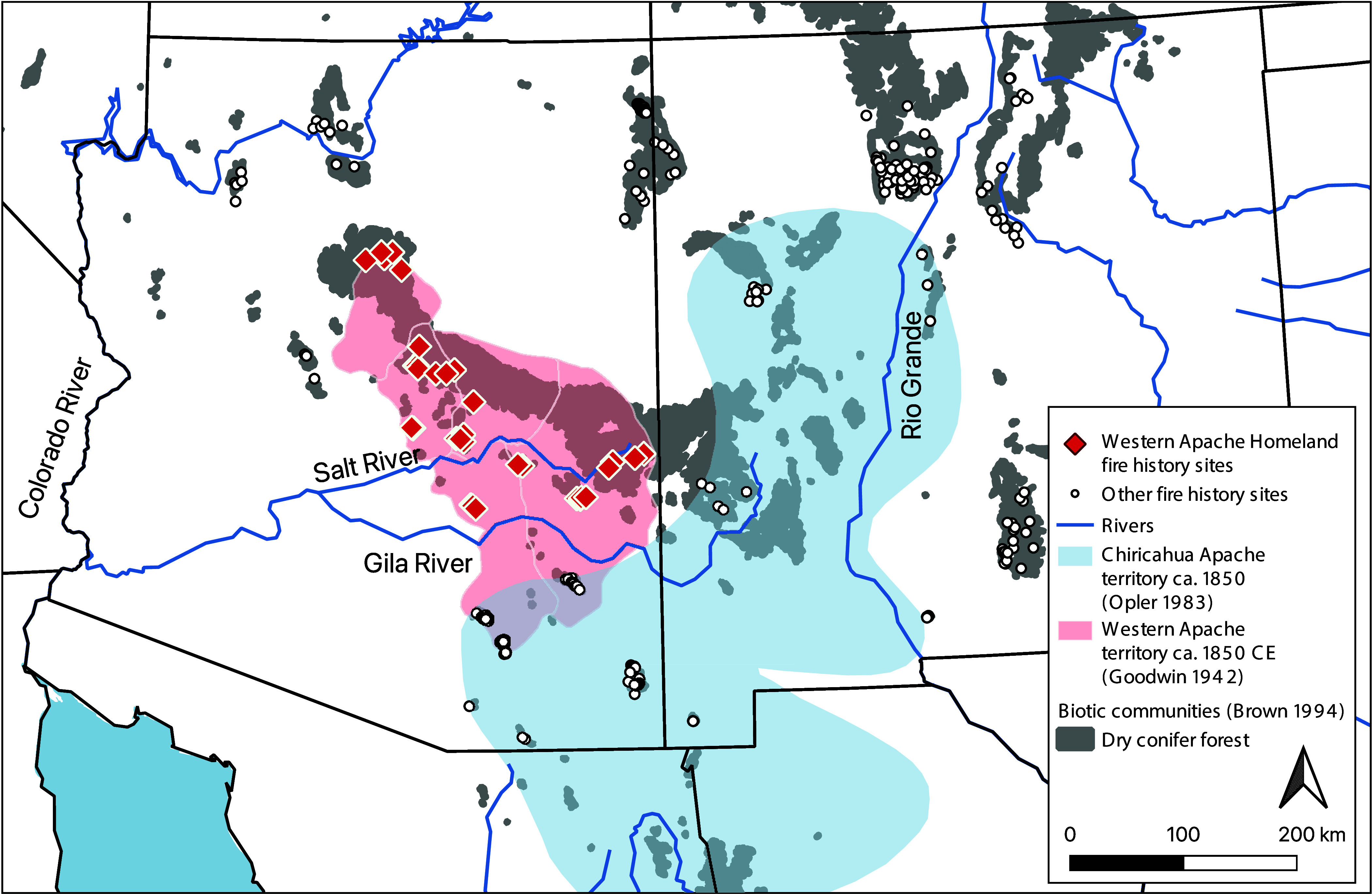
Identifying the influence of low-density Indigenous populations in paleofire records has been methodologically challenging. In the Southwest United States, well-replicated fire histories suggest that abundant lightning and suitable climate conditions drove frequent low-severity wildfires in dry pine forests independent of human activities even as ethnography provided hints that highly mobile indigenous populations used fire in myriad land use contexts. Here, we leverage published and unpublished tree-ring fire history records from pine forests in Western Apache (Ndee) traditional territory in central and eastern Arizona (N = 34 sites, N = 649 trees) to demonstrate that historical fire regimes were overwhelmingly influenced by Ndee cultural burning. Our tree-ring synthesis shows significantly more frequent fires in Ndee territory than elsewhere in the region for centuries before the establishment of reservations (1600–1870 CE). Despite the heightened fire activity, fires were largely small and asynchronous, occurred disproportionately in late April and May, when Ndee invested significant subsistence activities in these pine forests, and occurred independent of climate drivers. This suggests that Ndee fire stewardship created a patchwork of nearly annual small, spring fires that inhibited natural fire spread and limited the influence of drought on fire activity. Our work shows that even relatively small, highly mobile populations of forager-gardeners had significant influence...
Verified 2026-11-22 · 1 reference not checked yet
Overview
CoChat Summary
TL;DR
Tree-ring fire scars from 34 Western Apache (Ndee) sites show a centuries-long pattern of very frequent, often small, and seasonally distinctive burning that the authors interpret as Indigenous fire stewardship rather than climate or lightning alone. The signal persisted until reservation-era fire exclusion, with continued frequent fires on the San Carlos Reservation into the 20th century.
Key findings
- In the Ndee homeland, fires occurred somewhere in the territory in 93.7% of years from 1600 to 1870 CE; at least 10% of sites burned in 78% of years and at least 25% of sites burned in 47.3% of years.
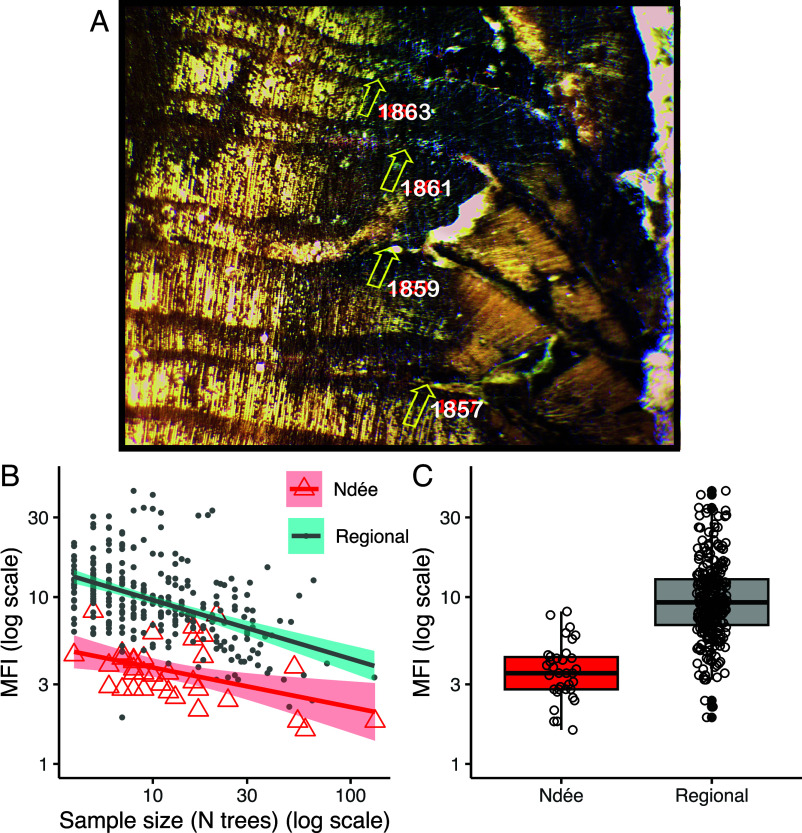
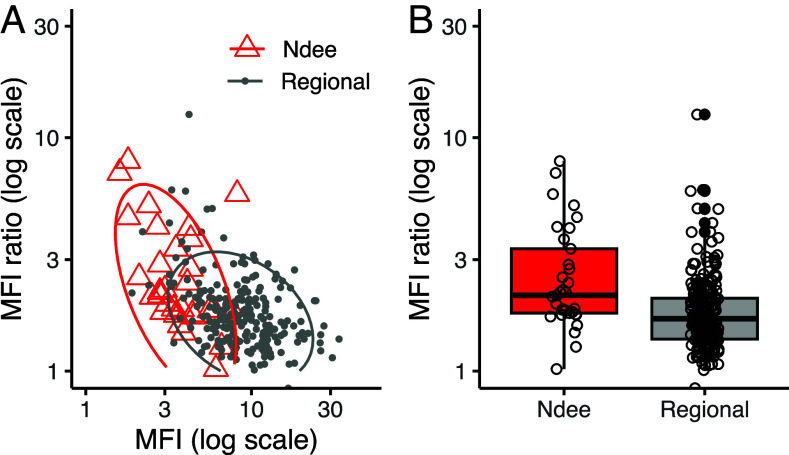
- Mean fire intervals were much shorter at Ndee sites than regional sites: MFIall = 3.9 years for Ndee versus 11.0 years regionally; for more filtered fire years, MFI2 = 7.6 vs. 15.1 years and MFI25% = 9.7 vs. 16.8 years.
- Fire size/synchrony metrics suggest more small fires in Ndee forests: mean MFI25%:MFIall = 2.74 at Ndee sites versus 1.86 regionally; 35.3% of Ndee sites had ratios > 2.5, compared with 11.1% of regional sites.
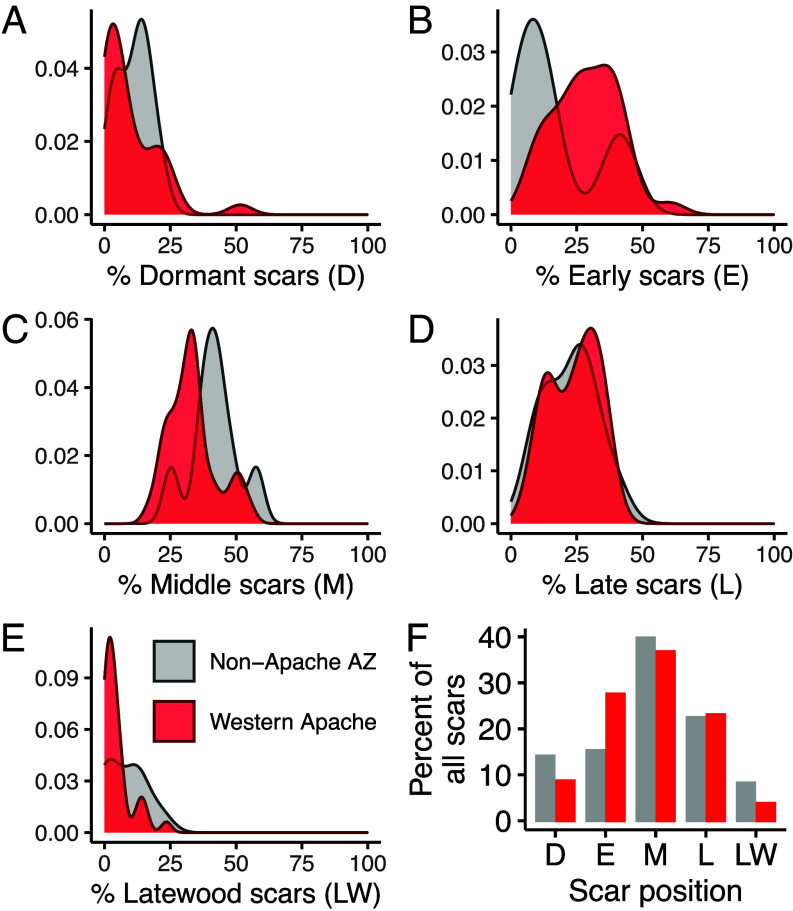
- Seasonality differed from non-Apache Arizona sites: early earlywood scars were overrepresented at Ndee sites, with 61.8% of seasonally assignable scars in early or middle earlywood, and the difference was statistically significant (Fisher’s exact test P < 0.001).
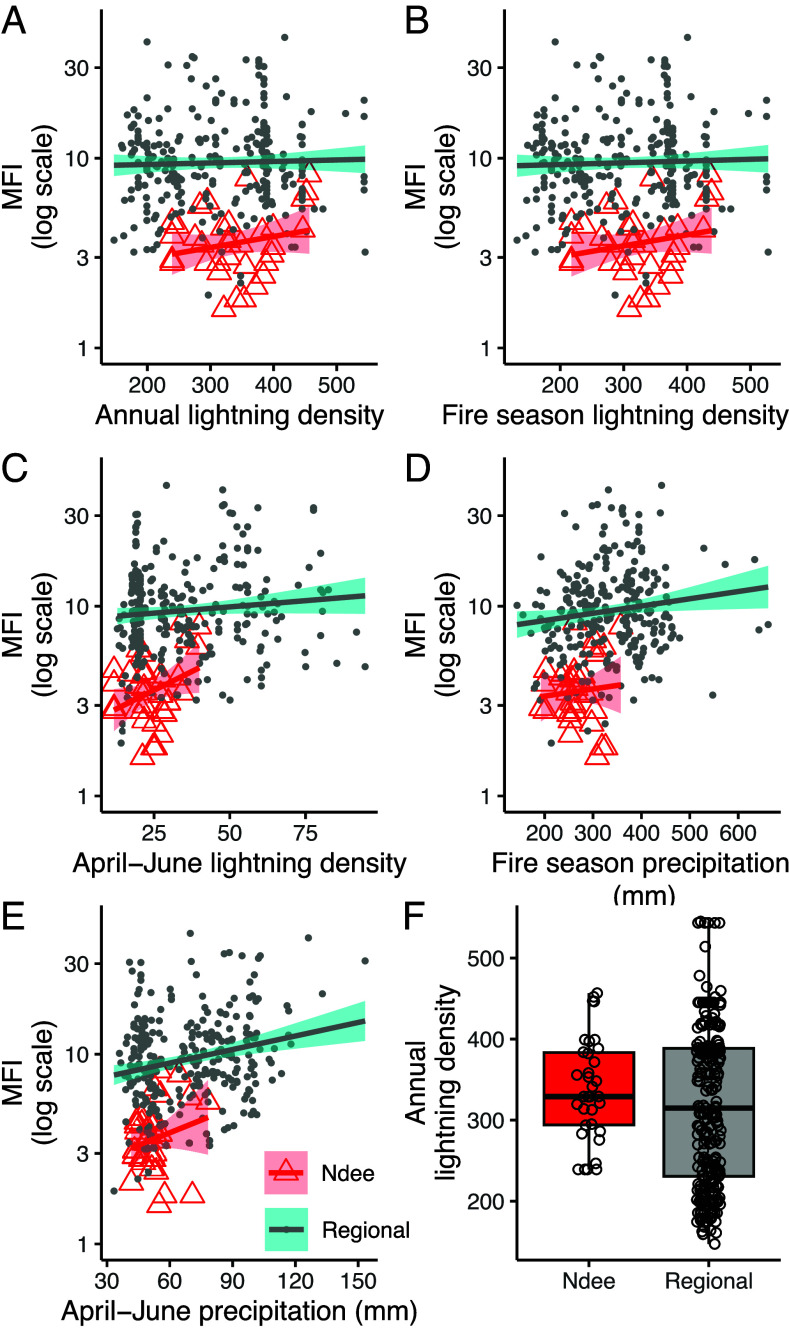
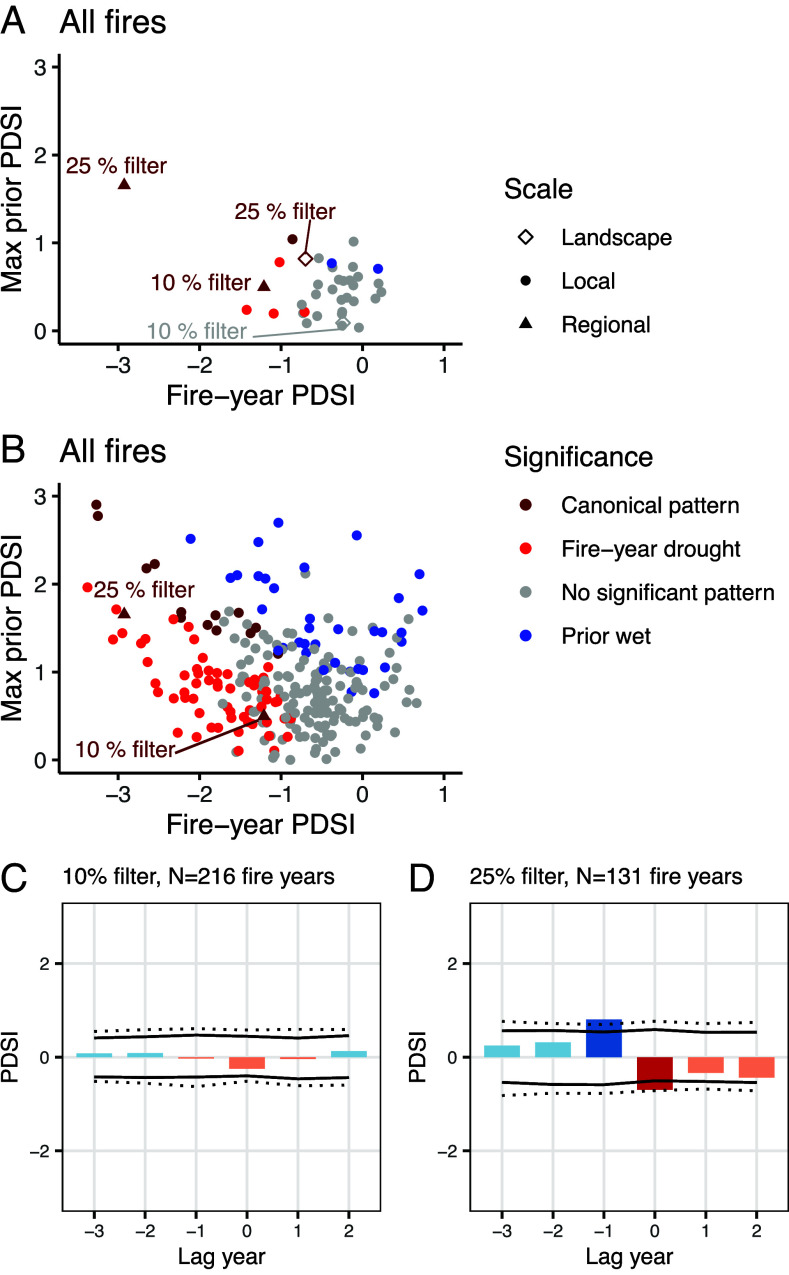
- Climate and lightning explained little of the Ndee pattern: only 20.6% of Ndee sites had statistically significant fire–climate associations (vs. 41.9% regionally), and lightning densities were significantly lower only in the April–June period at Ndee sites, not enough to explain the short intervals.
Methods
- The study analyzed tree-ring fire-scar records from 34 Ndee sites (649 trees) and compared them with 277 regional sites in Arizona and New Mexico (3,880 trees) for the pre-reservation period 1600–1870 CE.
- Fire scars were cross-dated from partial or complete cross-sections; the authors calculated mean fire return intervals for all fires (MFIall) and for filtered, more synchronous fire years (MFI2, MFI25%), then compared Ndee and regional sites using log-linear regressions and Wilcoxon rank-sum tests.
- To assess climate and ignition context, they used superposed epoch analysis (SEA) with PDSI, and linear regressions against lightning and precipitation data (including annual, April–June, and April–September windows); seasonality was tested with Fisher’s exact test.
Limitations
- The paper states that fire-scar records make it “challenging to unambiguously identify Indigenous contributions” because lightning is abundant and frequent fires already occur in the region; this is an inferential limitation of the record itself.
- The fire-size metric (MFI25%:MFIall) is described by the authors as only an “imperfect proxy” for fire size.
- Evident from the text: the main comparison is restricted to dry conifer forest / ponderosa pine-dominated sites north of the Gila River, so the conclusions do not directly cover all Apache territories or all vegetation types.
Model-written summary. Check it against the paper before relying on it.
Integrity signals
Registry
Cites
Statistics
Figures
Verification
Claims the paper makes
18 Valid · 2 Not valid · 27 Not checked · 67 Own results and interpretations
At least one cited source doesn’t support this claim or points to a different paper, and none confirmed it — see the verdicts below.
In the paper
“In fact, overall fire sizes on Ndee landscapes, whether started by Apaches or lightning, would have been small due to the self-limiting effects of frequent burning even when climate was suitable for driving widespread fires (21, 32).”
§ Tree rings reveal persistent Western Apache (Ndee) fire stewardship and niche construction in the American Southwest > Abstract
What the sources say
- Disputedcites [21] C. I. Roos, Indigenous fire management and cross-scale fire-climate relationships in the Southwest United States from 1500 to 1900 CE. Sci. Adv. 8, eabq3221 (2022). 36475806 PMC11318655 sourceExperimental — accuracy not yet measured
The Discussion (page unavailable) says Apache wartime fires were observed to be synchronous and widespread, contrary to the claim that fires on Ndée landscapes would have been small overall. It also says drought could overcome the limits on fire spread created by patch burning, even during intensive land use. (LLM, conf=0.88)
Checked by a reasoning model — may be wrong.
- Not matchedcites [32] W. Buskirk, The Western Apache: Living with the Land before 1950 (University of Oklahoma Press, Norman, OK, 1986).
We don’t have this paper’s reference list.
hedgedstates a cause- Asserted: passes — The authors put it forward as true.
- Checkable: passes — It can be checked against evidence.
- Load-bearing: passes — The paper’s conclusions depend on it.
- Based: passes — The paper gives a reason why it holds.
- Disputed
The cited sources support only part of this claim — read each source’s verdict below.
In the paper
“but identifying human influences in paleofire records of the region has been challenging (15), notably because of the widespread importance of lightning-started fires (16).”
§ Tree rings reveal persistent Western Apache (Ndee) fire stewardship and niche construction in the American Southwest > Abstract
What the sources say
- Supportedcites [15] J. R. Marlon, Long-term perspective on wildfires in the western USA. Proc. Natl. Acad. Sci. U.S.A. 109, E535– E543 (2012). 22334650 PMC3295264 source
The citation (15) is attached only to the clause that identifying human influences in western-US paleofire records has been challenging; the lightning-ignition reason is separately credited to (16) and is not judged here. Our copy supports that clause directly: the Introduction states that understanding the nature and magnitude of climate and human impacts on fire in the West 'has been challenging' because of ecological heterogeneity and the recency of most fire-history data, and the Broad-Scale Controls section notes that 'the scale of earlier impacts from indigenous burning are still debated' with 'little evidence for widespread impacts'. The Results and Discussion likewise report that before the 1800s human population does not appear to influence the charcoal influx or peak-density records, with the post-1800 divergence being the main expression of human impacts. (LLM, conf=0.85)
- Not matchedcites [16] C. D. Allen, “ Lots of lightning and plenty of people: An ecological history of fire in the upland Southwest” in Fire, Native Peoples, and the Natural Landscape, T. R. Vale, Ed. (Island Press, Washington DC, 2002), pp. 143– 193.
We don’t have this paper’s reference list.
plainstates a cause- Asserted: passes — The authors put it forward as true.
- Checkable: passes — It can be checked against evidence.
- Load-bearing: passes — The paper’s conclusions depend on it.
- Based: passes — The paper gives a reason why it holds.
- Supported
The cited sources support only part of this claim — read each source’s verdict below.
In the paper
“In alluvial stratigraphic records of the Forestdale Valley in the Carrizo Band territory of the Cibecue group on the White Mountain Apache Reservation, Roos et al. identified evidence for Ndee burning that enhanced the abundance of sunflower family plants and grasses for centuries (27) that persisted until the establishment of the reservation in 1870 CE.”
§ Tree rings reveal persistent Western Apache (Ndee) fire stewardship and niche construction in the American Southwest > Western Apache Settlement, Land Use, and Fire Use.
What the sources say
- Partly supportedcites [27] C. I. Roos, N. C. Laluk, W. Reitze, O. K. Davis, Stratigraphic evidence for culturally variable Indigenous fire regimes in ponderosa pine forests of the Mogollon Rim area, east-central Arizona. Quat. Res. 113, 69– 86 (2023). sourceExperimental — accuracy not yet measured
Split into 2 atoms — 1 confirmed, 1 partially supported, 0 disputed, 0 misattributed, 0 unverifiable. Expand the claim to see per-atom verdicts.
plainstates a cause- Asserted: passes — The authors put it forward as true.
- Checkable: passes — It can be checked against evidence.
- Load-bearing: passes — The paper’s conclusions depend on it.
- Based: passes — The paper gives a reason why it holds.
- Partly supported
The cited sources support only part of this claim — read each source’s verdict below.
In the paper
“In areas with abundant lightning that burned once or twice per decade, such as the dry pine forests of the Southwest United States, identifying frequent burning by mobile foragers would be particularly challenging using conventional fire frequency metrics (19).”
§ Tree rings reveal persistent Western Apache (Ndee) fire stewardship and niche construction in the American Southwest > Abstract
What the sources say
- Partly supportedcites [19] C. I. Roos, G. J. Williamson, D. M. J. S. Bowman, Is anthropogenic pyrodiversity invisible in paleofire records? Fire 2, 42 (2019). sourceExperimental — accuracy not yet measured
Split into 2 atoms — 1 confirmed, 1 partially supported, 0 disputed, 0 misattributed, 0 unverifiable. Expand the claim to see per-atom verdicts.
hedged- Asserted: passes — The authors put it forward as true.
- Checkable: passes — It can be checked against evidence.
- Load-bearing: passes — The paper’s conclusions depend on it.
- Based: passes — The paper gives a reason why it holds.
- Partly supported
The cited sources support only part of this claim — read each source’s verdict below.
In the paper
“Because lightning is abundant in the region and fires were already frequent, it has generally been challenging to unambiguously identify Indigenous contributions to fire regimes using conventional fire frequency metrics (16, 19).”
§ Tree rings reveal persistent Western Apache (Ndee) fire stewardship and niche construction in the American Southwest > Fire Ecology of Southwestern United States Dry Conifer Forests.
What the sources say
- Not matchedcites [16] C. D. Allen, “ Lots of lightning and plenty of people: An ecological history of fire in the upland Southwest” in Fire, Native Peoples, and the Natural Landscape, T. R. Vale, Ed. (Island Press, Washington DC, 2002), pp. 143– 193.
We don’t have this paper’s reference list.
- Supportedcites [19] C. I. Roos, G. J. Williamson, D. M. J. S. Bowman, Is anthropogenic pyrodiversity invisible in paleofire records? Fire 2, 42 (2019). source
The Introduction (page unavailable) says anthropogenic patch burning can occur even where lightning-ignited fires are frequent and landscape-scale fire rotations are nearly identical. The Results (page unavailable) explain that small differences in fire frequency make anthropogenic regime shifts difficult to identify statistically without historical, archaeological, or anthropological evidence. (LLM, conf=0.90)
plainstates a cause- Asserted: passes — The authors put it forward as true.
- Checkable: passes — It can be checked against evidence.
- Load-bearing: passes — The paper’s conclusions depend on it.
- Based: passes — The paper gives a reason why it holds.
- Not matched
54 more claims · 5 with their cited sources checked
Create a free account to see all 114 claims and to verify the 1 reference still open.
- It may state two separate claims as one. 36
- Probably not a substantial claim. 22
Citations
Cites
Bowman, D. M. J. S., Balch, J. K., Artaxo, P., Bond, W. J., Carlson, J. M., Cochrane, M. A., D’Antonio, C. M., DeFries, R. S., Doyle, J. C., Harrison, S. P., et al. (2009) · Science · doi:10.1126/science.1163886 · Cited by 3,351 · cited 1×
“Contemporary wildfires pose ecological, socioeconomic, and climatological challenges ( 1 – 4 ).”
Self-citationWillow Smoke and Dogs’ Tails: Hunter-Gatherer Settlement Systems and Archaeological Site Formation
Binford, L. R. (1980) · American Antiquity · doi:10.2307/279653 · Cited by 2,653 · cited 1×
“…apply to contexts in the woodland or pine forest biotic zones tethered to foraging, hunting, and land - use activities within 5 to 10 km of the farm sites because these were bases for logistical foraging activities ( 40 ), even if not all of this fire stewardship is associated with horticulture.”
APPLIED HISTORICAL ECOLOGY: USING THE PAST TO MANAGE FOR THE FUTURE
Swetnam, T. W., Allen, C. D., & Betancourt, J. L. (1999) · Ecological Applications · doi:10.1890/1051-0761(1999)009[1189:aheutp]2.0.co;2 · Cited by 1,418 · cited 1×
“Understanding the magnitude of these changes requires an understanding of historical fire regimes—regular patterns of fire frequency, size, seasonality, and severity ( 9 – 11 ).”
Self-citationLearning to coexist with wildfire
Moritz, M. A., Batllori, E., Bradstock, R. A., Gill, A. M., Handmer, J., Hessburg, P. F., Leonard, J., McCaffrey, S., Odion, D. C., Schoennagel, T., et al. (2014) · Nature · doi:10.1038/nature13946 · Cited by 1,169
Human-started wildfires expand the fire niche across the United States
Balch, J. K., Bradley, B. A., Abatzoglou, J. T., Nagy, R. C., Fusco, E. J., & Mahood, A. L. (2017) · Proceedings of the National Academy of Sciences · doi:10.1073/pnas.1617394114 · Cited by 1,043 · cited 1×
“Although lightning ignitions are abundant in the Western United States ( 12 ), human ignitions remain a major contributor to modern fire regimes ( 13 ).”
ECOLOGICAL RESTORATION OF SOUTHWESTERN PONDEROSA PINE ECOSYSTEMS: A BROAD PERSPECTIVE
Allen, C. D., Savage, M., Falk, D. A., Suckling, K. F., Swetnam, T. W., Schulke, T., Stacey, P. B., Morgan, P., Hoffman, M., & Klingel, J. T. (2002) · Ecological Applications · doi:10.1890/1051-0761(2002)012[1418:erospp]2.0.co;2 · Cited by 945
Self-citationNorth American drought: Reconstructions, causes, and consequences
Cook, E. R., Seager, R., Cane, M. A., & Stahle, D. W. (2007) · Earth-Science Reviews · doi:10.1016/j.earscirev.2006.12.002 · Cited by 862
Fire-Southern Oscillation Relations in the Southwestern United States
Swetnam, T. W., & Betancourt, J. L. (1990) · Science · doi:10.1126/science.249.4972.1017 · Cited by 672 · cited 2×
“Years prior to fire events were generally significantly wet to produce abundant fine fuels and fire years were significantly dry to allow those fuels to dry and burn widely—what we call the “canonical” fire–climate association in the Southwest ( 45 , 47 , 48 ).”
Self-citationDETERMINING REFERENCE CONDITIONS FOR ECOSYSTEM MANAGEMENT OF SOUTHWESTERN PONDEROSA PINE FORESTS
Fulé, P. Z., Covington, W. W., & Moore, M. M. (1997) · Ecological Applications · doi:10.1890/1051-0761(1997)007[0895:drcfem]2.0.co;2 · Cited by 661 · cited 2×
“In the past, differences in the environment, climate, or lightning abundance have been used to explain the unusually short fire - return intervals of Western Apache homeland tree - ring sites ( 51 , 52 ).”
Wildfire-Driven Forest Conversion in Western North American Landscapes
Coop, J. D., Parks, S. A., Stevens-Rumann, C. S., Crausbay, S. D., Higuera, P. E., Hurteau, M. D., Tepley, A., Whitman, E., Assal, T., Collins, B. M., et al. (2020) · BioScience · doi:10.1093/biosci/biaa061 · Cited by 642 · cited 1×
“In the Western United States, wildfires are burning in unprecedented ways, with substantial increases in canopy - killing high - severity burned areas that are transforming forests to nonforest conditions ( 5 – 8 ).”
Long-term perspective on wildfires in the western USA
Marlon, J. R., Bartlein, P. J., Gavin, D. G., Long, C. J., Anderson, R. S., Briles, C. E., Brown, K. J., Colombaroli, D., Hallett, D. J., Power, M. J., et al. (2012) · Proceedings of the National Academy of Sciences · doi:10.1073/pnas.1112839109 · Cited by 629 · cited 1×
“…Indigenous populations in the Western United States used cultural burning as a deliberate land management tool ( 14 ) but identifying human influences in paleofire records of the region has been challenging ( 15 ), notably because of the widespread importance of lightning - started fires ( 16 ).”
Cook, E. R., Seager, R., Heim, R. R., Vose, R. S., Herweijer, C., & Woodhouse, C. (2010) · Journal of Quaternary Science · doi:10.1002/jqs.1303 · Cited by 549
Historical Fire Regime Patterns in the Southwestern United States Since AD 1700
Swetnam, T. W., & Baisan, C. H. (1996) · Digital Commons - USU (Utah State University) · Cited by 493
Self-citationHagmann, R. K., Hessburg, P. F., Prichard, S. J., Povak, N. A., Brown, P. M., Fulé, P. Z., Keane, R. E., Knapp, E. E., Lydersen, J. M., Metlen, K. L., et al. (2021) · Ecological Applications · doi:10.1002/eap.2431 · Cited by 400
Self-citationHuman niche construction in interdisciplinary focus
Kendal, J., Tehrani, J. J., & Odling-Smee, J. (2011) · Philosophical Transactions of the Royal Society B: Biological Sciences · doi:10.1098/rstb.2010.0306 · Cited by 350 · cited 1×
“…ecological consequences of cultural burning by foragers may have generated reinforcing feedbacks for continued use of particular areas via niche construction ( 28 ) and Allee effects—increased fitness or niche productivity positively correlated with population density and intensity of use ( 29 ).”
Biotic Communities: Southwestern United States and Northwestern Mexico
Schmid, R., Brown, D. E., & Lowe, C. H. (1995) · Taxon · doi:10.2307/1223522 · Cited by 338 · cited 2×
“…forest dominated by ponderosa pine ( Pinus ponderosa ) and dry mixed conifer forests (ponderosa with Pseudotsuga menziesii , Pinus strobiformis ) and oaks (2,100 to 2,900 m), to the highest elevation subalpine conifer forests with spruce (Picea spp.) and fir (Abies spp.) (2,700 to 3,700 m) ( 38 ).”
The Role of Indigenous Burning in Land Management
Kimmerer, R. W., & Lake, F. K. (2001) · Journal of Forestry · doi:10.1093/jof/99.11.36 · Cited by 313
Multi‐scale controls of historical forest‐fire regimes: new insights from fire‐scar networks
Falk, D. A., Heyerdahl, E. K., Brown, P. M., Farris, C., Fulé, P. Z., McKenzie, D., Swetnam, T. W., Taylor, A. H., & Van Horne, M. L. (2011) · Frontiers in Ecology and the Environment · doi:10.1890/100052 · Cited by 263
Self-citationCross-Scale Analysis of Fire Regimes
Falk, D. A., Miller, C., McKenzie, D., & Black, A. E. (2007) · Ecosystems · doi:10.1007/s10021-007-9070-7 · Cited by 250
Fire, Native Peoples, and the Natural Landscape
Pyne, S., & Vale, T. R. (2003) · Restoration Ecology · doi:10.1046/j.1526-100x.2003.01122.x · Cited by 235
Taylor, A. H., Trouet, V., Skinner, C. N., & Stephens, S. (2016) · Proceedings of the National Academy of Sciences · doi:10.1073/pnas.1609775113 · Cited by 228
Returning Fire to the Land: Celebrating Traditional Knowledge and Fire
Lake, F. K., Wright, V., Morgan, P., McFadzen, M., McWethy, D., & Stevens-Rumann, C. (2017) · Journal of Forestry · doi:10.5849/jof.2016-043r2 · Cited by 227 · cited 3×
“Other tribes are actively returning fire stewardship to their cultural land-scapes for this purpose ( 64 , 65 ).”
Swetnam, T. W., & Baisan, C. H. (2003) · Ecological Studies · doi:10.1007/0-387-21710-x_6 · Cited by 221 · cited 2×
“Years prior to fire events were generally significantly wet to produce abundant fine fuels and fire years were significantly dry to allow those fuels to dry and burn widely—what we call the “canonical” fire–climate association in the Southwest ( 45 , 47 , 48 ).”
Self-citationDendrochronology of a Fire-Scarred Ponderosa Pine
Dieterich, J. H., & Swetnam, T. W. (1984) · Forest Science · doi:10.1093/forestscience/30.1.238 · Cited by 219 · cited 3×
“Fifteen of the 34 Ndee fire history sites have been published elsewhere (Table 1) (50, 52, 53, 86–92).”
Self-citationWildfire risk as a socioecological pathology
Fischer, A. P., Spies, T. A., Steelman, T. A., Moseley, C., Johnson, B. R., Bailey, J. D., Ager, A. A., Bourgeron, P., Charnley, S., Collins, B. M., et al. (2016) · Frontiers in Ecology and the Environment · doi:10.1002/fee.1283 · Cited by 218 · cited 1×
“Contemporary wildfires pose ecological, socioeconomic, and climatological challenges ( 1 – 4 ).”
Self-citationForgotten Fires: Native Americans and the Transient Wilderness
Pinkoski, M., Stewart, O. C., Lewis, H. T., & Anderson, M. K. (2003) · Anthropologica · doi:10.2307/25606129 · Cited by 168
Centering Indigenous Voices: The Role of Fire in the Boreal Forest of North America
Christianson, A. C., Sutherland, C. R., Moola, F. M., Bautista, N. G., Young, D., & MacDonald, H. (2022) · Current Forestry Reports · doi:10.1007/s40725-022-00168-9 · Cited by 163
Liebmann, M. J., Farella, J., Roos, C. I., Stack, A., Martini, S., & Swetnam, T. W. (2016) · Proceedings of the National Academy of Sciences · doi:10.1073/pnas.1521744113 · Cited by 158
Self-citationRoos, C. I., Swetnam, T. W., Ferguson, T. J., Liebmann, M. J., Loehman, R. A., Welch, J. R., Margolis, E. Q., Guiterman, C. H., Hockaday, W. C., Aiuvalasit, M. J., et al. (2021) · Proceedings of the National Academy of Sciences · doi:10.1073/pnas.2018733118 · Cited by 145 · cited 3×
“We compare the fire frequency, seasonality, size, and fire–climate associations for tree - ring sites within Ndee territory with 277 tree - ring sites from throughout Arizona and New Mexico [a subset of the sites from Roos et al. ( 21 )] from the North American Fire - Scar Network ( 30 ).”
Self-citationThe right to burn: barriers and opportunities for Indigenous-led fire stewardship in Canada
Hoffman, K. M., Christianson, A. C., Dickson‐Hoyle, S., Copes‐Gerbitz, K., Nikolakis, W. D., Diabo, D. A., McLeod, R. S., Michell, H., Mamun, A. A., Zahara, A., et al. (2022) · FACETS · doi:10.1139/facets-2021-0062 · Cited by 143
The archaeology of meaningful places
Bowser, B. J., & Zedeño, M. N. (2009) · University of Utah Press eBooks · Cited by 141
Assessing fire regimes on Grand Canyon landscapes with fire-scar and fire-record data
Fulé, P. Z., Heinlein, T. A., Covington, W. W., & Moore, M. M. (2003) · International Journal of Wildland Fire · doi:10.1071/wf02060 · Cited by 134 · cited 1×
“We follow Huffman and others (53) and Fulé and others (54) in using the MFI 25% :MFI all ratio with higher values to indicate a greater importance for small or nonsynchronous fire years.”
Fire‐climate interactions in the American West since 1400 CE
Trouet, V., Taylor, A. H., Wahl, E. R., Skinner, C. N., & Stephens, S. L. (2010) · Geophysical Research Letters · doi:10.1029/2009gl041695 · Cited by 130 · cited 1×
“Across the Southwest ( 48 ) and even much of the western United States ( 20 , 58 ), climate has been a major driver of widespread fire activity but this was not evident during Ndee fire stewardship prior to the establishment of reservations.”
Swetnam, T. W., Farella, J., Roos, C. I., Liebmann, M. J., Falk, D. A., & Allen, C. D. (2016) · Philosophical Transactions of the Royal Society B: Biological Sciences · doi:10.1098/rstb.2015.0168 · Cited by 128 · cited 4×
“Southwestern dry conifer forests have one of the best - known historical fire regimes in the world, largely due to an extensive and well replicated tree - ring record of fire activity (20, 30).”
InfluentialSelf-citationControls on interannual variability in lightning-caused fire activity in the western US
Abatzoglou, J. T., Kolden, C. A., Balch, J. K., & Bradley, B. A. (2016) · Environmental Research Letters · doi:10.1088/1748-9326/11/4/045005 · Cited by 116 · cited 1×
“Although lightning ignitions are abundant in the Western United States ( 12 ), human ignitions remain a major contributor to modern fire regimes ( 13 ).”
Reimagine fire science for the anthropocene
Shuman, J. K., Balch, J. K., Barnes, R. T., Higuera, P. E., Roos, C. I., Schwilk, D. W., Stavros, E. N., Banerjee, T., Bela, M. M., Bendix, J., et al. (2022) · PNAS Nexus · doi:10.1093/pnasnexus/pgac115 · Cited by 113
Self-citationVegetation type conversion in the US Southwest: frontline observations and management responses
Guiterman, C. H., Gregg, R. M., Marshall, L. A. E., Beckmann, J. J., van Mantgem, P. J., Falk, D. A., Keeley, J. E., Caprio, A. C., Coop, J. D., Fornwalt, P. J., et al. (2022) · Fire Ecology · doi:10.1186/s42408-022-00131-w · Cited by 112
Self-citationTheoretical fire-interval distributions
McCarthy, M. A., Gill, A. M., & Bradstock, R. A. (2001) · International Journal of Wildland Fire · doi:10.1071/wf01013 · Cited by 101 · cited 1×
“Although there are several different metrics that have been used to identify the central tendency of fire interval distributions (98) we have chosen to use the MFI all because it is the easiest to interpret and has been shown to provide the closest estimates to real fire return intervals in a…”
Lots of lightning and plenty of people: an ecological history of fire in the upland southwest
Allen, C. D. (2002) · Cited by 99
Chimney Spring forest fire history /
Dieterich, J. H., & Rocky Mountain Forest and Range Experiment Station (Fort Collins, C. ). (1980) · doi:10.5962/bhl.title.98633 · Cited by 97
Parks, S. A., Holsinger, L. M., Blankenship, K., Dillon, G. K., Goeking, S. A., & Swaty, R. L. (2023) · Forest Ecology and Management · doi:10.1016/j.foreco.2023.121232 · Cited by 87
AN ASSESSMENT OF FIRE, CLIMATE, AND APACHE HISTORY IN THE SACRAMENTO MOUNTAINS, NEW MEXICO
Kaye, M. W., & Swetnam, T. W. (1999) · Physical Geography · doi:10.1080/02723646.1999.10642681 · Cited by 79 · cited 1×
“In Mescalero Apache territory in New Mexico, Kaye, and Swetnam identified subtle changes in fire frequency and seasonality during periods of local Apache use ( 43 ).”
Self-citationHandbook of North American Indians.
Vitart-Fardoulis, A. (1982) · Persée (Ministère de lEnseignement supérieur et de la Recherche) · Cited by 77
Codding, B. F., Bliege Bird, R., Kauhanen, P. G., & Bird, D. W. (2014) · Human Ecology · doi:10.1007/s10745-014-9682-4 · Cited by 75 · cited 1×
“Burning that promoted wild resources and forage for preferred game allowed these persistent places to remain productive in spite of moderate levels of resource use ( 60 ), likely due to Allee effects created by cultural burning ( 29 ).”
The North American tree‐ring fire‐scar network
Margolis, E. Q., Guiterman, C. H., Chavardès, R. D., Coop, J. D., Copes‐Gerbitz, K., Dawe, D. A., Falk, D. A., Johnston, J. D., Larson, E., Li, H., et al. (2022) · Ecosphere · doi:10.1002/ecs2.4159 · Cited by 75
Self-citationAn Apache Life-way. The Economic, Social, and Religious Institutions of the Chiricahua Indians
Sharp, L. (1942) · Hispanic American Historical Review · doi:10.1215/00182168-22.1.190a · Cited by 68
Fire mosaics and habitat choice in nomadic foragers
Bliege Bird, R., McGuire, C., Bird, D. W., Price, M. H., Zeanah, D., & Nimmo, D. G. (2020) · Proceedings of the National Academy of Sciences · doi:10.1073/pnas.1921709117 · Cited by 64 · cited 2×
“…ecological consequences of cultural burning by foragers may have generated reinforcing feedbacks for continued use of particular areas via niche construction ( 28 ) and Allee effects—increased fitness or niche productivity positively correlated with population density and intensity of use ( 29 ).”
Fire history of southwestern mixed conifer: A case study
Dieterich, J. H. (1983) · Forest Ecology and Management · doi:10.1016/0378-1127(83)90003-8 · Cited by 63 · cited 1×
“Fifteen of the 34 Ndee fire history sites have been published elsewhere (Table 1) (50, 52, 53, 86–92).”
Marks-Block, T., Lake, F. K., Bliege Bird, R., & Curran, L. M. (2021) · Fire Ecology · doi:10.1186/s42408-021-00092-6 · Cited by 61 · cited 1×
“When and where it is possible, Indigenous communities should be supported to restore their own cultural burning practices, as is true in parts of the United States ( 65 , 72 – 74 ) and elsewhere in the world ( 75 – 77 ).”
Heinlein, T. A., Moore, M. M., Fulé, P. Z., & Covington, W. W. (2005) · International Journal of Wildland Fire · doi:10.1071/wf04060 · Cited by 59
THE SOCIAL DIVISIONS AND ECONOMIC LIFE OF THE WESTERN APACHE
GOODWIN, G. (1935) · American Anthropologist · doi:10.1525/aa.1935.37.1.02a00050 · Cited by 59
Roos, C. I., Scott, A. C., Belcher, C. M., Chaloner, W. G., Aylen, J., Bird, R. B., Coughlan, M. R., Johnson, B. R., Johnston, F. H., McMorrow, J., et al. (2016) · Philosophical Transactions of the Royal Society B: Biological Sciences · doi:10.1098/rstb.2015.0469 · Cited by 57
Self-citationThe Western Apache: Living with the Land before 1950
Melody, M. E., & Buskirk, W. (1988) · The American Indian Quarterly · doi:10.2307/1184427 · Cited by 56 · cited 10×
“Furthermore, Apache burning would have altered the seasonal occurrence of fires to timings that reflected Ndee land use ( 32 ).”
InfluentialScale in the study of Indigenous burning
Roos, C. I. (2020) · Nature Sustainability · doi:10.1038/s41893-020-0579-5 · Cited by 56
Self-citationburnr: Fire history analysis and graphics in R
Malevich, S. B., Guiterman, C. H., & Margolis, E. Q. (2018) · Dendrochronologia · doi:10.1016/j.dendro.2018.02.005 · Cited by 55 · cited 1×
“All analysis for this paper was done using the burnr package (96) in the R programming environment in R 4.3.0 (97).”
InfluentialSelf-citationCoughlan, M. R. (2013) · Forest Ecology and Management · doi:10.1016/j.foreco.2013.10.021 · Cited by 53 · cited 1×
“…the influence of traditional burning by a small and mobile population has broad relevance to other areas where traditional burning was historically significant but often overlooked, including other Indigenous contexts ( 80 ) but also traditional burning practices in Europe ( 81 ) and Africa ( 82 ).”
Roos, C. I., Guiterman, C. H., Margolis, E. Q., Swetnam, T. W., Laluk, N. C., Thompson, K. F., Toya, C., Farris, C. A., Fulé, P. Z., Iniguez, J. M., et al. (2022) · Science Advances · doi:10.1126/sciadv.abq3221 · Cited by 52 · cited 12×
“Climate played a significant role in synchronizing widespread fire activity across local to regional scales (46), although this was muted by Indigenous fire management at local and landscape scales in particular places during particular periods of time (21).”
InfluentialSelf-citationTime to support Indigenous science
Kimmerer, R. W., & Artelle, K. A. (2024) · Science · doi:10.1126/science.ado0684 · Cited by 50 · cited 1×
“When this is not feasible, Indigenous communities should be part of the decision - making and ecological monitoring processes to restore cultural burns by appropriate agencies ( 65 , 78 , 79 ).”
On the problems and promises of savanna fire regime change
Laris, P. S. (2021) · Nature Communications · doi:10.1038/s41467-021-25141-1 · Cited by 47 · cited 1×
“…the influence of traditional burning by a small and mobile population has broad relevance to other areas where traditional burning was historically significant but often overlooked, including other Indigenous contexts ( 80 ) but also traditional burning practices in Europe ( 81 ) and Africa ( 82 ).”
Mountain, R. (2005) · Cited by 46
Drought, multi-seasonal climate, and wildfire in northern New Mexico
Margolis, E. Q., Woodhouse, C. A., & Swetnam, T. W. (2017) · Climatic Change · doi:10.1007/s10584-017-1958-4 · Cited by 46 · cited 1×
“Years prior to fire events were generally significantly wet to produce abundant fine fuels and fire years were significantly dry to allow those fuels to dry and burn widely—what we call the “canonical” fire–climate association in the Southwest ( 45 , 47 , 48 ).”
Self-citationLarson, E. R., Kipfmueller, K. F., & Johnson, L. B. (2021) · Annals of the American Association of Geographers · doi:10.1080/24694452.2020.1768042 · Cited by 45 · cited 1×
“When and where it is possible, Indigenous communities should be supported to restore their own cultural burning practices, as is true in parts of the United States ( 65 , 72 – 74 ) and elsewhere in the world ( 75 – 77 ).”
(1994) · University of Michigan Library Repository · Cited by 41
Spatiotemporal variability of human–fire interactions on the Navajo Nation
Guiterman, C. H., Margolis, E. Q., Baisan, C. H., Falk, D. A., Allen, C. D., & Swetnam, T. W. (2019) · Ecosphere · doi:10.1002/ecs2.2932 · Cited by 40
Self-citationWynecoop, M. D., Morgan, P., Strand, E. K., & Sanchez Trigueros, F. (2019) · Fire Ecology · doi:10.1186/s42408-019-0030-3 · Cited by 39 · cited 1×
“Furthermore, the generalization that happens when conflating institutional burning with Indigenous fire stewardship often leads to erasure of Indigenous knowledge and worldview ( 68 – 71 ).”
McClure, E. J., Coop, J. D., Guiterman, C. H., Margolis, E. Q., & Parks, S. A. (2024) · Communications Earth & Environment · doi:10.1038/s43247-024-01686-z · Cited by 39 · cited 1×
“In the Western United States, wildfires are burning in unprecedented ways, with substantial increases in canopy - killing high - severity burned areas that are transforming forests to nonforest conditions ( 5 – 8 ).”
Self-citationFire history of a mixed conifer forest on the Mogollon Rim, northern Arizona, USA
Huffman, D. W., Zegler, T. J., & Fulé, P. Z. (2015) · International Journal of Wildland Fire · doi:10.1071/wf14005 · Cited by 37
Is Anthropogenic Pyrodiversity Invisible in Paleofire Records?
Roos, C. I., Williamson, G. J., & Bowman, D. M. J. S. (2019) · Fire · doi:10.3390/fire2030042 · Cited by 37 · cited 5×
“…in a given year, although it is noteworthy that even these synchronous fire years occurred more frequently in Western Apache territory than elsewhere in the Southwest, something that does not rule out synchronous fire years simply having more small fires rather than larger individual fires ( 19 ).”
InfluentialSelf-citationThe Social Organization of the Western Apache.
OPLER, M. E., & Goodwin, G. (1942) · American Sociological Review · doi:10.2307/2085701 · Cited by 37
Western Apache Raiding and Warfare: From the Notes of Grenville Goodwin
Nichols, R. L., Basso, K. H., & Goodwin, G. (1972) · Western Historical Quarterly · doi:10.2307/966876 · Cited by 33 · cited 1×
“…of the White Mountain Reserve in 1870 ( 34 ), land use outside of the reservation was prohibited and traditional land stewardship within the reservation persisted but was heavily curtailed ( 31 , 32 , 35 ), although some off - reservation economic activities persisted for some time ( 36 ).”
Human augmentation of historical red pine fire regimes in the Boundary Waters Canoe Area Wilderness
Kipfmueller, K. F., Larson, E. R., Johnson, L. B., & Schneider, E. A. (2021) · Ecosphere · doi:10.1002/ecs2.3673 · Cited by 25 · cited 1×
“…indicate that while Indigenous fire stewardship might not be distinguishable from lightning fire regimes in terms of frequency, Indigenous burning might be evident in altered fire–climate associations ( 20 , 21 ), burn patch size or synchroneity ( 22 – 25 ), and ecological impacts ( 26 , 27 ).”
A collaborative agenda for archaeology and fire science
Snitker, G., Roos, C. I., Sullivan, A. P., Maezumi, S. Y., Bird, D. W., Coughlan, M. R., Derr, K. M., Gassaway, L., Klimaszewski-Patterson, A., & Loehman, R. A. (2022) · Nature Ecology & Evolution · doi:10.1038/s41559-022-01759-2 · Cited by 25 · cited 1×
“…and paleofire science together can generate novel approaches to longstanding problems in a wide variety of regional and historical contexts, such as the identification of the ecological significance, dynamics, and climate relationships of traditional burning over centuries to mil-lennia ( 83 ).”
Self-citationHuffman, D. W., Floyd, M. L., Hanna, D. P., Crouse, J. E., Fulé, P. Z., Meador, A. J. S., & Springer, J. D. (2020) · Forest Ecology and Management · doi:10.1016/j.foreco.2020.118087 · Cited by 24 · cited 2×
“We follow Huffman and others (53) and Fulé and others (54) in using the MFI 25% :MFI all ratio with higher values to indicate a greater importance for small or nonsynchronous fire years.”
Bowman, D. M. J. S., Williamson, G. J., Johnston, F. H., Bowman, C. J. W., Murphy, B. P., Roos, C. I., Trauernicht, C., Rostron, J., & Prior, L. D. (2022) · Scientific Reports · doi:10.1038/s41598-022-12946-3 · Cited by 24 · cited 1×
“Institutional burning, even when intended to mimic Indigenous fire regimes, can produce unintended and undesirable outcomes ( 67 ).”
Self-citationIndigenous Fire Data Sovereignty: Applying Indigenous Data Sovereignty Principles to Fire Research
Adams, M. M. (2024) · Fire · doi:10.3390/fire7070222 · Cited by 22 · cited 1×
“As we learn more about the ecological and historical importance of Indigenous fire stewardship across the Western United States, it is imperative to avoid research harm by striving to involve Indigenous Peoples in the process ( 66 ).”
Self-citationWilliamson, B. (2022) · Australian Forestry · doi:10.1080/00049158.2022.2054134 · Cited by 19 · cited 1×
“When and where it is possible, Indigenous communities should be supported to restore their own cultural burning practices, as is true in parts of the United States ( 65 , 72 – 74 ) and elsewhere in the world ( 75 – 77 ).”
The Tree-Ring Drought Atlas Portal: Gridded Drought Reconstructions for the Past 500–2,000 Years
Burnette, D. J. (2021) · Bulletin of the American Meteorological Society · doi:10.1175/bams-d-20-0142.1 · Cited by 16
Souther, S., Lyndon, N., & Randall, D. (2021) · Forest Ecology and Management · doi:10.1016/j.foreco.2020.118900 · Cited by 13 · cited 2×
“For Ndee specifically, the research described in this paper supports current initiatives to restore historical fire regimes for cultural keystone species such as Emory oak ( Quercus emoryi Torr), a vital material to almost every Apache social and ceremonial function ( 63 ).”
A Preliminary Report on Prescribed Burning in Virgin Ponderosa Pine
Weaver, H. (1952) · Journal of Forestry · doi:10.1093/jof/50.9.662 · Cited by 12 · cited 1×
“Beginning in the 1950s, pioneering work on early prescribed burning efforts by Harold Weaver and Ndee crews on the Fort Apache and San Carlos Apache Reservations helped to set the stage for a move away from the policy of total fire suppression in the Southwest ( 59 ).”
Roos, C. I., Laluk, N. C., Reitze, W., & Davis, O. K. (2023) · Quaternary Research · doi:10.1017/qua.2022.61 · Cited by 11 · cited 3×
“…with abundant pine forests that were continuously occupied by one culturally and linguistically related population throughout the period of greatest tree - ring sample depth (after 1600 CE) ( 27 , 31 ) as well as for the depth of ethnographic and cultural knowledge about fire stewardship ( 32 ).”
Self-citationEngineering Mountain Landscapes: An Anthropology of Social Investment
(2015) · University of Utah Press eBooks · doi:10.1353/book73378 · Cited by 11
Fire histories from pine-dominant forest in the Madrean Archipelago
Swetnam, T. W. (2005) · Cited by 10
Self-citationFletcher, M., Romano, A., Nichols, S. C., Henríquez, W. I., Mariani, M., Jaganjac, D., & Sculthorpe, A. (2024) · Frontiers in Environmental Archaeology · doi:10.3389/fearc.2024.1386339 · Cited by 10 · cited 1×
“…the influence of traditional burning by a small and mobile population has broad relevance to other areas where traditional burning was historically significant but often overlooked, including other Indigenous contexts ( 80 ) but also traditional burning practices in Europe ( 81 ) and Africa ( 82 ).”
Booth, R. K., Schuurman, G. W., Lynch, E. A., Huff, M., Bebout, J., & Montano, N. M. (2023) · Ecological Applications · doi:10.1002/eap.2901 · Cited by 7
Fisher, J. L., & Jones, E. L. (2023) · University of Utah Press eBooks · doi:10.1353/book110021 · Cited by 6
Griffin, P. B., Leone, M. P., & Basso, K. H. (1971) · University of Arizona Press eBooks · doi:10.2307/j.ctv1gwqrdw.11 · Cited by 4
Indigenous Land Use and Fire Resilience of Southwest USA Ponderosa Pine Forests
Roos, C. I., Swetnam, T. W., & Guiterman, C. H. (2023) · Climatic and Ecological Change in the Americas · doi:10.4324/9781003316497-6 · Cited by 4
Self-citationNorth American tree-ring fire-scar site descriptions
Margolis, E. Q., & Guiterman, C. (2022) · USGS DOI Tool Production Environment · doi:10.5066/p9pt90qx · Cited by 4
Self-citationIndigenizing Archaeology: Putting Theory into Practice
Panich, L. M. (2025) · Historical Archaeology · doi:10.1007/s41636-025-00592-1 · Cited by 1
Roos, C. I., Laluk, N. C., Reitze, W. T., & Davis, O. K. (2023) · Quaternary Research · doi:10.1017/qua.2023.3 · Cited by 1
Self-citationFRITTS, H. C. (1976) · Tree Rings and Climate · doi:10.1016/b978-0-12-268450-0.50012-4
Research works printed but not linked: 12
- R. L. Kelly, The Foraging Spectrum (Smithsonian Institution Press, Washington, DC, 1995).
- H. T. Lewis, “ Hunter-gatherers and problems for fire history” in Proceedings of the Fire History Workshop, M. A. Stokes, J. H. Dieterich, Eds. (U.S. Department of Agriculture, Forest Service, Rocky Mountain Research Station, Fort Collins, CO, 1980), 20–24 October 1980, Tucson, Arizona, pp. 115– 119.
- M. Kaib, Fire History in Riparian Canyon Pine-Oak Forests and the Intervening Grasslands of the Southwestern Borderlands: A Dendroecological, Historical, and Cultural Inquiry (University of Arizona, Tucson, AZ, 1998), p. 234.
- T. W. Swetnam, C. H. Baisan, “ Fire histories of montane forests in the Madrean Borderlands” (United States Department of Agriculture Forest Service General Technical Report RM-GTR-289, 1996), pp. 15– 36.
- Status of Tribes and Climate Change Working Group, Status of Tribes and Climate Change Report, B. M. Panek, Ed. (Institute for Tribal Environmental Professionals, Northern Arizona University, 2025).
- M. M. Adams, Indigenous ecologies: Cultivating fire, plants, and climate futurity. Artemisia 49, 20– 29 (2023).
- R. W. Goode, S. F. Beard, C. Oraftik, Putting fire on the land: The Indigenous people spoke the language of ecology, and understood the connectedness and relationship between lland, water, and fire. J. Calif. Great Basin Anthropol. 42, 85– 95 (2022).
- S. R. Danzer, C. H. Baisan, T. W. Swetnam, “ The influence of fire and land-use history on stand dynamics in the Huachuca Mountains of Southeastern Arizona” in Effects of Fire on Madrean Province Ecosystems, A Symposium Proceedings, P. F. Ffolliott, Eds. (U.S. Dept. of Agriculture, Forest Service, Rocky Mountain Forest and Range Experiment Station, Fort Collins, CO, 1996), pp. 265-270.
- M. Kaib, C. H. Baisan, H. D. Grissino-Mayer, T. W. Swetnam, “ Fire history in the gallery pine-oak forests and adjacent grasslands of the Chiricahua Mountains of Arizona” in Effects of Fire on Madrean Province Ecosystems: A Symposium Proceedings, G. Solis-Garza, Eds. (U.S. Department of Agriculture, Forest Service, Rocky Mountain Research Station, Fort Collins, CO, 1996), 11–15 March 1996, Tucson, Arizona, pp. 253– 264.
- J. M. Kaib, Fire History Reconstructions in the Mogollon Province Ponderosa Pine Forests of the Tonto National Forest, Central Arizona (The University of Arizona, Tucson, Arizona, Laboratory of Tree-Ring Research, 2001).
- J. M. Kaib, Fire History Reconstructions in Mogollon Province Ponderosa Pine Forests of the San Carlos Apache Tribe, Central Arizona (The University of Arizona, Tucson, Arizona, Laboratory of Tree-Ring Research, 2001).
- H. C. Fritts, Tree Rings and Climate (Academic Press, New York, 1976).
Cited by
Respecting indigenous knowledge in the era of big data: A call for ethical research practices
Fletcher, M., & Romano, A. (2025) · Journal of Quaternary Science · doi:10.1002/jqs.70032 · Cited by 4
“Thus, landscapes are cultural products as well as ecological systems (e.g., Östlund et al., 2003; Maezumi et al., 2018; Larson et al., 2021; de Novaes Nascimento et al., 2023; Fletcher et al., 2024b; Roos et al., 2025) and data drawn from them should be treated under ICIP protocols.”
Size of modern megafire not unprecedented and a cumulative fire deficit persists
Guiterman, C. H., Margolis, E. Q., Huffman, D. W., Lonergan, M. K., Kaib, J. M., & Baisan, C. H. (2026) · Fire Ecology · doi:10.1186/s42408-026-00482-8 · Cited by 3
“The area has been inhabited by Indigenous groups who managed fire in these and surrounding forested ecosystems prior to Euro-American colonization (Roos et al. 2022, 2025).”
Self-citationFire Back: Rematriating Indigenous Cultural Fire and Sovereignty
Adams, M. M., Caverley, N., Gregor, T., Leonard, K., Burgueno, E., Cardinal Christianson, A., Carrière, M., Carrière, S., Carrière, R., Courtorielle, M., et al. (2026) · American Indian Culture and Research Journal · doi:10.17953/a3.43537 · Cited by 2
Self-citationWhitehair, L., Fulé, P. Z., Ramos, S. C., & Marek-Martinez, O. V. (2026) · International Journal of Wildland Fire · doi:10.1071/wf25156 · Cited by 3
Wion, A. P., Stevens, J. T., Coop, J. D., Farris, C. A., Parks, S. A., Allen, C. D., & Margolis, E. Q. (2026) · Proceedings of the National Academy of Sciences · doi:10.1073/pnas.2513731123 · Cited by 2
“At the same time, tree - ring science is rapidly expanding in scope, with new methods using remnant wood to address questions spanning fire ecology, forest dynamics, paleoclimate, and human–environment interactions (7, 48–51).”
Metadata
- Authors
- Roos, C. I., Kaib, J. M., Laluk, N. C., Adams, M. M., Guiterman, C. H., Baisan, C. H., Morino, K., & Swetnam, T. W.
- Affiliations
- Southern Methodist University (US)
- United States Fish and Wildlife Service (US)
- University of California, Berkeley (US)
- University of Kansas (US)
- National Oceanic and Atmospheric Administration (US)
- University of Arizona (US)
- Corresponding author
- Roos, Christopher I.
- ORCID
- Venue
- Proceedings of the National Academy of Sciences
- Publisher
- National Academy of Sciences
- Published
- 2025-08-04
- Volume
- 122
- Issue
- 32
- Pages
- e2509169122-e2509169122
- ISSN
- 0027-8424 (ISSN-L)
- 1091-6490
- PMC
- PMC12358881
- OpenAlex
- W4412934547
- Cited by
- 8
- References
- 90
- Citations by year
- 2026: 6 · 2025: 2
- FWCI
- 3.26
- Type
- journal article
- Language
- en
- Open access
- hybrid
- doi.org
- Licence
- Locations
- Proceedings of the National Academy of Sciences (publishedVersion, cc-by-nc-nd)
- PubMed Central (publishedVersion, cc-by-nc-nd)
- PubMed (publishedVersion)
- NOAA Institutional Repository (submittedVersion, cc-by-nc-nd)
- Topics
- Physical Sciences › Environmental Science › Global and Planetary Change › Fire effects on ecosystems
- Social Sciences › Archeology › Archaeology and ancient environmental studies
- Physical Sciences › Earth and Planetary Sciences › Atmospheric Science › Tree-ring climate responses
- Keywords
- Indigenous fire management, cultural burning, paleofire, fire history, tree-ring records, pine forest, fire seasonality, fire frequency, fire size distribution, lightning ignition, drought and fire
- MeSH terms
- Wildfires, Arizona, Fires, Humans, Trees, Southwestern United States, Ecosystem, Pinus, History, 16th Century, History, 17th Century, History, 18th Century, History, 19th Century, Forests
About these checks
Registry, retraction, Cites and statistics results are computed, not judged, with one exception: a printed reference that no index lists is read once by a model before it counts as a citation error. Claims are extracted by a model and kept only when their quote appears verbatim in the text; each cited source is then checked, with a model’s help, for whether it says what the claim relies on. Those verdicts can be wrong — read the claim’s quote and the cited source before relying on one.
The claim verdicts this report counts are experimental: their accuracy is not yet measured.
A language model drew the claims from the paper on 2026-10-11, under version 3 of the claim definition (model deepseek-v4.1-flash, prompt extract-v3).
A second model labelled each claim on 2026-10-11 (model jev-1.13-20260917, definition revision gold-guideline-v0.2).
Cited sources are checked with a language model’s help (gpt-6-sol and qwen3.8-omni-flash).
Statistics and arithmetic are recomputed, not judged.
Confidence bands are shown only for fields calibrated on our annotated test set. None is calibrated yet, so no band is shown.
What counts as a claim ›How we measure confidence ›How we check this ›
Are you an author, or do you see a problem with this page? Request a review
Data sources
Bibliographic data: Semantic Scholar, OpenAlex, Crossref.
Contains information from the Semantic Scholar Academic Graph Datasets, made available under the ODC Attribution License (ODC-BY 1.0).
Semantic Scholar’s data is described in: Kinney, R., et al. (2023). The Semantic Scholar Open Data Platform. arXiv:2301.10140.
