

The role of beliefs in teacher agency
Open accessThe DOI matches its Crossref record; 44 of the 47 references it cites were found in a registry or an index; none of the 31 sources its claims cite is checked for support yet.
Abstract
There is an ongoing tension within educational policy worldwide between countries that seek to reduce the opportunities for teachers to exert judgement and control over their own work, and those who seek to promote it. Some see teacher agency as a weakness within the operation of schools and seek to replace it with evidence-based and data-driven approaches, whereas others argue that because of the complexities of situated educational practices, teacher agency is an indispensable element of good and meaningful education. While the ideological debate about the shape and form of teacher professionalism is important, it is equally important to understand the dynamics of teacher agency and the factors that contribute to its promotion and enhancement. In this paper, we draw from a two-year study into teacher agency against the backdrop of large-scale educational reform – the implementation of Scotland’s Curriculum for Excellence – in order to explore these questions. We focus on teachers’ beliefs in order to get a sense of the individual and collective discourses that inform teachers’ perceptions, judgements and decision-making and that motivate and drive teachers’ action. While the research suggests that beliefs play an important role in teachers’ work, an apparent mismatch between teachers’ individual beliefs and values and wider institutional discourses and cultures, and a relative lack of a clear and robust professional vision of the purposes of education indicate that the promotion of teacher agency does not just rely on the beliefs that individual teachers bring to their practice, but also requires collective development and consideration.
Overview
CoChat Summary
## TL;DR
The paper argues that teacher beliefs matter for agency, but mainly insofar as they are shaped by policy discourse, schooling culture, and limited professional visions of what education is for. Using ethnographic case studies from three Scottish schools during Curriculum for Excellence, the authors find that teachers’ beliefs were often short-term, instrumental, and only loosely connected to broader purposes or values.
## Key findings
- Across the six classroom teachers, beliefs about children, teaching, and educational purpose were notably similar, and often framed by recent policy language rather than a robust professional discourse.
- Teachers strongly emphasized relationships, safety, care, enjoyment, skills, socialisation, and “maximising student potential,” but gave little sustained attention to knowledge, qualification, social justice, or democratic values.
- The paper argues that a narrow view of purpose limits agency: teachers were effective at short-term classroom management and curriculum delivery, but less able to use beliefs to imagine or enact longer-term educational aims.
- The authors report that teachers’ understandings of Curriculum for Excellence were often superficial or vague; some described the curriculum as “airy fairy,” “overly complicated,” or something they were “fumbling about trying.”
## Methods
- Ethnographic research in one Scottish education authority, in one primary school and two secondary schools, focusing on two experienced classroom teachers in each setting; senior managers were also interviewed.
- The project ran over a full year with three data-collection phases and used observation, semi-structured individual and group interviews, a personal/professional history interview, policy-text analysis, and teacher network mapping.
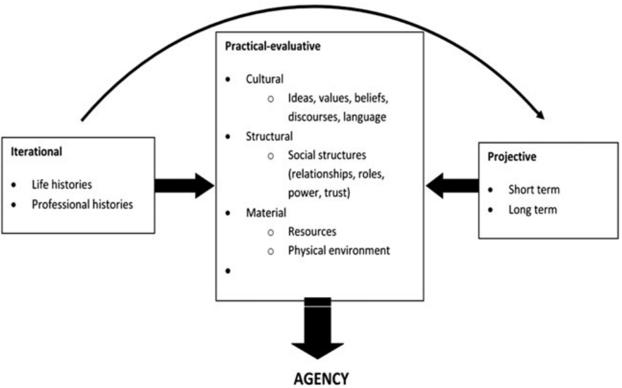
- For this paper, the authors primarily analyzed interview data from all three phases, using codes from an agency model and then open coding to interpret beliefs and aspirations.
## Limitations
- The authors explicitly say the data refer to “one particular though nonetheless interesting case,” so the findings are limited in scope.
- The study draws primarily on the stories of six classroom teachers, which is a small sample; this is evident in the text.
- The analysis focuses on interviews and selected themes from one reform context in Scotland, so transferability beyond this setting is not established; this is evident in the text.
Model-written summary. Check it against the paper before relying on it.
Integrity signals
Registry
Cites
Statistics
Figures
Verification
Claims the paper makes
0 Valid · 2 Not valid · 30 Not checked · 99 Own results and interpretations
A result the paper reports from its own data — it cites no other source for it, so there is none to check. The quote shows it is in the paper.
In the paper
“The significance of what was often referred to as a safe and caring learning environment for everyone who came into their classrooms was articulated strongly.”
§ 4. Teachers’ beliefs > 4.1. Beliefs relating to children and young people
boosted- Asserted: passes — The authors put it forward as true.
- Checkable: passes — It can be checked against evidence.
- Load-bearing: unclear — It is unclear whether the paper’s conclusions depend on it.
- Based: passes — The paper gives a reason why it holds.
A result the paper reports from its own data — it cites no other source for it, so there is none to check. The quote shows it is in the paper.
In the paper
“In analysing the data, we were struck by the similarity of beliefs articulated across this small group of teachers, despite their location in different sectors of education.”
plain- Asserted: passes — The authors put it forward as true.
- Checkable: passes — It can be checked against evidence.
- Load-bearing: passes — The paper’s conclusions depend on it.
- Based: passes — The paper gives a reason why it holds.
A result the paper reports from its own data — it cites no other source for it, so there is none to check. The quote shows it is in the paper.
In the paper
“The data clearly convey the strong sense of teachers’ professional responsibility towards their students.”
§ 4. Teachers’ beliefs > 4.1. Beliefs relating to children and young people
boosted- Asserted: passes — The authors put it forward as true.
- Checkable: passes — It can be checked against evidence.
- Load-bearing: unclear — It is unclear whether the paper’s conclusions depend on it.
- Based: passes — The paper gives a reason why it holds.
A result the paper reports from its own data — it cites no other source for it, so there is none to check. The quote shows it is in the paper.
In the paper
“Indeed, only one participant strongly referred to the importance of subject knowledge, lamenting what she saw as the detrimental effects of vocationalism on the academic content of her subject.”
§ 4. Teachers’ beliefs > 4.2. Beliefs about the role of the teacher
plainSingle case- Asserted: passes — The authors put it forward as true.
- Checkable: passes — It can be checked against evidence.
- Load-bearing: unclear — It is unclear whether the paper’s conclusions depend on it.
- Based: passes — The paper gives a reason why it holds.
A result the paper reports from its own data — it cites no other source for it, so there is none to check. The quote shows it is in the paper.
In the paper
“these discourses appear to be fairly restricted in scope, more geared to short-term goals, and predominantly articulated via the language of recent policy documentation.”
hedged- Asserted: passes — The authors put it forward as true.
- Checkable: passes — It can be checked against evidence.
- Load-bearing: passes — The paper’s conclusions depend on it.
- Based: passes — The paper gives a reason why it holds.
57 more claims
Create a free account to see all 131 claims and every source verdict.
- It may state two separate claims as one. 39
- Probably not a substantial claim. 46
Claims other papers make about this one
Each is checked against this paper’s own text: does it say what the citing paper says it does?
The cited source says what the claim attributes to it.
In the citing paper
“This absence leaves teachers unsure about their roles and contributions (Biesta et al. 2015).”
From Unveiling teachers’ professional agency and decision-making in professional learning: the illusion of choice (2025) · cites this paper as Biesta et al. 2015
The cited source says what the claim attributes to it.
In the citing paper
“As Biesta et al. (2015) suggests, teachers' agency is influenced not just by their attributes, but also by their professional experience.”
From Unveiling teachers’ professional agency and decision-making in professional learning: the illusion of choice (2025) · cites this paper as Biesta et al. 2015
The cited source says what the claim attributes to it.
In the citing paper
“Likewise Biesta, Priestley and Robinson (2015) point to a lack of discourses among teachers that constructs education in terms other than the technical-rational concerns of 'efficiency' to include questions of purpose and value.”
From Teacher agency and professional learning communities; what can Learning Rounds in Scotland teach us? (2017) · cites this paper as Biesta, Priestley and Robinson (2015)
The cited source says what the claim attributes to it.
In the citing paper
“Biesta, Priestley and Robinson (2015) report that the Scottish teachers in their research had a very similar set of views about teaching, learning and education more broadly, even though they were from diverse locations and sectors.”
From Teacher agency and professional learning communities; what can Learning Rounds in Scotland teach us? (2017) · cites this paper as Biesta, Priestley and Robinson (2015)
The cited source says what the claim attributes to it.
In the citing paper
“Biesta, Priestley and Robinson (2015) report a similar experience in their research on teacher agency.”
From Teacher agency and professional learning communities; what can Learning Rounds in Scotland teach us? (2017) · cites this paper as Biesta, Priestley and Robinson (2015)
1 more claim about this paper
Create a free account to see every claim other papers make about this one.
Citations
Cites
Outline of a Theory of Practice
Bourdieu, P. (1977) · doi:10.1017/cbo9780511812507 · Cited by 27,606
(1984) · Cited by 21,166
Outline of a Theory of Practice.
Frank, A. W., & Bourdieu, P. (1980) · Contemporary Sociology · doi:10.2307/2066038 · Cited by 14,545
Teachers' beliefs and educational research: cleaning up a messy construct
Pajares, M. F. (1992) · Review of Educational Research · doi:10.3102/00346543062003307 · Cited by 9,007 · cited 2×
“In the discussion section, we explore what this reveals about the role of beliefs in teacher agency.”
BackgroundEmirbayer, M., & Mische, A. (1998) · American Journal of Sociology · doi:10.1086/231294 · Cited by 6,165
Outline of a Theory of Practice
BOURDIEU, P. (2007) · On Violence · doi:10.2307/j.ctv120qr2d.16 · Cited by 5,527
Realist Social Theory: The Morphogenetic Approach
Archer, M. S. (1995) · Cambridge University Press eBooks · doi:10.1017/cbo9780511557675 · Cited by 3,125
Change Forces: Probing the Depths of Educational Reform
Fullan, M. (1993) · doi:10.4324/9780203059005 · Cited by 3,111
Realist social theory the morphogenetic approach
Archer, M. S. (1995) · Cited by 2,938
Change Forces: Probing the Depths of Educational Reform
Davies, S., & Fullan, M. (1995) · Canadian Public Policy / Analyse de Politiques · doi:10.2307/3552051 · Cited by 2,809
Research works printed but not linked: 3
- Brown, S., & McIntyre, D. (1993). Making sense of teaching: Developing teachers and teaching. Buckingham: Open University Press. (Open in a new window)Google Scholar
- Hollis, M. (1994). The philosophy of social science: An introduction. Cambridge: Cambridge University Press. (Open in a new window)Google Scholar · doi:10.1017/ccol0521447801
- Nieveen N. (2011 September 14). Teachers’ professional development in curriculum design in the Netherlands. Paper presented at the European Conference for Educational Research Berlin.
Cited by
Items 101–200 of 1,289
Gao, Z., & Yuan, R. (2021) · Teaching in Higher Education · doi:10.1080/13562517.2021.1989577 · Cited by 44
ELT teachers’ agency for wellbeing
Sulis, G., Mairitsch, A., Babić, S., Mercer, S., & Resnik, P. (2023) · ELT Journal · doi:10.1093/elt/ccad050 · Cited by 50
Teacher professional identity: agentic actions of a novice teacher in a challenging school context
Groenewald, E., & Arnold, L. (2024) · Teachers and Teaching · doi:10.1080/13540602.2024.2308890 · Cited by 74
“When teachers act, they use their past experiences, their future ambitions, and their knowledge of the resources currently available to do so (Biesta et al., 2015; Jenkins, 2014).”
InfluentialPolatcan, M., Özkan, P., & Bellibaş, M. Ş. (2024) · Journal of Professional Capital and Community · doi:10.1108/jpcc-01-2024-0008 · Cited by 55
Chaharbashloo, H., Gholami, K., Aliasgari, M., Talebzadeh, H., & Mousapour, N. (2019) · Teaching and Teacher Education · doi:10.1016/j.tate.2019.102931 · Cited by 64
Kalsoom, Q., & Qureshi, N. (2021) · International Journal of Sustainable Development & World Ecology · doi:10.1080/13504509.2021.1880983 · Cited by 52
“In addition to social conditions and contexts, agency is influenced by ‘the interplay of personal capacities and the resources’ (Biesta et al. 2015).”
BackgroundUnderstanding gender bias in teachers’ grading: The role of gender stereotypical beliefs
Doornkamp, L., van der Pol, L. D., Groeneveld, S. M., Mesman, J., Endendijk, J. J., & Groeneveld, M. G. (2022) · Teaching and Teacher Education · doi:10.1016/j.tate.2022.103826 · Cited by 50
Transformative professional learning: an ecological approach to agency through critical reflection
Jones, M., & Charteris, J. (2017) · Reflective Practice · doi:10.1080/14623943.2017.1307729 · Cited by 49
“As an ‘emergent phenomenon’ it is produced through ‘actor-situation transaction’ (Biesta et al., 2015, p. 626), and can be a methodological challenge for researchers to capture (Edwards, 2015) and to explain.”
BackgroundMethodInfluentialAyish, N., & Deveci, T. (2019) · International journal on teaching and learning in higher education · Cited by 75
How vocational education teachers and managers make sense of career guidance
Magee, M., Kuijpers, M., & Runhaar, P. (2021) · British Journal of Guidance and Counselling · doi:10.1080/03069885.2021.1948970 · Cited by 36
Curriculum policy and instructional planning: Teachers’ autonomy across various school contexts
Dieudé, A., & Prøitz, T. S. (2022) · European Educational Research Journal · doi:10.1177/14749041221075156 · Cited by 57
“Various aspects of control and decision making have also been raised as crucial in the literature when investigating what autonomy means for actors operating in various national and local contexts where comprehensive reforms have occurred (Bergh, 2015; Priestley et al., 2015; Wermke et al., 2018).”
BackgroundResearch-informed teacher education, teacher autonomy and teacher agency: the example of Finland
Chung, J. (2023) · London Review of Education · doi:10.14324/lre.21.1.13 · Cited by 89
“Furthermore, Biesta et al. (2015) similarly view teacher agency through an ecological lens.”
InfluentialFu, G., & Clarke, A. (2018) · Educational Review · doi:10.1080/00131911.2019.1524205 · Cited by 39
“Such findings provide evidence for employing an ecological understanding of teacher agency: it implies the engagement between actors and their temporal-relational contexts-for-action (Biesta et al., 2015).”
BackgroundLindsay, G. M. (2020) · Australasian Journal of Early Childhood · doi:10.1177/1836939120979061 · Cited by 47
Sang, G.-Y. (2019) · Encyclopedia of Teacher Education · doi:10.1007/978-981-13-1179-6_271-1 · Cited by 63
Nuancing the critique of commercialisation in schools: recognising teacher agency
Hogan, A., Enright, E., Stylianou, M., & McCuaig, L. (2018) · Journal of Education Policy · doi:10.1080/02680939.2017.1394500 · Cited by 31
“For Biesta, Priestley, and Robinson (2015), this suggests that teacher agency is an emergent phenomenon of an ‘actor-situation transaction’.”
BackgroundInfluentialTeacher agency in times of educational change: the case of transitioned teachers in Vietnam
Tran, H. (2018) · Current Issues in Language Planning · doi:10.1080/14664208.2018.1553912 · Cited by 41
“Biesta, Priestley, and Robinson (2015) also suggested that teacher agency is an indispensable element of good and meaningful education in relation to the complexities of different educational practices.”
BackgroundAspbury-Miyanishi, E. (2022) · Teaching and Teacher Education · doi:10.1016/j.tate.2022.103662 · Cited by 47
Chalkley, A. E., Mandelid, M. B., Thurston, M. N., Daly-Smith, A., Singh, A. S., Huiberts, I., Archbold, V. S. J., Resaland, G. K., & Tjomsland, H. E. (2022) · Teaching and Teacher Education · doi:10.1016/j.tate.2022.103825 · Cited by 45
Phan, H. L. T., Trần, L. T., & Blackmore, J. (2018) · Journal of Studies in International Education · doi:10.1177/1028315318803717 · Cited by 40
Xu, Y., & Harfitt, G. J. (2018) · Asia-Pacific Journal of Teacher Education · doi:10.1080/1359866x.2018.1555790 · Cited by 46
“In other words, agency is not a quality that teachers have, but “a quality of the engagement” of teachers “with temporal-relational contexts-for-actions” (Biesta et al., 2015, p. 626).”
BackgroundFinding success with pedagogical innovation: A case from CSL teachers’ experiences with TBLT
Peng, Y., & Pyper, J. S. (2019) · Language Teaching Research · doi:10.1177/1362168819862132 · Cited by 44
“Recall the conceptualization of teacher agency as what teachers do to critically respond to their problems (Biesta et al., 2015; Biesta & Tedder, 2006); understanding teachers’ challenges in the first place followed by guiding teachers to see how tasks have the potential to address their perceived challenges gives tea…”
BackgroundVoices of student teachers' professional agency at the intersection of theory and practice
Heikkilä, M., Iiskala, T., & Mikkilä‐Erdmann, M. (2020) · Learning Culture and Social Interaction · doi:10.1016/j.lcsi.2020.100405 · Cited by 49
Ribaeus, K., Enochsson, A.-B., & Hultman, A. L. (2020) · Journal of Early Childhood Teacher Education · doi:10.1080/10901027.2020.1797956 · Cited by 52
Individual and collective agencies in China's curriculum reform: A case of physics teachers
Fu, G., & Clarke, A. (2018) · Journal of Research in Science Teaching · doi:10.1002/tea.21467 · Cited by 35
New immigrants. An incentive for intercultural education
Leeman, Y., & van Koeven, E. (2019) · Education Inquiry · doi:10.1080/20004508.2018.1541675 · Cited by 31
An exploration of agency in the localisation of open educational resources for teacher development
Wolfenden, F., & Adinolfi, L. (2019) · Learning Media and Technology · doi:10.1080/17439884.2019.1628046 · Cited by 40
Lambirth, A., Cabral, A. P., McDonald, R., Philpott, C., Brett, A., & Magaji, A. (2019) · Professional Development in Education · doi:10.1080/19415257.2019.1685565 · Cited by 70
Assessing student teachers’ agency and using it for predicting commitment to teaching
Leijen, Ä., Pedaste, M., & Baucal, A. (2021) · European Journal of Teacher Education · doi:10.1080/02619768.2021.1889507 · Cited by 57
“The attainment of agency is therefore influenced by individual efforts, resources, and cultural and structural factors and we cannot view agency as mere characteristic or property of an individual (Biesta, Priestley, and Robinson 2015).”
BackgroundLerum, Ø., Bartholomew, J. B., McKay, H. A., Resaland, G. K., Tjomsland, H. E., Anderssen, S. A., Leirhaug, P. E., & Moe, V. F. (2019) · Translational Journal of the American College of Sports Medicine · doi:10.1249/tjx.0000000000000104 · Cited by 45
“Beliefs can have an orientation toward the future and thus play a particular “driving” or “motivating” role in the achievement of agency (37).”
BackgroundBridging Educational Change and Social Justice: A Call to the Field
Datnow, A., Yoshisato, M., Macdonald, B., Trejos, J., & Kennedy, B. C. (2022) · Educational Researcher · doi:10.3102/0013189x221138837 · Cited by 43
“From the research base on educational change, we know that educational reform unfolds in a multilayered, dynamic system in which people exercise power and agency (Biesta et al., 2015; Bridwell-Mitchell, 2015; Datnow et al., 2002).”
BackgroundConnolly, M. R., Hadfield, M., Barnes, Y., & Snook, J. (2018) · Teaching and Teacher Education · doi:10.1016/j.tate.2018.01.010 · Cited by 43
“This increased agency should allow these BTs to accept, reject and/or amend organisational norms around teaching as “choices”, rather than passively accepting their “inevitability” (Biesta et al., 2015, p. 638)- or as Whitty (2008) asserts, reconstitute them as agents, rather than victims of change.”
BackgroundTeacher agency in English language arts teaching: a scoping review of the literature
Chisholm, J. S., Alford, J. H., Halliday, L. M., & Cox, F. M. (2019) · English Teaching Practice & Critique · doi:10.1108/etpc-05-2019-0080 · Cited by 46
EFL Teacher Education in Finland: Manifestations of Professional Agency in Teacher Educators’ Work
Green, C., & Pappa, S. (2020) · Scandinavian Journal of Educational Research · doi:10.1080/00313831.2020.1739128 · Cited by 46
Du, X., Naji, K. K., Ebead, U. A., & Ma, J. (2020) · European Journal of Engineering Education · doi:10.1080/03043797.2020.1832444 · Cited by 45
Pedaste, M., Leijen, Ä., Kivirand, T., Nelis, P., & Malva, L. (2021) · International Journal of Inclusive Education · doi:10.1080/13603116.2021.1994661 · Cited by 59
“Biesta, Priestley, and Robinson (2015) developed an ecological model of agency.”
InfluentialGao, Y., Qin, L., & Gu, Q. (2022) · Frontiers in Psychology · doi:10.3389/fpsyg.2022.958003 · Cited by 35
Sansom, D. W. (2019) · Professional Development in Education · doi:10.1080/19415257.2019.1634625 · Cited by 43
Mohammad Nezhad, P., & Stolz, S. A. (2025) · Professional Development in Education · doi:10.1080/19415257.2024.2349058 · Cited by 61
“When granted, decision-making power usually aligns with external policy objectives (Priestley et al .”
InfluentialWang, K., Chai, C. S., Liang, J., & Sang, G. (2024) · Technology Pedagogy and Education · doi:10.1080/1475939x.2024.2369241 · Cited by 47
“Biesta et al. (2015) defined teacher agency as teachers’ active contributions to shaping their work and conditions.”
Buckworth, J. (2017) · Asia-Pacific Journal of Teacher Education · doi:10.1080/1359866x.2017.1335853 · Cited by 31
¿Qué Opinan los Maestros sobre las Competencias de Liderazgo Escolar y sobre su Formación Inicial?
Iranzo‐García, P., Camarero‐Figuerola, M., Barrios-Arós, C., García, J. M. T., & Gilabert, S. (2018) · REICE Revista Iberoamericana sobre Calidad Eficacia y Cambio en Educación · doi:10.15366/reice2018.16.3.002 · Cited by 28
Ritter, R., Wehner, A., Lohaus, G., & Krämer, P. (2019) · Frontiers in Education · doi:10.3389/feduc.2019.00101 · Cited by 35
“In other words, beliefs constitute the expert knowledge on the ground of which teachers draw decisions concerning teaching and interaction (Biesta et al., 2015).”
BackgroundBradfield, K. Z., & Exley, B. (2020) · The Curriculum Journal · doi:10.1002/curj.56 · Cited by 42
“Research exploring influences on teachers’ use of curriculum has often focused on non-subject-specific foci (e.g. Priestley et al., 2012; Biesta et al., 2015), the examination of perceived curriculum ownership, the implementation strategy that facilitates collective sense-making (März &…”
BackgroundHobbiss, M. H., Sims, S., & Allen, R. S. (2020) · Review of Education · doi:10.1002/rev3.3226 · Cited by 56
Nilsen, T. R. (2021) · International journal of child care and education policy/International journal of child care and education · doi:10.1186/s40723-020-00078-y · Cited by 48
Whose action research is it?: Promoting linguistically sensitive teacher education in Europe
Bergroth, M., Esbert, J. L., Pépiot, N., Sierens, S., Dražnik, T., & van der Worp, K. (2021) · Educational Action Research · doi:10.1080/09650792.2021.1925570 · Cited by 43
“…of prior experience and knowledge, in addition to beliefs, attitudes and perceptions (Portolés and Otilia 2020; Farrell 2018; Kalaja et al. 2016; Biesta, Priestley, and Robinson 2015); therefore, in order to achieve the desired change in teacher cognition, both the education and the…”
BackgroundHuang, J., & Yip, J. W. C. (2021) · Frontiers in Psychology · doi:10.3389/fpsyg.2021.739271 · Cited by 41
Moradkhani, S., & Ebadijalal, M. (2021) · Journal of Language Identity & Education · doi:10.1080/15348458.2021.1988605 · Cited by 33
“While Parna chose not to adopt a stance of overt refusal and criticism, Nika displayed resistance toward and opted for agentive renegotiation of such rules (Cross, 2018), treating them as “choices” rather than accepting them “inevitably” (Biesta et al., 2015, p. 638).”
BackgroundTeacher agency and school-based curriculum in China’s non-elite schools
Tan, C. (2016) · Journal of educational change · doi:10.1007/s10833-016-9274-8
“Biesta et al. (2015) maintain that ‘‘the achievement of agency is always informed by past experience, including personal and professional biographies; that it is orientated towards the future, both with regard to more short-term and more long-term perspectives; and that it is enacted in the here-and-now, where such en…”
BackgroundNest, A. V. D., Long, C., & Engelbrecht, J. (2018) · South African Journal of Education · doi:10.15700/saje.v38n1a1382 · Cited by 21
Teacher agency and language mediation in two Maltese preschool bilingual classrooms
Mifsud, C. L., & Vella, L. A. (2018) · Language Culture and Curriculum · doi:10.1080/07908318.2018.1504400 · Cited by 38
“Teacher agency is dependent upon the personal qualities that the teachers bring to their work, which form part of the iterational dimension of their agency (Biesta et al., 2015).”
BackgroundMethodInfluentialOECD Reviews of School Resources
(2015) · OECD reviews of school resources · doi:10.1787/24133841 · Cited by 28
Space as a lens for teacher agency: A case study of three beginning teachers in England, UK
Rushton, E. A. C., & Bird, A. (2024) · The Curriculum Journal · doi:10.1002/curj.224 · Cited by 28
“Much recent research (e.g. Erss, 2018; Leijen et al., 2020) which considers teacher agency has drawn on the ecological approach articulated by Priestley et al. (2015).”
BackgroundInfluentialLanguage teachers’ engagement with ideological representations as materials designers
Li, J., Yun, W., & Gao, X. A. (2023) · System · doi:10.1016/j.system.2023.103121 · Cited by 36
Narrating neoliberalism: alternative education teachers’ conceptions of their changing roles
Golden, N. A. (2017) · Teaching Education · doi:10.1080/10476210.2017.1331213 · Cited by 35
“Without ‘opportunities for systematic sense-making’ around educational practices and philosophies (Biesta et al., 2015, p. 636), teachers’ collective agency diminishes as educators are left to individually navigate externally imposed systems of meaning-making around teaching and learning.”
BackgroundToom, A., Tiilikainen, M., Heikonen, L., Leijen, Ä., Mena, J., & Husu, J. (2019) · Teachers and Teaching · doi:10.1080/13540602.2019.1652162 · Cited by 37
van de Kuilen, H. S., Altinyelken, H. K., Voogt, J. M., et al. (2020) · Compare A Journal of Comparative and International Education · doi:10.1080/03057925.2020.1847044 · Cited by 27
Nakata, Y., Tokuyama, M., & Gao, X. A. (2021) · Asia-Pacific Journal of Teacher Education · doi:10.1080/1359866x.2021.1940841 · Cited by 33
Investigating Pre-Service Teachers’ Behavioral Intentions to Use Web 2.0 Gamification Tools
Turan, Z., Küçük, S., & Karabey, S. Ç. (2022) · Participatory Educational Research · doi:10.17275/per.22.85.9.4 · Cited by 43
Entrepreneurship educators: a configurational analysis of factors influencing pedagogical choices
Nikou, S., Brush, C. G., & Wraae, B. (2023) · International Journal of Entrepreneurial Behaviour & Research · doi:10.1108/ijebr-08-2022-0760 · Cited by 46
What really contributes to employability of PhD graduates in uncertain labour markets?
Pham, T. T. H. (2023) · Globalisation Societies and Education · doi:10.1080/14767724.2023.2192908 · Cited by 45
“These enduring journeys resonate with a line of research that emphasises the need to examine agency continuously throughout one ’ s life course rather than from a limited momentary and cross-sectional viewpoint (Biesta, Priestley, and Robinson 2015; Eteläpelto et al. 2013).”
Preservice Teachers’ TPACK Growth After Technology Integration Courses in Early Childhood Education
Lim, B. Y., Lake, V. E., Beisly, A. H., & Ross, R. K. (2023) · Early Education and Development · doi:10.1080/10409289.2023.2224219 · Cited by 60
“Understanding teachers’ attitudes and beliefs about technology is essential because they influence their pedagogical approaches to teaching, perceptions of how children learn, and the propensity to adopt new instructional strategies, initiatives, and practices (Biesta et al., 2015).”
BackgroundMary, L., & Young, A. S. (2018) · Language Culture and Curriculum · doi:10.1080/07908318.2018.1504403 · Cited by 30
“This notion of beliefs is also taken up in the ecological model of agency proposed by Biesta, Priestly, and Robinson (2015) in which agency is seen to be influenced by past experiences, future aspirations and present circumstances, all of which are mediated by individuals’ underlying beliefs.”
BackgroundInfluentialCunningham, C. (2019) · Language Culture and Curriculum · doi:10.1080/07908318.2019.1619751 · Cited by 38
“tor’s role here is crucial and individual teachers are agents for social change (Biesta et al., 2015; Gkaintartzi et al., 2015).”
BackgroundHilal, Y. Y., Hammad, W., & Polatcan, M. (2022) · Educational Management Administration & Leadership · doi:10.1177/17411432221134931 · Cited by 42
“…educational discourse delineating teachers as professionals and active agents within their communities (Biesta et al., 2015; Harris, 2006) where they are expected to collaborate with their colleagues and support each other ’ s ’ professional development (Biesta et al., 2015; Fu and Clarke, 2017).”
Ulvik, M., & Smith, K. (2016) · Uniped · doi:10.18261/issn.1893-8981-2016-01-06 · Cited by 37
Teacher Agency and Futures Thinking
Varpanen, J., Laherto, A., Hilppö, J. A., & Ukkonen-Mikkola, T. (2022) · Education Sciences · doi:10.3390/educsci12030177 · Cited by 51
Ahmad, H., & Shah, S. R. (2022) · Cogent Education · doi:10.1080/2331186x.2022.2080352 · Cited by 65
“In contrast, the finding is in accordance with conclusion arrived by Biesta et al. (2015) who elaborated that due to the lack of clear institutional policy towards students’ learning, teachers despite possessing a large repertoire of teaching strategies, are unable to exercise their agency in…”
BackgroundMethodResultInfluentialSchwartz, M., Ragnarsdóttir, H., Toren, N. K., & Dror, O. (2022) · Linguistics and Education · doi:10.1016/j.linged.2022.101125 · Cited by 29
The role of teacher agency in refugee education
Rose, A. (2018) · The Australian Educational Researcher · doi:10.1007/s13384-018-0280-0 · Cited by 3
Learning to Use Teaching for Personal and Social Responsibility Through Action Research
Gray, S., Wright, P. M., Sievwright, R., & Robertson, S. (2019) · Journal of Teaching in Physical Education · doi:10.1123/jtpe.2018-0190 · Cited by 26
“This reflects a form of 359 ‘ecological agency’ proposed by Biesta et al. (2015) who suggest that achieving such agency is 360 critical if teachers are to engage with policy and change in more meaningful ways.”
Nguyen, C. D., & Huynh, T.-N. (2021) · Educational Review · doi:10.1080/00131911.2021.1974346 · Cited by 44
“One the other hand, the findings are, to some extent, consistent with the literature on teacher agency in the sense that the participants’ decisions and initiatives for educational change are highlighted (Biesta et al., 2015; Buchanan, 2015; Molla & Nolan, 2020).”
ResultTeacher Agency for Change and Development in Higher Education: A Scoping Literature Review
Cong‐Lem, N. (2024) · International Journal of Educational Reform · doi:10.1177/10567879231224744 · Cited by 63
“Teacher agency is inherently situated (Biesta et al., 2015), practiced within the constraints of local conditions.”
Insulander, E., Brehmer, D., & Ryve, A. (2019) · Learning Culture and Social Interaction · doi:10.1016/j.lcsi.2019.100330 · Cited by 34
Madondo, F. (2020) · Journal of Research in Childhood Education · doi:10.1080/02568543.2020.1731024 · Cited by 58
Mertala, P. (2021) · British Journal of Educational Technology · doi:10.1111/bjet.13125 · Cited by 35
“The individu-alistic dimension, in turn, encourages students to criticize the prevalent societal structures and to act as agents of change as they contribute to the development of a society that ‘might be’ (Biesta et al., 2015).”
BackgroundTarnanen, M., Kostiainen, E., Kaukonen, V., Martin, A. C., & Toikka, T. (2021) · Professional Development in Education · doi:10.1080/19415257.2021.1959383 · Cited by 43
“This kind of collaboration is worth considering because research has also shown that schools struggle to create constructive interactions amongst teachers when promoting teacher PDL (e.g. Biesta et al .”
Democracy and teachers: the im/possibilities for pluralisation in evidence-based practice
Holloway, J., & Hedegaard, M. L. L. (2021) · Journal of Education Policy · doi:10.1080/02680939.2021.2014571 · Cited by 37
“They also show the dangers of relying on ‘what works’ as a means for directing pedagogical decisions, which can undermine teachers’ capacity to exercise professional judgment (Biesta, Priestley, and Robinson 2015; Krejsler 2013; Wescott 2021).”
BackgroundXu, Y., & Tao, J. (2023) · Language Teaching Research · doi:10.1177/13621688221151047 · Cited by 33
“While their multi-faceted care can be related to their beliefs about teaching (Biesta et al., 2015), it brings new insights about what a caring teacher can be.”
Influential‘We are creating a reality’: teacher agency in early bilingual education
Dubiner, D., Deeb, I., & Schwartz, M. (2018) · Language, Culture and Curriculum · doi:10.1080/07908318.2018.1504399 · Cited by 22
Bergroth, M., Esbert, J. L., Pépiot, N., van der Worp, K., Dražnik, T., & Sierens, S. (2021) · European Educational Research Journal · doi:10.1177/14749041211012500 · Cited by 44
“Everything that teachers do is filtered through their prior experiences and knowledge in addition to their beliefs, attitudes and perceptions (Biesta et al., 2015; Kirsch et al., 2020).”
BackgroundProfessional Survival in a Neoliberal Age : A Case Study of an EFL Teacher in China
Li, W., & Costa, P. I. D. (2017) · The Journal of AsiaTEFL · doi:10.18823/asiatefl.2017.14.2.5.277 · Cited by 36
“Biesta, Priestley, and Robinson (2015) pointed out that the evaluations from teachers’ past experience as well as their intentions and expectations account for a significant part of teachers’ belief systems, which in turn have an impact on their exercise of teacher agency.”
BackgroundWright, D. S., Crooks, K., Hunter, D. O., Krumm, C., & Balgopal, M. (2021) · Environmental Education Research · doi:10.1080/13504622.2021.1960955 · Cited by 26
“To address this need, we call on teacher educators to encourage teachers to recount past experiences when they have tried adapting and implementing new curricula and ask them to identify how they overcame perceived barriers (Biesta, Priestley, and Robinson 2015).”
BackgroundRe-imagining Digital Technology in Education through Critical and Neo-materialist Insights
Pischetola, M. (2021) · Digital Education Review · doi:10.1344/der.2021.40.154-171 · Cited by 42
“In recent years, Biesta and collaborators have made the attempt to reframe teacher agency within the tradition of pragmatist philosophy and have considered it as the result of an ecological and emergent process (Biesta & Tedder, 2007; Biesta et al., 2015).”
English Language Teacher Agency in Response to Curriculum Reform in China: An Ecological Approach
Wang, L. (2022) · Frontiers in Psychology · doi:10.3389/fpsyg.2022.935038 · Cited by 55
“These findings also confirm that the agency to change is not activated by beliefs alone; a partial adoption of reform beliefs can also coexist with the agency of resistance toward the reform, but teaching and learning achievement gains for implementing reforms appear to be precursors of deep change in beliefs (Biesta…”
BackgroundGandolfi, H. E. (2023) · Educational Review · doi:10.1080/00131911.2022.2163378 · Cited by 34
“…lives and of people ’ s expectations of their lives, work and places in society (Ger-meten, 2013, p. 614) and, as such, that participants ’ views and agentic work on environmental issues were also intrinsically connected with their broader life and professional trajectories (Biesta et al., 2015).”
Ethical aspects of professional dilemmas in the first year of teaching
Ulvik, M., Smith, K., & Helleve, I. (2016) · Professional Development in Education · doi:10.1080/19415257.2016.1178163 · Cited by 36
“Being aware of different educational discourses might provide perspectives to evaluate one’s own beliefs against and offer alternative views on education (Biesta et al. 2015).”
BackgroundTeacher agency in the Canadian context: linking thehowand thewhat
Fu, G., & Clarke, A. (2017) · Journal of Education for Teaching International Research and Pedagogy · doi:10.1080/02607476.2017.1355046 · Cited by 34
“…(Toom, Pyhältö, and Rust 2015), scholars conducted empirical studies related to teacher agency in their respective jurisdictions including the UK (Biesta, Priestley, and Robinson 2015; Pantić 2015), Finland (Eteläpelto, Vähäsantanen, and Hökkä 2015; Soini et al. 2015), Netherlands (Van der…”
BackgroundResearching Teachers’ Agentic Orientations to Educational Change in Finnish Schools
Rajala, A., & Kumpulainen, K. (2017) · Professional and practice-based learning · doi:10.1007/978-3-319-60943-0_16 · Cited by 24
“We hold that teacher agency matters in educational change efforts as it is teachers who enact reforms in the daily practices of their classrooms and school communities (Biesta et al., 2015).”
BackgroundMethodInfluentialThe place of forest school within English primary schools: senior leader perspectives
Kemp, N., & Pagden, A. (2018) · Education 3-13 · doi:10.1080/03004279.2018.1499791 · Cited by 30
Pantić, N., Taiwo, M., & Martindale, A. (2019) · Teachers and Teaching · doi:10.1080/13540602.2018.1562441 · Cited by 35
Fostering the Digital Competence of Schools: Piloting SELFIE in the Italian Education Context
Bocconi, S., Panesi, S., & Kampylis, P. (2020) · IEEE Revista Iberoamericana de Tecnologias del Aprendizaje · doi:10.1109/rita.2020.3033228 · Cited by 35
“…of teacher agency (i.e. constructed engagement for transformation) is always (i) informed by personal and professional previous experiences; (ii) orientated towards more short-and long-term perspectives; and (iii) that it is enacted by cultural, material and contextual resources [42, pp.626-627].”
BackgroundCong‐Lem, N., & Nguyen, M. H. (2024) · System · doi:10.1016/j.system.2024.103347 · Cited by 33
“Drawing on an ecological approach, Biesta et al. (2015) view agency as pragmatic actions, or something an individual does that is informed by iterative, practical-evaluative, and projective dimensions (i.e., elements of the past, present, and future).”
Charteris, J., & Smith, J. (2017) · Reflective Practice · doi:10.1080/14623943.2017.1304375 · Cited by 30
Language policy, professional development and sustainability of multilingual approaches
Kirsch, C., Duarte, J., & Palviainen, Å. (2020) · Routledge eBooks · doi:10.4324/9780429059674-14 · Cited by 50
Teacher agency in enacting physical education in a period of curriculum change and reform in Ireland
Scanlon, D., Calderón, A. A., & MacPhail, A. (2020) · The Curriculum Journal · doi:10.1002/curj.80 · Cited by 27
Tan, H., Zhao, K., & Dervin, F. (2021) · Language and Intercultural Communication · doi:10.1080/14708477.2021.1988631 · Cited by 29
“It can also be restricted when confronted with dilemmas, contradictions, incoherent educational visions, and uncertainty (Biesta et al., 2015).”
BackgroundThe ‘Postdigital Teacher Identities’ Praxis: a Discussion Paper
Arantes, J. A. (2021) · Postdigital Science and Education · doi:10.1007/s42438-021-00271-3 · Cited by 40
Legette, K. B., Iruka, I. U., Halberstadt, A. G., & Forte, A. B. (2023) · Teaching and Teacher Education · doi:10.1016/j.tate.2023.104213 · Cited by 32
Metadata
- Authors
- Biesta, G., Priestley, M., & Robinson, S.
- Affiliations
- ArtEZ University of the Arts (NL)
- University of Stirling (GB)
- Aarhus University (DK)
- Corresponding author
- Biesta, Gert
- Venue
- Teachers and Teaching
- Publisher
- Informa UK Limited
- Published
- 2015-06-15
- Volume
- 21
- Issue
- 6
- Pages
- 624-640
- ISSN
- 1354-0602 (ISSN-L)
- 1470-1278
- OpenAlex
- W1911902575
- Cited by
- 1,318
- References
- 47
- Citations by year
- 2026: 233 · 2025: 161 · 2024: 141 · 2023: 157 · 2022: 139 · 2021: 131 · 2020: 118 · 2019: 96 · 2018: 73 · 2017: 48 · 2016: 17 · 2015: 4
- FWCI
- 236.15
- Type
- journal article
- Language
- en
- Open access
- hybrid
- doi.org
- Licence
- cc-by-nc-nd
- Locations
- Teachers and Teaching (publishedVersion, cc-by-nc-nd)
- Brunel University Research Archive (BURA) (Brunel University London) (submittedVersion)
- Stirling Online Research Repository (University of Stirling) (submittedVersion, cc-by-nc-nd)
- Edinburgh Research Explorer (University of Edinburgh) (submittedVersion, other-oa)
- Funders
- Economic and Social Research Council (ES/I006907/1)
- Topics
- Social Sciences › Education › Teacher Education and Leadership Studies
- Social Sciences › Education › Education Pedagogy and Practices
- Social Sciences › Arts and Humanities › Philosophy › Education, Philosophy, and Society
- Keywords
- teacher agency, teacher beliefs, Curriculum for Excellence, educational reform, teacher professionalism, teacher decision-making, institutional discourse, professional vision, Scotland
About these checks
Registry, retraction, Cites and statistics results are computed, not judged, with one exception: a printed reference that no index lists is read once by a model before it counts as a citation error. Claims are extracted by a model and kept only when their quote appears verbatim in the text; each cited source is then checked, with a model’s help, for whether it says what the claim relies on. Those verdicts can be wrong — read the claim’s quote and the cited source before relying on one.
A language model drew the claims from the paper on 2026-10-11, under version 3 of the claim definition (model deepseek-v4.1-flash, prompt extract-v3).
A second model labelled each claim on 2026-10-11 (model jev-1.13-20260917, definition revision gold-guideline-v0.2).
Statistics and arithmetic are recomputed, not judged.
Confidence bands are shown only for fields calibrated on our annotated test set. None is calibrated yet, so no band is shown.
What counts as a claim ›How we measure confidence ›How we check this ›
Are you an author, or do you see a problem with this page? Request a review
Data sources
Bibliographic data: Semantic Scholar, OpenAlex, Crossref.
Contains information from the Semantic Scholar Academic Graph Datasets, made available under the ODC Attribution License (ODC-BY 1.0).
Semantic Scholar’s data is described in: Kinney, R., et al. (2023). The Semantic Scholar Open Data Platform. arXiv:2301.10140.
