

The role of beliefs in teacher agency
Open accessThe DOI matches its Crossref record; 44 of the 47 references it cites were found in a registry or an index; none of the 31 sources its claims cite is checked for support yet.
Abstract
There is an ongoing tension within educational policy worldwide between countries that seek to reduce the opportunities for teachers to exert judgement and control over their own work, and those who seek to promote it. Some see teacher agency as a weakness within the operation of schools and seek to replace it with evidence-based and data-driven approaches, whereas others argue that because of the complexities of situated educational practices, teacher agency is an indispensable element of good and meaningful education. While the ideological debate about the shape and form of teacher professionalism is important, it is equally important to understand the dynamics of teacher agency and the factors that contribute to its promotion and enhancement. In this paper, we draw from a two-year study into teacher agency against the backdrop of large-scale educational reform – the implementation of Scotland’s Curriculum for Excellence – in order to explore these questions. We focus on teachers’ beliefs in order to get a sense of the individual and collective discourses that inform teachers’ perceptions, judgements and decision-making and that motivate and drive teachers’ action. While the research suggests that beliefs play an important role in teachers’ work, an apparent mismatch between teachers’ individual beliefs and values and wider institutional discourses and cultures, and a relative lack of a clear and robust professional vision of the purposes of education indicate that the promotion of teacher agency does not just rely on the beliefs that individual teachers bring to their practice, but also requires collective development and consideration.
Overview
CoChat Summary
## TL;DR
The paper argues that teacher beliefs matter for agency, but mainly insofar as they are shaped by policy discourse, schooling culture, and limited professional visions of what education is for. Using ethnographic case studies from three Scottish schools during Curriculum for Excellence, the authors find that teachers’ beliefs were often short-term, instrumental, and only loosely connected to broader purposes or values.
## Key findings
- Across the six classroom teachers, beliefs about children, teaching, and educational purpose were notably similar, and often framed by recent policy language rather than a robust professional discourse.
- Teachers strongly emphasized relationships, safety, care, enjoyment, skills, socialisation, and “maximising student potential,” but gave little sustained attention to knowledge, qualification, social justice, or democratic values.
- The paper argues that a narrow view of purpose limits agency: teachers were effective at short-term classroom management and curriculum delivery, but less able to use beliefs to imagine or enact longer-term educational aims.
- The authors report that teachers’ understandings of Curriculum for Excellence were often superficial or vague; some described the curriculum as “airy fairy,” “overly complicated,” or something they were “fumbling about trying.”
## Methods
- Ethnographic research in one Scottish education authority, in one primary school and two secondary schools, focusing on two experienced classroom teachers in each setting; senior managers were also interviewed.
- The project ran over a full year with three data-collection phases and used observation, semi-structured individual and group interviews, a personal/professional history interview, policy-text analysis, and teacher network mapping.
- For this paper, the authors primarily analyzed interview data from all three phases, using codes from an agency model and then open coding to interpret beliefs and aspirations.
## Limitations
- The authors explicitly say the data refer to “one particular though nonetheless interesting case,” so the findings are limited in scope.
- The study draws primarily on the stories of six classroom teachers, which is a small sample; this is evident in the text.
- The analysis focuses on interviews and selected themes from one reform context in Scotland, so transferability beyond this setting is not established; this is evident in the text.
Model-written summary. Check it against the paper before relying on it.
Integrity signals
Registry
Cites
Statistics
Figures
Verification
Claims the paper makes
0 Valid · 2 Not valid · 30 Not checked · 99 Own results and interpretations
A result the paper reports from its own data — it cites no other source for it, so there is none to check. The quote shows it is in the paper.
In the paper
“The significance of what was often referred to as a safe and caring learning environment for everyone who came into their classrooms was articulated strongly.”
§ 4. Teachers’ beliefs > 4.1. Beliefs relating to children and young people
boosted- Asserted: passes — The authors put it forward as true.
- Checkable: passes — It can be checked against evidence.
- Load-bearing: unclear — It is unclear whether the paper’s conclusions depend on it.
- Based: passes — The paper gives a reason why it holds.
A result the paper reports from its own data — it cites no other source for it, so there is none to check. The quote shows it is in the paper.
In the paper
“In analysing the data, we were struck by the similarity of beliefs articulated across this small group of teachers, despite their location in different sectors of education.”
plain- Asserted: passes — The authors put it forward as true.
- Checkable: passes — It can be checked against evidence.
- Load-bearing: passes — The paper’s conclusions depend on it.
- Based: passes — The paper gives a reason why it holds.
A result the paper reports from its own data — it cites no other source for it, so there is none to check. The quote shows it is in the paper.
In the paper
“The data clearly convey the strong sense of teachers’ professional responsibility towards their students.”
§ 4. Teachers’ beliefs > 4.1. Beliefs relating to children and young people
boosted- Asserted: passes — The authors put it forward as true.
- Checkable: passes — It can be checked against evidence.
- Load-bearing: unclear — It is unclear whether the paper’s conclusions depend on it.
- Based: passes — The paper gives a reason why it holds.
A result the paper reports from its own data — it cites no other source for it, so there is none to check. The quote shows it is in the paper.
In the paper
“Indeed, only one participant strongly referred to the importance of subject knowledge, lamenting what she saw as the detrimental effects of vocationalism on the academic content of her subject.”
§ 4. Teachers’ beliefs > 4.2. Beliefs about the role of the teacher
plainSingle case- Asserted: passes — The authors put it forward as true.
- Checkable: passes — It can be checked against evidence.
- Load-bearing: unclear — It is unclear whether the paper’s conclusions depend on it.
- Based: passes — The paper gives a reason why it holds.
A result the paper reports from its own data — it cites no other source for it, so there is none to check. The quote shows it is in the paper.
In the paper
“these discourses appear to be fairly restricted in scope, more geared to short-term goals, and predominantly articulated via the language of recent policy documentation.”
hedged- Asserted: passes — The authors put it forward as true.
- Checkable: passes — It can be checked against evidence.
- Load-bearing: passes — The paper’s conclusions depend on it.
- Based: passes — The paper gives a reason why it holds.
57 more claims
Create a free account to see all 131 claims and every source verdict.
- It may state two separate claims as one. 39
- Probably not a substantial claim. 46
Claims other papers make about this one
Each is checked against this paper’s own text: does it say what the citing paper says it does?
The cited source says what the claim attributes to it.
In the citing paper
“This absence leaves teachers unsure about their roles and contributions (Biesta et al. 2015).”
From Unveiling teachers’ professional agency and decision-making in professional learning: the illusion of choice (2025) · cites this paper as Biesta et al. 2015
The cited source says what the claim attributes to it.
In the citing paper
“As Biesta et al. (2015) suggests, teachers' agency is influenced not just by their attributes, but also by their professional experience.”
From Unveiling teachers’ professional agency and decision-making in professional learning: the illusion of choice (2025) · cites this paper as Biesta et al. 2015
The cited source says what the claim attributes to it.
In the citing paper
“Likewise Biesta, Priestley and Robinson (2015) point to a lack of discourses among teachers that constructs education in terms other than the technical-rational concerns of 'efficiency' to include questions of purpose and value.”
From Teacher agency and professional learning communities; what can Learning Rounds in Scotland teach us? (2017) · cites this paper as Biesta, Priestley and Robinson (2015)
The cited source says what the claim attributes to it.
In the citing paper
“Biesta, Priestley and Robinson (2015) report that the Scottish teachers in their research had a very similar set of views about teaching, learning and education more broadly, even though they were from diverse locations and sectors.”
From Teacher agency and professional learning communities; what can Learning Rounds in Scotland teach us? (2017) · cites this paper as Biesta, Priestley and Robinson (2015)
The cited source says what the claim attributes to it.
In the citing paper
“Biesta, Priestley and Robinson (2015) report a similar experience in their research on teacher agency.”
From Teacher agency and professional learning communities; what can Learning Rounds in Scotland teach us? (2017) · cites this paper as Biesta, Priestley and Robinson (2015)
1 more claim about this paper
Create a free account to see every claim other papers make about this one.
Citations
Cites
Outline of a Theory of Practice
Bourdieu, P. (1977) · doi:10.1017/cbo9780511812507 · Cited by 27,606
(1984) · Cited by 21,166
Outline of a Theory of Practice.
Frank, A. W., & Bourdieu, P. (1980) · Contemporary Sociology · doi:10.2307/2066038 · Cited by 14,545
Teachers' beliefs and educational research: cleaning up a messy construct
Pajares, M. F. (1992) · Review of Educational Research · doi:10.3102/00346543062003307 · Cited by 9,007 · cited 2×
“In the discussion section, we explore what this reveals about the role of beliefs in teacher agency.”
BackgroundEmirbayer, M., & Mische, A. (1998) · American Journal of Sociology · doi:10.1086/231294 · Cited by 6,165
Outline of a Theory of Practice
BOURDIEU, P. (2007) · On Violence · doi:10.2307/j.ctv120qr2d.16 · Cited by 5,527
Realist Social Theory: The Morphogenetic Approach
Archer, M. S. (1995) · Cambridge University Press eBooks · doi:10.1017/cbo9780511557675 · Cited by 3,125
Change Forces: Probing the Depths of Educational Reform
Fullan, M. (1993) · doi:10.4324/9780203059005 · Cited by 3,111
Realist social theory the morphogenetic approach
Archer, M. S. (1995) · Cited by 2,938
Change Forces: Probing the Depths of Educational Reform
Davies, S., & Fullan, M. (1995) · Canadian Public Policy / Analyse de Politiques · doi:10.2307/3552051 · Cited by 2,809
Research works printed but not linked: 3
- Brown, S., & McIntyre, D. (1993). Making sense of teaching: Developing teachers and teaching. Buckingham: Open University Press. (Open in a new window)Google Scholar
- Hollis, M. (1994). The philosophy of social science: An introduction. Cambridge: Cambridge University Press. (Open in a new window)Google Scholar · doi:10.1017/ccol0521447801
- Nieveen N. (2011 September 14). Teachers’ professional development in curriculum design in the Netherlands. Paper presented at the European Conference for Educational Research Berlin.
Cited by
Items 201–300 of 1,289
Discourses on encountering multilingual learners in Finnish schools
Repo, E. (2020) · Linguistics and Education · doi:10.1016/j.linged.2020.100864 · Cited by 60
“In that regard, the study aligns with current understanding of teachers as policy makers (cf. Tarnanen & Palviainen, 2018; Biesta et al., 2017; Biesta et al., 2015).”
BackgroundResultHe, J., Wang, H., Xia, J., & He, X. (2024) · System · doi:10.1016/j.system.2024.103222 · Cited by 36
Dinh, H., & Sannino, A. (2024) · Teaching and Teacher Education · doi:10.1016/j.tate.2024.104494 · Cited by 37
Feng, X., Zhang, N., Yang, D., Lin, W., & Maulana, R. (2024) · Learning Environments Research · doi:10.1007/s10984-024-09518-9 · Cited by 53
“They are not static but are continuously shaped by a complex interplay of ongoing experiences, as well as the cultural and structural contexts in which teachers operate (Biesta et al., 2015).”
Rich, K. M. (2020) · Teaching and Teacher Education · doi:10.1016/j.tate.2020.103249 · Cited by 38
Pantić, N. (2021) · Teacher Development · doi:10.1080/13664530.2020.1868561 · Cited by 36
An Integrative Approach to Emotional Agency at Work
Hökkä, P. K., Vähäsantanen, K., & Ikävalko, H. (2022) · Vocations and Learning · doi:10.1007/s12186-022-09299-3 · Cited by 47
“According to this approach, agency is not something that people possess (in the manner of a property, capacity, or competence) but rather something that people do and achieve (see also Biesta et al., 2015).”
BackgroundVaris, S., Heikkilä, M., Metsäpelto, R., & Mikkilä‐Erdmann, M. (2023) · Teaching and Teacher Education · doi:10.1016/j.tate.2023.104354 · Cited by 37
“Without a robust professional understanding about teaching and education in general, teachers may struggle to locate their work within the purposes of education (Biesta et al., 2015).”
BackgroundMusic teacher professional agency as challenge to music education policy
Spruce, G., Stanley, A. M., & Li, M. (2020) · Arts Education Policy Review · doi:10.1080/10632913.2020.1756020 · Cited by 35
“Biesta et al. (2015) argued that the quality of the discourses to which teachers have access and their capacity and opportunity to participate in these discourses is a key to agency.”
InfluentialBeliefs and engagement in an institution-wide pedagogic shift
Antunes, V. T., Armellini, A., & Howe, R. (2021) · Teaching in Higher Education · doi:10.1080/13562517.2021.1881773 · Cited by 34
Viewpoints about Educational Language Policies: Multilingualism in Sweden and Switzerland
Lundberg, A. (2020) · doi:10.24834/isbn.9789178770779 · Cited by 41
Özdemir, M., Kaymak, M. N., & ÇETİN, O. U. (2023) · Educational Management Administration & Leadership · doi:10.1177/17411432231217136 · Cited by 30
“Finally, the researches focusing on teacher agency has been predominantly conducted in Western countries (e.g., Biesta et al., 2015; Cong-Lem, 2021; Priestley et al., 2015) and research on the manifestations of teacher agency in Eastern societies that attach importance to paternalistic, centralised…”
The ‘good’ teacher in an era of professional standards: policy frameworks and lived realities
Salton, Y., Riddle, S., & Baguley, M. M. (2021) · Teachers and Teaching · doi:10.1080/13540602.2021.2017274 · Cited by 34
“The literature on teachers’ experiences, identities and agency (e.g., Beauchamp & Thomas, 2009; Biesta et al., 2015; Moore, 2004, 2018) has demonstrated the complexity and diversity of teachers and teaching practices.”
BackgroundEducational data advocates: emerging forms of teacher agency in postdigital classrooms
Arantes, J. A., & Buchanan, R. (2022) · Learning Media and Technology · doi:10.1080/17439884.2022.2087084 · Cited by 30
“Biesta, Priestley, and Robinson (2015) acknowledge that teacher agency has the power to construct the everyday reality of educational practice both face to face and through data.”
BackgroundInfluentialMeihami, H. (2023) · Computer Assisted Language Learning · doi:10.1080/09588221.2023.2173614 · Cited by 31
“Teacher agency is not of a fixed quality (Lipponen & Kumpulainen, 2011), yet it is a phenomenon that can be addressed ecologically (Priestley et al., 2015).”
InfluentialArantes, J. A. (2023) · Policy Futures in Education · doi:10.1177/14782103231176357 · Cited by 42
“As such, the audit culture and quanti fi ed reporting of quality teaching is arguably at the expense of acknowledgment of the relational, human engagement of a human teacher (Biesta et al., 2015).”
BackgroundPurdy, N., Hall, K., Khanolainen, D. P., & Galvin, C. (2023) · European Journal of Teacher Education · doi:10.1080/02619768.2023.2288556 · Cited by 43
“For example, writing in the Estonian context and drawing on previous work by Biesta et al. (2015) and Priestley, Biesta, and Robinson (2015), Äli Leijen, Margus Pedaste, and Liina Lepp (2020) have argued for the power and potential of an ecologically centred understanding of teacher-agency and its…”
MethodSánchez‐Mena, A., Parreño, J. M., & Manzano, J. A. (2017) · International Journal of Emerging Technologies in Learning (iJET) · doi:10.3991/ijet.v12i03.6505 · Cited by 30
“Nevertheless, teachers are key agents in the teaching-learning process [25] and teachers play a key role in introducing pedagogical innovations in the classroom, especially technology-related innovations [26]-[27] such as EVGs.”
BackgroundClassroom Assessment Practices and Teacher Learning: An Australian Perspective
Willis, J., & Klenowski, V. (2018) · Springer eBooks · doi:10.1007/978-981-10-9053-0_2 · Cited by 25
Erss, M., & Калмус, В. (2018) · Teaching and Teacher Education · doi:10.1016/j.tate.2018.08.003 · Cited by 29
Bao, M., Ren, W., & Wang, D. (2020) · Sustainability · doi:10.3390/su12187493 · Cited by 31
“and both socially and individually resourced” [38] (p.”
BackgroundStraková, J., Simonová, J., & Greger, D. (2018) · School Effectiveness and School Improvement · doi:10.1080/09243453.2018.1446449 · Cited by 26
Teachers’ perceived opportunity to contribute to school culture transformation
Reinius, H., Hakkarainen, K., Juuti, K., & Korhonen, T. (2023) · Journal of Educational Change · doi:10.1007/s10833-023-09496-4 · Cited by 45
“In addition, however, as Biesta et al. (2015) state, teachers’ professional agency is intertwined with their personal views of teaching and learning and thus reflects their former experiences.”
InfluentialGuerrero, A. L., & Camargo-Abello, M. (2023) · International journal of child care and education policy/International journal of child care and education · doi:10.1186/s40723-023-00104-9 · Cited by 33
Teacher professionalism towards transformative education: insights from a literature review
Lopes, A., Folque, M. A., Marta, M., & de Sousa, R. T. (2023) · Professional Development in Education · doi:10.1080/19415257.2023.2235572 · Cited by 42
“In line with several authors (Sachs 2003, 2016, Evans 2008, 2013, Hoyle 2008, Biesta et al .”
Competition, Ideology, and the One-Dimensional Music Program
Powell, S. R. (2021) · Action Criticism and Theory for Music Education · doi:10.22176/act20.3.19 · Cited by 32
“Furthermore, teachers’ horizons of possibility — what they can even imagine to be possible — are necessarily limited by the professional discourse centered around competition (see Biesta, Priestley, and Robinson 2015; Tucker 2020).”
BackgroundHelleve, I., & Ulvik, M. (2019) · European Journal of Teacher Education · doi:10.1080/02619768.2019.1570495 · Cited by 26
“In high quality professional practice decisions are informed by practical as well as theoretical knowledge (Kvernbekk 2012; Biesta, Priestley, and Robinson 2015).”
BackgroundBengtsson, A., & Mickwitz, L. (2021) · European Educational Research Journal · doi:10.1177/14749041211009421 · Cited by 36
“Agency is an important part of teachers’ professionalism (Biesta et al., 2015; Priestly et al., 2015).”
BackgroundTeacher Agency and Professional Learning Communities: What Can Learning Rounds in Scotland Teach Us?
Philpott, C. (2017) · Springer eBooks · doi:10.1007/978-981-10-4075-7_18 · Cited by 22
Nazari, M., Nejadghanbar, H., & Hu, G. (2024) · International Journal of Educational Research · doi:10.1016/j.ijer.2024.102367 · Cited by 24
Quiroz-Martínez, D., & Rushton, E. A. C. (2024) · Teaching and Teacher Education · doi:10.1016/j.tate.2024.104787 · Cited by 25
Samnøy, S., Thurston, M. N., Wold, B., Jenssen, E. S., & Tjomsland, H. E. (2020) · Pastoral Care in Education · doi:10.1080/02643944.2020.1855673 · Cited by 25
“The degree of teachers’ awareness about the dilemmas they experienced, and of their own strategies to deal with them, might be important for their capacity to foster student wellbeing (Biesta et al., 2015; Whitley et al., 2013).”
BackgroundThe Principal as the Instructional Leader in School-Age Educare
Glaés-Coutts, L. (2021) · Leadership and Policy in Schools · doi:10.1080/15700763.2021.2019792 · Cited by 36
“As the process of interpreting and implementing policy is dependent on the individual principal, the development of this understanding at a local level is essential (Biesta et al., 2015; Leithwood et al., 2020).”
BackgroundA narrative inquiry into the agency of an EFL teacher in Western China
Gu, H., Liang, Y., & Wang, Q. (2022) · Frontiers in Psychology · doi:10.3389/fpsyg.2022.957372 · Cited by 26
“for him to negotiate with the test-oriented culture (Biesta et al., 2015).”
BackgroundSupporting teacher agency during a collaborative inquiry-based in-service teacher education course
Leijen, Ä., Pedaste, M., & Lepp, L. (2022) · European Journal of Teacher Education · doi:10.1080/02619768.2022.2132385 · Cited by 40
“Approaches derived from pragmatism, like subject-oriented socio-cultural views, focus primarily on the person’s temporary constructed engagement with the environment and define agency as a potential to act through the environment (Biesta, Priestley, and Robinson 2015).”
Castañeda, L., & Villar-Onrubia, D. (2022) · Contemporary Educational Technology · doi:10.30935/cedtech/12599 · Cited by 44
“…the school boundaries – maintains its relevance for socialization and employability, but the need of reinforcing its emancipatory approach – the one that subjectifies the person (Biesta et al., 2015) – does not always attract the level of attention it deserves in an increasingly datafied society.”
BackgroundSteadman, A. N., Kayı-Aydar, H., & Vogel, S. M. (2018) · System · doi:10.1016/j.system.2018.04.013 · Cited by 29
Fostering preservice teacher agency in 21st century writing instruction
Jensen, A. (2019) · English Teaching: Practice & Critique · doi:10.1108/etpc-12-2018-0129 · Cited by 11
Emerging perspectives of teacher agency in a post-conflict setting: The case of Liberia
Adebayo, S. B. (2019) · Teaching and Teacher Education · doi:10.1016/j.tate.2019.102928 · Cited by 31
The dissonance between scientific evidence, diversity and dialogic pedagogy in the science classroom
Mansour, N. (2020) · International Journal of Science Education · doi:10.1080/09500693.2019.1706114 · Cited by 21
Huang, X., Lin, C.-H., Sun, M., & Xu, P. (2022) · Metacognition and Learning · doi:10.1007/s11409-022-09297-9 · Cited by 27
“The necessity of catering to increasingly diversified student needs in rapidly changing educational contexts has made teachers’ self-regulated learning and teaching an important issue worldwide (Biesta et al., 2015; Johnston et al., 2016; OECD, 2018).”
BackgroundFu, G., & Clarke, A. (2019) · Studies in Science Education · doi:10.1080/03057267.2020.1735756 · Cited by 27
Children's interests in the early years classroom: Views, practices and challenges
Birbili, M. (2018) · Learning Culture and Social Interaction · doi:10.1016/j.lcsi.2018.11.006 · Cited by 25
Preservice teachers’ beliefs about young children’s technology use at home
Dong, C., & Mertala, P. (2021) · Teaching and Teacher Education · doi:10.1016/j.tate.2021.103325 · Cited by 21
Foster, C. F., Francome, T., Hewitt, D., & Shore, C. (2021) · Journal of Curriculum Studies · doi:10.1080/00220272.2021.1902569 · Cited by 32
Teachers and teaching: (re)thinking professionalism, subjectivity and critical inquiry
Holloway, J. (2021) · Critical Studies in Education · doi:10.1080/17508487.2021.1966065 · Cited by 29
Sider, S. (2019) · International Journal of Mentoring and Coaching in Education · doi:10.1108/ijmce-04-2018-0016 · Cited by 23
Beyond teaching methods: Highlighting physics faculty’s strengths and agency
Strubbe, L. E., Madsen, A., McKagan, S. B., & Sayre, E. C. (2020) · Physical Review Physics Education Research · doi:10.1103/physrevphyseducres.16.020105 · Cited by 41
Leighton, V. (2020) · Springer eBooks · doi:10.1007/978-981-15-7497-9_21 · Cited by 22
Crowe, F., & McGarr, O. (2022) · Journal of Teacher Education · doi:10.1177/00224871221087199 · Cited by 23
“171)? Part of the answer to this question, we contend, is that preservice teachers must be supported by initial teacher education (ITE) to be agentic in the things they do in their practice (Biesta et al., 2015).”
BackgroundLeung, S. K. Y., Wu, J., & Li, H. (2023) · Journal for the Study of Education and Development Infancia y Aprendizaje · doi:10.1080/02103702.2022.2133400 · Cited by 17
“Esta brecha entre creencias y prácticas docentes significa que podría haber cierta confusión pedagógica (Biesta et al., 2015) sobre la enseñanza temprana de APV entre los docentes hongkoneses, que ‘no están bien equipados para discernir los méritos de las experien-cias artísticas y distinguir entre…”
BackgroundUnpacking EFL teachers' agency enacted in nested ecosystems in developing regions of Southern China
Zhang, Q., Liu, Y., & Peng, J. (2023) · Learning Culture and Social Interaction · doi:10.1016/j.lcsi.2023.100775 · Cited by 28
Becoming an open educator: towards an open threshold framework
Tur, G., Havemann, L., Marsh, J. D., Keefer, J. M., & Nascimbeni, F. (2020) · Research in Learning Technology · doi:10.25304/rlt.v28.2338 · Cited by 32
“The currently dominant neoliberal policy context casts teachers as technicians to be directed and controlled (Biesta, Priestley, and Robinson 2015; Larke 2019; Zeichner 2010); therefore, recentering the debate on teachers’ identity is a relevant contribution to the development of open educators,…”
BackgroundProject Based Learning (PBL) Based Lesson Study for Learning Community (LSLC) in kindergarten
Sumarni, S., Putri, R. I. I., & Andika, W. D. (2021) · Jurnal Obsesi Jurnal Pendidikan Anak Usia Dini · doi:10.31004/obsesi.v6i2.1637 · Cited by 31
“In line with the research of (Baldinger & Lai, 2019; Biesta et al., 2015) Teacher skills in teaching is how teacher place theirselves according to their roles.”
ResultTeachers’ beliefs and practices in culturally diverse schools: an empirical study in Southwest China
Liu, Q., Colak, F. Z., & Ağırdağ, O. (2021) · Teachers and Teaching · doi:10.1080/13540602.2021.1987878 · Cited by 27
Everyday environmental education: five practices of ecologically minded teachers
Morrison, S. A. (2018) · Environmental Education Research · doi:10.1080/13504622.2018.1496227 · Cited by 18
“In their study of teachers in Scotland, Biesta, Priestley, and Robinson (2015) concluded that the significance of teacher beliefs is usually mediated by other factors.”
BackgroundProfessional Development of Preschool Teacher Assistants in Multilingual and Multicultural Contexts
Toren, N. K., & Schwartz, M. (2024) · Early Childhood Education Journal · doi:10.1007/s10643-024-01629-5 · Cited by 27
“Attitudes, beliefs, and knowledge are central facets of teacher agency (Biesta et al., 2015; Emirbayer & Mische, 1998).”
Agency in the age of generative AI: a critical review of educational implications
Roe, J., & Perkins, M. (2026) · Academia AI and Applications · doi:10.20935/acadai8422 · Cited by 90
“Agency is situated contextually, temporally, and intra-personally (Manyukhina & Wyse, 2019), thus agency is emergent in the processes of social relations (Biesta et al., 2015).”
Reframing new teacher induction: Opportunities over deficiencies
Skytterstad, R., Antonsen, Y., Aspfors, J., & Heikkinen, H. L. T. (2025) · Teaching and Teacher Education · doi:10.1016/j.tate.2024.104910 · Cited by 30
Ubaque-Casallas, D. (2021) · PROFILE Issues in Teachers Professional Development · doi:10.15446/profile.v23n2.90754 · Cited by 32
“This attempt is twofold. action that influences experience” (Hadar & BenishWeisman, 2019, p. 138); such influence and action are self-initiated (Biesta et al., 2015).”
BackgroundRosenfeld, I., Yemini, M., & Mamlok, D. (2022) · Teachers and Teaching · doi:10.1080/13540602.2022.2097216 · Cited by 25
“For the purpose of this paper, agency ‘denotes a quality of the engagement of actors with temporal-relational contexts-for-action, not a quality of the actors themselves’ (Biesta et al., 2015, p. 626).”
BackgroundLim, F. V., & Nguyen, T. T. H. (2022) · Language and Education · doi:10.1080/09500782.2022.2107875 · Cited by 29
“In this respect, student agency has been seen as a quality of the engagement of actors with temporal–relational con-texts-for-action, not a quality of the actors themselves (Biesta, Priestley, and Robinson 2015, 626).”
BackgroundExploring multilingual education in Morocco: official documents and teachers’ perceptions
Hammou, S. B., & Kesbi, A. (2023) · International Journal of Multilingualism · doi:10.1080/14790718.2023.2235401 · Cited by 21
“Teachers ’ agency is de fi ned as the teachers ’ contribution to shaping classroom activities in a way that takes into account the needs of the students, rather than sticking to a top-down framework of guidelines (Biesta et al., 2015; Skinnari, 2020).”
InfluentialTransformational professional development: (re)claiming agency and change (in the margins)
Lambirth, A., Cabral, A. P., & McDonald, R. (2019) · Teacher Development · doi:10.1080/13664530.2019.1605407 · Cited by 24
Teaching a minimal citizenship in China: Testing, official discourse, and teacher agency
Jiang, J. (2021) · Teaching and Teacher Education · doi:10.1016/j.tate.2021.103441 · Cited by 18
Enochsson, A.-B., Kilbrink, N., Andersén, A., & Ådefors, A. (2021) · International Journal of Training Research · doi:10.1080/14480220.2021.1979623 · Cited by 24
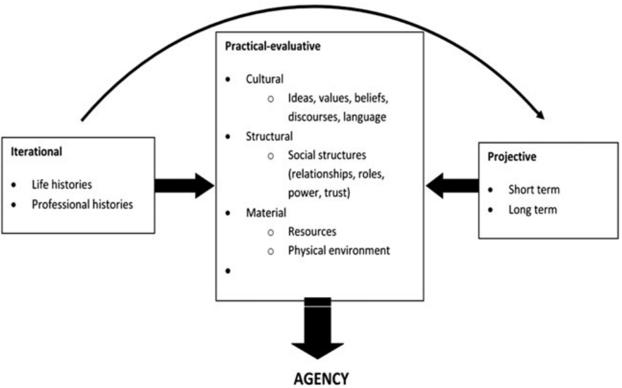
“Following Biesta et al.’s (2015) model, the teachers experienced obstacles related to all three aspects of the practical-evaluative dimension.”
BackgroundMethodInfluentialHeikkilä, M., Iiskala, T., Mikkilä‐Erdmann, M., & Warinowski, A. (2022) · British Journal of Sociology of Education · doi:10.1080/01425692.2022.2038541 · Cited by 24
Ghiasvand, F., Jahanbakhsh, A. A., & Sharifpour, P. (2023) · Language Testing in Asia · doi:10.1186/s40468-023-00255-z · Cited by 18
“In a seminal study, for instance, Priestley et al. (2015) perceived teacher agency as a time-contingent and situated achievement, resulting from the interplay among the three pivotal dimensions of ecological teacher agency (Fig.”
BackgroundResultInfluentialEarly language development and education: teachers, parents and children as agents
Schwartz, M., & Yağmur, K. (2018) · Language Culture and Curriculum · doi:10.1080/07908318.2018.1504390 · Cited by 16
“The coherence of the volume is achieved by the contributors drawing largely on two recent models: ecological model of teacher agency by Biesta, Priestley, and Robinson (2015) and model of interface between individual agencies of children, parents and teachers in the context of early bilingual…”
MethodPei, M., & Yang, H. (2019) · Asia Pacific Education Review · doi:10.1007/s12564-019-09606-z · Cited by 24
Pedagogy in a pandemic: Responsibilisation and agency in the (re)making of teachers
Teruya, J. (2021) · Pedagogy Culture and Society · doi:10.1080/14681366.2021.1898044 · Cited by 16
“…of accountability as oversight, this ambiguity created openings for teachers to agentically (re)interpret their roles, responsibilities, and pedagogical actions in ways that ‘accentuate[d] their own beliefs’ (Biesta, Priestley, and Robinson 2015, 632) and their own internal educational discourses.”
BackgroundInfluentialO’Reilly, J., & O’Grady, E. (2024) · Education 3-13 · doi:10.1080/03004279.2024.2331954 · Cited by 31
“Building on Biesta et al.’s (2015) review of agency, we suggest that the most significant and visible structure to examine in terms of linking voice and agency is student engagement.”
BackgroundKersna, L., Laak, K.-J., Lepp, L., & Pedaste, M. (2025) · Education Sciences · doi:10.3390/educsci15010060 · Cited by 29
Segal, A. (2021) · Learning Culture and Social Interaction · doi:10.1016/j.lcsi.2021.100597 · Cited by 23
Methodology to Study Teacher Agency: A Systematic Review of the Literature
Deschênes, M., & Parent, S. (2022) · European Journal of Educational Research · doi:10.12973/eu-jer.11.4.2459 · Cited by 33
“While there seems to be a general agreement that agency needs to be studied (Bartell et al., 2019; Biesta et al., 2015; Pantić, 2017a), there is less consensus on how to study it.”
Mifsud, D. (2023) · Teacher education, learning innovation and accountability · doi:10.1007/978-3-031-28620-9_1 · Cited by 24
A Study of Student and Teacher Challenges in Smart Synchronous Hybrid Learning Environments
Martín, A. C., Alario‐Hoyos, C., Martínez‐Monés, A., & Kloos, C. D. (2023) · Sustainability · doi:10.3390/su151511694 · Cited by 25
“Teacher agency refers to the experiences, professional training, resources, culture, social structure, and environment that influence the teacher’s decision-making process [17].”
BackgroundEstaji, M. (2024) · Language Testing in Asia · doi:10.1186/s40468-024-00292-2 · Cited by 31
“This finding represented the prominence of providing teachers with comprehensive knowledge and skills in assessment to enable them to design assessments that accurately reflect students’ language abilities (Priestley et al., 2015).”
BackgroundMethodInfluentialClimate change in common core policy context: The shifting role of attitudes and beliefs
Liou, Y.-H., Bjorklund, P., & Daly, A. J. (2021) · Educational Policy · doi:10.1177/0895904819843603 · Cited by 14
Karim, A., Reshmin, L., Kabilan, M. K., Shahed, F. H., Rahman, M. M., & Singh, M. K. M. (2020) · The Qualitative Report · doi:10.46743/2160-3715/2020.4272 · Cited by 26
“Now the question is why our participants made changes in their beliefs about teaching, as many studies expressed tensions that no change in teachers’ beliefs occurred after teacher education programs (Biesta et al., 2015; Borg, 2011).”
ResultLi, L., & Huang, J. L. (2023) · Asia Pacific Journal of Education · doi:10.1080/02188791.2023.2167806 · Cited by 21
“Understanding the transformation of contexts-for-action is important for understanding the significant factors that facilitate actors’ agency (Biesta, Priestley, & Robinson, 2015).”
Promoting teachers’ agency and creative teaching through research
Cloonan, A., Hutchison, K., & Paatsch, L. E. (2019) · English Teaching Practice & Critique · doi:10.1108/etpc-11-2018-0107 · Cited by 22
Teaching with Google Classroom
Svensson, E., Pendrill, A.-M., & Pelger, S. (2020) · Educare - vetenskapliga skrifter · doi:10.24834/educare.2020.4.7 · Cited by 15
“…achieved as a result of previous experience, projective and the perceived possible activities of the tool , but also of the setting: “rather than seeing the agency residing i n individuals, agency is understood as an emergent phenomenon of actor-situation transaction” (Biesta et al., 2015, p. 626).”
BackgroundConceptualising translational research in schools: A systematic literature review
Jones, S.-L., Hall, T., Procter, R., Connolly, C., & Fazlagić, J. (2022) · International Journal of Educational Research · doi:10.1016/j.ijer.2022.101998 · Cited by 25
‘They can show you with their body’: affect, embodiment and access to learning
Garrett, R. (2022) · Sport Education and Society · doi:10.1080/13573322.2022.2102603 · Cited by 16
“In a neoliberal context where professional decision making for teachers continues to be compromised, both Flo and Tina demonstrated renewed agency and control over their professional beliefs (Biesta et al., 2015).”
BackgroundBehling, F., Förtsch, C., & Neuhaus, B. J. (2022) · Education Sciences · doi:10.3390/educsci12100654 · Cited by 24
Naimi-Akbar, I., Weurlander, M., & Barman, L. (2023) · Teaching in Higher Education · doi:10.1080/13562517.2023.2201674 · Cited by 35
“Contextual factors such as material conditions and disciplinary educational traditions also in fl uence teachers ’ strategies (Biesta, Priestley, and Robinson 2015; Prosser et al. 2005; Sadler 2012).”
Leijen, Ä., Pedaste, M., Baucal, A., Poom‐Valickis, K., & Lepp, L. (2024) · Frontiers in Psychology · doi:10.3389/fpsyg.2024.1287313 · Cited by 37
Skourdoumbis, A., & Rowe, E. (2025) · The Australian Educational Researcher · doi:10.1007/s13384-024-00743-y · Cited by 17
“…for those working in the field globally where there is an active destruction and overthrow of the established ontology, axi-ology and praxeology (Biesta et al., 2015) of a university based ITE, particularly evident in England and the embedding of a school-led system of ITE (Mutton et al., 2017).”
English Language Teacher Agency in Classroom-Based Empirical Studies: A Research Synthesis.
Weng, Z., Zhu, J., & Kim, G. J. Y. (2019) · TESOL journal (Laguna) · Cited by 14
Every Teacher a Changemaker: Reflections on Teacher Agency and Empowerment
Malaya, U., Chau, M. H., & Shunmugam, K. (2021) · The English Teacher · doi:10.52696/fwym7144 · Cited by 14
Zainal, A. Z., & Zainuddin, S. Z. (2021) · Íkala Revista de Lenguaje y Cultura · doi:10.17533/udea.ikala.v26n3a07 · Cited by 24
“Teacher agency depends highly on the teacher’s individual qualities in terms of professional knowledge and skills (Biesta et al., 2015); and the pandemic has seen teachers across the world attempting to upskill themselves to adjust to the requirements of online teaching, including teachers in English as foreign langua…”
BackgroundInfluentialTeacher educators’ adaptability process when faced with remote teaching
Salinas, D., & Garrido, C. G. (2022) · Teaching and Teacher Education · doi:10.1016/j.tate.2022.103890 · Cited by 21
Robertson, M., Macdonald, S., Starks, D., & Nicholas, H. (2017) · System · doi:10.1016/j.system.2017.11.002 · Cited by 23
Teaching About Teaching: Teacher Educators’ and Student Teachers’ Perspectives from Norway
Ulvik, M., & Smith, K. (2018) · Springer eBooks · doi:10.1007/978-3-030-01612-8_9 · Cited by 25
Goodson, I. F., & Umarik, M. (2019) · Policy, Teacher Education and the Quality of Teachers and Teaching · doi:10.1080/13540602.2019.1664300 · Cited by 13
Wellbeing: How we make sense of it and what this means for teachers
O'brien, T., & Guiney, D. (2021) · Support for Learning · doi:10.1111/1467-9604.12366 · Cited by 24
Pantić, N., Brouwer, J., Thomas, L., & Froehlich, D. E. (2022) · International Journal of Research & Method in Education · doi:10.1080/1743727x.2022.2094361 · Cited by 20
Ghamoushi, M., Zenouzagh, Z. M., & Hashamdar, M. (2022) · Language Testing in Asia · doi:10.1186/s40468-022-00190-5 · Cited by 21
“In other words, participants were invited to take part based on accessibility or opportunity (Best & Kahn, 2006).”
BackgroundIntrojected Regulation in Teachers’ Professional Development Motivations
Proudfoot, K. (2022) · Teachers and Teaching · doi:10.1080/13540602.2022.2144816 · Cited by 19
“Such notions of autonomy also link to teacher agency and its value in relation to professional development (for example, Biesta et al., 2015; Sullivan et al., 2020).”
Background
Metadata
- Authors
- Biesta, G., Priestley, M., & Robinson, S.
- Affiliations
- ArtEZ University of the Arts (NL)
- University of Stirling (GB)
- Aarhus University (DK)
- Corresponding author
- Biesta, Gert
- Venue
- Teachers and Teaching
- Publisher
- Informa UK Limited
- Published
- 2015-06-15
- Volume
- 21
- Issue
- 6
- Pages
- 624-640
- ISSN
- 1354-0602 (ISSN-L)
- 1470-1278
- OpenAlex
- W1911902575
- Cited by
- 1,318
- References
- 47
- Citations by year
- 2026: 233 · 2025: 161 · 2024: 141 · 2023: 157 · 2022: 139 · 2021: 131 · 2020: 118 · 2019: 96 · 2018: 73 · 2017: 48 · 2016: 17 · 2015: 4
- FWCI
- 236.15
- Type
- journal article
- Language
- en
- Open access
- hybrid
- doi.org
- Licence
- cc-by-nc-nd
- Locations
- Teachers and Teaching (publishedVersion, cc-by-nc-nd)
- Brunel University Research Archive (BURA) (Brunel University London) (submittedVersion)
- Stirling Online Research Repository (University of Stirling) (submittedVersion, cc-by-nc-nd)
- Edinburgh Research Explorer (University of Edinburgh) (submittedVersion, other-oa)
- Funders
- Economic and Social Research Council (ES/I006907/1)
- Topics
- Social Sciences › Education › Teacher Education and Leadership Studies
- Social Sciences › Education › Education Pedagogy and Practices
- Social Sciences › Arts and Humanities › Philosophy › Education, Philosophy, and Society
- Keywords
- teacher agency, teacher beliefs, Curriculum for Excellence, educational reform, teacher professionalism, teacher decision-making, institutional discourse, professional vision, Scotland
About these checks
Registry, retraction, Cites and statistics results are computed, not judged, with one exception: a printed reference that no index lists is read once by a model before it counts as a citation error. Claims are extracted by a model and kept only when their quote appears verbatim in the text; each cited source is then checked, with a model’s help, for whether it says what the claim relies on. Those verdicts can be wrong — read the claim’s quote and the cited source before relying on one.
A language model drew the claims from the paper on 2026-10-11, under version 3 of the claim definition (model deepseek-v4.1-flash, prompt extract-v3).
A second model labelled each claim on 2026-10-11 (model jev-1.13-20260917, definition revision gold-guideline-v0.2).
Statistics and arithmetic are recomputed, not judged.
Confidence bands are shown only for fields calibrated on our annotated test set. None is calibrated yet, so no band is shown.
What counts as a claim ›How we measure confidence ›How we check this ›
Are you an author, or do you see a problem with this page? Request a review
Data sources
Bibliographic data: Semantic Scholar, OpenAlex, Crossref.
Contains information from the Semantic Scholar Academic Graph Datasets, made available under the ODC Attribution License (ODC-BY 1.0).
Semantic Scholar’s data is described in: Kinney, R., et al. (2023). The Semantic Scholar Open Data Platform. arXiv:2301.10140.
