

Fear of missing out and psychological well-being: Examining the dual pathways of problematic social media use and digital burnout
Open accessThe DOI matches its Crossref record; 65 of the 66 references it cites were found in a registry or an index; 17 of the 60 sources its claims cite were checked for support.
Abstract
The present study examined how fear of missing out (FoMO) relates to psychological well-being in a collectivist context through a sequential moderated mediation framework. Grounded in self-determination theory, the study assessed whether FoMO related to well-being indirectly via problematic social media use (PSMU) and digital burnout (emotional exhaustion), and whether free time management (FTM; goal-setting and evaluation) moderated these associations. Cross-sectional data were collected from 570 sports science undergraduates in Türkiye. Results indicated that (i) FoMO was positively associated with PSMU, (ii) PSMU was positively associated with digital burnout, and (iii) digital burnout was negatively associated with well-being. This resulted in a sequential indirect association from FoMO to well-being via PSMU and digital burnout. Results also indicated that FoMO was indirectly associated with lower psychological well-being via higher PSMU and digital burnout. However, when these indirect associations were accounted for, FoMO showed a small positive direct association with well-being, a suppressor-like pattern consistent with socially oriented motivation in collectivist settings. FTM moderated several paths, buffering some associations while strengthening others, indicating conditional indirect associations. These findings nuance deficit-only views of FoMO and its socially-oriented aspects within collectivist settings and suggest that integrating digital literacy with time-management training may further support student well-being.
Overview
CoChat Summary
TL;DR
In a cross-sectional sample of 570 Turkish sports science undergraduates, FoMO was linked to lower psychological well-being indirectly through problematic social media use and digital burnout, while a positive direct FoMO–well-being association emerged after including mediators (suppressor effect). Free time management moderated some paths, buffering the DBO–well-being link but unexpectedly strengthening the FoMO–DBO link.
Key findings
- FoMO positively predicted PSMU (β = .29, p < .001) and DBO (β = .27, p < .001); PSMU and DBO negatively predicted PWB (β = -.19, p = .018; β = -.47, p < .001). FoMO had a positive direct effect on PWB after mediators were included (β = .29, p < .001), described as a suppressor effect; the zero-order FoMO–PWB correlation was not significant (r = .05).
- The indirect FoMO → PWB path via PSMU was significant and negative at mean FTM (effect = -.057, 95% CI [-.105, -.011]) and high FTM (effect = -.086, 95% CI [-.148, -.033]), but not at low FTM. The indirect path via DBO was significant at all FTM levels, strongest at low FTM (effect = -.138) and weakened at high FTM (effect = -.099).
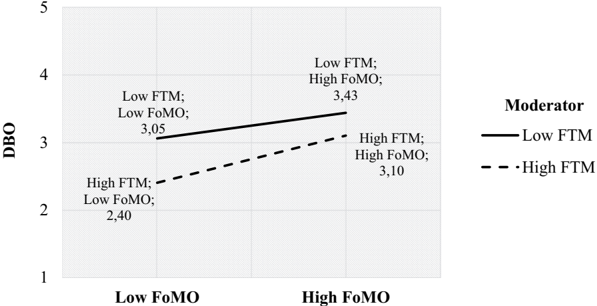
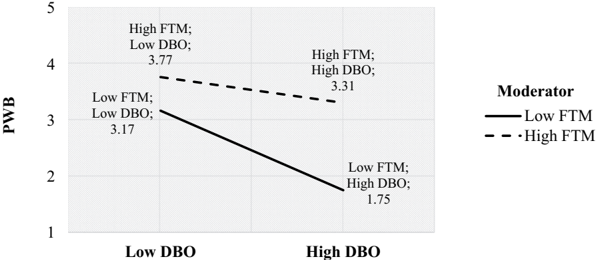
- FTM moderated FoMO → DBO (β = .08, p = .018), but higher FTM strengthened the positive FoMO–DBO association rather than buffering it. FTM moderated DBO → PWB (β = .25, p = .009), with the negative DBO–PWB association worse at low FTM and buffered at high FTM. PSMU × FTM on PWB was not significant (p = .079), and FoMO × FTM on PSMU was not significant (p = .212).
- Correlations showed FoMO positively associated with PSMU (r = .52) and DBO (r = .45); PSMU positively associated with DBO (r = .62); PWB negatively associated with PSMU (r = -.22) and DBO (r = -.36), and positively associated with FTM (r = .42).
Methods
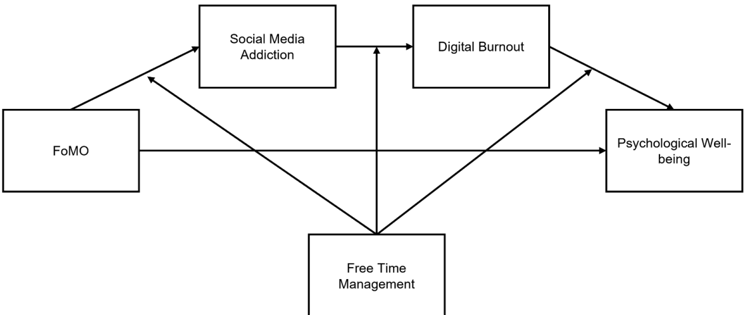
- Cross-sectional explanatory design using a serial conditional process model (PROCESS Model 59 adapted) linking FoMO → PSMU → DBO → PWB, with FTM tested as a moderator. Controls included gender, age, grade, most-used platform, session duration, and internet access; predictors in interactions were mean-centered, and bias-corrected bootstrap confidence intervals were reported.
- Participants were undergraduate sports science students at a Turkish public university. Of 927 enrolled, 598 completed surveys; 28 failed attention checks, leaving a final N = 570 (64% response rate). Sample was 54% female and 46% male; mean age 20.54 years (SD = 0.49), range 17–42.
- Measures: FoMOS (10 items, α = .95), SMAS (20 items, total α = .93), DBS emotional exhaustion subscale (6 items, α = .94), FTMS goal setting and evaluation subscale (6 items, α = .87), and PWBS (8 items, α = .89). Analysis included CFA, correlations, hierarchical regression, and bootstrap tests (5,000 samples).
Limitations
- Stated: cross-sectional design limits causal inference; self-report measures may introduce social desirability bias, though statistical checks indicated minimal impact; the sample was limited to sports science students at a single Turkish university, constraining generalizability; using only single subscales for DBO and FTM narrowed construct coverage.
- Stated: the unexpected positive FoMO–PWB association and the finding that higher FTM strengthened FoMO–DBO require cautious interpretation and further research.
- Evident from the text: the prose reports R² = .32 for the PWB model while Table 4 reports R² = .26, and the tested FoMO → DBO moderation path is not among the stated H7–H9.
Model-written summary. Check it against the paper before relying on it.
Integrity signals
Registry
Cites
Statistics
Figures


Verification
Claims the paper makes
14 Valid · 3 Not valid · 32 Not checked · 66 Own results and interpretations
The cited sources support only part of this claim — read each source’s verdict below.
In the paper
“In particular, there is insufficient evidence regarding how FTM may relate to the associa tions between digital stress factors and PWB in collectivist cultural settings (Young et al., 2024).”
What the sources say
- Partly supportedcites Young et al., 2024 matched to “Effects of time management interventions on mental health and wellbeing factors: A protocol for a systematic review” (2024) sourceExperimental — accuracy not yet measured
The Discussion (page unavailable in our copy) says that little is known about the effectiveness of time-management interventions for mental health and wellbeing. It does not address FTM’s relationship to digital stress factors and psychological well-being, or evidence in collectivist cultural settings. (LLM, conf=0.78)
plain- Asserted: passes — The authors put it forward as true.
- Checkable: passes — It can be checked against evidence.
- Load-bearing: passes — The paper’s conclusions depend on it.
- Based: passes — The paper gives a reason why it holds.
- Partly supported
The cited sources support only part of this claim — read each source’s verdict below.
In the paper
“This pattern has been associated with heightened susceptibility to DBO symptoms, including mental fatigue and emo tional exhaustion, which are negatively associated with psychological well-being (Kumpikaitė-Valiūnienė et al., 2021; Sheng et al., 2023).”
What the sources say
- Partly supportedcites Kumpikaitė-Valiūnienė et al., 2021 matched to “Influence of Digital Competence on Perceived Stress, Burnout and Well-Being Among Students Studying Online During the COVID-19 Lockdown: A 4-Country Perspective” (2021) sourceExperimental — accuracy not yet measured
The Results report a negative correlation between students’ burnout and subjective well-being during online learning (r = −0.500, p < 0.001). The Measures section includes tiredness among the burnout items, but the paper does not report a separate association for DBO symptoms or measure psychological well-being specifically rather than subjective well-being. (LLM, conf=0.83)
- Not checked — no full text of the sourcecites Sheng et al., 2023 matched to “Too much overload and concerns: Antecedents of social media fatigue and the mediating role of emotional exhaustion” (2023) source
plainstates an association- Asserted: passes — The authors put it forward as true.
- Checkable: passes — It can be checked against evidence.
- Load-bearing: passes — The paper’s conclusions depend on it.
- Based: passes — The paper gives a reason why it holds.
- Partly supported
The cited sources support only part of this claim — read each source’s verdict below.
In the paper
“This pattern has been associated with heightened susceptibility to DBO symptoms, including mental fatigue and emo tional exhaustion, which are negatively associated with psychological well-being (Kumpikaitė-Valiūnienė et al., 2021; Sheng et al., 2023).”
What the sources say
- Partly supportedcites Kumpikaitė-Valiūnienė et al., 2021 matched to “Influence of Digital Competence on Perceived Stress, Burnout and Well-Being Among Students Studying Online During the COVID-19 Lockdown: A 4-Country Perspective” (2021) sourceExperimental — accuracy not yet measured
The Results (page not available in our copy) report a negative correlation between student burnout and subjective well-being. The theoretical background identifies emotional exhaustion and tiredness as features of burnout. The paper does not establish that problematic social media use (PSMU) is associated with digital burnout (DBO) or heightened susceptibility to its symptoms; it studies digital competence among students learning online. (LLM, conf=0.88)
- Not checked — no full text of the sourcecites Sheng et al., 2023 matched to “Too much overload and concerns: Antecedents of social media fatigue and the mediating role of emotional exhaustion” (2023) source
plainstates an association- Asserted: passes — The authors put it forward as true.
- Checkable: passes — It can be checked against evidence.
- Load-bearing: passes — The paper’s conclusions depend on it.
- Based: passes — The paper gives a reason why it holds.
- Partly supported
Every source the paper cites for this claim was checked and supports it.
In the paper
“Empirical evidence also shows that PSMU is negatively associated with psychological well-being (Feng et al., 2025), suggest ing its central role in the broader spectrum of digital stressors.”
What the sources say
- Supportedcites Feng et al., 2025 matched to “The relationships between mental health and social media addiction, and between academic burnout and social media addiction among Chinese college students: A network analysis” (2025) source
The Discussion section, “The psychopathological pathways between social media addiction and mental health” (page unavailable), reports that social media addiction was significantly positively correlated with depression, anxiety, and stress symptoms in the study’s college students. This supports the claimed negative association with psychological well-being, expressed through those mental-health symptoms. (LLM, conf=0.88)
plainstates an association- Asserted: passes — The authors put it forward as true.
- Checkable: passes — It can be checked against evidence.
- Load-bearing: passes — The paper’s conclusions depend on it.
- Based: passes — The paper gives a reason why it holds.
- Supported
The cited sources that could be checked couldn’t confirm or dispute this claim.
In the paper
“Compared to the broader university student population, their competitive orien tation and emphasis on team cohesion may intensify the associations between PSMU and DBO (Zhong et al., 2025).”
What the sources say
- Could not verifycites Zhong et al., 2025 matched to “The impact of digital technology on sports consumption: evidence from Chinese college students” (2025) sourceExperimental — accuracy not yet measured
The Methods (section 2.1) describe a sample of Chinese college students, and the Results (section 3.6) examine symbolic perception, emotional experience, and sports consumption. Our copy does not address whether sports science students differ from other university students in competitive orientation or team cohesion, or whether those traits intensify a PSMU–DBO association (searched: PSMU, DBO, competitive orientation, team cohesion). (LLM, conf=0.77)
hedgedstates a possible cause- Asserted: passes — The authors put it forward as true.
- Checkable: passes — It can be checked against evidence.
- Load-bearing: passes — The paper’s conclusions depend on it.
- Based: passes — The paper gives a reason why it holds.
- Could not verify
62 more claims · 1 with their cited sources checked
Create a free account to see all 115 claims and to verify the 5 references still open.
- It may state two separate claims as one. 28
- Probably not a substantial claim. 32
Statistics recomputed
Every reported test result, recomputed from its test statistic and degrees of freedom. A result shows as not adding up only once an independent check has confirmed it.
- ConsistentF(13, 556) = 20.08reported p < .001 · recomputed p < .001
“F(13,556) = 20.08, p < .001”
Self-check
Percentages, sums and reported differences re-computed from the paper’s own numbers.
Each contradiction between two passages listed here was confirmed by an independent check.
Rated major: it would touch a result — a value a result rests on, reported and recomputed p-values on opposite sides of the significance level, two passages that conflict with no sign which is right, or a cited work retracted before this paper was published.
In the paper
§ Regression analysis
“| R 2 | 0.38 | 0.30 | 0.26 |”
§ Regression analysis
“The full model predicting the main dependent variable, psychological well-being, was also statistically significant, R 2 = .32, F(13,556) = 20.08, p < .001.”
Rated major: it would touch a result — a value a result rests on, reported and recomputed p-values on opposite sides of the significance level, two passages that conflict with no sign which is right, or a cited work retracted before this paper was published.
In the paper
§ Regression analysis
“Figure 2 indicates that individuals with poor FTM experienced more digital exhaustion due to FoMO than those with good FTM skills.”
§ Regression analysis
“The graph shows that the positive relationship between FoMO and DBO is stronger for individuals with high FTM (+1 SD) compared to those with low FTM (-1 SD).”
Rated minor: it would not touch a result — a value no result rests on, a p-value that stays on the same side of the significance level, or a conflict that is clerical, resolved elsewhere in the paper, or outside its own findings.
In the paper
§ Measures
“The scale includes eight items (e.g. 'I lead a purposeful and meaningful life' ) are rated on a seven-point scale (1 = totally disagree, 5 = totally agree).”
§ Measures
“Total scores range from 8 to 56, with higher scores indicating greater psychological well-being.”
Rated minor: it would not touch a result — a value no result rests on, a p-value that stays on the same side of the significance level, or a conflict that is clerical, resolved elsewhere in the paper, or outside its own findings.
In the paper
“The final sample included 570 participants, resulting in a response rate of 64%.”
Reported 64 · recomputed 61.488673
Rated minor: it would not touch a result — a value no result rests on, a p-value that stays on the same side of the significance level, or a conflict that is clerical, resolved elsewhere in the paper, or outside its own findings.
In the paper
§ Participants and procedure
“The average age was 20.54 years (SD = 0.49), ranging from 17 to 42 years.”
§ Participants and procedure
“The final sample included 570 participants, resulting in a response rate of 64%.”
Citations
Cites
Evaluating structural equation models with unobservable variables and measurement error
Fornell, C., & Larcker, D. F. (1981) · Journal of Marketing Research · doi:10.1177/002224378101800104 · Cited by 109,190 · cited 1×
“According to the criterion by Fornell and Larcker (1981), each construct’s AVE must be higher than its correlations with other constructs.”
Hu, L., & Bentler, P. M. (1999) · Structural Equation Modeling A Multidisciplinary Journal · doi:10.1080/10705519909540118 · Cited by 108,788 · cited 1×
“The CFA indicated a good fit of the measurement model to the data: χ 2 (1163) = 2622.815, χ 2 /df = 2.255, CFI = 0.913, SRMR = 0.052, RMSEA = 0.047, P close = 0.982 (Hu & Bentler, 1999).”
InfluentialA new criterion for assessing discriminant validity in variance-based structural equation modeling
Henseler, J., Ringle, C. M., & Sarstedt, M. (2015) · Journal of the Academy of Marketing Science · doi:10.1007/s11747-014-0403-8 · Cited by 38,459 · cited 1×
“This was confirmed because AVE values exceeded MSV and the heterotrait-monotrait ratio ranged from 0.083 to 0.470 (Henseler et al., 2015) providing evidence of discriminant validity.”
InfluentialConservation of resources: A new attempt at conceptualizing stress
Hobfoll, S. E. (1989) · American Psychologist · doi:10.1037/0003-066x.44.3.513 · Cited by 18,187 · cited 4×
“These contributions strengthen the integration of self-regulation (Baumeister et al.,) and conservation of resources frameworks (Hobfoll, 1989), particularly in collectivist settings where group dynamics amplify digital stress factors.”
InfluentialNew well-being measures: Short scales to assess flourishing and positive and negative feelings
Diener, E., Wirtz, D., Tov, W., Kim-Prieto, C., Choi, D.-W., Oishi, S., & Biswas-Diener, R. (2010) · Social Indicators Research · doi:10.1007/s11205-009-9493-y · Cited by 4,980 · cited 1×
“The Psychological Well-Being Scale (PWBS: Diener et al., 2009, 2010; Turkish version: Telef, 2013) was used to assess psychological well-being.”
Equivalence of the Mediation, Confounding and Suppression Effect
MacKinnon, D. P., Krull, J. L., & Lockwood, C. M. (2000) · Prevention Science · doi:10.1023/a:1026595011371 · Cited by 4,188 · cited 1×
“However, the most theoretically noteworthy result was the positive direct association between FoMO and psychological well-being, shown through a suppressor effect (i.e. when a variable masks the true association between two constructs due to statistical suppression; MacKinnon et al., 2000).”
Motivational, emotional, and behavioral correlates of fear of missing out
Przybylski, A. K., Murayama, K., DeHaan, C. R., & Gladwell, V. (2013) · Computers in Human Behavior · doi:10.1016/j.chb.2013.02.014 · Cited by 3,932 · cited 4×
“Consistent with prior research (e.g. Przybylski et al., 2013; Tandon et al., 2021), FoMO was positively associated with PSMU and DBO, and negatively predicted psychological well-being.”
InfluentialThe Strength Model of Self-Control
Baumeister, R. F., Vohs, K. D., & Tice, D. M. (2007) · Current Directions in Psychological Science · doi:10.1111/j.1467-8721.2007.00534.x · Cited by 3,567 · cited 2×
“Similarly, self-regulation theory highlights that the capacity for self-control is finite and may be depleted through constant digital engagement and social comparison (Baumeister et al., 2007).”
Deci, E. L., & Ryan, R. M. (2012) · Handbook of Theories of Social Psychology: Volume 1 · doi:10.4135/9781446249215.n21 · Cited by 3,161
Sonnentag, S., & Fritz, C. (2007) · Journal of Occupational Health Psychology · doi:10.1037/1076-8998.12.3.204 · Cited by 2,133 · cited 1×
“This idea is supported by research, such as the study by Sonnentag and Fritz (2007), which suggested that such activities can be critical in maintaining overall health and resilience.”
Social networking sites and addiction: Ten lessons learned
Kuss, D., & Griffiths, M. (2017) · International Journal of Environmental Research and Public Health · doi:10.3390/ijerph14030311 · Cited by 1,603 · cited 1×
“PSMU is a behavioral pattern of uncontrolled and intensive social media use that undermines users’ psychological health and daily functioning (Chen et al., 2025; Kuss & Griffiths, 2017).”
Self-citationDiener, E., Wirtz, D., Biswas-Diener, R., Tov, W., Kim-Prieto, C., Choi, D.-W., & Oishi, S. (2009) · Social Indicators Research Series · doi:10.1007/978-90-481-2354-4_12 · Cited by 1,152
Burnout: A Review of Theory and Measurement
Edú-Valsania, S., Laguía, A., & Moriano, J. A. (2022) · International Journal of Environmental Research and Public Health · doi:10.3390/ijerph19031780 · Cited by 845 · cited 1×
“As aforementioned, only the ‘emotional exhaustion’ subscale was used, consistent with literature identifying emotional exhaustion as the core component of burnout and most directly associated with decrements in psychological well-being (Edú-Valsania et al., 2022).”
(2009) · Social Indicators Research Series · doi:10.1007/978-90-481-2354-4 · Cited by 571
Roberts, J. A., & David, M. E. (2020) · International Journal of Human–Computer Interaction · doi:10.1080/10447318.2019.1646517 · Cited by 440 · cited 1×
“…among FoMO, PSMU, and psychological well-being (Bacaksız et al., 2023; Brailovskaia & Margraf, 2024; de Hesselle & Montag, 2024; Eitan & Gazit, 2024; Hayran & Anik, 2021; Ng & Fam, 2024; Roberts & David, 2020; Savitri, 2019; Shane-Simpson & Bakken, 2024; Tufan et al., 2024; Tufan et al., 2025).”
Elhai, J. D., Yang, H., & Montag, C. (2021) · Brazilian Journal of Psychiatry · doi:10.1590/1516-4446-2020-0870 · Cited by 362 · cited 2×
“…relationships among FoMO, PSMU, and DBO, research investigating the sequential associations of these variables with psychological well-being (PWB) and the potential moderating role of free time management (FTM) within an integrated model remains limited (Elhai et al., 2021; Hou et al., 2024).”
Reer, F., Tang, W. Y., & Quandt, T. (2019) · New Media & Society · doi:10.1177/1461444818823719 · Cited by 335 · cited 1×
“…in group-based social media platforms (e.g. WhatsApp groups for team coordination or sports events) may foster a sense of belonging, aligning with findings that FoMO is associated with social engagement in collectivist contexts (Elhai et al., 2021; Reer et al., 2019; Servidio et al., 2024).”
COVID-19 anxiety symptoms associated with problematic smartphone use severity in Chinese adults
Elhai, J. D., Yang, H., McKay, D., & Asmundson, G. J. G. (2020) · Journal of Affective Disorders · doi:10.1016/j.jad.2020.05.080 · Cited by 325 · cited 1×
“This maladaptive engagement often co-occurs with FoMO and DBO, reinforcing compulsive online behaviors and heightening vulnerability to emotional exhaustion (Elhai et al., 2020; Liu & Ma, 2020a).”
Tandon, A., Dhir, A., Almugren, I., AlNemer, G. N., & Mäntymäki, M. (2021) · Internet Research · doi:10.1108/intr-11-2019-0455 · Cited by 315 · cited 3×
“Consistent with prior research (e.g. Przybylski et al., 2013; Tandon et al., 2021), FoMO was positively associated with PSMU and DBO, and negatively predicted psychological well-being.”
Wang, P., Zhao, M., Wang, X., Xie, X., Wang, Y., & Lei, L. (2017) · Journal of Behavioral Addictions · doi:10.1556/2006.6.2017.079 · Cited by 247 · cited 1×
“It has been found that smartphone users frequently and unconsciously check the information on their devices due to the influence of FoMO, leading to information overload behaviors (Wang et al., 2017).”
Social media addiction and burnout: The mediating roles of envy and social media use anxiety
Liu, C., & Ma, J. (2018) · Current Psychology · doi:10.1007/s12144-018-9998-0 · Cited by 203 · cited 1×
“This maladaptive engagement often co-occurs with FoMO and DBO, reinforcing compulsive online behaviors and heightening vulnerability to emotional exhaustion (Elhai et al., 2020; Liu & Ma, 2020a).”
Li, L., Niu, Z., Mei, S., & Griffiths, M. D. (2022) · Computers in Human Behavior · doi:10.1016/j.chb.2021.107086 · Cited by 179 · cited 1×
“One key reason for selecting this group is their pronounced engagement with social media and their heightened tendency to seek social approval (Li et al., 2022; Liu & Ma, 2020b).”
Self-citationOn the efficiency of using the sample kurtosis in selecting optimal lpestimators
Sposito, V. A., Hand, M. L., & Skarpness, B. (1983) · Communications in Statistics - Simulation and Computation · doi:10.1080/03610918308812318 · Cited by 171 · cited 1×
“The scale items were checked for normal distribution, with skewness values from −1.025 to 0.213 and kurtosis values from −1.512 to 0.970, all within the acceptable range (Sposito et al., 1983).”
InfluentialSheng, N., Yang, C., Han, L., & Jou, M. (2023) · Computers in Human Behavior · doi:10.1016/j.chb.2022.107500 · Cited by 162 · cited 2×
“This constant digital engagement leads to information overload and emotional exhaustion, core components of digital burnout (Sheng et al., 2023).”
Wang, W. C., Kao, C.-H., Huan, T.-C. T. C., & Wu, C.-C. (2010) · Journal of Happiness Studies · doi:10.1007/s10902-010-9217-7 · Cited by 151 · cited 1×
“The Free Time Management Scale (FTMS: Wang et al., 2011; Turkish version: Akgül & Karaküçük, 2015) was used to assess FTM.”
Hayran, C., & Anik, L. (2021) · International Journal of Environmental Research and Public Health · doi:10.3390/ijerph18041974 · Cited by 137 · cited 1×
“…among FoMO, PSMU, and psychological well-being (Bacaksız et al., 2023; Brailovskaia & Margraf, 2024; de Hesselle & Montag, 2024; Eitan & Gazit, 2024; Hayran & Anik, 2021; Ng & Fam, 2024; Roberts & David, 2020; Savitri, 2019; Shane-Simpson & Bakken, 2024; Tufan et al., 2024; Tufan et al., 2025).”
Brailovskaia, J., & Margraf, J. (2023) · Computers in Human Behavior · doi:10.1016/j.chb.2023.107984 · Cited by 137 · cited 1×
“…existing research facilitates a richer understanding of the complex interplay among FoMO, PSMU, and psychological well-being (Bacaksız et al., 2023; Brailovskaia & Margraf, 2024; de Hesselle & Montag, 2024; Eitan & Gazit, 2024; Hayran & Anik, 2021; Ng & Fam, 2024; Roberts & David, 2020; Savitri,…”
Abbasi, M. S., Tarhini, A., Elyas, T., & Shah, F. (2015) · Journal of Enterprise Information Management · doi:10.1108/jeim-12-2014-0124 · Cited by 125 · cited 3×
“In cultures that emphasize collectivism and prioritize group harmony (Abbasi et al., 2015), the desire to stay connected – which is central to FoMO – can act as a safeguard for well-being, as long as it does not develop into the harmful behaviors (Chua & Koestner, 2008) associated with PSMU and DBO.”
School burnout and engagement profiles among digital natives in Finland: a person-oriented approach
Salmela-Aro, K., Muotka, J., Alho, K., Hakkarainen, K., & Lonka, K. (2016) · European Journal of Developmental Psychology · doi:10.1080/17405629.2015.1107542 · Cited by 124 · cited 1×
“Digital burnout, a state of emotional, mental, and physical exhaustion caused by prolonged digital stress, is inherently detrimental to psychological well-being (Salmela-Aro et al., 2016).”
A Self-Determination Theory Perspective on the Role of Autonomy in Solitary Behavior
Chua, S. N., & Koestner, R. (2008) · The Journal of Social Psychology · doi:10.3200/socp.148.5.645-648 · Cited by 122 · cited 1×
“In cultures that emphasize collectivism and prioritize group harmony (Abbasi et al., 2015), the desire to stay connected – which is central to FoMO – can act as a safeguard for well-being, as long as it does not develop into the harmful behaviors (Chua & Koestner, 2008) associated with PSMU and DBO.”
Determining validity and reliability of Turkish version of Fear of Missing out Scale
Gokler, M., Aydin, R., nal, E., & Metintas, S. (2016) · Anatolian Journal of Psychiatry · doi:10.5455/apd.195843 · Cited by 116 · cited 1×
“The Fear of Missing Out Scale (FoMOS: Przybylski et al., 2013; Turkish version: Gokler et al., 2016): was used to assess FoMO.”
Erten, P., & Özdemir, O. (2020) · İnönü Üniversitesi Eğitim Fakültesi Dergisi · doi:10.17679/inuefd.597890 · Cited by 98 · cited 1×
“The Digital Burnout Scale (DBS: (developed in Turkish by Erten and Özdemir [2020]) was used to assess DBO.”
Wang, W.-C. (2019) · Psychological Reports · doi:10.1177/0033294118789034 · Cited by 97 · cited 2×
“Free time management (FTM) refers to the capacity of individuals to structure their leisure time through planned and meaningful activities, which may serve as a protective process variable in the relationship between compulsive digital behaviors and psychological well-being (Wang, 2019).”
Servidio, R., Soraci, P., Griffiths, M. D., Boca, S., & Demetrovics, Z. (2024) · Addictive Behaviors Reports · doi:10.1016/j.abrep.2024.100536 · Cited by 91 · cited 1×
“…in group-based social media platforms (e.g. WhatsApp groups for team coordination or sports events) may foster a sense of belonging, aligning with findings that FoMO is associated with social engagement in collectivist contexts (Elhai et al., 2021; Reer et al., 2019; Servidio et al., 2024).”
Self-citationMental wellbeing in digital workplaces: The role of digital resources, technostress, and burnout
Li, X., Seah, R. Y. T., & Yuen, K. F. (2025) · Technology in Society · doi:10.1016/j.techsoc.2025.102844 · Cited by 86 · cited 2×
“The present stidy’s findings supported the hypothesized sequential pathway: FoMO contributed to PSMU (Giancola et al., 2025), which in turn led to DBO (da Silva et al., 2024), ultimately diminishing psychological wellbeing (Li et al., 2025).”
Kumpikaitė-Valiūnienė, V., Aslan, I., Duobienė, J., Glińska, E., & Anandkumar, V. (2021) · Psychology Research and Behavior Management · doi:10.2147/prbm.s325092 · Cited by 67 · cited 1×
“This pattern has been associated with heightened susceptibility to DBO symptoms, including mental fatigue and emotional exhaustion, which are negatively associated with psychological well-being (Kumpikaitė-Valiūnienė et al., 2021; Sheng et al., 2023).”
de Hesselle, L. C., & Montag, C. (2024) · BMC Psychology · doi:10.1186/s40359-024-01611-1 · Cited by 64 · cited 1×
“…a richer understanding of the complex interplay among FoMO, PSMU, and psychological well-being (Bacaksız et al., 2023; Brailovskaia & Margraf, 2024; de Hesselle & Montag, 2024; Eitan & Gazit, 2024; Hayran & Anik, 2021; Ng & Fam, 2024; Roberts & David, 2020; Savitri, 2019; Shane-Simpson & Bakken,…”
Liu, C., & Ma, J. (2020) · Current Psychology · doi:10.1007/s12144-018-0075-5 · Cited by 60 · cited 2×
“This maladaptive engagement often co-occurs with FoMO and DBO, reinforcing compulsive online behaviors and heightening vulnerability to emotional exhaustion (Elhai et al., 2020; Liu & Ma, 2020a).”
Akgül, B. M., & Karaküçük, S. (2015) · International Journal of Human Sciences · doi:10.14687/ijhs.v12i2.3445 · Cited by 50 · cited 1×
“The Free Time Management Scale (FTMS: Wang et al., 2011; Turkish version: Akgül & Karaküçük, 2015) was used to assess FTM.”
Savitri, J. A. (2019) · Psychological Research and Intervention · doi:10.21831/pri.v2i2.30363 · Cited by 47 · cited 1×
“…among FoMO, PSMU, and psychological well-being (Bacaksız et al., 2023; Brailovskaia & Margraf, 2024; de Hesselle & Montag, 2024; Eitan & Gazit, 2024; Hayran & Anik, 2021; Ng & Fam, 2024; Roberts & David, 2020; Savitri, 2019; Shane-Simpson & Bakken, 2024; Tufan et al., 2024; Tufan et al., 2025).”
Students’ Fear of Missing Out Predicts In-Class Social Media Use
Shane‐Simpson, C., & Bakken, T. (2022) · Teaching of Psychology · doi:10.1177/00986283211060752 · Cited by 45 · cited 1×
“…among FoMO, PSMU, and psychological well-being (Bacaksız et al., 2023; Brailovskaia & Margraf, 2024; de Hesselle & Montag, 2024; Eitan & Gazit, 2024; Hayran & Anik, 2021; Ng & Fam, 2024; Roberts & David, 2020; Savitri, 2019; Shane-Simpson & Bakken, 2024; Tufan et al., 2024; Tufan et al., 2025).”
Feng, T., Wang, B., Mi, M., Ren, L., Wu, L., Wang, H., Liu, X., & Wang, X. (2025) · Heliyon · doi:10.1016/j.heliyon.2025.e41869 · Cited by 43 · cited 1×
“Empirical evidence also shows that PSMU is negatively associated with psychological well-being (Feng et al., 2025), suggesting its central role in the broader spectrum of digital stressors.”
Li, Y.-Y., Koning, I. M., Finkenauer, C., Boer, M., & van den Eijnden, R. J. J. M. (2024) · Computers in Human Behavior · doi:10.1016/j.chb.2024.108160 · Cited by 41 · cited 3×
“Recent longitudinal work has confirmed a bidirectional relationship, where FoMO predicts decreases in psychological well-being over time, and lower psychological well-being, which in turn, can exacerbate FoMO (Li et al., 2024).”
InfluentialThe “here and now” effect: JoMO, FoMO and the well-being of social media users
Eitan, T., & Gazit, T. (2024) · Online Information Review · doi:10.1108/oir-03-2023-0111 · Cited by 39 · cited 1×
“…complex interplay among FoMO, PSMU, and psychological well-being (Bacaksız et al., 2023; Brailovskaia & Margraf, 2024; de Hesselle & Montag, 2024; Eitan & Gazit, 2024; Hayran & Anik, 2021; Ng & Fam, 2024; Roberts & David, 2020; Savitri, 2019; Shane-Simpson & Bakken, 2024; Tufan et al., 2024;…”
Tufan, C., Köksal, K., & Griffiths, M. D. (2025) · International Journal of Mental Health and Addiction · doi:10.1007/s11469-025-01477-3 · Cited by 33 · cited 1×
“…among FoMO, PSMU, and psychological well-being (Bacaksız et al., 2023; Brailovskaia & Margraf, 2024; de Hesselle & Montag, 2024; Eitan & Gazit, 2024; Hayran & Anik, 2021; Ng & Fam, 2024; Roberts & David, 2020; Savitri, 2019; Shane-Simpson & Bakken, 2024; Tufan et al., 2024; Tufan et al., 2025).”
Self-citationTufan, C., Köksal, K., Griffiths, M. D., Erturgut, R., & Mert, İ. S. (2024) · Behaviour and Information Technology · doi:10.1080/0144929x.2024.2434893 · Cited by 32 · cited 1×
“…among FoMO, PSMU, and psychological well-being (Bacaksız et al., 2023; Brailovskaia & Margraf, 2024; de Hesselle & Montag, 2024; Eitan & Gazit, 2024; Hayran & Anik, 2021; Ng & Fam, 2024; Roberts & David, 2020; Savitri, 2019; Shane-Simpson & Bakken, 2024; Tufan et al., 2024; Tufan et al., 2025).”
Self-citationImpact of digital burnout on the use of digital consumer platforms
da Silva, F. P., Jerónimo, H. M., Henriques, P. L., & Ribeiro, J. (2024) · Technological Forecasting and Social Change · doi:10.1016/j.techfore.2023.123172 · Cited by 32 · cited 2×
“The present stidy’s findings supported the hypothesized sequential pathway: FoMO contributed to PSMU (Giancola et al., 2025), which in turn led to DBO (da Silva et al., 2024), ultimately diminishing psychological wellbeing (Li et al., 2025).”
Terzi, E., Isik, U., Inan, B. C., Akyildiz, C., & Ustun, U. D. (2024) · BMC Psychology · doi:10.1186/s40359-024-01745-2 · Cited by 30 · cited 1×
“Finally, Terzi et al. (2024) found that FTM was associated with reductions in the relationship between stress-related experiences and psychological well-being.”
Giancola, M., Perazzini, M., Bontempo, D., Perilli, E., & D’Amico, S. (2025) · International Journal of Human–Computer Interaction · doi:10.1080/10447318.2024.2411468 · Cited by 28 · cited 2×
“The present stidy’s findings supported the hypothesized sequential pathway: FoMO contributed to PSMU (Giancola et al., 2025), which in turn led to DBO (da Silva et al., 2024), ultimately diminishing psychological wellbeing (Li et al., 2025).”
(2016) · Journal of Human Sciences · doi:10.14687/ijhs · Cited by 28
Young, A. N., Bourke, A., Foley, S., & Di Blasi, Z. (2024) · PLOS ONE · doi:10.1371/journal.pone.0288887 · Cited by 21 · cited 1×
“In particular, there is insufficient evidence regarding how FTM may relate to the associations between digital stress factors and PWB in collectivist cultural settings (Young et al., 2024).”
Ng, S. P., & Fam, J. Y. (2023) · Computers in Human Behavior Reports · doi:10.1016/j.chbr.2023.100352 · Cited by 20 · cited 1×
“…among FoMO, PSMU, and psychological well-being (Bacaksız et al., 2023; Brailovskaia & Margraf, 2024; de Hesselle & Montag, 2024; Eitan & Gazit, 2024; Hayran & Anik, 2021; Ng & Fam, 2024; Roberts & David, 2020; Savitri, 2019; Shane-Simpson & Bakken, 2024; Tufan et al., 2024; Tufan et al., 2025).”
The Effect of Free Time Management Skills upon Smartphone Addiction Risk in University Students
GEZGİN, D. M., MIHCI, C., & GEDİK, S. (2021) · Journal of Education in Science, Environment and Health · doi:10.21891/jeseh.991910 · Cited by 19 · cited 1×
“For instance, Gezgin et al. (2021) indicated that FTM may serve as a protective factor against addiction risk but also noted that this function may vary depending on addiction severity.”
Argan, M. T., Koçak, F., Gürbüz, B., Argan, M., & Dinç, H. (2024) · World Leisure Journal · doi:10.1080/16078055.2023.2244452 · Cited by 17 · cited 1×
“Argan et al. (2024) observed that structured leisure activities may correspond to reductions in the association between FoMO and social media use.”
Problematic Social Media Use and Employee Outcomes: A Systematic Literature Review
Gao, S., & Shao, B. (2024) · Sage Open · doi:10.1177/21582440241259158 · Cited by 12 · cited 1×
“FTM has been conceptualized as supporting renewal of self-regulatory resources, which may correspond to reductions in the relationship between compulsive social media use and DBO (Gao & Shao, 2024; Sonnentag & Pundt, 2016).”
Bacaksız, S., Özsoy, İ., Teğin, T., Bıçaksız, P., & Tekeş, B. (2023) · Psychological Reports · doi:10.1177/00332941231180115 · Cited by 11 · cited 1×
“…comparisons with existing research facilitates a richer understanding of the complex interplay among FoMO, PSMU, and psychological well-being (Bacaksız et al., 2023; Brailovskaia & Margraf, 2024; de Hesselle & Montag, 2024; Eitan & Gazit, 2024; Hayran & Anik, 2021; Ng & Fam, 2024; Roberts &…”
Kong, W., Li, Y., Luo, A., & Xie, W. (2024) · Journal of Medical Internet Research · doi:10.2196/48026 · Cited by 11 · cited 1×
“This interpretation aligns with moderation studies suggesting that personal resources, under conditions of high demand, can sometimes lead to paradoxical outcomes by enabling individuals to push themselves closer to exhaustion before disengaging (Kong et al., 2024).”
KARA, F. M., SAROL, H., GÜRBÜZ, B., & GÜRKAN, R. K. (2023) · Journal of Education and Recreation Patterns · doi:10.53016/jerp.v4i2.178 · Cited by 10 · cited 1×
“Kara et al. (2023) suggested that regular participation in leisure activities may correspond to less pronounced relationships between PSMU and DBO.”
Psychometric properties of Nursing Time Management Scale (NTMS), Arabic version
Zyoud, R. N. (2023) · BMC Nursing · doi:10.1186/s12912-023-01316-7 · Cited by 10
Untitled work
(2016) · doi:10.4324/9781315714752.ch26 · Cited by 10
The impact of digital technology on sports consumption: evidence from Chinese college students
Zhong, Y.-J., Yang, J.-W., Guo, W.-H., & Wang, Y.-S. (2025) · Frontiers in Psychology · doi:10.3389/fpsyg.2025.1501327 · Cited by 7 · cited 12×
“Kara et al. (2023) suggested that regular participation in leisure activities may correspond to less pronounced relationships between PSMU and DBO.”
InfluentialNetwork modeling of problematic social media use components in college student social media users
Chen, J., Su, T., Dong, J., Li, Y., Feng, J., Chen, Y., & Liu, G. (2025) · Frontiers in Psychiatry · doi:10.3389/fpsyt.2024.1386845 · Cited by 7 · cited 1×
“PSMU is a behavioral pattern of uncontrolled and intensive social media use that undermines users’ psychological health and daily functioning (Chen et al., 2025; Kuss & Griffiths, 2017).”
Wang, L., Xu, J., & Liu, Y. (2024) · Frontiers in Psychology · doi:10.3389/fpsyg.2024.1473506 · Cited by 6 · cited 1×
“Sports science students represent an appropriate sample for this research due to their high levels of social media engagement and group-oriented social contexts (Wang et al., 2024).”
The Digital Paradigm Shift for a New Business DNA
Sestino, A., & Nasta, L. (2024) · Springer eBooks · doi:10.1007/978-3-031-76238-3 · Cited by 2
Research works printed but not linked: 4
- Hayes, A. F. (2013). Introduction to mediation, moderation, and conditional process analysis: A regression-based approach . The Guildford Press.
- Hou, Y., Xiong, D., Jiang, T., Song, L., & Wang, Q. (2024). Social media addiction: Its impact, mediation, and intervention. Cyberpsychology Journal of Psychosocial Research on Cyberspace , 13 (1), 4. https://doi.org/10.5817/CP2019-1- · doi:10.5817/cp2019-1-
- Şahin, C., & Yağcı, M. (2017). Social media addiction scale - adult form: The reliability and validity study. Ahi Evran University Journal of Kırşehir Education Faculty , 18 (1), 523-538. Retrieved October 12, 2025, from https://dergipark.org.tr/tr/pub/kefad/issue/59268/851452
- Telef, B. B. (2013). Psikolojik iyi oluş ölçeği: Türkçeye uyarlama, geçerlik ve güvenirlik çalışması. Hacettepe Üniversitesi Eğitim Fakültesi Dergisi , 28 (28-3), 374-384. Retrieved October 12, 2025, from https://dergipark.org.tr/tr/pub/hunefd/issue/7791/101929
Cited by
The need to be seen: social approval and evaluative fears as psychological pathways to FOMO
Akbay, S. E., Kurt, A. A., Aygar, B., & Yaman, Ş. (2026) · Frontiers in Psychology · doi:10.3389/fpsyg.2026.1840811 · Cited by 2
“…recent studies showing that, depending on the regulatory dynamics of socially oriented motivations, FOMO can both strengthen and weaken its relationships with well-being and problematic technology use (Tufan et al., 2025; Groenestein et al., 2024; Servidio et al., 2024; Fioravanti et al., 2021).”
A Human-Centered Design Framework for Understanding FoMO in Social Media Use
Cabrera, G., & Sinag, J. R. (2026) · International Conference on Emerging Trends in Information, Communication & Systems (ICETICS) · doi:10.1109/icetics69505.2026.11651252
“Tufan et al. studied FoMO and psychological well-being through problematic social media use and digital burnout [12], while Elsayed examined relationships among FoMO, social media use, psychological well-being, and academic performance among university students [13].”
Metadata
- Authors
- Tufan, C., Köksal, K., Griffiths, M. D., & Terzioglu, Z. A.
- Affiliations
- Akdeniz University (TR)
- Nottingham Trent University (GB)
- Antalya Bilim University
- Corresponding author
- Griffiths, Mark D.
- Venue
- Psychology, Health & Medicine
- Publisher
- Informa UK Limited
- Published
- 2025-11-21
- Volume
- 31
- Issue
- 6
- Pages
- 1341-1360
- ISSN
- 1354-8506 (ISSN-L)
- 1465-3966
- OpenAlex
- W4416501152
- Cited by
- 4
- References
- 60
- Citations by year
- 2026: 4
- FWCI
- 6.87
- Type
- journal article
- Language
- en
- Open access
- hybrid
- doi.org
- Licence
- cc-by-nc-nd
- creativecommons.org/licenses/by-nc-nd/4.0/ (vor)
- doi.org/10.1080/policies-text-data-mining (tdm)
- Locations
- Psychology Health & Medicine (publishedVersion, cc-by-nc-nd)
- PubMed (publishedVersion)
- Nottingham Trent University's Institutional Repository (Nottingham Trent Repository) (acceptedVersion)
- Topics
- Social Sciences › Sociology and Political Science › Impact of Technology on Adolescents
- Social Sciences › Business, Management and Accounting › Organizational Behavior and Human Resource Management › Cyberloafing and Workplace Behavior
- Social Sciences › Psychology › Social Psychology › Workaholism, burnout, and well-being
- Keywords
- fear of missing out, psychological well-being, social media addiction, digital burnout, emotional exhaustion, free time management, goal setting, collectivist culture, self-determination theory, social motivation, sports science students, digital literacy, time management training
- MeSH terms
- Psychological Well-Being, Emotional Exhaustion, Media Exposure, Digital Media, Adult, Burnout, Professional, Cross-Sectional Studies, Fear, Female, Humans, Male, Students, Time Management, Young Adult, Social Media
About these checks
Registry, retraction, Cites and statistics results are computed, not judged, with one exception: a printed reference that no index lists is read once by a model before it counts as a citation error. Claims are extracted by a model and kept only when their quote appears verbatim in the text; each cited source is then checked, with a model’s help, for whether it says what the claim relies on. Those verdicts can be wrong — read the claim’s quote and the cited source before relying on one.
The claim verdicts this report counts are experimental: their accuracy is not yet measured.
A language model drew the claims from the paper on 2026-10-11, under version 3 of the claim definition (model deepseek-v4.1-flash, prompt extract-v3).
A second model labelled each claim on 2026-10-11 (model jev-1.13-20260917, definition revision gold-guideline-v0.2).
Cited sources are checked with a language model’s help (gpt-6-sol).
Statistics and arithmetic are recomputed, not judged.
Confidence bands are shown only for fields calibrated on our annotated test set. None is calibrated yet, so no band is shown.
What counts as a claim ›How we measure confidence ›How we check this ›
Are you an author, or do you see a problem with this page? Request a review
Data sources
Bibliographic data: Semantic Scholar, OpenAlex, Crossref.
Contains information from the Semantic Scholar Academic Graph Datasets, made available under the ODC Attribution License (ODC-BY 1.0).
Semantic Scholar’s data is described in: Kinney, R., et al. (2023). The Semantic Scholar Open Data Platform. arXiv:2301.10140.
