

Myotubes differentiate optimally on substrates with tissue-like stiffness
Open accessThe DOI matches its Crossref record; 58 of the 58 references it cites were found in a registry or an index.
Abstract
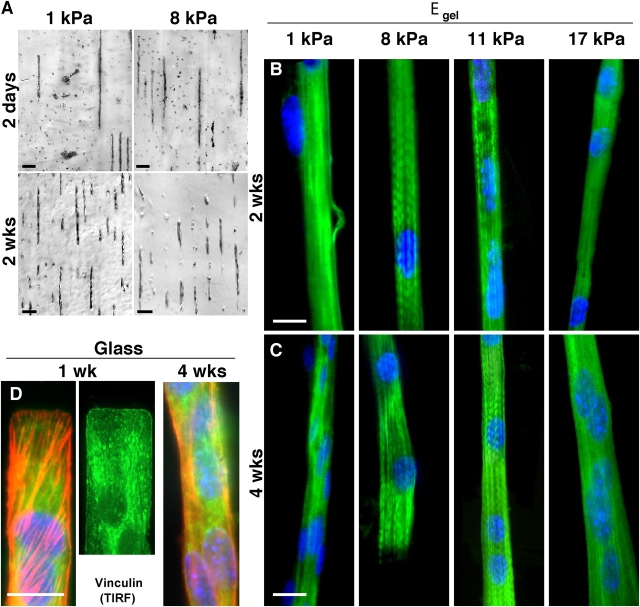
Contractile myocytes provide a test of the hypothesis that cells sense their mechanical as well as molecular microenvironment, altering expression, organization, and/or morphology accordingly. Here, myoblasts were cultured on collagen strips attached to glass or polymer gels of varied elasticity. Subsequent fusion into myotubes occurs independent of substrate flexibility. However, myosin/actin striations emerge later only on gels with stiffness typical of normal muscle (passive Young's modulus, E ∼12 kPa). On glass and much softer or stiffer gels, including gels emulating stiff dystrophic muscle, cells do not striate. In addition, myotubes grown on top of a compliant bottom layer of glass-attached myotubes (but not softer fibroblasts) will striate, whereas the bottom cells will only assemble stress fibers and vinculin-rich adhesions. Unlike sarcomere formation, adhesion strength increases monotonically versus substrate stiffness with strongest adhesion on glass. These findings have major implications for in vivo introduction of stem cells into diseased or damaged striated muscle of altered mechanical composition.
Overview
The claims and statistics of this paper haven’t been checked yet.
Free: it reads the open-access text and checks the first 5 claims that cite a source we can check. Create a free account to check every claim.
Integrity signals
Registry
Cites
Statistics
Figures




Verification
Claims the paper makes
The claims and statistics of this paper haven’t been checked yet.
Free: it reads the open-access text and checks the first 5 claims that cite a source we can check. Create a free account to check every claim.
Claims other papers make about this one
Each is checked against this paper’s own text: does it say what the citing paper says it does?
The source backs part of the claim, not all of it — or backs it for a different population, condition or comparison.
In the citing paper
“Additionally, the stiffness of the cellular environment or niche is an additional mechanical signal that influences for example the differentiation of mesenchymal stem cells into muscle and other cell types (34, 35).”
From The Hippo signal transduction network for exercise physiologists (2016) · cites this paper as [34]
Experimental — accuracy not yet measuredThe cited source says what the claim attributes to it.
In the citing paper
“In studies using biomimetic niches, substrates with an elastic stiffness of young adult skeletal muscle (∼12 kPa Young's modulus, the characteristic elastic rigidity of a material), which is five orders of magnitude softer than traditonal tissue culture plastic), promote MuSC self-renewal29,31 and myoblast differentiation94,95 (Fig. 4).”
From The central role of muscle stem cells in regenerative failure with aging (2015) · cites this paper as [94]
Self-check
Percentages, sums and reported differences re-computed from the paper’s own numbers.
The self-check needs the paper’s full text.
Citations
Cites
Calcium's Role in Mechanotransduction during Muscle Development
Benavides Damm, T., & Egli, M. (2014) · Cellular Physiology and Biochemistry · doi:10.1159/000356667 · Cited by 14,502
Biomechanics. Mechanical Properties of Living Tissues
Fung, Y. C., & Skalak, R. (1982) · Journal of Applied Mechanics · doi:10.1115/1.3162171 · Cited by 6,025
Cell Movement Is Guided by the Rigidity of the Substrate
Lo, C.-M., Wang, H.-B., Dembo, M., & Wang, Y.-L. (2000) · Biophysical Journal · doi:10.1016/s0006-3495(00)76279-5 · Cited by 3,289 · cited 3×
“FAK regulation could also occur by calciumdependent mechanisms (Lo et al., 2000) or stretch-activation (Nakamura et al.”
BackgroundCell locomotion and focal adhesions are regulated by substrate flexibility
Pelham, R. J., & Wang, Y.-L. (1997) · Proceedings of the National Academy of Sciences · doi:10.1073/pnas.94.25.13661 · Cited by 3,027 · cited 7×
“The reason is unclear, but physical aspects of the microenvironment, especially mechanical compliance of matrix (Pelham and Wang, 1997) and perhaps adjacent cells, are becoming increasingly linked to gene expression and protein organization.”
BackgroundInfluentialTaking Cell-Matrix Adhesions to the Third Dimension
Cukierman, E., Pankov, R., Stevens, D. R., & Yamada, K. M. (2001) · Science · doi:10.1126/science.1064829 · Cited by 3,027 · cited 1×
“…adhesion (Choquest et al., 1997; Beningo et al., 2001), posttranslational modification (Pelham and Wang, 1997; Beningo et al., 2001), protein expression (Cukierman et al., 2001), cytoskeletal organization (Cukierman et al., 2001; Engler et al., 2004a), and even cell viability (Wang et al., 2000).”
BackgroundCells lying on a bed of microneedles: An approach to isolate mechanical force
Tan, J. L., Tien, J., Pirone, D. M., Gray, D. S., Bhadriraju, K., & Chen, C. S. (2003) · Proceedings of the National Academy of Sciences · doi:10.1073/pnas.0235407100 · Cited by 1,962 · cited 2×
“The mechanism of coalignment is understood, from theory (Bischofs and Schwartz, 2003), to involve a propagation of cell-induced substrate contractions (Pelham and Wang, 1997; Wang et al., 2001; Tan et al., 2003 ).”
BackgroundSilicone Rubber Substrata: A New Wrinkle in the Study of Cell Locomotion
Harris, A. K., Wild, P., & Stopak, D. (1980) · Science · doi:10.1126/science.6987736 · Cited by 1,348 · cited 1×
“Analogous to the wrinkling of films by cells (Harris et al., 1980; Oliver et al., 1995), cells generate traction forces on collagen-coated polyacrylamide (PA) gel substrates.”
BackgroundExtracellular Matrix Rigidity Causes Strengthening of Integrin–Cytoskeleton Linkages
Choquet, D., Felsenfeld, D. P., & Sheetz, M. P. (1997) · Cell · doi:10.1016/s0092-8674(00)81856-5 · Cited by 1,245 · cited 1×
“Such signals feed back into cell tension (Wang et al., 2002), cell adhesion ( Choquest et al., 1997; Beningo et al., 2001), posttranslational modification (Pelham and Wang, 1997; Beningo et al., 2001), protein expression (Cukierman et al., 2001), cytoskeletal organization (Cukierman et al., 2001; Engler et al., 2004a)…”
BackgroundDetermination of Elastic Moduli of Thin Layers of Soft Material Using the Atomic Force Microscope
Dimitriadis, E. K., Horkay, F., Maresca, J., Kachar, B., & Chadwick, R. S. (2002) · Biophysical Journal · doi:10.1016/s0006-3495(02)75620-8 · Cited by 1,230 · cited 2×
“Mechanics of gels The elastic modulus of various gels was determined by AFM as well as macroscopic methods (Dimitriadis et al., 2002; Engler et al., 2004a).”
MethodSubstrate Compliance versus Ligand Density in Cell on Gel Responses
Engler, A., Bacakova, L., Newman, C., Hategan, A., Griffin, M., & Discher, D. (2004) · Biophysical Journal · doi:10.1016/s0006-3495(04)74140-5 · Cited by 1,141 · cited 16×
“In the absence of stiff ECM resistance, however, assembly and phosphorylation of adhesion proteins are inhibited (Pelham and Wang, 1997), and thus F-actin assembly is reduced (Engler et al., 2004a).”
BackgroundMethodInfluentialSelf-citation
Research works printed but not linked: 1
- 2004, Surf. Sci., In press
Cited by
Items 901–1,000 of 1,003
Mechanical regulation of cell adhesion
Schmitz, J., & Gottschalk, K. (2008) · Soft Matter · doi:10.1039/b716805p · Cited by 33
Optimisation of cell fate determination for cultivated muscle differentiation
Melzener, L., Schaeken, L., Fros, M., Messmer, T., Raina, D., Kiessling, A., van Haaften, T., Spaans, S., Doǧan, A., Post, M. J., et al. (2024) · Communications Biology · doi:10.1038/s42003-024-07201-6 · Cited by 29
“Further improvements to 3D culture systems might also come in the form of additional functionalisation of alginate (to more accurately mimic the array of ECM proteins present in the muscle niche), addition of secondary components 53 – 55 , or the modulation of hydrogel stiffness 56 .”
Yang, P., Boer, G. E., Snow, F., Williamson, A., Cheeseman, S., Samarasinghe, R. M., Rifai, A., Priyam, A., Elnathan, R., Guijt, R. M., et al. (2025) · Chemical Engineering Journal · doi:10.1016/j.cej.2025.159295 · Cited by 37
Kuraitis, D., Ebadi, D., Zhang, P., Rizzuto, E., Vulesevic, B., Padavan, D. T., Madhoun, A. S. A., McEwan, K., Sofrenovic, T., Nicholson, K., et al. (2012) · European Cells and Materials · doi:10.22203/ecm.v024a13 · Cited by 29
Scaffold-in-Scaffold Potential to Induce Growth and Differentiation of Cardiac Progenitor Cells
Ciocci, M., Mochi, F., Carotenuto, F., Giovanni, E. D., Prosposito, P., Francini, R., Matteis, F. D., Reshetov, I. V., Casalboni, M., Melino, S., et al. (2017) · Stem Cells and Development · doi:10.1089/scd.2017.0051 · Cited by 29
“Engler et al. [8] showed that skeletal myoblasts striated only when cultured on gels with a stiffness mimicking that of the native tissue; cardiac progenitor cells also modulate their cardiac commitment depending on the substrate stiffness and pore geometry [9,10].”
Surface-modified polymers for cardiac tissue engineering
Moorthi, A., Tyan, Y., & Chung, T. (2017) · Biomaterials Science · doi:10.1039/c7bm00309a · Cited by 30
Elango, J., Saravanakumar, K., Rahman, S. U., Henrotin, Y. E., Regenstein, J. M., Wu, W., & Bao, B. (2019) · Biomolecules · doi:10.3390/biom9050173 · Cited by 31
“The scaffold compression strength might be expected to influence the differentiation and proliferation of fibroblast [28].”
BackgroundA Review of in vitro Platforms for Understanding Cardiomyocyte Mechanobiology
Chin, I. L., Hool, L. C., & Choi, Y. S. (2019) · Frontiers in Bioengineering and Biotechnology · doi:10.3389/fbioe.2019.00133 · Cited by 32
“In vitro matching substrate stiffness to physiological values (∼10 kPa) has been found to promote maturation and improve contractility in neonatal cardiomyocytes whereas pathological stiffnesses (>35 kPa) result in hypertrophy and reduced contractility (Engler et al., 2004; Jacot et al., 2008; McCain et al., 2014).”
BackgroundLi, Y., Wu, M., Zhang, Z., Xia, J., Wang, Z., Chen, X., Xiao, X., Lu, F., & Dong, Z. (2019) · Tissue Engineering Part A · doi:10.1089/ten.tea.2019.0046 · Cited by 29
“20,21 The optimum stiffness for adipogenesis is * 2–4 kPa.”
Fibrogenesis in LAMA2-Related Muscular Dystrophy Is a Central Tenet of Disease Etiology
Accorsi, A., Cramer, M. L., & Girgenrath, M. (2020) · Frontiers in Molecular Neuroscience · doi:10.3389/fnmol.2020.00003 · Cited by 33
Pereira, D., Richert, A., Medjkane, S., Hénon, S., & Weitzman, J. B. (2020) · Scientific Reports · doi:10.1038/s41598-020-75833-9 · Cited by 35
Pham‐Nguyen, O., Son, Y. J., Kwon, T., Kim, J., Jung, Y. C., Park, J. B., Kang, B., & Yoo, H. S. (2021) · Advanced Healthcare Materials · doi:10.1002/adhm.202002228 · Cited by 32
Hu, L.-Y., Mileti, C. J., Loomis, T., Brashear, S. E., Ahmad, S., Chellakudam, R. R., Wohlgemuth, R. P., Gionet‐Gonzales, M., Leach, J. K., & Smith, L. (2021) · American Journal of Physiology-Cell Physiology · doi:10.1152/ajpcell.00065.2021 · Cited by 35
Fabrication of hydrogels with elasticity changed by alkaline phosphatase for stem cell culture
Toda, H., Yamamoto, M., Uyama, H., & Tabata, Y. (2015) · Acta Biomaterialia · doi:10.1016/j.actbio.2015.10.036 · Cited by 30
“The elasticity of microenvironments within the brain [58,59], fat [60], muscle [20,61], cartilage [62] and pre-calcified bone [11,63–65] ranges over more than two orders of magnitude with key contributions from the most abundant proteins in animals, namely the extracellular matrix proteins such as collagens.”
BackgroundMyhre, J. L., & Pilgrim, D. B. (2012) · Biochemistry Research International · doi:10.1155/2012/712315 · Cited by 36
Li, Y., Lin, M.-W., Yen, M.-H., Fan, S. M., Wu, J., Young, T., Cheng, J., & Lin, S. (2015) · ACS Applied Materials & Interfaces · doi:10.1021/acsami.5b05978 · Cited by 28
Abdeen, A. A., Lee, J., & Kilian, K. A. (2016) · Experimental Biology and Medicine · doi:10.1177/1535370216644532 · Cited by 32
“Engler et al.(94,95) demonstrated that MSC fate depends on substrate compliance, with optimal differentiation marker expression occurring on elasticities matching in vivo elasticity.”
BackgroundBiomechanical Origins of Muscle Stem Cell Signal Transduction
Morrissey, J. B., Cheng, R. Y., Davoudi, S., & Gilbert, P. M. (2015) · Journal of Molecular Biology · doi:10.1016/j.jmb.2015.05.004 · Cited by 36
Wu, X., Han, W.-M., Hou, L.-Y., Lin, D.-D., Li, J., Lin, S.-T., Yang, J., Liao, L., & Zeng, X. (2024) · International Journal of Biological Macromolecules · doi:10.1016/j.ijbiomac.2024.131438 · Cited by 34
Tissue Engineered 3D Constructs for Volumetric Muscle Loss
Gahlawat, S., Oruc, D., Paul, N., Ragheb, M., Patel, S., Fasasi, O., Sharma, P. K., Shreiber, D. I., & Freeman, J. W. (2024) · Annals of Biomedical Engineering · doi:10.1007/s10439-024-03541-w · Cited by 34
“The mechanical stiffness of the scaffold regulates gene expression of anchorage-dependent cells, such as myoblasts, to influence cell adhesion, proliferation, and differentiation [29, 31].”
BackgroundCao, T., & Warren, C. R. (2025) · Cells · doi:10.3390/cells14120882 · Cited by 32
“Studies demonstrate that myoblasts cultured on PEG substrates with a stiffness of ~12 kPa exhibit enhanced actin/myosin striations and differentiation compared to softer or stiffer substrates [73].”
Wouters, O. Y., Ploeger, D. T. A., van Putten, S. M., & Bank, R. A. (2016) · Tissue Engineering Part C Methods · doi:10.1089/ten.tec.2015.0312 · Cited by 26
“Furthermore, cells generally proliferate faster on a stiff substrate,(6) and substrate stiffness affects stem cell lineage differentiation.(7,8) To study the effect of substrate stiffness on cells in vitro, polyacrylamide hydrogels (PAAMs) have been used for years as elastomers with a pretunable stiffness.”
Factors That Affect Tissue-Engineered Skeletal Muscle Function and Physiology
Khodabukus, A., & Baar, K. (2016) · Cells Tissues Organs · doi:10.1159/000446067 · Cited by 28
“Culturing skeletal muscle above 18 kPa decreases muscle differentiation and maturation [Engler et al., 2004], and fibrin-based human engineered muscle has a stiffness of 12 kPa when fully formed [Chiron et al., 2012].”
BackgroundMartin, N. R. W., Turner, M. C., Farrington, R., Player, D. J., & Lewis, M. P. (2017) · Journal of Cellular Physiology · doi:10.1002/jcp.25960 · Cited by 34
“Tissue engineered skeletal muscle however allows for skeletal muscle progenitor cells to be cultured on/inside biologically relevant substrates in 3-dimensions, and are less stiff, in turn supporting improvements in levels of skeletal muscle maturation (Engler et al., 2004), and generation of contractile force.”
BackgroundEngineering Smart Hybrid Tissues with Built-In Electronics
Feiner, R., & Dvir, T. (2020) · iScience · doi:10.1016/j.isci.2020.100833 · Cited by 33
“…et al., 1999; and Hai et al., 2010. because the mechanical properties of the substrate on which cells are seeded can impact the behavior of individual cells as well as the success of their development into a functional tissue (Engler et al., 2004, 2006; Discher et al., 2005; Rehfeldt et al., 2007).”
BackgroundControlled domain gels with a biomimetic gradient environment for osteochondral tissue regeneration
Zhang, N., Wang, Y., Zhang, J., Guo, J., & He, J. H. (2021) · Acta Biomaterialia · doi:10.1016/j.actbio.2021.08.029 · Cited by 28
Elvitigala, K. C. M. L., Mubarok, W., & Sakai, S. (2023) · Soft Matter · doi:10.1039/d3sm00560g · Cited by 31
Griffin, M. A., Feng, H., Tewari, M., Acosta, P., Kawana, M., Sweeney, H. L., & Discher, D. E. (2005) · Journal of Cell Science · doi:10.1242/jcs.01717 · Cited by 28
“2C), consistent with results previously reported by our laboratory (Engler et al., 2004a; Engler et al., 2004b; Griffin et al., 2004b).”
MethodResultSelf-citation3-Dimensional Structures to Enhance Cell Therapy and Engineer Contractile Tissue
Schussler, O., Chachques, J., Mesana, T., Suuronen, E. J., Lecarpentier, Y., & Ruel, M. (2010) · Asian Cardiovascular and Thoracic Annals · doi:10.1177/0218492310361531 · Cited by 34
“Furthermore, it has been shown that contractile cells such as myoblasts or cardiomyocytes differentiate and beat synchronously on a matrix with an intermediate stiffness of 8 to 11 kpa, but they do not beat on a matrix with lower or higher stiffness, such as that observed in scar (20 to 40 kpa).(35,36) Cell orientatio…”
BackgroundZhang, S., Sun, A., Ma, H., Kang, Y., Zhou, N., Shen, L., Zhang, C., Zou, Y., & Ge, J. (2010) · Journal of Cellular and Molecular Medicine · doi:10.1111/j.1582-4934.2010.01217.x · Cited by 34
“Matrix stiffness, corresponding to specific tissues, could promote tissue-mimetic differentiation of cells in vitro [27–28].”
BackgroundCompliance-induced adherens junction formation in epithelial cells and tissues is regulated by JNK
You, H., Padmashali, R. M., Ranganathan, A., Lei, P., Girnius, N., Davis, R. J., & Andreadis, S. T. (2013) · Journal of Cell Science · doi:10.1242/jcs.122903 · Cited by 33
“…by Discher and colleagues who observed that myotubes attaching on glass showed abundant stress fibers but myotubes cultured on top of another myotube layer differentiated into a striated state, presumably because they perceived a softer substrate (Engler et al., 2004; Griffin et al., 2004).”
BackgroundSen, S., Tewari, M., Zajac, A. L., Barton, E. R., Sweeney, H. L., & Discher, D. E. (2010) · European Journal of Cell Biology · doi:10.1016/j.ejcb.2010.06.005 · Cited by 34
“…(e.g. FA density, spread area, stress fibers), which is consistent with past reports on a vascular smooth muscle cell line (Engler et al., 2004a), but Pax+ could still promote cytoskeletal contractility since myofibrillogenesis starts at the adhesions (Engler et al., 2004b; Griffin et al., 2004b).”
MethodResultSelf-citationEngineered Polymeric Biomaterials for Tissue Engineering
Wong, Y. S., Tay, C. Y., Wen, F., Venkatraman, S. S., & Tan, L. P. (2012) · Current Tissue Engineering · doi:10.2174/2211542011201010041 · Cited by 29
Suzuki, S., Nishiwaki, K., Takeoka, S., & Fujie, T. (2016) · Advanced Materials Technologies · doi:10.1002/admt.201600064 · Cited by 28
The Stiffness‐Sensitive Transcriptome of Human Tendon Stromal Cells
Hussien, A. A., Niederöst, B., Bollhalder, M., Goedecke, N., & Snedeker, J. G. (2022) · Advanced Healthcare Materials · doi:10.1002/adhm.202101216 · Cited by 31
Scalable Processes for Culturing Meat Using Edible Scaffolds
Kawecki, N. S., Chen, K. K., Smith, C. S., Xie, Q., Cohen, J. M., & Rowat, A. C. (2024) · Annual Review of Food Science and Technology · doi:10.1146/annurev-food-072023-034451 · Cited by 36
Kim, W.-J., Kim, Y., Lu, Y., Ovissipour, R., & Nitin, N. (2024) · Food Hydrocolloids · doi:10.1016/j.foodhyd.2024.110823 · Cited by 28
Skeletal Muscle Tissue Engineering: From Tissue Regeneration to Biorobotics
Cordelle, M. Z., Snelling, S. J. B., & Mouthuy, P. (2025) · Cyborg and Bionic Systems · doi:10.34133/cbsystems.0279 · Cited by 33
“While softer and stiffer substrates (including glass controls) also supported myo-blast fusion into multi-nucleated myotubes, only gels possessing a muscle-like stiffness showed advanced levels of myosin striation even at 4 weeks in culture [ 64 ].”
Experimental and numerical determination of cellular traction force on polymeric hydrogels
Ng, S. S., Li, C., & Chan, V. (2011) · Interface Focus · doi:10.1098/rsfs.2011.0036 · Cited by 27
Optically Induced Nanostructures: Biomedical and Technical Applications
König, R. N. H. K., & Ostendorf, H. A. (2015) · De Gruyter eBooks · doi:10.1515/9783110354324 · Cited by 45
Wu, S., Zhu, M., Lu, D., Milani, A. H., Lian, Q., Fielding, L. A., Saunders, B. R., Derry, M. J., Armes, S. P., Adlam, D. J., et al. (2019) · Chemical Science · doi:10.1039/c9sc02555c · Cited by 27
Comelles, J., Fernández‐Majada, V., Berlanga-Navarro, N., Acevedo, V., Paszkowska, K., & Martínez, E. (2020) · Biofabrication · doi:10.1088/1758-5090/ab7552 · Cited by 31
Wolfram, T., Spatz, J. P., & Burgess, R. W. (2008) · BMC Cell Biology · doi:10.1186/1471-2121-9-64 · Cited by 30
“Substrate rigidity has been shown to have a variety of effects on cell morphology, proliferation, and differentiation [32,33].”
Ramkisoensing, A. A., de Vries, A. A. F., Atsma, D. E., Schalij, M. J., & Pijnappels, D. A. (2014) · Cardiovascular Research · doi:10.1093/cvr/cvu047 · Cited by 29
“investigated the importance of the rigidity of the microenvironment in striated muscle differentiation.(78) In this study, they showed that myosin/actin striation only appeared in myotubes that were seeded on”
BackgroundBioactive polyacrylamide hydrogels with gradients in mechanical stiffness
Diederich, V., Studer, P., Kern, A., Lattuada, M., Storti, G., Sharma, R. I., Snedeker, J. G., & Morbidelli, M. (2012) · Biotechnology and Bioengineering · doi:10.1002/bit.24810 · Cited by 27
“…Vol. 110, No. 5, May, 2013 2012 Wiley Periodicals, Inc. proliferate (Engler et al., 2004b; Nemir et al., 2009; Semler et al., 2005) and even differentiate (Chatterjee et al., 2010; Engler et al., 2004b, 2006; Saha et al., 2008; Sharma and Snedeker, 2010; Sundararaghavan et al., 2009).”
BackgroundMethodInfluentialTan, S., Fang, J. Y., Wu, Y., Yang, Z. G., Liang, G., & Han, B. (2015) · Scientific Reports · doi:10.1038/srep16333 · Cited by 32
Macroporous Biodegradable Cryogels of Synthetic Poly(α-amino acids)
Sedlačík, T., Proks, V., Šlouf, M., Dušková‐Smrc̆ková, M., Studenovská, H., & Rypáček, F. (2015) · Biomacromolecules · doi:10.1021/acs.biomac.5b01224 · Cited by 29
Mollaeian, K., Liu, Y., Bi, S., Wang, Y., Ren, J., & Lu, M. (2018) · International Journal of Molecular Sciences · doi:10.3390/ijms19113461 · Cited by 27
“This directly results in lower shear stress of the cytoskeleton and lower cell contractility [11,39].”
BackgroundOveissi, F., Naficy, S., Le, T. Y. L., Fletcher, D. F., & Dehghani, F. (2019) · Journal of Materials Chemistry B · doi:10.1039/c9tb00080a · Cited by 27
Bischofs, I. B., & Schwarz, U. S. (2006) · Acta Biomaterialia · doi:10.1016/j.actbio.2006.01.002 · Cited by 27
“During recent years, the sophisticated use of elastic substrates has proven that cells indeed respond to purely elastic features in their environment, including rigidity, rigidity gradients and prestrain [12, 6, 13, 14, 15, 16].”
BackgroundBulk elastic properties of chicken embryos during somitogenesis
Agero, U., Glazier, J. A., & Hosek, M. (2010) · BioMedical Engineering OnLine · doi:10.1186/1475-925x-9-19 · Cited by 27
“For example, cultured myocytes growing on different substrates can sense the mechanical properties of their environment and change their morphology in response to the substrate stiffness [11].”
BackgroundBiomineralization of a Self-Assembled Extracellular Matrix for Bone Tissue Engineering
Meng, Y., Qin, Y., DiMasi, E., Ba, X., Rafailovich, M. H., & Pernodet, N. (2008) · Tissue Engineering Part A · doi:10.1089/ten.tea.2007.0371 · Cited by 26
“It has been shown by Lo et al. 39 that fibroblast migration is enhanced on a more rigid surface, and in other analogous studies, muscle cells 40,41 exhibited preferential alignment and spreading on stiffer substrates.”
Effects of Regulatory Factors on Engineered Cardiac Tissue In Vitro
Cheng, M., Park, H., Engelmayr, G. C., Moretti, M., & Freed, L. E. (2007) · Tissue Engineering · doi:10.1089/ten.2006.0414 · Cited by 29
“Further optimization of scaffold structural and mechanical cues and biophysical signaling can reasonably be expected to further enhance CM elongation and CM differentiation, based on systematic in vitro studies of substrate structure, 52–54 local stiffness, 55–57 and cyclic stretch.”
Nanoindentation Response of 3D Printed PEGDA Hydrogels in a Hydrated Environment
Khalili, M. H., Williams, C. J., Micallef, C., Martinez, F. D., Afsar, A., Zhang, R., Wilson, S., Dossi, E., Impey, S., Goel, S., et al. (2023) · ACS Applied Polymer Materials · doi:10.1021/acsapm.2c01700 · Cited by 32
Roch, T., Cui, J., Kratz, K. L., Lendlein, A., & Jung, F. (2012) · Clinical Hemorheology and Microcirculation · doi:10.3233/ch-2010-1449 · Cited by 29
“One of the key properties that influences the patency rate of small diameter vascular prostheses is the for muscle tissue and up to 100 kPa for collagenous bone tissue [11, 12, 14].”
Unc45b is essential for early myofibrillogenesis and costamere formation in zebrafish
Myhre, J. L., Hills, J. A., Jean, F., & Pilgrim, D. B. (2014) · Developmental Biology · doi:10.1016/j.ydbio.2014.02.022 · Cited by 27
Microscale technologies for regulating human stem cell differentiation
Cimetta, E., & Vunjak‐Novakovic, G. (2014) · Experimental Biology and Medicine · doi:10.1177/1535370214530369 · Cited by 26
Lee, S., Hong, J., & Lee, J. (2016) · Soft Matter · doi:10.1039/c5sm00649j · Cited by 32
Enhanced Osteogenic Activity of TiO2 Nanorod Films with Microscaled Distribution of Zn-CaP
He, M. S., Chen, X., Cheng, K., Weng, W., & Wang, H. (2016) · ACS Applied Materials & Interfaces · doi:10.1021/acsami.6b01284 · Cited by 26
Improving cartilage phenotype from differentiated pericytes in tunable peptide hydrogels
Alakpa, E. V., Jayawarna, V., Burgess, K. E., West, C. C., Péault, B., Ulijn, R. V., & Dalby, M. J. (2017) · Scientific Reports · doi:10.1038/s41598-017-07255-z · Cited by 26
Localized neurite outgrowth sensing via substrates with alternative rigidities
Chou, S.-Y., Cheng, C., Chen, C., & LeDuc, P. R. (2011) · Soft Matter · doi:10.1039/c1sm06336g · Cited by 26
Hörning, M., Kidoaki, S., Kawano, T., & Yoshikawa, K. (2012) · Biophysical Journal · doi:10.1016/j.bpj.2011.12.018 · Cited by 26
“This suggests that the minimum main cycle length is proportional to the adhesion strength of cells, since the adhesion strength increases monotonically with increasing substrate rigidity, and the strongest adhesion occurs on glass (15).”
BackgroundDevelopment and application of human skeletal muscle microphysiological systems
Truskey, G. A. (2018) · Lab on a Chip · doi:10.1039/c8lc00553b · Cited by 28
An AFM-Based Nanomechanical Study of Ovarian Tissues with Pathological Conditions
Ansardamavandi, A., Tafazzoli‐Shadpour, M., Omidvar, R., & Nili, F. (2020) · International Journal of Nanomedicine · doi:10.2147/ijn.s254342 · Cited by 28
Decellularized Plant-Based Scaffolds for Guided Alignment of Myoblast CellsPreprint
Campuzano, S., Mogilever, N. B., & Pelling, A. E. (2020) · bioRxiv (Cold Spring Harbor Laboratory) · doi:10.1101/2020.02.23.958686 · Cited by 30
Kim, M. S., Choi, Y., & Lee, K. Y. (2025) · Polymers · doi:10.3390/polym17172337 · Cited by 39
“Nevertheless, achieving fully synchronized electromechanical coupling and long-term mechanical resilience that precisely replicates the anisotropic and hierarchical characteristics of native cardiac tissues remains an unmet need [61,116].”
Farouz, Y., Chen, Y., Terzic, A., & Menasché, P. (2014) · Stem Cells · doi:10.1002/stem.1929 · Cited by 27
Saglam, A., Perets, A., Canver, A. C., Li, H.-L., Kollins, K. M., Cohen, G., Fischer, I., Lazarovici, P., & Lelkes, P. I. (2012) · Journal of Molecular Neuroscience · doi:10.1007/s12031-012-9863-9 · Cited by 25
“…being exposed to guiding cues/molecules on the EC surface, rather feel the “softening cushion” of the underlying cells, which will more closely mimic the stiffness of their tissue of origin and hence facilitate tissue-specific differentiation (Engler et al. 2004), i.e., in this case neuritogenesis.”
BackgroundDiffusion Dynamics of Motor-Driven Transport: Gradient Production and Self-Organization of Surfaces
Vikhorev, P. G., Vikhoreva, N. N., Sundberg, M., Balaz, M., Albet-Torres, N., Bunk, R., Kvennefors, A., Liljesson, K., Nicholls, I. A., Nilsson, L., et al. (2008) · Langmuir · doi:10.1021/la8016112 · Cited by 25
Guerra, N. B., Cassel, J. B., Henckes, N. A. C., de Oliveira, F. D. S., Lima, E. O. C., & dos Santos, L. A. (2018) · Journal of Polymer Research · doi:10.1007/s10965-018-1542-2 · Cited by 30
Aprile, P., Whelan, I. T., Sathy, B. N., Carroll, S. F., & Kelly, D. J. (2022) · Macromolecular Bioscience · doi:10.1002/mabi.202100365 · Cited by 24
Decellularization: Leveraging a Tissue Engineering Technique for Food Production
Jones, J. D., Thyden, R., Perreault, L. R., Varieur, B. M., Patmanidis, A. A., Daley, L., Gaudette, G. R., & Dominko, T. (2023) · ACS Biomaterials Science & Engineering · doi:10.1021/acsbiomaterials.2c01421 · Cited by 26
Palamà, I. E., D’Amone, S., Coluccia, A. M. L., & Gigli, G. (2012) · Biotechnology and Bioengineering · doi:10.1002/bit.24626 · Cited by 25
Schulte, V. A., Díez, M., Hu, Y., Möller, M., & Lensen, M. C. (2010) · Biomacromolecules · doi:10.1021/bm100881y · Cited by 26
Surface functionalization of acrylic based photocrosslinkable resin for 3D printing applications
Ronca, A., Maiullari, F., Milan, M., Pace, V., Gloria, A., Rizzi, R., Santis, R. D., & Ambrosio, L. (2017) · Bioactive Materials · doi:10.1016/j.bioactmat.2017.04.002 · Cited by 29
Quiescence of human muscle stem cells is favored by culture on natural biopolymeric films
Monge, C., Distasio, N., Rossi, T., Sébastien, M., Sakai, H., Kalman, B., Boudou, T., Tajbakhsh, S., Marty, I., Bigot, A., et al. (2017) · Stem Cell Research & Therapy · doi:10.1186/s13287-017-0556-8 · Cited by 29
“However, in addition to matrix composition, matrix stiffness (or rigidity) is also a determinant for muscle cell fate [29].”
BackgroundAgrawal, S. K., Sanabria-DeLong, N., Tew, G. N., & Bhatia, S. R. (2006) · Journal of materials research/Pratt's guide to venture capital sources · doi:10.1557/jmr.2006.0261 · Cited by 28
Skeletal Muscle Spheroids as Building Blocks for Engineered Muscle Tissue
Johnson, N., Filler, A. C., Sethi, A., Smith, L., & Leach, J. K. (2023) · ACS Biomaterials Science & Engineering · doi:10.1021/acsbiomaterials.3c01078 · Cited by 27
Meka, S. R. K., Chacko, L. A., Ravi, A., Chatterjee, K., & Ananthanarayanan, V. (2017) · ACS Biomaterials Science & Engineering · doi:10.1021/acsbiomaterials.6b00725 · Cited by 25
Bhosle, S. M., Loomis, K. H., Kirschman, J. L., Blanchard, E. L., Vanover, D. A., Zurla, C., Habrant, D., Edwards, D., Baumhof, P., Pitard, B., et al. (2018) · Biomaterials · doi:10.1016/j.biomaterials.2018.01.010 · Cited by 28
“13 for myoblast and 12 kPa for myotubes strengthen adhesion, cell spreading and traction force which recapitulate the mechanosensitive property of muscle tissue [75,76].”
BackgroundMalijauskaite, S., Connolly, S. A., Newport, D. T., & McGourty, K. (2021) · Cytokine & Growth Factor Reviews · doi:10.1016/j.cytogfr.2021.03.002 · Cited by 29
Pei, M., Hwangbo, H., & Kim, G. (2023) · Composites Part B Engineering · doi:10.1016/j.compositesb.2023.110730 · Cited by 29
Extracellular matrix biomimicry for the creation of investigational and therapeutic devices
Pellowe, A. S., & Gonzalez, A. L. (2015) · Wiley Interdisciplinary Reviews Nanomedicine and Nanobiotechnology · doi:10.1002/wnan.1349 · Cited by 24
The interplay between physical and chemical properties of protein films affects their bioactivity
Grover, C. N., Farndale, R. W., Best, S. M., & Cameron, R. E. (2012) · Journal of Biomedical Materials Research Part A · doi:10.1002/jbm.a.34187 · Cited by 24
Krieger, C. C., Bhasin, N., Tewari, M., Brown, A. E., Safer, D., Sweeney, H. L., & Discher, D. E. (2010) · Cytoskeleton · doi:10.1002/cm.20489 · Cited by 24
Self-citationStructural, mechanical and osmotic properties of injectable hyaluronan-based composite hydrogels
Horkay, F., Magda, J. J., Alcoutlabi, M., Atzet, S. K., & Zarembinski, T. I. (2010) · Polymer · doi:10.1016/j.polymer.2010.06.027 · Cited by 24
Macrí-Pellizzeri, L., De‐Juan‐Pardo, E. M., Prósper, F., & Pelacho, B. (2017) · Journal of Tissue Engineering and Regenerative Medicine · doi:10.1002/term.2586 · Cited by 25
“For instance, mouse explanted myoblasts were induced to terminally differentiate into myotubes upon culturing on collagen patterned hydrogels with healthy muscle‐like stiffness (Engler et al., 2004).”
BackgroundRosso, G., Young, P., & Shahin, V. (2017) · Frontiers in Molecular Neuroscience · doi:10.3389/fnmol.2017.00345 · Cited by 29
“Simulated by these findings, diverse follow-up studies were published (Engler et al., 2004, 2006; Gilbert et al., 2010; Arulmoli et al., 2015; Sosale et al., 2015).”
BackgroundCagnin, S., Cimetta, E., Guiducci, C., Martini, P. G. V., & Lanfranchi, G. (2012) · Sensors · doi:10.3390/s121115947 · Cited by 26
“It is now widely assessed that the mechanical properties of the substrate where cells adhere greatly influence and guide cell proliferation and differentiation [99,100].”
BackgroundRandom cellulose acetate nanofibers: a breakthrough for cultivated meat production
dos Santos, A. E. A., Guadalupe, J. L., Albergaria, J. D. S., Almeida, I. A., Moreira, A. M. S., Copola, A. G. L., de Araújo, I. P., de Paula, A. M., Neves, B. R. A., Santos, J. P. F., et al. (2024) · Frontiers in Nutrition · doi:10.3389/fnut.2023.1297926 · Cited by 24
Aggregation dynamics of molecular bonds between compliant materials
Jiang, H., Qian, J. W., Lin, Y., Ni, Y. Z., & He, L. (2015) · Soft Matter · doi:10.1039/c4sm02903h · Cited by 23
Effect of Substrate Modulus on Cell Function and Differentiation
Vincent, L. G., & Engler, A. J. (2011) · Elsevier eBooks · doi:10.1016/b978-0-08-055294-1.00158-6 · Cited by 27
Self-citationAndersen, J. I., Pennisi, C. P., Fink, T., & Zachar, V. (2017) · Tissue Engineering Part A · doi:10.1089/ten.tea.2017.0137 · Cited by 23
“3 In skeletal muscle cells, biophysical signals such as externally applied tensile stresses, 4,5 substrate stiffness, 6,7 and surface topography 8 have been shown to initiate mechanotransduction events by activating mechanosensors.”
Strategies for neural control of prosthetic limbs: from electrode interfacing to 3D printing
Ngan, C., Kapsa, R. M. I., & Choong, P. (2019) · Materials · doi:10.3390/ma12121927 · Cited by 26
Ledo, A. M., Senra, A., Rilo-Alvarez, H., Borrajo, E., Vidal, A., Alonso, M. J., & García-Fuentes, M. (2020) · Biomaterials · doi:10.1016/j.biomaterials.2020.120016 · Cited by 26
Kim, H., Osaki, T., Kamm, R. D., & Asada, H. H. (2022) · The FASEB Journal · doi:10.1096/fj.202200500r · Cited by 25
Adhesion Dynamics and Durotaxis in Migrating Cells
Harland, B., Walcott, S., & Sun, S. X. (2011) · Biophysical Journal · doi:10.1016/j.bpj.2010.12.1855 · Cited by 23
Costa, M. L., Escaleira, R. C., Jazenko, F., & Mermelstein, C. (2008) · Cell Motility and the Cytoskeleton · doi:10.1002/cm.20301 · Cited by 23
Ghosh, D., Lili, L., McGrail, D. J., Matyunina, L. V., McDonald, J. F., & Dawson, M. (2013) · Stem Cells and Development · doi:10.1089/scd.2013.0240 · Cited by 26
“A more dynamic understanding of how mechanical stresses regulate cell functions requires increased knowledge of the microscopic mechanical properties of cells [44,45] and their extra-cellular environments [46].”
Synthetic Matrices to Serve as Niches for Muscle Cell Transplantation
Fernandes, S., Kuklok, S., McGonigle, J., Reinecke, H., & Murry, C. E. (2011) · Cells Tissues Organs · doi:10.1159/000331414 · Cited by 26
Metadata
- Authors
- Engler, A. J., Griffin, M. A., Sen, S., Bönnemann, C. G., Sweeney, H. L., & Discher, D. E.
- Affiliations
- University of Pennsylvania (US)
- 2Pennsylvania Muscle Institute, University of Pennsylvania, Philadelphia, PA 19104
- Venue
- The Journal of Cell Biology
- Publisher
- Rockefeller University Press
- Published
- 2004-09-13
- Volume
- 166
- Issue
- 6
- Pages
- 877-887
- ISSN
- 0021-9525 (ISSN-L)
- 1540-8140
- PMC
- PMC2172122
- OpenAlex
- W2167243609
- Cited by
- 1,743
- References
- 57
- Citations by year
- 2026: 47 · 2025: 54 · 2024: 63 · 2023: 49 · 2022: 71 · 2021: 84 · 2020: 87 · 2019: 77 · 2018: 86 · 2017: 119 · 2016: 90 · 2015: 88 · 2014: 92 · 2013: 115 · 2012: 128
- FWCI
- 14.63
- Type
- journal article
- Language
- en
- Open access
- green
- www.ncbi.nlm.nih.gov
- Licence
- cc-by-nc-sa
- Locations
- The Journal of Cell Biology (publishedVersion)
- PubMed Central (publishedVersion, cc-by-nc-sa)
- PubMed (publishedVersion)
- ScholarlyCommons (University of Pennsylvania) (submittedVersion)
- eScholarship (California Digital Library) (submittedVersion)
- Topics
- Life Sciences › Biochemistry, Genetics and Molecular Biology › Cell Biology › Cellular Mechanics and Interactions
- Life Sciences › Biochemistry, Genetics and Molecular Biology › Molecular Biology › Muscle Physiology and Disorders
- Health Sciences › Medicine › Surgery › Tissue Engineering and Regenerative Medicine
- Keywords
- myotube differentiation, substrate stiffness, mechanotransduction, myoblast fusion, sarcomere formation, cell adhesion, stress fibers, vinculin, dystrophic muscle, collagen substrate, polymer gels, stem cell transplantation, muscle regeneration
- MeSH terms
- Polyacrylamides, Acrylic Resins, Animals, Cell Adhesion, Cell Differentiation, Cell Line, Cells, Cultured, Elasticity, Fibroblasts, Gels, Mice, Inbred C3H, Mice, Mutant Strains, Models, Biological, Substrate Specificity, Muscle, Skeletal, Muscle Fibers, Skeletal, Microscopy, Atomic Force, Fluorescent Antibody Technique, Direct, Mice
About these checks
Registry, retraction, Cites and statistics results are computed, not judged, with one exception: a printed reference that no index lists is read once by a model before it counts as a citation error. Claims are extracted by a model and kept only when their quote appears verbatim in the text; each cited source is then checked, with a model’s help, for whether it says what the claim relies on. Those verdicts can be wrong — read the claim’s quote and the cited source before relying on one.
Statistics and arithmetic are recomputed, not judged.
Confidence bands are shown only for fields calibrated on our annotated test set. None is calibrated yet, so no band is shown.
What counts as a claim ›How we measure confidence ›How we check this ›
Are you an author, or do you see a problem with this page? Request a review
Data sources
Bibliographic data: Semantic Scholar, OpenAlex, Crossref.
Contains information from the Semantic Scholar Academic Graph Datasets, made available under the ODC Attribution License (ODC-BY 1.0).
Semantic Scholar’s data is described in: Kinney, R., et al. (2023). The Semantic Scholar Open Data Platform. arXiv:2301.10140.
