

Myotubes differentiate optimally on substrates with tissue-like stiffness
Open accessThe DOI matches its Crossref record; 58 of the 58 references it cites were found in a registry or an index.
Abstract
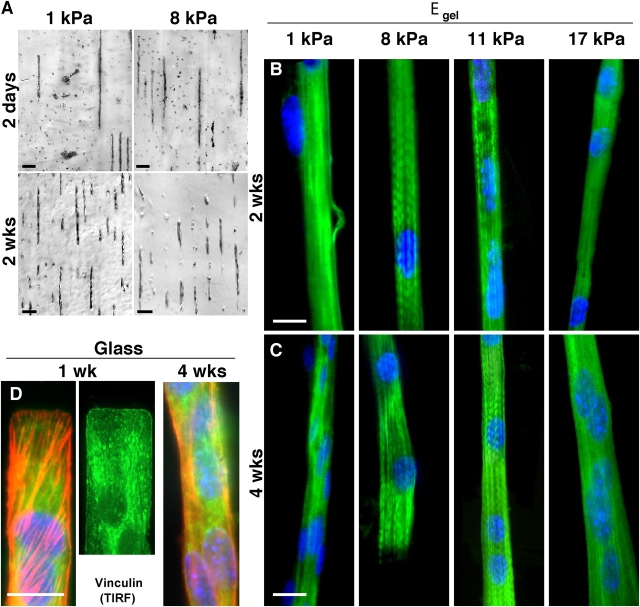
Contractile myocytes provide a test of the hypothesis that cells sense their mechanical as well as molecular microenvironment, altering expression, organization, and/or morphology accordingly. Here, myoblasts were cultured on collagen strips attached to glass or polymer gels of varied elasticity. Subsequent fusion into myotubes occurs independent of substrate flexibility. However, myosin/actin striations emerge later only on gels with stiffness typical of normal muscle (passive Young's modulus, E ∼12 kPa). On glass and much softer or stiffer gels, including gels emulating stiff dystrophic muscle, cells do not striate. In addition, myotubes grown on top of a compliant bottom layer of glass-attached myotubes (but not softer fibroblasts) will striate, whereas the bottom cells will only assemble stress fibers and vinculin-rich adhesions. Unlike sarcomere formation, adhesion strength increases monotonically versus substrate stiffness with strongest adhesion on glass. These findings have major implications for in vivo introduction of stem cells into diseased or damaged striated muscle of altered mechanical composition.
Overview
The claims and statistics of this paper haven’t been checked yet.
Free: it reads the open-access text and checks the first 5 claims that cite a source we can check. Create a free account to check every claim.
Integrity signals
Registry
Cites
Statistics
Figures




Verification
Claims the paper makes
The claims and statistics of this paper haven’t been checked yet.
Free: it reads the open-access text and checks the first 5 claims that cite a source we can check. Create a free account to check every claim.
Claims other papers make about this one
Each is checked against this paper’s own text: does it say what the citing paper says it does?
The source backs part of the claim, not all of it — or backs it for a different population, condition or comparison.
In the citing paper
“Additionally, the stiffness of the cellular environment or niche is an additional mechanical signal that influences for example the differentiation of mesenchymal stem cells into muscle and other cell types (34, 35).”
From The Hippo signal transduction network for exercise physiologists (2016) · cites this paper as [34]
Experimental — accuracy not yet measuredThe cited source says what the claim attributes to it.
In the citing paper
“In studies using biomimetic niches, substrates with an elastic stiffness of young adult skeletal muscle (∼12 kPa Young's modulus, the characteristic elastic rigidity of a material), which is five orders of magnitude softer than traditonal tissue culture plastic), promote MuSC self-renewal29,31 and myoblast differentiation94,95 (Fig. 4).”
From The central role of muscle stem cells in regenerative failure with aging (2015) · cites this paper as [94]
Self-check
Percentages, sums and reported differences re-computed from the paper’s own numbers.
The self-check needs the paper’s full text.
Citations
Cites
Calcium's Role in Mechanotransduction during Muscle Development
Benavides Damm, T., & Egli, M. (2014) · Cellular Physiology and Biochemistry · doi:10.1159/000356667 · Cited by 14,502
Biomechanics. Mechanical Properties of Living Tissues
Fung, Y. C., & Skalak, R. (1982) · Journal of Applied Mechanics · doi:10.1115/1.3162171 · Cited by 6,025
Cell Movement Is Guided by the Rigidity of the Substrate
Lo, C.-M., Wang, H.-B., Dembo, M., & Wang, Y.-L. (2000) · Biophysical Journal · doi:10.1016/s0006-3495(00)76279-5 · Cited by 3,289 · cited 3×
“FAK regulation could also occur by calciumdependent mechanisms (Lo et al., 2000) or stretch-activation (Nakamura et al.”
BackgroundCell locomotion and focal adhesions are regulated by substrate flexibility
Pelham, R. J., & Wang, Y.-L. (1997) · Proceedings of the National Academy of Sciences · doi:10.1073/pnas.94.25.13661 · Cited by 3,027 · cited 7×
“The reason is unclear, but physical aspects of the microenvironment, especially mechanical compliance of matrix (Pelham and Wang, 1997) and perhaps adjacent cells, are becoming increasingly linked to gene expression and protein organization.”
BackgroundInfluentialTaking Cell-Matrix Adhesions to the Third Dimension
Cukierman, E., Pankov, R., Stevens, D. R., & Yamada, K. M. (2001) · Science · doi:10.1126/science.1064829 · Cited by 3,027 · cited 1×
“…adhesion (Choquest et al., 1997; Beningo et al., 2001), posttranslational modification (Pelham and Wang, 1997; Beningo et al., 2001), protein expression (Cukierman et al., 2001), cytoskeletal organization (Cukierman et al., 2001; Engler et al., 2004a), and even cell viability (Wang et al., 2000).”
BackgroundCells lying on a bed of microneedles: An approach to isolate mechanical force
Tan, J. L., Tien, J., Pirone, D. M., Gray, D. S., Bhadriraju, K., & Chen, C. S. (2003) · Proceedings of the National Academy of Sciences · doi:10.1073/pnas.0235407100 · Cited by 1,962 · cited 2×
“The mechanism of coalignment is understood, from theory (Bischofs and Schwartz, 2003), to involve a propagation of cell-induced substrate contractions (Pelham and Wang, 1997; Wang et al., 2001; Tan et al., 2003 ).”
BackgroundSilicone Rubber Substrata: A New Wrinkle in the Study of Cell Locomotion
Harris, A. K., Wild, P., & Stopak, D. (1980) · Science · doi:10.1126/science.6987736 · Cited by 1,348 · cited 1×
“Analogous to the wrinkling of films by cells (Harris et al., 1980; Oliver et al., 1995), cells generate traction forces on collagen-coated polyacrylamide (PA) gel substrates.”
BackgroundExtracellular Matrix Rigidity Causes Strengthening of Integrin–Cytoskeleton Linkages
Choquet, D., Felsenfeld, D. P., & Sheetz, M. P. (1997) · Cell · doi:10.1016/s0092-8674(00)81856-5 · Cited by 1,245 · cited 1×
“Such signals feed back into cell tension (Wang et al., 2002), cell adhesion ( Choquest et al., 1997; Beningo et al., 2001), posttranslational modification (Pelham and Wang, 1997; Beningo et al., 2001), protein expression (Cukierman et al., 2001), cytoskeletal organization (Cukierman et al., 2001; Engler et al., 2004a)…”
BackgroundDetermination of Elastic Moduli of Thin Layers of Soft Material Using the Atomic Force Microscope
Dimitriadis, E. K., Horkay, F., Maresca, J., Kachar, B., & Chadwick, R. S. (2002) · Biophysical Journal · doi:10.1016/s0006-3495(02)75620-8 · Cited by 1,230 · cited 2×
“Mechanics of gels The elastic modulus of various gels was determined by AFM as well as macroscopic methods (Dimitriadis et al., 2002; Engler et al., 2004a).”
MethodSubstrate Compliance versus Ligand Density in Cell on Gel Responses
Engler, A., Bacakova, L., Newman, C., Hategan, A., Griffin, M., & Discher, D. (2004) · Biophysical Journal · doi:10.1016/s0006-3495(04)74140-5 · Cited by 1,141 · cited 16×
“In the absence of stiff ECM resistance, however, assembly and phosphorylation of adhesion proteins are inhibited (Pelham and Wang, 1997), and thus F-actin assembly is reduced (Engler et al., 2004a).”
BackgroundMethodInfluentialSelf-citation
Research works printed but not linked: 1
- 2004, Surf. Sci., In press
Cited by
Items 101–200 of 1,003
Anisotropic Materials for Skeletal‐Muscle‐Tissue Engineering
Jana, S., Levengood, S. K. L., & Zhang, M. (2016) · Advanced Materials · doi:10.1002/adma.201600240 · Cited by 345
Bioengineering human myocardium on native extracellular matrix
Guyette, J. P., Charest, J. M., Mills, R. W., Jank, B. J., Moser, P. T., Gilpin, S. E., Gershlak, J. R., Okamoto, T., Gonzalez, G., Milan, D. J., et al. (2016) · Circulation Research · doi:10.1161/circresaha.115.306874 · Cited by 343
Chowdhury, F., Li, Y., Poh, Y.-C., Yokohama-Tamaki, T., Wang, N., & Tanaka, T. S. (2010) · PLoS ONE · doi:10.1371/journal.pone.0015655 · Cited by 341
“the previous findings in skeletal and cardiac muscle cells [35,36] and the finding from a very recent report on skeletal muscle stem cells [37].”
Controlling Cell Behavior Through the Design of Polymer Surfaces
Alves, N. M., Pashkuleva, I., Reis, R. L., & Mano, J. F. (2010) · Small · doi:10.1002/smll.201000233 · Cited by 338
The effect of matrix characteristics on fibroblast proliferation in 3D gels
Bott, K., Upton, Z., Schrobback, K., Ehrbar, M., Hubbell, J. A., Lutolf, M. P., & Rizzi, S. C. (2010) · Biomaterials · doi:10.1016/j.biomaterials.2010.07.046 · Cited by 334
Costantini, M., Testa, S., Mozetic, P., Barbetta, A., Fuoco, C., Fornetti, E., Tamiro, F., Bernardini, S., Jaroszewicz, J., Święszkowski, W., et al. (2017) · Biomaterials · doi:10.1016/j.biomaterials.2017.03.026 · Cited by 330
Matrix Rigidity Regulates Cancer Cell Growth and Cellular Phenotype
Tilghman, R. W., Cowan, C. R., Mih, J. D., Koryakina, Y., Gioeli, D., Slack-Davis, J. K., Blackman, B. R., Tschumperlin, D. J., & Parsons, J. T. (2010) · PLoS ONE · doi:10.1371/journal.pone.0012905 · Cited by 331
“were chosen based on published measurements of the rigidity of soft tissues and tumors [7,10,16,18], and on preliminary data”
MethodSchneider, A., Francius, G., Obeid, R., Schwinté, P., Hemmerlé, J., Frisch, B., Schaaf, P., Voegel, J.-C., Senger, B., & Picart, C. (2006) · Langmuir · doi:10.1021/la0521802 · Cited by 324
Advances in Bioactive Hydrogels to Probe and Direct Cell Fate
DeForest, C. A., & Anseth, K. S. (2012) · Annual Review of Chemical and Biomolecular Engineering · doi:10.1146/annurev-chembioeng-062011-080945 · Cited by 323
Synthetic Materials in the Study of Cell Response to Substrate Rigidity
Nemir, S., & West, J. L. (2010) · Annals of Biomedical Engineering · doi:10.1007/s10439-009-9811-1 · Cited by 318
Organ-on-a-chip platforms: a convergence of advanced materials, cells, and microscale technologies
Ahadian, S., Civitarese, R., Bannerman, D., Mohammadi, M. H., Lu, R., Wang, E., Davenport‐Huyer, L., Lai, B., Zhang, B., Zhao, Y., et al. (2018) · Advanced Healthcare Materials · doi:10.1002/adhm.201700506 · Cited by 315
Kong, H. J., Polte, T. R., Alsberg, E., & Mooney, D. J. (2005) · Proceedings of the National Academy of Sciences · doi:10.1073/pnas.0405873102 · Cited by 308
Hybrid Multicomponent Hydrogels for Tissue Engineering
Jia, X., & Kiick, K. L. (2009) · Macromolecular Bioscience · doi:10.1002/mabi.200800284 · Cited by 308
Nanoengineering the Heart: Conductive Scaffolds Enhance Connexin 43 Expression
You, J.-O., Rafat, M., Ye, G. J. C., & Auguste, D. T. (2011) · Nano Letters · doi:10.1021/nl201514a · Cited by 306
Skeletal muscle tissue engineering
Bach, A. D., Beier, J. P., Stern‐Staeter, J., & Horch, R. E. (2004) · Journal of Cellular and Molecular Medicine · doi:10.1111/j.1582-4934.2004.tb00466.x · Cited by 303
Skeletal muscle tissue engineering: methods to form skeletal myotubes and their applications
Ostrovidov, S., Hosseini, V., Ahadian, S., Fujie, T., Parthiban, S. P., Ramalingam, M., Bae, H., Kaji, H., & Khademhosseini, A. (2014) · Tissue Engineering Part B: Reviews · doi:10.1089/ten.teb.2013.0534 · Cited by 302
Kraehenbuehl, T. P., Zammaretti, P., Van der Vlies, A. J., Schoenmakers, R. G., Lutolf, M. P., Jaconi, M. E., & Hubbell, J. A. (2008) · Biomaterials · doi:10.1016/j.biomaterials.2008.03.016 · Cited by 299
“6 Pa), resembling embryonic skeletal muscle tissue [31], while soft matrices (E1⁄4 322 64.”
BackgroundCan cancer be reversed by engineering the tumor microenvironment?
Ingber, D. E. (2008) · Seminars in Cancer Biology · doi:10.1016/j.semcancer.2008.03.016 · Cited by 298
“In addition, substrates that mimic the flexibility of the ECM of a particular tissue type best support the expression of the differentiated phenotype normally exhibited cells from that tissue [95,96].”
BackgroundAdaptive rheology and ordering of cell cytoskeleton govern matrix rigidity sensing
Gupta, M., Sarangi, B. R., Deschamps, J., Nematbakhsh, Y., Callan-Jones, A., Margadant, F., Mège, R.-M., Lim, C. T., Voituriez, R., & Ladoux, B. (2015) · Nature Communications · doi:10.1038/ncomms8525 · Cited by 292
Electrical and mechanical stimulation of cardiac cells and tissue constructs
Stoppel, W. L., Kaplan, D. L., & Black, L. D. (2016) · Advanced Drug Delivery Reviews · doi:10.1016/j.addr.2015.07.009 · Cited by 289
“The ability of substrate stiffness to aid in the differentiation of stem cells [229,230,235,236], suggests that utilization of substrates with stiffnesses, which match the changes present in development, during the in vitro growth, differentiation, and maturation of stem cells into CMs may lead to improved differentia…”
BackgroundFormation and optogenetic control of engineered 3D skeletal muscle bioactuators
Sakar, M. S., Neal, D., Boudou, T., Borochin, M. A., Li, Y., Weiss, R., Kamm, R. D., Chen, C. S., & Asada, H. H. (2012) · Lab on a Chip · doi:10.1039/c2lc40338b · Cited by 288
“C2C12 myotubes show welldeveloped striations when they are cultured on substrates with tissue-like stiffness (E approximately 12 kPa) after 2–4 weeks of differentiation (42).”
BackgroundA Single Component Conducting Polymer Hydrogel as a Scaffold for Tissue Engineering
Mawad, D., Stewart, E., Officer, D. L., Romeo, T., Wagner, P., Wagner, K., & Wallace, G. G. (2012) · Advanced Functional Materials · doi:10.1002/adfm.201102373 · Cited by 285
Spatially controlled hydrogel mechanics to modulate stem cell interactions
Marklein, R. A., & Burdick, J. A. (2010) · Soft Matter · doi:10.1039/b916933d · Cited by 280
Biomaterials that promote cell-cell interactions enhance the paracrine function of MSCs
Qazi, T. H., Mooney, D. J., Duda, G. N., & Geissler, S. (2017) · Biomaterials · doi:10.1016/j.biomaterials.2017.06.019 · Cited by 279
Yang, M. T., Fu, J., Wang, Y.-K., Desai, R. A., & Chen, C. S. (2011) · Nature Protocols · doi:10.1038/nprot.2010.189 · Cited by 274
Microcarriers for Upscaling Cultured Meat Production
Bodiou, V., Moutsatsou, P., & Post, M. J. (2020) · Frontiers in Nutrition · doi:10.3389/fnut.2020.00010 · Cited by 272
Microfluidic platforms for mechanobiology
Polacheck, W. J., Li, R., Uzel, S. G. M., & Kamm, R. D. (2013) · Lab on a Chip · doi:10.1039/c3lc41393d · Cited by 272
Polyelectrolyte Multilayer Films of Controlled Stiffness Modulate Myoblast Cell Differentiation
Ren, K., Crouzier, T., Roy, C., & Picart, C. (2008) · Advanced Functional Materials · doi:10.1002/adfm.200701297 · Cited by 273
Substrate rigidity and force define form through tyrosine phosphatase and kinase pathways
Giannone, G., & Sheetz, M. P. (2006) · Trends in Cell Biology · doi:10.1016/j.tcb.2006.02.005 · Cited by 271
Tseng, Q., Wang, I., Duchemin-Pelletier, E., Azioune, A., Carpi, N., Gao, J., Filhol, O., Piel, M., Théry, M., & Balland, M. (2011) · Lab on a Chip · doi:10.1039/c0lc00641f · Cited by 266
Control of stem cell fate and function by engineering physical microenvironments
Kshitiz, Park, J., Kim, P., Helen, W., Engler, A. J., Levchenko, A., & Kim, D.-H. (2012) · Integrative Biology · doi:10.1039/c2ib20080e · Cited by 267
Self-citationAging of the skeletal muscle extracellular matrix drives a stem cell fibrogenic conversion
Stearns-Reider, K. M., D'Amore, A., Beezhold, K., Rothrauff, B., Cavalli, L., Wagner, W. R., Vorp, D. A., Tsamis, A., Shinde, S., Zhang, C., et al. (2017) · Aging Cell · doi:10.1111/acel.12578 · Cited by 265
“Dystrophic skeletal muscle, which is also characterized by a significant decrease in tissue compliance (average elastic modulus of 18 kPa, range from 5 to 35 kPa (Engler et al., 2004)), also displays MuSC dysfunction and an impaired muscle regenerative capacity (Biressi et al.”
BackgroundEpithelial mechanobiology, skin wound healing, and the stem cell niche
Evans, N. D., Oreffo, R. O. C., Healy, E., Thurner, P. J., & Man, Y. H. (2013) · Journal of the Mechanical Behavior of Biomedical Materials · doi:10.1016/j.jmbbm.2013.04.023 · Cited by 265
“Subsequently, a number of groups showed related effects on other cells, such as endothelial cells (Deroanne et al., 2001) and muscle cells (Engler et al., 2004).”
BackgroundBiophysical Regulation of Cell Behavior—Cross Talk between Substrate Stiffness and Nanotopography
Yang, Y., Wang, K., Gu, X., & Leong, K. W. (2017) · Engineering · doi:10.1016/j.eng.2017.01.014 · Cited by 263
“For example, C2C12 mouse myoblasts exhibit definitive actomyosin striations only on polyacrylamide (PAAm) gels with a stiffness that is typical of normal muscle, but not on softer gel or stiffer glass substrate [33].”
BackgroundCheng, H., Yue, K., Kazemzadeh-Narbat, M., Liu, Y., Khalilpour, A., Li, B., Zhang, Y. S., Annabi, N., & Khademhosseini, A. (2017) · ACS Applied Materials & Interfaces · doi:10.1021/acsami.6b16779 · Cited by 264
“57,58 Addition of SNs (100 μ g/mL) and AMPs (1.0 mg/mL) at the relevant concentrations did not show signi fi cant in fl uence on the compressive moduli of the 20% (w/v) GelMA-DOPA hydrogels (Figure 2b), which could be attributed to the low loading concentrations.”
InfluentialKhatiwala, C. B., Peyton, S. R., & Putnam, A. J. (2006) · American Journal of Physiology-Cell Physiology · doi:10.1152/ajpcell.00455.2005 · Cited by 257
Aligned electrospun polymer fibres for skeletal muscle regeneration
School of Materials, B. G., Aviss, K., Gough, J., & Downes, S. (2010) · European Cells and Materials · doi:10.22203/ecm.v019a19 · Cited by 253
“…has shown that using flat, inflexible scaffolds for myoblast differentiation is ineffective as the myoblasts spontaneously contract as they near the end of the differentiation process and often detach away from stiff scaffolds (Cooper et al., 2004; Engler et al., 2004; Ren et al., 2008).”
BackgroundResultInfluentialAccelerated de novo sarcomere assembly by electric pulse stimulation in C2C12 myotubes
Fujita, H., Nedachi, T., & Kanzaki, M. (2007) · Experimental Cell Research · doi:10.1016/j.yexcr.2007.03.002 · Cited by 244
“importance of ECM and its receptors for de novo sarcomere assembly [5–8].”
BackgroundContractile C2C12myotube model for studying exercise-inducible responses in skeletal muscle
Nedachi, T., Fujita, H., & Kanzaki, M. (2008) · American Journal of Physiology-Endocrinology and Metabolism · doi:10.1152/ajpendo.90280.2008 · Cited by 245
“To establish our in vitro contraction model, we took advantage of mouse C2C12 cell lines, which show relatively good differentiation in terms of sarcomere development compared with other established cell lines, such as rat L6 (17).”
BackgroundCadherin-based intercellular adhesions organize epithelial cell–matrix traction forces
Mertz, A. F., Che, Y., Banerjee, S., Goldstein, J. M., Rosowski, K. A., Revilla, S. F., Niessen, C. M., Marchetti, M. C., Dufresne, E. R., & Horsley, V. (2013) · Proceedings of the National Academy of Sciences · doi:10.1073/pnas.1217279110 · Cited by 243
“However, mechanical interactions of cells within a tissue also affect the tissue’s static mechanical properties including elastic modulus (8), surface tension (9), and fracture toughness (10).”
BackgroundEngineered Contractile Skeletal Muscle Tissue on a Microgrooved Methacrylated Gelatin Substrate
Hosseini, V., Ahadian, S., Ostrovidov, S., Camci-Unal, G., Chen, S., Kaji, H., Ramalingam, M., & Khademhosseini, A. (2012) · Tissue Engineering Part A · doi:10.1089/ten.tea.2012.0181 · Cited by 242
“When the substrate is stiff, for example, a conventional polystyrene culture dish or a glass slide, myotube contraction is isometric, but when the substrate is compliant such as a hydrogel substrate, contraction is isotonic.(22) Therefore, on the hydrogel substrate, the muscle remains at a constant tension while its l…”
BackgroundGenipin‐induced changes in collagen gels: Correlation of mechanical properties to fluorescence
Sundararaghavan, H. G., Monteiro, G. A., Lapin, N. A., Chabal, Y. J., Miksan, J. R., & Shreiber, D. I. (2008) · Journal of Biomedical Materials Research Part A · doi:10.1002/jbm.a.31715 · Cited by 241
Controlling Stem Cell Fate with Material Design
Marklein, R. A., & Burdick, J. A. (2010) · Advanced Materials · doi:10.1002/adma.200901055 · Cited by 242
Rheological Properties of Cross‐Linked Hyaluronan–Gelatin Hydrogels for Tissue Engineering
Vanderhooft, J. L., Alcoutlabi, M., Magda, J. J., & Prestwich, G. D. (2009) · Macromolecular Bioscience · doi:10.1002/mabi.200800141 · Cited by 238
Mechanical regulation of chromatin and transcription
Dupont, S., & Wickström, S. A. (2022) · Nature Reviews Genetics · doi:10.1038/s41576-022-00493-6 · Cited by 236
Non-viral gene delivery regulated by stiffness of cell adhesion substrates
Kong, H. J., Liu, J., Riddle, K., Matsumoto, T., Leach, K., & Mooney, D. J. (2005) · Nature Materials · doi:10.1038/nmat1392 · Cited by 238
The Role of Matrix Stiffness in Hepatic Stellate Cell Activation and Liver Fibrosis
Wells, R. G. (2005) · Journal of Clinical Gastroenterology · doi:10.1097/01.mcg.0000155516.02468.0f · Cited by 232
Rigidity Sensing at the Leading Edge through αvβ3 Integrins and RPTPα
Jiang, G., Huang, A. H., Cai, Y., Tanase, M., & Sheetz, M. P. (2006) · Biophysical Journal · doi:10.1529/biophysj.105.072462 · Cited by 234
Regulating Myoblast Phenotype Through Controlled Gel Stiffness and Degradation
Boontheekul, T., Hill, E. E., Kong, H.-J., & Mooney, D. J. (2007) · Tissue Engineering · doi:10.1089/ten.2006.0356 · Cited by 233
“5 However, the current findings differ from a recent study using C2C12 cells cultured on collagen-coated PA gels, 4 in which cell spreading was found to increase as gel stiffness was increased from 1– 17 kPa.”
Light-assisted direct-write of 3D functional biomaterials
Hribar, K. C., Soman, P., Warner, J., Chung, P., & Chen, S. (2014) · Lab Chip · doi:10.1039/c3lc50634g · Cited by 231
A review of microfabrication and hydrogel engineering for micro-organs on chips
Verhulsel, M., Vignes, M., Descroix, S., Malaquin, L., Vignjevic, D. M., & Viovy, J.-L. (2014) · Biomaterials · doi:10.1016/j.biomaterials.2013.11.021 · Cited by 231
“In contrast, when grown in porousmacrogels, they failed to form striation [51].”
BackgroundNaturally derived and synthetic scaffolds for skeletal muscle reconstruction
Wolf, M. T., Dearth, C. L., Sonnenberg, S. B., Loboa, E. G., & Badylak, S. F. (2015) · Advanced Drug Delivery Reviews · doi:10.1016/j.addr.2014.08.011 · Cited by 230
“Several studies have shown that the mechanical environment greatly influences stem cell differentiation [95].”
BackgroundDynamics of the Self-Assembly of Complex Cellular Aggregates on Micromolded Nonadhesive Hydrogels
Napolitano, A. P., Chai, P., Dean, D. M., & Morgan, J. R. (2007) · Tissue Engineering · doi:10.1089/ten.2006.0190 · Cited by 228
“24 Our data support the role of cytoskeleton-mediated tension and cell contraction in the dynamics of the self-assembly process and the pathway by which complex shapes resolve into spheroids.”
ECM Compliance Regulates Osteogenesis by Influencing MAPK Signaling Downstream of RhoA and ROCK
Khatiwala, C. B., Kim, P. D., Peyton, S. R., & Putnam, A. J. (2009) · Journal of Bone and Mineral Research · doi:10.1359/jbmr.081240 · Cited by 226
“of a mature osteoblastic collagenous bone environment (approximately >100 kPa).((6,51)) Rigid polystyrene was used throughout as a control.”
MethodScaffold Stiffness Influences Cell Behavior: Opportunities for Skeletal Tissue Engineering
Breuls, R. G. M., Jiya, T. U., & Smit, T. H. (2008) · The Open Orthopaedics Journal · doi:10.2174/1874325000802010103 · Cited by 224
Single-cell response to stiffness exhibits muscle-like behavior
Mitrossilis, D., Fouchard, J., Guiroy, A., Desprat, N., Rodriguez, N., Fabry, B., & Asnacios, A. (2009) · Proceedings of the National Academy of Sciences · doi:10.1073/pnas.0903994106 · Cited by 225
Ghajar, C. M., Blevins, K. S., Hughes, C. C. W., George, S. C., & Putnam, A. J. (2006) · Tissue Engineering · doi:10.1089/ten.2006.12.2875 · Cited by 224
“(These values are slightly below those reported for skeletal muscle tissue, 24 suggesting the physiological relevance of these fibrin matrices for soft tissues.)”
Last, J. A., Liliensiek, S. J., Nealey, P. F., & Murphy, C. J. (2009) · Journal of Structural Biology · doi:10.1016/j.jsb.2009.03.012 · Cited by 222
“In addition to sensing substrate topography, cells sense and respond to the mechanical properties of the underlying substrate (Discher et al., 2005; Engler et al., 2004b; Georges and Janmey, 2005).”
BackgroundInfluentialCell adhesion and mechanical stimulation in the regulation of mesenchymal stem cell differentiation
Wang, Y., & Chen, C. S. (2013) · Journal of Cellular and Molecular Medicine · doi:10.1111/jcmm.12061 · Cited by 220
“2C and D) [80].”
Review on Cell Mechanics: Experimental and Modeling Approaches
Rodriguez, M. L., McGarry, P. J., & Sniadecki, N. J. (2013) · Applied Mechanics Reviews · doi:10.1115/1.4025355 · Cited by 218
“…used to examine the mechanics of individual biomolecules [118] [119] [120], components of the cell nucleus [121] [122], cytoskeletal structures [123] [124], and whole cells [78,125–140]; as well as changes in these mechanics during differentiation [141] and disease progression [142] [143] [144].”
The nuclear lamina is mechano-responsive to ECM elasticity in mature tissue
Swift, J., & Discher, D. E. (2014) · Journal of Cell Science · doi:10.1242/jcs.149203 · Cited by 217
“…including contraction (Discher et al., 2005), migration (Hadjipanayi et al., 2009b; Winer et al., 2009; Raab et al., 2012), proliferation (Hadjipanayi et al., 2009a; Klein et al., 2009; Lo et al., 2000), differentiation (Engler et al., 2004; Engler et al., 2006) and apoptosis (Wang et al., 2000).”
BackgroundSelf-citationPatterning the differentiation of C2C12 skeletal myoblasts
Bajaj, P., Reddy, B., Millet, L., Wei, C., Zorlutuna, P., Bao, G., & Bashir, R. (2011) · Integrative Biology · doi:10.1039/c1ib00058f · Cited by 212
Uzel, S. G. M., Platt, R. J., Subramanian, V., Pearl, T. M., Rowlands, C. J., Chan, V., Boyer, L. A., So, P. T. C., & Kamm, R. D. (2016) · Science Advances · doi:10.1126/sciadv.1501429 · Cited by 213
Micromechanical control of cell and tissue development: Implications for tissue engineering☆
GHOSH, K., & INGBER, D. (2007) · Advanced Drug Delivery Reviews · doi:10.1016/j.addr.2007.08.014 · Cited by 212
Versatile polyphenolic platforms in regulating cell biology
Cao, H., Yang, L., Tian, R., Wu, H., Gu, Z., & Li, Y. (2022) · Chemical Society Reviews · doi:10.1039/d1cs01165k · Cited by 212
Co-electrospun dual scaffolding system with potential for muscle–tendon junction tissue engineering
Ladd, M. R., Lee, S. J., Stitzel, J. D., Atala, A., & Yoo, J. J. (2011) · Biomaterials · doi:10.1016/j.biomaterials.2010.10.038 · Cited by 212
“have shown that muscle optimally differentiates on materials that more closely match its stiffness [12].”
BackgroundLeach, J. B., Brown, X. Q., Jacot, J. G., DiMilla, P. A., & Wong, J. Y. (2007) · Journal of Neural Engineering · doi:10.1088/1741-2560/4/2/003 · Cited by 211
3D-printable plant protein-enriched scaffolds for cultivated meat development
Ianovici, I., Zagury, Y., Redenski, I., Lavon, N., & Levenberg, S. (2022) · Biomaterials · doi:10.1016/j.biomaterials.2022.121487 · Cited by 206
Neutrophil morphology and migration are affected by substrate elasticity
Oakes, P. W., Patel, D. C., Morin, N. A., Zitterbart, D. P., Fabry, B., Reichner, J. S., & Tang, J. X. (2009) · Blood · doi:10.1182/blood-2008-11-191445 · Cited by 208
Extracellular matrix stiffness dictates Wnt expression through integrin pathway
Du, J., Zu, Y., Li, J., Du, S., Xu, Y., Zhang, L., Jiang, L., Wang, Z., Chien, S., & Yang, C. (2016) · Scientific Reports · doi:10.1038/srep20395 · Cited by 207
Lam, M. T., Sim, S., Zhu, X., & Takayama, S. (2006) · Biomaterials · doi:10.1016/j.biomaterials.2006.04.012 · Cited by 205
Hu, X., Park, S.-H., Gil, E. S., Xia, X.-X., Weiss, A. S., & Kaplan, D. L. (2011) · Biomaterials · doi:10.1016/j.biomaterials.2011.08.037 · Cited by 206
Cell Adhesion Strength Is Controlled by Intermolecular Spacing of Adhesion Receptors
Selhuber-Unkel, C., Erdmann, T., López-García, M., Kessler, H., Schwarz, U. S., & Spatz, J. P. (2010) · Biophysical Journal · doi:10.1016/j.bpj.2009.11.001 · Cited by 204
Janson, I. A., & Putnam, A. J. (2015) · Journal of Biomedical Materials Research Part A · doi:10.1002/jbm.a.35254 · Cited by 203
“Subsequent studies demonstrated that smooth muscle cell (SMC) spreading increased quantitatively with substrate elasticity.(16,23) The magnitude of spreading depended strongly on ECM ligand density (fibronectin) for SMCs cultured on soft substrates (PAA), but was invariant to these changes on rigid polystyrene control…”
The initial steps of myofibril assembly: integrins pave the way
Sparrow, J. C., & Schöck, F. (2009) · Nature Reviews Molecular Cell Biology · doi:10.1038/nrm2634 · Cited by 202
“Indirect evidence from muscle cell differentiation in tissue culture supports this notion: inhibition of integrins with function-blocking antibodies or the inability to form properly sized integrin adhesion sites inhibits myofibril assembl”
BackgroundRoca-Cusachs, P., Alcaraz, J., Sunyer, R., Samitier, J., Farré, R., & Navajas, D. (2008) · Biophysical Journal · doi:10.1529/biophysj.107.116863 · Cited by 202
Singh, M., Berkland, C., & Detamore, M. S. (2008) · Tissue Engineering Part B: Reviews · doi:10.1089/ten.teb.2008.0304 · Cited by 202
“Smooth muscle cells prefer moderately stiff surfaces (E* 8–10 kPa) to display tissue-like actomyosin patterns and cellular spreading areas compared to softer or stiffer substrates.(37,38) Also, the response of the cells to the physical cues is generally not isolated from the presence of cell-to-cell interaction and ha…”
Evaluation of Photocrosslinked Lutrol Hydrogel for Tissue Printing Applications
Fedorovich, N. E., Swennen, I., Girones, J., Moroni, L., van Blitterswijk, C. A., Schacht, E., Alblas, J., & Dhert, W. J. A. (2009) · Biomacromolecules · doi:10.1021/bm801463q · Cited by 202
Matrix Strains Induced by Cells: Computing How Far Cells Can Feel
Sen, S., Engler, A. J., & Discher, D. E. (2009) · Cellular and Molecular Bioengineering · doi:10.1007/s12195-009-0052-z · Cited by 201
Self-citationLarge-scale cultured meat production: Trends, challenges and promising biomanufacturing technologies
Chen, L., Guttieres, D., Koenigsberg, A., Barone, P. W., Sinskey, A. J., & Springs, S. L. (2022) · Biomaterials · doi:10.1016/j.biomaterials.2021.121274 · Cited by 199
Vimentin Enhances Cell Elastic Behavior and Protects against Compressive Stress
Mendez, M. G., Restle, D., & Janmey, P. A. (2014) · Biophysical Journal · doi:10.1016/j.bpj.2014.04.050 · Cited by 200
“This failure to flatten and spread has been attributed to insufficient internal tension generation that is at least in part attributable to actomyosin systems (46,47,21).”
BackgroundCavitation rheology for soft materials
Zimberlin, J. A., Sanabria-DeLong, N., Tew, G. N., & Crosby, A. J. (2007) · Soft Matter · doi:10.1039/b617050a · Cited by 199
Prospectus of cultured meat—advancing meat alternatives
Bhat, Z. F., & Fayaz, H. (2011) · Journal of Food Science and Technology · doi:10.1007/s13197-010-0198-7 · Cited by 197
“A best scaffold is one that mimics the in vivo situation as myotubes differentiate optimally on scaffold with a tissue-like stiffness (Engler et al. 2004) and its byproducts must be edible and natural and may be derived from non-animal sources, though inedible scaffold materials cannot be disregarded.”
BackgroundHeher, P., Maleiner, B., Prüller, J., Teuschl, A. H., Kollmitzer, J., Monforte, X., Wolbank, S., Redl, H., Rünzler, D., & Fuchs, C. (2015) · Acta Biomaterialia · doi:10.1016/j.actbio.2015.06.033 · Cited by 195
“This effect is linked to the matrix properties as striations have been shown to primarily develop on substrates with a stiffness comparable to native muscle [47].”
BackgroundExtracellular matrix regulation in the muscle satellite cell niche
Thomas, K., Engler, A. J., & Meyer, G. A. (2015) · Connective Tissue Research · doi:10.3109/03008207.2014.947369 · Cited by 196
“(55) induced fusion in immortalized mouse myoblasts on polyacrylamide gels of varying stiffness and found maximal myosin heavy chain striation, a marker of myotube maturity, on gels of muscle-like stiffness ( 11 kPa).”
BackgroundSelf-citationFibronectin Expression Modulates Mammary Epithelial Cell Proliferation during Acinar Differentiation
Williams, C. M., Engler, A. J., Slone, R. D., Galante, L. L., & Schwarzbauer, J. E. (2008) · Cancer Research · doi:10.1158/0008-5472.can-07-2673 · Cited by 195
“Polyacrylamide substrates. Polyacrylamide substrates were made as previously described ( 29 , 30).”
MethodSelf-citationAn injectable extracellular matrix derived hydrogel for meniscus repair and regeneration
Wu, J., Ding, Q., Dutta, A., Wang, Y., Huang, Y.-H., Weng, H., Tang, L., & Hong, Y. (2015) · Acta Biomaterialia · doi:10.1016/j.actbio.2015.01.027 · Cited by 194
Spearman, B. S., Agrawal, N. K., Rubiano, A., Simmons, C. S., Mobini, S., & Schmidt, C. E. (2020) · Journal of Biomedical Materials Research Part A · doi:10.1002/jbm.a.36814 · Cited by 191
Zhang, R., Xie, L., Wu, H., Yang, T., Zhang, Q., Tian, Y., Liu, Y., Han, X., Guo, W., He, M., et al. (2020) · Acta Biomaterialia · doi:10.1016/j.actbio.2020.07.012 · Cited by 192
Wide-range stiffness gradient PVA/HA hydrogel to investigate stem cell differentiation behavior
Oh, S. H., An, D. B., Kim, T. H., & Lee, J. H. (2016) · Acta Biomaterialia · doi:10.1016/j.actbio.2016.02.016 · Cited by 190
Cellular Responses to Substrate Topography: Role of Myosin II and Focal Adhesion Kinase
Frey, M. T., Tsai, I. Y., Russell, T. P., Hanks, S. K., & Wang, Y.-L. (2006) · Biophysical Journal · doi:10.1529/biophysj.105.074526 · Cited by 189
“Moreover, cells also adhere more tightly to stiff substrates than to soft substrates, as shown by a centrifugation assay and by a microneedle peeling assay (34,35).”
BackgroundDi Cio, S., & Gautrot, J. E. (2016) · Acta Biomaterialia · doi:10.1016/j.actbio.2015.11.027 · Cited by 189
Jo, H., Sim, M., Kim, S., Yang, S., Yoo, Y., Park, J.-H., Yoon, T. H., Kim, M.-G., & Lee, J. Y. (2017) · Acta Biomaterialia · doi:10.1016/j.actbio.2016.10.035 · Cited by 188
“For example, myoblasts were reported to show enhanced differentiation and form more myotubes on polyacrylamide gels possessing tissue-like stiffness than on those with non-physiological stiffness [55].”
The emergence of ECM mechanics and cytoskeletal tension as important regulators of cell function
Peyton, S. R., Ghajar, C. M., Khatiwala, C. B., & Putnam, A. J. (2007) · Cell Biochemistry and Biophysics · doi:10.1007/s12013-007-0004-y · Cited by 188
“Perhaps the best evidence supporting this hypothesis comes from Discher and colleagues, who first showed that multinucleated skeletal muscle myotubes form striated actin and myosin filaments indicative of their optimal differentiation on compliant surfaces whose mechanical properties approximate the equilibrium modulu…”
BackgroundHoshiba, T., Chen, G., Endo, C., Maruyama, H., Wakui, M., Nemoto, E., Kawazoe, N., & Tanaka, M. (2016) · Stem Cells International · doi:10.1155/2016/6397820 · Cited by 186
“Stiffness is partially dependent on the ECM and can influence cellular functions [17–20].”
Jeong, S. I., Jun, I. D., Choi, M. J., Nho, Y. C., Lee, Y. M., & Shin, H. (2008) · Macromolecular Bioscience · doi:10.1002/mabi.200800005 · Cited by 187
Alcaraz, J., Xu, R., Mori, H., Nelson, C. M., Mroue, R., Spencer, V. A., Brownfield, D., Radisky, D. C., Bustamante, C., & Bissell, M. J. (2008) · The EMBO Journal · doi:10.1038/emboj.2008.206 · Cited by 186
3D bioprinting in cardiac tissue engineering
Wang, Z., Wang, L., Li, T., Liu, S., Guo, B., Huang, W., & Wu, Y. (2021) · Theranostics · doi:10.7150/thno.61621 · Cited by 185
“(iii) Mechanical strength: scaffolds should retain the shape with muscle tissue-like stiffness (~10 kPa) [21].”
BackgroundPromoting neuron adhesion and growth
Yu, L. M. Y., Leipzig, N. D., & Shoichet, M. S. (2008) · Materials Today · doi:10.1016/s1369-7021(08)70088-9 · Cited by 183
Matrix Elasticity, Cytoskeletal Tension, and TGF-β: The Insoluble and Soluble Meet
Wells, R. G., & Discher, D. E. (2008) · Science Signaling · doi:10.1126/stke.110pe13 · Cited by 183
Self-citation
Metadata
- Authors
- Engler, A. J., Griffin, M. A., Sen, S., Bönnemann, C. G., Sweeney, H. L., & Discher, D. E.
- Affiliations
- University of Pennsylvania (US)
- 2Pennsylvania Muscle Institute, University of Pennsylvania, Philadelphia, PA 19104
- Venue
- The Journal of Cell Biology
- Publisher
- Rockefeller University Press
- Published
- 2004-09-13
- Volume
- 166
- Issue
- 6
- Pages
- 877-887
- ISSN
- 0021-9525 (ISSN-L)
- 1540-8140
- PMC
- PMC2172122
- OpenAlex
- W2167243609
- Cited by
- 1,743
- References
- 57
- Citations by year
- 2026: 47 · 2025: 54 · 2024: 63 · 2023: 49 · 2022: 71 · 2021: 84 · 2020: 87 · 2019: 77 · 2018: 86 · 2017: 119 · 2016: 90 · 2015: 88 · 2014: 92 · 2013: 115 · 2012: 128
- FWCI
- 14.63
- Type
- journal article
- Language
- en
- Open access
- green
- www.ncbi.nlm.nih.gov
- Licence
- cc-by-nc-sa
- Locations
- The Journal of Cell Biology (publishedVersion)
- PubMed Central (publishedVersion, cc-by-nc-sa)
- PubMed (publishedVersion)
- ScholarlyCommons (University of Pennsylvania) (submittedVersion)
- eScholarship (California Digital Library) (submittedVersion)
- Topics
- Life Sciences › Biochemistry, Genetics and Molecular Biology › Cell Biology › Cellular Mechanics and Interactions
- Life Sciences › Biochemistry, Genetics and Molecular Biology › Molecular Biology › Muscle Physiology and Disorders
- Health Sciences › Medicine › Surgery › Tissue Engineering and Regenerative Medicine
- Keywords
- myotube differentiation, substrate stiffness, mechanotransduction, myoblast fusion, sarcomere formation, cell adhesion, stress fibers, vinculin, dystrophic muscle, collagen substrate, polymer gels, stem cell transplantation, muscle regeneration
- MeSH terms
- Polyacrylamides, Acrylic Resins, Animals, Cell Adhesion, Cell Differentiation, Cell Line, Cells, Cultured, Elasticity, Fibroblasts, Gels, Mice, Inbred C3H, Mice, Mutant Strains, Models, Biological, Substrate Specificity, Muscle, Skeletal, Muscle Fibers, Skeletal, Microscopy, Atomic Force, Fluorescent Antibody Technique, Direct, Mice
About these checks
Registry, retraction, Cites and statistics results are computed, not judged, with one exception: a printed reference that no index lists is read once by a model before it counts as a citation error. Claims are extracted by a model and kept only when their quote appears verbatim in the text; each cited source is then checked, with a model’s help, for whether it says what the claim relies on. Those verdicts can be wrong — read the claim’s quote and the cited source before relying on one.
Statistics and arithmetic are recomputed, not judged.
Confidence bands are shown only for fields calibrated on our annotated test set. None is calibrated yet, so no band is shown.
What counts as a claim ›How we measure confidence ›How we check this ›
Are you an author, or do you see a problem with this page? Request a review
Data sources
Bibliographic data: Semantic Scholar, OpenAlex, Crossref.
Contains information from the Semantic Scholar Academic Graph Datasets, made available under the ODC Attribution License (ODC-BY 1.0).
Semantic Scholar’s data is described in: Kinney, R., et al. (2023). The Semantic Scholar Open Data Platform. arXiv:2301.10140.
