

Myotubes differentiate optimally on substrates with tissue-like stiffness
Open accessThe DOI matches its Crossref record; 58 of the 58 references it cites were found in a registry or an index.
Abstract
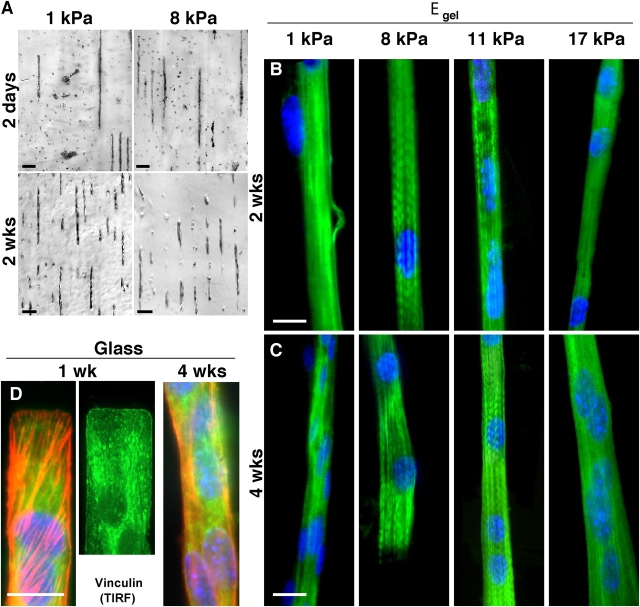
Contractile myocytes provide a test of the hypothesis that cells sense their mechanical as well as molecular microenvironment, altering expression, organization, and/or morphology accordingly. Here, myoblasts were cultured on collagen strips attached to glass or polymer gels of varied elasticity. Subsequent fusion into myotubes occurs independent of substrate flexibility. However, myosin/actin striations emerge later only on gels with stiffness typical of normal muscle (passive Young's modulus, E ∼12 kPa). On glass and much softer or stiffer gels, including gels emulating stiff dystrophic muscle, cells do not striate. In addition, myotubes grown on top of a compliant bottom layer of glass-attached myotubes (but not softer fibroblasts) will striate, whereas the bottom cells will only assemble stress fibers and vinculin-rich adhesions. Unlike sarcomere formation, adhesion strength increases monotonically versus substrate stiffness with strongest adhesion on glass. These findings have major implications for in vivo introduction of stem cells into diseased or damaged striated muscle of altered mechanical composition.
Overview
The claims and statistics of this paper haven’t been checked yet.
Free: it reads the open-access text and checks the first 5 claims that cite a source we can check. Create a free account to check every claim.
Integrity signals
Registry
Cites
Statistics
Figures




Verification
Claims the paper makes
The claims and statistics of this paper haven’t been checked yet.
Free: it reads the open-access text and checks the first 5 claims that cite a source we can check. Create a free account to check every claim.
Claims other papers make about this one
Each is checked against this paper’s own text: does it say what the citing paper says it does?
The source backs part of the claim, not all of it — or backs it for a different population, condition or comparison.
In the citing paper
“Additionally, the stiffness of the cellular environment or niche is an additional mechanical signal that influences for example the differentiation of mesenchymal stem cells into muscle and other cell types (34, 35).”
From The Hippo signal transduction network for exercise physiologists (2016) · cites this paper as [34]
Experimental — accuracy not yet measuredThe cited source says what the claim attributes to it.
In the citing paper
“In studies using biomimetic niches, substrates with an elastic stiffness of young adult skeletal muscle (∼12 kPa Young's modulus, the characteristic elastic rigidity of a material), which is five orders of magnitude softer than traditonal tissue culture plastic), promote MuSC self-renewal29,31 and myoblast differentiation94,95 (Fig. 4).”
From The central role of muscle stem cells in regenerative failure with aging (2015) · cites this paper as [94]
Self-check
Percentages, sums and reported differences re-computed from the paper’s own numbers.
The self-check needs the paper’s full text.
Citations
Cites
Calcium's Role in Mechanotransduction during Muscle Development
Benavides Damm, T., & Egli, M. (2014) · Cellular Physiology and Biochemistry · doi:10.1159/000356667 · Cited by 14,502
Biomechanics. Mechanical Properties of Living Tissues
Fung, Y. C., & Skalak, R. (1982) · Journal of Applied Mechanics · doi:10.1115/1.3162171 · Cited by 6,025
Cell Movement Is Guided by the Rigidity of the Substrate
Lo, C.-M., Wang, H.-B., Dembo, M., & Wang, Y.-L. (2000) · Biophysical Journal · doi:10.1016/s0006-3495(00)76279-5 · Cited by 3,289 · cited 3×
“FAK regulation could also occur by calciumdependent mechanisms (Lo et al., 2000) or stretch-activation (Nakamura et al.”
BackgroundCell locomotion and focal adhesions are regulated by substrate flexibility
Pelham, R. J., & Wang, Y.-L. (1997) · Proceedings of the National Academy of Sciences · doi:10.1073/pnas.94.25.13661 · Cited by 3,027 · cited 7×
“The reason is unclear, but physical aspects of the microenvironment, especially mechanical compliance of matrix (Pelham and Wang, 1997) and perhaps adjacent cells, are becoming increasingly linked to gene expression and protein organization.”
BackgroundInfluentialTaking Cell-Matrix Adhesions to the Third Dimension
Cukierman, E., Pankov, R., Stevens, D. R., & Yamada, K. M. (2001) · Science · doi:10.1126/science.1064829 · Cited by 3,027 · cited 1×
“…adhesion (Choquest et al., 1997; Beningo et al., 2001), posttranslational modification (Pelham and Wang, 1997; Beningo et al., 2001), protein expression (Cukierman et al., 2001), cytoskeletal organization (Cukierman et al., 2001; Engler et al., 2004a), and even cell viability (Wang et al., 2000).”
BackgroundCells lying on a bed of microneedles: An approach to isolate mechanical force
Tan, J. L., Tien, J., Pirone, D. M., Gray, D. S., Bhadriraju, K., & Chen, C. S. (2003) · Proceedings of the National Academy of Sciences · doi:10.1073/pnas.0235407100 · Cited by 1,962 · cited 2×
“The mechanism of coalignment is understood, from theory (Bischofs and Schwartz, 2003), to involve a propagation of cell-induced substrate contractions (Pelham and Wang, 1997; Wang et al., 2001; Tan et al., 2003 ).”
BackgroundSilicone Rubber Substrata: A New Wrinkle in the Study of Cell Locomotion
Harris, A. K., Wild, P., & Stopak, D. (1980) · Science · doi:10.1126/science.6987736 · Cited by 1,348 · cited 1×
“Analogous to the wrinkling of films by cells (Harris et al., 1980; Oliver et al., 1995), cells generate traction forces on collagen-coated polyacrylamide (PA) gel substrates.”
BackgroundExtracellular Matrix Rigidity Causes Strengthening of Integrin–Cytoskeleton Linkages
Choquet, D., Felsenfeld, D. P., & Sheetz, M. P. (1997) · Cell · doi:10.1016/s0092-8674(00)81856-5 · Cited by 1,245 · cited 1×
“Such signals feed back into cell tension (Wang et al., 2002), cell adhesion ( Choquest et al., 1997; Beningo et al., 2001), posttranslational modification (Pelham and Wang, 1997; Beningo et al., 2001), protein expression (Cukierman et al., 2001), cytoskeletal organization (Cukierman et al., 2001; Engler et al., 2004a)…”
BackgroundDetermination of Elastic Moduli of Thin Layers of Soft Material Using the Atomic Force Microscope
Dimitriadis, E. K., Horkay, F., Maresca, J., Kachar, B., & Chadwick, R. S. (2002) · Biophysical Journal · doi:10.1016/s0006-3495(02)75620-8 · Cited by 1,230 · cited 2×
“Mechanics of gels The elastic modulus of various gels was determined by AFM as well as macroscopic methods (Dimitriadis et al., 2002; Engler et al., 2004a).”
MethodSubstrate Compliance versus Ligand Density in Cell on Gel Responses
Engler, A., Bacakova, L., Newman, C., Hategan, A., Griffin, M., & Discher, D. (2004) · Biophysical Journal · doi:10.1016/s0006-3495(04)74140-5 · Cited by 1,141 · cited 16×
“In the absence of stiff ECM resistance, however, assembly and phosphorylation of adhesion proteins are inhibited (Pelham and Wang, 1997), and thus F-actin assembly is reduced (Engler et al., 2004a).”
BackgroundMethodInfluentialSelf-citation
Research works printed but not linked: 1
- 2004, Surf. Sci., In press
Cited by
Items 401–500 of 1,003
Striated muscle function, regeneration, and repair
Shadrin, I. Y., Khodabukus, A., & Bursac, N. (2016) · Cellular and Molecular Life Sciences · doi:10.1007/s00018-016-2285-z · Cited by 126
“stiffness of native skeletal muscle [97]) were shown to engraft more efficiently compared to cells grown on standard tissue culture dishes but still less efficiently than freshly isolated SCs [98], suggesting that mechanical cues of native SC microenvironment are an important but not the only determinant of SC ‘‘stemn…”
BackgroundDayanidhi, S., & Lieber, R. L. (2014) · Muscle & Nerve · doi:10.1002/mus.24441 · Cited by 113
Duffy, R. M., Sun, Y., & Feinberg, A. W. (2016) · Annals of Biomedical Engineering · doi:10.1007/s10439-016-1592-8 · Cited by 93
Injectable biomimetic liquid crystalline scaffolds enhance muscle stem cell transplantation
Sleep, E., Cosgrove, B. D., McClendon, M. T., Preslar, A. T., Chen, C. H., Sangji, M. H., Pérez, C. M. R., Haynes, R. D., Meade, T. J., Blau, H. M., et al. (2017) · Proceedings of the National Academy of Sciences · doi:10.1073/pnas.1708142114 · Cited by 93
“We sought to design an injectable PA scaffold with the microstructural organization and stiffness of myofibers in muscle (21, 22, 26).”
BackgroundMethodResultInfluentialMatrix stiffness mechanically conditions EMT and migratory behavior of oral squamous cell carcinoma
Matte, B. F., Kumar, A., Placone, J. K., Zanella, V. G., Martins, M. D., Engler, A. J., & Lamers, M. L. (2018) · Journal of Cell Science · doi:10.1242/jcs.224360 · Cited by 92
“In all cases, migration appeared to occur through randomwalk, based on a lack of difference in either the angle betweenmigration steps (i.e. orientation correlation coefficient; Engler et al., 2004) or the persistence index (i.e. path length divided by total displacement; Fig.”
BackgroundSelf-citationLauer, J. C., Selig, M., Hart, M. L., Kurz, B., & Rolauffs, B. (2021) · International Journal of Molecular Sciences · doi:10.3390/ijms22063279 · Cited by 98
Kuraitis, D., Giordano, C., Ruel, M., Musarò, A., & Suuronen, E. J. (2011) · Biomaterials · doi:10.1016/j.biomaterials.2011.09.078 · Cited by 107
“Additionally, myoblasts displayed optimal differentiation and striation when exposed to ECM components that had physical properties of their native environment [26].”
BackgroundBiochemical and mechanical environment cooperatively regulate skeletal muscle regeneration
Calve, S., & Simon, H. (2012) · The FASEB Journal · doi:10.1096/fj.11-200162 · Cited by 103
Lee, S., Serpooshan, V., Tong, X., Venkatraman, S., Lee, M. J., Lee, J., Chirikian, O., Wu, J. C., Wu, S. M., & Yang, F. (2017) · Biomaterials · doi:10.1016/j.biomaterials.2017.03.039 · Cited by 103
“In addition, it is essential tomatch the hydrogel stiffness to that of native cardiac tissue (8e11 kPa), given matrix stiffness has been shown to play an important role in maturation of muscle [16,17].”
BackgroundThe Hippo signal transduction network in skeletal and cardiac muscle
Wackerhage, H., Del Re, D. P., Judson, R. N., Sudol, M., & Sadoshima, J. (2014) · Science Signaling · doi:10.1126/scisignal.2005096 · Cited by 92
Temporal Modulation of Stem Cell Activity Using Magnetoactive Hydrogels
Abdeen, A. A., Lee, J., Bharadwaj, N. A., Ewoldt, R. H., & Kilian, K. A. (2016) · Advanced Healthcare Materials · doi:10.1002/adhm.201600349 · Cited by 96
Ostrovidov, S., Ahadian, S., Ramón‐Azcón, J., Hosseini, V., Fujie, T., Parthiban, S. P., Shiku, H., Matsue, T., Kaji, H., Ramalingam, M., et al. (2014) · Journal of Tissue Engineering and Regenerative Medicine · doi:10.1002/term.1956 · Cited by 101
“To improve myotube formation and maturation, different substrate stiffnesses (Engler et al., 2004; Ostrovidov et al., 2014b) and three-dimensional (3D) cultures (van der Schaft et al., 2011) have also been used, while electrical stimulation has been shown to improve the contractibility of the…”
MethodCancer Cell Invasion Is Enhanced by Applied Mechanical Stimulation
Menon, S., & Beningo, K. A. (2011) · PLoS ONE · doi:10.1371/journal.pone.0017277 · Cited by 92
“to influence cell growth, morphology, differentiation and motility [48–52].”
BackgroundAdhesion dynamics and durotaxis in migrating cells
Harland, B., Walcott, S., & Sun, S. X. (2011) · Physical Biology · doi:10.1088/1478-3975/8/1/015011 · Cited by 109
“It has been shown that differentiation of mesenchymal stem cells to more specialized cells is influenced by the stiffness of the cellular substrate [12, 15, 38].”
Interfaces to Control Cell-Biomaterial Adhesive Interactions
García, A. J. (2006) · Springer eBooks · doi:10.1007/12_071 · Cited by 104
Benedetto, C. D., Barbaglio, A., Martinello, T., Alongi, V., Fassini, D., Cullorà, E., Patruno, M., Bonasoro, F., Barbosa, M. A., Carnevali, C., et al. (2014) · Marine Drugs · doi:10.3390/md12094912 · Cited by 91
“In tissue engineering it is now well known that mechanical properties and scaffold geometry/ultrastructure play a crucial role in cell differentiation and specification [16,17].”
BackgroundUniaxial Cyclic Strain Drives Assembly and Differentiation of Skeletal Myocytes
Pennisi, C. P., Olesen, C. G., de Zee, M., Rasmussen, J., & Zachar, V. (2011) · Tissue Engineering Part A · doi:10.1089/ten.tea.2011.0089 · Cited by 91
“17 In addition to these static cues and given the role of strain in myogenesis in vivo , 18 it is believed that active mechanical stimulation is an important regulatory factor.”
Cultured meat: state of the art and future
Gaydhane, M. K., Mahanta, U., Sharma, C. S., Khandelwal, M., & Ramakrishna, S. (2018) · Biomanufacturing Reviews · doi:10.1007/s40898-018-0005-1 · Cited by 103
“Thus, scaffolds should provide large surface area and be flexible to allow for contraction, maximize medium diffusion and be easily dissociated from the meat culture [29].”
BackgroundSustainable Biomass Materials for Biomedical Applications
Li, Y. E. (2019) · ACS Biomaterials Science & Engineering · doi:10.1021/acsbiomaterials.8b01634 · Cited by 94
Probing cellular microenvironments and tissue remodeling by atomic force microscopy
Ludwig, T. E., Kirmse, R., Poole, K., & Schwarz, U. S. (2007) · Pflügers Archiv - European Journal of Physiology · doi:10.1007/s00424-007-0398-9 · Cited by 104
“It is increasingly recognized that the micromechanics of the environment determine cell fate and function as much as soluble molecular factors do [22, 31, 38, 69, 72, 78, 165].”
Chitosan Scaffolds with Unidirectional Microtubular Pores for Large Skeletal Myotube Generation
Jana, S., Cooper, A., & Zhang, M. (2012) · Advanced Healthcare Materials · doi:10.1002/adhm.201200177 · Cited by 90
Matrix mechanics and regulation of the fibroblast phenotype
Hinz, B. (2013) · Periodontology 2000 · doi:10.1111/prd.12030 · Cited by 90
Retrograde Fluxes of Focal Adhesion Proteins in Response to Cell Migration and Mechanical Signals
Guo, W.-H., & Wang, Y. (2007) · Molecular Biology of the Cell · doi:10.1091/mbc.e07-06-0582 · Cited by 99
“Retrieved from https://escholarship.umassmed.edu/oapubs/1321 This material is brought to you by eScholarship@UMassChan.”
BackgroundMethodMechanically dynamic PDMS substrates to investigate changing cell environments
Yeh, Y., Corbin, E. A., Caliari, S. R., Ouyang, L., Vega, S. L., Truitt, R., Han, L., Margulies, K. B., & Burdick, J. A. (2017) · Biomaterials · doi:10.1016/j.biomaterials.2017.08.033 · Cited by 102
Mechanical Control of Stem Cell Differentiation
Rosenfeld, D., Sagi, M., Levenberg, S., & Zemel, A. (2011) · Regenerative Medicine · doi:10.2217/rme.11.99 · Cited by 98
Stem Cells for Skeletal Muscle Tissue Engineering
Pantelic, M. N., & Larkin, L. M. (2018) · Tissue Engineering Part B Reviews · doi:10.1089/ten.teb.2017.0451 · Cited by 91
“Indeed, Engler et al. 60 found that increasing or decreasing hydrogel stiffness outside of physiologically normal range for skeletal muscle significantly reduces myogenic differentiation in mouse myoblasts, which underscores the importance of engineering an in vitro environment that is as similar to…”
A holistic approach to access the viability of cultured meat: A review
Jairath, G., Mal, G., Gopinath, D., & Singh, B. (2021) · Trends in Food Science & Technology · doi:10.1016/j.tifs.2021.02.024 · Cited by 103
AFM and combined optical techniques
Geisse, N. A. (2009) · Materials Today · doi:10.1016/s1369-7021(09)70201-9 · Cited by 156
Cell differentiation through tissue elasticity-coupled, myosin-driven remodeling
Zajac, A. L., & Discher, D. E. (2008) · Current Opinion in Cell Biology · doi:10.1016/j.ceb.2008.09.006 · Cited by 88
“1–1 kPa [20] is softer than striated muscle with E 10 kPa [12,22], which is softer than osteoid with E 20–40 kPa [14 ].”
Self-citationDeng, M., Lin, J., Nowsheen, S., Liu, T., Zhao, Y., Villalta, P. W., Sicard, D., Tschumperlin, D. J., Lee, S., Kim, J.-J., et al. (2020) · Science Advances · doi:10.1126/sciadv.abb2630 · Cited by 99
Sicari, B. M., Dearth, C. L., & Badylak, S. F. (2013) · The Anatomical Record · doi:10.1002/ar.22794 · Cited by 96
“…other native mammalian tissue may be advantageous because the differentiation of myogenic progenitor cells can be influenced by natural tissue specific factors including the three-dimensional ultrastructure, surface ligands, and chemical and mechanical microenvironment (Engler et al., 2004, 2006).”
BackgroundKim, P., Yuan, A. E., Nam, K., Jiao, A., & Kim, D. (2014) · Biofabrication · doi:10.1088/1758-5082/6/2/024112 · Cited by 96
Directed Stem Cell Differentiation: The Role of Physical Forces
Clause, K. C., Liu, L., & Tobita, K. (2010) · Cell Communication & Adhesion · doi:10.3109/15419061.2010.492535 · Cited by 103
Chen, A. A., Khetani, S. R., Lee, S., Bhatia, S. N., & Van Vliet, K. J. (2009) · Biomaterials · doi:10.1016/j.biomaterials.2008.10.055 · Cited by 88
“…77 Massachusetts Avenue, Cambridge, MA 02139, USA d Division of Medicine, Brigham and Women’s Hospital, 75 Francis Street, Boston, MA 02115, USA e School of Engineering and Applied Sciences, Harvard University, 29 Oxford Street, Cambridge, MA 02138, USA a r t i c l e i n f o Article…”
BackgroundThe role of material structure and mechanical properties in cell–matrix interactions
Evans, N. D., & Gentleman, E. (2014) · Journal of Materials Chemistry B · doi:10.1039/c3tb21604g · Cited by 98
FAK-Mediated Mechanotransduction in Skeletal Regeneration
Leucht, P., Kim, J., Currey, J. A., Brunski, J., & Helms, J. A. (2007) · PLoS ONE · doi:10.1371/journal.pone.0000390 · Cited by 95
“Changes in the stiffness of the extracellular matrix can have a profound influence on the fate decisions made by stem cells [5,6].”
BackgroundStimuli-responsive hydrogels as a model of the dynamic cellular microenvironment
Tanaka, M., Nakahata, M., Linke, P., & Kaufmann, S. (2020) · Polymer Journal · doi:10.1038/s41428-020-0353-6 · Cited by 98
Koohestani, F., Braundmeier, A. G., Mahdian, A., Seo, J., Bi, J., & Nowak, R. A. (2013) · PLoS ONE · doi:10.1371/journal.pone.0075844 · Cited by 89
Local Tissue Geometry Determines Contractile Force Generation of Engineered Muscle Networks
Bian, W., Juhas, M., Pfeiler, T. W., & Bursac, N. (2012) · Tissue Engineering Part A · doi:10.1089/ten.tea.2011.0313 · Cited by 86
“In addition, optimization of hydrogel stiffness 27 through use of different cross-linking agents 28 or techniques, such as ruthenium-catalyzed photo cross-linking, 29 may additionally enhance efficiency of myoblast fusion and differentiation, and further enhance the contractile function of…”
Li, Z., Guo, X., Palmer, A. F., Das, H., & Guan, J. (2012) · Acta Biomaterialia · doi:10.1016/j.actbio.2012.06.024 · Cited by 91
Regulation of cancer invasiveness by the physical extracellular matrix environment
Parekh, A., & Weaver, A. (2009) · Cell Adhesion & Migration · doi:10.4161/cam.3.3.8888 · Cited by 87
Seib, F. P., Prewitz, M. C., Werner, C., & Bornhäuser, M. (2009) · Biochemical and Biophysical Research Communications · doi:10.1016/j.bbrc.2009.09.051 · Cited by 89
“[8,9,24,25]).”
BackgroundDuffy, R. M., & Feinberg, A. W. (2013) · Wiley Interdisciplinary Reviews Nanomedicine and Nanobiotechnology · doi:10.1002/wnan.1254 · Cited by 99
Mechanical cues in cellular signalling and communication
Bukoreshtliev, N. V., Haase, K., & Pelling, A. E. (2012) · Cell and Tissue Research · doi:10.1007/s00441-012-1531-4 · Cited by 102
“2010) and the complex process of myogenesis also occurs optimally in a manner dependent on the elasticity of the surrounding tissue (Carmignac and Durbeej 2012; Engler et al. 2004).”
BackgroundBridging the Gap Between Physicochemistry and Interpretation Prevalent in Cell−Surface Interactions
Dubiel, E. A., Martin, Y., & Vermette, P. (2011) · Chemical Reviews · doi:10.1021/cr9002598 · Cited by 102
Biomimicry at the nanoscale: current research and perspectives of two-photon polymerization
Marino, A., Filippeschi, C., Mattoli, V., Mazzolai, B., & Ciofani, G. (2014) · Nanoscale · doi:10.1039/c4nr06500j · Cited by 90
Lamin A/C Mechanotransduction in Laminopathies
Donnaloja, F., Carnevali, F., Jacchetti, E., & Raimondi, M. T. (2020) · Cells · doi:10.3390/cells9051306 · Cited by 99
Intrinsic Mechanical Cues and Their Impact on Stem Cells and Embryogenesis
Petzold, J., & Gentleman, E. (2021) · Frontiers in Cell and Developmental Biology · doi:10.3389/fcell.2021.761871 · Cited by 90
Thickness sensing of hMSCs on collagen gel directs stem cell fate
Leong, W. S., Tay, C. Y., Yu, H., Li, A., Wu, S. C., Duong‐Hong, D., Lim, C. T., & Tan, L. P. (2010) · Biochemical and Biophysical Research Communications · doi:10.1016/j.bbrc.2010.09.052 · Cited by 85
“rons and myoblast [8,18].”
Cimetta, E., Pizzato, S., Bollini, S., Serena, E., Coppi, P. D., & Elvassore, N. (2008) · Biomedical Microdevices · doi:10.1007/s10544-008-9245-9 · Cited by 86
Substrate conductivity dependent modulation of cell proliferation and differentiation in vitro
Thrivikraman, G., Mallik, P. K., & Basu, B. (2013) · Biomaterials · doi:10.1016/j.biomaterials.2013.05.076 · Cited by 88
Monodisperse collagen–gelatin beads as potential platforms for 3D cell culturing
Ma, S., Natoli, M., Liu, X., Neubauer, M. P., Watt, F. M., Fery, A., & Huck, W. T. S. (2013) · Journal of Materials Chemistry B · doi:10.1039/c3tb20851f · Cited by 84
González, A., López, B., Ravassa, S., José, G. S., & Díez, J. (2019) · Biochimica et Biophysica Acta (BBA) - Molecular Cell Research · doi:10.1016/j.bbamcr.2019.06.001 · Cited by 103
Kocgozlu, L., Lavall�e, P., Koenig, G., Senger, B., Haïkel, Y., Schaaf, P., Voegel, J., Tenenbaum, H., & Vautier, D. (2009) · Journal of Cell Science · doi:10.1242/jcs.053520 · Cited by 94
“Tissue from kidney has a value around 100 kPa and that of tendon and cartilage is in the range of megapascals (Levental et al., 2007; Georges et al., 2006; Snedeker et al., 2005; Engler et al., 2004; Discher et al., 2005).”
BackgroundGribova, V., Gauthier‐Rouvière, C., Albigès‐Rizo, C., Auzély‐Velty, R., & Picart, C. (2012) · Acta Biomaterialia · doi:10.1016/j.actbio.2012.12.015 · Cited by 99
“This has been shown using different types of synthetic and natural materials, such as model synthetic polyacrylamide (PA) gels coated with collagen [26], poly(ethylene glycol) (PEG) hydrogels [31], alginate gels of varying stiffness [27] and polyelectrolyte multilayer films made of biopolymers [32].”
Tissue-Engineered Skeletal Muscle Models to Study Muscle Function, Plasticity, and Disease
Khodabukus, A. (2021) · Frontiers in Physiology · doi:10.3389/fphys.2021.619710 · Cited by 97
Mechanobiology of mesenchymal stem cells and their use in cardiovascular repair
Jennifer, S. (2007) · Frontiers in bioscience · doi:10.2741/2551 · Cited by 92
“In myogenesis, rigidity is important for myotube striation (133).”
BackgroundSanabria-DeLong, N., Crosby, A. J., & Tew, G. N. (2008) · Biomacromolecules · doi:10.1021/bm800557r · Cited by 84
Self-Assembly of Fibronectin Mimetic Peptide-Amphiphile Nanofibers
Rexeisen, E. L., Fan, W., Pangburn, T. O., Taribagil, R. R., Bates, F. S., Lodge, T. P., Michael Tsapatsis, B., & Kokkoli, E. (2009) · Langmuir · doi:10.1021/la902571q · Cited by 85
Cellular modulation by the elasticity of biomaterials
Han, F., Zhu, C., Guo, Q., Yang, H., & Li, B. (2016) · Journal of Materials Chemistry B · doi:10.1039/c5tb02077h · Cited by 83
Zhang, Y., Zhang, Z., Wang, Y., Su, Y., & Chen, M. (2020) · Materials Science and Engineering: C · doi:10.1016/j.msec.2020.111070 · Cited by 83
Miroshnikova, Y. A., Jorgens, D. M., Spirio, L., Auer, M., Sarang-Sieminski, A. L., & Weaver, V. M. (2011) · Physical Biology · doi:10.1088/1478-3975/8/2/026013 · Cited by 82
“PA gels have proved quite useful in exploring fundamental links between ECM stiffness and cell behavior, and when used in conjunction with a matrix overlay assay, they have illustrated a role for ECM tension in multicellular morphogenesis [6, 10, 16, 17].”
BackgroundPassive stiffness of fibrotic skeletal muscle in mdx mice relates to collagen architecture
Brashear, S. E., Wohlgemuth, R. P., Gonzalez, G., & Smith, L. (2020) · The Journal of Physiology · doi:10.1113/jp280656 · Cited by 86
“The muscle stem cells responsible for regenerating new muscle tissue are known to be sensitive to the stiffness of their environment (Engler et al. 2004; Gilbert et al. 2010; Urciuolo et al. 2013).”
BackgroundWitkowska-Zimny, M., Walenko, K., Wróbel, E., Mrówka, P., Mikulska, A., & Przybylski, J. (2013) · Cell Biology International · doi:10.1002/cbin.10078 · Cited by 85
“Young's modulus (E) was calculated from the collected force–indentation curves by fitting to the classical Hertz model for cone-shaped geometry, according to the procedure described by Engler and Mahaffy (Engler et al., 2004; Mahaffy et al., 2004).”
BackgroundMethodInfluentialCell shape regulates collagen type I expression in human tendon fibroblasts
Li, F., Li, B., Wang, Q., & Wang, J. H. (2008) · Cell Motility and the Cytoskeleton · doi:10.1002/cm.20263 · Cited by 92
“Microcontact printing method was also been used for fabrication of adhesive islands on polyacrylamide (PA) gel according to a method modified from the literature [Engler et al., 2004].”
MethodZhang, Y., Zhao, C., Jiang, L., & Dai, L. (2010) · Matrix Biology · doi:10.1016/j.matbio.2010.10.008 · Cited by 83
Effects of substrate stiffness on the tenoinduction of human mesenchymal stem cells
Islam, A., Mbimba, T., Younesi, M., & Akkuş, O. (2017) · Acta Biomaterialia · doi:10.1016/j.actbio.2017.05.058 · Cited by 88
Rajendran, A. K., Sankar, D., Amirthalingam, S., Kim, H. D., Jayakumar, R., & Hwang, N. S.-Y. (2023) · Biomaterials Research · doi:10.1186/s40824-023-00393-8 · Cited by 95
Huebsch, N., & Mooney, D. J. (2007) · Biomaterials · doi:10.1016/j.biomaterials.2007.01.023 · Cited by 91
Active mechanics and dynamics of cell spreading on elastic substrates
Nisenholz, N., Rajendran, K., Dang, Q. N., Chen, H., Kemkemer, R., Krishnan, R., & Zemel, A. (2014) · Soft Matter · doi:10.1039/c4sm00780h · Cited by 86
Regulation of Tissue Fibrosis by the Biomechanical Environment
Carver, W. E., & Goldsmith, E. C. (2013) · BioMed Research International · doi:10.1155/2013/101979 · Cited by 95
“Component cells sense and respond to ECM rigidity, which can regulate cell growth [38], shape [39], migration [40, 41], and differentiation [42, 43].”
BackgroundSmith, L., Cho, S., & Discher, D. E. (2017) · Seminars in Cell and Developmental Biology · doi:10.1016/j.semcdb.2017.05.025 · Cited by 89
“This is consistent with an optimal 12 kPa stiffness for striation when using gels [77], with a high degree of sensitivity as a change of only ∼5 kPa either side of the optimal 12 kPa gels resulted in 50% decreases in striation (Fig.”
MethodSelf-citationTalking over the extracellular matrix: How do cells communicate mechanically?
Sapir, L., & Tzlil, S. (2017) · Seminars in Cell and Developmental Biology · doi:10.1016/j.semcdb.2017.06.010 · Cited by 81
Regulation of Endothelial Cell Adherence and Elastic Modulus by Substrate Stiffness
Jalali, S., Tafazzoli‐Shadpour, M., Haghighipour, N., Omidvar, R., & Safshekan, F. (2015) · Cell Communication & Adhesion · doi:10.1080/15419061.2016.1265949 · Cited by 86
Lanniel, M., Huq, E., Allen, S., Buttery, L. D. K., Williams, P. M., & Alexander, M. R. (2011) · Soft Matter · doi:10.1039/c1sm05167a · Cited by 79
Vascular differentiation of bone marrow stem cells is directed by a tunable three-dimensional matrix
Zhang, G., Drinnan, C. T., Geuss, L. R., & Suggs, L. J. (2010) · Acta Biomaterialia · doi:10.1016/j.actbio.2010.03.019 · Cited by 93
“Blebbistatin was used as previously reported [4] as a non-muscle myosin inhibitor in order to deplete the ability of MSC to contract and respond to matrix stiffness.”
MethodHow far cardiac cells can see each other mechanically
Tang, X., Bajaj, P., Bashir, R., & Saif, T. A. (2011) · Soft Matter · doi:10.1039/c0sm01453b · Cited by 81
Measuring cellular forces using bis-aliphatic hydrazone crosslinked stress-relaxing hydrogels
McKinnon, D. D., Domaille, D. W., Brown, T. E., Kyburz, K. A., Kiyotake, E., Cha, J. N., & Anseth, K. S. (2014) · Soft Matter · doi:10.1039/c4sm01365d · Cited by 80
Nakayama, K. H., Alcazar, C. A., Yang, G., Quarta, M., Paine, P., Doan, L., Davies, A., Rando, T. A., & Huang, N. F. (2018) · npj Regenerative Medicine · doi:10.1038/s41536-018-0054-3 · Cited by 86
Zhang, Q., Yang, T. Q., Zhang, R., Liang, X., Wang, G., Tian, Y., Li, X., & Tian, W. (2021) · Acta Biomaterialia · doi:10.1016/j.actbio.2021.09.024 · Cited by 86
Combining insoluble and soluble factors to steer stem cell fate
Dingal, P. C. D. P., & Discher, D. E. (2014) · Nature Materials · doi:10.1038/nmat3997 · Cited by 84
Self-citationKawano, T., Sato, M., Yabu, H., & Shimomura, M. (2013) · Biomaterials Science · doi:10.1039/c3bm60195a · Cited by 79
New advances in probing cell–extracellular matrix interactions
Liu, A. P., Chaudhuri, O., & Parekh, S. H. (2017) · Integrative Biology · doi:10.1039/c6ib00251j · Cited by 78
Selig, M., Lauer, J. C., Hart, M. L., & Rolauffs, B. (2020) · International Journal of Molecular Sciences · doi:10.3390/ijms21155399 · Cited by 92
“Thus, cells grown on stiffer substrates have larger and more stable FAs, with increased F-actin assembly and increased adhesion [43], whereas cells on softer substrates display small and punctuated but still dynamic FAs [55,56].”
BackgroundLelièvre, S. A. (2009) · Biochimica et Biophysica Acta (BBA) - General Subjects · doi:10.1016/j.bbagen.2009.03.013 · Cited by 83
“Mechanical stiffness similar to that found in natural tissues reproduced with ECM in the laboratory permitted the differentiation of myotubes [63].”
ResultSubstrate stiffness regulates solubility of cellular vimentin
Murray, M. E., Mendez, M. G., & Janmey, P. A. (2013) · Molecular Biology of the Cell · doi:10.1091/mbc.e13-06-0326 · Cited by 88
“Supplemental Materials Molecular Biology of the Cell Murray et al.”
BackgroundPoveda‐Reyes, S., Moulisová, V., Sanmartín‐Masiá, E., Quintanilla‐Sierra, L., Salmerón‐Sánchez, M., & Ferrer, G. G. (2016) · Macromolecular Bioscience · doi:10.1002/mabi.201500469 · Cited by 91
Zimoch, J., Padial, J. S., Klar, A. S., Vallmajo-Martin, Q., Meuli, M., Biedermann, T., Wilson, C. J., Rowan, A., & Reichmann, E. (2018) · Acta Biomaterialia · doi:10.1016/j.actbio.2018.01.042 · Cited by 78
Mestre, R., Patiño, T., Barceló, X., Anand, S., Perez‐Jiménez, A., & Sánchez, S. (2018) · Advanced Materials Technologies · doi:10.1002/admt.201800631 · Cited by 84
Regenerative medicine for skeletal muscle loss: a review of current tissue engineering approaches
Langridge, B., Griffin, M., & Butler, P. E. M. (2021) · Journal of Materials Science Materials in Medicine · doi:10.1007/s10856-020-06476-5 · Cited by 94
“Replicating the mechanical properties of the native ECM is also important, several studies have demonstrated that optimal myogenesis occurs on scaffolds with muscle like stiffness [23].”
BackgroundSelf-citationPetrochenko, P. E., Torgersen, J., Gruber, P., Hicks, L. A., Zheng, J., Kumar, G., Narayan, R. J., Goering, P. L., Liska, R., Stampfl, J., et al. (2014) · Advanced Healthcare Materials · doi:10.1002/adhm.201400442 · Cited by 84
Marsano, A., Maidhof, R., Wan, L. Q., Wang, Y., Gao, J., Tandon, N., & Vunjak‐Novakovic, G. (2010) · Biotechnology Progress · doi:10.1002/btpr.435 · Cited by 77
“It has been shown that the differentiation status of a skeletal myoblast can be directly influenced by the stiffness of the substrate it is grown on, and that the myotubes cultured in two-dimensional (2D) settings differentiated optimally on materials with a stiffness mimicking that of native tissue.(8) It was postula…”
BackgroundRegulating Fibrinolysis to Engineer Skeletal Muscle from the C2C12 Cell Line
Khodabukus, A., & Baar, K. (2009) · Tissue Engineering Part C Methods · doi:10.1089/ten.tec.2008.0286 · Cited by 78
“Further, if stem cells are seeded on a moderately stiff substrate or muscle cells are seeded on a fibroblast feeder layer, the cells become more myogenic, expressing more muscle genes, contracting more, and remaining attached to the substrate for longer.(5,6) Together, these data suggest that the skeletal muscle cells…”
BackgroundSkeletal myotube formation enhanced by electrospun polyurethane carbon nanotube scaffolds
Sirivisoot, S., & Harrison (2011) · International Journal of Nanomedicine · doi:10.2147/ijn.s24073 · Cited by 76
“Engler et al suggested that myoblasts could differentiate more readily on elastic or softer surfaces.(37) Specifically, myotubes were found to be formed with a higher degree of striation when cultured on softer fibers (0.”
Graphene Foam as a Three-Dimensional Platform for Myotube Growth
Krueger, E. E., Chang, A. N., Brown, D. R., Eixenberger, J. E., Brown, R. J., Rastegar, S., Yocham, K. M., Cantley, K. D., & Estrada, D. (2016) · ACS Biomaterials Science & Engineering · doi:10.1021/acsbiomaterials.6b00139 · Cited by 78
Interplay Between LOX Enzymes and Integrins in the Tumor Microenvironment
Amendola, P. G., Reuten, R., & Erler, J. T. (2019) · Cancers · doi:10.3390/cancers11050729 · Cited by 82
“Type I collagen is the most abundant ECM scaffold protein in the stroma [33], providing tensile strength and stiffness to tissues [34].”
BackgroundNanoscale Technologies for Prevention and Treatment of Heart Failure: Challenges and Opportunities
Hajipour, M. J., Mehrani, M., Abbasi, S. H., Amin, A., Kassaian, S. E., Garbern, J. C., Caracciolo, G., Zanganeh, S., Chitsazan, M., Aghaverdi, H., et al. (2019) · Chemical Reviews · doi:10.1021/acs.chemrev.8b00323 · Cited by 79
Godwin, J. W., Kuraitis, D., & Rosenthal, N. A. (2014) · The International Journal of Biochemistry & Cell Biology · doi:10.1016/j.biocel.2014.10.011 · Cited by 81
Shape-Dependent Dissolution and Cellular Uptake of Silver Nanoparticles
Graf, C. M., Nordmeyer, D., Sengstock, C., Ahlberg, S., Diendorf, J., Raabe, J., Epple, M., Köller, M., Lademann, J. M., Vogt, A., et al. (2018) · Langmuir · doi:10.1021/acs.langmuir.7b03126 · Cited by 81
Scalable 3D Printed Molds for Human Tissue Engineered Skeletal Muscle
Capel, A. J., Rimington, R. P., Fleming, J. W., Player, D. J., Baker, L. A., Turner, M. C., Jones, J. M., Martin, N. R. W., Ferguson, R. A., Mudera, V., et al. (2019) · Frontiers in Bioengineering and Biotechnology · doi:10.3389/fbioe.2019.00020 · Cited by 76
Metadata
- Authors
- Engler, A. J., Griffin, M. A., Sen, S., Bönnemann, C. G., Sweeney, H. L., & Discher, D. E.
- Affiliations
- University of Pennsylvania (US)
- 2Pennsylvania Muscle Institute, University of Pennsylvania, Philadelphia, PA 19104
- Venue
- The Journal of Cell Biology
- Publisher
- Rockefeller University Press
- Published
- 2004-09-13
- Volume
- 166
- Issue
- 6
- Pages
- 877-887
- ISSN
- 0021-9525 (ISSN-L)
- 1540-8140
- PMC
- PMC2172122
- OpenAlex
- W2167243609
- Cited by
- 1,743
- References
- 57
- Citations by year
- 2026: 47 · 2025: 54 · 2024: 63 · 2023: 49 · 2022: 71 · 2021: 84 · 2020: 87 · 2019: 77 · 2018: 86 · 2017: 119 · 2016: 90 · 2015: 88 · 2014: 92 · 2013: 115 · 2012: 128
- FWCI
- 14.63
- Type
- journal article
- Language
- en
- Open access
- green
- www.ncbi.nlm.nih.gov
- Licence
- cc-by-nc-sa
- Locations
- The Journal of Cell Biology (publishedVersion)
- PubMed Central (publishedVersion, cc-by-nc-sa)
- PubMed (publishedVersion)
- ScholarlyCommons (University of Pennsylvania) (submittedVersion)
- eScholarship (California Digital Library) (submittedVersion)
- Topics
- Life Sciences › Biochemistry, Genetics and Molecular Biology › Cell Biology › Cellular Mechanics and Interactions
- Life Sciences › Biochemistry, Genetics and Molecular Biology › Molecular Biology › Muscle Physiology and Disorders
- Health Sciences › Medicine › Surgery › Tissue Engineering and Regenerative Medicine
- Keywords
- myotube differentiation, substrate stiffness, mechanotransduction, myoblast fusion, sarcomere formation, cell adhesion, stress fibers, vinculin, dystrophic muscle, collagen substrate, polymer gels, stem cell transplantation, muscle regeneration
- MeSH terms
- Polyacrylamides, Acrylic Resins, Animals, Cell Adhesion, Cell Differentiation, Cell Line, Cells, Cultured, Elasticity, Fibroblasts, Gels, Mice, Inbred C3H, Mice, Mutant Strains, Models, Biological, Substrate Specificity, Muscle, Skeletal, Muscle Fibers, Skeletal, Microscopy, Atomic Force, Fluorescent Antibody Technique, Direct, Mice
About these checks
Registry, retraction, Cites and statistics results are computed, not judged, with one exception: a printed reference that no index lists is read once by a model before it counts as a citation error. Claims are extracted by a model and kept only when their quote appears verbatim in the text; each cited source is then checked, with a model’s help, for whether it says what the claim relies on. Those verdicts can be wrong — read the claim’s quote and the cited source before relying on one.
Statistics and arithmetic are recomputed, not judged.
Confidence bands are shown only for fields calibrated on our annotated test set. None is calibrated yet, so no band is shown.
What counts as a claim ›How we measure confidence ›How we check this ›
Are you an author, or do you see a problem with this page? Request a review
Data sources
Bibliographic data: Semantic Scholar, OpenAlex, Crossref.
Contains information from the Semantic Scholar Academic Graph Datasets, made available under the ODC Attribution License (ODC-BY 1.0).
Semantic Scholar’s data is described in: Kinney, R., et al. (2023). The Semantic Scholar Open Data Platform. arXiv:2301.10140.
