

Myotubes differentiate optimally on substrates with tissue-like stiffness
Open accessThe DOI matches its Crossref record; 58 of the 58 references it cites were found in a registry or an index.
Abstract
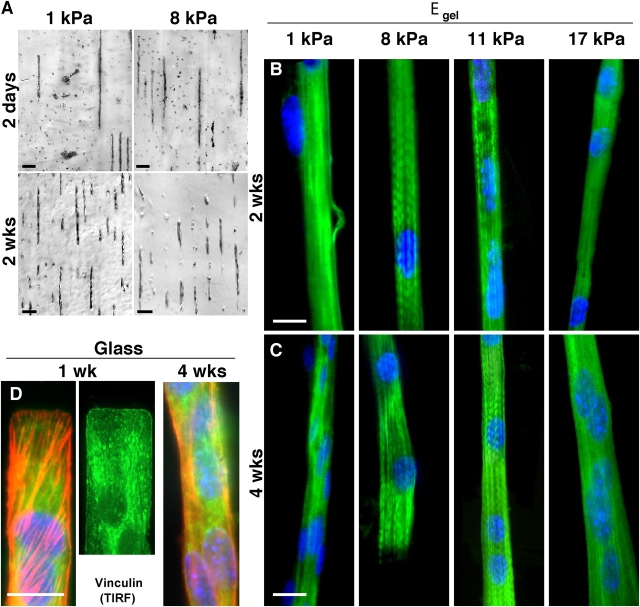
Contractile myocytes provide a test of the hypothesis that cells sense their mechanical as well as molecular microenvironment, altering expression, organization, and/or morphology accordingly. Here, myoblasts were cultured on collagen strips attached to glass or polymer gels of varied elasticity. Subsequent fusion into myotubes occurs independent of substrate flexibility. However, myosin/actin striations emerge later only on gels with stiffness typical of normal muscle (passive Young's modulus, E ∼12 kPa). On glass and much softer or stiffer gels, including gels emulating stiff dystrophic muscle, cells do not striate. In addition, myotubes grown on top of a compliant bottom layer of glass-attached myotubes (but not softer fibroblasts) will striate, whereas the bottom cells will only assemble stress fibers and vinculin-rich adhesions. Unlike sarcomere formation, adhesion strength increases monotonically versus substrate stiffness with strongest adhesion on glass. These findings have major implications for in vivo introduction of stem cells into diseased or damaged striated muscle of altered mechanical composition.
Overview
The claims and statistics of this paper haven’t been checked yet.
Free: it reads the open-access text and checks the first 5 claims that cite a source we can check. Create a free account to check every claim.
Integrity signals
Registry
Cites
Statistics
Figures




Verification
Claims the paper makes
The claims and statistics of this paper haven’t been checked yet.
Free: it reads the open-access text and checks the first 5 claims that cite a source we can check. Create a free account to check every claim.
Claims other papers make about this one
Each is checked against this paper’s own text: does it say what the citing paper says it does?
The source backs part of the claim, not all of it — or backs it for a different population, condition or comparison.
In the citing paper
“Additionally, the stiffness of the cellular environment or niche is an additional mechanical signal that influences for example the differentiation of mesenchymal stem cells into muscle and other cell types (34, 35).”
From The Hippo signal transduction network for exercise physiologists (2016) · cites this paper as [34]
Experimental — accuracy not yet measuredThe cited source says what the claim attributes to it.
In the citing paper
“In studies using biomimetic niches, substrates with an elastic stiffness of young adult skeletal muscle (∼12 kPa Young's modulus, the characteristic elastic rigidity of a material), which is five orders of magnitude softer than traditonal tissue culture plastic), promote MuSC self-renewal29,31 and myoblast differentiation94,95 (Fig. 4).”
From The central role of muscle stem cells in regenerative failure with aging (2015) · cites this paper as [94]
Self-check
Percentages, sums and reported differences re-computed from the paper’s own numbers.
The self-check needs the paper’s full text.
Citations
Cites
Calcium's Role in Mechanotransduction during Muscle Development
Benavides Damm, T., & Egli, M. (2014) · Cellular Physiology and Biochemistry · doi:10.1159/000356667 · Cited by 14,502
Biomechanics. Mechanical Properties of Living Tissues
Fung, Y. C., & Skalak, R. (1982) · Journal of Applied Mechanics · doi:10.1115/1.3162171 · Cited by 6,025
Cell Movement Is Guided by the Rigidity of the Substrate
Lo, C.-M., Wang, H.-B., Dembo, M., & Wang, Y.-L. (2000) · Biophysical Journal · doi:10.1016/s0006-3495(00)76279-5 · Cited by 3,289 · cited 3×
“FAK regulation could also occur by calciumdependent mechanisms (Lo et al., 2000) or stretch-activation (Nakamura et al.”
BackgroundCell locomotion and focal adhesions are regulated by substrate flexibility
Pelham, R. J., & Wang, Y.-L. (1997) · Proceedings of the National Academy of Sciences · doi:10.1073/pnas.94.25.13661 · Cited by 3,027 · cited 7×
“The reason is unclear, but physical aspects of the microenvironment, especially mechanical compliance of matrix (Pelham and Wang, 1997) and perhaps adjacent cells, are becoming increasingly linked to gene expression and protein organization.”
BackgroundInfluentialTaking Cell-Matrix Adhesions to the Third Dimension
Cukierman, E., Pankov, R., Stevens, D. R., & Yamada, K. M. (2001) · Science · doi:10.1126/science.1064829 · Cited by 3,027 · cited 1×
“…adhesion (Choquest et al., 1997; Beningo et al., 2001), posttranslational modification (Pelham and Wang, 1997; Beningo et al., 2001), protein expression (Cukierman et al., 2001), cytoskeletal organization (Cukierman et al., 2001; Engler et al., 2004a), and even cell viability (Wang et al., 2000).”
BackgroundCells lying on a bed of microneedles: An approach to isolate mechanical force
Tan, J. L., Tien, J., Pirone, D. M., Gray, D. S., Bhadriraju, K., & Chen, C. S. (2003) · Proceedings of the National Academy of Sciences · doi:10.1073/pnas.0235407100 · Cited by 1,962 · cited 2×
“The mechanism of coalignment is understood, from theory (Bischofs and Schwartz, 2003), to involve a propagation of cell-induced substrate contractions (Pelham and Wang, 1997; Wang et al., 2001; Tan et al., 2003 ).”
BackgroundSilicone Rubber Substrata: A New Wrinkle in the Study of Cell Locomotion
Harris, A. K., Wild, P., & Stopak, D. (1980) · Science · doi:10.1126/science.6987736 · Cited by 1,348 · cited 1×
“Analogous to the wrinkling of films by cells (Harris et al., 1980; Oliver et al., 1995), cells generate traction forces on collagen-coated polyacrylamide (PA) gel substrates.”
BackgroundExtracellular Matrix Rigidity Causes Strengthening of Integrin–Cytoskeleton Linkages
Choquet, D., Felsenfeld, D. P., & Sheetz, M. P. (1997) · Cell · doi:10.1016/s0092-8674(00)81856-5 · Cited by 1,245 · cited 1×
“Such signals feed back into cell tension (Wang et al., 2002), cell adhesion ( Choquest et al., 1997; Beningo et al., 2001), posttranslational modification (Pelham and Wang, 1997; Beningo et al., 2001), protein expression (Cukierman et al., 2001), cytoskeletal organization (Cukierman et al., 2001; Engler et al., 2004a)…”
BackgroundDetermination of Elastic Moduli of Thin Layers of Soft Material Using the Atomic Force Microscope
Dimitriadis, E. K., Horkay, F., Maresca, J., Kachar, B., & Chadwick, R. S. (2002) · Biophysical Journal · doi:10.1016/s0006-3495(02)75620-8 · Cited by 1,230 · cited 2×
“Mechanics of gels The elastic modulus of various gels was determined by AFM as well as macroscopic methods (Dimitriadis et al., 2002; Engler et al., 2004a).”
MethodSubstrate Compliance versus Ligand Density in Cell on Gel Responses
Engler, A., Bacakova, L., Newman, C., Hategan, A., Griffin, M., & Discher, D. (2004) · Biophysical Journal · doi:10.1016/s0006-3495(04)74140-5 · Cited by 1,141 · cited 16×
“In the absence of stiff ECM resistance, however, assembly and phosphorylation of adhesion proteins are inhibited (Pelham and Wang, 1997), and thus F-actin assembly is reduced (Engler et al., 2004a).”
BackgroundMethodInfluentialSelf-citation
Research works printed but not linked: 1
- 2004, Surf. Sci., In press
Cited by
Items 501–600 of 1,003
Cytoskeletal tension actively sustains the migratory T‐cell synaptic contact
Kumari, S., Mak, M., Poh, Y., Tohme, M., Watson, N., Melo, M., Janssen, E., Dustin, M., Geha, R., & Irvine, D. J. (2020) · The EMBO Journal · doi:10.15252/embj.2019102783 · Cited by 76
“To assess whether this was the case here, and whether the resulting forces may help sustain synapse symmetry, we quantified foci-dependent forces in the synaptic contact interface using traction force microscopy (TFM, Fig 3A; Engler et al , 2004; Yeung et al , 2005; Poh et al , 2012).”
Polymers for Cardiovascular Stent Coatings
Strohbach, A., & Busch, R. (2015) · International Journal of Polymer Science · doi:10.1155/2015/782653 · Cited by 75
Hong, H., & Stegemann, J. P. (2008) · Journal of Biomaterials Science Polymer Edition · doi:10.1163/156856208786052380 · Cited by 75
Sanz‐Herrera, J. A., & Reina-Romo, E. (2011) · International Journal of Molecular Sciences · doi:10.3390/ijms12118217 · Cited by 81
“This explanation is in connection with measured adhesion forces on cells on soft and rigid substrates [13] and also with the observed evidence that neurons apply very little stress to substrates and then they prefer soft gels [14].”
BackgroundFabrication of porous synthetic polymer scaffolds for tissue engineering
Mi, H., Jing, X., & Turng, L. (2014) · Journal of Cellular Plastics · doi:10.1177/0021955x14531002 · Cited by 90
Rhim, C., Lowell, D. A., Reedy, M. C., Slentz, D. H., Zhang, S. J., Kraus, W. E., & Truskey, G. A. (2007) · Muscle & Nerve · doi:10.1002/mus.20788 · Cited by 75
Soft matters in cell adhesion: rigidity sensing on soft elastic substrates
Schwarz, U. S. (2006) · Soft Matter · doi:10.1039/b606409d · Cited by 77
Recombinant spider silk-based bioinks
DeSimone, E. K., Schacht, K., Pellert, A., & Scheibel, T. (2017) · Biofabrication · doi:10.1088/1758-5090/aa90db · Cited by 81
Mechanotransduction of keratinocytes in culture and in the epidermis
Reichelt, J. (2007) · European Journal of Cell Biology · doi:10.1016/j.ejcb.2007.06.004 · Cited by 74
Ordering of myosin II filaments driven by mechanical forces: experiments and theory
Dasbiswas, K., Hu, S., Schnorrer, F., Safran, S. A., & Bershadsky, A. D. (2018) · Philosophical Transactions of the Royal Society B Biological Sciences · doi:10.1098/rstb.2017.0114 · Cited by 81
Rao, N., Agmon, G., Tierney, M. T., Ungerleider, J. L., Braden, R. L., Sacco, A., & Christman, K. L. (2017) · ACS Nano · doi:10.1021/acsnano.7b00093 · Cited by 73
Brown, T. E., Silver, J. S., Worrell, B. T., Marozas, I. A., Yavitt, F. M., Günay, K. A., Bowman, C. N., & Anseth, K. S. (2018) · Journal of the American Chemical Society · doi:10.1021/jacs.8b07551 · Cited by 78
Recent advances and new opportunities in lung mechanobiology
Tschumperlin, D. J., Boudreault, F., & Liu, F. (2009) · Journal of Biomechanics · doi:10.1016/j.jbiomech.2009.09.015 · Cited by 70
“But AFM has also been used to characterize the local mechanical properties of intact soft tissues (Engler et al. 2004; Berry et al. 2006; Engler et al. 2007).”
Characterizing Bioinks for Extrusion Bioprinting: Printability and Rheology
O’Connell, C., Ren, J., Pope, L., Zhang, Y., Mohandas, A., Blanchard, R., Duchi, S., & Onofrillo, C. (2020) · Methods in Molecular Biology · doi:10.1007/978-1-0716-0520-2_7 · Cited by 69
Regulators of cardiac fibroblast cell state
Bretherton, R. C., Bugg, D., Olszewski, E., & Davis, J. (2020) · Matrix Biology · doi:10.1016/j.matbio.2020.04.002 · Cited by 77
“Myocytes match their stiffness as measured by AFM to the stiffness of their substrate, but the role of fibroblasts in maintaining homeostasis of matrix stiffness to match myocyte stiffness has not yet been fully explored [85].”
BackgroundMolnár, P., Wang, W., Natarajan, A., Rumsey, J. W., & Hickman, J. J. (2007) · Biotechnology Progress · doi:10.1021/bp060302q · Cited by 72
The Effect of Substrate Stiffness on Cardiomyocyte Action Potentials
Boothe, S. D., Myers, J. D., Pok, S., Sun, J., Xi, Y. T., Nieto, R., Cheng, J., & Jacot, J. G. (2016) · Cell Biochemistry and Biophysics · doi:10.1007/s12013-016-0758-1 · Cited by 72
“using fluorescent attachment proteins have demonstrated that protein attachment density is independent of hydrogel stiffness in these PAAm systems [11, 22, 23].”
BackgroundResultDecellularized grass as a sustainable scaffold for skeletal muscle tissue engineering
Allan, S. J., Ellis, M. J., & Bank, P. D. (2021) · Journal of Biomedical Materials Research Part A · doi:10.1002/jbm.a.37241 · Cited by 75
Markert, L. D., Lovmand, J., Foss, M., Lauridsen, R. H., Lovmand, M., Füchtbauer, E., Füchtbauer, A. C., Wertz, K., Besenbacher, F., Pedersen, F. S., et al. (2009) · Stem Cells and Development · doi:10.1089/scd.2009.0114 · Cited by 74
“It is known that cells in vitro sense substrate stiffness [50].”
Jiang, J., & Papoutsakis, E. T. (2012) · Advanced Healthcare Materials · doi:10.1002/adhm.201200169 · Cited by 76
Influence of conductive polymer doping on the viability of cardiac progenitor cells
Gelmi, A. A., Ljunggren, M. K., Rafat, M., & Jager, E. W. H. (2014) · Journal of Materials Chemistry B · doi:10.1039/c4tb00142g · Cited by 78
Intercellular and extracellular mechanotransduction in cardiac myocytes
Kresh, J. Y., & Chopra, A. (2011) · Pflügers Archiv - European Journal of Physiology · doi:10.1007/s00424-011-0954-1 · Cited by 79
“Even myotubes show a higher adhesive force and tension on stiff substrates [ 16 ].”
BackgroundInfluentialAdhesive free-standing multilayer films containing sulfated levan for biomedical applications
Gomes, T. D., Caridade, S. G., Sousa, M. P., Azevedo, S., Kandur, M. Y., Öner, E. T., Alves, N. M., & Mano, J. F. (2018) · Acta Biomaterialia · doi:10.1016/j.actbio.2018.01.027 · Cited by 82
Silk nanofiber hydrogels with tunable modulus to regulate nerve stem cell fate
Bai, S., Zhang, W., Lü, Q., Ma, Q., Kaplan, D. L., & Zhu, H. (2014) · Journal of Materials Chemistry B · doi:10.1039/c4tb00878b · Cited by 73
Huang, Y.-C., Cheng, Q., Jeng, U., & Hsu, S. (2023) · ACS Applied Materials & Interfaces · doi:10.1021/acsami.2c18961 · Cited by 72
Kaji, H., Ishibashi, T., Nagamine, K., Kanzaki, M., & Nishizawa, M. (2010) · Biomaterials · doi:10.1016/j.biomaterials.2010.05.071 · Cited by 77
“Myotubes differentiate to the more physiological, striated state on substrates with muscle tissue-like stiffness [23,24].”
BackgroundBiomimetic artificial ECMs stimulate bone regeneration
Chung, E. H., Gilbert, M., Virdi, A. S., Sena, K., Sumner, D. R., & Healy, K. E. (2006) · Journal of Biomedical Materials Research Part A · doi:10.1002/jbm.a.30809 · Cited by 81
Jung, S. M., Jandu, S., Steppan, J., Belkin, A., An, S. S., Pak, A., Choi, E. Y., Nyhan, D., Butlin, M., Viegas, K., et al. (2013) · American Journal of Physiology-Heart and Circulatory Physiology · doi:10.1152/ajpheart.00103.2013 · Cited by 70
“Taken together, these results underscore the potential dual role of TG2 in mediating vascular stiffness by altering matrix stiffness (6, 11) and by mediating cell-matrix interaction (1).”
BackgroundAtomic force microscopy-based force measurements on animal cells and tissues
Gautier, H. O. B., Thompson, A. J., Achouri, S., Koser, D. E., Holtzmann, K., Moeendarbary, E., & Franze, K. (2015) · Methods in cell biology · doi:10.1016/bs.mcb.2014.10.005 · Cited by 72
Topotactic Fibrillogenesis of Freeze-Cast Microridged Collagen Scaffolds for 3D Cell Culture
Rieu, C., Parisi, C., Mosser, G., Haye, B., Coradin, T., Fernandes, F. M., & Trichet, L. (2019) · ACS Applied Materials & Interfaces · doi:10.1021/acsami.9b03219 · Cited by 72
Shaheen, S., Wan, Z., Li, Z., Chau, A., Li, X., Zhang, S., Liu, Y., Yi, J., Zeng, Y., Wang, J., et al. (2017) · eLife · doi:10.7554/elife.23060 · Cited by 73
“…antigens in a B cell receptor (BCR) and contact-dependent manner (Ciechomska et al., 2014), in the presence of a considerable range of stiffness of ECM in the tissue, from 0.012 kPa to 20 kPa (Bao and Suresh, 2003; Paszek et al., 2005; Engler et al., 2004; Nemir and West, 2010).”
BackgroundInfluentialBiophysics and dynamics of natural and engineered stem cell microenvironments
Keung, A. J., Healy, K. E., Kumar, S., & Schaffer, D. V. (2009) · WIREs Systems Biology and Medicine · doi:10.1002/wsbm.46 · Cited by 75
Micropatterning Topology on Soft Substrates Affects Myoblast Proliferation and Differentiation
Zatti, S., Zoso, A., Serena, E., Luni, C., Cimetta, E., & Elvassore, N. (2012) · Langmuir · doi:10.1021/la204776e · Cited by 69
Bruyère, C., Versaevel, M., Mohammed, D., Alaimo, L., Luciano, M., Vercruysse, E., & Gabriele, S. (2019) · Scientific Reports · doi:10.1038/s41598-019-52129-1 · Cited by 74
Human cardiosphere-seeded gelatin and collagen scaffolds as cardiogenic engineered bioconstructs
Chimenti, I., Rizzitelli, G., Gaetani, R., Angelini, F., Ionta, V., Forte, E., Frati, G., Schussler, O., Barbetta, A., Messina, E., et al. (2011) · Biomaterials · doi:10.1016/j.biomaterials.2011.08.049 · Cited by 68
Prospects for In Vitro Cultured Meat – A Future Harvest
Bhat, H. F., Bhat, H. F., & Pathak, V. (2013) · Elsevier eBooks · doi:10.1016/b978-0-12-398358-9.00079-3 · Cited by 81
Xie, J., Zhang, Q., Zhu, T., Zhang, Y., Liu, B., Xu, J., & Zhao, H. (2014) · Acta Biomaterialia · doi:10.1016/j.actbio.2014.01.031 · Cited by 69
Varkey, M., Ding, J., & Tredget, E. E. (2011) · Biomaterials · doi:10.1016/j.biomaterials.2011.06.070 · Cited by 70
Cell morphology and migration linked to substrate rigidity
Ni, Y. Z., & Chiang, M. Y. M. (2007) · Soft Matter · doi:10.1039/b703376a · Cited by 72
Cellular self-organization by autocatalytic alignment feedback
Junkin, M., Leung, S. L., Whitman, S. A., Gregorio, C. C., & Wong, P. K. (2011) · Journal of Cell Science · doi:10.1242/jcs.088898 · Cited by 66
“Another factor that has been reported to be relevant to sarcomere development is adhesion (Engler et al., 2004a; Griffen et al., 2004; Sen et al., 2011).”
BackgroundHuerta-López, C., & Alegre‐Cebollada, J. (2021) · Nanomaterials · doi:10.3390/nano11071656 · Cited by 70
“Two pioneer examples include the study of the dependence of myocyte striation and subsequent functionality on collagen substrate stiffness [229], as well as integrin clustering and downstream signalling activation induced by collagen substrate stiffening in malignant breast tissue [227].”
BackgroundDensity–property relationships in collagen–glycosaminoglycan scaffolds
Kanungo, B. P., & Gibson, L. J. (2009) · Acta Biomaterialia · doi:10.1016/j.actbio.2009.09.012 · Cited by 72
Injectable biomaterials for adipose tissue engineering
Young, D. A., & Christman, K. L. (2012) · Biomedical Materials · doi:10.1088/1748-6041/7/2/024104 · Cited by 66
Control of myotube contraction using electrical pulse stimulation for bio-actuator
Yamasaki, K., Hayashi, H., Nishiyama, K., Kobayashi, H., Uto, S., Kondo, H., Hashimoto, S., & Fujisato, T. (2009) · Journal of Artificial Organs · doi:10.1007/s10047-009-0457-4 · Cited by 66
Micropatterning contractile C2C12 myotubes embedded in a fibrin gel
Nagamine, K., Kawashima, T., Ishibashi, T., Kaji, H., Kanzaki, M., & Nishizawa, M. (2010) · Biotechnology and Bioengineering · doi:10.1002/bit.22636 · Cited by 66
“Various methods, including microcontact printing (Cimetta et al., 2009; Engler et al., 2004; Li et al., 2008), micromolding (Tourovskaia et al.”
BackgroundMethodElectrostatic effects on nanofiber formation of self-assembling peptide amphiphiles
Ataca, S. T., Mammadov, R., Tekinay, A. B., & Guler, M. O. (2011) · Journal of Colloid and Interface Science · doi:10.1016/j.jcis.2010.12.076 · Cited by 66
Epigenetics: DNA demethylation promotes skeletal myotube maturation
Hupkes, M., Jonsson, M. K. B., Scheenen, W. J. J. M., van Rotterdam, W., Sotoca, A. M., van Someren, E. P., van der Heyden, M. A. G., van Veen, T. A. B., Os, R. I. V. R.-V., Bauerschmidt, S., et al. (2011) · The FASEB Journal · doi:10.1096/fj.11-186122 · Cited by 67
Ansardamavandi, A., Tafazzoli‐Shadpour, M., Omidvar, R., & Iisa, J. (2016) · Journal of the mechanical behavior of biomedical materials/Journal of mechanical behavior of biomedical materials · doi:10.1016/j.jmbbm.2015.12.028 · Cited by 75
Atomic Force Microscopy in Mechanobiology: Measuring Microelastic Heterogeneity of Living Cells
Azeloglu, E. U., & Costa, K. D. (2011) · Methods in molecular biology · doi:10.1007/978-1-61779-105-5_19 · Cited by 72
Kirsch, M., Birnstein, L., Pepelanova, I., Handke, W., Rach, J., Seltsam, A. W., Scheper, T. H., & Lavrentieva, A. V. (2019) · Bioengineering · doi:10.3390/bioengineering6030076 · Cited by 71
Choi, C. K., Breckenridge, M. T., & Chen, C. S. (2010) · Trends in Cell Biology · doi:10.1016/j.tcb.2010.09.007 · Cited by 65
Traction Force Microscopy for Understanding Cellular Mechanotransduction
Hur, S. S., Jeong, J. H., Ban, M. J., Park, J. H., Yoon, J. K., & Hwang, Y. (2020) · BMB Reports · doi:10.5483/bmbrep.2020.53.2.308 · Cited by 73
Progress in the mechanical modulation of cell functions in tissue engineering
Dey, K., Roca, E., Ramorino, G., & Sartore, L. (2020) · Biomaterials Science · doi:10.1039/d0bm01255f · Cited by 68
Chronic lung diseases: entangled in extracellular matrix
Burgess, J. K., & Harmsen, M. C. (2022) · European Respiratory Review · doi:10.1183/16000617.0202-2021 · Cited by 79
Valero, C., Javierre, E., García‐Aznar, J. M., & Gómez‐Benito, M. J. (2014) · PLoS ONE · doi:10.1371/journal.pone.0092774 · Cited by 67
“Mechanical stimuli are known to influence several cellular processes such as migration, differentiation and orientation [7–12].”
Chen, W.-C., Lin, H., & Tang, M. (2014) · American Journal of Physiology-Renal Physiology · doi:10.1152/ajprenal.00684.2013 · Cited by 65
Optically controlled contraction of photosensitive skeletal muscle cells
Asano, T., Ishizua, T., & Yawo, H. (2012) · Biotechnology and Bioengineering · doi:10.1002/bit.23285 · Cited by 65
“Under conventional differentiation conditions, the development of sarcomere structure in a C2C12 myotube is very slow and its contractile activity is also retarded (Engler et al., 2004).”
Soft substrates drive optimal differentiation of human healthy and dystrophic myotubes
Serena, E., Zatti, S., Reghelin, E., Pasut, A., Cimetta, E., & Elvassore, N. (2010) · Integrative Biology · doi:10.1039/b921401a · Cited by 73
Giammanco, G. E., Carrion, B., Coleman, R. M., & Ostrowski, A. D. (2016) · ACS Applied Materials & Interfaces · doi:10.1021/acsami.6b03834 · Cited by 65
Minami, K., Mori, T., Nakanishi, W., Shigi, N., Nakanishi, J., Hill, J. P., Komiyama, M., & Ariga, K. (2017) · ACS Applied Materials & Interfaces · doi:10.1021/acsami.7b11445 · Cited by 64
Francius, G., Hemmerlé, J., Ball, V., Lavall�e, P., Picart, C., Voegel, J., Schaaf, P., & Senger, B. (2007) · The Journal of Physical Chemistry C · doi:10.1021/jp070435+ · Cited by 72
Myoconductive and osteoinductive free-standing polysaccharide membranes
Caridade, S. G., Monge, C., Almodóvar, J., Guillot, R., Lavaud, J., Josserand, V., Coll, J., Mano, J. F., & Picart, C. (2015) · Acta Biomaterialia · doi:10.1016/j.actbio.2014.12.027 · Cited by 64
“Our results are consistent with previous results showing that muscle cell adhesion, proliferation and differentiation depend on substrate stiffness [57–59].”
TGFβ signalling acts as a molecular brake of myoblast fusion
Melendez, J., Sieiro, D., Salgado, D., Morin, V., Dejardin, M.-J., Zhou, C., Mullen, A. C., & Marcelle, C. (2021) · Nature Communications · doi:10.1038/s41467-020-20290-1 · Cited by 75
Polyacrylamide Hydrogels as Versatile Biomimetic Platforms to Study Cell‐Materials Interactions
Miloš, F., & del Campo, A. (2024) · Advanced Materials Interfaces · doi:10.1002/admi.202400404 · Cited by 73
Shimizu, T., Ueda, J., Ho, J. C., Iwasaki, K., Poellinger, L., Harada, I., & Sawada, Y. (2012) · Stem Cells · doi:10.1002/stem.1119 · Cited by 64
Markowski, M. C., Brown, A. C., & Barker, T. H. (2012) · Journal of Biomedical Materials Research Part A · doi:10.1002/jbm.a.34068 · Cited by 70
SnapShot: Mechanosensing Matrix
Irianto, J., Pfeifer, C. R., Xia, Y., & Discher, D. E. (2016) · Cell · doi:10.1016/j.cell.2016.06.002 · Cited by 65
Self-citationThe role of mechanobiology in progression of rotator cuff muscle atrophy and degeneration
Gibbons, M. C., Singh, A., Engler, A. J., & Ward, S. R. (2017) · Journal of Orthopaedic Research® · doi:10.1002/jor.23662 · Cited by 64
Self-citationLiao, I., & Leong, K. W. (2010) · Biomaterials · doi:10.1016/j.biomaterials.2010.10.049 · Cited by 63
Borau, C., Kim, T., Bidone, T. C., García‐Aznar, J. M., & Kamm, R. D. (2012) · PLoS ONE · doi:10.1371/journal.pone.0049174 · Cited by 72
“The inverse proportionality between ep and E (Figure 2E), consistent with experiments [33], supports that cells on stiff substrates tend to rearrange intracellular structures rather than deforming the substrate, as in [5,6,7,8].”
BackgroundResultThe role of substratum compliance of hydrogels on vascular endothelial cell behavior
Wood, J. A., Shah, N. M., McKee, C. T., Hughbanks, M. L., Liliensiek, S. J., Russell, P., & Murphy, C. J. (2011) · Biomaterials · doi:10.1016/j.biomaterials.2011.03.054 · Cited by 63
“Recent reports have also suggested that dysregulation of the endothelial layer can result in modification of the extracellular matrix (ECM) and influence disease states [3,18].”
PEG-Phosphorylcholine Hydrogels As Tunable and Versatile Platforms for Mechanobiology
Herrick, W. G., Nguyen, T. V., Sleiman, M., McRae, S., Emrick, T. S., & Peyton, S. R. (2013) · Biomacromolecules · doi:10.1021/bm400418g · Cited by 78
The effect of Young’s modulus on the neuronal differentiation of mouse embryonic stem cells
Ali, S., Wall, I. B., Mason, C., Pelling, A. E., & Veraitch, F. S. (2015) · Acta Biomaterialia · doi:10.1016/j.actbio.2015.07.008 · Cited by 67
“found effect on the behaviour of somatic cells, including increased beating in cardiomyocytes [22], increased spreading of fibroblasts [23] and direction of differentiation in myoblasts [24].”
BackgroundMechanical Induction of Gene Expression in Connective Tissue Cells
Chan, M. W. C., Hinz, B., & McCulloch, C. A. (2010) · Methods in cell biology · doi:10.1016/s0091-679x(10)98008-4 · Cited by 74
Sustained transgene expression via citric acid-based polyester elastomers
Zhang, X.-Q., Tang, H., Hoshi, R. A., Laporte, L. D., Qiu, H., Xu, X., Shea, L. D., & Ameer, G. A. (2009) · Biomaterials · doi:10.1016/j.biomaterials.2009.01.021 · Cited by 62
“As for mechanical cues, the effect of mechanical stimulation and scaffold/substrate mechanical properties on cell processes and tissue formation has been documented by several research groups [27–29].”
Relationships among cell morphology, intrinsic cell stiffness and cell–substrate interactions
Chiang, M. Y. M., Yangben, Y., Lin, N. J., Zhong, J. L., & Yang, L. (2013) · Biomaterials · doi:10.1016/j.biomaterials.2013.09.014 · Cited by 71
Inherent Interfacial Mechanical Gradients in 3D Hydrogels Influence Tumor Cell Behaviors
Rao, S. S., Bentil, S. A., DeJesus, J., Larison, J., Hissong, A., Dupaix, R. B., Sarkar, A., & Winter, J. O. (2012) · PLoS ONE · doi:10.1371/journal.pone.0035852 · Cited by 66
“, neurons [4], endothelial cells [5], myoblasts [6], cancer cells [7]).”
BackgroundBera, T., Freeman, E. J., McDonough, J. A., Clements, R. J., Aladlaan, A., Miller, D. W., Malcuit, C. M., Hegmann, T., & Hegmann, E. (2015) · ACS Applied Materials & Interfaces · doi:10.1021/acsami.5b04208 · Cited by 63
Mechanically patterned neuromuscular junctions-in-a-dish have improved functional maturation
Happe, C. L., Tenerelli, K. P., Gromova, A., Kolb, F., & Engler, A. J. (2017) · Molecular Biology of the Cell · doi:10.1091/mbc.e17-01-0046 · Cited by 68
“Myoblasts attach and fuse on patterned ECM, creating aligned myotubes (Engler et al., 2004; Altomare et al., 2010).”
BackgroundInfluentialSelf-citationPerfect chronic skeletal muscle regeneration in adult spiny mice, Acomys cahirinus
Maden, M., Brant, J. O., Rubiano, A., Sandoval, A. G. W., Simmons, C. S., Mitchell, R., Collins‐Hooper, H., Jacobson, J., Omairi, S., & Patel, K. (2018) · Scientific Reports · doi:10.1038/s41598-018-27178-7 · Cited by 66
Macromolecular crowding tunes 3D collagen architecture and cell morphogenesis
Ranamukhaarachchi, S. K., Modi, R. N., Han, A., Velez, D. O., Kumar, A., Engler, A. J., & Fraley, S. I. (2019) · Biomaterials Science · doi:10.1039/c8bm01188e · Cited by 66
Self-citationA novel functional assessment of the differentiation of micropatterned muscle cells
Li, B., Lin, M. M., Tang, Y., Wang, B., & Wang, J. H. (2008) · Journal of Biomechanics · doi:10.1016/j.jbiomech.2008.09.025 · Cited by 62
“We first demonstrated that C2C12 cells can be micropatterned into specific geometry with consistent alignment on collagen-coated PAGs, which facilitate differentiation of these cells into myotubes (Engler et al. 2004).”
BackgroundMethodCytoskeletal prestress: The cellular hallmark in mechanobiology and mechanomedicine
Chowdhury, F., Huang, B., & Wang, N. (2021) · Cytoskeleton · doi:10.1002/cm.21658 · Cited by 68
“The dependence of stiffness on cytoskeletal prestress is later demon- strated in purified actomyosin networks (Gardel et al., 2006) and in vari- ous cell types using different methods (Engler et al., 2004; Engler, Sen, Sweeney, & Discher, 2006; Solon, Levental, Sengupta, Georges, & Janmey, 2007).”
MethodJalal, S., Dastidar, S., & Tedesco, F. S. (2021) · Current Opinion in Cell Biology · doi:10.1016/j.ceb.2021.06.004 · Cited by 66
Gribova, V., Crouzier, T., & Picart, C. (2011) · Journal of Materials Chemistry · doi:10.1039/c1jm11372k · Cited by 61
Regeneration in heart disease—Is ECM the key?
Bayomy, A. F., Bauer, M., Qiu, Y., & Liao, R. (2012) · Life Sciences · doi:10.1016/j.lfs.2012.08.034 · Cited by 66
“This assembly is influenced by ECM composition (Hilenski et al. 1991), myocyte (Bray et al. 2008; McCain and Parker 2011) and matrix stiffness (Engler et al. 2004).”
BackgroundPark, K. M., Lee, Y., Son, J. Y., Bae, J. W., & Park, K. D. (2012) · Bioconjugate Chemistry · doi:10.1021/bc300110b · Cited by 61
Effects of high-gradient magnetic fields on living cell machinery
Zablotskii, V., Lunov, O., Kubinová, Š., Polyakova, T., Syková, E., & Dejneka, A. (2016) · Journal of Physics D Applied Physics · doi:10.1088/0022-3727/49/49/493003 · Cited by 61
“An unfertilized egg has a stiffness of ~10 Pa [53], an embryonic cell has a stiffness of ~500 Pa [52], a brain neural cell has a stiffness of ~100–500 Pa [54], a typical differentiated tissue cell has a stiffness of 1–5 kPa [55] and a skeletal-muscle cell has a stiffness of ~12 kPa [56].”
BackgroundSubstrate stiffness affects skeletal myoblast differentiationin vitro
Romanazzo, S., Forte, G., Ebara, M., Uto, K., Pagliari, S., Aoyagi, T., Traversa, E., & Taniguchi, A. (2012) · Science and Technology of Advanced Materials · doi:10.1088/1468-6996/13/6/064211 · Cited by 64
Collective Cell Behavior in Mechanosensing of Substrate Thickness
Tusan, C. G., Man, Y. H., Zarkoob, H., Johnston, D. A., Andriotis, O. G., Thurner, P. J., Yang, S., Sander, E. A., Gentleman, E., Sengers, B. G., et al. (2018) · Biophysical Journal · doi:10.1016/j.bpj.2018.03.037 · Cited by 69
Matrix stiffness controls cardiac fibroblast activation through regulating YAP via AT 1 R
Niu, L., Jia, Y., Wu, M., Liu, H., Feng, Y., Hu, Y., Zhang, X., Gao, D., Xu, F., & Huang, G. (2020) · Journal of Cellular Physiology · doi:10.1002/jcp.29678 · Cited by 62
“The stiffness of living tissues varies over several orders of magnitude (Albers et al., 2011; Engler et al., 2004; Georges et al., 2007; Hinz, 2013; Ho et al., 2010; Ho, Marshall, Ryder, & Marshall, 2007).”
BackgroundMatrix stiffness and architecture drive fibro-adipogenic progenitors’ activation into myofibroblasts
Loomis, T., Hu, L.-Y., Wohlgemuth, R. P., Chellakudam, R. R., Muralidharan, P. D., & Smith, L. (2022) · Scientific Reports · doi:10.1038/s41598-022-17852-2 · Cited by 69
New biomaterials for orthopedic implants
Ong, K. L., Yun, M., & White, J. B. R. (2015) · Orthopedic Research and Reviews · doi:10.2147/orr.s63437 · Cited by 68
“118,119 For such constructs, it appears that preconditioning in vitro affects biologic properties and subsequent behavior of the scaffold.”
Optogenetic induction of contractile ability in immature C2C12 myotubes
Asano, T., Ishizuka, T., Morishima, K., & Yawo, H. (2015) · Scientific Reports · doi:10.1038/srep08317 · Cited by 58
Crosslinking of collagen scaffolds promotes blood and lymphatic vascular stability
Chan, K. L. S., Khankhel, A. H., Thompson, R. L., Coisman, B. J., Wong, K. H. K., Truslow, J. G., & Tien, J. (2013) · Journal of Biomedical Materials Research Part A · doi:10.1002/jbm.a.34990 · Cited by 59
“2 dyn/cm.(38) Since the work of adhesion (shaded region in Fig.”
Facile fabrication of aloe vera containing PCL nanofibers for barrier membrane application
Carter, P., Rahman, S. M., & Bhattarai, N. (2016) · Journal of Biomaterials Science Polymer Edition · doi:10.1080/09205063.2016.1152857 · Cited by 62
“[30] For example, muscle cells are particularly anchorage-dependent due to the contractile behaviors of the natural tissue, which requires a compliant substrate for effective myogeneis,[31] whereas bone cells prefer stiff substrates to enhance osteogenesis.”
BackgroundTamate, R., Ueki, T., Kitazawa, Y., Kuzunuki, M., Watanabe, M., Akimoto, A. M., & Yoshida, R. (2016) · Chemistry of Materials · doi:10.1021/acs.chemmater.6b02839 · Cited by 65
Gelatin–genipin‐based biomaterials for skeletal muscle tissue engineering
Gattazzo, F., Maria, C. D., Rimessi, A., Donà, S., Braghetta, P., Pinton, P., Vozzi, G., & Bonaldo, P. (2018) · Journal of Biomedical Materials Research Part B Applied Biomaterials · doi:10.1002/jbm.b.34057 · Cited by 62
Ultralight Conductive and Elastic Aerogel for Skeletal Muscle Atrophy Regeneration
Wang, L., Zhang, X., He, Y., Wang, Y., Zhong, W., Mequanint, K., Qiu, X., & Xing, M. M. Q. (2018) · Advanced Functional Materials · doi:10.1002/adfm.201806200 · Cited by 65
Charrier, E. E., Pogoda, K., Li, R., Park, C. Y., Fredberg, J. J., & Janmey, P. A. (2020) · APL Bioengineering · doi:10.1063/5.0002750 · Cited by 64
Metadata
- Authors
- Engler, A. J., Griffin, M. A., Sen, S., Bönnemann, C. G., Sweeney, H. L., & Discher, D. E.
- Affiliations
- University of Pennsylvania (US)
- 2Pennsylvania Muscle Institute, University of Pennsylvania, Philadelphia, PA 19104
- Venue
- The Journal of Cell Biology
- Publisher
- Rockefeller University Press
- Published
- 2004-09-13
- Volume
- 166
- Issue
- 6
- Pages
- 877-887
- ISSN
- 0021-9525 (ISSN-L)
- 1540-8140
- PMC
- PMC2172122
- OpenAlex
- W2167243609
- Cited by
- 1,743
- References
- 57
- Citations by year
- 2026: 47 · 2025: 54 · 2024: 63 · 2023: 49 · 2022: 71 · 2021: 84 · 2020: 87 · 2019: 77 · 2018: 86 · 2017: 119 · 2016: 90 · 2015: 88 · 2014: 92 · 2013: 115 · 2012: 128
- FWCI
- 14.63
- Type
- journal article
- Language
- en
- Open access
- green
- www.ncbi.nlm.nih.gov
- Licence
- cc-by-nc-sa
- Locations
- The Journal of Cell Biology (publishedVersion)
- PubMed Central (publishedVersion, cc-by-nc-sa)
- PubMed (publishedVersion)
- ScholarlyCommons (University of Pennsylvania) (submittedVersion)
- eScholarship (California Digital Library) (submittedVersion)
- Topics
- Life Sciences › Biochemistry, Genetics and Molecular Biology › Cell Biology › Cellular Mechanics and Interactions
- Life Sciences › Biochemistry, Genetics and Molecular Biology › Molecular Biology › Muscle Physiology and Disorders
- Health Sciences › Medicine › Surgery › Tissue Engineering and Regenerative Medicine
- Keywords
- myotube differentiation, substrate stiffness, mechanotransduction, myoblast fusion, sarcomere formation, cell adhesion, stress fibers, vinculin, dystrophic muscle, collagen substrate, polymer gels, stem cell transplantation, muscle regeneration
- MeSH terms
- Polyacrylamides, Acrylic Resins, Animals, Cell Adhesion, Cell Differentiation, Cell Line, Cells, Cultured, Elasticity, Fibroblasts, Gels, Mice, Inbred C3H, Mice, Mutant Strains, Models, Biological, Substrate Specificity, Muscle, Skeletal, Muscle Fibers, Skeletal, Microscopy, Atomic Force, Fluorescent Antibody Technique, Direct, Mice
About these checks
Registry, retraction, Cites and statistics results are computed, not judged, with one exception: a printed reference that no index lists is read once by a model before it counts as a citation error. Claims are extracted by a model and kept only when their quote appears verbatim in the text; each cited source is then checked, with a model’s help, for whether it says what the claim relies on. Those verdicts can be wrong — read the claim’s quote and the cited source before relying on one.
Statistics and arithmetic are recomputed, not judged.
Confidence bands are shown only for fields calibrated on our annotated test set. None is calibrated yet, so no band is shown.
What counts as a claim ›How we measure confidence ›How we check this ›
Are you an author, or do you see a problem with this page? Request a review
Data sources
Bibliographic data: Semantic Scholar, OpenAlex, Crossref.
Contains information from the Semantic Scholar Academic Graph Datasets, made available under the ODC Attribution License (ODC-BY 1.0).
Semantic Scholar’s data is described in: Kinney, R., et al. (2023). The Semantic Scholar Open Data Platform. arXiv:2301.10140.
