

Myotubes differentiate optimally on substrates with tissue-like stiffness
Open accessThe DOI matches its Crossref record; 58 of the 58 references it cites were found in a registry or an index.
Abstract
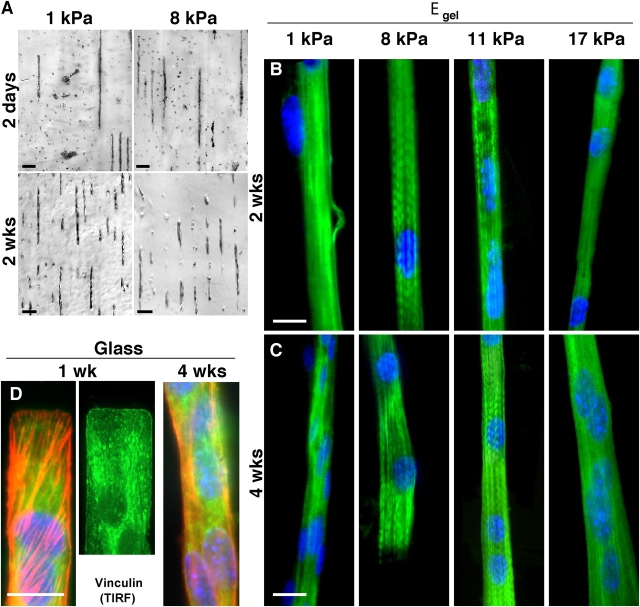
Contractile myocytes provide a test of the hypothesis that cells sense their mechanical as well as molecular microenvironment, altering expression, organization, and/or morphology accordingly. Here, myoblasts were cultured on collagen strips attached to glass or polymer gels of varied elasticity. Subsequent fusion into myotubes occurs independent of substrate flexibility. However, myosin/actin striations emerge later only on gels with stiffness typical of normal muscle (passive Young's modulus, E ∼12 kPa). On glass and much softer or stiffer gels, including gels emulating stiff dystrophic muscle, cells do not striate. In addition, myotubes grown on top of a compliant bottom layer of glass-attached myotubes (but not softer fibroblasts) will striate, whereas the bottom cells will only assemble stress fibers and vinculin-rich adhesions. Unlike sarcomere formation, adhesion strength increases monotonically versus substrate stiffness with strongest adhesion on glass. These findings have major implications for in vivo introduction of stem cells into diseased or damaged striated muscle of altered mechanical composition.
Overview
The claims and statistics of this paper haven’t been checked yet.
Free: it reads the open-access text and checks the first 5 claims that cite a source we can check. Create a free account to check every claim.
Integrity signals
Registry
Cites
Statistics
Figures




Verification
Claims the paper makes
The claims and statistics of this paper haven’t been checked yet.
Free: it reads the open-access text and checks the first 5 claims that cite a source we can check. Create a free account to check every claim.
Claims other papers make about this one
Each is checked against this paper’s own text: does it say what the citing paper says it does?
The source backs part of the claim, not all of it — or backs it for a different population, condition or comparison.
In the citing paper
“Additionally, the stiffness of the cellular environment or niche is an additional mechanical signal that influences for example the differentiation of mesenchymal stem cells into muscle and other cell types (34, 35).”
From The Hippo signal transduction network for exercise physiologists (2016) · cites this paper as [34]
Experimental — accuracy not yet measuredThe cited source says what the claim attributes to it.
In the citing paper
“In studies using biomimetic niches, substrates with an elastic stiffness of young adult skeletal muscle (∼12 kPa Young's modulus, the characteristic elastic rigidity of a material), which is five orders of magnitude softer than traditonal tissue culture plastic), promote MuSC self-renewal29,31 and myoblast differentiation94,95 (Fig. 4).”
From The central role of muscle stem cells in regenerative failure with aging (2015) · cites this paper as [94]
Self-check
Percentages, sums and reported differences re-computed from the paper’s own numbers.
The self-check needs the paper’s full text.
Citations
Cites
Calcium's Role in Mechanotransduction during Muscle Development
Benavides Damm, T., & Egli, M. (2014) · Cellular Physiology and Biochemistry · doi:10.1159/000356667 · Cited by 14,502
Biomechanics. Mechanical Properties of Living Tissues
Fung, Y. C., & Skalak, R. (1982) · Journal of Applied Mechanics · doi:10.1115/1.3162171 · Cited by 6,025
Cell Movement Is Guided by the Rigidity of the Substrate
Lo, C.-M., Wang, H.-B., Dembo, M., & Wang, Y.-L. (2000) · Biophysical Journal · doi:10.1016/s0006-3495(00)76279-5 · Cited by 3,289 · cited 3×
“FAK regulation could also occur by calciumdependent mechanisms (Lo et al., 2000) or stretch-activation (Nakamura et al.”
BackgroundCell locomotion and focal adhesions are regulated by substrate flexibility
Pelham, R. J., & Wang, Y.-L. (1997) · Proceedings of the National Academy of Sciences · doi:10.1073/pnas.94.25.13661 · Cited by 3,027 · cited 7×
“The reason is unclear, but physical aspects of the microenvironment, especially mechanical compliance of matrix (Pelham and Wang, 1997) and perhaps adjacent cells, are becoming increasingly linked to gene expression and protein organization.”
BackgroundInfluentialTaking Cell-Matrix Adhesions to the Third Dimension
Cukierman, E., Pankov, R., Stevens, D. R., & Yamada, K. M. (2001) · Science · doi:10.1126/science.1064829 · Cited by 3,027 · cited 1×
“…adhesion (Choquest et al., 1997; Beningo et al., 2001), posttranslational modification (Pelham and Wang, 1997; Beningo et al., 2001), protein expression (Cukierman et al., 2001), cytoskeletal organization (Cukierman et al., 2001; Engler et al., 2004a), and even cell viability (Wang et al., 2000).”
BackgroundCells lying on a bed of microneedles: An approach to isolate mechanical force
Tan, J. L., Tien, J., Pirone, D. M., Gray, D. S., Bhadriraju, K., & Chen, C. S. (2003) · Proceedings of the National Academy of Sciences · doi:10.1073/pnas.0235407100 · Cited by 1,962 · cited 2×
“The mechanism of coalignment is understood, from theory (Bischofs and Schwartz, 2003), to involve a propagation of cell-induced substrate contractions (Pelham and Wang, 1997; Wang et al., 2001; Tan et al., 2003 ).”
BackgroundSilicone Rubber Substrata: A New Wrinkle in the Study of Cell Locomotion
Harris, A. K., Wild, P., & Stopak, D. (1980) · Science · doi:10.1126/science.6987736 · Cited by 1,348 · cited 1×
“Analogous to the wrinkling of films by cells (Harris et al., 1980; Oliver et al., 1995), cells generate traction forces on collagen-coated polyacrylamide (PA) gel substrates.”
BackgroundExtracellular Matrix Rigidity Causes Strengthening of Integrin–Cytoskeleton Linkages
Choquet, D., Felsenfeld, D. P., & Sheetz, M. P. (1997) · Cell · doi:10.1016/s0092-8674(00)81856-5 · Cited by 1,245 · cited 1×
“Such signals feed back into cell tension (Wang et al., 2002), cell adhesion ( Choquest et al., 1997; Beningo et al., 2001), posttranslational modification (Pelham and Wang, 1997; Beningo et al., 2001), protein expression (Cukierman et al., 2001), cytoskeletal organization (Cukierman et al., 2001; Engler et al., 2004a)…”
BackgroundDetermination of Elastic Moduli of Thin Layers of Soft Material Using the Atomic Force Microscope
Dimitriadis, E. K., Horkay, F., Maresca, J., Kachar, B., & Chadwick, R. S. (2002) · Biophysical Journal · doi:10.1016/s0006-3495(02)75620-8 · Cited by 1,230 · cited 2×
“Mechanics of gels The elastic modulus of various gels was determined by AFM as well as macroscopic methods (Dimitriadis et al., 2002; Engler et al., 2004a).”
MethodSubstrate Compliance versus Ligand Density in Cell on Gel Responses
Engler, A., Bacakova, L., Newman, C., Hategan, A., Griffin, M., & Discher, D. (2004) · Biophysical Journal · doi:10.1016/s0006-3495(04)74140-5 · Cited by 1,141 · cited 16×
“In the absence of stiff ECM resistance, however, assembly and phosphorylation of adhesion proteins are inhibited (Pelham and Wang, 1997), and thus F-actin assembly is reduced (Engler et al., 2004a).”
BackgroundMethodInfluentialSelf-citation
Research works printed but not linked: 1
- 2004, Surf. Sci., In press
Cited by
Items 701–800 of 1,003
Theoretical Concepts and Models of Cellular Mechanosensing
De, R., Zemel, A., & Safran, S. A. (2010) · Methods in cell biology · doi:10.1016/s0091-679x(10)98007-2 · Cited by 54
Chondrogenesis on sulfonate-coated hydrogels is regulated by their mechanical properties
Kwon, H. J., & Yasuda, K. (2012) · Journal of the mechanical behavior of biomedical materials/Journal of mechanical behavior of biomedical materials · doi:10.1016/j.jmbbm.2012.10.006 · Cited by 56
Coaxing stem cells for skeletal muscle repair
McCullagh, K. J. A., & Perlingeiro, R. C. R. (2014) · Advanced Drug Delivery Reviews · doi:10.1016/j.addr.2014.07.007 · Cited by 54
“C2C12 cells were shown to have greatly reduced differentiation on softer (<5kPa) and stiffer (>20KPa) substrate surfaces that the cells were grown on [40].”
BackgroundMethodYu, H., Tay, C. Y., Pal, M., Leong, W. S., Li, H., Li, H., Wen, F., Leong, D. T., & Tan, L. P. (2012) · Advanced Healthcare Materials · doi:10.1002/adhm.201200142 · Cited by 51
Friedrich, B., Buxboim, A., Discher, D., & Safran, S. (2011) · Biophysical Journal · doi:10.1016/j.bpj.2011.04.050 · Cited by 55
“Here, we used a 1⁄4 1 mm for the minisarcomere spacing and Em 1⁄4 10 kPa for the substrate stiffness; for this value, experiments show that myofibrillogenesis is optimal (13).”
BackgroundMethodSelf-citationAnisotropic rigidity sensing on grating topography directs human mesenchymal stem cell elongation
Wong, S. T., Teo, S.-K., Park, S., Chiam, K., & Yim, E. K. F. (2013) · Biomechanics and Modeling in Mechanobiology · doi:10.1007/s10237-013-0483-2 · Cited by 49
“2005), we hypothesized that cell elongation is dependent on the geometrical and mechanical properties of the gratings, namely their aspect ratio and rigidity (Engler et al. 2004; Yeung et al. 2005).”
BackgroundAbhyankar, V. V., Wu, M., Koh, C.-Y., & Hatch, A. V. (2016) · PLOS ONE · doi:10.1371/journal.pone.0156341 · Cited by 46
Luo, B., Tian, L., Chen, N., Ramakrishna, S., Thakor, N. V., & Yang, I. H. (2018) · Biomaterials Science · doi:10.1039/c8bm00720a · Cited by 51
Kirsch, M., Rach, J., Handke, W., Seltsam, A. W., Pepelanova, I., Strauß, S., Vogt, P. M., Scheper, T. H., & Lavrentieva, A. V. (2021) · Frontiers in Bioengineering and Biotechnology · doi:10.3389/fbioe.2020.598389 · Cited by 53
“Indeed, several studies described the effect of the material stiffness from different matrices on the cell behavior of MSCs, embryonic stem cells and fibroblasts (Engler et al., 2004; Solon et al., 2007; Chowdhury et al., 2010; Park et al., 2011; Sun et al., 2018).”
BackgroundCarnicer-Lombarte (2019) · doi:10.1101/829648 · Cited by 46
Guex, A. G., Birrer, D. L., Fortunato, G., Tevaearai, H. T., & Giraud, M. (2013) · Biomedical Materials · doi:10.1088/1748-6041/8/2/021001 · Cited by 46
Hayenga, H. N., Trache, A., Trzeciakowski, J. P., & Humphrey, J. D. (2011) · Journal of Vascular Research · doi:10.1159/000329586 · Cited by 48
“] calculated peak circumferential stress in nonruptured ApoE–/– plaques to be higher than the estimated rupture threshold of humans (minimum 300 kPa, average 545 kPa). Thus, despite having a thin cap and large lipid pool, the lack of rigid inclusions (calcification) was suggested to render these plaques relatively sta…”
BackgroundPolyelectrolyte Multilayer Nanofilms Used as Thin Materials for Cell Mechano‐Sensitivity Studies
Boudou, T., Crouzier, T., Nicolas, C., Ren, K., & Picart, C. (2010) · Macromolecular Bioscience · doi:10.1002/mabi.201000301 · Cited by 52
Hou, L., Coller, J., Natu, V. S., Hastie, T. J., & Huang, N. F. (2016) · Acta Biomaterialia · doi:10.1016/j.actbio.2016.08.003 · Cited by 48
“Although the mechanism by which combinatorial ECMs modulate cell behavior or lead to non-intuitive interactions is largely unknown, the likely contributing factors include including cell shape [51], ECM stiffness [52, 53], mechanical stimuli [54], and activation of integrin-mediated signal transduction pathways [55].”
BackgroundIchikawa, T., Kita, M., Matsui, T. S., Nagasato, A. I., Araki, T., Chiang, S.-H., Sezaki, T., Kimura, Y., Ueda, K., Deguchi, S., et al. (2017) · Journal of Cell Science · doi:10.1242/jcs.200691 · Cited by 44
“Extracellular matrix (ECM) stiffness is a critical determinant of cell fates, such as migration (Pelham and Wang, 1997; Lo et al., 2000; Peyton and Putnam, 2005), proliferation (Wang et al., 2000; Klein et al., 2009) and differentiation (Engler et al., 2004, 2006).”
Electroconductive materials as biomimetic platforms for tissue regeneration
Hosoyama, K., Ahumada, M., Goël, K., Ruel, M., Suuronen, E. J., & Alarcon, E. I. (2019) · Biotechnology Advances · doi:10.1016/j.biotechadv.2019.02.011 · Cited by 48
Matrix stiffness and its influence on pancreatic diseases
Zhang, W., Zhang, S., Zhang, W., Yue, Y., Qian, W., & Wang, Z. (2021) · Biochimica et Biophysica Acta (BBA) - Reviews on Cancer · doi:10.1016/j.bbcan.2021.188583 · Cited by 47
Engelmayr, G. C., & Sacks, M. S. (2007) · Biomechanics and Modeling in Mechanobiology · doi:10.1007/s10237-007-0102-1 · Cited by 46
Endo, Y., Samandari, M., Karvar, M., Mostafavi, A., Quint, J. P., Rinoldi, C., Yazdi, I. K., Święszkowski, W., Mauney, J. R., Agarwal, S., et al. (2023) · Biomaterials · doi:10.1016/j.biomaterials.2023.122058 · Cited by 45
Benitez, P. L., Sweet, J. A., Fink, H., Chennazhi, K. P., Nair, S. V., Enejder, A. M. K., & Heilshorn, S. C. (2012) · Advanced Healthcare Materials · doi:10.1002/adhm.201200115 · Cited by 46
Modulating Extracellular Matrix at Interfaces of Polymeric Materials
Werner, C., Pompe, W., & Salchert, K. (2006) · Advances in polymer science · doi:10.1007/12_089 · Cited by 48
Machillot, P., Quintal, C., Dalonneau, F., Hermant, L., Monnot, P., Matthews, K., Fitzpatrick, V., Liu, J., Pignot‐Paintrand, I., & Picart, C. (2018) · Advanced Materials · doi:10.1002/adma.201801097 · Cited by 44
Substrate Rigidity Deforms and Polarizes Active Gels
Banerjee, S., Marchetti, M. C., Banerjee, S., & Marchetti, M. C. (2011) · Cited by 45
Correlating cell architecture with osteogenesis: first steps towards live single cell monitoring
Rottmar, M., Guimond-Lischer, S., Pleskova, M., Bruinink, A., & Maniura‐Weber, K. (2009) · European Cells and Materials · doi:10.22203/ecm.v018a05 · Cited by 45
“Furthermore, it has been shown that mechanical properties of the surrounding environment influences FA structure and the cell cytoskeleton as well as cell fate (Discher et al., 2005; Engler et al., 2004; Engler et al., 2006; Kong et al., 2005; Pelham and Wang, 1997).”
BackgroundNowatzki, P. J., Franck, C., Maskarinec, S. A., Ravichandran, G., & Tirrell, D. A. (2008) · Macromolecules · doi:10.1021/ma071717a · Cited by 45
Combining mechanical and optical approaches to dissect cellular mechanobiology
Sen, S., & Kumar, S. (2009) · Journal of Biomechanics · doi:10.1016/j.jbiomech.2009.09.008 · Cited by 51
“, 2002) and disease progression (Engler et al., 2004; Lam et al., 2007; Rosenbluth et al., 2006) (Fig.”
BackgroundSelf-citationSimple and versatile methods for the fabrication of arrays of live mammalian cells
Peterbauer, T., Heitz, J., Olbrich, M. R., & Hering, S. (2006) · Lab on a Chip · doi:10.1039/b601803c · Cited by 49
Forsprecher, J., Wang, Z., Goldberg, H. A., & Kaartinen, M. T. (2011) · Cell Adhesion & Migration · doi:10.4161/cam.5.1.13369 · Cited by 45
Critical review of cultivated meat from a Nordic perspective
Rasmussen, M. K., Gold, J., Kaiser, M., Moritz, J., Räty, N. S., Rønning, S. B., Ryynänen, T., Skrivergaard, S., Ström, A., Therkildsen, M., et al. (2024) · Trends in Food Science & Technology · doi:10.1016/j.tifs.2024.104336 · Cited by 50
Hesaraki, S., Nazarian, H., Masouleh, M. P., & Borhan, S. (2013) · Journal of Biomedical Materials Research Part B Applied Biomaterials · doi:10.1002/jbm.b.32987 · Cited by 48
Heras-Bautista, C. O., Katsen‐Globa, A., Schloerer, N., Dieluweit, S., Aziz, O. M. A. E., Peinkofer, G., Attia, W., Khalil, M., Brockmeier, K., Hescheler, J., et al. (2014) · Biomaterials · doi:10.1016/j.biomaterials.2014.05.027 · Cited by 49
“, The influence pluripotent stem cell-derived cardiomyocytes, Biomaterials (2014), http: Cells exhibit their differentiated phenotype on substrates that match the stiffness of their native ECM [26,27], therefore it was hypothesized by Bhana et al.”
BackgroundProtein‐Engineered Biomaterials to Generate Human Skeletal Muscle Mimics
Sengupta, D., Gilbert, P. M., Johnson, K. J., Blau, H. M., & Heilshorn, S. C. (2012) · Advanced Healthcare Materials · doi:10.1002/adhm.201200195 · Cited by 44
Yunoki, S., Ohyabu, Y., & Hatayama, H. (2013) · International Journal of Biomaterials · doi:10.1155/2013/620765 · Cited by 49
“3 kPa) [33], muscle (approximately 10 kPa) [34], and the collagen-based precursor to bone (approximately 30 kPa) [35].”
Tissue engineered meat- Future meat
Bhat, H. F. (2011) · Journal of Parasitology and Vector Biology · doi:10.5897/jsppr.9000047 · Cited by 54
“A best scaffold is one that mimics the in vivo situation as myotubes differentiate optimally on scaffold with a tissuelike stiffness (Engler et al., 2004) and its by-products must be edible and natural and may be derived from nonanimal sources, though inedible scaffold materials cannot be…”
BackgroundGaudière, F., Morin‐Grognet, S., Bidault, L., Lembré, P., Pauthe, E., Vannier, J., Atmani, H., Ladam, G. D., & Labat, B. (2014) · Biomacromolecules · doi:10.1021/bm401866w · Cited by 45
Development of a Virtual Cell Model to Predict Cell Response to Substrate Topography
Heydari, T., Heidari, M., Mashinchian, O., Wojcik, M., Xu, K., Dalby, M. J., Mahmoudi, M., & Ejtehadi, M. R. (2017) · ACS Nano · doi:10.1021/acsnano.7b03732 · Cited by 50
Riedel, S., Hietschold, P., Krömmelbein, C., Kunschmann, T., Konieczny, R., Knolle, W., Mierke, C. T., Zink, M., & Mayr, S. G. (2019) · Materials & Design · doi:10.1016/j.matdes.2019.107606 · Cited by 48
Directional topography gradients drive optimum alignment and differentiation of human myoblasts
Suarez, A. M. A., Zhou, Q., van Rijn, P., & Harmsen, M. C. (2019) · Journal of Tissue Engineering and Regenerative Medicine · doi:10.1002/term.2976 · Cited by 44
“Stiffer substrates increase the proliferation of myogenic progenitor cells (Engler et al., 2004).”
BackgroundMechanically enhanced composite hydrogel scaffold for in situ bone repairs
Zhang, Y., Li, Z., Wang, Z., Yan, B., Shi, A., Xu, J., Guan, J., Zhang, L., Zhou, P., & Mao, Y. (2022) · Biomaterials Advances · doi:10.1016/j.msec.2022.112700 · Cited by 48
Collagen type V modulates fibroblast behavior dependent on substrate stiffness
Breuls, R. G. M., Klumpers, D. D., Everts, V. E., & Smit, T. H. (2009) · Biochemical and Biophysical Research Communications · doi:10.1016/j.bbrc.2009.01.110 · Cited by 45
Characterization of the mechanical properties of microgels acting as cellular microenvironments
Kumachev, A., Tumarkin, E., Walker, G. C., & Kumacheva, E. (2013) · Soft Matter · doi:10.1039/c3sm27400d · Cited by 45
Prestress and Adhesion Site Dynamics Control Cell Sensitivity to Extracellular Stiffness
Féréol, S., Fodil, R., Laurent, V. M., Balland, M., Louis, B., Pelle, G., Hénon, S., Planus, E., & Isabey, D. (2009) · Biophysical Journal · doi:10.1016/j.bpj.2008.10.072 · Cited by 43
“INTRODUCTION Cell sensitivity to Extracellular Environment (ECE) is fundamental for many biological functions such as cell-tissue interactions, cell migration, tissue repair, differentiation (1-4).”
Moyle, L. A., Cheng, R. Y., Liu, H., Davoudi, S., Ferreira, S. A., Nissar, A. A., Sun, Y., Gentleman, E., Simmons, C. A., & Gilbert, P. M. (2020) · Molecular Biology of the Cell · doi:10.1091/mbc.e20-01-0078 · Cited by 47
“To understand whether mechanical stiffness directly affects SC activation and fate, we developed a methodology to embed dissociated muscle fibers in 3D artificial niches using agarose gels of varying concentrations that mimic measurements of bulk apparent moduli acquired by measuring healthy and regenerating native ti…”
BackgroundInfluentialInsight into muscle stem cell regeneration and mechanobiology
Pang, K. T., Loo, L. S. W., Chia, S., Ong, F. Y. T., Yu, H., & Walsh, I. (2023) · Stem Cell Research & Therapy · doi:10.1186/s13287-023-03363-y · Cited by 49
“The stiffness of mouse skeletal muscle and myoblast cell lines (C2C12) was found to be around 12 kPa through atomic force microscopy (AFM) indentation [74, 75].”
BackgroundMechanical Regulation of Cells by Materials and Tissues
Thomas, W. E., Discher, D. E., & Shastri, V. P. (2010) · MRS Bulletin · doi:10.1557/mrs2010.525 · Cited by 45
Self-citationKopecek, M., Bačáková, L., Vacik, J., Fendrych, F., Vorlíček, V., Kratochvílová, I., Lisá, V., Hove, E. V., Mer, C., Bergonzo, P., et al. (2008) · physica status solidi (a) · doi:10.1002/pssa.200879729 · Cited by 43
Injectable biomaterials: a perspective on the next wave of injectable therapeutics
Spector, M., & Lim, T. C. (2016) · Biomedical Materials · doi:10.1088/1748-6041/11/1/014110 · Cited by 43
Xu, X., Li, Z., Cai, L., Calve, S., & Neu, C. P. (2016) · Scientific Reports · doi:10.1038/srep24272 · Cited by 42
Penton, C. M., Badarinarayana, V., Prisco, J., Powers, E. A., Pincus, M. J., Allen, R. E., & August, P. R. (2016) · Skeletal Muscle · doi:10.1186/s13395-016-0116-4 · Cited by 51
Cultured Meat: Meat Industry Hand in Hand with Biomedical Production Methods
Zidarič, T., Milojević, M., Vajda, J., Vihar, B., & Maver, U. (2020) · Food Engineering Reviews · doi:10.1007/s12393-020-09253-w · Cited by 49
Alheib, O., da Silva, L. P., Caballero, D., Pires, R. A., Kundu, S. C., Correlo, V. M., & Reis, R. L. (2021) · Biomaterials · doi:10.1016/j.biomaterials.2021.121217 · Cited by 45
Development of a novel smart scaffold for human skeletal muscle regeneration
Shah, R., Knowles, J. C., Hunt, N. P., & Lewis, M. P. (2013) · Journal of Tissue Engineering and Regenerative Medicine · doi:10.1002/term.1780 · Cited by 43
Substrate rigidity deforms and polarizes active gels
Banerjee, S., & Marchetti, M. C. (2011) · Europhysics Letters (EPL) · doi:10.1209/0295-5075/96/28003 · Cited by 43
Improved Mechanical Properties of Zwitterionic Hydrogels with Hydroxyl Groups
He, Y., Tsao, H., & Jiang, S. (2012) · The Journal of Physical Chemistry B · doi:10.1021/jp300205m · Cited by 42
ZnO nanowire arrays as substrates for cell proliferation and differentiation
Ciofani, G., Genchi, G. G., & Mattoli, V. (2011) · Materials Science and Engineering C · doi:10.1016/j.msec.2011.11.001 · Cited by 44
Shroff, K., Rexeisen, E. L., Arunagirinathan, M. A., & Kokkoli, E. (2010) · Soft Matter · doi:10.1039/c0sm00321b · Cited by 47
Biophysical Stimulation for Engineering Functional Skeletal Muscle
Somers, S. M., Spector, A. A., DiGirolamo, D. J., & Grayson, W. L. (2017) · Tissue Engineering Part B Reviews · doi:10.1089/ten.teb.2016.0444 · Cited by 42
Chaudhuri, T., Rehfeldt, F., Sweeney, H. L., & Discher, D. E. (2010) · Methods in molecular biology · doi:10.1007/978-1-60761-063-2_13 · Cited by 42
“Potent mechanotransductive components couple some wellknown signaling processes into anchorage-dependent viability and additional processes such as differentiation (2, 8) as is emphasized here with adult bone-marrow-derived mesenchymal stem cells (MSCs).”
Self-citationEngineering Muscle Tissues on Microstructured Polyelectrolyte Multilayer Films
Monge, C., Ren, K., Berton, K., Guillot, R., Peyrade, D., & Picart, C. (2012) · Tissue Engineering Part A · doi:10.1089/ten.tea.2012.0079 · Cited by 42
“For instance, fibronectin was deposited by microcontact printing on TCPS,(12) or parallel lanes of ECM proteins were formed on a polyacrylamide hydrogel.(31,35) This allowed the formation of collectively aligned myotubes.”
Microfabricated three-dimensional environments for single cell studies
Dusseiller, M. R., Smith, M. L., Vogel, V., & Textor, M. (2006) · Biointerphases · doi:10.1116/1.2190698 · Cited by 46
Wagermaier, W., & Fratzl, P. (2012) · Elsevier eBooks · doi:10.1016/b978-0-444-53349-4.00247-8 · Cited by 49
Probing local nonlinear viscoelastic properties in soft materials
Chockalingam, S., Roth, C., Henzel, T., & Cohen, T. (2020) · Journal of the Mechanics and Physics of Solids · doi:10.1016/j.jmps.2020.104172 · Cited by 41
“Mechanical characterisation of soft and biological materials is important in several applications including tissue engineering (Engler et al., 2004; Kong et al., 2005; Vedadghavami et al., 2017), food science (Finney, 1967; Solomon and Jindal, 2007), disease detection (Yeh et al.”
BackgroundHopkins, T. I. R., Bemmer, V. L., Franks, S., Dunlop, C. M., Hardy, K., & Dunlop, I. E. (2021) · Biomaterials · doi:10.1016/j.biomaterials.2021.121099 · Cited by 49
Unlocking the therapeutic potential of cellular mechanobiology
Kalukula, Y., Ciccone, G., Mohammed, D., Procès, A., Versaevel, M., Deridoux, A., Ergot, L., Barbier, Z., Mansy, M., Aucouturier, R., et al. (2025) · Science Advances · doi:10.1126/sciadv.aea6817 · Cited by 57
“For example, brain tissues and healthy liver are very soft and exhibit elastic moduli in the range of a few hundred pascals, while muscle tissues are stiffer with an elastic modulus around 12 kPa ( 9 ).”
Spatial coordination of cell orientation directed by nanoribbon sheets
Fujie, T., Shi, X., Ostrovidov, S., Liang, X., Nakajima, K., Chen, Y., Wu, H., & Khademhosseini, A. (2015) · Biomaterials · doi:10.1016/j.biomaterials.2015.02.028 · Cited by 41
Skeletal Muscle Atrophy in Bioengineered Skeletal Muscle: A New Model System
Lee, P. H. U., & Vandenburgh, H. H. (2013) · Tissue Engineering Part A · doi:10.1089/ten.tea.2012.0597 · Cited by 41
“41 Also of note, the BAMs were not under tension when fixed before the immunocytochemical analysis of CSA.”
Evrova, O., Hosseini, V., Milleret, V., Palazzolo, G., Zenobi‐Wong, M., Sulser, T., Buschmann, J., & Eberli, D. (2016) · ACS Applied Materials & Interfaces · doi:10.1021/acsami.6b11291 · Cited by 41
MyoScreen, a High-Throughput Phenotypic Screening Platform Enabling Muscle Drug Discovery
Young, J., Margaron, Y., Fernandes, M., Duchemin-Pelletier, E., Michaud, J., Flaender, M., Lorintiu, O., Degot, S., & Poydenot, P. (2018) · SLAS DISCOVERY · doi:10.1177/2472555218761102 · Cited by 41
Optimizing C2C12 myoblast differentiation using polycaprolactone–polypyrrole copolymer scaffolds
Browe, D. P., & Freeman, J. W. (2018) · Journal of Biomedical Materials Research Part A · doi:10.1002/jbm.a.36556 · Cited by 41
Jiwlawat, N., Lynch, E. M., Napiwocki, B. N., Stempien, A., Ashton, R. S., Kamp, T. J., Crone, W. C., & Suzuki, M. (2019) · Biotechnology and Bioengineering · doi:10.1002/bit.27075 · Cited by 43
Qiu, W., Wang, Q., Li, M., Li, N., Wang, X., Yu, J., Li, F., & Wu, D. (2022) · Composites Part B Engineering · doi:10.1016/j.compositesb.2022.109688 · Cited by 41
Mechanical cues in orofacial tissue engineering and regenerative medicine
Brouwer, K. M., Lundvig, D. M. S., Middelkoop, E., Wagener, F. A. D. T. G., & den Hoff, J. W. V. (2015) · Wound Repair and Regeneration · doi:10.1111/wrr.12283 · Cited by 40
“Muscle cell differentiation is also enhanced by mechanical stimulation.(39,46,47) In contrast to these findings, cyclic mechanical strain can also reduce the differentiation of C2C12 mouse myoblasts, adult bovine myoblasts, and murine muscle progenitor cells.”
ResultSong, S., Kim, E. J., Bahney, C. S., Miclau, T., Marcucio, R., & Roy, S. (2015) · Acta Biomaterialia · doi:10.1016/j.actbio.2015.02.021 · Cited by 44
Bio-inspired materials for parsing matrix physicochemical control of cell migration: A Review
Kim, H., & Peyton, S. R. (2011) · Integrative Biology · doi:10.1039/c1ib00069a · Cited by 43
“vitro are known to influence endothelial cell behavior (for review, see [82]), stem cell lineage commitment [83], both smooth and skeletal muscle cell plasticity [84-86],”
BackgroundEffect of Poisson Ratio on Cellular Structure Formation
Bischofs, I. B., & Schwarz, U. S. (2005) · Physical Review Letters · doi:10.1103/physrevlett.95.068102 · Cited by 40
Polymeric Electrospinning for Musculoskeletal Regenerative Engineering
Narayanan, N., Jiang, C., Uzunallı, G., Thankappan, S. K., Laurencin, C. T., & Deng, M. (2016) · Regenerative Engineering and Translational Medicine · doi:10.1007/s40883-016-0013-8 · Cited by 44
“Mouse extensor digitorum longus (EDL) muscle Atomic force microscopy indentation 10–20 kPa [9]”
BackgroundEngineering of Human Skeletal Muscle With an Autologous Deposited Extracellular Matrix
Thorrez, L., DiSano, K., Shansky, J., & Vandenburgh, H. H. (2018) · Frontiers in Physiology · doi:10.3389/fphys.2018.01076 · Cited by 40
“Results varied from a Young’s modulus of an extensor digitorum longus muscle of 12 ± 4 kPa (Engler et al., 2004) to 61 ± 5 kPa for single fibers of the flexor digitorum brevis muscle (Defranchi et al.”
MethodInfluentialSalgarella, A. R., Cafarelli, A., Ricotti, L., Capineri, L., Dario, P., & Menciassi, A. (2017) · Ultrasound in Medicine & Biology · doi:10.1016/j.ultrasmedbio.2017.03.003 · Cited by 43
Schuster, E., Wallin, P., Klose, F. P. S., Gold, J., & Ström, A. (2017) · Food Hydrocolloids · doi:10.1016/j.foodhyd.2017.05.036 · Cited by 40
Materials for Neural Differentiation, Trans‐Differentiation, and Modeling of Neurological Disease
Gong, L., Cao, L., Shen, Z., Shao, L., Gao, S., Zhang, C., Lü, J., & Li, W. (2018) · Advanced Materials · doi:10.1002/adma.201705684 · Cited by 41
Decellularized extracellular matrix hydrogels—cell behavior as a function of matrix stiffness
Sasikumar, S., Chameettachal, S., Cromer, B., Pati, F., & Kingshott, P. (2019) · Current Opinion in Biomedical Engineering · doi:10.1016/j.cobme.2019.05.002 · Cited by 40
Somers, S. M., Zhang, N. Y., Morrissette-McAlmon, J. B. F., Tran, K., Mao, H., & Grayson, W. L. (2019) · Acta Biomaterialia · doi:10.1016/j.actbio.2019.06.024 · Cited by 42
A subtle relationship between substrate stiffness and collective migration of cell clusters
Balcioglu, H. E., Balasubramaniam, L., Stirbat, T. V., Doss, B. L., Fardin, M.-A., Mège, R., & Ladoux, B. (2020) · Soft Matter · doi:10.1039/c9sm01893j · Cited by 48
Undyala, V. V. R., Dembo, M., Cembrola, K., Perrin, B. J., Anna Huttenlocher, A., Elce, J. S., Greer, P. A., Wang, Y., & Beningo, K. A. (2008) · Journal of Cell Science · doi:10.1242/jcs.036152 · Cited by 40
“Various types of cell have been shown to respond to mechanical stimuli (Lo et al., 2000; Flanagan et al., 2002; Engler et al., 2004; Sieminski et al., 2004).”
BackgroundThrown for a loop: fibro-adipogenic progenitors in skeletal muscle fibrosis
Loomis, T., & Smith, L. (2023) · American Journal of Physiology-Cell Physiology · doi:10.1152/ajpcell.00245.2023 · Cited by 49
Skillin, N. P., Kirkpatrick, B. E., Herbert, K. M., Nelson, B. R., Hach, G. K., Günay, K. A., Khan, R. M., DelRio, F. W., White, T. J., & Anseth, K. S. (2024) · Science Advances · doi:10.1126/sciadv.adn0235 · Cited by 40
“It is important to highlight that the overall moduli (MPa to GPa) of the materials studied here, as well as their large (MPa) orthogonal differences in moduli, are orders of magnitude greater than that of most soft tissues, including muscle ( 54 ).”
Xu, F., Jin, H., Liu, L., Yang, Y., Cen, J., Wu, Y., Chen, S., & Sun, D. (2024) · Microsystems & Nanoengineering · doi:10.1038/s41378-024-00692-7 · Cited by 45
Feng, Z., Wagatsuma, Y., Kikuchi, M., KOSAWADA, T., Nakamura, T., Sato, D., Shirasawa, N., Kitajima, T., & Umezu, M. (2014) · Biomaterials · doi:10.1016/j.biomaterials.2014.05.072 · Cited by 39
Cheng, C., LeDuc, P. R., & Lin, Y. (2011) · Journal of Biomechanics · doi:10.1016/j.jbiomech.2010.12.006 · Cited by 39
Role for Mechanotransduction in Macrophage and Dendritic Cell Immunobiology
Mennens, S. F. B., van den Dries, K., & Cambi, A. (2017) · Results and problems in cell differentiation · doi:10.1007/978-3-319-54090-0_9 · Cited by 43
Morphological and mechanical stability of bladder cancer cells in response to substrate rigidity
Lekka, M., Pabijan, J., & Orzechowska, B. (2019) · Biochimica et Biophysica Acta (BBA) - General Subjects · doi:10.1016/j.bbagen.2019.03.010 · Cited by 38
Wang, Y., Wei, X., Wang, L., Qian, Z., Liu, H., & Fan, Y. (2022) · Composites Part B Engineering · doi:10.1016/j.compositesb.2022.110311 · Cited by 41
Concise Review: Stem Cell Therapy for Muscular Dystrophies
Wilschut, K. J., Ling, V. B., & Bernstein, H. S. (2012) · Stem Cells Translational Medicine · doi:10.5966/sctm.2012-0071 · Cited by 41
Soleas, J. P., Paz, A., Marcus, P., McGuigan, A. P., & Waddell, T. K. (2012) · BioMed Research International · doi:10.1155/2012/982971 · Cited by 43
Angelini, T. E., Dunn, A. C., Urueña, J. M., Dickrell, D. J., Burris, D. L., & Sawyer, W. G. (2012) · Faraday Discussions · doi:10.1039/c2fd00130f · Cited by 42
Myoblast mechanotransduction and myotube morphology is dependent on BAG3 regulation of YAP and TAZ
Günay, K. A., Silver, J. S., Chang, T.-L., Bednarski, O. J., Bannister, K. L., Rogowski, C. J., Olwin, B. B., & Anseth, K. S. (2021) · Biomaterials · doi:10.1016/j.biomaterials.2021.121097 · Cited by 46
The Role of Fibroblasts in Self-Assembled Skeletal Muscle
Li, M., Dickinson, C. E., Finkelstein, E. B., Neville, C. M., & Sundback, C. A. (2011) · Tissue Engineering Part A · doi:10.1089/ten.tea.2010.0700 · Cited by 44
“Sarcomeric maturation was likely enhanced by contact with surrounding myotubes 32 and by the mechanical stimulation of spontaneous coordinated contraction.”
Functional polyaniline nanofibre mats for human adipose-derived stem cell proliferation and adhesion
Rahman, N. A., Feisst, V., Dickinson, M., Malmström, J., Dunbar, P. R., & Travaš‐Sejdić, J. (2012) · Materials Chemistry and Physics · doi:10.1016/j.matchemphys.2012.11.065 · Cited by 38
Genchi, G. G., Ciofani, G., Liakos, I., Ricotti, L., Ceseracciu, L., Athanassiou, A., Mazzolai, B., Menciassi, A., & Mattoli, V. (2013) · Colloids and Surfaces B Biointerfaces · doi:10.1016/j.colsurfb.2012.12.035 · Cited by 38
Mechanical Cues Direct Focal Adhesion Dynamics
Haase, K., Al‐Rekabi, Z., & Pelling, A. E. (2014) · Progress in molecular biology and translational science · doi:10.1016/b978-0-12-394624-9.00005-1 · Cited by 43
Metadata
- Authors
- Engler, A. J., Griffin, M. A., Sen, S., Bönnemann, C. G., Sweeney, H. L., & Discher, D. E.
- Affiliations
- University of Pennsylvania (US)
- 2Pennsylvania Muscle Institute, University of Pennsylvania, Philadelphia, PA 19104
- Venue
- The Journal of Cell Biology
- Publisher
- Rockefeller University Press
- Published
- 2004-09-13
- Volume
- 166
- Issue
- 6
- Pages
- 877-887
- ISSN
- 0021-9525 (ISSN-L)
- 1540-8140
- PMC
- PMC2172122
- OpenAlex
- W2167243609
- Cited by
- 1,743
- References
- 57
- Citations by year
- 2026: 47 · 2025: 54 · 2024: 63 · 2023: 49 · 2022: 71 · 2021: 84 · 2020: 87 · 2019: 77 · 2018: 86 · 2017: 119 · 2016: 90 · 2015: 88 · 2014: 92 · 2013: 115 · 2012: 128
- FWCI
- 14.63
- Type
- journal article
- Language
- en
- Open access
- green
- www.ncbi.nlm.nih.gov
- Licence
- cc-by-nc-sa
- Locations
- The Journal of Cell Biology (publishedVersion)
- PubMed Central (publishedVersion, cc-by-nc-sa)
- PubMed (publishedVersion)
- ScholarlyCommons (University of Pennsylvania) (submittedVersion)
- eScholarship (California Digital Library) (submittedVersion)
- Topics
- Life Sciences › Biochemistry, Genetics and Molecular Biology › Cell Biology › Cellular Mechanics and Interactions
- Life Sciences › Biochemistry, Genetics and Molecular Biology › Molecular Biology › Muscle Physiology and Disorders
- Health Sciences › Medicine › Surgery › Tissue Engineering and Regenerative Medicine
- Keywords
- myotube differentiation, substrate stiffness, mechanotransduction, myoblast fusion, sarcomere formation, cell adhesion, stress fibers, vinculin, dystrophic muscle, collagen substrate, polymer gels, stem cell transplantation, muscle regeneration
- MeSH terms
- Polyacrylamides, Acrylic Resins, Animals, Cell Adhesion, Cell Differentiation, Cell Line, Cells, Cultured, Elasticity, Fibroblasts, Gels, Mice, Inbred C3H, Mice, Mutant Strains, Models, Biological, Substrate Specificity, Muscle, Skeletal, Muscle Fibers, Skeletal, Microscopy, Atomic Force, Fluorescent Antibody Technique, Direct, Mice
About these checks
Registry, retraction, Cites and statistics results are computed, not judged, with one exception: a printed reference that no index lists is read once by a model before it counts as a citation error. Claims are extracted by a model and kept only when their quote appears verbatim in the text; each cited source is then checked, with a model’s help, for whether it says what the claim relies on. Those verdicts can be wrong — read the claim’s quote and the cited source before relying on one.
Statistics and arithmetic are recomputed, not judged.
Confidence bands are shown only for fields calibrated on our annotated test set. None is calibrated yet, so no band is shown.
What counts as a claim ›How we measure confidence ›How we check this ›
Are you an author, or do you see a problem with this page? Request a review
Data sources
Bibliographic data: Semantic Scholar, OpenAlex, Crossref.
Contains information from the Semantic Scholar Academic Graph Datasets, made available under the ODC Attribution License (ODC-BY 1.0).
Semantic Scholar’s data is described in: Kinney, R., et al. (2023). The Semantic Scholar Open Data Platform. arXiv:2301.10140.
