

Myotubes differentiate optimally on substrates with tissue-like stiffness
Open accessThe DOI matches its Crossref record; 58 of the 58 references it cites were found in a registry or an index.
Abstract
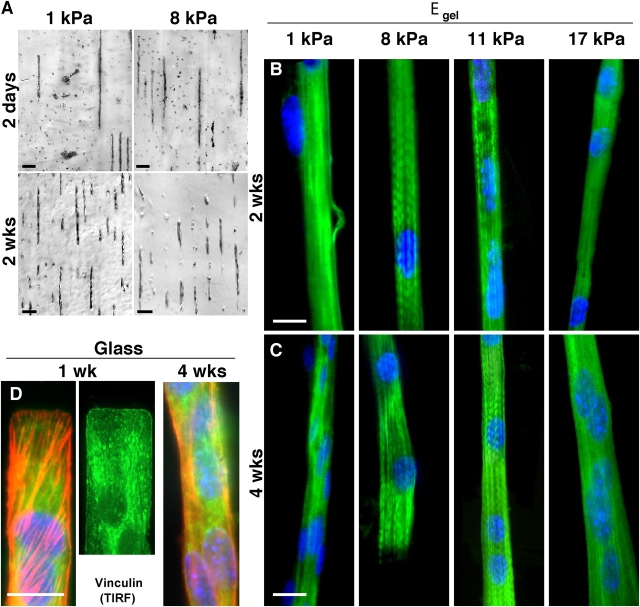
Contractile myocytes provide a test of the hypothesis that cells sense their mechanical as well as molecular microenvironment, altering expression, organization, and/or morphology accordingly. Here, myoblasts were cultured on collagen strips attached to glass or polymer gels of varied elasticity. Subsequent fusion into myotubes occurs independent of substrate flexibility. However, myosin/actin striations emerge later only on gels with stiffness typical of normal muscle (passive Young's modulus, E ∼12 kPa). On glass and much softer or stiffer gels, including gels emulating stiff dystrophic muscle, cells do not striate. In addition, myotubes grown on top of a compliant bottom layer of glass-attached myotubes (but not softer fibroblasts) will striate, whereas the bottom cells will only assemble stress fibers and vinculin-rich adhesions. Unlike sarcomere formation, adhesion strength increases monotonically versus substrate stiffness with strongest adhesion on glass. These findings have major implications for in vivo introduction of stem cells into diseased or damaged striated muscle of altered mechanical composition.
Overview
The claims and statistics of this paper haven’t been checked yet.
Free: it reads the open-access text and checks the first 5 claims that cite a source we can check. Create a free account to check every claim.
Integrity signals
Registry
Cites
Statistics
Figures




Verification
Claims the paper makes
The claims and statistics of this paper haven’t been checked yet.
Free: it reads the open-access text and checks the first 5 claims that cite a source we can check. Create a free account to check every claim.
Claims other papers make about this one
Each is checked against this paper’s own text: does it say what the citing paper says it does?
The source backs part of the claim, not all of it — or backs it for a different population, condition or comparison.
In the citing paper
“Additionally, the stiffness of the cellular environment or niche is an additional mechanical signal that influences for example the differentiation of mesenchymal stem cells into muscle and other cell types (34, 35).”
From The Hippo signal transduction network for exercise physiologists (2016) · cites this paper as [34]
Experimental — accuracy not yet measuredThe cited source says what the claim attributes to it.
In the citing paper
“In studies using biomimetic niches, substrates with an elastic stiffness of young adult skeletal muscle (∼12 kPa Young's modulus, the characteristic elastic rigidity of a material), which is five orders of magnitude softer than traditonal tissue culture plastic), promote MuSC self-renewal29,31 and myoblast differentiation94,95 (Fig. 4).”
From The central role of muscle stem cells in regenerative failure with aging (2015) · cites this paper as [94]
Self-check
Percentages, sums and reported differences re-computed from the paper’s own numbers.
The self-check needs the paper’s full text.
Citations
Cites
Calcium's Role in Mechanotransduction during Muscle Development
Benavides Damm, T., & Egli, M. (2014) · Cellular Physiology and Biochemistry · doi:10.1159/000356667 · Cited by 14,502
Biomechanics. Mechanical Properties of Living Tissues
Fung, Y. C., & Skalak, R. (1982) · Journal of Applied Mechanics · doi:10.1115/1.3162171 · Cited by 6,025
Cell Movement Is Guided by the Rigidity of the Substrate
Lo, C.-M., Wang, H.-B., Dembo, M., & Wang, Y.-L. (2000) · Biophysical Journal · doi:10.1016/s0006-3495(00)76279-5 · Cited by 3,289 · cited 3×
“FAK regulation could also occur by calciumdependent mechanisms (Lo et al., 2000) or stretch-activation (Nakamura et al.”
BackgroundCell locomotion and focal adhesions are regulated by substrate flexibility
Pelham, R. J., & Wang, Y.-L. (1997) · Proceedings of the National Academy of Sciences · doi:10.1073/pnas.94.25.13661 · Cited by 3,027 · cited 7×
“The reason is unclear, but physical aspects of the microenvironment, especially mechanical compliance of matrix (Pelham and Wang, 1997) and perhaps adjacent cells, are becoming increasingly linked to gene expression and protein organization.”
BackgroundInfluentialTaking Cell-Matrix Adhesions to the Third Dimension
Cukierman, E., Pankov, R., Stevens, D. R., & Yamada, K. M. (2001) · Science · doi:10.1126/science.1064829 · Cited by 3,027 · cited 1×
“…adhesion (Choquest et al., 1997; Beningo et al., 2001), posttranslational modification (Pelham and Wang, 1997; Beningo et al., 2001), protein expression (Cukierman et al., 2001), cytoskeletal organization (Cukierman et al., 2001; Engler et al., 2004a), and even cell viability (Wang et al., 2000).”
BackgroundCells lying on a bed of microneedles: An approach to isolate mechanical force
Tan, J. L., Tien, J., Pirone, D. M., Gray, D. S., Bhadriraju, K., & Chen, C. S. (2003) · Proceedings of the National Academy of Sciences · doi:10.1073/pnas.0235407100 · Cited by 1,962 · cited 2×
“The mechanism of coalignment is understood, from theory (Bischofs and Schwartz, 2003), to involve a propagation of cell-induced substrate contractions (Pelham and Wang, 1997; Wang et al., 2001; Tan et al., 2003 ).”
BackgroundSilicone Rubber Substrata: A New Wrinkle in the Study of Cell Locomotion
Harris, A. K., Wild, P., & Stopak, D. (1980) · Science · doi:10.1126/science.6987736 · Cited by 1,348 · cited 1×
“Analogous to the wrinkling of films by cells (Harris et al., 1980; Oliver et al., 1995), cells generate traction forces on collagen-coated polyacrylamide (PA) gel substrates.”
BackgroundExtracellular Matrix Rigidity Causes Strengthening of Integrin–Cytoskeleton Linkages
Choquet, D., Felsenfeld, D. P., & Sheetz, M. P. (1997) · Cell · doi:10.1016/s0092-8674(00)81856-5 · Cited by 1,245 · cited 1×
“Such signals feed back into cell tension (Wang et al., 2002), cell adhesion ( Choquest et al., 1997; Beningo et al., 2001), posttranslational modification (Pelham and Wang, 1997; Beningo et al., 2001), protein expression (Cukierman et al., 2001), cytoskeletal organization (Cukierman et al., 2001; Engler et al., 2004a)…”
BackgroundDetermination of Elastic Moduli of Thin Layers of Soft Material Using the Atomic Force Microscope
Dimitriadis, E. K., Horkay, F., Maresca, J., Kachar, B., & Chadwick, R. S. (2002) · Biophysical Journal · doi:10.1016/s0006-3495(02)75620-8 · Cited by 1,230 · cited 2×
“Mechanics of gels The elastic modulus of various gels was determined by AFM as well as macroscopic methods (Dimitriadis et al., 2002; Engler et al., 2004a).”
MethodSubstrate Compliance versus Ligand Density in Cell on Gel Responses
Engler, A., Bacakova, L., Newman, C., Hategan, A., Griffin, M., & Discher, D. (2004) · Biophysical Journal · doi:10.1016/s0006-3495(04)74140-5 · Cited by 1,141 · cited 16×
“In the absence of stiff ECM resistance, however, assembly and phosphorylation of adhesion proteins are inhibited (Pelham and Wang, 1997), and thus F-actin assembly is reduced (Engler et al., 2004a).”
BackgroundMethodInfluentialSelf-citation
Research works printed but not linked: 1
- 2004, Surf. Sci., In press
Cited by
Items 601–700 of 1,003
Ricotti, L., Taccola, S., Pensabene, V., Mattoli, V., Fujie, T., Takeoka, S., Menciassi, A., & Dario, P. (2010) · Biomedical Microdevices · doi:10.1007/s10544-010-9435-0 · Cited by 58
Biomaterials and their potential applications for dental tissue engineering
Galler, K. M., D’Souza, R. N., & Hartgerink, J. D. (2010) · Journal of Materials Chemistry · doi:10.1039/c0jm01207f · Cited by 64
Regulation of Matrix Assembly through Rigidity-dependent Fibronectin Conformational Changes
Carraher, C. L., & Schwarzbauer, J. E. (2013) · Journal of Biological Chemistry · doi:10.1074/jbc.m112.435271 · Cited by 58
Physiology and metabolism of tissue-engineered skeletal muscle
Cheng, C. S., Davis, B. N. J., Madden, L. R., Bursac, N., & Truskey, G. A. (2014) · Experimental Biology and Medicine · doi:10.1177/1535370214538589 · Cited by 69
Yao, J., Ko, C. W., Baranov, P. Y., Regatieri, C. V., Redenti, S., Tucker, B. A., Mighty, J., Tao, S. L., & Young, M. J. (2014) · Tissue Engineering Part A · doi:10.1089/ten.tea.2013.0720 · Cited by 59
Narayanan, N., Jia, Z., Kim, K. H., Kuang, L., Lengemann, P., Shafer, G., Bernal-Crespo, V., Kuang, S., & Deng, M. (2020) · Bioactive Materials · doi:10.1016/j.bioactmat.2020.10.012 · Cited by 76
“For example, prior studies reported that healthy resting skeletal muscle has an average elastic modulus of 12 ± 4 kPa and optimal myoblast differentiation occurs in tissue-like stiffness [23].”
Dysart, M. M., Galvis, B. R., Russell, A. G., & Barker, T. H. (2014) · PLoS ONE · doi:10.1371/journal.pone.0106821 · Cited by 57
“Previous work has shown that matrix rigidity plays a critical role in directing many aspects of cellular behavior including stem cell, myoblast, and breast epithelial cell differentiation; cellular motility; contraction and focal adhesion formation, and it has also been shown to contribute or prevent a malignant pheno…”
BackgroundPuckert, C., Tomaskovic‐Crook, E., Gambhir, S., Wallace, G. G., Crook, J. M., & Higgins, M. J. (2020) · Acta Biomaterialia · doi:10.1016/j.actbio.2020.02.023 · Cited by 57
Madl, C. M., Flaig, I. A., Holbrook, C. A., Wang, Y. X., & Blau, H. M. (2021) · Biomaterials · doi:10.1016/j.biomaterials.2021.120973 · Cited by 59
You, Y., Zheng, Q., Dong, Y., Wang, Y., Zhang, L., Xue, T., Xie, X., Hu, C., Wang, Z., Chen, R., et al. (2015) · PLOS ONE · doi:10.1371/journal.pone.0134243 · Cited by 57
Gene-mediated Restoration of Normal Myofiber Elasticity in Dystrophic Muscles
Puttini, S., Lekka, M., Dorchies, O. M., Saugy, D., Incitti, T., Rüegg, U. T., Bozzoni, I., Kulik, A., & Mermod, N. (2008) · Molecular Therapy · doi:10.1038/mt.2008.239 · Cited by 61
Chen, W. L. K., & Simmons, C. A. (2011) · Advanced Drug Delivery Reviews · doi:10.1016/j.addr.2011.01.004 · Cited by 66
“Similarly, myotubes mature and striate preferentially on skeletal muscle-like stiffness (12 kPa) [10].”
BackgroundScalable alignment of three-dimensional cellular constructs in a microfluidic chip
Anene-Nzelu, C. G., Peh, K. Y., Fraiszudeen, A., Kuan, Y. H., Ng, S. H., Toh, Y. C., Leo, H. L., & Yu, H. (2013) · Lab on a Chip · doi:10.1039/c3lc50730k · Cited by 57
Oda, H., Konno, T., & Ishihara, K. (2013) · Biomaterials · doi:10.1016/j.biomaterials.2013.04.015 · Cited by 59
Hörning, M., Nakahata, M., Linke, P., Yamamoto, A., Veschgini, M., Kaufmann, S., Takashima, Y., Harada, A., & Tanaka, M. (2017) · Scientific Reports · doi:10.1038/s41598-017-07934-x · Cited by 58
Dual-Crosslinked Alginate-Based Hydrogels with Tunable Mechanical Properties for Cultured Meat
Tahir, I., & Floreani, R. A. (2022) · Foods · doi:10.3390/foods11182829 · Cited by 63
Dolgin, J., Hanumantharao, S. N., Farias, S. L., Simon, C. G., & Rao, S. (2023) · Fibers · doi:10.3390/fib11050039 · Cited by 63
“The subsequent proliferation, elongation, alignment and myofibrillogenesis of myoblasts [169] occurs in an even smaller range of microenvironmental stiffness of 11–15 kPa, with the striation of cells decreasing significantly outside this range [170].”
BackgroundActivation of Notch Signaling During Ex Vivo Expansion Maintains Donor Muscle Cell Engraftment
Parker, M. H., Loretz, C. J., Tyler, A. E., Duddy, W. J., Hall, J. K., Olwin, B. B., Bernstein, I. D., Storb, R. F., & Tapscott, S. J. (2012) · Stem Cells · doi:10.1002/stem.1181 · Cited by 59
Acto-myosin based response to stiffness and rigidity sensing
Fouchard, J., Mitrossilis, D., & Asnacios, A. (2011) · Cell Adhesion & Migration · doi:10.4161/cam.5.1.13281 · Cited by 61
“1-3 In particular, rigidity (the ability of a material to resist deformation) influences many cellular processes such as spreading,(4,5) migration(6) or even differentiation.(7,8) The challenge is thus to understand how cells sense rigidity and respond to it.”
BackgroundBlacklock, J., Vetter, A., Lankenau, A., Oupický, D., & Möhwald, H. (2010) · Biomaterials · doi:10.1016/j.biomaterials.2010.06.002 · Cited by 57
“It is known that alterations to the mechanical properties of films can promote cellular responses affecting cell-surface interactions along with cell growth and viability [3–7].”
BackgroundSmith, A. S. T., Davis, J., Lee, G., Mack, D. L., & Kim, D. (2016) · Drug Discovery Today · doi:10.1016/j.drudis.2016.04.013 · Cited by 59
The Importance of Biophysical and Biochemical Stimuli in Dynamic Skeletal Muscle Models
Maleiner, B., Tomasch, J., Heher, P., Spadiut, O., Rünzler, D., & Fuchs, C. (2018) · Frontiers in Physiology · doi:10.3389/fphys.2018.01130 · Cited by 63
“Thus, many research groups are now focusing on in vitro SMTE, providing new remarkable data for this field, some of which will be discussed in more detail in the subsequent sections (Engler et al., 2004; Huang et al., 2004; Matsumoto et al., 2007; Lam et al., 2009; van der Schaft et al., 2013; Kurth et al., 2015; Bers…”
BackgroundControlling Hydrogel Properties by Crystallization of Hydrophobic Domains
Sanabria-DeLong, N., Agrawal, S. K., Bhatia, S. R., & Tew, G. N. (2006) · Macromolecules · doi:10.1021/ma052243n · Cited by 56
Schätzlein, E., & Blaeser, A. (2022) · Communications Biology · doi:10.1038/s42003-022-03593-5 · Cited by 62
Biofunctional hydrogels for skeletal muscle constructs
Salimath, A. S., & Garcı́a, A. J. (2014) · Journal of Tissue Engineering and Regenerative Medicine · doi:10.1002/term.1881 · Cited by 56
“It has been shown that matrix elasticity provides biophysical cues that impact skeletal muscle stem cell behaviour, such as viability and lineage commitment (Engler et al., 2004; Raab et al., 2010).”
BackgroundNanomechanics of Cells and Biomaterials Studied by Atomic Force Microscopy
Kilpatrick, J. I., Revenko, I., & Rodriguez, B. J. (2015) · Advanced Healthcare Materials · doi:10.1002/adhm.201500229 · Cited by 57
Moussallem, M. D., Olenych, S. G., Scott, S. L., Keller, T. C. S., & Schlenoff, J. B. (2009) · Biomacromolecules · doi:10.1021/bm9007309 · Cited by 57
Trensz, F., Lucien, F., Couture, V., Söllrald, T., Drouin, G., Rouleau, A.-J., Grandbois, M., Lacraz, G., & Grenier, G. (2015) · Skeletal Muscle · doi:10.1186/s13395-015-0030-1 · Cited by 69
“A previous study using AFM-based indentation experiments to determine the stiffness value of skeletal muscle reported a Young’s modulus of approximately 12 kPa [67].”
Influence of Systematically Varied Nano-Scale Topography on Cell Morphology and Adhesion
Heydarkhan-Hagvall, S., Choi, C.-H., Dunn, J., Heydarkhan, S., Schenke-Layland, K., MacLellan, W. R., & Beygui, R. E. (2007) · Cell Communication & Adhesion · doi:10.1080/15419060701755594 · Cited by 55
“D systems in vivo (Wang et al. 2000; Engler et al. 2004).”
Altomare, L., Riehle, M. O., Gadegaard, N., Tanzi, M. C., & Farè, S. (2010) · The International Journal of Artificial Organs · doi:10.1177/039139881003300804 · Cited by 56
“relevance for the functionality of contractile cells (5, 6), and this translates into the coupling to a soft or stiff substrate.”
BackgroundLeung, L. Y., Tian, D., Brangwynne, C. P., Weitz, D. A., & Tschumperlin, D. J. (2007) · The FASEB Journal · doi:10.1096/fj.06-7510com · Cited by 55
“chanics develop (2, 3, 5, 6), therapeutic approaches”
BackgroundCancer invasion into musculature: Mechanics, molecules and implications
Beunk, L., Brown, K., Nagtegaal, I. D., Friedl, P., & Wolf, K. (2018) · Seminars in Cell and Developmental Biology · doi:10.1016/j.semcdb.2018.07.014 · Cited by 58
Functionalized, Swellable Hydrogel Layers as a Platform for Cell Studies
Marí‐Buyé, N., O'Shaughnessy, S., Colominas, C., Semino, C. E., Gleason, K. K., & Borrós, S. (2009) · Advanced Functional Materials · doi:10.1002/adfm.200801561 · Cited by 54
Tyramine‐conjugated alginate hydrogels as a platform for bioactive scaffolds
Schulz, A., Gepp, M. M., Stracke, F., von Briesen, H., Neubauer, J. C., & Zimmermann, H. (2018) · Journal of Biomedical Materials Research Part A · doi:10.1002/jbm.a.36538 · Cited by 59
“mechanical microenvironment of the cells affects cellular processes like adhesion,(9) gene expression,(10) and differentiation.(11) Nevertheless, standard cell culture processes are still”
Natarajan, A., Sethumadhavan, A., & Krishnan, U. M. (2019) · ACS Omega · doi:10.1021/acsomega.9b00973 · Cited by 57
Park, S., Jung, W., Pittman, M., Chen, J., & Chen, Y. (2020) · Journal of Biomechanical Engineering · doi:10.1115/1.4048110 · Cited by 57
Gawlitta, D., Boonen, K. J. M., Oomens, C. W. J., Baaijens, F. F., & Bouten, C. V. C. (2008) · Tissue Engineering Part A · doi:10.1089/ten.a.2007.0095 · Cited by 54
“This affects the stiffness of the tissue, which influences differentiation, as shown by Engler et al.(42) These authors have also shown that myosin and actin striations emerge only on gels with stiffness typical of native muscle.”
Shafiq, M., Ali, O., Han, S., & Kim, D. (2021) · Frontiers in Cell and Developmental Biology · doi:10.3389/fcell.2021.747398 · Cited by 58
Biophysical Cueing and Vascular Endothelial Cell Behavior
Wood, J. A., Liliensiek, S. J., Russell, P., Nealey, P. F., & Murphy, C. J. (2010) · Materials · doi:10.3390/ma3031620 · Cited by 60
“However, in the use of mesenchymal stem cells (MSCs) to repair infracted heart tissue it was found that myosin/actin striations form on gels with a normal muscle Young’s modulus (~12 kPa) but not on softer or stiffer gels simulating dystrophic muscle [33].”
BackgroundColley, H. E., Mishra, G., Scutt, A. M., & McArthur, S. L. (2009) · Plasma Processes and Polymers · doi:10.1002/ppap.200900040 · Cited by 53
van der Schaft, D. W. J., van Spreeuwel, A. C. C., van Assen, H. C., & Baaijens, F. P. T. (2011) · Tissue Engineering Part A · doi:10.1089/ten.tea.2011.0214 · Cited by 53
Furusawa, K., Sato, S., Masumoto, J.-I., Hanazaki, Y., Maki, Y., Dobashi, T., Yamamoto, T., Fukui, A., & Sasaki, N. (2011) · Biomacromolecules · doi:10.1021/bm200869p · Cited by 56
Fischer, T., Wilharm, N., Hayn, A., & Mierke, C. T. (2017) · Convergent Science Physical Oncology · doi:10.1088/2057-1739/aa8bbb · Cited by 62
Huebsch, N. (2019) · Acta Biomaterialia · doi:10.1016/j.actbio.2019.05.055 · Cited by 55
Mechanophysical Cues in Extracellular Matrix Regulation of Cell Behavior
Wang, T., Nanda, S. S., Papaefthymiou, G. C., & Yi, D. K. (2019) · ChemBioChem · doi:10.1002/cbic.201900686 · Cited by 58
Gupta, D., Santoso, J. W., & McCain, M. L. (2021) · Bioengineering · doi:10.3390/bioengineering8010006 · Cited by 54
“To compare the ability of iffere t gelatin-MTG hydrogel formulations to support myoblast adhesion, fusion, and differentiation into my tubes, we s lected three gelatinMTG hydrogels (8–4, 10–2, 10–4) based on their stability ov r two weeks, the relative similarity of their elastic modulus values to nativ skel tal muscl…”
BackgroundMethodInfluentialBiobased Elastomer Nanofibers Guide Light‐Controlled Human‐iPSC‐Derived Skeletal Myofibers
Cheesbrough, A., Sciscione, F., Riccio, F., Harley, P., R’Bibo, L., Ziakas, G., Darbyshire, A., Lieberam, I., & Song, W. (2022) · Advanced Materials · doi:10.1002/adma.202110441 · Cited by 55
Bomkamp, C., Musgrove, L., Marques, D. M. C., Fernando, G. F., Ferreira, F. C., & Specht, E. A. (2022) · Marine Biotechnology · doi:10.1007/s10126-022-10174-4 · Cited by 52
Alignment of multi-layered muscle cells within three-dimensional hydrogel macrochannels
Hume, S. L., Hoyt, S. M., Walker, J. S., Sridhar, B. V., Ashley, J. F., Bowman, C. N., & Bryant, S. J. (2012) · Acta Biomaterialia · doi:10.1016/j.actbio.2012.02.001 · Cited by 59
A potential role for integrin signaling in mechanoelectrical feedback
Dabiri, B. E., Lee, H., & Parker, K. K. (2012) · Progress in Biophysics and Molecular Biology · doi:10.1016/j.pbiomolbio.2012.07.002 · Cited by 55
“between 5 and 10 cell widths apart (Engler et al., 2004).”
BackgroundMaterial strategies for creating artificial cell-instructive niches
Edalat, F., Sheu, I., Manoucheri, S., & Khademhosseini, A. (2012) · Current Opinion in Biotechnology · doi:10.1016/j.copbio.2012.05.007 · Cited by 52
“For instance, fibroblast, endothelial and epithelial cell growth is enhanced on stiffer substrates, whereas neurons prefer softer substrates [29].”
BackgroundWang, J. H., & Li, B. (2010) · BMC Sports Science Medicine and Rehabilitation · doi:10.1186/1758-2555-2-16 · Cited by 55
“Finally, even stiffer substrates (2540 kPa) resembling osteoid matrix can induce hMSCs to undergo osteogenic differentiation [46,47].”
BackgroundTissue specific microenvironments: a key tool for tissue engineering and regenerative medicine
Sachs, P. C., Mollica, P. A., & Bruno, R. D. (2017) · Journal of Biological Engineering · doi:10.1186/s13036-017-0077-0 · Cited by 56
“[104], epithelial cells [105], myotubes [106]), neural stem cells are particularly sensitive to the substrate and matrix”
BackgroundIwashita, M., Ohta, H., Fujisawa, T., Cho, M., Ikeya, M., Kidoaki, S., & Kosodo, Y. (2019) · Scientific Reports · doi:10.1038/s41598-018-38395-5 · Cited by 60
New volumetric CNT-doped gelatin–cellulose scaffolds for skeletal muscle tissue engineering
Velasco‐Mallorquí, F., Fernández‐Costa, J. M., Neves, L. A., & Ramón‐Azcón, J. (2020) · Nanoscale Advances · doi:10.1039/d0na00268b · Cited by 56
Cell stretchers and the LINC complex in mechanotransduction
Khilan, A. A., Al-Maslamani, N. A., & Horn, H. F. (2021) · Archives of Biochemistry and Biophysics · doi:10.1016/j.abb.2021.108829 · Cited by 52
New properties from PLA–PEO–PLA hydrogels
Tew, G. N., Sanabria-DeLong, N., Agrawal, S. K., & Bhatia, S. R. (2005) · Soft Matter · doi:10.1039/b509800a · Cited by 51
Yu, H., Lui, Y. S., Xiong, S., Leong, W. S., Wen, F., Nurkahfianto, H., Rana, S., Leong, D. T., Ng, K. W., & Tan, L. P. (2012) · Stem Cells and Development · doi:10.1089/scd.2012.0160 · Cited by 54
“They also used micropatterning of a collagen strip to show that myoblasts would only striate on the patterned substrate with a stiffness of around 12 kPa [7].”
Guo, J., Sachs, F., & Fanjie, M. (2013) · Antioxidants and Redox Signaling · doi:10.1089/ars.2013.5708 · Cited by 52
“Muscle stem cells differentiate optimally on substrates that imitate the stiffness of muscle tissue (24).”
BackgroundUltra-Soft PDMS-Based Magnetoactive Elastomers as Dynamic Cell Culture Substrata
Mayer, M., Rabindranath, R., Börner, J., Hörner, E., Bentz, A., Salgado, J. P., Han, H., Böse, H., Probst, J., Shamonin, M., et al. (2013) · PLoS ONE · doi:10.1371/journal.pone.0076196 · Cited by 54
“Substratum elasticity has also been shown to influence mesenchymal stem cell and myotube differentiation [3], [28].”
BackgroundEmbryonic Stem Cells Do Not Stiffen on Rigid Substrates
Poh, Y., Chowdhury, F., Tanaka, T. S., & Wang, N. (2010) · Biophysical Journal · doi:10.1016/j.bpj.2010.04.057 · Cited by 57
“Cytoskeletal stiffening as a result of elevation of cytoskeletal tension (prestress) has been established as a key feature of anchorage-dependent cells such as terminally differentiated cells (1,2) and mesenchymal stem cells (3).”
BackgroundMicro- and Nanoengineering Approaches to Control Stem Cell-Biomaterial Interactions
Dolatshahi‐Pirouz, A., Nikkhah, M., Kolind, K., Dokmeci, M. R., & Khademhosseini, A. (2011) · Journal of Functional Biomaterials · doi:10.3390/jfb2030088 · Cited by 57
“In another study, myoblasts were seeded on substrates with different stiffness [113] to show that actin/myosin striation, as it is seen in natural muscle, occurred only on the substrates with mechanical properties similar to that of a muscle [114].”
BackgroundFrank, V., Kaufmann, S., Wright, R., Horn, P., Yoshikawa, H., Wuchter, P., Madsen, J., Lewis, A. L., Armes, S. P., Ho, A. D., et al. (2016) · Scientific Reports · doi:10.1038/srep24264 · Cited by 52
Gilbert‐Honick, J., Ginn, B. P., Zhang, T., Salehi, S., Wagner, K. R., Mao, H., & Grayson, W. L. (2018) · Cell Transplantation · doi:10.1177/0963689718805370 · Cited by 54
Ma, Z., Sagrillo‐Fagundes, L., Mok, S., Vaillancourt, C., & Moraes, C. (2020) · Scientific Reports · doi:10.1038/s41598-020-62659-8 · Cited by 54
Koeck, K. S., Salehi, S., Humeník, M., & Scheibel, T. (2021) · Advanced Functional Materials · doi:10.1002/adfm.202112238 · Cited by 53
Nelea, V., Nakano, Y., & Kaartinen, M. T. (2008) · The Protein Journal · doi:10.1007/s10930-008-9128-1 · Cited by 51
Chaturvedi, V., Naskar, D., Kinnear, B. F., Grenik, E., Dye, D. E., Grounds, M. D., Kundu, S. C., & Coombe, D. R. (2017) · Journal of Tissue Engineering and Regenerative Medicine · doi:10.1002/term.2227 · Cited by 50
“…myotubes irrespective of substrate flexibility, actin/myosin striations appeared only in myotubes cultured on gels with a stiffness close to normal muscle (Young’s modulus: E ~ 12 kPa), indicating that substrate stiffness is a critical factor regulating myotube maturation (Engler et al., 2004).”
BackgroundResultInfluentialThe influence of matrix elasticity on chondrocyte behavior in 3D
Schuh, E., Hofmann, S., Stok, K. S., Notbohm, H., Müller, R., & Rotter, N. (2011) · Journal of Tissue Engineering and Regenerative Medicine · doi:10.1002/term.501 · Cited by 52
Robinson, K. G., Nie, T., Baldwin, A. D., Yang, E. C., Kiick, K. L., & Akins, R. E. (2012) · Journal of Biomedical Materials Research Part A · doi:10.1002/jbm.a.34075 · Cited by 50
Yu, H., Xiong, S., Tay, C. Y., Leong, W. S., & Tan, L. P. (2011) · Acta Biomaterialia · doi:10.1016/j.actbio.2011.09.006 · Cited by 63
“It has been established that in soft tissue culture, the substrate materials for stem cell culture have to be mechanically compliant with the soft tissues [6,7].”
BackgroundFarran, A. J. E., Teller, S. S., Jha, A. K., Jiao, T., Hule, R. A., Clifton, R. J., Pochan, D. J., Duncan, R. L., & Jia, X. (2010) · Tissue Engineering Part A · doi:10.1089/ten.tea.2009.0344 · Cited by 50
“20,21 22–26 For vocal fold tissue engineering to be successful, the chemical composition, structural characteristics, and mechanical properties of the vocal fold LP need to be recaptured in vitro .”
Interplay between Covalent and Physical Interactions within Environment Sensitive Hydrogels
Jeong, K. J., & Panitch, A. (2009) · Biomacromolecules · doi:10.1021/bm801270k · Cited by 52
Three-dimensional traction forces of Schwann cells on compliant substrates
López-Fagundo, C., Bar-Kochba, E., Livi, L. L., Hoffman–Kim, D., & Franck, C. (2014) · Journal of The Royal Society Interface · doi:10.1098/rsif.2014.0247 · Cited by 52
“It is known that not only do cells interact with their environment biochemically, but also physically; for example, substrate stiffness modulates cell functions such as cell adhesion, motility and spreading [10–14].”
BackgroundSynthesis, mechanical and thermal rheological properties of new gellan gum derivatives
Agnello, S., Gasperini, L., Mano, J. F., Pitarresi, G. L., Palumbo, F. S., Reis, R. L., & Giammona, G. (2017) · International Journal of Biological Macromolecules · doi:10.1016/j.ijbiomac.2017.02.029 · Cited by 50
Lamins and nesprin-1 mediate inside-out mechanical coupling in muscle cell precursors through FHOD1
Schwartz, C., Fischer, M., Mamchaoui, K., Bigot, A., Lok, T., Verdier, C., Duperray, A., Michel, R., Holt, I., Voït, T., et al. (2017) · Scientific Reports · doi:10.1038/s41598-017-01324-z · Cited by 58
Self-spreading of the wetting ridge during stick-slip on a viscoelastic surface
Park, S. J., Bostwick, J. B., Andrade, V. D., & Je, J. H. (2017) · Soft Matter · doi:10.1039/c7sm01408b · Cited by 51
Mechanical interplay between cell shape and actin cytoskeleton organization
Schakenraad, K., Ernst, J., Pomp, W., Danen, E. H. J., Merks, R. M. H., Schmidt, T., & Giomi, L. (2020) · Soft Matter · doi:10.1039/d0sm00492h · Cited by 55
Wang, X., Senapati, S., Akinbote, A., Gnanasambandam, B., Park, P. S. ‐., & Senyo, S. E. (2020) · Acta Biomaterialia · doi:10.1016/j.actbio.2020.06.032 · Cited by 53
Yamamoto, D. L., Csikasz, R. I., Li, Y., Sharma, G., Hjort, K., Karlsson, R., & Bengtsson, T. (2008) · Journal of Histochemistry & Cytochemistry · doi:10.1369/jhc.2008.951228 · Cited by 50
“…from each other, making this technique particularly suitable for microscopy and also allowing for micro-manipulation of individual -nucleated cells, thereby extending the usefulness of previous techniques (Clark et al. 1997; Evans et al. 1999; Engler et al. 2004; Feng et al. 2007; Yan et al. 2007).”
MethodWu, Y. B., Al-Ameen, M. A., & Ghosh, G. (2014) · Annals of Biomedical Engineering · doi:10.1007/s10439-014-0987-7 · Cited by 49
Co-culture induces alignment in engineered cardiac constructs via MMP-2 expression
Nichol, J. W., Engelmayr, G. C., Cheng, M., & Freed, L. E. (2008) · Biochemical and Biophysical Research Communications · doi:10.1016/j.bbrc.2008.06.019 · Cited by 49
“[33] However, constructs made using 0.”
Lin, G., Cosimbescu, L., Karin, N. J., Gutowska, A., & Tarasevich, B. J. (2013) · Journal of Materials Chemistry B · doi:10.1039/c2tb00468b · Cited by 52
Cross-Linked Bioreducible Layer-by-Layer Films for Increased Cell Adhesion and Transgene Expression
Blacklock, J., Sievers, T. K., Handa, H., You, Y., Oupický, D., Mao, G., & Möhwald, H. (2010) · The Journal of Physical Chemistry B · doi:10.1021/jp100486h · Cited by 50
Bioactive Scaffolds for Engineering Vascularized Cardiac Tissues
Chiu, L. L. Y., Radisic, M., & Vunjak‐Novakovic, G. (2010) · Macromolecular Bioscience · doi:10.1002/mabi.201000202 · Cited by 52
Constructing stem cell microenvironments using bioengineering approaches
Brafman, D. A. (2013) · Physiological Genomics · doi:10.1152/physiolgenomics.00099.2013 · Cited by 51
“Based on these measurements, the authors generated collagen substrates of stiffness similar to normal and dystrophic tissue to investigate the influence of substrate elasticity on the growth of myotubes (53).”
BackgroundMethodInfluentialCellular Biomechanics in Skeletal Muscle Regeneration
Li, E. W., McKee-Muir, O. C., & Gilbert, P. M. (2017) · Current topics in developmental biology/Current Topics in Developmental Biology · doi:10.1016/bs.ctdb.2017.08.007 · Cited by 60
Effects of tunable, 3D-bioprinted hydrogels on human brown adipocyte behavior and metabolic function
Kuss, M. A., Kim, J., Qi, D., Wu, S., Lei, Y., Chung, S., & Duan, B. (2018) · Acta Biomaterialia · doi:10.1016/j.actbio.2018.03.021 · Cited by 53
“was within the low range of muscle (~8–17 kPa) [66,67].”
BackgroundErramilli, S., & Genzer, J. (2019) · Soft Matter · doi:10.1039/c9sm00527g · Cited by 53
The Hippo signal transduction network for exercise physiologists
Gabriel, B. M., Hamilton, D. L., Tremblay, A. M., & Wackerhage, H. (2016) · Journal of Applied Physiology · doi:10.1152/japplphysiol.01076.2015 · Cited by 48
“Currently, it is unclear whether Bag3 is the major mediator of mechanical loading-induced hypertrophy or whether it mainly senses the changes in the stiffness of a cell’s niche; for example, satellite cells, and accordingly regulates their behavior (34).”
BackgroundBioprinting and Tissue Engineering: Recent Advances and Future Perspectives
Seliktar, D., Dikovsky, D., & Napadensky, E. (2013) · Israel Journal of Chemistry · doi:10.1002/ijch.201300084 · Cited by 53
Stabenfeldt, S. E., & LaPlaca, M. C. (2011) · Acta Biomaterialia · doi:10.1016/j.actbio.2011.07.026 · Cited by 48
“Such observations and reports are not surprising since similar biphasic responses have been reported for cell spreading and migration of fibroblasts, endothelial cells, hepatocytes, and myocytes [8, 9, 27].”
BackgroundCorrelating the Compliance and Permeability of Photo-Cross-Linked Polyelectrolyte Multilayers
Lehaf, A. M., Moussallem, M. D., & Schlenoff, J. B. (2011) · Langmuir · doi:10.1021/la200229h · Cited by 52
Harris, G. M., Piroli, M. E., & Jabbarzadeh, E. (2013) · Advanced Functional Materials · doi:10.1002/adfm.201303400 · Cited by 55
Biomembrane-mimicking lipid bilayer system as a mechanically tunable cell substrate
Lautscham, L. A., Lin, C. Y.-H., Auernheimer, V., Naumann, C. A., Goldmann, W. H., & Fabry, B. (2014) · Biomaterials · doi:10.1016/j.biomaterials.2013.12.091 · Cited by 51
“This finding is also in line with previous reports [1,3].”
Biocompatible Tissue Scaffold Compliance Promotes Salivary Gland Morphogenesis and Differentiation
Peters, S. B., Naim, N., Nelson, D. A., Mosier, A. P., Cady, N. C., & Larsen, M. (2014) · Tissue Engineering Part A · doi:10.1089/ten.tea.2013.0515 · Cited by 57
Controlled Exposure of Bioactive Growth Factor in 3D Amyloid Hydrogel for Stem Cells Differentiation
Das, S., Kumar, R., Jha, N. N., & Maji, S. K. (2017) · Advanced Healthcare Materials · doi:10.1002/adhm.201700368 · Cited by 47
Marrella, A., Dondero, A., Aiello, M., Casu, B., Olive, D., Regis, S., Bottino, C., Pende, D., Meazza, R., Caluori, G., et al. (2019) · Frontiers in Immunology · doi:10.3389/fimmu.2019.01876 · Cited by 55
Dasbiswas, K., Majkut, S., Discher, D. E., & Safran, S. A. (2015) · Nature Communications · doi:10.1038/ncomms7085 · Cited by 54
Self-citationTissue mechanics coevolves with fibrillar matrisomes in healthy and fibrotic tissues
Dooling, L. J., Saini, K., Anlaş, A. A., & Discher, D. E. (2022) · Matrix Biology · doi:10.1016/j.matbio.2022.06.006 · Cited by 46
Self-citation
Metadata
- Authors
- Engler, A. J., Griffin, M. A., Sen, S., Bönnemann, C. G., Sweeney, H. L., & Discher, D. E.
- Affiliations
- University of Pennsylvania (US)
- 2Pennsylvania Muscle Institute, University of Pennsylvania, Philadelphia, PA 19104
- Venue
- The Journal of Cell Biology
- Publisher
- Rockefeller University Press
- Published
- 2004-09-13
- Volume
- 166
- Issue
- 6
- Pages
- 877-887
- ISSN
- 0021-9525 (ISSN-L)
- 1540-8140
- PMC
- PMC2172122
- OpenAlex
- W2167243609
- Cited by
- 1,743
- References
- 57
- Citations by year
- 2026: 47 · 2025: 54 · 2024: 63 · 2023: 49 · 2022: 71 · 2021: 84 · 2020: 87 · 2019: 77 · 2018: 86 · 2017: 119 · 2016: 90 · 2015: 88 · 2014: 92 · 2013: 115 · 2012: 128
- FWCI
- 14.63
- Type
- journal article
- Language
- en
- Open access
- green
- www.ncbi.nlm.nih.gov
- Licence
- cc-by-nc-sa
- Locations
- The Journal of Cell Biology (publishedVersion)
- PubMed Central (publishedVersion, cc-by-nc-sa)
- PubMed (publishedVersion)
- ScholarlyCommons (University of Pennsylvania) (submittedVersion)
- eScholarship (California Digital Library) (submittedVersion)
- Topics
- Life Sciences › Biochemistry, Genetics and Molecular Biology › Cell Biology › Cellular Mechanics and Interactions
- Life Sciences › Biochemistry, Genetics and Molecular Biology › Molecular Biology › Muscle Physiology and Disorders
- Health Sciences › Medicine › Surgery › Tissue Engineering and Regenerative Medicine
- Keywords
- myotube differentiation, substrate stiffness, mechanotransduction, myoblast fusion, sarcomere formation, cell adhesion, stress fibers, vinculin, dystrophic muscle, collagen substrate, polymer gels, stem cell transplantation, muscle regeneration
- MeSH terms
- Polyacrylamides, Acrylic Resins, Animals, Cell Adhesion, Cell Differentiation, Cell Line, Cells, Cultured, Elasticity, Fibroblasts, Gels, Mice, Inbred C3H, Mice, Mutant Strains, Models, Biological, Substrate Specificity, Muscle, Skeletal, Muscle Fibers, Skeletal, Microscopy, Atomic Force, Fluorescent Antibody Technique, Direct, Mice
About these checks
Registry, retraction, Cites and statistics results are computed, not judged, with one exception: a printed reference that no index lists is read once by a model before it counts as a citation error. Claims are extracted by a model and kept only when their quote appears verbatim in the text; each cited source is then checked, with a model’s help, for whether it says what the claim relies on. Those verdicts can be wrong — read the claim’s quote and the cited source before relying on one.
Statistics and arithmetic are recomputed, not judged.
Confidence bands are shown only for fields calibrated on our annotated test set. None is calibrated yet, so no band is shown.
What counts as a claim ›How we measure confidence ›How we check this ›
Are you an author, or do you see a problem with this page? Request a review
Data sources
Bibliographic data: Semantic Scholar, OpenAlex, Crossref.
Contains information from the Semantic Scholar Academic Graph Datasets, made available under the ODC Attribution License (ODC-BY 1.0).
Semantic Scholar’s data is described in: Kinney, R., et al. (2023). The Semantic Scholar Open Data Platform. arXiv:2301.10140.
