

Myotubes differentiate optimally on substrates with tissue-like stiffness
Open accessThe DOI matches its Crossref record; 58 of the 58 references it cites were found in a registry or an index.
Abstract
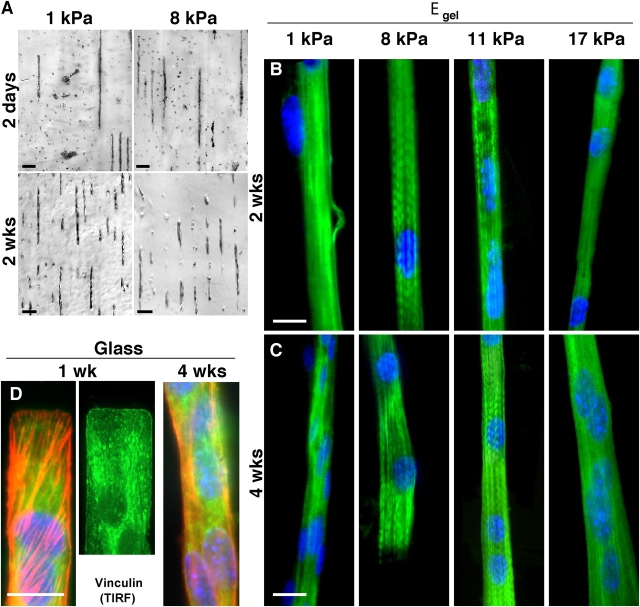
Contractile myocytes provide a test of the hypothesis that cells sense their mechanical as well as molecular microenvironment, altering expression, organization, and/or morphology accordingly. Here, myoblasts were cultured on collagen strips attached to glass or polymer gels of varied elasticity. Subsequent fusion into myotubes occurs independent of substrate flexibility. However, myosin/actin striations emerge later only on gels with stiffness typical of normal muscle (passive Young's modulus, E ∼12 kPa). On glass and much softer or stiffer gels, including gels emulating stiff dystrophic muscle, cells do not striate. In addition, myotubes grown on top of a compliant bottom layer of glass-attached myotubes (but not softer fibroblasts) will striate, whereas the bottom cells will only assemble stress fibers and vinculin-rich adhesions. Unlike sarcomere formation, adhesion strength increases monotonically versus substrate stiffness with strongest adhesion on glass. These findings have major implications for in vivo introduction of stem cells into diseased or damaged striated muscle of altered mechanical composition.
Overview
The claims and statistics of this paper haven’t been checked yet.
Free: it reads the open-access text and checks the first 5 claims that cite a source we can check. Create a free account to check every claim.
Integrity signals
Registry
Cites
Statistics
Figures




Verification
Claims the paper makes
The claims and statistics of this paper haven’t been checked yet.
Free: it reads the open-access text and checks the first 5 claims that cite a source we can check. Create a free account to check every claim.
Claims other papers make about this one
Each is checked against this paper’s own text: does it say what the citing paper says it does?
The source backs part of the claim, not all of it — or backs it for a different population, condition or comparison.
In the citing paper
“Additionally, the stiffness of the cellular environment or niche is an additional mechanical signal that influences for example the differentiation of mesenchymal stem cells into muscle and other cell types (34, 35).”
From The Hippo signal transduction network for exercise physiologists (2016) · cites this paper as [34]
Experimental — accuracy not yet measuredThe cited source says what the claim attributes to it.
In the citing paper
“In studies using biomimetic niches, substrates with an elastic stiffness of young adult skeletal muscle (∼12 kPa Young's modulus, the characteristic elastic rigidity of a material), which is five orders of magnitude softer than traditonal tissue culture plastic), promote MuSC self-renewal29,31 and myoblast differentiation94,95 (Fig. 4).”
From The central role of muscle stem cells in regenerative failure with aging (2015) · cites this paper as [94]
Self-check
Percentages, sums and reported differences re-computed from the paper’s own numbers.
The self-check needs the paper’s full text.
Citations
Cites
Calcium's Role in Mechanotransduction during Muscle Development
Benavides Damm, T., & Egli, M. (2014) · Cellular Physiology and Biochemistry · doi:10.1159/000356667 · Cited by 14,502
Biomechanics. Mechanical Properties of Living Tissues
Fung, Y. C., & Skalak, R. (1982) · Journal of Applied Mechanics · doi:10.1115/1.3162171 · Cited by 6,025
Cell Movement Is Guided by the Rigidity of the Substrate
Lo, C.-M., Wang, H.-B., Dembo, M., & Wang, Y.-L. (2000) · Biophysical Journal · doi:10.1016/s0006-3495(00)76279-5 · Cited by 3,289 · cited 3×
“FAK regulation could also occur by calciumdependent mechanisms (Lo et al., 2000) or stretch-activation (Nakamura et al.”
BackgroundCell locomotion and focal adhesions are regulated by substrate flexibility
Pelham, R. J., & Wang, Y.-L. (1997) · Proceedings of the National Academy of Sciences · doi:10.1073/pnas.94.25.13661 · Cited by 3,027 · cited 7×
“The reason is unclear, but physical aspects of the microenvironment, especially mechanical compliance of matrix (Pelham and Wang, 1997) and perhaps adjacent cells, are becoming increasingly linked to gene expression and protein organization.”
BackgroundInfluentialTaking Cell-Matrix Adhesions to the Third Dimension
Cukierman, E., Pankov, R., Stevens, D. R., & Yamada, K. M. (2001) · Science · doi:10.1126/science.1064829 · Cited by 3,027 · cited 1×
“…adhesion (Choquest et al., 1997; Beningo et al., 2001), posttranslational modification (Pelham and Wang, 1997; Beningo et al., 2001), protein expression (Cukierman et al., 2001), cytoskeletal organization (Cukierman et al., 2001; Engler et al., 2004a), and even cell viability (Wang et al., 2000).”
BackgroundCells lying on a bed of microneedles: An approach to isolate mechanical force
Tan, J. L., Tien, J., Pirone, D. M., Gray, D. S., Bhadriraju, K., & Chen, C. S. (2003) · Proceedings of the National Academy of Sciences · doi:10.1073/pnas.0235407100 · Cited by 1,962 · cited 2×
“The mechanism of coalignment is understood, from theory (Bischofs and Schwartz, 2003), to involve a propagation of cell-induced substrate contractions (Pelham and Wang, 1997; Wang et al., 2001; Tan et al., 2003 ).”
BackgroundSilicone Rubber Substrata: A New Wrinkle in the Study of Cell Locomotion
Harris, A. K., Wild, P., & Stopak, D. (1980) · Science · doi:10.1126/science.6987736 · Cited by 1,348 · cited 1×
“Analogous to the wrinkling of films by cells (Harris et al., 1980; Oliver et al., 1995), cells generate traction forces on collagen-coated polyacrylamide (PA) gel substrates.”
BackgroundExtracellular Matrix Rigidity Causes Strengthening of Integrin–Cytoskeleton Linkages
Choquet, D., Felsenfeld, D. P., & Sheetz, M. P. (1997) · Cell · doi:10.1016/s0092-8674(00)81856-5 · Cited by 1,245 · cited 1×
“Such signals feed back into cell tension (Wang et al., 2002), cell adhesion ( Choquest et al., 1997; Beningo et al., 2001), posttranslational modification (Pelham and Wang, 1997; Beningo et al., 2001), protein expression (Cukierman et al., 2001), cytoskeletal organization (Cukierman et al., 2001; Engler et al., 2004a)…”
BackgroundDetermination of Elastic Moduli of Thin Layers of Soft Material Using the Atomic Force Microscope
Dimitriadis, E. K., Horkay, F., Maresca, J., Kachar, B., & Chadwick, R. S. (2002) · Biophysical Journal · doi:10.1016/s0006-3495(02)75620-8 · Cited by 1,230 · cited 2×
“Mechanics of gels The elastic modulus of various gels was determined by AFM as well as macroscopic methods (Dimitriadis et al., 2002; Engler et al., 2004a).”
MethodSubstrate Compliance versus Ligand Density in Cell on Gel Responses
Engler, A., Bacakova, L., Newman, C., Hategan, A., Griffin, M., & Discher, D. (2004) · Biophysical Journal · doi:10.1016/s0006-3495(04)74140-5 · Cited by 1,141 · cited 16×
“In the absence of stiff ECM resistance, however, assembly and phosphorylation of adhesion proteins are inhibited (Pelham and Wang, 1997), and thus F-actin assembly is reduced (Engler et al., 2004a).”
BackgroundMethodInfluentialSelf-citation
Research works printed but not linked: 1
- 2004, Surf. Sci., In press
Cited by
Items 801–900 of 1,003
Shinozawa, T., Yoshikawa, H., & Takebe, T. (2016) · Developmental Biology · doi:10.1016/j.ydbio.2016.06.036 · Cited by 40
“For instance, Engler et al. showed that myotube striation is maximized on hydrogel substrate with stiffness typical of normal muscles (E ~ 10 kPa) (Engler et al., 2004).”
Background3D Printed Hydrogel Multiassay Platforms for Robust Generation of Engineered Contractile Tissues
Christensen, R. K., von Halling Laier, C., Kiziltay, A., Wilson, S., & Larsen, N. B. (2020) · Biomacromolecules · doi:10.1021/acs.biomac.9b01274 · Cited by 38
Bioengineered in vitro 3D model of myotonic dystrophy type 1 human skeletal muscle
Fernández‐Garibay, X., Ortega, M. A., Cerro-Herreros, E., Comelles, J., Martínez, E., Artero, R. D., Fernández‐Costa, J. M., & Ramón‐Azcón, J. (2021) · Biofabrication · doi:10.1088/1758-5090/abf6ae · Cited by 43
“Some studies suggest that the optimal stiffness for myotube maturation is higher, being closer to the native skeletal muscle tissue (∼12 kPa) [69, 70].”
BackgroundZhao, X., Zhang, Z., Luo, J., Wu, Z., Yang, Z., Zhou, S., Tu, Y., Huang, Y., Han, Y., & Guo, B. (2022) · Applied Materials Today · doi:10.1016/j.apmt.2022.101365 · Cited by 40
Mohammed, J. S., DeCoster, M. A., & McShane, M. J. (2006) · Langmuir · doi:10.1021/la0525473 · Cited by 40
In vivo response to dynamic hyaluronic acid hydrogels
Young, J. L., Tuler, J., Braden, R. L., Schup-Magoffin, P. J., Schaefer, J., Kretchmer, K., Christman, K. L., & Engler, A. J. (2013) · Acta Biomaterialia · doi:10.1016/j.actbio.2013.03.019 · Cited by 38
“cell fusion [15], or striation assembly [16].”
Self-citationChiu, W., Tang, M., Jao, H.-C., & Shen, M. (2008) · Molecular Biology of the Cell · doi:10.1091/mbc.e07-11-1170 · Cited by 41
“Microenvironments between cell–substrate adhesions appear important in controlling cell proliferation (Chen et al., 1997; Chicurel et al., 1998) or even critical in stem cell lineage specification (Engler et al., 2004, 2006).”
BackgroundInfluentialBiehl, J. K., Yamanaka, S., Desai, T. A., Boheler, K. R., & Russell, B. (2009) · Developmental Dynamics · doi:10.1002/dvdy.22030 · Cited by 38
Functional Modulation of ES-Derived Hepatocyte Lineage Cells via Substrate Compliance Alteration
Li, L., Sharma, N. S., Chippada, U., Jiang, X. D., Schloss, R. S., Yarmush, M. L., & Langrana, N. A. (2008) · Annals of Biomedical Engineering · doi:10.1007/s10439-008-9458-3 · Cited by 40
Advances in Bioadhesive Hydrogels for Musculoskeletal Tissue Application
Zhang, F., Chien, M., Fan, Q., & Jiang, D. (2024) · Advanced Functional Materials · doi:10.1002/adfm.202316540 · Cited by 43
Mapping the Single-Cell Differentiation Landscape of Osteosarcoma
Truong, D. D., Weistuch, C., Murgas, K. A., Admane, P. S., King, B. L., Lee, J. C., Lamhamedi-Cherradi, S.-E., Swaminathan, J., Daw, N. C., Gordon, N. B., et al. (2024) · Clinical Cancer Research · doi:10.1158/1078-0432.ccr-24-0563 · Cited by 39
Role of TGF-β/SMAD/YAP/TAZ signaling in skeletal muscle fibrosis
Gallardo, F. S., Cruz-Soca, M., Bock-Pereda, A., Faundez-Contreras, J., Gutiérrez‐Rojas, C., Gandin, A., Torresan, V., Casar, J. C., Ravasio, A., & Brandan, E. (2025) · American Journal of Physiology-Cell Physiology · doi:10.1152/ajpcell.00541.2024 · Cited by 51
Li, Z., Guo, X., & Guan, J. (2012) · Biomacromolecules · doi:10.1021/bm300574j · Cited by 37
Chitosan-gelatin sheets as scaffolds for muscle tissue engineering
Hajiabbas, M., Mashayekhan, S., Nazaripouya, A., Naji, M., Hunkeler, D. J., Zeleti, S. R., & Sharifiaghdas, F. (2013) · Artificial Cells Nanomedicine and Biotechnology · doi:10.3109/21691401.2013.852101 · Cited by 37
“…behavior of a wide variety of cells (Pelham and Wang 1997, Th omas and DiMilla 2000, Wang et al. 2000, Deroanne et al. 2001, Wozniak et al. 2003, Engler et al.,2004a, 2004b, Mcbeath et al. 2004, Engler et al. 2006, Ghosh et al. 2007, Hsiong et al. 2008, Saha et al. 2008, Kim et al. 2009, Li et…”
BackgroundMethodRigidity‐Patterned Polyelectrolyte Films to Control Myoblast Cell Adhesion and Spatial Organization
Monge, C., Saha, N., Boudou, T., Vázquez, C. P., Dulong, V., Glinel, K., & Picart, C. (2013) · Advanced Functional Materials · doi:10.1002/adfm.201203580 · Cited by 42
A Cellular Potts Model of single cell migration in presence of durotaxis
Allena, R., Scianna, M., & Preziosi, L. (2016) · Mathematical Biosciences · doi:10.1016/j.mbs.2016.02.011 · Cited by 36
Gribova, V., Liu, C., Nishiguchi, A., Matsusaki, M., Boudou, T., Picart, C., & Akashi, M. (2016) · Biochemical and Biophysical Research Communications · doi:10.1016/j.bbrc.2016.04.130 · Cited by 37
“Stress fiber formation is closely related to the stiffness of the cell environment [35,36], and it is now acknowledged that mechanical properties of the 2D substrate can affect muscle cell adhesion, spreading, proliferation and differentiation [37,38,39,40].”
BackgroundSpatiotemporal quantification of acoustic cell patterning using Voronoï tessellation
Armstrong, J. P. K., Maynard, S. A., Pence, I. J., Franklin, A. C., Drinkwater, B. W., & Stevens, M. M. (2019) · Lab on a Chip · doi:10.1039/c8lc01108g · Cited by 38
Constricted migration modulates stem cell differentiation
Smith, L., Irianto, J., Xia, Y., Pfeifer, C. R., & Discher, D. E. (2019) · Molecular Biology of the Cell · doi:10.1091/mbc.e19-02-0090 · Cited by 39
Self-citationVimentin Intermediate Filaments Mediate Cell Morphology on Viscoelastic Substrates
Swoger, M., Gupta, S., Charrier, E. E., Bates, M., Hehnly, H., & Patteson, A. E. (2022) · ACS Applied Bio Materials · doi:10.1021/acsabm.1c01046 · Cited by 38
Cell mechanics of alveolar epithelial cells (AECs) and macrophages (AMs)
Féréol, S., Fodil, R., Pelle, G., Louis, B., & Isabey, D. (2008) · Respiratory Physiology & Neurobiology · doi:10.1016/j.resp.2008.04.018 · Cited by 47
“A number of recent studies have suggested that the pathological orientation of cell function depends on the change in ECE properties (Engler et al., 2004; Paszek et al., 2005; Solon et al., 2007).”
BackgroundTransparent and Cell-Guiding Cellulose Nanofiber 3D Printing Bioinks
Radeke, C., Pons, R., Mihajlovic, M., Knudsen, J. R., Butdayev, S., Kempen, P. J., Segeritz, C., Andresen, T. L., Pehmøller, C. K., Jensen, T. E., et al. (2023) · ACS Applied Materials & Interfaces · doi:10.1021/acsami.2c16126 · Cited by 37
Ansari, A., Bhowmik, S., Zhang, K., Reeves, C. L., Vahala, D., Choi, Y. S., Gelmi, A. A., Combes, A. N., Tuan, R. S., Truong, V. X., et al. (2025) · Advanced Functional Materials · doi:10.1002/adfm.202501585 · Cited by 40
A new method for the preparation of biocompatible silica coated-collagen hydrogels
Foglia, M. L., Camporotondi, D. E., Álvarez, G. S., Heinemann, S., Hanke, T., Pérez, C. J., Díaz, L. E., & Desimone, M. F. (2013) · Journal of Materials Chemistry B · doi:10.1039/c3tb21067g · Cited by 36
Hydrogels as Carriers for Stem Cell Transplantation
Alvarado‐Velez, M., Pai, S. B., & Bellamkonda, R. V. (2014) · IEEE Transactions on Biomedical Engineering · doi:10.1109/tbme.2014.2305753 · Cited by 36
Giménez, A., Uriarte, J. J., Vieyra, J., Navajas, D., & Alcaraz, J. (2016) · Microscopy Research and Technique · doi:10.1002/jemt.22740 · Cited by 42
“Sulfo-SANPAH is a commercial UVlight-activated cross-linker that covalently attaches collagen-I or other ECM molecules to the PAA gel surface, and remains the current standard method for ECM cross-linking to PAA gels (Engler et al., 2004b; Paszek et al., 2005).”
BackgroundMethodMechanobiological model of arterial growth and remodeling
Keshavarzian, M., Meyer, C. A., & Hayenga, H. N. (2017) · Biomechanics and Modeling in Mechanobiology · doi:10.1007/s10237-017-0946-y · Cited by 38
Emerin modulates spatial organization of chromosome territories in cells on softer matrices
Pradhan, R., Ranade, D., & Sengupta, K. (2018) · Nucleic Acids Research · doi:10.1093/nar/gky288 · Cited by 37
Ramey‐Ward, A. N., Su, H., & Salaita, K. S. (2020) · ACS Applied Materials & Interfaces · doi:10.1021/acsami.0c08871 · Cited by 37
Uchimura, T., Asano, T., Nakata, T., Hotta, A., & Sakurai, H. (2021) · Cell Reports Medicine · doi:10.1016/j.xcrm.2021.100298 · Cited by 39
Perfusable Biohybrid Designs for Bioprinted Skeletal Muscle Tissue
Filippi, M., Yaşa, Ö., Giachino, J., Graf, R., Balciunaite, A., Stefani, L., & Katzschmann, R. K. (2023) · Advanced Healthcare Materials · doi:10.1002/adhm.202300151 · Cited by 44
Impact of Synthetic Technique on PLA−PEO−PLA Physical Hydrogel Properties
Sanabria-DeLong, N., Agrawal, S. K., Bhatia, S. R., & Tew, G. N. (2007) · Macromolecules · doi:10.1021/ma071243f · Cited by 36
Chen, G., Zhao, L., Feng, J., You, G., Sun, Q., Li, P., Han, D. C., & Zhou, H. M. (2013) · PLoS ONE · doi:10.1371/journal.pone.0067360 · Cited by 39
“The mechanical changes, therefore, may lead to dysregulate the endothelial layer and influence disease states [8,9].”
BackgroundHelix versus coil polypeptide macromers: gel networks with decoupled stiffness and permeability
Oelker, A. M., Morey, S. M., Griffith, L. G., & Hammond, P. T. (2012) · Soft Matter · doi:10.1039/c2sm26487k · Cited by 37
Isolation and Purification of Satellite Cells for Skeletal Muscle Tissue Engineering
Syverud, B. C., & VanDusen, K. W. (2015) · Journal of Regenerative Medicine · doi:10.4172/2325-9620.1000117 · Cited by 50
“Instead of using stiff substrates such as polystyrene or glass, culture of isolated satellite cells on more compliant hydrogels promoted myogenic differentiation and allowed formation of advanced sarcomeric structure [75,76].”
BackgroundCross talk between matrix elasticity and mechanical force regulates myoblast traction dynamics
Al‐Rekabi, Z., & Pelling, A. E. (2013) · Physical Biology · doi:10.1088/1478-3975/10/6/066003 · Cited by 39
Uto, K., Aoyagi, T., DeForest, C. A., Hoffman, A. S., & Ebara, M. (2017) · Advanced Healthcare Materials · doi:10.1002/adhm.201601439 · Cited by 35
Plasticity of the Muscle Stem Cell Microenvironment
Dinulović, I., Furrer, R., & Handschin, C. (2017) · Advances in experimental medicine and biology · doi:10.1007/978-3-319-69194-7_8 · Cited by 39
“The elastic stiffness of uninjured skeletal muscle is ~12kPa, and ECM deposition during regeneration increases this value (90).”
Redox‐Responsive Resilin‐Like Hydrogels for Tissue Engineering and Drug Delivery Applications
Su, R. S. ‐., Galas, R. J., Lin, C., & Liu, J. C. (2019) · Macromolecular Bioscience · doi:10.1002/mabi.201900122 · Cited by 38
Uniaxially crumpled graphene as a platform for guided myotube formation
Kim, J., Leem, J., Kim, H. N., Kang, P., Choi, J., Haque, M. F., Kang, D., & Nam, S. (2019) · Microsystems & Nanoengineering · doi:10.1038/s41378-019-0098-6 · Cited by 38
3D PCL/Gelatin/Genipin Nanofiber Sponge as Scaffold for Regenerative Medicine
Merk, M. W., Chirikian, O., & Adlhart, C. (2021) · Materials · doi:10.3390/ma14082006 · Cited by 38
“Indeed, studies on myoblasts grown on substrates with Young’s moduli comparable to mature muscle tissues (≈12 kPa) showed improved muscle differentiation compared to cells grown on either softer or stiffer materials [65].”
BackgroundHandrea-Dragan, I. M., Botiz, I., Tatar, A.-S., & Boca, S. (2022) · Colloids and Surfaces B Biointerfaces · doi:10.1016/j.colsurfb.2022.112730 · Cited by 43
Huang, J., Peng, X., Xiong, C., & Fang, J. S. (2010) · Journal of Colloid and Interface Science · doi:10.1016/j.jcis.2010.12.055 · Cited by 39
Enhanced osteoblast adhesion on transglutaminase 2-crosslinked fibronectin
Forsprecher, J., Wang, Z., Nelea, V., & Kaartinen, M. T. (2008) · Amino Acids · doi:10.1007/s00726-008-0125-7 · Cited by 35
“It is known that cells not only respond to proteins within the matrix (via integrins), but also sense matrix rigidity (compliance) (Choquet et al. 1997; Engler et al. 2004, 2006 ) and migrate towards stiffer matrices (durotaxis) (Jiang et al. 2006; Kostic and Sheetz 2006).”
BackgroundInfluentialEpimuscular Fat in the Human Rotator Cuff Is a Novel Beige Depot
Meyer, G. A., Gibbons, M. C., Sato, E. J., Lane, J. G., Ward, S. R., & Engler, A. J. (2015) · Stem Cells Translational Medicine · doi:10.5966/sctm.2014-0287 · Cited by 38
Self-citationPopescu, D. C., Lems, R., Rossi, N. A. A., Yeoh, C., Loos, J., Holder, S. J., Bouten, C. V. C., & Sommerdijk, N. A. J. M. (2005) · Advanced Materials · doi:10.1002/adma.200500039 · Cited by 36
Mechanosensitive hormone signaling promotes mammary progenitor expansion and breast cancer risk
Northey, J. J., Hayward, M.-K., Yui, Y., Stashko, C., Kai, F., Mouw, J. K., Thakar, D., Lakins, J. N., Ironside, A. J., Samson, S. M., et al. (2024) · Cell stem cell · doi:10.1016/j.stem.2023.12.002 · Cited by 41
Bhutani, S., Nachlas, A. L. Y., Brown, M. E., Pete, T., Johnson, C. T., Garcı́a, A. J., & Davis, M. E. (2017) · ACS Biomaterials Science & Engineering · doi:10.1021/acsbiomaterials.7b00502 · Cited by 34
Roether, J., Bertels, S., Oelschlaeger, C., Bastmeyer, M., & Willenbacher, N. (2018) · PLoS ONE · doi:10.1371/journal.pone.0207397 · Cited by 36
Qin, E. C., Ahmed, S. T., Sehgal, P., Vu, V. H., Kong, H., & Leckband, D. E. (2020) · Biomaterials · doi:10.1016/j.biomaterials.2020.119846 · Cited by 38
Li, S. C., Lee, K. L., & Luo, J. (2011) · Stem Cells and Development · doi:10.1089/scd.2011.0267 · Cited by 34
“An interesting finding was that the matrix elasticity (physical signal) activates the stem cell differentiation signal pathway, directing the organ-specific stem cell lineage specification [17–19].”
Lück, S., Schubel, R., Rüb, J., Hahn, D., Mathieu, E., Zimmermann, H., Scharnweber, D., Werner, C., Pautot, S., & Jordan, R. (2015) · Biomaterials · doi:10.1016/j.biomaterials.2015.11.045 · Cited by 36
Self-assembly of polydimethylsiloxane structures from 2D to 3D for bio-hybrid actuation
Vannozzi, L., Ricotti, L., Cianchetti, M., Bearzi, C., Gargioli, C., Rizzi, R., Dario, P., & Menciassi, A. (2015) · Bioinspiration & Biomimetics · doi:10.1088/1748-3190/10/5/056001 · Cited by 36
Rerouting mesenchymal stem cell trajectory towards epithelial lineage by engineering cellular niche
Barui, A., Chowdhury, F., Pandit, A. S., & Datta, P. (2017) · Biomaterials · doi:10.1016/j.biomaterials.2017.11.036 · Cited by 37
Huang, N. F., Lee, R. J., & Li, S. (2007) · Tissue Engineering · doi:10.1089/ten.2006.0096 · Cited by 38
Kawecki, N. S., Norris, S. C. P., Xu, Y., Wu, Y., Davis, A. R., Fridman, E., Chen, K. K., Crosbie, R. H., Garmyn, A. J., Li, S., et al. (2023) · Food Research International · doi:10.1016/j.foodres.2023.113080 · Cited by 37
Shi, N., Wang, J., Tang, S., Zhang, H., Zhao, W., Li, A., Ma, Y., & Xu, F. (2023) · Small · doi:10.1002/smll.202305218 · Cited by 42
Eliahoo, P., Setayesh, H., Hoffman, T., Wu, Y., Li, S., & Treweek, J. B. (2024) · ACS Materials Au · doi:10.1021/acsmaterialsau.3c00038 · Cited by 38
Dasbiswas, K., Majkut, S., Discher, D. E., & Safran, S. A. (2015) · Biophysical Journal · doi:10.1016/j.bpj.2014.11.2423 · Cited by 33
Self-citationLeong, W. S., Wu, S. C., Pal, M., Tay, C. Y., Yu, H., Li, H., & Tan, L. P. (2012) · Journal of Tissue Engineering and Regenerative Medicine · doi:10.1002/term.1548 · Cited by 38
“, 2007) or the formation of sarcomere structure during myogenesis (Engler et al., 2004).”
BackgroundThe effect of nano-scale topography on osteogenic differentiation of mesenchymal stem cells
Faghihi, F., & Eslaminejad, M. B. (2013) · Biomedical Papers · doi:10.5507/bp.2013.013 · Cited by 34
Atomic force microscopy for the investigation of molecular and cellular behavior
Özkan, A. D., Topal, A. E., Dâna, A., Guler, M. O., & Tekinay, A. B. (2016) · Micron · doi:10.1016/j.micron.2016.07.011 · Cited by 34
Engineering complex muscle-tissue interfaces through microfabrication
Arrigoni, C., Petta, D., Bersini, S., Mironov, V., Candrian, C., & Moretti, M. (2019) · Biofabrication · doi:10.1088/1758-5090/ab1e7c · Cited by 35
Photoreactive Hydrogel Stiffness Influences Volumetric Muscle Loss Repair
Basurto, I. M., Passipieri, J. A., Gardner, G. M., Smith, K. K., Amacher, A. R., Hansrisuk, A., Christ, G. J., & Caliari, S. R. (2021) · Tissue Engineering Part A · doi:10.1089/ten.tea.2021.0137 · Cited by 36
How cells feel their substrate: spontaneous symmetry breaking of active surface stresses
Friedrich, B., & Safran, S. (2012) · Soft Matter · doi:10.1039/c2sm06450b · Cited by 34
Mechanical Signaling on the Single Protein Level Studied Using Steered Molecular Dynamics
Genchev, G. Z., Källberg, M., Gürsoy, G., Mittal, A., Dubey, L., Perišić, O., Feng, G., Langlois, R. E., & Lu, H. J. (2009) · Cell Biochemistry and Biophysics · doi:10.1007/s12013-009-9064-5 · Cited by 37
“and the differentiation of myotubes [8] (see recent reviews for a multitude of other examples [9]).”
Crosslinking strategies facilitate tunable structural properties of fibrin microthreads
Grasman, J. M., Page, R. L., Dominko, T., & Pins, G. D. (2012) · Acta Biomaterialia · doi:10.1016/j.actbio.2012.07.018 · Cited by 44
Tailoring the elasticity of nerve implants for regulating peripheral nerve regeneration
Kong, Y., Xu, J., Guan, W., Sun, S., Yang, Y., & Li, G. (2022) · Smart Materials in Medicine · doi:10.1016/j.smaim.2022.11.004 · Cited by 33
Tissue engineering: Hydrogel scaffolds and mechanical properties as key design parameters
Goswami, A. K., Giduturi, V. K., Yerramilli, S. N., Chauhan, V. S., & Yadav, N. (2025) · Advances in Colloid and Interface Science · doi:10.1016/j.cis.2025.103691 · Cited by 48
Advancements in stem cells treatment of skeletal muscle wasting
Meregalli, M., Farini, A., Sitzia, C., & Torrente, Y. (2014) · Frontiers in Physiology · doi:10.3389/fphys.2014.00048 · Cited by 36
“Interestingly, some of injected CD133+ stem cells were identified beneath the basal lamina, in SC-like position, thus expressing M-Cadherin (Benchaouir et al., 2007).”
BackgroundForces During Cell Adhesion and Spreading: Implications for Cellular Homeostasis
Carey, S. P., Charest, J. M., & Reinhart‐King, C. A. (2010) · Studies in mechanobiology, tissue engineering and biomaterials · doi:10.1007/8415_2010_22 · Cited by 40
“While this phenomenon was originally observed and identified in the context of cell morphology, motility, and adhesion strengthening [56, 57], ongoing work has shown that mechanosensing of matrix stiffness is intimately involved in directional cell migration [58], cell differentiation [59], tissue development and main…”
BackgroundImproving myoblast differentiation on electrospun poly(ε‐caprolactone) scaffolds
Abarzúa‐Illanes, P. N., Padilla, C. R., Ramos, A., Isaacs, M. A., Ramos-Grez, J. A., Olguín, H. C., & Valenzuela, L. M. (2017) · Journal of Biomedical Materials Research Part A · doi:10.1002/jbm.a.36091 · Cited by 37
Mierke, C. T. (2019) · Frontiers in Cell and Developmental Biology · doi:10.3389/fcell.2019.00184 · Cited by 38
Huang, K.-T., Hsieh, P., Dai, L., & Huang, C. (2020) · Journal of Materials Chemistry B · doi:10.1039/d0tb01163k · Cited by 32
Neuromuscular disease modeling on a chip
Santoso, J. W., & McCain, M. L. (2020) · Disease Models & Mechanisms · doi:10.1242/dmm.044867 · Cited by 36
Jensen, J. H., Cakal, S. D., Li, J., Pless, C. J., Radeke, C., Jepsen, M. L., Jensen, T. E., Dufva, M., & Lind, J. U. (2020) · Scientific Reports · doi:10.1038/s41598-020-69936-6 · Cited by 35
Microstructures in 3D Biological Gels Affect Cell Proliferation
Norman, J. J., Collins, J. M., Sharma, S., Russell, B., & Desai, T. A. (2007) · Tissue Engineering Part A · doi:10.1089/tea.2007.0077 · Cited by 34
“Numerous studies have shown that cells will change their proliferation and migration rate as well as their differentiation state due to changes in stiffness of the supporting matrix [4-6, 34, 35].”
Mechanical regulation of cellular phenotype: implications for vascular tissue regeneration
Liu, W. F. (2012) · Cardiovascular Research · doi:10.1093/cvr/cvs168 · Cited by 36
Peptide hydrogels: mimicking the extracellular matrix
Gough, J. E., Saiani, A., & Miller, A. F. (2011) · Bioinspired Biomimetic and Nanobiomaterials · doi:10.1680/bbn.11.00007 · Cited by 37
Capturing relevant extracellular matrices for investigating cell migration
Keely, P. J., & Nain, A. S. (2015) · F1000Research · doi:10.12688/f1000research.6623.1 · Cited by 33
Thin polymeric films for building biohybrid microrobots
Ricotti, L., & Fujie, T. (2017) · Bioinspiration & Biomimetics · doi:10.1088/1748-3190/aa5e5f · Cited by 36
Yoshikawa, H., Kawano, T., Matsuda, T., Kidoaki, S., & Tanaka, M. (2013) · The Journal of Physical Chemistry B · doi:10.1021/jp4008224 · Cited by 31
Role and mechanism of catechin in skeletal muscle cell differentiation
Li, P., Liu, A., Liu, C., Qu, Z., Xiao, W., Huang, J., Liu, Z., & Zhang, S. (2019) · The Journal of Nutritional Biochemistry · doi:10.1016/j.jnutbio.2019.108225 · Cited by 31
Cultured meat—a humane meat production system
Bhat, Z. F., Bhat, H. F., & Kumar, S. (2020) · Elsevier eBooks · doi:10.1016/b978-0-12-818422-6.00075-7 · Cited by 39
Relation analysis between out-of-plane and in-plane failure of corrugated steel plate shear wall
Wang, W., Luo, Q., Sun, Z., Wang, B., & Xu, S. (2021) · Structures · doi:10.1016/j.istruc.2020.12.030 · Cited by 31
Zhao, G., Qin, Q., Jing, C., & Wang, C. (2009) · Microscopy Research and Technique · doi:10.1002/jemt.20716 · Cited by 31
Substrate stiffness does affect the fate of human keratinocytes
Gupta, P., Narayana, G. H. N. S., Kasiviswanathan, U., Agarwal, T., Kulanthaivel, S., Mukhopadhyay, D., Pal, K., Giri, S., Maiti, T. K., & Banerjee, I. (2015) · RSC Advances · doi:10.1039/c5ra19947f · Cited by 33
Material Stiffness Effects on Neurite Alignment to Photopolymerized Micropatterns
Tuft, B. W., Zhang, L., Xu, L., Hangartner, A., Leigh, B., Hansen, M. R., & Guymon, C. A. (2014) · Biomacromolecules · doi:10.1021/bm501019s · Cited by 36
Panzetta, V., Guarnieri, D., Paciello, A., Sala, F. D., Muscetti, O., Raiola, L., Netti, P. A., & Fusco, S. (2017) · ACS Biomaterials Science & Engineering · doi:10.1021/acsbiomaterials.7b00018 · Cited by 31
Sonomechanobiology: Vibrational stimulation of cells and its therapeutic implications
Ambattu, L. A., & Yeo, L. Y. (2023) · Biophysics Reviews · doi:10.1063/5.0127122 · Cited by 34
Review in edible materials for sustainable cultured meat: scaffolds and microcarriers production
Moslemy, N., Sharifi, E., Asadi‐Eydivand, M., & Abolfathi, N. (2023) · International Journal of Food Science & Technology · doi:10.1111/ijfs.16703 · Cited by 35
Tuning Molecular Adhesion via Material Anisotropy
Zhang, W., Lin, Y., Qian, J. W., Chen, W., & Gao, H. (2013) · Advanced Functional Materials · doi:10.1002/adfm.201300069 · Cited by 30
Safaee, H., Bakooshli, M. A., Davoudi, S., Cheng, R. Y., Martowirogo, A. J., Li, E. W., Simmons, C. A., & Gilbert, P. M. (2017) · Cellular and Molecular Bioengineering · doi:10.1007/s12195-017-0506-7 · Cited by 34
Designing the stem cell microenvironment for guided connective tissue regeneration
Bogdanowicz, D. R., & Lu, H. H. (2017) · Annals of the New York Academy of Sciences · doi:10.1111/nyas.13553 · Cited by 34
Isabela Monteiro, A., Kollmetz, T., & Malmström, J. (2018) · Biointerphases · doi:10.1116/1.5045231 · Cited by 37
Li, Q., Wang, Y., Hu, X., Zhang, Y., Li, H., Zhang, Q., Cai, W., Wang, Z., Zhu, B., Xu, L., et al. (2022) · Cell Proliferation · doi:10.1111/cpr.13219 · Cited by 31
Mesenchymal stem cell adhesion but not plasticity is affected by high substrate stiffness
Tam, J. K. V., Uto, K., Ebara, M., Pagliari, S., Forte, G., & Aoyagi, T. (2012) · Science and Technology of Advanced Materials · doi:10.1088/1468-6996/13/6/064205 · Cited by 37
Effect of Sustained Tension on Bladder Smooth Muscle Cells in Three-Dimensional Culture
Roby, T., Olsen, S., & Nagatomi, J. (2008) · Annals of Biomedical Engineering · doi:10.1007/s10439-008-9545-5 · Cited by 30
Influence of cell spreading and contractility on stiffness measurements using AFM
Vichare, S., Inamdar, M. M., & Sen, S. (2012) · Soft Matter · doi:10.1039/c2sm26348c · Cited by 31
Self-citationLuo, Y. (2020) · Elsevier eBooks · doi:10.1016/b978-0-12-818422-6.00020-4 · Cited by 40
Metadata
- Authors
- Engler, A. J., Griffin, M. A., Sen, S., Bönnemann, C. G., Sweeney, H. L., & Discher, D. E.
- Affiliations
- University of Pennsylvania (US)
- 2Pennsylvania Muscle Institute, University of Pennsylvania, Philadelphia, PA 19104
- Venue
- The Journal of Cell Biology
- Publisher
- Rockefeller University Press
- Published
- 2004-09-13
- Volume
- 166
- Issue
- 6
- Pages
- 877-887
- ISSN
- 0021-9525 (ISSN-L)
- 1540-8140
- PMC
- PMC2172122
- OpenAlex
- W2167243609
- Cited by
- 1,743
- References
- 57
- Citations by year
- 2026: 47 · 2025: 54 · 2024: 63 · 2023: 49 · 2022: 71 · 2021: 84 · 2020: 87 · 2019: 77 · 2018: 86 · 2017: 119 · 2016: 90 · 2015: 88 · 2014: 92 · 2013: 115 · 2012: 128
- FWCI
- 14.63
- Type
- journal article
- Language
- en
- Open access
- green
- www.ncbi.nlm.nih.gov
- Licence
- cc-by-nc-sa
- Locations
- The Journal of Cell Biology (publishedVersion)
- PubMed Central (publishedVersion, cc-by-nc-sa)
- PubMed (publishedVersion)
- ScholarlyCommons (University of Pennsylvania) (submittedVersion)
- eScholarship (California Digital Library) (submittedVersion)
- Topics
- Life Sciences › Biochemistry, Genetics and Molecular Biology › Cell Biology › Cellular Mechanics and Interactions
- Life Sciences › Biochemistry, Genetics and Molecular Biology › Molecular Biology › Muscle Physiology and Disorders
- Health Sciences › Medicine › Surgery › Tissue Engineering and Regenerative Medicine
- Keywords
- myotube differentiation, substrate stiffness, mechanotransduction, myoblast fusion, sarcomere formation, cell adhesion, stress fibers, vinculin, dystrophic muscle, collagen substrate, polymer gels, stem cell transplantation, muscle regeneration
- MeSH terms
- Polyacrylamides, Acrylic Resins, Animals, Cell Adhesion, Cell Differentiation, Cell Line, Cells, Cultured, Elasticity, Fibroblasts, Gels, Mice, Inbred C3H, Mice, Mutant Strains, Models, Biological, Substrate Specificity, Muscle, Skeletal, Muscle Fibers, Skeletal, Microscopy, Atomic Force, Fluorescent Antibody Technique, Direct, Mice
About these checks
Registry, retraction, Cites and statistics results are computed, not judged, with one exception: a printed reference that no index lists is read once by a model before it counts as a citation error. Claims are extracted by a model and kept only when their quote appears verbatim in the text; each cited source is then checked, with a model’s help, for whether it says what the claim relies on. Those verdicts can be wrong — read the claim’s quote and the cited source before relying on one.
Statistics and arithmetic are recomputed, not judged.
Confidence bands are shown only for fields calibrated on our annotated test set. None is calibrated yet, so no band is shown.
What counts as a claim ›How we measure confidence ›How we check this ›
Are you an author, or do you see a problem with this page? Request a review
Data sources
Bibliographic data: Semantic Scholar, OpenAlex, Crossref.
Contains information from the Semantic Scholar Academic Graph Datasets, made available under the ODC Attribution License (ODC-BY 1.0).
Semantic Scholar’s data is described in: Kinney, R., et al. (2023). The Semantic Scholar Open Data Platform. arXiv:2301.10140.
