

Myotubes differentiate optimally on substrates with tissue-like stiffness
Open accessThe DOI matches its Crossref record; 58 of the 58 references it cites were found in a registry or an index.
Abstract
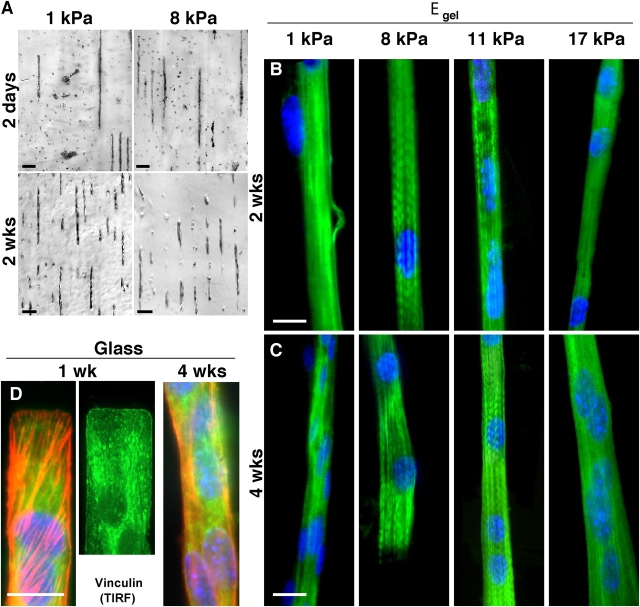
Contractile myocytes provide a test of the hypothesis that cells sense their mechanical as well as molecular microenvironment, altering expression, organization, and/or morphology accordingly. Here, myoblasts were cultured on collagen strips attached to glass or polymer gels of varied elasticity. Subsequent fusion into myotubes occurs independent of substrate flexibility. However, myosin/actin striations emerge later only on gels with stiffness typical of normal muscle (passive Young's modulus, E ∼12 kPa). On glass and much softer or stiffer gels, including gels emulating stiff dystrophic muscle, cells do not striate. In addition, myotubes grown on top of a compliant bottom layer of glass-attached myotubes (but not softer fibroblasts) will striate, whereas the bottom cells will only assemble stress fibers and vinculin-rich adhesions. Unlike sarcomere formation, adhesion strength increases monotonically versus substrate stiffness with strongest adhesion on glass. These findings have major implications for in vivo introduction of stem cells into diseased or damaged striated muscle of altered mechanical composition.
Overview
The claims and statistics of this paper haven’t been checked yet.
Free: it reads the open-access text and checks the first 5 claims that cite a source we can check. Create a free account to check every claim.
Integrity signals
Registry
Cites
Statistics
Figures




Verification
Claims the paper makes
The claims and statistics of this paper haven’t been checked yet.
Free: it reads the open-access text and checks the first 5 claims that cite a source we can check. Create a free account to check every claim.
Claims other papers make about this one
Each is checked against this paper’s own text: does it say what the citing paper says it does?
The source backs part of the claim, not all of it — or backs it for a different population, condition or comparison.
In the citing paper
“Additionally, the stiffness of the cellular environment or niche is an additional mechanical signal that influences for example the differentiation of mesenchymal stem cells into muscle and other cell types (34, 35).”
From The Hippo signal transduction network for exercise physiologists (2016) · cites this paper as [34]
Experimental — accuracy not yet measuredThe cited source says what the claim attributes to it.
In the citing paper
“In studies using biomimetic niches, substrates with an elastic stiffness of young adult skeletal muscle (∼12 kPa Young's modulus, the characteristic elastic rigidity of a material), which is five orders of magnitude softer than traditonal tissue culture plastic), promote MuSC self-renewal29,31 and myoblast differentiation94,95 (Fig. 4).”
From The central role of muscle stem cells in regenerative failure with aging (2015) · cites this paper as [94]
Self-check
Percentages, sums and reported differences re-computed from the paper’s own numbers.
The self-check needs the paper’s full text.
Citations
Cites
Calcium's Role in Mechanotransduction during Muscle Development
Benavides Damm, T., & Egli, M. (2014) · Cellular Physiology and Biochemistry · doi:10.1159/000356667 · Cited by 14,502
Biomechanics. Mechanical Properties of Living Tissues
Fung, Y. C., & Skalak, R. (1982) · Journal of Applied Mechanics · doi:10.1115/1.3162171 · Cited by 6,025
Cell Movement Is Guided by the Rigidity of the Substrate
Lo, C.-M., Wang, H.-B., Dembo, M., & Wang, Y.-L. (2000) · Biophysical Journal · doi:10.1016/s0006-3495(00)76279-5 · Cited by 3,289 · cited 3×
“FAK regulation could also occur by calciumdependent mechanisms (Lo et al., 2000) or stretch-activation (Nakamura et al.”
BackgroundCell locomotion and focal adhesions are regulated by substrate flexibility
Pelham, R. J., & Wang, Y.-L. (1997) · Proceedings of the National Academy of Sciences · doi:10.1073/pnas.94.25.13661 · Cited by 3,027 · cited 7×
“The reason is unclear, but physical aspects of the microenvironment, especially mechanical compliance of matrix (Pelham and Wang, 1997) and perhaps adjacent cells, are becoming increasingly linked to gene expression and protein organization.”
BackgroundInfluentialTaking Cell-Matrix Adhesions to the Third Dimension
Cukierman, E., Pankov, R., Stevens, D. R., & Yamada, K. M. (2001) · Science · doi:10.1126/science.1064829 · Cited by 3,027 · cited 1×
“…adhesion (Choquest et al., 1997; Beningo et al., 2001), posttranslational modification (Pelham and Wang, 1997; Beningo et al., 2001), protein expression (Cukierman et al., 2001), cytoskeletal organization (Cukierman et al., 2001; Engler et al., 2004a), and even cell viability (Wang et al., 2000).”
BackgroundCells lying on a bed of microneedles: An approach to isolate mechanical force
Tan, J. L., Tien, J., Pirone, D. M., Gray, D. S., Bhadriraju, K., & Chen, C. S. (2003) · Proceedings of the National Academy of Sciences · doi:10.1073/pnas.0235407100 · Cited by 1,962 · cited 2×
“The mechanism of coalignment is understood, from theory (Bischofs and Schwartz, 2003), to involve a propagation of cell-induced substrate contractions (Pelham and Wang, 1997; Wang et al., 2001; Tan et al., 2003 ).”
BackgroundSilicone Rubber Substrata: A New Wrinkle in the Study of Cell Locomotion
Harris, A. K., Wild, P., & Stopak, D. (1980) · Science · doi:10.1126/science.6987736 · Cited by 1,348 · cited 1×
“Analogous to the wrinkling of films by cells (Harris et al., 1980; Oliver et al., 1995), cells generate traction forces on collagen-coated polyacrylamide (PA) gel substrates.”
BackgroundExtracellular Matrix Rigidity Causes Strengthening of Integrin–Cytoskeleton Linkages
Choquet, D., Felsenfeld, D. P., & Sheetz, M. P. (1997) · Cell · doi:10.1016/s0092-8674(00)81856-5 · Cited by 1,245 · cited 1×
“Such signals feed back into cell tension (Wang et al., 2002), cell adhesion ( Choquest et al., 1997; Beningo et al., 2001), posttranslational modification (Pelham and Wang, 1997; Beningo et al., 2001), protein expression (Cukierman et al., 2001), cytoskeletal organization (Cukierman et al., 2001; Engler et al., 2004a)…”
BackgroundDetermination of Elastic Moduli of Thin Layers of Soft Material Using the Atomic Force Microscope
Dimitriadis, E. K., Horkay, F., Maresca, J., Kachar, B., & Chadwick, R. S. (2002) · Biophysical Journal · doi:10.1016/s0006-3495(02)75620-8 · Cited by 1,230 · cited 2×
“Mechanics of gels The elastic modulus of various gels was determined by AFM as well as macroscopic methods (Dimitriadis et al., 2002; Engler et al., 2004a).”
MethodSubstrate Compliance versus Ligand Density in Cell on Gel Responses
Engler, A., Bacakova, L., Newman, C., Hategan, A., Griffin, M., & Discher, D. (2004) · Biophysical Journal · doi:10.1016/s0006-3495(04)74140-5 · Cited by 1,141 · cited 16×
“In the absence of stiff ECM resistance, however, assembly and phosphorylation of adhesion proteins are inhibited (Pelham and Wang, 1997), and thus F-actin assembly is reduced (Engler et al., 2004a).”
BackgroundMethodInfluentialSelf-citation
Research works printed but not linked: 1
- 2004, Surf. Sci., In press
Cited by
Items 201–300 of 1,003
Engler, A. J., Rehfeldt, F., Sen, S., & Discher, D. E. (2007) · Methods in Cell Biology · doi:10.1016/s0091-679x(07)83022-6 · Cited by 182
“SMCs appear highly sensitive to the elasticity of their microenvironment, showing more stress fibers and focal adhesions on increasingly stiV matrices (Engler et al., 2004a) as do most other cell types in vitro.”
BackgroundMethodInfluentialSelf-citationHigh-Throughput Methods in the Discovery and Study of Biomaterials and Materiobiology
Yang, L., Pijuan-Galito, S., Rho, H. S., Vasilevich, A. S., Eren, A. D., Ge, L., Habibović, P., Alexander, M. R., de Boer, J., Carlier, A., et al. (2021) · Chemical Reviews · doi:10.1021/acs.chemrev.0c00752 · Cited by 180
Quantitative Evaluation of Mechanosensing of Cells on Dynamically Tunable Hydrogels
Yoshikawa, H. Y., Rossetti, F. F., Kaufmann, S., Kaindl, T., Madsen, J., Engel, U., Lewis, A. L., Armes, S. P., & Tanaka, M. (2011) · Journal of the American Chemical Society · doi:10.1021/ja1060615 · Cited by 181
Hydrogel substrate stress-relaxation regulates the spreading and proliferation of mouse myoblasts
Bauer, A., Gu, L., Kwee, B., Li, W. A., Dellacherie, M., Celiz, A. D., & Mooney, D. J. (2017) · Acta Biomaterialia · doi:10.1016/j.actbio.2017.08.041 · Cited by 180
Role of Mechanical Factors in Fate Decisions of Stem Cells
Li, D., Zhou, J., Chowdhury, F., Cheng, J., Wang, N., & Wang, F. (2011) · Regenerative Medicine · doi:10.2217/rme.11.2 · Cited by 181
Surface strategies for control of neuronal cell adhesion: A review
Roach, P., Parker, T., Gadegaard, N., & Alexander, M. R. (2010) · Surface Science Reports · doi:10.1016/j.surfrep.2010.07.001 · Cited by 180
Langelaan, M. L. P., Boonen, K. J. M., Rosaria-Chak, K. Y., van der Schaft, D. W. J., Post, M. J., & Baaijens, F. P. T. (2011) · Journal of Tissue Engineering and Regenerative Medicine · doi:10.1002/term.345 · Cited by 175
“We observed enhancement of skeletal muscle cell maturation upon electrical stimulation, as opposed to poor sarcomere formation under conventional culture conditions (Dennis et al., 2001; Engler et al., 2004), underlined by the results of Fujita et al.”
ResultIsolation and Culture of Individual Myofibers and their Satellite Cells from Adult Skeletal Muscle
Pasut, A., Jones, A. E., & Rudnicki, M. A. (2013) · Journal of Visualized Experiments · doi:10.3791/50074 · Cited by 167
The Importance of Mechanical Forces for in vitro Endothelial Cell Biology
Gordon, E., Schimmel, L., & Frye, M. (2020) · Frontiers in Physiology · doi:10.3389/fphys.2020.00684 · Cited by 171
Presentation Counts: Microenvironmental Regulation of Stem Cells by Biophysical and Material Cues
Keung, A. J., Kumar, S., & Schaffer, D. V. (2010) · Annual Review of Cell and Developmental Biology · doi:10.1146/annurev-cellbio-100109-104042 · Cited by 171
“The elastic moduli of various tissues range over four orders of magnitude from <1 kPa for fat (Wellman 1999), brain (Gefen et al. 2003), and mammary tissue (Paszek et al. 2005) to ∼10 kPa for skeletal muscle (Engler et al. 2004) and 10 MPa for bone (Goldstein et al. 1983).”
Molecular clutch drives cell response to surface viscosity
Bennett, M., Cantini, M., Reboud, J., Cooper, J. M., Roca-Cusachs, P., & Salmeron-Sanchez, M. (2018) · Proceedings of the National Academy of Sciences · doi:10.1073/pnas.1710653115 · Cited by 170
“The stiffness of a substrate is important in myogenic differentiation (49); due to the similar nature of cell response to the viscosity of the surface, it could be assumed that analogous pathways are activated and promoted here.”
BackgroundMechanical Mapping of Spinal Cord Growth and Repair in Living Zebrafish Larvae by Brillouin Imaging
Schlüßler, R., Möllmert, S., Abuhattum, S., Cojoc, G., Müller, P., Kim, K., Möckel, C., Zimmermann, C., Czarske, J., & Guck, J. (2018) · Biophysical Journal · doi:10.1016/j.bpj.2018.07.027 · Cited by 170
“Previous publications addressing the mechanical characterization of muscle and nervous tissue reported greater elasticity values of muscle tissue in comparison to spinal cord tissue (92,94,95).”
BackgroundResultCell–scaffold mechanical interplay within engineered tissue
Dado, D., & Levenberg, S. (2009) · Seminars in Cell & Developmental Biology · doi:10.1016/j.semcdb.2009.02.001 · Cited by 168
Zhang, J., Wehrle, E., Adamek, P., Paul, G. R., Qin, X.-H., Rubert, M., & Müller, R. (2020) · Acta Biomaterialia · doi:10.1016/j.actbio.2020.07.016 · Cited by 169
Liu, X., Chen, L., Liu, H., Yang, G., Zhang, P., Han, D., Wang, S., & Jiang, L. (2013) · NPG Asia Materials · doi:10.1038/am.2013.43 · Cited by 167
CDH2 and CDH11 act as regulators of stem cell fate decisions
Alimperti, S., & Andreadis, S. T. (2015) · Stem Cell Research · doi:10.1016/j.scr.2015.02.002 · Cited by 166
Berger, A. J., Linsmeier, K. M., Kreeger, P. K., & Masters, K. S. (2017) · Biomaterials · doi:10.1016/j.biomaterials.2017.06.039 · Cited by 162
Norman, M. D. A., Ferreira, S. A., Jowett, G. M., Bozec, L., & Gentleman, E. (2021) · Nature Protocols · doi:10.1038/s41596-021-00495-4 · Cited by 162
Effect of Electromechanical Stimulation on the Maturation of Myotubes on Aligned Electrospun Fibers
Liao, I.-C., Liu, J. B., Bursac, N., & Leong, K. W. (2008) · Cellular and Molecular Bioengineering · doi:10.1007/s12195-008-0021-y · Cited by 164
Hydrogel Network Dynamics Regulate Vascular Morphogenesis
Wei, Z., Schnellmann, R., Pruitt, H. C., & Gerecht, S. (2020) · Cell Stem Cell · doi:10.1016/j.stem.2020.08.005 · Cited by 162
Physically based principles of cell adhesion mechanosensitivity in tissues
Ladoux, B., & Nicolas, A. (2012) · Reports on Progress in Physics · doi:10.1088/0034-4885/75/11/116601 · Cited by 162
The Stiffness of Collagen Fibrils Influences Vascular Smooth Muscle Cell Phenotype
McDaniel, D. P., Shaw, G. A., Elliott, J. T., Bhadriraju, K., Meuse, C., Chung, K.-H., & Plant, A. L. (2007) · Biophysical Journal · doi:10.1529/biophysj.106.089003 · Cited by 161
Magnetic Tweezers in Cell Biology
Tanase, M., Biais, N., & Sheetz, M. (2007) · Methods in Cell Biology · doi:10.1016/s0091-679x(07)83020-2 · Cited by 161
Biohybrid soft robots with self-stimulating skeletons
Guix, M., Mestre, R., Patiño, T., Corato, M. D., Fuentes, J., Zarpellon, G., & Sánchez, S. (2021) · Science Robotics · doi:10.1126/scirobotics.abe7577 · Cited by 173
A Multiwell Platform for Studying Stiffness-Dependent Cell Biology
Mih, J. D., Sharif, A. S., Liu, F., Marinkovic, A., Symer, M. M., & Tschumperlin, D. J. (2011) · PLoS ONE · doi:10.1371/journal.pone.0019929 · Cited by 160
“The observed conservation among cell growth responses to substrate stiffness contrasts with observations of divergent lineage specification over unique stiffness ranges [3] and existence of optimal stiffness ranges for differentiated cell functions [4,5], suggesting multiple levels of complexity in cell fate regulatio…”
BackgroundHuang, S., & Ingber, D. E. (2007) · Breast Disease · doi:10.3233/bd-2007-26104 · Cited by 160
“Interestingly, substrates that mimic the flexibility of the ECM of a particular tissue type best support the expression of the differentiated phenotype by cells isolated from that tissue [145,156, 157] Mesenchymal stem cells also can be selectively switched between different differentiation lineages by altering their…”
BackgroundSilva, C. R., Babo, P. S., Gulino, M., Costa, L., Oliveira, J. M., Silva-Correia, J., Domingues, R. M. A., Reis, R. L., & Gomes, M. E. (2018) · Acta Biomaterialia · doi:10.1016/j.actbio.2018.07.035 · Cited by 160
“Regarding stem cell differentiation, cells seem to be tuned mechanically (compliancematched) so that they preferentially differentiate on ECMs that have a mechanical stiffness similar to that of their natural tissues [50,51].”
BackgroundModulation of Nuclear Shape by Substrate Rigidity
Lovett, D. B., Shekhar, N., Nickerson, J. A., Roux, K. J., & Lele, T. P. (2013) · Cellular and Molecular Bioengineering · doi:10.1007/s12195-013-0270-2 · Cited by 182
The biophysics of neuronal growth
Franze, K., & Guck, J. R. (2010) · Reports on Progress in Physics · doi:10.1088/0034-4885/73/9/094601 · Cited by 180
The alignment and fusion assembly of adipose-derived stem cells on mechanically patterned matrices
Choi, Y. S., Vincent, L. G., Lee, A. R., Kretchmer, K. C., Chirasatitsin, S., Dobke, M. K., & Engler, A. J. (2012) · Biomaterials · doi:10.1016/j.biomaterials.2012.06.057 · Cited by 156
Self-citationvan Helvert, S., & Friedl, P. (2016) · ACS Applied Materials & Interfaces · doi:10.1021/acsami.6b01755 · Cited by 175
Hydrogels as artificial matrices for human embryonic stem cell self‐renewal
Li, Y. J., Chung, E. H., Rodriguez, R. T., Firpo, M. T., & Healy, K. E. (2006) · Journal of Biomedical Materials Research Part A · doi:10.1002/jbm.a.30732 · Cited by 155
Wang, H., Tibbitt, M. W., Langer, S. J., Leinwand, L. A., & Anseth, K. S. (2013) · Proceedings of the National Academy of Sciences · doi:10.1073/pnas.1306369110 · Cited by 155
“Despite the recognized importance of elasticity in regulating the function and differentiation of many cell types, including fibroblasts (1), mesenchymal stem cells (11), and myoblasts (12), the effect of matrix stiffness is still debated (13, 14) and many questions remain about how the mechanical cue of elasticity is…”
BackgroundBiomaterials in Tendon and Skeletal Muscle Tissue Engineering: Current Trends and Challenges
Beldjilali‐Labro, M., Garcia, A. G., Farhat, F., Bédoui, F., Grosset, J.-F., Dufresne, M., & Legallais, C. (2018) · Materials · doi:10.3390/ma11071116 · Cited by 172
“This method might then make it possible to produce scaffolds with mechanical properties that are similar to those of native skeletal muscle tissue (≈10 kPa) [170].”
BackgroundMethodBrown, A. C., Fiore, V. F., Sulchek, T. A., & Barker, T. H. (2013) · The Journal of Pathology · doi:10.1002/path.4114 · Cited by 152
“…12– 16 Potentially adding to the complexity, numerous recent publications suggest that the physical/ mechanical properties of the ECM, such as stiffness, can in part regulate a host of cellular processes and phenotypes, from regulation of stem cell differentiation to malignant phenotypes [19–24].”
BackgroundHersch, N., Wolters, B., Dreissen, G., Springer, R., Kirchgeßner, N., Merkel, R., & Hoffmann, B. (2013) · Biology Open · doi:10.1242/bio.20133830 · Cited by 156
“Furthermore, several cell types as stem cells or cardiac fibroblasts differentiate in a substrate elasticity dependent manner with prominent changes in almost all types of cytoskeletal and adhesion structures (Engler et al., 2004; Engler et al., 2006; Gilbert et al., 2010).”
BackgroundEffect of Scaffold Stiffness on Myoblast Differentiation
Levy-Mishali, M., Zoldan, J., & Levenberg, S. (2009) · Tissue Engineering Part A · doi:10.1089/ten.tea.2008.0111 · Cited by 150
“Recent studies on 2D substrates revealed that substrate elasticity directed mesenchymal stem cell(12) and myotube differentiation.(11) Furthermore, 2D substrate stiffness had elicit changes in focal adhesion structure, cytoskeleton assembly, locomotion and spreading of epithelial, fibroblasts,(14) and smooth muscle ce…”
Meet the new meat: tissue engineered skeletal muscle
Langelaan, M. L. P., Boonen, K. J. M., Polak, R. B., Baaijens, F. F., Post, M. J., & van der Schaft, D. W. J. (2009) · Trends in Food Science & Technology · doi:10.1016/j.tifs.2009.11.001 · Cited by 169
Weitkunat, M., Kaya-Çopur, A., Grill, S. W., & Schnorrer, F. (2014) · Current Biology · doi:10.1016/j.cub.2014.02.032 · Cited by 149
Merritt, E. K., Cannon, M. V., Hammers, D. W., Le, L. N., Gokhale, R., Sarathy, A., Song, T. J., Tierney, M. T., Suggs, L. J., Walters, T. J., et al. (2010) · Tissue Engineering Part A · doi:10.1089/ten.tea.2009.0826 · Cited by 149
“Using a three-dimensional ECM derived from skeletal muscle as a scaffold is advantageous because differentiation of muscle progenitor cells is stimulated by numerous factors, including their three-dimensional configuration, and chemical and mechanical environment.(15,16) The decellularized ECM serves as a platform for”
Microglia mechanics: immune activation alters traction forces and durotaxis
Bollmann, L., Koser, D. E., Shahapure, R., Gautier, H. O. B., Holzapfel, G. A., Scarcelli, G., Gather, M. C., Ulbricht, E., & Franze, K. (2015) · Frontiers in Cellular Neuroscience · doi:10.3389/fncel.2015.00363 · Cited by 150
Young, A. T., White, O. C., & Daniele, M. A.-A. (2020) · Macromolecular Bioscience · doi:10.1002/mabi.202000183 · Cited by 167
Micropatterning Alginate Substrates for In Vitro Cardiovascular Muscle on a Chip
Agarwal, A., Farouz, Y., Nesmith, A. P., Deravi, L. F., McCain, M. L., & Parker, K. K. (2013) · Advanced Functional Materials · doi:10.1002/adfm.201203319 · Cited by 148
Shao, Y., & Fu, J. (2013) · Advanced Materials · doi:10.1002/adma.201304431 · Cited by 165
Moshayedi, P., da F Costa, L., Christ, A., Lacour, S. P., Fawcett, J., Guck, J., & Franze, K. (2010) · Journal of Physics: Condensed Matter · doi:10.1088/0953-8984/22/19/194114 · Cited by 148
“to surface topological cues or inhomogeneities in surface coating [24, 28].”
BackgroundMethodBiomimetic Cell Culture Proteins as Extracellular Matrices for Stem Cell Differentiation
Higuchi, A., Ling, Q., Hsu, S.-T., & Umezawa, A. (2012) · Chemical Reviews · doi:10.1021/cr3000169 · Cited by 157
Fibrin-based delivery strategies for acute and chronic wound healing
Heher, P., Mühleder, S., Mittermayr, R., Redl, H. R., & Slezak, P. (2017) · Advanced Drug Delivery Reviews · doi:10.1016/j.addr.2017.12.007 · Cited by 164
Bioinks and Bioprinting Strategies for Skeletal Muscle Tissue Engineering
Samandari, M., Quint, J. P., Rodríguez‐delaRosa, A., Sinha, I., Pourquié, O., & Tamayol, A. (2022) · Advanced Materials · doi:10.1002/adma.202105883 · Cited by 156
Keselowsky, B. G., Wang, L., Schwartz, Z., García, A. J., & Boyan, B. D. (2006) · Journal of Biomedical Materials Research Part A · doi:10.1002/jbm.a.30898 · Cited by 160
Zhang, P., Zhang, C., Li, J., Han, J., Liu, X., & Yang, H. (2019) · Stem Cell Research & Therapy · doi:10.1186/s13287-019-1422-7 · Cited by 170
Mechanotransduction from the ECM to the genome: Are the pieces now in place?
Gieni, R. S., & Hendzel, M. J. (2008) · Journal of Cellular Biochemistry · doi:10.1002/jcb.21364 · Cited by 147
Mosqueira, D., Pagliari, S., Uto, K., Ebara, M., Romanazzo, S., Escobedo-Lucea, C., Nakanishi, J., Taniguchi, A., Franzese, O., Di Nardo, P., et al. (2014) · ACS Nano · doi:10.1021/nn4058984 · Cited by 144
“To test the possibility that hCMPCs utilize YAP/TAZ as a relay for substrate stiffness, collagen- and fibronectin-coated polyacrylamide (PA) gels with different PA concentrations were prepared as previously described.(31) The films displayed physiological elastic moduli (E) in the kPa range and were compared to PCL cr…”
Prolonged Culture of Aligned Skeletal Myotubes on Micromolded Gelatin Hydrogels
Bettadapur, A., Suh, G. C., Geisse, N. A., Wang, E. R., Hua, C., Huber, H. A., Viscio, A. A., Kim, J. Y., Strickland, J. B., & McCain, M. L. (2016) · Scientific Reports · doi:10.1038/srep28855 · Cited by 159
Walters, N. J., & Gentleman, E. (2014) · Acta Biomaterialia · doi:10.1016/j.actbio.2014.09.038 · Cited by 166
“Muscle cell differentiation has also been shown to be optimal on substrates with a narrow range of moduli, similar to those of the healthy native tissue [89,94].”
BackgroundThe influence of scaffold elasticity on germ layer specification of human embryonic stem cells
Zoldan, J., Karagiannis, E. D., Lee, C. Y., Anderson, D. G., Langer, R., & Levenberg, S. (2011) · Biomaterials · doi:10.1016/j.biomaterials.2011.09.012 · Cited by 144
“In certain cell types, such as myotubes[8, 9] and mesenchymal stem cells[10], optimal differentiation was achieved on a substrate bearing the same stiffness as the natural microenvironment.”
Substrate rigidity regulates Ca2+ oscillation via RhoA pathway in stem cells
Kim, T., Seong, J., Ouyang, M., Sun, J., Lu, S., Hong, J. P., Wang, N., & Wang, Y. (2008) · Journal of Cellular Physiology · doi:10.1002/jcp.21598 · Cited by 147
“In the process of myofibrillogenesis, differentiation is regulated by substrate compliance and adhesive tension (Engler et al., 2004).”
BackgroundPhysical surface and electromechanical properties of doped polypyrrole biomaterials
Gelmi, A. A., Higgins, M. J., & Wallace, G. G. (2010) · Biomaterials · doi:10.1016/j.biomaterials.2009.11.040 · Cited by 144
Hiramatsu, R., Matsuoka, T., Kimura-Yoshida, C., Han, S.-W., Mochida, K., ADACHI, T., Takayama, S., & Matsuo, I. (2013) · Developmental Cell · doi:10.1016/j.devcel.2013.09.026 · Cited by 152
Screening of rat mesenchymal stem cell behaviour on polydimethylsiloxane stiffness gradients
Wang, P., Tsai, W., & Voelcker, N. H. (2011) · Acta Biomaterialia · doi:10.1016/j.actbio.2011.09.030 · Cited by 145
“Substrate stiffness has been studied as an important determinant of the fate of cells in vitro [8–11].”
BackgroundNorian, J. M., Malik, M., Parker, C. Y., Joseph, D., Leppert, P. C., Segars, J. H., & Catherino, W. H. (2009) · Reproductive Sciences · doi:10.1177/1933719109343310 · Cited by 160
“Orientation of ECM matrix mediates tension-dependent cell migration,(59) and alterations in orientation that influence matrix rigidity has been shown to influence cell growth, viability, differentiation, and motility.(58,60) Thus, versican’s role in contributing to an increased and dysregulated ECM may stimulate growt…”
BackgroundComposite Biomaterials as Long‐Lasting Scaffolds for 3D Bioprinting of Highly Aligned Muscle Tissue
García‐Lizarribar, A., Fernández‐Garibay, X., Velasco‐Mallorquí, F., Castaño, A. G., Samitier, J., & Ramón‐Azcón, J. (2018) · Macromolecular Bioscience · doi:10.1002/mabi.201800167 · Cited by 154
CHRONIC EFFECTS OF MECHANICAL FORCE ON AIRWAYS
Tschumperlin, D. J., & Drazen, J. M. (2005) · Annual Review of Physiology · doi:10.1146/annurev.physiol.68.072304.113102 · Cited by 143
Biomaterial-based delivery for skeletal muscle repair
Cezar, C. A., & Mooney, D. J. (2015) · Advanced Drug Delivery Reviews · doi:10.1016/j.addr.2014.09.008 · Cited by 143
The Regulation of Cellular Responses to Mechanical Cues by Rho GTPases
Hoon, J., Tan, M., & Koh, C.-G. (2016) · Cells · doi:10.3390/cells5020017 · Cited by 138
“Soft tissues such as the lung, breast and brain have low stiffness [8–10], while muscles and bones exhibit intermediate and high stiffness [11,12], respectively.”
BackgroundLiving Materials Herald a New Era in Soft Robotics
Appiah, C., Arndt, C., Siemsen, K., Heitmann, A., Staubitz, A., & Selhuber‐Unkel, C. (2019) · Advanced Materials · doi:10.1002/adma.201807747 · Cited by 156
Bakhshayesh, A. R. D., Asadi, N., Alihemmati, A., Nasrabadi, H. T., Montaseri, A., Davaran, S., Saghati, S., Akbarzadeh, A., & Abedelahi, A. (2019) · Journal of Biological Engineering · doi:10.1186/s13036-019-0209-9 · Cited by 148
Cortical cell stiffness is independent of substrate mechanics
Rheinlaender, J., Dimitracopoulos, A., Wallmeyer, B., Kronenberg, N. M., Chalut, K. J., Gather, M. C., Betz, T., Charras, G., & Franze, K. (2020) · Nature Materials · doi:10.1038/s41563-020-0684-x · Cited by 147
“In previous reports, perturbations of actomyosin contractility were shown to prevent the apparent stiffening of cells on stiffer substrates 25-27 .”
BackgroundMethodMerritt, E. K., Hammers, D. W., Tierney, M., Suggs, L. J., Walters, T. J., & Farrar, R. P. (2010) · Tissue Engineering Part A · doi:10.1089/ten.tea.2009.0226 · Cited by 137
Substrate stiffness regulates the proliferation, migration, and differentiation of epidermal cells
Wang, Y., Wang, G., Luo, X., Qiu, J., & Tang, C. (2011) · Burns · doi:10.1016/j.burns.2011.09.002 · Cited by 161
Method for Decellularizing Skeletal Muscle Without Detergents or Proteolytic Enzymes
Gillies, A. R., Smith, L. R., Lieber, R. L., & Varghese, S. (2011) · Tissue Engineering Part C: Methods · doi:10.1089/ten.tec.2010.0438 · Cited by 139
“Biochemical and mechanical signals of the ECM play a key role in the activation of muscle progenitor cells and their differentiation, 11,21,36 and thus the use of muscle ECM that contains these signals may be more effective at achieving functional regeneration of impaired muscles.”
Carnes, M. E., & Pins, G. D. (2020) · Bioengineering · doi:10.3390/bioengineering7030085 · Cited by 156
Cellular Agriculture: Opportunities and Challenges
Eibl, R., Senn, Y., Gubser, G., Jossen, V., van den Bos, C., & Eibl, D. (2021) · Annual Review of Food Science and Technology · doi:10.1146/annurev-food-063020-123940 · Cited by 158
Cosgrove, B. D., Sacco, A., Gilbert, P. M., & Blau, H. M. (2009) · Differentiation · doi:10.1016/j.diff.2009.08.004 · Cited by 137
“The biophysical properties of skeletal muscle are altered in aging, disease, and injury, as evidenced by the stiffer elastic modulus (>18 kPa) observed in muscle from the dystrophin-deficient mdx mouse model of Duchenne muscular dystrophy (Engler et al., 2004; Stedman et al., 1991) and in aged animals (Gao et al.”
InfluentialReal-time single-cell response to stiffness
Mitrossilis, D., Fouchard, J., Pereira, D., Postic, F., Richert, A., Jean, M. S., & Asnacios, A. (2010) · Proceedings of the National Academy of Sciences · doi:10.1073/pnas.1007940107 · Cited by 156
“S2), whereas myotube differentiation was optimal on gels with tissue-like stiffness of about 12 kPa (10).”
BackgroundEngineering biomaterials to control cell function
Liu, W. F., & Chen, C. S. (2005) · Materials Today · doi:10.1016/s1369-7021(05)71222-0 · Cited by 137
Stem cells and injectable hydrogels: Synergistic therapeutics in myocardial repair
Sepantafar, M., Maheronnaghsh, R., Mohammadi, H., Rajabi, S., Annabi, N., Aghdami, N., & Baharvand, H. (2016) · Biotechnology Advances · doi:10.1016/j.biotechadv.2016.03.003 · Cited by 144
“However, rigid matrices that imitate collagenous bone tissues are more osteogenic (Engler et al., 2004).”
Benoit, D. S. W., Durney, A. R., & Anseth, K. S. (2006) · Tissue Engineering · doi:10.1089/ten.2006.12.1663 · Cited by 134
Boonen, K. J. M., Rosaria-Chak, K. Y., Baaijens, F. P. T., van der Schaft, D. W. J., & Post, M. J. (2009) · American Journal of Physiology-Cell Physiology · doi:10.1152/ajpcell.00015.2009 · Cited by 135
“Several observations have suggested that muscle differentiation is strongly influenced by substrate stiffness: C2C12 myoblasts only showed striations characteristic of maturation on a small range of soft gels or on top of a layer of myotubes of approximately equal stiffness (11).”
BackgroundStereolithography‐Based Hydrogel Microenvironments to Examine Cellular Interactions
Zorlutuna, P., Jeong, J. H., Kong, H., & Bashir, R. (2011) · Advanced Functional Materials · doi:10.1002/adfm.201101023 · Cited by 155
Wan, Z., Chen, X., Chen, H., Ji, Q., Chen, Y., Wang, J., Cao, Y., Wang, F., Lou, J., Tang, Z., et al. (2015) · eLife · doi:10.7554/elife.06925 · Cited by 142
“These results defined the mechanical force sensitivity and threshold that are required to activate different isotyped BCRs. DOI: 10.7554/eLife.06925.001”
BackgroundInfluentialMekhdjian, A. H., Kai, F., Rubashkin, M. G., Prahl, L. S., Przybyla, L., McGregor, A., Bell, E. S., Barnes, J. M., DuFort, C. C., Ou, G., et al. (2017) · Molecular Biology of the Cell · doi:10.1091/mbc.e16-09-0654 · Cited by 148
“These findings are consistent with the general observation that cells tune their cytoskeletal tension to the stiffness of their underlying ECM (Engler et al., 2004; Discher et al., 2005; Paszek et al., 2005; Yeung et al., 2005; Saha et al., 2008; Butcher et al., 2009; Allen et al., 2012; Cosgrove…”
ResultMechanical properties of biological specimens explored by atomic force microscopy
Kasas, S., Longo, G., & Dietler, G. (2013) · Journal of Physics D Applied Physics · doi:10.1088/0022-3727/46/13/133001 · Cited by 151
“Moreover, recent results suggest that mechanical forces trigger numerous and important cellular physiological phenomena such as cell morphology, mobility and cellular differentiation [73–75].”
BackgroundRegulation of fibrosis in muscular dystrophy
Smith, L., & Barton, E. R. (2018) · Matrix Biology · doi:10.1016/j.matbio.2018.01.014 · Cited by 152
“Myoblasts also possess a fine-tuned mechanosensitive differentiation, with substrates much softer or stiffer than healthy muscle reducing their ability to differentiate and form contractile sarcomeres [78].”
BackgroundHule, R. A., Nagarkar, R. P., Altunbaş, A., Ramay, H. R., Branco, M. C., Schneider, J. P., & Pochan, D. J. (2008) · Faraday Discussions · doi:10.1039/b717616c · Cited by 136
Crouzier, T., Fourel, L., Boudou, T., Albigès‐Rizo, C., & Picart, C. (2011) · Advanced Materials · doi:10.1002/adma.201004637 · Cited by 144
Mechanical forces during muscle development
Lemke, S. B., & Schnorrer, F. (2016) · Mechanisms of Development · doi:10.1016/j.mod.2016.11.003 · Cited by 153
In-vitro meat: a promising solution for sustainability of meat sector
Kumar, P., Sharma, N., Sharma, S., Mehta, N. R., Verma, A. K., Chemmalar, S., & Sazili, A. Q. (2021) · Journal of Animal Science and Technology · doi:10.5187/jast.2021.e85 · Cited by 157
“An ideal scaffold should be sourced from non-animal source (suitable collagen alternatives) and have large surface area for proper growth and attachment of cells, flexible with tissue like stiffness for proper growth of myotubes, proper medium diffusion and ability to separate easily from cultured meat [28,65,89].”
BackgroundPoly(ε-caprolactone)/keratin-based composite nanofibers for biomedical applications
Edwards, A., Jarvis, D., Hopkins, T., Pixley, S. K., & Bhattarai, N. (2014) · Journal of Biomedical Materials Research Part B Applied Biomaterials · doi:10.1002/jbm.b.33172 · Cited by 132
Sieminski, A. L., Was, A. S., Kim, G., Gong, H., & Kamm, R. D. (2007) · Cell Biochemistry and Biophysics · doi:10.1007/s12013-007-0046-1 · Cited by 146
“Additionally, previous studies demonstrating an influence of matrix stiffness on various aspects of cell function [17, 21, 22, 38, 39], motivated investigation of the effect of changing the”
BackgroundByfield, F. J., Wen, Q., Levental, I., Nordstrom, K., Arratia, P. E., Miller, R. T., & Janmey, P. A. (2009) · Biophysical Journal · doi:10.1016/j.bpj.2009.03.046 · Cited by 147
In Vitro Tissue‐Engineered Skeletal Muscle Models for Studying Muscle Physiology and Disease
Khodabukus, A., Prabhu, N., Wang, J., & Bursac, N. (2018) · Advanced Healthcare Materials · doi:10.1002/adhm.201701498 · Cited by 126
Kim, S., Chung, E. H., Gilbert, M., & Healy, K. E. (2005) · Journal of Biomedical Materials Research Part A · doi:10.1002/jbm.a.30375 · Cited by 129
Cardiac myocyte remodeling mediated by N-cadherin-dependent mechanosensing
Chopra, A., Tabdanov, E., Patel, H., Janmey, P. A., & Kresh, J. Y. (2011) · American Journal of Physiology-Heart and Circulatory Physiology · doi:10.1152/ajpheart.00515.2010 · Cited by 129
Microgel Translocation through Pores under Confinement
Hendrickson, G. R., & Lyon, L. A. (2010) · Angewandte Chemie International Edition · doi:10.1002/anie.200906606 · Cited by 130
Mechanical Environment Modulates Biological Properties of Oligodendrocyte Progenitor Cells
Jagielska, A., Norman, A. L., Whyte, G., Vliet, K. J. V., Guck, J., & Franklin, R. J. M. (2012) · Stem Cells and Development · doi:10.1089/scd.2012.0189 · Cited by 128
“However, remarkably little is known of how the physical properties of the environment in which these events take place contribute to their regulation, despite the increasing knowledge that tissue cells from other lineages are mechanosensitive [30,34–40] and that physical properties of tissue are profoundly altered by…”
Fabrication of skeletal muscle constructs by topographic activation of cell alignment
Zhao, Y., Zeng, H., Nam, J., & Agarwal, S. (2008) · Biotechnology and Bioengineering · doi:10.1002/bit.22080 · Cited by 130
“…al.: Topographic Activation of Myoblast Alignment 629 Biotechnology and Bioengineering the additional cells in such cell-on-cell differentiation leads to a higher level of myosin striation (Engler et al., 2004), which may directly affect the contractile performance of the fabricated muscle tissue.”
Bertrand, A. T., Ziaei, S., Ehret, C., Duchemin, H., Mamchaoui, K., Bigot, A., Mayer, M., Quijano-Roy, S., Desguerre, I., Lainé, J., et al. (2014) · Journal of Cell Science · doi:10.1242/jcs.144907 · Cited by 126
“…align, fuse and form parallel multinucleated myotubes (Goldspink et al., 1991; Collinsworth et al., 2000) relies on their ability to sense mechanical cues in their surrounding microenvironment and to transduce physical stimuli into biochemical signaling pathways (Engler et al., 2004; Vogel, 2006).”
BackgroundSapir, Y., Cohen, S., FRIEDMAN, G. D., & Polyak, B. (2012) · Biomaterials · doi:10.1016/j.biomaterials.2012.02.037 · Cited by 134
Mechanochemical regulation of growth cone motility
Kerstein, P. C., Nichol, R. H., & Gómez, T. M. (2015) · Frontiers in Cellular Neuroscience · doi:10.3389/fncel.2015.00244 · Cited by 150
“After entering the periphery, MN axons are sorted toward targets in the body wall and limb muscles (Bonanomi and Pfaff, 2010), which are significantly more rigid tissues(Engler et al., 2004; Discher et al., 2009).”
BackgroundEffect of Matrix Elasticity on the Maintenance of the Chondrogenic Phenotype
Schuh, E., Kramer, J., Rohwedel, J., Notbohm, H., Müller, R., Gutsmann, T., & Rotter, N. (2009) · Tissue Engineering Part A · doi:10.1089/ten.tea.2009.0614 · Cited by 145
“…myogenic, and osteogenic precursor cells through cultivation on substrates with the respective elasticity 38 ; studies with neurons, 5 pre-osteoblasts, 39,40 and myoblasts 23 additionally showed that tissue level elasticity is optimal for the growth and differentiation of further developed cells.”
Influential
Metadata
- Authors
- Engler, A. J., Griffin, M. A., Sen, S., Bönnemann, C. G., Sweeney, H. L., & Discher, D. E.
- Affiliations
- University of Pennsylvania (US)
- 2Pennsylvania Muscle Institute, University of Pennsylvania, Philadelphia, PA 19104
- Venue
- The Journal of Cell Biology
- Publisher
- Rockefeller University Press
- Published
- 2004-09-13
- Volume
- 166
- Issue
- 6
- Pages
- 877-887
- ISSN
- 0021-9525 (ISSN-L)
- 1540-8140
- PMC
- PMC2172122
- OpenAlex
- W2167243609
- Cited by
- 1,743
- References
- 57
- Citations by year
- 2026: 47 · 2025: 54 · 2024: 63 · 2023: 49 · 2022: 71 · 2021: 84 · 2020: 87 · 2019: 77 · 2018: 86 · 2017: 119 · 2016: 90 · 2015: 88 · 2014: 92 · 2013: 115 · 2012: 128
- FWCI
- 14.63
- Type
- journal article
- Language
- en
- Open access
- green
- www.ncbi.nlm.nih.gov
- Licence
- cc-by-nc-sa
- Locations
- The Journal of Cell Biology (publishedVersion)
- PubMed Central (publishedVersion, cc-by-nc-sa)
- PubMed (publishedVersion)
- ScholarlyCommons (University of Pennsylvania) (submittedVersion)
- eScholarship (California Digital Library) (submittedVersion)
- Topics
- Life Sciences › Biochemistry, Genetics and Molecular Biology › Cell Biology › Cellular Mechanics and Interactions
- Life Sciences › Biochemistry, Genetics and Molecular Biology › Molecular Biology › Muscle Physiology and Disorders
- Health Sciences › Medicine › Surgery › Tissue Engineering and Regenerative Medicine
- Keywords
- myotube differentiation, substrate stiffness, mechanotransduction, myoblast fusion, sarcomere formation, cell adhesion, stress fibers, vinculin, dystrophic muscle, collagen substrate, polymer gels, stem cell transplantation, muscle regeneration
- MeSH terms
- Polyacrylamides, Acrylic Resins, Animals, Cell Adhesion, Cell Differentiation, Cell Line, Cells, Cultured, Elasticity, Fibroblasts, Gels, Mice, Inbred C3H, Mice, Mutant Strains, Models, Biological, Substrate Specificity, Muscle, Skeletal, Muscle Fibers, Skeletal, Microscopy, Atomic Force, Fluorescent Antibody Technique, Direct, Mice
About these checks
Registry, retraction, Cites and statistics results are computed, not judged, with one exception: a printed reference that no index lists is read once by a model before it counts as a citation error. Claims are extracted by a model and kept only when their quote appears verbatim in the text; each cited source is then checked, with a model’s help, for whether it says what the claim relies on. Those verdicts can be wrong — read the claim’s quote and the cited source before relying on one.
Statistics and arithmetic are recomputed, not judged.
Confidence bands are shown only for fields calibrated on our annotated test set. None is calibrated yet, so no band is shown.
What counts as a claim ›How we measure confidence ›How we check this ›
Are you an author, or do you see a problem with this page? Request a review
Data sources
Bibliographic data: Semantic Scholar, OpenAlex, Crossref.
Contains information from the Semantic Scholar Academic Graph Datasets, made available under the ODC Attribution License (ODC-BY 1.0).
Semantic Scholar’s data is described in: Kinney, R., et al. (2023). The Semantic Scholar Open Data Platform. arXiv:2301.10140.
