

Myotubes differentiate optimally on substrates with tissue-like stiffness
Open accessThe DOI matches its Crossref record; 58 of the 58 references it cites were found in a registry or an index.
Abstract
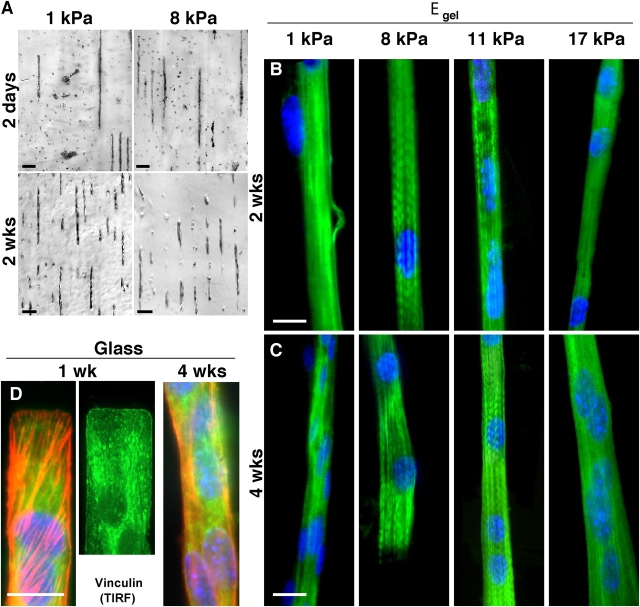
Contractile myocytes provide a test of the hypothesis that cells sense their mechanical as well as molecular microenvironment, altering expression, organization, and/or morphology accordingly. Here, myoblasts were cultured on collagen strips attached to glass or polymer gels of varied elasticity. Subsequent fusion into myotubes occurs independent of substrate flexibility. However, myosin/actin striations emerge later only on gels with stiffness typical of normal muscle (passive Young's modulus, E ∼12 kPa). On glass and much softer or stiffer gels, including gels emulating stiff dystrophic muscle, cells do not striate. In addition, myotubes grown on top of a compliant bottom layer of glass-attached myotubes (but not softer fibroblasts) will striate, whereas the bottom cells will only assemble stress fibers and vinculin-rich adhesions. Unlike sarcomere formation, adhesion strength increases monotonically versus substrate stiffness with strongest adhesion on glass. These findings have major implications for in vivo introduction of stem cells into diseased or damaged striated muscle of altered mechanical composition.
Overview
The claims and statistics of this paper haven’t been checked yet.
Free: it reads the open-access text and checks the first 5 claims that cite a source we can check. Create a free account to check every claim.
Integrity signals
Registry
Cites
Statistics
Figures




Verification
Claims the paper makes
The claims and statistics of this paper haven’t been checked yet.
Free: it reads the open-access text and checks the first 5 claims that cite a source we can check. Create a free account to check every claim.
Claims other papers make about this one
Each is checked against this paper’s own text: does it say what the citing paper says it does?
The source backs part of the claim, not all of it — or backs it for a different population, condition or comparison.
In the citing paper
“Additionally, the stiffness of the cellular environment or niche is an additional mechanical signal that influences for example the differentiation of mesenchymal stem cells into muscle and other cell types (34, 35).”
From The Hippo signal transduction network for exercise physiologists (2016) · cites this paper as [34]
Experimental — accuracy not yet measuredThe cited source says what the claim attributes to it.
In the citing paper
“In studies using biomimetic niches, substrates with an elastic stiffness of young adult skeletal muscle (∼12 kPa Young's modulus, the characteristic elastic rigidity of a material), which is five orders of magnitude softer than traditonal tissue culture plastic), promote MuSC self-renewal29,31 and myoblast differentiation94,95 (Fig. 4).”
From The central role of muscle stem cells in regenerative failure with aging (2015) · cites this paper as [94]
Self-check
Percentages, sums and reported differences re-computed from the paper’s own numbers.
The self-check needs the paper’s full text.
Citations
Cites
Calcium's Role in Mechanotransduction during Muscle Development
Benavides Damm, T., & Egli, M. (2014) · Cellular Physiology and Biochemistry · doi:10.1159/000356667 · Cited by 14,502
Biomechanics. Mechanical Properties of Living Tissues
Fung, Y. C., & Skalak, R. (1982) · Journal of Applied Mechanics · doi:10.1115/1.3162171 · Cited by 6,025
Cell Movement Is Guided by the Rigidity of the Substrate
Lo, C.-M., Wang, H.-B., Dembo, M., & Wang, Y.-L. (2000) · Biophysical Journal · doi:10.1016/s0006-3495(00)76279-5 · Cited by 3,289 · cited 3×
“FAK regulation could also occur by calciumdependent mechanisms (Lo et al., 2000) or stretch-activation (Nakamura et al.”
BackgroundCell locomotion and focal adhesions are regulated by substrate flexibility
Pelham, R. J., & Wang, Y.-L. (1997) · Proceedings of the National Academy of Sciences · doi:10.1073/pnas.94.25.13661 · Cited by 3,027 · cited 7×
“The reason is unclear, but physical aspects of the microenvironment, especially mechanical compliance of matrix (Pelham and Wang, 1997) and perhaps adjacent cells, are becoming increasingly linked to gene expression and protein organization.”
BackgroundInfluentialTaking Cell-Matrix Adhesions to the Third Dimension
Cukierman, E., Pankov, R., Stevens, D. R., & Yamada, K. M. (2001) · Science · doi:10.1126/science.1064829 · Cited by 3,027 · cited 1×
“…adhesion (Choquest et al., 1997; Beningo et al., 2001), posttranslational modification (Pelham and Wang, 1997; Beningo et al., 2001), protein expression (Cukierman et al., 2001), cytoskeletal organization (Cukierman et al., 2001; Engler et al., 2004a), and even cell viability (Wang et al., 2000).”
BackgroundCells lying on a bed of microneedles: An approach to isolate mechanical force
Tan, J. L., Tien, J., Pirone, D. M., Gray, D. S., Bhadriraju, K., & Chen, C. S. (2003) · Proceedings of the National Academy of Sciences · doi:10.1073/pnas.0235407100 · Cited by 1,962 · cited 2×
“The mechanism of coalignment is understood, from theory (Bischofs and Schwartz, 2003), to involve a propagation of cell-induced substrate contractions (Pelham and Wang, 1997; Wang et al., 2001; Tan et al., 2003 ).”
BackgroundSilicone Rubber Substrata: A New Wrinkle in the Study of Cell Locomotion
Harris, A. K., Wild, P., & Stopak, D. (1980) · Science · doi:10.1126/science.6987736 · Cited by 1,348 · cited 1×
“Analogous to the wrinkling of films by cells (Harris et al., 1980; Oliver et al., 1995), cells generate traction forces on collagen-coated polyacrylamide (PA) gel substrates.”
BackgroundExtracellular Matrix Rigidity Causes Strengthening of Integrin–Cytoskeleton Linkages
Choquet, D., Felsenfeld, D. P., & Sheetz, M. P. (1997) · Cell · doi:10.1016/s0092-8674(00)81856-5 · Cited by 1,245 · cited 1×
“Such signals feed back into cell tension (Wang et al., 2002), cell adhesion ( Choquest et al., 1997; Beningo et al., 2001), posttranslational modification (Pelham and Wang, 1997; Beningo et al., 2001), protein expression (Cukierman et al., 2001), cytoskeletal organization (Cukierman et al., 2001; Engler et al., 2004a)…”
BackgroundDetermination of Elastic Moduli of Thin Layers of Soft Material Using the Atomic Force Microscope
Dimitriadis, E. K., Horkay, F., Maresca, J., Kachar, B., & Chadwick, R. S. (2002) · Biophysical Journal · doi:10.1016/s0006-3495(02)75620-8 · Cited by 1,230 · cited 2×
“Mechanics of gels The elastic modulus of various gels was determined by AFM as well as macroscopic methods (Dimitriadis et al., 2002; Engler et al., 2004a).”
MethodSubstrate Compliance versus Ligand Density in Cell on Gel Responses
Engler, A., Bacakova, L., Newman, C., Hategan, A., Griffin, M., & Discher, D. (2004) · Biophysical Journal · doi:10.1016/s0006-3495(04)74140-5 · Cited by 1,141 · cited 16×
“In the absence of stiff ECM resistance, however, assembly and phosphorylation of adhesion proteins are inhibited (Pelham and Wang, 1997), and thus F-actin assembly is reduced (Engler et al., 2004a).”
BackgroundMethodInfluentialSelf-citation
Research works printed but not linked: 1
- 2004, Surf. Sci., In press
Cited by
Items 301–400 of 1,003
Sensing and Modulation of Invadopodia across a Wide Range of Rigidities
Parekh, A., Ruppender, N. S., Branch, K. M., Sewell-Loftin, M. K., Lin, J., Boyer, P. D., Candiello, J., Merryman, W. D., Guelcher, S. A., & Weaver, A. M. (2011) · Biophysical Journal · doi:10.1016/j.bpj.2010.12.3733 · Cited by 152
“Nonetheless, substrate stiffness has been shown to be more important for determining cell shape than adhesive ligand density (51), implying that”
BackgroundCharacterizing the micro-scale elastic modulus of hydrogels for use in regenerative medicine
Markert, C. D., Guo, X., Skardal, A., Wang, Z., Bharadwaj, S., Zhang, Y., Bonin, K., & Guthold, M. (2013) · Journal of the mechanical behavior of biomedical materials/Journal of mechanical behavior of biomedical materials · doi:10.1016/j.jmbbm.2013.07.008 · Cited by 129
“The elastic modulus of hydrogels has previously been experimentally manipulated by varying acrylamide and bis-acrylamide concentrations (Engler et al., 2004) or the percentage of poly-”
BackgroundMethodCooke, M. E., Allon, A. A., Cheng, T., Kuo, A. C., Kim, H. T., Vail, T. P., Marcucio, R., Schneider, R. A., Lotz, J. C., & Alliston, T. N. (2011) · Osteoarthritis and Cartilage · doi:10.1016/j.joca.2011.07.005 · Cited by 131
Nanopatterned cardiac cell patches promote stem cell niche formation and myocardial regeneration
Kim, D., Gupta, K., Smith, R. R., Kim, P., Ahn, E. H., Kim, H. N., Marbán, E., Suh, K. Y., & Levchenko, A. (2012) · Integrative Biology · doi:10.1039/c2ib20067h · Cited by 134
Elango, J., Zhang, J., Bao, B., Palaniyandi, K., Wang, S., Wu, W., & Robinson, J. S. (2016) · International Journal of Biological Macromolecules · doi:10.1016/j.ijbiomac.2016.05.067 · Cited by 121
Decellularized spinach: An edible scaffold for laboratory-grown meat
Jones, J. D., Rebello, A. S., & Gaudette, G. R. (2021) · Food Bioscience · doi:10.1016/j.fbio.2021.100986 · Cited by 133
Hillberg, A. L., Holmes, C. A., & Tabrizian, M. (2009) · Biomaterials · doi:10.1016/j.biomaterials.2009.05.026 · Cited by 134
Park, K., Ko, K. S., Joung, Y. K., Shin, H., & Park, K. D. (2011) · Journal of Materials Chemistry · doi:10.1039/c1jm12527c · Cited by 131
Cafarelli, A., Verbeni, A., Poliziani, A., Dario, P., Menciassi, A., & Ricotti, L. (2016) · Acta Biomaterialia · doi:10.1016/j.actbio.2016.11.049 · Cited by 137
Fabrication methods of an engineered microenvironment for analysis of cell–biomaterial interactions
Shin, H. (2006) · Biomaterials · doi:10.1016/j.biomaterials.2006.08.007 · Cited by 134
Use of Flow, Electrical, and Mechanical Stimulation to Promote Engineering of Striated Muscles
Rangarajan, S., Madden, L., & Bursac, N. (2014) · Annals of Biomedical Engineering · doi:10.1007/s10439-013-0966-4 · Cited by 122
Cell response to matrix mechanics: Focus on collagen
Plant, A. L., Bhadriraju, K., Spurlin, T. A., & Elliott, J. T. (2008) · Biochimica et Biophysica Acta (BBA) - Molecular Cell Research · doi:10.1016/j.bbamcr.2008.10.012 · Cited by 139
“On the other hand, data on the response of smooth muscle cells to matrix stiffness through stress fibers and membrane tension have led to the suggestion that mechanics may override matrix ligand pathways in directing cell responses [46].”
BackgroundAhmed, W., Wolfram, T., Goldyn, A. M., Bruellhoff, K., Rioja, B. A., Möller, M., Spatz, J. P., Saif, T. A., Gröll, J., & Kemkemer, R. (2009) · Biomaterials · doi:10.1016/j.biomaterials.2009.09.047 · Cited by 121
“In the absence of mechanical strain myotube formation occurs on substrates regardless of stiffness [14], however mature sarcomeric striations form only on substrates with elastic modulus ranging from 10 to 12 kPa, which implicates that restoring forces of the surrounding matrix might influence myotube development [15].”
Integrating Biomaterials and Food Biopolymers for Cultured Meat Production
Ng, S., & Kurisawa, M. (2020) · Acta Biomaterialia · doi:10.1016/j.actbio.2021.01.017 · Cited by 128
Culturing C2C12 myotubes on micromolded gelatin hydrogels accelerates myotube maturation
Denes, L. T., Riley, L. A., Mijares, J., Arboleda, J. D., McKee, K., Esser, K. A., & Wang, E. T. (2019) · Skeletal Muscle · doi:10.1186/s13395-019-0203-4 · Cited by 142
“Over the next several days, myotubes develop similarly to embryonic skeletal muscle, but often detach from the cell culture dish after approximately 7 to 10 days due to spontaneous contraction [15, 16].”
BackgroundAltomare, L., Gadegaard, N., Visai, L., Tanzi, M. C., & Farè, S. (2009) · Acta Biomaterialia · doi:10.1016/j.actbio.2009.12.040 · Cited by 120
Complex Stiffness Gradient Substrates for Studying Mechanotactic Cell Migration
Kuo, C. R., Xian, J., Brenton, J. D., Franze, K., & Sivaniah, E. (2012) · Advanced Materials · doi:10.1002/adma.201202520 · Cited by 117
Hydrophobic nanopillars initiate mesenchymal stem cell aggregation and osteo-differentiation
Brammer, K. S., Choi, C., Frandsen, C. J., Oh, S., & Jin, S. (2010) · Acta Biomaterialia · doi:10.1016/j.actbio.2010.09.022 · Cited by 120
Myotube formation on gelatin nanofibers – Multi-walled carbon nanotubes hybrid scaffolds
Ostrovidov, S., Shi, X., Zhang, L., Liang, X., Kim, S. B., Fujie, T., Ramalingam, M., Chen, M. W., Nakajima, K., Al-Hazmi, F., et al. (2014) · Biomaterials · doi:10.1016/j.biomaterials.2014.04.021 · Cited by 127
3D Bioprinting at the Frontier of Regenerative Medicine, Pharmaceutical, and Food Industries
Ramadan, Q., & Zourob, M. M. (2021) · Frontiers in Medical Technology · doi:10.3389/fmedt.2020.607648 · Cited by 142
Nuclear deformation guides chromatin reorganization in cardiac development and disease
Seelbinder, B., Ghosh, S., Schneider, S. E., Scott, A. K., Berman, A. G., Goergen, C. J., Margulies, K. B., Bedi, K. C., Casas, E., Swearingen, A. R., et al. (2021) · Nature Biomedical Engineering · doi:10.1038/s41551-021-00823-9 · Cited by 119
Ahadian, S., Ramón-Azcón, J., Ostrovidov, S., Camci-Unal, G., Hosseini, V., Kaji, H., Ino, K., Shiku, H., Khademhosseini, A., & Matsue, T. (2012) · Lab on a Chip · doi:10.1039/c2lc40479f · Cited by 118
Miller, A. E., Hu, P., & Barker, T. H. (2020) · Advanced Healthcare Materials · doi:10.1002/adhm.201901445 · Cited by 127
Silver, J. S., Günay, K. A., Cutler, A. A., Vogler, T. O., Brown, T. E., Pawlikowski, B. T., Bednarski, O. J., Bannister, K. L., Rogowski, C. J., Mckay, A. G., et al. (2021) · Science Advances · doi:10.1126/sciadv.abe4501 · Cited by 129
Self-Organization of Muscle Cell Structure and Function
Grosberg, A., Kuo, P.-L., Guo, C.-L., Geisse, N. A., Bray, M.-A., Adams, W. J., Sheehy, S. P., & Parker, K. K. (2011) · PLoS Computational Biology · doi:10.1371/journal.pcbi.1001088 · Cited by 116
“Our model assumes that the assembly of FAs and the parallel bundling of actin based fibers is coupled by a positive feedback loop and that the growing force on the FA potentiates its structural reinforcement, as suggested by previous experimental work [7,8,9].”
BackgroundResultMicrowrinkled Conducting Polymer Interface for Anisotropic Multicellular Alignment
Greco, F., Fujie, T., Ricotti, L., Taccola, S., Mazzolai, B., & Mattoli, V. (2012) · ACS Applied Materials & Interfaces · doi:10.1021/am301908w · Cited by 123
Engineering functional and histological regeneration of vascularized skeletal muscle
Gilbert‐Honick, J., Iyer, S. R., Somers, S. M., Lovering, R. M., Wagner, K. R., Mao, H., & Grayson, W. L. (2018) · Biomaterials · doi:10.1016/j.biomaterials.2018.02.006 · Cited by 116
Tailoring material properties of a nanofibrous extracellular matrix derived hydrogel
Johnson, T. D., Lin, S. Y., & Christman, K. L. (2011) · Nanotechnology · doi:10.1088/0957-4484/22/49/494015 · Cited by 115
“It has previously been shown that the stiffness of a gel or scaffold can impact cell fate [48], and thus being able to modify this material property may be advantageous.”
The Muscle Stem Cell Niche: Regulation of Satellite Cells During Regeneration
Boonen, K. J. M., & Post, M. J. (2008) · Tissue Engineering Part B Reviews · doi:10.1089/ten.teb.2008.0045 · Cited by 128
“3) or on top of a layer of myotubes (Young’s modulus, 12–15 kPa).(173) Probably, the proliferative capacity of cells(175) is also influenced by substrate stiffness (personal observations), which could partly explain the discrepancy between the in vivo and in vitro proliferative behavior of satellite cells.”
Zeng, Y., Yi, J., Wan, Z., Liu, K., Song, P., Chau, A., Wang, F., Chang, Z., Han, W., Zheng, W., et al. (2015) · European Journal of Immunology · doi:10.1002/eji.201444777 · Cited by 116
Optimizing the structure and contractility of engineered skeletal muscle thin films
Sun, Y., Duffy, R., Lee, A., & Feinberg, A. W. (2013) · Acta Biomaterialia · doi:10.1016/j.actbio.2013.04.036 · Cited by 115
Buxboim, A., Irianto, J., Swift, J., Athirasala, A., Shin, J.-W., Rehfeldt, F., & Discher, D. E. (2017) · Molecular Biology of the Cell · doi:10.1091/mbc.e17-06-0393 · Cited by 114
“…et al. 2015), plating of cells on surfaces with different mechanical properties has been well studied in terms of the effects on the acto-myosin cytoskeleton (Beningo et al. 2004, Engler et al. 2004, Prager-Khoutorsky et al. 2011, Talele et al. 2015, Meacci et al. 2016, Kassianidou et al. 2017).”
BackgroundInfluentialSelf-citationHakim Khalili, M., Zhang, R., Wilson, S., Goel, S., Impey, S. A., & Aria, A. I. (2023) · Polymers · doi:10.3390/polym15102341 · Cited by 114
Davidenko, N., Bax, D. V., Schuster, C. F., Farndale, R. W., Hamaia, S. W., Best, S. M., & Cameron, R. E. (2016) · Journal of Materials Science: Materials in Medicine · doi:10.1007/s10856-015-5627-8 · Cited by 112
Computational modeling of three-dimensional ECM-rigidity sensing to guide directed cell migration
Kim, M., Silberberg, Y. R., Abeyaratne, R., Kamm, R. D., & Asada, H. H. (2018) · Proceedings of the National Academy of Sciences · doi:10.1073/pnas.1717230115 · Cited by 117
“Cellular mechanosensing in the surrounding ECM also influences many cellular functions such as cell spreading (3, 4), cell migration (5), and stem cell differentiation (6, 7).”
BackgroundPatel, D. B., Santoro, M., Born, L. J., Fisher, J. P., & Jay, S. M. (2018) · Biotechnology Advances · doi:10.1016/j.biotechadv.2018.09.001 · Cited by 125
“Further, the regulation of MSC specification by matrix stiffness was shown to involve non-muscle myosin (Engler et al., 2004).”
BackgroundImproving the mechanical properties of chitosan-based heart valve scaffolds using chitosan fibers
Albanna, M. Z., Bou-Akl, T. H., Walters, H. L., & Matthew, H. W. T. (2011) · Journal of the mechanical behavior of biomedical materials/Journal of mechanical behavior of biomedical materials · doi:10.1016/j.jmbbm.2011.08.021 · Cited by 113
Simulation and Fabrication of Stronger, Larger, and Faster Walking Biohybrid Machines
Pagan‐Diaz, G. J., Zhang, X., Grant, L., Kim, Y., Aydin, O., Cvetkovic, C., Ko, E. C., Solomon, E. A., Hollis, J., Kong, H., et al. (2018) · Advanced Functional Materials · doi:10.1002/adfm.201801145 · Cited by 119
Pupkaitė, J., Rosenquist, J., Hilborn, J. G., & Samanta, A. (2019) · Biomacromolecules · doi:10.1021/acs.biomac.9b00769 · Cited by 120
A photo-modulatable material for probing cellular responses to substrate rigidity
Frey, M. T., & Wang, Y.-L. (2009) · Soft Matter · doi:10.1039/b818104g · Cited by 112
Hashimoto, Y., Funamoto, S., Kimura, T., Nam, K., Fujisato, T., & Kishida, A. (2011) · Biomaterials · doi:10.1016/j.biomaterials.2011.06.008 · Cited by 119
“reported that matrix elasticity strongly affected differentiation of MSCs and rigid matrices that mimic bone induced osteogenic differentiation [7,40].”
BackgroundThe influence of substrate stiffness gradients on primary human dermal fibroblasts
Hopp, I., Michelmore, A., Smith, L. E., Robinson, D. E., Bachhuka, A., Mierczynska-Vasilev, A. M., & Vasilev, K. A. (2013) · Biomaterials · doi:10.1016/j.biomaterials.2013.03.075 · Cited by 119
Adhesion-contractile balance in myocyte differentiation
Griffin, M. A., Sen, S., Sweeney, H. L., & Discher, D. E. (2004) · Journal of Cell Science · doi:10.1242/jcs.01496 · Cited by 111
“S1 in supplementary material) (Engler et al., 2004b).”
BackgroundMethodInfluentialSelf-citationNikolić, N., Görgens, S. W., Thoresen, G. H., Aas, V., Eckel, J., & Eckardt, K. (2017) · Acta Physiologica · doi:10.1111/apha.12830 · Cited by 110
“In addition, muscle fibres in vivo are surrounded by connective tissue and extracellular matrix, which might impact on transcriptional activation of genes in contracting cells, as well as protein release (Purslow 2002, Engler et al. 2004).”
BackgroundNoriega, S. E., Hasanova, G., Schneider, M., Larsen, G. F., & Subramanian, A. (2011) · Cells Tissues Organs · doi:10.1159/000325144 · Cited by 119
“Interestingly, cells seem to be tuned mechanically so that they preferentially differentiate on ECMs that have mechanical stiffness similar to that of their natural tissues [Engler et al., 2004; Georges and Janmey, 2005].”
Rational design of biodegradable thermoplastic polyurethanes for tissue repair
Xu, C., & Hong, Y. (2022) · Bioactive Materials · doi:10.1016/j.bioactmat.2021.11.029 · Cited by 109
Matrix Stiffness: A Regulator of Cellular Behavior and Tissue Formation
Mason, B. N., Califano, J. P., & Reinhart‐King, C. A. (2011) · Springer eBooks · doi:10.1007/978-1-4614-1080-5_2 · Cited by 123
Bio-printing of aligned GelMa-based cell-laden structure for muscle tissue regeneration
Hwangbo, H., Lee, H., Jin, E., Lee, J., Jo, Y., Ryu, D., & Kim, G. (2021) · Bioactive Materials · doi:10.1016/j.bioactmat.2021.06.031 · Cited by 122
“62 mechanical stiffness of the cell-culturing or cell-encapsulating matrix [21,22].”
Stiffness of the substrate influences the phenotype of embryonic chicken cardiac myocytes
Bajaj, P., Tang, X., Saif, T. A., & Bashir, R. (2010) · Journal of Biomedical Materials Research Part A · doi:10.1002/jbm.a.32951 · Cited by 106
Engineering Muscle Constructs for the Creation of Functional Engineered Musculoskeletal Tissue
Mertens, J. P., Sugg, K. B., Lee, J. D., & Larkin, L. M. (2013) · Regenerative Medicine · doi:10.2217/rme.13.81 · Cited by 123
Aligned chitosan-based nanofibers for enhanced myogenesis
Cooper, A., Jana, S., Bhattarai, N., & Zhang, M. (2010) · Journal of Materials Chemistry · doi:10.1039/c0jm01841d · Cited by 119
Combining adult stem cells and polymeric devices for tissue engineering in infarcted myocardium
Karam, J., Muscari, C., & Montero‐Menei, C. N. (2012) · Biomaterials · doi:10.1016/j.biomaterials.2012.04.028 · Cited by 120
Nieuwenhove, I. V., Tytgat, L., Ryx, M., Blondeel, P. N., Stillaert, F. B. J. L., Thienpont, H., Ottevaere, H., Dubruel, P., & Vlierberghe, S. V. (2017) · Acta Biomaterialia · doi:10.1016/j.actbio.2017.09.026 · Cited by 115
3D‐Printed Biomimetic Scaffold Simulating Microfibril Muscle Structure
Kim, W.-J., Kim, M., & Kim, G. (2018) · Advanced Functional Materials · doi:10.1002/adfm.201800405 · Cited by 109
Paul, R., Heil, P., Spatz, J. P., & Schwarz, U. S. (2007) · Biophysical Journal · doi:10.1529/biophysj.107.108688 · Cited by 112
“This value also corresponds well to the order-of-magnitude estimate Fc 1⁄4 T0w/N 1⁄4 12 nN which one can derive from the measured peeling tension T0 1⁄4 6 nN/mm for adhering cells (where cell width w1⁄4 20 mm and number of adhesions N1⁄4 10) (40).”
BackgroundModulus-dependent macrophage adhesion and behavior
Irwin, E. F., Saha, K., Rosenbluth, M., Gamble, L. J., Castner, D. G., & Healy, K. E. (2008) · Journal of Biomaterials Science, Polymer Edition · doi:10.1163/156856208786052407 · Cited by 105
Eugenis, I., Wu, D., & Rando, T. A. (2021) · Biomaterials · doi:10.1016/j.biomaterials.2021.121173 · Cited by 115
Regulation of glucose transporters by insulin and extracellular glucose in C2C12 myotubes.
Nedachi, T., & Kanzaki, M. (2006) · American Journal of Physiology. Endocrinology and Metabolism · doi:10.1152/ajpendo.00194.2006 · Cited by 131
Cardiac myocyte force development during differentiation and maturation
Jacot, J. G., Kita‐Matsuo, H., Wei, K. A., Vincent Chen, H. S., Omens, J. H., Mercola, M., & McCulloch, A. D. (2010) · Annals of the New York Academy of Sciences · doi:10.1111/j.1749-6632.2009.05091.x · Cited by 105
Cell shape, spreading symmetry, and the polarization of stress-fibers in cells
Zemel, A., Rehfeldt, F., Brown, A. E., Discher, D. E., & Safran, S. A. (2010) · Journal of Physics Condensed Matter · doi:10.1088/0953-8984/22/19/194110 · Cited by 114
“Engler et al [6] have shown that while the level of stem cell elongation on a substrate depends non-monotonically on the matrix rigidity, smooth muscle cells do not show this dependence; these cells adopt elongated morphologies (characteristic of muscle cells) even when plated on glass surfaces.”
BackgroundMethodResultSelf-citationBoron Nitride Nanotube-Mediated Stimulation of Cell Co-Culture on Micro-Engineered Hydrogels
Ricotti, L., Fujie, T., Vazão, H., Ciofani, G., Marotta, R., Brescia, R., Filippeschi, C., Corradini, I., Matteoli, M., Mattoli, V., et al. (2013) · PLoS ONE · doi:10.1371/journal.pone.0071707 · Cited by 109
“It has been demonstrated that skeletal muscle cells optimally differentiate by forming elongated and multinucleated myotubes when cultured on substrates characterized by tissue-like stiffness (10–15 kPa) [16], while much softer or much stiffer matrices hamper myotube formation or induce cell detachment.”
BackgroundSubstrate Stiffness Modulates Gene Expression and Phenotype in Neonatal Cardiomyocytes In Vitro
Forte, G., Pagliari, S., Ebara, M., Uto, K., Tam, J. K. V., Romanazzo, S., Escobedo‐Lucea, C., Romano, E., Nardo, P. D., Traversa, E., et al. (2012) · Tissue Engineering Part A · doi:10.1089/ten.tea.2011.0707 · Cited by 117
“Nonetheless, the process of cell fusion leading to the formation of myotubes did not seem to be affected by substrate mechanical properties.(18) In vivo, the slight variations in substrate stiffness following scar formation after myocardial infarction(19) have been proposed to impair injected or resident stem cell abi…”
Edible films for cultivated meat production
Xiang, N., Yao, Y. D., Yuen, J. S. K., Stout, A. J., Fennelly, C., Sylvia, R., Schnitzler, A. C., Wong, S. C., & Kaplan, D. L. (2022) · Biomaterials · doi:10.1016/j.biomaterials.2022.121659 · Cited by 108
Hickey, R. J., Modulevsky, D. J., Cuerrier, C. M., & Pelling, A. E. (2018) · ACS Biomaterials Science & Engineering · doi:10.1021/acsbiomaterials.8b00178 · Cited by 111
Vascularization of tissue-engineered skeletal muscle constructs
Gholobova, D., Terrie, L., Gérard, M., Declercq, H., & Thorrez, L. (2019) · Biomaterials · doi:10.1016/j.biomaterials.2019.119708 · Cited by 112
“Also for myotube formation and striation a proper stiffness is required [122].”
BackgroundActive biomaterials for mechanobiology
Özkale, B., Sakar, M. S., & Mooney, D. J. (2020) · Biomaterials · doi:10.1016/j.biomaterials.2020.120497 · Cited by 110
“This mechanism likely plays a major role in cellular responses to cyclic softening/stiffening, and active biomaterials can cross the 5 kPa mechanical threshold repeatedly [88], [152],”
BackgroundBio-hybrid muscle cell-based actuators
Ricotti, L., & Menciassi, A. (2012) · Biomedical Microdevices · doi:10.1007/s10544-012-9697-9 · Cited by 113
Elasticity, biodegradability and cell adhesive properties of chitosan/hyaluronan multilayer films
Schneider, A., Richert, L., Francius, G., Voegel, J., & Picart, C. (2007) · Biomedical Materials · doi:10.1088/1748-6041/2/1/s07 · Cited by 103
Ricotti, L., Polini, A., Genchi, G. G., Ciofani, G., Iandolo, D., Vazão, H., Mattoli, V., Ferreira, L., Menciassi, A., & Pisignano, D. (2012) · Biomedical Materials · doi:10.1088/1748-6041/7/3/035010 · Cited by 103
Kaufman, J. D., Miller, G. J., Morgan, E. F., & Klapperich, C. M. (2008) · Journal of materials research/Pratt's guide to venture capital sources · doi:10.1557/jmr.2008.0185 · Cited by 103
“Many factors contribute to the difficulty of measuring the mechanical properties of biomaterials on the scale of cellular interactions.(1) As with all polymers, the mechanical properties of biomaterials depend on loading rate and temperature.”
BackgroundMechanical derivation of functional myotubes from adipose-derived stem cells
Choi, Y. S., Vincent, L. G., Lee, A. R., Dobke, M. K., & Engler, A. J. (2011) · Biomaterials · doi:10.1016/j.biomaterials.2011.12.004 · Cited by 110
“Fibrotic muscle often is stiffer than normal such as in muscular dystrophy [1,15].”
Self-citationNorris, S. C. P., Kawecki, N. S., Davis, A. R., Chen, K. K., & Rowat, A. C. (2022) · Biomaterials · doi:10.1016/j.biomaterials.2022.121669 · Cited by 111
Cardiogenesis of Embryonic Stem Cells with Liquid Marble Micro‐Bioreactor
Sarvi, F., Jain, K., Arbatan, T., Verma, P. J., Hourigan, K., Thompson, M. C., Shen, W., & Chan, P. P. Y. (2014) · Advanced Healthcare Materials · doi:10.1002/adhm.201400138 · Cited by 107
Park, J., Choi, J. H., Kim, S., Jang, I., Jeong, S., & Lee, J. Y. (2019) · Acta Biomaterialia · doi:10.1016/j.actbio.2019.07.044 · Cited by 102
Mechanical Force Affects Expression of an In Vitro Metastasis-Like Phenotype in HCT-8 Cells
Tang, X., Kuhlenschmidt, T. B., Zhou, J., Bell, P., Wang, F., Kuhlenschmidt, M. S., & Saif, T. A. (2010) · Biophysical Journal · doi:10.1016/j.bpj.2010.08.034 · Cited by 112
Indentation measurements of the subendothelial matrix in bovine carotid arteries
Peloquin, J. M., Huynh, J., Williams, R. M., & Reinhart‐King, C. A. (2011) · Journal of Biomechanics · doi:10.1016/j.jbiomech.2010.12.018 · Cited by 103
The applications of atomic force microscopy to vision science
Last, J. A., Russell, P., Nealey, P. F., & Murphy, C. J. (2010) · Investigative Opthalmology & Visual Science · doi:10.1167/iovs.10-5470 · Cited by 100
Complex Interactions between Human Myoblasts and the Surrounding 3D Fibrin-Based Matrix
Chiron, S., Tomczak, C., Duperray, A., Lainé, J., Bonne, G., Eder, A., Hansen, A., Eschenhagen, T., Claude Verdier, A., & Coirault, C. (2012) · PLoS ONE · doi:10.1371/journal.pone.0036173 · Cited by 107
“In addition, it is noteworthy that the final elastic modulus of our construct matched the stiffness of normal skeletal muscle [17], further supporting the formation of a Figure 6.”
BackgroundMethodResultInfluentialFine-tuning of substrate architecture and surface chemistry promotes muscle tissue development
Guex, A. G., Kocher, F. M., Fortunato, G., Körner, E., Hegemann, D., Carrel, T. P., Tevaearai, H. T., & Giraud, M. (2012) · Acta Biomaterialia · doi:10.1016/j.actbio.2011.12.033 · Cited by 100
“[49] reported that myotubes differentiated optimally on substrates with tissue-like stiffness.”
BackgroundAnimal-free Meat Biofabrication
Bhat, Z. F., & Bhat, H. F. (2011) · American Journal of Food Technology · doi:10.3923/ajft.2011.441.459 · Cited by 115
Forte, G., Carotenuto, F., Pagliari, F., Pagliari, S., Cossa, P., Fiaccavento, R., Ahluwalia, A. D., Vozzi, G., Vinci, B., Serafino, A., et al. (2008) · Stem Cells · doi:10.1634/stemcells.2008-0061 · Cited by 99
Mechanosensing in macrophages and dendritic cells in steady-state and disease
Lee, M., Du, H., Winer, D. A., Clemente-Casares, X., & Tsai, S. (2022) · Frontiers in Cell and Developmental Biology · doi:10.3389/fcell.2022.1044729 · Cited by 99
“…et al. (2002) 2–5 kPa Adipose tissue, lymph nodes Samani et al. (2003) 0–12 kPa Lung McGee et al. (2008) 12 kPa Cardiomyocytes, skeletal muscle Engler et al. (2004) 3–16 kPa Spleen, endothelium (Arda et al., 2011; Pawluś et al., 2016; Le Master et al., 2018) 5–27 kPa Bone marrow Jansen et…”
BackgroundScott, E. A., Nichols, M. D., Kuntz-Willits, R., & Elbert, D. L. (2010) · Acta Biomaterialia · doi:10.1016/j.actbio.2009.07.009 · Cited by 99
“Gradients in these properties may have applications in both the transplantation of cells in vivo and the differentiation of stem cells in vitro [46–48].”
BackgroundForce nanoscopy of cell mechanics and cell adhesion
Dufrêne, Y. F., & Pelling, A. E. (2013) · Nanoscale · doi:10.1039/c3nr00340j · Cited by 99
Endothelial Network Formation Within Human Tissue-Engineered Skeletal Muscle
Gholobova, D., Decroix, L., Van Muylder, V., Desender, L., Gerard, M., Carpentier, G., Vandenburgh, H., & Thorrez, L. (2015) · Tissue Engineering Part A · doi:10.1089/ten.tea.2015.0093 · Cited by 99
“These have been described in vitro both in 2D 29 as well as in 3D muscle cultures.”
Francius, G., Hemmerlé, J., Jacques Ohayon, A., Schaaf, P., Voegel, J., Picart, C., & Senger, B. (2006) · Microscopy Research and Technique · doi:10.1002/jemt.20275 · Cited by 108
“Engler et al. have shown that the projected cell area of smooth muscle cells (Engler et al., 2004a) and myoblasts (Engler et al., 2004b) increases as the elastic modulus of the substrate increases up to a plateau value.”
Skeletal muscle tissue engineering: strategies for volumetric constructs
Cittadella, G., & Mantero, S. (2014) · Frontiers in Physiology · doi:10.3389/fphys.2014.00362 · Cited by 106
“…soleus SC Self-produced ECM In vitro model μpatterning; self assembly into 3D (roll-up) Riboldi et al., 2008 C2C12 Degrapol In vitro model μpatterning Engler et al., 2004 C2C12; primary human fibroblasts Patterned polyacrylamide gel In vitro model Mechanoregulation; cellular substrate Dennis et…”
BackgroundDesai, N., Rambhia, P., & Gishto, A. (2015) · Reproductive Biology and Endocrinology · doi:10.1186/s12958-015-0005-4 · Cited by 98
“Studies indicate distinct differences in cell signaling and behavior in cells grown in 2-D versus 3-D culture [105-107].”
BackgroundEnhancement of the Mechanical Properties of Hydrogels with Continuous Fibrous Reinforcement
Beckett, L. E., Lewis, J. T., Tonge, T. K., & Korley, L. T. J. (2020) · ACS Biomaterials Science & Engineering · doi:10.1021/acsbiomaterials.0c00911 · Cited by 106
Boularaoui, S. M., Shanti, A., Lanotte, M., Luo, S., Bawazir, S. S., Lee, S., Christoforou, N., Khan, K. A., & Stefanini, C. (2021) · ACS Biomaterials Science & Engineering · doi:10.1021/acsbiomaterials.1c01193 · Cited by 108
Naderi, P., Zarei, M., Karbasi, S., & Salehi, H. (2020) · European Polymer Journal · doi:10.1016/j.eurpolymj.2020.109502 · Cited by 101
Costantini, M., Testa, S., Fornetti, E., Barbetta, A., Trombetta, M., Cannata, S. M., Gargioli, C., & Rainer, A. (2017) · Frontiers in Bioengineering and Biotechnology · doi:10.3389/fbioe.2017.00022 · Cited by 109
“Pioneering studies have demonstrated that myogenic precursors are particularly sensitive to the stiffness of the substrate on top of which they are cultured, demonstrating that sarcomerogenesis is favored only for a small range of stiffness values (~10 ÷ 14 kPa) (Engler et al., 2004).”
BackgroundEnhanced efficiency of genetic programming toward cardiomyocyte creation through topographical cues
Morez, C., Noseda, M., Paiva, M. S. A., Belian, E., Schneider, M. D., & Stevens, M. M. (2015) · Biomaterials · doi:10.1016/j.biomaterials.2015.07.063 · Cited by 101
Steering cell behavior through mechanobiology in 3D: A regenerative medicine perspective
Zonderland, J., & Moroni, L. (2020) · Biomaterials · doi:10.1016/j.biomaterials.2020.120572 · Cited by 103
Brown, X. Q., Bartolak‐Suki, E., Williams, C., Walker, M. L., Weaver, V. M., & Wong, J. Y. (2010) · Journal of Cellular Physiology · doi:10.1002/jcp.22202 · Cited by 96
Genomic expression of mesenchymal stem cells to altered nanoscale topographies
Dalby, M. J., Andar, A. U., Nag, A., Affrossman, S., Tare, R. S., McFarlane, S., & Oreffo, R. O. C. (2008) · Journal of The Royal Society Interface · doi:10.1098/rsif.2008.0016 · Cited by 106
Cell-material interactions in tendon tissue engineering
Lin, J., Zhou, W., Han, S., Bunpetch, V., Zhao, K., Liu, C., Yin, Z., & Ouyang, H. (2018) · Acta Biomaterialia · doi:10.1016/j.actbio.2018.01.012 · Cited by 98
Scaffold-based 3D cellular models mimicking the heterogeneity of osteosarcoma stem cell niche
Bassi, G., Panseri, S., Dozio, S. M., Sandri, M., Campodoni, E., Dapporto, M., Sprio, S., Tampieri, A., & Montesi, M. (2020) · Scientific Reports · doi:10.1038/s41598-020-79448-y · Cited by 110
Skeletal myogenesis on highly orientated microfibrous polyesterurethane scaffolds
Riboldi, S. A., Sadr, N., Pigini, L., Neuenschwander, P., Simonet, M., Mognol, P., Sampaolesi, M., Cossu, G., & Mantero, S. (2007) · Journal of Biomedical Materials Research Part A · doi:10.1002/jbm.a.31534 · Cited by 94
Bian, W., & Bursac, N. (2008) · IEEE Engineering in Medicine and Biology Magazine · doi:10.1109/memb.2008.928460 · Cited by 96
Metadata
- Authors
- Engler, A. J., Griffin, M. A., Sen, S., Bönnemann, C. G., Sweeney, H. L., & Discher, D. E.
- Affiliations
- University of Pennsylvania (US)
- 2Pennsylvania Muscle Institute, University of Pennsylvania, Philadelphia, PA 19104
- Venue
- The Journal of Cell Biology
- Publisher
- Rockefeller University Press
- Published
- 2004-09-13
- Volume
- 166
- Issue
- 6
- Pages
- 877-887
- ISSN
- 0021-9525 (ISSN-L)
- 1540-8140
- PMC
- PMC2172122
- OpenAlex
- W2167243609
- Cited by
- 1,743
- References
- 57
- Citations by year
- 2026: 47 · 2025: 54 · 2024: 63 · 2023: 49 · 2022: 71 · 2021: 84 · 2020: 87 · 2019: 77 · 2018: 86 · 2017: 119 · 2016: 90 · 2015: 88 · 2014: 92 · 2013: 115 · 2012: 128
- FWCI
- 14.63
- Type
- journal article
- Language
- en
- Open access
- green
- www.ncbi.nlm.nih.gov
- Licence
- cc-by-nc-sa
- Locations
- The Journal of Cell Biology (publishedVersion)
- PubMed Central (publishedVersion, cc-by-nc-sa)
- PubMed (publishedVersion)
- ScholarlyCommons (University of Pennsylvania) (submittedVersion)
- eScholarship (California Digital Library) (submittedVersion)
- Topics
- Life Sciences › Biochemistry, Genetics and Molecular Biology › Cell Biology › Cellular Mechanics and Interactions
- Life Sciences › Biochemistry, Genetics and Molecular Biology › Molecular Biology › Muscle Physiology and Disorders
- Health Sciences › Medicine › Surgery › Tissue Engineering and Regenerative Medicine
- Keywords
- myotube differentiation, substrate stiffness, mechanotransduction, myoblast fusion, sarcomere formation, cell adhesion, stress fibers, vinculin, dystrophic muscle, collagen substrate, polymer gels, stem cell transplantation, muscle regeneration
- MeSH terms
- Polyacrylamides, Acrylic Resins, Animals, Cell Adhesion, Cell Differentiation, Cell Line, Cells, Cultured, Elasticity, Fibroblasts, Gels, Mice, Inbred C3H, Mice, Mutant Strains, Models, Biological, Substrate Specificity, Muscle, Skeletal, Muscle Fibers, Skeletal, Microscopy, Atomic Force, Fluorescent Antibody Technique, Direct, Mice
About these checks
Registry, retraction, Cites and statistics results are computed, not judged, with one exception: a printed reference that no index lists is read once by a model before it counts as a citation error. Claims are extracted by a model and kept only when their quote appears verbatim in the text; each cited source is then checked, with a model’s help, for whether it says what the claim relies on. Those verdicts can be wrong — read the claim’s quote and the cited source before relying on one.
Statistics and arithmetic are recomputed, not judged.
Confidence bands are shown only for fields calibrated on our annotated test set. None is calibrated yet, so no band is shown.
What counts as a claim ›How we measure confidence ›How we check this ›
Are you an author, or do you see a problem with this page? Request a review
Data sources
Bibliographic data: Semantic Scholar, OpenAlex, Crossref.
Contains information from the Semantic Scholar Academic Graph Datasets, made available under the ODC Attribution License (ODC-BY 1.0).
Semantic Scholar’s data is described in: Kinney, R., et al. (2023). The Semantic Scholar Open Data Platform. arXiv:2301.10140.
