

Domain randomization for transferring deep neural networks from simulation to the real world
Open accessThe DOI matches its Crossref record; 71 of the 71 references it cites were found in a registry or an index; 8 of the 17 sources its claims cite were checked for support.
Abstract
Bridging the `reality gap' that separates simulated robotics from experiments on hardware could accelerate robotic research through improved data availability. This paper explores domain randomization, a simple technique for training models on simulated images that transfer to real images by randomizing rendering in the simulator. With enough variability in the simulator, the real world may appear to the model as just another variation. We focus on the task of object localization, which is a stepping stone to general robotic manipulation skills. We find that it is possible to train a real-world object detector that is accurate to 1.5 cm and robust to distractors and partial occlusions using only data from a simulator with non-realistic random textures. To demonstrate the capabilities of our detectors, we show they can be used to perform grasping in a cluttered environment. To our knowledge, this is the first successful transfer of a deep neural network trained only on simulated RGB images (without pre-training on real images) to the real world for the purpose of robotic control.
Overview
CoChat Summary
TL;DR
This paper introduces domain randomization: training an object detector on simulated RGB images with randomized rendering, textures, lighting, camera pose, and distractors so that the real world appears as another variation. The authors show that a detector trained only in simulation can localize objects in the real world accurately enough to grasp them in clutter.
Key findings
- Real-world object detectors trained only on simulated images localized objects to within about 1.5 cm on average, including with distractors and partial occlusions; per-object errors in Table I range from 0.6 ± 0.3 cm to 3.2 ± 5.8 cm depending on object and condition.
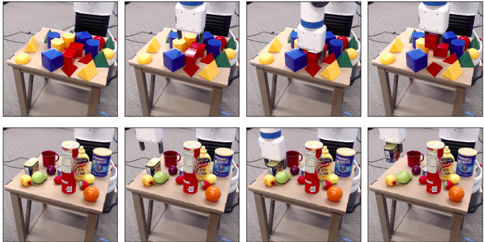
- The pipeline enabled a Fetch robot to detect and pick up the target object in 38 out of 40 trials in increasingly cluttered scenes, and a detector trained on a Spam can succeeded in 9 of 10 trials with previously unseen YCB food distractors.
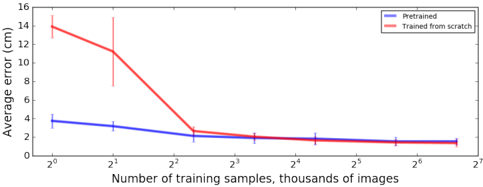
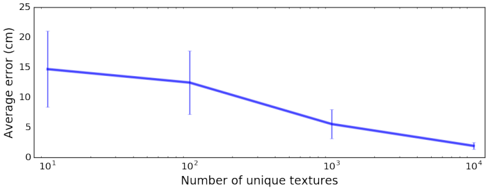
- Ablations found sensitivity to number of training images, number of unique textures, presence of distractors in training, and camera randomization; random noise had negligible effect. Performance improved up to around 50,000 training samples, and degraded significantly with fewer than 1,000 textures.
- ImageNet pretraining was not essential with enough data: random weight initialization achieved nearly the same real-world transfer performance as pretrained initialization, though pretraining helped in the low-data regime.
Methods
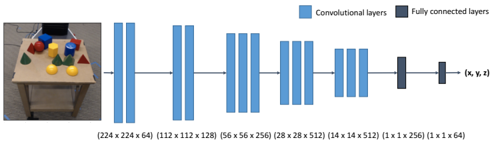
- The authors trained a modified VGG-16 convolutional neural network to map a single 224×224 monocular webcam image to Cartesian coordinates of object(s) of interest, using simulated images rendered by MuJoCo.
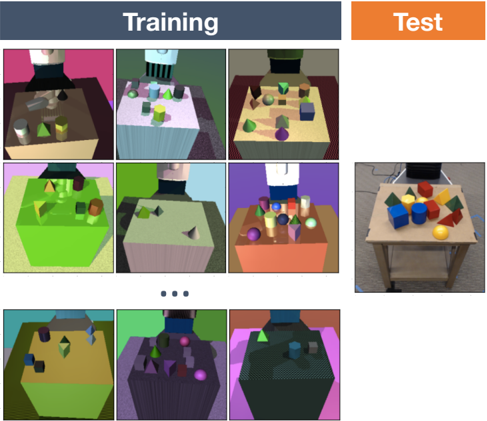
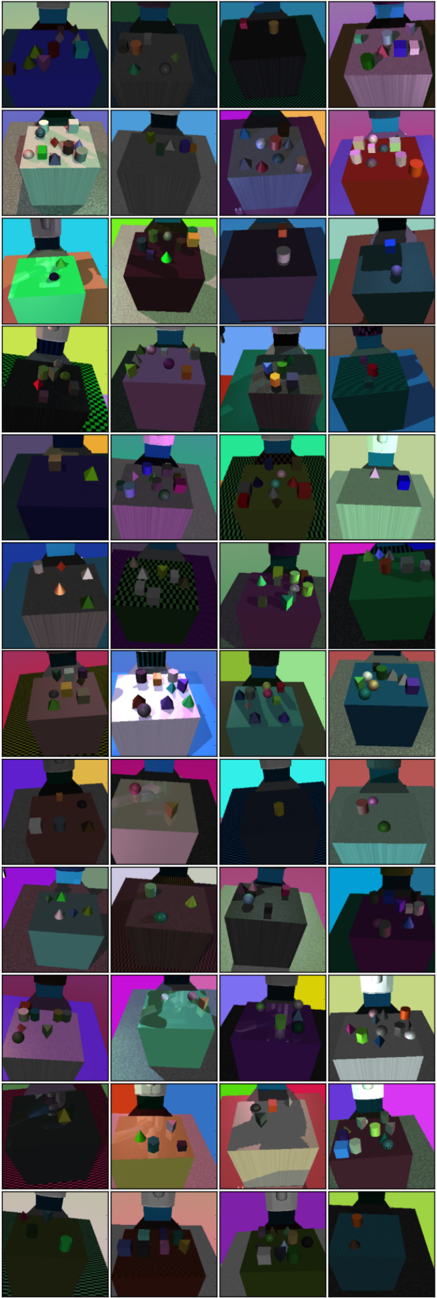
- Domain randomization varied number/shape of distractors, object positions and textures, table/floor/skybox/robot textures, camera position/orientation/field of view, number and properties of lights, and image noise. Textures were random RGB values, gradients, or checker patterns; 0–10 distractor objects were added per scene.
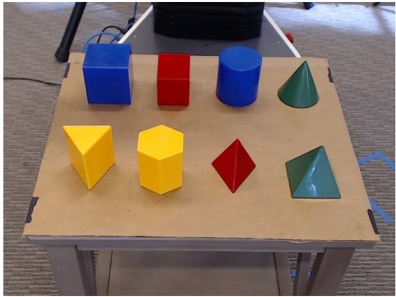
- Training used stochastic gradient descent with Adam on an L2 loss, learning rates around 1e-4, and batch sizes of 25, 50, or 100. Evaluation used 480 webcam images of eight geometric objects at 70–105 cm from a fixed camera, with 60 labeled images per object: 20 alone, 20 with distractors, and 20 partially occluded.
Limitations
- The paper states that the detectors still overfit simulated training data: simulated error was 0.3–0.5 cm versus about 1.5 cm in the real world, and no real-world validation could be done during training because no real data were assumed available.
- The paper states future work is needed for contact-rich manipulation or higher precision, and that the method fixes table height, effectively making the task 2D pose estimation from a single monocular uncalibrated camera.
- Evident from the text: evaluation is limited to eight geometric objects plus one Spam can, the test camera position remains constant across all images, and lighting and surrounding scene were not controlled.
Model-written summary. Check it against the paper before relying on it.
Integrity signals
Registry
Cites
Statistics
Figures
Verification
Claims the paper makes
2 Valid · 8 Not valid · 7 Not checked · 32 Own results and interpretations
The cited sources support only part of this claim — read each source’s verdict below.
In the paper
“Although previous work demonstrated the ability to perform robotic control using a neural network pretrained on ImageNet and fine-tuned on randomized rendered pixels [37], this paper provides the first demonstration that domain randomization can be useful for robotic tasks requiring precision.”
What the sources say
- Partly supportedcites [37] [37] Fereshteh Sadeghi and Sergey Levine. (cad) 2 RL: Real single-image flight without a single real image. arXiv preprint arXiv:1611.04201 , 2016. - sourceExperimental — accuracy not yet measured
The citation [37] is attached to the preceding claim about prior work, not to the citing authors’ claim that their own paper is the first to demonstrate precision robotics. Section 3.1 (p. 4) says LSDA pretrains a CNN on ImageNet classification data and fine-tunes it, but for object detection. It does not report robotic control or fine-tuning on randomized rendered pixels. (LLM, conf=0.84)
boostedstates a cause- Asserted: passes — The authors put it forward as true.
- Checkable: passes — It can be checked against evidence.
- Load-bearing: passes — The paper’s conclusions depend on it.
- Based: passes — The paper gives a reason why it holds.
- Partly supported
The cited sources that could be checked couldn’t confirm or dispute this claim.
In the paper
“Rather than relying on controller robustness, Yu et al. [53] use a model trained on varied physics to perform system identification using online trajectory data, but their approach is not shown to succeed in the real world.”
What the sources say
- Could not verifycites [53] [53] Wenhao Yu, C Karen Liu, and Greg Turk. Preparing for the unknown: Learning a universal policy with online system identification. arXiv preprint arXiv:1702.02453 , 2017. - sourceExperimental — accuracy not yet measured
The cited paper discusses image classification and localisation with convolutional networks (A.1, p. 10; A.2, p. 11), not Yu et al.'s approach. Searches for varied-physics training, online trajectory-based system identification, and real-world success found no passage addressing the claim. Our copy therefore cannot verify it. (LLM, conf=0.78)
plain- Asserted: passes — The authors put it forward as true.
- Checkable: passes — It can be checked against evidence.
- Load-bearing: unclear — It is unclear whether the paper’s conclusions depend on it.
- Based: passes — The paper gives a reason why it holds.
- Could not verify
The cited sources that could be checked couldn’t confirm or dispute this claim.
In the paper
“Though using realistic RGB rendering alone has had limited success for transferring to real robotic tasks [16], incorporating realistic simulation of depth information can allow models trained on rendered images to transfer reasonably well to the real world [32].”
What the sources say
- Could not verifycites [16] [16] Stephen James and Edward Johns. 3d simulation for robot arm control with deep q-learning. arXiv preprint arXiv:1609.03759 , 2016. - sourceExperimental — accuracy not yet measured
The Introduction (§1) and Conclusion (§8) describe Adam as a method for stochastic optimization, while the CNN experiment (§6.3) concerns training on image datasets. Searches for realistic RGB rendering and sim-to-real robotic transfer found no passage addressing whether RGB rendering alone has had limited success on real robotic tasks. (LLM, conf=0.78)
plain- Asserted: passes — The authors put it forward as true.
- Checkable: passes — It can be checked against evidence.
- Load-bearing: passes — The paper’s conclusions depend on it.
- Based: passes — The paper gives a reason why it holds.
- Could not verify
The cited sources that could be checked couldn’t confirm or dispute this claim.
In the paper
“However, their experiments - collision avoidance in hallways and open spaces - do not demonstrate the ability to deal with high-precision tasks.”
What the sources say
- Could not verifycites [37] [37] Fereshteh Sadeghi and Sergey Levine. (cad) 2 RL: Real single-image flight without a single real image. arXiv preprint arXiv:1611.04201 , 2016. - sourceExperimental — accuracy not yet measured
The Experiments section (p. 5) evaluates LSDA on an object-detection dataset, not Sadeghi and Levine’s collision-avoidance experiments. Searches for Sadeghi and Levine, hallway or open-space collision avoidance, and high-precision tasks found no passage addressing the claim. (LLM, conf=0.76)
plain- Asserted: passes — The authors put it forward as true.
- Checkable: passes — It can be checked against evidence.
- Load-bearing: passes — The paper’s conclusions depend on it.
- Based: passes — The paper gives a reason why it holds.
- Could not verify
A result the paper reports from its own data — it cites no other source for it, so there is none to check. The quote shows it is in the paper.
In the paper
“However, using a pre-trained model can significantly improve performance when less training data is used.”
plainstates a cause- Asserted: passes — The authors put it forward as true.
- Checkable: passes — It can be checked against evidence.
- Load-bearing: unclear — It is unclear whether the paper’s conclusions depend on it.
- Based: passes — The paper gives a reason why it holds.
29 more claims
Create a free account to see all 49 claims and to verify the 7 references still open.
- Probably not a substantial claim. 11
- It may state two separate claims as one. 8
Claims other papers make about this one
Each is checked against this paper’s own text: does it say what the citing paper says it does?
The source backs part of the claim, not all of it — or backs it for a different population, condition or comparison.
In the citing paper
“Most policies trained in simulation generalize poorly to the real-world due to agents adapting to specific visual details of the simulator.”
From Language-Based Augmentation to Address Shortcut Learning in Object-Goal Navigation (2023) · cites this paper as [8]
Experimental — accuracy not yet measuredThe source backs part of the claim, not all of it — or backs it for a different population, condition or comparison.
In the citing paper
“In robotic vision tasks including object localization [53], object detection [54], pose estimation [55], and semantic segmentation [56], the training data from simulator always have different textures, lighting, and camera positions from the realistic environments.”
From Sim-to-Real Transfer in Deep Reinforcement Learning for Robotics: a Survey (2020) · cites this paper as [53]
Experimental — accuracy not yet measuredThe source backs part of the claim, not all of it — or backs it for a different population, condition or comparison.
In the citing paper
“These artifacts limit the applicability of generative videos in physics-sensitive domains such as robotics [25,26], autonomous driving [27], simulationbased design, and scientific visualization [28].”
From PhyStruct-Video: Structured Physics State Spaces for Physically Consistent Video Generation (2025) · cites this paper as [25]
Experimental — accuracy not yet measuredThe source backs part of the claim, not all of it — or backs it for a different population, condition or comparison.
In the citing paper
“In domain randomization, the inputs during learning are “randomized” in the sense of being warped or corrupted in particular ways.”
From The overfitted brain: Dreams evolved to assist generalization (2021) · cites this paper as [144]
Experimental — accuracy not yet measuredThe source backs part of the claim, not all of it — or backs it for a different population, condition or comparison.
In the citing paper
“Domain randomization is a domain generalization technique that introduces drastic changes in the training image appearances, which forces the network to learn domain-invariant features between training and target domains [39].”
From A Fully Differentiable Framework for 2D/3D Registration and the Projective Spatial Transformers (2024) · cites this paper as [39]
Experimental — accuracy not yet measured
8 more claims about this paper
Create a free account to see every claim other papers make about this one.
Self-check
Percentages, sums and reported differences re-computed from the paper’s own numbers.
Each contradiction between two passages listed here was confirmed by an independent check.
Rated minor: it would not touch a result — a value no result rests on, a p-value that stays on the same side of the significance level, or a conflict that is clerical, resolved elsewhere in the paper, or outside its own findings.
In the paper
§ A. Experimental Setup · p. 4
“Each training sample consists of (a) a rendered image of the object and one or more distractors (also from among the geometric object set) on a simulated tabletop”
§ A. Domain randomization · p. 4
“Between 0 and 10 distractor objects are added to the table in each scene.”
Citations
Cites
Very Deep Convolutional Networks for Large-Scale Image Recognition
Simonyan, K., & Zisserman, A. (2014) · arXiv · doi:10.48550/arxiv.1409.1556 · Cited by 114,148 · cited 1×
“In particular, we use a modified version the VGG-16 architecture [42] shown in Figure 2.”
MethodAdam: A Method for Stochastic Optimization
Kingma, D. P., & Ba, J. (2014) · arXiv · doi:10.48550/arxiv.1412.6980 · Cited by 98,946 · cited 1×
“We found that using a learning rate of around 1e − 4 (as opposed to the standard 1e − 3 for Adam) improved convergence and helped avoid a common local optimum, mapping all objects to the center of the table.”
MethodLeCun, Y., Bengio, Y., & Hinton, G. (2015) · Nature · doi:10.1038/nature14539 · Cited by 84,126
Human-level control through deep reinforcement learning
Mnih, V., Kavukcuoglu, K., Silver, D., Rusu, A. A., Veness, J., Bellemare, M. G., Graves, A., Riedmiller, M., Fidjeland, A. K., Ostrovski, G., et al. (2015) · Nature · doi:10.1038/nature14236 · Cited by 30,357 · cited 3×
“Learning in simulation is especially promising for building on recent results using deep reinforcement learning to achieve human-level performance on tasks like Atari [27] and robotic control [21], [38].”
BackgroundResultHow transferable are features in deep neural networks?
Yosinski, J., Clune, J., Bengio, Y., & Lipson, H. (2014) · arXiv · doi:10.48550/arxiv.1411.1792 · Cited by 6,061 · cited 1×
“A variety of approaches have been proposed, including re-training the model in the target domain (e.g., [52]), adapting the weights of the model based on the statistics of the source and target domains (e.g., [22]), learning invariant features between domains (e.g., [47]), and learning a mapping…”
BackgroundMuJoCo: A physics engine for model-based control
Todorov, E., Erez, T., & Tassa, Y. (2012) · 2012 IEEE/RSJ International Conference on Intelligent Robots and Systems · doi:10.1109/iros.2012.6386109 · Cited by 4,767 · cited 1×
“We render images using the MuJoCo Physics Engine’s [45] built-in renderer.”
MethodTrust region policy optimization
Schulman, J., Levine, S., Moritz, P., Jordan, M. I., & Abbeel, P. (2015) · arXiv · doi:10.48550/arxiv.1502.05477 · Cited by 4,578 · cited 1×
“Learning in simulation is especially promising for building on recent results using deep reinforcement learning to achieve human-level performance on tasks like Atari [29] and robotic control [26], [41].”
ResultSelf-citationLearning Transferable Features with Deep Adaptation Networks
Long, M., Cao, Y., Wang, J., & Jordan, M. I. (2015) · arXiv · doi:10.48550/arxiv.1502.02791 · Cited by 4,505 · cited 1×
“omputer vision community has devoted significant study to the problem of adapting vision-based models trained in a source domain to a previously unseen target domain (see, e.g., [9], [14], [15], [19], [23], [25], [51]). A variety of approaches have been proposed, including re-training the model in the target domain (e.…”
BackgroundEnd-to-End Training of Deep Visuomotor Policies
Levine, S., Finn, C., Darrell, T., et al. (2015) · Journal of machine learning research · doi:10.5555/2946645.2946684 · Cited by 3,987
Describing Textures in the Wild
Cimpoi, M., Maji, S., Kokkinos, I., Mohamed, S., & Vedaldi, A. (2014) · 2014 IEEE Conference on Computer Vision and Pattern Recognition · doi:10.1109/cvpr.2014.461 · Cited by 2,438 · cited 1×
“To examine how our detectors would perform on objects with complex textures, we created simulated scenes in which the object of interest is given a texture from the Describable Textures Dataset (DTD) [4].”
Method
Research works printed but not linked: 3
- [24] David G Lowe. Three-dimensional object recognition from single two-dimensional images. Artificial intelligence , 31(3):355-395, 1987. -
- [49] Melonee Wise, Michael Ferguson, Derek King, Eric Diehr, and David Dymesich. Fetch and freight: Standard platforms for service robot applications. In Workshop on Autonomous Mobile Service Robots , 2016. -
- sucan, 0, MoveIt!
Cited by
Items 1,901–2,000 of 2,970
PCGOD: Enhancing Object Detection With Synthetic Data for Scarce and Sensitive Computer Vision Tasks
Remmas, W., Lints, M., & Uudmäe, J. J. (2025) · IEEE Access · doi:10.1109/access.2025.3572719 · Cited by 7
“An alternative strategy, domain randomization, has been proposed to expose the model to a wide range of visual variations during training [18].”
BehAVE: Behaviour Alignment of Video Game Encodings
Rašajski, N., Trivedi, C., Makantasis, K., Liapis, A., & Yannakakis, G. N. (2025) · Lecture notes in computer science · doi:10.1007/978-3-031-92387-6_23 · Cited by 5
“Tobin et al. [28] introduced the technique of domain randomisation to train transferable vision models by injecting variability during learning.”
BackgroundMethodOutdoor Dataset for Flying a UAV at an Appropriate Altitude
Alotaibi, T., Jambi, K. M., Khemakhem, M. A., Eassa, F. E., & Bourennani, F. (2025) · Drones · doi:10.3390/drones9060406 · Cited by 2
Seeing Through Uncertainty: Robot Pose Estimation Based on Imperfect Prior Kinematic Knowledge
Klüpfel, L., Burkhard, L., Reichert, A. E., Durner, M., & Triebel, R. (2025) · IEEE Transactions on Robotics · doi:10.1109/tro.2025.3577030 · Cited by 2
“For all three robotic systems, we train on synthetic images only, (re-)sized 640 × 480 × 3, which we generate for the Jaco2 and neoDavid using BlenderProc [53] and with various domain randomization techniques [54].”
Deep learning-based ranking method for subgroup and predictive biomarker identification in patients
Liu, Z., Gu, Y., & Huang, X. (2025) · Communications Medicine · doi:10.1038/s43856-025-00946-z · Cited by 5
“Furthermore, recent studies indicate that domain randomization, in which variations in color, texture, lighting, and other factors are introduced during simulation, cantrainneuralnetworksonsimulatedimagesthattransfertorealimages 44 .”
PDSP-Bench: A Benchmarking System for Parallel and Distributed Stream Processing
Agnihotri, P., Koldehofe, B., Heinrich, R., Binnig, C., & Luthra, M. (2025) · Lecture notes in computer science · doi:10.1007/978-3-031-93858-0_1 · Cited by 8
Quadruped Robot Locomotion Based on Deep Learning Rules
Escudero‐Villa, P., Merino, G., & Paredes‐Fierro, J. (2025) · International Electronic Conference on Applied Sciences (ASEC) · doi:10.3390/engproc2025087100 · Cited by 3
“By bridging sim-to-real disparities through domain randomization [17] and establishing CoG stability as a primary success criterion, this research advances robust locomotion strategies for real-world deployment.”
Robust 3D Shape Reconstruction in Zero-Shot from a Single Image in the Wild
Cho, J., Youwang, K., Yang, H., & Oh, T.-H. (2025) · IEEE Computer Society Conference on Computer Vision and Pattern Recognition/Proceedings - IEEE Computer Society Conference on Computer Vision and Pattern Recognition/Proceedings · doi:10.1109/cvpr52734.2025.02122 · Cited by 8
“To effectively tackle this issue, domain randomization meth-ods [8, 14, 26, 46, 56, 61, 67, 69, 84] synthesize multiple domains via a random simulation of diverse scenarios.”
Li, Z., Chen, W., Wang, S., Wang, P., Yuan, Y., Wu, T., Zhang, J., & Li, Q. (2025) · Complex & Intelligent Systems · doi:10.1007/s40747-025-02056-8 · Cited by 2
“Sim2Real techniques bridge the reality gap through domain randomization, accurate physics modeling, and sophisticated transfer methods, allowing RL-trained policies to achieve high performance and robustness when deployed on physical systems [17–20].”
Variable-Friction In-Hand Manipulation for Arbitrary Objects via Diffusion-Based Imitation Learning
Yan, Q., Ding, Z., Zhou, X., & Spiers, A. J. (2025) · Proceedings - IEEE International Conference on Robotics and Automation/Proceedings · doi:10.1109/icra55743.2025.11127479 · Cited by 3
“Domain randomization [30], [29] has been applied to parameters in the policy training and data collection process, with their ranges identified during SI.”
Generalizable Imitation Learning Through Pre-Trained Representations
Chang, W.-D., Hogan, F. R., Fujimoto, S., Meger, D., & Dudek, G. (2025) · Proceedings - IEEE International Conference on Robotics and Automation/Proceedings · doi:10.1109/icra55743.2025.11127800 · Cited by 6
“Unlike previous approaches, DVK generalizes to unseen objects and object classes by extracting visual object-part semantic concepts from expert demonstrations and tracking them as keypoints.”
Unified Sim-and-Real Scoring Methods for Robot Policy Selection
Im, S., & Lee, J. (2025) · The Journal of Korea Robotics Society · doi:10.7746/jkros.2025.20.3.371 · Cited by 2
Think Before You Act: Popperian Expectations for Adaptive Agents
Mills, J. R. E., & Lewis, P. R. (2025) · IEEE International Conference on Autonomic Computing and Self-Organizing Systems Companion (ACSOS-C) · doi:10.1109/acsos-c66519.2025.00038 · Cited by 4
Scalable and Generalizable RL Agents for Attack Path Discovery via Continuous Invariant Spaces
Terranova, F., Lahmadi, A., & Chrisment, I. (2025) · International Symposium on Research in Attacks, Intrusions and Defenses (RAID) · doi:10.1109/raid67961.2025.00029 · Cited by 11
“To prevent the agent from overfitting to a single vulnerability allocation or a fixed set of graph and cyber-terrain parameters, the scenario generator supports domain randomization [56].”
Generating All the Roads to Rome: Road Layout Randomization for Improved Road Marking Segmentation
Bruls, T., Porav, H., Kunze, L., & Newman, P. M. (2019) · IEEE International Conference on Intelligent Transportation Systems (ITSC) · doi:10.1109/itsc.2019.8916785 · Cited by 2
“We avoid solving this hard problem by employing the principles of domain randomization [13].”
MethodToward Robust Long Range Policy Transfer
Tseng, W.-C., Lin, J.-S., Feng, Y.-M., & Sun, M. (2021) · Proceedings of the AAAI Conference on Artificial Intelligence · doi:10.1609/aaai.v35i11.17196 · Cited by 6
“Although domain randomization (Tobin et al. 2017; Nachum et al. 2020) in the pre-training phase may mitigate this problem, we prefer the pre-trained policies to gradually fit the transferring tasks.”
BackgroundKubosawa, S., Onishi, T., & Tsuruoka, Y. (2021) · Society of Instrument and Control Engineers of Japan · Cited by 2
Null Space Based Efficient Reinforcement Learning with Hierarchical Safety Constraints
Yang, Q., Stork, J. A., & Stoyanov, T. (2021) · European Conference on Mobile Robots · doi:10.1109/ecmr50962.2021.9568848 · Cited by 7
Research on Force Control Based on Sim2Real Transfer for Stiffness of Thin-walled Parts
均优于现有基, N., Xiangfei, L., Xianming, H., Yuanhao, C., Huan, Z., & Han, D. (2021) · Journal of Mechanical Engineering · doi:10.3901/jme.2021.17.053 · Cited by 2
AI and Simulation for Soft Sensors and Process Control
Kubosawa, S., Onishi, T., & Tsuruoka, Y. (2022) · KAGAKU KOGAKU RONBUNSHU · doi:10.1252/kakoronbunshu.48.141 · Cited by 3
Tsinganos, K., Chatzilygeroudis, K. I., Hadjivelichkov, D., Komninos, T., Dermatas, E., & Kanoulas, D. (2022) · Frontiers in Robotics and AI · doi:10.3389/frobt.2022.974537 · Cited by 2
“In this paper, we experiment with domain randomization (Tobin et al., 2017) to robustify the policy to verify the idea.”
BackgroundMethodLearning color space adaptation from synthetic to real images of cirrus clouds
Lyu, Q., Chen, M., & Chen, X. (2020) · The Visual Computer · doi:10.1007/s00371-020-01990-7 · Cited by 3
“Training on synthetic images has become increasingly popular in vision tasks, such as object detection[9,10,11, 12], viewpoints estimation[13,14,15,16], and semantic segmentation[17].”
BackgroundError-Aware Policy Learning: Zero-Shot Generalization in Partially Observable Dynamic Environments
Kumar, V. C. V., Ha, S., & Liu, C. K. (2021) · Robotics: Science and Systems · doi:10.15607/rss.2021.xvii.065 · Cited by 3
“Two broad approaches have been proposed to address the sim-to-real issue: 1) Domain randomization and domain adaptation methods [22, 33, 27, 23, 28] which aim to learn robust or universal policies by training them with variations in the model parameters.”
BackgroundMethodTraining An Embedded Object Detector For Industrial Settings Without Real Images
Cohen, J., Crispim-Junior, C. F., Chiappa, J.-M., & Tougne, L. (2021) · Proceedings - International Conference on Image Processing · doi:10.1109/icip42928.2021.9506574 · Cited by 3
CAD-to-real: enabling deep neural networks for 3D pose estimation of electronic control units
Bäuerle, S., Böhland, M., Barth, J., Reischl, M., Steimer, A., & Mikut, R. (2021) · at - Automatisierungstechnik · doi:10.1515/auto-2021-0020 · Cited by 3
HARL-A: Hardware Agnostic Reinforcement Learning Through Adversarial Selection
Jackson, L., Eckersley, S., Senior, P., & Hadfield, S. (2021) · IEEE/RSJ International Conference on Intelligent Robots and Systems (IROS) · doi:10.1109/iros51168.2021.9636167 · Cited by 2
“Prior work has also looked into transfer between control policies [12], dynamics [13], non-stationary environments [14], and visual inputs [15].”
BackgroundLearning Grasp Ability Enhancement Through Deep Shape Generation
Jiang, J., Xiao, X., Chen, F., & Li, M. (2022) · Lecture notes in computer science · doi:10.1007/978-3-031-13841-6_66 · Cited by 3
Cognitive Robotics and Adaptive Behaviors
Habib, M. K. (2022) · IntechOpen eBooks · doi:10.5772/intechopen.95128 · Cited by 6
KI-Anwendungsfälle in der Produktion
Wagner, P., Nagel, T., Hennebold, C., Huber, M. F., & Kraus, W. (2021) · Springer eBooks · doi:10.1007/978-3-662-45537-1_167-1 · Cited by 4
How to increase and balance current DBT datasets via an Evolutionary GAN: preliminary results
Staffa, M., D’Errico, L., Ricciardi, R., Barra, P., Antignani, E., Minelli, S., & Mettivier, G. (2022) · IEEE/ACM International Symposium on Cluster, Cloud and Grid Computing (CCGrid) · doi:10.1109/ccgrid54584.2022.00110 · Cited by 4
Makki, A., Hadi, A., Tarvirdizadeh, B., & Teimouri, M. (2022) · BMC Research Notes · doi:10.1186/s13104-022-06155-4 · Cited by 1
“Also, with novel sim-to-real transfer techniques, the accuracy of tools developed with virtual data in practical applications could be improved [3].”
BackgroundJasperneite, J., & Lohweg, V. (2022) · Technologien für die intelligente Automation · doi:10.1007/978-3-662-64283-2 · Cited by 4
\rho\mu: A Java library of randomization enhancements and other math utilities
Cicirello, V. A. (2022) · The Journal of Open Source Software · doi:10.21105/joss.04663 · Cited by 6
On the Verge of Solving Rocket League using Deep Reinforcement Learning and Sim-to-sim Transfer
Pleines, M., Ramthun, K., Wegener, Y., Meyer, H., Pallasch, M., Prior, S., Drogemuller, J., Büttinghaus, L., Rothemeyer, T., Kaschwig, A., et al. (2022) · IEEE Conference on Games (CoG) · doi:10.1109/cog51982.2022.9893628 · Cited by 6
“Another approach to narrow the sim-to-real gap is domain randomization [20].”
BackgroundPeterson, M., Du, M., Springle, B., & Black, J. T. (2022) · IEEE Aerospace Conference (AERO) · doi:10.1109/aero53065.2022.9843216 · Cited by 3
Autoencoder for Synthetic to Real Generalization: From Simple to More Complex Scenes
Cruz, S., Taetz, B., Stifter, T., & Stricker, D. (2022) · Proceedings - International Conference on Pattern Recognition/Proceedings/International Conference on Pattern Recognition · doi:10.1109/icpr56361.2022.9956635 · Cited by 2
“Another work focuses on localization and training on synthetic images only [23], though the applicability is only tested on simple geometries.”
BackgroundSESR: Self-Ensembling Sim-to-Real Instance Segmentation for Auto-Store Bin Picking
Yang, B., Gao, X., Chen, K., Cao, R., Feng, Y., Li, X., Dou, Q., Fu, C., Liu, Y., & Heng, P. (2022) · IEEE/RSJ International Conference on Intelligent Robots and Systems (IROS) · doi:10.1109/iros47612.2022.9981845 · Cited by 8
“First is domain randomization [23], the core idea is to randomize abundant environment information to cover the real distribution of the real-world data.”
BackgroundRobotic Strawberry Flower Treatment Based on Deep-Learning Vision
Vuletić, J., Polić, M., & Orsag, M. (2023) · Springer proceedings in advanced robotics · doi:10.1007/978-3-031-22731-8_14 · Cited by 2
Virtual Reality Image Dataset vCAT Helps Research on Semantic Segmentation Algorithms
Li, W., Jia, W., Fan, Y., & Ma, S. (2022) · IEEE International Conference on Industrial Technology (ICIT) · doi:10.1109/icit48603.2022.10002818 · Cited by 4
“explored the light and shadow characteristics of modeled objects under different lighting conditions in the gripping training of robotic arms in a three-dimensional modeling environment, and solve the learning limitations of reinforcement learning in hundreds of thousands or even millions of samples [20].”
BackgroundImproved Robustness of Reinforcement Learning Based on Uncertainty and Disturbance Estimator
Choi, J., Park, H., Baek, J., & Han, S. (2022) · International Conference on Control, Automation and Systems (ICCAS) · doi:10.23919/iccas55662.2022.10003692 · Cited by 2
“In order to improve the robustness of RL-CAS, there are studies such as domain adaptation [24] or domain randomization [25] to consider uncertainty and disturbance in the learning process.”
MethodMulti-task Self-Supervised Adaptation for Reinforcement Learning
Wu, K., Chen, Z., Wu, M., Xiang, S., Jin, R., Zhang, L., & Li, X. (2022) · IEEE Conference on Industrial Electronics and Applications (ICIEA) · doi:10.1109/iciea54703.2022.10006291 · Cited by 2
“One well explored solution is domain randomization, which typically creates a variety of environments with random properties so as to figure out the best policy that can work across all the environments [8].”
BackgroundDresia, K., Adler, A., Saraf, A. M., Hahn, R. H. S., Kurudzija, E., Traudt, T., Deeken, J. C., & Waxenegger-Wilfing, G. (2023) · AIAA SciTech Forum · doi:10.2514/6.2023-0137 · Cited by 4
Object pose estimation in industrial environments using a synthetic data generation pipeline
Belke, M., Blanke, P., Storms, S., & Herfs, W. (2022) · IEEE International Conference on Robotic Computing (IRC) · doi:10.1109/irc55401.2022.00084 · Cited by 2
“Rudor-fer uses the domain randomization approach of Tobin et al. [17] to generate images and train the CNN [15].”
MethodSurvey of recent progress in data-driven policy optimization for controller design
赵, 斐., & 游, 科. (2023) · Scientia Sinica Informationis · doi:10.1360/ssi-2022-0455 · Cited by 2
Reducing the Reality Gap Using Hybrid Data for Real-Time Autonomous Operations
Yildirim, S., & Rana, Z. A. (2023) · Mathematics · doi:10.3390/math11071696 · Cited by 2
Continual Learning of Vacuum Grasps from Grasp Outcome for Unsupervised Domain Adaption
Gilles, M., & Rau, V. (2022) · International Conference on Robotics, Automation and Artificial Intelligence (RAAI) · doi:10.1109/raai56146.2022.10092970 · Cited by 3
“Work such as [14] or [15] added random textures, lightning conditions or camera poses to their simulation environments.”
BackgroundImproving the Quality of Underwater Wireless Optical Communications in Uncertain Ocean Environments
Weng, Y., Matsuda, T., & Maki, T. (2023) · IEEE Underwater Technology (UT) · doi:10.1109/ut49729.2023.10103370 · Cited by 3
“Domain randomization aims to provide enough simulated variability at training time so that the simulation model generalizes to the real environment at test time [14].”
BackgroundSchneider, D. G., & Stemmer, M. R. (2023) · IFIP advances in information and communication technology · doi:10.1007/978-3-031-36007-7_10 · Cited by 3
Learning Visual-Audio Representations for Voice-Controlled Robots
Chang, P., Liu, S., McPherson, D. L., & Driggs-Campbell, K. (2023) · Proceedings - IEEE International Conference on Robotics and Automation/Proceedings · doi:10.1109/icra48891.2023.10161461 · Cited by 3
“We compare our method with domain randomization, a widely used strategy for sim2real [12] and show the advantage of our real-world fine-tuning.”
BackgroundMethodOno, T., Suzuki, A., & Tamukoh, H. (2023) · Proceedings of International Conference on Artificial Life and Robotics · doi:10.5954/icarob.2023.os17-6 · Cited by 2
“Domain randomization[7] and domain adaptation[8] were proposed to fill this domain gap in Sim2Real studies.”
BackgroundP3O: Transferring Visual Representations for Reinforcement Learning via Prompting
You, G., Chu, X., Duan, Y., Peng, J., Ji, J., Zhang, Y., & Zhang, Y. (2023) · IEEE International Conference on Multimedia and Expo (ICME) · doi:10.1109/icme55011.2023.00474 · Cited by 3
Deep learning for COVID ‐19 contamination analysis and prediction using ECG images on Raspberry Pi 4
Mhamdi, L., Dammak, O., Cottin, F., & Dhaou, I. B. (2023) · International Journal of Imaging Systems and Technology · doi:10.1002/ima.22965 · Cited by 5
“We used a free public ECG images data-base by khan et al. 25 As deep learning requires thousands of prints to perform well for better accuracy and a reliable algorithm, 26,27 we applied a data augmentation technique to increase ECG images number.”
MethodInfluentialStaged Reinforcement Learning for Complex Tasks Through Decomposed Environments
Pina, R., Artaud, C., Liu, X., & Silva, D. (2023) · Communications in computer and information science · doi:10.1007/978-3-031-46338-9_11 · Cited by 2
Zhu, H., Yang, S., Wang, W., He, X., & Ding, N. (2023) · IEEE International Conference on Robotics and Biomimetics (ROBIO) · doi:10.1109/robio58561.2023.10354782 · Cited by 6
“Physics randomization: We randomize the robot’s initial position to ensure that the learned policy can deal with different kinds of situation [27].”
MethodDetermination of output factor for CyberKnife using scintillation dosimetry and deep learning
Ocampo, J., Heyes, G., Dehghani, H., et al. (2024) · Physics in Medicine and Biology · doi:10.1088/1361-6560/ad1b69 · Cited by 2
Analyzing Generalization in Policy Networks: A Case Study with the Double-Integrator System
Zhang, R., Han, H., Lv, M., Yang, Q., & Cheng, J. P. (2024) · Proceedings of the AAAI Conference on Artificial Intelligence · doi:10.1609/aaai.v38i15.29623 · Cited by 10
Control in Stochastic Environment with Delays: A Model-based Reinforcement Learning Approach
Yao, Z., Florescu, I., & Lee, C. (2024) · Proceedings of the International Conference on Automated Planning and Scheduling · doi:10.1609/icaps.v34i1.31529 · Cited by 2
Domain Adaption as Auxiliary Task for Sim-to-Real Transfer in Vision-based Neuro-Robotic Control
Gäde, C., Habekost, J.-G., & Wermter, S. (2024) · International Joint Conference on Neural Networks (IJCNN) · doi:10.1109/ijcnn60899.2024.10650722 · Cited by 9
“However, due to the difficulty of vision-based robot manipulation policies to generalize to new environments [6], a model trained on simulated data with approximated visuals and dynamics is often unable to perform well in a real-world environment [4], [7].”
BackgroundMethodMaxey, C., & Shamwell, E. J. (2019) · Micro- and Nanotechnology Sensors, Systems, and Applications · doi:10.1117/12.2518551 · Cited by 2
Mavaddat, N., Ahderom, S., Tiporlini, V., & Alameh, K. (2020) · Elsevier eBooks · doi:10.1016/b978-0-12-819061-6.00009-4 · Cited by 8
Chen, C., Li, H.-Y., Dharmawan, A. G., Ismail, K., Liu, X., & Tan, U.-X. (2019) · IEEE International Conference on Robotics and Biomimetics (ROBIO) · doi:10.1109/robio49542.2019.8961517 · Cited by 2
Hafez, N., Dietrich, V., & Röhrl, S. (2020) · Mechanisms and machine science · doi:10.1007/978-3-030-48989-2_54 · Cited by 3
Guided Policy Search Based Control of a High Dimensional Advanced Manufacturing Process
Surana, A., & Reddy, K. (2022) · IEEE Conference on Control Technology and Applications (CCTA) · doi:10.1109/ccta49430.2022.9966165 · Cited by 4
“In order to generate training data for NN, initial starting surface for each iLQR was perturbed which not only involved randomized to account for measurement noise in the experiments Tobin et al. (2017), but also included the propagation effect of previous iLQR controller in achieving their goal surface profiles.”
MethodAcquiring Custom OCR System with Minimal Manual Annotation
Hůla, J., Mojžíšek, D., Adamczyk, D., & Čech, R. (2020) · IEEE International Conference on Data Stream Mining & Processing (DSMP) · doi:10.1109/dsmp47368.2020.9204229 · Cited by 2
“As a possible solution to this problem, a technique called Domain Randomization became popular in recent years [20]–[22].”
MethodRecognizing Multiplayer Behaviors Using Synthetic Training Data
Feng, A., & Gordon, A. S. (2020) · IEEE Conference on Games (CoG) · doi:10.1109/cog47356.2020.9231742 · Cited by 2
“Tobin et al [17] introduced a domain randomization technique to adapt synthetic training data for object detection.”
MethodGenerating Physically Sound Training Data for Image Recognition of Additively Manufactured Parts
Nickchen, T., Heindorf, S., & Engels, G. (2021) · IEEE Winter Conference on Applications of Computer Vision · doi:10.1109/wacv48630.2021.00204 · Cited by 2
“Approaches employing domain randomization [22, 23], e.g., placing the objects within different virtual environments with distracting objects and textures, appear less relevant for our purposes since we have a fixed environment with black background and fixed light sources and cameras.”
MethodA Metric Space Perspective on Self-Supervised Policy Adaptation
Bodnar, C., Hausman, K., Dulac-Arnold, G., & Jonschkowski, R. (2021) · IEEE Robotics and Automation Letters · doi:10.1109/lra.2021.3068100 · Cited by 5
“Another class of methods tries to train robust policies by applying various types of domain randomizations [21]–[23].”
BackgroundZhang, J., & Wu, F. (2021) · Wireless Communications and Mobile Computing · doi:10.1155/2021/7331894 · Cited by 2
“A number of previous studies have examined this type of method to learn robotic skills in realworld systems, including locomotion [11], robotic control [12], and vision-based autonomous flight [13].”
BackgroundRetractedNg, R., Tang, Y., Lin, H., et al. (2021) · Proceedings of the ... American Control Conference/Proceedings of the American Control Conference · doi:10.23919/acc50511.2021.9482939 · Cited by 2
Continual Learning on Incremental Simulations for Real-World Robotic Manipulation Tasks
Josifovski, J., Malmir, M., Klarmann, N., & Knoll, A. (2020) · mediaTUM (Technical University of Munich) · Cited by 9
Data Augmentation Using Image Generation for Change Detection
Li, X., Duan, H., Zhang, H., & Wang, F. (2021) · IEEE International Conference on Digital Twins and Parallel Intelligence (DTPI) · doi:10.1109/dtpi52967.2021.9540199 · Cited by 2
Yu, W., Liu, C. K., & Turk, G. (2021) · Proceedings - IEEE International Conference on Robotics and Automation/Proceedings · doi:10.1109/icra48506.2021.9562051 · Cited by 4
“There has been extensive research in transferring control policies from one domain to another [1]–[4] as well as incorporating safety in robotic control [5]–[8].”
BackgroundBridging the Domain Gap for Stance Detection for the Zulu Language
Dlamini, G., Bekkouch, I. E. I., Khan, A., & Derczynski, L. (2022) · Lecture notes in networks and systems · doi:10.1007/978-3-031-16072-1_23 · Cited by 2
Visual Sensor Network Reconfiguration with Deep Reinforcement LearningPreprint
Jasek, P., & Abayowa, B. O. (2018) · arXiv (Cornell University) · doi:10.48550/arxiv.1808.04287 · Cited by 2
Zero-shot Sim-to-Real Transfer with Modular Priors.Preprint
Lee, R., Mou, S., Dasagi, V., Bruce, J., Leitner, J., & Sünderhauf, N. (2018) · arXiv (Cornell University) · Cited by 3
Learning to Augment Synthetic Images for Sim2Real Policy TransferPreprint
Pashevich, A., Strudel, R., Kalevatykh, I., et al. (2019) · arXiv (Cornell University) · Cited by 2
Domain Randomization for Active Pose EstimationPreprint
Ren, X., Luo, J., Solowjow, E., et al. (2019) · arXiv (Cornell University) · doi:10.48550/arxiv.1903.03953 · Cited by 2
“Recently proposed methods proposing leveraging simulation as a tool for model-based pose estimation given accurate models of objects in an environment [ 7], [8], [9].”
BackgroundMethodInfluentialSelf-citationTraining Object Detectors on Synthetic Images Containing Reflecting MaterialsPreprint
Hartwig, S., & Ropinski, T. (2019) · arXiv (Cornell University) · doi:10.48550/arxiv.1904.00824 · Cited by 5
“Domain randomization was introduced to bridge the gap between synthetic and real images [19].”
BackgroundMethodInfluentialIntensity augmentation for domain transfer of whole breast segmentation in MRIPreprint
Hesse, L. S., Kuling, G., Veta, M., & Martel, A. L. (2019) · arXiv (Cornell University) · doi:10.48550/arxiv.1909.02642 · Cited by 4
“Recent studies showed that style transfer can force a network to focus on shape features [17] and that it can”
BackgroundPAC Reinforcement Learning without Real-World FeedbackPreprint
Zhong, Y., Deshmukh, A. A., & Scott, C. D. (2019) · arXiv (Cornell University) · doi:10.48550/arxiv.1909.10449 · Cited by 7
“, 2017) or does not (Tobin et al., 2017; Peng et al., 2018; Bousmalis et al., 2018) receive feedback in the real-world.”
BackgroundUsing Synthetic Data and Deep Networks to Recognize Primitive Shapes for Object GraspingPreprint
Lin, Y., Tang, C., Chu, F.-J., et al. (2019) · arXiv (Cornell University) · doi:10.48550/arxiv.1909.08508 · Cited by 2
“Primitive shapes offer a powerful means to alleviate the data insufficiency problem [8], [9], [10] by abstracting target objects to primitive shapes with a priori known grasp configurations.”
BackgroundMethodTowards More Sample Efficiency in Reinforcement Learning with Data AugmentationPreprint
Lin, Y., Huang, J., Zimmer, M., Rojas, J., & Weng, P. (2019) · arXiv (Cornell University) · doi:10.48550/arxiv.1910.09959 · Cited by 6
“Finally, in order to avoid or reduce learning on an actual robot, recent works have investigated how policies learned in a simulator can be transferred to a real robot [Tobin et al., 2017].”
BackgroundProvably Efficient Third-Person Imitation from Offline ObservationPreprint
Zweig, A., & Bruna, J. (2020) · arXiv (Cornell University) · doi:10.48550/arxiv.2002.12446 · Cited by 2
“General domain adaptation for imitation learning has a rich applied literature (Ammar et al., 2015; Pastor et al., 2009; Tobin et al., 2017).”
BackgroundA Simulation Environment with Reduced Reality Gap for Testing Autonomous Vehicles
Patel, K. K. (2020) · Scholarship at UWindsor (University of Windsor) · Cited by 2
Dynamic Value Estimation for Single-Task Multi-Scene Reinforcement LearningPreprint
Singh, J., & Zheng, L. (2020) · arXiv (Cornell University) · doi:10.48550/arxiv.2005.12254 · Cited by 2
A study of the effect of the illumination model on the generation of synthetic training datasetsPreprint
Zhang, X., Jia, N., & Ivrissimtzis, I. P. (2020) · arXiv (Cornell University) · doi:10.48550/arxiv.2006.08819 · Cited by 4
“At the lower end, addressing the limitation that sophisticated software requires designers at artist level, techniques such as domain randomization (DR) [30] have been proposed.”
BackgroundSheikh, H. U., & Bölöni, L. L. (2020) · arXiv (Cornell University) · Cited by 3
(2020) · eScholarship (California Digital Library) · Cited by 2
Fault-Aware Robust Control via Adversarial Reinforcement LearningPreprint
Yang, F., Yang, C., Guo, D., Liu, H.-P., & Sun, F. (2020) · Cyber .. · doi:10.48550/arxiv.2011.08728 · Cited by 13
Explaining Conditions for Reinforcement Learning Behaviors from Real and Imagined DataPreprint
Acharya, A., Russell, R. L., & Ahmed, N. R. (2020) · arXiv (Cornell University) · doi:10.48550/arxiv.2011.09004 · Cited by 8
“Reinforcement learning (RL) continues to be a promising field with demonstrated success in a wide variety of challenging tasks from Atari [12, 23] to robotics [5, 19, 15].”
BackgroundI'm Sorry for Your Loss: Spectrally-Based Audio Distances Are Bad at PitchPreprint
Turian, J. P., & Henry, M. (2020) · arXiv.org · doi:10.48550/arxiv.2012.04572 · Cited by 49
“Sufficiently diverse synthesized data might encompass real-world data as a special case [64].”
BackgroundFunctional Optimal Transport: Mapping Estimation and Domain Adaptation for Functional data.Preprint
Zhu, J., Guha, A., Xu, M., Ma, Y., Lei, R., Loffredo, V., Nguyen, X., & Zhao, D. X. (2021) · arXiv (Cornell University) · Cited by 2
Sparse Attention Guided Dynamic Value Estimation for Single-Task Multi-Scene Reinforcement LearningPreprint
Singh, J., & Zheng, L. (2021) · arXiv (Cornell University) · doi:10.48550/arxiv.2102.07266 · Cited by 3
“Noise injection techniques like (Igl et al., 2019; Tobin et al., 2017) add noise to the model parameters in order to improve the generalization capability.”
MethodPre-training of Deep RL Agents for Improved Learning under Domain RandomizationPreprint
Amiranashvili, A., Argus, M. J., Hermann, L., Burgard, W., & Brox, T. (2021) · arXiv (Cornell University) · doi:10.48550/arxiv.2104.14386 · Cited by 6
“It has led to many successful zero-shot sim2real transfer applications such as indoor flight [1], grasping [2], [3], stacking [4], [5] or dexterous in-hand manipulation [6], [7].”
BackgroundSound-to-Imagination: Unsupervised Crossmodal Translation Using Deep Dense Network Architecture.Preprint
Fanzeres, L. A., & Nadeu, C. (2021) · arXiv (Cornell University) · Cited by 2
MDP Playground: A Design and Debug Testbed for Reinforcement LearningPreprint
Rajan, R., Diaz, J. L. B., Guttikonda, S., Ferreira, F., Biedenkapp, A., von Hartz, J. O., & Hutter, F. (2021) · arXiv (Cornell University) · Cited by 3
Learning to Navigate Sidewalks in Outdoor EnvironmentsPreprint
Sorokin, M., Tan, J., Liu, C. K., et al. (2021) · arXiv (Cornell University) · doi:10.48550/arxiv.2109.05603 · Cited by 2
“For instance, previous work [20], [21] investigated the Domain Randomization approach by applying random textures to the world surfaces to learn texture agnostic visual features.”
BackgroundSIM2REALVIZ: Visualizing the Sim2Real Gap in Robot Ego-Pose EstimationPreprint
Jaunet, T., Bono, G., Vuillemot, R., & Wolf, C. (2021) · arXiv (Cornell University) · doi:10.48550/arxiv.2109.11801 · Cited by 14
“Another approach is to uniformly alter simulation parameters through domain randomization, e. g., modifying lighting and object textures, to encourage models to learn invariant features during training [37, 38].”
A Simple Approach to Continual Learning by Transferring Skill ParametersPreprint
Zentner, K. R., Julian, R., Puri, U., Zhang, Y., & Sukhatme, G. S. (2021) · arXiv (Cornell University) · doi:10.48550/arxiv.2110.10255 · Cited by 3
“…[2009], Levine et al. [2016], Finn et al. [2016], Gupta et al. [2018], Pinto and Gupta [2016], experience in simulation Sadeghi and Levine [2017], Tobin et al. [2017], Sadeghi et al. [2018], Tan et al. [2018], OpenAI et al. [2019], Rusu et al. [2016b], Peng et al. [2018], Higuera et al. [2017],…”
BackgroundIntelligent control of a quadrotor using reinforcement learning with proximal policy optimization
Lopes, G. C. (2018) · doi:10.47749/t/unicamp.2018.1079803 · Cited by 2
Metadata
- Authors
- Tobin, J., Fong, R., Ray, A., Schneider, J., Zaremba, W., & Abbeel, P.
- Affiliations
- University of California, Berkeley (US)
- OpenAI (United States) (US)
- International Computer Science Institute (US)
- ORCID
- Abbeel, Pieter
- Venue
- 2017 IEEE/RSJ International Conference on Intelligent Robots and Systems (IROS)
- Publisher
- IEEE
- Published
- 2017-09
- Pages
- 23-30
- ISSN
- 2153-0858 (ISSN-L)
- OpenAlex
- W2605102758
- Semantic Scholar
- 32ceb28e45a445df4d89df281bb0e3ab5aab1a2a
- Cited by
- 3,124
- References
- 69
- Citations by year
- 2026: 413 · 2025: 433 · 2024: 336 · 2023: 403 · 2022: 374 · 2021: 422 · 2020: 352 · 2019: 256 · 2018: 106 · 2017: 25
- FWCI
- 92.18
- Type
- conference paper
- Language
- en
- Open access
- green
- arxiv.org
- Locations
- IEEE/RSJ International Conference on Intelligent Robots and Systems (IROS) (publishedVersion)
- arXiv (Cornell University) (submittedVersion)
- arXiv (Cornell University)
- Topics
- Physical Sciences › Computer Science › Artificial Intelligence › Reinforcement Learning in Robotics
- Physical Sciences › Engineering › Control and Systems Engineering › Robot Manipulation and Learning
- Physical Sciences › Computer Science › Artificial Intelligence › Domain Adaptation and Few-Shot Learning
- Keywords
- domain randomization, sim-to-real transfer, reality gap, object detection, object localization, robotic grasping, cluttered environments, distractor robustness, partial occlusion, robotic manipulation
About these checks
Registry, retraction, Cites and statistics results are computed, not judged, with one exception: a printed reference that no index lists is read once by a model before it counts as a citation error. Claims are extracted by a model and kept only when their quote appears verbatim in the text; each cited source is then checked, with a model’s help, for whether it says what the claim relies on. Those verdicts can be wrong — read the claim’s quote and the cited source before relying on one.
The claim verdicts this report counts are experimental: their accuracy is not yet measured.
A language model drew the claims from the paper on 2026-10-10, under version 3 of the claim definition (model deepseek-v4.1-flash, prompt extract-v3).
A second model labelled each claim on 2026-10-10 (model jev-1.13-20260917, definition revision gold-guideline-v0.2).
Cited sources are checked with a language model’s help (gpt-6-sol).
Statistics and arithmetic are recomputed, not judged.
Confidence bands are shown only for fields calibrated on our annotated test set. None is calibrated yet, so no band is shown.
What counts as a claim ›How we measure confidence ›How we check this ›
Are you an author, or do you see a problem with this page? Request a review
Data sources
Bibliographic data: Semantic Scholar, OpenAlex, Crossref.
Contains information from the Semantic Scholar Academic Graph Datasets, made available under the ODC Attribution License (ODC-BY 1.0).
Semantic Scholar’s data is described in: Kinney, R., et al. (2023). The Semantic Scholar Open Data Platform. arXiv:2301.10140.
