

Domain randomization for transferring deep neural networks from simulation to the real world
Open accessThe DOI matches its Crossref record; 71 of the 71 references it cites were found in a registry or an index; 8 of the 17 sources its claims cite were checked for support.
Abstract
Bridging the `reality gap' that separates simulated robotics from experiments on hardware could accelerate robotic research through improved data availability. This paper explores domain randomization, a simple technique for training models on simulated images that transfer to real images by randomizing rendering in the simulator. With enough variability in the simulator, the real world may appear to the model as just another variation. We focus on the task of object localization, which is a stepping stone to general robotic manipulation skills. We find that it is possible to train a real-world object detector that is accurate to 1.5 cm and robust to distractors and partial occlusions using only data from a simulator with non-realistic random textures. To demonstrate the capabilities of our detectors, we show they can be used to perform grasping in a cluttered environment. To our knowledge, this is the first successful transfer of a deep neural network trained only on simulated RGB images (without pre-training on real images) to the real world for the purpose of robotic control.
Overview
CoChat Summary
TL;DR
This paper introduces domain randomization: training an object detector on simulated RGB images with randomized rendering, textures, lighting, camera pose, and distractors so that the real world appears as another variation. The authors show that a detector trained only in simulation can localize objects in the real world accurately enough to grasp them in clutter.
Key findings
- Real-world object detectors trained only on simulated images localized objects to within about 1.5 cm on average, including with distractors and partial occlusions; per-object errors in Table I range from 0.6 ± 0.3 cm to 3.2 ± 5.8 cm depending on object and condition.
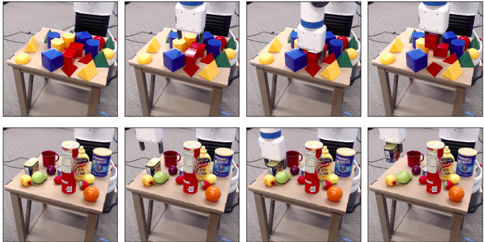
- The pipeline enabled a Fetch robot to detect and pick up the target object in 38 out of 40 trials in increasingly cluttered scenes, and a detector trained on a Spam can succeeded in 9 of 10 trials with previously unseen YCB food distractors.
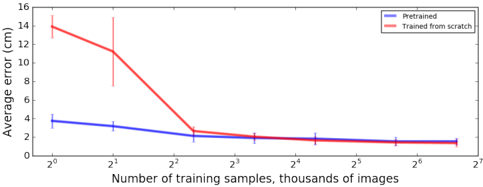
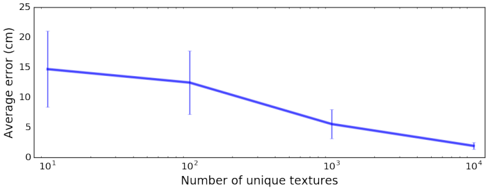
- Ablations found sensitivity to number of training images, number of unique textures, presence of distractors in training, and camera randomization; random noise had negligible effect. Performance improved up to around 50,000 training samples, and degraded significantly with fewer than 1,000 textures.
- ImageNet pretraining was not essential with enough data: random weight initialization achieved nearly the same real-world transfer performance as pretrained initialization, though pretraining helped in the low-data regime.
Methods
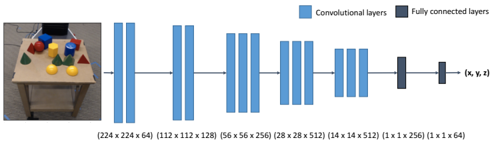
- The authors trained a modified VGG-16 convolutional neural network to map a single 224×224 monocular webcam image to Cartesian coordinates of object(s) of interest, using simulated images rendered by MuJoCo.
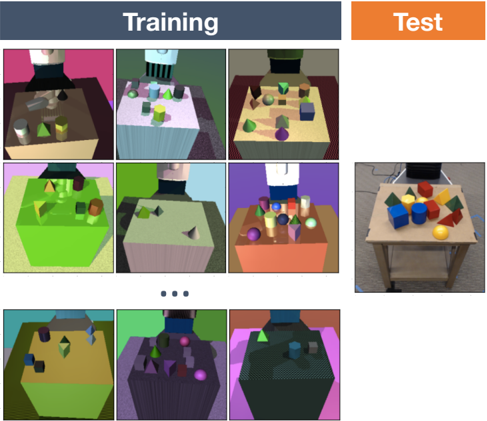
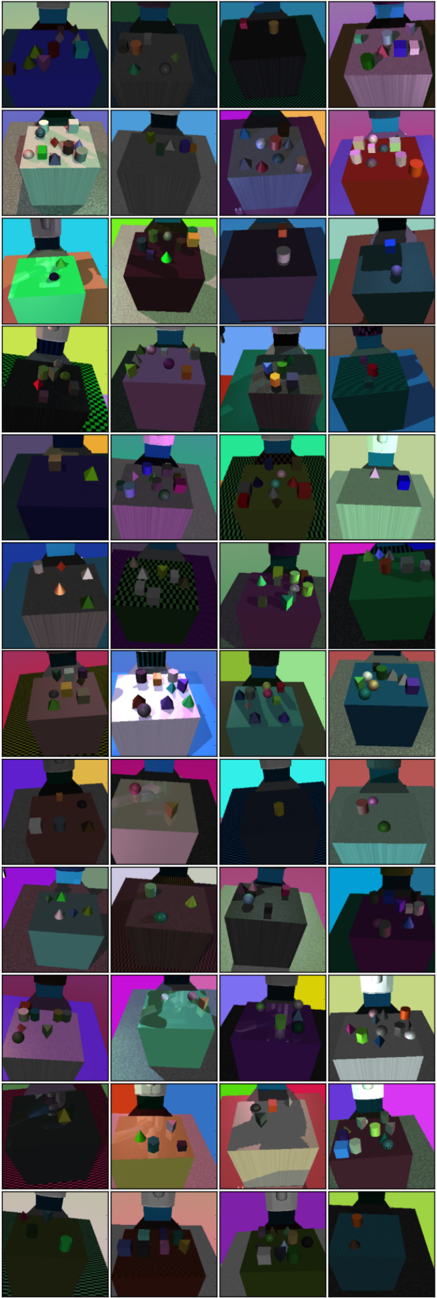
- Domain randomization varied number/shape of distractors, object positions and textures, table/floor/skybox/robot textures, camera position/orientation/field of view, number and properties of lights, and image noise. Textures were random RGB values, gradients, or checker patterns; 0–10 distractor objects were added per scene.
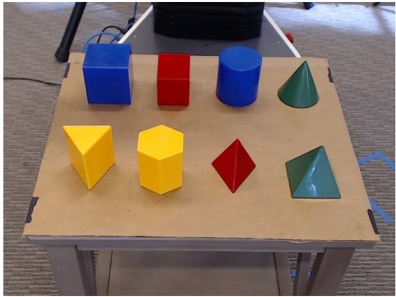
- Training used stochastic gradient descent with Adam on an L2 loss, learning rates around 1e-4, and batch sizes of 25, 50, or 100. Evaluation used 480 webcam images of eight geometric objects at 70–105 cm from a fixed camera, with 60 labeled images per object: 20 alone, 20 with distractors, and 20 partially occluded.
Limitations
- The paper states that the detectors still overfit simulated training data: simulated error was 0.3–0.5 cm versus about 1.5 cm in the real world, and no real-world validation could be done during training because no real data were assumed available.
- The paper states future work is needed for contact-rich manipulation or higher precision, and that the method fixes table height, effectively making the task 2D pose estimation from a single monocular uncalibrated camera.
- Evident from the text: evaluation is limited to eight geometric objects plus one Spam can, the test camera position remains constant across all images, and lighting and surrounding scene were not controlled.
Model-written summary. Check it against the paper before relying on it.
Integrity signals
Registry
Cites
Statistics
Figures
Verification
Claims the paper makes
2 Valid · 8 Not valid · 7 Not checked · 32 Own results and interpretations
The cited sources support only part of this claim — read each source’s verdict below.
In the paper
“Although previous work demonstrated the ability to perform robotic control using a neural network pretrained on ImageNet and fine-tuned on randomized rendered pixels [37], this paper provides the first demonstration that domain randomization can be useful for robotic tasks requiring precision.”
What the sources say
- Partly supportedcites [37] [37] Fereshteh Sadeghi and Sergey Levine. (cad) 2 RL: Real single-image flight without a single real image. arXiv preprint arXiv:1611.04201 , 2016. - sourceExperimental — accuracy not yet measured
The citation [37] is attached to the preceding claim about prior work, not to the citing authors’ claim that their own paper is the first to demonstrate precision robotics. Section 3.1 (p. 4) says LSDA pretrains a CNN on ImageNet classification data and fine-tunes it, but for object detection. It does not report robotic control or fine-tuning on randomized rendered pixels. (LLM, conf=0.84)
boostedstates a cause- Asserted: passes — The authors put it forward as true.
- Checkable: passes — It can be checked against evidence.
- Load-bearing: passes — The paper’s conclusions depend on it.
- Based: passes — The paper gives a reason why it holds.
- Partly supported
The cited sources that could be checked couldn’t confirm or dispute this claim.
In the paper
“Rather than relying on controller robustness, Yu et al. [53] use a model trained on varied physics to perform system identification using online trajectory data, but their approach is not shown to succeed in the real world.”
What the sources say
- Could not verifycites [53] [53] Wenhao Yu, C Karen Liu, and Greg Turk. Preparing for the unknown: Learning a universal policy with online system identification. arXiv preprint arXiv:1702.02453 , 2017. - sourceExperimental — accuracy not yet measured
The cited paper discusses image classification and localisation with convolutional networks (A.1, p. 10; A.2, p. 11), not Yu et al.'s approach. Searches for varied-physics training, online trajectory-based system identification, and real-world success found no passage addressing the claim. Our copy therefore cannot verify it. (LLM, conf=0.78)
plain- Asserted: passes — The authors put it forward as true.
- Checkable: passes — It can be checked against evidence.
- Load-bearing: unclear — It is unclear whether the paper’s conclusions depend on it.
- Based: passes — The paper gives a reason why it holds.
- Could not verify
The cited sources that could be checked couldn’t confirm or dispute this claim.
In the paper
“Though using realistic RGB rendering alone has had limited success for transferring to real robotic tasks [16], incorporating realistic simulation of depth information can allow models trained on rendered images to transfer reasonably well to the real world [32].”
What the sources say
- Could not verifycites [16] [16] Stephen James and Edward Johns. 3d simulation for robot arm control with deep q-learning. arXiv preprint arXiv:1609.03759 , 2016. - sourceExperimental — accuracy not yet measured
The Introduction (§1) and Conclusion (§8) describe Adam as a method for stochastic optimization, while the CNN experiment (§6.3) concerns training on image datasets. Searches for realistic RGB rendering and sim-to-real robotic transfer found no passage addressing whether RGB rendering alone has had limited success on real robotic tasks. (LLM, conf=0.78)
plain- Asserted: passes — The authors put it forward as true.
- Checkable: passes — It can be checked against evidence.
- Load-bearing: passes — The paper’s conclusions depend on it.
- Based: passes — The paper gives a reason why it holds.
- Could not verify
The cited sources that could be checked couldn’t confirm or dispute this claim.
In the paper
“However, their experiments - collision avoidance in hallways and open spaces - do not demonstrate the ability to deal with high-precision tasks.”
What the sources say
- Could not verifycites [37] [37] Fereshteh Sadeghi and Sergey Levine. (cad) 2 RL: Real single-image flight without a single real image. arXiv preprint arXiv:1611.04201 , 2016. - sourceExperimental — accuracy not yet measured
The Experiments section (p. 5) evaluates LSDA on an object-detection dataset, not Sadeghi and Levine’s collision-avoidance experiments. Searches for Sadeghi and Levine, hallway or open-space collision avoidance, and high-precision tasks found no passage addressing the claim. (LLM, conf=0.76)
plain- Asserted: passes — The authors put it forward as true.
- Checkable: passes — It can be checked against evidence.
- Load-bearing: passes — The paper’s conclusions depend on it.
- Based: passes — The paper gives a reason why it holds.
- Could not verify
A result the paper reports from its own data — it cites no other source for it, so there is none to check. The quote shows it is in the paper.
In the paper
“However, using a pre-trained model can significantly improve performance when less training data is used.”
plainstates a cause- Asserted: passes — The authors put it forward as true.
- Checkable: passes — It can be checked against evidence.
- Load-bearing: unclear — It is unclear whether the paper’s conclusions depend on it.
- Based: passes — The paper gives a reason why it holds.
29 more claims
Create a free account to see all 49 claims and to verify the 7 references still open.
- Probably not a substantial claim. 11
- It may state two separate claims as one. 8
Claims other papers make about this one
Each is checked against this paper’s own text: does it say what the citing paper says it does?
The source backs part of the claim, not all of it — or backs it for a different population, condition or comparison.
In the citing paper
“Most policies trained in simulation generalize poorly to the real-world due to agents adapting to specific visual details of the simulator.”
From Language-Based Augmentation to Address Shortcut Learning in Object-Goal Navigation (2023) · cites this paper as [8]
Experimental — accuracy not yet measuredThe source backs part of the claim, not all of it — or backs it for a different population, condition or comparison.
In the citing paper
“In robotic vision tasks including object localization [53], object detection [54], pose estimation [55], and semantic segmentation [56], the training data from simulator always have different textures, lighting, and camera positions from the realistic environments.”
From Sim-to-Real Transfer in Deep Reinforcement Learning for Robotics: a Survey (2020) · cites this paper as [53]
Experimental — accuracy not yet measuredThe source backs part of the claim, not all of it — or backs it for a different population, condition or comparison.
In the citing paper
“These artifacts limit the applicability of generative videos in physics-sensitive domains such as robotics [25,26], autonomous driving [27], simulationbased design, and scientific visualization [28].”
From PhyStruct-Video: Structured Physics State Spaces for Physically Consistent Video Generation (2025) · cites this paper as [25]
Experimental — accuracy not yet measuredThe source backs part of the claim, not all of it — or backs it for a different population, condition or comparison.
In the citing paper
“In domain randomization, the inputs during learning are “randomized” in the sense of being warped or corrupted in particular ways.”
From The overfitted brain: Dreams evolved to assist generalization (2021) · cites this paper as [144]
Experimental — accuracy not yet measuredThe source backs part of the claim, not all of it — or backs it for a different population, condition or comparison.
In the citing paper
“Domain randomization is a domain generalization technique that introduces drastic changes in the training image appearances, which forces the network to learn domain-invariant features between training and target domains [39].”
From A Fully Differentiable Framework for 2D/3D Registration and the Projective Spatial Transformers (2024) · cites this paper as [39]
Experimental — accuracy not yet measured
8 more claims about this paper
Create a free account to see every claim other papers make about this one.
Self-check
Percentages, sums and reported differences re-computed from the paper’s own numbers.
Each contradiction between two passages listed here was confirmed by an independent check.
Rated minor: it would not touch a result — a value no result rests on, a p-value that stays on the same side of the significance level, or a conflict that is clerical, resolved elsewhere in the paper, or outside its own findings.
In the paper
§ A. Experimental Setup · p. 4
“Each training sample consists of (a) a rendered image of the object and one or more distractors (also from among the geometric object set) on a simulated tabletop”
§ A. Domain randomization · p. 4
“Between 0 and 10 distractor objects are added to the table in each scene.”
Citations
Cites
Very Deep Convolutional Networks for Large-Scale Image Recognition
Simonyan, K., & Zisserman, A. (2014) · arXiv · doi:10.48550/arxiv.1409.1556 · Cited by 114,148 · cited 1×
“In particular, we use a modified version the VGG-16 architecture [42] shown in Figure 2.”
MethodAdam: A Method for Stochastic Optimization
Kingma, D. P., & Ba, J. (2014) · arXiv · doi:10.48550/arxiv.1412.6980 · Cited by 98,946 · cited 1×
“We found that using a learning rate of around 1e − 4 (as opposed to the standard 1e − 3 for Adam) improved convergence and helped avoid a common local optimum, mapping all objects to the center of the table.”
MethodLeCun, Y., Bengio, Y., & Hinton, G. (2015) · Nature · doi:10.1038/nature14539 · Cited by 84,126
Human-level control through deep reinforcement learning
Mnih, V., Kavukcuoglu, K., Silver, D., Rusu, A. A., Veness, J., Bellemare, M. G., Graves, A., Riedmiller, M., Fidjeland, A. K., Ostrovski, G., et al. (2015) · Nature · doi:10.1038/nature14236 · Cited by 30,357 · cited 3×
“Learning in simulation is especially promising for building on recent results using deep reinforcement learning to achieve human-level performance on tasks like Atari [27] and robotic control [21], [38].”
BackgroundResultHow transferable are features in deep neural networks?
Yosinski, J., Clune, J., Bengio, Y., & Lipson, H. (2014) · arXiv · doi:10.48550/arxiv.1411.1792 · Cited by 6,061 · cited 1×
“A variety of approaches have been proposed, including re-training the model in the target domain (e.g., [52]), adapting the weights of the model based on the statistics of the source and target domains (e.g., [22]), learning invariant features between domains (e.g., [47]), and learning a mapping…”
BackgroundMuJoCo: A physics engine for model-based control
Todorov, E., Erez, T., & Tassa, Y. (2012) · 2012 IEEE/RSJ International Conference on Intelligent Robots and Systems · doi:10.1109/iros.2012.6386109 · Cited by 4,767 · cited 1×
“We render images using the MuJoCo Physics Engine’s [45] built-in renderer.”
MethodTrust region policy optimization
Schulman, J., Levine, S., Moritz, P., Jordan, M. I., & Abbeel, P. (2015) · arXiv · doi:10.48550/arxiv.1502.05477 · Cited by 4,578 · cited 1×
“Learning in simulation is especially promising for building on recent results using deep reinforcement learning to achieve human-level performance on tasks like Atari [29] and robotic control [26], [41].”
ResultSelf-citationLearning Transferable Features with Deep Adaptation Networks
Long, M., Cao, Y., Wang, J., & Jordan, M. I. (2015) · arXiv · doi:10.48550/arxiv.1502.02791 · Cited by 4,505 · cited 1×
“omputer vision community has devoted significant study to the problem of adapting vision-based models trained in a source domain to a previously unseen target domain (see, e.g., [9], [14], [15], [19], [23], [25], [51]). A variety of approaches have been proposed, including re-training the model in the target domain (e.…”
BackgroundEnd-to-End Training of Deep Visuomotor Policies
Levine, S., Finn, C., Darrell, T., et al. (2015) · Journal of machine learning research · doi:10.5555/2946645.2946684 · Cited by 3,987
Describing Textures in the Wild
Cimpoi, M., Maji, S., Kokkinos, I., Mohamed, S., & Vedaldi, A. (2014) · 2014 IEEE Conference on Computer Vision and Pattern Recognition · doi:10.1109/cvpr.2014.461 · Cited by 2,438 · cited 1×
“To examine how our detectors would perform on objects with complex textures, we created simulated scenes in which the object of interest is given a texture from the Describable Textures Dataset (DTD) [4].”
Method
Research works printed but not linked: 3
- [24] David G Lowe. Three-dimensional object recognition from single two-dimensional images. Artificial intelligence , 31(3):355-395, 1987. -
- [49] Melonee Wise, Michael Ferguson, Derek King, Eric Diehr, and David Dymesich. Fetch and freight: Standard platforms for service robot applications. In Workshop on Autonomous Mobile Service Robots , 2016. -
- sucan, 0, MoveIt!
Cited by
Items 2,101–2,200 of 2,970
Simplified Geometric Inverse Kinematic Approach for Collaborative Robot
Kholodilin, I. Y., Kuznetsova, Y. S., Saranceva, K. M., Egorova, K. A., Filimonova, V. A., & Андреевич, Р. Л. (2026) · doi:10.1109/elcon-cp69823.2026.11452159 · Cited by 1
“Beyond code portability, our evaluation embraces a sim-to-real mindset emphasizing simple, explainable controllers and consistent interfaces, in order to reduce the “reality gap” during deployment [14], [15].”
Lin, G., Zhu, Y., Qiu, Y., Huang, D., Song, S., & Hu, W. (2026) · Optics Communications · doi:10.1016/j.optcom.2026.133238 · Cited by 1
SynthAirDrone: Synthetic Drone Detection Dataset for Airport-Runway Environments
Guo, J., Chen, J., Zhang, T., & Feng, Q. (2026) · Drones · doi:10.3390/drones10040306 · Cited by 1
Yang, S., Wu, X., Zhou, Y., jia, H., Bao, W., Rong, W., Wang, Q., Zou, T., & Xue, X. (2026) · Aerospace Science and Technology · doi:10.1016/j.ast.2026.112443 · Cited by 3
Chow, Y.-T., Xia, L.-Q., Li, Q.-B., Li, C.-H., Keung, K.-L., & Lau, Y. (2026) · Journal of engineering design · doi:10.1080/09544828.2026.2650609 · Cited by 1
Towards Scalable Spatial Intelligence Via 2D-To-3D Data Lifting
Miao, X., Duan, H., Qian, Q., Wang, J., Long, Y., Shao, L., Zhao, D., Xu, R., & Zhang, G. (2025) · IEEE/CVF International Conference on Computer Vision (ICCV) · doi:10.1109/iccv51701.2025.00096 · Cited by 12
“…each faces distinct drawbacks: • Simulation-based approaches: Although simulation-based methods using game-engine simulators (e.g., NVIDIA Isaac Gym [75]) enable fast and cost-effective data generation under controlled conditions, they often encounter a substantial sim-to-real gap [3, 80, 81, 94].”
A Data‐Driven Inverse Design Methodology for Magnetic Soft Millirobots Navigating in Confined Spaces
Ren, Z., Wang, H., Tse, C. W., Zheng, Y., Chen, X., & Hu, W. (2026) · Advanced Science · doi:10.1002/advs.75714 · Cited by 1
“Second, to bridge the reality gap where sim-to-real discrepancies in contact dynamics typically lead to severe locomotion failures, domain randomization [ 31, 32 ] is employed.”
РУБЕЛЬ, Ю., & Грицюк, Ю. І. (2026) · Науковий вісник НЛТУ України · doi:10.36930/40360221 · Cited by 1
Deep learning-based rotoscoping: a systematic review of methods and applications
Yuce, D. (2026) · Journal of Mechatronics and Artificial Intelligence in Engineering · doi:10.21595/jmai.2026.26653 · Cited by 2
““Sim-to-real domain shift”, which represents the transition from synthetic to real-world data, leads to performance degradation on noisy real-world data due to the model’s overfitting to the perfection in synthetic data [34], [51].”
InfluentialWU, J., & Yu, S. (2026) · Robotica · doi:10.1017/s0263574726103518 · Cited by 1
“Recent work on sim-to-real transfer [19] and domain randomization [20] addresses this but may not capture true physical constraints.”
From virtual experiments to biomedical insight with synthetic data
Victoriano, M., Pavlović, M., Sandve, G. K., Oliveira, H. P., Rocha, A., & Greiff, V. (2026) · Nature Machine Intelligence · doi:10.1038/s42256-026-01244-6 · Cited by 7
“Domain adaptation, by contrast, attempts to align synthetic and real data distributions via learned feature transformations or adversarial objectives 137 .”
From Physics to Representation: Audio Learning with Synthetic Pre-training via Procedural Generation
Liu, F., Huang, R., Zheng, Q., Wang, Y., & Liu, F. (2026) · International Conference on Multimedia Retrieval · doi:10.1145/3805622.3810789 · Cited by 3
Gadekallu, T. R., Zhao, Y., Wen, Z., Bhattacharya, P., Xia, Y., Cai, J., Zeydan, E., Fang, K., & Feng, H. (2026) · IEEE Internet of Things Journal · doi:10.1109/jiot.2026.3703862 · Cited by 4
“Domain randomization [54] and online system identification [55] are widely used approaches for addressing this issue.”
Cherniaeva, P. D., Losev, A., & Panfilov, I. (2026) · International Conference on Industrial Engineering, Applications and Manufacturing · doi:10.1109/icieam69213.2026.11549558 · Cited by 2
“By establishing a high-fidelity baseline of nominal behavior, the system can identify any statistically significant deviation from the learned manifold as an anomaly [4].”
Sim2Rob—A Sim2Real Framework for Smart Robotics in Assembly
Petrović, O., Tesic, P., & Brecher, C. (2026) · Springer eBooks · doi:10.1007/978-3-031-91463-8_28 · Cited by 1
A Reference Architecture of Reinforcement Learning Frameworks
Liu, X., & Dávid, I. (2026) · IEEE International Conference on Software Architecture (ICSA) · doi:10.1109/icsa66085.2026.00016 · Cited by 3
“To demonstrate the RA, we reconstruct typical RL patterns.”
MammoDG: Generalisable Deep Learning Advances Cross-Domain Multi-Center Breast Cancer Screening
Yang, Y., Wang, S., Liu, L., Hickman, S. E., Gilbert, F. J., Schönlieb, C., & Avilés-Rivero, A. I. (2026) · International Journal of Computer Vision · doi:10.1007/s11263-026-02979-w · Cited by 18
“For example, domain randomization (Tobin et al., 2017), transformation network trained adversarially (Zhou et al., 2020), and Mixup (Zhang et al., 2017) are utilized to generate more training samples.”
Radovanović, D., Marković, D., Kresoja, P., Cvetković, A. S., Radojčić, V., Šarac, M., & Savanović, N. (2026) · Machine Learning and Knowledge Extraction · doi:10.3390/make8090276 · Cited by 1
Multi-Vehicle Mixed Reality Reinforcement Learning for Autonomous Multi-Lane Driving
Mitchell, R., Fletcher, J., Panerati, J., & Prorok, A. (2020) · Adaptive Agents and Multi-Agents Systems · doi:10.65109/lqgx1131 · Cited by 19
“Several methods alleviate the difficulty of bridging the reality gap: (i) parameter estimation, which estimates parameters of the real system to achieve a more realistic simulation [20, 34], (ii) iterative data collection, which learns distributions of dynamics parameters in an iterative manner [3, 5], and (iii) domai…”
MethodESKO6d - A Binocular and RGB-D Dataset of Stored Kitchen Objects with 6d Poses
Richter-Klug, J., Wellhausen, C., & Frese, U. (2019) · IEEE/RSJ International Conference on Intelligent Robots and Systems (IROS) · doi:10.1109/iros40897.2019.8967937 · Cited by 3
“[18] uses a mixture of few real and many rendered images while [19] and [17] use purely rendered images.”
BackgroundAutoSynPose: Automatic Generation of Synthetic Datasets for 6D Object Pose Estimation
Engemann, H., Du, S., Kallweit, S., Ning, C., & Anwar, S. (2020) · Frontiers in artificial intelligence and applications · doi:10.3233/faia200770 · Cited by 1
“manipulation [3,4].”
MethodA Cloud-based Network of 3D Objects for Robust Grasp Planning
Muravyov, S., & Filchenkov, A. A. (2020) · International Conference on Control, Robotics and Intelligent System (CCRIS) · doi:10.1145/3437802.3437820 · Cited by 2
“3437820 encoding regarding modelling robot perception, grasps planning and control [5, 13], given a simple task like grapping a can of soda by a robotic hand, it involves many calculations, starting with pro-”
MethodUnsupervised Feature Learning for Manipulation with Contrastive Domain Randomization
Rabinovitz, C., Grupen, N. A., & Tamar, A. (2021) · Proceedings - IEEE International Conference on Robotics and Automation/Proceedings · doi:10.1109/icra48506.2021.9561527 · Cited by 2
OHPL: One-shot Hand-eye Policy Learner
Oh, C., Pang, Y. L., & Cavallaro, A. (2021) · IEEE/RSJ International Conference on Intelligent Robots and Systems (IROS) · doi:10.1109/iros51168.2021.9636835 · Cited by 1
“textures, lighting and camera position) of sensory inputs during training, thus helping the agent learn relevant features that are invariant across the domain gap [8].”
BackgroundInfluentialJoint Learning of Object Detection and Pose Estimation using Augmented Autoencoder
Hayashi, R., Shimokura, A., Matsumoto, T., & Ukita, N. (2021) · doi:10.23919/mva51890.2021.9511343 · Cited by 2
Adversarially Robust Imitation Learning
Wang, J., Zhuang, Z., Wang, Y., & Zhao, H. (2021) · Conference on Robot Learning · Cited by 3
Learning Smooth and Omnidirectional Locomotion for Quadruped Robots
Wu, J., Wang, C., Zhang, D., Zhong, S., Wang, B., & Qiao, H. (2021) · International Conference on Advanced Robotics and Mechatronics (ICARM) · doi:10.1109/icarm52023.2021.9536204 · Cited by 1
MDP Playground: An Analysis and Debug Testbed for Reinforcement Learning
Rajan, R., Diaz, J. L. B., Guttikonda, S., Ferreira, F., Biedenkapp, A., von Hartz, J. O., & Hutter, F. (2023) · Journal of Artificial Intelligence Research · doi:10.1613/jair.1.14314 · Cited by 20
“…game domain, a practitioner may not want to inject any kind of noise into the environment, if their only aim is to obtain high scores, whereas in a domain like robotics adding such noise to a deterministic simulator could be crucial in order to obtain generalisable policies (Tobin et al., 2017).”
BackgroundImage Registration Algorithm for Deep Learning-Based Stereo Visual Control of Mobile Robots
Miljković, Z., Jokić, A., & Petrović, M. (2021) · Studies in computational intelligence · doi:10.1007/978-3-030-77939-9_13 · Cited by 2
Model-based Domain Randomization of Dynamics System with Deep Bayesian Locally Linear Embedding
Park, J. H., Park, S., & Kim, H. J. (2021) · Proceedings - IEEE International Conference on Robotics and Automation/Proceedings · doi:10.1109/icra48506.2021.9561942 · Cited by 2
“Domain randomization (DR) [1], [2], [3] is a simple technique to enhance the robustness of the policy in various environments.”
MethodA Grid-Structured Model of Tubular Reactors
Haitsiukevich, K., Bergman, S., Filho, C. D. A., Corona, F., & Ilin, A. (2021) · IEEE International Conference on Industrial Informatics (INDIN) · doi:10.1109/indin45523.2021.9557382 · Cited by 2
Pose Estimation of a Robot Arm from a Single Camera
Sithamparanathan, K., Rajendran, S., Thavapirakasam, P., et al. (2021) · doi:10.1109/eecon52960.2021.9580957 · Cited by 1
“…the gap between real and synthetic data, domain randomization techniques were employed, including random placement of distractor objects in the background, variation of colour intensity, variation of texture of wall and floor and variation of number of lights in the scene and their position [9].”
A Novel Shape-based Robotic Sorting Approach based on Computer Vision
Chen, T., Ren, T., Niu, J., & Li, Q. (2021) · IEEE International Symposium on Parallel and Distributed Processing with Applications (ISPA) · doi:10.1109/ispa-bdcloud-socialcom-sustaincom52081.2021.00096 · Cited by 1
Weber, T., Danner, M., Zhang, B., et al. (2022) · International Joint Conference on Computer Vision, Imaging and Computer Graphics Theory and Applications (VISIGRAPP) · doi:10.5220/0010904100003124 · Cited by 1
“closely, contrary to Tobin et al (Tobin et al., 2017) and is a computation and time trade-off.”
MethodResultTwo-Policy Cooperative Transfer for Alleviation of Sim-to-Real Gap
Wu, L., Xiong, F., & Liu, Z. (2022) · International Conference on Artificial Intelligence in Information and Communication (ICAIIC) · doi:10.1109/icaiic54071.2022.9722630 · Cited by 1
Peterson, M., Du, M., Cherfaoui, N., Koolipurackal, A., Doyle, D., & Black, J. T. (2022) · IEEE/SICE International Symposium on System Integration (SII) · doi:10.1109/sii52469.2022.9708798 · Cited by 3
Performance of Domain Adaptation Schemes in Video Action Recognition using Synthetic Data
Isoi, H., Takefusa, A., Nakada, H., & Oguchi, M. (2022) · International Conference on Image, Video and Signal Processing (IVSP) · doi:10.1145/3531232.3531242 · Cited by 1
“As a solution against such a lack of learning data, it is known that utilization of synthetic data and domain adaptation using existing data sets are effective, and various studies of image analysis are being conducted [11, 12, 20, 25].”
BackgroundArtificial intelligence applications for proactive environmental monitoring and asset management
Chow, J. K., Tan, P. S., Liu, K.-F., Mao, X., Su, Z., Ooi, G. L., Cheong, Y. H., Leung, M. L., Wu, J., Chan, H. M., et al. (2022) · HKIE Transactions · doi:10.33430/v29n2thie-2021-0028 · Cited by 1
Visual transfer for reinforcement learning via gradient penalty based Wasserstein domain confusion
(2022) · Journal of Nonlinear and Variational Analysis · doi:10.23952/jnva.6.2022.3.05 · Cited by 1
Design of Interpretable Machine Learning Tasks for the Application to Industrial Order Picking
Schwan, C., & Schenck, W. (2012) · Technologien für die intelligente Automation · doi:10.1007/978-3-662-64283-2_21 · Cited by 1
Instance Segmentation and Classification of Armoured Fighting Vehicles
Rissanen, V., Toivonen, E., Lagashkin, R., Saastamoinen, K., Rissanen, A., & Vankka, J. (2022) · International Conference on Artificial Intelligence, Big Data, Computing and Data Communication Systems (icABCD) · doi:10.1109/icabcd54961.2022.9855933 · Cited by 6
“behavior in neural nets during training [1], [2].”
BackgroundData Augmentation and Domain Randomization: Empirical Approaches for Data-driven Robot Learning
Hanai, R., Makihara, K., & Domae, Y. (2022) · Journal of the Robotics Society of Japan · doi:10.7210/jrsj.40.605 · Cited by 1
3D Pose Estimation of Custom Objects Using Synthetic Datasets
Florea, A. G., Stoican, F., Buiu, C., et al. (2022) · International Conference on System Theory, Control and Computing (ICSTCC) · doi:10.1109/icstcc55426.2022.9931890 · Cited by 1
“randomization [17], [26], [27], a technique which consists of randomly alternating features such as colors, backgrounds, textures, material properties, occlusions and light sources in the generated images such that the images appear more diverse to the model, to the point where the real world ”is just another variatio…”
BackgroundInfluentialUncertainty Aware System Identification with Universal Policies
Semage, B. L., Karimpanal, T. G., Rana, S., & Venkatesh, S. (2022) · Proceedings - International Conference on Pattern Recognition/Proceedings/International Conference on Pattern Recognition · doi:10.1109/icpr56361.2022.9956103 · Cited by 2
“approach for generating robust policies [3], [4], [29].”
BackgroundDomain Randomization with Adaptive Weight Distillation
Wang, S., Wu, F., Lin, Y., & Zhao, J. (2022) · Lecture notes in computer science · doi:10.1007/978-3-031-23609-9_13 · Cited by 1
3D Object and Hand Pose Estimation
Lepetit, V. (2023) · Springer handbooks · doi:10.1007/978-3-030-67822-7_4 · Cited by 1
Real-Time Assembly Operation Recognition
MARIN, F.-B., Gurău, G., & MARIN, M. (2022) · The Annals of “Dunarea de Jos” University of Galati Fascicle IX Metallurgy and Materials Science · doi:10.35219/mms.2022.4.15 · Cited by 1
Reinforcement Learning for Pan-Tilt-Zoom Camera Control, with Focus on Drone Tracking
Wisniewski, M., Rana, Z. A., & Petrunin, I. V. (2023) · AIAA SciTech Forum · doi:10.2514/6.2023-0194 · Cited by 2
SEIC: Semantic Embedding with Intermediate Classes for Zero-Shot Domain Generalization
Mondal, B., & Biswas, S. (2023) · Lecture notes in computer science · doi:10.1007/978-3-031-26348-4_20 · Cited by 3
Few-Shot Object Detection in Unseen Domains
Guirguis, K., Eskandar, G., Kayser, M., Yang, B., & Beyerer, J. (2022) · International Conference on Signal-Image Technology & Internet-Based Systems (SITIS) · doi:10.1109/sitis57111.2022.00023 · Cited by 1
“Recently, various DR methods were introduced in robotics applications like 6D object detection [33], 6D object tracking [42], object localization [34], person detection [21] and segmentation [6].”
BackgroundMethodResultReinforcement Learning and Action Space Shaping for a Humanoid Agent in a Highly Dynamic Environment
Song, J.-T., Christmann, G. H. G., Jeong, J., & Baltes, J. (2023) · Studies in computational intelligence · doi:10.1007/978-3-031-26135-0_4 · Cited by 2
Expeditious Object Pose Estimation for Autonomous Robotic Grasping
Deevi, S. A., & Mishra, D. (2023) · Communications in computer and information science · doi:10.1007/978-3-031-31417-9_2 · Cited by 1
Implementation of an Effective Framework in Merging Cybersecurity and Software Engineering
Alhuqail, S. K., & Jamail, N. S. M. (2023) · International Women in Data Science Conference at Prince Sultan University (WiDS PSU) · doi:10.1109/wids-psu57071.2023.00019 · Cited by 3
“[6][7][8][9] A comprehensive security architecture is presented to provide a software security development (SSD).”
BackgroundReinforcement Learning Requires Human-in-the-Loop Framing and Approaches
Taylor, M. E. (2023) · Frontiers in artificial intelligence and applications · doi:10.3233/faia230098 · Cited by 1
“, sim2real [25])? How should one balance between an abstract simulation that is fast to learn and a more realistic simulation that is slower? If no simulator is used, how can the agent learn as quickly as possible while minimizing regret and other potential side effects (e.”
BackgroundFC-TrackNet: Fast Convergence Net for 6D Pose Tracking in Synthetic Domains
Jia, D., Wang, Q., Cao, J., Cai, P., & Jin, Z. (2023) · Proceedings of the AAAI Conference on Artificial Intelligence · doi:10.1609/aaai.v37i13.27077 · Cited by 1
User-Oriented Robust Reinforcement Learning
You, H., Yu, B., Jin, H., Yang, Z., & Sun, J. (2023) · Proceedings of the AAAI Conference on Artificial Intelligence · doi:10.1609/aaai.v37i12.26781 · Cited by 2
“Domain Randomization (DR) (Tobin et al. 2017) is a method that randomly samples environment parameters in a domain, and optimizes the expected return over all collected trajectories.”
BackgroundMethodInfluentialMoonen, S. (2023) · Advances in Artificial Intelligence and Machine Learning · doi:10.54364/aaiml.2023.1158 · Cited by 2
“Inspired by the key insight of Tobin et al. [6], that domain randomization is a powerful tool to successfully exploit synthetic data for training deep learning models, we argue that CAD2Render should support a wide set of complex variations.”
BackgroundMethodTrentsios, P., Wolf, M., & Gerhard, D. (2023) · Procedia CIRP · doi:10.1016/j.procir.2023.03.141 · Cited by 1
Improving Rare Classes on nuScenes LiDAR segmentation Through Targeted Domain Adaptation
Rajendran, V., Tang, C., & van Paasschen, F. (2023) · IEEE/CVF Conference on Computer Vision and Pattern Recognition Workshops (CVPRW) · doi:10.1109/cvprw59228.2023.00018 · Cited by 4
“During the upsampling process, we use six different bicycle assets to replace examples of cars and perform domain randomization [29] [9] on the asset dimensions and LiDAR sensor noise floor to increase the diversity of the auxiliary synthetic nuScenes dataset.”
MethodSustainability Effects of Robust and Resilient Artificial Intelligence
Priebe, T., Kieseberg, P., Adrowitzer, A., Eigner, O., & Kovac, F. (2023) · Lecture notes in computer science · doi:10.1007/978-3-031-40837-3_12 · Cited by 1
Sensor Datasets for Human Daily Safety and Well-Being
Cauli, N., Massa, S. M., Recupero, D. R., & Riboni, D. (2023) · Studies in computational intelligence · doi:10.1007/978-3-031-38281-9_1 · Cited by 2
Mixing Domains for Smartly Picking and Using Limited Datasets in Industrial Object Detection
Akar, C. A., Semaan, A., Haddad, Y., Kamradt, M., & Makhoul, A. (2023) · Lecture notes in computer science · doi:10.1007/978-3-031-44137-0_23 · Cited by 1
Autonomous Port Navigation With Ranging Sensors Using Model-Based Reinforcement Learning
Herremans, S., Anwar, A., Troch, A., Ravijts, I., Vangeneugden, M., Mercelis, S., & Hellinckx, P. (2023) · International Conference on Offshore Mechanics and Arctic Engineering (OMAE) · doi:10.1115/omae2023-104455 · Cited by 4
“To provide a sufficiently large S we employ domain randomization [26] in our simulator by randomizing the following elements (see Fig.”
MethodClass-aware cross-domain target detection based on cityscape in fog
Gan, L., Liu, H., Chen, A., Xu, X., & Zhang, X. (2023) · Machine Vision and Applications · doi:10.1007/s00138-023-01463-6 · Cited by 1
LWOSNet: A Lightweight One-Shot Network Framework for Object Pose Estimation
Wang, C., Zang, X., Zhang, X., Cao, B., Zhou, L., Zhao, J., & Ang, M. H. (2023) · IEEE Sensors Journal · doi:10.1109/jsen.2023.3320697 · Cited by 1
“An effective solution to this limitation is to generate synthetic data using domain randomization [32], thus forcing the network to focus more on the unique features of the image.”
BackgroundDetection of Tea Box Orientations in Retail Shelves Images
Filipović, B., Šikić, F., Kalafatić, Z., Lončarić, S., & Subašić, M. (2023) · International symposium on image and signal processing and analysis/ISPA ... · doi:10.1109/ispa58351.2023.10279661 · Cited by 3
“For future work, we plan to expand upon this paper by possibly implementing domain augmentation methods as showcased in [20], which should hopefully improve the ability of the model to better generalize on real-life data.”
MethodAnomaly data synthesis and detection via domain randomization
Jun, J., & Lee, J. (2023) · PHM Society Asia-Pacific Conference · doi:10.36001/phmap.2023.v4i1.3672 · Cited by 1
6-DOF UR3 Robot Manipulation Based on Deep Learning
Zhang, J., & Yan, W. (2023) · International Conference on Advanced Computer Theory and Engineering · doi:10.1109/icacte59887.2023.10335347 · Cited by 2
“Experimental results show that the models trained with domain-randomized synthetic data when applied to robot systems in real environments, demonstrate promising control effectiveness [6].”
BackgroundIlboudo, W. E. L., Kobayashi, T., & Matsubara, T. (2023) · IEEE/RSJ International Conference on Intelligent Robots and Systems (IROS) · doi:10.1109/iros55552.2023.10342236 · Cited by 3
“Under this later approach, two main methods can be found in the flourishing literature, i.e. Domain Ran-domization (DR) [5]–[10] and Robust MDP (RMDP) [11]– [16].”
MethodMasked Imitation Learning: Discovering Environment-Invariant Modalities in Multimodal Demonstrations
Hao, Y., Wang, R., Cao, Z., Wang, Z., Cui, Y., & Sadigh, D. (2023) · IEEE/RSJ International Conference on Intelligent Robots and Systems (IROS) · doi:10.1109/iros55552.2023.10341728 · Cited by 6
“To address this, domain randomization approaches [47–49] try creating diverse environments by randomizing factors such as texture, lighting, etc., but a large number of variations of these factors, which often need to be done in simulation, might still not be able to capture all the spurious…”
MethodKayisu, A. K., Kambale, W. V., Bernabia, T., Deeb, A., Bokoro, P. N., & Kyamakya, K. (2023) · International Conference on Circuits, Systems, Communications and Computers (CSCC) · doi:10.1109/cscc58962.2023.00010 · Cited by 1
“To overcome these challenges and limitations in SEACM systems, it is crucial to investigate new techniques and methodologies, including domain adaptation, [41], [42], reinforcement learning, [33], and integration of real data into the training process, [43].”
BackgroundInstance Segmentation to Path Planning in a Simulated Industrial Environment
Schneider, D. G., & Stemmer, M. R. (2024) · Lecture notes in networks and systems · doi:10.1007/978-3-031-47272-5_24 · Cited by 1
Nassif, J., Tekli, J., & Kamradt, M. (2024) · Springer eBooks · doi:10.1007/978-3-031-47560-3_8 · Cited by 1
Digital Images – The Bread and Butter of Computer Vision
Nassif, J., Tekli, J., & Kamradt, M. (2024) · Springer eBooks · doi:10.1007/978-3-031-47560-3_5 · Cited by 2
Distributionally Robust Behavioral Cloning for Robust Imitation Learning
Panaganti, K., Xu, Z., Kalathil, D. M., & Ghavamzadeh, M. (2023) · IEEE Conference on Decision and Control (CDC) · doi:10.1109/cdc49753.2023.10383976 · Cited by 3
Rathod, A. S., Jadhav, J., Londhe, V. M., et al. (2024) · International Journal of Research in Agronomy · doi:10.33545/2618060x.2024.v7.i2a.278 · Cited by 1
Synthetic Simulated Data for Construction Automation: A Review
Xu, L.-Q., Liu, H., Xiao, B., Luo, X., & Zhu, Z. (2024) · ASCE Construction Research Congress (CRC) · doi:10.1061/9780784485262.054 · Cited by 3
A Survey of Path Planning and Navigation in Multi-Robotic Systems
Chandrasekaran, B. (2023) · International Conference on Advanced Engineering and Technologies (ICONNIC) · doi:10.1109/iconnic59854.2023.10467847 · Cited by 2
“As mentioned by the authors [1], for designing effective control policies for robots for many tasks learning based methods are useful [2][3].”
BackgroundUnsupervised Training Sequence Design: Efficient and Generalizable Agent Training
Li, W., & Varakantham, P. R. (2024) · Proceedings of the AAAI Conference on Artificial Intelligence · doi:10.1609/aaai.v38i12.29268 · Cited by 2
“Two of the earliest approaches to UED are Domain Randomization (DR, (Jakobi 1997; Tobin et al. 2017)), which uniformly randomizes the environment configurations regardless of the student’s policy, and Minimax (Morimoto and Doya 2005; Pinto, David-son, and Gupta 2017) that adversarially generates…”
BackgroundClassifying Cable Tendency with Semantic Segmentation by Utilizing Real and Simulated RGB Data
Chien, P.-C., Liao, P., Fukuzawa, E., & Ohya, J. (2024) · IEEE Winter Conference on Applications of Computer Vision · doi:10.1109/wacv57701.2024.00824 · Cited by 1
“However, caveats exist that the sole use of synthetic data introduces an adaptation gap between simulation and the real world – often referred to as the “reality gap” [24] [4].”
BackgroundDecentralized multi-agent cooperation via adaptive partner modeling
Xu, C., Wang, J., Zhu, X., Yue, Y., Zhou, W., Liang, Z., & Wojtczak, D. (2024) · Complex & Intelligent Systems · doi:10.1007/s40747-024-01421-3 · Cited by 3
“One possible approach is to merge sim-to-real [43] learning with partner modeling, enabling agents to utilize their acquired knowledge when working in real-world conditions instead of beginning from the beginning.”
Aflakian, A., Rastegarpanah, A., Hathaway, J., & Stolkin, R. (2024) · Journal of Field Robotics · doi:10.1002/rob.22355 · Cited by 2
“DR is a technique used for training models to work in various simulated settings with randomized properties [37].”
MethodTeoh, W. K., & Mizuuchi, I. (2024) · International Conference on Image Processing and Robotics (ICIPRoB) · doi:10.1109/iciprob62548.2024.10544130 · Cited by 1
“One such approach is domain randomization, a data synthesis technique that overcomes conventional fidelity and resource limitations by introducing a high degree of variability in synthesized data in order to force neural networks to focus on critical features of interest in the specific task [1].”
BackgroundAn Adaptive Meta-Reinforcement Learning Algorithm for Simulation to Reality in Dynamic Scene
Xiao, W., Luo, X., Xie, S., & Yu, H. (2024) · IEEE Transactions on Intelligent Vehicles · doi:10.1109/tiv.2024.3424859 · Cited by 4
High-Fidelity Simulation of a Cartpole for Sim-to-Real Deep Reinforcement Learning
Bantel, L., Domanski, P., & Pflüger, D. (2024) · Interdisciplinary Conference on Electrics and Computer (INTCEC) · doi:10.1109/intcec61833.2024.10602859 · Cited by 3
“Two commonly used methods to improve the sim-to-real transferability are domain randomization (DR) [16] and domain adaption (DA) [17].”
MethodExpert Composer Policy: Scalable Skill Repertoire for Quadruped Robots
Christmann, G. H. G., Luo, Y., & Chen, W. (2024) · Proceedings - IEEE International Conference on Robotics and Automation/Proceedings · doi:10.1109/icra57147.2024.10611039 · Cited by 2
“The controllers can be deployed to the real world using methods such as domain randomization [32] during training or domain adaptation with real-world trajectories [33].”
MethodDomain Adaptation of Visual Policies with a Single Demonstration
Wang, W., & Hager, G. D. (2024) · Proceedings - IEEE International Conference on Robotics and Automation/Proceedings · doi:10.1109/icra57147.2024.10610569 · Cited by 1
“…the efficacy of our method in learning domain-adapting visual policies given demonstration, we compare it against three baseline methods: RL with domain randomization (DR) [10], policy distillation with domain randomization and policy distillation with model-agnostic meta-learning (MAML) [43].”
BackgroundMethodPretrained Dynamics Learning of Numerous Heterogeneous Robots and Gen2Real Transfer
Xing, D., Yang, Y., & Li, J. (2024) · IEEE Transactions on Cognitive and Developmental Systems · doi:10.1109/tcds.2024.3454240 · Cited by 1
“Domain randomization varies parameters to define a simulation environment and models the differences between the source and target domains [19].”
Catching Robot: Predicting the Trajectory of a Rolling Ball Using Transformer
Lee, N., Oh, Y., & Moon, J. (2024) · IEEE Access · doi:10.1109/access.2024.3455553 · Cited by 3
“The approaches in [15] and [16] learn the images in the simulator and then control the robotic manipulator for the pick and place task using a simple CNN.”
MethodInfluentialInitial state diversification for efficient AlphaZero-style training
Demura, Y., & Kaneko, T. (2024) · ICGA Journal · doi:10.3233/icg-240255 · Cited by 2
“This approach is inspired by procedural generation (Justesen et al., 2018; Juliani et al., 2019; Cobbe et al., 2020) and domain randomization (Tobin et al., 2017) in other RL domains.”
Scaling Backwards: Minimal Synthetic Pre-Training?
Nakamura, R., Tadokoro, R., Yamada, R., Asano, Y. M., Laina, I., Rupprecht, C., Inoue, N., Yokota, R., & Kataoka, H. (2024) · Lecture notes in computer science · doi:10.1007/978-3-031-72633-0_9 · Cited by 14
Simulation-Aided Policy Tuning for Black-Box Robot Learning
He, S., von Rohr, A., Baumann, D., Ji, X., & Trimpe, S. (2025) · IEEE Transactions on Robotics · doi:10.1109/tro.2025.3539192 · Cited by 8
Jiang, X., Zhu, Z., Gao, T., & Guo, N. (2024) · Sensors · doi:10.3390/s24237584 · Cited by 3
“Inspired by prior studies [29–31], Ikeda et al. established a weak pairwise correlation between synthetic and real-world data and trained an instance-level style transfer network to render target objects in synthetic images with a more realistic appearance.”
Exploring the Impact of Geometric Model Fidelity on the Sim-to-Real Gap in Visual Robot Perception
Tanz, L., Müller, J., Geng, P., et al. (2024) · Lecture notes in mechanical engineering · doi:10.1007/978-3-031-74485-3_34 · Cited by 1
Adaptive Trajectory Database Learning for Nonlinear Control with Hybrid Gradient Optimization
Tseng, K.-Y., Zhang, M., Hauser, K. K., & Dullerud, G. E. (2024) · IEEE/RSJ International Conference on Intelligent Robots and Systems (IROS) · doi:10.1109/iros58592.2024.10801717 · Cited by 1
“Different techniques are utilized to bridge the gap, such as dynamics randomization [15], [14] and domain randomization [17].”
Mix-Spectrum for Generalization in Visual Reinforcement Learning
Lee, J. W., & Hwang, H. (2025) · IEEE Access · doi:10.1109/access.2025.3526959 · Cited by 1
“Numerous studies have focused on enhancing the generalization in visual RL using techniques such as data augmentation [2], [21], [22], domain randomization [23], [24], [25], self-supervised learning [26], [27], [28], and knowledge distillation [29], [30], [31].”
AirPilot Drone Controller: Enabling Interpretable On-the-Fly PID Auto-Tuning via DRL
Zhang, J., Rivera, C. E. O., Tyni, K., et al. (2024) · IEEE International Conference on Civil Aviation Safety and Information Technology (ICCASIT) · doi:10.1109/iccasit62299.2024.10828099 · Cited by 1
“Due to the training being conducted in a simulated environment, and the well-documented Sim-To-Real challenge, also known as the reality gap [10], the drone exhibited less-than-ideal behavior during real-world deployment.”
Petropoulakis, P., Gräf, L., Malmir, M., Josifovski, J., & Knoll, A. (2024) · Conference proceedings/Conference proceedings - IEEE International Conference on Systems, Man, and Cybernetics · doi:10.1109/smc54092.2024.10832053 · Cited by 4
“We adopt the core ideas from the RAD module [11] and Tobin et al. [26], which demonstrated successful agent transfer via domain randomization in both numerical and vision-based domains.”
MethodKim, H. (2024) · Proceedings of the IEEE Conference on Decision & Control, including the Symposium on Adaptive Processes · doi:10.1109/cdc56724.2024.10886297 · Cited by 1
“This method has shown promising results in several fields, including robotics and autonomous systems, where real-world data collection may be challenging or infeasible [10]–[12].”
Significance extraction based on data augmentation for reinforcement learning
Han, Y., Li, D., & Yang, Y. (2025) · Frontiers of Information Technology & Electronic Engineering · doi:10.1631/fitee.2400406 · Cited by 1
Metadata
- Authors
- Tobin, J., Fong, R., Ray, A., Schneider, J., Zaremba, W., & Abbeel, P.
- Affiliations
- University of California, Berkeley (US)
- OpenAI (United States) (US)
- International Computer Science Institute (US)
- ORCID
- Abbeel, Pieter
- Venue
- 2017 IEEE/RSJ International Conference on Intelligent Robots and Systems (IROS)
- Publisher
- IEEE
- Published
- 2017-09
- Pages
- 23-30
- ISSN
- 2153-0858 (ISSN-L)
- OpenAlex
- W2605102758
- Semantic Scholar
- 32ceb28e45a445df4d89df281bb0e3ab5aab1a2a
- Cited by
- 3,124
- References
- 69
- Citations by year
- 2026: 413 · 2025: 433 · 2024: 336 · 2023: 403 · 2022: 374 · 2021: 422 · 2020: 352 · 2019: 256 · 2018: 106 · 2017: 25
- FWCI
- 92.18
- Type
- conference paper
- Language
- en
- Open access
- green
- arxiv.org
- Locations
- IEEE/RSJ International Conference on Intelligent Robots and Systems (IROS) (publishedVersion)
- arXiv (Cornell University) (submittedVersion)
- arXiv (Cornell University)
- Topics
- Physical Sciences › Computer Science › Artificial Intelligence › Reinforcement Learning in Robotics
- Physical Sciences › Engineering › Control and Systems Engineering › Robot Manipulation and Learning
- Physical Sciences › Computer Science › Artificial Intelligence › Domain Adaptation and Few-Shot Learning
- Keywords
- domain randomization, sim-to-real transfer, reality gap, object detection, object localization, robotic grasping, cluttered environments, distractor robustness, partial occlusion, robotic manipulation
About these checks
Registry, retraction, Cites and statistics results are computed, not judged, with one exception: a printed reference that no index lists is read once by a model before it counts as a citation error. Claims are extracted by a model and kept only when their quote appears verbatim in the text; each cited source is then checked, with a model’s help, for whether it says what the claim relies on. Those verdicts can be wrong — read the claim’s quote and the cited source before relying on one.
The claim verdicts this report counts are experimental: their accuracy is not yet measured.
A language model drew the claims from the paper on 2026-10-10, under version 3 of the claim definition (model deepseek-v4.1-flash, prompt extract-v3).
A second model labelled each claim on 2026-10-10 (model jev-1.13-20260917, definition revision gold-guideline-v0.2).
Cited sources are checked with a language model’s help (gpt-6-sol).
Statistics and arithmetic are recomputed, not judged.
Confidence bands are shown only for fields calibrated on our annotated test set. None is calibrated yet, so no band is shown.
What counts as a claim ›How we measure confidence ›How we check this ›
Are you an author, or do you see a problem with this page? Request a review
Data sources
Bibliographic data: Semantic Scholar, OpenAlex, Crossref.
Contains information from the Semantic Scholar Academic Graph Datasets, made available under the ODC Attribution License (ODC-BY 1.0).
Semantic Scholar’s data is described in: Kinney, R., et al. (2023). The Semantic Scholar Open Data Platform. arXiv:2301.10140.
