

Domain randomization for transferring deep neural networks from simulation to the real world
Open accessThe DOI matches its Crossref record; 71 of the 71 references it cites were found in a registry or an index; 8 of the 17 sources its claims cite were checked for support.
Abstract
Bridging the `reality gap' that separates simulated robotics from experiments on hardware could accelerate robotic research through improved data availability. This paper explores domain randomization, a simple technique for training models on simulated images that transfer to real images by randomizing rendering in the simulator. With enough variability in the simulator, the real world may appear to the model as just another variation. We focus on the task of object localization, which is a stepping stone to general robotic manipulation skills. We find that it is possible to train a real-world object detector that is accurate to 1.5 cm and robust to distractors and partial occlusions using only data from a simulator with non-realistic random textures. To demonstrate the capabilities of our detectors, we show they can be used to perform grasping in a cluttered environment. To our knowledge, this is the first successful transfer of a deep neural network trained only on simulated RGB images (without pre-training on real images) to the real world for the purpose of robotic control.
Overview
CoChat Summary
TL;DR
This paper introduces domain randomization: training an object detector on simulated RGB images with randomized rendering, textures, lighting, camera pose, and distractors so that the real world appears as another variation. The authors show that a detector trained only in simulation can localize objects in the real world accurately enough to grasp them in clutter.
Key findings
- Real-world object detectors trained only on simulated images localized objects to within about 1.5 cm on average, including with distractors and partial occlusions; per-object errors in Table I range from 0.6 ± 0.3 cm to 3.2 ± 5.8 cm depending on object and condition.
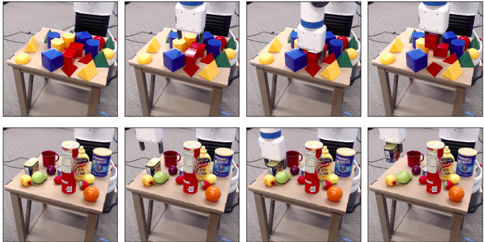
- The pipeline enabled a Fetch robot to detect and pick up the target object in 38 out of 40 trials in increasingly cluttered scenes, and a detector trained on a Spam can succeeded in 9 of 10 trials with previously unseen YCB food distractors.
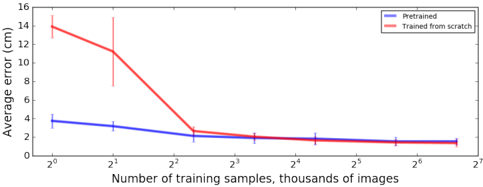
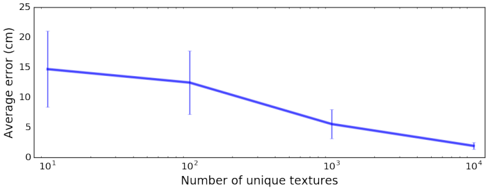
- Ablations found sensitivity to number of training images, number of unique textures, presence of distractors in training, and camera randomization; random noise had negligible effect. Performance improved up to around 50,000 training samples, and degraded significantly with fewer than 1,000 textures.
- ImageNet pretraining was not essential with enough data: random weight initialization achieved nearly the same real-world transfer performance as pretrained initialization, though pretraining helped in the low-data regime.
Methods
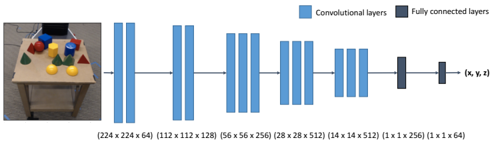
- The authors trained a modified VGG-16 convolutional neural network to map a single 224×224 monocular webcam image to Cartesian coordinates of object(s) of interest, using simulated images rendered by MuJoCo.
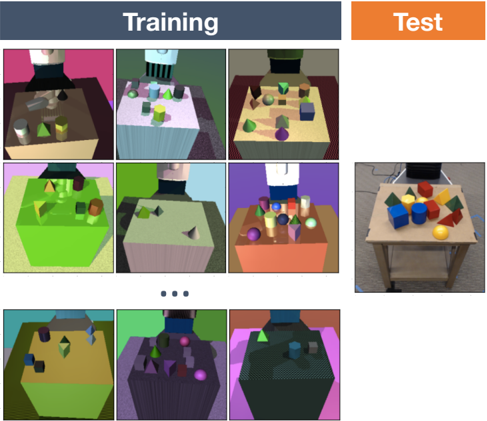
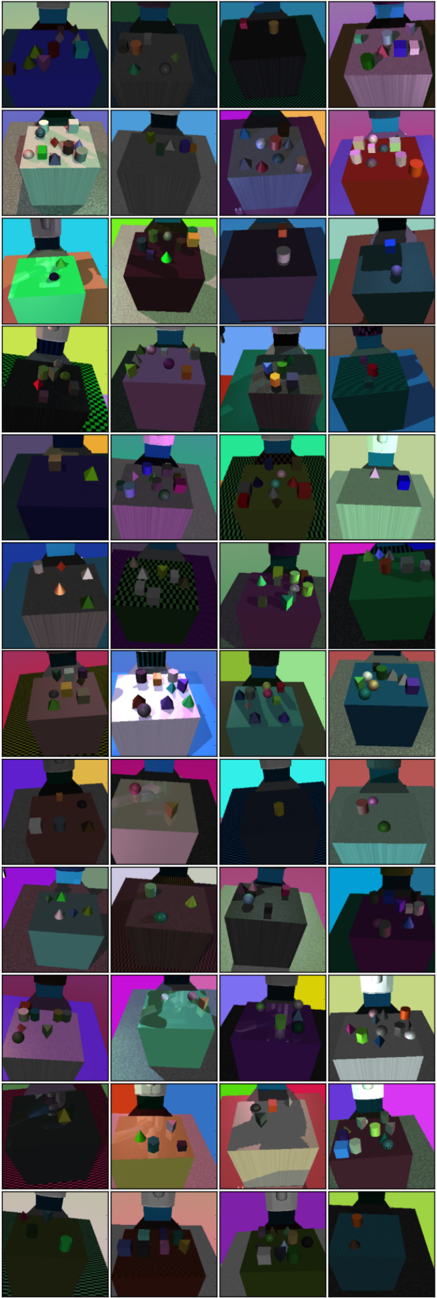
- Domain randomization varied number/shape of distractors, object positions and textures, table/floor/skybox/robot textures, camera position/orientation/field of view, number and properties of lights, and image noise. Textures were random RGB values, gradients, or checker patterns; 0–10 distractor objects were added per scene.
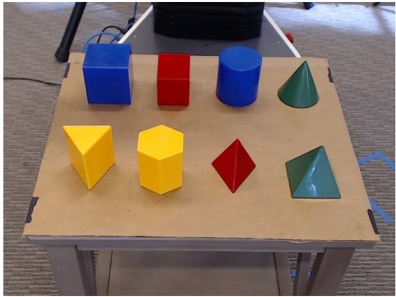
- Training used stochastic gradient descent with Adam on an L2 loss, learning rates around 1e-4, and batch sizes of 25, 50, or 100. Evaluation used 480 webcam images of eight geometric objects at 70–105 cm from a fixed camera, with 60 labeled images per object: 20 alone, 20 with distractors, and 20 partially occluded.
Limitations
- The paper states that the detectors still overfit simulated training data: simulated error was 0.3–0.5 cm versus about 1.5 cm in the real world, and no real-world validation could be done during training because no real data were assumed available.
- The paper states future work is needed for contact-rich manipulation or higher precision, and that the method fixes table height, effectively making the task 2D pose estimation from a single monocular uncalibrated camera.
- Evident from the text: evaluation is limited to eight geometric objects plus one Spam can, the test camera position remains constant across all images, and lighting and surrounding scene were not controlled.
Model-written summary. Check it against the paper before relying on it.
Integrity signals
Registry
Cites
Statistics
Figures
Verification
Claims the paper makes
2 Valid · 8 Not valid · 7 Not checked · 32 Own results and interpretations
The cited sources support only part of this claim — read each source’s verdict below.
In the paper
“Although previous work demonstrated the ability to perform robotic control using a neural network pretrained on ImageNet and fine-tuned on randomized rendered pixels [37], this paper provides the first demonstration that domain randomization can be useful for robotic tasks requiring precision.”
What the sources say
- Partly supportedcites [37] [37] Fereshteh Sadeghi and Sergey Levine. (cad) 2 RL: Real single-image flight without a single real image. arXiv preprint arXiv:1611.04201 , 2016. - sourceExperimental — accuracy not yet measured
The citation [37] is attached to the preceding claim about prior work, not to the citing authors’ claim that their own paper is the first to demonstrate precision robotics. Section 3.1 (p. 4) says LSDA pretrains a CNN on ImageNet classification data and fine-tunes it, but for object detection. It does not report robotic control or fine-tuning on randomized rendered pixels. (LLM, conf=0.84)
boostedstates a cause- Asserted: passes — The authors put it forward as true.
- Checkable: passes — It can be checked against evidence.
- Load-bearing: passes — The paper’s conclusions depend on it.
- Based: passes — The paper gives a reason why it holds.
- Partly supported
The cited sources that could be checked couldn’t confirm or dispute this claim.
In the paper
“Rather than relying on controller robustness, Yu et al. [53] use a model trained on varied physics to perform system identification using online trajectory data, but their approach is not shown to succeed in the real world.”
What the sources say
- Could not verifycites [53] [53] Wenhao Yu, C Karen Liu, and Greg Turk. Preparing for the unknown: Learning a universal policy with online system identification. arXiv preprint arXiv:1702.02453 , 2017. - sourceExperimental — accuracy not yet measured
The cited paper discusses image classification and localisation with convolutional networks (A.1, p. 10; A.2, p. 11), not Yu et al.'s approach. Searches for varied-physics training, online trajectory-based system identification, and real-world success found no passage addressing the claim. Our copy therefore cannot verify it. (LLM, conf=0.78)
plain- Asserted: passes — The authors put it forward as true.
- Checkable: passes — It can be checked against evidence.
- Load-bearing: unclear — It is unclear whether the paper’s conclusions depend on it.
- Based: passes — The paper gives a reason why it holds.
- Could not verify
The cited sources that could be checked couldn’t confirm or dispute this claim.
In the paper
“Though using realistic RGB rendering alone has had limited success for transferring to real robotic tasks [16], incorporating realistic simulation of depth information can allow models trained on rendered images to transfer reasonably well to the real world [32].”
What the sources say
- Could not verifycites [16] [16] Stephen James and Edward Johns. 3d simulation for robot arm control with deep q-learning. arXiv preprint arXiv:1609.03759 , 2016. - sourceExperimental — accuracy not yet measured
The Introduction (§1) and Conclusion (§8) describe Adam as a method for stochastic optimization, while the CNN experiment (§6.3) concerns training on image datasets. Searches for realistic RGB rendering and sim-to-real robotic transfer found no passage addressing whether RGB rendering alone has had limited success on real robotic tasks. (LLM, conf=0.78)
plain- Asserted: passes — The authors put it forward as true.
- Checkable: passes — It can be checked against evidence.
- Load-bearing: passes — The paper’s conclusions depend on it.
- Based: passes — The paper gives a reason why it holds.
- Could not verify
The cited sources that could be checked couldn’t confirm or dispute this claim.
In the paper
“However, their experiments - collision avoidance in hallways and open spaces - do not demonstrate the ability to deal with high-precision tasks.”
What the sources say
- Could not verifycites [37] [37] Fereshteh Sadeghi and Sergey Levine. (cad) 2 RL: Real single-image flight without a single real image. arXiv preprint arXiv:1611.04201 , 2016. - sourceExperimental — accuracy not yet measured
The Experiments section (p. 5) evaluates LSDA on an object-detection dataset, not Sadeghi and Levine’s collision-avoidance experiments. Searches for Sadeghi and Levine, hallway or open-space collision avoidance, and high-precision tasks found no passage addressing the claim. (LLM, conf=0.76)
plain- Asserted: passes — The authors put it forward as true.
- Checkable: passes — It can be checked against evidence.
- Load-bearing: passes — The paper’s conclusions depend on it.
- Based: passes — The paper gives a reason why it holds.
- Could not verify
A result the paper reports from its own data — it cites no other source for it, so there is none to check. The quote shows it is in the paper.
In the paper
“However, using a pre-trained model can significantly improve performance when less training data is used.”
plainstates a cause- Asserted: passes — The authors put it forward as true.
- Checkable: passes — It can be checked against evidence.
- Load-bearing: unclear — It is unclear whether the paper’s conclusions depend on it.
- Based: passes — The paper gives a reason why it holds.
29 more claims
Create a free account to see all 49 claims and to verify the 7 references still open.
- Probably not a substantial claim. 11
- It may state two separate claims as one. 8
Claims other papers make about this one
Each is checked against this paper’s own text: does it say what the citing paper says it does?
The source backs part of the claim, not all of it — or backs it for a different population, condition or comparison.
In the citing paper
“Most policies trained in simulation generalize poorly to the real-world due to agents adapting to specific visual details of the simulator.”
From Language-Based Augmentation to Address Shortcut Learning in Object-Goal Navigation (2023) · cites this paper as [8]
Experimental — accuracy not yet measuredThe source backs part of the claim, not all of it — or backs it for a different population, condition or comparison.
In the citing paper
“In robotic vision tasks including object localization [53], object detection [54], pose estimation [55], and semantic segmentation [56], the training data from simulator always have different textures, lighting, and camera positions from the realistic environments.”
From Sim-to-Real Transfer in Deep Reinforcement Learning for Robotics: a Survey (2020) · cites this paper as [53]
Experimental — accuracy not yet measuredThe source backs part of the claim, not all of it — or backs it for a different population, condition or comparison.
In the citing paper
“These artifacts limit the applicability of generative videos in physics-sensitive domains such as robotics [25,26], autonomous driving [27], simulationbased design, and scientific visualization [28].”
From PhyStruct-Video: Structured Physics State Spaces for Physically Consistent Video Generation (2025) · cites this paper as [25]
Experimental — accuracy not yet measuredThe source backs part of the claim, not all of it — or backs it for a different population, condition or comparison.
In the citing paper
“In domain randomization, the inputs during learning are “randomized” in the sense of being warped or corrupted in particular ways.”
From The overfitted brain: Dreams evolved to assist generalization (2021) · cites this paper as [144]
Experimental — accuracy not yet measuredThe source backs part of the claim, not all of it — or backs it for a different population, condition or comparison.
In the citing paper
“Domain randomization is a domain generalization technique that introduces drastic changes in the training image appearances, which forces the network to learn domain-invariant features between training and target domains [39].”
From A Fully Differentiable Framework for 2D/3D Registration and the Projective Spatial Transformers (2024) · cites this paper as [39]
Experimental — accuracy not yet measured
8 more claims about this paper
Create a free account to see every claim other papers make about this one.
Self-check
Percentages, sums and reported differences re-computed from the paper’s own numbers.
Each contradiction between two passages listed here was confirmed by an independent check.
Rated minor: it would not touch a result — a value no result rests on, a p-value that stays on the same side of the significance level, or a conflict that is clerical, resolved elsewhere in the paper, or outside its own findings.
In the paper
§ A. Experimental Setup · p. 4
“Each training sample consists of (a) a rendered image of the object and one or more distractors (also from among the geometric object set) on a simulated tabletop”
§ A. Domain randomization · p. 4
“Between 0 and 10 distractor objects are added to the table in each scene.”
Citations
Cites
Very Deep Convolutional Networks for Large-Scale Image Recognition
Simonyan, K., & Zisserman, A. (2014) · arXiv · doi:10.48550/arxiv.1409.1556 · Cited by 114,148 · cited 1×
“In particular, we use a modified version the VGG-16 architecture [42] shown in Figure 2.”
MethodAdam: A Method for Stochastic Optimization
Kingma, D. P., & Ba, J. (2014) · arXiv · doi:10.48550/arxiv.1412.6980 · Cited by 98,946 · cited 1×
“We found that using a learning rate of around 1e − 4 (as opposed to the standard 1e − 3 for Adam) improved convergence and helped avoid a common local optimum, mapping all objects to the center of the table.”
MethodLeCun, Y., Bengio, Y., & Hinton, G. (2015) · Nature · doi:10.1038/nature14539 · Cited by 84,126
Human-level control through deep reinforcement learning
Mnih, V., Kavukcuoglu, K., Silver, D., Rusu, A. A., Veness, J., Bellemare, M. G., Graves, A., Riedmiller, M., Fidjeland, A. K., Ostrovski, G., et al. (2015) · Nature · doi:10.1038/nature14236 · Cited by 30,357 · cited 3×
“Learning in simulation is especially promising for building on recent results using deep reinforcement learning to achieve human-level performance on tasks like Atari [27] and robotic control [21], [38].”
BackgroundResultHow transferable are features in deep neural networks?
Yosinski, J., Clune, J., Bengio, Y., & Lipson, H. (2014) · arXiv · doi:10.48550/arxiv.1411.1792 · Cited by 6,061 · cited 1×
“A variety of approaches have been proposed, including re-training the model in the target domain (e.g., [52]), adapting the weights of the model based on the statistics of the source and target domains (e.g., [22]), learning invariant features between domains (e.g., [47]), and learning a mapping…”
BackgroundMuJoCo: A physics engine for model-based control
Todorov, E., Erez, T., & Tassa, Y. (2012) · 2012 IEEE/RSJ International Conference on Intelligent Robots and Systems · doi:10.1109/iros.2012.6386109 · Cited by 4,767 · cited 1×
“We render images using the MuJoCo Physics Engine’s [45] built-in renderer.”
MethodTrust region policy optimization
Schulman, J., Levine, S., Moritz, P., Jordan, M. I., & Abbeel, P. (2015) · arXiv · doi:10.48550/arxiv.1502.05477 · Cited by 4,578 · cited 1×
“Learning in simulation is especially promising for building on recent results using deep reinforcement learning to achieve human-level performance on tasks like Atari [29] and robotic control [26], [41].”
ResultSelf-citationLearning Transferable Features with Deep Adaptation Networks
Long, M., Cao, Y., Wang, J., & Jordan, M. I. (2015) · arXiv · doi:10.48550/arxiv.1502.02791 · Cited by 4,505 · cited 1×
“omputer vision community has devoted significant study to the problem of adapting vision-based models trained in a source domain to a previously unseen target domain (see, e.g., [9], [14], [15], [19], [23], [25], [51]). A variety of approaches have been proposed, including re-training the model in the target domain (e.…”
BackgroundEnd-to-End Training of Deep Visuomotor Policies
Levine, S., Finn, C., Darrell, T., et al. (2015) · Journal of machine learning research · doi:10.5555/2946645.2946684 · Cited by 3,987
Describing Textures in the Wild
Cimpoi, M., Maji, S., Kokkinos, I., Mohamed, S., & Vedaldi, A. (2014) · 2014 IEEE Conference on Computer Vision and Pattern Recognition · doi:10.1109/cvpr.2014.461 · Cited by 2,438 · cited 1×
“To examine how our detectors would perform on objects with complex textures, we created simulated scenes in which the object of interest is given a texture from the Describable Textures Dataset (DTD) [4].”
Method
Research works printed but not linked: 3
- [24] David G Lowe. Three-dimensional object recognition from single two-dimensional images. Artificial intelligence , 31(3):355-395, 1987. -
- [49] Melonee Wise, Michael Ferguson, Derek King, Eric Diehr, and David Dymesich. Fetch and freight: Standard platforms for service robot applications. In Workshop on Autonomous Mobile Service Robots , 2016. -
- sucan, 0, MoveIt!
Cited by
Items 2,501–2,600 of 2,970
Matsumura, Y., Kishikawa, T., & Kinoshita, K. (2024) · The Journal of The Institute of Image Information and Television Engineers · doi:10.3169/itej.79.128
Sim-to-Real Image Transfer for RL-Based Bin Picking
Park, I. J., & Han, H. (2024) · International Conference on Information and Communication Technology Convergence (ICTC) · doi:10.1109/ictc62082.2024.10826807
Lee, E., Kim, E., & Choi, A. J. (2025) · Elsevier eBooks · doi:10.1016/b978-0-443-21996-2.00003-6
Action Robust Reinforcement Learning with Highly Expressive Policy
Kim, S., & Shibuya, T. (2024) · Conference proceedings/Conference proceedings - IEEE International Conference on Systems, Man, and Cybernetics · doi:10.1109/smc54092.2024.10831098 · Cited by 1
Learning Fault-Tolerant Quadruped Locomotion with Unknown Motor Failure Using Reliability Reward
Wang, S., Zhao, C., Qian, L., & Luo, X. (2025) · Lecture notes in computer science · doi:10.1007/978-981-96-0783-9_10 · Cited by 3
Use of Reinforcement Learning Algorithms in the Development of Pedagogical Methodologies
Aguilar-Ortíz, J., Zamudio-García, V. M., & Franco, G. S. (2025) · IGI Global eBooks · doi:10.4018/979-8-3693-7793-2.ch010
TGRL: A Trajectory-Guided Reinforcement Learning Approach for Robust Autonomous Racing
Sun, Y., Qu, D., Zuo, Z., Zhang, H., Xu, L. J., Ren, X., & Wang, X. (2024) · China Automation Congress (CAC) · doi:10.1109/cac63892.2024.10865358
“Domain randomization enhances an agent’s adaptability by varying environmental dynamics during training, rather than confining it to a single simulated environment [20]–[22].”
Bergemann, M., Singha, T., Pham, D.-S., & Krishna, A. (2024) · International Conference on Digital Image Computing: Techniques and Applications (DICTA) · doi:10.1109/dicta63115.2024.00102
“Techniques such as adversarial training [5], self-training [33], feature alignment, and domain randomization [24] are employed to enhance UDA performance and bridge the gap between source and target domains.”
Yong, J.-H., Kim, M.-S., & Park, T.-H. (2025) · Journal of Institute of Control Robotics and Systems · doi:10.5302/j.icros.2025.24.0263
Güitta-López, L., Güitta-López, L., Martín-Larrauri, J. B., & López, Á. J. L. (2025) · SSRN Electronic Journal · doi:10.2139/ssrn.5158700
Learning to Navigate Under Unified Scene Style
Cui, X., Liu, Z., & Gao, Y. (2025) · Lecture notes in electrical engineering · doi:10.1007/978-981-96-2236-8_52
Continuously Visual Pre-training with Artificially Generated and Real Images
MATSUO, Y., Hayamizu, R., Nakamura, S., Inoue, N., Yokota, R., Kataoka, H., & Nakamura, A. (2025) · Journal of the Japan Society for Precision Engineering · doi:10.2493/jjspe.91.425
Speech Re-Painting for Robust ASR
Kastner, K., Wang, G., Elias, I., Saeki, T., Mengibar, P. M., Beaufays, F., Rosenberg, A., & Ramabhadran, B. (2025) · IEEE International Conference on Acoustics Speech and Signal Processing · doi:10.1109/icassp49660.2025.10888357 · Cited by 1
“The approach of using controlled generations to improve robustness is similar to related work in reinforcement learning on domain randomization [29], [30], though the typical focus in domain randomization is on bridging the so-called “sim-to-real" gap.”
Balasooriya, T., Yoo, S., Schoefer, V., Tseng, H.-H., Gao, Y., Lin, W., & Silva, C. D. (2025) · IEEE International Conference on Acoustics Speech and Signal Processing · doi:10.1109/icassp49660.2025.10889501
“To ensure robustness and scalability to real-world scenarios, we apply domain randomization, a technique commonly used to facilitate simulation-to-reality transfer [12], [19].”
Cross-Scale Transformer-Based Matching Network for Generalizable Person Re-Identification
Xiao, J., Jiang, J., Huang, J., Hu, W., & Zhang, W. (2025) · IEEE Access · doi:10.1109/access.2025.3548321
“[20], [21], [22], representation learning [23], [24], [25], and learning strategies [26], [27], [28].”
AutoSelecter: Efficient Synthetic Nighttime Images Make Object Detector Stronger
Chao, M., Mengjie, W., Wenxiu, S., Huiping, Z., Song, Z., Zhang, R., & Yang, M. Z. (2025) · IEEE Robotics and Automation Letters · doi:10.1109/lra.2025.3552996 · Cited by 1
Martínez-Arellano, G., & Buck, M. G. (2025) · Lecture notes in mechanical engineering · doi:10.1007/978-3-031-86489-6_13
Liu, Q. Z., Liu, Y., Du, Y., Yan, Y., & Jiang, X. (2025) · IEEE Sensors Journal · doi:10.1109/jsen.2025.3552822 · Cited by 1
“The authors [17], [18], [19], and [20] applied domain randomization for 3-”
GOME-NGU: Visual Navigation Under Sparse Reward via Goal-Oriented Memory Encoder With Never Give Up
Lee, J. S., & Moon, J. (2025) · IEEE Access · doi:10.1109/access.2025.3556894
Swenson, N., Goddard, J., Fern, X. Z., Balasubramanian, R., & Grimm, C. M. (2025) · IEEE Robotics and Automation Letters · doi:10.1109/lra.2025.3558699 · Cited by 1
Hönig, P., Thalhammer, S., Weibel, J.-B., Hirschmanner, M., & Vincze, M. (2025) · IEEE Winter Conference on Applications of Computer Vision · doi:10.1109/wacv61041.2025.00853 · Cited by 4
“The capacity of networks to generalize from synthetic to real object primitives with random color has been demonstrated by [34].”
InfluentialLim, M. C., & Choi, H. (2025) · International Journal of Advanced Robotic Systems · doi:10.1177/17298806251332359
“Techniques such as data augmentation 12 – 14 and domain randomization 15,16 introduce variability during training, helping to develop more robust models.”
WITHDRAWNPreprint
Lei, D. (2025) · PsyArXiv (OSF Preprints) · doi:10.31234/osf.io/hu87m_v3
ForceMapping: learning visual-force features from vision for soft objects manipulation
Mustafa, A., Hanai, R., Ramírez-Alpizar, I. G., Erich, F., Nakajo, R., Domae, Y., & Ogata, T. (2025) · Advanced Robotics · doi:10.1080/01691864.2025.2483929 · Cited by 1
“We strive to accomplish this through careful domain randomization [31] within simulations, coupled with the incorporation of zero-shot physical understanding of Vision-Language Models (VLMs), such as GPT-4V [21].”
SoS: A Semi-Synthetic RoboCup Soccer Dataset for Visual Segmentation
Sims, Y., Houliston, T., Amos, M., et al. (2025) · Lecture notes in computer science · doi:10.1007/978-3-031-85859-8_27
Faster Training for Robotic Manipulation in GPU Parallelized Robotics Simulation
Pitkevich, A. V. (2025) · International Journal of Software Science and Computational Intelligence · doi:10.4018/ijssci.374216 · Cited by 1
Grasp Point Estimation using Simulator-Generated Datasets Including Pose Information
Maruno, R., Shiba, T., Yamaguchi, N., et al. (2025) · Proceedings of International Conference on Artificial Life and Robotics · doi:10.5954/icarob.2025.os17-7
Demystifying machine learning for predictive analytics in construction
Delgado, J. M. D. (2025) · Elsevier eBooks · doi:10.1016/b978-0-443-29861-5.00023-8
Imran, A., & Gopalakrishnan, K. (2025) · Apress eBooks · doi:10.1007/979-8-8688-0989-7_5
ADR-PNAS: a Novel Sim-to-Real Transfer Approach for Robotic Manipulation TasksPreprint
Nong, Y. (2025) · Research Square · doi:10.21203/rs.3.rs-6619931/v1
Gao, S., & Bezzo, N. (2025) · Journal of Intelligent & Robotic Systems · doi:10.1007/s10846-025-02250-3
Design Principles for Reinforcement Learning in Congestion Control Environments
Kiarie, L. K., Derakhshani, M., & Kyriakopoulos, K. G. (2025) · IEEE Access · doi:10.1109/access.2025.3569093
“This approach of randomly changing parameters in the network during training is known as Domain Randomization (DR) [25].”
Güitta-López, L., Boal, J., & López-López, Á. J. (2025) · Research Square · doi:10.21203/rs.3.rs-6662623/v1
Kozuka, H., Zhao, M., Nishio, T., Yanokura, I., Kawaharazuka, K., Sugihara, J., Sugihara, K., Okada, K., & Inaba, M. (2025) · Advanced Robotics · doi:10.1080/01691864.2025.2506091 · Cited by 2
“In this paper, the objective of Domain Randomization (DR) [24] is to train the navigator using a diverse range of robot configurations, thereby fostering the learning of adaptive strategies that can be applied effectively across various quadrotor platforms.”
Wang, D., & Ghoreishi, S. F. (2026) · International Journal of Intelligent Transportation Systems Research · doi:10.1007/s13177-026-00685-y
Dahdal, R., & Hament, B. (2025) · Systems and Information Engineering Design Symposium · doi:10.1109/sieds65500.2025.11021213
Watson, J., Urain, J., Carvalho, J., Funk, N., & Peters, J. (2025) · Springer eBooks · doi:10.1007/978-3-319-74095-9_6
Domain Randomization for Object Detection: A Survey
Fan, J., Xie, Y., & Li, Z. (2025) · International Conference on Advanced Electronic Materials, Computers and Software Engineering (AEMCSE) · doi:10.1109/aemcse65292.2025.11042418 · Cited by 2
LIANG, B., Wang, X., Kang, L., XIE, D., Wang, L., WANG, S., & ZHANG, M. (2025) · SSRN Electronic Journal · doi:10.2139/ssrn.5347256
Deep Reinforcement Learning Based Dynamic Controller for Trajectory Tracking of Mobile Robots
Ndlovu, H., & Wang, C. (2025) · 2025 5th International Conference on Computer, Control and Robotics (ICCCR) · doi:10.1109/icccr65461.2025.11072639
Learning Accurate and Robust Velocity Tracking for Quadrupedal Robots
Zhu, C., Zhang, Z., Liu, W., Li, S., & Liu, Y. (2025) · Journal of Field Robotics · doi:10.1002/rob.70028 · Cited by 3
“Techniques such as dynamics randomization (Tobin et al. 2017; Peng et al. 2018a) have been widely used to adapt to uncertain dynamics, but they are still insufficient to bridge the sim ‐ to ‐ real gap.”
Reachability Graph Learning with Reinforcement Learning Control for Robotic Tasks
Bonnavaud, H., Albore, A., & Rachelson, E. (2025) · International Conference on Control and Robotics Engineering (ICCRE) · doi:10.1109/iccre65455.2025.11093311
“Various methods help adapting the policy to the real world, such as domain randomization [25] or domain adaptation [26].”
A Deep Reinforcement Learning Algorithm for Objects Balance Control with Hexapod Robot
Tsai, Y.-H., Saeedvand, S., & Baltes, J. (2025) · International Conference on Control and Robotics Engineering (ICCRE) · doi:10.1109/iccre65455.2025.11093566 · Cited by 1
“This algorithm adeptly estimates the policy gradient [21] on a batch of states, executing multiple updates while ensuring that the revised policy stays within a reasonable deviation from the current one.”
AeroGen: Ground-to-Air Generalization for Action Recognition
Shah, K., Shah, A., Reddy, A., Roy, A., de Melo, C. M., & Chellappa, R. (2025) · International Conference on Automatic Face and Gesture Recognition · doi:10.1109/fg61629.2025.11099250
“Domain randomization [49], [40] is a common technique used for domain generalization where the input is augmented using different transformations.”
Bringing Equity to Classification: Domain Generalization for Domain-Linked Classes
Kaai, K., Hossain, S., & Rambhatla, S. (2025) · IEEE Transactions on Pattern Analysis and Machine Intelligence · doi:10.1109/tpami.2025.3593407 · Cited by 2
Visual Multi Feature Fusion for Precise Robot Grasping: A Comprehensive Analysis
Chang, H., & Liu, Z. (2025) · International Journal of Cognitive Informatics and Natural Intelligence · doi:10.4018/ijcini.386767
Reinforcement Learning in Robotic Systems: A Review on Sim-to-Real TransferPreprint
Khapre, S. P., Tiwari, R., & Singh, A. (2025) · SSRN Electronic Journal · doi:10.2139/ssrn.5387665
Foundational Models for Robotics need to be made Bio-Inspired
Chen, L., & Nguyen, S. M. (2025) · IEEE Workshop on Advanced Robotics and its Social Impacts (ARSO) · doi:10.1109/arso64737.2025.11124992
“Simulation-based learning plays a key role in enabling FMRs to accumulate diverse experiences required for scalable self-supervised learning [28, 29, 30].”
A Survey of Domain Adaptation in Robotics Using Diffusion Models
Huang, X. (2025) · Applied and Computational Engineering · doi:10.54254/2755-2721/2025.ld26106 · Cited by 1
Ilboudo, W. E. L., Kobayashi, T., & Matsubara, T. (2025) · The International Journal of Robotics Research · doi:10.1177/02783649251358844 · Cited by 2
“Among these, Domain Randomization (DR) (see Tobin et al. (2017); Ruiz et al. (2018); Chen et al. (2021); Weng (2019)) and Robust MDP (RMDP) (see Morimoto and Doya (2005); Derman et al. (2019); Tessler et al. (2019); Lin et al. (2020); Mankowitz et al. (2019); Pinto et al. (2017)) have the highest…”
BackgroundTransfer Learning for a Class of Cascade Dynamical Systems
Rabiei, S., Mishra, S., & Paternain, S. (2025) · Proceedings of the ... American Control Conference/Proceedings of the American Control Conference · doi:10.23919/acc63710.2025.11107987 · Cited by 1
“This enables agents to quickly adapt to new environments, thereby facilitating their adaptation to discrepancies between simulation and reality [22], [23].”
Learning and Control of Terrestrial Gait for a Bionic Turtle
Xue, M., Zhang, S., Liang, L., Hu, Y., & Yuan, X. (2025) · IEEE International Conference on Mechatronics and Automation (ICMA) · doi:10.1109/icma65362.2025.11120657
“Domain randomization, proposed by Tobin et al. [15], bridges the gap between simulation and reality.”
Salvador, L. F. F., Tejela, B. V., Almodóvar, A., Parras, J., & Zazo, S. (2025) · Journal of Marine Science and Engineering · doi:10.3390/jmse13091627 · Cited by 1
Language-guided multimodal domain generalization for outcome prediction of head and neck cancer
Wang, R., Chen, J., Zhang, X., Liu, H., Zhou, Z., Wang, K., Jiao, C., & Wang, J. (2025) · Computers in Biology and Medicine · doi:10.1016/j.compbiomed.2025.110992
Trescher, D., Haag, W., & Schröder, E. (2025) · Lecture notes in computer science · doi:10.1007/978-3-032-02813-6_22
Distributed Perception Aware Safe Leader Follower System via Control Barrier Methods
Suganda, R. R., Tran, T. T., Pan, M., et al. (2025) · Proceedings - IEEE International Conference on Robotics and Automation/Proceedings · doi:10.1109/icra55743.2025.11127883
Generating Diverse Challenging Terrains for Legged Robots Using Quality-Diversity Algorithm
Esquerre-Pourtère, A., Kim, M., & Park, J. (2025) · Proceedings - IEEE International Conference on Robotics and Automation/Proceedings · doi:10.1109/icra55743.2025.11128362
Efficient Cross-Boundary Grasping in Stacked Clutter with Single-Visual Mapping Multi-Step
Luo, Y., Wang, T., Xie, F., Zhao, N., Fu, X., & Shen, Y. (2025) · Proceedings - IEEE International Conference on Robotics and Automation/Proceedings · doi:10.1109/icra55743.2025.11127976
“Considering the potential discrepancies between the sizes of simulated models and their real world counterparts, we aim to enhance the model’s generalization using domain randomization [19] for improved robustness.”
HEROES: Unreal Engine-based Human and Emergency Robot Operation Education System
Chaudhary, A., Tiwari, K., & Bera, A. (2025) · Proceedings - IEEE International Conference on Robotics and Automation/Proceedings · doi:10.1109/icra55743.2025.11128532 · Cited by 3
Byrd, M., Crandell, J. L., Das, M., Inman, J., Wright, R., & Ha, S. (2025) · Proceedings - IEEE International Conference on Robotics and Automation/Proceedings · doi:10.1109/icra55743.2025.11127672 · Cited by 4
“It has been effective in many applications, including manipulation [19], [2], [20], [21], locomotion [3], [22], autonomous driving [23], and indoor drone flying [24].”
Wang, C., Lin, Y., Yang, Q., Fan, L., Ye, M., Wu, Z., Cai, C., & Cai, S. (2025) · IEEE Transactions on Emerging Topics in Computational Intelligence · doi:10.1109/tetci.2025.3602075
A Learning-Based Adaptive Compliance Control Approach with Coupling Dynamics for Mobile Manipulators
Cheng, M., Li, X., & Ren, Q. (2025) · IEEE Conference on Industrial Electronics and Applications (ICIEA) · doi:10.1109/iciea65512.2025.11149223
“In order to ensure the generalization of the policy network and improve the performance of adaptive force control, the domain randomization method [17] has been adopted in this work.”
Synthetic Data for Robust Runway Detection
Chigot, E., Wilson, D. G., Ghrib, M., Jimenez, F., & Oberlin, T. (2025) · Lecture notes in computer science · doi:10.1007/978-3-032-04968-1_25
“The first one, domain randomization [24, 25, 7], implies that photorealism doesn’t matter as it tries to make data as diverse as possible.”
Training Autonomous Robotic Tasks Through the Use of Machine Learning in Simulated Realities
Patterson, M. C., Cohen, S., Bjornstad, J., Amaro, R., Tucker, J., Gurley, A., & Kubik, K. (2025) · Nuclear Technology · doi:10.1080/00295450.2025.2535192 · Cited by 1
“[5] A set of 200 real images were used to create a small test dataset for comparison.”
InfluentialCutaway View Learning for Visually-Guided Assembly with Crane
Li, P., Hauser, K. K., & Nagi, R. (2025) · IEEE International Conference on Automation Science and Engineering (CASE) · doi:10.1109/case58245.2025.11163919 · Cited by 1
“During training-time, we use domain randomization [33], which varies simulation parameters during training to allow for robust deployment.”
Васильевич, К. В., & Олейникова, С. А. (2025) · Программные системы и вычислительные методы · doi:10.7256/2454-0714.2025.3.75996
Fundamentals of applied robotics: an integrated guide on control, programming and training
Zamora, Y. M., Cuestab, M. A., Reynac, T. A., & Salazard, J. B. (2025) · Prohominum · doi:10.47606/acven/ph0383
“Third, in professional workflows (CI/CD), simulators enable automated testing: every code change triggers simulation tests, preventing regressions and improving software robustness (Tobin et al., 2017).”
ENDLESS: An End-to-End Framework for Urban Synthetic Dataset Generation
Neto, A. T. C., Costa, W. D. L., Teichrieb, V., & Teixeira, J. M. (2025) · Journal of the Brazilian Computer Society · doi:10.5753/jbcs.2025.5869
“However, since the real world cannot be fully simulated in a virtual environment, a reality gap [Tobin et al ., 2017] may be present in synthetic datasets.”
InfluentialEnhancing World Models with Specialized Prediction Networks for Reinforcement Learning
Mellado-Ibanez, A., Arana-Arexolaleiba, N., & Vázquez, J. I. (2025) · Lecture notes in computer science · doi:10.1007/978-3-032-08462-0_20
Enhancing generalization in autonomous driving through track-agnostic reinforcement learning
Authier-Carcelen, J.-B., & Zadourian, R. (2025) · Neural Computing and Applications · doi:10.1007/s00521-025-11597-5
“[29] introduced domain randomization, varying environmental parameters (e.g., textures and lighting) to force agents to learn generalizable policies.”
Krau, T., Schäfer, G., Damm, T., & Heieck, F. (2025) · International Conference on Machine Learning Technologies (ICMLT) · doi:10.1109/icmlt65785.2025.11193289 · Cited by 1
“Tobin et al. [20] demonstrated that modifying simulation parameters can enhance the generalization ability of models, making them more robust when applied to real-world systems.”
Barragan, R. N. C., Alamilla, M. E. R., Ruiz, R. B. J., Zagal-Flores, R., & Barria, C. (2025) · Communications in computer and information science · doi:10.1007/978-3-032-06760-9_12
Emura, K., & HAYASHI, R. (2025) · Journal of Robotics and Mechatronics · doi:10.20965/jrm.2025.p1024
From Sim-to-Real to Learn-in-Real: Real-World Online Learning for Humanoid Robots
Li, R., Xie, Y., Zhu, L., Ye, L., Li, Q., & Peng, Y. (2025) · Lecture notes in computer science · doi:10.1007/978-981-95-2098-5_44 · Cited by 2
Learning human-to-robot handovers through 3D scene reconstruction
Wu, Y., Pang, Y. L., Cavallaro, A., & Oh, C. (2025) · IEEE RO-MAN · doi:10.1109/ro-man63969.2025.11217579 · Cited by 1
“To mitigate these challenges, policies are often trained in simulated environments and then transferred to the real world [35], [36], [5].”
Chen, L., Mo, Y., Wang, Y., Miao, Z., Zeng, K., Feng, M., Zhou, Z., Wang, S., & Wang, D. (2025) · IEEE Transactions on Intelligent Transportation Systems · doi:10.1109/tits.2025.3612273
“Domain randomization fails to extend to one-to-many generalization scenarios, and the application of the trained policy to guide agents in new domains similar to the training environment poses significant uncertainty [10], [11], [12].”
Interdisciplinary Programming Education Through AI Robot Control
Yanagisawa, K., & Hiromi, M. I. N. E. (2025) · Journal of JSEE · doi:10.4307/jsee.73.6_11
Exploring Synthetic Generation of Digital Data Through Data-Driven Learning
Chakkaravarthy, A. P., & Jaganathan, D. (2025) · IGI Global eBooks · doi:10.4018/979-8-3373-2277-3.ch002
Digital Synthetic Motion Outputs
Kundu, S., Dey, K., Bir, R., & Pal, S. (2025) · IGI Global eBooks · doi:10.4018/979-8-3373-2277-3.ch005
Kapusi, T. P., Erdei, T. I., Abdullah, M., Husi, G., & Hajdú, A. (2025) · Robotics · doi:10.3390/robotics14120175 · Cited by 1
“Approaches such as those as Tobin et al. and Peng et al. demonstrated that randomizing textures, lighting, and dynamics enables robust transfer of trained policies to real robots [1,12].”
CCDP: Composition of Conditional Diffusion Policies with Guided Sampling
Razmjoo, A., Calinon, S., Gienger, M., & Zhang, F. (2025) · IEEE/RSJ International Conference on Intelligent Robots and Systems (IROS) · doi:10.1109/iros60139.2025.11247405 · Cited by 1
“While this approach can handle some types of failures, like those caused by environmental parameter shifts (e.g., changes in friction), it struggles with a wider range of failures where a single robust policy may not exist.”
LoopSR: Looping Sim-and-Real for Lifelong Policy Adaptation of Legged Robots
Wu, P., Xie, W., Cao, J., Lai, H., & Zhang, W. (2025) · IEEE/RSJ International Conference on Intelligent Robots and Systems (IROS) · doi:10.1109/iros60139.2025.11246873 · Cited by 6
“III-E).”
Learning Robust Agile Flight Control with Stability Guarantees
Pries, L., & Ryll, M. (2025) · IEEE/RSJ International Conference on Intelligent Robots and Systems (IROS) · doi:10.1109/iros60139.2025.11246103
“To overcome this challenge, training is often augmented with domain randomization techniques [34]–[37] and by abstracting control inputs to high-level commands [4], [37]–[39].”
A Sim-to-Real Transfer Framework for Enhancing Marine Vehicle Performance in Ocean Environments
Zheng, Z., Wang, Z., & Xie, W. (2025) · IEEE/RSJ International Conference on Intelligent Robots and Systems (IROS) · doi:10.1109/iros60139.2025.11246159 · Cited by 1
“If the model sees enough simulated variation, the real world may look like just the next simulator [10].”
On learning racing policies with reinforcement learning
Czechmanowski, G., Węgrzynowski, J., Kicki, P., & Walas, K. (2025) · IEEE/RSJ International Conference on Intelligent Robots and Systems (IROS) · doi:10.1109/iros60139.2025.11245855 · Cited by 3
“To address this challenge, domain randomization [31] is often employed during training by perturbing the model parameters.”
Liu, Y. T., Vale, A., Ahmad, A., Ventura, R., & Basiri, M. (2025) · IEEE/RSJ International Conference on Intelligent Robots and Systems (IROS) · doi:10.1109/iros60139.2025.11247765
“In our experiments, we evaluated our GCN-based multitask SAC framework for UAV control using IsaacGym’s large-scale simulation to train and validate two key tasks: attitude tracking and stabilization.”
InfluentialBridge the Gap: Enhancing Quadruped Locomotion with Vertical Ground Perturbations
Stasica, M. A., Bick, A., Bohlinger, N., Mohseni, O., Fritzsche, M. J. A., Hübler, C., Peters, J., & Seyfarth, A. (2025) · IEEE/RSJ International Conference on Intelligent Robots and Systems (IROS) · doi:10.1109/iros60139.2025.11247549 · Cited by 5
“This includes randomizing the robot’s properties, such as mass, inertia, and actuator dynamics, as well as the environment’s properties, such as ground friction and roughness of the terrain.”
Xie, L., Rong, H., Chen, Z., Zhou, Z., Mo, S., & Cheng, H. (2025) · IEEE/RSJ International Conference on Intelligent Robots and Systems (IROS) · doi:10.1109/iros60139.2025.11247253 · Cited by 1
“To mitigate the physical reality gap in dynamic bipedal locomotion, we employ domain randomization [27] by systematically perturbing inertial, actuation, and environmental parameters during policy training.”
Huang, D., Li, Z., & Hu, C. (2025) · IEEE/RSJ International Conference on Intelligent Robots and Systems (IROS) · doi:10.1109/iros60139.2025.11246499
“Domain Randomization (DR) has proven to be an effective method to address this issue [28].”
Leung, B., Haomachai, W., Pedersen, J. W., Risi, S., & Manoonpong, P. (2025) · IEEE/RSJ International Conference on Intelligent Robots and Systems (IROS) · doi:10.1109/iros60139.2025.11247433 · Cited by 1
“This approach demonstrated the possibility of rapidly transforming a randomly initialized network into a functional one and adapting to leg damages not seen during the evolution of the plasticity rules.”
Domain-randomised instance-segmentation benchmark for soot in PIV images
Jose, B., Geigle, K. P., & Hampp, F. (2025) · Machine Learning Science and Technology · doi:10.1088/2632-2153/ae2565 · Cited by 1
“Domain randomisation (DR), a novel method first applied to transfer domains in robotics [48] and later in many CV applications [21, 49, 50], can effectively gener-alise to a wide range of domains, while accurately segmenting QoI with minimal human input.”
Zhao, E., Pérez, S. A. H., & Harada, K. (2025) · Scientific Reports · doi:10.1038/s41598-025-26600-1 · Cited by 1
ToggleMimic: A Two-Stage Policy for Text-Driven Humanoid Whole-Body Control
Zheng, W., Wang, S., & Qian, B. (2025) · Sensors · doi:10.3390/s25237259 · Cited by 1
“With the advent of domain randomization [7] and the advancement of GPU parallel computing [8,9], constructing whole-body controllers for humanoid robots using reinforcement learning or imitation learning algorithms has become mainstream.”
Wu, J., Chen, Z., Chen, Y., Cui, Z., Du, S., Yang, X., & Xin, J. (2025) · Medical Physics · doi:10.1002/mp.70118 · Cited by 2
PGA6D: 6D pose estimation for grasping and assemblying based on keypoints voting
He, Y., Wang, S., Wu, C., & Chen, L. (2025) · Machine Vision and Applications · doi:10.1007/s00138-025-01771-z · Cited by 3
“The dataset was partitioned into training (35,000 images), validation (5,000 images), and test sets (5000 images) following established domain randomiza - tion practices [29].”
Recent advances in diffusion-based embodied imitation learning: a survey
Mu, L. I., Liu, X., Li, Q., Yu, X., Jingzhi, C. U. I., Zhao, L., Feng, H. A. N., Yang, X., Zhou, B., Niu, J., et al. (2026) · Scientia Sinica Informationis · doi:10.1360/ssi-2025-0307 · Cited by 2
A Synthetic Dataset for Manometry Recognition in Robotic Applications
Saraiva, P. A. R., de Souza, E. F., Pinheiro, J. M. H., Segreto, T. H., de Godoy, R. V., & Becker, M. (2025) · Latin American Robotics Symposium, Brazilian Symposium on Robotics and Workshop on Robotics in Education (LARS/SBR/WRE) · doi:10.1109/lars69345.2025.11272958 · Cited by 1
“Early sim-to-real studies demonstrated that heavy appearance randomization can transfer object localization and even collision-avoidance policies trained purely in simulation to the real world [31], [32].”
ElMoaqet, H., Rashed, M., & Bakr, M. H. (2025) · Machines · doi:10.3390/machines13121126
“Another solution is to use domain randomization [6], where objects are rendered with randomized backgrounds, lighting conditions, materials, and other parameters, as seen in Figure 3.”
Soft Robotic Sim2Real via Conditional Flow Matching
Shi, G., Wang, X., Farinha, A. T., Pinskier, J., Shen, X., Scalzo, R. A., & Howard, D. (2025) · Advanced Intelligent Systems · doi:10.1002/aisy.202500690 · Cited by 3
Deep Reinforcement Learning for Autonomous Navigation: Sim-to-Real Transfer on TurtleBots
Nevo, M. D., Turcato, N., Sinigaglia, A., et al. (2025) · IFAC-PapersOnLine · doi:10.1016/j.ifacol.2025.12.003
Metadata
- Authors
- Tobin, J., Fong, R., Ray, A., Schneider, J., Zaremba, W., & Abbeel, P.
- Affiliations
- University of California, Berkeley (US)
- OpenAI (United States) (US)
- International Computer Science Institute (US)
- ORCID
- Abbeel, Pieter
- Venue
- 2017 IEEE/RSJ International Conference on Intelligent Robots and Systems (IROS)
- Publisher
- IEEE
- Published
- 2017-09
- Pages
- 23-30
- ISSN
- 2153-0858 (ISSN-L)
- OpenAlex
- W2605102758
- Semantic Scholar
- 32ceb28e45a445df4d89df281bb0e3ab5aab1a2a
- Cited by
- 3,124
- References
- 69
- Citations by year
- 2026: 413 · 2025: 433 · 2024: 336 · 2023: 403 · 2022: 374 · 2021: 422 · 2020: 352 · 2019: 256 · 2018: 106 · 2017: 25
- FWCI
- 92.18
- Type
- conference paper
- Language
- en
- Open access
- green
- arxiv.org
- Locations
- IEEE/RSJ International Conference on Intelligent Robots and Systems (IROS) (publishedVersion)
- arXiv (Cornell University) (submittedVersion)
- arXiv (Cornell University)
- Topics
- Physical Sciences › Computer Science › Artificial Intelligence › Reinforcement Learning in Robotics
- Physical Sciences › Engineering › Control and Systems Engineering › Robot Manipulation and Learning
- Physical Sciences › Computer Science › Artificial Intelligence › Domain Adaptation and Few-Shot Learning
- Keywords
- domain randomization, sim-to-real transfer, reality gap, object detection, object localization, robotic grasping, cluttered environments, distractor robustness, partial occlusion, robotic manipulation
About these checks
Registry, retraction, Cites and statistics results are computed, not judged, with one exception: a printed reference that no index lists is read once by a model before it counts as a citation error. Claims are extracted by a model and kept only when their quote appears verbatim in the text; each cited source is then checked, with a model’s help, for whether it says what the claim relies on. Those verdicts can be wrong — read the claim’s quote and the cited source before relying on one.
The claim verdicts this report counts are experimental: their accuracy is not yet measured.
A language model drew the claims from the paper on 2026-10-10, under version 3 of the claim definition (model deepseek-v4.1-flash, prompt extract-v3).
A second model labelled each claim on 2026-10-10 (model jev-1.13-20260917, definition revision gold-guideline-v0.2).
Cited sources are checked with a language model’s help (gpt-6-sol).
Statistics and arithmetic are recomputed, not judged.
Confidence bands are shown only for fields calibrated on our annotated test set. None is calibrated yet, so no band is shown.
What counts as a claim ›How we measure confidence ›How we check this ›
Are you an author, or do you see a problem with this page? Request a review
Data sources
Bibliographic data: Semantic Scholar, OpenAlex, Crossref.
Contains information from the Semantic Scholar Academic Graph Datasets, made available under the ODC Attribution License (ODC-BY 1.0).
Semantic Scholar’s data is described in: Kinney, R., et al. (2023). The Semantic Scholar Open Data Platform. arXiv:2301.10140.
