

Domain randomization for transferring deep neural networks from simulation to the real world
Open accessThe DOI matches its Crossref record; 71 of the 71 references it cites were found in a registry or an index; 8 of the 17 sources its claims cite were checked for support.
Abstract
Bridging the `reality gap' that separates simulated robotics from experiments on hardware could accelerate robotic research through improved data availability. This paper explores domain randomization, a simple technique for training models on simulated images that transfer to real images by randomizing rendering in the simulator. With enough variability in the simulator, the real world may appear to the model as just another variation. We focus on the task of object localization, which is a stepping stone to general robotic manipulation skills. We find that it is possible to train a real-world object detector that is accurate to 1.5 cm and robust to distractors and partial occlusions using only data from a simulator with non-realistic random textures. To demonstrate the capabilities of our detectors, we show they can be used to perform grasping in a cluttered environment. To our knowledge, this is the first successful transfer of a deep neural network trained only on simulated RGB images (without pre-training on real images) to the real world for the purpose of robotic control.
Overview
CoChat Summary
TL;DR
This paper introduces domain randomization: training an object detector on simulated RGB images with randomized rendering, textures, lighting, camera pose, and distractors so that the real world appears as another variation. The authors show that a detector trained only in simulation can localize objects in the real world accurately enough to grasp them in clutter.
Key findings
- Real-world object detectors trained only on simulated images localized objects to within about 1.5 cm on average, including with distractors and partial occlusions; per-object errors in Table I range from 0.6 ± 0.3 cm to 3.2 ± 5.8 cm depending on object and condition.
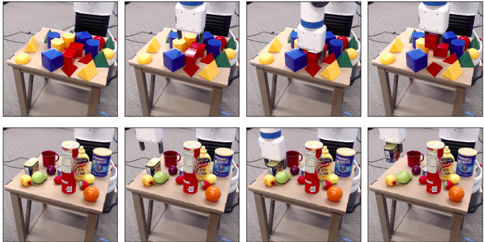
- The pipeline enabled a Fetch robot to detect and pick up the target object in 38 out of 40 trials in increasingly cluttered scenes, and a detector trained on a Spam can succeeded in 9 of 10 trials with previously unseen YCB food distractors.
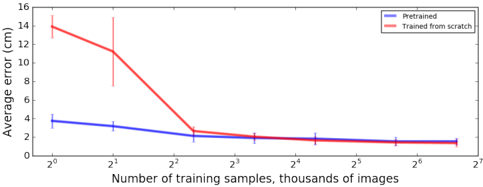
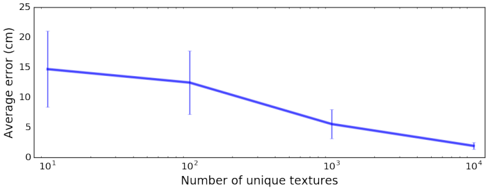
- Ablations found sensitivity to number of training images, number of unique textures, presence of distractors in training, and camera randomization; random noise had negligible effect. Performance improved up to around 50,000 training samples, and degraded significantly with fewer than 1,000 textures.
- ImageNet pretraining was not essential with enough data: random weight initialization achieved nearly the same real-world transfer performance as pretrained initialization, though pretraining helped in the low-data regime.
Methods
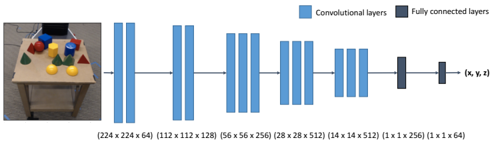
- The authors trained a modified VGG-16 convolutional neural network to map a single 224×224 monocular webcam image to Cartesian coordinates of object(s) of interest, using simulated images rendered by MuJoCo.
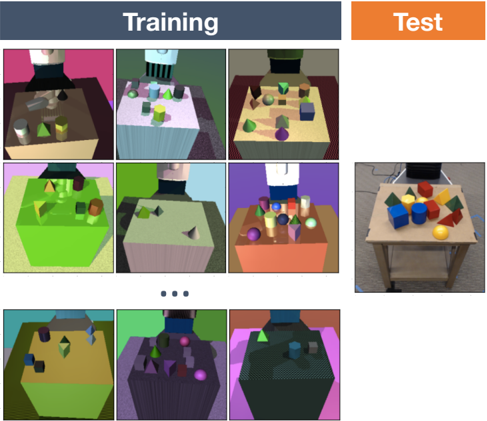
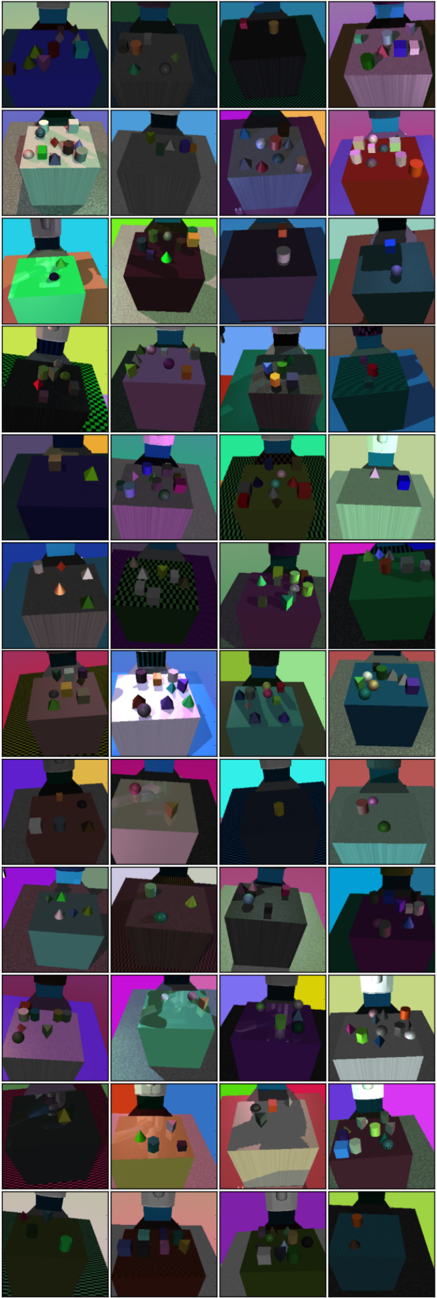
- Domain randomization varied number/shape of distractors, object positions and textures, table/floor/skybox/robot textures, camera position/orientation/field of view, number and properties of lights, and image noise. Textures were random RGB values, gradients, or checker patterns; 0–10 distractor objects were added per scene.
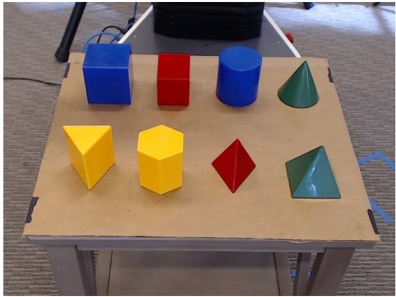
- Training used stochastic gradient descent with Adam on an L2 loss, learning rates around 1e-4, and batch sizes of 25, 50, or 100. Evaluation used 480 webcam images of eight geometric objects at 70–105 cm from a fixed camera, with 60 labeled images per object: 20 alone, 20 with distractors, and 20 partially occluded.
Limitations
- The paper states that the detectors still overfit simulated training data: simulated error was 0.3–0.5 cm versus about 1.5 cm in the real world, and no real-world validation could be done during training because no real data were assumed available.
- The paper states future work is needed for contact-rich manipulation or higher precision, and that the method fixes table height, effectively making the task 2D pose estimation from a single monocular uncalibrated camera.
- Evident from the text: evaluation is limited to eight geometric objects plus one Spam can, the test camera position remains constant across all images, and lighting and surrounding scene were not controlled.
Model-written summary. Check it against the paper before relying on it.
Integrity signals
Registry
Cites
Statistics
Figures
Verification
Claims the paper makes
2 Valid · 8 Not valid · 7 Not checked · 32 Own results and interpretations
The cited sources support only part of this claim — read each source’s verdict below.
In the paper
“Although previous work demonstrated the ability to perform robotic control using a neural network pretrained on ImageNet and fine-tuned on randomized rendered pixels [37], this paper provides the first demonstration that domain randomization can be useful for robotic tasks requiring precision.”
What the sources say
- Partly supportedcites [37] [37] Fereshteh Sadeghi and Sergey Levine. (cad) 2 RL: Real single-image flight without a single real image. arXiv preprint arXiv:1611.04201 , 2016. - sourceExperimental — accuracy not yet measured
The citation [37] is attached to the preceding claim about prior work, not to the citing authors’ claim that their own paper is the first to demonstrate precision robotics. Section 3.1 (p. 4) says LSDA pretrains a CNN on ImageNet classification data and fine-tunes it, but for object detection. It does not report robotic control or fine-tuning on randomized rendered pixels. (LLM, conf=0.84)
boostedstates a cause- Asserted: passes — The authors put it forward as true.
- Checkable: passes — It can be checked against evidence.
- Load-bearing: passes — The paper’s conclusions depend on it.
- Based: passes — The paper gives a reason why it holds.
- Partly supported
The cited sources that could be checked couldn’t confirm or dispute this claim.
In the paper
“Rather than relying on controller robustness, Yu et al. [53] use a model trained on varied physics to perform system identification using online trajectory data, but their approach is not shown to succeed in the real world.”
What the sources say
- Could not verifycites [53] [53] Wenhao Yu, C Karen Liu, and Greg Turk. Preparing for the unknown: Learning a universal policy with online system identification. arXiv preprint arXiv:1702.02453 , 2017. - sourceExperimental — accuracy not yet measured
The cited paper discusses image classification and localisation with convolutional networks (A.1, p. 10; A.2, p. 11), not Yu et al.'s approach. Searches for varied-physics training, online trajectory-based system identification, and real-world success found no passage addressing the claim. Our copy therefore cannot verify it. (LLM, conf=0.78)
plain- Asserted: passes — The authors put it forward as true.
- Checkable: passes — It can be checked against evidence.
- Load-bearing: unclear — It is unclear whether the paper’s conclusions depend on it.
- Based: passes — The paper gives a reason why it holds.
- Could not verify
The cited sources that could be checked couldn’t confirm or dispute this claim.
In the paper
“Though using realistic RGB rendering alone has had limited success for transferring to real robotic tasks [16], incorporating realistic simulation of depth information can allow models trained on rendered images to transfer reasonably well to the real world [32].”
What the sources say
- Could not verifycites [16] [16] Stephen James and Edward Johns. 3d simulation for robot arm control with deep q-learning. arXiv preprint arXiv:1609.03759 , 2016. - sourceExperimental — accuracy not yet measured
The Introduction (§1) and Conclusion (§8) describe Adam as a method for stochastic optimization, while the CNN experiment (§6.3) concerns training on image datasets. Searches for realistic RGB rendering and sim-to-real robotic transfer found no passage addressing whether RGB rendering alone has had limited success on real robotic tasks. (LLM, conf=0.78)
plain- Asserted: passes — The authors put it forward as true.
- Checkable: passes — It can be checked against evidence.
- Load-bearing: passes — The paper’s conclusions depend on it.
- Based: passes — The paper gives a reason why it holds.
- Could not verify
The cited sources that could be checked couldn’t confirm or dispute this claim.
In the paper
“However, their experiments - collision avoidance in hallways and open spaces - do not demonstrate the ability to deal with high-precision tasks.”
What the sources say
- Could not verifycites [37] [37] Fereshteh Sadeghi and Sergey Levine. (cad) 2 RL: Real single-image flight without a single real image. arXiv preprint arXiv:1611.04201 , 2016. - sourceExperimental — accuracy not yet measured
The Experiments section (p. 5) evaluates LSDA on an object-detection dataset, not Sadeghi and Levine’s collision-avoidance experiments. Searches for Sadeghi and Levine, hallway or open-space collision avoidance, and high-precision tasks found no passage addressing the claim. (LLM, conf=0.76)
plain- Asserted: passes — The authors put it forward as true.
- Checkable: passes — It can be checked against evidence.
- Load-bearing: passes — The paper’s conclusions depend on it.
- Based: passes — The paper gives a reason why it holds.
- Could not verify
A result the paper reports from its own data — it cites no other source for it, so there is none to check. The quote shows it is in the paper.
In the paper
“However, using a pre-trained model can significantly improve performance when less training data is used.”
plainstates a cause- Asserted: passes — The authors put it forward as true.
- Checkable: passes — It can be checked against evidence.
- Load-bearing: unclear — It is unclear whether the paper’s conclusions depend on it.
- Based: passes — The paper gives a reason why it holds.
29 more claims
Create a free account to see all 49 claims and to verify the 7 references still open.
- Probably not a substantial claim. 11
- It may state two separate claims as one. 8
Claims other papers make about this one
Each is checked against this paper’s own text: does it say what the citing paper says it does?
The source backs part of the claim, not all of it — or backs it for a different population, condition or comparison.
In the citing paper
“Most policies trained in simulation generalize poorly to the real-world due to agents adapting to specific visual details of the simulator.”
From Language-Based Augmentation to Address Shortcut Learning in Object-Goal Navigation (2023) · cites this paper as [8]
Experimental — accuracy not yet measuredThe source backs part of the claim, not all of it — or backs it for a different population, condition or comparison.
In the citing paper
“In robotic vision tasks including object localization [53], object detection [54], pose estimation [55], and semantic segmentation [56], the training data from simulator always have different textures, lighting, and camera positions from the realistic environments.”
From Sim-to-Real Transfer in Deep Reinforcement Learning for Robotics: a Survey (2020) · cites this paper as [53]
Experimental — accuracy not yet measuredThe source backs part of the claim, not all of it — or backs it for a different population, condition or comparison.
In the citing paper
“These artifacts limit the applicability of generative videos in physics-sensitive domains such as robotics [25,26], autonomous driving [27], simulationbased design, and scientific visualization [28].”
From PhyStruct-Video: Structured Physics State Spaces for Physically Consistent Video Generation (2025) · cites this paper as [25]
Experimental — accuracy not yet measuredThe source backs part of the claim, not all of it — or backs it for a different population, condition or comparison.
In the citing paper
“In domain randomization, the inputs during learning are “randomized” in the sense of being warped or corrupted in particular ways.”
From The overfitted brain: Dreams evolved to assist generalization (2021) · cites this paper as [144]
Experimental — accuracy not yet measuredThe source backs part of the claim, not all of it — or backs it for a different population, condition or comparison.
In the citing paper
“Domain randomization is a domain generalization technique that introduces drastic changes in the training image appearances, which forces the network to learn domain-invariant features between training and target domains [39].”
From A Fully Differentiable Framework for 2D/3D Registration and the Projective Spatial Transformers (2024) · cites this paper as [39]
Experimental — accuracy not yet measured
8 more claims about this paper
Create a free account to see every claim other papers make about this one.
Self-check
Percentages, sums and reported differences re-computed from the paper’s own numbers.
Each contradiction between two passages listed here was confirmed by an independent check.
Rated minor: it would not touch a result — a value no result rests on, a p-value that stays on the same side of the significance level, or a conflict that is clerical, resolved elsewhere in the paper, or outside its own findings.
In the paper
§ A. Experimental Setup · p. 4
“Each training sample consists of (a) a rendered image of the object and one or more distractors (also from among the geometric object set) on a simulated tabletop”
§ A. Domain randomization · p. 4
“Between 0 and 10 distractor objects are added to the table in each scene.”
Citations
Cites
Very Deep Convolutional Networks for Large-Scale Image Recognition
Simonyan, K., & Zisserman, A. (2014) · arXiv · doi:10.48550/arxiv.1409.1556 · Cited by 114,148 · cited 1×
“In particular, we use a modified version the VGG-16 architecture [42] shown in Figure 2.”
MethodAdam: A Method for Stochastic Optimization
Kingma, D. P., & Ba, J. (2014) · arXiv · doi:10.48550/arxiv.1412.6980 · Cited by 98,946 · cited 1×
“We found that using a learning rate of around 1e − 4 (as opposed to the standard 1e − 3 for Adam) improved convergence and helped avoid a common local optimum, mapping all objects to the center of the table.”
MethodLeCun, Y., Bengio, Y., & Hinton, G. (2015) · Nature · doi:10.1038/nature14539 · Cited by 84,126
Human-level control through deep reinforcement learning
Mnih, V., Kavukcuoglu, K., Silver, D., Rusu, A. A., Veness, J., Bellemare, M. G., Graves, A., Riedmiller, M., Fidjeland, A. K., Ostrovski, G., et al. (2015) · Nature · doi:10.1038/nature14236 · Cited by 30,357 · cited 3×
“Learning in simulation is especially promising for building on recent results using deep reinforcement learning to achieve human-level performance on tasks like Atari [27] and robotic control [21], [38].”
BackgroundResultHow transferable are features in deep neural networks?
Yosinski, J., Clune, J., Bengio, Y., & Lipson, H. (2014) · arXiv · doi:10.48550/arxiv.1411.1792 · Cited by 6,061 · cited 1×
“A variety of approaches have been proposed, including re-training the model in the target domain (e.g., [52]), adapting the weights of the model based on the statistics of the source and target domains (e.g., [22]), learning invariant features between domains (e.g., [47]), and learning a mapping…”
BackgroundMuJoCo: A physics engine for model-based control
Todorov, E., Erez, T., & Tassa, Y. (2012) · 2012 IEEE/RSJ International Conference on Intelligent Robots and Systems · doi:10.1109/iros.2012.6386109 · Cited by 4,767 · cited 1×
“We render images using the MuJoCo Physics Engine’s [45] built-in renderer.”
MethodTrust region policy optimization
Schulman, J., Levine, S., Moritz, P., Jordan, M. I., & Abbeel, P. (2015) · arXiv · doi:10.48550/arxiv.1502.05477 · Cited by 4,578 · cited 1×
“Learning in simulation is especially promising for building on recent results using deep reinforcement learning to achieve human-level performance on tasks like Atari [29] and robotic control [26], [41].”
ResultSelf-citationLearning Transferable Features with Deep Adaptation Networks
Long, M., Cao, Y., Wang, J., & Jordan, M. I. (2015) · arXiv · doi:10.48550/arxiv.1502.02791 · Cited by 4,505 · cited 1×
“omputer vision community has devoted significant study to the problem of adapting vision-based models trained in a source domain to a previously unseen target domain (see, e.g., [9], [14], [15], [19], [23], [25], [51]). A variety of approaches have been proposed, including re-training the model in the target domain (e.…”
BackgroundEnd-to-End Training of Deep Visuomotor Policies
Levine, S., Finn, C., Darrell, T., et al. (2015) · Journal of machine learning research · doi:10.5555/2946645.2946684 · Cited by 3,987
Describing Textures in the Wild
Cimpoi, M., Maji, S., Kokkinos, I., Mohamed, S., & Vedaldi, A. (2014) · 2014 IEEE Conference on Computer Vision and Pattern Recognition · doi:10.1109/cvpr.2014.461 · Cited by 2,438 · cited 1×
“To examine how our detectors would perform on objects with complex textures, we created simulated scenes in which the object of interest is given a texture from the Describable Textures Dataset (DTD) [4].”
Method
Research works printed but not linked: 3
- [24] David G Lowe. Three-dimensional object recognition from single two-dimensional images. Artificial intelligence , 31(3):355-395, 1987. -
- [49] Melonee Wise, Michael Ferguson, Derek King, Eric Diehr, and David Dymesich. Fetch and freight: Standard platforms for service robot applications. In Workshop on Autonomous Mobile Service Robots , 2016. -
- sucan, 0, MoveIt!
Cited by
Items 2,301–2,400 of 2,970
Realistic Data Generation for 6D Pose Estimation of Surgical Instruments
Barragan, J. A., Zhang, J., Zhou, H., Munawar, A., & Kazanzides, P. (2024) · Proceedings - IEEE International Conference on Robotics and Automation/Proceedings · doi:10.1109/icra57147.2024.10611638 · Cited by 10
“As a solution, it has been shown that high-fidelity synthetic data of models of physical objects can be used to train pose networks that perform well in locating their real counterparts [10], [11].”
Dense tracking of human facial geometry
Ronkainen, M. (2017)
Boosting Robot Learning and Control with Domain Constraints
Yin, H., Melo, F. S., Billard, A., & Paiva, A. (2018) · Infoscience (Ecole Polytechnique Fédérale de Lausanne) · Cited by 1
Learning color space adaptation from synthetic to real images of cirrus cloudsPreprint
Lyu, Q., Chen, M., & Chen, X. (2018) · arXiv (Cornell University) · doi:10.48550/arxiv.1810.10286
“Training on synthetic images has become increasingly popular in vision tasks, such as object detection[9,10,11, 12], viewpoints estimation[13,14,15,16], and semantic segmentation[17].”
BackgroundLearning Real-World Visuo-Motor Policies from Simulation
Zhang, F. (2018) · Queensland University of Technology · doi:10.5204/thesis.eprints.121471
Real-time Approximate Bayesian Computation for Scene UnderstandingPreprint
Felip, J., Ahuja, N., Gómez‐Gutiérrez, D., Tickoo, O., & Mansinghka, V. K. (2019) · arXiv (Cornell University) · doi:10.48550/arxiv.1905.13307 · Cited by 1
“It can be viewed as a simple form of domain randomization (Tobin et al., 2017), an increasingly popular technique for building deep learning systems that are trained on synthetic data from complex simulators but deployed on data from the real world (Li et al.”
BackgroundMethodProximal Reliability Optimization for Reinforcement Learning
Patwardhan, N. (2020) · doi:10.37099/mtu.dc.etdr/1026
“Another related technique, domain randomization, is presented in [2] and [3].”
MethodPhysics-based Scene-level Reasoning for Object Pose Estimation in ClutterPreprint
Mitash, C., Boularias, A., & Bekris, K. E. (2018) · arXiv (Cornell University) · doi:10.48550/arxiv.1806.10457
“There is also a wide interest in bridging the domain gap between simulated and real images by domain randomization (Tobin et al. (2017)) or with a generative learning technique (Shrivastava et al. (2017)).”
BackgroundLearning deep representations for robotics applications
Aktaş, Ü. R. (2018) · University of Birmingham Institutional Research Archive (University of Birmingham)
Toward a Procedural Fruit Tree Rendering Framework for Image AnalysisPreprint
Duboudin, T., Petit, M., & Chen, L. (2019) · arXiv (Cornell University) · doi:10.48550/arxiv.1907.04759 · Cited by 1
“This is a much needed feature allowing Domain Randomization, known to be efficient in reducing the Reality Gap encountered when transferring deep neural networks from simulation to the real world [7].”
Cooperative Learning for the Consensus of Multi-Agent Systems
Liu, Q. (2019) · Lincoln (University of Nebraska)
Invariant Transform Experience Replay.
Lin, Y., Huang, J., Zimmer, M., et al. (2019)
Sim-to-Real Transfer of Robot Learning with Variable Length InputsPreprint
Dasagi, V., Lee, R., Mou, S., Bruce, J., Sünderhauf, N., & Leitner, J. (2018) · arXiv (Cornell University) · doi:10.48550/arxiv.1809.07480 · Cited by 5
“handle the intricacies of the real world, such as domain randomization [24]–[26].”
BackgroundRGB-D Individual SegmentationPreprint
Xu, W., Fu, Y., Luo, Y., Liu, C., & Lu, C. (2019) · arXiv (Cornell University) · doi:10.48550/arxiv.1910.07641
“Render CNN [36], rendering and domain adaptation [42], domain randomization [37, 2] are representative works of 3D model rendering synthesis.”
MethodTask-Informed Fidelity Management for Speeding Up Robotics SimulationPreprint
Tallavajhula, A., Schoisengeier, A., Kim, S.-K., Vemula, A., Lister, L., & Salzman, O. (2019) · arXiv (Cornell University) · doi:10.48550/arxiv.1910.12284 · Cited by 1
“To achieve this, previous work has either introduced noise into the low-fidelity simulations so that resulting policies are robust to noise [27, 3, 30], or approximate inaccurate parts of the simulation with fast inference models such as neural networks [28] which are learned using real-world data.”
BackgroundLearning to Match Templates for Unseen Instance DetectionPreprint
Mercier, J. P., Garon, M., Giguère, P., & Lalonde, J. (2019) · arXiv (Cornell University) · Cited by 1
Search Algorithm Using Prior Knowledge of Similar Task
Karasawa, H., Fukui, R., & Warisawa, S. (2019) · Transactions of the Society of Instrument and Control Engineers · doi:10.9746/sicetr.55.709
Task Focused Robotic Imitation Learning
Abolghasemi, P. (2019) · Journal of International Crisis and Risk Communication Research
Synthetic Meta-Learning: : Learning to learn real-world tasks with synthetic data
Lundmark, L. (2019) · KTH Publication Database DiVA (KTH Royal Institute of Technology)
Zero-shot generalization using cascaded system-representationsPreprint
Malik, A. (2019) · arXiv (Cornell University) · doi:10.48550/arxiv.1912.05501 · Cited by 2
Three-dimensional Localization of Convolutional Neural Networks Based on Domain Randomization
Zuo, G., Zhang, C., Zheng, T., Gu, Q., & Gong, D. (2019) · IEEE International Conference on Robotics and Biomimetics (ROBIO) · doi:10.1109/robio49542.2019.8961846
“[11-13] used domain randomization to obtain the grab target and Tremblay et al.”
MethodProbabilistic Modelling combined with a CNN for boundary detection of carbon fiber fabrics
Zambal, S., Heindl, C., & Eitzinger, C. (2019) · 2022 IEEE 20th International Conference on Industrial Informatics (INDIN) · doi:10.1109/indin41052.2019.8972094
“Examples are computer-generated images for machine learning in autonomous driving [8], [9], object localization [10], [11], or tracking of honeybees [12].”
BackgroundMethodPolicy gradient optimization of controllers for natural dynamic mono-pedal gait
Schallheim, I., & Zacksenhouse, M. (2020) · Bioinspiration & Biomimetics · doi:10.1088/1748-3190/ab782a
“In future work we will consider using a NN to directly approximate the SEA actuation, since it is a main source of uncertainty in the model [43], or using other generalization techniques, such as domain randomization [74, 75].”
MethodDeep Monocular Depth Estimation in Partially-Known Environments
Kaneko, N., Akazawa, Y., & Sumi, K. (2019) · IEEE Global Conference on Consumer Electronics (GCCE) · doi:10.1109/gcce46687.2019.9015566
A perception pipeline exploiting trademark databases for service robots
Song, J. (2020) · The University of Queensland · doi:10.14264/uql.2020.171
A Multi-task Learning Framework for Grasping-Position Detection and Few-Shot ClassificationPreprint
Yokota, Y., Suzuki, K., Kanazawa, Y., et al. (2020) · arXiv (Cornell University) · doi:10.48550/arxiv.2003.05624
“Therefore, in recent years, many studies have applied deep neural networks (DNNs), which have multiple layers to implement these tasks[1][2][3][4] and have achieved high accuracy.”
BackgroundOn Building Generalizable Learning Agents
Wu, Y. (2019) · UC Berkeley
Tang, Z., Naphade, M. R., Birchfield, S. T., et al. (2020) · arXiv (Cornell University) · doi:10.48550/arxiv.2005.00673
“A popular approach to overcome the so-called reality gap is domain randomization [34, 35], in which a model is trained with extreme visual variety so that when presented with a real-world image the model treats it as just another variation.”
BackgroundMethodFrom Real to Synthetic and Back: Synthesizing Training Data for Multi-Person Scene UnderstandingPreprint
Kviatkovsky, I., Bhonker, N., & Medioni, G. G. (2020) · arXiv (Cornell University) · doi:10.48550/arxiv.2006.02110 · Cited by 1
“Another leading group of methods, known as domain randomization [53, 54, 5, 60, 31, 46], randomizes the appearance of objects of interest.”
BackgroundSazanovich, M., Chaika, K., Krinkin, K. V., & Shpilman, A. (2020) · arXiv (Cornell University) · doi:10.48550/arxiv.2007.03514 · Cited by 1
“Some approaches suggests randomizing the domain for the transfer (Tobin et al., 2017).”
BackgroundGhosn, Y., Kamareddine, M. H., salloum, G., Najem, E., Ghosn, A., & Saade, C. (2020) · Clinical surgery research communications · doi:10.31491/csrc.2020.06.051
A Neural-Symbolic Framework for Mental SimulationPreprint
Kissner, M. (2020) · arXiv (Cornell University) · doi:10.48550/arxiv.2008.02356
“Models pre-trained on such synthetic datasets have been shown to generalize well and reduce the amount of training needed for real environments [Sun and Saenko, 2014, Peng et al., 2015, Tobin et al., 2017, Tremblay et al., 2018], making it an ideal candidate for training set augmentation.”
BackgroundAlgoet, O., Lefebvre, T., & Crevecoeur, G. (2020) · IEEE/ASME International Conference on Advanced Intelligent Mechatronics · doi:10.1109/aim43001.2020.9158908
“the solved simulated task to the real world by replaying it with different initial conditions and domain randomization [12] to generalize.”
MethodVision-Based Autonomous Drone Control using Supervised Learning in SimulationPreprint
Christl, M. (2020) · arXiv (Cornell University) · doi:10.48550/arxiv.2009.04298 · Cited by 4
“Under the assumption that sim-to-real transfer is possible, which has been shown by several other publications [12, 13, 9, 10, 11], our approach has two advantages: Firstly, since the data collection procedure is fully automated, we can create large datasets with very little effort and thus generalize the model more b…”
BackgroundPredicting Sim-to-Real Transfer with Probabilistic Dynamics ModelsPreprint
Zhang, L. M., Plappert, M., & Zaremba, W. (2020) · arXiv (Cornell University) · doi:10.48550/arxiv.2009.12864 · Cited by 3
“(Tobin et al., 2017; Sadeghi & Levine, 2017; Peng et al., 2018; OpenAI et al., 2018).”
BackgroundSelf-citationUnsupervised Object-aware Learning from Videos
Hůla, J. (2020) · IEEE International Conference on Data Stream Mining & Processing (DSMP) · doi:10.1109/dsmp47368.2020.9204219
“ant [7].”
Learning from limited experience: Real-world robot navigation from a single traversal
Bruce, J. (2020) · Queensland University of Technology · doi:10.5204/thesis.eprints.205492
A Geometric Perspective on Self-Supervised Policy AdaptationPreprint
Bodnar, C., Hausman, K., Dulac-Arnold, G., & Jonschkowski, R. (2020) · arXiv (Cornell University) · doi:10.48550/arxiv.2011.07318
“Another class of methods tries to train robust policies by applying various types of domain randomizations (Peng et al., 2018; Ramos et al., 2019; Tobin et al., 2017).”
BackgroundLearning Synthetic to Real Transfer for Localization and Navigational TasksPreprint
Pietrantoni, M., Chidlovskii, B., & Silander, T. (2020) · arXiv (Cornell University) · doi:10.48550/arxiv.2011.10274
“1) Bridging the reality gap: A common approach to bridge the reality gap is applying domain randomization [1].”
BackgroundFine-Grained Vehicle Perception via 3D Part-Guided Visual Data AugmentationPreprint
Lu, F., Liu, Z., Miao, H., Wang, P., Zhang, L., Yang, R., Manocha, D., & Zhou, B. (2020) · arXiv (Cornell University) · doi:10.48550/arxiv.2012.08055
“Domain randomization [44] is widely used for vehicle detection [11], [12], which gets the improved performance.”
BackgroundVariable photorealistic image synthesis for training dataset generation
Санжаров, В., Frolov, V. A., & Voloboy, A. G. (2020) · International Scientific Conference on Computing in Physics and Technology (CPT) · doi:10.30987/conferencearticle_5fce27723872e5.04814843 · Cited by 1
“A similar approach, called Domain Randomization (DR) is used in [20-21].”
MethodVariational Augmented the Heuristic Funnel-Transitions Model for Dexterous Robot Manipulation
Huang, J., Lin, Y., Wu, H., & Guan, Y. (2020) · Lecture notes in computer science · doi:10.1007/978-3-030-66645-3_13
Learning Vision-Based Physics Intuition Models for Non-Disruptive Object Extraction
Ahuja, S., Admoni, H., & Steinfeld, A. M. (2020) · IEEE/RSJ International Conference on Intelligent Robots and Systems (IROS) · doi:10.1109/iros45743.2020.9341675
“We extensively perform domain randomization [26] by varying the block color and table textures during training to make the sim-to-real transfer tractable.”
MethodAiello, G. (2020) · Digital Commons - URI (University of Rhode Island) · doi:10.23860/thesis-aiello-gabriella-2020
Robust 2D/3D Vehicle Parsing in CVISPreprint
Miao, H., Lu, F., Liu, Z., Zhang, L., Manocha, D., & Zhou, B. (2021) · arXiv (Cornell University) · doi:10.48550/arxiv.2103.06432
Koch, P., Schlüter, M., & Thill, S. (2021) · arXiv (Cornell University) · doi:10.48550/arxiv.2103.09696
“Recent work in robot perception trained in simulation utilize methods like domain adaptation and domain randomisation to cope with the sim-to-real domain gap [16], [17], [18], [19].”
MethodIntuitive Physics Guided Exploration for Sample Efficient Sim2real Transfer
Semage, B. L., Karimpanal, T. G., Rana, S., & Venkatesh, S. (2023) · Lecture notes in computer science · doi:10.1007/978-3-031-37742-6_52
“When training robots in simulated environments for transfer, domain randomisation [20, 21] and domain adaptation [3] are generally the two main approaches adopted.”
MethodReinforcement Learning Approach for Inspect/Correct Tasks
Nasereddin, H. (2020) · Louisiana State University · doi:10.31390/gradschool_dissertations.5431
Detection and Segmentation of Custom Objects using High Distraction Photorealistic Synthetic DataPreprint
Ron, R., & Elbaz, G. (2020) · arXiv (Cornell University) · doi:10.48550/arxiv.2007.14354
“For instance, [6, 7] apply DR techniques both to the scene structure (placing the objects) and to the textures.”
MethodPolicy Iteration with Gaussian Process based Value Function Approximation
Khadke, A., & Rai, A. (2020)
Learning to See by Looking at NoisePreprint
Baradad, M., Wulff, J., Wang, T., Isola, P., & Torralba, A. B. (2021) · arXiv (Cornell University) · doi:10.48550/arxiv.2106.05963 · Cited by 108
“The use of randomized training data has also been explored under the heading of domain randomization [44], where, 3D synthetic data is rendered under a variety of lighting conditions to transfer to real environments where the lighting may be unknown.”
Robustifying Reinforcement Learning Policies with $\mathcal{L}_1$ Adaptive ControlPreprint
Cheng, Y., Zhao, P., Gandhi, M. S., Li, B., Theodorou, E. A., & Hovakimyan, N. (2021) · arXiv (Cornell University) · doi:10.48550/arxiv.2106.02249
“Domain/dynamics randomization was proposed to close the sim-to-real (S2R) gap [5]– [7] when transferring a policy from a simulator to the real”
BackgroundMethodResultInfluentialThere is no mouse: using a virtual mouse to generate training data for video-based pose estimation
Meijer, G. T., Arlandis, J., & Urai, A. E. (2021) · Lab Animal · doi:10.1038/s41684-021-00794-z
Sasaki, H., & Matsubara, T. (2021) · Neural Networks · doi:10.48550/arxiv.2106.07125 · Cited by 8
“Reinforcement learning (robust to state noise [38]) and robust reinforcement learning (robust to disturbances in actual environments) have been proposed [39].”
BackgroundPolicy Transfer across Visual and Dynamics Domain Gaps via Iterative GroundingPreprint
Zhang, G., Zhong, L., Lee, Y., & Lim, J. J. (2021) · Robotics: Science and Systems Conference · doi:10.48550/arxiv.2107.00339 · Cited by 16
“Hence, a variety of approaches propose to train a policy robust to domain gaps through noise injection [11], adversarial training [6, 23, 26], learning domain-invariant representations [7], or domain randomization [33, 13, 21].”
BackgroundInfluentialLearning to See before Learning to Act: Visual Pre-training for ManipulationPreprint
Lin, Y.-C., Zeng, A., Song, S., et al. (2021) · arXiv (Cornell University) · doi:10.48550/arxiv.2107.00646
“environments [22] or bridging the gap between simulation and reality [23, 24, 25, 26].”
BackgroundBuilding Intelligent Autonomous Navigation AgentsPreprint
Chaplot, D. S. (2021) · arXiv (Cornell University) · doi:10.48550/arxiv.2106.13415
Robustifying Reinforcement Learning Policies with L 1 Adaptive Control.Preprint
Cheng, Y., Zhao, P., Gandhi, M. S., Li, B., Theodorou, E. A., & Hovakimyan, N. (2021) · arXiv (Cornell University)
Blondé, L., & Kalousis, A. (2021) · arXiv (Cornell University)
Maximizing Ensemble Diversity in Deep Q-LearningPreprint
Sheikh, H. U., Phielipp, M., & Bölöni, L. L. (2020) · arXiv (Cornell University) · Cited by 2
Zeng, L., Yin, X., Li, Y., & Li, Z. (2021) · Lecture notes in computer science · doi:10.1007/978-3-030-78811-7_35
Synthetic-to-real transfer for natural language processing
Marzoev, M. A. (2021)
Tangent Space Least Adaptive Clustering
Buenfil, J., Koelle, S., & Meilă, M. (2021) · International Conference on Machine Learning · Cited by 5
Global and Local Texture Randomization for Synthetic-to-Real Semantic SegmentationPreprint
Peng, D., Lei, Y., Liu, L., et al. (2021) · arXiv (Cornell University) · doi:10.48550/arxiv.2108.02376
“Based on the observations above, another growing trend of SRSS is Domain Generalization (DG) [10], [11], [12], [13].”
Active Reinforcement Learning over MDPsPreprint
Yang, Q., Yang, P., & Tang, K. (2021) · arXiv (Cornell University) · doi:10.48550/arxiv.2108.02323
“…aims to explicitly or implicitly diversify dataset (Kostrikov et al., 2021; Laskin et al., 2020; Lee et al., 2020; Seo et al., Copyright © 2021 2020; Tobin et al., 2017; Ye et al., 2020), while the second aims to explicitly or implicitly control the complexity of the policy model or use ensemble…”
BackgroundInfluentialAction-Insensitive Embodied Visual Navigation
Liu, X., Guo, D., Liu, H., & Sun, F. (2021) · IEEE International Conference on Development and Learning (ICDL) · doi:10.1109/icdl49984.2021.9515646
Brecher, C., Blanke, P., Buchsbaum, M., Dassen, Y., Fimmers, C., Müller, A., Petrović, O., Pieske, S., Roggendorf, S., Schilling, K., et al. (2021) · Springer eBooks · doi:10.1007/978-3-662-62915-4_27
Adversarial Domain RandomizationPreprint
Khirodkar, R., & Kitani, K. (2018) · arXiv (Cornell University) · doi:10.48550/arxiv.1812.00491 · Cited by 25
“Domain Randomization: These methods [38, 10, 48, 18, 49, 32, 31, 46, 44, 20] do not use any information about the target domain during training and only rely on a simulator capable of generating varied data.”
BackgroundMethodRobot Sound Interpretation: Learning Visual-Audio Representations for Voice-Controlled Robots.Preprint
Chang, P., Liu, S., & Campbell, K. D. (2021) · arXiv (Cornell University)
3DStyleNet: Creating 3D Shapes with Geometric and Texture Style VariationsPreprint
Yin, K., Gao, J., Shugrina, M., et al. (2021) · arXiv (Cornell University) · doi:10.48550/arxiv.2108.12958
“For texture-based augmentation, we compare with b) random texture replacement akin to domain randomization work [53], where for each of the 221 objects we randomly select 221 COCO [31] images as new textures (yielding 221 × 221 combinations), and c) using image style transfer [28] to transfer the texture image style f…”
MethodGong, P. L., Shi, D., Xue, C., & Chen, X. (2021) · International Conference on Innovation in Artificial Intelligence (ICIAI) · doi:10.1145/3461353.3461373 · Cited by 1
“DR method was first proposed in [19] to bridge the reality gap between object positioning and robotic grasping tasks.”
MethodActive Perception with Neural NetworksPreprint
Lee, E. S. (2021) · arXiv (Cornell University) · doi:10.48550/arxiv.2109.02744 · Cited by 1
“neural networks trained with domain randomization [14], and the final pose is improved by combining the neural net outputs.”
BackgroundMethodInfluentialArai, S. (2021) · Journal of the Robotics Society of Japan · doi:10.7210/jrsj.39.625
Developing a mobile manipulation system to handle unknown and unstructured objects
Al-Shanoon, A. A. S. (2021) · e-scholar@UOIT (University of Ontario Institute of Technology)
Chen, J., Gao, Y., Hu, J., Deng, F., & Lam, T. L. (2021) · arXiv (Cornell University) · doi:10.48550/arxiv.2109.13617
“• Domain Randomization Domain Randomization technique [35] is a common way to improve the generality of reinforcement learning.”
MethodSim and Real: Better TogetherPreprint
Shashua, S. D.-C., Castro, D. D., & Mannor, S. (2021) · arXiv (Cornell University) · doi:10.48550/arxiv.2110.00445 · Cited by 8
Bridging the Last Mile in Sim-to-Real Robot Perception via Bayesian Active Learning.Preprint
Feng, J., Lee, J., Durner, M., & Triebel, R. (2021) · arXiv (Cornell University) · Cited by 1
Realeasy: Real-Time capable Simulation to Reality Domain Adaptation
Dürr, A., Neric, L., Krueger, V., & Topp, E. A. (2021) · IEEE International Conference on Automation Science and Engineering (CASE) · doi:10.1109/case49439.2021.9551626
“[2] use Domain Randomization (DR) by imposing a prior distribution over the parameters of the simulator to find a robust control policy to achieve a certain task.”
BackgroundMethodDeep Reinforcement Learning for Interactive Systems
Tang, Z. (2021) · DigitalGeorgetown (Georgetown University Library)
Vision-Guided Quadrupedal Locomotion in the Wild with Multi-Modal Delay RandomizationPreprint
Imai, C. S., Zhang, M., Zhang, Y., et al. (2021) · arXiv (Cornell University) · doi:10.48550/arxiv.2109.14549
Stochastic Observation Prediction for Efficient Reinforcement Learning in Robotics
Wang, S., & Nakayama, H. (2021) · IEEE International Conference on Multimedia Information Processing and Retrieval (MIPR) · doi:10.1109/mipr51284.2021.00027
Nuisance-Label Supervision: Robustness Improvement by Free LabelsPreprint
Wei, X., Qiu, W., Zhang, Y., et al. (2021) · arXiv (Cornell University) · doi:10.48550/arxiv.2110.07118
“Following the concept of domain randomization [33], the textures for human appearance and background are randomly sampled from 1000 images within the MSCOCO dataset [18]; the camera is randomly set on 240 positions to record videos.”
Ferri, M., Mantegazza, D., Cereda, E., Zimmerman, N., Gambardella, L. M., Palossi, D., Guzzi, J., & Giusti, A. (2021) · arXiv (Cornell University) · doi:10.48550/arxiv.2110.14491
“When training from simulated data, one can solve this problem with domain randomization techniques [3], which promote generalization by randomizing various aspects of the simulated environment.”
MethodInterpretable and Realtime Predictions of Social Interactions for Autonomous Vehicles
Anderson, C. (2021) · Deep Blue (University of Michigan) · doi:10.7302/3026
Beyond Classification: Knowledge Distillation using Multi-Object Impressions
Nayak, G. K., Keswani, M., Seshadri, S., & Chakraborty, A. (2021) · British Machine Vision Conference (BMVC) · doi:10.5244/c.35.263 · Cited by 2
“Few works such as [12, 16, 42] generate synthetic data using external tools like CAD or depend on the availability of cropped images of objects.”
Segmentation-driven spacecraft pose estimation for vision-based relative navigation in space
Kajak, K. M., Maddock, C. A., Frei, H., & Schwenk, K. (2021) · elib (German Aerospace Center)
Jacopin, E., Cornuéjols, A., Martin, C., Kazemipour, F., & Sausse, C. (2021) · Revue Ouverte d Intelligence Artificielle · doi:10.5802/roia.12
Learning Provably Robust Motion Planners Using Funnel LibrariesPreprint
Gurgen, A. E., Majumdar, A., & Veer, S. (2021) · arXiv (Cornell University) · doi:10.48550/arxiv.2111.08733 · Cited by 4
Training neural networks with synthetic electrocardiogramsPreprint
Kaisti, M., Laitala, J., & Airola, A. (2021) · arXiv (Cornell University) · doi:10.48550/arxiv.2111.06175 · Cited by 2
“promising in image classification tasks [4], [5], [6], [7].”
BackgroundLearning to Cooperate with Unseen Agent via Meta-Reinforcement LearningPreprint
Charakorn, R., Manoonpong, P., & Dilokthanakul, N. (2021) · arXiv (Cornell University) · doi:10.48550/arxiv.2111.03431 · Cited by 2
“…the single-agent domain, is being tackled from many different directions, e.g. using domain randomization (Andrychowicz et al., 2020; Mehta et al., 2020; Tobin et al., 2017), model-based learning (Hafner et al., 2019; Sekar et al., 2020), and meta-learning (Finn et al., 2017; Mishra et al., 2017).”
BackgroundNo More Pesky Hyperparameters: Offline Hyperparameter Tuning For Reinforcement Learning
Sakhadeo, A. (2021) · ERA: Education and Research Archive (University of Alberta) · doi:10.7939/r3-t3y1-d119
Bulletin No. 329 - Cost and Efficiency of Producing Sugar Beets in Utah, 1945
Morrison, E. M. (1948) · Digital Commons - USU (Utah State University)
6d Object Pose Estimation with Location-and-Channel AttentionPreprint
Zuo, G., Chen, K., & Huang, G. M. (2021) · SSRN Electronic Journal · doi:10.2139/ssrn.3979336
Proximal Policy Optimization for Radiation Source Search
Proctor, P. (2021) · PDXScholar (Portland State University) · doi:10.15760/etd.7657 · Cited by 1
Mounsif, M., Lengagne, S., Thuilot, B., & Adouane, L. (2022) · Lecture notes in electrical engineering · doi:10.1007/978-3-030-92442-3_10
Human-Agent Collaboration Strategies for Vision-Grounded Instruction Following
Chao, G.-L., & Lane, I. R. (2021) · IEEE Workshop on Automatic Speech Recognition and Understanding (ASRU) · doi:10.1109/asru51503.2021.9688143
Cross-Domain Knowledge Transfer Using High Dynamic Range Imaging in Synthetic Datasets
Peleka, G., Sarafis, D., Mariolis, I. G., & Tzovaras, D. K. (2022) · Cybernetics & Systems · doi:10.1080/01969722.2022.2030004
“Tobin et al. (2017) utilized domain randomization stating that the synthetic image trained models can be transferred to actual images by randomization while rendering with a simulator.”
Method
Metadata
- Authors
- Tobin, J., Fong, R., Ray, A., Schneider, J., Zaremba, W., & Abbeel, P.
- Affiliations
- University of California, Berkeley (US)
- OpenAI (United States) (US)
- International Computer Science Institute (US)
- ORCID
- Abbeel, Pieter
- Venue
- 2017 IEEE/RSJ International Conference on Intelligent Robots and Systems (IROS)
- Publisher
- IEEE
- Published
- 2017-09
- Pages
- 23-30
- ISSN
- 2153-0858 (ISSN-L)
- OpenAlex
- W2605102758
- Semantic Scholar
- 32ceb28e45a445df4d89df281bb0e3ab5aab1a2a
- Cited by
- 3,124
- References
- 69
- Citations by year
- 2026: 413 · 2025: 433 · 2024: 336 · 2023: 403 · 2022: 374 · 2021: 422 · 2020: 352 · 2019: 256 · 2018: 106 · 2017: 25
- FWCI
- 92.18
- Type
- conference paper
- Language
- en
- Open access
- green
- arxiv.org
- Locations
- IEEE/RSJ International Conference on Intelligent Robots and Systems (IROS) (publishedVersion)
- arXiv (Cornell University) (submittedVersion)
- arXiv (Cornell University)
- Topics
- Physical Sciences › Computer Science › Artificial Intelligence › Reinforcement Learning in Robotics
- Physical Sciences › Engineering › Control and Systems Engineering › Robot Manipulation and Learning
- Physical Sciences › Computer Science › Artificial Intelligence › Domain Adaptation and Few-Shot Learning
- Keywords
- domain randomization, sim-to-real transfer, reality gap, object detection, object localization, robotic grasping, cluttered environments, distractor robustness, partial occlusion, robotic manipulation
About these checks
Registry, retraction, Cites and statistics results are computed, not judged, with one exception: a printed reference that no index lists is read once by a model before it counts as a citation error. Claims are extracted by a model and kept only when their quote appears verbatim in the text; each cited source is then checked, with a model’s help, for whether it says what the claim relies on. Those verdicts can be wrong — read the claim’s quote and the cited source before relying on one.
The claim verdicts this report counts are experimental: their accuracy is not yet measured.
A language model drew the claims from the paper on 2026-10-10, under version 3 of the claim definition (model deepseek-v4.1-flash, prompt extract-v3).
A second model labelled each claim on 2026-10-10 (model jev-1.13-20260917, definition revision gold-guideline-v0.2).
Cited sources are checked with a language model’s help (gpt-6-sol).
Statistics and arithmetic are recomputed, not judged.
Confidence bands are shown only for fields calibrated on our annotated test set. None is calibrated yet, so no band is shown.
What counts as a claim ›How we measure confidence ›How we check this ›
Are you an author, or do you see a problem with this page? Request a review
Data sources
Bibliographic data: Semantic Scholar, OpenAlex, Crossref.
Contains information from the Semantic Scholar Academic Graph Datasets, made available under the ODC Attribution License (ODC-BY 1.0).
Semantic Scholar’s data is described in: Kinney, R., et al. (2023). The Semantic Scholar Open Data Platform. arXiv:2301.10140.
