

Domain randomization for transferring deep neural networks from simulation to the real world
Open accessThe DOI matches its Crossref record; 71 of the 71 references it cites were found in a registry or an index; 8 of the 17 sources its claims cite were checked for support.
Abstract
Bridging the `reality gap' that separates simulated robotics from experiments on hardware could accelerate robotic research through improved data availability. This paper explores domain randomization, a simple technique for training models on simulated images that transfer to real images by randomizing rendering in the simulator. With enough variability in the simulator, the real world may appear to the model as just another variation. We focus on the task of object localization, which is a stepping stone to general robotic manipulation skills. We find that it is possible to train a real-world object detector that is accurate to 1.5 cm and robust to distractors and partial occlusions using only data from a simulator with non-realistic random textures. To demonstrate the capabilities of our detectors, we show they can be used to perform grasping in a cluttered environment. To our knowledge, this is the first successful transfer of a deep neural network trained only on simulated RGB images (without pre-training on real images) to the real world for the purpose of robotic control.
Overview
CoChat Summary
TL;DR
This paper introduces domain randomization: training an object detector on simulated RGB images with randomized rendering, textures, lighting, camera pose, and distractors so that the real world appears as another variation. The authors show that a detector trained only in simulation can localize objects in the real world accurately enough to grasp them in clutter.
Key findings
- Real-world object detectors trained only on simulated images localized objects to within about 1.5 cm on average, including with distractors and partial occlusions; per-object errors in Table I range from 0.6 ± 0.3 cm to 3.2 ± 5.8 cm depending on object and condition.
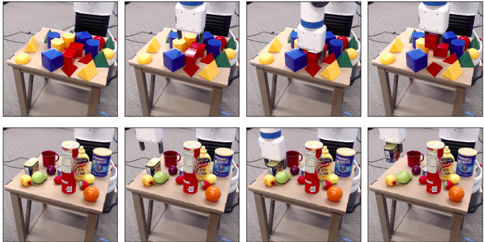
- The pipeline enabled a Fetch robot to detect and pick up the target object in 38 out of 40 trials in increasingly cluttered scenes, and a detector trained on a Spam can succeeded in 9 of 10 trials with previously unseen YCB food distractors.
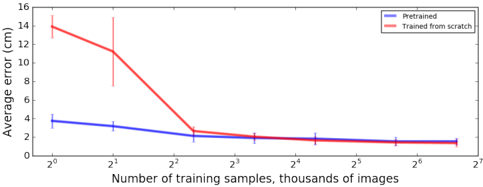
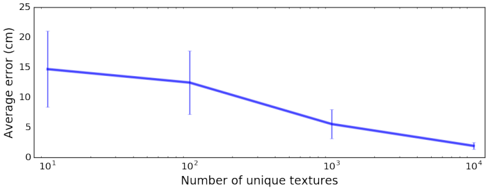
- Ablations found sensitivity to number of training images, number of unique textures, presence of distractors in training, and camera randomization; random noise had negligible effect. Performance improved up to around 50,000 training samples, and degraded significantly with fewer than 1,000 textures.
- ImageNet pretraining was not essential with enough data: random weight initialization achieved nearly the same real-world transfer performance as pretrained initialization, though pretraining helped in the low-data regime.
Methods
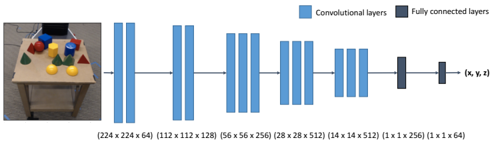
- The authors trained a modified VGG-16 convolutional neural network to map a single 224×224 monocular webcam image to Cartesian coordinates of object(s) of interest, using simulated images rendered by MuJoCo.
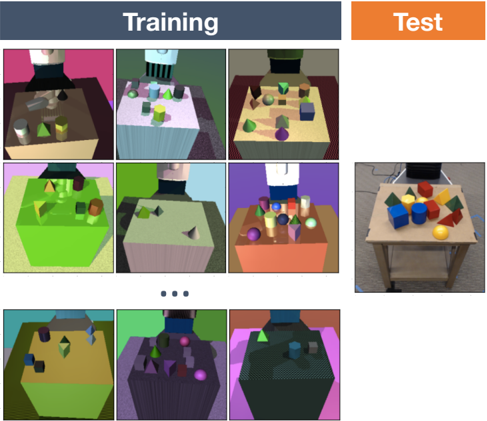
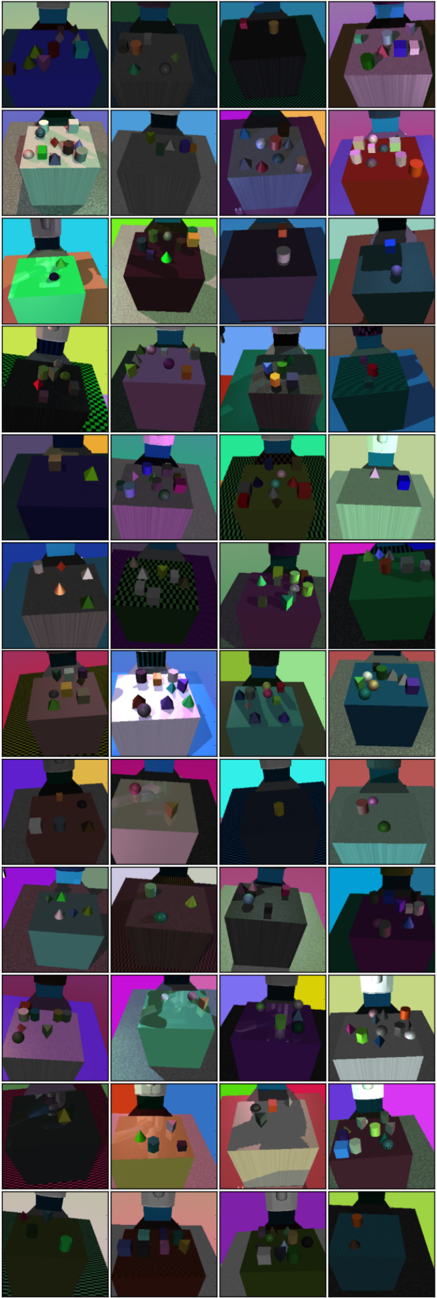
- Domain randomization varied number/shape of distractors, object positions and textures, table/floor/skybox/robot textures, camera position/orientation/field of view, number and properties of lights, and image noise. Textures were random RGB values, gradients, or checker patterns; 0–10 distractor objects were added per scene.
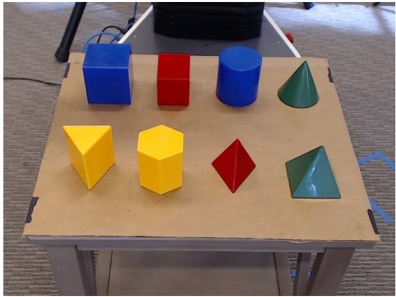
- Training used stochastic gradient descent with Adam on an L2 loss, learning rates around 1e-4, and batch sizes of 25, 50, or 100. Evaluation used 480 webcam images of eight geometric objects at 70–105 cm from a fixed camera, with 60 labeled images per object: 20 alone, 20 with distractors, and 20 partially occluded.
Limitations
- The paper states that the detectors still overfit simulated training data: simulated error was 0.3–0.5 cm versus about 1.5 cm in the real world, and no real-world validation could be done during training because no real data were assumed available.
- The paper states future work is needed for contact-rich manipulation or higher precision, and that the method fixes table height, effectively making the task 2D pose estimation from a single monocular uncalibrated camera.
- Evident from the text: evaluation is limited to eight geometric objects plus one Spam can, the test camera position remains constant across all images, and lighting and surrounding scene were not controlled.
Model-written summary. Check it against the paper before relying on it.
Integrity signals
Registry
Cites
Statistics
Figures
Verification
Claims the paper makes
2 Valid · 8 Not valid · 7 Not checked · 32 Own results and interpretations
The cited sources support only part of this claim — read each source’s verdict below.
In the paper
“Although previous work demonstrated the ability to perform robotic control using a neural network pretrained on ImageNet and fine-tuned on randomized rendered pixels [37], this paper provides the first demonstration that domain randomization can be useful for robotic tasks requiring precision.”
What the sources say
- Partly supportedcites [37] [37] Fereshteh Sadeghi and Sergey Levine. (cad) 2 RL: Real single-image flight without a single real image. arXiv preprint arXiv:1611.04201 , 2016. - sourceExperimental — accuracy not yet measured
The citation [37] is attached to the preceding claim about prior work, not to the citing authors’ claim that their own paper is the first to demonstrate precision robotics. Section 3.1 (p. 4) says LSDA pretrains a CNN on ImageNet classification data and fine-tunes it, but for object detection. It does not report robotic control or fine-tuning on randomized rendered pixels. (LLM, conf=0.84)
boostedstates a cause- Asserted: passes — The authors put it forward as true.
- Checkable: passes — It can be checked against evidence.
- Load-bearing: passes — The paper’s conclusions depend on it.
- Based: passes — The paper gives a reason why it holds.
- Partly supported
The cited sources that could be checked couldn’t confirm or dispute this claim.
In the paper
“Rather than relying on controller robustness, Yu et al. [53] use a model trained on varied physics to perform system identification using online trajectory data, but their approach is not shown to succeed in the real world.”
What the sources say
- Could not verifycites [53] [53] Wenhao Yu, C Karen Liu, and Greg Turk. Preparing for the unknown: Learning a universal policy with online system identification. arXiv preprint arXiv:1702.02453 , 2017. - sourceExperimental — accuracy not yet measured
The cited paper discusses image classification and localisation with convolutional networks (A.1, p. 10; A.2, p. 11), not Yu et al.'s approach. Searches for varied-physics training, online trajectory-based system identification, and real-world success found no passage addressing the claim. Our copy therefore cannot verify it. (LLM, conf=0.78)
plain- Asserted: passes — The authors put it forward as true.
- Checkable: passes — It can be checked against evidence.
- Load-bearing: unclear — It is unclear whether the paper’s conclusions depend on it.
- Based: passes — The paper gives a reason why it holds.
- Could not verify
The cited sources that could be checked couldn’t confirm or dispute this claim.
In the paper
“Though using realistic RGB rendering alone has had limited success for transferring to real robotic tasks [16], incorporating realistic simulation of depth information can allow models trained on rendered images to transfer reasonably well to the real world [32].”
What the sources say
- Could not verifycites [16] [16] Stephen James and Edward Johns. 3d simulation for robot arm control with deep q-learning. arXiv preprint arXiv:1609.03759 , 2016. - sourceExperimental — accuracy not yet measured
The Introduction (§1) and Conclusion (§8) describe Adam as a method for stochastic optimization, while the CNN experiment (§6.3) concerns training on image datasets. Searches for realistic RGB rendering and sim-to-real robotic transfer found no passage addressing whether RGB rendering alone has had limited success on real robotic tasks. (LLM, conf=0.78)
plain- Asserted: passes — The authors put it forward as true.
- Checkable: passes — It can be checked against evidence.
- Load-bearing: passes — The paper’s conclusions depend on it.
- Based: passes — The paper gives a reason why it holds.
- Could not verify
The cited sources that could be checked couldn’t confirm or dispute this claim.
In the paper
“However, their experiments - collision avoidance in hallways and open spaces - do not demonstrate the ability to deal with high-precision tasks.”
What the sources say
- Could not verifycites [37] [37] Fereshteh Sadeghi and Sergey Levine. (cad) 2 RL: Real single-image flight without a single real image. arXiv preprint arXiv:1611.04201 , 2016. - sourceExperimental — accuracy not yet measured
The Experiments section (p. 5) evaluates LSDA on an object-detection dataset, not Sadeghi and Levine’s collision-avoidance experiments. Searches for Sadeghi and Levine, hallway or open-space collision avoidance, and high-precision tasks found no passage addressing the claim. (LLM, conf=0.76)
plain- Asserted: passes — The authors put it forward as true.
- Checkable: passes — It can be checked against evidence.
- Load-bearing: passes — The paper’s conclusions depend on it.
- Based: passes — The paper gives a reason why it holds.
- Could not verify
A result the paper reports from its own data — it cites no other source for it, so there is none to check. The quote shows it is in the paper.
In the paper
“However, using a pre-trained model can significantly improve performance when less training data is used.”
plainstates a cause- Asserted: passes — The authors put it forward as true.
- Checkable: passes — It can be checked against evidence.
- Load-bearing: unclear — It is unclear whether the paper’s conclusions depend on it.
- Based: passes — The paper gives a reason why it holds.
29 more claims
Create a free account to see all 49 claims and to verify the 7 references still open.
- Probably not a substantial claim. 11
- It may state two separate claims as one. 8
Claims other papers make about this one
Each is checked against this paper’s own text: does it say what the citing paper says it does?
The source backs part of the claim, not all of it — or backs it for a different population, condition or comparison.
In the citing paper
“Most policies trained in simulation generalize poorly to the real-world due to agents adapting to specific visual details of the simulator.”
From Language-Based Augmentation to Address Shortcut Learning in Object-Goal Navigation (2023) · cites this paper as [8]
Experimental — accuracy not yet measuredThe source backs part of the claim, not all of it — or backs it for a different population, condition or comparison.
In the citing paper
“In robotic vision tasks including object localization [53], object detection [54], pose estimation [55], and semantic segmentation [56], the training data from simulator always have different textures, lighting, and camera positions from the realistic environments.”
From Sim-to-Real Transfer in Deep Reinforcement Learning for Robotics: a Survey (2020) · cites this paper as [53]
Experimental — accuracy not yet measuredThe source backs part of the claim, not all of it — or backs it for a different population, condition or comparison.
In the citing paper
“These artifacts limit the applicability of generative videos in physics-sensitive domains such as robotics [25,26], autonomous driving [27], simulationbased design, and scientific visualization [28].”
From PhyStruct-Video: Structured Physics State Spaces for Physically Consistent Video Generation (2025) · cites this paper as [25]
Experimental — accuracy not yet measuredThe source backs part of the claim, not all of it — or backs it for a different population, condition or comparison.
In the citing paper
“In domain randomization, the inputs during learning are “randomized” in the sense of being warped or corrupted in particular ways.”
From The overfitted brain: Dreams evolved to assist generalization (2021) · cites this paper as [144]
Experimental — accuracy not yet measuredThe source backs part of the claim, not all of it — or backs it for a different population, condition or comparison.
In the citing paper
“Domain randomization is a domain generalization technique that introduces drastic changes in the training image appearances, which forces the network to learn domain-invariant features between training and target domains [39].”
From A Fully Differentiable Framework for 2D/3D Registration and the Projective Spatial Transformers (2024) · cites this paper as [39]
Experimental — accuracy not yet measured
8 more claims about this paper
Create a free account to see every claim other papers make about this one.
Self-check
Percentages, sums and reported differences re-computed from the paper’s own numbers.
Each contradiction between two passages listed here was confirmed by an independent check.
Rated minor: it would not touch a result — a value no result rests on, a p-value that stays on the same side of the significance level, or a conflict that is clerical, resolved elsewhere in the paper, or outside its own findings.
In the paper
§ A. Experimental Setup · p. 4
“Each training sample consists of (a) a rendered image of the object and one or more distractors (also from among the geometric object set) on a simulated tabletop”
§ A. Domain randomization · p. 4
“Between 0 and 10 distractor objects are added to the table in each scene.”
Citations
Cites
Very Deep Convolutional Networks for Large-Scale Image Recognition
Simonyan, K., & Zisserman, A. (2014) · arXiv · doi:10.48550/arxiv.1409.1556 · Cited by 114,148 · cited 1×
“In particular, we use a modified version the VGG-16 architecture [42] shown in Figure 2.”
MethodAdam: A Method for Stochastic Optimization
Kingma, D. P., & Ba, J. (2014) · arXiv · doi:10.48550/arxiv.1412.6980 · Cited by 98,946 · cited 1×
“We found that using a learning rate of around 1e − 4 (as opposed to the standard 1e − 3 for Adam) improved convergence and helped avoid a common local optimum, mapping all objects to the center of the table.”
MethodLeCun, Y., Bengio, Y., & Hinton, G. (2015) · Nature · doi:10.1038/nature14539 · Cited by 84,126
Human-level control through deep reinforcement learning
Mnih, V., Kavukcuoglu, K., Silver, D., Rusu, A. A., Veness, J., Bellemare, M. G., Graves, A., Riedmiller, M., Fidjeland, A. K., Ostrovski, G., et al. (2015) · Nature · doi:10.1038/nature14236 · Cited by 30,357 · cited 3×
“Learning in simulation is especially promising for building on recent results using deep reinforcement learning to achieve human-level performance on tasks like Atari [27] and robotic control [21], [38].”
BackgroundResultHow transferable are features in deep neural networks?
Yosinski, J., Clune, J., Bengio, Y., & Lipson, H. (2014) · arXiv · doi:10.48550/arxiv.1411.1792 · Cited by 6,061 · cited 1×
“A variety of approaches have been proposed, including re-training the model in the target domain (e.g., [52]), adapting the weights of the model based on the statistics of the source and target domains (e.g., [22]), learning invariant features between domains (e.g., [47]), and learning a mapping…”
BackgroundMuJoCo: A physics engine for model-based control
Todorov, E., Erez, T., & Tassa, Y. (2012) · 2012 IEEE/RSJ International Conference on Intelligent Robots and Systems · doi:10.1109/iros.2012.6386109 · Cited by 4,767 · cited 1×
“We render images using the MuJoCo Physics Engine’s [45] built-in renderer.”
MethodTrust region policy optimization
Schulman, J., Levine, S., Moritz, P., Jordan, M. I., & Abbeel, P. (2015) · arXiv · doi:10.48550/arxiv.1502.05477 · Cited by 4,578 · cited 1×
“Learning in simulation is especially promising for building on recent results using deep reinforcement learning to achieve human-level performance on tasks like Atari [29] and robotic control [26], [41].”
ResultSelf-citationLearning Transferable Features with Deep Adaptation Networks
Long, M., Cao, Y., Wang, J., & Jordan, M. I. (2015) · arXiv · doi:10.48550/arxiv.1502.02791 · Cited by 4,505 · cited 1×
“omputer vision community has devoted significant study to the problem of adapting vision-based models trained in a source domain to a previously unseen target domain (see, e.g., [9], [14], [15], [19], [23], [25], [51]). A variety of approaches have been proposed, including re-training the model in the target domain (e.…”
BackgroundEnd-to-End Training of Deep Visuomotor Policies
Levine, S., Finn, C., Darrell, T., et al. (2015) · Journal of machine learning research · doi:10.5555/2946645.2946684 · Cited by 3,987
Describing Textures in the Wild
Cimpoi, M., Maji, S., Kokkinos, I., Mohamed, S., & Vedaldi, A. (2014) · 2014 IEEE Conference on Computer Vision and Pattern Recognition · doi:10.1109/cvpr.2014.461 · Cited by 2,438 · cited 1×
“To examine how our detectors would perform on objects with complex textures, we created simulated scenes in which the object of interest is given a texture from the Describable Textures Dataset (DTD) [4].”
Method
Research works printed but not linked: 3
- [24] David G Lowe. Three-dimensional object recognition from single two-dimensional images. Artificial intelligence , 31(3):355-395, 1987. -
- [49] Melonee Wise, Michael Ferguson, Derek King, Eric Diehr, and David Dymesich. Fetch and freight: Standard platforms for service robot applications. In Workshop on Autonomous Mobile Service Robots , 2016. -
- sucan, 0, MoveIt!
Cited by
Items 2,801–2,900 of 2,970
simDP: Sim-to-Real Transfer with Shared Action Spaces
Jung, C., Choi, J., Yoo, S., & Ko, B. C. (2026) · Sensors · doi:10.3390/s26134079 · Cited by 1
“Domain randomization was established as an effective sim-to-real transfer technique in [7,10,11], which showed that randomizing textures, lighting, materials, camera poses, and other rendering factors enables transfer from simulated RGB images to real-world robotic control.”
Park, H., & Lee, S.-H. (2026) · Lecture notes in computer science · doi:10.1007/978-3-032-37167-6_3
Metabolically Faithful 3D PET Restoration via Volumetric Swin Transformers
Grigas, O., & Maskeliūnas, R. (2026) · Neuroinformatics · doi:10.1007/s12021-026-09796-z
“This is analogous to domain randomization techniques used in sim-to-real transfer (Tobin et al., 2017), adapted here to the physics of PET image formation.”
Deep Reinforcement Learning for Adaptive Decision-Making in Real-World Applications
Touati, C., & Kemmar, A. (2026) · Advances in computational intelligence and robotics book series · doi:10.4018/979-8-3373-7082-8.ch005
Deep Reinforcement Learning for Collision-Aware Leader–Follower Formation Control
Romaniuk, S., & Budnik, J. (2026) · Sensors · doi:10.3390/s26134162
Cai, Y., Zhang, X., Liu, S., LOU, J., & Yuan, C. (2026) · Nonlinear Dynamics · doi:10.1007/s11071-026-12695-2 · Cited by 1
“Pio-neering domain randomization methodologies [7, 38–42] demonstrated the empirical viability of this formulation.”
Straub, F., Schmidt, M., & Dietrich, S. (2025) · IEEE International Conference on Cybernetics, Cognition and Machine Learning Applications (ICCCMLA) · doi:10.1109/icccmla66092.2025.11580723
“The utilization of synthetic data has become indispensable in the domain of robotic perception, facilitating the training of models exclusively on rendered scenes with performance on par with real-data baselines [25], [26].”
Sim-to-Real Transfer Learning for Humanoid Robot Control: A Mini-Review
Zhao, Z., Zhou, M., & LingFeng, F. (2026) · International Conference on Computer Supported Cooperative Work in Design (CSCWD) · doi:10.1109/cscwd68734.2026.11582160
“In fact, many successful policies have been trained using simpler, faster models combined with extensive domain randomization to achieve robustness [42] [43].”
343Chapter 14 Real-World Deployment of Reinforcement Learning in Robotics: Lessons from Industry
Ashraf, G. Y., Siddiqui, I. N., & Sivarethinamohan, R. (2026) · De Gruyter eBooks · doi:10.1515/9783111633909-014
Koch, P., Chavan, V., Sérs, A., Karakurt, A., Hofmann, P., Ziadeh, M. Z., & Krüger, J. (2026) · Springer eBooks · doi:10.1007/978-3-031-91463-8_22
Smart Robotics Systems using Reinforcement Learning for Autonomous Decision Making
Srivani, P., Ashwini, P., N, P. N., Narmada, S., Soumya, S., & DhanaVaishnavi, S. (2026) · International Conference on System, Computation, Automation and Networking (ICSCAN) · doi:10.1109/icscan66520.2026.11588402 · Cited by 1
“The domain randomization techniques introduced by Tobin et al. allowed the robotic systems to transfer the learned policies to real-life setting in a high success rate of learning in simulation [15].”
Exploring Procedural Content Generation of 3D City Scenes for 2D Semantic Segmentation
Gallego, N. P. D., & Peña, R. M. N. (2026) · Lecture notes in computer science · doi:10.1007/978-3-032-22261-9_27
Lin, Y., Xue, B., Zhang, M., et al. (2026) · Lecture notes in computer science · doi:10.1007/978-981-92-2487-6_10
Varshosaz, M., Hassanpoor, K., Mousavi, V., Liu, X., & Feng, S. (2026) · Remote Sensing · doi:10.3390/rs18142272
An improved, scalable and modular framework for vision-based robotic grasp detection
Arora, S., Saxena, A., Khurana, A., & Kumar, S. (2026) · International Journal of Machine Learning and Cybernetics · doi:10.1007/s13042-026-03193-3
Sygkounas, A., Hazra, R., Persson, A., Martires, P. Z. D., & Loutfi, A. (2026) · Genetic and Evolutionary Computation Conference (GECCO) · doi:10.1145/3795095.3805144 · Cited by 6
Joo, H., & Lee, O. (2026) · Urban Science · doi:10.3390/urbansci10070398
Fakhri, A., & Fassnacht, F. E. (2026) · Forestry An International Journal of Forest Research · doi:10.1093/forestry/cpag050
UAV 3D Scene Understanding: A Survey from an Agent-Capability Evolution Perspective
Zhu, E., Xu, L., Chen, Z., Cui, J., Wang, J., Zou, Y., Yang, K., Liu, X., Qi, X., & Wang, L. (2026) · Remote Sensing · doi:10.3390/rs18142323 · Cited by 1
Liu, X., Ren, J., Zhai, K., Zhang, Q., Zhang, X., Jiang, Z., & Liang, B. (2026) · Lecture notes in computer science · doi:10.1007/978-981-92-3441-7_21
Federated Energy-Aware Deep Reinforcement Learning for GNSS-Independent Swarm UAV Autonomy
Almalis, N. D., Tsihrintzis, G. A., Baris, G., & Armenakis, N. (2026) · Electronics · doi:10.3390/electronics15143064
Lane Centering Under Camera Failures: Classical Control vs. Reinforcement Learning for ADAS
Hall, C., Setty, C. T., Szurek, D., Yoon, H.-S., & Puzinauskas, P. V. (2026) · IEEE Transportation Electrification Conference and Expo · doi:10.1109/iteceats66641.2026.11592966
“3] m, and initial heading error from [ − 3 ◦ , 3 ◦ ] , providing domain randomization over operating conditions [21].”
Follower-Aware Reward Shaping for Leader–Follower Formation Control via Dueling Deep Q-Networks
Caxias, N. A., Rocha, A. S., & Carvalho, J. R. H. (2026) · Revista Eletrônica de Iniciação Científica em Computação · doi:10.5753/reic.2026.8466
Nakov, P., Petrov, P., Kotov, G., et al. (2026) · doi:10.3390/engproc2026150010
Navigating Coverage Imbalance: Prospective Weighting for Offline Reinforcement Learning
Li, H., Zhou, L., Sun, L., & Wang, N. (2026) · Lecture notes in computer science · doi:10.1007/978-981-92-3381-6_21
Transferable DL for in-situ validated LIF segmentation
Jose, B., Greenblatt, D., Lindstedt, R. P., Breicher, A., Geyer, D., Lammel, O., & Hampp, F. (2026) · Proceedings of the Combustion Institute · doi:10.1016/j.proci.2026.106253
Gim, J., & Min, J. (2026) · Research Square · doi:10.21203/rs.3.rs-10340311/v1
Vision-Based Multi-Camera Safety Monitoring for Human-Robot Collaboration
Hartanto, J. K., & Budiharto, W. (2026) · IEEE International Conference on Signals and Systems (ICSigSys) · doi:10.1109/icsigsys71160.2026.11613922
“To bridge the gap between simulation and real-world domains (the sim-to-real gap), domain randomization techniques are applied to visual parameters such as textures, lighting, and background occlusions [17].”
AI-driven quadruped robots: from fundamental locomotion to advanced biomimetic behaviors
Wu, L., Chow, C., Wong, W. R., Chuah, J. H., Kanesan, J., & Zhang, M. (2026) · Frontiers in Neurorobotics · doi:10.3389/fnbot.2026.1855550 · Cited by 1
Qi, K., Liu, C. Y., & Liu, Z. (2026) · Drones · doi:10.3390/drones10080575
“The robustness of learned quadrotor controllers across changing operating conditions depends strongly on the training distribution, observation design, actuation model, and evaluation protocol [26], while domain randomization is a common way to expose the policy to diverse simulated conditions [27].”
Physics-Regularized Learning for Robust Sim-to-Real Tactile Friction Estimation
Nawaz, M. S., Fu, Z., & Lee, K.-J. (2026) · IEEE Robotics and Automation Letters · doi:10.1109/lra.2026.3717192
Han, H., Gong, G., & Li, N. (2026) · Drones · doi:10.3390/drones10080572
A scoping review of reinforcement learning methods for long horizon robotic manipulation
Acs, M., & Zhong, X. (2026) · Discover Robotics · doi:10.1007/s44430-026-00037-1
“These factors further increase the gap between simulation-based learning and real-world deployment [18, 19].”
Mighty: A Comprehensive Tool for Studying Generalization, Meta-RL and AutoRL
Mohan, A., Eimer, T., Benjamins, C., Lindauer, M., & Biedenkapp, A. (2026) · Journal of Open Source Software · doi:10.21105/joss.10439 · Cited by 1
“For example, to integrate domain randomization (Tobin et al., 2017) via Syllabus (Sullivan et al., 2025), we need around 100 lines of code each to interface Syllabus and build a custom task wrapper.”
Kim, S. (2026) · JMIR Nursing · doi:10.2196/96848
“In conventional robotics, simulation-to-real transfer is treated primarily as a technical challenge: closing the gap between simulated and physical dynamics through domain randomization [19], dynamics randomization [20], and system identification.”
A Review of Language-Guided Dexterous Grasping with Human-in-the-Loop Adaptation
Jeong, E., & Lim, S. (2026) · Mathematics · doi:10.3390/math14152709
Advances, challenges, and opportunities for legged robots
Frey, J., Mattamala, M., Park, H.-W., Mittal, M., Martius, G., Osborne, M. A., Sparrow, R., & Hutter, M. (2026) · Science Robotics · doi:10.1126/scirobotics.aee0787 · Cited by 8
“Although perfect simulation remains elusive, techniques such as extensive domain randomization ( 117 ), learned residual models ( 11,82 ), and accurate system identification ( 118 ) have proven effective in narrowing this gap.”
Deep learning for analysis of visible-light polarimetric image: a review
Zheng, Z., Wang, E., Liu, Y., & Chu, L. (2026) · Machine Vision and Applications · doi:10.1007/s00138-026-01877-y
“…strategies include cross-camera, cross-lens, cross-focal-length, cross-ex-posure, and cross-calibration data collection, physically consistent data augmentation, noise modeling, domain randomization, synthetic-to-real calibration, and cross-camera or cross-lens validation protocols [46–48].”
Intra-Modal Cross-Attention Fusion for Domain Generalized Semantic Segmentation
Bätje, M., Schwalbe, G., Mütze, A., Schwonberg, M., & Leucker, M. (2026) · IEEE Intelligent Vehicles Symposium · doi:10.1109/iv66570.2026.11625210
“These include data augmentation [4], the generation of new samples using generative adversarial networks [27] or diffusion models [28], and Domain Randomization (DR) [29].”
Prior-Guided 3D Gaussian Splatting for Data Augmentation in Endoscopic Monocular Depth Estimation
Colan, J., Davila, A., & Hasegawa, Y. (2026) · International Conference on Ubiquitous Robots (UR) · doi:10.1109/ur69537.2026.11626692
“Similarly, standard domain randomization techniques attempt to bridge this gap, but often fail to enforce strict geometric consistency [7], [8].”
Physics-driven snowy scene rendering and robust vehicle tracking under adverse weather
Su, Q., Zhou, G., Liu, Y., Zhou, Y., & Zhang, L. (2026) · The Visual Computer · doi:10.1007/s00371-026-04630-8
“Buildingonsim-to-real principles such as domain randomization [40] and recent end-to-end MOT formulations with dynamic scene perception [41], the proposed framework combines a physics-driven video rendering engine, SnowTrack-Synth, with an end-to-end joint tracking model, WeatherTrack.”
Liu, S., Li, Q., Tan, P., Sun, H., Zhang, B., Lu, W., Wang, Z., Zhou, Q., & Nie, B. (2026) · Accident Analysis & Prevention · doi:10.1016/j.aap.2026.108690
Lê, T. S., Le, H. S., Tuyen, N. T. V., & Tuyen, N. T. V. (2026) · Advanced Robotics · doi:10.1080/01691864.2026.2707053
EGP2: A sample-efficient and generalizable reinforcement learning framework for UAV path planning
Li, Z., Shan, Y., & Mo, H. (2026) · Robotics and Autonomous Systems · doi:10.1016/j.robot.2026.105670 · Cited by 1
Cho, H., 이재석, Lee, J., Yoo, Y., & Kang, J. (2026) · Medical Physics · doi:10.1002/mp.70620 · Cited by 1
“BUSI 43 46 places the evaluation data within the trained distribution rather than treating it as out-of-distribution extrapolation.”
Xia, Y., Tian, Y., Xi, W., Wang, F., Liu, Y., Liang, N., & Zhang, W. (2026) · Remote Sensing · doi:10.3390/rs18152545
Kaixi, Y., & Qu, S. (2026) · Sensors · doi:10.3390/s26154869
“Domain randomization has been widely used to improve sim-to-real transfer by randomizing visual, environmental, or physical parameters during training, so that the learned model is less likely to over-specialize to a single source-domain condition [16–18].”
Spatial Attention and Edge-Contact Penalization for Robust Quadruped Robots Obstacle Traversal
Li, M., Zhang, H., Li, W., & Hu, F. (2026) · Youth Academic Annual Conference of Chinese Association of Automation (YAC) · doi:10.1109/yac71005.2026.11616115
“Recent studies commonly adopt the teacher–student privileged learning framework for quadruped locomotion on complex terrains [9][10] .”
Real-Time Mask-Conditioned Surgical Grasping via Action Chunking Transformers
Duan, W., Li, B., & Liu, Y.-H. (2026) · International Conference on Control and Automation · doi:10.1109/icca69928.2026.11618205 · Cited by 1
“However, many existing systems either rely on specific pose estimation [11], task-specific visual pipelines, or manually designed target features, limiting their generalization ability across different tasks and scenarios [12], [13].”
A VLM-Driven High-Fidelity Domain Randomization Framework for Imitation Learning
Huo, Z., Wu, F., Hao, F., Song, C., Cheng, J., & Liu, J. (2026) · International Conference on Control and Automation · doi:10.1109/icca69928.2026.11618169
“Domain Randomization (DR) [16], [17] bridges the sim-to-real gap by training across varied simulation parameters, but standard uniform sampling trades optimality for robustness.”
Elguea-Aguinaco, Í., Giraud-Carrier, E., Rodríguez-Guerra, J., Aguirre-Ortuzar, A., & Arana-Arexolaleiba, N. (2026) · Neural Computing and Applications · doi:10.1007/s00521-026-12364-w
“Domain randomization is a well-established technique to improve robustness and generalization of learned policies to unseen subjects and interac - tion conditions by preventing overfitting to a single nominal model [57 , 58 ].”
Zhu, Y., Li, Z., Lang, Y., et al. (2026) · International Conference on Control and Automation · doi:10.1109/icca69928.2026.11618287
“While these policies may succeed in simulation, the lack of motion smoothness and physical consistency poses a severe risk to hardware, making the sim-to-real transfer impractical without extensive post-processing or domain randomization [13].”
EDA Job Scheduling Using Reinforcement Learning with Adaptive Macro Actions
Shao, Y., An, A., Spriggs, M., Feiman, M., & Zhou, H. (2026) · ACM SIGKDD Conference on Knowledge Discovery and Data Mining (KDD) · doi:10.1145/3770855.3818390
Zhu, Y., Zhang, Y., Xu, Z., Lin, Y., Wang, R., Huang, H., & Yuan, Y. (2026) · IEEE Transactions on Instrumentation and Measurement · doi:10.1109/tim.2026.3720877
“Conventional approaches typically relied on data augmentation [37] and domain randomization [38], [39] to enhance generalization ability.”
A Standardized Multi-Dimensional Evaluation Framework for Indoor Autonomous Service Robots
Chen, Q., Chen, Z., Maul, T., Zhou, D., Yang, Z., & Wen, J. Z. (2026) · International Conference on Artificial Intelligence, Robotics and Control (AIRC) · doi:10.1109/airc69745.2026.11631325
“Many recent studies report high detection precision on benchmark datasets or improved path optimality in simulation environments [5].”
Ghanim, R. (2026) · Al-Noor Journal of Engineering Management and Computer Science · doi:10.71229/8chpd013
Zhang, X., Luo, X., & Xie, S. (2026) · International Conference on Electronic Information Technology and Computer Engineering (EITCE) · doi:10.1109/eitce70137.2026.11634316
Wang, Z., Aziz, I. A., & Alipour, M. (2026) · IEEE Journal of Selected Topics in Applied Earth Observations and Remote Sensing · doi:10.1109/jstars.2026.3721490 · Cited by 3
“Domain randomization, as another sim-to-real transfer technique, enhances the diversity of simulated data by randomizing key simulation parameters, thereby enabling the trained model to generalize more effectively to real-world variations [37].”
Teacher-Student Dexterous Grasping System for Cluttered Scenes with Sim-to-Real Transfer
Fang, S., Wang, R., & Chen, H. (2026) · IEEE China Conference on System Simulation Technology and its Applications (CCSSTA) · doi:10.1109/ccssta69471.2026.11635795
“Domain randomization [14] perturbs visual and dynamics parameters such as lighting, camera pose, object mass, and friction coefficients during training, guiding the policy to learn representations robust to real-world parameter variation and enabling zero-shot transfer.”
Rendering Synthetic Defects for Learning‐Based Industrial Inspection
Mao, R., Sakai, H., Freude, C., Garth, C., Gospodnetić, P., & Fulir, J. (2026) · Computer Graphics Forum · doi:10.1111/cgf.70550
Applications of Reinforcement Learning for Autonomous Surgical Robotics: A Systematic Review
Shahid, M., Abdullah, A., Fatima, Z., Feroze, W., Torres-Ruiz, M. J., Saldaña-Pérez, M., Sanchéz-Mejorada, C. G., & Quintero, R. (2026) · Biomimetics · doi:10.3390/biomimetics11080577 · Cited by 2
RL-Based Weightlifting for a Small-Size Humanoid Robot
Vlasenko, A., Сивак, В., Chaikovskaia, E., & Gorbachev, R. (2026) · International Siberian workshops and tutorials on electron devices and materials · doi:10.1109/edm69524.2026.11632088
“Reinforcement learning (RL) offers a more capable alternative, however policies trained in simulation often perform poorly or fail entirely on the real robot [3], [4].”
Jokanovich, D., Adnan, A., Carlo, A., et al. (2026) · Lecture notes in computer science · doi:10.1007/978-3-032-33182-3_5
Tianchen, P., Song, H., Tao, Z., et al. (2026) · International Conference on Mechanical Engineering and Robotics Research (ICMERR) · doi:10.1109/icmerr70056.2026.11643167
“Experimental results indicate that the proposed framework was tested in a simulation robot peg-in-hole assembly task[9]; it achieved smooth and stable force control without any parameter tuning, significantly enhancing the robustness and generalization capability of the system in complex contact…”
Single Domain Generalization Benchmark: Current State and Challenges
Imbulgoda, K., Tennakoon, R., Chuah, W., Korevaar, S., Xia, F., & Bab‐Hadiashar, A. (2026) · International Journal of Computer Vision · doi:10.1007/s11263-026-02985-y
“Although earlier methods such as Tobin et al. (2017) require access to a simulator, subsequent methods have eliminated this requirement.”
Lundervold, A., Alam, S., Hannisdal, M. H., Goplen, D., Chekenya, M., & Lundervold, A. S. (2026) · Journal of Medical Engineering & Technology · doi:10.1080/03091902.2026.2713703
Few-Shot Meta-Reinforcement Learning for Cross-Project Construction Scheduling
Dayalan, D. (2026) · International Conference on Sustainable Computing and Smart Systems (ICSCSS) · doi:10.1109/icscss69635.2026.11645904
PRP: Procedural-to-Real Masked Pre-Training for Transferable and Interpretable Audio Representations
Liu, F., Huang, R., Zheng, Q., Wang, Y., & Liu, F. (2026) · IEEE Transactions on Audio Speech and Language Processing · doi:10.1109/taslpro.2026.3724415
Force-Feedback RL-Based Bionic Control of Hand Exoskeleton for Object Grasping and Slip Prevention
Singh, A., Hazoary, U., Sarmah, N., et al. (2026) · IEEE Guwahati Subsection Conference (GCON) · doi:10.1109/gcon69192.2026.11648397
“In this work, we address this gap by developing a reinforcement learning–based pinch grip controller for the BRAIL hand exoskeleton in PyBullet [10], [11], integrating wavelet-based slip detection and domain randomization [12] to study robust grasping under uncertain contact conditions.”
NFH‐26‐03: Data‐efficient robot learning for contact‐rich manipulation
Seita, D. (2026) · AI Magazine · doi:10.1002/aaai.70074
Zhang, Z., Biao, H. E., & Zuo, Y. (2026) · IEEE Access · doi:10.1109/access.2026.3725090
“The augmentation we use is conceptually analogous to sim-to-real domain randomization in robotics [34], [35]: a network trained on a distribution of randomized environments is expected to generalize to an unseen target environment.”
Elazouni, O. Y., Ahmad, M. S., & Bogatyrev, V. A. (2026) · International Conference on Neural Networks and Neurotechnologies (NeuroNT) · doi:10.1109/neuront71829.2026.11651405
Prakash, R., Jagadeesh, S., & Gentyala, S. (2026) · IEEE International Workshop on Metrology for AeroSpace (MetroAeroSpace) · doi:10.1109/metroaerospace69299.2026.11646672
Reducing Distribution Shift in Imitation Learning with an Expert for Stable Flight
Boudlal, A., Khafaji, A., & Elabbadi, J. (2026) · Lecture notes in networks and systems · doi:10.1007/978-3-032-28094-7_27
Reinforcement Learning for Autonomous Control in Industrial Robotic Systems
Jagan, K., Modhalavalasa, R., Sheeba, G., Karthikeyan, C., Jemi Gold, P., & Kumar, D. (2026) · International Conference on Sustainable Computing and Integrated Communication in Changing Landscape of AI (ICSCAI) · doi:10.1109/icscai68849.2026.11649312
Evolution of humanoid locomotion control
Gu, Y., Shi, G., Shi, F., Chang, I.-C., Wang, Y., Cheng, Q., Olkin, Z., López-Sánchez, I., Feng, Y., Zhang, J., et al. (2026) · Science Robotics · doi:10.1126/scirobotics.aed3973 · Cited by 8
Talib, M. W. A., Nasir, Q., Ali, S. K., et al. (2026) · Array · doi:10.1016/j.array.2026.101146
Ma, A., Cruz, J. M., Luo, D., & Sha, M. (2026) · IEEE Annual International Computer Software and Applications Conference (COMPSAC) · doi:10.1109/compsac69091.2026.00180
Randomize and Identify for Stable Flight
Boudlal, A., Khafaji, A., & Elabbadi, J. (2026) · Lecture notes in networks and systems · doi:10.1007/978-3-032-28097-8_17
Synthetic Data from Simulated Lecture Environments for Handwritten Content Extraction
Song, M., & Davila, K. (2026) · Lecture notes in computer science · doi:10.1007/978-3-032-36033-5_30
Robust Industrial Manipulation Under Test-Time Perturbations in RLBench and Colosseum
Matar, A., Altamimi, Y., & Al-Rawashdeh, Y. M. (2026) · IEEE Jordan Conference on Applied Electrical Engineering and Computing Technologies · doi:10.1109/aeect69724.2026.11657856
“2) Robustness, sim-to-real transfer, and domain randomization: Domain randomization is one of the most influential approaches for dealing with simulation mismatch and unseen deployment conditions [9], [10].”
Intelligent Robotic Manipulation for IV Bag Quality Control: A Contamination-Aware Learning System
Jurado, U. T., & Martínez-Hernández, U. (2026) · IEEE/ASME International Conference on Advanced Intelligent Mechatronics · doi:10.1109/aim65483.2026.11658033
“Robotics has advanced rapidly with transfer learning, sim-to-real transfer and domain randomisation [9], [10], hierarchical and imitation learning for long-horizon skills [11], [12] and vision-language-action (VLA) models that promise broader generality [13], [14].”
Kim, S., Kim, Y., Kim, H., 최동기, & Song, Y.-E. (2026) · IEEE/ASME International Conference on Advanced Intelligent Mechatronics · doi:10.1109/aim65483.2026.11658110
Robotic Wire Assembly via Data-Driven Modeling, Policy Learning, and Sim-to-Real Transfer
Chien, S.-L., Kao, F.-C., Shih, C.-S., Lu, S.-H., & Lin, P. (2026) · IEEE/ASME International Conference on Advanced Intelligent Mechatronics · doi:10.1109/aim65483.2026.11658356
“Although techniques such as domain randomization [11], [12] have proven effective, accurately modeling deformable linear objects remains challenging.”
A Survey on Intelligent Robot Testing and Automation
Rengarajan, K., Pokuri, S., & Gao, J. (2026) · IEEE International Conference on Artificial Intelligence Testing (AITest) · doi:10.1109/aitest70988.2026.00041
“[26] with domain randomization [27] and adversarial sim-to-real transfer [51].”
Caxias, N. A., Rocha, A. S., & Carvalho, J. R. (2026) · Anais do LIII Seminário Integrado de Software e Hardware (SEMISH 2026) · doi:10.5753/semish.2026.21882
“The task geometry evolves across three training phases [Narvekar et al. 2020, Tobin et al. 2017].”
Huang, J., Tucker, E., Yu, R., & Liu, Y. (2026) · International Conference on Computer Communications and Networks (ICCCN) · doi:10.1109/icccn69946.2026.11662747
“In particular, reinforcement learning (RL) and extended multi-agent reinforcement learning (MARL) have shown promise for adaptive UAV planning under uncertainty [7]–[10].”
Sim-to-Real Diffusion Policies for Robotic Alignment in Manufacturing
Zheng, Y., Zheng, Z., Gu, J., & Liu, W. (2026) · IEEE Canadian Atlantic Ocean Symposium (CAOS) · doi:10.1109/caos69069.2026.11666177
“While we did not perform a full quantitative ablation study in this work, our limited trials and prior literature suggest that removing semantic preprocessing or recoloring can significantly degrade performance [10], [5].”
Meta-Knowledge Extraction and Reuse: A Novel Approach for Transfer Reinforcement Learning
Tang, T., Ma, M., Chen, C. G., Yang, M., Zhang, W., & Lan, Y. (2026) · International Artificial Intelligence Technology Conference (AITC) · doi:10.1109/aitc70732.2026.11666562
Machine Learning-Driven Load Balancing in Edge and 5G Networks: A Comprehensive Survey
Moghadam, E., Kanso, M., Younesi, A., & Safaei, B. (2026) · IEEE Open Journal of the Communications Society · doi:10.1109/ojcoms.2026.3728736
“In [84], domain randomization is used to train models on randomized simulated observations and subsequently transfer them to real-world robotic perception without pre-training on real images.”
Geometry-Consistent Diffusion Particle Filter for Robust Multistatic Radar Tracking
Li, Y., Fan, H., Chen, X., et al. (2026) · IEEE Signal Processing Letters · doi:10.1109/lsp.2026.3728407
“We propose a Geometry-Consistent Diffusion Particle Filter (GC-DPF) with three contributions: 1) Range-aware proposal: The angle/log-range encoding and domain randomization (DR) [25] allow the same proposal to serve the near-and far-range scenarios S0 and S1 (Section IV-A) without retraining.”
Distribution‐Level Regularization for Robust Reinforcement Learning in Autonomous Driving
Zanki, H., & Huszák, Á. (2026) · Journal of Advanced Transportation · doi:10.1155/atr/6789335
Alkhodre, A. B., Al-Amine, M. A., & Alsaawy, Y. (2026) · Drones · doi:10.3390/drones10090660
“To narrow the sim-to-real gap, we plan to apply domain randomization and sensor noise injection [36,37] during retraining, systematically varying inertial parameters, motor response curves, and sensor latencies to produce a more transfer-robust policy.”
Jiang, L., Chen, J., Lan, K., et al. (2026) · Biomimetics · doi:10.3390/biomimetics11090610
Khanna, R., Fischer, N., Du, Z., & Bergeles, C. (2026) · International Journal of Computer Assisted Radiology and Surgery · doi:10.1007/s11548-026-03779-w
Luzar, M. (2026) · International Conference on Methods and Models in Automation and Robotics · doi:10.1109/mmar70562.2026.11667843
A survey of world models for physical AI with uncertainty representation and control
Kirchner, S., Purschke, N., & Knoll, A. (2026) · Discover Artificial Intelligence · doi:10.1007/s44163-026-02122-1 · Cited by 1
Petrović, O., Dohmen, P., Tesic, P., & Herfs, W. (2026) · Procedia CIRP · doi:10.1016/j.procir.2026.03.172
Alnaim, A. K., & Alwakeel, A. M. (2026) · Sensors · doi:10.3390/s26175632
“When an episode is initialized in such a way that learning does not rely on a single set of model parameters, it is known as domain randomization [36].”
Fan, Y., Liu, Z., Lin, X., Xu, R., Zhang, O., Zhu, Q., Gao, Y., & Liu, J. (2026) · Nonlinear Dynamics · doi:10.1007/s11071-026-12999-3
“To address this robustness issue, domain randomization (DR) has become a common strategy [21].”
Metadata
- Authors
- Tobin, J., Fong, R., Ray, A., Schneider, J., Zaremba, W., & Abbeel, P.
- Affiliations
- University of California, Berkeley (US)
- OpenAI (United States) (US)
- International Computer Science Institute (US)
- ORCID
- Abbeel, Pieter
- Venue
- 2017 IEEE/RSJ International Conference on Intelligent Robots and Systems (IROS)
- Publisher
- IEEE
- Published
- 2017-09
- Pages
- 23-30
- ISSN
- 2153-0858 (ISSN-L)
- OpenAlex
- W2605102758
- Semantic Scholar
- 32ceb28e45a445df4d89df281bb0e3ab5aab1a2a
- Cited by
- 3,124
- References
- 69
- Citations by year
- 2026: 413 · 2025: 433 · 2024: 336 · 2023: 403 · 2022: 374 · 2021: 422 · 2020: 352 · 2019: 256 · 2018: 106 · 2017: 25
- FWCI
- 92.18
- Type
- conference paper
- Language
- en
- Open access
- green
- arxiv.org
- Locations
- IEEE/RSJ International Conference on Intelligent Robots and Systems (IROS) (publishedVersion)
- arXiv (Cornell University) (submittedVersion)
- arXiv (Cornell University)
- Topics
- Physical Sciences › Computer Science › Artificial Intelligence › Reinforcement Learning in Robotics
- Physical Sciences › Engineering › Control and Systems Engineering › Robot Manipulation and Learning
- Physical Sciences › Computer Science › Artificial Intelligence › Domain Adaptation and Few-Shot Learning
- Keywords
- domain randomization, sim-to-real transfer, reality gap, object detection, object localization, robotic grasping, cluttered environments, distractor robustness, partial occlusion, robotic manipulation
About these checks
Registry, retraction, Cites and statistics results are computed, not judged, with one exception: a printed reference that no index lists is read once by a model before it counts as a citation error. Claims are extracted by a model and kept only when their quote appears verbatim in the text; each cited source is then checked, with a model’s help, for whether it says what the claim relies on. Those verdicts can be wrong — read the claim’s quote and the cited source before relying on one.
The claim verdicts this report counts are experimental: their accuracy is not yet measured.
A language model drew the claims from the paper on 2026-10-10, under version 3 of the claim definition (model deepseek-v4.1-flash, prompt extract-v3).
A second model labelled each claim on 2026-10-10 (model jev-1.13-20260917, definition revision gold-guideline-v0.2).
Cited sources are checked with a language model’s help (gpt-6-sol).
Statistics and arithmetic are recomputed, not judged.
Confidence bands are shown only for fields calibrated on our annotated test set. None is calibrated yet, so no band is shown.
What counts as a claim ›How we measure confidence ›How we check this ›
Are you an author, or do you see a problem with this page? Request a review
Data sources
Bibliographic data: Semantic Scholar, OpenAlex, Crossref.
Contains information from the Semantic Scholar Academic Graph Datasets, made available under the ODC Attribution License (ODC-BY 1.0).
Semantic Scholar’s data is described in: Kinney, R., et al. (2023). The Semantic Scholar Open Data Platform. arXiv:2301.10140.
