

Domain randomization for transferring deep neural networks from simulation to the real world
Open accessThe DOI matches its Crossref record; 71 of the 71 references it cites were found in a registry or an index; 8 of the 17 sources its claims cite were checked for support.
Abstract
Bridging the `reality gap' that separates simulated robotics from experiments on hardware could accelerate robotic research through improved data availability. This paper explores domain randomization, a simple technique for training models on simulated images that transfer to real images by randomizing rendering in the simulator. With enough variability in the simulator, the real world may appear to the model as just another variation. We focus on the task of object localization, which is a stepping stone to general robotic manipulation skills. We find that it is possible to train a real-world object detector that is accurate to 1.5 cm and robust to distractors and partial occlusions using only data from a simulator with non-realistic random textures. To demonstrate the capabilities of our detectors, we show they can be used to perform grasping in a cluttered environment. To our knowledge, this is the first successful transfer of a deep neural network trained only on simulated RGB images (without pre-training on real images) to the real world for the purpose of robotic control.
Overview
CoChat Summary
TL;DR
This paper introduces domain randomization: training an object detector on simulated RGB images with randomized rendering, textures, lighting, camera pose, and distractors so that the real world appears as another variation. The authors show that a detector trained only in simulation can localize objects in the real world accurately enough to grasp them in clutter.
Key findings
- Real-world object detectors trained only on simulated images localized objects to within about 1.5 cm on average, including with distractors and partial occlusions; per-object errors in Table I range from 0.6 ± 0.3 cm to 3.2 ± 5.8 cm depending on object and condition.
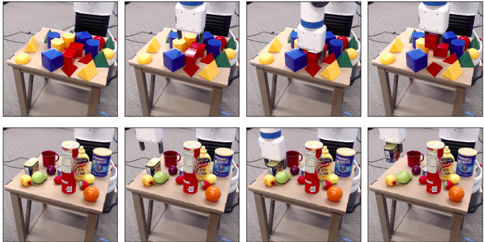
- The pipeline enabled a Fetch robot to detect and pick up the target object in 38 out of 40 trials in increasingly cluttered scenes, and a detector trained on a Spam can succeeded in 9 of 10 trials with previously unseen YCB food distractors.
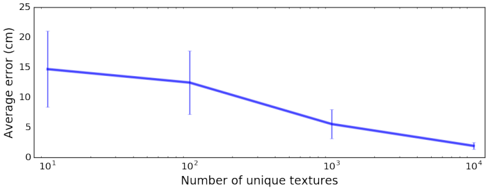
- Ablations found sensitivity to number of training images, number of unique textures, presence of distractors in training, and camera randomization; random noise had negligible effect. Performance improved up to around 50,000 training samples, and degraded significantly with fewer than 1,000 textures.
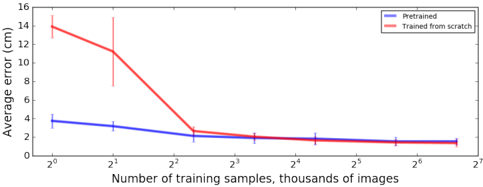
- ImageNet pretraining was not essential with enough data: random weight initialization achieved nearly the same real-world transfer performance as pretrained initialization, though pretraining helped in the low-data regime.
Methods
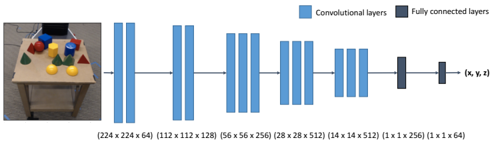
- The authors trained a modified VGG-16 convolutional neural network to map a single 224×224 monocular webcam image to Cartesian coordinates of object(s) of interest, using simulated images rendered by MuJoCo.
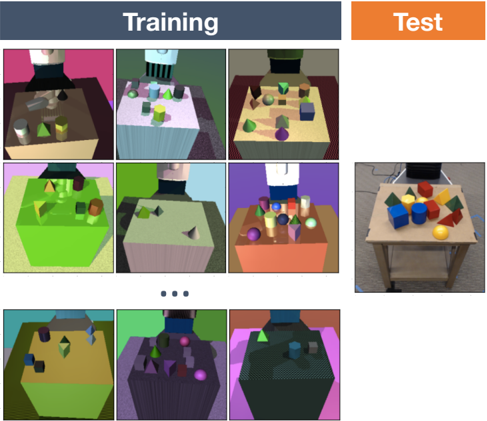
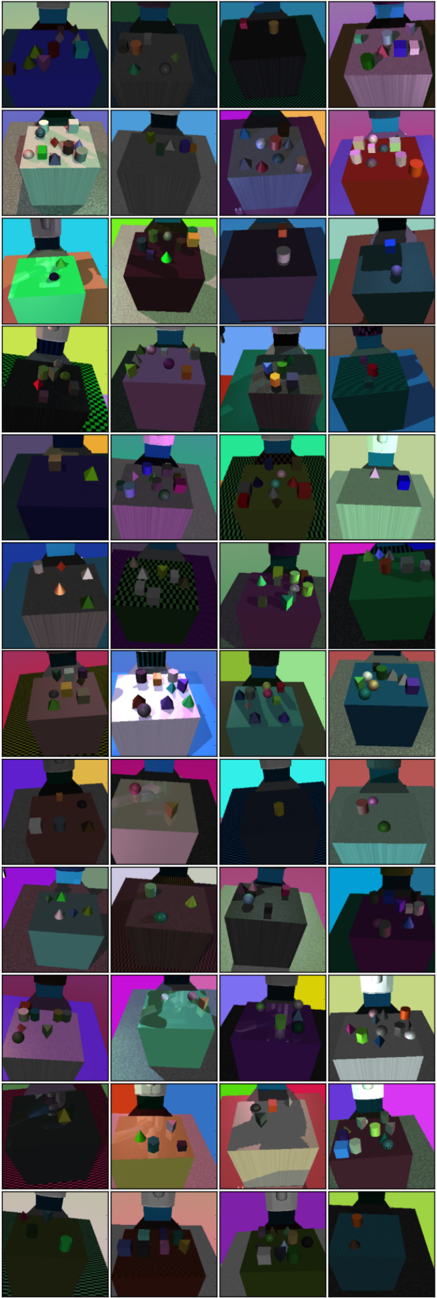
- Domain randomization varied number/shape of distractors, object positions and textures, table/floor/skybox/robot textures, camera position/orientation/field of view, number and properties of lights, and image noise. Textures were random RGB values, gradients, or checker patterns; 0–10 distractor objects were added per scene.
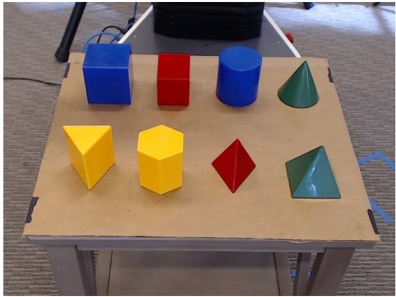
- Training used stochastic gradient descent with Adam on an L2 loss, learning rates around 1e-4, and batch sizes of 25, 50, or 100. Evaluation used 480 webcam images of eight geometric objects at 70–105 cm from a fixed camera, with 60 labeled images per object: 20 alone, 20 with distractors, and 20 partially occluded.
Limitations
- The paper states that the detectors still overfit simulated training data: simulated error was 0.3–0.5 cm versus about 1.5 cm in the real world, and no real-world validation could be done during training because no real data were assumed available.
- The paper states future work is needed for contact-rich manipulation or higher precision, and that the method fixes table height, effectively making the task 2D pose estimation from a single monocular uncalibrated camera.
- Evident from the text: evaluation is limited to eight geometric objects plus one Spam can, the test camera position remains constant across all images, and lighting and surrounding scene were not controlled.
Model-written summary. Check it against the paper before relying on it.
Integrity signals
Registry
Cites
Statistics
Figures
Verification
Claims the paper makes
2 Valid · 8 Not valid · 7 Not checked · 32 Own results and interpretations
The cited sources support only part of this claim — read each source’s verdict below.
In the paper
“Although previous work demonstrated the ability to perform robotic control using a neural network pretrained on ImageNet and fine-tuned on randomized rendered pixels [37], this paper provides the first demonstration that domain randomization can be useful for robotic tasks requiring precision.”
What the sources say
- Partly supportedcites [37] [37] Fereshteh Sadeghi and Sergey Levine. (cad) 2 RL: Real single-image flight without a single real image. arXiv preprint arXiv:1611.04201 , 2016. - sourceExperimental — accuracy not yet measured
The citation [37] is attached to the preceding claim about prior work, not to the citing authors’ claim that their own paper is the first to demonstrate precision robotics. Section 3.1 (p. 4) says LSDA pretrains a CNN on ImageNet classification data and fine-tunes it, but for object detection. It does not report robotic control or fine-tuning on randomized rendered pixels. (LLM, conf=0.84)
boostedstates a cause- Asserted: passes — The authors put it forward as true.
- Checkable: passes — It can be checked against evidence.
- Load-bearing: passes — The paper’s conclusions depend on it.
- Based: passes — The paper gives a reason why it holds.
- Partly supported
The cited sources that could be checked couldn’t confirm or dispute this claim.
In the paper
“Rather than relying on controller robustness, Yu et al. [53] use a model trained on varied physics to perform system identification using online trajectory data, but their approach is not shown to succeed in the real world.”
What the sources say
- Could not verifycites [53] [53] Wenhao Yu, C Karen Liu, and Greg Turk. Preparing for the unknown: Learning a universal policy with online system identification. arXiv preprint arXiv:1702.02453 , 2017. - sourceExperimental — accuracy not yet measured
The cited paper discusses image classification and localisation with convolutional networks (A.1, p. 10; A.2, p. 11), not Yu et al.'s approach. Searches for varied-physics training, online trajectory-based system identification, and real-world success found no passage addressing the claim. Our copy therefore cannot verify it. (LLM, conf=0.78)
plain- Asserted: passes — The authors put it forward as true.
- Checkable: passes — It can be checked against evidence.
- Load-bearing: unclear — It is unclear whether the paper’s conclusions depend on it.
- Based: passes — The paper gives a reason why it holds.
- Could not verify
The cited sources that could be checked couldn’t confirm or dispute this claim.
In the paper
“Though using realistic RGB rendering alone has had limited success for transferring to real robotic tasks [16], incorporating realistic simulation of depth information can allow models trained on rendered images to transfer reasonably well to the real world [32].”
What the sources say
- Could not verifycites [16] [16] Stephen James and Edward Johns. 3d simulation for robot arm control with deep q-learning. arXiv preprint arXiv:1609.03759 , 2016. - sourceExperimental — accuracy not yet measured
The Introduction (§1) and Conclusion (§8) describe Adam as a method for stochastic optimization, while the CNN experiment (§6.3) concerns training on image datasets. Searches for realistic RGB rendering and sim-to-real robotic transfer found no passage addressing whether RGB rendering alone has had limited success on real robotic tasks. (LLM, conf=0.78)
plain- Asserted: passes — The authors put it forward as true.
- Checkable: passes — It can be checked against evidence.
- Load-bearing: passes — The paper’s conclusions depend on it.
- Based: passes — The paper gives a reason why it holds.
- Could not verify
The cited sources that could be checked couldn’t confirm or dispute this claim.
In the paper
“However, their experiments - collision avoidance in hallways and open spaces - do not demonstrate the ability to deal with high-precision tasks.”
What the sources say
- Could not verifycites [37] [37] Fereshteh Sadeghi and Sergey Levine. (cad) 2 RL: Real single-image flight without a single real image. arXiv preprint arXiv:1611.04201 , 2016. - sourceExperimental — accuracy not yet measured
The Experiments section (p. 5) evaluates LSDA on an object-detection dataset, not Sadeghi and Levine’s collision-avoidance experiments. Searches for Sadeghi and Levine, hallway or open-space collision avoidance, and high-precision tasks found no passage addressing the claim. (LLM, conf=0.76)
plain- Asserted: passes — The authors put it forward as true.
- Checkable: passes — It can be checked against evidence.
- Load-bearing: passes — The paper’s conclusions depend on it.
- Based: passes — The paper gives a reason why it holds.
- Could not verify
A result the paper reports from its own data — it cites no other source for it, so there is none to check. The quote shows it is in the paper.
In the paper
“However, using a pre-trained model can significantly improve performance when less training data is used.”
plainstates a cause- Asserted: passes — The authors put it forward as true.
- Checkable: passes — It can be checked against evidence.
- Load-bearing: unclear — It is unclear whether the paper’s conclusions depend on it.
- Based: passes — The paper gives a reason why it holds.
29 more claims
Create a free account to see all 49 claims and to verify the 7 references still open.
- Probably not a substantial claim. 11
- It may state two separate claims as one. 8
Claims other papers make about this one
Each is checked against this paper’s own text: does it say what the citing paper says it does?
The source backs part of the claim, not all of it — or backs it for a different population, condition or comparison.
In the citing paper
“Most policies trained in simulation generalize poorly to the real-world due to agents adapting to specific visual details of the simulator.”
From Language-Based Augmentation to Address Shortcut Learning in Object-Goal Navigation (2023) · cites this paper as [8]
Experimental — accuracy not yet measuredThe source backs part of the claim, not all of it — or backs it for a different population, condition or comparison.
In the citing paper
“In robotic vision tasks including object localization [53], object detection [54], pose estimation [55], and semantic segmentation [56], the training data from simulator always have different textures, lighting, and camera positions from the realistic environments.”
From Sim-to-Real Transfer in Deep Reinforcement Learning for Robotics: a Survey (2020) · cites this paper as [53]
Experimental — accuracy not yet measuredThe source backs part of the claim, not all of it — or backs it for a different population, condition or comparison.
In the citing paper
“These artifacts limit the applicability of generative videos in physics-sensitive domains such as robotics [25,26], autonomous driving [27], simulationbased design, and scientific visualization [28].”
From PhyStruct-Video: Structured Physics State Spaces for Physically Consistent Video Generation (2025) · cites this paper as [25]
Experimental — accuracy not yet measuredThe source backs part of the claim, not all of it — or backs it for a different population, condition or comparison.
In the citing paper
“In domain randomization, the inputs during learning are “randomized” in the sense of being warped or corrupted in particular ways.”
From The overfitted brain: Dreams evolved to assist generalization (2021) · cites this paper as [144]
Experimental — accuracy not yet measuredThe source backs part of the claim, not all of it — or backs it for a different population, condition or comparison.
In the citing paper
“Domain randomization is a domain generalization technique that introduces drastic changes in the training image appearances, which forces the network to learn domain-invariant features between training and target domains [39].”
From A Fully Differentiable Framework for 2D/3D Registration and the Projective Spatial Transformers (2024) · cites this paper as [39]
Experimental — accuracy not yet measured
8 more claims about this paper
Create a free account to see every claim other papers make about this one.
Self-check
Percentages, sums and reported differences re-computed from the paper’s own numbers.
Each contradiction between two passages listed here was confirmed by an independent check.
Rated minor: it would not touch a result — a value no result rests on, a p-value that stays on the same side of the significance level, or a conflict that is clerical, resolved elsewhere in the paper, or outside its own findings.
In the paper
§ A. Experimental Setup · p. 4
“Each training sample consists of (a) a rendered image of the object and one or more distractors (also from among the geometric object set) on a simulated tabletop”
§ A. Domain randomization · p. 4
“Between 0 and 10 distractor objects are added to the table in each scene.”
Citations
Cites
Very Deep Convolutional Networks for Large-Scale Image Recognition
Simonyan, K., & Zisserman, A. (2014) · arXiv · doi:10.48550/arxiv.1409.1556 · Cited by 114,148 · cited 1×
“In particular, we use a modified version the VGG-16 architecture [42] shown in Figure 2.”
MethodAdam: A Method for Stochastic Optimization
Kingma, D. P., & Ba, J. (2014) · arXiv · doi:10.48550/arxiv.1412.6980 · Cited by 98,946 · cited 1×
“We found that using a learning rate of around 1e − 4 (as opposed to the standard 1e − 3 for Adam) improved convergence and helped avoid a common local optimum, mapping all objects to the center of the table.”
MethodLeCun, Y., Bengio, Y., & Hinton, G. (2015) · Nature · doi:10.1038/nature14539 · Cited by 84,126
Human-level control through deep reinforcement learning
Mnih, V., Kavukcuoglu, K., Silver, D., Rusu, A. A., Veness, J., Bellemare, M. G., Graves, A., Riedmiller, M., Fidjeland, A. K., Ostrovski, G., et al. (2015) · Nature · doi:10.1038/nature14236 · Cited by 30,357 · cited 3×
“Learning in simulation is especially promising for building on recent results using deep reinforcement learning to achieve human-level performance on tasks like Atari [27] and robotic control [21], [38].”
BackgroundResultHow transferable are features in deep neural networks?
Yosinski, J., Clune, J., Bengio, Y., & Lipson, H. (2014) · arXiv · doi:10.48550/arxiv.1411.1792 · Cited by 6,061 · cited 1×
“A variety of approaches have been proposed, including re-training the model in the target domain (e.g., [52]), adapting the weights of the model based on the statistics of the source and target domains (e.g., [22]), learning invariant features between domains (e.g., [47]), and learning a mapping…”
BackgroundMuJoCo: A physics engine for model-based control
Todorov, E., Erez, T., & Tassa, Y. (2012) · 2012 IEEE/RSJ International Conference on Intelligent Robots and Systems · doi:10.1109/iros.2012.6386109 · Cited by 4,767 · cited 1×
“We render images using the MuJoCo Physics Engine’s [45] built-in renderer.”
MethodTrust region policy optimization
Schulman, J., Levine, S., Moritz, P., Jordan, M. I., & Abbeel, P. (2015) · arXiv · doi:10.48550/arxiv.1502.05477 · Cited by 4,578 · cited 1×
“Learning in simulation is especially promising for building on recent results using deep reinforcement learning to achieve human-level performance on tasks like Atari [29] and robotic control [26], [41].”
ResultSelf-citationLearning Transferable Features with Deep Adaptation Networks
Long, M., Cao, Y., Wang, J., & Jordan, M. I. (2015) · arXiv · doi:10.48550/arxiv.1502.02791 · Cited by 4,505 · cited 1×
“omputer vision community has devoted significant study to the problem of adapting vision-based models trained in a source domain to a previously unseen target domain (see, e.g., [9], [14], [15], [19], [23], [25], [51]). A variety of approaches have been proposed, including re-training the model in the target domain (e.…”
BackgroundEnd-to-End Training of Deep Visuomotor Policies
Levine, S., Finn, C., Darrell, T., et al. (2015) · Journal of machine learning research · doi:10.5555/2946645.2946684 · Cited by 3,987
Describing Textures in the Wild
Cimpoi, M., Maji, S., Kokkinos, I., Mohamed, S., & Vedaldi, A. (2014) · 2014 IEEE Conference on Computer Vision and Pattern Recognition · doi:10.1109/cvpr.2014.461 · Cited by 2,438 · cited 1×
“To examine how our detectors would perform on objects with complex textures, we created simulated scenes in which the object of interest is given a texture from the Describable Textures Dataset (DTD) [4].”
Method
Research works printed but not linked: 3
- [24] David G Lowe. Three-dimensional object recognition from single two-dimensional images. Artificial intelligence , 31(3):355-395, 1987. -
- [49] Melonee Wise, Michael Ferguson, Derek King, Eric Diehr, and David Dymesich. Fetch and freight: Standard platforms for service robot applications. In Workshop on Autonomous Mobile Service Robots , 2016. -
- sucan, 0, MoveIt!
Cited by
Items 2,701–2,800 of 2,970
Robots that can see : Learning visually guided behavior
Pashevich, A. (2021) · theses.fr (ABES) · doi:10.70675/03640d1fz838cz4bcbz8665z5f769976ea7b
Bolotnikova, A. (2021) · theses.fr (ABES) · doi:10.70675/8b3b9215z3b2bz4830za3f8z64f40bee3963 · Cited by 1
Representations for generalization in Reinforcement Learning
Bertoin, D. (2023) · theses.fr (ABES) · doi:10.70675/793c524dzf379z40c7z8575zd28a2125db2a
Deep learning interpretability with visual analytics : Exploring reasoning and bias exploitation
Jaunet, T. (2022) · theses.fr (ABES) · doi:10.70675/a754696bzcd37z49a2zb2a7z2ad1bfd9b620 · Cited by 1
Adapting Deep Neural Information Retrieval Models to Long Documents and New Domains
Li, M. (2023) · theses.fr (ABES) · doi:10.70675/b7c1a41fz0808z4c09zac20z6c9e21586cb0 · Cited by 1
Learning goal-oriented agents with limited supervision
Mezghani, L. (2023) · theses.fr (ABES) · doi:10.70675/81301ccfz41d1z457cz8afcz7049fd4699c5
Whole-body Teleoperation of Humanoid Robots
Penco, L. (2022) · theses.fr (ABES) · doi:10.70675/d6be66aezf366z44b0z9e9ez334f9b028771
DeepType : Natural Language Understanding by Abstraction
Raiman, J. (2023) · theses.fr (ABES) · doi:10.70675/53ffd2e4za20ez442eza8fazfe5f3c1db0de
Moghadam, A., Bhatia, S. S., Kakhki, F. D., & Ichikawa, H. (2025) · International Conference on Machine Learning and Applications · doi:10.1109/icmla66185.2025.00176
“To narrow this gap without additional data collection, future work can incorporate physics-based photorealistic rendering pipelines [15], [31], stronger domain randomization protocols [19], [20], and learning-based domain adaptation such as adversarial or image-to-image adaptation [21], [35].”
InfluentialFeature Orthogonalization via Contrastive Upper-bound Separation for Domain Generalization
Mehmood, N., & Barner, K. E. (2025) · International Conference on Machine Learning and Applications · doi:10.1109/icmla66185.2025.00023 · Cited by 1
“Techniques like Domain Randomization [28] further introduce visual diversity through controlled alterations in color, lighting, and textures.”
Li, J., Mak, M., Rohdin, J., Plchot, O., Lee, K. A., & Heřmanský, H. (2026) · IEEE Transactions on Audio Speech and Language Processing · doi:10.1109/taslpro.2026.3682044
Learning to Grasp in Robotics with Quality-Diversity Generated Data
Huber, J. B. (2024) · theses.fr (ABES) · doi:10.70675/b98f392dz4df9z4646z8b34z59f447564543
Kamienny, P.-A. (2023) · theses.fr (ABES) · doi:10.70675/eb3ca119z46c6z44c2zb8a4z75d2bd53def8 · Cited by 1
Improving Cooperation in Multi-agent Deep Reinforcement Learning for Mobile Robotics
Toquebiau, M. (2024) · theses.fr (ABES) · doi:10.70675/3385d0bbzc66cz4fceza9e0z8696ff61ff4e
Improving Novelty Search Sample Efficiency with Models or Archive Bootstrapping
Hanna, E. (2024) · theses.fr (ABES) · doi:10.70675/9d7e6e4ezde3bz4cfcz88c4z5b5ab36619f1
Jenkins, J. (2024) · theses.fr (ABES) · doi:10.70675/1ac422ebz2d5bz4d7bzb61fz32b83ff31419
Assisting multi-agent systems design with $$\mathcal {M}OISE^+$$ and MARL: The MAMAD method
Soulé, J., Jamont, J.-P., Occello, M., Traonouez, L., & Théron, P. (2026) · Autonomous Agents and Multi-Agent Systems · doi:10.1007/s10458-026-09740-0
On, S. K., Jeong, S., Lee, J., & Yang, I. (2026) · International Journal of Control Automation and Systems · doi:10.1007/s12555-026-00082-x · Cited by 3
Pilla, J. K. (2026) · IEEE SoutheastCon · doi:10.1109/southeastcon63549.2026.11476314
“• Domain Randomization [37]: Vary friction coefficients, sensor mounting angles, and attenuation parameters during tuning to generalize against ”unknown unknowns.””
Agentic Manufacturing: Enabling Autonomous, AI-Powered Industrial Robotics
López-Juárez, I. (2025) · IEEE CHILEAN Conference on Electrical, Electronics Engineering, Information and Communication Technologies (CHILECON) · doi:10.1109/chilecon66915.2025.11476602
“Our method integrates procedural generation of training environments and domain randomization [32] across object geometries, textures, lighting, and robot–environment interactions, alongside systematic robustness evaluation across multiple deployment scenarios.”
Free Your Hands: Human-Demonstration-Free Diffusion Policy Adaptation for Robotic Manipulation
Yuan, G., Yang, M., Zhang, J., Pang, J., & Xu, D. (2026) · IEEE Transactions on Circuits and Systems for Video Technology · doi:10.1109/tcsvt.2026.3686290
“Mainstream Sim2Real methods typically address visual shifts via domain randomization [43], [44] and dynamics shifts via system identification [42], [45].”
Măduța, A.-P. (2025) · International Symposium on Symbolic and Numeric Algorithms for Scientific Computing (SYNASC) · doi:10.1109/synasc69064.2025.00052
“Meth-ods like domain randomization [11], deception-based simulation [14], and adaptive sampling have helped bridge the gap between synthetic and real-world environments.”
Wang, J., Greenfield, J., Mitrouchev, P., et al. (2026) · Sensors · doi:10.3390/s26092575
“However, a significant scientific hurdle remains the “reality gap,” which describes the persistent discrepancies in sensory integration and physiological behavior observed between virtual and physical environments [6].”
AeroBridge-TTA: Test-Time Adaptive Language-Conditioned Control for UAVs
Lyu, L. (2026) · IEEE Conference on Cybernetics and Intelligent Systems · doi:10.1109/cis-ram71614.2026.11668516 · Cited by 1
“Domain randomisation [23], [24] trains over a dynamics distribution.”
CoDA: A Cognitive-Inspired Approach for Domain Adaptation
GEMİRTER, C. B., Korkmaz, E. E., & Goularas, D. (2026) · Applied Sciences · doi:10.3390/app16094115
Kuramoto Object-Centric Reinforcement Learning for Robotic Manipulation Tasks
Ugadiarov, L., & Panov, A. (2026) · Technologies · doi:10.3390/technologies14050266
Wang, B., Wang, M., Yu, H., et al. (2026) · Lecture notes in electrical engineering · doi:10.1007/978-981-95-7656-2_45
Graph-Temporal Actor-Critic: A Hybrid Architecture for UAV Navigation in Dynamic Environments
Essaky, S., Surya Raj, M., Shanmugam, P., & Kishore, K. (2025) · IEEE International Conference on Smart Technologies for Power, Energy and Control (STPEC) · doi:10.1109/stpec66316.2025.11491003
“A successful physical deployment would require addressing complexities such as continuous state and action spaces, sensor noise models, actuator delays, and complex aerodynamics that are not captured in the simulation [20].”
Learn2Synth: Learning Optimal Data Synthesis Using Hypergradients for Brain Image Segmentation
Hu, X., Zeng, X., Puonti, O., Iglesias, J. E., Fischl, B. R., & Balbastre, Y. (2025) · IEEE/CVF International Conference on Computer Vision (ICCV) · doi:10.1109/iccv51701.2025.01894 · Cited by 6
“The introduction of domain randomization [5, 64, 65, 78], in which the concept of augmentation is pushed even further by randomly sampling entire images, has been a paradigm shift in this regard.”
Advances in Neural 3D Mesh Texturing: A Survey
Perla, S. R. K., Zhang, H., & Amiri, A. M. (2026) · Computer Graphics Forum · doi:10.1111/cgf.70392 · Cited by 1
Autonomous Multi-Agent Navigation in Crowded Environments: A Comprehensive Survey and Analysis
James, G. M. (2025) · International Journal of Technical Research Studies (IJTRS) · doi:10.63090/ijtrs/3139.1788.0002
Efficient learning for active wrist compensation strategy of ledge-climbing robot
Aji, A. A. K., & Lin, C.-Y. (2026) · Applied Intelligence · doi:10.1007/s10489-026-07245-7
“8 friction coefficient to make the locomotion more robust on different kind of ledge materials [41].”
Yang, Z., He, B., Zhang, T., et al. (2025) · International Conference on Intelligent Education and Intelligent Research (IEIR) · doi:10.1109/ieir67391.2025.11491037
“Furthermore, we apply mild domain randomization [33] to the observation data during fine-tuning to enhance the model’s robustness to errors in video-based pose estimation.”
What we Need is Explicit Controllability: Training 3D Gaze Estimator Using Only Facial Images
李亭緯, Bao, J., Kuang, Z., & Liu, B. (2025) · IEEE/CVF International Conference on Computer Vision (ICCV) · doi:10.1109/iccv51701.2025.01062 · Cited by 5
“Learning-by-synthesis provides an effective way to address data issues [5, 35, 44, 54, 63].”
Isaac, E., George, A., Ioannou, I. I., Abraham, J. P., Kallam, S., Ghantasala, G. P. P., Vidyullatha, P., & Vassiliou, V. (2026) · Electronics · doi:10.3390/electronics15091945
“The sim-to-real transfer will be studied through CARLA [34] and domain-randomization [35] to bridge the reality gap surveyed in [36].”
Uchiyama, T., Sakata, Y., Hirai, R., Ishikawa, H., & Mori, S. (2026) · IEEE Winter Conference on Applications of Computer Vision · doi:10.1109/wacv61042.2026.00262
“However, the cost of collecting and annotating the large amount of clinical data required for training presents a major barrier to clinical application [1, 2, 11, 20, 28, 31].”
Alfonso-Arsuaga, M., Dominguez-Elvira, H., Casas-Guerrero, J., Castiella-Aguirrezabala, A., Costabile-Dominguez, L., García-González, J., Naranjo-Almeida, M., Trinidad, M. C., & López‐Moreno, J. (2026) · IEEE Winter Conference on Applications of Computer Vision · doi:10.1109/wacv61042.2026.00163 · Cited by 3
“However, policies and perception models trained in simulation frequently underperform when deployed on physical robots due to the well-known sim-to-real gap—a mismatch between virtual and real-world domains caused by differences in visual appearance, sensor noise, and object physics [21, 27, 36].”
Renedo-Alonso, I., Sánchez-Margallo, J. A., Arana-Arexolaleiba, N., & Elguea-Aguinaco, Í. (2026) · Sensors · doi:10.3390/s26092881
“This strategy exposes the agent to slightly different initial configurations and is commonly used to prevent overfitting to a single workspace configuration [53].”
An LLM-Driven Pipeline for Synthetic Surveillance Video Dataset Generation in Virtual Environments
Moon, J., Heo, J. H., & Jung, S. K. (2026) · IEEE Conference on Virtual Reality and 3D User Interfaces Abstracts and Workshops (VRW) · doi:10.1109/vrw70859.2026.00316
“Synthetic data generation has therefore emerged as a practical alternative, enabling controllable environments and dense ground-truth annotations without manual labeling [5, 6].”
Geeganage, V., Gamage, L., Weerathunga, H., et al. (2026) · International Conference on Image Processing and Robotics (ICIPRoB) · doi:10.1109/iciprob69625.2026.11497788
“…a robust PPO algorithm and simplifying the input state to relative bounding box coordinates (as opposed to raw pixel data), our approach aims to minimize this gap, leveraging the principles of domain randomization to bridge the disparity between synthetic and real world visual data [27], [28].”
Development of an Imitation Learning-based Manipulator Framework for Peg-in-hole process Automation
Lee, B. E., & Oh, K. (2026) · Journal of the Korean Society for Precision Engineering · doi:10.7736/jkspe.025.00042
Santos, B. (2026) · Journal of Artificial Intelligence & Control Systems · doi:10.66967/jaics.2026.v2i105
SynthSwarm: A controllable synthetic dataset for UAV Swarm detection
Zheng, C., Liu, L., Zhang, L., et al. (2026) · Journal of the European Optical Society Rapid Publications · doi:10.1051/jeos/2026043
Zero-shot MARL benchmark in the Cyber-Physical Mobility Lab
Beerwerth, J., Xu, J., Schäfer, S., Belderink, F., & Alrifaee, B. (2026) · at - Automatisierungstechnik · doi:10.1515/auto-2025-0057
A VLA Strategy Selection Framework via Global Physical Environment Awareness in Robot Workcells
Choi, Y., Ju, E., Lee, J., Yoo, C., & Ryu, D. (2026) · The Journal of Korean Institute of Information Technology · doi:10.14801/jkiit.2026.24.4.85
Dynamic Dense Packing of Unknown Objects Based on Perception
Cao, S., & Xiao, J. (2026) · IEEE Transactions on Automation Science and Engineering · doi:10.1109/tase.2026.3691769
“Bridging the gap between simulation and reality has been a major challenge for similar RL-based approaches [21], [22].”
Wei, J., Tian, Y., Zhao, G., Zhang, W., Li, H., & Wang, Y. (2026) · International Conference on Communications, Information System and Computer Engineering (CISCE) · doi:10.1109/cisce69494.2026.11504956
“Motivated by this observation, we further propose a domain-randomized training strategy for PPO, termed Robust-PPO, to improve resilience under distribution shifts [13],[14] .”
Go, Y., Oh, Y., Kim, S., & Moon, J. (2026) · International Journal of Control Automation and Systems · doi:10.1007/s12555-026-00109-3
“There have been many approaches in sim-to-real, such as domain randomization [33, 34], and domain adaptation [35].”
Morphology-Aware Graph Reinforcement Learning for Tensegrity Robot Locomotion
Zhang, C., Li, M., Tong, W., et al. (2026) · IEEE Robotics and Automation Letters · doi:10.1109/lra.2026.3693535
“However, most existing approaches adopt generic multilayer perceptrons (MLPs) as policy networks, treating the robot state as an unstructured vector of observations.”
Ghaleb, A. M., Allahloh, A. S., Mejjaouli, S., Ali, M. A. H., & Al-Shayea, A. (2026) · Sensors · doi:10.3390/s26103140 · Cited by 2
LineRides: Line-Guided Reinforcement Learning for Bicycle Robot Stunts
Rho, S., Fahmi, S., Kim, J., Ilvonen, A., Ha, S., & Nelson, G. (2026) · IEEE Robotics and Automation Letters · doi:10.1109/lra.2026.3693936
“Restrictions apply.”
Методика верификации функции вознаграждения для обучения политик локомоции четвероногого робота
Geroyev, A. S., Гергет, О. М., Башкирова, А. В., & Фильченков, А. А. (2026) · Modelirovanie, optimizaciâ i informacionnye tehnologii. · doi:10.26102/2310-6018/2026.56.5.003
Shahin, A., Kheder, R., & Moussa, Z. (2026) · Research Square · doi:10.21203/rs.3.rs-9741710/v1
Okusa, K. (2026) · Sensors · doi:10.3390/s26103211 · Cited by 1
“At the same time, the synthetic-data condition benefits from scalable sample generation through domain randomization [44].”
Çakir, E., Ayturan, K., & Kutbay, U. (2026) · Applied Sciences · doi:10.3390/app16104975 · Cited by 1
Farhadi, A., Amoli, D. M., Fallahzadeh, A., & Zamnifar, A. (2026) · Springer eBooks · doi:10.1007/978-3-032-15088-2_9
A Fixed-Budget Study of Real–Synthetic Data Mixing for PPE Detection in Construction
Zhang, Z., Zhang, Y., & SHIDE, K. (2026) · Buildings · doi:10.3390/buildings16102034
“Domain randomization mitigates this by diversifying simulation parameters [29,30], but a practical question persists for construction safety: how should real and synthetic data be mixed under a fixed training budget to maximize safety-critical performance ?”
Guan, Y., Tang, L., Lyu, Y., Li, S. W., Yang, Y., Sheng, K., Zhang, B., He, L., & Li, K. (2026) · IEEE Transactions on Automation Science and Engineering · doi:10.1109/tase.2026.3695533 · Cited by 5
“Sim-to-real transfer has been widely studied through domain randomization [62], dynamics randomization [63], and broader randomized-simulation pipelines reviewed in [64].”
Patel, T., Kulkarni, C., Purushothaman, R., Kole, D., Parikh, M., & Keshava, R. (2026) · International Conference on Current Research in Artificial Intelligence and Data Science (ICCRAIDS) · doi:10.1109/iccraids67816.2026.11519729
“3) Robustness and Generalization: Domain randomization [29], [30] improves robustness to environmental variations by training on diverse simulation parameters.”
Picture Your Satellite in Space: A Hybrid Rendering Framework for Physically Based Space Images
Schenk, D., Wulkop, J. C., Ulmer, M., Gerndt, A., & Albuquerque, G. (2026) · IEEE Aerospace Conference (AERO) · doi:10.1109/aero66936.2026.11520066 · Cited by 1
“A large variety of poses and environmental conditions within a dataset is generally known to improve the performance of computer vision algorithms [46].”
Learning Policy-Dependent Traversability for Terrain-Aware Quadruped Navigation
Yan, C., Jiang, Y., Liu, Q., & Qin, J. (2026) · IEEE Transactions on Automation Science and Engineering · doi:10.1109/tase.2026.3696520 · Cited by 1
“One can partly mitigate this through domain randomization, curriculum learning, or policy distillation [21], [22], [23], [24], [25], but this does not remove the need for a navigation layer that selects a global path according to policy-dependent capability.”
Sim2Real Transfer for End-to-End Dynamic Robotic Grasping via Domain Randomization
Luo, Z., Xie, W., Jiang, L., Luo, J., Lin, J., & Tang, J. (2026) · International Conference on Mechatronics Technology and Intelligent Manufacturing (ICMTIM) · doi:10.1109/icmtim69588.2026.11525620
LightAD: A Lightweight Vision-Based Autonomous Driving System
Li, Y., Zhou, Z., Saha, S., Irshayyid, A., Chen, K., Xu, L., & Chen, J. (2026) · IEEE International Conference on Mobility, Operations, Services and Technologies (MOST) · doi:10.1109/most69733.2026.00015
“Using simulation engines like Gazebo or Unity to batch-generate diverse virtual images containing mannequins, combined with Domain Randomization techniques [35] (such as randomly altering lighting and textures), can train robust models without any real-world data collection.”
Scaling Vision–Language–Action Policy Adaptation via Action-Conditioned World Models
Yeboah, Y., Buertey, J. T. I., Agyapong-Kodua, K., Farisi, Z., & Brace, R. (2026) · International Conference on Mechatronics and Robotics Engineering (ICMRE) · doi:10.1109/icmre69538.2026.11533985
“Specifically, we employ a 3D Gaussian reconstruction method [31] to reconstruct the target scene and individual objects, which are then converted into a universal scene descriptor format for deployment in the simulation environment [23].”
Neural Surrogate-Enhanced Metaheuristic Optimization for Distributed Quadrotor Swarm Control
Li, J., Wen, Z., & Ning, Z. (2026) · Sensors · doi:10.3390/s26113398
“The training data are constructed by rolling out the online modified MPIO controller in randomized scenes and recording local feature–weight pairs [32].”
Lagattu, K., Alham, R., Chaffre, T., Artusi, E., Santos, P. E., Chenadec, G. L., Sammut, K., & Clément, B. (2026) · The International Journal of Robotics Research · doi:10.1177/02783649261451002
Ramaswamy, V., Ozcan, K., & Narayanan, K. (2026) · Springer eBooks · doi:10.1007/978-3-032-19468-8_7
Ou, C., Peng, Y., & Zhang, F. (2026) · Healthcare · doi:10.3390/healthcare14111523 · Cited by 1
Yoo, J., Rachim, V. P., Lee, Y., Lee, J., & Park, S.-J. (2026) · bioRxiv (Cold Spring Harbor Laboratory) · doi:10.64898/2026.05.25.727637
“The key idea is to pre-train the policy using domain randomization (29), exposing it to a wide range of physiological variability observed in diabetes.”
Barati, H., Kim, S., Nguyen, T., Lee, J., & Park, Y. J. (2026) · IEEE Robotics and Automation Letters · doi:10.1109/lra.2026.3699246 · Cited by 5
“During training, domain randomization was applied by injecting additive Gaussian noise into the measured hip joint angles and angular velocities [24].”
Davidsson, D. H., Salas, B. M. D., Svendsen, G. G., et al. (2026) · IEEE Conference on Artificial Intelligence (CAI) · doi:10.1109/cai68641.2026.11536641
“Additionally, domain randomization techniques [23] could be explored to improve policy robustness across a wider range of tasks and dynamic conditions, especially as the system scales toward more complex 3D crawling behaviors.”
Generalized 3D Energy-Aware Path Planning Under Dynamic Turbulent Wind Conditions
Rocha, S. A., & Sun, L. (2026) · AIAA AVIATION Forum · doi:10.2514/6.2026-4636
Li, Y., Zhou, Z., Li, H., Sun, Y., Wu, Y., Lai, Y., Wang, Y., Gong, Y., & Mei, J. (2026) · IEEE Robotics and Automation Letters · doi:10.1109/lra.2026.3700665
“To capture the Evader’s behavior and maintain prediction continuity under partial observability, an LSTM-based trajectory predictor is employed.”
Sun, J., Wang, Z., Li, Y., & Zhou, L. (2026) · Electronics · doi:10.3390/electronics15122528 · Cited by 2
Data-Driven Approach for Wideband Frequency-Invariant Beamforming
Chang, J.-W., Kim, S.-K., & Park, C. S. (2026) · The Journal of Korean Institute of Electromagnetic Engineering and Science · doi:10.5515/kjkiees.2026.37.5.452
Synthetic Data Generation Using Physically-Based Rendering for Segmentation and Performance Analysis
Bhang, M., & Lee, J. (2026) · The Journal of Korea Robotics Society · doi:10.7746/jkros.2026.21.2.239
Druba, R. A., Mahabub, N. I., & Gulzat, T. (2026) · doi:10.1109/qpain69676.2026.11545559
“Transfer learning [7] and domain randomization [2], [8] were suggested to close this gap.”
Govender, S., & Jeewa, A. (2026) · Communications in computer and information science · doi:10.1007/978-3-032-29003-8_31
TrinitySeg: A Benchmark and Baseline for Monochrome NIR Smoke Segmentation
Hua, H., Shao, Z., Guo, S., See, J., Boukhers, Z., Ohsaki, M., Shirahama, K., & Yang, C. (2026) · International Conference on Multimedia Retrieval · doi:10.1145/3805622.3810713
He, Q., Ding, X., Yuan, J., et al. (2026) · Electronics · doi:10.3390/electronics15122596
Xu, Z., Yang, H., Liu, C., Chen, Q., & Yao, C. (2026) · IEEE Transactions on Automation Science and Engineering · doi:10.1109/tase.2026.3703136
“The central insight is that su ffi cient variability is not only a robustness tool, as in conventional domain randomization [40], but a necessary condition for attention-based policies to learn active and cooperative navigation behaviors.”
Guo, X., Fu, X., Li, L., & Li, W. (2026) · International Conference on Image, Signal Processing and Pattern Recognition (ISPP) · doi:10.1109/ispp69262.2026.11542846
“We build an automated Blender pipeline that renders > 100k multi-view images with domain randomization, enabling cross-device generalization [9].”
Evolutionary Bilevel Reward Shaping for Generalization in Reinforcement Learning
Usaratniwart, E., Gao, X., Ong, M., & Akimoto, Y. (2026) · Lecture notes in computer science · doi:10.1007/978-3-032-36217-9_2
Losev, A. N., Panfilov, I. A., & Cherniaeva, P. D. (2026) · International Conference on Industrial Engineering, Applications and Manufacturing (ICIEAM) · doi:10.1109/icieam69213.2026.11549759 · Cited by 1
Shen, C., Lee, S., & Lee, C.-G. (2026) · ACM Sustainability Week · doi:10.1145/3765611.3815365
Reward Shaping for Learning the Pre-Skimming Reach Phase with a Robotic Manipulator
Rocha, T. L., Azpúrua, H., & Macharet, D. G. (2026) · Brazilian Conference on Robotics (CROS) · doi:10.1109/cros69211.2026.11565724
“To bridge the sim-to-real gap, techniques like domain randomization [15] and learning from demonstrations [16] have been widely adopted to improve robustness and sample efficiency.”
Naveen, A., Mohammed, F., & Pokahli, S. R. B. (2026) · International Conference on Integrated Intelligence and Cognitive Engineering (ICIICE) · doi:10.1109/iciice69672.2026.11565184
“Sim-to-Real RL, specifically domain randomization, where parameters of an environment are randomized for better adaptation of the policy, can be utilized ahead of traditional RL in this research [6], [7].”
Yingjian, 余. Y., Xichao, 腾. T., Li, Z., & Qifeng, 于. Y. (2026) · Laser & Optoelectronics Progress · doi:10.3788/lop260969
Digital Twin-based Robust Viewpoint Sampling for Automated Robotic Inspection
Seo, Y., Lee, J., Yu, H., et al. (2026) · IEEE International Conference on Industrial Cyber-Physical Systems (ICPS) · doi:10.1109/icps70486.2026.11567976
“DR has emerged as a powerful technique to bridge the reality gap in Sim-to-Real transfer [15].”
Desai, J. P. (2026) · Discover Robotics · doi:10.1007/s44430-026-00033-5 · Cited by 1
Autonomous Systems Through Platform-Based Computing Instruction
Hadzik, S., Shaikh, M., & Stevenson, B. (2026) · Intermountain Engineering, Technology and Computing (IETC) · doi:10.1109/ietc69527.2026.11568638
“These challenges high-lighted the importance of system-level thinking and reinforced the limitations of purely simulated development environments [1].”
RL Agents Reveal What’s Hard: Bootstrapping Difficulty-Ordered Curricula for Human Learners
Tio, S., Li, W., Karunasena, R., & Varakantham, P. R. (2026) · Lecture notes in computer science · doi:10.1007/978-3-032-29755-6_29
Automated EEG Classification to Track Levels of ConsciousnessPreprint
Curley, W. H., Hoopes, A., Zhou, D. W., Conte, M. M., Victor, J. D., Schiff, N. D., & Edlow, B. L. (2026) · medRxiv · doi:10.64898/2026.06.18.26355981
Learning to predict contact force distributions from vision leveraging object geometry priors
Hanai, R., Domae, Y., Ramírez-Alpizar, I. G., Mustafa, A., Erich, F., & Ogata, T. (2026) · Advanced Robotics · doi:10.1080/01691864.2026.2693560
“The domain gap between synthetic and real images is reduced via domain randomization [17,18].”
Woo, M., Lee, B. S., Oh, G. S., & Ki, H. (2026) · Journal of Intelligent Manufacturing · doi:10.1007/s10845-026-02912-5
Gripperpose: A Novel Approach for Large Industrial Grippers 5D Pose Estimation
Wu, L., Lin, J., Du, J., Luo, C., Yi, G., Liang, T., Zhang, X., Sheng, P., & Wang, H. G. (2026) · IET Image Processing · doi:10.1049/ipr2.70418
Metadata
- Authors
- Tobin, J., Fong, R., Ray, A., Schneider, J., Zaremba, W., & Abbeel, P.
- Affiliations
- University of California, Berkeley (US)
- OpenAI (United States) (US)
- International Computer Science Institute (US)
- ORCID
- Abbeel, Pieter
- Venue
- 2017 IEEE/RSJ International Conference on Intelligent Robots and Systems (IROS)
- Publisher
- IEEE
- Published
- 2017-09
- Pages
- 23-30
- ISSN
- 2153-0858 (ISSN-L)
- OpenAlex
- W2605102758
- Semantic Scholar
- 32ceb28e45a445df4d89df281bb0e3ab5aab1a2a
- Cited by
- 3,124
- References
- 69
- Citations by year
- 2026: 413 · 2025: 433 · 2024: 336 · 2023: 403 · 2022: 374 · 2021: 422 · 2020: 352 · 2019: 256 · 2018: 106 · 2017: 25
- FWCI
- 92.18
- Type
- conference paper
- Language
- en
- Open access
- green
- arxiv.org
- Locations
- IEEE/RSJ International Conference on Intelligent Robots and Systems (IROS) (publishedVersion)
- arXiv (Cornell University) (submittedVersion)
- arXiv (Cornell University)
- Topics
- Physical Sciences › Computer Science › Artificial Intelligence › Reinforcement Learning in Robotics
- Physical Sciences › Engineering › Control and Systems Engineering › Robot Manipulation and Learning
- Physical Sciences › Computer Science › Artificial Intelligence › Domain Adaptation and Few-Shot Learning
- Keywords
- domain randomization, sim-to-real transfer, reality gap, object detection, object localization, robotic grasping, cluttered environments, distractor robustness, partial occlusion, robotic manipulation
About these checks
Registry, retraction, Cites and statistics results are computed, not judged, with one exception: a printed reference that no index lists is read once by a model before it counts as a citation error. Claims are extracted by a model and kept only when their quote appears verbatim in the text; each cited source is then checked, with a model’s help, for whether it says what the claim relies on. Those verdicts can be wrong — read the claim’s quote and the cited source before relying on one.
The claim verdicts this report counts are experimental: their accuracy is not yet measured.
A language model drew the claims from the paper on 2026-10-10, under version 3 of the claim definition (model deepseek-v4.1-flash, prompt extract-v3).
A second model labelled each claim on 2026-10-10 (model jev-1.13-20260917, definition revision gold-guideline-v0.2).
Cited sources are checked with a language model’s help (gpt-6-sol).
Statistics and arithmetic are recomputed, not judged.
Confidence bands are shown only for fields calibrated on our annotated test set. None is calibrated yet, so no band is shown.
What counts as a claim ›How we measure confidence ›How we check this ›
Are you an author, or do you see a problem with this page? Request a review
Data sources
Bibliographic data: Semantic Scholar, OpenAlex, Crossref.
Contains information from the Semantic Scholar Academic Graph Datasets, made available under the ODC Attribution License (ODC-BY 1.0).
Semantic Scholar’s data is described in: Kinney, R., et al. (2023). The Semantic Scholar Open Data Platform. arXiv:2301.10140.
