

Domain randomization for transferring deep neural networks from simulation to the real world
Open accessThe DOI matches its Crossref record; 71 of the 71 references it cites were found in a registry or an index; 8 of the 17 sources its claims cite were checked for support.
Abstract
Bridging the `reality gap' that separates simulated robotics from experiments on hardware could accelerate robotic research through improved data availability. This paper explores domain randomization, a simple technique for training models on simulated images that transfer to real images by randomizing rendering in the simulator. With enough variability in the simulator, the real world may appear to the model as just another variation. We focus on the task of object localization, which is a stepping stone to general robotic manipulation skills. We find that it is possible to train a real-world object detector that is accurate to 1.5 cm and robust to distractors and partial occlusions using only data from a simulator with non-realistic random textures. To demonstrate the capabilities of our detectors, we show they can be used to perform grasping in a cluttered environment. To our knowledge, this is the first successful transfer of a deep neural network trained only on simulated RGB images (without pre-training on real images) to the real world for the purpose of robotic control.
Overview
CoChat Summary
TL;DR
This paper introduces domain randomization: training an object detector on simulated RGB images with randomized rendering, textures, lighting, camera pose, and distractors so that the real world appears as another variation. The authors show that a detector trained only in simulation can localize objects in the real world accurately enough to grasp them in clutter.
Key findings
- Real-world object detectors trained only on simulated images localized objects to within about 1.5 cm on average, including with distractors and partial occlusions; per-object errors in Table I range from 0.6 ± 0.3 cm to 3.2 ± 5.8 cm depending on object and condition.
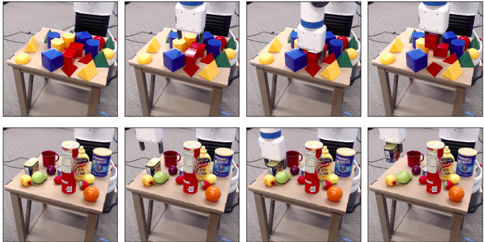
- The pipeline enabled a Fetch robot to detect and pick up the target object in 38 out of 40 trials in increasingly cluttered scenes, and a detector trained on a Spam can succeeded in 9 of 10 trials with previously unseen YCB food distractors.
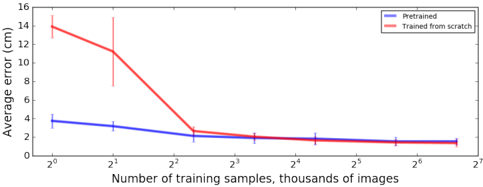
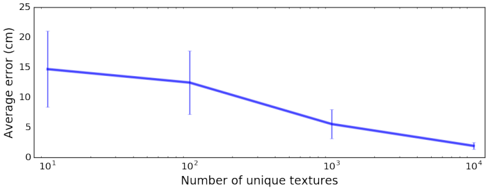
- Ablations found sensitivity to number of training images, number of unique textures, presence of distractors in training, and camera randomization; random noise had negligible effect. Performance improved up to around 50,000 training samples, and degraded significantly with fewer than 1,000 textures.
- ImageNet pretraining was not essential with enough data: random weight initialization achieved nearly the same real-world transfer performance as pretrained initialization, though pretraining helped in the low-data regime.
Methods
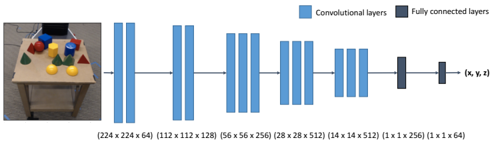
- The authors trained a modified VGG-16 convolutional neural network to map a single 224×224 monocular webcam image to Cartesian coordinates of object(s) of interest, using simulated images rendered by MuJoCo.
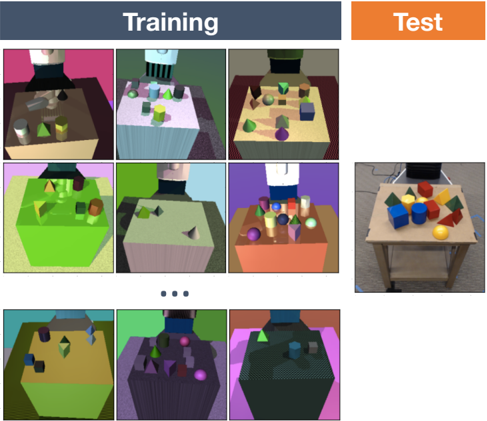
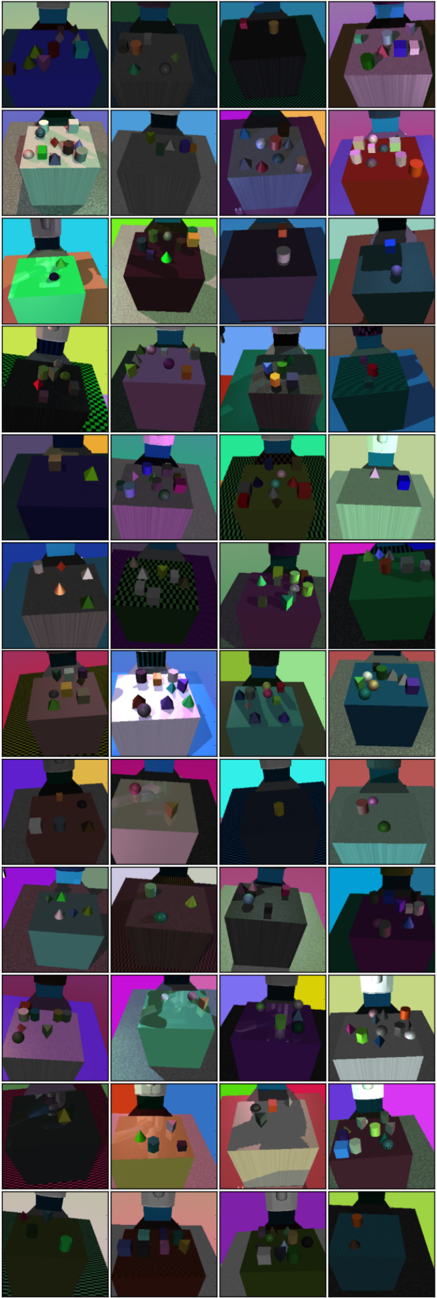
- Domain randomization varied number/shape of distractors, object positions and textures, table/floor/skybox/robot textures, camera position/orientation/field of view, number and properties of lights, and image noise. Textures were random RGB values, gradients, or checker patterns; 0–10 distractor objects were added per scene.
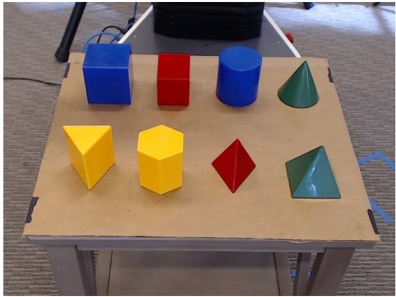
- Training used stochastic gradient descent with Adam on an L2 loss, learning rates around 1e-4, and batch sizes of 25, 50, or 100. Evaluation used 480 webcam images of eight geometric objects at 70–105 cm from a fixed camera, with 60 labeled images per object: 20 alone, 20 with distractors, and 20 partially occluded.
Limitations
- The paper states that the detectors still overfit simulated training data: simulated error was 0.3–0.5 cm versus about 1.5 cm in the real world, and no real-world validation could be done during training because no real data were assumed available.
- The paper states future work is needed for contact-rich manipulation or higher precision, and that the method fixes table height, effectively making the task 2D pose estimation from a single monocular uncalibrated camera.
- Evident from the text: evaluation is limited to eight geometric objects plus one Spam can, the test camera position remains constant across all images, and lighting and surrounding scene were not controlled.
Model-written summary. Check it against the paper before relying on it.
Integrity signals
Registry
Cites
Statistics
Figures
Verification
Claims the paper makes
2 Valid · 8 Not valid · 7 Not checked · 32 Own results and interpretations
The cited sources support only part of this claim — read each source’s verdict below.
In the paper
“Although previous work demonstrated the ability to perform robotic control using a neural network pretrained on ImageNet and fine-tuned on randomized rendered pixels [37], this paper provides the first demonstration that domain randomization can be useful for robotic tasks requiring precision.”
What the sources say
- Partly supportedcites [37] [37] Fereshteh Sadeghi and Sergey Levine. (cad) 2 RL: Real single-image flight without a single real image. arXiv preprint arXiv:1611.04201 , 2016. - sourceExperimental — accuracy not yet measured
The citation [37] is attached to the preceding claim about prior work, not to the citing authors’ claim that their own paper is the first to demonstrate precision robotics. Section 3.1 (p. 4) says LSDA pretrains a CNN on ImageNet classification data and fine-tunes it, but for object detection. It does not report robotic control or fine-tuning on randomized rendered pixels. (LLM, conf=0.84)
boostedstates a cause- Asserted: passes — The authors put it forward as true.
- Checkable: passes — It can be checked against evidence.
- Load-bearing: passes — The paper’s conclusions depend on it.
- Based: passes — The paper gives a reason why it holds.
- Partly supported
The cited sources that could be checked couldn’t confirm or dispute this claim.
In the paper
“Rather than relying on controller robustness, Yu et al. [53] use a model trained on varied physics to perform system identification using online trajectory data, but their approach is not shown to succeed in the real world.”
What the sources say
- Could not verifycites [53] [53] Wenhao Yu, C Karen Liu, and Greg Turk. Preparing for the unknown: Learning a universal policy with online system identification. arXiv preprint arXiv:1702.02453 , 2017. - sourceExperimental — accuracy not yet measured
The cited paper discusses image classification and localisation with convolutional networks (A.1, p. 10; A.2, p. 11), not Yu et al.'s approach. Searches for varied-physics training, online trajectory-based system identification, and real-world success found no passage addressing the claim. Our copy therefore cannot verify it. (LLM, conf=0.78)
plain- Asserted: passes — The authors put it forward as true.
- Checkable: passes — It can be checked against evidence.
- Load-bearing: unclear — It is unclear whether the paper’s conclusions depend on it.
- Based: passes — The paper gives a reason why it holds.
- Could not verify
The cited sources that could be checked couldn’t confirm or dispute this claim.
In the paper
“Though using realistic RGB rendering alone has had limited success for transferring to real robotic tasks [16], incorporating realistic simulation of depth information can allow models trained on rendered images to transfer reasonably well to the real world [32].”
What the sources say
- Could not verifycites [16] [16] Stephen James and Edward Johns. 3d simulation for robot arm control with deep q-learning. arXiv preprint arXiv:1609.03759 , 2016. - sourceExperimental — accuracy not yet measured
The Introduction (§1) and Conclusion (§8) describe Adam as a method for stochastic optimization, while the CNN experiment (§6.3) concerns training on image datasets. Searches for realistic RGB rendering and sim-to-real robotic transfer found no passage addressing whether RGB rendering alone has had limited success on real robotic tasks. (LLM, conf=0.78)
plain- Asserted: passes — The authors put it forward as true.
- Checkable: passes — It can be checked against evidence.
- Load-bearing: passes — The paper’s conclusions depend on it.
- Based: passes — The paper gives a reason why it holds.
- Could not verify
The cited sources that could be checked couldn’t confirm or dispute this claim.
In the paper
“However, their experiments - collision avoidance in hallways and open spaces - do not demonstrate the ability to deal with high-precision tasks.”
What the sources say
- Could not verifycites [37] [37] Fereshteh Sadeghi and Sergey Levine. (cad) 2 RL: Real single-image flight without a single real image. arXiv preprint arXiv:1611.04201 , 2016. - sourceExperimental — accuracy not yet measured
The Experiments section (p. 5) evaluates LSDA on an object-detection dataset, not Sadeghi and Levine’s collision-avoidance experiments. Searches for Sadeghi and Levine, hallway or open-space collision avoidance, and high-precision tasks found no passage addressing the claim. (LLM, conf=0.76)
plain- Asserted: passes — The authors put it forward as true.
- Checkable: passes — It can be checked against evidence.
- Load-bearing: passes — The paper’s conclusions depend on it.
- Based: passes — The paper gives a reason why it holds.
- Could not verify
A result the paper reports from its own data — it cites no other source for it, so there is none to check. The quote shows it is in the paper.
In the paper
“However, using a pre-trained model can significantly improve performance when less training data is used.”
plainstates a cause- Asserted: passes — The authors put it forward as true.
- Checkable: passes — It can be checked against evidence.
- Load-bearing: unclear — It is unclear whether the paper’s conclusions depend on it.
- Based: passes — The paper gives a reason why it holds.
29 more claims
Create a free account to see all 49 claims and to verify the 7 references still open.
- Probably not a substantial claim. 11
- It may state two separate claims as one. 8
Claims other papers make about this one
Each is checked against this paper’s own text: does it say what the citing paper says it does?
The source backs part of the claim, not all of it — or backs it for a different population, condition or comparison.
In the citing paper
“Most policies trained in simulation generalize poorly to the real-world due to agents adapting to specific visual details of the simulator.”
From Language-Based Augmentation to Address Shortcut Learning in Object-Goal Navigation (2023) · cites this paper as [8]
Experimental — accuracy not yet measuredThe source backs part of the claim, not all of it — or backs it for a different population, condition or comparison.
In the citing paper
“In robotic vision tasks including object localization [53], object detection [54], pose estimation [55], and semantic segmentation [56], the training data from simulator always have different textures, lighting, and camera positions from the realistic environments.”
From Sim-to-Real Transfer in Deep Reinforcement Learning for Robotics: a Survey (2020) · cites this paper as [53]
Experimental — accuracy not yet measuredThe source backs part of the claim, not all of it — or backs it for a different population, condition or comparison.
In the citing paper
“These artifacts limit the applicability of generative videos in physics-sensitive domains such as robotics [25,26], autonomous driving [27], simulationbased design, and scientific visualization [28].”
From PhyStruct-Video: Structured Physics State Spaces for Physically Consistent Video Generation (2025) · cites this paper as [25]
Experimental — accuracy not yet measuredThe source backs part of the claim, not all of it — or backs it for a different population, condition or comparison.
In the citing paper
“In domain randomization, the inputs during learning are “randomized” in the sense of being warped or corrupted in particular ways.”
From The overfitted brain: Dreams evolved to assist generalization (2021) · cites this paper as [144]
Experimental — accuracy not yet measuredThe source backs part of the claim, not all of it — or backs it for a different population, condition or comparison.
In the citing paper
“Domain randomization is a domain generalization technique that introduces drastic changes in the training image appearances, which forces the network to learn domain-invariant features between training and target domains [39].”
From A Fully Differentiable Framework for 2D/3D Registration and the Projective Spatial Transformers (2024) · cites this paper as [39]
Experimental — accuracy not yet measured
8 more claims about this paper
Create a free account to see every claim other papers make about this one.
Self-check
Percentages, sums and reported differences re-computed from the paper’s own numbers.
Each contradiction between two passages listed here was confirmed by an independent check.
Rated minor: it would not touch a result — a value no result rests on, a p-value that stays on the same side of the significance level, or a conflict that is clerical, resolved elsewhere in the paper, or outside its own findings.
In the paper
§ A. Experimental Setup · p. 4
“Each training sample consists of (a) a rendered image of the object and one or more distractors (also from among the geometric object set) on a simulated tabletop”
§ A. Domain randomization · p. 4
“Between 0 and 10 distractor objects are added to the table in each scene.”
Citations
Cites
Very Deep Convolutional Networks for Large-Scale Image Recognition
Simonyan, K., & Zisserman, A. (2014) · arXiv · doi:10.48550/arxiv.1409.1556 · Cited by 114,148 · cited 1×
“In particular, we use a modified version the VGG-16 architecture [42] shown in Figure 2.”
MethodAdam: A Method for Stochastic Optimization
Kingma, D. P., & Ba, J. (2014) · arXiv · doi:10.48550/arxiv.1412.6980 · Cited by 98,946 · cited 1×
“We found that using a learning rate of around 1e − 4 (as opposed to the standard 1e − 3 for Adam) improved convergence and helped avoid a common local optimum, mapping all objects to the center of the table.”
MethodLeCun, Y., Bengio, Y., & Hinton, G. (2015) · Nature · doi:10.1038/nature14539 · Cited by 84,126
Human-level control through deep reinforcement learning
Mnih, V., Kavukcuoglu, K., Silver, D., Rusu, A. A., Veness, J., Bellemare, M. G., Graves, A., Riedmiller, M., Fidjeland, A. K., Ostrovski, G., et al. (2015) · Nature · doi:10.1038/nature14236 · Cited by 30,357 · cited 3×
“Learning in simulation is especially promising for building on recent results using deep reinforcement learning to achieve human-level performance on tasks like Atari [27] and robotic control [21], [38].”
BackgroundResultHow transferable are features in deep neural networks?
Yosinski, J., Clune, J., Bengio, Y., & Lipson, H. (2014) · arXiv · doi:10.48550/arxiv.1411.1792 · Cited by 6,061 · cited 1×
“A variety of approaches have been proposed, including re-training the model in the target domain (e.g., [52]), adapting the weights of the model based on the statistics of the source and target domains (e.g., [22]), learning invariant features between domains (e.g., [47]), and learning a mapping…”
BackgroundMuJoCo: A physics engine for model-based control
Todorov, E., Erez, T., & Tassa, Y. (2012) · 2012 IEEE/RSJ International Conference on Intelligent Robots and Systems · doi:10.1109/iros.2012.6386109 · Cited by 4,767 · cited 1×
“We render images using the MuJoCo Physics Engine’s [45] built-in renderer.”
MethodTrust region policy optimization
Schulman, J., Levine, S., Moritz, P., Jordan, M. I., & Abbeel, P. (2015) · arXiv · doi:10.48550/arxiv.1502.05477 · Cited by 4,578 · cited 1×
“Learning in simulation is especially promising for building on recent results using deep reinforcement learning to achieve human-level performance on tasks like Atari [29] and robotic control [26], [41].”
ResultSelf-citationLearning Transferable Features with Deep Adaptation Networks
Long, M., Cao, Y., Wang, J., & Jordan, M. I. (2015) · arXiv · doi:10.48550/arxiv.1502.02791 · Cited by 4,505 · cited 1×
“omputer vision community has devoted significant study to the problem of adapting vision-based models trained in a source domain to a previously unseen target domain (see, e.g., [9], [14], [15], [19], [23], [25], [51]). A variety of approaches have been proposed, including re-training the model in the target domain (e.…”
BackgroundEnd-to-End Training of Deep Visuomotor Policies
Levine, S., Finn, C., Darrell, T., et al. (2015) · Journal of machine learning research · doi:10.5555/2946645.2946684 · Cited by 3,987
Describing Textures in the Wild
Cimpoi, M., Maji, S., Kokkinos, I., Mohamed, S., & Vedaldi, A. (2014) · 2014 IEEE Conference on Computer Vision and Pattern Recognition · doi:10.1109/cvpr.2014.461 · Cited by 2,438 · cited 1×
“To examine how our detectors would perform on objects with complex textures, we created simulated scenes in which the object of interest is given a texture from the Describable Textures Dataset (DTD) [4].”
Method
Research works printed but not linked: 3
- [24] David G Lowe. Three-dimensional object recognition from single two-dimensional images. Artificial intelligence , 31(3):355-395, 1987. -
- [49] Melonee Wise, Michael Ferguson, Derek King, Eric Diehr, and David Dymesich. Fetch and freight: Standard platforms for service robot applications. In Workshop on Autonomous Mobile Service Robots , 2016. -
- sucan, 0, MoveIt!
Cited by
Items 2,601–2,700 of 2,970
Kobayashi, M., Owen, M., & Liarokapis, M. V. (2025) · IEEE International Conference on Bioinformatics and Bioengineering (BIBE) · doi:10.1109/bibe66822.2025.00097
“While techniques such as domain randomization [21], [22] have been developed to minimize the ’sim-to-real gap,’ many simulators still struggle to accurately represent soft, flexible, and compliant objects that are essential elements in modelling real-world manipulation tasks [23].”
Self-Supervised Learning for Object Pose Estimation Through Active Real Sample Capture
Li, A., & Schoellig, A. P. (2025) · IEEE Robotics and Automation Letters · doi:10.1109/lra.2025.3643269
Sakemi, Y., Awano, H., & Morie, T. (2025) · IEICE Transactions on Fundamentals of Electronics Communications and Computer Sciences · doi:10.1587/transfun.2025gci0001 · Cited by 2
Priya, A., Tiwari, R., Agrawal, P., & Kumar, S. (2025) · Intelligent Service Robotics · doi:10.1007/s11370-025-00673-3 · Cited by 2
“…this problem, there are different methods available like using data augmentation to decrease the differences between training and testing environments [12], domain randomization is used during training for different combination of environments and obstacles to make agent aware with it [13, 14].”
Multi-agent Path Finding via Offline RL and LLM Collaboration
Atasever, M., Hong, M., Kulkarni, M. N., Li, Q., & Deshmukh, J. V. (2026) · Lecture notes in computer science · doi:10.1007/978-3-032-39395-1_2 · Cited by 3
Hybrid Cross-Domain Robust Reinforcement Learning
Van, L. L. P., Nguyen, M. H., Le, H., Tran-The, H., & Gupta, S. (2025) · Lecture notes in computer science · doi:10.1007/978-3-032-06106-5_7 · Cited by 3
Hybrid Contact Dynamics and Residual-RL Framework for Multi-Point Object Pushing
Chen, C., Dai, X., & Kövecses, J. (2025) · IEEE Robotics and Automation Letters · doi:10.1109/lra.2025.3634905
ADR-PNAS: A Novel Sim-to-Real Transfer Approach for Robotic Manipulation Tasks
Nong, Y., Zhang, H.-T., & Sun, J.-Q. (2025) · IEEE Transactions on Robotics · doi:10.1109/tro.2025.3644950
Learning Embodied Quadruped Agents for Posture-Aware Locomotion
Miao, X., Sun, J., Lai, H., Di, X., Cao, J., Yu, Y., & Zhang, W. (2025) · International Conference on Distributed Artificial Intelligence (DAI) · doi:10.1145/3772429.3772430 · Cited by 1
Pose Refinement for Reflective Workpieces using Deep Iterative Matching
Kaya, O., Thieu, K., Holden, C., & Egeland, O. (2025) · Modeling Identification and Control A Norwegian Research Bulletin · doi:10.4173/mic.2025.3.3
Zhang, B., Ding, X., Bai, X., Liu, W., Ren, C., Chen, C., & Guan, X. (2025) · IEEE Transactions on Automation Science and Engineering · doi:10.1109/tase.2025.3648194 · Cited by 1
“In sim-real RL, studies have explored domain transfer [12], domain randomness [13], progressive neural networks [14], and reverse dynamic modeling methods [15].”
Improvement of Simulated Data for Hybrid Datasets used in Training Perception Models in Construction
Aparicio, J. L. J., Wang, X., & Roßmann, J. (2025) · Procedia Computer Science · doi:10.1016/j.procs.2025.12.049
Sim-to-Real Deployment of a Sinusoidal Policy for Snake Robots
Sangryeong, S., Ryu, D., Lee, W., et al. (2025) · International Conference on Control, Automation and Systems (ICCAS) · doi:10.23919/iccas66577.2025.11301402
“To enhance the generalization performance of the learned policy, domain randomization is applied during training [7].”
Motor-Guided Randomization Reinforcement Learning in Humanoid Robots Walking on Terrain Locomotion
Gong, Y., Li, Y., Sun, X., & Jia, L. (2025) · International Conference on Control, Automation and Systems (ICCAS) · doi:10.23919/iccas66577.2025.11301086
“Another widely adopted method is domain randomization (DR)[6–8], which randomizes various parameters to ensure diverse training data.”
A Bias-Aware Learning Model for Reliable Monocular Perception Under Camera Misalignment
Wang, R., Han, G., Liu, A., Ye, Z., Deng, A., Liu, L., & Wei, X. (2025) · International Conference on Control, Automation and Systems (ICCAS) · doi:10.23919/iccas66577.2025.11301341
“One common strategy is domain randomization, where training data is artificially augmented with randomized lighting, textures, or viewpoints to increase generalization [9].”
Cubides, C., Amaya, C., & Duchon, M. (2025) · IEEE PES Innovative Smart Grid Technologies Europe · doi:10.1109/isgteurope64741.2025.11305410
“In robotics, visual sim-to-real gaps are mitigated via pixel-level CycleGAN translation [14] or extreme domain randomization [15].”
Autonomous Driving Model Training with 3D Gaussian Splatting Simulation and Limited Real-World Data
Akira, S., Yuichi, O., Kensuke, K., Weiming, H., & Yoichi, T. (2025) · IEEE International Symposium on Embedded Multicore/Many-core Systems-on-Chip (MCSoC) · doi:10.1109/mcsoc67473.2025.00044
REPAM: A Novel Framework for Hybrid Multimodal Model Operations in Robotics
Bhardwaj, K., Sehgal, R., Abraham, A., & Soryan, R. (2026) · Lecture notes in networks and systems · doi:10.1007/978-981-96-8898-2_18
Flotzinger, J., Deuser, F., Jaziri, A., et al. (2026) · Lecture notes in computer science · doi:10.1007/978-3-032-12840-9_25
NDRL: Cotton Irrigation and Nitrogen Application with Nested Dual-Agent Reinforcement Learning
Xu, R., & He, L. J. (2026) · Lecture notes in computer science · doi:10.1007/978-981-95-4445-5_29
Survey on AI‐Enabled Computer Vision Technologies and Applications for Space Robotic Missions
Quoos, M., Kay, S., Wajoras, J., Field, R., Ntagiou, E., Mohammad, F., & Gao, Y. (2026) · Journal of Field Robotics · doi:10.1002/rob.70150 · Cited by 4
Iteration Complexity for Robust CMDP for finite policy space
Ganguly, S., & Ghosh, A. (2025) · IEEE Conference on Decision and Control (CDC) · doi:10.1109/cdc57313.2025.11312439
“Standard RL algorithms even fail to adapt to the model-mismatch in the unconstrained setting [8], [9].”
Li, T., Ali, H. B. Y., & Chamran, M. K. (2025) · International Conference on Software Engineering and Computer Systems · doi:10.1109/icsecs65227.2025.11279207
“RS operates at a micro level, providing dense, step-by-step feedback to guide the agent's actions effectively [6].”
Lightweight HRI Task Classification from Synthetic Logs
Qiang, Y. (2025) · IEEE International Conference on Big Data and Artificial Intelligence (BDAI) · doi:10.1109/bdai66031.2025.11325211
“The underlying hypothesis is that with sufficient variability in simulation, the real world appears to the model as just another variation, enabling robust zero-shot transfer [10].”
Deep Neural Networks Trained on Synthetic Data for a Pick and Place System
Marques, N., Rodrigues, M. A. B., & Martins, I. (2026) · Lecture notes in networks and systems · doi:10.1007/978-3-032-12882-9_3
GenoS SKGE-Swin: Real World Data Implementation of Skip Stage Swin for Autonomous Vehicle
Kartiman, F. N. N., Hasanah, N., Natan, O., et al. (2025) · International Conference on Computer, Control, Informatics and its Applications · doi:10.1109/ic3ina68387.2025.11325684
“…is very promising, models trained in simulation often experience a performance degradation when implemented in the real world due to sensor inaccuracies and varied environmental conditions, which encourages further research into methods such as imitation learning using data from expert drivers [2].”
Akamisaka, A., & Nagao, K. (2026) · Sensors · doi:10.3390/s26020566
“To this end, techniques such as curriculum learning [29], which gradually increases the difficulty of tasks, and domain randomization [30], which ran-domizes the physical parameters and appearance of simulators, are known to enhance the generalization performance of strategies learned through…”
Cost-Aware and Risk-Sensitive Learning for Autonomous Robots A Conceptual Framework
Eziokwu, U. J., Duruemeruo, U. C., Akande, N. A., & Makinde, O. F. (2023) · International Journal of Scientific Research in Science Engineering and Technology · doi:10.32628/ijsrset23103204
Synthetic Data Enabled Under the Cover Human Pose Estimation Using RGB Images
Vaidya, A., Lindemeier, T., Walch, M., & Werdehausen, D. (2026) · Lecture notes in computer science · doi:10.1007/978-3-032-14492-8_15
A New Pipeline for Extracting and Clustering Sub-Images from Unannotated Complex Image Datasets
Akar, C. A., Beddawi, C., Kamradt, M., & Makhoul, A. (2025) · International Workshop on Content-Based Multimedia Indexing (CBMI) · doi:10.1109/cbmi66578.2025.11339275
“Basically, DR consists of feeding enough synthetic variations of an object o i into a DL model, so at the end, a real data of o i is considered as another variation of that domain [23].”
Zhang, X., He, C., Li, Z., & Wang, S. (2026) · Applied Sciences · doi:10.3390/app16021084
Ahmed, A. S., & Mustafa, M. O. (2026) · Lecture notes in networks and systems · doi:10.1007/978-3-032-13921-4_48
Huang, Y.-C., Chen, Y., Chuang, J., & Hwang, J. (2025) · International Conference on Robotics and Computer Vision (ICRCV) · doi:10.1109/icrcv67407.2025.11349206 · Cited by 1
“For instance, studies have explored how random alterations of physical parameters in simulated environments can improve neural network adaptability [6, 7].”
Human-in-The-Loop Sim-to-Real Transfer Policy for Robotic Assembly via Reinforcement Learning
Ren, S., Zeng, C., Li, Z., Yang, C., & Wang, N. (2025) · International Conference on Robotics, Control and Automation Engineering (RCAE) · doi:10.1109/rcae66389.2025.11355281
“Domain adaptation methods [15][16] map simulation and real environments into a shared latent space, while domain randomization techniques [17][18] facilitate safe sim-to-real transfer.”
Dual-Constrained Actor-Critic Deep Reinforcement Learning for Autonomous Driving Decision-Making
Wang, K., Liu, J., Meng, Q., & Guo, H. (2025) · CAA International Conference on Vehicular Control and Intelligence (CVCI) · doi:10.1109/cvci66304.2025.11348303
“Adversarial RL methods [19] train policies against worst-case perturbations, while domain randomization techniques [20] expose the agent to environmental variations during training.”
Geroyev, A. S., & Gerget, O. M. (2025) · Journal of Communications Technology and Electronics · doi:10.1134/s1064226925700433
“Unlike traditional methods such as Domain Randomization [9] and Domain Adaptation [10], our approach does not require retraining the base policy or access to the parameters of the physical engine, which makes it particularly practical for real-world applications.”
Recovery-Focused Dynamic Curriculum TD3 for Robotic Peg-in-Hole Insertion Skill
Yu, H., & Lee, S. (2026) · International Conference on Ubiquitous Information Management and Communication (IMCOM) · doi:10.1109/imcom69009.2026.11360912
“The policy is trained with TD3 under light domain randomization (per-episode target color randomization) to discourage overfitting and support sim-to-real considerations [5], [6].”
SynthConstruct: Large-Scale 3D Simulation Dataset for Embodied AI in Construction Sites
Bonyani, M., Soleymani, M., & Wang, C. (2025) · IEEE International Conference on Intelligent Reality (ICIR) · doi:10.1109/icir68135.2025.11361587
“By integrating realistic 3D construction models with domain randomization [11], [31], [33] and procedural scene generation [1], [11], SynthConstruct enables training and evaluation of AI agents for perception, planning, and interaction in complex, evolving construction environments, facilitating…”
Illy-Net: A GMM Based Performance Evaluation Framework for Sim-to-Real Transfer of RL Policies
Im, S., & Lee, J. (2025) · IEEE International Conference on Intelligent Reality (ICIR) · doi:10.1109/icir68135.2025.11361591
“Tobin et al.[6] introduce one of the earliest empirical applications of domain randomization, showing that randomizing textures, lighting, and object positions during training enables visual policies to transfer to real-world tasks.”
Expert Switching for Robust AAV Landing: A Dual-Detector Framework in Simulation
Tasnim, H., Rasul, A. E., Jo, B. W., et al. (2026) · AIAA SciTech Forum · doi:10.2514/6.2026-2171
Efficient and Robust Self-Recovery of Quadruped Robots Using Asymmetric Proximal Policy Optimization
Akar, Y. E., Demirayak, O., & Temeltaş, H. (2025) · International Conference on Robotics and Automation Engineering (ICRAE) · doi:10.1109/icrae67496.2025.00011
“This prevents overfitting to a single simulator configuration and leads to more reliable performance when deployed on real hardware [13].”
RAISE: Robust and Adversarially Informed Safe Explanations for Reinforcement Learning
Kim, S., & Shibuya, T. (2026) · Electronics · doi:10.3390/electronics15030666
A Practical Multi-Body Model Enabling a Flexible-Wheeled Robot to Learn Blind Stair Climbing
Yoon, C.-Y., & Cho, B. (2026) · IEEE Robotics and Automation Letters · doi:10.1109/lra.2026.3662534 · Cited by 1
Holst, D., Schmedemann, O., & Schüppstuhl, T. (2026) · Procedia CIRP · doi:10.1016/j.procir.2026.01.189
Drone Quidditch: Aerial Manipulation and Human–Robot Collaboration in a Novel Drone
Rajasekar, L., Yash, S., Pongiannan, R. K., Indirani, M., Govindaraju, S., & Brindha, R. (2025) · International Conference on Ubiquitous Computing and Intelligent Information Systems (ICUIS) · doi:10.1109/icuis67429.2025.11380782
“Our simulation-first approach, validated across two distinct physics engines, allows for extensive and safe testing, establishing a strong foundation for future hardware deployment and sim to real transfer [10].”
Adaptive Generative Simulation for Robust Prosthetic Arm Control
Hadi, M. A., Mustansar, Z., Shah, S. I. A., & Ayaz, Y. (2025) · International Conference on Engineering & Computing Technologies (ICECT) · doi:10.1109/icect66235.2025.11381660
Bipedal Robot Running Gait Design Based on Phase Information
Yang, Y., Li, Q., Gan, W., Liang, Z., Ding, Y., & Gao, G. (2025) · International Conference on Robot Systems and Applications (ICRSA) · doi:10.1109/icrsa66467.2025.11383795
Decoupled Dual-Attention for Humanoid Locomotion via Reinforcement Learning
Chu, D., Bai, Y., Zhu, W., et al. (2025) · International Forum on Electrical Engineering and Automation (IFEEA) · doi:10.1109/ifeea66847.2025.11388961
“Furthermore, despite techniques like domain randomization [4], the sim-to-real gap remains challenging when policy architectures cannot adequately capture spatiotemporal dynamics.”
Impact of Traffic Density on Reinforcement Learning-Based Autonomous Driving
Park, S., Ajani, O. S., & Mallipeddi, R. (2025) · International Conference on Information and Communication Technology Convergence (ICTC) · doi:10.1109/ictc66702.2025.11388183
“• The Density-Mix agent sacrifices peak performance but raises the performance floor, providing greater overall robustness [9].”
Jin, H., Min, Y., Park, T., & Kim, J. (2025) · International Conference on Information and Communication Technology Convergence (ICTC) · doi:10.1109/ictc66702.2025.11388115
Uhlmann, T., Dadgar, A., Weigand, F., & Brunnett, G. (2026) · Advances in Science, Technology & Innovation/Advances in science, technology & innovation · doi:10.1007/978-3-032-03488-5_16
Lee, U., Hwang, C., Kang, H., Park, Y., Jin, H., Nguyễn, T. A., Choi, E., & Min, D. (2026) · Advanced Intelligent Systems · doi:10.1002/aisy.202500636
“[16] shuffled many scenes, rotated the camera, and their robot then acted in real frames although gaps in appearance persisted, plus the learner still missed unseen objects.”
Synthetic Image Generation for Underwater Diver Detection
Hożyń, S. (2026) · IEEE Access · doi:10.1109/access.2026.3667212
“Additionally, to address the scarcity of real-world imagery data, randomised variation techniques have been deployed to create images [32].”
Jeffery, Z., Bramantoro, A., Siau, N. Z., & Noorfatimah, S. (2025) · International Conference on Applied Computational Intelligence in Information Systems (ACIIS) · doi:10.1109/aciis66255.2025.11402941
“A well-designed reward function is also critical: shaped rewards provide continuous feedback and faster convergence than sparse or binary signals [14]–[16].”
Sim2Real Domain Shifting: Hyper-Realistic Data Generation for Object Segmentation
Zheng, H., Xiong, R., Wang, Y., & Wu, J. (2026) · IEEE Robotics and Automation Letters · doi:10.1109/lra.2026.3668590
Liang, Z., Diehl, M., Hashimoto, N., Köpken, A., Leidner, D. S., Ramírez-Amaro, K., & Dean, E. (2026) · IEEE/SICE International Symposium on System Integration (SII) · doi:10.1109/sii64115.2026.11404539
“Simulation environments allow faster, repeatable experiments, safer exploration of diverse conditions, and more scalable, lower-cost data acquisition than physical robots [1].”
Development of a Digital Twin for Robotic Inspection Using Computer Vision and Machine Learning
Pramila, P. V., Jothilakshmi, R., Kumar, K. R. S., et al. (2026) · EPJ Web of Conferences · doi:10.1051/epjconf/202635403005
Fault-Resilient Flat-Top Current Control for Large-Scale Electromagnetic Forming Using Staged-DQN
Huang, M., Sun, X., Wang, J., et al. (2026) · Applied Sciences · doi:10.3390/app16052478
PHER: A Method for Solving the Sparse Reward Problem of a Manipulator Grasping Task
Zhang, D., Yang, M., Wang, Y., et al. (2026) · Technologies · doi:10.3390/technologies14030164
A Simulation Framework for Fixed-Wing Aircraft Robust Control via Adversarial Reinforcement Learning
Liu, Z., Hu, J., Zhai, P., Hu, K., Nian, L., & Zhang, L. (2025) · International Conference on Virtual Reality and Visualization · doi:10.1109/icvrv67992.2025.00171
“Domain randomization (DR) [3] is a commonly used approach, which improves policy adaptability to diverse conditions by randomizing environment parameters during training.”
When Robots Say No: The Empathic Ethical Disobedience Benchmark
Kuzmenko, D., & Shvai, N. (2026) · ACM/IEEE International Conference on Human-Robot Interaction (HRI) · doi:10.1145/3757279.3785547
Reinforcement Learning Qualification Process
Senczyszyn, S. A., Havens, T., Summers, J. E., Werner, B., & Schumeg, B. (2026) · Reliability and Maintainability Symposium · doi:10.1109/rams50514.2026.11424508
“Domain randomization [4] and adversarial training [5] have been proposed to improve RL robustness.”
Learning Gait Control for Quadrupedal Robots Operating on Ships
Gu, B., & Jung, J. (2026) · Journal of Institute of Control Robotics and Systems · doi:10.5302/j.icros.2026.25.0317
A Real2Sim2Real Transformer Policy System for Bimanual R2R2H Tasks
Jaramillo, I. E., Choi, Y.-H., Lee, K., Oh, J.-H., Pahk, K. J., & Kim, T. (2026) · ACM/IEEE International Conference on Human-Robot Interaction (HRI) · doi:10.1145/3776734.3794489
Reinforcement Learning-Based Whole-Body Motion Control for Humanoids With Position-Controlled Joints
Liu, C., Xiao, K., Hu, M., Fang, Q. Z., Xu, Z., & Chen, Q. (2026) · IEEE Transactions on Automation Science and Engineering · doi:10.1109/tase.2026.3673779 · Cited by 1
“Balance and smoothness are enforced through structured reward shaping, and domain randomization [40] is applied to enhance robustness for real-world deployment.”
Qian, C., Xia, S., Zhang, P., et al. (2026) · Ultrasonics · doi:10.1016/j.ultras.2026.108054
Verifiable Language Model Explanations for Deep RL-Based Flow Smoothing
Pandian, A., Dara, A., Bindel, A., Lichtlé, N., Singh, P. J., Alzamzami, F., Othman, E. M. A., Almatrudi, S., Lee, J., & Bayen, A. M. (2025) · IEEE International Conference on Intelligent Transportation Systems (ITSC) · doi:10.1109/itsc60802.2025.11423700
“Common strategies to address this include domain randomization (which introduces variability during training to enhance robustness) [18] and progressive deployment (which gradually increases autonomy in operational settings) [19].”
Algashev, G., & Lezin, I. (2025) · International Conference on Information, Control, and Communication Technologies (ICCT) · doi:10.1109/icct67028.2025.11427793
“Today, they are used in assembly control systems, defect detection, alignment, and robotic production lines where precise part localization is essential [1], [14].”
InverseLight: Inverse Dynamics Enabling Policy Transfer with Limited Data for Traffic Signal Control
Zhang, Y., Bian, Z., Liu, Q., & Li, Z. (2025) · IEEE International Conference on Intelligent Transportation Systems (ITSC) · doi:10.1109/itsc60802.2025.11423052
“Domain randomization techniques [6]–[8] have demonstrated effectiveness by exposing models to systematically varied simulation conditions, including randomized traffic patterns, vehicle behaviors, and environmental factors.”
Feng, K., Yang, T., & Luo, S. (2026) · Neural Computing and Applications · doi:10.1007/s00521-025-11808-z
Park, I. J. (2026) · Research Square · doi:10.21203/rs.3.rs-8645116/v1
Improved Weakly Supervised Logo Detection Using Semantic Domain Adaptation and Regularization
Jain, R. K., Sato, T., Ruan, X., & Chen, Y.-W. (2026) · IEEE Transactions on Emerging Topics in Computational Intelligence · doi:10.1109/tetci.2026.3670694
Rabeneck, N., & Kamble, P. R. (2026) · Discover Applied Sciences · doi:10.1007/s42452-026-08499-z
Panovskiy, V. (2026) · Modelling and Data Analysis · doi:10.17759/mda.2026160108
Zou, Z., Du, J., Jiang, C., et al. (2025) · Globecom · doi:10.1109/globecom59602.2025.11432095
“During the initialization, all entities (UAVs, targets, obstacles) are randomly positioned using domain randomization [5] to enhance the generalization capability of the learned policies.”
Hybrid Data Curation for Imitation Learning with Physics- Generated Trajectories
Lee, M., Cho, D.-S., & Kim, W.-T. (2026) · Applied Sciences · doi:10.3390/app16062968
Sim2Dust: Mastering Dynamic Waypoint Tracking on Granular Media
Orsula, A., Geist, M., Olivares-Méndez, M. A., & Martínez, C. (2025) · International Conference on Space Robotics (iSpaRo) · doi:10.1109/isparo66239.2025.11436990 · Cited by 4
“This system combines a powerful simulation environment for training, a realistic physical testbed for validation, and a mission-relevant control task.”
A Sim-to-Real Few-Shot Object Detection Framework for Multi-Class Industrial Part Grasping
Li, B., He, Y., Qu, L., & Jing, M. (2025) · IEEE International Conference on Computer and Communications (ICCC) · doi:10.1109/iccc68654.2025.11438118
“For instance, the pioneering work by Tobin et al. [10] demonstrated that models can be successfully transferred from simulation to real robots through visual randomization.”
Highly generalizable cross-domain machine-generated text detection
Xing, Y., Men, Y., Luo, S., Yang, Z., Zhou, J., & Pan, L. (2026) · Neurocomputing · doi:10.1016/j.neucom.2026.133426
Benchmarking Full-Stack ROS 2 Simulation Platforms for Mobile Robots
Soriano, Á., Navarro, R., Navarrete, J. M., Zavaleta, R. V., ın, R. M., on, C. G., & Ramos, J. (2026) · IEEE Robotics and Automation Letters · doi:10.1109/lra.2026.3678463
Amarnath, V. (2026) · Water Resources Management · doi:10.1007/s11269-026-04592-5
CVSM: Contrastive Vocal Similarity Modeling
Garoufis, C., Zlatintsi, A., & Maragos, P. A. (2026) · IEEE Transactions on Audio Speech and Language Processing · doi:10.1109/taslpro.2026.3677618
“Moreover,artificialincreaseofthetrainingdataset [69],[70];assuch,researchershave attemptedtobypassitbyeitherperformingsomesmall-scale finetuningondatasetsfromthetargetdomain[71]orintroducing analignmentstage,withregardtoeithertempo,orpitch,before superimposingthevariousaudiosegments[11],[72].”
Jester-Informed Synthetic Data Generation for TPU-Accelerated Binary Gesture Recognition
G, S. T., Spandana, S., Banerjee, S., et al. (2026) · doi:10.1109/i5cps67958.2026.11452614
“Future studies will investigate the application of these ideas to multi-class gesture recognition, improving the visual realism of synthetic images, and domain adaptation techniques to further close the gap between the synthetic and real worlds [5], [6].”
InfluentialIm, S., & Lee, J. (2026) · International Journal of Precision Engineering and Manufacturing · doi:10.1007/s12541-026-01499-4 · Cited by 1
“Tobin et al. [ 17 ] introduced pure domain randomization (DR), randomizing object textures, lighting, and camera parameters to approximate the variability of real-world con - ditions, thereby allowing a single policy to generalize across diverse scenarios.”
Güitta-López, L., Boal, J., & López-López, Á. J. (2026) · AI · doi:10.3390/ai7040120
Deep Reinforcement Learning-Based Mobile Robot Navigation Using Truncated Quantile Critics
Bae, S., & Han, D. S. (2026) · Digital Signal Processing and Signal Processing Education Workshop · doi:10.1109/icaiic68212.2026.11454248 · Cited by 1
“The main contributions of this paper are summarized as follows: facilitates robust learning through domain randomization [7], varying the poses of the robot, goal, and obstacles in every episode to prevent overfitting.”
Sagar, B. R., Abbili, K. K., & Konjeti, R. K. (2026) · Proceedings of the Institution of mechanical engineers. Part C, journal of mechanical engineering science · doi:10.1177/09544062261431870
“29 Exposing the agent to random variations in key parameters in the training environment makes it more robust and adaptable when deployed in dynamic, imperfect real-world conditions.”
Learning sensori-motor mappings using little knowledge : application to manipulation robotics
Bourdonnaye, F. D. L. (2018) · theses.fr (ABES) · doi:10.70675/c1fd9025zeba7z4f16zb3c2z3de4fb2a60fb · Cited by 1
Tran, V.-T., Chen, Y.-L., Kuo, Y.-W., & Tsai, W.-H. (2026) · Measurement · doi:10.1016/j.measurement.2026.121376
Lesort, T. (2020) · theses.fr (ABES) · doi:10.70675/e714c94ezb6d9z4adbz9daaz60088df88f5f · Cited by 3
Acremont, A. D. (2020) · theses.fr (ABES) · doi:10.70675/8760fbeez9087z45a7z8958z74f77c24d5e4 · Cited by 1
Safe and Efficient Reinforcement Learning for decision-making in Autonomous Driving
Leurent, E. (2020) · theses.fr (ABES) · doi:10.70675/be8afdb3zd53dz4900z8a5dzfb79ab926190 · Cited by 22
Estimation de la pose 3D d’objets dans un environment industriel
Pitteri, G. (2020) · theses.fr (ABES) · doi:10.70675/158365c2z46e2z4d5fza900z71cfb7bef6d0 · Cited by 1
Representation Transfer via Invariant Input-driven Continuous Attractors for Fast Domain Adaptation
Xu, T. J., Wu, S., Luo, J., Lin, F., Jiang, J., Chen, G., Yang, Y., Ye, J., & Yang, D. (2026) · Communications Biology · doi:10.1038/s42003-026-09938-8
Active Vibration Control of Piezoelectric Beams under Uncertain Delay via a DDR-PPO Approach
Wu, J., & Zhang, T. (2026) · Journal of Vibration Engineering & Technologies · doi:10.1007/s42417-026-02453-4
Automatic Curriculum Learning for Developmental Machine Learners
Portelas, R. (2022) · theses.fr (ABES) · doi:10.70675/947677c7z2ec1z4b61zbae3z6f358c02b050
Intrinsically Motivated and Interactive Reinforcement Learning : a Developmental Approach
Fournier, P. (2019) · theses.fr (ABES) · doi:10.70675/525d96caz1d44z4f9cz86bfzb69a83bf40b5 · Cited by 1
“In meta-RL, better than random training task acquisition has been proposed with domain randomization (Tobin et al. 2017) or automatic environment generation by evolutionary strategies (Wang et al.”
Apprentissage profond auto-supervisé par simulation pour la saisie robotique adaptative
Depierre, A. (2021) · theses.fr (ABES) · doi:10.70675/879b6cb1z4eaaz480bzafd2zad300dec31ef
Carton, F. (2021) · theses.fr (ABES) · doi:10.70675/9aa0cab2z7ec4z456az9f57z1c8be2733b1b · Cited by 4
On the role of Actions and Machine Learning in Artificial Agent Perception.
Caselles-Dupré, H. (2021) · theses.fr (ABES) · doi:10.70675/6cfe7f36z5adcz4a30za086z8f2bdc924098 · Cited by 1
Metadata
- Authors
- Tobin, J., Fong, R., Ray, A., Schneider, J., Zaremba, W., & Abbeel, P.
- Affiliations
- University of California, Berkeley (US)
- OpenAI (United States) (US)
- International Computer Science Institute (US)
- ORCID
- Abbeel, Pieter
- Venue
- 2017 IEEE/RSJ International Conference on Intelligent Robots and Systems (IROS)
- Publisher
- IEEE
- Published
- 2017-09
- Pages
- 23-30
- ISSN
- 2153-0858 (ISSN-L)
- OpenAlex
- W2605102758
- Semantic Scholar
- 32ceb28e45a445df4d89df281bb0e3ab5aab1a2a
- Cited by
- 3,124
- References
- 69
- Citations by year
- 2026: 413 · 2025: 433 · 2024: 336 · 2023: 403 · 2022: 374 · 2021: 422 · 2020: 352 · 2019: 256 · 2018: 106 · 2017: 25
- FWCI
- 92.18
- Type
- conference paper
- Language
- en
- Open access
- green
- arxiv.org
- Locations
- IEEE/RSJ International Conference on Intelligent Robots and Systems (IROS) (publishedVersion)
- arXiv (Cornell University) (submittedVersion)
- arXiv (Cornell University)
- Topics
- Physical Sciences › Computer Science › Artificial Intelligence › Reinforcement Learning in Robotics
- Physical Sciences › Engineering › Control and Systems Engineering › Robot Manipulation and Learning
- Physical Sciences › Computer Science › Artificial Intelligence › Domain Adaptation and Few-Shot Learning
- Keywords
- domain randomization, sim-to-real transfer, reality gap, object detection, object localization, robotic grasping, cluttered environments, distractor robustness, partial occlusion, robotic manipulation
About these checks
Registry, retraction, Cites and statistics results are computed, not judged, with one exception: a printed reference that no index lists is read once by a model before it counts as a citation error. Claims are extracted by a model and kept only when their quote appears verbatim in the text; each cited source is then checked, with a model’s help, for whether it says what the claim relies on. Those verdicts can be wrong — read the claim’s quote and the cited source before relying on one.
The claim verdicts this report counts are experimental: their accuracy is not yet measured.
A language model drew the claims from the paper on 2026-10-10, under version 3 of the claim definition (model deepseek-v4.1-flash, prompt extract-v3).
A second model labelled each claim on 2026-10-10 (model jev-1.13-20260917, definition revision gold-guideline-v0.2).
Cited sources are checked with a language model’s help (gpt-6-sol).
Statistics and arithmetic are recomputed, not judged.
Confidence bands are shown only for fields calibrated on our annotated test set. None is calibrated yet, so no band is shown.
What counts as a claim ›How we measure confidence ›How we check this ›
Are you an author, or do you see a problem with this page? Request a review
Data sources
Bibliographic data: Semantic Scholar, OpenAlex, Crossref.
Contains information from the Semantic Scholar Academic Graph Datasets, made available under the ODC Attribution License (ODC-BY 1.0).
Semantic Scholar’s data is described in: Kinney, R., et al. (2023). The Semantic Scholar Open Data Platform. arXiv:2301.10140.
