

Climbing-inspired twining electrodes using shape memory for peripheral nerve stimulation and recording
Open accessThe DOI matches its Crossref record; 56 of the 56 references it cites were found in a registry or an index; 11 of the 65 sources its claims cite were checked for support.
Abstract
Proposed 3D neural electrode can self-climb onto peripheral nerve driven by body temperature and form flexible neural interface.
Overview
CoChat Summary
TL;DR
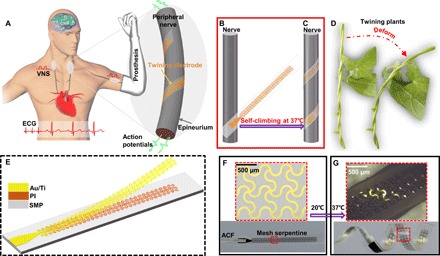
The paper presents a climbing-inspired twining electrode made of a shape memory polymer substrate and mesh serpentine Au/Ti/PI wires that self-climbs onto peripheral nerves when actuated by body temperature (~37°C), forming a conformal interface without additional surgical fixation. In rabbits, the device was used for vagus nerve stimulation with ECG recording and for sciatic nerve evoked action potential recording.
Key findings
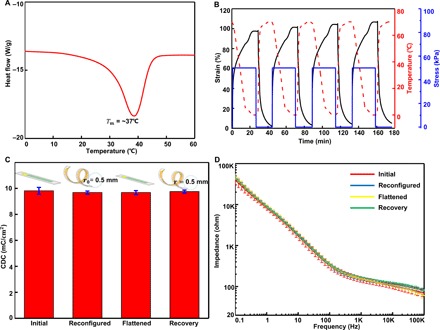
- The synthesized SMP has a transition temperature of ~37°C, shape fixity and recovery ratios above 97% over four cycles, fracture strain ~1100%, and elastic modulus changing from ~100 MPa to ~300 kPa before and after the phase transition.
- Electrochemical characterization showed average CDC ~9.7 mC/cm² and impedance magnitude ~156 ohms at 1 kHz, with little change across initial flat, reconfigured, flattened, and recovery states; fabricated electrodes had ~126 ohms at ~0.5 mm inner radius and ~119 ohms at ~1 mm inner radius.
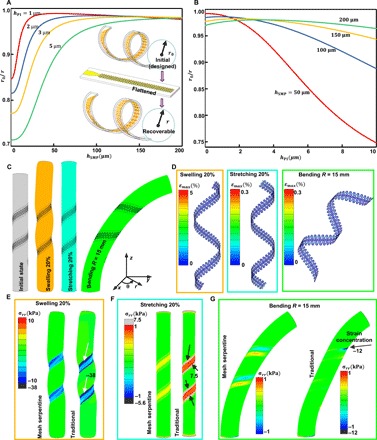
- Structural optimization gave r0/r = 0.98 and maximum Au strain εAumax = 0.24%; the twining electrode had bending stiffness EI ~1.0 × 10⁻¹⁰ N·m² and stretching stiffness EA 0.08 N, and FEA showed Au strain below fracture strain (5%) during 20% swelling and below yield strain (0.3%) during 20% stretching and bending (R = 15 mm).
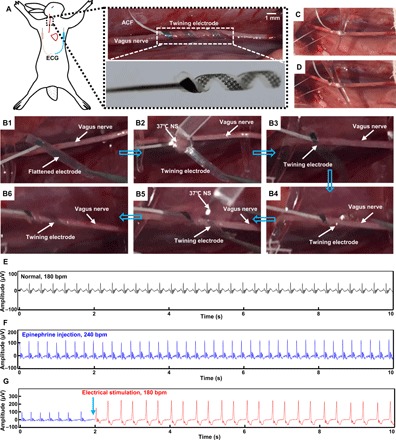
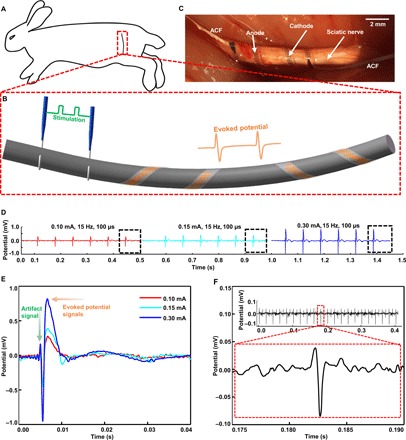
- In vivo, epinephrine increased rabbit heart rate from 180 to 240 bpm; VNS at 0.4 mA, 100 μs, 10 Hz reduced HR to 180 bpm and increased R-wave peak from 100 to 250 mV. Sciatic nerve recording showed evoked CNAP peak potentials of ~275, ~380, and ~820 μV for 0.1, 0.15, and 0.3 mA stimulation, and ~80 μV evoked CNAPs without stimulus artifact at an SNR of 16 dB.
Methods
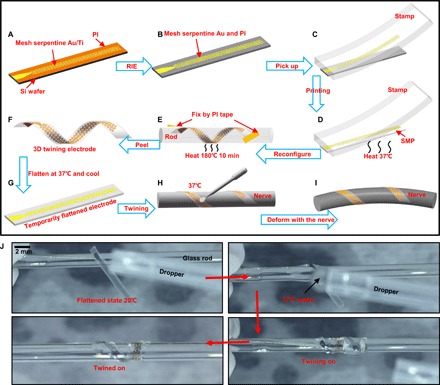
- The electrode was fabricated by depositing/etching Au/Ti mesh serpentine structures on ultrathin PI, transfer printing them onto an SMP substrate, reconfiguring the assembly into a 3D helix at 180°C for 10 min, and temporarily flattening it at 37°C; self-climbing was driven by 37°C normal saline.
- Material and device characterization included DSC, DMA, tensile testing, CV, and EIS in phosphate-buffered saline using a three-electrode setup with six samples in four states; FEA (Abaqus) modeled stress/strain under 20% swelling, 20% stretching, and bending to R = 15 mm.
- In vivo experiments used two New Zealand rabbits (3.2–3.3 kg): one for right vagus nerve stimulation with ECG recording, and one for sciatic nerve evoked potential recording using hooked platinum stimulating electrodes and twining recording electrodes.
Limitations
- The paper does not include a dedicated limitations section; it states that future twining electrodes will benefit from new high-surface-area materials and high-resolution designs for selective stimulation and recording.
- Evident from the text: in vivo validation was acute and limited to two rabbits, with no chronic implantation, long-term stability, or histological safety data reported.
- Evident from the text: biocompatibility of the main SMP precursors is cited from previous work rather than newly demonstrated in this study.
Model-written summary. Check it against the paper before relying on it.
Integrity signals
Registry
Cites
Statistics
Figures
Verification
Claims the paper makes
6 Valid · 2 Not valid · 17 Not checked · 62 Own results and interpretations
None of the sources cited for this claim have been checked yet.
In the paper
“Large mechanical and geometrical mismatches still exist at the neural interfaces.”
§ Climbing-inspired twining electrodes using shape memory for peripheral nerve stimulation and recording > INTRODUCTION
What the sources say
- Not checked yetcites [5] Naples R. G., Mortimer J. T., Scheiner A., Sweeney J. D., A spiral nerve cuff electrode for peripheral nerve stimulation. IEEE Trans. Biomed. Eng. 35, 905– 916 (1988). 3198136 source
- Not checked yetcites [6] Tarver W. B., George R. E., Maschino S. E., Holder L. K., Wernicke J. F., Clinical experience with a helical bipolar stimulating lead. Pacing Clin. Electrophysiol. 15, 1545– 1556 (1992). 1383969 source
- Not checked yetcites [7] Tyler D. J., Durand D. M., Functionally selective peripheral nerve stimulation with a flat interface nerve electrode. IEEE Trans. Neural Syst. Rehabil. Eng. 10, 294– 303 (2002). 12611367 source
- Could not verifycites [8] Foldes E. L., Ackermann D. M., Bhadra N., Kilgore K. L., Bhadra N., Design, fabrication and evaluation of a conforming circumpolar peripheral nerve cuff electrode for acute experimental use. J. Neurosci. Methods 196, 31– 37 (2011). 21187115 PMC3042051 sourceExperimental — accuracy not yet measured
Our copy of Foldes et al. (2011) frames the electrode-nerve interface in terms of achieving a conforming, close-fitting geometry — the Introduction stresses that 'consistent and predictable electrical peripheral nerve stimulation requires a robust and stable physical interface' obtained by a cylindrical cuff conforming to the nerve, and §2.1 sets a cuff-to-nerve diameter ratio of 0.9–1.1 — but it nowhere asserts that large mechanical or geometrical mismatches persist at neural interfaces, and it makes no statement about mechanical/compliance (stiffness) mismatch or about 'first-generation extraneural electrodes'. The Discussion (§4) notes only minor geometric limits of its own design (silicone bowing at IPDs beyond ~4 mm, sheath opening at lengths >2 mm), which is not the general claim being attributed. Searches run: 'mechanical and geometrical mismatch at the neural interface', 'compliance mismatch between electrode and nerve tissue', 'limitations of existing cuff electrodes: size mismatch, stiffness, poor conformal contact', 'first generation extraneural electrode problems'. Nothing in our copy supports or contradicts the claim, so it cannot be judged from this source. (LLM, conf=0.62)
plain- Asserted: passes — The authors put it forward as true.
- Checkable: passes — It can be checked against evidence.
- Load-bearing: passes — The paper’s conclusions depend on it.
- Based: passes — The paper gives a reason why it holds.
The cited sources support only part of this claim — read each source’s verdict below.
In the paper
“To decrease damage to nerves and increase long-term stability, several forms of extraneural electrodes have been proposed to replace intraneural electrodes, which penetrate into the nerve fascicles (3, 4).”
§ Climbing-inspired twining electrodes using shape memory for peripheral nerve stimulation and recording > INTRODUCTION
What the sources say
- Could not verifycites [3] Fattahi P., Yang G., Kim G., Abidian M. R., A review of organic and inorganic biomaterials for neural interfaces. Adv. Mater. 26, 1846– 1885 (2014). 24677434 PMC4373558 sourceExperimental — accuracy not yet measured
Our copy of Fattahi et al. (2014) never addresses extraneural versus intraneural (intrafascicular) electrodes for peripheral nerves; searched for 'extraneural', 'intrafascicular/nerve fascicles', 'cuff/peripheral nerve electrodes' and 'penetrating vs surface electrodes to reduce damage and improve long-term stability'. The closest passages discuss central implants only — e.g., Section 6.3 (Mechanical Stability) that stiff silicon penetrating electrodes 'create mechanical trauma on insertion' while flexible polyimide/parylene 'may improve this issue', and Section 3.1 that flexible surface microelectrodes 'may generate less tissue damage and be functional longer than silicon-based electrodes' — plus Section 6.3 mentioning hydrogel tubes 'for interfacing with the peripheral nerve'. None of these states the proposal of extraneural electrodes to replace fascicle-penetrating ones, so the claim can be neither confirmed nor contradicted from our copy. (LLM, conf=0.70)
- Partly supportedcites [4] Ecker M., Joshi-Imre A., Modi R., Frewin C. L., Garcia-Sandoval A., Maeng J., Gutierrez-Heredia G., Pancrazio J. J., Voit W. E., From softening polymers to multimaterial based bioelectronic devices. Multifunct. Mater. 2, 012001 (2019). sourceExperimental — accuracy not yet measured
Our copy supports the extraneural half of the claim: §2.2 (Nerve cuffs) describes 'several forms' of cuffs wrapping around nerves — first-generation hook-like self-coiling devices [30], newer folding thin-film cuffs in various sizes for acute and chronic studies [68,73], and softening-polymer cuffs — and the Fig. 3 caption explicitly labels them 'extra-neural cuff' devices; §2.2 also ties these to reducing nerve damage ('often causes nerve damage [67,68]', 'safer electrical stimulation') and to chronic/long-term use. What our copy does NOT support is the replacement framing: no passage mentions intraneural/intrafascicular electrodes or devices that penetrate nerve fascicles, and the paper's stated motive is overcoming the limits of silicone cuff electrodes (thickness, hardness, no size adjustment), not supplanting intraneural ones. The 'increase long-term stability' rationale appears only generally (§5.2 on reliability of chronic implants), not as a comparison against intraneural electrodes. (LLM, conf=0.68)
plainstates a cause- Asserted: passes — The authors put it forward as true.
- Checkable: passes — It can be checked against evidence.
- Load-bearing: passes — The paper’s conclusions depend on it.
- Based: passes — The paper gives a reason why it holds.
- Could not verify
The sources with a verdict support this claim; the rest weren’t checked yet, have no full text we could read, or their verdicts aren’t rated yet.
In the paper
“With the introduction of dynamic covalent bonds into the polymer network, the permanent shape of traditional thermoset SMPs can be reconfigured (23, 24).”
§ Climbing-inspired twining electrodes using shape memory for peripheral nerve stimulation and recording > INTRODUCTION
What the sources say
- Supportedcites [23] Zhao Q., Zou W., Luo Y., Xie T., Shape memory polymer network with thermally distinct elasticity and plasticity. Sci. Adv. 2, e1501297 (2016). 26824077 PMC4730863 source
The Introduction (Abstract section) states that permanent reshaping without macroscopic melting 'is achieved by covalent bond exchange in a polymer network, allowing its topography to be rearranged in response to an external force... the permanent reshaping can occur while the material maintains its dynamic crosslinking state,' listing 'malleability of thermoset polymers' among its consequences. The paper's own crosslinked PCL-thiolene network (Fig. 1A right-hand route; Figs. 3-4 discussion) demonstrates exactly this: reversible covalent bonds activated at Tp give nonrecoverable, cumulative redefinition of a permanently crosslinked (thermoset) SMP's permanent shape, with 'numerous cycles of manipulation of a permanent shape.' The paraphrase therefore matches what this source attributes. (LLM, conf=0.85)
- Not checked yetcites [24] Zheng N., Hou J., Xu Y., Fang Z., Zou W., Zhao Q., Xie T., Catalyst-free thermoset polyurethane with permanent shape reconfigurability and highly tunable triple-shape memory performance. ACS Macro Lett. 6, 326– 330 (2017). 35610855 source
plainstates a cause- Asserted: passes — The authors put it forward as true.
- Checkable: passes — It can be checked against evidence.
- Load-bearing: passes — The paper’s conclusions depend on it.
- Based: passes — The paper gives a reason why it holds.
- Supported
A result the paper reports from its own data — it cites no other source for it, so there is none to check. The quote shows it is in the paper.
In the paper
“The differential scanning calorimeter (DSC) curve for the synthetic SMPs (Fig. 3A) shows that the melt transition temperature (Tm) is approximately 37°C (i.e., Ttrans = ~37°C), which means that the SMPs recovering their permanent shapes can be actuated by body temperature (movie S4).”
§ Climbing-inspired twining electrodes using shape memory for peripheral nerve stimulation and recording > RESULTS > Material characterization and structure optimization
plain- Asserted: passes — The authors put it forward as true.
- Checkable: passes — It can be checked against evidence.
- Load-bearing: passes — The paper’s conclusions depend on it.
- Based: passes — The paper gives a reason why it holds.
A result the paper states — it cites no source for it, so there is none to check. The quote shows it is in the paper.
In the paper
“Distinct elastic modulus controllability from ~100 MPa to ~300 kPa before and after the phase transition greatly facilitates the surgical implantation in limited space, where the twining electrodes are handled in a relatively stiff state and soften after climbing on the nerves.”
§ Climbing-inspired twining electrodes using shape memory for peripheral nerve stimulation and recording > INTRODUCTION
plain- Asserted: passes — The authors put it forward as true.
- Checkable: passes — It can be checked against evidence.
- Load-bearing: passes — The paper’s conclusions depend on it.
- Based: passes — The paper gives a reason why it holds.
38 more claims
Create a free account to see all 87 claims and to verify the 54 references still open.
- Probably not a substantial claim. 17
- It may state two separate claims as one. 29
Claims other papers make about this one
Each is checked against this paper’s own text: does it say what the citing paper says it does?
The cited source says what the claim attributes to it.
In the citing paper
“In vivo Vagus nerve stimulation was carried out on a rabbit to demonstrate the validity of the device (Figure 8F).”
From Flexible Electronics and Devices as Human–Machine Interfaces for Medical Robotics (2022) · cites this paper as [358]
Self-check
Percentages, sums and reported differences re-computed from the paper’s own numbers.
Each contradiction between two passages listed here was confirmed by an independent check.
Rated minor: it would not touch a result — a value no result rests on, a p-value that stays on the same side of the significance level, or a conflict that is clerical, resolved elsewhere in the paper, or outside its own findings.
In the paper
§ Climbing-inspired twining electrodes using shape memory for peripheral nerve stimulation and recording > RESULTS > Material characterization and structure optimization
“the selected hSMP and hPI are ~2 and ~100 μm, respectively”
§ Climbing-inspired twining electrodes using shape memory for peripheral nerve stimulation and recording > RESULTS > Fabrication process
“Fabrication of the mesh serpentine starts with spin casting of an ultrathin PI film (~2 μm) (fig. S3) onto silicon wafers coated with a layer of a sacrificial polymethylmethacrylate (PMMA) film.”
Citations
Cites
Pursuing prosthetic electronic skin
Chortos, A., Liu, J., & Bao, Z. (2016) · Nature Materials · doi:10.1038/nmat4671 · Cited by 2,396
The rise of plastic bioelectronics
Someya, T., Bao, Z., & Malliaras, G. G. (2016) · Nature · doi:10.1038/nature21004 · Cited by 1,884
Recent Advances in Flexible and Stretchable Bio‐Electronic Devices Integrated with Nanomaterials
Choi, S., Lee, H., Ghaffari, R., Hyeon, T., & Kim, D. (2016) · Advanced Materials · doi:10.1002/adma.201504150 · Cited by 1,104
Fractal design concepts for stretchable electronics
Fan, J. A., Yeo, W.-H., Su, Y., Hattori, Y., Lee, W., Jung, S.-Y., Zhang, Y., Liu, Z., Cheng, H., Falgout, L., et al. (2014) · Nature Communications · doi:10.1038/ncomms4266 · Cited by 1,088
Self-citation3D Printing of Shape Memory Polymers for Flexible Electronic Devices
Zarek, M., Layani, M., Cooperstein, I., Sachyani, E., Cohn, D., & Magdassi, S. (2016) · Advanced Materials · doi:10.1002/adma.201503132 · Cited by 903
Navarro, X., Krueger, T. B., Lago, N., Micera, S., Stieglitz, T., & Dario, P. (2005) · Journal of the Peripheral Nervous System · doi:10.1111/j.1085-9489.2005.10303.x · Cited by 845
Flexible and Stretchable Electronics for Biointegrated Devices
Kim, D.-H., Ghaffari, R., Lu, N., & Rogers, J. A. (2012) · Annual Review of Biomedical Engineering · doi:10.1146/annurev-bioeng-071811-150018 · Cited by 749
Highly Flexible Silver Nanowire Electrodes for Shape‐Memory Polymer Light‐Emitting Diodes
Yu, Z., Zhang, Q., Li, L., Chen, Q., Niu, X., Liu, J., & Pei, Q. (2011) · Advanced Materials · doi:10.1002/adma.201003398 · Cited by 688
A Review of Organic and Inorganic Biomaterials for Neural Interfaces
Fattahi, P., Yang, G., Kim, G., & Abidian, M. R. (2014) · Advanced Materials · doi:10.1002/adma.201304496 · Cited by 580 · cited 1×
“To decrease damage to nerves and increase long-term stability, several forms of extraneural electrodes have been proposed to replace intraneural electrodes, which penetrate into the nerve fascicles (3, 4).”
BackgroundA jump-start for electroceuticals
Famm, K., Litt, B., Tracey, K. J., Boyden, E. S., & Slaoui, M. (2013) · Nature · doi:10.1038/496159a · Cited by 554
Cited by
Items 101–200 of 329
Programming the time into 3D printing: current advances and future directions in 4D printing
Shen, B., Erol, O., Fang, L., & Kang, S. H. (2019) · Multifunctional Materials · doi:10.1088/2399-7532/ab54ea · Cited by 51
Stretchable gold nanowire-based cuff electrodes for low-voltage peripheral nerve stimulation
Lienemann, S., Zötterman, J., Farnebo, S., & Tybrandt, K. (2021) · Journal of Neural Engineering · doi:10.1088/1741-2552/abfebb · Cited by 48
Shape-adaptable biodevices for wearable and implantable applications
Zhao, Q., Li, C., Shum, H. C., & Du, X. (2020) · Lab on a Chip · doi:10.1039/d0lc00569j · Cited by 48
Self-shrinking soft demoulding for complex high-aspect-ratio microchannels
Fan, D., Yuan, X., Wu, W., Zhu, R., Yang, X., Liao, Y., Ma, Y., Xiao, C., Chen, C., Liu, C., et al. (2022) · Nature Communications · doi:10.1038/s41467-022-32859-z · Cited by 47
Self-citationChu, T., Xiao, Y., Lai, H., Shi, L., Cheng, Y., Sun, J., Pang, Z., Cheng, S., Zhao, K., Gao, Z., et al. (2025) · ACS Nano · doi:10.1021/acsnano.5c03336 · Cited by 45
Shape morphing of plastic films
Zhang, F., Li, D., Wang, C., Liu, Z., Yang, M., Cui, Z., Yi, J., Wang, M., Jiang, Y., Lv, Z., et al. (2022) · Nature Communications · doi:10.1038/s41467-022-34844-y · Cited by 45
Flexible Microinterventional Sensors for Advanced Biosignal Monitoring
Liu, Y., Fan, P., Pan, Y., & Ping, J. F. (2025) · Chemical Reviews · doi:10.1021/acs.chemrev.5c00115 · Cited by 43
A photo-driven metallo-supramolecular stress-free reversible shape memory polymer
Chen, G., Jin, B., Zhao, Q., & Xie, T. (2021) · Journal of Materials Chemistry A · doi:10.1039/d1ta01111a · Cited by 43
Self-citationShan, L., Xue, Y., Chen, X., Wang, Y., Feng, Y., Li, D., Wang, C., Zhang, P., Wang, F., Guo, L., et al. (2025) · Advanced Materials · doi:10.1002/adma.202511014 · Cited by 43
Self-citationNeural electrodes for brain‐computer interface system: From rigid to soft
Yang, D., Tian, G., Chen, J., Liu, Y., Fatima, E., Qiu, J., Malek, N. A. N. N., & Qi, D. (2025) · BMEMat · doi:10.1002/bmm2.12130 · Cited by 41
He, G., Dong, X., & Qi, M. (2020) · Materials Research Express · doi:10.1088/2053-1591/abb857 · Cited by 41
Research Progress on the Flexibility of an Implantable Neural Microelectrode
Zhao, H., Liu, R., Zhang, H., Cao, P., Liu, Z., & Li, Y. (2022) · Micromachines · doi:10.3390/mi13030386 · Cited by 41
“[78] developed a 3D twining electrode using intelligent shape memory polymers (SMPs), which has permanent shape reconfigurability (from 2D to 3D), distinct controllability of Young’s modulus (from ~100 MPa to ~300 kPa), and shape memory recoverability at body temperature.”
BackgroundSelf-citation3D Conformal Curvy Electronics: Design, Fabrication, and Application
Jian, W., Chen, Y., & Feng, X. (2025) · ACS Nano · doi:10.1021/acsnano.5c03179 · Cited by 40
Self-citationBio-integrative design of the neural tissue-device interface
Shi, D., Dhawan, V., & Cui, X. T. (2021) · Current Opinion in Biotechnology · doi:10.1016/j.copbio.2021.10.003 · Cited by 40
You, D., Lin, L., Dong, M., Wu, Y., Hu, Y., Hu, X., Shao, Y., Xie, Y., Xu, M., Chen, G., et al. (2025) · Smart Materials in Medicine · doi:10.1016/j.smaim.2025.06.001 · Cited by 39
Graphene and graphene-related materials as brain electrodes
Xu, B., Pei, J., Feng, L., & Zhang, X. (2021) · Journal of Materials Chemistry B · doi:10.1039/d1tb01795k · Cited by 39
Mechanics Strategies for Implantation of Flexible Neural Probes
Zhang, S., Wang, C., Linghu, C., Wang, S., & Song, J. (2020) · Journal of Applied Mechanics · doi:10.1115/1.4047858 · Cited by 38
Structural and functional imaging of brains
Liu, Z., Zhu, Y. J., Zhang, L., Jiang, W., Liu, Y., Tang, Q., Cai, X., Li, J., Wang, L., Tao, C.-L., et al. (2022) · Science China Chemistry · doi:10.1007/s11426-022-1408-5 · Cited by 38
Shape-programmable and healable materials and devices using thermo- and photo-responsive vitrimer
Kuang, X., Mu, Q., Roach, D. J., & Qi, H. J. (2020) · Multifunctional Materials · doi:10.1088/2399-7532/abbdc1 · Cited by 36
“Three-dimensional (3D) architectures capable of altering the shape on-demand are highly desirable in many applications, including actuators [1, 2], deployable devices [3, 4], transformable electronics [5, 6], and biomedical devices [7–9].”
BackgroundMagnetically Driven Non‐Contact Transfer Printing Based on a Bi‐Stable Elastomeric Stamp
Li, C., Luo, H., & Song, J. (2021) · Advanced Materials Technologies · doi:10.1002/admt.202100335 · Cited by 36
Tough, Self-Healing, and Conductive Elastomer ─Ionic PEGgel
Wang, Z., Lai, Y., Chiang, Y.-T., Scheiger, J. M., Li, S., Dong, Z., Cai, Q., Liu, S., Hsu, S., Chou, C., et al. (2022) · ACS Applied Materials & Interfaces · doi:10.1021/acsami.2c14394 · Cited by 36
Advances in Physiologically Relevant Actuation of Shape Memory Polymers for Biomedical Applications
Sun, L., Gao, X., Wu, D., & Guo, Q. (2020) · Journal of macromolecular science. Part C, Reviews in macromolecular chemistry and physics/Journal of macromolecular science. Reviews in macromolecular chemistry and physics · doi:10.1080/15583724.2020.1825487 · Cited by 35
“Moreover, the successful in vivo experiment, including vagus nerve stimulation and action potential recording of sciatic nerves, demonstrated their potential utility in clinic.([66]) Immune response is an essential part in the tissue engineering for it has the potential”
BackgroundMethodInfluentialYu, M., Wang, C., Cui, H., Huang, J., Yu, Q., Wang, P., Huang, C., Li, G., Zhao, Y., Du, X., et al. (2023) · ACS Applied Materials & Interfaces · doi:10.1021/acsami.2c15808 · Cited by 35
Self-citationApplications of flexible electronics related to cardiocerebral vascular system
Lin, R., Lei, M., Ding, S., Cheng, Q., Ma, Z., Wang, L., Tang, Z., Zhou, B., & Zhou, Y. (2023) · Materials Today Bio · doi:10.1016/j.mtbio.2023.100787 · Cited by 35
“10e) [345].”
BackgroundMethodInfluentialZu, Y., Sun, H., Wang, C., Ji, Y., Zhang, Y., Xu, Z., Liu, L., Nie, W., & Hu, Q. (2025) · Chemical Engineering Journal · doi:10.1016/j.cej.2025.164939 · Cited by 34
Self-citationThin‐Film‐Shaped Flexible Actuators
Pang, W., Xu, S., Liu, L., Bo, R., & Zhang, Y. (2023) · Advanced Intelligent Systems · doi:10.1002/aisy.202300060 · Cited by 33
Self-citationWang, Z., Zhang, Z., & Kuang, X. (2025) · Smart Materials in Medicine · doi:10.1016/j.smaim.2025.09.001 · Cited by 32
Ren, Y., Wang, X., & Liu, J. (2019) · IEEE Transactions on Biomedical Circuits and Systems · doi:10.1109/tbcas.2019.2935026 · Cited by 32
Skin‐Like Hybrid Integrated Circuits Conformal to Face for Continuous Respiratory Monitoring
Chen, Y., Liu, F., Lu, B., Zhang, Y., & Feng, X. (2020) · Advanced Electronic Materials · doi:10.1002/aelm.202000145 · Cited by 31
Self-citationNguyen, T., Barton, M., Ashok, A., Truong, T., Yadav, S., Leitch, M., Nguyen, T., Kashaninejad, N., Dinh, T., Hold, L., et al. (2022) · Proceedings of the National Academy of Sciences · doi:10.1073/pnas.2203287119 · Cited by 31
“Nevertheless, extraneural approaches are preferred due to a lower risk of nerve damage and potentially higher resolution for spatial physiological mapping (17).”
BackgroundLee, J. H., Jang, T., Shin, J., Lim, B. H., Rajaram, K., Han, W. B., Ko, G., Yang, S. M., Han, S., Kim, D., et al. (2023) · ACS Nano · doi:10.1021/acsnano.3c00755 · Cited by 31
Totally Organic Hydrogel‐Based Self‐Closing Cuff Electrode for Vagus Nerve Stimulation
Terutsuki, D., Yoroizuka, H., Osawa, S., Ogihara, Y., Abe, H., Nakagawa, A., Iwasaki, M., & Nishizawa, M. (2022) · Advanced Healthcare Materials · doi:10.1002/adhm.202201627 · Cited by 29
Synthesis of shape-programmable elastomer for a bioresorbable, wireless nerve stimulator
Lim, J. H., Han, W. B., Jang, T., Ko, G., Shin, J., Han, S., Kang, H., Eom, C., Choi, S. J., Rajaram, K., et al. (2024) · Biosensors and Bioelectronics · doi:10.1016/j.bios.2024.116222 · Cited by 29
Materials, design, and fabrication of shape programmable polymers
Kuang, X., Roach, D. J., Hamel, C. M., Yu, K., & Qi, H. J. (2020) · Multifunctional Materials · doi:10.1088/2399-7532/aba1d9 · Cited by 29
Emergence of shape memory polymers as a new material for diverse applications
Chandaka, S. K., Das, A., & Laskar, P. (2025) · RSC Advances · doi:10.1039/d5ra04372g · Cited by 28
“67 Thus, stable, biocompatible and implantable neural interfaces are in high demand.”
Implantable neural electrodes: from preparation optimization to application
Zhang, B., Xie, R., Jiang, J., Hao, S., Fang, B., Zhang, J., Bai, H., Peng, B., Li, L., Liu, Z., et al. (2023) · Journal of Materials Chemistry C · doi:10.1039/d2tc05162a · Cited by 29
Flexible, ultrathin bioelectronic materials and devices for chronically stable neural interfaces
Zhou, L., Wu, Z., Sun, M., Park, J., Han, M., Wang, M., Yu, J., Di, Z., Mei, Y., Bai, W., et al. (2023) · Brain‐X · doi:10.1002/brx2.47 · Cited by 28
Wang, S., Li, S., & Gao, L. (2019) · ACS Applied Materials & Interfaces · doi:10.1021/acsami.9b16205 · Cited by 28
Ma, Y., Li, H., Chen, S., Liu, Y., Meng, Y., Cheng, J., & Feng, X. (2020) · Advanced Intelligent Systems · doi:10.1002/aisy.202000108 · Cited by 28
Self-citationTissue/Organ Adaptable Bioelectronic Silk‐Based Implants
Zhu, Z., Yan, Z., Ni, S., Yang, H., Xie, Y., Wang, X., Zou, D., Tao, C., Jiang, W., Jiang, J., et al. (2024) · Advanced Materials · doi:10.1002/adma.202405892 · Cited by 27
Lin, X., Zhang, X., Chen, J., & Liu, J. (2025) · Advanced Materials · doi:10.1002/adma.202413938 · Cited by 27
Huang, K., Li, X., Chen, W., Pan, L., Kong, L., Shao, J., Lin, Z., Hao, M., Zhang, W., Ma, F., et al. (2022) · Chemical Engineering Journal · doi:10.1016/j.cej.2022.136378 · Cited by 27
Engineering viscoelastic mismatch for temporal morphing of tough supramolecular hydrogels
Hao, X. P., Zhang, C. W., Hong, W., Meng, M., Hou, L. X., Du, M., Zheng, Q., & Wu, Z. L. (2022) · Materials Horizons · doi:10.1039/d2mh01339h · Cited by 27
Reconfigurable scaffolds for adaptive tissue regeneration
Peng, M., Zhao, Q., Wang, M., & Du, X. (2023) · Nanoscale · doi:10.1039/d3nr00281k · Cited by 26
Ni, C., Zhang, C., Qin, Z., Ke, Q., Wu, B., Zhuoruo, X., Sun, Y., Fu, Q., Chen, D., Zheng, N., et al. (2025) · Nature Communications · doi:10.1038/s41467-025-67323-1 · Cited by 25
“On one hand, permanent geometries are supposed to match the contour of the target tissue 18,22 .”
Self-citationPeng, S., Cao, X., Sun, Y., Chen, L., Ma, C., Yang, L., Zhao, H., Liu, Q., Liu, Z., & Ma, C. (2023) · Gels · doi:10.3390/gels9050428 · Cited by 25
“The polyurethane shape memory polymer (PU SMP) is relatively soft [48,49] and can reach less than 2 MPa of the elastic modulus [50,51], which can help several of the soft hydrogels achieve a high shape fixing ratio and can be relatively soft to combine with a soft hydrogel firmly.”
BackgroundCheng, X., Liu, Z. Y., Jin, T., Zhang, F., Zhang, H., & Zhang, Y. (2021) · Nanotechnology · doi:10.1088/1361-6528/abd581 · Cited by 25
Self-citationProgrammable Stimulation and Actuation in Flexible and Stretchable Electronics
Luan, H., & Zhang, Y. (2021) · Advanced Intelligent Systems · doi:10.1002/aisy.202000228 · Cited by 25
Self-citationOrganic Mixed Conductors for Neural Biomimicry and Biointerfacing
Gao, D., van der Pol, T. P. A., Musumeci, C., Tu, D., & Fabiano, S. (2025) · Annual Review of Chemical and Biomolecular Engineering · doi:10.1146/annurev-chembioeng-082323-114810 · Cited by 25
Performance‐Recoverable Closed‐Loop Neuroprosthetic System
Kim, Y., Kang, K., Koo, J. H., Jeong, Y., Lee, S., Jung, D., Seong, D., Kim, H., Han, H., Suh, M., et al. (2025) · Advanced Materials · doi:10.1002/adma.202503413 · Cited by 23
Vėbraitė, I., & Hanein, Y. (2021) · Frontiers in Medical Technology · doi:10.3389/fmedt.2021.675744 · Cited by 23
Emerging Trends of Biomedical Circuits and Systems
Sawan, M., Yang, J., Tarkhan, M., Chen, J., Wang, M., Wang, C., Xia, F., & Chen, Y.-H. (2021) · Foundations and Trends® in Integrated Circuits and Systems · doi:10.1561/3500000005 · Cited by 23
Self-citationElectrothermally activated soft materials: Mechanisms, methods and applications
Long, C., Wang, R., Wang, Y., Lan, H., Zhu, X., & Zhang, Y. (2024) · Progress in Materials Science · doi:10.1016/j.pmatsci.2024.101406 · Cited by 23
Self-citationReview on Microscale Sensors with 3D Engineered Structures: Fabrication and Applications
Zhang, C., Qu, M., Fu, X., & Lin, J. (2022) · Small Methods · doi:10.1002/smtd.202101384 · Cited by 22
Yang, G., Li, X., Zhao, B., Liu, C., Zhang, T., Li, Z., Liu, Z., & Li, X. (2022) · Langmuir · doi:10.1021/acs.langmuir.2c00792 · Cited by 22
Yang, S., He, Y., Song, Z., & Li, Y. (2025) · Polymers · doi:10.3390/polym17101360 · Cited by 21
Self-citationMoon, H., Aymon, B. F. G., Deng, J., Zhou, T., Prevosto, V., Wang, F., Wu, J., & Zhao, X. (2025) · Science Advances · doi:10.1126/sciadv.adz3668 · Cited by 22
“Although many strategies for device implantation have emerged to secure contact with peripheral nerves—such as soft-actuating ( 51 ), nanoclip ( 52 ), shape memory ( 53 ), and self-healing ( 3 , 54 ) de-vices—these physical contact methods still impose mechanical pressure.”
Self-citationAdaptive Interfacial Materials and Implants for Visual Restoration
Zhu, X., Wang, F., Zhao, Q., & Du, X. (2024) · Advanced Functional Materials · doi:10.1002/adfm.202314575 · Cited by 21
Self-citationDesign and modeling of a programmable morphing structure with variable stiffness capability
Chen, T., Yang, X., & Wang, Y. (2024) · International Journal of Mechanical Sciences · doi:10.1016/j.ijmecsci.2024.109699 · Cited by 21
Chen, H., Wang, L., Lu, Y., & Du, X. (2020) · Microsystems & Nanoengineering · doi:10.1038/s41378-020-0172-0 · Cited by 21
Xu, X., Hao, X., Hu, J., Gao, W., Ning, N., Yu, B., Zhang, L., & Tian, M. (2021) · Polymer Chemistry · doi:10.1039/d1py01632f · Cited by 21
Bioelectronics for targeted pain management
Flavin, M. T., Foppiani, J., Paul, M. A., Alvarez, A. H., Foster, L., Gavlasova, D., Ma, H., Rogers, J. A., & Lin, S. J. (2025) · Nature Reviews Electrical Engineering · doi:10.1038/s44287-025-00177-3 · Cited by 20
Tissue-like Bioelectronic Material Strategies for Personalized Closed-Loop Neuroprostheses
Kim, Y., Lee, H., Lee, J., Shin, M., & Son, D. (2025) · ACS Nano · doi:10.1021/acsnano.5c07150 · Cited by 21
Liu, Z., Jin, Q., Zhuang, C., He, P., Liu, Y., Wang, X., & Ouyang, X. (2024) · Composites Part B Engineering · doi:10.1016/j.compositesb.2024.111978 · Cited by 20
Intrinsically Soft Implantable Electronics for Long‐term Biosensing Applications
Lee, S. H., Lee, H., Lee, S., Kim, D., Kim, H. J., & Sunwoo, S. (2025) · Advanced Sensor Research · doi:10.1002/adsr.202500002 · Cited by 20
Sadeghi, A., Afshari, E., Hashemi, M., Kaplan, D. L., & Mozafari, M. (2022) · Current Opinion in Biomedical Engineering · doi:10.1016/j.cobme.2022.100420 · Cited by 20
Materials and Structural Designs for Neural Interfaces
Kim, S., Kwon, Y. W., Seo, H., Chung, W. G., Kim, E., Park, W., Song, H., Lee, D. H., Lee, J., Lee, S., et al. (2023) · ACS Applied Electronic Materials · doi:10.1021/acsaelm.2c01608 · Cited by 20
Chen, Y., Liu, X., Ma, Y., Chen, Y., Lu, B., & Feng, X. (2021) · Advanced Materials Interfaces · doi:10.1002/admi.202100287 · Cited by 20
Self-citationFu, F., Liu, C., Jiang, Z., Zhao, Q., Shen, A., Wu, Y., & Gu, W. (2024) · Smart Medicine · doi:10.1002/smmd.20240027 · Cited by 19
Wang, T., Chen, Y., Wang, Y., Lee, S., Lee, Y., & Dong, J. (2024) · Advanced Sensor Research · doi:10.1002/adsr.202400142 · Cited by 19
Self-citation3D electronic and photonic structures as active biological interfaces
Wang, H., Sun, P., Yin, L., & Sheng, X. (2019) · InfoMat · doi:10.1002/inf2.12054 · Cited by 19
“Reproduced with permission.(139) Copyright 2019, AAAS 544 WANG ET AL.”
BackgroundFluid Microchannel Encapsulation to Improve the Stretchability of Flexible Electronics
Jin, P., Wang, P., Pang, W., Wang, H., Jiao, Y., Zhang, J., Lu, B., Liu, B., Chen, Y., Ma, Y., et al. (2021) · Advanced Materials Technologies · doi:10.1002/admt.202101126 · Cited by 19
Self-citationAdvanced Design Concepts for Shape-Memory Polymers in Biomedical Applications and Soft Robotics
Fetisova, A. A., Surmeneva, M. A., & Анатольевич, С. Р. (2026) · Polymers · doi:10.3390/polym18020214 · Cited by 18
Supramolecular Adhesive Materials with Antimicrobial Activity for Emerging Biomedical Applications
Hou, C., Chang, Y., & Yao, X. (2022) · Pharmaceutics · doi:10.3390/pharmaceutics14081616 · Cited by 18
Jeong, J., Kim, T. H., Park, S. U., Lee, J., Chae, U., Jeong, J. Y., Park, S., Kim, S., Cho, I., Jung, Y., et al. (2023) · Chemical Engineering Journal · doi:10.1016/j.cej.2023.142966 · Cited by 18
Flexible and stretchable implantable devices for peripheral neuromuscular electrophysiology
Li, H., Zhao, H., Song, K., Han, F., Liu, Z., & Tian, Q. (2024) · Nanoscale · doi:10.1039/d3nr05488h · Cited by 18
Zhao, P., Niu, Z., Zeng, C., Zhao, W. D., Leng, J., & Liu, Y. (2025) · Nano Energy · doi:10.1016/j.nanoen.2025.110895 · Cited by 18
Guo, T., Chen, L., Tran, K. T. M., Ghelich, P., Guo, Y., Nolta, N. F., Emadi, S., Han, M., & Feng, B. (2020) · Sensors and Actuators B Chemical · doi:10.1016/j.snb.2020.128111 · Cited by 18
“For example, cuff electrodes non-invasively wrap around the nerve trunk outside the epineurium, providing long-term biocompatibility at the expense of lowresolution recordings of compound action potentials (CAPs) from a population of axons [14, 15].”
BackgroundWei, W., Hao, M., Zhou, K., Wang, Y., Lu, Q., Zhang, H., Wu, Y., Zhang, T., & Liu, Y. (2022) · Acta Biomaterialia · doi:10.1016/j.actbio.2022.08.053 · Cited by 18
Duan, Y., Wang, S., Yuan, Q., Shi, Y., Jiang, N., Jiang, D., Song, J., Wang, P., & Zhuang, L. (2023) · Small · doi:10.1002/smll.202205768 · Cited by 18
Self-citationInverse Vulcanized Polymers with Shape Memory, Enhanced Mechanical Properties, and Vitrimer Behavior
Yan, P., Zhao, W. J., Zhang, B., Jiang, L., Petcher, S., Smith, J. A., Parker, D. J., Cooper, A. I., Lei, J., & Hasell, T. (2020) · Angewandte Chemie · doi:10.1002/ange.202004311 · Cited by 17
Jiao, Y., Zhang, Y., Feng, H., Li, H., Wang, Z., Wang, P., Wang, Y., Zheng, N., Xie, T., Ma, Y., et al. (2023) · Advanced Electronic Materials · doi:10.1002/aelm.202201343 · Cited by 17
Self-citationRecent Advances in Implantable Neural Interfaces for Multimodal Electrical Neuromodulation
Wang, L., Liu, S., Zhao, W., Li, J., Zeng, H., Kang, S., Sheng, X., Wang, L., Fan, Y., & Yin, L. (2024) · Advanced Healthcare Materials · doi:10.1002/adhm.202303316 · Cited by 16
Flexible and Stretchable Electrodes for In Vivo Electrophysiological and Electrochemical Monitoring†
Sheng, K., Lu, Y., Fan, W., & Liu, Y. (2024) · Chinese Journal of Chemistry · doi:10.1002/cjoc.202300652 · Cited by 16
Evolution of Musculoskeletal Electronics
Li, J., Zhang, F., Lyu, H., Yin, P., Shi, L., Li, Z., Zhang, L., Di, C., & Tang, P. (2024) · Advanced Materials · doi:10.1002/adma.202303311 · Cited by 16
Liu, Y., Wang, Z., Jiao, Y., Chen, Y., Xu, G., Ma, Y., & Feng, X. (2024) · Bio-Design and Manufacturing · doi:10.1007/s42242-024-00278-2 · Cited by 17
Self-citationShape-morphing bioelectronic devices
Xu, S., Yang, R., Yang, Y., & Zhang, Y. (2025) · Materials Horizons · doi:10.1039/d5mh00453e · Cited by 16
Self-citationFiltration-processed biomass nanofiber electrodes for flexible bioelectronics
Ando, D., Teshima, T., Zurita, F., Hu, P., Ogura, K., Kondo, K., Weiß, L. J. K., Hirano‐Iwata, A., Becherer, M., Alexander, J., et al. (2022) · Journal of Nanobiotechnology · doi:10.1186/s12951-022-01684-3 · Cited by 16
“PU has been widely used for insulating implantable electrodes while preserving biocompatibility and flexibility [46].”
BackgroundMethodShape Morphable Hydrogel/Elastomer Bilayer for Implanted Retinal Electronics
Zhou, M., Kang, D. H., Kim, J., & Weiland, J. D. (2020) · Micromachines · doi:10.3390/mi11040392 · Cited by 16
Conforming strategies for bioelectronics on arbitrary surfaces
Liang, X., Yu, B., Yokota, T., & Someya, T. (2025) · npj Biosensing · doi:10.1038/s44328-025-00064-9 · Cited by 15
Flexible and Soft Materials and Devices for Neural Interface
Castagnola, E., Zheng, X. S., & Cui, X. T. (2023) · Handbook of Neuroengineering · doi:10.1007/978-981-16-5540-1_5 · Cited by 15
Bioinspired strategies for biomimetic actuators from ultrafast to ultraslow
Yang, M., Zhang, F., & Wang, S. (2023) · Nano Research · doi:10.1007/s12274-023-6092-1 · Cited by 15
Soft‐Actuated Cuff Electrodes with Minimal Contact for Bidirectional Peripheral Interfaces
Moon, H., Park, B., Chou, N., Park, K., Lee, S., & Kim, S. (2024) · Advanced Materials · doi:10.1002/adma.202409942 · Cited by 15
Bidirectional mechanisms and emerging strategies for implantable bioelectronic interfaces
Yan, Z., Gao, W., Duan, Y.-Y., Zhou, H., Ni, C., Huang, L., & Ye, Z. (2025) · Bioactive Materials · doi:10.1016/j.bioactmat.2025.06.014 · Cited by 16
Shen, Y., Qin, F., Dong, X., Xie, C., Xiong, S., Lu, X. P., Jiang, X., & Zhou, Y. (2021) · Organic Electronics · doi:10.1016/j.orgel.2021.106162 · Cited by 15
Meng, Z., Gu, B., Yao, C., Li, J., Yu, K., Ding, Y. C., He, P., Jiang, N., Li, D., & He, J. (2024) · International Journal of Extreme Manufacturing · doi:10.1088/2631-7990/ad9365 · Cited by 14
“Further, photolithography-derived bioelectronics that can intimately match with in vivo tissues can be developed by transferring stretchable serpentine mesh electronics onto a 100 µ m-thickness flexible shape-memory substrate (figure 11(a-i)) [218].”
Yang, Y., Gu, W., Xu, S., Wang, S., Shi, H., Zhang, L., Meng, X., Hong, F., & Du, Y. (2024) · BMJ Open · doi:10.1136/bmjopen-2024-090497 · Cited by 14
“15 Another non-surgical method is high-frequency impulse magnetic stimulation of the spinal cord and corresponding spinal nerve roots to accelerate peripheral nerve repair by facilitating synaptic regeneration and promoting functional recovery.”
Advanced manufacturing techniques and applications of micro-/nanoscale helices
Ye, Y., Wu, H., Wu, R., Xu, C., Dong, Y., Zhang, L., & Li, B. (2025) · International Journal of Extreme Manufacturing · doi:10.1088/2631-7990/add633 · Cited by 14
“…flexible electronic components encompass a variety of applications, including twining electrodes for peripheral nerve recording and stimulation [50] , piezoelectric pacemakers for in vivo cardiac power generation [207] , and stretchable electronic strips with LEDs and temperature sensors for…”
InfluentialNano/micro-engineered metallic flexible electrodes: advancing the era of epidermal electronics
Zhu, H., Liu, H., Cho, J. H., & Liu, G. (2025) · International Journal of Extreme Manufacturing · doi:10.1088/2631-7990/ae02ca · Cited by 14
3D-structured soft bioelectronic devices with crack-free metal patterns
Moon, H., Park, B., Hong, D., Park, K., Lee, S., & Kim, S. (2021) · Sensors and Actuators B Chemical · doi:10.1016/j.snb.2021.130123 · Cited by 14
Metadata
- Authors
- Zhang, Y., Zheng, N., Cao, Y., Wang, F., Wang, P., Ma, Y., Lu, B., Hou, G., Fang, Z., Liang, Z., Yue, M., Li, Y., Chen, Y., Fu, J., Wu, J., Xie, T., & Feng, X.
- Affiliations
- Tsinghua University (CN)
- State Key Laboratory of Chemical Engineering (CN)
- Institute of Flexible Electronics Technology of THU, Jiaxing 314000, China.
- Corresponding author
- Feng, Xue
- ORCID
- Venue
- Science Advances
- Published
- 2019-04-05
- Volume
- 5
- Issue
- 4
- Pages
- eaaw1066-eaaw1066
- ISSN
- 2375-2548 (ISSN-L)
- PMC
- PMC6505533
- OpenAlex
- W2939525019
- Semantic Scholar
- b3a40db8c16eaf07ed6df41a31d1c7ee4b486e98
- Cited by
- 314
- References
- 56
- Citations by year
- 2026: 22 · 2025: 53 · 2024: 62 · 2023: 42 · 2022: 31 · 2021: 58 · 2020: 34 · 2019: 12
- FWCI
- 16.12
- Type
- journal article
- Language
- en
- Open access
- gold
- doi.org
- Licence
- cc-by
- Locations
- Science Advances (publishedVersion, cc-by)
- PubMed Central (publishedVersion, cc-by)
- PubMed (publishedVersion)
- Funders
- National Natural Science Foundation of China (11625207, 11320101001, 11222220)
- National Basic Research Program of China (2015CB351900)
- Topics
- Life Sciences › Neuroscience › Cellular and Molecular Neuroscience › Neuroscience and Neural Engineering
- Life Sciences › Neuroscience › Neurology › Vagus Nerve Stimulation Research
- Physical Sciences › Engineering › Biomedical Engineering › Advanced Sensor and Energy Harvesting Materials
- Keywords
- shape memory polymers, peripheral nerve stimulation, peripheral nerve recording, neural interfaces, stretchable electrodes, vagus nerve stimulation
- MeSH terms
- Action Potentials, Animals, Electric Stimulation, Electrodes, Peripheral Nerves, Polymers, Rabbits, Elastic Modulus
About these checks
Registry, retraction, Cites and statistics results are computed, not judged, with one exception: a printed reference that no index lists is read once by a model before it counts as a citation error. Claims are extracted by a model and kept only when their quote appears verbatim in the text; each cited source is then checked, with a model’s help, for whether it says what the claim relies on. Those verdicts can be wrong — read the claim’s quote and the cited source before relying on one.
The claim verdicts this report counts are experimental: their accuracy is not yet measured.
A language model drew the claims from the paper on 2026-10-04, under version 3 of the claim definition (model deepseek-v4.1-flash, prompt extract-v3).
A second model labelled each claim on 2026-10-04 (model jev-1.13-20260917, definition revision gold-guideline-v0.2).
Cited sources are checked with a language model’s help (qwen3.8-omni-flash).
Statistics and arithmetic are recomputed, not judged.
Confidence bands are shown only for fields calibrated on our annotated test set. None is calibrated yet, so no band is shown.
What counts as a claim ›How we measure confidence ›How we check this ›
Are you an author, or do you see a problem with this page? Request a review
Data sources
Bibliographic data: Semantic Scholar, OpenAlex, Crossref.
Contains information from the Semantic Scholar Academic Graph Datasets, made available under the ODC Attribution License (ODC-BY 1.0).
Semantic Scholar’s data is described in: Kinney, R., et al. (2023). The Semantic Scholar Open Data Platform. arXiv:2301.10140.
