

Climbing-inspired twining electrodes using shape memory for peripheral nerve stimulation and recording
Open accessThe DOI matches its Crossref record; 56 of the 56 references it cites were found in a registry or an index; 11 of the 65 sources its claims cite were checked for support.
Abstract
Proposed 3D neural electrode can self-climb onto peripheral nerve driven by body temperature and form flexible neural interface.
Overview
CoChat Summary
TL;DR
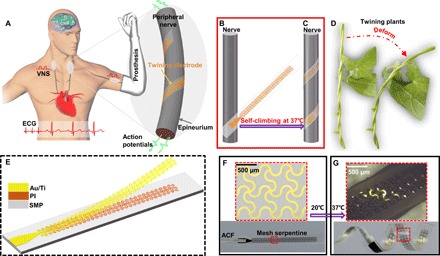
The paper presents a climbing-inspired twining electrode made of a shape memory polymer substrate and mesh serpentine Au/Ti/PI wires that self-climbs onto peripheral nerves when actuated by body temperature (~37°C), forming a conformal interface without additional surgical fixation. In rabbits, the device was used for vagus nerve stimulation with ECG recording and for sciatic nerve evoked action potential recording.
Key findings
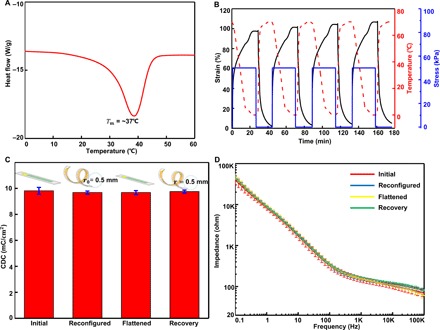
- The synthesized SMP has a transition temperature of ~37°C, shape fixity and recovery ratios above 97% over four cycles, fracture strain ~1100%, and elastic modulus changing from ~100 MPa to ~300 kPa before and after the phase transition.
- Electrochemical characterization showed average CDC ~9.7 mC/cm² and impedance magnitude ~156 ohms at 1 kHz, with little change across initial flat, reconfigured, flattened, and recovery states; fabricated electrodes had ~126 ohms at ~0.5 mm inner radius and ~119 ohms at ~1 mm inner radius.
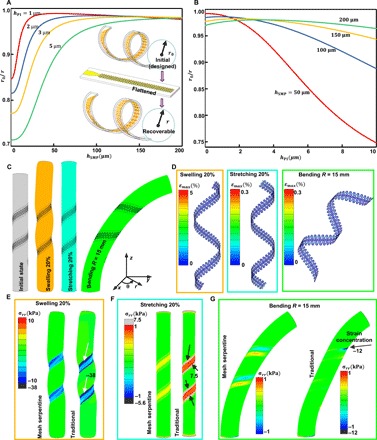
- Structural optimization gave r0/r = 0.98 and maximum Au strain εAumax = 0.24%; the twining electrode had bending stiffness EI ~1.0 × 10⁻¹⁰ N·m² and stretching stiffness EA 0.08 N, and FEA showed Au strain below fracture strain (5%) during 20% swelling and below yield strain (0.3%) during 20% stretching and bending (R = 15 mm).
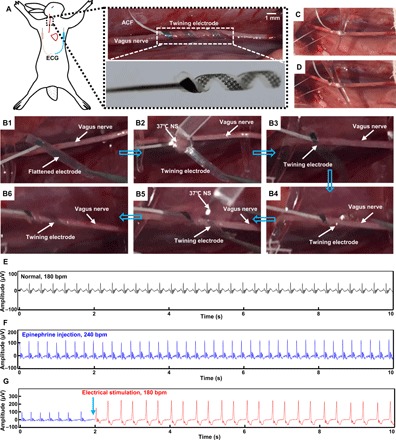
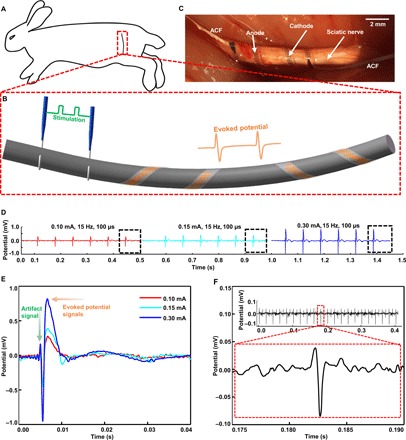
- In vivo, epinephrine increased rabbit heart rate from 180 to 240 bpm; VNS at 0.4 mA, 100 μs, 10 Hz reduced HR to 180 bpm and increased R-wave peak from 100 to 250 mV. Sciatic nerve recording showed evoked CNAP peak potentials of ~275, ~380, and ~820 μV for 0.1, 0.15, and 0.3 mA stimulation, and ~80 μV evoked CNAPs without stimulus artifact at an SNR of 16 dB.
Methods
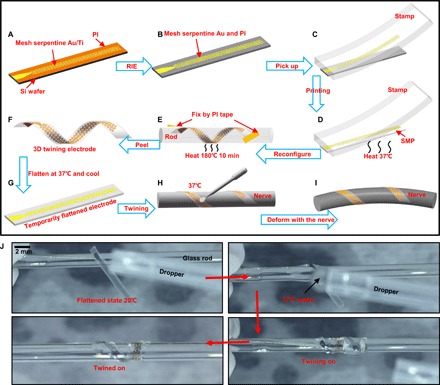
- The electrode was fabricated by depositing/etching Au/Ti mesh serpentine structures on ultrathin PI, transfer printing them onto an SMP substrate, reconfiguring the assembly into a 3D helix at 180°C for 10 min, and temporarily flattening it at 37°C; self-climbing was driven by 37°C normal saline.
- Material and device characterization included DSC, DMA, tensile testing, CV, and EIS in phosphate-buffered saline using a three-electrode setup with six samples in four states; FEA (Abaqus) modeled stress/strain under 20% swelling, 20% stretching, and bending to R = 15 mm.
- In vivo experiments used two New Zealand rabbits (3.2–3.3 kg): one for right vagus nerve stimulation with ECG recording, and one for sciatic nerve evoked potential recording using hooked platinum stimulating electrodes and twining recording electrodes.
Limitations
- The paper does not include a dedicated limitations section; it states that future twining electrodes will benefit from new high-surface-area materials and high-resolution designs for selective stimulation and recording.
- Evident from the text: in vivo validation was acute and limited to two rabbits, with no chronic implantation, long-term stability, or histological safety data reported.
- Evident from the text: biocompatibility of the main SMP precursors is cited from previous work rather than newly demonstrated in this study.
Model-written summary. Check it against the paper before relying on it.
Integrity signals
Registry
Cites
Statistics
Figures
Verification
Claims the paper makes
6 Valid · 2 Not valid · 17 Not checked · 62 Own results and interpretations
None of the sources cited for this claim have been checked yet.
In the paper
“Large mechanical and geometrical mismatches still exist at the neural interfaces.”
§ Climbing-inspired twining electrodes using shape memory for peripheral nerve stimulation and recording > INTRODUCTION
What the sources say
- Not checked yetcites [5] Naples R. G., Mortimer J. T., Scheiner A., Sweeney J. D., A spiral nerve cuff electrode for peripheral nerve stimulation. IEEE Trans. Biomed. Eng. 35, 905– 916 (1988). 3198136 source
- Not checked yetcites [6] Tarver W. B., George R. E., Maschino S. E., Holder L. K., Wernicke J. F., Clinical experience with a helical bipolar stimulating lead. Pacing Clin. Electrophysiol. 15, 1545– 1556 (1992). 1383969 source
- Not checked yetcites [7] Tyler D. J., Durand D. M., Functionally selective peripheral nerve stimulation with a flat interface nerve electrode. IEEE Trans. Neural Syst. Rehabil. Eng. 10, 294– 303 (2002). 12611367 source
- Could not verifycites [8] Foldes E. L., Ackermann D. M., Bhadra N., Kilgore K. L., Bhadra N., Design, fabrication and evaluation of a conforming circumpolar peripheral nerve cuff electrode for acute experimental use. J. Neurosci. Methods 196, 31– 37 (2011). 21187115 PMC3042051 sourceExperimental — accuracy not yet measured
Our copy of Foldes et al. (2011) frames the electrode-nerve interface in terms of achieving a conforming, close-fitting geometry — the Introduction stresses that 'consistent and predictable electrical peripheral nerve stimulation requires a robust and stable physical interface' obtained by a cylindrical cuff conforming to the nerve, and §2.1 sets a cuff-to-nerve diameter ratio of 0.9–1.1 — but it nowhere asserts that large mechanical or geometrical mismatches persist at neural interfaces, and it makes no statement about mechanical/compliance (stiffness) mismatch or about 'first-generation extraneural electrodes'. The Discussion (§4) notes only minor geometric limits of its own design (silicone bowing at IPDs beyond ~4 mm, sheath opening at lengths >2 mm), which is not the general claim being attributed. Searches run: 'mechanical and geometrical mismatch at the neural interface', 'compliance mismatch between electrode and nerve tissue', 'limitations of existing cuff electrodes: size mismatch, stiffness, poor conformal contact', 'first generation extraneural electrode problems'. Nothing in our copy supports or contradicts the claim, so it cannot be judged from this source. (LLM, conf=0.62)
plain- Asserted: passes — The authors put it forward as true.
- Checkable: passes — It can be checked against evidence.
- Load-bearing: passes — The paper’s conclusions depend on it.
- Based: passes — The paper gives a reason why it holds.
The cited sources support only part of this claim — read each source’s verdict below.
In the paper
“To decrease damage to nerves and increase long-term stability, several forms of extraneural electrodes have been proposed to replace intraneural electrodes, which penetrate into the nerve fascicles (3, 4).”
§ Climbing-inspired twining electrodes using shape memory for peripheral nerve stimulation and recording > INTRODUCTION
What the sources say
- Could not verifycites [3] Fattahi P., Yang G., Kim G., Abidian M. R., A review of organic and inorganic biomaterials for neural interfaces. Adv. Mater. 26, 1846– 1885 (2014). 24677434 PMC4373558 sourceExperimental — accuracy not yet measured
Our copy of Fattahi et al. (2014) never addresses extraneural versus intraneural (intrafascicular) electrodes for peripheral nerves; searched for 'extraneural', 'intrafascicular/nerve fascicles', 'cuff/peripheral nerve electrodes' and 'penetrating vs surface electrodes to reduce damage and improve long-term stability'. The closest passages discuss central implants only — e.g., Section 6.3 (Mechanical Stability) that stiff silicon penetrating electrodes 'create mechanical trauma on insertion' while flexible polyimide/parylene 'may improve this issue', and Section 3.1 that flexible surface microelectrodes 'may generate less tissue damage and be functional longer than silicon-based electrodes' — plus Section 6.3 mentioning hydrogel tubes 'for interfacing with the peripheral nerve'. None of these states the proposal of extraneural electrodes to replace fascicle-penetrating ones, so the claim can be neither confirmed nor contradicted from our copy. (LLM, conf=0.70)
- Partly supportedcites [4] Ecker M., Joshi-Imre A., Modi R., Frewin C. L., Garcia-Sandoval A., Maeng J., Gutierrez-Heredia G., Pancrazio J. J., Voit W. E., From softening polymers to multimaterial based bioelectronic devices. Multifunct. Mater. 2, 012001 (2019). sourceExperimental — accuracy not yet measured
Our copy supports the extraneural half of the claim: §2.2 (Nerve cuffs) describes 'several forms' of cuffs wrapping around nerves — first-generation hook-like self-coiling devices [30], newer folding thin-film cuffs in various sizes for acute and chronic studies [68,73], and softening-polymer cuffs — and the Fig. 3 caption explicitly labels them 'extra-neural cuff' devices; §2.2 also ties these to reducing nerve damage ('often causes nerve damage [67,68]', 'safer electrical stimulation') and to chronic/long-term use. What our copy does NOT support is the replacement framing: no passage mentions intraneural/intrafascicular electrodes or devices that penetrate nerve fascicles, and the paper's stated motive is overcoming the limits of silicone cuff electrodes (thickness, hardness, no size adjustment), not supplanting intraneural ones. The 'increase long-term stability' rationale appears only generally (§5.2 on reliability of chronic implants), not as a comparison against intraneural electrodes. (LLM, conf=0.68)
plainstates a cause- Asserted: passes — The authors put it forward as true.
- Checkable: passes — It can be checked against evidence.
- Load-bearing: passes — The paper’s conclusions depend on it.
- Based: passes — The paper gives a reason why it holds.
- Could not verify
The sources with a verdict support this claim; the rest weren’t checked yet, have no full text we could read, or their verdicts aren’t rated yet.
In the paper
“With the introduction of dynamic covalent bonds into the polymer network, the permanent shape of traditional thermoset SMPs can be reconfigured (23, 24).”
§ Climbing-inspired twining electrodes using shape memory for peripheral nerve stimulation and recording > INTRODUCTION
What the sources say
- Supportedcites [23] Zhao Q., Zou W., Luo Y., Xie T., Shape memory polymer network with thermally distinct elasticity and plasticity. Sci. Adv. 2, e1501297 (2016). 26824077 PMC4730863 source
The Introduction (Abstract section) states that permanent reshaping without macroscopic melting 'is achieved by covalent bond exchange in a polymer network, allowing its topography to be rearranged in response to an external force... the permanent reshaping can occur while the material maintains its dynamic crosslinking state,' listing 'malleability of thermoset polymers' among its consequences. The paper's own crosslinked PCL-thiolene network (Fig. 1A right-hand route; Figs. 3-4 discussion) demonstrates exactly this: reversible covalent bonds activated at Tp give nonrecoverable, cumulative redefinition of a permanently crosslinked (thermoset) SMP's permanent shape, with 'numerous cycles of manipulation of a permanent shape.' The paraphrase therefore matches what this source attributes. (LLM, conf=0.85)
- Not checked yetcites [24] Zheng N., Hou J., Xu Y., Fang Z., Zou W., Zhao Q., Xie T., Catalyst-free thermoset polyurethane with permanent shape reconfigurability and highly tunable triple-shape memory performance. ACS Macro Lett. 6, 326– 330 (2017). 35610855 source
plainstates a cause- Asserted: passes — The authors put it forward as true.
- Checkable: passes — It can be checked against evidence.
- Load-bearing: passes — The paper’s conclusions depend on it.
- Based: passes — The paper gives a reason why it holds.
- Supported
A result the paper reports from its own data — it cites no other source for it, so there is none to check. The quote shows it is in the paper.
In the paper
“The differential scanning calorimeter (DSC) curve for the synthetic SMPs (Fig. 3A) shows that the melt transition temperature (Tm) is approximately 37°C (i.e., Ttrans = ~37°C), which means that the SMPs recovering their permanent shapes can be actuated by body temperature (movie S4).”
§ Climbing-inspired twining electrodes using shape memory for peripheral nerve stimulation and recording > RESULTS > Material characterization and structure optimization
plain- Asserted: passes — The authors put it forward as true.
- Checkable: passes — It can be checked against evidence.
- Load-bearing: passes — The paper’s conclusions depend on it.
- Based: passes — The paper gives a reason why it holds.
A result the paper states — it cites no source for it, so there is none to check. The quote shows it is in the paper.
In the paper
“Distinct elastic modulus controllability from ~100 MPa to ~300 kPa before and after the phase transition greatly facilitates the surgical implantation in limited space, where the twining electrodes are handled in a relatively stiff state and soften after climbing on the nerves.”
§ Climbing-inspired twining electrodes using shape memory for peripheral nerve stimulation and recording > INTRODUCTION
plain- Asserted: passes — The authors put it forward as true.
- Checkable: passes — It can be checked against evidence.
- Load-bearing: passes — The paper’s conclusions depend on it.
- Based: passes — The paper gives a reason why it holds.
38 more claims
Create a free account to see all 87 claims and to verify the 54 references still open.
- Probably not a substantial claim. 17
- It may state two separate claims as one. 29
Claims other papers make about this one
Each is checked against this paper’s own text: does it say what the citing paper says it does?
The cited source says what the claim attributes to it.
In the citing paper
“In vivo Vagus nerve stimulation was carried out on a rabbit to demonstrate the validity of the device (Figure 8F).”
From Flexible Electronics and Devices as Human–Machine Interfaces for Medical Robotics (2022) · cites this paper as [358]
Self-check
Percentages, sums and reported differences re-computed from the paper’s own numbers.
Each contradiction between two passages listed here was confirmed by an independent check.
Rated minor: it would not touch a result — a value no result rests on, a p-value that stays on the same side of the significance level, or a conflict that is clerical, resolved elsewhere in the paper, or outside its own findings.
In the paper
§ Climbing-inspired twining electrodes using shape memory for peripheral nerve stimulation and recording > RESULTS > Material characterization and structure optimization
“the selected hSMP and hPI are ~2 and ~100 μm, respectively”
§ Climbing-inspired twining electrodes using shape memory for peripheral nerve stimulation and recording > RESULTS > Fabrication process
“Fabrication of the mesh serpentine starts with spin casting of an ultrathin PI film (~2 μm) (fig. S3) onto silicon wafers coated with a layer of a sacrificial polymethylmethacrylate (PMMA) film.”
Citations
Cites
Pursuing prosthetic electronic skin
Chortos, A., Liu, J., & Bao, Z. (2016) · Nature Materials · doi:10.1038/nmat4671 · Cited by 2,396
The rise of plastic bioelectronics
Someya, T., Bao, Z., & Malliaras, G. G. (2016) · Nature · doi:10.1038/nature21004 · Cited by 1,884
Recent Advances in Flexible and Stretchable Bio‐Electronic Devices Integrated with Nanomaterials
Choi, S., Lee, H., Ghaffari, R., Hyeon, T., & Kim, D. (2016) · Advanced Materials · doi:10.1002/adma.201504150 · Cited by 1,104
Fractal design concepts for stretchable electronics
Fan, J. A., Yeo, W.-H., Su, Y., Hattori, Y., Lee, W., Jung, S.-Y., Zhang, Y., Liu, Z., Cheng, H., Falgout, L., et al. (2014) · Nature Communications · doi:10.1038/ncomms4266 · Cited by 1,088
Self-citation3D Printing of Shape Memory Polymers for Flexible Electronic Devices
Zarek, M., Layani, M., Cooperstein, I., Sachyani, E., Cohn, D., & Magdassi, S. (2016) · Advanced Materials · doi:10.1002/adma.201503132 · Cited by 903
Navarro, X., Krueger, T. B., Lago, N., Micera, S., Stieglitz, T., & Dario, P. (2005) · Journal of the Peripheral Nervous System · doi:10.1111/j.1085-9489.2005.10303.x · Cited by 845
Flexible and Stretchable Electronics for Biointegrated Devices
Kim, D.-H., Ghaffari, R., Lu, N., & Rogers, J. A. (2012) · Annual Review of Biomedical Engineering · doi:10.1146/annurev-bioeng-071811-150018 · Cited by 749
Highly Flexible Silver Nanowire Electrodes for Shape‐Memory Polymer Light‐Emitting Diodes
Yu, Z., Zhang, Q., Li, L., Chen, Q., Niu, X., Liu, J., & Pei, Q. (2011) · Advanced Materials · doi:10.1002/adma.201003398 · Cited by 688
A Review of Organic and Inorganic Biomaterials for Neural Interfaces
Fattahi, P., Yang, G., Kim, G., & Abidian, M. R. (2014) · Advanced Materials · doi:10.1002/adma.201304496 · Cited by 580 · cited 1×
“To decrease damage to nerves and increase long-term stability, several forms of extraneural electrodes have been proposed to replace intraneural electrodes, which penetrate into the nerve fascicles (3, 4).”
BackgroundA jump-start for electroceuticals
Famm, K., Litt, B., Tracey, K. J., Boyden, E. S., & Slaoui, M. (2013) · Nature · doi:10.1038/496159a · Cited by 554
Cited by
Zheng, N., Xu, Y., Zhao, Q., & Xie, T. (2021) · Chemical Reviews · doi:10.1021/acs.chemrev.0c00938 · Cited by 1,399
Self-citationA Review of Shape Memory Polymers and Composites: Mechanisms, Materials, and Applications
Xia, Y., He, Y., Zhang, F., Liu, Y., & Leng, J. (2021) · Advanced Materials · doi:10.1002/adma.202000713 · Cited by 1,281
Electrical bioadhesive interface for bioelectronics
Deng, J., Yuk, H., Wu, J., Varela, C. E., Chen, X., Roche, E. T., Guo, C. F., & Zhao, X. (2021) · Nature Materials · doi:10.1038/s41563-020-00814-2 · Cited by 727
Self-citationFlexible Hybrid Electronics for Digital Healthcare
Ma, Y., Zhang, Y., Cai, S., Han, Z., Liu, X., Wang, F., Cao, Y., Wang, Z., Li, H., Chen, Y., et al. (2020) · Advanced Materials · doi:10.1002/adma.201902062 · Cited by 620
Self-citationFlexible Electronics and Devices as Human–Machine Interfaces for Medical Robotics
Heng, W., Solomon, S., & Gao, W. (2022) · Advanced Materials · doi:10.1002/adma.202107902 · Cited by 609
Materials for flexible bioelectronic systems as chronic neural interfaces
Song, E., Li, J., Won, S. M., Bai, W., & Rogers, J. A. (2020) · Nature Materials · doi:10.1038/s41563-020-0679-7 · Cited by 498
Foreign Body Reaction to Implanted Biomaterials and Its Impact in Nerve Neuroprosthetics
Carnicer-Lombarte, A., Chen, S.-T., Malliaras, G. G., & Barone, D. G. (2021) · Frontiers in Bioengineering and Biotechnology · doi:10.3389/fbioe.2021.622524 · Cited by 454
“, 2020), self-wrapping designs (Zhang et al., 2019), and selfhealing, stretchable devices that accommodate for tissue growth as an animal grows (Liu et al.”
BackgroundNatural Biopolymer-Based Biocompatible Conductors for Stretchable Bioelectronics
Wang, C., Yokota, T., & Someya, T. (2021) · Chemical Reviews · doi:10.1021/acs.chemrev.0c00897 · Cited by 412
The Evolution of Flexible Electronics: From Nature, Beyond Nature, and To Nature
Wang, P., Hu, M., Wang, H., Chen, Z., Feng, Y., Wang, J., Ling, W., & Huang, Y. (2020) · Advanced Science · doi:10.1002/advs.202001116 · Cited by 397
Self-citationFunctional Conductive Hydrogels for Bioelectronics
Fu, F., Wang, J., Zeng, H., & Yu, J. (2020) · ACS Materials Letters · doi:10.1021/acsmaterialslett.0c00309 · Cited by 364
Wireless and battery-free technologies for neuroengineering
Won, S. M., Cai, L., Gutruf, P., & Rogers, J. A. (2021) · Nature Biomedical Engineering · doi:10.1038/s41551-021-00683-3 · Cited by 360
Wang, Y., Zhao, C., Wang, J., Luo, X., Xie, L., Zhan, S., Kim, J., Wang, X., Liu, X., & Ying, Y. (2021) · Science Advances · doi:10.1126/sciadv.abe4553 · Cited by 340
Strategies for body-conformable electronics
Liu, S., Rao, Y., Jang, H., Tan, P., & Lu, N. (2022) · Matter · doi:10.1016/j.matt.2022.02.006 · Cited by 306
“, 37 C), as evidenced in Figure 9Hii.(29)”
BackgroundMethodHydrogels for Flexible Electronics
Zhang, Y., Tan, Y., Lao, J., Gao, H., & Yu, J. (2023) · ACS Nano · doi:10.1021/acsnano.3c02897 · Cited by 291
Self-citationEmerging Modalities and Implantable Technologies for Neuromodulation
Won, S. M., Song, E., Reeder, J. T., & Rogers, J. A. (2020) · Cell · doi:10.1016/j.cell.2020.02.054 · Cited by 291
Water-responsive supercontractile polymer films for bioelectronic interfaces
Yi, J., Zou, G., Huang, J., Ren, X., Tian, Q., Yu, Q., Wang, P., Yuan, Y., Tang, W., Wang, C., et al. (2023) · Nature · doi:10.1038/s41586-023-06732-y · Cited by 240
“Shape-wrapping bioelectronics using soft elastomer 13 and shape memory materials 14,15 have recently attracted great attention because they can interface well with tissues and can withstand dynamic environments without an extra suturing fixation process.”
Self-citationFlexible inorganic bioelectronics
Chen, Y., Zhang, Y., Liang, Z., Cao, Y., Han, Z., & Feng, X. (2020) · npj Flexible Electronics · doi:10.1038/s41528-020-0065-1 · Cited by 227
“g, h Reproduced with permission(81) (Copyright 2016, Nature Publish Group).(112) (Copyright 2019, American Association for the Advancement of Science).”
BackgroundSelf-citationLi, H., Ma, Y., & Huang, Y. (2021) · Materials Horizons · doi:10.1039/d0mh00483a · Cited by 221
Self-citationMotion artefact management for soft bioelectronics
Yin, J., Wang, S., Tat, T., & Chen, J. (2024) · Nature Reviews Bioengineering · doi:10.1038/s44222-024-00175-4 · Cited by 220
Spatially Confined MXene/PVDF Nanofiber Piezoelectric Electronics
Zhang, J., Yang, T., Tian, G., Lan, B., Deng, W., Tang, L., Ao, Y., Sun, Y., Zeng, W., Ren, X., et al. (2024) · Advanced Fiber Materials · doi:10.1007/s42765-023-00337-w · Cited by 204
“In response to the above issues, two-dimensional (2D) or three-dimensional (3D) microstructures positively impact the dipole arrangement [26–29], such as the formation of 3D stacked porous nanofibers with highly confined stress areas [30, 31].”
4D Printing of shape-memory polymeric scaffolds for adaptive biomedical implantation
Zhang, C., Cai, D., Liao, P., Su, J.-W., Deng, H., Vardhanabhuti, B., Ulery, B. D., Chen, S.-Y., & Lin, J. (2021) · Acta Biomaterialia · doi:10.1016/j.actbio.2020.12.042 · Cited by 199
“While these approaches usually can facilitate the generation of twodimensional (2D) structures[3, 9, 11], or limited three-dimensional (3D) structures such as curve[7, 8, 12] and twining[6, 10], they cannot well match the intricacies of complex 3D structures like tissues and organs.”
BackgroundWearable and Implantable Soft Bioelectronics: Device Designs and Material Strategies
Sunwoo, S.-H., Ha, K.-H., Lee, S., Lu, N., & Kim, D.-H. (2021) · Annual Review of Chemical and Biomolecular Engineering · doi:10.1146/annurev-chembioeng-101420-024336 · Cited by 184
Xue, Y., Chen, X., Wang, F., Lin, J., & Liu, J. (2023) · Advanced Materials · doi:10.1002/adma.202304095 · Cited by 184
Self-citationBioelectronics for electrical stimulation: materials, devices and biomedical applications
Huang, Y., Yao, K., Zhang, Q., Huang, X., Chen, Z., Zhou, Y., & Yu, X. (2024) · Chemical Society Reviews · doi:10.1039/d4cs00413b · Cited by 183
Han, Z., Li, H., Xiao, J., Song, H., Li, B., Cai, S., Chen, Y., Ma, Y., & Feng, X. (2019) · ACS Applied Materials & Interfaces · doi:10.1021/acsami.9b12929 · Cited by 177
Self-citationSkin-inspired, sensory robots for electronic implants
Zhang, L., Xing, S., Yin, H., Weisbecker, H., Tran, H. T., Guo, Z., Han, T., Wang, Y., Liu, Y., Wu, Y., et al. (2024) · Nature Communications · doi:10.1038/s41467-024-48903-z · Cited by 175
“The on-demand motion provided by the soft robot facilitates device implantation and ensures benign and stable contact with targeted tissue or organs 12,102,103 .”
Wearable and Implantable Soft Robots
Yin, S., Yao, D. R., Song, Y., Heng, W., Ma, X., Han, H., & Gao, W. (2024) · Chemical Reviews · doi:10.1021/acs.chemrev.4c00513 · Cited by 173
Self‐Shaping Soft Electronics Based on Patterned Hydrogel with Stencil‐Printed Liquid Metal
Hao, X. P., Li, C. Y., Zhang, C. W., Du, M., Ying, Z., Zheng, Q., & Wu, Z. L. (2021) · Advanced Functional Materials · doi:10.1002/adfm.202105481 · Cited by 172
Inverse Vulcanized Polymers with Shape Memory, Enhanced Mechanical Properties, and Vitrimer Behavior
Yan, P., Zhao, W., Zhang, B., Jiang, L., Petcher, S., Smith, J. A., Parker, D. J., Cooper, A. I., Lei, J., & Hasell, T. (2020) · Angewandte Chemie International Edition · doi:10.1002/anie.202004311 · Cited by 170
Flexible Electrodes for In Vivo and In Vitro Electrophysiological Signal Recording
Zhu, M., Wang, H., Li, S., Liang, X., Zhang, M., Dai, X., & Zhang, Y. (2021) · Advanced Healthcare Materials · doi:10.1002/adhm.202100646 · Cited by 171
Self-citationElectroconductive, Adhesive, Non‐Swelling, and Viscoelastic Hydrogels for Bioelectronics
Han, I. K., Song, K., Jung, S., Jo, Y., Kwon, J., Chung, T., Yoo, S., Jang, J., Kim, Y., Hwang, D. S., et al. (2023) · Advanced Materials · doi:10.1002/adma.202203431 · Cited by 167
A flexible, stretchable system for simultaneous acoustic energy transfer and communication
Jin, P., Fu, J. S., Wang, F., Zhang, Y., Wang, P., Liu, X., Jiao, Y., Li, H., Chen, Y., Ma, Y., et al. (2021) · Science Advances · doi:10.1126/sciadv.abg2507 · Cited by 166
Self-citationAdvances in flexible sensors for intelligent perception system enhanced by artificial intelligence
Niu, H., Yin, F., Kim, E., Wang, W., Yoon, D., Wang, C., Liang, J., Li, Y., & Kim, N. (2023) · InfoMat · doi:10.1002/inf2.12412 · Cited by 165
Self-citationChen, S., Fan, S., Qiao, Z., Wu, Z., Lin, B., Li, Z., Riegler, M. A., Wong, M. Y. H., Opheim, A., Korostynska, O., et al. (2025) · Advanced Materials · doi:10.1002/adma.202500412 · Cited by 164
Mechanically-Guided 3D Assembly for Architected Flexible Electronics
Bo, R., Xu, S., Yang, Y., & Zhang, Y. (2023) · Chemical Reviews · doi:10.1021/acs.chemrev.3c00335 · Cited by 164
Self-citationWhen nano meets plants: A review on the interplay between nanoparticles and plants
Hu, J., & Xianyu, Y. (2021) · Nano Today · doi:10.1016/j.nantod.2021.101143 · Cited by 162
Trigger‐Detachable Hydrogel Adhesives for Bioelectronic Interfaces
Xue, Y., Zhang, J., Chen, X., Zhang, J., Chen, G., Zhang, K., Lin, J., Guo, C., & Liu, J. (2021) · Advanced Functional Materials · doi:10.1002/adfm.202106446 · Cited by 160
Hu, R., Yao, B., Geng, Y., Zhou, S., Li, M., Zhong, W. H., Sun, F., Zhao, H., Wang, J., Ge, J., et al. (2024) · Advanced Materials · doi:10.1002/adma.202403111 · Cited by 160
Self-citationConformal in-ear bioelectronics for visual and auditory brain-computer interfaces
Wang, Z., Shi, N., Zhang, Y., Zheng, N., Li, H., Jiao, Y., Cheng, J., Wang, Y., Zhang, X., Chen, Y., et al. (2023) · Nature Communications · doi:10.1038/s41467-023-39814-6 · Cited by 157
“The application of EAL is introduced to generate heating as demand instead of using hot water to drive the deformation as described in previous studies 33 , which is not suitable for EEG detection in ears.”
InfluentialSelf-citationCho, Y., Park, S., Lee, J., & Yu, K. J. (2021) · Advanced Materials · doi:10.1002/adma.202005786 · Cited by 151
Wearable and Implantable Electroceuticals for Therapeutic Electrostimulations
Long, Y., Li, J., Yang, F., Wang, J., & Wang, X. (2021) · Advanced Science · doi:10.1002/advs.202004023 · Cited by 149
Li, H., Ma, Y., Liang, Z., Wang, Z., Cao, Y., Xu, Y., Zhou, H., Lu, B., Chen, Y., Han, Z., et al. (2020) · National Science Review · doi:10.1093/nsr/nwaa022 · Cited by 140
Self-citationHighly-stable, injectable, conductive hydrogel for chronic neuromodulation
Yang, M., Wang, L., Liu, W., Li, W., Huang, Y., Jin, Q., Zhang, L., Jiang, Y., & Luo, Z. (2024) · Nature Communications · doi:10.1038/s41467-024-52418-y · Cited by 143
Kang, K., Ye, S., Jeong, C., Jeong, J., Ye, Y., Jeong, J. Y., Kim, Y.-J., Lim, S., Kim, T. H., Kim, K. Y., et al. (2024) · Nature Communications · doi:10.1038/s41467-023-44064-7 · Cited by 142
“Figure 2i shows the mechanical properties (~70.8 kPa) of 3D scaffold-based hydrogel, which closely match those of the sciatic nerve 38 .”
InfluentialPrinted Stretchable Liquid Metal Electrode Arrays for In Vivo Neural Recording
Dong, R., Wang, L., Hang, C., Chen, Z., Liu, X., Zhong, L., Qi, J., Huang, Y., Liu, S., Wang, L., et al. (2021) · Small · doi:10.1002/smll.202006612 · Cited by 141
Linghu, C., Liu, Y., Tan, Y. Y., Sing, J. H. M., Tang, Y., Zhou, A., Wang, X., Li, D., Gao, H., & Hsia, K. J. (2023) · Proceedings of the National Academy of Sciences · doi:10.1073/pnas.2221049120 · Cited by 135
“…for heating to several minutes for cooling, and the switching temperature is as high as 90 °C, they can be reduced to seconds or shorter and to lower switching temperatures, e.g., body temperature (22), with other material systems and actuation meth-ods (6, 68) for applications in, e.g., robotics.”
Luo, H., Wang, C., Linghu, C., Yu, K., Wang, C., & Song, J. (2019) · National Science Review · doi:10.1093/nsr/nwz109 · Cited by 134
Electrochemically actuated microelectrodes for minimally invasive peripheral nerve interfaces
Dong, C., Carnicer‐Lombarte, A., Bonafè, F., Huang, B., Middya, S., Jin, A. T., Tao, X., Han, S., Bance, M., Barone, D. G., et al. (2024) · Nature Materials · doi:10.1038/s41563-024-01886-0 · Cited by 133
“*: We find that these two parameters do not influence the agreement of the fitting, therefore we simply choose the same value as that used for the samples before PreC.”
Wang, J., He, T., & Lee, C. (2019) · Nano Energy · doi:10.1016/j.nanoen.2019.104039 · Cited by 129
“trodes using shape memory material [55].”
A Laminated Gravity‐Driven Liquid Metal‐Doped Hydrogel of Unparalleled Toughness and Conductivity
Zhang, Q., Lu, H., Yun, G., Gong, L., Chen, Z., Jin, S., Du, H., Jiang, Z., & Li, W. (2023) · Advanced Functional Materials · doi:10.1002/adfm.202308113 · Cited by 129
Qiu, Y., Sun, S., Wang, X., Shi, K., Wang, Z., Ma, X., Zhang, W., Bao, G., Tian, Y., Zhang, Z., et al. (2022) · npj Flexible Electronics · doi:10.1038/s41528-022-00181-9 · Cited by 123
Adaptive self-healing electronic epineurium for chronic bidirectional neural interfaces
Song, K.-I., Seo, H., Seong, D., Kim, S., Yu, K. J., Kim, Y.-C., Kim, J., Kwon, S. J., Han, H.-S., Youn, I., et al. (2020) · Nature Communications · doi:10.1038/s41467-020-18025-3 · Cited by 120
Devising Materials Manufacturing Toward Lab‐to‐Fab Translation of Flexible Electronics
Luo, Y., Wang, M., Wan, C., Cai, P., Loh, X. J., & Chen, X. (2020) · Advanced Materials · doi:10.1002/adma.202001903 · Cited by 121
Xiao, R., & Huang, W. (2020) · Macromolecular Bioscience · doi:10.1002/mabi.202000108 · Cited by 119
3D Electrodes for Bioelectronics
Cho, Y. H., Park, Y., Kim, S., & Park, J. (2021) · Advanced Materials · doi:10.1002/adma.202005805 · Cited by 116
Bioelectronic Implantable Devices for Physiological Signal Recording and Closed‐Loop Neuromodulation
Oh, S., Jekal, J., Liu, J., Kim, J., Park, J., Lee, T., & Jang, K. (2024) · Advanced Functional Materials · doi:10.1002/adfm.202403562 · Cited by 113
Reconfigurable 4D printing via mechanically robust covalent adaptable network shape memory polymer
Li, H., Zhang, B., Ye, H., Jian, B., He, X., Cheng, J., Sun, Z., Wang, R., Chen, Z., Lin, J., et al. (2024) · Science Advances · doi:10.1126/sciadv.adl4387 · Cited by 109
“…SMPs have been realized by incorporating thermally or optically induced BERs into the crystalline SMP systems, which mainly consist of high molecular weight linear chains such as polycaprolactone ( 27 – 31 ), polyurethane ( 32 – 35 ), polyethylene glycol ( 36 , 37 ), and others ( 38 – 40 ).”
BackgroundUltrastrong, highly conductive and capacitive hydrogel electrode for electron-ion transduction
Yao, B., Yan, Y., Cui, Q., Duan, S., Wang, C., Du, Y., Zhao, Y., Wu, D., Wu, S., Zhu, X., et al. (2022) · Matter · doi:10.1016/j.matt.2022.09.004 · Cited by 107
Flexible and Wearable Biosensors for Monitoring Health Conditions
Song, Z., Zhou, S., Qin, Y., Xia, X., Sun, Y., Han, G., Shu, T., Hu, L., & Zhang, Q. M. (2023) · Biosensors · doi:10.3390/bios13060630 · Cited by 102
Recent development of implantable and flexible nerve electrodes
Shi, Y., Liu, R., He, L. M., Feng, H., Li, Y., & Li, Z. (2020) · Smart Materials in Medicine · doi:10.1016/j.smaim.2020.08.002 · Cited by 97
“[60] proposed a 3D imitation climbing wound electrode to solve the interface mismatch between electrode and nerve bundle.”
BackgroundInfluentialSelf-citationBioinspired Materials for In Vivo Bioelectronic Neural Interfaces
Woods, G. A., Rommelfanger, N. J., & Hong, G. (2020) · Matter · doi:10.1016/j.matt.2020.08.002 · Cited by 91
Peng, W., Zhang, G., Liu, J., Nie, S., Wu, Y., Deng, S., Fang, G., Zhou, J., Song, J., Qian, J. W., et al. (2020) · Advanced Functional Materials · doi:10.1002/adfm.202000522 · Cited by 90
Self-citationStimuli-responsive smart materials for biomedical applications
Lin, C. H., Yang, M., Zhang, F., Liu, Y., & JinSong, L. E. N. G. (2025) · Materials Science and Engineering R Reports · doi:10.1016/j.mser.2025.101126 · Cited by 89
A comparative review of artificial muscles for microsystem applications
Shi, M., & Yeatman, E. M. (2021) · Microsystems & Nanoengineering · doi:10.1038/s41378-021-00323-5 · Cited by 88
Dong, C., & Malliaras, G. G. (2025) · Advanced Materials · doi:10.1002/adma.202417325 · Cited by 88
Design, fabrication and applications of soft network materials
Liu, J., Yan, D., Pang, W., & Zhang, Y. (2021) · Materials Today · doi:10.1016/j.mattod.2021.05.007 · Cited by 84
Self-citationVersatile adhesive skin enhances robotic interactions with the environment
Linghu, C., Liu, Y., Yang, X., Chen, Z., Feng, J., Zhang, Y., Li, Y., Zhao, Z., Seo, Y.-J., Li, J., et al. (2025) · Science Advances · doi:10.1126/sciadv.adt4765 · Cited by 83
Self-citationMicro- and nanotechnology for neural electrode-tissue interfaces
Liu, S., Zhao, Y., Hao, W., Zhang, X., & Ming, D. (2020) · Biosensors and Bioelectronics · doi:10.1016/j.bios.2020.112645 · Cited by 82
Origami-inspired soft fluidic actuation for minimally invasive large-area electrocorticography
Coles, L., Ventrella, D., Carnicer‐Lombarte, A., Elmi, A., Troughton, J. G., Mariello, M., Hadwe, S. E., Woodington, B. J., Bacci, M. L., Malliaras, G. G., et al. (2024) · Nature Communications · doi:10.1038/s41467-024-50597-2 · Cited by 81
“Concepts from soft robotics have recently converged with bioe-lectronic implants to create implants that can change shape and adapt within the body to enableminimally-invasive interfacing 33,34 or provide mechanical stimulation 35 .”
Soft Implantable Bioelectronics
Koo, J. H., Song, J., Kim, D., & Son, D. (2021) · ACS Materials Letters · doi:10.1021/acsmaterialslett.1c00438 · Cited by 79
Self‐Unfolding Flexible Microelectrode Arrays Based on Shape Memory Polymers
Wang, J., Zhao, Q., Wang, Y., Zeng, Q., Wu, T., & Du, X. (2019) · Advanced Materials Technologies · doi:10.1002/admt.201900566 · Cited by 77
Soft Electronics Based on Stretchable and Conductive Nanocomposites for Biomedical Applications
Zambrano, B. L., Renz, A. F., Ruff, T., Lienemann, S., Tybrandt, K., Vörös, J., & Lee, J. (2020) · Advanced Healthcare Materials · doi:10.1002/adhm.202001397 · Cited by 76
4D‐Printed Soft and Stretchable Self‐Folding Cuff Electrodes for Small‐Nerve Interfacing
Hiendlmeier, L., Zurita, F., Vogel, J., Duca, F. D., Boustani, G. A., Hu, P., Kopic, I., Nikić, M., Teshima, T., & Wolfrum, B. L. (2023) · Advanced Materials · doi:10.1002/adma.202210206 · Cited by 75
Bio‐Inspired Semi‐Active Safeguarding Design with Enhanced Impact Resistance via Shape Memory Effect
Wang, W., Wang, S., Zhou, J., Deng, H., Sun, S., Xue, T., Ma, Y., & Gong, X. (2023) · Advanced Functional Materials · doi:10.1002/adfm.202212093 · Cited by 69
Self-citationBioelectronic medicine for the autonomic nervous system: clinical applications and perspectives
Cracchiolo, M., Ottaviani, M. M., Panarese, A., Strauss, I., Vallone, F., Mazzoni, A., & Micera, S. (2021) · Journal of Neural Engineering · doi:10.1088/1741-2552/abe6b9 · Cited by 69
Differential diffusion driven far-from-equilibrium shape-shifting of hydrogels
Zhang, Y., Liu, K., Liu, T., Ni, C., Chen, D., Guo, J., Liu, C., Zhou, J., Jia, Z., Zhao, Q., et al. (2021) · Nature Communications · doi:10.1038/s41467-021-26464-9 · Cited by 67
Self-citationMaterials and Biomedical Applications of Implantable Electronic Devices
Liu, Y., Yu, Q., Li, Y., & Cui, Y. (2022) · Advanced Materials Technologies · doi:10.1002/admt.202200853 · Cited by 67
Self-citationNature's Blueprint in Bioinspired Materials for Robotics
Roh, Y., Lee, Y., Lim, D., Gong, D., Hwang, S., Kang, M., Kim, D., Cho, J., Kwon, G., Kang, D., et al. (2023) · Advanced Functional Materials · doi:10.1002/adfm.202306079 · Cited by 67
Materials, Devices, and Applications for Wearable and Implantable Electronics
Han, W. B., Ko, G., Jang, T., & Hwang, S. (2021) · ACS Applied Electronic Materials · doi:10.1021/acsaelm.0c00724 · Cited by 67
Hybrid‐Piezoelectret Based Highly Efficient Ultrasonic Energy Harvester for Implantable Electronics
Wan, X., Chen, P., Xu, Z., Mo, X., Jin, H., Yang, W., Wang, S., Duan, J., Hu, B., Luo, Z., et al. (2022) · Advanced Functional Materials · doi:10.1002/adfm.202200589 · Cited by 65
Wang, Z., Wang, T., Zhuang, M., & Xu, H. (2019) · ACS Applied Materials & Interfaces · doi:10.1021/acsami.9b16353 · Cited by 65
Conformal Fixation Strategies and Bioadhesives for Soft Bioelectronics
Park, J., Kim, H. W., Lim, S., Yi, H., Wu, Z., Kwon, I. G., Yeo, W., Song, E., & Yu, K. J. (2024) · Advanced Functional Materials · doi:10.1002/adfm.202313728 · Cited by 63
Principles and applications of sono-optogenetics
Yang, F., Kim, S., Wu, X., Cui, H., Hahn, S. K., & Hong, G. (2023) · Advanced Drug Delivery Reviews · doi:10.1016/j.addr.2023.114711 · Cited by 63
Tao, L., Xu, Y., Zhao, A., He, W., & Xiao, F. (2022) · Analytica Chimica Acta · doi:10.1016/j.aca.2022.339461 · Cited by 61
How is flexible electronics advancing neuroscience research?
Chen, Y., Rommelfanger, N. J., Mahdi, A. I., Wu, X., Keene, S. T., Obaid, A., Salleo, A., Wang, H., & Hong, G. (2020) · Biomaterials · doi:10.1016/j.biomaterials.2020.120559 · Cited by 61
Self-citationCompliant peripheral nerve interfaces.
Paggi, V., Akouissi, O., Micera, S., & Lacour, S. P. (2021) · Journal of Neural Engineering · doi:10.1088/1741-2552/abcdbe · Cited by 60
Ghanim, R. W., Kaushik, A., Park, J., & Abramson, A. (2023) · Device · doi:10.1016/j.device.2023.100092 · Cited by 60
A review of inkjet printing technology for personalized-healthcare wearable devices
Du, X., Wankhede, S. P., Prasad, S., Shehri, A., Morse, J. D., & Lakal, N. (2022) · Journal of Materials Chemistry C · doi:10.1039/d2tc02511f · Cited by 59
Qiu, Y., Zou, Z., Zou, Z., Setiawan, N. K., Dikshit, K. V., Whiting, G. L., Yang, F., Zhang, W., Lu, J., Zhong, B., et al. (2023) · npj Flexible Electronics · doi:10.1038/s41528-023-00272-1 · Cited by 57
Wang, Y., Li, L., Ji, Y., Wang, T., Fu, Y., Li, X., Li, G., Zheng, T., Wu, L., Han, Q., et al. (2023) · Proceedings of the National Academy of Sciences · doi:10.1073/pnas.2305704120 · Cited by 56
“Existing artificial actuation systems use diverse stimulus-responsive materials, such as liquid crystal elastomers (8–10), hydrogels (11–14), silicone elastomers (15), and shape-memory polymers (16, 17), to achieve targeted deformation, such as bending, folding, twisting, and buckling.”
BackgroundSelf-citationFibrillar adhesives with unprecedented adhesion strength, switchability and scalability
Linghu, C., Liu, Y., Yang, X., Li, D., Tan, Y. Y., Hafiz, M. H. B. M., Rohani, M. F. B., Du, Z., Su, J., Li, Y., et al. (2024) · National Science Review · doi:10.1093/nsr/nwae106 · Cited by 56
“Since the current systems using thermally-controlled SMP is limited in actuation speed, applications that require fast response may benefit from incorporating materials with lower transition temperature or other actuation mechanisms [37 ,46 ,50 ] to achieve more rapid switching.”
BackgroundSelf-citationAn Anti‐Fatigue Design Strategy for 3D Ribbon‐Shaped Flexible Electronics
Cheng, X., Zhang, F., Bo, R., Shen, Z., Pang, W., Jin, T., Song, H., Xue, Z., & Zhang, Y. (2021) · Advanced Materials · doi:10.1002/adma.202102684 · Cited by 56
Self-citationAdvancing smart dry adhesives with shape memory polymers
Linghu, C., Mu, T., Zhao, W. D., Liu, Y., Hsia, K. J., Leng, J., & Gao, H. (2024) · International Journal of Smart and Nano Materials · doi:10.1080/19475411.2024.2439954 · Cited by 55
“Moreover, Zhang et al. [129] engineered a flexible, self-climbing twining SMP electrode that establishes conformal contact with nerve structures, minimizing damage and enhancing the long-term stability of peripheral neuromodulation interfaces (see Figure 6f).”
InfluentialThree-dimensional micro- and nanomanufacturing techniques for high-fidelity wearable bioelectronics
Fan, P., Liu, Y., Pan, Y., Ying, Y. B., & Ping, J. F. (2025) · Nature Reviews Electrical Engineering · doi:10.1038/s44287-025-00174-6 · Cited by 55
“Other include 3D-wrapped electrodes that self-crawl onto nerves in response to temperature, forming flexible neural interfaces capable of recording action potentials with minimal constraint on the deformed nerve 195 .”
Herbert, R., Lim, H., Park, S., Kim, J., & Yeo, W. (2021) · Advanced Healthcare Materials · doi:10.1002/adhm.202100158 · Cited by 55
Tang, C., Liu, Z., Hu, Q., Jiang, Z., Zheng, M., Xiong, C., Wang, S., Yao, S., Zhao, Y., Wan, X., et al. (2023) · Small · doi:10.1002/smll.202304752 · Cited by 54
Luo, J., Xing, Y., Sun, C., Fan, L., Shi, H., Zhang, Q., Li, Y., Hou, C., & Wang, H. (2021) · Chemical Engineering Journal · doi:10.1016/j.cej.2021.130886 · Cited by 54
Self-citationActive Fabrics With Controllable Stiffness for Robotic Assistive Interfaces
Yang, X., Chen, Y., Chen, T., Li, J., & Wang, Y. (2024) · Advanced Materials · doi:10.1002/adma.202404502 · Cited by 53
Self-citationJiang, L., Lu, G., Yang, Y., Zeng, Y., Sun, Y., Li, R., Humayun, M. S., Chen, Y., & Zhou, Q. (2021) · Energy & Environmental Science · doi:10.1039/d0ee03801f · Cited by 51
Self-citationA multisensory-feedback tactile glove with dense coverage of sensing arrays for object recognition
Qiu, Y., Wang, Z., Zhu, P., Su, B., Wei, C., Tian, Y., Zhang, Z., Chai, H., Liu, A., Liang, L., et al. (2022) · Chemical Engineering Journal · doi:10.1016/j.cej.2022.140890 · Cited by 51
Metadata
- Authors
- Zhang, Y., Zheng, N., Cao, Y., Wang, F., Wang, P., Ma, Y., Lu, B., Hou, G., Fang, Z., Liang, Z., Yue, M., Li, Y., Chen, Y., Fu, J., Wu, J., Xie, T., & Feng, X.
- Affiliations
- Tsinghua University (CN)
- State Key Laboratory of Chemical Engineering (CN)
- Institute of Flexible Electronics Technology of THU, Jiaxing 314000, China.
- Corresponding author
- Feng, Xue
- ORCID
- Venue
- Science Advances
- Published
- 2019-04-05
- Volume
- 5
- Issue
- 4
- Pages
- eaaw1066-eaaw1066
- ISSN
- 2375-2548 (ISSN-L)
- PMC
- PMC6505533
- OpenAlex
- W2939525019
- Semantic Scholar
- b3a40db8c16eaf07ed6df41a31d1c7ee4b486e98
- Cited by
- 314
- References
- 56
- Citations by year
- 2026: 22 · 2025: 53 · 2024: 62 · 2023: 42 · 2022: 31 · 2021: 58 · 2020: 34 · 2019: 12
- FWCI
- 16.12
- Type
- journal article
- Language
- en
- Open access
- gold
- doi.org
- Licence
- cc-by
- Locations
- Science Advances (publishedVersion, cc-by)
- PubMed Central (publishedVersion, cc-by)
- PubMed (publishedVersion)
- Funders
- National Natural Science Foundation of China (11625207, 11320101001, 11222220)
- National Basic Research Program of China (2015CB351900)
- Topics
- Life Sciences › Neuroscience › Cellular and Molecular Neuroscience › Neuroscience and Neural Engineering
- Life Sciences › Neuroscience › Neurology › Vagus Nerve Stimulation Research
- Physical Sciences › Engineering › Biomedical Engineering › Advanced Sensor and Energy Harvesting Materials
- Keywords
- shape memory polymers, peripheral nerve stimulation, peripheral nerve recording, neural interfaces, stretchable electrodes, vagus nerve stimulation
- MeSH terms
- Action Potentials, Animals, Electric Stimulation, Electrodes, Peripheral Nerves, Polymers, Rabbits, Elastic Modulus
About these checks
Registry, retraction, Cites and statistics results are computed, not judged, with one exception: a printed reference that no index lists is read once by a model before it counts as a citation error. Claims are extracted by a model and kept only when their quote appears verbatim in the text; each cited source is then checked, with a model’s help, for whether it says what the claim relies on. Those verdicts can be wrong — read the claim’s quote and the cited source before relying on one.
The claim verdicts this report counts are experimental: their accuracy is not yet measured.
A language model drew the claims from the paper on 2026-10-04, under version 3 of the claim definition (model deepseek-v4.1-flash, prompt extract-v3).
A second model labelled each claim on 2026-10-04 (model jev-1.13-20260917, definition revision gold-guideline-v0.2).
Cited sources are checked with a language model’s help (qwen3.8-omni-flash).
Statistics and arithmetic are recomputed, not judged.
Confidence bands are shown only for fields calibrated on our annotated test set. None is calibrated yet, so no band is shown.
What counts as a claim ›How we measure confidence ›How we check this ›
Are you an author, or do you see a problem with this page? Request a review
Data sources
Bibliographic data: Semantic Scholar, OpenAlex, Crossref.
Contains information from the Semantic Scholar Academic Graph Datasets, made available under the ODC Attribution License (ODC-BY 1.0).
Semantic Scholar’s data is described in: Kinney, R., et al. (2023). The Semantic Scholar Open Data Platform. arXiv:2301.10140.
