

Dimensions of Mind Perception
The DOI matches its Crossref record; 4 of the 4 references it cites were found in a registry or an index.
Abstract
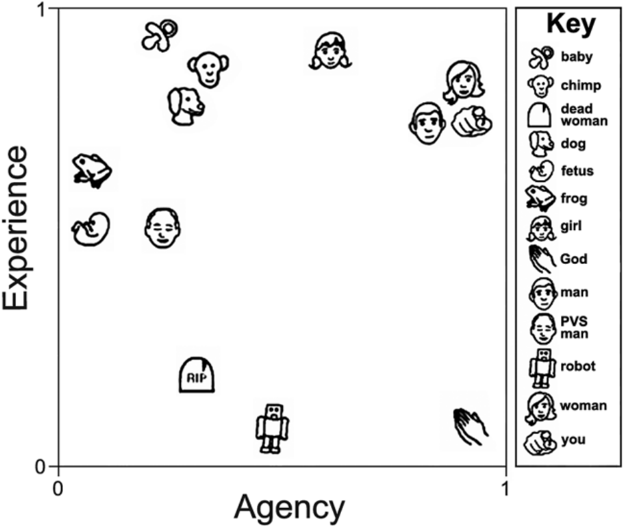
Participants compared the mental capacities of various human and nonhuman characters via online surveys. Factor analysis revealed two dimensions of mind perception, Experience (for example, capacity for hunger) and Agency (for example, capacity for self-control). The dimensions predicted different moral judgments but were both related to valuing of mind.
Overview
CoChat Summary
## TL;DR
This paper argues that mind perception is not a single continuum but instead has two dimensions: Experience and Agency. Using 2,399 completed web-based surveys, the authors found that these dimensions explain how people judge minds across 13 characters and are differentially related to moral judgments.
## Key findings
- A principal components factor analysis of correlations among 18 mental capacities yielded two factors with eigenvalues over 1.0: Experience (eigenvalue 15.85, explaining 88% of variance) and Agency (eigenvalue 1.46, explaining 8% of variance); the rotated solution explained 97% of rating variance.
- Experience loaded on 11 capacities: hunger, fear, pain, pleasure, rage, desire, personality, consciousness, pride, embarrassment, and joy; Agency loaded on 7 capacities: self-control, morality, memory, emotion recognition, planning, communication, and thought.
- Personal judgments tracked the dimensions differently: liking, saving from destruction, making happy, and perceiving a soul correlated with both dimensions, with r ranging from 0.38 to 0.72.
- Punishment judgments correlated more with Agency than Experience (r = 0.82 vs. r = 0.22, z = 2.86, P < 0.05), while avoidance of harm correlated more with Experience than Agency (r = 0.85 vs. r = 0.26, z = 2.10, P < 0.05).
## Methods
- Web-based Mind Survey design: respondents saw pairwise comparisons of 13 characters across 18 mental capacities or 6 personal judgments, using five-point scales for 78 comparisons per survey.
- Sample: about 3,400 survey launches, with 2,399 completed surveys analyzed; respondents ranged from 12 to 75 years old (mean 30.44, SD 12.27) and were 64% female.
- Main analysis: character means were computed, correlations across capacities were submitted to principal components factor analysis with varimax rotation, and factor scores were estimated via regression; additional analyses examined correlations with personal judgments and individual-difference variables using z-statistics.
## Limitations
- The paper states that the surveys were largely independent and that respondent data came from web recruitment through other psychology sites, which makes the sample a convenience sample rather than a random population sample.
- Evident from the text: the factor structure is based on self-selected web respondents and on pairwise judgments of preselected characters and capacities, so generalizability beyond the survey context is not directly tested.
- The paper notes that about 25% of launched surveys were not completed, indicating noncompletion/missing-data attrition.
Model-written summary. Check it against the paper before relying on it.
Integrity signals
Registry
Cites
Statistics
Figures
Verification
Claims the paper makes
0 Valid · 0 Not valid · 0 Not checked · 18 Own results and interpretations
A result the paper reports from its own data — it cites no other source for it, so there is none to check. The quote shows it is in the paper.
In the paper
“Characters ' factor scores on these dimensions (Fig. 1) reveal interesting features; for example, God was perceived as having much Agency but little Experience.”
- Also stated in: § Dimensions of Mind Perception · plain
“for example, God was perceived as having much Agency but little Experience.”
plain- Asserted: passes — The authors put it forward as true.
- Checkable: passes — It can be checked against evidence.
- Load-bearing: unclear — It is unclear whether the paper’s conclusions depend on it.
- Based: passes — The paper gives a reason why it holds.
- Also stated in: § Dimensions of Mind Perception · plain
A result the paper reports from its own data — it cites no other source for it, so there is none to check. The quote shows it is in the paper.
In the paper
“A factor we termed Experience (eigenvalue = 15.85) accounted for 88% of the variance and included 11 capacities (from highest loading): hunger, fear, pain, pleasure, rage, desire, personality, consciousness, pride, embarrassment, and joy.”
plain- Asserted: passes — The authors put it forward as true.
- Checkable: passes — It can be checked against evidence.
- Load-bearing: passes — The paper’s conclusions depend on it.
- Based: passes — The paper gives a reason why it holds.
A result the paper reports from its own data — it cites no other source for it, so there is none to check. The quote shows it is in the paper.
In the paper
“Of 234 z -statistics (13 characters × 9 individual difference variables × 2 factors), 23 were statistically significant.”
plain- Asserted: passes — The authors put it forward as true.
- Checkable: passes — It can be checked against evidence.
- Load-bearing: unclear — It is unclear whether the paper’s conclusions depend on it.
- Based: passes — The paper gives a reason why it holds.
A result the paper reports from its own data — it cites no other source for it, so there is none to check. The quote shows it is in the paper.
In the paper
“whereas desire to avoid harming ( ' If you were forced to harm one of these characters, which one would it be more painful for you to harm? ' ) correlated more with Experience ( r = 0.85) than Agency ( r = 0.26, z = 2.10, P < 0.05).”
plainstates an association- Asserted: passes — The authors put it forward as true.
- Checkable: passes — It can be checked against evidence.
- Load-bearing: passes — The paper’s conclusions depend on it.
- Based: passes — The paper gives a reason why it holds.
A result the paper reports from its own data — it cites no other source for it, so there is none to check. The quote shows it is in the paper.
In the paper
“The rotated solution accounted for all 18 capacities (extraction communalities ranged from 0.82 to 0.99), explained 97% of rating variance, and yielded two factors with eigenvalues over 1.0.”
plainstates an association- Asserted: passes — The authors put it forward as true.
- Checkable: passes — It can be checked against evidence.
- Load-bearing: passes — The paper’s conclusions depend on it.
- Based: passes — The paper gives a reason why it holds.
5 more claims
Create a free account to see all 18 claims and every source verdict.
- It may state two separate claims as one. 8
- Probably not a substantial claim. 1
Claims other papers make about this one
Each is checked against this paper’s own text: does it say what the citing paper says it does?
The source backs part of the claim, not all of it — or backs it for a different population, condition or comparison.
In the citing paper
“People also anthropomorphize a range of inanimate objects and animals (Kwan & Fiske, 2008; Gray, Gray, & Wegner, 2007).”
From Dehumanized Perception: A Psychological Means to Facilitate Atrocities, Torture, and Genocide? (2011) · cites this paper as Gray, Gray, & Wegner, 2007
Experimental — accuracy not yet measuredThe source backs part of the claim, not all of it — or backs it for a different population, condition or comparison.
In the citing paper
“work in social psychology has demonstrated that mental state attribution is not a unitary concept, but rather involves distinct and independent dimensions of ‘intelligence’ and ‘experience’.”
From The influence of mental state attributions on trust in large language models (2025) · cites this paper as [19]
Experimental — accuracy not yet measuredThe source backs part of the claim, not all of it — or backs it for a different population, condition or comparison.
In the citing paper
“Participants’ ratings for each of the 65 traits (Supplementary Fig. S1a) were reduced via a principal component analysis to two main dimensions, which together explained 58% of the variance (Supplementary Fig. S1b) and mapped onto previously identified dimensions of ‘experience’ (e.g. experiencing pleasure or feeling fearful) and ‘intelligence’ (e.g. knowing things or making choices; Gray et al. 2”
From Folk psychological attributions of consciousness to large language models (2024) · cites this paper as Gray et al. 2007
Experimental — accuracy not yet measuredThe cited source says what the claim attributes to it.
In the citing paper
“This dissociation is supported by factor analyses of ratings of a variety of mental states, which reveal two fundamental factors: agency, or the capacity for high-level reasoning and planning, and experience, or the capacity for sensations and emotions19”
From The influence of mental state attributions on trust in large language models (2025) · cites this paper as [19]
The cited source says what the claim attributes to it.
In the citing paper
“Other work has systematically explored the dimensions underlying mental state attributions to various agents, revealing a two-dimensional structure distinguishing between ‘Experience’ (i.e. the capacity to feel pain, fear, joy, or pride) and ‘Agency’ (i.e. the capacity to have self-control, morality, planning, or communication) that is reminiscent of the distinction between phenomenal and non-phen”
From Folk psychological attributions of consciousness to large language models (2024) · cites this paper as Gray et al. 2007
Statistics recomputed
Every reported test result, recomputed from its test statistic and degrees of freedom. A result shows as not adding up only once an independent check has confirmed it.
- Consistentz = 2.86reported p < .05 · recomputed p = .004
“z = 2.86, p < .05”
- Consistentz = 2.1reported p < .05 · recomputed p = .036
“z = 2.10, p < .05”
Self-check
Percentages, sums and reported differences re-computed from the paper’s own numbers.
Self-check results appear here once an independent check has confirmed them.
Citations
Cites
I.—COMPUTING MACHINERY AND INTELLIGENCE
TURING, A. M. (1950) · Mind · doi:10.1093/mind/lix.236.433 · Cited by 10,290
Does the chimpanzee have a theory of mind?
Premack, D., & Woodruff, G. (1978) · Behavioral and Brain Sciences · doi:10.1017/s0140525x00076512 · Cited by 8,743
Mindblindness: An Essay on Autism and Theory of Mind
Baron-Cohen, S. (1995) · doi:10.7551/mitpress/4635.001.0001 · Cited by 3,428
Dennett, D. C. (1996) · Medical Entomology and Zoology · Cited by 314
Research works printed but not linked: 1
- A. Turing, Mind59, 433 (1950).
Cited by
Items 1,301–1,400 of 2,340
Building bridges across species: empathy, prosociality, and ecosocial education
Keto, S. (2025) · Environmental Education Research · doi:10.1080/13504622.2025.2538771 · Cited by 6
“It has been observed that people who attributed a greater capacity for sensing and feeling to nonhuman entities were more hesitant to cause harm to them (Gray, Gray, and Wegner 2007).”
Robots allow for indulgence: how service robots impact consumers’ unhealthy food choices
Li, Y., Chang, Y., & Li, Y. (2025) · International Journal of Contemporary Hospitality Management · doi:10.1108/ijchm-11-2024-1678 · Cited by 5
Lin, T.-H., Kopelman, Y. R., Busse, M., Sebo, S. S., & Erel, H. (2025) · Computers in Human Behavior · doi:10.1016/j.chb.2025.108807 · Cited by 7
“…and pre-assumed human-like capabilities, may have made the participants attribute more mind and perceived agency to the high anthropomorphism robot (Gray et al., 2007; Marchesi et al., 2022; Nijssen et al., 2019) and thus take its negative feedback more seriously compared to the low…”
Furry Friends: Direct and Indirect Benefits of Human‐Animal Relationships on Well‐Being
McConnell, A. R., Folmsbee, J. R., & Aldstadt, K. M. (2025) · Social and Personality Psychology Compass · doi:10.1111/spc3.70091 · Cited by 8
Chen, Z., Liu, C., Ren, Y., Song, G., & Zhang, X. (2025) · Computers in Human Behavior Reports · doi:10.1016/j.chbr.2025.100827 · Cited by 6
Why human mistakes hurt more? Emotional responses in human-AI errors
Qin, Y., Zhou, W. A., & Zhong, B. (2025) · Computers in Human Behavior Artificial Humans · doi:10.1016/j.chbah.2025.100238 · Cited by 8
Neldner, K., Maurits, L., Junker, M., Abbas, L., Abbas, N., Abis, A., Amici, F., Arroyo-Garcia, B., Asghari, N., Pardo, G. B., et al. (2025) · Journal of Environmental Psychology · doi:10.1016/j.jenvp.2025.102861 · Cited by 4
Song, D., Deng, Z., & Evans, R. D. (2025) · Technological Forecasting and Social Change · doi:10.1016/j.techfore.2025.124482 · Cited by 6
Human nature in a virtual world: The attribution of mind perception to avatars
Mazerant, K., van Berlo, Z. M. C., Schouten, A. P., & Willemsen, L. M. (2025) · Computers in Human Behavior Artificial Humans · doi:10.1016/j.chbah.2025.100222 · Cited by 8
Gong, Z.-P., Han, X., & Zheng, Y. (2025) · Government Information Quarterly · doi:10.1016/j.giq.2025.102087 · Cited by 4
Ansari, B., & Sameer, A. (2026) · Journal of Technology in Behavioral Science · doi:10.1007/s41347-026-00594-7 · Cited by 5
AI influencers' humanlikeness, trust and relationships among female consumers
Kim, T. H., & Im, H. (2026) · International Journal of Retail & Distribution Management · doi:10.1108/ijrdm-01-2025-0050 · Cited by 6
Küçükuncular, A. (2026) · Frontiers in Robotics and AI · doi:10.3389/frobt.2026.1776097 · Cited by 5
“What is the consciousness claim, if any: access consciousness, phenomenal consciousness, or human perceived mindedness (Dehaene et al., 2017; Gray et al., 2007).”
InfluentialFan, X., & Kwon, S. (2026) · Technological Forecasting and Social Change · doi:10.1016/j.techfore.2026.124622 · Cited by 6
Can humans feel connected to AI? Perceived responsiveness drives social connection with AI chatbots
Telari, A., Gabbiadini, A., & Riva, P. (2026) · Journal of Social and Personal Relationships · doi:10.1177/02654075261438164 · Cited by 9
“Relational chatbots were attributed greater agency and experience (Gray et al., 2007), which may encourage more social engagement.”
A meta-analysis of the effects of AI agent implementation on customer-level outcomes
Raja, S. V. S., Orazi, D. C., Cheng, Y., & Belli, A. (2026) · Journal of Business Research · doi:10.1016/j.jbusres.2026.116172 · Cited by 8
Into the black box: Laypeople's folk theories about generative artificial intelligence chatbots
Li, Z., Kim, N., & Chen, L. (2026) · Big Data & Society · doi:10.1177/20539517261447838 · Cited by 6
“…2021), while recent research reports that users attribute varying degrees of consciousness to LLM based system, This shift is partly explained by the presence of anthropomorphic cues, which have been shown to increase perceptions of AI as possessing a mind (Gray et al., 2007; Martini et al., 2016).”
Growing Technological Opacity and the Social Brain
Osiurak, F., & Federico, G. (2026) · Perspectives on Psychological Science · doi:10.1177/17456916261438090 · Cited by 6
“As shown by Gray et al. (2007), people attribute intentions in a graded manner to nonbiological entities as they become more humanlike, despite knowing that these entities lack biological life.”
Xu, L., Tian, H., Zhang, Y., & Feng, Y. U. (2026) · Journal of Business Research · doi:10.1016/j.jbusres.2026.116313 · Cited by 9
Hu, M., Ho, J. Q. H., Ng, C., Wong, S. S., & Hartanto, A. (2026) · Computers in Human Behavior Reports · doi:10.1016/j.chbr.2026.101149 · Cited by 7
Abubshait, A., Siri, G., & Wykowska, A. (2022) · Acta Psychologica · doi:10.1016/j.actpsy.2022.103660 · Cited by 5
Sohail, S., Sajjad, A., & Zafar, S. (2022) · Frontiers in Psychology · doi:10.3389/fpsyg.2022.913978 · Cited by 5
“This third category of anthropomorphism is known as “anthropomorphic thinking or mind perception” in which people attribute sensation, feelings of consciousness, and mental states to nonhuman entities ascribing deeper meaning to the entity being anthropomorphized (Gray et al., 2007; Gray and Wegner, 2009; Epley and Wa…”
BackgroundYue, T., Haotian, Z., Zhao, S., Kaiping, P., & Hu, X. (2023) · Acta Psychologica Sinica · doi:10.3724/sp.j.1041.2024.00146 · Cited by 6
Yücel, E., Yıldırım, H. H., & Ceylan, M. Ş. (2024) · International Journal of Social Inquiry · doi:10.37093/ijsi.1372866 · Cited by 4
“This finding might imply the superiority of animals’ perceived sensation capacity over their intellect capacity in shaping moral attitudes toward animals (Gray et al., 2007; Singer, 1975).”
BackgroundConsumer Responses to CSR News of Family Business Brands: An Experimental Approach
Jaufenthaler, P., Schroll, R., & Grewal, D. (2024) · Family Business Review · doi:10.1177/08944865241285488 · Cited by 7
“Morality is a trait that is uniquely human (Gray et al., 2007; Waytz et al., 2010), which is why we pro-pose that a company that demonstrates such moral behaviors will be perceived as more human than a company that does not.”
Motives and Risks of Self-Disclosure to Robots versus Humans
Augustine, A. A., & Eyssel, F. (2024) · ACM Transactions on Human-Robot Interaction · doi:10.1145/3700887 · Cited by 13
“Robots are not perceived to have feelings [20], and are thus not capable of social approval or social rejection [22].”
Bakan, U., Han, T., & Bakan, U. (2025) · Intelligent Service Robotics · doi:10.1007/s11370-024-00575-w · Cited by 6
“This finding contrasts with earlier studies that suggested prior experience with robots might influence perceptions of human likeness in digital characters [53, 64, 65].”
YANIT, M. (2025) · Computers in Human Behavior Reports · doi:10.1016/j.chbr.2025.100682 · Cited by 4
Wang, Y., Jiao, Y., & Wang, Q. (2025) · Business Process Management Journal · doi:10.1108/bpmj-12-2024-1217 · Cited by 6
Exploring User Attitudes and Trust Toward ChatGPT as a Social Actor: A UTAUT-Based Analysis
Noh, H., Rim, H. B., & Lee, B. (2025) · SAGE Open · doi:10.1177/21582440251345896 · Cited by 6
“This understanding hinges on identifying the criteria for attributing mental attributes, with experience and agency playing pivotal roles (Gray et al., 2007).”
Lee, Y., & Kim, S.-H. (2025) · Proceedings of the Human Factors and Ergonomics Society Annual Meeting · doi:10.1177/10711813251358801 · Cited by 7
“To understand how we perceive the mind, Gray et al. (2007) proposed a mind perception framework that conceptualizes the mind along two key dimensions: Agency , which refers to the capacity for thought, planning, and self-control, and Experience , which encompasses the ability to feel emotions and…”
Friend or Foe? An empirical study on the mechanisms triggering robot abuse
Chen, Y., Cao, J., Liu, S., Huang, M., Wan, F., & Chen, C. W. (2025) · Journal of Hospitality and Tourism Management · doi:10.1016/j.jhtm.2025.101318 · Cited by 6
How musicality changes moral consideration: People judge musical entities as more wrong to harm
Agrawal, T., Rottman, J., & Schachner, A. (2022) · Psychology of Music · doi:10.1177/03057356221096507 · Cited by 6
Human-Animal Similarity and the Imageability of Mental State Concepts for Mentalizing Animals
Urquiza-Haas, E. G., & Kotrschal, K. M. (2022) · Journal of Cognition and Culture · doi:10.1163/15685373-12340133 · Cited by 5
Watching Animal-Computer Interaction: Effects on Perceptions of Animal Intellect
Webber, S. E., Smith, W., Carter, M., & Vetere, F. (2022) · International Conference on Animal-Computer Interaction (ACI) · doi:10.1145/3565995.3566035 · Cited by 5
“With regards to intellect, studies of belief in animal mind tend to explore loosely-defined cognitive process such as learning [25, 37] and memory [23, 33, 37].”
BackgroundMinds of Monsters: Scary Imbalances Between Cognition and Emotion
Hernandez, I. A., Ritter, R. S., & Preston, J. L. (2023) · Personality and Social Psychology Bulletin · doi:10.1177/01461672231160035 · Cited by 4
“Second, participants rated the target’s capacity for cognition and emotion using the 18 different mental capacities found by H. M. Gray et al. (2007).”
BackgroundMethodInfluentialBolstering Policy Support for Disadvantaged Groups Through Humanization
Findor, A., Hruška, M., Hlatky, R., Dvorská, A., Hrustič, T., Bošeľová, Z., & Buchel, O. (2023) · Social Psychological and Personality Science · doi:10.1177/19485506231167494 · Cited by 4
“Dehumanized targets are denied experience (capacity to feel) and agency (capacity for thought) (Gray et al., 2007; Waytz et al., 2010), and are thus perceived as animalistic—lacking in human uniqueness (e.g., rationality, morality, civility)—and mechanistic—lacking in human nature (e.g.,…”
BackgroundJeong, H. J. (2023) · Journal of Marketing Communications · doi:10.1080/13527266.2023.2208127 · Cited by 5
“…by the claim that warmth is the primary dimension of social perceptions in judging others and organizations in a social setting (Fiske et al. 2002; Author 2021), accounting for about 88% of the variance in our perceptions in identifying other individuals and entities (Gray, Gray, and Wegner 2007).”
Goo, H. G., Winkle, K., Williams, T., & Strait, M. K. (2023) · IEEE RO-MAN · doi:10.1109/ro-man57019.2023.10309640 · Cited by 13
“Effects of the manipulations: Using the Positive and Negative Affect Schedule [39] and the Mind Perception Scale [40], we assessed participants’ negative affect and humanization of the victimized agent (inferred from their attributions of agency and experiential capacity ), and, via factor analysis…”
MethodPimp my language! The influence of robot customization duration on psychological ownership and trust
Lacroix, D., Schober, J., Wullenkord, R., & Eyssel, F. (2023) · IEEE RO-MAN · doi:10.1109/ro-man57019.2023.10309370 · Cited by 4
“Furthermore, we used a short version of the mind attribution scale (MAS) [25], reflecting both experience (e.g., “To what extent is the robot NAO capable of feeling joy?””
MethodSainz, M., & Vázquez, A. (2023) · British Journal of Social Psychology · doi:10.1111/bjso.12697 · Cited by 7
„Creating God“: Religiöse Metaphorik in KI- und Technikdiskursen
Rothenhäusler, A. (2024) · De Gruyter eBooks · doi:10.1515/9783111351490-013 · Cited by 4
Experimental Philosophy of Consciousness
Reuter, K. (2024) · Oxford University Press eBooks · doi:10.1093/9780198918905.003.0017 · Cited by 7
Mu, Y., & Karasawa, M. (2024) · Cogent Psychology · doi:10.1080/23311908.2024.2384298 · Cited by 5
“People tend to infer a higher level of mental agency in human targets than in non-human targets (gray et al., 2007), even at the subconscious level (Z. li, et al., 2022). humans generally tend to be perceived as engaging in acts with a greater degree of agency and volition than non-human objects.…”
Would I lie to you? How interaction with chatbots induces dishonesty
Biener, C., & Waeber, A. (2024) · Journal of Behavioral and Experimental Economics · doi:10.1016/j.socec.2024.102279 · Cited by 11
Anthropomorphism – a double edged sword: influences on acceptance of livestock keeping
Knörr, A., Zhou, X., Bearth, A., & Siegrist, M. (2024) · Agriculture and Human Values · doi:10.1007/s10460-024-10621-z · Cited by 6
“According to Gray et al. (2007), moral agency is connected to being liable for one’s own life and being able to control one’s destiny, that is, being held responsible for one’s actions.”
InfluentialResponding to Cyberattacks: The Persuasiveness of Claiming Victimhood
Antonetti, P., & Baghi, I. (2024) · Journal of Service Research · doi:10.1177/10946705241271337 · Cited by 6
“While agents are attributed the ability to carry out plans and act intentionally, patients are seen as primarily able to experience positive or negative mental states such as pain, suffering, or joy (Gray, Gray, and Wegner 2007).”
Chen, Y., Tu, Y., & Zeng, S. (2024) · Sustainability · doi:10.3390/su16188236 · Cited by 3
Personality- and Memory-based framework for Emotionally Intelligent agents
Nardelli, A., Maccagni, G., Minutoli, F., Sgorbissa, A., & Recchiuto, C. T. (2024) · IEEE RO-MAN · doi:10.1109/ro-man60168.2024.10731309 · Cited by 11
“The second questionnaire measured the Agency and Experience of the digital human [19] (Hypothesis II).”
BackgroundThe Prioritization of Prospection
Caruso, E. M., Maglio, S. J., & Boven, L. V. (2024) · Personality and Social Psychology Review · doi:10.1177/10888683241292849 · Cited by 8
Consume humanity: Eating anthropomorphic food leads to the dehumanization of others
Wu, H., Wu, C., Zhang, J., Hu, Y., Liang, F., & He, X. (2024) · Journal of Experimental Social Psychology · doi:10.1016/j.jesp.2024.104710 · Cited by 4
How virtual streamers controlling entities and product sensitivity shape consumer purchase intention
Gong, X., Jiang, X., & Wang, M. (2025) · Electronic Commerce Research · doi:10.1007/s10660-025-10037-9 · Cited by 6
“For instance, babies are seen as high in emotional perception but low in cognitive autonomy, whereas God is viewed as high in cognitive autonomy but low in emotional perception [ 21, 38].”
InfluentialAgency Detection in God Concepts: Essential, Situational, and Individual Factors
Grysman, A., & Hudson, J. A. (2012) · Journal of Cognition and Culture · doi:10.1163/156853712x633965 · Cited by 4
Reasoning about Human Enhancement
Wilson, S. G., & Haslam, N. (2012) · IGI Global eBooks · doi:10.4018/978-1-4666-2211-1.ch010 · Cited by 4
Does Watching a Play about the Teenage Brain Affect Attitudes toward Young Offenders?
Blakey, R. (2017) · Frontiers in Psychology · doi:10.3389/fpsyg.2017.00964 · Cited by 4
“Indeed, people do not consider the brain sufficient or necessary to attribute agency to artificial actors, such as God, robots, frogs, newborns, or organizations (Gray et al., 2007; Knobe and Prinz, 2008).”
BackgroundThe Ascent of Man: A Theoretical and Empirical Case for Blatant Dehumanization
Bruneau, E., Kteily, N., Waytz, A. G., & Cotterill, S. (2015) · Cited by 4
Ze, Z., & Bao-Pei, W. (2019) · Advances in Psychological Science · doi:10.3724/sp.j.1042.2019.00128 · Cited by 6
“…动性”是计划与执行的心智能力, 包括自我控制、 判断、交流、思考、记忆, “感受性”是感觉和感受 的心智能力, 包括饥饿、害怕、痛苦、愉快。实 体在这两个独立维度上 , 可双高 , 可双低 , 也可 一高一低。双高, 诸如成年人; 双低, 诸如死者、 无生命客体; 低能动性、高感受性, 诸如动物、儿 童; 低感受性、高能动性, 诸如上帝。对他人心智 的感知, 影响道德判断。能动性与道德责任(moral responsibilities)相对应, 感受性与道德权利(moral rights)相对应。通常, 道德行为者, 被认为具有更 多的能动性与道德责任; 而道德受害者, 则具有…”
Personhood and care in disorders of consciousness. An ontological, patient-centred perspective
Zilio, F. (2020) · Medicina e Morale · doi:10.4081/mem.2020.706 · Cited by 5
Driving with Robots: Mind perception and propensity for aggressive driving
Nachmann, K., Pillot, B., Moore, P., & Wiese, E. (2020) · Proceedings of the Human Factors and Ergonomics Society Annual Meeting · doi:10.1177/1071181320641473 · Cited by 6
Humanness Is Not Always Positive: Automatic Associations between Incivilities and Human Symbols
Rodríguez-Gómez, L., Delgado, N., Betancor, V., Chen-Xia, X. J., & Pérez, A. R. (2021) · International Journal of Environmental Research and Public Health · doi:10.3390/ijerph18084353 · Cited by 4
“From the mind perception framework [24,25], two dimensions comprise what people consider to be a truly human mind: agency and experience.”
BackgroundWebb, C. E., Franks, B., Gagliano, M., & Smuts, B. B. (2023) · Routledge eBooks · doi:10.4324/9781003189978-15 · Cited by 11
Computer anthropomorphisation in a socio-economic dilemma
Cogoni, C., Fiuza, A., Hassanein, L. A., Antunes, M. C. D. S., & Prata, D. P. (2023) · Behavior Research Methods · doi:10.3758/s13428-023-02071-y · Cited by 4
“…indicating that all opponents were seen more as agents (i.e. deliberately making choices in the PD game) than as beings that experience emotions (Gray et al., 2007; Gray et al., 2011) (the mind dimension explained 68% of the variance in mind attribution ratings, left unexplained by play order…”
BackgroundMethodSpatola, N., & Chérif, E. (2023) · Computers in Human Behavior Artificial Humans · doi:10.1016/j.chbah.2023.100012 · Cited by 6
Lelieveld, G., Noordewier, M. K., Doolaard, F. T., & van Dijk, E. (2024) · Current Research in Ecological and Social Psychology · doi:10.1016/j.cresp.2024.100182 · Cited by 8
The Medusa effect: a registered replication report of Will, Merritt, Jenkins and Kingstone (2021)
Han, J., Zhang, M., Liu, J., Song, Y., & Yamada, Y. (2024) · Royal Society Open Science · doi:10.1098/rsos.231802 · Cited by 6
“[12], which refers to people intuitively thinking about other minds in terms of Experience (the capacity to sense and feel) and Agency (the capacity to plan and act).”
BackgroundInvestigating Mind Perception in HRI through Real-Time Implicit and Explicit Measurements
Pekçetin, T. N., Acartürk, C., & Ürgen, B. A. (2024) · ACM/IEEE International Conference on Human-Robot Interaction (HRI) · doi:10.1145/3610978.3638366 · Cited by 6
“Implicit Measurements We focused on the Agency and Experience dimensions of mind perception [12], aligning with the binary structure of the implicit association task (IAT) [16].”
MethodSöderlund, M., & Natorina, A. (2024) · Technology in Society · doi:10.1016/j.techsoc.2024.102560 · Cited by 7
Dehumanization of Uncivil Behaviors: Insights into Lack of Humanness and Racial Belonging
Chen-Xia, X. J., Betancor, V., Borges-Castells, N., & Pérez, A. R. (2024) · Social Sciences · doi:10.3390/socsci13050234 · Cited by 4
“This discrimination ranges from blatant forms where they are directly called apes, to subtle forms where they are considered as lesser individuals that are incapable of emotional regulation and self-control (Goff et al. 2008; Gray et al. 2007; Wittenbrink et al. 1997).”
BackgroundAnimacy perception of agents: Their effects on users behavior and variability between age groups
Hasegawa, R., Harada, E. T., Kayano, W., & Ōsawa, H. (2015) · IEEE RO-MAN · doi:10.1109/roman.2015.7333631 · Cited by 4
Negative Consequences of Anthropomorphized Technology: A Bias-Threat-Illusion Model
Zheng, J. (., & Järvenpää, S. L. (2019) · Hawaii International Conference on System Sciences (HICSS) · doi:10.24251/hicss.2019.804 · Cited by 6
Attributing Mind to Groups and Their Members on Two Dimensions
Tanibe, T., Hashimoto, T., Tomabechi, T., Masamoto, T., & Karasawa, K. (2019) · Frontiers in Psychology · doi:10.3389/fpsyg.2019.00840 · Cited by 3
Social Robots as Communication Partners to Support Emotional Health and Well-Being
Laban, G. (2022) · International Conference on Affective Computing and Intelligent Interaction Workshops and Demos (ACIIW) · doi:10.1109/aciiw57231.2022.10086018 · Cited by 5
“After each interaction participants evaluated the robot (e.g., mind perception [23]), the interaction (e.g., interaction quality [26]), other affect-related factors (e.g., mood [27]), as well as caregiving related factors (e.g., caregiver burden [31]).”
BackgroundMethodInfluentialKuroda, T., Yamada, S., & Terada, K. (2015) · Transactions of the Japanese Society for Artificial Intelligence · doi:10.1527/tjsai.g-f78 · Cited by 5
Lay Theories of the Mind/Brain Relationship and the Allure of Neuroscience
Fernandez‐Duque, D. (2017) · Springer eBooks · doi:10.1007/978-3-319-57306-9_9 · Cited by 4
Jouffre, S., Ghazal, J., Robert, R., Reignier, J., & Albarracín, D. (2018) · Journal of Palliative Medicine · doi:10.1089/jpm.2017.0502 · Cited by 4
“, ‘‘feeling afraid or fearful’’) by completing the validated Dimensions of Mind Perception questionnaire.(17,19) All items were rated on 7-point scales (-3, not at all, to 3, completely).”
MethodJaeger, C. B., Hymel, A. M., Levin, D. T., Biswas, G., Paul, N. A., & Kinnebrew, J. S. (2019) · Cognitive Research Principles and Implications · doi:10.1186/s41235-019-0163-6 · Cited by 6
The Role of Morality in Social Cognition
Ray, J. L., Mende‐Siedlecki, P., Gantman, A. P., & Bavel, J. J. V. (2021) · Springer eBooks · doi:10.1007/978-3-030-51890-5_28 · Cited by 5
Morris, K. L. (2013) · Digital Commons - University of South Florida (University of South Florida) · Cited by 4
Bayesian Inference of Other Minds Explains Human Choices in Group Decision MakingPreprint
Khalvati, K., Park, S. A., Mirbagheri, S., Philippe, R., Sestito, M., Dreher, J., & Rao, R. P. N. (2018) · bioRxiv (Cold Spring Harbor Laboratory) · doi:10.1101/419515 · Cited by 9
“…we would need to modify the model’s definition of the state of other minds to include dimensions such as valence, competence, and social impact instead of propensity to contribute monetary units as in the PGG task (Posner et al., 2005; Gray et al., 2007; Cuddy et al., 2008; Tamir et al., 2016).”
MethodWallkötter, S., Stower, R. E., Kappas, A., et al. (2020) · arXiv (Cornell University) · doi:10.48550/arxiv.2004.07594 · Cited by 4
“states [33, 43]. Finally, mind perception, as the focus of this paper, is related to the intentional stance [43, 52] and refers to the extent to which agents are seen as possessing a mind and agency [21]. There is a general consensus that the more human-like the robot appears to be, the greater the degree of anthropom…”
BackgroundMethodInfluentialSpontaneous Perspective Taking Toward Robots: The Unique Impact of Humanlike AppearancePreprint
Zhao, X., & Malle, B. F. (2019) · doi:10.31234/osf.io/8z72c · Cited by 4
Do Robo-Advisors Make Us Better Investors?Preprint
Back, C., Morana, S., & Spann, M. (2021) · Social Science Research Network · doi:10.5282/ubm/epub.75122 · Cited by 13
The relative importance of target and judge characteristics in shaping our moral circlePreprint
Jaeger, B., & Wilks, M. (2021) · doi:10.31234/osf.io/46kws · Cited by 4
The Terminology of Artificial SentiencePreprint
Pauketat, J. V. T. (2021) · PsyArXiv (OSF Preprints) · doi:10.31234/osf.io/sujwf · Cited by 6
Mentalizing During Social InterAction: A Four Component ModelPreprint
Wu, H., Liu, X., Hagan, C. C., et al. (2019) · doi:10.31234/osf.io/ftgs3 · Cited by 4
Under Pressure: Examining Social Conformity with Computer and Robot GroupsPreprint
Hertz, N., & Wiese, E. (2018) · PsyArXiv (OSF Preprints) · doi:10.31234/osf.io/trc9a · Cited by 4
Two Conceptions of Subjective Experience
Sytsma, J. M., & Machery, É. (2008) · PsycEXTRA Dataset · doi:10.1037/e511972013-016 · Cited by 5
Deployment of Algorithms in Management Tasks Reduces Prosocial MotivationPreprint
Granulo, A., Caprioli, S., Fuchs, C., & Puntoni, S. (2023) · doi:10.31234/osf.io/fz9h4 · Cited by 4
Artificial Intelligence Quotient (AIQ)Preprint
Qin, X., Lu, J. G., Chen, C., Zhou, X., Gan, Y., Li, W., & Song, L. L. (2024) · PsyArXiv (OSF Preprints) · doi:10.31234/osf.io/qjm3r · Cited by 5
No Hard Feelings: The Protective Power of AI Empathy During Service Interaction FailuresPreprint
Efthymiou, F., Mari, A., Uysal, E., & Brooks, J. (2025) · SSRN Electronic Journal · doi:10.2139/ssrn.5367747 · Cited by 5
Folk-Ontological Stances Towards Robots and Psychological Human Likeness
Datteri, E. (2025) · International Journal of Social Robotics · doi:10.1007/s12369-025-01225-6 · Cited by 4
Hu, X., Xu, H., Chen, H., Shen, M., & Zhou, J. (2025) · Cognition · doi:10.1016/j.cognition.2025.106101 · Cited by 4
Emotional anthropomorphism of notifications and app engagement: does the usage frequency matter?
Li, Y., Hwang, I., & Choi, J. (2025) · Journal of Research in Interactive Marketing · doi:10.1108/jrim-10-2024-0488 · Cited by 6
Dehumanization and aggression: A meta-analysis
Cheng, L., Zhang, J., Liao, J., Peng, F., & Wang, X. (2025) · Aggression and Violent Behavior · doi:10.1016/j.avb.2025.102079 · Cited by 7
Developing Intuitions That Close Friends Know the Content of Each Other’s Minds
Woo, B. M., Yu, E., Richardson, M., & Thomas, A. J. (2025) · Open Mind · doi:10.1162/opmi.a.22 · Cited by 3
Wei, C., Peng, L., & Zhu, Q. (2025) · Psychology and Marketing · doi:10.1002/mar.70007 · Cited by 3
“We draw this prediction based on the theory of mind perception (Gray et al. 2007; Gray and Wegner 2012), which suggests that AI is perceived as possessing significantly lower levels of agency (e.g., the ability to think) and experience (e.g., the ability to feel) compared to humans.”
InfluentialHou, C., Li, T., & Gu, Y. (2025) · Journal of Retailing and Consumer Services · doi:10.1016/j.jretconser.2025.104544 · Cited by 7
Álamo-Hernández, A., Sainz, M., Betancor, V., & Pérez, A. R. (2025) · Behavioral Sciences · doi:10.3390/bs15101317 · Cited by 4
“This process involves perceiving individuals as lacking the traits considered fundamental to human nature (Gray et al., 2007; Haslam, 2006; Leyens et al., 2000).”
Yu, G., Jiang, Y., Balaji, M. S., & Wang, Y. J. (2025) · International Journal of Hospitality Management · doi:10.1016/j.ijhm.2025.104476 · Cited by 5
Duan, Y., Hao, Z., Liang, F., Fan, M., Zhang, W., Wu, C., & He, X. (2025) · Journal of theoretical and applied electronic commerce research · doi:10.3390/jtaer20040305 · Cited by 4
“To explain this deeper process, we draw on Mind Perception Theory, a foundational framework in social cognition that explains how people attribute mental states to other entities [17].”
Influential
Metadata
- Authors
- Gray, H. M., Gray, K., & Wegner, D. M.
- Affiliations
- Harvard University (US)
- Corresponding author
- Gray, Heather M.
- Venue
- Science
- Published
- 2007-02-02
- Volume
- 315
- Issue
- 5812
- Pages
- 619-619
- ISSN
- 0036-8075 (ISSN-L)
- 1095-9203
- OpenAlex
- W2131227926
- Cited by
- 2,342
- References
- 4
- Citations by year
- 2026: 359 · 2025: 326 · 2024: 249 · 2023: 220 · 2022: 198 · 2021: 156 · 2020: 157 · 2019: 107 · 2018: 91 · 2017: 86 · 2016: 96 · 2015: 66 · 2014: 52 · 2013: 44 · 2012: 45
- FWCI
- 10.81
- Type
- journal article
- Language
- en
- Open access
- closed
- Locations
- Science (publishedVersion)
- PubMed (publishedVersion)
- Funders
- National Institutes of Health (1f31mh071053-01)
- National Institute of Mental Health (MH-71053, MH 49127, R01MH049127)
- Topics
- Life Sciences › Neuroscience › Cognitive Neuroscience › Psychology of Moral and Emotional Judgment
- Social Sciences › Psychology › Social Psychology › Social Robot Interaction and HRI
- Social Sciences › Sociology and Political Science › Social and Intergroup Psychology
- Keywords
- mind perception, moral judgment, agency, experience, non-human animals, personification, moral status of animals, self-control, hunger
- MeSH terms
- Adolescent, Adult, Aged, Child, Emotions, Female, Humans, Male, Mental Processes, Middle Aged, Morals, Perception, Personality, Principal Component Analysis
About these checks
Registry, retraction, Cites and statistics results are computed, not judged, with one exception: a printed reference that no index lists is read once by a model before it counts as a citation error. Claims are extracted by a model and kept only when their quote appears verbatim in the text; each cited source is then checked, with a model’s help, for whether it says what the claim relies on. Those verdicts can be wrong — read the claim’s quote and the cited source before relying on one.
A language model drew the claims from the paper on 2026-09-28, under version 3 of the claim definition (model deepseek-v4.1-flash, prompt extract-v3).
A second model labelled each claim on 2026-09-28 (model jev-1.13-20260917, definition revision gold-guideline-v0.2).
Statistics and arithmetic are recomputed, not judged.
Confidence bands are shown only for fields calibrated on our annotated test set. None is calibrated yet, so no band is shown.
What counts as a claim ›How we measure confidence ›How we check this ›
Are you an author, or do you see a problem with this page? Request a review
Data sources
Bibliographic data: Semantic Scholar, OpenAlex, Crossref.
Contains information from the Semantic Scholar Academic Graph Datasets, made available under the ODC Attribution License (ODC-BY 1.0).
Semantic Scholar’s data is described in: Kinney, R., et al. (2023). The Semantic Scholar Open Data Platform. arXiv:2301.10140.
