

Dimensions of Mind Perception
The DOI matches its Crossref record; 4 of the 4 references it cites were found in a registry or an index.
Abstract
Participants compared the mental capacities of various human and nonhuman characters via online surveys. Factor analysis revealed two dimensions of mind perception, Experience (for example, capacity for hunger) and Agency (for example, capacity for self-control). The dimensions predicted different moral judgments but were both related to valuing of mind.
Overview
CoChat Summary
## TL;DR
This paper argues that mind perception is not a single continuum but instead has two dimensions: Experience and Agency. Using 2,399 completed web-based surveys, the authors found that these dimensions explain how people judge minds across 13 characters and are differentially related to moral judgments.
## Key findings
- A principal components factor analysis of correlations among 18 mental capacities yielded two factors with eigenvalues over 1.0: Experience (eigenvalue 15.85, explaining 88% of variance) and Agency (eigenvalue 1.46, explaining 8% of variance); the rotated solution explained 97% of rating variance.
- Experience loaded on 11 capacities: hunger, fear, pain, pleasure, rage, desire, personality, consciousness, pride, embarrassment, and joy; Agency loaded on 7 capacities: self-control, morality, memory, emotion recognition, planning, communication, and thought.
- Personal judgments tracked the dimensions differently: liking, saving from destruction, making happy, and perceiving a soul correlated with both dimensions, with r ranging from 0.38 to 0.72.
- Punishment judgments correlated more with Agency than Experience (r = 0.82 vs. r = 0.22, z = 2.86, P < 0.05), while avoidance of harm correlated more with Experience than Agency (r = 0.85 vs. r = 0.26, z = 2.10, P < 0.05).
## Methods
- Web-based Mind Survey design: respondents saw pairwise comparisons of 13 characters across 18 mental capacities or 6 personal judgments, using five-point scales for 78 comparisons per survey.
- Sample: about 3,400 survey launches, with 2,399 completed surveys analyzed; respondents ranged from 12 to 75 years old (mean 30.44, SD 12.27) and were 64% female.
- Main analysis: character means were computed, correlations across capacities were submitted to principal components factor analysis with varimax rotation, and factor scores were estimated via regression; additional analyses examined correlations with personal judgments and individual-difference variables using z-statistics.
## Limitations
- The paper states that the surveys were largely independent and that respondent data came from web recruitment through other psychology sites, which makes the sample a convenience sample rather than a random population sample.
- Evident from the text: the factor structure is based on self-selected web respondents and on pairwise judgments of preselected characters and capacities, so generalizability beyond the survey context is not directly tested.
- The paper notes that about 25% of launched surveys were not completed, indicating noncompletion/missing-data attrition.
Model-written summary. Check it against the paper before relying on it.
Integrity signals
Registry
Cites
Statistics
Figures
Verification
Claims the paper makes
0 Valid · 0 Not valid · 0 Not checked · 18 Own results and interpretations
A result the paper reports from its own data — it cites no other source for it, so there is none to check. The quote shows it is in the paper.
In the paper
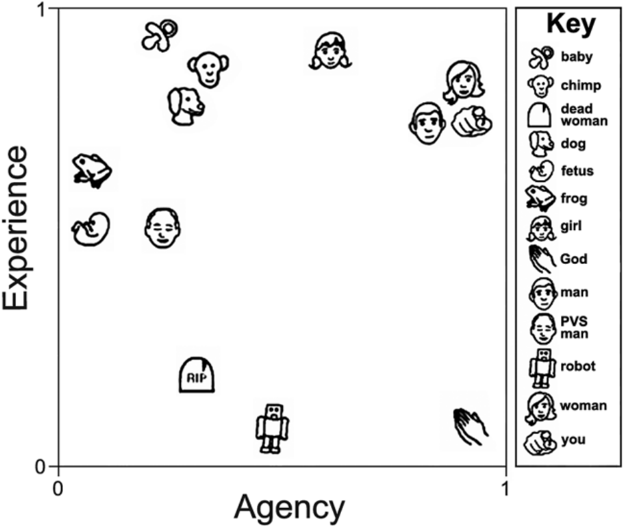
“Characters ' factor scores on these dimensions (Fig. 1) reveal interesting features; for example, God was perceived as having much Agency but little Experience.”
- Also stated in: § Dimensions of Mind Perception · plain
“for example, God was perceived as having much Agency but little Experience.”
plain- Asserted: passes — The authors put it forward as true.
- Checkable: passes — It can be checked against evidence.
- Load-bearing: unclear — It is unclear whether the paper’s conclusions depend on it.
- Based: passes — The paper gives a reason why it holds.
- Also stated in: § Dimensions of Mind Perception · plain
A result the paper reports from its own data — it cites no other source for it, so there is none to check. The quote shows it is in the paper.
In the paper
“A factor we termed Experience (eigenvalue = 15.85) accounted for 88% of the variance and included 11 capacities (from highest loading): hunger, fear, pain, pleasure, rage, desire, personality, consciousness, pride, embarrassment, and joy.”
plain- Asserted: passes — The authors put it forward as true.
- Checkable: passes — It can be checked against evidence.
- Load-bearing: passes — The paper’s conclusions depend on it.
- Based: passes — The paper gives a reason why it holds.
A result the paper reports from its own data — it cites no other source for it, so there is none to check. The quote shows it is in the paper.
In the paper
“Of 234 z -statistics (13 characters × 9 individual difference variables × 2 factors), 23 were statistically significant.”
plain- Asserted: passes — The authors put it forward as true.
- Checkable: passes — It can be checked against evidence.
- Load-bearing: unclear — It is unclear whether the paper’s conclusions depend on it.
- Based: passes — The paper gives a reason why it holds.
A result the paper reports from its own data — it cites no other source for it, so there is none to check. The quote shows it is in the paper.
In the paper
“whereas desire to avoid harming ( ' If you were forced to harm one of these characters, which one would it be more painful for you to harm? ' ) correlated more with Experience ( r = 0.85) than Agency ( r = 0.26, z = 2.10, P < 0.05).”
plainstates an association- Asserted: passes — The authors put it forward as true.
- Checkable: passes — It can be checked against evidence.
- Load-bearing: passes — The paper’s conclusions depend on it.
- Based: passes — The paper gives a reason why it holds.
A result the paper reports from its own data — it cites no other source for it, so there is none to check. The quote shows it is in the paper.
In the paper
“The rotated solution accounted for all 18 capacities (extraction communalities ranged from 0.82 to 0.99), explained 97% of rating variance, and yielded two factors with eigenvalues over 1.0.”
plainstates an association- Asserted: passes — The authors put it forward as true.
- Checkable: passes — It can be checked against evidence.
- Load-bearing: passes — The paper’s conclusions depend on it.
- Based: passes — The paper gives a reason why it holds.
5 more claims
Create a free account to see all 18 claims and every source verdict.
- It may state two separate claims as one. 8
- Probably not a substantial claim. 1
Claims other papers make about this one
Each is checked against this paper’s own text: does it say what the citing paper says it does?
The source backs part of the claim, not all of it — or backs it for a different population, condition or comparison.
In the citing paper
“People also anthropomorphize a range of inanimate objects and animals (Kwan & Fiske, 2008; Gray, Gray, & Wegner, 2007).”
From Dehumanized Perception: A Psychological Means to Facilitate Atrocities, Torture, and Genocide? (2011) · cites this paper as Gray, Gray, & Wegner, 2007
Experimental — accuracy not yet measuredThe source backs part of the claim, not all of it — or backs it for a different population, condition or comparison.
In the citing paper
“work in social psychology has demonstrated that mental state attribution is not a unitary concept, but rather involves distinct and independent dimensions of ‘intelligence’ and ‘experience’.”
From The influence of mental state attributions on trust in large language models (2025) · cites this paper as [19]
Experimental — accuracy not yet measuredThe source backs part of the claim, not all of it — or backs it for a different population, condition or comparison.
In the citing paper
“Participants’ ratings for each of the 65 traits (Supplementary Fig. S1a) were reduced via a principal component analysis to two main dimensions, which together explained 58% of the variance (Supplementary Fig. S1b) and mapped onto previously identified dimensions of ‘experience’ (e.g. experiencing pleasure or feeling fearful) and ‘intelligence’ (e.g. knowing things or making choices; Gray et al. 2”
From Folk psychological attributions of consciousness to large language models (2024) · cites this paper as Gray et al. 2007
Experimental — accuracy not yet measuredThe cited source says what the claim attributes to it.
In the citing paper
“This dissociation is supported by factor analyses of ratings of a variety of mental states, which reveal two fundamental factors: agency, or the capacity for high-level reasoning and planning, and experience, or the capacity for sensations and emotions19”
From The influence of mental state attributions on trust in large language models (2025) · cites this paper as [19]
The cited source says what the claim attributes to it.
In the citing paper
“Other work has systematically explored the dimensions underlying mental state attributions to various agents, revealing a two-dimensional structure distinguishing between ‘Experience’ (i.e. the capacity to feel pain, fear, joy, or pride) and ‘Agency’ (i.e. the capacity to have self-control, morality, planning, or communication) that is reminiscent of the distinction between phenomenal and non-phen”
From Folk psychological attributions of consciousness to large language models (2024) · cites this paper as Gray et al. 2007
Statistics recomputed
Every reported test result, recomputed from its test statistic and degrees of freedom. A result shows as not adding up only once an independent check has confirmed it.
- Consistentz = 2.86reported p < .05 · recomputed p = .004
“z = 2.86, p < .05”
- Consistentz = 2.1reported p < .05 · recomputed p = .036
“z = 2.10, p < .05”
Self-check
Percentages, sums and reported differences re-computed from the paper’s own numbers.
Self-check results appear here once an independent check has confirmed them.
Citations
Cites
I.—COMPUTING MACHINERY AND INTELLIGENCE
TURING, A. M. (1950) · Mind · doi:10.1093/mind/lix.236.433 · Cited by 10,290
Does the chimpanzee have a theory of mind?
Premack, D., & Woodruff, G. (1978) · Behavioral and Brain Sciences · doi:10.1017/s0140525x00076512 · Cited by 8,743
Mindblindness: An Essay on Autism and Theory of Mind
Baron-Cohen, S. (1995) · doi:10.7551/mitpress/4635.001.0001 · Cited by 3,428
Dennett, D. C. (1996) · Medical Entomology and Zoology · Cited by 314
Research works printed but not linked: 1
- A. Turing, Mind59, 433 (1950).
Cited by
Items 1,101–1,200 of 2,340
When does “no” mean no? Insights from sex robots
Grigoreva, A. D., Rottman, J., & Tasimi, A. (2023) · Cognition · doi:10.1016/j.cognition.2023.105687 · Cited by 11
Poets Over Quants: Automation and AI Threats Increase the Value People Place on Creativity
Gamez-Djokic, M., Waytz, A. G., & Kouchaki, M. (2025) · Personality and Social Psychology Bulletin · doi:10.1177/01461672251337126 · Cited by 10
“Mind perception research similarly suggests that people perceive robots to possess agency (intentional planning and thought) but not emotional experience (feeling), which people deem more distinctively human (Gray et al., 2007; Waytz & Norton, 2014).”
Analytic Functionalism and Mental State Attribution
Phelan, M., & Buckwalter, W. (2012) · Philosophical Topics · doi:10.5840/philtopics201240217 · Cited by 8
An Evaluation Study of Robot Designs for Smart Environments
Bernotat, J., & Eyssel, F. (2017) · ACM/IEEE International Conference on Human-Robot Interaction (HRI) · doi:10.1145/3029798.3038429 · Cited by 13
Rai, T. S., & Diermeier, D. A. (2018) · Psychology and Marketing · doi:10.1002/mar.21165 · Cited by 9
The Impact of Artificial Agents on Persuasion: a Construal Level Account
Kim, T. W., & Duhachek, A. (2018) · ACR Asia-Pacific Advances · Cited by 8
Does Long-Term Exposure To Robots Affect Mind Perception? An Exploratory Study
Kim, M. J., Kohn, S. C., & Shaw, T. H. (2020) · Proceedings of the Human Factors and Ergonomics Society Annual Meeting · doi:10.1177/1071181320641438 · Cited by 11
“This concept includes elements of both Agency and Experience, as established by Gray et al. (2007).”
BackgroundMethodInfluentialJohnson, J. D., Prasad, M., Sattler, D. N., Presterudstuen, G. H., Pacilli, M. G., & Pagliaro, S. (2022) · Sexuality & Culture · doi:10.1007/s12119-021-09936-4 · Cited by 9
Happy = Human: A Feeling of Belonging Modulates the “Expression-to-Mind” Effect
Saito, T. I., Almaraz, S. M., & Hugenberg, K. (2022) · Social Cognition · doi:10.1521/soco.2022.40.3.213 · Cited by 10
Not All ‘Intouchables’: Variations in Humanness Perceptions between Physical and Mental Disability
Rasset, P., Montalan, B., Mauny, N., Boudjemadi, V., & Mange, J. (2022) · International Review of Social Psychology · doi:10.5334/irsp.596 · Cited by 13
Animals are diverse: distinct forms of animalized dehumanization
Sevillano, V., & Fiske, S. T. (2023) · Current Opinion in Behavioral Sciences · doi:10.1016/j.cobeha.2023.101265 · Cited by 11
Spelke, E. S. (2023) · Behavioral and Brain Sciences · doi:10.1017/s0140525x23002443 · Cited by 23
On the Eeriness of Service Robots with Emotional Capabilities
Appel, M., Weber, S., Krause, S., et al. (2016) · doi:10.5555/2906831.2906902 · Cited by 8
Xu, X., & Sar, S. (2018) · IEEE RO-MAN · doi:10.1109/roman.2018.8525586 · Cited by 13
“They were the ones with highest factor loading for experience and agency in the study on mind perception (Gray et al., 2007).”
BackgroundInfluentialLane, J. D. (2020) · Journal of Cognition and Development · doi:10.1080/15248372.2019.1709468 · Cited by 8
“A fundamental lay assumption about minds is that they are “productive” – mental states can affect behavior and, in turn, affect the external world (e.g., Gray et al., 2007; Wellman, 1990).”
BackgroundTian, Q., Xiao-xiao, L., Zhou, J., & Sun, T. (2020) · Social Psychological and Personality Science · doi:10.1177/1948550620920982 · Cited by 8
Social Categorization and Cooperation between humans and computers
de Melo, C. P., Carnevale, P. J. D., & Gratch, J. S. (2014) · eScholarship (California Digital Library) · Cited by 10
Intuitive and Reflective Responses in PhilosophyPreprint
Byrd, N. (2016) · SSRN Electronic Journal · doi:10.2139/ssrn.2787284 · Cited by 8
Doing Business with Strangers: Reputation in Online Service MarketplacesPreprint
Moreno, A., & Terwiesch, C. (2013) · SSRN Electronic Journal · doi:10.2139/ssrn.2210175 · Cited by 8
Coping with Emotional Distress via Self-Disclosure to Robots: Intervention with CaregiversPreprint
Laban, G., Morrison, V. L., Kappas, A., & Cross, E. S. (2023) · doi:10.31234/osf.io/gbk2j · Cited by 8
Bouquet, C. A., Belletier, C., Monceau, S., Chaussé, P., Croizet, J., Huguet, P., & Ferrand, L. (2023) · Quarterly Journal of Experimental Psychology · doi:10.1177/17470218231158481 · Cited by 9
“…warmth and competence dimensions have been linked to experience (capacity to feel) and agency (capacity to act), the two dimensions governing the ascription of mind to various entities, including humans, animals and robots (Gray et al., 2007; Hortensius & Cross, 2018; Waytz et al., 2010).”
BackgroundOn the moral permissibility of robot apologies
Kureha, M. (2023) · AI & Society · doi:10.1007/s00146-023-01782-2 · Cited by 8
“A study of “mind perception” in social psychology (Gray et al. 2007) supports this view.”
Investigating the Dimensions of Mind Perception
McMurtrie, B. L. (2023) · Journal of European Psychology Students · doi:10.59477/jeps.594 · Cited by 8
“Like Gray et al. (2007), we performed a multidimensional scaling (MDS) on the characters to visualise character ratings on the two dimensions (Figure 4).”
InfluentialDavies, C. A., & Stanley, S. K. (2024) · Appetite · doi:10.1016/j.appet.2024.107692 · Cited by 10
“The scale comprised two dimensions identified by Gray et al. (2007) to capture Experience (11 items, e.g., Fear, α = .85) and Agency (7 items, e.g., Thought; α = .88).”
Beyond the monotonic: Enhancing human-robot interaction through affective communication
Klüber, K., & Onnasch, L. (2025) · Computers in Human Behavior Artificial Humans · doi:10.1016/j.chbah.2025.100131 · Cited by 10
Kitchens, M. B., & Meier, B. P. (2025) · The Journal of Social Psychology · doi:10.1080/00224545.2025.2503006 · Cited by 12
“Supporting this, Gray et al. (2007) discovered that people’s perception of a mind is determined by two properties: the extent to which it is perceived as having agency – that is, a cognitive capacity (e.g., self-control, thought, planning, memory) – and the extent to which it is perceived to be…”
How the elderly tackle age discrimination from human or AI servers
Jia, G., Luo, X., & Wan, L. C. (2025) · Annals of Tourism Research · doi:10.1016/j.annals.2025.103975 · Cited by 10
Consumer response to failure by service robots: the role of anticipatory guilt
Shu, L., Wu, Y., Wang, K., Li, S., & Lin, H. (2025) · Journal of Services Marketing · doi:10.1108/jsm-05-2024-0237 · Cited by 12
Gong, T., & Huang, Y. (2025) · Journal of Retailing and Consumer Services · doi:10.1016/j.jretconser.2025.104482 · Cited by 11
The ethics of automation: How the degree of robot adoption shapes unethical consumer behavior
Deng, C., Chang, Y., & Xia, Y. (2025) · Journal of Retailing and Consumer Services · doi:10.1016/j.jretconser.2025.104599 · Cited by 8
Li, Y., Xiang, X., & Wu, R. (2025) · Journal of Retailing and Consumer Services · doi:10.1016/j.jretconser.2025.104685 · Cited by 8
A framework for AI-driven value co-creation across customer journey stages
Chandra, B., & Rahman, Z. (2026) · Service Industries Journal · doi:10.1080/02642069.2026.2612702 · Cited by 13
“…such as Technology Acceptance Model (TAM) (Venkatesh et al., 2003), Anthropomorphism Theory (Epley et al., 2008), Theory of Mind Perception (Gray et al., 2007), and Psychological Ownership (Morewedge et al., 2021), can enrich established marketing theories like Sta-keholder Theory,…”
Theory of Mind and Joint Attention
Pérez-Osorio, J., Wiese, E., & Wykowska, A. (2021) · ACM eBooks · doi:10.1145/3477322.3477332 · Cited by 14
Yamaguchi, M., Okanda, M., Moriguchi, Y., & Itakura, S. (2023) · Personality and Individual Differences · doi:10.1016/j.paid.2023.112159 · Cited by 9
The “Hard Problem of Consciousness” Arises from Human Psychology
Berent, I. (2023) · Open Mind · doi:10.1162/opmi_a_00094 · Cited by 11
Here’s Looking at You, Robot: The Transparency Conundrum in HRI
Lee, M., Ruijten, P. A. M., Frank, L. E., & IJsselsteijn, W. A. (2023) · IEEE RO-MAN · doi:10.1109/ro-man57019.2023.10309653 · Cited by 13
“People perceive minds in others, even non-humans, based on agency that encompasses cognitive traits, e.g., being goal-oriented, having memory, and patiency as affective traits, e.g., the propensity to feel joy or anger [33].”
BackgroundHimpathy and status: Attitudes to social hierarchy predict reactions to sexual harassment
Weaving, M., Haslam, N., & Fine, C. (2023) · PLoS ONE · doi:10.1371/journal.pone.0292953 · Cited by 8
Rodríguez, C. G. (2024) · Studies in Psychology Estudios de Psicología · doi:10.1177/02109395241241386 · Cited by 8
“Given that a machine is regularly ascribed high levels of agency but minimal expertise (H. M. Gray et al., 2007), human likeness and thus discomfort with it would seem to be associated with resembling us specifically in that this entity can feel, experience or possess a certain degree of…”
BackgroundMorality on the road: Should machine drivers be more utilitarian than human drivers?
Liu, P., Chu, Y., Zhai, S., Zhang, T., & Awad, E. (2024) · Cognition · doi:10.1016/j.cognition.2024.106011 · Cited by 11
Liao, S., Chen, K., Yao, Y., & Chen, Q. (2024) · International Journal of Human-Computer Interaction · doi:10.1080/10447318.2024.2430911 · Cited by 10
“However, relevant studies show that humans are less likely to have intentions toward entities with low perceived agency (Gray et al., 2007).”
Mind Perception and Willingness to Withdraw Life Support
Rudski, J. M., Herbsman, B., Quitter, E. D., & Bilgram, N. (2016) · Neuroethics · doi:10.1007/s12152-016-9269-4 · Cited by 7
Kulow, K., Krämer, T., & Bentley, K. (2021) · Journal of the Association for Consumer Research · doi:10.1086/714502 · Cited by 8
Potocka, A. (2021) · Anthrozoös · doi:10.1080/08927936.2021.1963547 · Cited by 9
“Previous studies have suggested that people perceive the minds of other beings based on two sets of psychological capacities (Epley & Waytz, 2010; Gray et al., 2007).”
BackgroundMethodWullenkord, R., & Eyssel, F. (2022) · Frontiers in Robotics and AI · doi:10.3389/frobt.2022.728923 · Cited by 8
“To capture this concept, we included mind attribution (Gray et al., 2007) as a measure of anthropomorphism in the current experiment.”
MethodIndividual differences in children’s anthropomorphic tendencies to their special objects
Yamaguchi, M., Xianwei, M., Ishibashi, M., Moriguchi, Y., Mitsuishi, H., & Itakura, S. (2022) · Cognitive Development · doi:10.1016/j.cogdev.2022.101224 · Cited by 7
Are the folk utilitarian about animals?
Kahane, G., & Caviola, L. (2022) · Philosophical Studies · doi:10.1007/s11098-022-01833-2 · Cited by 9
“Indeed, there is converging evidence that people attribute lower moral status to individuals the less they perceive them to be capable of suffering (Knobe & Prinz, 2008; Gray, Gray & Wegner, 2007; Bastian et al., 2012; Bratanova et al, 2011; Loughnan et al., 2010; Kasperbauer, 2017).”
BackgroundA Functional and Neuroanatomical Model of Dehumanization
Mendez, M. F. (2022) · Cognitive and Behavioral Neurology · doi:10.1097/wnn.0000000000000316 · Cited by 11
Kiilavuori, H., Peltola, M. J., Sariola, V., & Hietanen, J. K. (2022) · Biological Psychology · doi:10.1016/j.biopsycho.2022.108451 · Cited by 13
“…previous research in HRI suggesting that people ascribe lower degree of mental capacities, such as intentionality, to robots ’ behavior than to other humans ’ behavior (Chaminade et al., 2012; Gray et al., 2007; Krach et al., 2008; Martini, Gonzalez, & Wiese 2016; Perez-Osorio & Wykowska, 2020).”
Carolus, A., & Wienrich, C. (2022) · Frontiers in Computer Science · doi:10.3389/fcomp.2022.981435 · Cited by 8
“Moreover, impressions of devices were also affected by the characteristics of the devices such as perceived agency (Gray et al., 2007) and by interindividual differences such as age (Pradhan et al., 2019), experience (Taylor et al., 2020), and personality (Tharp et al., 2017).”
BackgroundConnectedness to nature promotes downplaying others’ humanity among anxiously attached people
Chen, G., & Dang, J. (2023) · Journal of Environmental Psychology · doi:10.1016/j.jenvp.2023.102086 · Cited by 7
Do Companies Think and Feel? Mind Perception of Organizations
Tang, S., & Gray, K. J. (2023) · Cognitive Science · doi:10.1111/cogs.13320 · Cited by 10
Self-citationSocial Robots As Companions for Lonely Hearts: The Role of Anthropomorphism and Robot Appearance
Jung, Y., & Hahn, S. (2023) · IEEE RO-MAN · doi:10.1109/ro-man57019.2023.10309617 · Cited by 13
“To measure anthropomorphism, we used scales based on the 2-dimensional model of mind perception [24].”
BackgroundMethodInfluentialHaslam, N. (2012) · Psychological Inquiry · doi:10.1080/1047840x.2012.655236 · Cited by 9
“According to published versions of the mind perception map (Gray, Gray, & Wegner, 2007 ; Gray, Jenkins, Heberlein, & Wegner, 2011 ), for example, a dead person has less Experience than a tree, and a dog has the same degree of mind as a baby and the same capacity for Experience as a human adult.”
BackgroundMethodVarga, S. (2016) · Synthese · doi:10.1007/s11229-015-0994-8 · Cited by 12
“First, some of these studies claim that the attribution of human mindedness occurs in terms of two broad sets of psychological capacities: conscious experience and intentional agency (Gray et al. 2007).”
BackgroundAdults’ Theory of Infants’ Mind: A Comparison between Parents and Nonparents
Shinohara, I., & Moriguchi, Y. (2017) · Child Development Research · doi:10.1155/2017/8724562 · Cited by 8
“[3] showed that adults attributed different mental states such as agency (cognitive mental states) and experience (emotional mental states) to different agents such as God (agency) and infants (experience).”
BackgroundHow Human-Animal Relations are Realized: From Respective Realities to Merging Minds
Jürgens, U. M. (2017) · Ethics & the Environment · doi:10.2979/ethicsenviro.22.2.02 · Cited by 12
“Animals Like Us”: Identifying with Nonhuman Animals and Support for Nonhuman Animal Rights
Plante, C. N., Reysen, S., Roberts, S. E., & Gerbasi, K. C. (2018) · Anthrozoös · doi:10.1080/08927936.2018.1434045 · Cited by 9
“The studies speak to the literature on anthropomorphism, much of which has suggested that perceiving nonhuman entities as moral agents (Gray et al., 2007) or feeling a connection to it (e.g., Tam et al., 2013) should lead to greater concern for its wellbeing.”
Degrees of Empathy: Humans’ Empathy Toward Humans, Animals, Robots and Objects
Mattiassi, A. D. A., Sarrica, M., Cavallo, F., & Fortunati, L. (2019) · Lecture notes in electrical engineering · doi:10.1007/978-3-030-04672-9_7 · Cited by 7
Deska, J. C., Kunstman, J. W., Smith, A. R., Witte, T. K., & Rancourt, D. (2020) · Professional Psychology Research and Practice · doi:10.1037/pro0000358 · Cited by 7
Robot-on-Robot Gossiping to Improve Sense of Human-Robot Conversation
Mitsuno, S., Yoshikawa, Y., & Ishiguro, H. (2020) · IEEE RO-MAN · doi:10.1109/ro-man47096.2020.9223442 · Cited by 8
“As factors for the sense of conversation, we evaluated the credibility of the experience mentioned by the robots [16], mind perception scale [17] and level of empathetic understanding [18].”
MethodBorovik, K., & Pensini, P. (2022) · Current Research in Ecological and Social Psychology · doi:10.1016/j.cresp.2022.100039 · Cited by 9
Quadflieg, S., Michel, C., Bukowski, H., & Samson, D. (2014) · Canadian Journal of Experimental Psychology/Revue canadienne de psychologie expérimentale · doi:10.1037/cep0000001 · Cited by 8
Perception of artificial agents and utterance friendliness in dialogue
Griffiths, S., Eyssel, F., Philippsen, A. K., Pietsch, C., & Wachsmuth, S. (2015) · PUB – Publications at Bielefeld University (Bielefeld University) · Cited by 8
Human-Machine Communication: Complete Volume. Volume 12
(2021) · Human-Machine Communication · doi:10.30658/hmc.2 · Cited by 7
Who is Prejudiced, and Towards Whom? The Big Five Traits and Generalized PrejudicePreprint
Crawford, J. T., & Brandt, M. J. (2018) · PsyArXiv (OSF Preprints) · doi:10.31234/osf.io/6vqwk · Cited by 6
Your voice pitch speaks volumes about you: How voice pitch affects mind perception of the speakers
Jin, W. J., & Park, S. H. (2023) · British Journal of Social Psychology · doi:10.1111/bjso.12630 · Cited by 7
Autistic People Are Believed to Feel More Pain than Non-Autistic People
Basargekar, A., Rodi, C. E., Swisher, V. S., & Jaswal, V. K. (2024) · Social Psychological and Personality Science · doi:10.1177/19485506231225993 · Cited by 7
“According to mind perception research, children are believed not just to be more sensitive to emotions and sensations (including pain) but also less agentic (i.e., less responsible and less self-directed) than adults (Gray et al., 2007).”
Psychological and Brain Responses to Artificial Intelligence’s Violation of Community Ethics
He, Y., Gu, R., Deng, G., Lin, Y., Gan, T., Cui, F., Liu, C., & Luo, Y. (2024) · Cyberpsychology Behavior and Social Networking · doi:10.1089/cyber.2023.0524 · Cited by 8
“63 – 66 As a result, people tend to attribute less blame to AI agents than to humans in cases of ethical violations, including betrayals and subversions.”
Gong, Y., Tang, X., & Peng, H. (2024) · Frontiers in Psychology · doi:10.3389/fpsyg.2024.1437915 · Cited by 9
“Since people are more similar to other humans than to algorithms (Gray et al., 2007), they are more likely to project their intuitive understanding of the decision process onto humans, thus relying on their understanding of the decision process to perceive how other humans make decisions.”
Feng, Z., & Dang, J. (2024) · Personality and Individual Differences · doi:10.1016/j.paid.2024.112979 · Cited by 7
Preference for animal welfare products: The effect of power and animal anthropomorphism
Yoon, S., Kim, D. J., & Boichuk, J. P. (2025) · Journal of Business Research · doi:10.1016/j.jbusres.2025.115203 · Cited by 7
Human-centred AI vs machine-centred AI: navigating AI ethical crises in luxury retail
Li, J., & Kang, J. (2025) · International Journal of Retail & Distribution Management · doi:10.1108/ijrdm-11-2024-0600 · Cited by 12
Credibility of AI generated and human video doctors and the relationship to social media use
Liu, T., Wang, P., Pan, D., & Liu, R. (2025) · Frontiers in Public Health · doi:10.3389/fpubh.2025.1559378 · Cited by 7
“Secondly, according to the mind perception theory (36), individuals perceive AI as capable of reasoning and performing objective tasks, thus attributing higher credibility to AI in delivering objective viewpoints compared to humans.”
Lee, Y., & Kim, S.-H. (2025) · Computers in Human Behavior Artificial Humans · doi:10.1016/j.chbah.2025.100192 · Cited by 18
Are artificial agents perceived similarly to humans? Knowns, unknowns and the road ahead
Rubo, M., & Neumann, I. (2025) · Frontiers in Psychology · doi:10.3389/fpsyg.2025.1565170 · Cited by 10
“…unique) characteristics of humans to inquire are a capability for experience (the capacity to feel and sense , e.g., to experience pain, feel calm, or to be conscious; Gray et al., 2007; Malle, 2021; Weisman et al., 2017) or a fundamental need to form bonds with others (Baumeister and Leary, 2017).”
The Effects of AI Attribution, Source Priming, and Story Topic Polarization on News Credibility
Waddell, T. K. (2025) · Digital Journalism · doi:10.1080/21670811.2025.2551628 · Cited by 14
“…the machine heuristic, it may be time to consider alternative theoretical frameworks, such as those related to the dimensions of mind perception (e.g., Gray, Gray, and Wegner 2007) which shows that automated agents are distinguished from human authors along both indicators of agency and experience.”
Enhancing the Authenticity of Artificial Intelligence (AI)-Designed Souvenirs
Kim, H., Shin, S., & Shin, H. H. (2025) · Journal of Hospitality & Tourism Research · doi:10.1177/10963480251385697 · Cited by 8
“Based on our reasoning from mind perception theory (Gray et al., 2007) and algorithm aversion (Clegg et al., 2023; Dietvorst et al., 2015), we anticipated that consumers would likely view AI as lacking experience.”
InfluentialHow Does Human‐ AI Co‐Creation Design Help Luxury Brands Win Consumers' Favor?
Wang, Z., & Huang, M. (2025) · Journal of Consumer Behaviour · doi:10.1002/cb.70065 · Cited by 11
Gong, X., & Zhang, Y. (2025) · International Journal of Human-Computer Interaction · doi:10.1080/10447318.2025.2586085 · Cited by 8
“We argue that emotional perception—users’ subjective evaluation of an AI companion’s ability to recognize and respond to their affective cues (Gray et al., 2007)—serves as a more relevant mediating mechanism.”
Liu, C., Liu, X., Zhang, L., & Cheung, C. M. K. (2025) · Journal of Business Research · doi:10.1016/j.jbusres.2025.115841 · Cited by 7
Lee, Y., Oh, S., Kim, T., & Bang, H. (2025) · Journal of Marketing Management · doi:10.1080/0267257x.2025.2596021 · Cited by 10
“Because AI decision-making is often viewed as opaque and AI agents are regarded as possessing limited moral capacity and intentionality (Gray et al., 2007), their legitimacy in promoting prosocial behaviours is undermined.”
Gong, X., & Sun, P. (2025) · Journal of Business Research · doi:10.1016/j.jbusres.2025.115875 · Cited by 9
Kang, B., Kim, J., Yun, T., Bae, H., & Kim, C.-E. (2026) · Computers in Human Behavior Reports · doi:10.1016/j.chbr.2025.100901 · Cited by 6
Huang, Y., Kao, W., Tao, C.-W., & Ko, S. (2025) · International Journal of Contemporary Hospitality Management · doi:10.1108/ijchm-02-2025-0218 · Cited by 9
Framing responsibility: Human and AI agent effects on apology effectiveness in service failures
Soh, J., & Kim, E. (2026) · Computers in Human Behavior · doi:10.1016/j.chb.2026.108931 · Cited by 9
Roboception and adaptation in a cognitive robot
Augello, A., Gaglio, S., Infantino, I., Maniscalco, U., Pilato, G., & Vella, F. (2023) · Robotics and Autonomous Systems · doi:10.1016/j.robot.2023.104400 · Cited by 7
The Perception of Agency: Scale Reduction and Construct Validity*
Trafton, J. G., Frazier, C. R., Zish, K., Bio, B. J., & McCurry, J. M. (2023) · IEEE RO-MAN · doi:10.1109/ro-man57019.2023.10309544 · Cited by 11
“Previous researchers have suggested that there is a positive relationship between agency and morality [30], [31], [32].”
BackgroundMatarese, M., Cocchella, F., Rea, F., & Sciutti, A. (2023) · IEEE RO-MAN · doi:10.1109/ro-man57019.2023.10309636 · Cited by 12
“…evaluated the robot by answering the Warmth and Competence [46] (i.e., how much they felt the robot was competent and warm), Agency and Experience [47] (i.e., how much they thought the robot could act and feel) and Anthropomorphism scales [48] (i.e., how much they thought the robot is similar to…”
MethodMoral judgements of errors by AI systems and humans in civil and criminal law
Parlangeli, O., Currò, F., Palmitesta, P., & Guidi, S. (2023) · Behaviour and Information Technology · doi:10.1080/0144929x.2023.2283622 · Cited by 9
Real-World Implicit Association Task for Studying Mind Perception: Insights for Social Robotics
Pekçetin, T. N., Evsen, Ş., Pekçetin, S., Acartürk, C., & Ürgen, B. A. (2024) · ACM/IEEE International Conference on Human-Robot Interaction (HRI) · doi:10.1145/3610978.3640706 · Cited by 8
“Gray et al. [16] proposed two main dimensions of mind perception: Agency , the ability to do, and Experience , the ability to feel.”
BackgroundPersonality- and Memory-Based Software Framework for Human-Robot Interaction
Nardelli, A., Sgorbissa, A., & Recchiuto, C. T. (2024) · Proceedings - IEEE International Conference on Robotics and Automation/Proceedings · doi:10.1109/icra57147.2024.10611168 · Cited by 11
“The second one is used to measure the Agency and Experience of the robot [42].”
MethodSelf-dehumanization differences in perception of social class: The mediating role of authenticity
Wang, M., Liu, B., Lin, J., Tang, X., Yang, B., & Li, J. (2024) · Personality and Individual Differences · doi:10.1016/j.paid.2024.112907 · Cited by 6
The impact of mHealth apps’ affordance on consumers’ novel food purchasing decisions
Lu, Y., Lu, Y., Gupta, S., & An, K. (2025) · Data Science and Management · doi:10.1016/j.dsm.2025.01.002 · Cited by 7
von Steimker, F., Gleue, A., & Kühl, S. (2025) · Food Ethics · doi:10.1007/s41055-025-00167-z · Cited by 6
“…authors use different terminology, but which usually refers to an emotional (feelings, social connections, emotional experiences) and a cognitive dimension (thinking, planning, intelligence) (Gray et al. 2007; Bastian et al. 2012; Wilkins et al. 2015; Herzog and Galvin 1997; Callahan et al. 2021).”
Self-concept and theory of planned behaviour for pro-environmental behaviour
Oh, H., & Lee, M. (2025) · Current Issues in Tourism · doi:10.1080/13683500.2025.2532749 · Cited by 7
Seeing human: Do individual differences modulate the Uncanny Valley?
Abubshait, A., Momen, A., & Wiese, E. (2017) · Proceedings of the Human Factors and Ergonomics Society Annual Meeting · doi:10.1177/1541931213601690 · Cited by 5
More Than Machines? The Attribution of (In)Animacy to Robot Technology
Voß, L. (2021) · transcript Verlag eBooks · doi:10.14361/9783839455609 · Cited by 14
Good deeds and hard knocks: The effect of past suffering on praise for moral behavior
Robbins, P., Alvear, F., & Litton, P. (2021) · Journal of Experimental Social Psychology · doi:10.1016/j.jesp.2021.104216 · Cited by 6
“Indeed, moral patiency is sometimes operationalized in purely psychological terms, as a cluster of experiential 9 Psychological patiency and agency correspond to what Gray et al. (2007) refer to as Experience and Agency.”
BackgroundConsciousness, Phenomenal Consciousness, and Free Will
Sytsma, J. M., & Snater, M. (2023) · Bloomsbury Academic eBooks · doi:10.5040/9781350266353.0007 · Cited by 11
Experimental Investigation of Trust in Anthropomorphic Agents as Task Partners
Maehigashi, A., Tsumura, T., & Yamada, S. (2022) · International Conference on Human-Agent Interaction (HAI) · doi:10.1145/3527188.3563921 · Cited by 14
“Mind perception theory indicates that people perceive mind along with dimensions of experience (the capacity to feel and to sense) and agency (the capacity to do, to plan, and to exert self-control) [8, 9].”
Background
Metadata
- Authors
- Gray, H. M., Gray, K., & Wegner, D. M.
- Affiliations
- Harvard University (US)
- Corresponding author
- Gray, Heather M.
- Venue
- Science
- Published
- 2007-02-02
- Volume
- 315
- Issue
- 5812
- Pages
- 619-619
- ISSN
- 0036-8075 (ISSN-L)
- 1095-9203
- OpenAlex
- W2131227926
- Cited by
- 2,342
- References
- 4
- Citations by year
- 2026: 359 · 2025: 326 · 2024: 249 · 2023: 220 · 2022: 198 · 2021: 156 · 2020: 157 · 2019: 107 · 2018: 91 · 2017: 86 · 2016: 96 · 2015: 66 · 2014: 52 · 2013: 44 · 2012: 45
- FWCI
- 10.81
- Type
- journal article
- Language
- en
- Open access
- closed
- Locations
- Science (publishedVersion)
- PubMed (publishedVersion)
- Funders
- National Institutes of Health (1f31mh071053-01)
- National Institute of Mental Health (MH-71053, MH 49127, R01MH049127)
- Topics
- Life Sciences › Neuroscience › Cognitive Neuroscience › Psychology of Moral and Emotional Judgment
- Social Sciences › Psychology › Social Psychology › Social Robot Interaction and HRI
- Social Sciences › Sociology and Political Science › Social and Intergroup Psychology
- Keywords
- mind perception, moral judgment, agency, experience, non-human animals, personification, moral status of animals, self-control, hunger
- MeSH terms
- Adolescent, Adult, Aged, Child, Emotions, Female, Humans, Male, Mental Processes, Middle Aged, Morals, Perception, Personality, Principal Component Analysis
About these checks
Registry, retraction, Cites and statistics results are computed, not judged, with one exception: a printed reference that no index lists is read once by a model before it counts as a citation error. Claims are extracted by a model and kept only when their quote appears verbatim in the text; each cited source is then checked, with a model’s help, for whether it says what the claim relies on. Those verdicts can be wrong — read the claim’s quote and the cited source before relying on one.
A language model drew the claims from the paper on 2026-09-28, under version 3 of the claim definition (model deepseek-v4.1-flash, prompt extract-v3).
A second model labelled each claim on 2026-09-28 (model jev-1.13-20260917, definition revision gold-guideline-v0.2).
Statistics and arithmetic are recomputed, not judged.
Confidence bands are shown only for fields calibrated on our annotated test set. None is calibrated yet, so no band is shown.
What counts as a claim ›How we measure confidence ›How we check this ›
Are you an author, or do you see a problem with this page? Request a review
Data sources
Bibliographic data: Semantic Scholar, OpenAlex, Crossref.
Contains information from the Semantic Scholar Academic Graph Datasets, made available under the ODC Attribution License (ODC-BY 1.0).
Semantic Scholar’s data is described in: Kinney, R., et al. (2023). The Semantic Scholar Open Data Platform. arXiv:2301.10140.
