

Dimensions of Mind Perception
The DOI matches its Crossref record; 4 of the 4 references it cites were found in a registry or an index.
Abstract
Participants compared the mental capacities of various human and nonhuman characters via online surveys. Factor analysis revealed two dimensions of mind perception, Experience (for example, capacity for hunger) and Agency (for example, capacity for self-control). The dimensions predicted different moral judgments but were both related to valuing of mind.
Overview
CoChat Summary
## TL;DR
This paper argues that mind perception is not a single continuum but instead has two dimensions: Experience and Agency. Using 2,399 completed web-based surveys, the authors found that these dimensions explain how people judge minds across 13 characters and are differentially related to moral judgments.
## Key findings
- A principal components factor analysis of correlations among 18 mental capacities yielded two factors with eigenvalues over 1.0: Experience (eigenvalue 15.85, explaining 88% of variance) and Agency (eigenvalue 1.46, explaining 8% of variance); the rotated solution explained 97% of rating variance.
- Experience loaded on 11 capacities: hunger, fear, pain, pleasure, rage, desire, personality, consciousness, pride, embarrassment, and joy; Agency loaded on 7 capacities: self-control, morality, memory, emotion recognition, planning, communication, and thought.
- Personal judgments tracked the dimensions differently: liking, saving from destruction, making happy, and perceiving a soul correlated with both dimensions, with r ranging from 0.38 to 0.72.
- Punishment judgments correlated more with Agency than Experience (r = 0.82 vs. r = 0.22, z = 2.86, P < 0.05), while avoidance of harm correlated more with Experience than Agency (r = 0.85 vs. r = 0.26, z = 2.10, P < 0.05).
## Methods
- Web-based Mind Survey design: respondents saw pairwise comparisons of 13 characters across 18 mental capacities or 6 personal judgments, using five-point scales for 78 comparisons per survey.
- Sample: about 3,400 survey launches, with 2,399 completed surveys analyzed; respondents ranged from 12 to 75 years old (mean 30.44, SD 12.27) and were 64% female.
- Main analysis: character means were computed, correlations across capacities were submitted to principal components factor analysis with varimax rotation, and factor scores were estimated via regression; additional analyses examined correlations with personal judgments and individual-difference variables using z-statistics.
## Limitations
- The paper states that the surveys were largely independent and that respondent data came from web recruitment through other psychology sites, which makes the sample a convenience sample rather than a random population sample.
- Evident from the text: the factor structure is based on self-selected web respondents and on pairwise judgments of preselected characters and capacities, so generalizability beyond the survey context is not directly tested.
- The paper notes that about 25% of launched surveys were not completed, indicating noncompletion/missing-data attrition.
Model-written summary. Check it against the paper before relying on it.
Integrity signals
Registry
Cites
Statistics
Figures
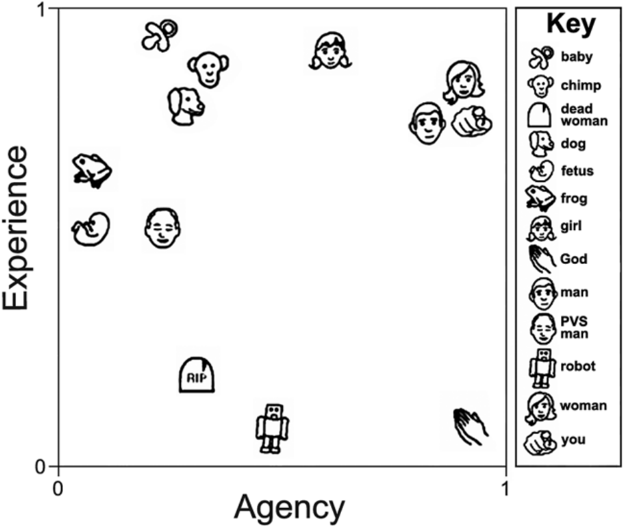
Verification
Claims the paper makes
0 Valid · 0 Not valid · 0 Not checked · 18 Own results and interpretations
A result the paper reports from its own data — it cites no other source for it, so there is none to check. The quote shows it is in the paper.
In the paper
“Characters ' factor scores on these dimensions (Fig. 1) reveal interesting features; for example, God was perceived as having much Agency but little Experience.”
- Also stated in: § Dimensions of Mind Perception · plain
“for example, God was perceived as having much Agency but little Experience.”
plain- Asserted: passes — The authors put it forward as true.
- Checkable: passes — It can be checked against evidence.
- Load-bearing: unclear — It is unclear whether the paper’s conclusions depend on it.
- Based: passes — The paper gives a reason why it holds.
- Also stated in: § Dimensions of Mind Perception · plain
A result the paper reports from its own data — it cites no other source for it, so there is none to check. The quote shows it is in the paper.
In the paper
“A factor we termed Experience (eigenvalue = 15.85) accounted for 88% of the variance and included 11 capacities (from highest loading): hunger, fear, pain, pleasure, rage, desire, personality, consciousness, pride, embarrassment, and joy.”
plain- Asserted: passes — The authors put it forward as true.
- Checkable: passes — It can be checked against evidence.
- Load-bearing: passes — The paper’s conclusions depend on it.
- Based: passes — The paper gives a reason why it holds.
A result the paper reports from its own data — it cites no other source for it, so there is none to check. The quote shows it is in the paper.
In the paper
“Of 234 z -statistics (13 characters × 9 individual difference variables × 2 factors), 23 were statistically significant.”
plain- Asserted: passes — The authors put it forward as true.
- Checkable: passes — It can be checked against evidence.
- Load-bearing: unclear — It is unclear whether the paper’s conclusions depend on it.
- Based: passes — The paper gives a reason why it holds.
A result the paper reports from its own data — it cites no other source for it, so there is none to check. The quote shows it is in the paper.
In the paper
“whereas desire to avoid harming ( ' If you were forced to harm one of these characters, which one would it be more painful for you to harm? ' ) correlated more with Experience ( r = 0.85) than Agency ( r = 0.26, z = 2.10, P < 0.05).”
plainstates an association- Asserted: passes — The authors put it forward as true.
- Checkable: passes — It can be checked against evidence.
- Load-bearing: passes — The paper’s conclusions depend on it.
- Based: passes — The paper gives a reason why it holds.
A result the paper reports from its own data — it cites no other source for it, so there is none to check. The quote shows it is in the paper.
In the paper
“The rotated solution accounted for all 18 capacities (extraction communalities ranged from 0.82 to 0.99), explained 97% of rating variance, and yielded two factors with eigenvalues over 1.0.”
plainstates an association- Asserted: passes — The authors put it forward as true.
- Checkable: passes — It can be checked against evidence.
- Load-bearing: passes — The paper’s conclusions depend on it.
- Based: passes — The paper gives a reason why it holds.
5 more claims
Create a free account to see all 18 claims and every source verdict.
- It may state two separate claims as one. 8
- Probably not a substantial claim. 1
Claims other papers make about this one
Each is checked against this paper’s own text: does it say what the citing paper says it does?
The source backs part of the claim, not all of it — or backs it for a different population, condition or comparison.
In the citing paper
“People also anthropomorphize a range of inanimate objects and animals (Kwan & Fiske, 2008; Gray, Gray, & Wegner, 2007).”
From Dehumanized Perception: A Psychological Means to Facilitate Atrocities, Torture, and Genocide? (2011) · cites this paper as Gray, Gray, & Wegner, 2007
Experimental — accuracy not yet measuredThe source backs part of the claim, not all of it — or backs it for a different population, condition or comparison.
In the citing paper
“work in social psychology has demonstrated that mental state attribution is not a unitary concept, but rather involves distinct and independent dimensions of ‘intelligence’ and ‘experience’.”
From The influence of mental state attributions on trust in large language models (2025) · cites this paper as [19]
Experimental — accuracy not yet measuredThe source backs part of the claim, not all of it — or backs it for a different population, condition or comparison.
In the citing paper
“Participants’ ratings for each of the 65 traits (Supplementary Fig. S1a) were reduced via a principal component analysis to two main dimensions, which together explained 58% of the variance (Supplementary Fig. S1b) and mapped onto previously identified dimensions of ‘experience’ (e.g. experiencing pleasure or feeling fearful) and ‘intelligence’ (e.g. knowing things or making choices; Gray et al. 2”
From Folk psychological attributions of consciousness to large language models (2024) · cites this paper as Gray et al. 2007
Experimental — accuracy not yet measuredThe cited source says what the claim attributes to it.
In the citing paper
“This dissociation is supported by factor analyses of ratings of a variety of mental states, which reveal two fundamental factors: agency, or the capacity for high-level reasoning and planning, and experience, or the capacity for sensations and emotions19”
From The influence of mental state attributions on trust in large language models (2025) · cites this paper as [19]
The cited source says what the claim attributes to it.
In the citing paper
“Other work has systematically explored the dimensions underlying mental state attributions to various agents, revealing a two-dimensional structure distinguishing between ‘Experience’ (i.e. the capacity to feel pain, fear, joy, or pride) and ‘Agency’ (i.e. the capacity to have self-control, morality, planning, or communication) that is reminiscent of the distinction between phenomenal and non-phen”
From Folk psychological attributions of consciousness to large language models (2024) · cites this paper as Gray et al. 2007
Statistics recomputed
Every reported test result, recomputed from its test statistic and degrees of freedom. A result shows as not adding up only once an independent check has confirmed it.
- Consistentz = 2.86reported p < .05 · recomputed p = .004
“z = 2.86, p < .05”
- Consistentz = 2.1reported p < .05 · recomputed p = .036
“z = 2.10, p < .05”
Self-check
Percentages, sums and reported differences re-computed from the paper’s own numbers.
Self-check results appear here once an independent check has confirmed them.
Citations
Cites
I.—COMPUTING MACHINERY AND INTELLIGENCE
TURING, A. M. (1950) · Mind · doi:10.1093/mind/lix.236.433 · Cited by 10,290
Does the chimpanzee have a theory of mind?
Premack, D., & Woodruff, G. (1978) · Behavioral and Brain Sciences · doi:10.1017/s0140525x00076512 · Cited by 8,743
Mindblindness: An Essay on Autism and Theory of Mind
Baron-Cohen, S. (1995) · doi:10.7551/mitpress/4635.001.0001 · Cited by 3,428
Dennett, D. C. (1996) · Medical Entomology and Zoology · Cited by 314
Research works printed but not linked: 1
- A. Turing, Mind59, 433 (1950).
Cited by
Items 1,201–1,300 of 2,340
Crawshaw, C., & Piazza, J. R. (2022) · Psychology of Human-Animal Intergroup Relations · doi:10.5964/phair.8513 · Cited by 5
Linnunsalo, S., Küster, D., Yrttiaho, S., Peltola, M. J., & Hietanen, J. K. (2023) · Neuropsychologia · doi:10.1016/j.neuropsychologia.2023.108668 · Cited by 11
Exploring behavior patterns in human and machine interactions
Zhao, P., Wei, Y., & Wang, S. (2024) · Fundamental Research · doi:10.1016/j.fmre.2023.12.021 · Cited by 6
“The framework suggests comparing agents’ behavior from a novel angle on several dimensions of mind perceptions [43] to judge the difference between humans and machines in HMI.”
Wei, L., Kang, J., & Liu, B. (2023) · Hawaii International Conference on System Sciences (HICSS) · doi:10.24251/hicss.2023.301 · Cited by 7
Brennan, R. A., Enock, F. E., & Over, H. (2024) · Royal Society Open Science · doi:10.1098/rsos.240087 · Cited by 4
“The mental state account maintains that outgroup members are dehumanized to the extent that they are denied mental states [34–36].”
BackgroundPhenomenal Consciousness Disembodied
(2014) · Bloomsbury Academic eBooks · doi:10.5040/9781472594136.ch-003 · Cited by 7
Johnson, K. A., Cohen, A. B., Neel, R., Berlin, A., & Homa, D. L. (2015) · Psychology of Religion and Spirituality · doi:10.1037/rel0000048 · Cited by 6
“Gray et al. (2007) also found that the unborn and the dead received low ratings on the “moral agency” dimension.”
BackgroundResultCut You Some Slack? An Investigation of the Perceptions of a Depleted Employee’s Unethicality
Zhang, Y., Yam, K. C., Kouchaki, M., & Zhang, J. (2017) · Journal of Business Ethics · doi:10.1007/s10551-017-3690-4 · Cited by 7
Does this robot have a mind? Schizophrenia patients' mind perception toward humanoid robots
Raffard, S., Bortolon, C., Cohen, L., Khoramshahi, M., Salesse, R. N., Billard, A., & Capdevielle, D. (2017) · Schizophrenia Research · doi:10.1016/j.schres.2017.11.034 · Cited by 6
Mind Perception in a Competitive Human-Robot Interaction Game
Currie, L., & Wiese, E. (2019) · Proceedings of the Human Factors and Ergonomics Society Annual Meeting · doi:10.1177/1071181319631284 · Cited by 5
“One reason why robots are currently not accepted as social companions might be that humans generally perceive them as mindless automatons with a reduced sense of agency (i.e., ability to plan/ act) and experience (i.e., ability to sense/ feel; Gray et al., 2007).”
BackgroundRacial slurs and perception of racism inHeart of Darkness
Mastropierro, L., & Conklin, K. (2021) · Journal of Literary Semantics · doi:10.1515/jls-2021-2028 · Cited by 6
“The items were adapted from Morena et al. ’ s (2016) study, which is itself based on Gray et al. ’ s (2007, 2011) dimensions of mind perception.”
MethodSpecialty Grand Challenge Article- Social Neuroergonomics
Krüeger, F., & Wiese, E. (2021) · Frontiers in Neuroergonomics · doi:10.3389/fnrgo.2021.654597 · Cited by 8
Mustajoki, A. (2021) · Russian Journal of Linguistics · doi:10.22363/2687-0088-2021-25-2-369-390 · Cited by 7
“People do not always ascribe a state of mind to other people, but on the other hand, they do ascribe a state of mind to non-humans (plants, gods, computers; Gray et al. 2007, Waytz et al. 2010).”
BackgroundHow the social robot Sophia is mediated by a YouTube video
Fortunati, L., Manganelli, A. M., Höflich, J. R., & Ferrin, G. (2022) · New Media & Society · doi:10.1177/14614448221103176 · Cited by 9
“The degree of human-likeness was analyzed within the dimensions of mind perception proposed by Gray et al. (2007) but, in particular, by exploring the selection of the mental functions identified by D’Andrade (1987), as well as the perception of primary emotions and secondary emotions, as…”
BackgroundMethodResultInfluentialDoran, R. P. (2022) · Philosophical Studies · doi:10.1007/s11098-022-01830-5 · Cited by 6
“Pretheoretically, we tend to divide mental states into those that are related to agency and those that are related to sentience (Gray et al., 2007), and we tend to think that, 11 This idea has some resemblance to the idea of dyadic completion; see Gray et al. (2014). by and large, only mental…”
BackgroundChildren's intuitions about the structure of mental life.
Weisman, K., Dweck, C. S., & Markman, E. M. (2017) · eScholarship (California Digital Library) · Cited by 6
Thornton, M. A., Wolf, S., Reilly, B. J., et al. (2020) · doi:10.31234/osf.io/m5p74 · Cited by 6
The Avatar Will See You Now: Support from a Virtual Human Provides Socio-Emotional BenefitsPreprint
Pauw, L. S., Sauter, D. A., Kleef, G. A. V., et al. (2022) · doi:10.31234/osf.io/5u6hz · Cited by 6
Dong, M., Conway, J. R., Bonnefon, J., Shariff, A., & Rahwan, I. (2023) · doi:10.31234/osf.io/pjvqt · Cited by 5
Womick, J., Kubin, E., Goya‐Tocchetto, D., Ochoa, N. R., Rebollar, C., Kapsaskis, K., Pratt, S., Devine, H., Payne, K., Vaisey, S., et al. (2024) · doi:10.31234/osf.io/qsg7j · Cited by 6
Self-citationKang, B., Kim, J., Yun, T.-R., Bae, H., & Kim, C.-E. (2025) · arXiv · doi:10.48550/arxiv.2502.15365 · Cited by 6
Tanrıverdi, V., Yurdagül, A., Tulum, E. A., & Özbilgin, M. F. (2024) · Frontiers in Psychology · doi:10.3389/fpsyg.2024.1387876 · Cited by 6
“…and emotionality, associated with relational orientation, to women, while agency and competence, linked with task orientation, have been predominantly ascribed to men (see Fiske et al., 2002; Cuddy et al., 2008 for the stereotype content model; see Gray et al., 2007 for mind perception theory).”
BackgroundNääs, H., Thellman, S., & Ziemke, T. (2025) · Frontiers in Robotics and AI · doi:10.3389/frobt.2025.1511549 · Cited by 5
Human Mentalizing as Rational Probabilistic Inference
Zhang, S., Howes, A., & Jokinen, J. (2025) · Computational Brain & Behavior · doi:10.1007/s42113-025-00244-w · Cited by 7
“Studies show that humans attribute different degrees of mind to other entities, and this directly influences how they treat them (Gray et al., 2007).”
While We Wait... How Users Perceive Waiting Times and Generation Cues during AI Image Generation
Lee, H. M., Yadav, D., Lee, S., Govindarazan, K., Chen, C., & Sundar, S. S. (2025) · CHI Conference Extended Abstracts on Human Factors in Computing Systems (CHI EA) · doi:10.1145/3706599.3719725 · Cited by 17
“This implicitly ascribes to GenAI the notion of “mind perception” [6], which has two components–agency, the ability to think, plan and act; and experience, the ability to feel emotions and consciousness–that are typically considered uniquely human.”
Chen, A., Kim, S. S. Y., Dharmasiri, A., Russakovsky, O., & Fan, J. E. (2025) · CHI Conference Extended Abstracts on Human Factors in Computing Systems (CHI EA) · doi:10.1145/3706599.3719710 · Cited by 14
“…further analyses can include relaxing the rigidity of Weisman et al. [80]’s categories, utilizing other frameworks (i.e., experience-agency [23] or experience-intelligence [11]), or performing our own data-driven factor analysis to uncover underlying factors of mental capacity attribution…”
Dancing With a Loving Chatbot: Power Dynamics Between Women and Their AI Partners
Pan, S., & Mou, Y. (2025) · Social Science Computer Review · doi:10.1177/08944393251340693 · Cited by 7
“Another line of research (e.g., Gray et al., 2007) suggests that instead of attributing a general level of agency to a given agent, people make independent attributions across different agency dimensions.”
Małecki, W., Messingschlager, T. V., & Appel, M. (2025) · New Media & Society · doi:10.1177/14614448251344590 · Cited by 13
“These are primarily the capacity for agency and the capacity for experience (Gray et al., 2007).”
When Neutrality Conceals Bias: Perceived Discrimination in Algorithmic Decisions
Li, Y., & Lu, R. (2025) · European Journal of Social Psychology · doi:10.1002/ejsp.70020 · Cited by 8
None of my business: The impact of anthropomorphism on helping behavior in access-based consumption
Chen, J., Wu, P., Feng, W., Jiang, Y., & Fan, Y. (2025) · Journal of Business Research · doi:10.1016/j.jbusres.2025.115686 · Cited by 5
Ragusa, A. (2025) · Biology · doi:10.3390/biology14101438 · Cited by 11
“Decision frameworks should integrate sentience, suffering capacity, and ecological function, using transparent multi-criteria methods to align public values with ecosystem needs [60,61].”
Agentic and communal motivations underlying human–AI interactions
Dang, J., & Liu, L. (2025) · Asian Journal Of Social Psychology · doi:10.1111/ajsp.70065 · Cited by 6
Measuring machine companionship experiences: Scale development and validation for AI companions
Banks, J. (2026) · Computers in Human Behavior · doi:10.1016/j.chb.2026.108945 · Cited by 15
“…correspond with the perception that the companion is a mindful agent; the perception of mind was captured using agency and experience dimensions of Gray et al.’s (2007) mind perception scale that asks participants to assess agreement with statements that the companion has specific capabilities…”
Rethinking personhood and agency: how AI challenges human-centered concepts
Gao, L., & Mvondo, G. F. N. (2026) · Frontiers in Psychology · doi:10.3389/fpsyg.2025.1717828 · Cited by 12
“Third, contemporary psychological research has demonstrated that experiences of authorship and attributions of agency can be both remarkably robust and systematically fallible (Heider and Simmel, 1944; Gray et al., 2007; Moore, 2016; Premack and Woodruff, 1978).”
Kim, W., Lee, D., & Ham, C.-D. (2026) · Journal of Advertising · doi:10.1080/00913367.2025.2602465 · Cited by 13
“…behind AI influencers, they will be less likely to perceive the dissimilarity between humans and AI systems, thereby imbuing the behaviors of these nonhuman agents with human-like characteristics and enhancing anthropomorphism (Epley, Waytz, and Cacioppo 2007; Gray, Gray, and Wegner 2007).”
Who uses general-purpose AI? A typology of ChatGPT early adopters
Gerling, C., Teubner, T., & Braesemann, F. (2026) · Electronic Markets · doi:10.1007/s12525-025-00853-0 · Cited by 15
“…our findings leave open the question of whether those who sense social presence are drawn to a human-like counterpart (by disposition) or instead develop a “theory of mind” through repeated interactions and efforts to anticipate the AI’s behavior (Gray et al., 2007; Vanneste & Puranam, 2024).”
Li, G., Xie, S., Huang, H., & Wang, K. (2026) · Journal of Retailing and Consumer Services · doi:10.1016/j.jretconser.2026.104749 · Cited by 4
Kim, H., Shin, H. H., & Choi, S. (2026) · International Journal of Hospitality Management · doi:10.1016/j.ijhm.2026.104743 · Cited by 5
Czy istnieje potoczne pojęcie świadomości fenomenalnej?
Wyrwa, M. (2022) · Diametros · doi:10.33392/diam.1751 · Cited by 5
Humanizing Animals Does Not Reduce Blatant Dehumanization by Children or Adults
Zhou, W., Bowie, A. C., Tan, J., & Hare, B. (2024) · Current Research in Ecological and Social Psychology · doi:10.1016/j.cresp.2024.100194 · Cited by 5
Wang, J., & Zhang, H. (2024) · British Journal of Social Psychology · doi:10.1111/bjso.12776 · Cited by 6
Aversion against machines with complex mental abilities: The role of individual differences
Grundke, A., Appel, M., & Stein, J. (2024) · Computers in Human Behavior Artificial Humans · doi:10.1016/j.chbah.2024.100087 · Cited by 8
Zhu, C., Huang, D., & Zuo, B. (2024) · Current Psychology · doi:10.1007/s12144-024-06347-0 · Cited by 6
“Referring to the approach of previous research, we checked the validity of our manipulations by using the Mind Perception Scale(Gray et al., 2007 ).”
Roupa, A., Patelarou, A. E., Fradelos, Ε. C., Fousiani, K., Laliotis, A., Giakoumidakis, K., & Patelarou, E. (2024) · Nursing Reports · doi:10.3390/nursrep14030167 · Cited by 9
“As a result, mechanistically dehumanized targets are viewed as introverted and passive beings unworthy of moral concern or care [6–8].”
BackgroundMethodMoral reasoning in a digital age: blaming artificial intelligence for incorrect high-risk decisions
Leichtmann, B., Hinterreiter, A., Humer, C., Ventura, A., Streit, M., & Mara, M. (2024) · Current Psychology · doi:10.1007/s12144-024-06658-2 · Cited by 7
“Research on mind perception of artificial agents such as robots, AI and other machines has rooted in the research tradition of theory of mind (see Gray et al., 2012 ; Gray et al., 2007 ; Gray and Wegner, 2009; Shank and DeSanti, 2018; Bigman et al., 2019; Waytz et al., 2010 ).”
Xu, W., Li, C., Miao, X.-Y., & Liu, L. (2025) · BMC Psychology · doi:10.1186/s40359-025-02673-5 · Cited by 5
“Additionally, based on the mental capability items developed by Gray et al. [22], we added five items about experience capabilities, such as having desire, personality, and experiencing emotions, to measure the importance of experience in humanity (α = 0.89).”
InfluentialThe notion of dyadic morality explains the logic of Zande witchcraft
Annus, A. (2020) · Religion Brain & Behavior · doi:10.1080/2153599x.2020.1805796 · Cited by 5
“…Amar Annus amar.annus@ut.ee established two dimensions of mind perception: (1) experience, which is the ability to be conscious and to feel (e.g., hunger, pleasure, fear); and (2) agency—the ability to do things, e.g., capacities for self-control, memory and moral action (Gray et al., 2007).”
BackgroundThe observant android: Limited social facilitation and inhibition from a copresent social robot.
Koban, K., Haggadone, B. A., & Banks, J. (2021) · Technology Mind and Behavior · doi:10.1037/tmb0000049 · Cited by 8
“…established conceptualizations that distinguish between agentic and experiential capacities (i.e., abilities to think and do and to sense and feel; Gray et al., 2007), current understandings of mind perception differentiate among three capabilities with which different agents can be adequately…”
BackgroundOikarinen, E.-L., & Söderlund, M. (2022) · The International Review of Retail Distribution and Consumer Research · doi:10.1080/09593969.2022.2047757 · Cited by 7
“The main reason for this is that morality signals the presence of a mind (Gray, Gray, and Wegner 2007; Gray, Young, and Waytz 2012), and perceptions of an agent’s mind are crucial when an agent is ascribed humanness (Söderlund and Oikarinen 2021).”
BackgroundMoral bias toward different social classes
Jiang, M., Yao, X., & Wang, Y. (2022) · Asian Journal Of Social Psychology · doi:10.1111/ajsp.12545 · Cited by 8
Ścigaj, P. (2022) · Politeja · doi:10.12797/politeja.19.2022.77.04 · Cited by 8
Deceptive (De)humanization: How Lying About Perceived Outgroups is Revealed in Language
Markowitz, D. M. (2022) · Journal of Language and Social Psychology · doi:10.1177/0261927x221117497 · Cited by 4
“Other forms of subtle dehumanization relate to the mind attribution model popularized by social psychologists (Gray et al., 2007), where perceivers ascribe less of a mind or fail to consider the minds of outgroups (Harris & Fiske, 2006, 2009, 2011; Kozak et al., 2006).”
BackgroundCooley, E., Brown-Iannuzzi, J. L., Payne, B. K., Steele, J., & Cipolli, W. (2022) · Group Processes & Intergroup Relations · doi:10.1177/13684302221119982 · Cited by 8
“Next, participants responded to exploratory items assessing humanization of the protesters (Gray et al., 2007; see supplemental material).”
BackgroundCooley, E., Brown-Iannuzzi, J. L., Lei, R. F., Cipolli, W., & Philbrook, L. E. (2022) · Personality and Social Psychology Bulletin · doi:10.1177/01461672221139071 · Cited by 8
“We hypothesized that, among White Americans, greater beliefs that White people benefit from welfare would predict greater perceptions that welfare recipients are capable of agency (Gray et al., 2007).”
BackgroundInfluentialRiemer, A. R., Holland, K. J., McCracken, E. W., Dale, A., & Gervais, S. J. (2022) · Law and Human Behavior · doi:10.1037/lhb0000512 · Cited by 5
Gender and age differences in mind perception of robots
Shen, J., & Koyama, S. (2022) · IEEE Global Conference on Consumer Electronics (GCCE) · doi:10.1109/gcce56475.2022.10014050 · Cited by 11
“Previous studies also classify the mind perception of the robot into two dimensions: perceptions of agency (i.e., capacity to think and plan) and perceptions of experience (i.e., capacity to feel and respond emotionally) [5] [6].”
BackgroundImperfectly Human: The Humanizing Potential of (Corrected) Errors in Text-Based Communication
Netter, S. B., Zhao, X., Barasch, A., & Schroeder, J. (2023) · Journal of the Association for Consumer Research · doi:10.1086/728412 · Cited by 16
“” By contrast, people tend to believe that machines lack the capacity for such self-awareness or conscious intent (Gray, Gray, and Wegner 2007) and do not care how they will be perceived by others (Boden 2018).”
BackgroundTse, T. T. K., Hanaki, N., & Mao, B. (2024) · Journal of Economic Psychology · doi:10.1016/j.joep.2024.102727 · Cited by 6
The medium modulates the medusa effect: Perceived mind in analogue and digital images
Edwards, S., Jenkins, R., Jacobs, O. L. E., & Kingstone, A. F. (2024) · Cognition · doi:10.1016/j.cognition.2024.105827 · Cited by 5
“Recent research in pictorial representation of people has shown that pictures of people are perceived as having less mind — specifically, less agency and experience (Gray et al., 2007) — than their real selves (Will et al., 2021).”
BackgroundIncreasing Social Support for Women via Humanizing Postpartum Depression
Wang, T. G., & Pavelko, R. L. (2024) · Health Communication · doi:10.1080/10410236.2024.2361582 · Cited by 5
“It entails attributing humanlike mental states to nonhuman entities, particularly the capacity for rational thought (agency) and conscious feeling (experience; Gray et al., 2007; Waytz et al., 2014).”
InfluentialDillon, M. R. (2024) · Behavioral and Brain Sciences · doi:10.1017/s0140525x23003047 · Cited by 5
The silicon service spectrum: warmth and competence explain people's preferences for AI assistants
Hernandez, I. A., & Chekili, A. (2024) · Frontiers in Social Psychology · doi:10.3389/frsps.2024.1396533 · Cited by 8
Second-Class Animals: Systematic Discrimination of Farm Animals in German Biology Textbooks
Folsche, E., Büscher, M., Muth, S., Wöbking, J., & Fiebelkorn, F. (2024) · Anthrozoös · doi:10.1080/08927936.2024.2430821 · Cited by 7
“To provide a deductive category system, we operationalized companion animal speciesism (Leach et al., 2023) and animal mind (Bastian et al., 2012; Callahan et al., 2021; Gray et al., 2007).”
InfluentialA multi-modal explainability approach for human-aware robots in multi-party conversation
Bečková, I., Pócoš, Š., Belgiovine, G., Matarese, M., Eldardeer, O., Sciutti, A., & Mazzola, C. (2025) · Computer Vision and Image Understanding · doi:10.1016/j.cviu.2025.104304 · Cited by 11
Zhang, Y., Fang, J., Liao, M., Han, L., Wen, C., & Addo, P. C. (2025) · Journal of Business Research · doi:10.1016/j.jbusres.2025.115315 · Cited by 8
Compliance with mandatory reporting of intimate partner violence among professionals in Norway
Nordby, C., Douglas, K. S., Vølstad, A. G., Brevik, T. B., Bjørkly, S. K., & Vatnar, S. K. B. (2025) · BMC Public Health · doi:10.1186/s12889-025-22637-z · Cited by 5
“Some research has found that IPV can be perceived as a “private mat-ter” [13], while children can be seen as more helpless and vulnerable [9, 15].”
Putting Cognition and Culture Back Together Again: Religion in Mind and Society
Pyysiäinen, I. (2012) · Method & Theory in the Study of Religion · doi:10.1163/157006811x609150 · Cited by 5
Supernatural Agency and Forgiveness
Nieuwboer, W., van Schie, H. T., Karremans, J. C., & Wigboldus, D. H. J. (2016) · Journal for the Cognitive Science of Religion · doi:10.1558/jcsr.v3i1.18402 · Cited by 5
How People Attribute Minds to Non-Living Entities
Ishii, T., & Watanabe, K. (2019) · International Conference on Knowledge and Smart Technology · doi:10.1109/kst.2019.8687324 · Cited by 5
“Recently, it has been argued that many of the mental states that humans are able to attribute to agents can be subsumed into two dimensions: Agency and Experience [5], [6].”
BackgroundMethodInfluentialThe Effect of Social Context on the Mind Perception of Robots
Butler, R., Pruitt, Z. M., & Wiese, E. (2019) · Proceedings of the Human Factors and Ergonomics Society Annual Meeting · doi:10.1177/1071181319631010 · Cited by 12
“Humans have been shown to perceive robots as having agency , the capacity to act independently and make decisions, but not experience , the ability to feel both mentally and physically, inhibiting our ability to empathize with the robot subject (Gray, Gray & Wegner, 2007).”
BackgroundMaj, K., & Zarzycki, P. (2019) · Paladyn Journal of Behavioral Robotics · doi:10.1515/pjbr-2019-0026 · Cited by 9
“The mind perception which is understood as the assigning the ability to experience consciously and act intentionally, appears very quickly in human-robot interaction [52, 53].”
BackgroundMoral Psychology and Artificial Agents (Part One): Ontologically Categorizing Bio-Cultural Humans
Laakasuo, M., Sundvall, J. R. I., van den Berg, A. A., Drosinou, M., Herzon, V., Kunnari, A., Koverola, M., Repo, M., Saikkonen, T., & Palomäki, J. (2020) · Advances in human and social aspects of technology book series · doi:10.4018/978-1-7998-4894-3.ch010 · Cited by 6
Morally excused but socially excluded: Denying agency through the defense of mental impairment
de Vel‐Palumbo, M., Schein, C., Ferguson, R., Chang, M. X., & Bastian, B. B. (2021) · PLoS ONE · doi:10.1371/journal.pone.0252586 · Cited by 6
“The aforementioned debate in mind perception and morality has explored a very narrow set of rights—the right to not be harmed [20], or the right to be helped [39].”
BackgroundHow do children answer questions from a physically present humanoid robot?
Okanda, M., & Taniguchi, K. (2021) · Infant and Child Development · doi:10.1002/icd.2300 · Cited by 5
Stakeholder-Oriented Firms Have Feelings and Moral Standing Too
Quintelier, K. J. P. (2022) · Frontiers in Psychology · doi:10.3389/fpsyg.2022.814624 · Cited by 5
“For instance, individuals tend to attribute experience but not agency to fetuses, and individuals tend to attribute agency but not experience to robots (Gray et al., 2007).”
BackgroundInfluential“I am Wolf, I Rule!” - Attributing Intentions to Animals in Human-Wildlife Interactions
Jürgens, U. M. (2022) · Frontiers in Conservation Science · doi:10.3389/fcosc.2022.803074 · Cited by 5
“Additionally, the more unpredictably animals behave, the more readily they are perceived as exhibiting intentional agency (cf. Johnson and Barrett, 2003; Gray et al., 2007).”
A three-dimensional motivation model of algorithm aversion
ZAHNG, Y., Xu, L., Yu, F., Xiaojun, D. I. N. G., Wu, J., Zhao, L., 邬, 家., & 赵, 靓. (2022) · Advances in Psychological Science · doi:10.3724/sp.j.1042.2022.01093 · Cited by 9
Stower, R. E., Tatarian, K., Rudaz, D., Chamoux, M., Chétouani, M., & Kappas, A. (2022) · IEEE RO-MAN · doi:10.1109/ro-man53752.2022.9900782 · Cited by 6
“We used the Dimensions of Mind Perception scale from [23], with good reliability, α = 0.”
Jürgens, U. M., Hackett, P. M. W., Hunziker, M., & Patt, A. (2022) · Diversity · doi:10.3390/d14080591 · Cited by 11
What is it like to be idle versus busy for a service machine?
Söderlund, M. (2023) · Psychology and Marketing · doi:10.1002/mar.21806 · Cited by 5
Ye, W., Su, X. U., & Zhou, X. (2024) · Acta Psychologica Sinica · doi:10.3724/sp.j.1041.2024.00650 · Cited by 9
Should Robots Kill? Moral Judgments for Actions of Artificial Cognitive Agents.
Hristova, E., & Grinberg, M. (2015) · Cited by 8
Trait Anthropomorphism Predicts Ascribing Human Traits to Upright But Not Inverted Chimpanzee Faces
Young, S. G., Goldberg, M. H., Rydell, R. J., & Hugenberg, K. (2019) · Social Cognition · doi:10.1521/soco.2019.37.2.105 · Cited by 5
Social Robots as Intentional Agents
Thellman, S. (2021) · Linköping studies in arts and science · doi:10.3384/diss.diva-178806 · Cited by 11
Conscious and Unconscious Influences of Money: Two Sides of the Same Coin?
Capa, R. L., & Custers, R. (2014) · Springer eBooks · doi:10.1007/978-1-4939-0959-9_4 · Cited by 8
Waytz, A. G., & Young, L. (2018) · Cited by 13
Verdiesen, I. (2017) · Research Repository (Delft University of Technology) · Cited by 8
The Punishment Gap: The Infeasible Public Attribution of Punishment to AI and RobotsPreprint
Lima, G., Cha, M., Jeon, C., & Park, K. (2020) · arXiv (Cornell University) · Cited by 5
Asian=Machine, Black=Animal? The Racial Asymmetry of DehumanizationPreprint
Bai, H., & Zhao, X. (2021) · doi:10.31234/osf.io/v2guk · Cited by 5
Disentangling five dimensions of animacy in human brain and behaviourPreprint
Jozwik, K. M., Najarro, E., van den Bosch, J. J., et al. (2021) · bioRxiv (Cold Spring Harbor Laboratory) · doi:10.1101/2021.09.12.459854 · Cited by 5
Leach, S., Piazza, J., Loughnan, S., Sutton, R. M., Kapantai, I., Dhont, K., & Douglas, K. M. (2022) · Appetite · doi:10.31234/osf.io/s3jta · Cited by 44
“…were confronted with smaller windows (pop-ups) occluding the main website and containing information about a single animals’ capacity for agency and/or experience--two dimensions of mind that are central to moral judgements (H. M. Gray et al., 2007; K. Gray et al., 2012; Sytsma & Machery, 2012).”
BackgroundOn the Realness of People Who Do Not Exist: The Social Processing of Artificial FacesPreprint
Tucciarelli, R., Vehar, N., Chandaria, S., & Tsakiris, M. (2022) · SSRN Electronic Journal · doi:10.2139/ssrn.4061183 · Cited by 7
Lekka, D., Richardson, C., Madoglou, A., et al. (2021) · SSRN Electronic Journal · doi:10.2139/ssrn.3968959 · Cited by 5
Bird, S. J. (2009) · Elsevier eBooks · doi:10.1016/b978-008045046-9.01936-7 · Cited by 5
Baldissarri, C., Demoulin, S., & Kteily, N. (2022) · Group Processes & Intergroup Relations · doi:10.1177/13684302221139414 · Cited by 6
Does she still love and feel hungry? Afterlife continuity beliefs and religion across 24 countriesPreprint
Hoogeveen, S., Altay, S., Bendixen, T., Berniûnas, R., Bulbulia, J. A., Cheshin, A., Gentili, C., Georgescu, R., Haaf, J. M., Hagel, K., et al. (2023) · PsyArXiv (OSF Preprints) · doi:10.31234/osf.io/tvycp · Cited by 4
Why Most Resist AI CompanionsPreprint
Uğuralp, Z., Uğuralp, A. K., Puntoni, S., & Freitas, J. D. (2025) · SSRN Electronic Journal · doi:10.2139/ssrn.5097445 · Cited by 14
How the Risk of Exploitation in Human-Ai Relationships Depends on Relationship TypePreprint
Earp, B. D., Feroz, F., Mann, S. P., Voinea, C., Chalson, S., Jurčys, P., Reinecke, M. G., Savulescu, J., Singh, I., & Clark, M. S. (2025) · SSRN Electronic Journal · doi:10.2139/ssrn.5288102 · Cited by 7
Comparative Designs Reveal Preferences for Human-Generated Rather Than AI-Generated art
Jacobs, O. L. E., Pazhoohi, F., Mullen, G., & Kingstone, A. F. (2025) · Empirical Studies of the Arts · doi:10.1177/02762374251360129 · Cited by 9
“…to which people perceive minds in others (i.e., mind perception) has revealed that while people do attribute agency to AI, albeit to a reduced degree compared to humans, there is less willingness to ascribe experiential features such as feelings to AI (Gray et al., 2007; Jacobs et al., 2022).”
A question of perspective: Target- vs. perceiver-specific dimensions of mind perception
Bögemann, N. J., Harris, L. T., & Nestler, S. (2025) · Cognition · doi:10.1016/j.cognition.2025.106231 · Cited by 7
“As for the conceptualization of the two-dimensional framework, our results generally support the Agency-Experience distinction (Gray et al., 2007) but also encourage fine-tuning the meaning of the two dimensions.”
Influential
Metadata
- Authors
- Gray, H. M., Gray, K., & Wegner, D. M.
- Affiliations
- Harvard University (US)
- Corresponding author
- Gray, Heather M.
- Venue
- Science
- Published
- 2007-02-02
- Volume
- 315
- Issue
- 5812
- Pages
- 619-619
- ISSN
- 0036-8075 (ISSN-L)
- 1095-9203
- OpenAlex
- W2131227926
- Cited by
- 2,342
- References
- 4
- Citations by year
- 2026: 359 · 2025: 326 · 2024: 249 · 2023: 220 · 2022: 198 · 2021: 156 · 2020: 157 · 2019: 107 · 2018: 91 · 2017: 86 · 2016: 96 · 2015: 66 · 2014: 52 · 2013: 44 · 2012: 45
- FWCI
- 10.81
- Type
- journal article
- Language
- en
- Open access
- closed
- Locations
- Science (publishedVersion)
- PubMed (publishedVersion)
- Funders
- National Institutes of Health (1f31mh071053-01)
- National Institute of Mental Health (MH-71053, MH 49127, R01MH049127)
- Topics
- Life Sciences › Neuroscience › Cognitive Neuroscience › Psychology of Moral and Emotional Judgment
- Social Sciences › Psychology › Social Psychology › Social Robot Interaction and HRI
- Social Sciences › Sociology and Political Science › Social and Intergroup Psychology
- Keywords
- mind perception, moral judgment, agency, experience, non-human animals, personification, moral status of animals, self-control, hunger
- MeSH terms
- Adolescent, Adult, Aged, Child, Emotions, Female, Humans, Male, Mental Processes, Middle Aged, Morals, Perception, Personality, Principal Component Analysis
About these checks
Registry, retraction, Cites and statistics results are computed, not judged, with one exception: a printed reference that no index lists is read once by a model before it counts as a citation error. Claims are extracted by a model and kept only when their quote appears verbatim in the text; each cited source is then checked, with a model’s help, for whether it says what the claim relies on. Those verdicts can be wrong — read the claim’s quote and the cited source before relying on one.
A language model drew the claims from the paper on 2026-09-28, under version 3 of the claim definition (model deepseek-v4.1-flash, prompt extract-v3).
A second model labelled each claim on 2026-09-28 (model jev-1.13-20260917, definition revision gold-guideline-v0.2).
Statistics and arithmetic are recomputed, not judged.
Confidence bands are shown only for fields calibrated on our annotated test set. None is calibrated yet, so no band is shown.
What counts as a claim ›How we measure confidence ›How we check this ›
Are you an author, or do you see a problem with this page? Request a review
Data sources
Bibliographic data: Semantic Scholar, OpenAlex, Crossref.
Contains information from the Semantic Scholar Academic Graph Datasets, made available under the ODC Attribution License (ODC-BY 1.0).
Semantic Scholar’s data is described in: Kinney, R., et al. (2023). The Semantic Scholar Open Data Platform. arXiv:2301.10140.
