

Dimensions of Mind Perception
The DOI matches its Crossref record; 4 of the 4 references it cites were found in a registry or an index.
Abstract
Participants compared the mental capacities of various human and nonhuman characters via online surveys. Factor analysis revealed two dimensions of mind perception, Experience (for example, capacity for hunger) and Agency (for example, capacity for self-control). The dimensions predicted different moral judgments but were both related to valuing of mind.
Overview
CoChat Summary
## TL;DR
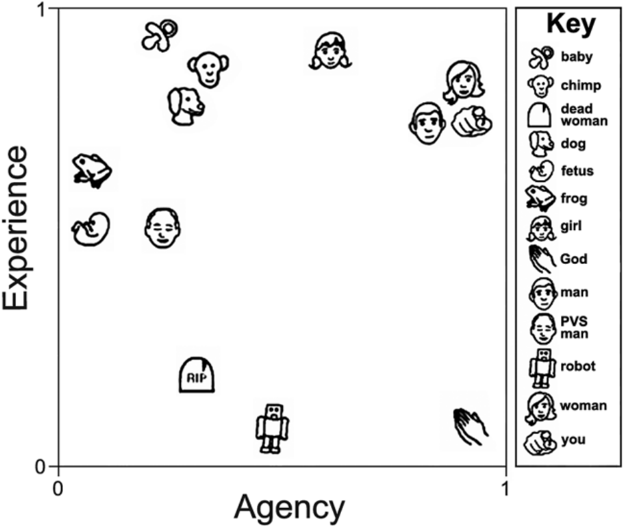
This paper argues that mind perception is not a single continuum but instead has two dimensions: Experience and Agency. Using 2,399 completed web-based surveys, the authors found that these dimensions explain how people judge minds across 13 characters and are differentially related to moral judgments.
## Key findings
- A principal components factor analysis of correlations among 18 mental capacities yielded two factors with eigenvalues over 1.0: Experience (eigenvalue 15.85, explaining 88% of variance) and Agency (eigenvalue 1.46, explaining 8% of variance); the rotated solution explained 97% of rating variance.
- Experience loaded on 11 capacities: hunger, fear, pain, pleasure, rage, desire, personality, consciousness, pride, embarrassment, and joy; Agency loaded on 7 capacities: self-control, morality, memory, emotion recognition, planning, communication, and thought.
- Personal judgments tracked the dimensions differently: liking, saving from destruction, making happy, and perceiving a soul correlated with both dimensions, with r ranging from 0.38 to 0.72.
- Punishment judgments correlated more with Agency than Experience (r = 0.82 vs. r = 0.22, z = 2.86, P < 0.05), while avoidance of harm correlated more with Experience than Agency (r = 0.85 vs. r = 0.26, z = 2.10, P < 0.05).
## Methods
- Web-based Mind Survey design: respondents saw pairwise comparisons of 13 characters across 18 mental capacities or 6 personal judgments, using five-point scales for 78 comparisons per survey.
- Sample: about 3,400 survey launches, with 2,399 completed surveys analyzed; respondents ranged from 12 to 75 years old (mean 30.44, SD 12.27) and were 64% female.
- Main analysis: character means were computed, correlations across capacities were submitted to principal components factor analysis with varimax rotation, and factor scores were estimated via regression; additional analyses examined correlations with personal judgments and individual-difference variables using z-statistics.
## Limitations
- The paper states that the surveys were largely independent and that respondent data came from web recruitment through other psychology sites, which makes the sample a convenience sample rather than a random population sample.
- Evident from the text: the factor structure is based on self-selected web respondents and on pairwise judgments of preselected characters and capacities, so generalizability beyond the survey context is not directly tested.
- The paper notes that about 25% of launched surveys were not completed, indicating noncompletion/missing-data attrition.
Model-written summary. Check it against the paper before relying on it.
Integrity signals
Registry
Cites
Statistics
Figures
Verification
Claims the paper makes
0 Valid · 0 Not valid · 0 Not checked · 18 Own results and interpretations
A result the paper reports from its own data — it cites no other source for it, so there is none to check. The quote shows it is in the paper.
In the paper
“Characters ' factor scores on these dimensions (Fig. 1) reveal interesting features; for example, God was perceived as having much Agency but little Experience.”
- Also stated in: § Dimensions of Mind Perception · plain
“for example, God was perceived as having much Agency but little Experience.”
plain- Asserted: passes — The authors put it forward as true.
- Checkable: passes — It can be checked against evidence.
- Load-bearing: unclear — It is unclear whether the paper’s conclusions depend on it.
- Based: passes — The paper gives a reason why it holds.
- Also stated in: § Dimensions of Mind Perception · plain
A result the paper reports from its own data — it cites no other source for it, so there is none to check. The quote shows it is in the paper.
In the paper
“A factor we termed Experience (eigenvalue = 15.85) accounted for 88% of the variance and included 11 capacities (from highest loading): hunger, fear, pain, pleasure, rage, desire, personality, consciousness, pride, embarrassment, and joy.”
plain- Asserted: passes — The authors put it forward as true.
- Checkable: passes — It can be checked against evidence.
- Load-bearing: passes — The paper’s conclusions depend on it.
- Based: passes — The paper gives a reason why it holds.
A result the paper reports from its own data — it cites no other source for it, so there is none to check. The quote shows it is in the paper.
In the paper
“Of 234 z -statistics (13 characters × 9 individual difference variables × 2 factors), 23 were statistically significant.”
plain- Asserted: passes — The authors put it forward as true.
- Checkable: passes — It can be checked against evidence.
- Load-bearing: unclear — It is unclear whether the paper’s conclusions depend on it.
- Based: passes — The paper gives a reason why it holds.
A result the paper reports from its own data — it cites no other source for it, so there is none to check. The quote shows it is in the paper.
In the paper
“whereas desire to avoid harming ( ' If you were forced to harm one of these characters, which one would it be more painful for you to harm? ' ) correlated more with Experience ( r = 0.85) than Agency ( r = 0.26, z = 2.10, P < 0.05).”
plainstates an association- Asserted: passes — The authors put it forward as true.
- Checkable: passes — It can be checked against evidence.
- Load-bearing: passes — The paper’s conclusions depend on it.
- Based: passes — The paper gives a reason why it holds.
A result the paper reports from its own data — it cites no other source for it, so there is none to check. The quote shows it is in the paper.
In the paper
“The rotated solution accounted for all 18 capacities (extraction communalities ranged from 0.82 to 0.99), explained 97% of rating variance, and yielded two factors with eigenvalues over 1.0.”
plainstates an association- Asserted: passes — The authors put it forward as true.
- Checkable: passes — It can be checked against evidence.
- Load-bearing: passes — The paper’s conclusions depend on it.
- Based: passes — The paper gives a reason why it holds.
5 more claims
Create a free account to see all 18 claims and every source verdict.
- It may state two separate claims as one. 8
- Probably not a substantial claim. 1
Claims other papers make about this one
Each is checked against this paper’s own text: does it say what the citing paper says it does?
The source backs part of the claim, not all of it — or backs it for a different population, condition or comparison.
In the citing paper
“People also anthropomorphize a range of inanimate objects and animals (Kwan & Fiske, 2008; Gray, Gray, & Wegner, 2007).”
From Dehumanized Perception: A Psychological Means to Facilitate Atrocities, Torture, and Genocide? (2011) · cites this paper as Gray, Gray, & Wegner, 2007
Experimental — accuracy not yet measuredThe source backs part of the claim, not all of it — or backs it for a different population, condition or comparison.
In the citing paper
“work in social psychology has demonstrated that mental state attribution is not a unitary concept, but rather involves distinct and independent dimensions of ‘intelligence’ and ‘experience’.”
From The influence of mental state attributions on trust in large language models (2025) · cites this paper as [19]
Experimental — accuracy not yet measuredThe source backs part of the claim, not all of it — or backs it for a different population, condition or comparison.
In the citing paper
“Participants’ ratings for each of the 65 traits (Supplementary Fig. S1a) were reduced via a principal component analysis to two main dimensions, which together explained 58% of the variance (Supplementary Fig. S1b) and mapped onto previously identified dimensions of ‘experience’ (e.g. experiencing pleasure or feeling fearful) and ‘intelligence’ (e.g. knowing things or making choices; Gray et al. 2”
From Folk psychological attributions of consciousness to large language models (2024) · cites this paper as Gray et al. 2007
Experimental — accuracy not yet measuredThe cited source says what the claim attributes to it.
In the citing paper
“This dissociation is supported by factor analyses of ratings of a variety of mental states, which reveal two fundamental factors: agency, or the capacity for high-level reasoning and planning, and experience, or the capacity for sensations and emotions19”
From The influence of mental state attributions on trust in large language models (2025) · cites this paper as [19]
The cited source says what the claim attributes to it.
In the citing paper
“Other work has systematically explored the dimensions underlying mental state attributions to various agents, revealing a two-dimensional structure distinguishing between ‘Experience’ (i.e. the capacity to feel pain, fear, joy, or pride) and ‘Agency’ (i.e. the capacity to have self-control, morality, planning, or communication) that is reminiscent of the distinction between phenomenal and non-phen”
From Folk psychological attributions of consciousness to large language models (2024) · cites this paper as Gray et al. 2007
Statistics recomputed
Every reported test result, recomputed from its test statistic and degrees of freedom. A result shows as not adding up only once an independent check has confirmed it.
- Consistentz = 2.86reported p < .05 · recomputed p = .004
“z = 2.86, p < .05”
- Consistentz = 2.1reported p < .05 · recomputed p = .036
“z = 2.10, p < .05”
Self-check
Percentages, sums and reported differences re-computed from the paper’s own numbers.
Self-check results appear here once an independent check has confirmed them.
Citations
Cites
I.—COMPUTING MACHINERY AND INTELLIGENCE
TURING, A. M. (1950) · Mind · doi:10.1093/mind/lix.236.433 · Cited by 10,290
Does the chimpanzee have a theory of mind?
Premack, D., & Woodruff, G. (1978) · Behavioral and Brain Sciences · doi:10.1017/s0140525x00076512 · Cited by 8,743
Mindblindness: An Essay on Autism and Theory of Mind
Baron-Cohen, S. (1995) · doi:10.7551/mitpress/4635.001.0001 · Cited by 3,428
Dennett, D. C. (1996) · Medical Entomology and Zoology · Cited by 314
Research works printed but not linked: 1
- A. Turing, Mind59, 433 (1950).
Cited by
Items 801–900 of 2,340
Phenomenological Obviousness and the New Science of Consciousness
Sytsma, J. M. (2009) · Philosophy of Science · doi:10.1086/605821 · Cited by 26
Development of Japanese Version of the Psychological Scale of Anthropomorphism
Kamide, H., Takashima, K., & Arai, T. (2016) · The Japanese Journal of Personality · doi:10.2132/personality.25.218 · Cited by 19
Yam, K. C., Tang, P. M., Jackson, J. C., et al. (2022) · doi:10.31234/osf.io/9v7jx · Cited by 19
Self-citationA Cross-Cultural Examination of Blatant and Subtle Dehumanization of Autistic People
Kim, S. Y., Cheon, J. E., & Kim, Y.-H. (2024) · Journal of Autism and Developmental Disorders · doi:10.1007/s10803-023-06217-x · Cited by 22
“Notably, robots and dead persons were rated as lacking both agency and experience traits in Gray et al. (2007).”
InfluentialGao, J., Wang, H., Li, W., Li, G., & He, S. (2024) · International Journal of Human-Computer Interaction · doi:10.1080/10447318.2024.2383483 · Cited by 21
“Mind perception theory is often used to examine human views of another entity (Gray et al., 2007; Waytz et al., 2010).”
The Double-Edged Sword of Anthropomorphism in LLMs
Reinecke, M. G., Ting, F., Savulescu, J., & Singh, I. (2025) · Proceedings · doi:10.3390/proceedings2025114004 · Cited by 47
“When we perceive others as capable of communicating in this way, the more likely we are to perceive them as agents with complex mental states [30].”
AI assessment changes human behavior
Görgen, J., de Bellis, E., & Klesse, A.-K. (2025) · Proceedings of the National Academy of Sciences · doi:10.1073/pnas.2425439122 · Cited by 32
Tamioso, P. R., Rucinque, D. S., Miele, M., Boissy, A., & Molento, C. F. M. (2018) · PLoS ONE · doi:10.1371/journal.pone.0200425 · Cited by 26
Robot Transparency and Anthropomorphic Attribute Effects on Human–Robot Interactions
Wang, J., Liu, Y., Yue, T., Wang, C., Mao, J., Wang, Y., & You, F. (2021) · Sensors · doi:10.3390/s21175722 · Cited by 24
“People are inspired (to some extent) to believe that this artifact has the ability to think rationally (agency) and feel consciously (experience) [15], which is usually influenced by people’s perception of these human traits and characteristics (voice, social behavior, etc.).”
BackgroundFortunati, L., Manganelli, A. M., Höflich, J. R., & Ferrin, G. (2021) · International Journal of Social Robotics · doi:10.1007/s12369-021-00827-0 · Cited by 26
“…of reference for our study: for the robots’ mental functions, we chose the theory of the dimensions of mind perception proposed by Gray et al. [28]; for the robots’ emotions, we chose the theory of infra-123 humanization elaborated by Leyens et al. [52]; and for the robot’s conception, we…”
MethodRobots or humans for disaster response? Impact on consumer prosociality and possible explanations
Chen, F., & Huang, S. (2022) · Journal of Consumer Psychology · doi:10.1002/jcpy.1338 · Cited by 21
Concept of Information as a Bridge between Mind and Brain
Schroeder, M. J. (2011) · Information · doi:10.3390/info2030478 · Cited by 20
“In psychological studies of the way people perceive the mind, two main dimensions have been distinguished, dimension of experience and of agency [10].”
BackgroundGood for God? Religious motivation reduces perceived responsibility for and morality of good deeds.
Gervais, W. M. (2014) · Journal of Experimental Psychology: General · doi:10.1037/a0036678 · Cited by 18
Affective valence signals agency within and between individuals.
Chang, Y.-P., Algoe, S. B., & Chen, L. H. (2016) · Emotion · doi:10.1037/emo0000229 · Cited by 20
Emotion expression modulates perception of animacy from faces
Bowling, N. C., & Banissy, M. J. (2017) · Journal of Experimental Social Psychology · doi:10.1016/j.jesp.2017.02.004 · Cited by 19
“Gray, Gray, and Wegner (2007) propose two core dimensions to mind perception: experience and agency.”
BackgroundA dehumanization perspective on dependence in low-satisfaction (abusive) relationships
Bastian, B. B. (2019) · Journal of Social and Personal Relationships · doi:10.1177/0265407519835978 · Cited by 23
Kerzel, M., Rosin, T. P., Strahl, E., Heinrich, S., & Wermter, S. (2020) · Frontiers in Neurorobotics · doi:10.3389/fnbot.2020.00028 · Cited by 19
“…were asked to return to the interview table to fill in the second questionnaire, based on the Godspeed questionnaires by Bartneck et al. (2009) and the Mind Perception questionnaire by Gray et al. (2007), with some additional questions collecting demographic information about the participants.”
MethodOn the eeriness of service robots with emotional capabilities
Appel, M., Weber, S., Krause, S., & Mara, M. (2016) · ACM/IEEE International Conference on Human-Robot Interaction (HRI) · doi:10.1109/hri.2016.7451781 · Cited by 19
Understanding Anthropomorphism: Anthropomorphism is not a Reverse Process of Dehumanization
Złotowski, J. A., Sumioka, H., Bartneck, C., Nishio, S., & Ishiguro, H. (2017) · Lecture notes in computer science · doi:10.1007/978-3-319-70022-9_61 · Cited by 27
“In addition, we measured attribution of mind to a robot using its 2 dimensions: experience and agency ([4], Japanese version [11]) – e.”
BackgroundMethodTao, L., Wan, J., & Wen, B. (2025) · Public Management Review · doi:10.1080/14719037.2024.2411632 · Cited by 18
“In contrast, human behaviour is a self-controlled and conscious process that relies on cognitive and emotional abilities (Gray, Gray, and Wegner 2007).”
Grundke, A. (2023) · Behaviour and Information Technology · doi:10.1080/0144929x.2023.2210688 · Cited by 21
“…a predictor of threat and aversion (Messingschlager and Appel 2022; Paluch et al. 2022), so a combination of both dimensions characterising human mind (Gray, Gray, and Wegner 2007) seems to be necessary to induce feelings of status threat in co-working scenarios of innovative machines and humans.”
BackgroundMethodInfluentialAttributions of intent and moral responsibility to AI agents
Ayad, R., & Plaks, J. E. (2024) · Computers in Human Behavior Artificial Humans · doi:10.1016/j.chbah.2024.100107 · Cited by 31
Gnambs, T., Stein, J., Zinn, S., Griese, F., & Appel, M. (2025) · Telematics and Informatics · doi:10.1016/j.tele.2025.102265 · Cited by 43
AI apology: a critical review of apology in AI systems
Harland, H., Dazeley, R., Senaratne, H., Vamplew, P., Cruz, F., & Nakisa, B. (2025) · Artificial Intelligence Review · doi:10.1007/s10462-025-11305-8 · Cited by 19
Interacting with a Social Robot Affects Visual Perception of Space
Mazzola, C., Aroyo, A. M., Rea, F., & Sciutti, A. (2020) · ACM/IEEE International Conference on Human-Robot Interaction (HRI) · doi:10.1145/3319502.3374819 · Cited by 22
“Furthermore, it was asked to participants to answer to the sub-scales Anthropomorphism , Animacy , Likeability , and Perceived Intelligence of the Godspeed questionnaire [21] and to the sub-Day Mind experience and Mind agency of a Mind perception test [22][23].”
Mind Perception and Social Robots: The Role of Agent Appearance and Action Types
Saltik, I., Erdil, D., & Ürgen, B. A. (2021) · ACM/IEEE International Conference on Human-Robot Interaction (HRI) · doi:10.1145/3434074.3447161 · Cited by 22
“We computed two scores for each video: The Agency Score which is the average rating of the questions that measured the agency dimension, and the Experience Score which is the average rating of the questions that measured the experience dimension.”
BackgroundMethodResultInfluentialChen, M., Liu, F., & Lee, Y.-H. (2022) · Lecture notes in computer science · doi:10.1007/978-3-031-05643-7_15 · Cited by 20
Algorithmic discrimination causes less desire for moral punishment than human discrimination
Xu, L., Yu, F., & Peng, K. (2022) · Acta Psychologica Sinica · doi:10.3724/sp.j.1041.2022.01076 · Cited by 27
Social robot advisors: effects of robot judgmental fallacies and context
Polakow, T., Laban, G., Teodorescu, A. R., Busemeyer, J. R., & Gordon, G. (2022) · Intelligent Service Robotics · doi:10.1007/s11370-022-00438-2 · Cited by 17
“When social robots employ and demonstrate social cues, these cues are often attributed to higher degrees of mind perceptions [41] in terms of agency (the ability to plan and act) and experience (the ability to sense and feel) [42].”
BackgroundHartmann, T. (2023) · Oxford University Press eBooks · doi:10.1093/oxfordhb/9780197650677.013.3 · Cited by 24
Extending Perspective Taking to Nonhuman Animals and Artificial Entities
Ladak, A., Wilks, M., & Anthis, J. R. (2023) · Social Cognition · doi:10.1521/soco.2023.41.3.274 · Cited by 24
Bao, A., Zeng, Y., & Lu, E. (2023) · Humanities and Social Sciences Communications · doi:10.1057/s41599-023-02143-6 · Cited by 26
“Gray et al. argue that the core of anthro-pomorphization is attributing human-like attributes and mental states to non-human agents and objects, in which the core anthropomorphic characteristics include conscious experience, metacognition, and intention (Gray et al. 2007).”
BackgroundPerceived opacity leads to algorithm aversion in the workplace
Yijun, Z. H. A. O., Xu, L., Yu, F., & Wanglong, J. I. N. (2024) · Acta Psychologica Sinica · doi:10.3724/sp.j.1041.2024.00497 · Cited by 26
Animal Humanness, Animal Use, and Intention to Become Ethical Vegetarian or Ethical Vegan
Díaz, E. (2016) · Anthrozoös · doi:10.1080/08927936.2016.1152720 · Cited by 26
Racial discrimination and belief in a just world: Police violence against teenagers in Brazil
Silva, K. D. C., Torres, A. R. R., Estramiana, J. L. Á., Luque, A. G., & Linhares, L. V. (2017) · Journal of Experimental Social Psychology · doi:10.1016/j.jesp.2017.10.009 · Cited by 25
(2013) · Humanness and Dehumanization · doi:10.4324/9780203110539-9 · Cited by 17
Dehumanizing Prisoners: Remaining Sentence Duration Predicts the Ascription of Mind to Prisoners
Deska, J. C., Almaraz, S. M., & Hugenberg, K. (2020) · Personality and Social Psychology Bulletin · doi:10.1177/0146167220911496 · Cited by 18
Mind perception and stereotype attribution of corporations and charities
Au, R. H. Y., & Ng, G. T. T. (2020) · British Journal of Social Psychology · doi:10.1111/bjso.12377 · Cited by 23
First-person representations and responsible agency in AI
Sebastián, M. Á. (2021) · Synthese · doi:10.1007/s11229-021-03105-8 · Cited by 30
“Further support for thinking that our notion of responsible agency is not necessarily linked to phenomenal consciousness is provided by a study conducted by Gray and Gray (2007).”
BackgroundMethodExpectations Vs. Reality: Unreliability and Transparency in a Treasure Hunt Game With Icub
Aroyo, A. M., Pasquali, D., Kothig, A., Rea, F., Sandini, G., & Sciutti, A. (2021) · IEEE Robotics and Automation Letters · doi:10.1109/lra.2021.3083465 · Cited by 17
“In both conditions, similar to literature [41], participants rated the mind agency of a robot some-where midway; while the mind experience was quite low.”
BackgroundRevenge in Couple Relationships and Their Relation to the Dark Triad
Clemente, M., & Espinosa, P. (2021) · International Journal of Environmental Research and Public Health · doi:10.3390/ijerph18147653 · Cited by 22
“Therefore, violence is directed against the person that the alleged victim identifies as causing the harm suffered, and intentionality is attributed to the perceived aggressor [6,7].”
BackgroundMixing It Up: How Mixed Groups of Humans and Machines Modulate Conformity
Hertz, N., Shaw, T. H., de Visser, E. J., & Wiese, E. (2019) · Journal of Cognitive Engineering and Decision Making · doi:10.1177/1555343419869465 · Cited by 17
“This result is in line with findings by Gray, Gray, and Wegner (2007) which shows humans have higher ratings of agency (i.e., ability to think rationally and plan) as well as experience (i.e., ability to feel and identify emotions), while computers are only ascribed agency.”
ResultImproving attitudes towards social robots using imagined contact
Wullenkord, R., & Eyssel, F. (2014) · IEEE RO-MAN · doi:10.1109/roman.2014.6926300 · Cited by 17
“Additionally, mind attribution was measured with a 10 item short version of the Mind Attribution Scale [21] (e. g., “How much is the robot able to report its thoughts and feelings?”).”
MethodChanges in perception of a small humanoid robot
Haring, K. S., Watanabe, K., Silvera‐Tawil, D., Velonaki, M., & Takahashi, T. (2015) · International Conference on Automation, Robotics and Applications · doi:10.1109/icara.2015.7081129 · Cited by 19
“Previous research has shown that people perceive minds in technological entities [45], it was suggested [46] that mind perception occurs along the dimension of experience (e.”
BackgroundMorality Goes Beyond Mind Perception
Monroe, A. E., Guglielmo, S., & Malle, B. F. (2012) · Psychological Inquiry · doi:10.1080/1047840x.2012.668271 · Cited by 23
“Adult humans are typically assumed to be fully “minded”—to have complete agentic and experiential capacities (Gray, Gray, & Wegner, 2007 ).”
BackgroundFeeling connected to younger versus older selves: The asymmetric impact of life stage orientation
O’Brien, E. (2014) · Cognition & Emotion · doi:10.1080/02699931.2014.924483 · Cited by 16
Beyond Believability: Quantifying the Differences Between Real and Virtual Humans
de Melo, C. M., & Gratch, J. S. (2015) · Lecture notes in computer science · doi:10.1007/978-3-319-21996-7_11 · Cited by 22
“Recent research, furthermore, suggests that we perceive mind in others according to two core dimensions [26]: agency , the ability to act and plan; and, experience , the ability to sense and feel emotion.”
BackgroundDesigning Artificial Agents as Social Companions
Wiese, E., Shaw, T. H., Lofaro, D. M., & Baldwin, C. L. (2017) · Proceedings of the Human Factors and Ergonomics Society Annual Meeting · doi:10.1177/1541931213601764 · Cited by 24
“The reason why artificial agents do not automatically activate social brain areas is because engagement of this network requires interactions with intentional beings (van Overwalle, 2009), whose behavior is believed to reflect the actions of a mind ( mind perception , Gray, Gray & Wegner, 2007).”
BackgroundBrain stimulation to left prefrontal cortex modulates attentional orienting to gaze cues
Wiese, E., Abubshait, A., Azarian, B., & Blumberg, E. J. (2019) · Philosophical Transactions of the Royal Society B Biological Sciences · doi:10.1098/rstb.2018.0430 · Cited by 20
Buckwalter, W., Knobe, J., Nichols, S., Pinillos, N. Á., Robbins, P., Sarkissian, H., Weigel, C., & Weinberg, J. M. (2012) · Oxford University Press eBooks · doi:10.1093/obo/9780195396577-0162 · Cited by 19
Hardin, A. E., Schinoff, B. S., Byron, K., & Balven, R. M. (2024) · Academy of Management Journal · doi:10.5465/amj.2022.0683 · Cited by 22
Leaders Inflate Performance Ratings for Employees Who Use Robots to Augment Their Performance
He, G., Yam, K. C., Zhao, P., Dong, X., Zheng, L., & Qin, X. (2024) · Human Resource Management · doi:10.1002/hrm.22267 · Cited by 20
What makes children perceive or not perceive minds in generative AI?
Xu, Y., Thomas, T., Yu, C., & Pan, Z. (2025) · Computers in Human Behavior Artificial Humans · doi:10.1016/j.chbah.2025.100135 · Cited by 26
Exploring the role of trust in AI-driven decision-making: a systematic literature review
Montealegre-López, N. (2025) · Management Review Quarterly · doi:10.1007/s11301-025-00526-4 · Cited by 36
Kim, T. H., & Im, H. (2025) · Journal of Consumer Behaviour · doi:10.1002/cb.70060 · Cited by 25
Kang, I., Leliveld, M. C., & Ferraro, R. (2022) · Journal of Behavioral Decision Making · doi:10.1002/bdm.2281 · Cited by 16
van Houwelingen, G., & Stoelhorst, J. W. (2022) · Academy of Management Discoveries · doi:10.5465/amd.2021.0245 · Cited by 17
The Trajectory of Anthropomorphism and Pro-Environmental Behavior: A Serial Mediation Model
Yang, Y., Sun, L., Han, B., & Liu, P. (2023) · International Journal of Environmental Research and Public Health · doi:10.3390/ijerph20032393 · Cited by 33
A data-driven investigation of human action representations
Dima, D. C., Hebart, M. N., & Işık, L. (2023) · Scientific Reports · doi:10.1038/s41598-023-32192-5 · Cited by 22
“Low-dimensional representations have been also proposed that explain how people perceive others and their mental states (Gray et al., 2007; Thornton & Tamir, 2020) or psychologically meaningful situations (Parrigon et al., 2016; Rauthmann et al., 2014).”
BackgroundHuman and machine drivers: Sharing control, sharing responsibility
Zhai, S., Wang, L., & Liu, P. (2023) · Accident Analysis & Prevention · doi:10.1016/j.aap.2023.107096 · Cited by 22
The AI Commander: Centaur Teaming, Command, and Ethical Dilemmas
Johnson, J. S. (2024) · doi:10.1093/oso/9780198892182.001.0001 · Cited by 28
Namkoong, M., Park, Y., Lee, S., & Park, G. (2024) · Behaviour and Information Technology · doi:10.1080/0144929x.2024.2367691 · Cited by 18
“…and their social in fl uence becomes stronger (Oh, Bailenson, and Welch 2018), which is particularly important in situations where emotional experiences are essential, as AI agents are generally evaluated as less capable of feeling or sharing emotions than real humans (Gray, Gray, and Wegner 2007).”
Revisiting the Effect of Anthropomorphizing a Social Cause Campaign
Williams, L. A., Masser, B., & Sun, J. (2015) · PLoS ONE · doi:10.1371/journal.pone.0138886 · Cited by 16
“, self-control, morality, thought) mental capacities [20].”
Mind attribution to Androids: A comparative study with Italian and Japanese adolescents
Trovato, G., & Eyssel, F. (2017) · IEEE RO-MAN · doi:10.1109/roman.2017.8172358 · Cited by 23
“Investigating mind attribution of androids is important also because they are judged as most threatening to human – robot distinction and that this perception may be responsible for the higher perceived potential damage to humans [23].”
BackgroundGoodridge, D. M., Martyniuk, S., & Stempien, J. (2018) · Gerontology and Geriatric Medicine · doi:10.1177/2333721418801373 · Cited by 22
Johnson, J. D., Lecci, L. B., & Dovidio, J. F. (2019) · Social Psychological and Personality Science · doi:10.1177/1948550619859316 · Cited by 19
Implicit evaluations of moral agents reflect intent and outcome
Kurdi, B., Krosch, A. R., & Ferguson, M. J. (2020) · Journal of Experimental Social Psychology · doi:10.1016/j.jesp.2020.103990 · Cited by 15
The Mind in the Machine: Mind Perception Modulates Gaze Aversion During Child–Robot Interaction
Desideri, L., Bonifacci, P., Croati, G., Dalena, A., Gesualdo, M., Molinario, G., Gherardini, A., Cesario, L., & Ottaviani, C. (2020) · International Journal of Social Robotics · doi:10.1007/s12369-020-00656-7 · Cited by 17
Lekka, D., Richardson, C., Madoglou, A., Orlandou, K., Karamanoli, V. I., Roubi, A., Pezirkianidis, C., Arachoviti, V., Tsaraklis, A., & Stalikas, A. (2021) · Cureus · doi:10.7759/cureus.20182 · Cited by 16
Children's Theories of the Self
Starmans, C. (2017) · Child Development · doi:10.1111/cdev.12951 · Cited by 16
Social robots as cultural objects: The sixth dimension of dynamicity?
Fortunati, L., Sarrica, M., Ferrin, G., Brondi, S., & Honsell, F. (2018) · The Information Society · doi:10.1080/01972243.2018.1444253 · Cited by 19
“One is a “ frictions of power ” between humans and robots since both may be perceived as moral agents (Gray, Gray, and Wegner 2007).”
BackgroundThe principle of discrimination: Investigating perceptions of soldiers
Watkins, H. M., & Laham, S. M. (2018) · Group Processes & Intergroup Relations · doi:10.1177/1368430218796277 · Cited by 16
“…agency (e.g., is able to plan actions, can communicate; α = .870) and experience (e.g., can experience pride, can experience pain; α = .911) were drawn from Gray, Gray, and Wegner (2007), and six harmfulness items (e.g., is hostile, is violent; α = .816) were drawn from Piazza et al. (2014).”
BackgroundDesigning a Personality-Driven Robot for a Human-Robot Interaction Scenario
Beik-Mohammadi, H., Xirakia, N., Abawi, F., Barykina, I., Chandran, K., Nair, G., Nguyen, C., Speck, D., Alpay, T., Griffiths, S., et al. (2019) · Proceedings - IEEE International Conference on Robotics and Automation/Proceedings · doi:10.1109/icra.2019.8793770 · Cited by 16
“The Mind Perception questionnaire contains questions to six mental capabilities judged on the robot’s behavior, where each personality is rated on the dimensions of agency and experience.”
MethodInfluentialHumans perceive warmth and competence in artificial intelligencePreprint
McKee, K. R., Bai, X., & Fiske, S. T. (2021) · PsyArXiv (OSF Preprints) · doi:10.31234/osf.io/5ursp · Cited by 20
How People Infer a Humanlike Mind from a Robot BodyPreprint
Zhao, X., Phillips, E. J., & Malle, B. F. (2019) · PsyArXiv (OSF Preprints) · doi:10.31234/osf.io/w6r24 · Cited by 22
Morgante, E., Susinna, C., Culicetto, L., Quartarone, A., & Lo Buono, V. (2024) · Frontiers in Psychology · doi:10.3389/fpsyg.2024.1391832 · Cited by 20
“These depend on both experience and behavior and suggest that the more mental state attribution capabilities are ascribed to robots, the more they are likely to be valued (Gray et al., 2007).”
BackgroundThe impact of humans vs. AI recommendation on consumer reactions to products exposure
Mazzù, M. F., Andria, A., Baccelloni, A., & Angelis, M. D. (2025) · Electronic Commerce Research · doi:10.1007/s10660-025-10048-6 · Cited by 31
Khatry, P., Manokara, K., & Harris, L. T. (2020) · Social Psychological and Personality Science · doi:10.1177/1948550620976206 · Cited by 17
“Consistent with established dehumanization frameworks (Gray et al., 2007; Harris & Fiske, 2011; Haslam, 2006), we grouped two of the original five factors into affective attributes (e.g., warmth ) and the remaining three into cognitive attributes (e.g., competence ).”
A preference for preference: Lack of subjective preference evokes dehumanization
Lopez, J. M., Woolley, K., & McGill, A. L. (2021) · Organizational Behavior and Human Decision Processes · doi:10.1016/j.obhdp.2021.01.002 · Cited by 20
Supriyanto, A., Hendiani, N., Hartini, S. H. A., & Sabri, F. (2021) · Counsellia Jurnal Bimbingan dan Konseling · doi:10.25273/counsellia.v11i1.8585 · Cited by 18
“Conceptually, affection involves feelings and emotions when confronted with certain stimuli (Gray et al., 2007).”
BackgroundHumanizing Stakeholders by Rethinking Business
Quintelier, K. J. P., van Hugten, J., Parmar, B. L., & Brokerhof, I. M. (2021) · Frontiers in Psychology · doi:10.3389/fpsyg.2021.687067 · Cited by 16
“For instance, mind attributions to an entity are positively related to willingness to save an entity from destruction (Gray et al., 2007).”
BackgroundInfluentialStrohminger, N., & Jordan, M. R. (2022) · Cognition · doi:10.1016/j.cognition.2022.105068 · Cited by 32
Penner, A., & Eyssel, F. (2022) · Robotics · doi:10.3390/robotics11060121 · Cited by 17
People treat social robots as real social agents
Eng, A., Kai, Y., & Gray, K. J. (2023) · Behavioral and Brain Sciences · doi:10.1017/s0140525x22001534 · Cited by 14
Self-citationBiswas, M. I., Talukder, M. S., & Khan, A. R. (2024) · China Accounting and Finance Review · doi:10.1108/cafr-08-2023-0095 · Cited by 32
Mo, Z., & Zhou, M. (2024) · Journal of theoretical and applied electronic commerce research · doi:10.3390/jtaer19030110 · Cited by 25
Do we want AI judges? The acceptance of AI judges’ judicial decision-making on moral foundations
Kim, T., & Peng, W. (2024) · AI & Society · doi:10.1007/s00146-024-02121-9 · Cited by 28
“The possible reason behind this is that people consider machines lacking a full human mind (Bigman and Gray 2018; Gray et al. 2007).”
LEXI: Large Language Models Experimentation Interface
Laban, G., Laban, T., & Güneş, H. (2024) · International Conference on Human-Agent Interaction (HAI) · doi:10.1145/3687272.3688296 · Cited by 29
“…perceived the empathetic agent ( M =62.92, SD =26.49) to demonstrate higher sense of experience (i.e., the extent to which the artificial agent displays the ability to sense and feel [26]) over the neutral agent ( M =52.11, SD =28.55), with a mean difference of -10.81, t =–7.60, 001, d =-.39.”
InfluentialExceptionalist naturalism: Human agency and the causal order
Turri, J. (2016) · Quarterly Journal of Experimental Psychology · doi:10.1080/17470218.2016.1251472 · Cited by 14
The Developmental Origins of Dehumanization
Mcloughlin, N. C., & Over, H. (2017) · Advances in child development and behavior · doi:10.1016/bs.acdb.2017.10.006 · Cited by 21
Sanoubari, E., Young, J. E., Houston, A., & Dautenhahn, K. (2021) · IEEE RO-MAN · doi:10.1109/ro-man50785.2021.9515450 · Cited by 23
Lantos, D., & Harris, L. T. (2021) · Journal of Theoretical Social Psychology · doi:10.1002/jts5.114 · Cited by 15
Kasper, A., Frébert, N., & Testé, B. (2022) · Social Psychology · doi:10.1027/1864-9335/a000478 · Cited by 16
Speciesism in everyday language
Leach, S., Kitchin, A. P., Sutton, R. M., & Dhont, K. (2022) · British Journal of Social Psychology · doi:10.1111/bjso.12561 · Cited by 25
“Moreover, it could be interesting to explore if language encodes other disadvantageous distinctions which may ground animals' moral standing, like their intelligence and competence (Gray et al., 2007; Leach et al., 2021; Sevillano & Fiske, 2016).”
InfluentialMind attributions about moral actors: Intentionality is greater given coherent cues
Hughes, J. S., & Trafimow, D. (2014) · British Journal of Social Psychology · doi:10.1111/bjso.12077 · Cited by 16
Robots as Intentional Agents: Using neuroscientific methods to make robots appear more socialPreprint
Wiese, E., Metta, G., & Wykowska, A. (2019) · doi:10.31234/osf.io/5y3jz · Cited by 15
The Human AffectomePreprint
Schiller, D., Yu, A. N. C., Alia‐Klein, N., Becker, S., Cromwell, H. C., Dolcos, F., Eslinger, P. J., Frewen, P., Kemp, A. H., Pace-Schott, E. F., et al. (2022) · PsyArXiv (OSF Preprints) · doi:10.31234/osf.io/9nu32 · Cited by 31
If Asimo Thinks, Does Roomba Feel? The Legal Implications of Attributing Agency to Technology
Jaeger, C. B., & Levin, D. T. (2016) · Journal of Human-Robot Interaction · doi:10.5898/jhri.5.3.jaeger · Cited by 15
Li, G., Wang, T., Yang, M., & Guo, F. (2025) · International Journal of Human-Computer Interaction · doi:10.1080/10447318.2025.2452212 · Cited by 18
“Perceived experience refers to the extent to which humans attribute emotional states similar to human psychology, such as hunger, fear, pain, and pleasure, to non-human entities (Gray et al., 2007).”
InfluentialSherman, U., Rousseau, D. M., Carbery, R., McDonnell, A., Duggan, J., & MORLEY, M. J. (2025) · Human Resource Management Journal · doi:10.1111/1748-8583.12599 · Cited by 20
Metadata
- Authors
- Gray, H. M., Gray, K., & Wegner, D. M.
- Affiliations
- Harvard University (US)
- Corresponding author
- Gray, Heather M.
- Venue
- Science
- Published
- 2007-02-02
- Volume
- 315
- Issue
- 5812
- Pages
- 619-619
- ISSN
- 0036-8075 (ISSN-L)
- 1095-9203
- OpenAlex
- W2131227926
- Cited by
- 2,342
- References
- 4
- Citations by year
- 2026: 359 · 2025: 326 · 2024: 249 · 2023: 220 · 2022: 198 · 2021: 156 · 2020: 157 · 2019: 107 · 2018: 91 · 2017: 86 · 2016: 96 · 2015: 66 · 2014: 52 · 2013: 44 · 2012: 45
- FWCI
- 10.81
- Type
- journal article
- Language
- en
- Open access
- closed
- Locations
- Science (publishedVersion)
- PubMed (publishedVersion)
- Funders
- National Institutes of Health (1f31mh071053-01)
- National Institute of Mental Health (MH-71053, MH 49127, R01MH049127)
- Topics
- Life Sciences › Neuroscience › Cognitive Neuroscience › Psychology of Moral and Emotional Judgment
- Social Sciences › Psychology › Social Psychology › Social Robot Interaction and HRI
- Social Sciences › Sociology and Political Science › Social and Intergroup Psychology
- Keywords
- mind perception, moral judgment, agency, experience, non-human animals, personification, moral status of animals, self-control, hunger
- MeSH terms
- Adolescent, Adult, Aged, Child, Emotions, Female, Humans, Male, Mental Processes, Middle Aged, Morals, Perception, Personality, Principal Component Analysis
About these checks
Registry, retraction, Cites and statistics results are computed, not judged, with one exception: a printed reference that no index lists is read once by a model before it counts as a citation error. Claims are extracted by a model and kept only when their quote appears verbatim in the text; each cited source is then checked, with a model’s help, for whether it says what the claim relies on. Those verdicts can be wrong — read the claim’s quote and the cited source before relying on one.
A language model drew the claims from the paper on 2026-09-28, under version 3 of the claim definition (model deepseek-v4.1-flash, prompt extract-v3).
A second model labelled each claim on 2026-09-28 (model jev-1.13-20260917, definition revision gold-guideline-v0.2).
Statistics and arithmetic are recomputed, not judged.
Confidence bands are shown only for fields calibrated on our annotated test set. None is calibrated yet, so no band is shown.
What counts as a claim ›How we measure confidence ›How we check this ›
Are you an author, or do you see a problem with this page? Request a review
Data sources
Bibliographic data: Semantic Scholar, OpenAlex, Crossref.
Contains information from the Semantic Scholar Academic Graph Datasets, made available under the ODC Attribution License (ODC-BY 1.0).
Semantic Scholar’s data is described in: Kinney, R., et al. (2023). The Semantic Scholar Open Data Platform. arXiv:2301.10140.
