

Dimensions of Mind Perception
The DOI matches its Crossref record; 4 of the 4 references it cites were found in a registry or an index.
Abstract
Participants compared the mental capacities of various human and nonhuman characters via online surveys. Factor analysis revealed two dimensions of mind perception, Experience (for example, capacity for hunger) and Agency (for example, capacity for self-control). The dimensions predicted different moral judgments but were both related to valuing of mind.
Overview
CoChat Summary
## TL;DR
This paper argues that mind perception is not a single continuum but instead has two dimensions: Experience and Agency. Using 2,399 completed web-based surveys, the authors found that these dimensions explain how people judge minds across 13 characters and are differentially related to moral judgments.
## Key findings
- A principal components factor analysis of correlations among 18 mental capacities yielded two factors with eigenvalues over 1.0: Experience (eigenvalue 15.85, explaining 88% of variance) and Agency (eigenvalue 1.46, explaining 8% of variance); the rotated solution explained 97% of rating variance.
- Experience loaded on 11 capacities: hunger, fear, pain, pleasure, rage, desire, personality, consciousness, pride, embarrassment, and joy; Agency loaded on 7 capacities: self-control, morality, memory, emotion recognition, planning, communication, and thought.
- Personal judgments tracked the dimensions differently: liking, saving from destruction, making happy, and perceiving a soul correlated with both dimensions, with r ranging from 0.38 to 0.72.
- Punishment judgments correlated more with Agency than Experience (r = 0.82 vs. r = 0.22, z = 2.86, P < 0.05), while avoidance of harm correlated more with Experience than Agency (r = 0.85 vs. r = 0.26, z = 2.10, P < 0.05).
## Methods
- Web-based Mind Survey design: respondents saw pairwise comparisons of 13 characters across 18 mental capacities or 6 personal judgments, using five-point scales for 78 comparisons per survey.
- Sample: about 3,400 survey launches, with 2,399 completed surveys analyzed; respondents ranged from 12 to 75 years old (mean 30.44, SD 12.27) and were 64% female.
- Main analysis: character means were computed, correlations across capacities were submitted to principal components factor analysis with varimax rotation, and factor scores were estimated via regression; additional analyses examined correlations with personal judgments and individual-difference variables using z-statistics.
## Limitations
- The paper states that the surveys were largely independent and that respondent data came from web recruitment through other psychology sites, which makes the sample a convenience sample rather than a random population sample.
- Evident from the text: the factor structure is based on self-selected web respondents and on pairwise judgments of preselected characters and capacities, so generalizability beyond the survey context is not directly tested.
- The paper notes that about 25% of launched surveys were not completed, indicating noncompletion/missing-data attrition.
Model-written summary. Check it against the paper before relying on it.
Integrity signals
Registry
Cites
Statistics
Figures
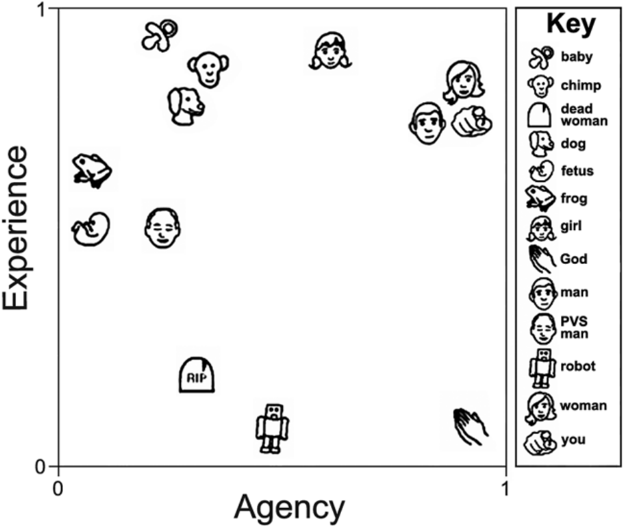
Verification
Claims the paper makes
0 Valid · 0 Not valid · 0 Not checked · 18 Own results and interpretations
A result the paper reports from its own data — it cites no other source for it, so there is none to check. The quote shows it is in the paper.
In the paper
“Characters ' factor scores on these dimensions (Fig. 1) reveal interesting features; for example, God was perceived as having much Agency but little Experience.”
- Also stated in: § Dimensions of Mind Perception · plain
“for example, God was perceived as having much Agency but little Experience.”
plain- Asserted: passes — The authors put it forward as true.
- Checkable: passes — It can be checked against evidence.
- Load-bearing: unclear — It is unclear whether the paper’s conclusions depend on it.
- Based: passes — The paper gives a reason why it holds.
- Also stated in: § Dimensions of Mind Perception · plain
A result the paper reports from its own data — it cites no other source for it, so there is none to check. The quote shows it is in the paper.
In the paper
“A factor we termed Experience (eigenvalue = 15.85) accounted for 88% of the variance and included 11 capacities (from highest loading): hunger, fear, pain, pleasure, rage, desire, personality, consciousness, pride, embarrassment, and joy.”
plain- Asserted: passes — The authors put it forward as true.
- Checkable: passes — It can be checked against evidence.
- Load-bearing: passes — The paper’s conclusions depend on it.
- Based: passes — The paper gives a reason why it holds.
A result the paper reports from its own data — it cites no other source for it, so there is none to check. The quote shows it is in the paper.
In the paper
“Of 234 z -statistics (13 characters × 9 individual difference variables × 2 factors), 23 were statistically significant.”
plain- Asserted: passes — The authors put it forward as true.
- Checkable: passes — It can be checked against evidence.
- Load-bearing: unclear — It is unclear whether the paper’s conclusions depend on it.
- Based: passes — The paper gives a reason why it holds.
A result the paper reports from its own data — it cites no other source for it, so there is none to check. The quote shows it is in the paper.
In the paper
“whereas desire to avoid harming ( ' If you were forced to harm one of these characters, which one would it be more painful for you to harm? ' ) correlated more with Experience ( r = 0.85) than Agency ( r = 0.26, z = 2.10, P < 0.05).”
plainstates an association- Asserted: passes — The authors put it forward as true.
- Checkable: passes — It can be checked against evidence.
- Load-bearing: passes — The paper’s conclusions depend on it.
- Based: passes — The paper gives a reason why it holds.
A result the paper reports from its own data — it cites no other source for it, so there is none to check. The quote shows it is in the paper.
In the paper
“The rotated solution accounted for all 18 capacities (extraction communalities ranged from 0.82 to 0.99), explained 97% of rating variance, and yielded two factors with eigenvalues over 1.0.”
plainstates an association- Asserted: passes — The authors put it forward as true.
- Checkable: passes — It can be checked against evidence.
- Load-bearing: passes — The paper’s conclusions depend on it.
- Based: passes — The paper gives a reason why it holds.
5 more claims
Create a free account to see all 18 claims and every source verdict.
- It may state two separate claims as one. 8
- Probably not a substantial claim. 1
Claims other papers make about this one
Each is checked against this paper’s own text: does it say what the citing paper says it does?
The source backs part of the claim, not all of it — or backs it for a different population, condition or comparison.
In the citing paper
“People also anthropomorphize a range of inanimate objects and animals (Kwan & Fiske, 2008; Gray, Gray, & Wegner, 2007).”
From Dehumanized Perception: A Psychological Means to Facilitate Atrocities, Torture, and Genocide? (2011) · cites this paper as Gray, Gray, & Wegner, 2007
Experimental — accuracy not yet measuredThe source backs part of the claim, not all of it — or backs it for a different population, condition or comparison.
In the citing paper
“work in social psychology has demonstrated that mental state attribution is not a unitary concept, but rather involves distinct and independent dimensions of ‘intelligence’ and ‘experience’.”
From The influence of mental state attributions on trust in large language models (2025) · cites this paper as [19]
Experimental — accuracy not yet measuredThe source backs part of the claim, not all of it — or backs it for a different population, condition or comparison.
In the citing paper
“Participants’ ratings for each of the 65 traits (Supplementary Fig. S1a) were reduced via a principal component analysis to two main dimensions, which together explained 58% of the variance (Supplementary Fig. S1b) and mapped onto previously identified dimensions of ‘experience’ (e.g. experiencing pleasure or feeling fearful) and ‘intelligence’ (e.g. knowing things or making choices; Gray et al. 2”
From Folk psychological attributions of consciousness to large language models (2024) · cites this paper as Gray et al. 2007
Experimental — accuracy not yet measuredThe cited source says what the claim attributes to it.
In the citing paper
“This dissociation is supported by factor analyses of ratings of a variety of mental states, which reveal two fundamental factors: agency, or the capacity for high-level reasoning and planning, and experience, or the capacity for sensations and emotions19”
From The influence of mental state attributions on trust in large language models (2025) · cites this paper as [19]
The cited source says what the claim attributes to it.
In the citing paper
“Other work has systematically explored the dimensions underlying mental state attributions to various agents, revealing a two-dimensional structure distinguishing between ‘Experience’ (i.e. the capacity to feel pain, fear, joy, or pride) and ‘Agency’ (i.e. the capacity to have self-control, morality, planning, or communication) that is reminiscent of the distinction between phenomenal and non-phen”
From Folk psychological attributions of consciousness to large language models (2024) · cites this paper as Gray et al. 2007
Statistics recomputed
Every reported test result, recomputed from its test statistic and degrees of freedom. A result shows as not adding up only once an independent check has confirmed it.
- Consistentz = 2.86reported p < .05 · recomputed p = .004
“z = 2.86, p < .05”
- Consistentz = 2.1reported p < .05 · recomputed p = .036
“z = 2.10, p < .05”
Self-check
Percentages, sums and reported differences re-computed from the paper’s own numbers.
Self-check results appear here once an independent check has confirmed them.
Citations
Cites
I.—COMPUTING MACHINERY AND INTELLIGENCE
TURING, A. M. (1950) · Mind · doi:10.1093/mind/lix.236.433 · Cited by 10,290
Does the chimpanzee have a theory of mind?
Premack, D., & Woodruff, G. (1978) · Behavioral and Brain Sciences · doi:10.1017/s0140525x00076512 · Cited by 8,743
Mindblindness: An Essay on Autism and Theory of Mind
Baron-Cohen, S. (1995) · doi:10.7551/mitpress/4635.001.0001 · Cited by 3,428
Dennett, D. C. (1996) · Medical Entomology and Zoology · Cited by 314
Research works printed but not linked: 1
- A. Turing, Mind59, 433 (1950).
Cited by
Items 901–1,000 of 2,340
Zhou, C., & Jiang, B. (2025) · Journal of Retailing and Consumer Services · doi:10.1016/j.jretconser.2025.104431 · Cited by 33
Social Responses to Virtual Humans: The Effect of Human-Like Characteristics
Park, S. H., & Catrambone, R. (2021) · Applied Sciences · doi:10.3390/app11167214 · Cited by 22
From Freud to Android: Constructing a Scale of Uncanny Feelings
Benjamin, R., & Heine, S. J. (2022) · Journal of Personality Assessment · doi:10.1080/00223891.2022.2048842 · Cited by 20
“A capacity for experience is typically reserved for humans (Gray et al., 2007), though objects that fall into the uncanny valley may be perceived as having an internal life.”
BackgroundInnocence over utilitarianism: Heightened moral standards for robots in rescue dilemmas
Sundvall, J. R. I., Drosinou, M., Hannikainen, I. R., Elovaara, K., Halonen, J., Herzon, V., Kopecký, R., Košová, M. J., Koverola, M., Kunnari, A., et al. (2023) · European Journal of Social Psychology · doi:10.1002/ejsp.2936 · Cited by 20
An integrated psychology of (animalistic) dehumanization requires a focus on human-animal relations
Hodson, G., & Dhont, K. (2023) · Current Research in Ecological and Social Psychology · doi:10.1016/j.cresp.2023.100131 · Cited by 16
Aging with robots: A brief review on eldercare automation
Zhang, Y., Luo, L., & Wang, X. (2024) · Interdisciplinary Nursing Research · doi:10.1097/nr9.0000000000000052 · Cited by 19
The roles of gender and temporal distance in the recall of dissonant self-related memories
Grysman, A. (2014) · Consciousness and Cognition · doi:10.1016/j.concog.2014.07.003 · Cited by 17
“To measure agency, a series of ratings scales were adopted from Gray, Gray, and Wegner (2007), including: self-control, morality, memory, emotion recognition, planning, communication, and thought.”
MethodMind perception of God in Japanese children
Moriguchi, Y., Takahashi, H., Nakamata, T., & Todo, N. (2018) · International Journal of Psychology · doi:10.1002/ijop.12482 · Cited by 15
Waśniewska, M. (2018) · New Horizons in English Studies · doi:10.17951/nh.2018.3.3 · Cited by 22
Robot's Impression of Appearance and Their Trustworthy and Emotion Richness
Matsui, T., & Yamada, S. (2018) · IEEE RO-MAN · doi:10.1109/roman.2018.8525796 · Cited by 16
“This model was suggested by Gray et al.[29].”
BackgroundMethodInfluentialEpley, N., & Eyal, T. (2019) · Advances in experimental social psychology · doi:10.1016/bs.aesp.2019.04.002 · Cited by 16
The Influence of Robot Number on Robot Group Perception—A Call for Action
Wullenkord, R., & Eyssel, F. (2020) · ACM Transactions on Human-Robot Interaction · doi:10.1145/3394899 · Cited by 15
“Finally, participants reported mind attribution to robots with a short 10-item version of the Mind Attribution Scale (MAS, Reference [39]); e.g., “To what extent are robots able to experience joy?”.”
Background“Alexa, how are you feeling today?”: Mind perception, smart speakers, and uncanniness
Taylor, J., Weiss, S. M., & Marshall, P. J. (2020) · Interaction Studies Social Behaviour and Communication in Biological and Artificial Systems · doi:10.1075/is.19015.tay · Cited by 14
Peña, J. F., Craig, M., & Baumhardt, H. (2022) · New Media & Society · doi:10.1177/14614448221127258 · Cited by 20
“Individuals perceive mind or mental capacity in humans, animals, and virtual humans along two dimensions: “Agency” or the capacity to do, plan, and exert self-control, along with “experience” or the capacity to feel and to sense pleasure or pain (Gray et al., 2007; Gray and Wegner, 2012).”
What Kind of Mind Do I Want in My Robot?
Malle, B. F., & Magar, S. T. (2017) · ACM/IEEE International Conference on Human-Robot Interaction (HRI) · doi:10.1145/3029798.3038378 · Cited by 14
“Because there is no prior work on such desires, we drew on literatures examining people’s beliefs about robots’ mental capacities [5], their moral competence [4], as well as their capacity for experiences and agency [2].”
BackgroundMethodMind Perception in Humanoid Agents has Negative Effects on Cognitive Processing
Mandell, A. R., Smith, M. A. B., & Wiese, E. (2017) · Proceedings of the Human Factors and Ergonomics Society Annual Meeting · doi:10.1177/1541931213601760 · Cited by 18
“…is a natural and efficient way to understand agents with minds (i.e., humans), it seems illog-ical to reason about the internal states of agents who by definition do not have minds (i.e., robots or GPS systems) or whose mind status is ambiguous (i.e., animals; Gray, Gray & Wegner, 2007).”
BackgroundTwo-Dimensional Mind Perception Model of Humanoid Virtual Agent
Matsui, T., & Yamada, S. (2017) · International Conference on Human-Agent Interaction (HAI) · doi:10.1145/3125739.3125761 · Cited by 15
“This result complies with that of Gary et al. [4].”
BackgroundMethodResultInfluentialLi, Z., Thomas, T., Yu, C., & Xu, Y. (2024) · ACM International Conference on Interaction Design and Children (IDC) · doi:10.1145/3628516.3659394 · Cited by 17
“Studies concerning preschool-aged children interacting with social robots [5, 21, 27, 32] have suggested that such mind perception tendency [16] is linked to more social-oriented and more effortful interactions with technologies.”
BackgroundService task compatibility for human staff vs. service robots: Roles of product type and brand level
Lee, S. A., & Oh, H. (2024) · International Journal of Hospitality Management · doi:10.1016/j.ijhm.2024.103952 · Cited by 16
How Body Size Cues Judgments on Person Perception Dimensions
Bryksina, O., Wang, L., & Mai-McManus, T. (2020) · Social Psychological and Personality Science · doi:10.1177/1948550620963675 · Cited by 18
“A framework by H. M. Gray et al. (2007) and K. Gray et al. (2011) identified dimensions of experience and agency, and work by Todorov and colleagues (e.g., Oosterhof & Todorov, 2008, 2009; Willis & Todorov, 2006) discussed trustworthiness and dominance as the two main dimensions underlying social…”
MethodThe protective effect of agency on victims of humiliation
Fernández, S., Gaviria, E., Halperin, E., Agudo, R., Gonzalez-Puerto, J. A., Chas, A., & Saguy, T. (2022) · Journal of Experimental Social Psychology · doi:10.1016/j.jesp.2022.104375 · Cited by 15
Am I being dehumanized? Development and validation of the experience of dehumanization measurement
Golossenko, A., Palumbo, H., Mathai, M., & Tran, H. (2023) · British Journal of Social Psychology · doi:10.1111/bjso.12633 · Cited by 19
“…person is to dementalize them—to perceive them as lacking mental capacities (Epley & Waytz, 2010; Haslam, 2022; Waytz et al., 2010) for conscious experience (the capability of an agent to feel and sense) and intentional agency (the capacity to plan and act; Epley & Waytz, 2010; Gray et al., 2007).”
Hong, J. (2023) · Social Science Computer Review · doi:10.1177/08944393231167211 · Cited by 14
Anthropomorphism, anthropocentrism, and human-orientation in environmental discourse
Schmitt, C. R. (2023) · Journal of Language and Politics · doi:10.1075/jlp.22123.sch · Cited by 19
Gabbiadini, A., Durante, F., Baldissarri, C., & Andrighetto, L. (2024) · Human Behavior and Emerging Technologies · doi:10.1155/2024/7008056 · Cited by 31
Wu, S., Walzer, A. N., Kahlert, A., Dillenburger, B., & Hall, D. (2024) · Construction Robotics · doi:10.1007/s41693-024-00115-z · Cited by 18
“According to Gray et al. (2007), a robot would be more seen as having human-like consciousness when its decision-making is driven by AI.”
Ladak, A., Harris, J., & Anthis, J. R. (2024) · CHI Conference on Human Factors in Computing Systems · doi:10.1145/3613904.3642403 · Cited by 24
“This question, adapted from Gray et al. [26], was the dependent variable through which we operationalized moral consideration.”
MethodThe impact of differential pricing subject on consumer behavior
Chen, J., Zhang, Y., & Wu, Y. (2024) · BMC Psychology · doi:10.1186/s40359-024-01928-x · Cited by 32
“Mind perception (MP) denotes an individual’s capacity to infer the mental states, objectives, beliefs, and emotions of a physical object by postulating unobservable attributes, which act as mediators between sensory inputs and subsequent behaviors [21, 22].”
BackgroundMethodResultKhan, M. I., Tarofder, A. K., Gopinathan, S., & Haque, A. (2025) · International Journal of Human-Computer Interaction · doi:10.1080/10447318.2025.2495118 · Cited by 25
“To develop the conceptual model, this study draws on four interrelated theoretical frameworks offering a multidimensional lens for understanding perceived authenticity in chatbot-mediated service encounters: Mind Perception Theory, Uncanny Valley Theory, Theory of Mind, and the Authenticity Model of Computer-Mediated…”
InfluentialSome Correlates of Agency Ascription and Emotional Value and Their Effects on Decision-Making
Strait, M. K., Briggs, G., & Scheutz, M. J. (2013) · International Conference on Affective Computing and Intelligent Interaction and workshops · doi:10.1109/acii.2013.89 · Cited by 14
“As agency attribution has been shown to be a dynamic process subject to experience and interaction [4], [5], it is important to extend neuroimaging techniques to environments in which interaction with embodied agents (e.”
BackgroundMahzoon, H., Ogawa, K., Yoshikawa, Y., Tanaka, M., Ogawa, K., Miyazaki, R., Ota, Y., & Ishiguro, H. (2019) · Advanced Robotics · doi:10.1080/01691864.2019.1676823 · Cited by 18
“Several factors have been proposed to facilitate mind perception, such as the perceived agency, autonomy, intelligence, and experience [35–37] as well as the perceived independency, anthropomorphism, animacy, and lifelike behavior of the communication robot [38–42].”
BackgroundGuidi, S., Marchigiani, E., Roncato, S., & Parlangeli, O. (2021) · Behaviour and Information Technology · doi:10.1080/0144929x.2021.1905879 · Cited by 17
Perceptions of Intentionality for Goal-Related Action: Behavioral Description Matters
Monroe, A. E., Reeder, G. D., & James, L. (2015) · PLoS ONE · doi:10.1371/journal.pone.0119841 · Cited by 18
“The sustained effort (and long chain of events) needed to get published might imply high levels of planning and intelligence, which are positively associated with attributions of agency and intentionality [27, 50–51].”
BackgroundAnthropomorphizing without Social Cues Requires the Basolateral Amygdala
Waytz, A. G., Cacioppo, J. T., Hurlemann, R., Castelli, F., Adolphs, R., & Paul, L. K. (2018) · Journal of Cognitive Neuroscience · doi:10.1162/jocn_a_01365 · Cited by 20
Robots are both anthropomorphized and dehumanized when harmed intentionally
Wieringa, M. S., Müller, B. C. N., Bijlstra, G., & Bosse, T. (2024) · Communications Psychology · doi:10.1038/s44271-024-00116-2 · Cited by 21
Two distinct neural pathways for mechanical versus digital technology
Federico, G., Lesourd, M., Fournel, A., Bluet, A., Bryche, C., Metaireau, M., Baldi, D., Brandimonte, M. A., Soricelli, A., Rossetti, Y., et al. (2024) · NeuroImage · doi:10.1016/j.neuroimage.2024.120971 · Cited by 14
Yu, Z., & Ai-zhong, H. (2025) · Journal of Product & Brand Management · doi:10.1108/jpbm-02-2024-4974 · Cited by 25
Lei, S., & Xie, L. (2025) · Journal of Business Research · doi:10.1016/j.jbusres.2025.115549 · Cited by 13
Qiu, J., Zhang, T., Xu, Z., Fu, Y., Mi, Q., & Li, S. (2025) · Online Information Review · doi:10.1108/oir-11-2024-0706 · Cited by 16
Kostick, K. M., Halm, A., O’Brien, K. A., Kothari, S., & Blumenthal‐Barby, J. S. (2019) · Disability and Rehabilitation · doi:10.1080/09638288.2019.1697383 · Cited by 12
The moral significance of protecting environmental and cultural objects
Bastian, B. B., Crimston, C. R., Klebl, C., & Lange, P. A. M. V. (2023) · PLoS ONE · doi:10.1371/journal.pone.0280393 · Cited by 14
“It was this recognition which led Aristotle to declare that there can be both moral agents–those whose actions can be morally right or wrong–and moral patients–those who can have moral right or wrong done to them (see [10]).”
BackgroundAre we smart enough to remember how smart animals are?
Leach, S., Sutton, R. M., Dhont, K., Douglas, K. M., & Bergström, Z. M. (2023) · Journal of Experimental Psychology General · doi:10.1037/xge0001401 · Cited by 15
Jacobs, T. P., Humphrey, B. T., & McConnell, A. R. (2023) · Anthrozoös · doi:10.1080/08927936.2023.2200647 · Cited by 14
“The two-dimensional model of mind perception (Gray et al., 2007; Waytz et al., 2010) describes how people attribute abilities to entities along two different dimensions: agency (i.e., capacity for deliberate action and selfcontrol) and experience (i.e., capacity to feel bodily sensations and…”
BackgroundMethodResultInfluentialTaking Algorithmic (Vs. Human) Advice Reveals Different Goals to Others
Efendić, E., de Calseyde, P. P. F. M. V., Bahník, Š., & Vranka, M. A. (2023) · International Journal of Human-Computer Interaction · doi:10.1080/10447318.2023.2210886 · Cited by 16
“Human advisors, on the other hand, are able to consider additional, secondary goals (and related information) when examining possible solutions (Gray et al., 2007; Longoni et al., 2019).”
BackgroundRubo, M., & Munsch, S. (2023) · Computers in Human Behavior · doi:10.1016/j.chb.2023.107915 · Cited by 17
The effects of social presence on cooperative trust with algorithms
Liefooghe, B., Min, E., & Aarts, H. (2023) · Scientific Reports · doi:10.1038/s41598-023-44354-6 · Cited by 19
Roy, S. K., Singh, G., Gruner, R. L., Dey, B. L., Shabnam, S., Muhammad, S. S., & Quaddus, M. (2023) · Information Systems Frontiers · doi:10.1007/s10796-023-10445-y · Cited by 17
“…of Human–Robot Interaction is uniquely human characteristics that lead to the perception of humans as animal-like (Cognition, intelligence, secondary emotions/morality and intentionality), and human nature characteristics that represent primary emotions, sociability or warmth (Gray et al., 2007).”
BackgroundAnimal roles in organizations: A framework for exploring organizational human–animal relations
Kandel, I. J., Dlouhy, K., & Schmitt, A. (2023) · Organization · doi:10.1177/13505084231217079 · Cited by 12
“One implication of anthropomorphism is that perceiving an animal to be human or human-like renders them worthy of moral care and consideration (Gray et al., 2007).”
Ioannidou, M., Francis, K., Stewart-Knox, B. J., & Lesk, V. E. (2024) · Appetite · doi:10.1016/j.appet.2024.107559 · Cited by 17
“These qualities, indicative of possessing a mind, are considered highly relevant for moral judgments, and ascribing moral worth (Gray et al., 2007, 2012; Leach et al., 2021).”
BackgroundDimensions of wisdom perception across twelve countries on five continents
Rudnev, M., Barrett, H. C., Buckwalter, W., Machery, É., Stich, S., Barr, K., Bencherifa, A., Clancy, R. F., Crone, D. L., Deguchi, Y., et al. (2024) · Nature Communications · doi:10.1038/s41467-024-50294-0 · Cited by 22
“Our study, following the methodologies of prior mind perception 15,28 and social judgment research 24 , used a relatively small sample of targets.”
InfluentialThe need for an empirical research program regarding human–AI relational norms
Reinecke, M. G., Kappes, A., Mann, S. P., Savulescu, J., & Earp, B. D. (2025) · AI and Ethics · doi:10.1007/s43681-024-00631-2 · Cited by 20
Moriuchi, E. (2025) · Technological Forecasting and Social Change · doi:10.1016/j.techfore.2025.124004 · Cited by 15
Han, L., Fang, J., Xie, C., Liao, M., & Zhang, Y. (2025) · Journal of Business Ethics · doi:10.1007/s10551-025-06061-2 · Cited by 19
Perspectives Questionnaire: Measuring propensities to take viewpoints of agent or recipient
Baryła, W., Białobrzeska, O., Bocian, K., Parzuchowski, M., Szymków, A., & Wojciszke, B. (2019) · Personality and Individual Differences · doi:10.1016/j.paid.2019.02.025 · Cited by 13
Would You Turn Off a Robot because It Confronts You with your Own Mortality?
Spatola, N. (2020) · ACM/IEEE International Conference on Human-Robot Interaction (HRI) · doi:10.1145/3371382.3380736 · Cited by 14
“For instance, perceiving or inferring that other beings have certain mental states are more likely to be attributed with moral rights [34].”
BackgroundIntegrating Dehumanization and Attachment in the Prediction of Teen Dating Violence Perpetration
Morera, M. D., Quiles, M. N., & González-Méndez, R. (2020) · Journal of Interpersonal Violence · doi:10.1177/0886260520933042 · Cited by 16
“We used a modified version of the indicators proposed by Gray et al. (2007) to measure the mind dimensions.”
MethodSaving Mr. Water: anthropomorphizing water promotes water conservation
Chan, E. Y. (2021) · Resources Conservation and Recycling · doi:10.1016/j.resconrec.2021.105814 · Cited by 16
Empathizing and Sympathizing With Robots: Implications for Moral Standing
Quick, O. S. (2022) · Frontiers in Robotics and AI · doi:10.3389/frobt.2021.791527 · Cited by 19
“To further investigate this claim, we can adopt a distinction between two types of capacities: “ agency ” (i.e., cognitive capacities such as planning and thought) and ‘ experience ’ (i.e., capacities such as emotions and consciousness) (Gray et al., 2007).”
BackgroundThe role of agency and communion in dehumanization — an integrative perspective
Formanowicz, M., Bulska, D., & Shnabel, N. (2022) · Current Opinion in Behavioral Sciences · doi:10.1016/j.cobeha.2022.101236 · Cited by 17
Küster, D., Krumhuber, E. G., & Kappas, A. (2014) · Palgrave Macmillan UK eBooks · doi:10.1057/9781137345868_13 · Cited by 17
Mentalizing animals: implications for moral psychology and animal ethics
Kasperbauer, T. J. (2016) · Philosophical Studies · doi:10.1007/s11098-016-0692-5 · Cited by 13
Jack, A. I. (2013) · Cited by 18
White, C., & Schaller, M. (2018) · Personality and Social Psychology Bulletin · doi:10.1177/0146167218760800 · Cited by 14
“It is well-established that adults and infants are perceived to have similar levels of patiency but different levels of agency (H. M. Gray et al., 2007).”
BackgroundInfluentialMcCoy, J. P., & Ullman, T. D. (2018) · Journal of Experimental Social Psychology · doi:10.1016/j.jesp.2018.05.007 · Cited by 17
“This research suggests that people judge other minds along two dimensions, often labeled agency and experience (Gray, Gray, & Wegner, 2007; Gray, Jenkins, Heberlein, & Wegner, 2011; Gray & Wegner, 2012; Wegner & Gray, 2016).”
BackgroundResultInfluentialWhelan, J., Hingston, S. T., & Thomson, M. (2018) · Personality and Individual Differences · doi:10.1016/j.paid.2018.08.015 · Cited by 16
Collectives in organizations appear less morally motivated than individuals.
Jago, A. S., Kreps, T. A., & Laurin, K. (2019) · Journal of Experimental Psychology General · doi:10.1037/xge0000608 · Cited by 11
The temporal dynamics of the link between configural face processing and dehumanization
Young, S. G., Tracy, R. E., Wilson, J. P., Rydell, R. J., & Hugenberg, K. (2019) · Journal of Experimental Social Psychology · doi:10.1016/j.jesp.2019.103883 · Cited by 13
Mind Perception of a Sociable Humanoid Robot: A Comparison Between Elderly and Young Adults
Alimardani, M., & Qurashi, S. (2019) · Advances in intelligent systems and computing · doi:10.1007/978-3-030-36150-1_9 · Cited by 23
Velez, J. A., Loof, T., Smith, C. A. A., Jordan, J. M., Villarreal, J. A., & Roskos‐Ewoldsen, D. R. (2019) · Journal of Computer-Mediated Communication · doi:10.1093/jcmc/zmz016 · Cited by 12
Clemente, M., Padilla-Racero, D., & Espinosa, P. (2019) · International Journal of Environmental Research and Public Health · doi:10.3390/ijerph16244950 · Cited by 14
“Therefore, although revenge is behavioral, it is essential for the person seeking revenge to have a perception of having been hurt, and to perceive that the harm they believe they have suffered is not involuntary [4,5].”
BackgroundMind perception and causal attribution for failure in a game with a robot
Miyake, T., Kawai, Y., Park, J., Shimaya, J., Takahashi, H., & Asada, M. (2019) · IEEE RO-MAN · doi:10.1109/ro-man46459.2019.8956325 · Cited by 19
“Each participant evaluated the mind perception [4] (Japanese version of the questionnaire [11]) of the facing partner agent before the game.”
BackgroundMethodResultInfluentialThe Objectification and Blame of Sexually Diverse Women who are Revenge Porn Victims
Serpe, C. R., & Brown, C. (2021) · Sexual and Gender Diversity in Social Services · doi:10.1080/10538720.2021.1911901 · Cited by 13
Dinet, J., & Vivian, R. (2015) · Psychologie Française · doi:10.1016/j.psfr.2015.05.002 · Cited by 17
Breaking Out of Moral Typecasting
Arico, A. J. (2012) · Review of Philosophy and Psychology · doi:10.1007/s13164-012-0108-1 · Cited by 15
Ditto, P. H., Liu, B., & Wojcik, S. P. (2012) · Psychological Inquiry · doi:10.1080/1047840x.2012.669248 · Cited by 14
“By linking this notion to the latest research on mind perception (eg, Gray, Gray, & Wegner, 2007 ), Gray et al.”
MethodBuck, B., Hester, N., Penn, D. L., & Gray, K. J. (2017) · Cognitive Neuropsychiatry · doi:10.1080/13546805.2017.1287692 · Cited by 13
Self-citationI’ve got a feeling: Urban and rural indigenous children’s beliefs about early life mentality
Emmons, N. A., & Kelemen, D. A. (2015) · Journal of Experimental Child Psychology · doi:10.1016/j.jecp.2015.05.001 · Cited by 11
Facing humanness: Facial width-to-height ratio predicts ascriptions of humanityPreprint
Deska, J. C., Lloyd, E. P., & Hugenberg, K. (2017) · PsyArXiv (OSF Preprints) · doi:10.31234/osf.io/5ak6b · Cited by 11
Liu, D., Zhang, J., & Qi, J. (2025) · Acta Psychologica · doi:10.1016/j.actpsy.2025.105030 · Cited by 11
Xu, Y., Chi, C. G., Gürsoy, D., & Cai, R. (2025) · Technology in Society · doi:10.1016/j.techsoc.2025.103189 · Cited by 21
Auditor Judgment Bias Research: A 50-Year Trend Analysis and Emerging Technology Use
Lombardi, D. R., Sipior, J. C., & Dannemiller, S. (2023) · Journal of Information Systems · doi:10.2308/isys-2020-079 · Cited by 18
Trusting autonomous vehicles as moral agents improves related policy support
Hurst, K. F., & Sintov, N. D. (2022) · Frontiers in Psychology · doi:10.3389/fpsyg.2022.976023 · Cited by 14
“Prior work on mind perception and morality has found that the ascription of moral responsibility is a matter of perception that depends to a large extent on agency (Gray et al., 2007, 2012; Bigman et al., 2019).”
BackgroundCreators Matter. Perception and Pricing of Art Made by Human, Cyborgs and Humanoid Robots
Fortuna, P., Modliński, A., & McNeill, M. (2022) · Empirical Studies of the Arts · doi:10.1177/02762374221143717 · Cited by 12
“Perception of agency is based on assigning attributes such as self-control, planning and thought (Gray et al., 2007).”
BackgroundPotocka, A., & Bielecki, M. (2023) · Anthrozoös · doi:10.1080/08927936.2023.2200648 · Cited by 14
Mosley, A. J., Bharj, N., & Biernat, M. (2023) · Sex Roles · doi:10.1007/s11199-023-01414-5 · Cited by 12
The Relative Importance of Target and Judge Characteristics in Shaping the Moral Circle
Jaeger, B., & Wilks, M. (2023) · Cognitive Science · doi:10.1111/cogs.13362 · Cited by 18
“Currently, most theoretical approaches to understanding moral concern center around mind perception (i.e., the attribution of different mental capacities, such as the capacity to feel pleasure and pain; Gray et al., 2012; Gray, Gray, & Wegner, 2007; Leach et al., 2021).”
BackgroundXiao, Y., Tiantian, M., & Xin-yue, Z. (2023) · Acta Psychologica Sinica · doi:10.3724/sp.j.1041.2024.00161 · Cited by 18
Srivastava, S., & Dhir, S. (2024) · International journal of organizational analysis · doi:10.1108/ijoa-05-2023-3764 · Cited by 13
Social perception of robots is shaped by beliefs about their minds
Momen, A., Hugenberg, K., & Wiese, E. (2024) · Scientific Reports · doi:10.1038/s41598-024-53187-w · Cited by 17
Jacobs, O. L. E., Pazhoohi, F., & Kingstone, A. F. (2024) · Consciousness and Cognition · doi:10.1016/j.concog.2024.103733 · Cited by 14
“Items from the Mind survey (Gray et al., 2007) were averaged across the items corresponding to agency and the items corresponding to experience.”
BackgroundMethodInfluentialLonely Minds and Robotic Bonds: Effects of Human Loneliness on the Anthropomorphization of Robots
Leichtmann, B., Gollob, E., Mayer, M., Paschmanns, A. K., & Mara, M. (2025) · International Journal of Social Robotics · doi:10.1007/s12369-025-01210-z · Cited by 16
“This may include the attribution of mind [30, 31] or social characteristics [32].”
Success Leads to Agentic Cognition: Two Field Studies
Baryła, W., & Wojciszke, B. (2018) · Social Psychological and Personality Science · doi:10.1177/1948550618765065 · Cited by 11
Seeing minds in patients with disorders of consciousness
Peterson, A. H., Kostick, K. M., O’Brien, K. A., & Blumenthal‐Barby, J. (2019) · Brain Injury · doi:10.1080/02699052.2019.1706000 · Cited by 11
The ACME shop: A paradigm to investigate working (self-) objectification
Baldissarri, C., Gabbiadini, A., Andrighetto, L., & Volpato, C. (2020) · The Journal of Social Psychology · doi:10.1080/00224545.2020.1845592 · Cited by 11
“…Valtorta, et al., 2017; Loughnan et al., 2017) is related to a denial of humanness that involves a decreased attribution of both the agency and experience dimensions of mind proposed by Gray et al. (2007) that we usually attribute to others when we consider them fully human (see Li et al., 2014).”
BackgroundFairness perceptions of artificial intelligence decision-making
Jiang, L., Cao, L., Qin, X., Tan, L., Chen, C. H. E. N., & Xiaofei, P. E. N. G. (2022) · Advances in Psychological Science · doi:10.3724/sp.j.1042.2022.01078 · Cited by 19
Wang, C., Zheng, Q., Zeng, H., Lai, R., & Xu, A. (2023) · SAGE Open · doi:10.1177/21582440221144969 · Cited by 14
“Gray et al. (2007) found that the more participants thought a nonhuman role (such as a fetus, a robot) could perceive and feel, the less they would like to hurt it.”
BackgroundHuman-robot swarm interaction: coordinated role of human mind mindsets and robot group entitativity
Dang, J., & Liu, L. (2023) · Behaviour and Information Technology · doi:10.1080/0144929x.2023.2207668 · Cited by 12
“Mind refers to an entity ’ s mental capacities, including the ability to think, plan, feel, and have intents (Gray, Gray, and Wegner 2007).”
BackgroundSocializing with robots: Human-robot interactions within a virtual environment
Richert, A., Shehadeh, M. A., Müller, S. I., Schröder, S., & Jeschke, S. (2016) · IEEE Workshop on Advanced Robotics and its Social Impacts (ARSO) · doi:10.1109/arso.2016.7736255 · Cited by 12
“In this way, the human performance differs from the imperfect performance in the way of naturally delayed reaction times, natural error rates and natural cooperation behavior.”
BackgroundThe utilitarian scientist: The humanization of scientists in moral dilemmas
Sosa, N. E., & Morrison, K. R. (2019) · Journal of Experimental Social Psychology · doi:10.1016/j.jesp.2019.103818 · Cited by 14
Taghian, M., Polonsky, M. J., & D’Souza, C. (2019) · VOLUNTAS International Journal of Voluntary and Nonprofit Organizations · doi:10.1007/s11266-019-00167-8 · Cited by 15
Metadata
- Authors
- Gray, H. M., Gray, K., & Wegner, D. M.
- Affiliations
- Harvard University (US)
- Corresponding author
- Gray, Heather M.
- Venue
- Science
- Published
- 2007-02-02
- Volume
- 315
- Issue
- 5812
- Pages
- 619-619
- ISSN
- 0036-8075 (ISSN-L)
- 1095-9203
- OpenAlex
- W2131227926
- Cited by
- 2,342
- References
- 4
- Citations by year
- 2026: 359 · 2025: 326 · 2024: 249 · 2023: 220 · 2022: 198 · 2021: 156 · 2020: 157 · 2019: 107 · 2018: 91 · 2017: 86 · 2016: 96 · 2015: 66 · 2014: 52 · 2013: 44 · 2012: 45
- FWCI
- 10.81
- Type
- journal article
- Language
- en
- Open access
- closed
- Locations
- Science (publishedVersion)
- PubMed (publishedVersion)
- Funders
- National Institutes of Health (1f31mh071053-01)
- National Institute of Mental Health (MH-71053, MH 49127, R01MH049127)
- Topics
- Life Sciences › Neuroscience › Cognitive Neuroscience › Psychology of Moral and Emotional Judgment
- Social Sciences › Psychology › Social Psychology › Social Robot Interaction and HRI
- Social Sciences › Sociology and Political Science › Social and Intergroup Psychology
- Keywords
- mind perception, moral judgment, agency, experience, non-human animals, personification, moral status of animals, self-control, hunger
- MeSH terms
- Adolescent, Adult, Aged, Child, Emotions, Female, Humans, Male, Mental Processes, Middle Aged, Morals, Perception, Personality, Principal Component Analysis
About these checks
Registry, retraction, Cites and statistics results are computed, not judged, with one exception: a printed reference that no index lists is read once by a model before it counts as a citation error. Claims are extracted by a model and kept only when their quote appears verbatim in the text; each cited source is then checked, with a model’s help, for whether it says what the claim relies on. Those verdicts can be wrong — read the claim’s quote and the cited source before relying on one.
A language model drew the claims from the paper on 2026-09-28, under version 3 of the claim definition (model deepseek-v4.1-flash, prompt extract-v3).
A second model labelled each claim on 2026-09-28 (model jev-1.13-20260917, definition revision gold-guideline-v0.2).
Statistics and arithmetic are recomputed, not judged.
Confidence bands are shown only for fields calibrated on our annotated test set. None is calibrated yet, so no band is shown.
What counts as a claim ›How we measure confidence ›How we check this ›
Are you an author, or do you see a problem with this page? Request a review
Data sources
Bibliographic data: Semantic Scholar, OpenAlex, Crossref.
Contains information from the Semantic Scholar Academic Graph Datasets, made available under the ODC Attribution License (ODC-BY 1.0).
Semantic Scholar’s data is described in: Kinney, R., et al. (2023). The Semantic Scholar Open Data Platform. arXiv:2301.10140.
