

Dimensions of Mind Perception
The DOI matches its Crossref record; 4 of the 4 references it cites were found in a registry or an index.
Abstract
Participants compared the mental capacities of various human and nonhuman characters via online surveys. Factor analysis revealed two dimensions of mind perception, Experience (for example, capacity for hunger) and Agency (for example, capacity for self-control). The dimensions predicted different moral judgments but were both related to valuing of mind.
Overview
CoChat Summary
## TL;DR
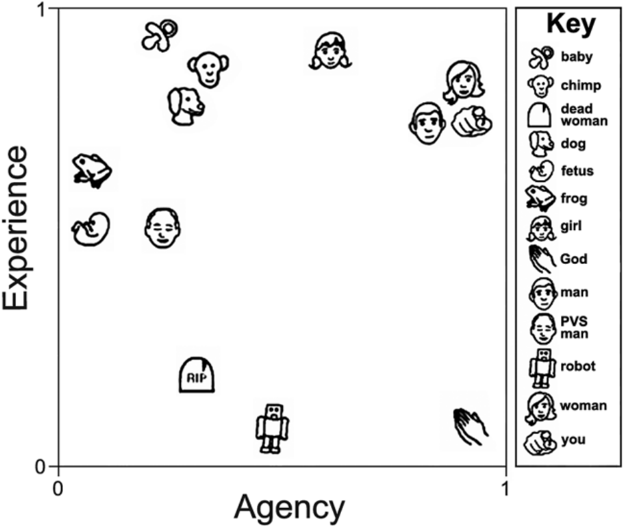
This paper argues that mind perception is not a single continuum but instead has two dimensions: Experience and Agency. Using 2,399 completed web-based surveys, the authors found that these dimensions explain how people judge minds across 13 characters and are differentially related to moral judgments.
## Key findings
- A principal components factor analysis of correlations among 18 mental capacities yielded two factors with eigenvalues over 1.0: Experience (eigenvalue 15.85, explaining 88% of variance) and Agency (eigenvalue 1.46, explaining 8% of variance); the rotated solution explained 97% of rating variance.
- Experience loaded on 11 capacities: hunger, fear, pain, pleasure, rage, desire, personality, consciousness, pride, embarrassment, and joy; Agency loaded on 7 capacities: self-control, morality, memory, emotion recognition, planning, communication, and thought.
- Personal judgments tracked the dimensions differently: liking, saving from destruction, making happy, and perceiving a soul correlated with both dimensions, with r ranging from 0.38 to 0.72.
- Punishment judgments correlated more with Agency than Experience (r = 0.82 vs. r = 0.22, z = 2.86, P < 0.05), while avoidance of harm correlated more with Experience than Agency (r = 0.85 vs. r = 0.26, z = 2.10, P < 0.05).
## Methods
- Web-based Mind Survey design: respondents saw pairwise comparisons of 13 characters across 18 mental capacities or 6 personal judgments, using five-point scales for 78 comparisons per survey.
- Sample: about 3,400 survey launches, with 2,399 completed surveys analyzed; respondents ranged from 12 to 75 years old (mean 30.44, SD 12.27) and were 64% female.
- Main analysis: character means were computed, correlations across capacities were submitted to principal components factor analysis with varimax rotation, and factor scores were estimated via regression; additional analyses examined correlations with personal judgments and individual-difference variables using z-statistics.
## Limitations
- The paper states that the surveys were largely independent and that respondent data came from web recruitment through other psychology sites, which makes the sample a convenience sample rather than a random population sample.
- Evident from the text: the factor structure is based on self-selected web respondents and on pairwise judgments of preselected characters and capacities, so generalizability beyond the survey context is not directly tested.
- The paper notes that about 25% of launched surveys were not completed, indicating noncompletion/missing-data attrition.
Model-written summary. Check it against the paper before relying on it.
Integrity signals
Registry
Cites
Statistics
Figures
Verification
Claims the paper makes
0 Valid · 0 Not valid · 0 Not checked · 18 Own results and interpretations
A result the paper reports from its own data — it cites no other source for it, so there is none to check. The quote shows it is in the paper.
In the paper
“Characters ' factor scores on these dimensions (Fig. 1) reveal interesting features; for example, God was perceived as having much Agency but little Experience.”
- Also stated in: § Dimensions of Mind Perception · plain
“for example, God was perceived as having much Agency but little Experience.”
plain- Asserted: passes — The authors put it forward as true.
- Checkable: passes — It can be checked against evidence.
- Load-bearing: unclear — It is unclear whether the paper’s conclusions depend on it.
- Based: passes — The paper gives a reason why it holds.
- Also stated in: § Dimensions of Mind Perception · plain
A result the paper reports from its own data — it cites no other source for it, so there is none to check. The quote shows it is in the paper.
In the paper
“A factor we termed Experience (eigenvalue = 15.85) accounted for 88% of the variance and included 11 capacities (from highest loading): hunger, fear, pain, pleasure, rage, desire, personality, consciousness, pride, embarrassment, and joy.”
plain- Asserted: passes — The authors put it forward as true.
- Checkable: passes — It can be checked against evidence.
- Load-bearing: passes — The paper’s conclusions depend on it.
- Based: passes — The paper gives a reason why it holds.
A result the paper reports from its own data — it cites no other source for it, so there is none to check. The quote shows it is in the paper.
In the paper
“Of 234 z -statistics (13 characters × 9 individual difference variables × 2 factors), 23 were statistically significant.”
plain- Asserted: passes — The authors put it forward as true.
- Checkable: passes — It can be checked against evidence.
- Load-bearing: unclear — It is unclear whether the paper’s conclusions depend on it.
- Based: passes — The paper gives a reason why it holds.
A result the paper reports from its own data — it cites no other source for it, so there is none to check. The quote shows it is in the paper.
In the paper
“whereas desire to avoid harming ( ' If you were forced to harm one of these characters, which one would it be more painful for you to harm? ' ) correlated more with Experience ( r = 0.85) than Agency ( r = 0.26, z = 2.10, P < 0.05).”
plainstates an association- Asserted: passes — The authors put it forward as true.
- Checkable: passes — It can be checked against evidence.
- Load-bearing: passes — The paper’s conclusions depend on it.
- Based: passes — The paper gives a reason why it holds.
A result the paper reports from its own data — it cites no other source for it, so there is none to check. The quote shows it is in the paper.
In the paper
“The rotated solution accounted for all 18 capacities (extraction communalities ranged from 0.82 to 0.99), explained 97% of rating variance, and yielded two factors with eigenvalues over 1.0.”
plainstates an association- Asserted: passes — The authors put it forward as true.
- Checkable: passes — It can be checked against evidence.
- Load-bearing: passes — The paper’s conclusions depend on it.
- Based: passes — The paper gives a reason why it holds.
5 more claims
Create a free account to see all 18 claims and every source verdict.
- It may state two separate claims as one. 8
- Probably not a substantial claim. 1
Claims other papers make about this one
Each is checked against this paper’s own text: does it say what the citing paper says it does?
The source backs part of the claim, not all of it — or backs it for a different population, condition or comparison.
In the citing paper
“People also anthropomorphize a range of inanimate objects and animals (Kwan & Fiske, 2008; Gray, Gray, & Wegner, 2007).”
From Dehumanized Perception: A Psychological Means to Facilitate Atrocities, Torture, and Genocide? (2011) · cites this paper as Gray, Gray, & Wegner, 2007
Experimental — accuracy not yet measuredThe source backs part of the claim, not all of it — or backs it for a different population, condition or comparison.
In the citing paper
“work in social psychology has demonstrated that mental state attribution is not a unitary concept, but rather involves distinct and independent dimensions of ‘intelligence’ and ‘experience’.”
From The influence of mental state attributions on trust in large language models (2025) · cites this paper as [19]
Experimental — accuracy not yet measuredThe source backs part of the claim, not all of it — or backs it for a different population, condition or comparison.
In the citing paper
“Participants’ ratings for each of the 65 traits (Supplementary Fig. S1a) were reduced via a principal component analysis to two main dimensions, which together explained 58% of the variance (Supplementary Fig. S1b) and mapped onto previously identified dimensions of ‘experience’ (e.g. experiencing pleasure or feeling fearful) and ‘intelligence’ (e.g. knowing things or making choices; Gray et al. 2”
From Folk psychological attributions of consciousness to large language models (2024) · cites this paper as Gray et al. 2007
Experimental — accuracy not yet measuredThe cited source says what the claim attributes to it.
In the citing paper
“This dissociation is supported by factor analyses of ratings of a variety of mental states, which reveal two fundamental factors: agency, or the capacity for high-level reasoning and planning, and experience, or the capacity for sensations and emotions19”
From The influence of mental state attributions on trust in large language models (2025) · cites this paper as [19]
The cited source says what the claim attributes to it.
In the citing paper
“Other work has systematically explored the dimensions underlying mental state attributions to various agents, revealing a two-dimensional structure distinguishing between ‘Experience’ (i.e. the capacity to feel pain, fear, joy, or pride) and ‘Agency’ (i.e. the capacity to have self-control, morality, planning, or communication) that is reminiscent of the distinction between phenomenal and non-phen”
From Folk psychological attributions of consciousness to large language models (2024) · cites this paper as Gray et al. 2007
Statistics recomputed
Every reported test result, recomputed from its test statistic and degrees of freedom. A result shows as not adding up only once an independent check has confirmed it.
- Consistentz = 2.86reported p < .05 · recomputed p = .004
“z = 2.86, p < .05”
- Consistentz = 2.1reported p < .05 · recomputed p = .036
“z = 2.10, p < .05”
Self-check
Percentages, sums and reported differences re-computed from the paper’s own numbers.
Self-check results appear here once an independent check has confirmed them.
Citations
Cites
I.—COMPUTING MACHINERY AND INTELLIGENCE
TURING, A. M. (1950) · Mind · doi:10.1093/mind/lix.236.433 · Cited by 10,290
Does the chimpanzee have a theory of mind?
Premack, D., & Woodruff, G. (1978) · Behavioral and Brain Sciences · doi:10.1017/s0140525x00076512 · Cited by 8,743
Mindblindness: An Essay on Autism and Theory of Mind
Baron-Cohen, S. (1995) · doi:10.7551/mitpress/4635.001.0001 · Cited by 3,428
Dennett, D. C. (1996) · Medical Entomology and Zoology · Cited by 314
Research works printed but not linked: 1
- A. Turing, Mind59, 433 (1950).
Cited by
Items 1,001–1,100 of 2,340
Mastropierro, L., & Conklin, K. (2019) · Language and Literature International Journal of Stylistics · doi:10.1177/0963947019884450 · Cited by 11
Choi, S. Y., Liu, J. H.-F., Csertő, I., Vincze, O., Fülöp, É., & Pólya, T. (2019) · Journal of Language and Social Psychology · doi:10.1177/0261927x19893833 · Cited by 16
“On the other hand, psychological states recognized by the emotion module are associated with basic experience, and this is considered to be a more fundamental part of human nature (Epley & Waytz, 2010; Gray et al., 2007).”
BackgroundInfluentialExploring the ins and outs of biodiversity in the moral community
Batavia, C., Bruskotter, J. T., Jones, J. A., & Nelson, M. P. (2020) · Biological Conservation · doi:10.1016/j.biocon.2020.108580 · Cited by 11
The Science of Belief: A Progress Report
Porot, N., & Mandelbaum, E. (2022) · Cambridge University Press eBooks · doi:10.1017/9781009001021.005 · Cited by 13
Consciousness, Metacognition, and the Unconscious
Winkielman, P., & Schooler, J. W. (2012) · SAGE Publications Ltd eBooks · doi:10.4135/9781446247631.n4 · Cited by 15
White, M., & Molina, L. E. (2016) · Social Psychology · doi:10.1027/1864-9335/a000272 · Cited by 13
Oldmeadow, J. A. (2018) · British Journal of Social Psychology · doi:10.1111/bjso.12262 · Cited by 14
Hanson, R. (2016) · Oxford University Press eBooks · doi:10.1093/oso/9780198754626.003.0021 · Cited by 11
Dong, J., Yu, S., Choi, K., & Jeon, M. (2025) · Frontiers in Robotics and AI · doi:10.3389/frobt.2025.1529421 · Cited by 15
“Thus, beetles, as well as babies, are more likely to be perceived as being capable of biological experience, such as feeling pain, but having less agency, such as planning, compared to robots (Weisman, Dweck, and Markman, 2017; Gray et al., 2007).”
Responsibility Attribution in Human Interactions with Everyday AI Systems
Brailsford, J., Vetere, F., & Velloso, E. (2025) · CHI Conference on Human Factors in Computing Systems · doi:10.1145/3706598.3713126 · Cited by 25
“Some claims have been made that agency relates the perception of a mind within the machine itself [24, 25].”
Tripathi, S. N., Husain, R., & Rana, N. P. (2025) · Journal of Hospitality Marketing & Management · doi:10.1080/19368623.2025.2552202 · Cited by 13
“This further leads to expectations of abilities like planning, emotion recognition, and communication (Gray et al., 2007), accompanied by possession of enhanced capabilities of verbal information exchange, gestures, facial expressions, gaze, and facial expressions which in turn offer the potential…”
The essence of mentalistic agents
Nichols, S. (2015) · Synthese · doi:10.1007/s11229-015-0893-z · Cited by 11
“(Gray et al. 2007 adopt a more restrictive usage on which “agency” does not include experiential states).”
BackgroundChen, Z. J., Guo, S., & Cowden, R. G. (2023) · International Journal for the Psychology of Religion · doi:10.1080/10508619.2023.2265267 · Cited by 12
“…which is innate even among children (Bering & Bjorklund, 2004; Bloom, 2005), mind perception that entails ascribing mental capacities to other (Gray et al., 2007), and ontological confusions with which one ascribe attributes of mental phenomena to physical phenomena (Lindeman et al., 2015).”
BackgroundKjeldgaard‐Christiansen, J., & Clasen, M. (2023) · Style · doi:10.5325/style.57.3.0322 · Cited by 11
Wang, M., Lee, S. C., & Jeon, M. (2024) · Human-Computer Interaction · doi:10.1080/07370024.2024.2341217 · Cited by 14
“Thus, the conversational speech style stimulated drivers to treat the IVIA as a moral agent worthy of care and concern (Gray et al., 2007), which positively influences driver behaviors by encouraging safe driving.”
Mindless furry test-tubes: Categorizing animals as lab-subjects leads to their mind denial
Vezirian, K., Bègue, L., & Bastian, B. B. (2024) · Journal of Experimental Social Psychology · doi:10.1016/j.jesp.2024.104629 · Cited by 13
Trust in AI Chatbots: The Perceived Expertise of ChatGPT in Subjective and Objective Tasks
Ramrath, M., Scharmann, A., Ridder, A., Kühn, T., Weller, S., & Krämer, N. C. (2024) · Frontiers in artificial intelligence and applications · doi:10.3233/faia240200 · Cited by 13
Bodily feelings as information: the embodied cognition perspective on robotic services
Xiong, X., Wong, I. A., & Yang, F. X. (2025) · European Journal of Marketing · doi:10.1108/ejm-06-2023-0457 · Cited by 13
More polite, more immoral: how does politeness in service robots influence consumer moral choices?
Dong, X., Zvereva, G., Wen, X., & Xi, N. (2025) · Service Industries Journal · doi:10.1080/02642069.2025.2453676 · Cited by 13
“This may lead to an increase in the perceived threat due to the realization that robots could act as moral agents (Gray et al., 2007; Gray & Wegner, 2009).”
InfluentialUnderstanding service performance of frontline employees from employee–AI interaction perspective
Yang, S., Yu, G., Chen, Y., Li, Y., Zhou, S., & Jiang, H. (2025) · Journal of service management · doi:10.1108/josm-10-2023-0425 · Cited by 19
"Do As I Say, Not As I Do": Challenges in Delegating Decisions to Automated Agents
de Melo, C. M., Marsella, S., & Gratch, J. S. (2016) · ENLIGHTEN (Jurnal Bimbingan dan Konseling Islam) · doi:10.5555/2936924.2937063 · Cited by 10
Towards Turing Test 2.0—Attribution of Moral Status and Personhood to Human and Non-Human Agents
Lukaszewicz, A., & Fortuna, P. (2022) · Postdigital Science and Education · doi:10.1007/s42438-022-00303-6 · Cited by 6
“(Gray et al. 2007: 619) The dimensions found by Gray et al. (2007) were confirmed in other studies (Weisman et al. 2017), including those that considered humanoid robots (Saltik et al. 2021) and algorithmic systems (Castelo 2019) performing artistic works (Lima et al. 2021).”
BackgroundMethodResultInfluentialPepper, just show me the way! How robotic shopping assistants should look and act
Fukawa, N., Huang, Y., & Babin, B. J. (2023) · Journal of Consumer Behaviour · doi:10.1002/cb.2273 · Cited by 12
Potocka, A., & Bielecki, M. (2023) · PLoS ONE · doi:10.1371/journal.pone.0295085 · Cited by 11
“Next, the participants were asked to write a short post for Facebook or Twitter about the text they read and to complete the Animal Mind Questionnaire (AMQ-PL, [12]) based on the Mind Survey [15].”
BackgroundMethodInfluentialThe Self in Action: Narrating Agentic Moments
Zilberstein, S., Ayala‐Hurtado, E., Sanchez, M., & Robey, D. J. (2024) · RSF The Russell Sage Foundation Journal of the Social Sciences · doi:10.7758/rsf.2024.10.5.05 · Cited by 9
“In this literature, passive individuals are those who receive, feel, desire, or experience in ad hoc, uncontrolled, or overly structured ways (Gray, Gray, and Wegner 2007; Gray and Wegner 2009; Jenks 1998; Parsons 1951).”
Quadflieg, S., Ul-Haq, I., & Mavridis, N. (2016) · Interaction Studies Social Behaviour and Communication in Biological and Artificial Systems · doi:10.1075/is.17.2.03qua · Cited by 14
Formal and Social Enforcement in Response to Individual Versus Corporate Transgressions
Haran, U., Teichman, D., & Feldman, Y. (2016) · Journal of Empirical Legal Studies · doi:10.1111/jels.12133 · Cited by 11
Riskind, J. H., & Richards, D. K. (2017) · Cognitive Therapy and Research · doi:10.1007/s10608-017-9877-2 · Cited by 10
Perceiving Sophisticated Minds Influences Perceptual Individuation
Almaraz, S. M., Hugenberg, K., & Young, S. G. (2017) · Personality and Social Psychology Bulletin · doi:10.1177/0146167217733070 · Cited by 10
“Participants then learned to individuate these stimuli, and finally rated this species on characteristics related to Agency and Experience (Gray et al., 2007).”
BackgroundMethodInfluentialSánchez, J. R. L., & Rivera-Largacha, S. (2018) · Revista Ciencias de la Salud · doi:10.12804/revistas.urosario.edu.co/revsalud/a.6773 · Cited by 10
Davies, T., Yogeeswaran, K., Verkuyten, M., & Loughnan, S. (2018) · PLoS ONE · doi:10.1371/journal.pone.0207343 · Cited by 15
Gender associations in the twentieth-century English-language literature
Schulz, D., & Bahník, Š. (2019) · Journal of Research in Personality · doi:10.1016/j.jrp.2019.05.010 · Cited by 19
Tausen, B. M., Charleson, M., & Fingerhut, L. (2021) · Journal of Community Psychology · doi:10.1002/jcop.22630 · Cited by 16
The socio-parasite and bio-parasite metaphorical concepts in racist discourse
Wasniewska, M. (2017) · Crossroads A Journal of English Studies · doi:10.15290/cr.2017.17.2.03 · Cited by 8
Developmental changes in perceived moral standing of robotsPreprint
Reinecke, M. G., Wilks, M., & Bloom, P. (2021) · doi:10.31234/osf.io/xtgys · Cited by 10
“Here, we highlight the relationship between mental life and moral standing, echoing a large existing literature in moral psychology (Gray et al., 2007; Schein & Gray, 2018).”
BackgroundInfluentialHow We Understand Others: A Theory of How Social Perspective Taking UnfoldsPreprint
Gehlbach, H., & Mu, N. (2022) · doi:10.31234/osf.io/q9fev · Cited by 10
Tu, Y., Li, J., Chen, J., Li, C.-J., & He, W. (2025) · Journal of Organizational Behavior · doi:10.1002/job.70038 · Cited by 22
AI or human: How the type of information to be disclosed alters customer service agent preferences
Dai, X., Zhang, L., Huang, Z., & Wang, L. (2025) · Journal of Retailing and Consumer Services · doi:10.1016/j.jretconser.2025.104621 · Cited by 12
Ding, X., & Xing, C. (2025) · Acta Psychologica · doi:10.1016/j.actpsy.2025.105945 · Cited by 11
Mind-reading machines: Distinct user responses to thought-detecting and emotion-detecting robots.
Grundke, A., Stein, J., & Appel, M. (2022) · Technology Mind and Behavior · doi:10.1037/tmb0000053 · Cited by 11
Elaborating humanness: a direct comparison between mindful and mindless entities
Ruzzante, D., & Vaes, J. (2022) · Current Opinion in Behavioral Sciences · doi:10.1016/j.cobeha.2022.101235 · Cited by 9
Training School Teachers to Use Robots as an Educational Tool: The Impact on Robotics Perception
Pusceddu, G., Cocchella, F., Bogliolo, M., Belgiovine, G., Lastrico, L., Casadio, M., Rea, F., & Sciutti, A. (2022) · Lecture notes in computer science · doi:10.1007/978-3-031-24670-8_10 · Cited by 11
Spatola, N., Wudarczyk, O. A., Nomura, T., & Chérif, E. (2023) · International Journal of Social Robotics · doi:10.1007/s12369-023-01056-3 · Cited by 15
“From a societal perspective, the degree of anthropomorphism is predictive of how agents are considered in terms of legal protection, public interest [62], responsibility, and moral status [63].”
BackgroundMomen, A., de Visser, E. J., Wolsten, K., Cooley, K., Walliser, J., & Tossell, C. C. (2023) · Hawaii International Conference on System Sciences (HICSS) · doi:10.24251/hicss.2023.063 · Cited by 25
Gálvez, V., & Hanono, E. (2024) · International Journal of Social Robotics · doi:10.1007/s12369-024-01113-5 · Cited by 11
The More You Know: The Impact of Personal Knowledge on Interpersonal Treatment at Work
Hardin, A. E. (2024) · Organization Science · doi:10.1287/orsc.2021.15606 · Cited by 13
Mays, K. K., Cummings, J. J., & Katz, J. E. (2024) · International Journal of Human-Computer Interaction · doi:10.1080/10447318.2024.2338332 · Cited by 20
“Mind Attribution was adapted from Gray et al. (2007) 18-item scale that measured perceptions of robots’ capacities to feel joy, have a personality, communication, and other human experiences ( M ¼ 3.87, SD ¼ 1.46, a ¼ .96).”
InfluentialZheng, C., Zhang, L., & Bian, X. (2024) · Journal of Retailing and Consumer Services · doi:10.1016/j.jretconser.2024.103934 · Cited by 10
First impressions: Do faces with scars and palsies influence warmth, competence and humanization?
Paruzel‐Czachura, M., Workman, C. I., Toukhy, N. E., & Chatterjee, A. K. (2024) · British Journal of Psychology · doi:10.1111/bjop.12719 · Cited by 13
Chien, S.-E., Chen, Y.-S., Chen, Y., & Yeh, S. (2024) · International Journal of Human-Computer Interaction · doi:10.1080/10447318.2024.2376365 · Cited by 13
“Mind perception has two key dimensions: agency and experience (Gray et al., 2007).”
Oliveira, M., Brands, J., Mashudi, J., Liefooghe, B., & Hortensius, R. (2024) · Cognitive Research Principles and Implications · doi:10.1186/s41235-024-00573-7 · Cited by 17
“…of prior work in mind perception and morality research documenting people’s tendency to ascribe a low ability to experience emotion to artificial entities (Big-man & Gray, 2018; Gray et al., 2007) and how such an ability is essential for moral reasoning (Gray et al., 2012; Haidt et al., 1993).”
BackgroundInfluentialNature contact increases perceived humanness in others
Cheng, L., Wang, X., Shi, J., & Teng, F. (2024) · Journal of Environmental Psychology · doi:10.1016/j.jenvp.2024.102389 · Cited by 12
Anthropomorphic Sad Expressions Reduce Waste of “Single” Imperfect Food
Gerecht, S., Eckmann, L., Wentzel, D., & Landwehr, J. R. (2024) · Psychology and Marketing · doi:10.1002/mar.22145 · Cited by 12
Guidi, S., Bracci, M., Currò, F., Innocenti, A., Lusuardi, L. M., Marchigiani, E., Palmitesta, P., Sirizzotti, M., & Parlangeli, O. (2025) · Behaviour and Information Technology · doi:10.1080/0144929x.2025.2457563 · Cited by 10
“The first 18 questions concerned the robot’s mental skills (Gray, Gray, and Wegner 2007) and referred to two main dimensions of mind perception: the Experience level (conceived as the ability to have feelings and emotions), investigated by 11 questions, and the Agency level (conceived as the…”
Kim, T., Lee, S. J., & Park, S. (2025) · International Journal of Human-Computer Interaction · doi:10.1080/10447318.2025.2489029 · Cited by 14
“Recognizing experiencing and perceiving emotion as unique human abilities (Gray et al., 2007), studies have examined how the integration of emotion into endorsement messages and the types of emotion affect attitudes and purchase intentions with regard to brands advertised by virtual (vs. human)…”
Ladak, A., Wilks, M., Loughnan, S., & Anthis, J. R. (2025) · CHI Conference on Human Factors in Computing Systems · doi:10.1145/3706598.3713130 · Cited by 27
“Mental agency and experience are correlated with two analogous moral faculties: moral agency, the capacity to do right and wrong, and moral patiency, the capacity to be treated rightly or wrongly [16].”
InfluentialPromoting mindful consumption through a chatbot with an experiential mind
Seo, J. K., & Yoon, H. J. (2025) · Journal of Consumer Marketing · doi:10.1108/jcm-05-2024-6844 · Cited by 15
When privacy concerns drive AI adoption: a psychological perspective
Guo, T. T., Wu, Q., & Cai, F. (2025) · Journal of Research in Interactive Marketing · doi:10.1108/jrim-02-2024-0122 · Cited by 18
How task objectivity shapes customer responses to robot service failure
Huang, H., Chen, F. F., Liu, S. Q., & Xing, Y. (2025) · Journal of service management · doi:10.1108/josm-07-2024-0323 · Cited by 12
Machine talk: When flattery sounds better from a bot
Chai, D., Li, J., & Huang, J. (2025) · Journal of Retailing and Consumer Services · doi:10.1016/j.jretconser.2025.104465 · Cited by 12
Caviola, L., Wilks, M., Suárez-Yera, C., Allen, C., Kahane, G., McGuire, L., Faber, N. S., Tejada, A. J. R., Sánchez‐Castelló, M., Ordóñez-Carrasco, J. L., et al. (2025) · Personality and Social Psychology Bulletin · doi:10.1177/01461672251373108 · Cited by 11
“Research in moral psychology has echoed this focus, similarly finding that people rely on both identity-based (e.g., species) and capacity-based (e.g., cognitive) reasoning when making moral judgments (Caviola et al., 2019, 2021; Gray et al., 2007; Kozachenko & Piazza, 2021; Piazza et al., 2014).”
Risk Perception and Risk Behavior in Response to Service Robot Anthropomorphism in Banking
Aubel, M., Pikturnienė, I., & Joye, Y. (2022) · Central European Management Journal · doi:10.7206/cemj.2658-0845.74 · Cited by 14
Banks, J., Koban, K., & Haggadone, B. A. (2023) · ACM Transactions on Human-Robot Interaction · doi:10.1145/3572036 · Cited by 12
How objectifiers are granted power in the workplace
Zhang, B., Wisse, B. M., & Lord, R. G. (2023) · European Journal of Social Psychology · doi:10.1002/ejsp.2930 · Cited by 10
Clark, H. H., & Fischer, K. (2023) · Behavioral and Brain Sciences · doi:10.1017/s0140525x22002825 · Cited by 11
Permissibility vs. Feasibility: AI in service from a CX perspective
Giebelhausen, M. D., & Poehlman, T. A. (2023) · Journal of Services Marketing · doi:10.1108/jsm-06-2023-0210 · Cited by 12
The future of the labor force: higher cognition and more skills
Zhang, W., Lai, K., & Gong, Q. (2024) · Humanities and Social Sciences Communications · doi:10.1057/s41599-024-02962-1 · Cited by 20
“People tend to think that machines lack essential human emotions or emotional abilities (that is, they lack emotions similar to humans) (Haslam et al., 2008; Gray et al., 2007), so they are skeptical of machines performing socio-cognitive skills.”
Jacobs, T. P., Mei-ying, W., Leach, S., Siu, H. L., Khanna, M., Chan, K. W., Chau, H. T., Tam, K. Y. Y., & Feldman, G. (2024) · International Review of Social Psychology · doi:10.5334/irsp.932 · Cited by 11
Humanness beliefs about behavior: An index and comparative human-nonhuman behavior judgments
Wilson, S. G., & Haslam, N. (2012) · Behavior Research Methods · doi:10.3758/s13428-012-0252-7 · Cited by 15
“…(e.g., pleasure, fear), and appetites (e.g., hunger), as well as capacities for forming and maintaining affectionate relationships (interpersonal warmth), learning from experience (cognitive openness), and individuality and self-determination (H.M. Gray et al., 2007; Haslam et al., 2005, 2004).”
BackgroundInfluentialMorality in the era of smart devices
Sui, J., & Mo, T. (2021) · International Journal of Emerging Markets · doi:10.1108/ijoem-06-2021-0917 · Cited by 9
Perceiving People With Physical Disabilities as Overcoming Adversity Warps Mind Perception
Sim, M., & Hugenberg, K. (2022) · Personality and Social Psychology Bulletin · doi:10.1177/01461672221099378 · Cited by 14
Shared Perception Is Different From Individual Perception: A New Look on Context Dependency
Mazzola, C., Rea, F., & Sciutti, A. (2022) · IEEE Transactions on Cognitive and Developmental Systems · doi:10.1109/tcds.2022.3185100 · Cited by 13
“On this occasion, we delivered the Inclusion of Other in Self-scale (IOS) questionnaire [42] to assess how close to iCub, in a range from 1 to 7, participants felt during the task; the Godspeed questionnaires with the subscales Anthropomorphism, Animacy, Likeability, and Perceived Intelligence [43] and the subscales M…”
MethodLack of Effort or Lack of Ability? Robot Failures and Human Perception of Agency and Responsibility
van der Woerdt, S., & Haselager, P. (2017) · Communications in computer and information science · doi:10.1007/978-3-319-67468-1_11 · Cited by 13
Jesso, S. T., Kennedy, W. G., & Wiese, E. (2020) · Frontiers in Robotics and AI · doi:10.3389/frobt.2020.531805 · Cited by 11
“When a non-human agent is perceived to have high amounts of human-likeness, individuals adopt the “intentional stance” (Dennett, 1989), or the belief that the actions carried out by the agent are the result of “having a mind” that is capable of rational, intentional choices (Gray et al., 2007).”
BackgroundWhite, C. J. M., Norenzayan, A., & Schaller, M. (2020) · PLOS ONE · doi:10.1371/journal.pone.0244144 · Cited by 9
“Compared to adults, young children are perceived as less capable in the moral domain—less able to foresee the consequences of their actions, less able to control their own behavior, and thus less able to distinguish right from wrong [17, 18].”
BackgroundPsychological Inquiry: An International Journal for the Advancement of Psychological Theory
Dillon, K. D., & Cushman, F. A. (2012) · Cited by 8
The Flatland Fallacy: Moving Beyond Low Dimensional ThinkingPreprint
Jolly, E., & Chang, L. J. (2017) · PsyArXiv (OSF Preprints) · doi:10.31234/osf.io/zdrfg · Cited by 8
Cultural Variation in Attitudes Towards Social ChatbotsPreprint
Folk, D. P., Wu, C., & Heine, S. J. (2023) · PsyArXiv (OSF Preprints) · doi:10.31234/osf.io/wc895 · Cited by 9
Ruzzante, D., & Vaes, J. (2021) · Neuropsychologia · doi:10.1016/j.neuropsychologia.2021.107983 · Cited by 8
Li, X., Si, W., & Chan, K. W. (2023) · Psychology and Marketing · doi:10.1002/mar.21943 · Cited by 11
Configural face processing and its influence on the timeline of mentalization
Ruzzante, D., & Vaes, J. (2024) · Current Research in Ecological and Social Psychology · doi:10.1016/j.cresp.2024.100184 · Cited by 9
Why People Judge Humans Differently from Machines: The Role of Perceived Agency and Experience
Zhang, J., Conway, J., & Hidalgo, C. A. (2023) · IEEE International Conference on Cognitive Infocommunications · doi:10.1109/coginfocom59411.2023.10397474 · Cited by 17
“…the concept of moral status (not to be confused with the idea of expertise) and to the right of an agent to be treated with These two that has been used previously to explain the cognition and behavior of alters using representations of their perceived mental abilities [3], [4], [8], [11].”
BackgroundMindful Explanations: Prevalence and Impact of Mind Attribution in XAI Research
Hindennach, S., Shi, L., Miletić, F., & Bulling, A. (2024) · Proceedings of the ACM on Human-Computer Interaction · doi:10.1145/3641009 · Cited by 17
“According to Gray et al. [17], responsibility is associated with high levels of agency, and experience is matched with moral patiency, i.e. being the recipient of moral wrong-doing.”
BackgroundMethodInfluentialOvercome Medical Algorithm Aversion: Conditional Joint Effect of Direct and Indirect Information
Zhao, Y., & Xiao, C. (2024) · International Journal of Human-Computer Interaction · doi:10.1080/10447318.2024.2344146 · Cited by 12
“Research on mind perception suggests that people think AI has agency (e.g., self-control, memory, and planning) but no experience (e.g., hunger, fear, pain, and pleasure) (Gray et al., 2007), that is, a machine with cognitive ability.”
Giger, J., Piçarra, N., Pochwatko, G., Almeida, N., Almeida, A. S., & Costa, N. (2024) · Human Behavior and Emerging Technologies · doi:10.1155/2024/5569587 · Cited by 13
World‐making for a future with sentient AI
Pauketat, J. V. T., Ladak, A., & Anthis, J. R. (2024) · British Journal of Social Psychology · doi:10.1111/bjso.12844 · Cited by 13
“The moral circle bounds moral consideration, protection from harm, care, and the right to fairness standards (H. M. Gray et al., 2007; K. Gray & Wegner, 2009; Hadarics & Kende, 2018; Opotow, 1990, 1993) and entities can be included to various degrees (Crimston et al., 2016).”
Will human designers be replaced? Exploring consumer responses to AI involvement in interior design
Hai, L., Tang, X., Fu, M., & Peng, H. (2025) · Current Psychology · doi:10.1007/s12144-025-07422-w · Cited by 12
“According to the theory of mind perception, people usually perceive other entities in terms of two differ - ent dimensions, agency and experience, leading to differ - ent downstream outcomes, such as attitudes or behavioral changes (Gray et al., 2007; Gray & Wegner, 2012).”
Affect-Enhancing Speech Characteristics for Robotic Communication
Klüber, K., Schwaiger, K., & Onnasch, L. (2025) · International Journal of Social Robotics · doi:10.1007/s12369-025-01221-w · Cited by 12
“In contrast, robots are typically rated low on theexperiencedimensionandmoderateontheagencydimen-sion [6], which often results in harsher judgments when they make mistakes.”
InfluentialTill Tech Do Us Part: Betrayal Aversion and Its Role in Algorithm Use
Kormylo, C., Adjerid, I., Ball, S. B., & Dogan, C. (2025) · Management Science · doi:10.1287/mnsc.2022.03510 · Cited by 10
Xin, X., & Liu, W. (2025) · Frontiers in Psychology · doi:10.3389/fpsyg.2025.1555395 · Cited by 13
“Additionally, the conscious experiences, metacognitive abilities, and intentional features associated with human perception constitute fundamental components of anthropomorphism (Gray et al., 2007).”
Knowledge cues to human origins facilitate self-disclosure during interactions with chatbots
Warren-Smith, G., Laban, G., Pacheco, E.-M., & Cross, E. S. (2025) · Computers in Human Behavior Artificial Humans · doi:10.1016/j.chbah.2025.100174 · Cited by 21
Yao, X., & Xi, Y. (2025) · Social Science Computer Review · doi:10.1177/08944393251354976 · Cited by 24
“Gray et al. (2007) proposed that people attribute humanness based on two core dimensions — agency (planning, thinking, acting) and experience (feeling, emoting).”
Socially (un)acceptable errors of AI: Consumer perceptions of different AI-induced errors
Mueller, A., Kuester, S., & von Janda, S. (2025) · Journal of Business Research · doi:10.1016/j.jbusres.2025.115673 · Cited by 14
Kim, H., & Lee, S. W. (2025) · International Journal of Information Management · doi:10.1016/j.ijinfomgt.2025.102996 · Cited by 20
Turner, P., Hetherington, R., Turner, S., & Kosek, M. (2015) · Digital Creativity · doi:10.1080/14626268.2015.1091778 · Cited by 8
Concepts of God and Germs: Social Mechanisms and Cognitive Heuristics
Saide, A. R., & Richert, R. A. (2021) · Cognitive Science · doi:10.1111/cogs.12942 · Cited by 8
Alcohol use by Athletes: Hierarchy, status, and Reciprocity
Harris, M. A., Jones, C., & Brown, D. H. K. (2022) · Journal of Sport and Social Issues · doi:10.1177/01937235221144432 · Cited by 11
“Whereas dehumanisation reduces the moral worth attributed to the dehumanised and increases perceptions that they are less worthy of protection from harm (Christoff, 2014; Opotow, 1990; Haslam & Loughnan, 2014; Gray et al., 2007; Bastian & Haslam, 2011).”
BackgroundWhat is (and was) a person? Evidence on historical mind perceptions from natural language
Ash, E., Stammbach, D., & Tobia, K. P. (2023) · Cognition · doi:10.1016/j.cognition.2023.105501 · Cited by 13
When it is ok to give the Robot Less: Children’s Fairness Intuitions Towards Robots
Ayalon, O., Hok, H., Shaw, A., & Gordon, G. (2023) · International Journal of Social Robotics · doi:10.1007/s12369-023-01047-4 · Cited by 10
“A large body of research in social robotics has been founded on two dimensions of mind perception: experience and agency, e.g., [41, 42].”
BackgroundThe positive–negative–competence (PNC) model of psychological responses to representations of robots
Krpan, D., Booth, J. E., & Damien, A. (2023) · Nature Human Behaviour · doi:10.1038/s41562-023-01705-7 · Cited by 10
Metadata
- Authors
- Gray, H. M., Gray, K., & Wegner, D. M.
- Affiliations
- Harvard University (US)
- Corresponding author
- Gray, Heather M.
- Venue
- Science
- Published
- 2007-02-02
- Volume
- 315
- Issue
- 5812
- Pages
- 619-619
- ISSN
- 0036-8075 (ISSN-L)
- 1095-9203
- OpenAlex
- W2131227926
- Cited by
- 2,342
- References
- 4
- Citations by year
- 2026: 359 · 2025: 326 · 2024: 249 · 2023: 220 · 2022: 198 · 2021: 156 · 2020: 157 · 2019: 107 · 2018: 91 · 2017: 86 · 2016: 96 · 2015: 66 · 2014: 52 · 2013: 44 · 2012: 45
- FWCI
- 10.81
- Type
- journal article
- Language
- en
- Open access
- closed
- Locations
- Science (publishedVersion)
- PubMed (publishedVersion)
- Funders
- National Institutes of Health (1f31mh071053-01)
- National Institute of Mental Health (MH-71053, MH 49127, R01MH049127)
- Topics
- Life Sciences › Neuroscience › Cognitive Neuroscience › Psychology of Moral and Emotional Judgment
- Social Sciences › Psychology › Social Psychology › Social Robot Interaction and HRI
- Social Sciences › Sociology and Political Science › Social and Intergroup Psychology
- Keywords
- mind perception, moral judgment, agency, experience, non-human animals, personification, moral status of animals, self-control, hunger
- MeSH terms
- Adolescent, Adult, Aged, Child, Emotions, Female, Humans, Male, Mental Processes, Middle Aged, Morals, Perception, Personality, Principal Component Analysis
About these checks
Registry, retraction, Cites and statistics results are computed, not judged, with one exception: a printed reference that no index lists is read once by a model before it counts as a citation error. Claims are extracted by a model and kept only when their quote appears verbatim in the text; each cited source is then checked, with a model’s help, for whether it says what the claim relies on. Those verdicts can be wrong — read the claim’s quote and the cited source before relying on one.
A language model drew the claims from the paper on 2026-09-28, under version 3 of the claim definition (model deepseek-v4.1-flash, prompt extract-v3).
A second model labelled each claim on 2026-09-28 (model jev-1.13-20260917, definition revision gold-guideline-v0.2).
Statistics and arithmetic are recomputed, not judged.
Confidence bands are shown only for fields calibrated on our annotated test set. None is calibrated yet, so no band is shown.
What counts as a claim ›How we measure confidence ›How we check this ›
Are you an author, or do you see a problem with this page? Request a review
Data sources
Bibliographic data: Semantic Scholar, OpenAlex, Crossref.
Contains information from the Semantic Scholar Academic Graph Datasets, made available under the ODC Attribution License (ODC-BY 1.0).
Semantic Scholar’s data is described in: Kinney, R., et al. (2023). The Semantic Scholar Open Data Platform. arXiv:2301.10140.
