

Dimensions of Mind Perception
The DOI matches its Crossref record; 4 of the 4 references it cites were found in a registry or an index.
Abstract
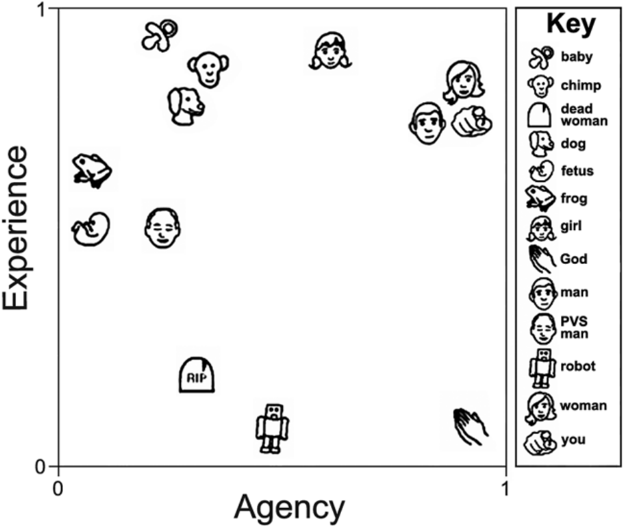
Participants compared the mental capacities of various human and nonhuman characters via online surveys. Factor analysis revealed two dimensions of mind perception, Experience (for example, capacity for hunger) and Agency (for example, capacity for self-control). The dimensions predicted different moral judgments but were both related to valuing of mind.
Overview
CoChat Summary
## TL;DR
This paper argues that mind perception is not a single continuum but instead has two dimensions: Experience and Agency. Using 2,399 completed web-based surveys, the authors found that these dimensions explain how people judge minds across 13 characters and are differentially related to moral judgments.
## Key findings
- A principal components factor analysis of correlations among 18 mental capacities yielded two factors with eigenvalues over 1.0: Experience (eigenvalue 15.85, explaining 88% of variance) and Agency (eigenvalue 1.46, explaining 8% of variance); the rotated solution explained 97% of rating variance.
- Experience loaded on 11 capacities: hunger, fear, pain, pleasure, rage, desire, personality, consciousness, pride, embarrassment, and joy; Agency loaded on 7 capacities: self-control, morality, memory, emotion recognition, planning, communication, and thought.
- Personal judgments tracked the dimensions differently: liking, saving from destruction, making happy, and perceiving a soul correlated with both dimensions, with r ranging from 0.38 to 0.72.
- Punishment judgments correlated more with Agency than Experience (r = 0.82 vs. r = 0.22, z = 2.86, P < 0.05), while avoidance of harm correlated more with Experience than Agency (r = 0.85 vs. r = 0.26, z = 2.10, P < 0.05).
## Methods
- Web-based Mind Survey design: respondents saw pairwise comparisons of 13 characters across 18 mental capacities or 6 personal judgments, using five-point scales for 78 comparisons per survey.
- Sample: about 3,400 survey launches, with 2,399 completed surveys analyzed; respondents ranged from 12 to 75 years old (mean 30.44, SD 12.27) and were 64% female.
- Main analysis: character means were computed, correlations across capacities were submitted to principal components factor analysis with varimax rotation, and factor scores were estimated via regression; additional analyses examined correlations with personal judgments and individual-difference variables using z-statistics.
## Limitations
- The paper states that the surveys were largely independent and that respondent data came from web recruitment through other psychology sites, which makes the sample a convenience sample rather than a random population sample.
- Evident from the text: the factor structure is based on self-selected web respondents and on pairwise judgments of preselected characters and capacities, so generalizability beyond the survey context is not directly tested.
- The paper notes that about 25% of launched surveys were not completed, indicating noncompletion/missing-data attrition.
Model-written summary. Check it against the paper before relying on it.
Integrity signals
Registry
Cites
Statistics
Figures
Verification
Claims the paper makes
0 Valid · 0 Not valid · 0 Not checked · 18 Own results and interpretations
A result the paper reports from its own data — it cites no other source for it, so there is none to check. The quote shows it is in the paper.
In the paper
“Characters ' factor scores on these dimensions (Fig. 1) reveal interesting features; for example, God was perceived as having much Agency but little Experience.”
- Also stated in: § Dimensions of Mind Perception · plain
“for example, God was perceived as having much Agency but little Experience.”
plain- Asserted: passes — The authors put it forward as true.
- Checkable: passes — It can be checked against evidence.
- Load-bearing: unclear — It is unclear whether the paper’s conclusions depend on it.
- Based: passes — The paper gives a reason why it holds.
- Also stated in: § Dimensions of Mind Perception · plain
A result the paper reports from its own data — it cites no other source for it, so there is none to check. The quote shows it is in the paper.
In the paper
“A factor we termed Experience (eigenvalue = 15.85) accounted for 88% of the variance and included 11 capacities (from highest loading): hunger, fear, pain, pleasure, rage, desire, personality, consciousness, pride, embarrassment, and joy.”
plain- Asserted: passes — The authors put it forward as true.
- Checkable: passes — It can be checked against evidence.
- Load-bearing: passes — The paper’s conclusions depend on it.
- Based: passes — The paper gives a reason why it holds.
A result the paper reports from its own data — it cites no other source for it, so there is none to check. The quote shows it is in the paper.
In the paper
“Of 234 z -statistics (13 characters × 9 individual difference variables × 2 factors), 23 were statistically significant.”
plain- Asserted: passes — The authors put it forward as true.
- Checkable: passes — It can be checked against evidence.
- Load-bearing: unclear — It is unclear whether the paper’s conclusions depend on it.
- Based: passes — The paper gives a reason why it holds.
A result the paper reports from its own data — it cites no other source for it, so there is none to check. The quote shows it is in the paper.
In the paper
“whereas desire to avoid harming ( ' If you were forced to harm one of these characters, which one would it be more painful for you to harm? ' ) correlated more with Experience ( r = 0.85) than Agency ( r = 0.26, z = 2.10, P < 0.05).”
plainstates an association- Asserted: passes — The authors put it forward as true.
- Checkable: passes — It can be checked against evidence.
- Load-bearing: passes — The paper’s conclusions depend on it.
- Based: passes — The paper gives a reason why it holds.
A result the paper reports from its own data — it cites no other source for it, so there is none to check. The quote shows it is in the paper.
In the paper
“The rotated solution accounted for all 18 capacities (extraction communalities ranged from 0.82 to 0.99), explained 97% of rating variance, and yielded two factors with eigenvalues over 1.0.”
plainstates an association- Asserted: passes — The authors put it forward as true.
- Checkable: passes — It can be checked against evidence.
- Load-bearing: passes — The paper’s conclusions depend on it.
- Based: passes — The paper gives a reason why it holds.
5 more claims
Create a free account to see all 18 claims and every source verdict.
- It may state two separate claims as one. 8
- Probably not a substantial claim. 1
Claims other papers make about this one
Each is checked against this paper’s own text: does it say what the citing paper says it does?
The source backs part of the claim, not all of it — or backs it for a different population, condition or comparison.
In the citing paper
“People also anthropomorphize a range of inanimate objects and animals (Kwan & Fiske, 2008; Gray, Gray, & Wegner, 2007).”
From Dehumanized Perception: A Psychological Means to Facilitate Atrocities, Torture, and Genocide? (2011) · cites this paper as Gray, Gray, & Wegner, 2007
Experimental — accuracy not yet measuredThe source backs part of the claim, not all of it — or backs it for a different population, condition or comparison.
In the citing paper
“work in social psychology has demonstrated that mental state attribution is not a unitary concept, but rather involves distinct and independent dimensions of ‘intelligence’ and ‘experience’.”
From The influence of mental state attributions on trust in large language models (2025) · cites this paper as [19]
Experimental — accuracy not yet measuredThe source backs part of the claim, not all of it — or backs it for a different population, condition or comparison.
In the citing paper
“Participants’ ratings for each of the 65 traits (Supplementary Fig. S1a) were reduced via a principal component analysis to two main dimensions, which together explained 58% of the variance (Supplementary Fig. S1b) and mapped onto previously identified dimensions of ‘experience’ (e.g. experiencing pleasure or feeling fearful) and ‘intelligence’ (e.g. knowing things or making choices; Gray et al. 2”
From Folk psychological attributions of consciousness to large language models (2024) · cites this paper as Gray et al. 2007
Experimental — accuracy not yet measuredThe cited source says what the claim attributes to it.
In the citing paper
“This dissociation is supported by factor analyses of ratings of a variety of mental states, which reveal two fundamental factors: agency, or the capacity for high-level reasoning and planning, and experience, or the capacity for sensations and emotions19”
From The influence of mental state attributions on trust in large language models (2025) · cites this paper as [19]
The cited source says what the claim attributes to it.
In the citing paper
“Other work has systematically explored the dimensions underlying mental state attributions to various agents, revealing a two-dimensional structure distinguishing between ‘Experience’ (i.e. the capacity to feel pain, fear, joy, or pride) and ‘Agency’ (i.e. the capacity to have self-control, morality, planning, or communication) that is reminiscent of the distinction between phenomenal and non-phen”
From Folk psychological attributions of consciousness to large language models (2024) · cites this paper as Gray et al. 2007
Statistics recomputed
Every reported test result, recomputed from its test statistic and degrees of freedom. A result shows as not adding up only once an independent check has confirmed it.
- Consistentz = 2.86reported p < .05 · recomputed p = .004
“z = 2.86, p < .05”
- Consistentz = 2.1reported p < .05 · recomputed p = .036
“z = 2.10, p < .05”
Self-check
Percentages, sums and reported differences re-computed from the paper’s own numbers.
Self-check results appear here once an independent check has confirmed them.
Citations
Cites
I.—COMPUTING MACHINERY AND INTELLIGENCE
TURING, A. M. (1950) · Mind · doi:10.1093/mind/lix.236.433 · Cited by 10,290
Does the chimpanzee have a theory of mind?
Premack, D., & Woodruff, G. (1978) · Behavioral and Brain Sciences · doi:10.1017/s0140525x00076512 · Cited by 8,743
Mindblindness: An Essay on Autism and Theory of Mind
Baron-Cohen, S. (1995) · doi:10.7551/mitpress/4635.001.0001 · Cited by 3,428
Dennett, D. C. (1996) · Medical Entomology and Zoology · Cited by 314
Research works printed but not linked: 1
- A. Turing, Mind59, 433 (1950).
Cited by
Items 501–600 of 2,340
Affect-Driven Learning of Robot Behaviour for Collaborative Human-Robot Interactions
Churamani, N., Barros, P. V. A., Güneş, H., & Wermter, S. (2022) · Frontiers in Robotics and AI · doi:10.3389/frobt.2022.717193 · Cited by 49
“Thus, participants’ evaluations on the 3-part Likert-scale questionnaire, based on the GODSPEED [65], Mind Perception [66] and Asch’s Personality Impression tests [67], are examined.”
BackgroundMethodWilson, A., Stefanik, C., & Shank, D. B. (2022) · Computers in Human Behavior Reports · doi:10.1016/j.chbr.2022.100229 · Cited by 51
Koban, K., & Banks, J. (2023) · Computers in Human Behavior · doi:10.1016/j.chb.2023.108098 · Cited by 55
Zhang, Y., & Wang, X. (2024) · Journal of Product & Brand Management · doi:10.1108/jpbm-08-2023-4690 · Cited by 50
Lei, S., Xie, L., & Peng, J. (2024) · Journal of Service Research · doi:10.1177/10946705241278837 · Cited by 61
“This perception strongly in fl uences their judgments and perceptions of moral responsibility toward service providers (Bigman et al. 2019; Gray, Gray, and Wegner 2007).”
Zhao, Y., Zhu, Z., & Tang, B. (2025) · International Journal of Hospitality Management · doi:10.1016/j.ijhm.2025.104103 · Cited by 44
From Tools to Agents: Meta-Analytic Insights into Human Acceptance of AI
Li, B., Lai, E. Y., & Wang, X. (. (2025) · Journal of Marketing · doi:10.1177/00222429251355266 · Cited by 78
Raffard, S., Bortolon, C., Khoramshahi, M., Salesse, R. N., Burca, M., Marín, L., Bardy, B. G., Billard, A., Macioce, V., & Capdevielle, D. (2016) · Schizophrenia Research · doi:10.1016/j.schres.2016.06.001 · Cited by 42
“Mind Perception Questionnaire (MPQ; Gray et al., 2007) The MPQ was developed to evaluate how individuals perceive the mental capacities of various human and nonhuman characters.”
Of filthy pigs and subhuman mongrels: Dehumanization, disgust, and intergroup prejudice
Hodson, G., Kteily, N., & Hoffarth, M. R. (2014) · doi:10.4473/tpm21.3.3 · Cited by 45
Söderlund, M. (2020) · Journal of Retailing and Consumer Services · doi:10.1016/j.jretconser.2020.102209 · Cited by 42
Jeong, H. J., & Kim, J. (2020) · Journal of Brand Management · doi:10.1057/s41262-020-00212-8 · Cited by 53
How children and adults value different animal lives
Kozachenko, H. H., & Piazza, J. R. (2021) · Journal of Experimental Child Psychology · doi:10.1016/j.jecp.2021.105204 · Cited by 50
Perceptions of violations by artificial and human actors across moral foundations
Maninger, T., & Shank, D. B. (2021) · Computers in Human Behavior Reports · doi:10.1016/j.chbr.2021.100154 · Cited by 48
Scoping review of the neural evidence on the uncanny valley
Vaitonyté, J., Alimardani, M., & Louwerse, M. M. (2022) · Computers in Human Behavior Reports · doi:10.1016/j.chbr.2022.100263 · Cited by 45
From robots to chatbots: unveiling the dynamics of human-AI interaction
Łukasik, A., & Gut, A. (2025) · Frontiers in Psychology · doi:10.3389/fpsyg.2025.1569277 · Cited by 72
“This involves analyzing why we attribute mental states, intentions, and thoughts to entities we know are artificially intelligent—a process known as mind reading or mind perception (Gray et al., 2007; Koban and Banks, 2024).”
Lischetzke, T., Izydorczyk, D., Hüller, C., & Appel, M. (2017) · Journal of Research in Personality · doi:10.1016/j.jrp.2017.02.001 · Cited by 36
Johanson, D. L., Ahn, H. S., Sutherland, C. J., Brown, B., MacDonald, B. A., Lim, J. Y., Ahn, B. K., & Broadbent, E. (2020) · Paladyn, Journal of Behavioral Robotics · doi:10.1515/pjbr-2020-0008 · Cited by 38
“Mind perception: The extent to which participants thought EveR could think and feel was assessed using the dimensions of Mind Perception Questionnaire [43].”
BackgroundMethodInfluentialHow We Understand Others: A Theory of How Social Perspective Taking Unfolds
Gehlbach, H., & Mu, N. (2023) · Review of General Psychology · doi:10.1177/10892680231152595 · Cited by 62
Schweitzer, S., & Cremer, D. D. (2023) · Academy of Management Discoveries · doi:10.5465/amd.2022.0115 · Cited by 53
Dong, M., & Bocian, K. (2023) · Journal of Experimental Social Psychology · doi:10.1016/j.jesp.2023.104584 · Cited by 49
Victimhood: The most powerful force in morality and politics
Gray, K. J., & Kubin, E. (2024) · Advances in experimental social psychology · doi:10.1016/bs.aesp.2024.03.004 · Cited by 57
Self-citationEffects of Agent Appearance on Customer Buying Motivations on Online Shopping Sites
Terada, K., Jing, L., & Yamada, S. (2015) · Proceedings of the 33rd Annual ACM Conference Extended Abstracts on Human Factors in Computing Systems · doi:10.1145/2702613.2732798 · Cited by 36
“We selected six characteristic PRVAs with regard to the agency and experience aspects that were investigated by Gray et al., who conducted an experiment with many participants and found that these two significant dimensions characterize various agents [4].”
MethodGill, M. J., & Cerce, S. C. (2017) · Journal of Personality and Social Psychology · doi:10.1037/pspa0000073 · Cited by 38
The Minds of God(s) and Humans: Differences in Mind Perception in Fiji and North America
Willard, A. K., & McNamara, R. A. (2019) · Cognitive Science · doi:10.1111/cogs.12703 · Cited by 57
Guilt of the Meat‐Eating Consumer: When Animal Anthropomorphism Leads to Healthy Meat Dish Choices
Kim, D. J., & Yoon, S. (2020) · Journal of Consumer Psychology · doi:10.1002/jcpy.1215 · Cited by 46
How does anthropomorphism promote consumer responses to social chatbots: mind perception perspective
Li, B., Yao, R., & Nan, Y. (2025) · Internet Research · doi:10.1108/intr-04-2024-0583 · Cited by 36
Horstmann, A. C., & Krämer, N. C. (2022) · International Journal of Social Robotics · doi:10.1007/s12369-021-00856-9 · Cited by 35
Humanlike service robots: A systematic literature review and research agenda
Zhang, W., Slade, E. L., & Pantano, E. (2024) · Psychology and Marketing · doi:10.1002/mar.22099 · Cited by 55
Six Guidelines for Interesting Research
Gray, K. J., & Wegner, D. M. (2013) · Perspectives on Psychological Science · doi:10.1177/1745691613497967 · Cited by 34
Self-citationThe “Empty Vessel” Physician: Physicians’ Instrumentality Makes Them Seem Personally Empty
Schroeder, J., & Fishbach, A. (2015) · Social Psychological and Personality Science · doi:10.1177/1948550615597976 · Cited by 41
“We selected these items because they had the highest factor loadings on the factors of experience (e.g., emotions) and agency in Gray, Gray, and Wegner (2007).”
MethodBlake, K. R., Bastian, B. B., & Denson, T. F. (2016) · Aggressive Behavior · doi:10.1002/ab.21644 · Cited by 42
“Perceptions of agency were evaluated via five mental agency items (from Gray et al., 2007; 1 = not at all capable, 7 = very; e.g., thinking) and five moral agency items (from Holland and Haslam, 2013; 1 = not/none at all, 7 = very; e.g., ‘how intentional is this person’s behavior?’).”
A humanness dimension to visual object coding in the brain
Contini, E. W., Goddard, E., Grootswagers, T., Williams, M., & Carlson, T. A. (2020) · NeuroImage · doi:10.1016/j.neuroimage.2020.117139 · Cited by 35
Khoa, D. T., Wang, C.-Y., & Guchait, P. (2020) · Service Industries Journal · doi:10.1080/02642069.2020.1831477 · Cited by 38
Levin, D. T., Killingsworth, S. S., Saylor, M. M., Gordon, S. M., & Kawamura, K. (2012) · Human-Computer Interaction · doi:10.1080/07370024.2012.697007 · Cited by 50
“…of different agents has relied upon participants to rate intentions, free will, and consciousness directly (Epley, Akalis, Waytz, & Cacioppo, 2008; Gray et al., 2007; Morewedge et al., 2007), or has reported participant comments about entities such as robots (Kanda, Hirano, Eaton, & Ishiguro,…”
BackgroundFoetus or child? Abortion discourse and attributions of humanness
Mikołajczak, M., & Bilewicz, M. (2014) · British Journal of Social Psychology · doi:10.1111/bjso.12096 · Cited by 42
Algorithmic Discrimination Causes Less Moral Outrage than Human DiscriminationPreprint
Bigman, Y., Gray, K. J., Waytz, A. G., et al. (2020) · doi:10.31234/osf.io/m3nrp · Cited by 35
Self-citationMoral Judgments of Human vs. AI Agents in Moral Dilemmas
Zhang, Y., Wu, J., Yu, F., & Xu, L. (2023) · Behavioral Sciences · doi:10.3390/bs13020181 · Cited by 53
“Therefore, AI agents are often seen to have some agency [40,41], which refers to the capacities such as communication, planning, and memory [40].”
BackgroundAnthropomorphism in comparative affective science: Advocating a mindful approach
Williams, L. A., Brosnan, S. F., & Clay, Z. (2020) · Neuroscience & Biobehavioral Reviews · doi:10.1016/j.neubiorev.2020.05.014 · Cited by 39
Fear leads to suffering: Fears of compassion predict restriction of the moral boundary
Crimston, C. R., Blessing, S., Gilbert, P., & Kirby, J. N. (2021) · British Journal of Social Psychology · doi:10.1111/bjso.12483 · Cited by 42
“Ouch!” When and why food anthropomorphism negatively affects consumption
Schroll, R. (2022) · Journal of Consumer Psychology · doi:10.1002/jcpy.1316 · Cited by 44
Mind the Machines: Applying Implicit Measures of Mind Perception to Social Robotics
Li, Z., Terfurth, L., Woller, J. P., & Wiese, E. (2022) · ACM/IEEE International Conference on Human-Robot Interaction (HRI) · doi:10.1109/hri53351.2022.9889356 · Cited by 49
“It is crucial to realize that engagement in social interactions depends not only on the other’s factual social capability, but also on the human interaction partner’s subjective belief whether the other agent “has a mind” (i.e. mind perception ; [6]).”
BackgroundMethodResultInfluentialJudging the Goring Ox: Retribution Directed Toward Animals
Goodwin, G. P., & Benforado, A. (2014) · Cognitive Science · doi:10.1111/cogs.12175 · Cited by 40
Cute Little Things: The Objectification of Prepubescent Girls
Holland, E., & Haslam, N. (2015) · Psychology of Women Quarterly · doi:10.1177/0361684315602887 · Cited by 40
“These items captured the two dimensions of mind—half assessed agency, while the other half tapped into experience (H. Gray et al., 2007).”
BackgroundBai, B., Dai, H.-C., Zhang, D. J., Zhang, F.-Q., & Hu, H. (2020) · Manufacturing & Service Operations Management · doi:10.2139/ssrn.3550887 · Cited by 82
Can you count on a calculator? The role of agency and affect in judgments of robots as moral agents
Nijssen, S. R. R., Müller, B. C. N., Bosse, T., & Paulus, M. (2022) · Human-Computer Interaction · doi:10.1080/07370024.2022.2080552 · Cited by 41
“…(“Completely”): eight items related to participants’ anthropomorphic agency and affect attributions (based on the Dimensions of Mind scale, H. M. Gray et al., 2007); two general questions were included to measure participants’ liking of the robots (“How much do you like “X”?” and “How much do…”
BackgroundMethodInfluentialMcGuire, J., & Cremer, D. D. (2022) · AI and Ethics · doi:10.1007/s43681-022-00192-2 · Cited by 48
“This added line of reasoning is, first, based on prior research noting that to be considered fit and suitable for making moral decisions, decision-makers are required to possess a full human mind [9], which includes the capacity for agency and experience [51, 53].”
BackgroundRiva, P., Aureli, N., & Silvestrini, F. (2022) · Acta Psychologica · doi:10.1016/j.actpsy.2022.103681 · Cited by 43
Toward human-centered AI management: Methodological challenges and future directions
Dong, M., Bonnefon, J., & Rahwan, I. (2024) · Technovation · doi:10.1016/j.technovation.2024.102953 · Cited by 55
Wollast, R., Puvia, E., Bernard, P., Tevichapong, P., & Klein, O. (2018) · Swiss Journal of Psychology · doi:10.1024/1421-0185/a000209 · Cited by 39
“These two dimensions of mind perception were found to be related to perceptions of moral agency (i.e., the capacity to act morally) and moral patiency (deserving of moral treatment and of not being harmed), respectively (Gray et al., 2007).”
What's on Your Virtual Mind? Mind Perception in Human-Agent Negotiations
Lee, M., Lucas, G., Mell, J., Johnson, E., & Gratch, J. S. (2019) · ACM International Conference on Intelligent Virtual Agents (IVA) · doi:10.1145/3308532.3329465 · Cited by 38
“To note, perceived agency and patiency are not independent of each other [23, 40].”
BackgroundMethodInfluentialThink versus feel: two dimensions of brand anthropomorphism
Huang, R., Zhou, X., Ye, W., & Guo, S. (2020) · Journal of Product & Brand Management · doi:10.1108/jpbm-11-2018-2125 · Cited by 43
The Robot Made Me Do It: Human–Robot Interaction and Risk-Taking Behavior
Hanoch, Y., Arvizzigno, F., García, D. H., Denham, S. L., Belpaeme, T., & Gummerum, M. (2020) · Cyberpsychology Behavior and Social Networking · doi:10.1089/cyber.2020.0148 · Cited by 36
“While previous research 24,25 has shown that humans can attribute mental states (e.g., intentions, agency) to robots and other inanimate objects, this process is not automatic but might depend on robots being active and interacting with the participant.”
How Political Ideology Shapes Preferences for Observably Inferior Products
Lisjak, M., & Ordabayeva, N. (2022) · Journal of Consumer Research · doi:10.1093/jcr/ucac030 · Cited by 34
Who are we? The impacts of anthropomorphism and the humanization of nonprofits on brand personality
Stinnett, R. C., Hardy, E. E., & Waters, R. D. (2012) · International Review on Public and Nonprofit Marketing · doi:10.1007/s12208-012-0087-z · Cited by 35
Minimal humanity cues induce neural empathic reactions towards non-human entities
Vaes, J., Meconi, F., Sessa, P., & Olechowski, M. (2016) · Neuropsychologia · doi:10.1016/j.neuropsychologia.2016.06.004 · Cited by 42
Ebner, P., & Szczuka, J. (2025) · arXiv · doi:10.48550/arxiv.2503.00195 · Cited by 33
Blurring two conceptions of subjective experience: folk versus philosophical phenomenality
Peressini, A. (2014) · Philosophical Psychology · doi:10.1080/09515089.2013.793150 · Cited by 32
“Similarly, Gray et al. (2007), while using the term “experience” in their study, do not use it in the philosophical sense of general subjective experience because they do not include perceptual experience in their sense of it.”
BackgroundWe Do Not Anthropomorphize a Robot Based Only on Its Cover: Context Matters too!
Dubois-Sage, M., Jacquet, B., Jamet, F., & Baratgin, J. (2023) · Applied Sciences · doi:10.3390/app13158743 · Cited by 43
“Individuals can attribute a wide range of mental capacities when engaging in anthropomorphism, such as intentions, or conscious experiences [5,9].”
BackgroundResultInfluentialMachine Replacement: A Mind-Role Fit Perspective
Yam, K. C., Eng, A., & Gray, K. J. (2024) · Annual Review of Organizational Psychology and Organizational Behavior · doi:10.1146/annurev-orgpsych-030223-044504 · Cited by 47
Self-citationAutistic traits and sensitivity to human-like features of robot behavior
Wykowska, A., Kajopoulos, J., Ramírez-Amaro, K., & Cheng, G. (2015) · Interaction Studies Social Behaviour and Communication in Biological and Artificial Systems · doi:10.1075/is.16.2.09wyk · Cited by 31
Newton, F. J., Newton, J., & Wong, J. (2017) · Journal of Business Research · doi:10.1016/j.jbusres.2016.07.020 · Cited by 36
Organizations Appear More Unethical than Individuals
Jago, A. S., & Pfeffer, J. (2018) · Journal of Business Ethics · doi:10.1007/s10551-018-3811-8 · Cited by 35
Using the Engagement Profile to Design an Engaging Robotic Teaching Assistant for Students
Cooney, M., & Leister, W. (2019) · Robotics · doi:10.3390/robotics8010021 · Cited by 34
“Although performance was not always perfect, we observed as previous studies have, that weakness could be perceived as a plus, as when mistakes lighten the mood of the class [35], or perhaps by eliciting altruistic feelings to protect and help an imperfectly functioning robot [60]; for example, in the case of the stud…”
Resultvan Prooijen, A., & Bartels, J. (2019) · Journal of Consumer Behaviour · doi:10.1002/cb.1786 · Cited by 38
Bernard, P., Content, J., Servais, L., Wollast, R., & Gervais, S. J. (2020) · Sex Roles · doi:10.1007/s11199-019-01115-y · Cited by 46
“For mind attribution, we used a modified version of the Mind Perception Scale (Gray et al. 2007), which includes two subscales (i.e., agency and experience).”
BackgroundMethodInfluentialJudge, M., Fernando, J. W., Paladino, Á., & Kashima, Y. (2020) · Personality and Social Psychology Review · doi:10.1177/1088868320905763 · Cited by 35
Lee, M., Lucas, G., & Gratch, J. S. (2021) · Journal on Multimodal User Interfaces · doi:10.1007/s12193-020-00356-6 · Cited by 37
van Straten, C. L., Peter, J., Kühne, R., & Barco, À. (2021) · AI & Society · doi:10.1007/s00146-021-01202-3 · Cited by 45
“Indeed, agency plays an important role in mind perception (see Gray et al. 2007), which largely determines whether we attribute humanlike characteristics to, and form human-like relationships with, nonhuman others (Epley and Waytz 2010).”
BackgroundHiding Behind Machines: Artificial Agents May Help to Evade Punishment
Feier, T., Gogoll, J., & Uhl, M. (2022) · Science and Engineering Ethics · doi:10.1007/s11948-022-00372-7 · Cited by 54
“In this context, anthropomorphism describes the attribution of distinctively human characteristics to nonhuman entities, primarily a consciousness or conscious mind (Appel et al., 2020; Gray & Wegner, 2012; Gray et al., 2007; Shank, DeSanti, et al., 2019; Shank, Graves, et al., 2019).”
BackgroundYam, K. C., Tang, P. M., & Lam, C. (2022) · Personnel Psychology · doi:10.1111/peps.12517 · Cited by 37
Human- or object-like? Cognitive anthropomorphism of humanoid robots
Sacino, A., Cocchella, F., Vita, G. D., Bracco, F., Rea, F., Sciutti, A., & Andrighetto, L. (2022) · PLoS ONE · doi:10.1371/journal.pone.0270787 · Cited by 40
Deska, J. C., & Hugenberg, K. (2017) · Social and Personality Psychology Compass · doi:10.1111/spc3.12361 · Cited by 40
Cucciniello, I., Sangiovanni, S., Maggi, G., & Rossi, S. (2023) · International Journal of Social Robotics · doi:10.1007/s12369-023-00989-z · Cited by 46
“We asked the participant to complete the Dimensions of Mind Perception questionnaire [12] adapted for comparing two styles of interaction at a time on 18 mental capacities related to different mind dimensions: Experience and Agency.”
BackgroundMethodInfluentialThe future is now? Consumers' paradoxical expectations of human-like service robots
Zhu, T., Lin, Z., & Liu, X. (2023) · Technological Forecasting and Social Change · doi:10.1016/j.techfore.2023.122830 · Cited by 37
Einola, K., Khoreva, V., & Tienari, J. (2023) · Human Relations · doi:10.1177/00187267231206328 · Cited by 45
“Matters related to a mind and its capability to perceive, such as conscious experience, metacognition and intentionality (Gray et al., 2007), as well as human-like emotional states and behavioural characteristics (Epley et al., 2007) are central to understanding the phenomenon.”
Human or AI robot? Who is fairer on the service organizational frontline
Wu, X., Li, S., Guo, Y., & Fang, S. (2024) · Journal of Business Research · doi:10.1016/j.jbusres.2024.114730 · Cited by 43
Zhang, Y., Zhu, J., Chen, H., & Jiang, Y. (2024) · Journal of Consumer Behaviour · doi:10.1002/cb.2423 · Cited by 46
Not a human, not for green? The effectiveness of virtual influencers endorsing green products
Wang, J., Ye, G., & Yang, J. (2025) · Journal of Product & Brand Management · doi:10.1108/jpbm-04-2024-5105 · Cited by 49
Deska, J. C., Almaraz, S. M., & Hugenberg, K. (2016) · Social Psychological and Personality Science · doi:10.1177/1948550616671404 · Cited by 36
“Comparatively, the possibility that perceptual processes influence mind ascription has received relatively short shrift in most models of mind perception (e.g., Gray et al., 2007).”
BackgroundSocial decisions and fairness change when people’s interests are represented by autonomous agents
de Melo, C. M., Marsella, S., & Gratch, J. S. (2017) · Autonomous Agents and Multi-Agent Systems · doi:10.1007/s10458-017-9376-6 · Cited by 34
“Other lines of research suggest this tendency is relatively weak and largely shaped by beliefs about the “mind” behind the machine [34-37].”
BackgroundThe role of self-disclosure in human-robot interaction
Eyssel, F., Wullenkord, R., & Nitsch, V. (2017) · IEEE RO-MAN · doi:10.1109/roman.2017.8172413 · Cited by 44
“Participants’ attribution of MindAgency and MindExperience towards robots was assessed with a 10-item short version of the Mind Attribution Scale (MAS) [20], with 5 items per subscale.”
MethodPairing People with Products: Anthropomorphizing the Object, Dehumanizing the Person
Herak, I., Kervyn, N. O., & Thomson, M. (2019) · Journal of Consumer Psychology · doi:10.1002/jcpy.1128 · Cited by 41
Grandiose and Vulnerable Narcissism as Predictors of the Tendency to Objectify Other People
Lachowicz‐Tabaczek, K., Lewandowska, B., Kochan-Wójcik, M., Andrzejewska, B. E., & Juszkiewicz, A. (2019) · Current Psychology · doi:10.1007/s12144-019-00569-3 · Cited by 33
Exploring the relationship between anthropomorphism and theory‐of‐mind in brain and behaviour
Hortensius, R., Kent, M., Darda, K. M., Jastrzab, L. E., Koldewyn, K., Ramsey, R., & Cross, E. S. (2021) · Human Brain Mapping · doi:10.1002/hbm.25542 · Cited by 39
Understanding the Links between Inferring Mental States, Empathy, and Burnout in Medical Contexts
Delgado, N., Bonache, H., Betancort, M., Morera, Y., & Harris, L. T. (2021) · Healthcare · doi:10.3390/healthcare9020158 · Cited by 44
“The inference of mental states refers to the assumption that others with whom we interact have minds, which means that they have intentions, plans, and goals [18,19], as well as experiences of pleasure, pain, and emotions [20].”
BackgroundMind the Robot! Variation in Attributions of Mind to a Wide Set of Real and Fictional Robots
Jacobs, O. L. E., Gazzaz, K., & Kingstone, A. F. (2021) · International Journal of Social Robotics · doi:10.1007/s12369-021-00807-4 · Cited by 35
Do I amuse you? Asymmetric predictors for humor appreciation and humor production
Moran, J. M., Rain, M., Page‐Gould, E., & Mar, R. A. (2013) · Journal of Research in Personality · doi:10.1016/j.jrp.2013.12.002 · Cited by 43
Dehumanization and intergroup relations.
Haslam, N. (2014) · American Psychological Association eBooks · doi:10.1037/14342-011 · Cited by 40
Grounding principles for inferring agency: Two cultural perspectives
ojalehto, B., Medin, D. L., & García, S. G. (2017) · Cognitive Psychology · doi:10.1016/j.cogpsych.2017.04.001 · Cited by 35
“Within the folkpsychological domain, a further distinction has been proposed between two forms of mental agency associated with either experiential or cognitive capacities (Gray et al., 2007).”
BackgroundThe influence of mental state attributions on trust in large language models
Colombatto, C., Birch, J., & Fleming, S. M. (2025) · Communications Psychology · doi:10.1038/s44271-025-00262-1 · Cited by 34
Li, T., Wang, L., Liu, J., Yuan, J., & Liu, P. (2021) · International Journal of Human-Computer Interaction · doi:10.1080/10447318.2021.1938392 · Cited by 34
“The first EFA extracted two factors, consistent with Gray et al. (2007), except that the “emotion recognition” item loaded on both factors (0.53 and 0.50) (see Table A1 and Table A2 in Appendix).”
BackgroundResultInfluentialArtificial intelligence psychological anthropomorphism: scale development and validation
Shen, P., Zhang, F., Fan, X., & Liu, F. (2024) · Service Industries Journal · doi:10.1080/02642069.2024.2366970 · Cited by 36
“One considers psychological anthropomorphism as a basic inductive reasoning process (Blut et al., 2021), emphasizing the central role of mind perception attributes, such as conscious experience, metacognition, and intention (Gray et al., 2007).”
Psychological Contributions to Philosophy: The Cases of Just War Theory and Nonviolence
Adelman, L., Leidner, B., & Orazani, S. N. (2017) · Springer eBooks · doi:10.1007/978-3-319-57123-2_14 · Cited by 30
Heiphetz, L., Lane, J. D., Waytz, A. G., & Young, L. (2018) · British Journal of Developmental Psychology · doi:10.1111/bjdp.12231 · Cited by 28
“…people and conceptualizing themselves as the ‘odd one out’ (Fromkin & Snyder, 1980); or viewing themselves as especially similar to other people and conceiving ofGod as the ‘odd one out’ (consistent with theological teachings and with Barrett et al., 2001; Gray et al., 2007; Lane et al., 2010).”
BackgroundResultDoctors are seen as Godlike: Moral typecasting in medicine
Goranson, A., Sheeran, P., Katz, J., & Gray, K. J. (2020) · Social Science & Medicine · doi:10.1016/j.socscimed.2020.113008 · Cited by 34
Self-citationPortraying Humans as Machines to Promote Health: Unintended Risks, Mechanisms, and Solutions
Weihrauch, A., & Huang, S. (2020) · Journal of Marketing · doi:10.1177/0022242920974986 · Cited by 39
More than appearance: the uncanny valley effect changes with a robot’s mental capacity
Yin, J., Shiqi, W., Guo, W., & Shao, M. (2021) · Current Psychology · doi:10.1007/s12144-021-02298-y · Cited by 33
Understanding the Human–Reptile Bond: An Exploratory Mixed-Methods Study
Azevedo, A., Guimarães, L., Ferraz, J., Whiting, M. C., & Magalhães‐Sant’Ana, M. (2022) · Anthrozoös · doi:10.1080/08927936.2022.2051934 · Cited by 30
“These results were similar across taxonomic groups and are consistent with the observations of Gray et al. (2007), where animals (including non-primate, non-domestic animals such as frogs) were perceived as being able to experience emotions and feelings such as pleasure and pain.”
ResultWould You Like to Listen to My Music, My Friend? An Experiment on AI Musicians
Sun, D., Wang, H., & Xiong, J. (2023) · International Journal of Human-Computer Interaction · doi:10.1080/10447318.2023.2181872 · Cited by 40
“…an individual ’ s perception that a non-human entity has the ability to act deliberately (Waytz et al., 2010), thus users assume that the anthropomorphic entity has some agency ability, including emotion recognition, planning, communication, and thought (Epley et al., 2007; Gray et al., 2007).”
BackgroundIs the Future more or less Human? Differing Views of Humanness in the Posthumanism Debate
Wilson, S. G., & Haslam, N. (2009) · Journal for the Theory of Social Behaviour · doi:10.1111/j.1468-5914.2009.00398.x · Cited by 45
Metadata
- Authors
- Gray, H. M., Gray, K., & Wegner, D. M.
- Affiliations
- Harvard University (US)
- Corresponding author
- Gray, Heather M.
- Venue
- Science
- Published
- 2007-02-02
- Volume
- 315
- Issue
- 5812
- Pages
- 619-619
- ISSN
- 0036-8075 (ISSN-L)
- 1095-9203
- OpenAlex
- W2131227926
- Cited by
- 2,342
- References
- 4
- Citations by year
- 2026: 359 · 2025: 326 · 2024: 249 · 2023: 220 · 2022: 198 · 2021: 156 · 2020: 157 · 2019: 107 · 2018: 91 · 2017: 86 · 2016: 96 · 2015: 66 · 2014: 52 · 2013: 44 · 2012: 45
- FWCI
- 10.81
- Type
- journal article
- Language
- en
- Open access
- closed
- Locations
- Science (publishedVersion)
- PubMed (publishedVersion)
- Funders
- National Institutes of Health (1f31mh071053-01)
- National Institute of Mental Health (MH-71053, MH 49127, R01MH049127)
- Topics
- Life Sciences › Neuroscience › Cognitive Neuroscience › Psychology of Moral and Emotional Judgment
- Social Sciences › Psychology › Social Psychology › Social Robot Interaction and HRI
- Social Sciences › Sociology and Political Science › Social and Intergroup Psychology
- Keywords
- mind perception, moral judgment, agency, experience, non-human animals, personification, moral status of animals, self-control, hunger
- MeSH terms
- Adolescent, Adult, Aged, Child, Emotions, Female, Humans, Male, Mental Processes, Middle Aged, Morals, Perception, Personality, Principal Component Analysis
About these checks
Registry, retraction, Cites and statistics results are computed, not judged, with one exception: a printed reference that no index lists is read once by a model before it counts as a citation error. Claims are extracted by a model and kept only when their quote appears verbatim in the text; each cited source is then checked, with a model’s help, for whether it says what the claim relies on. Those verdicts can be wrong — read the claim’s quote and the cited source before relying on one.
A language model drew the claims from the paper on 2026-09-28, under version 3 of the claim definition (model deepseek-v4.1-flash, prompt extract-v3).
A second model labelled each claim on 2026-09-28 (model jev-1.13-20260917, definition revision gold-guideline-v0.2).
Statistics and arithmetic are recomputed, not judged.
Confidence bands are shown only for fields calibrated on our annotated test set. None is calibrated yet, so no band is shown.
What counts as a claim ›How we measure confidence ›How we check this ›
Are you an author, or do you see a problem with this page? Request a review
Data sources
Bibliographic data: Semantic Scholar, OpenAlex, Crossref.
Contains information from the Semantic Scholar Academic Graph Datasets, made available under the ODC Attribution License (ODC-BY 1.0).
Semantic Scholar’s data is described in: Kinney, R., et al. (2023). The Semantic Scholar Open Data Platform. arXiv:2301.10140.
