

Dimensions of Mind Perception
The DOI matches its Crossref record; 4 of the 4 references it cites were found in a registry or an index.
Abstract
Participants compared the mental capacities of various human and nonhuman characters via online surveys. Factor analysis revealed two dimensions of mind perception, Experience (for example, capacity for hunger) and Agency (for example, capacity for self-control). The dimensions predicted different moral judgments but were both related to valuing of mind.
Overview
CoChat Summary
## TL;DR
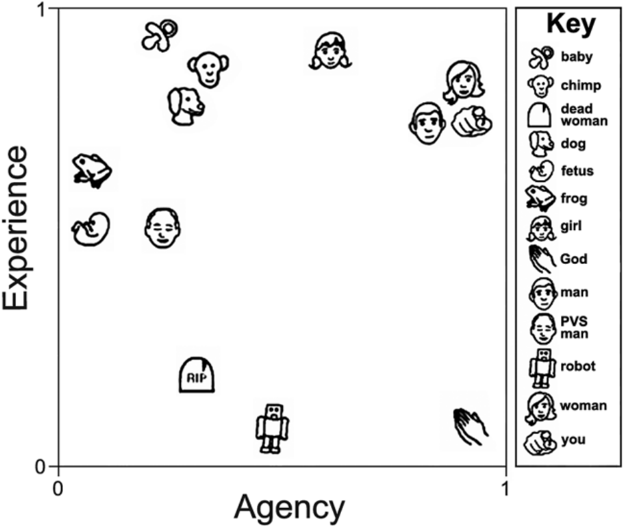
This paper argues that mind perception is not a single continuum but instead has two dimensions: Experience and Agency. Using 2,399 completed web-based surveys, the authors found that these dimensions explain how people judge minds across 13 characters and are differentially related to moral judgments.
## Key findings
- A principal components factor analysis of correlations among 18 mental capacities yielded two factors with eigenvalues over 1.0: Experience (eigenvalue 15.85, explaining 88% of variance) and Agency (eigenvalue 1.46, explaining 8% of variance); the rotated solution explained 97% of rating variance.
- Experience loaded on 11 capacities: hunger, fear, pain, pleasure, rage, desire, personality, consciousness, pride, embarrassment, and joy; Agency loaded on 7 capacities: self-control, morality, memory, emotion recognition, planning, communication, and thought.
- Personal judgments tracked the dimensions differently: liking, saving from destruction, making happy, and perceiving a soul correlated with both dimensions, with r ranging from 0.38 to 0.72.
- Punishment judgments correlated more with Agency than Experience (r = 0.82 vs. r = 0.22, z = 2.86, P < 0.05), while avoidance of harm correlated more with Experience than Agency (r = 0.85 vs. r = 0.26, z = 2.10, P < 0.05).
## Methods
- Web-based Mind Survey design: respondents saw pairwise comparisons of 13 characters across 18 mental capacities or 6 personal judgments, using five-point scales for 78 comparisons per survey.
- Sample: about 3,400 survey launches, with 2,399 completed surveys analyzed; respondents ranged from 12 to 75 years old (mean 30.44, SD 12.27) and were 64% female.
- Main analysis: character means were computed, correlations across capacities were submitted to principal components factor analysis with varimax rotation, and factor scores were estimated via regression; additional analyses examined correlations with personal judgments and individual-difference variables using z-statistics.
## Limitations
- The paper states that the surveys were largely independent and that respondent data came from web recruitment through other psychology sites, which makes the sample a convenience sample rather than a random population sample.
- Evident from the text: the factor structure is based on self-selected web respondents and on pairwise judgments of preselected characters and capacities, so generalizability beyond the survey context is not directly tested.
- The paper notes that about 25% of launched surveys were not completed, indicating noncompletion/missing-data attrition.
Model-written summary. Check it against the paper before relying on it.
Integrity signals
Registry
Cites
Statistics
Figures
Verification
Claims the paper makes
0 Valid · 0 Not valid · 0 Not checked · 18 Own results and interpretations
A result the paper reports from its own data — it cites no other source for it, so there is none to check. The quote shows it is in the paper.
In the paper
“Characters ' factor scores on these dimensions (Fig. 1) reveal interesting features; for example, God was perceived as having much Agency but little Experience.”
- Also stated in: § Dimensions of Mind Perception · plain
“for example, God was perceived as having much Agency but little Experience.”
plain- Asserted: passes — The authors put it forward as true.
- Checkable: passes — It can be checked against evidence.
- Load-bearing: unclear — It is unclear whether the paper’s conclusions depend on it.
- Based: passes — The paper gives a reason why it holds.
- Also stated in: § Dimensions of Mind Perception · plain
A result the paper reports from its own data — it cites no other source for it, so there is none to check. The quote shows it is in the paper.
In the paper
“A factor we termed Experience (eigenvalue = 15.85) accounted for 88% of the variance and included 11 capacities (from highest loading): hunger, fear, pain, pleasure, rage, desire, personality, consciousness, pride, embarrassment, and joy.”
plain- Asserted: passes — The authors put it forward as true.
- Checkable: passes — It can be checked against evidence.
- Load-bearing: passes — The paper’s conclusions depend on it.
- Based: passes — The paper gives a reason why it holds.
A result the paper reports from its own data — it cites no other source for it, so there is none to check. The quote shows it is in the paper.
In the paper
“Of 234 z -statistics (13 characters × 9 individual difference variables × 2 factors), 23 were statistically significant.”
plain- Asserted: passes — The authors put it forward as true.
- Checkable: passes — It can be checked against evidence.
- Load-bearing: unclear — It is unclear whether the paper’s conclusions depend on it.
- Based: passes — The paper gives a reason why it holds.
A result the paper reports from its own data — it cites no other source for it, so there is none to check. The quote shows it is in the paper.
In the paper
“whereas desire to avoid harming ( ' If you were forced to harm one of these characters, which one would it be more painful for you to harm? ' ) correlated more with Experience ( r = 0.85) than Agency ( r = 0.26, z = 2.10, P < 0.05).”
plainstates an association- Asserted: passes — The authors put it forward as true.
- Checkable: passes — It can be checked against evidence.
- Load-bearing: passes — The paper’s conclusions depend on it.
- Based: passes — The paper gives a reason why it holds.
A result the paper reports from its own data — it cites no other source for it, so there is none to check. The quote shows it is in the paper.
In the paper
“The rotated solution accounted for all 18 capacities (extraction communalities ranged from 0.82 to 0.99), explained 97% of rating variance, and yielded two factors with eigenvalues over 1.0.”
plainstates an association- Asserted: passes — The authors put it forward as true.
- Checkable: passes — It can be checked against evidence.
- Load-bearing: passes — The paper’s conclusions depend on it.
- Based: passes — The paper gives a reason why it holds.
5 more claims
Create a free account to see all 18 claims and every source verdict.
- It may state two separate claims as one. 8
- Probably not a substantial claim. 1
Claims other papers make about this one
Each is checked against this paper’s own text: does it say what the citing paper says it does?
The source backs part of the claim, not all of it — or backs it for a different population, condition or comparison.
In the citing paper
“People also anthropomorphize a range of inanimate objects and animals (Kwan & Fiske, 2008; Gray, Gray, & Wegner, 2007).”
From Dehumanized Perception: A Psychological Means to Facilitate Atrocities, Torture, and Genocide? (2011) · cites this paper as Gray, Gray, & Wegner, 2007
Experimental — accuracy not yet measuredThe source backs part of the claim, not all of it — or backs it for a different population, condition or comparison.
In the citing paper
“work in social psychology has demonstrated that mental state attribution is not a unitary concept, but rather involves distinct and independent dimensions of ‘intelligence’ and ‘experience’.”
From The influence of mental state attributions on trust in large language models (2025) · cites this paper as [19]
Experimental — accuracy not yet measuredThe source backs part of the claim, not all of it — or backs it for a different population, condition or comparison.
In the citing paper
“Participants’ ratings for each of the 65 traits (Supplementary Fig. S1a) were reduced via a principal component analysis to two main dimensions, which together explained 58% of the variance (Supplementary Fig. S1b) and mapped onto previously identified dimensions of ‘experience’ (e.g. experiencing pleasure or feeling fearful) and ‘intelligence’ (e.g. knowing things or making choices; Gray et al. 2”
From Folk psychological attributions of consciousness to large language models (2024) · cites this paper as Gray et al. 2007
Experimental — accuracy not yet measuredThe cited source says what the claim attributes to it.
In the citing paper
“This dissociation is supported by factor analyses of ratings of a variety of mental states, which reveal two fundamental factors: agency, or the capacity for high-level reasoning and planning, and experience, or the capacity for sensations and emotions19”
From The influence of mental state attributions on trust in large language models (2025) · cites this paper as [19]
The cited source says what the claim attributes to it.
In the citing paper
“Other work has systematically explored the dimensions underlying mental state attributions to various agents, revealing a two-dimensional structure distinguishing between ‘Experience’ (i.e. the capacity to feel pain, fear, joy, or pride) and ‘Agency’ (i.e. the capacity to have self-control, morality, planning, or communication) that is reminiscent of the distinction between phenomenal and non-phen”
From Folk psychological attributions of consciousness to large language models (2024) · cites this paper as Gray et al. 2007
Statistics recomputed
Every reported test result, recomputed from its test statistic and degrees of freedom. A result shows as not adding up only once an independent check has confirmed it.
- Consistentz = 2.86reported p < .05 · recomputed p = .004
“z = 2.86, p < .05”
- Consistentz = 2.1reported p < .05 · recomputed p = .036
“z = 2.10, p < .05”
Self-check
Percentages, sums and reported differences re-computed from the paper’s own numbers.
Self-check results appear here once an independent check has confirmed them.
Citations
Cites
I.—COMPUTING MACHINERY AND INTELLIGENCE
TURING, A. M. (1950) · Mind · doi:10.1093/mind/lix.236.433 · Cited by 10,290
Does the chimpanzee have a theory of mind?
Premack, D., & Woodruff, G. (1978) · Behavioral and Brain Sciences · doi:10.1017/s0140525x00076512 · Cited by 8,743
Mindblindness: An Essay on Autism and Theory of Mind
Baron-Cohen, S. (1995) · doi:10.7551/mitpress/4635.001.0001 · Cited by 3,428
Dennett, D. C. (1996) · Medical Entomology and Zoology · Cited by 314
Research works printed but not linked: 1
- A. Turing, Mind59, 433 (1950).
Cited by
Items 701–800 of 2,340
AI in Your Mind: Counterbalancing Perceived Agency and Experience in Human-AI Interaction
Hwang, A. H., & Won, A. S. (2022) · CHI Conference Extended Abstracts on Human Factors in Computing Systems (CHI EA) · doi:10.1145/3491101.3519833 · Cited by 43
“Gray et al.’s influential work, Dimensions of Mind Perception [13], proposes that how humans perceive other entities internally and how such conceptions translate to external behaviors can be measured through two dimensions: agency (the ability to do) and experience (the ability to feel).”
BackgroundMethodInfluentialInteracting with agents without a mind: the case for artificial agents
Geiselmann, R., Tsourgianni, A., Deroy, O. D., & Harris, L. T. (2023) · Current Opinion in Behavioral Sciences · doi:10.1016/j.cobeha.2023.101282 · Cited by 35
Li, J., Huang, J., & Ni, B. (2023) · International Journal of Human-Computer Interaction · doi:10.1080/10447318.2023.2221603 · Cited by 25
“This theory suggests that people ’ s perceptions of AI agents can be divided into two dimensions, including functional perception, such as perception related to competence, and emotional perception, such as perception related to warmth (Belanche et al., 2021; Gray et al., 2007).”
Observing Social Exclusion Leads to Dehumanizing the Victim
Park, Y. O., & Park, S. H. (2015) · Frontiers in Psychology · doi:10.3389/fpsyg.2015.01815 · Cited by 24
“Items measuring Agency and Experience (3 each) were adopted from Gray et al. (2007).”
BackgroundMethodResultInfluentialMind Perception and Individual Differences: A Replication and Extension
Tharp, M., Holtzman, N. S., & Eadeh, F. R. (2016) · Basic and Applied Social Psychology · doi:10.1080/01973533.2016.1256287 · Cited by 27
“First, factor analyses indicated that constructs such as self-control, morality, and memory loaded onto the agency dimension; hunger, fear, and pleasure most strongly loaded onto the experience dimension (Gray et al., 2007).”
BackgroundResultInfluentialSome are more equal than others: Ingroup robots gain some but not all benefits of team membership
Fraune, M. R., Šabanović, S., & Smith, E. R. (2020) · Interaction Studies Social Behaviour and Communication in Biological and Artificial Systems · doi:10.1075/is.18043.fra · Cited by 28
Park, Y., & Yi, Y. (2021) · Journal of Retailing and Consumer Services · doi:10.1016/j.jretconser.2021.102489 · Cited by 26
Who Is to Blame? The Appearance of Virtual Agents and the Attribution of Perceived Responsibility
Matsui, T., & Koike, A. (2021) · Sensors · doi:10.3390/s21082646 · Cited by 29
“God has low agency and high experience [36]; however, God cannot be visualized.”
BackgroundMethodInfluentialMattiassi, A. D. A., Sarrica, M., Cavallo, F., & Fortunati, L. (2021) · Motivation and Emotion · doi:10.1007/s11031-021-09886-2 · Cited by 34
The Medusa effect reveals levels of mind perception in pictures
Will, P., Merritt, E., Jenkins, R., & Kingstone, A. F. (2021) · Proceedings of the National Academy of Sciences · doi:10.1073/pnas.2106640118 · Cited by 24
Mitigating the negative effects of service failure through customer identification
Song, J., Huang, J., & Jiang, Y. (2021) · Psychology and Marketing · doi:10.1002/mar.21615 · Cited by 25
Money in a “Safe” place: Money anthropomorphism increases saving behavior
Wang, L., Kim, S., & Zhou, X. (2022) · International Journal of Research in Marketing · doi:10.1016/j.ijresmar.2022.02.001 · Cited by 28
In families we trust: Family firm branding and consumer’s reaction to product harm crisis
Datta, S., & Mukherjee, S. (2022) · Journal of Business Research · doi:10.1016/j.jbusres.2022.07.009 · Cited by 28
Social Functions of Machine Emotional Expressions
de Melo, C. M., Gratch, J. S., Marsella, S., & Pélachaud, C. (2023) · Proceedings of the IEEE · doi:10.1109/jproc.2023.3261137 · Cited by 33
“AI is commonly seen as rational and emotionless [77] and adding emotion into machines can make them seem disturbing or uncanny [164].”
First-person and third-person verbs in visual motion-perception regions
Papeo, L., & Lingnau, A. (2015) · Brain and Language · doi:10.1016/j.bandl.2014.11.011 · Cited by 26
Krumhuber, E. G., Lai, Y., Rosin, P. L., & Hugenberg, K. (2018) · Emotion · doi:10.1037/emo0000475 · Cited by 24
Adopting the Intentional Stance Towards Humanoid Robots
Pérez-Osorio, J., & Wykowska, A. (2019) · Springer tracts in advanced robotics · doi:10.1007/978-3-030-17974-8_10 · Cited by 24
Capozza, D., Falvo, R., & Bernardo, G. A. D. (2020) · Journal of Applied Social Psychology · doi:10.1111/jasp.12692 · Cited by 24
Who Wants to Grant Robots Rights?
de Graaf, M. M. A., Hindriks, F., & Hindriks, K. V. (2022) · Frontiers in Robotics and AI · doi:10.3389/frobt.2021.781985 · Cited by 79
Cameron, C. D., Scheffer, J. A., Hadjiandreou, E., & Anderson, S. (2022) · Advances in experimental social psychology · doi:10.1016/bs.aesp.2022.04.005 · Cited by 35
How trust and attachment styles jointly shape job candidates’ AI receptivity
Deriu, V., Pozharliev, R., & Angelis, M. D. (2024) · Journal of Business Research · doi:10.1016/j.jbusres.2024.114717 · Cited by 35
AI contextual information shapes moral and aesthetic judgments of AI-generated visual art
Bara, I., Ramsey, R., & Cross, E. S. (2025) · Cognition · doi:10.1016/j.cognition.2025.106063 · Cited by 37
The neural representation of human versus nonhuman bipeds and quadrupeds
Papeo, L., Wurm, M. F., Oosterhof, N. N., & Caramazza, A. (2017) · Scientific Reports · doi:10.1038/s41598-017-14424-7 · Cited by 24
Control it and it is yours: Children's reasoning about the ownership of living things
Espinosa, J., & Starmans, C. (2020) · Cognition · doi:10.1016/j.cognition.2020.104319 · Cited by 22
The Uncanny Valley Phenomenon and the Temporal Dynamics of Face Animacy Perception
Wang, S., Cheong, Y. F., Dilks, D. D., & Rochat, P. (2020) · Perception · doi:10.1177/0301006620952611 · Cited by 26
“They argue that the uncanny valley is due to humans’ ascription of minds to robots, which violates humans’ expectations for machines lacking human capacities to feel and sense (H. M. Gray et al., 2007; Mind Perception Hypothesis).”
BackgroundKeijsers, M., Bartneck, C., & Eyssel, F. (2021) · International Journal of Social Robotics · doi:10.1007/s12369-021-00799-1 · Cited by 28
“Mind perception has been linked to the moral standing of an agent [24] and, in human-human interaction, (inversely) to aggression [26].”
BackgroundMethodResultOn the Social-Relational Moral Standing of AI: An Empirical Study Using AI-Generated Art
Lima, G., Zhunis, A., Манович, Л., & Cha, M. (2021) · Frontiers in Robotics and AI · doi:10.3389/frobt.2021.719944 · Cited by 33
“Participants assigned to the pre condition fi rst responded to a series of questions compiled from previous work on mind perception theory (Gray et al., 2007; Bigman and Gray, 2018).”
BackgroundMethodInfluentialThe primacy of communality in humanization
Chu, C., & Martin, A. E. (2021) · Journal of Experimental Social Psychology · doi:10.1016/j.jesp.2021.104224 · Cited by 24
Bodies and Minds: Heavier Weight Targets Are De-Mentalized as Lacking in Mental Agency
Sim, M., Almaraz, S. M., & Hugenberg, K. (2021) · Personality and Social Psychology Bulletin · doi:10.1177/01461672211039981 · Cited by 28
“This distinction between unthinking animals and unfeeling machines maps onto research suggesting people perceive two separable dimensions of mind: experience and mental agency (H. M. Gray et al., 2007; Kozak et al., 2006).”
BackgroundMethodInfluentialDoes Connectedness Need Satisfaction Diminish or Promote Social Goal Striving?
Dang, J., & Liu, L. (2022) · Personality and Social Psychology Bulletin · doi:10.1177/01461672221084539 · Cited by 24
“Research on anthropomorphism suggests that prosocial responses to a non-human agent reflect the fact that people perceive this agent as having a humanlike mind (Gray et al., 2007).”
BackgroundBlake, K. R., McCartney, M., & Arslan, R. C. (2022) · Journal of Experimental Social Psychology · doi:10.1016/j.jesp.2022.104382 · Cited by 24
Not so trustless after all: Trust in Web3 technology and opportunities for brands
Ferraro, C., Wheeler, M. A., Pallant, J. I., Wilson, S. G., & Oldmeadow, J. A. (2023) · Business Horizons · doi:10.1016/j.bushor.2023.01.007 · Cited by 31
On the Psychological Origins of Dualism: Dual-Process Cognition and the Explanatory Gap*
Fiala, B., Arico, A. J., & Nichols, S. (2011) · Oxford University Press eBooks · doi:10.1093/acprof:oso/9780199794393.003.0005 · Cited by 28
“4 This model was developed in the wake of recent work on the folk psychology of consciousness ( Gray et al. 2007, Knobe & Prinz 2008, Sytsma & Machery 2009).”
MethodAnthropomorphism and Intentionality Improve Memory for Events
Baker, L. J., Hymel, A. M., & Levin, D. T. (2016) · Discourse Processes · doi:10.1080/0163853x.2016.1223517 · Cited by 22
Theory of Animal Mind: Human Nature or Experimental Artefact?
Spence, C. E., Osman, M., & McElligott, A. G. (2017) · Trends in Cognitive Sciences · doi:10.1016/j.tics.2017.02.003 · Cited by 22
Embodied social robots trigger gaze following in real-time HRI
Wiese, E., Weis, P. P., & Lofaro, D. M. (2018) · International Conference on Ubiquitous Robots (UR) · doi:10.1109/urai.2018.8441825 · Cited by 21
“A crucial part of this process concerns the degree to which others are believed to be intentional agents with internal states like beliefs, emotions or action goals [1].”
BackgroundDeveloping Future Wearable Interfaces for Human-Drone Teams through a Virtual Drone Search Game
Fraune, M. R., Khalaf, A. S., Zemedie, M., Pianpak, P., Mianji, Z. N., Alharthi, S. A., Dolgov, I., Hamilton, B., Son, T. C., & Dugas, P. O. T. (2020) · International Journal of Human-Computer Studies · doi:10.1016/j.ijhcs.2020.102573 · Cited by 29
The Trust Recovery Journey. The Effect of Timing of Errors on the Willingness to Follow AI Advice.
Kahr, P. K., Rooks, G., Snijders, C., & Willemsen, M. C. (2024) · Proceedings of the 29th International Conference on Intelligent User Interfaces · doi:10.1145/3640543.3645167 · Cited by 21
“Gray et al. [25] propose that AI systems can be perceived as having abilities, such as the ability to think, plan, and act autonomously.”
BackgroundAI service may backfire: Reduced service warmth due to service provider transformation
Lv, X., Yang, Y., Qin, D., & Liu, X. (2025) · Journal of Retailing and Consumer Services · doi:10.1016/j.jretconser.2025.104282 · Cited by 29
Avatars in Pain: Visible Harm Enhances Mind Perception in Humans and Robots
Świderska, A., & Küster, D. (2018) · Perception · doi:10.1177/0301006618809919 · Cited by 29
“However, it is possible that pain and empathy could play different roles if overall mind attribution is further decomposed into its more fine-grained underlying dimensions of agency and experience (Gray et al., 2007, 2011).”
BackgroundInfluentialKlein, O., Arnal, C., Eagan, S. R., Bernard, P., & Gervais, S. J. (2020) · Equality Diversity and Inclusion An International Journal · doi:10.1108/edi-04-2019-0127 · Cited by 23
Changing minds about minds: Evidence that people are too sceptical about animal sentience
Leach, S., Sutton, R. M., Dhont, K., Douglas, K. M., & Bergström, Z. M. (2022) · Cognition · doi:10.1016/j.cognition.2022.105263 · Cited by 33
Evidence of the unidimensional structure of mind perception
Tzelios, K., Williams, L. A., Omerod, J., & Bliss‐Moreau, E. (2022) · Scientific Reports · doi:10.1038/s41598-022-23047-6 · Cited by 31
Improving evaluations of advanced robots by depicting them in harmful situations
Grundke, A., Stein, J., & Appel, M. (2022) · Computers in Human Behavior · doi:10.1016/j.chb.2022.107565 · Cited by 24
“According to Gray et al. (2007), mind can be distinguished into experience (i.e., the ability to feel emotions, have a personality and consciousness) and agency (i.e., self-control, morality, memory, recognition, planning, communication, and thinking).”
BackgroundMiraglia, L., Peretti, G., Manzi, F., Dio, C. D., Massaro, D., & Marchetti, A. (2023) · Frontiers in Psychology · doi:10.3389/fpsyg.2023.999921 · Cited by 33
“Congruent with theoretical formulations postulating that people intuitively think about others’ minds in distinct dimensional representations (Gray et al., 2007; Malle, 2019), we expected at least a two-factor model of the AMS-Q, with scales that distinctly assessed mental states attribution and sensory states attribu…”
BackgroundInfluentialJohnson, J. S. (2023) · Global Society · doi:10.1080/13600826.2023.2205444 · Cited by 30
“Paradoxically, advances in autonomy and machine intelligence will require more (rather than less) contributions from the human operator to cope with the inevitable unexpected contingencies that fall outside of an algorithm’s training parameters or fail in some way (Gray, Gray, and Wegner 2007).”
Xue, J., Niu, Y., Liang, X., & Yin, S. (2023) · International Journal of Human-Computer Interaction · doi:10.1080/10447318.2023.2227834 · Cited by 23
“Therefore, drawing on mind perception theory (Gray et al., 2007) and social perception theory (Fiske et al., 2002), we employed the competence-warmth framework of mind perception theory to explicate how users perceive the down-stream effects of VA interaction, and captured the influential mechanism…”
Effect of Gratitude Expression of AI Chatbot on Willingness to Donate
Namkoong, M., Park, G., Park, Y., & Lee, S. (2023) · International Journal of Human-Computer Interaction · doi:10.1080/10447318.2023.2259719 · Cited by 34
“The gratitude expressed by a robot can provide confidence in the recipient’s ability to perform prosocial behaviors; because robots have a level of agency comparable to that of humans (Gray et al., 2007), they can think and judge human capabilities.”
InfluentialAntecedents, Manifestations, and Consequences of Belief in Mind–Body Dualism
Forstmann, M., & Burgmer, P. (2017) · Springer eBooks · doi:10.1007/978-3-319-57306-9_8 · Cited by 23
Factors that influence robot acceptance
Xu, L., & Yu, F. (2019) · Chinese Science Bulletin (Chinese Version) · doi:10.1360/tb-2019-0136 · Cited by 29
Guingrich, R. E., & Graziano, M. S. A. (2023) · arXiv · doi:10.48550/arxiv.2311.10599 · Cited by 21
Psychological consequences of legal responsibility misattribution associated with automated vehicles
Liu, P., Du, M., & Li, T. (2021) · Ethics and Information Technology · doi:10.1007/s10676-021-09613-y · Cited by 20
Stengelin, R., Haun, D. B. M., & Kanngießer, P. (2023) · Child Development · doi:10.1111/cdev.13913 · Cited by 30
“It is thus likely that children would also view puppets as possessing mental attributes like human agents: A cognitive capacity to think ( agency ) and a more emotional and motivational capacity to feel ( experience ; Gray et al., 2007; Moriguchi et al., 2019; Weisman et al., 2018).”
InfluentialFocusing on the self to humanize others: the role of empathy and morality
Scatolon, A., Sharvit, K., Huici, C., Álamo-Hernández, A., Glazer, G., Lorenzo, E., & Michna, M. (2023) · Current Opinion in Behavioral Sciences · doi:10.1016/j.cobeha.2023.101264 · Cited by 24
Social Connectedness Promotes Robot Anthropomorphism
Dang, J., & Liu, L. (2023) · Social Psychological and Personality Science · doi:10.1177/19485506231170917 · Cited by 22
“Anthropomorphism is closely associated with moral consideration for non-human agents (Gray et al., 2007); in line with this, our results suggest that social connectedness facilitated participants to treat the abused robot as an agent worthy of moral concern.”
BackgroundResultThe Ethics of Terminology: Can We Use Human Terms to Describe AI?
Deroy, O. D. (2023) · Topoi · doi:10.1007/s11245-023-09934-1 · Cited by 32
“Following Gray et al. (2007), Geiselmann et al. (2023) suggest that the attributions of human characteristics to AI should not confuse the attribution of a capacity for agency and the attribution of a capacity for experience (such as hunger, fear, pain, etc.).”
BackgroundPurcell, Z. A., Dong, M., Nußberger, A.-M., Köbis, N., & Jakesch, M. (2024) · British Journal of Psychology · doi:10.1111/bjop.12727 · Cited by 48
“People believe AI lacks particularly subjective capabilities required for conveying emotions and attributes that are essential and unique to humans (authenticity, empathy, morality, etc.; Bigman & Gray, 2018; Castelo et al., 2019; Gray et al., 2007; Morewedge, 2022).”
Herriger, C., Merlo, O., Eisingerich, A. B., & Arigayota, A. (2025) · Journal of Medical Internet Research · doi:10.2196/71951 · Cited by 40
“Uysal et al [149] Gray et al [179] Mind perception theory Sun et al [181] Johnson et al [180] Query theory Attié and Meyer-Waarden [137] Rogers [182]; Rogers et al [183] Theory of diffusion of innovation Our findings indicated that most theories in our subsample were also recognized by Barth and de…”
Qin, J., Nan, Y., Li, Z., & Meng, J. (2025) · Journal of Medical Internet Research · doi:10.2196/76296 · Cited by 33
“In the early years, machines were generally perceived as lacking the capability to feel and sense [43,44].”
Kuriki, S., Tamura, Y., Igarashi, M., Kato, N., & Nakano, T. (2016) · Cognition · doi:10.1016/j.cognition.2016.04.004 · Cited by 24
Do You See what I See? Tracking the Perceptual Beliefs of Robots
Thellman, S., & Ziemke, T. (2020) · iScience · doi:10.1016/j.isci.2020.101625 · Cited by 21
Taking the perspectives of many people: Humanization matters
Tian, Y., Furumi, F., da Silva, D. C., & Hamilton, A. F. D. C. (2020) · Psychonomic Bulletin & Review · doi:10.3758/s13423-020-01850-4 · Cited by 21
“These results can be summarized in terms of humanization (Gray, Gray, & Wegner, 2007) — that is, the theory that people do not attribute as many human abilities, including emotion and per-spective-taking, to robots and out-group members compared with in-group members.”
BackgroundGeraci, A., D’Amico, A., Pipitone, A., Seidita, V., & Chella, A. (2021) · Frontiers in Robotics and AI · doi:10.3389/frobt.2021.620026 · Cited by 27
“Mind perception is how people discern between human and nonhuman agents and consists of two core dimensions: (1) agency, e.g., self-control, memory, planning, and communication, and (2) experience, e.g., pain, pleasure, desire, joy, consciousness (Gray et al., 2007).”
BackgroundThornton, M. A., Wolf, S., Reilly, B. J., Slingerland, E., & Tamir, D. (2022) · Affective Science · doi:10.1007/s42761-021-00089-z · Cited by 18
Sitruk, J., Summers, K. M., & Lloyd, E. P. (2023) · Current Research in Ecological and Social Psychology · doi:10.1016/j.cresp.2023.100162 · Cited by 22
Söderlund, M. (2024) · Journal of Retailing and Consumer Services · doi:10.1016/j.jretconser.2024.103964 · Cited by 24
Paperless and Soulless: E-signatures Diminish the Signer’s Presence and Decrease Acceptance
Chou, E. Y. (2014) · Social Psychological and Personality Science · doi:10.1177/1948550614558841 · Cited by 26
“This research also broadens and enriches the literature on communication channels by integrating concepts and ideas from different theoretical frameworks, including social presence theory (Short, 1974) and mind perception theory (Epley et al., 2007; Gray et al., 2007).”
BackgroundPeople show envy, not guilt, when making decisions with machines
de Melo, C. M., & Gratch, J. S. (2015) · International Conference on Affective Computing and Intelligent Interaction and workshops · doi:10.1109/acii.2015.7344589 · Cited by 25
“These findings are compatible with research that shows that people perceive less mind in machines than in humans [23].”
BackgroundResultMartínez, R., Rodríguez‐Bailón, R., Moya, M., & Vaes, J. (2016) · The Journal of Social Psychology · doi:10.1080/00224545.2016.1192097 · Cited by 27
“Gray, Gray, and Wegner (2007) found that mind attribution depends on two orthogonal dimensions, which they call Experience and Agency.”
BackgroundBilewicz, M., Mikołajczak, G., & Babińska, M. (2017) · Personality and Individual Differences · doi:10.1016/j.paid.2017.02.018 · Cited by 18
“Interestingly, Gray et al. (2007) found that a 7-week-old fetus was rated as relatively high (i.e., comparable to an adult in a persistent vegetative state) on the experience dimension, yet very low (i.e., comparable to a frog) on the agency dimension.”
BackgroundParviainen, J., Aerschot, L. V., Särkikoski, T., Pekkarinen, S., Melkas, H., & Hennala, L. (2019) · Techné Research in Philosophy and Technology · doi:10.5840/techne20191126106 · Cited by 28
Polluted humanity: Air pollution leads to the dehumanization of oneself and others
Shi, J., Wang, X., & Chen, Z. (2022) · Journal of Environmental Psychology · doi:10.1016/j.jenvp.2022.101873 · Cited by 22
Mind perception and moral judgment in autism
Akechi, H., Kikuchi, Y., Tojo, Y., Hakarino, K., & Hasegawa, T. (2018) · Autism Research · doi:10.1002/aur.1970 · Cited by 23
“The two dimensions of mind perception relate to two aspects of morality; entities perceived to have agency are condemned for wrongdoing, and those perceived to have experience are given moral consideration [Gray et al., 2007].”
BackgroundMethodResultInfluentialFolk Theories of Consciousness
Malle, B. F. (2009) · Elsevier eBooks · doi:10.1016/b978-012373873-8.00023-2 · Cited by 22
Sytsma, J. (2014) · WIREs Cognitive Science · doi:10.1002/wcs.1320 · Cited by 20
Anthropomorphism-based causal and responsibility attributions to robots
Kawai, Y., Miyake, T., Park, J., Shimaya, J., Takahashi, H., & Asada, M. (2023) · Scientific Reports · doi:10.1038/s41598-023-39435-5 · Cited by 28
“It has been reported that Japanese people tend to attribute the cause of a failure to themselves, in a so-called self-effacing bias 27,28 , and the fact that they tend to attribute more Agency to artificial agents was found by Gray et al. 15,16 .”
BackgroundCaregiving relationships are a cornerstone of developmental psychopathology
Humphreys, K. L., Garon‐Bissonnette, J., Hill, K. E., Bailes, L. G., Barnett, W., & Hare, M. M. (2024) · Development and Psychopathology · doi:10.1017/s0954579424000300 · Cited by 33
Dang, J., & Liu, L. (2024) · Technological Forecasting and Social Change · doi:10.1016/j.techfore.2024.123683 · Cited by 26
Yan, X., Tat, H. H., & BAKAR, S. A. (2024) · Sustainability · doi:10.3390/su16229896 · Cited by 31
It’s the AI’s fault, not mine: Mind perception increases blame attribution to AI
Joo, M. (2024) · PLoS ONE · doi:10.1371/journal.pone.0314559 · Cited by 36
Joel-Edgar, S., Chowdhury, S., Nagy, P., & Ren, S. (2024) · Journal of Business Research · doi:10.1016/j.jbusres.2024.115139 · Cited by 34
Huang, Z., & Lo, A. (2025) · Information Technology & Tourism · doi:10.1007/s40558-025-00314-6 · Cited by 32
“Human adults are generally perceived to possess both high levels of agency and experience, whereas robots are usually regarded as having low experience and moderate agency (Gray et al. 2007; Gray and Wegner 2012).”
Workplace objectification: A review, synthesis, and research agenda
Zhang, B., Wisse, B. M., & Lord, R. G. (2025) · Human Resource Management Review · doi:10.1016/j.hrmr.2025.101104 · Cited by 21
Abubshait, A., Momen, A., & Wiese, E. (2020) · Frontiers in Psychology · doi:10.3389/fpsyg.2020.02234 · Cited by 20
Yue, D., Tong, Z., Tian, J., Li, Y., Zhang, L., & Sun, Y. (2021) · International Journal of Environmental Research and Public Health · doi:10.3390/ijerph18073565 · Cited by 30
“The more people believe that nonhuman agents have senses and feelings, the less they want to hurt them [25].”
BackgroundInfluentialProstitution Policies and Attitudes Toward Prostitutes
Bonache, H., Delgado, N., Pina, A., & Hernandez-Cabrera, J. A. (2021) · Archives of Sexual Behavior · doi:10.1007/s10508-020-01891-9 · Cited by 26
Pensini, P., & McMullen, J. (2021) · Current Research in Ecological and Social Psychology · doi:10.1016/j.cresp.2021.100024 · Cited by 20
Deng, S., Xu, Q., Zhang, J., & Li, X. (2022) · Advances in Psychological Science · doi:10.3724/sp.j.1042.2022.00723 · Cited by 23
Responsibility in Hybrid Societies: concepts and terms
Meyer, S., Mandl, S., Gesmann-Nuissl, D., & Strobel, A. (2022) · AI and Ethics · doi:10.1007/s43681-022-00184-2 · Cited by 29
“Normative understanding, that is, the awareness of responsibility or moral reasoning, was also included by several researchers [17, 37, 122, 129, 138].”
BackgroundResultInfluentialDehumanization and mass violence: A study of mental state language in Nazi propaganda (1927–1945)
Landry, A., Orr, R. I., & Mere, K. (2022) · PLoS ONE · doi:10.1371/journal.pone.0274957 · Cited by 35
“, [10, 14]), emotional states [38], conceptually related coding schemes [39], and synonyms taken from a standard English dictionary.”
BackgroundLacroix, D., Wullenkord, R., & Eyssel, F. (2022) · Lecture notes in computer science · doi:10.1007/978-3-031-24670-8_53 · Cited by 32
Robot’s Inner Speech Effects on Human Trust and Anthropomorphism
Pipitone, A., Geraci, A., D’Amico, A., Seidita, V., & Chella, A. (2023) · International Journal of Social Robotics · doi:10.1007/s12369-023-01002-3 · Cited by 37
“As a matter of fact, mind perceptions consist of two core dimensions: (1) agency, e.g. self-control, memory, planning and communication; (2) experience, e.g. pain, pleasure, desire, joy, consciousness [10].”
BackgroundInvestigating the Effects of Perceived Autonomy in Chatbot Advertising
Hu, X., Xu, X., & Chen, C. (2023) · Journal of Interactive Advertising · doi:10.1080/15252019.2023.2262456 · Cited by 25
“Participants viewed snapshots of interactions to both chatbot interfaces and decided which one was perceived more human-like (scale adapted from Gray, Gray, and Wegner 2007; MacDorman 2006).”
MethodNayak, S. M., White, S. H., Hilbert, S. N., Lowe, M. X., Jackson, H., Griffiths, R. R., Garcia‐Romeu, A., & Yaden, D. B. (2024) · Journal of Psychoactive Drugs · doi:10.1080/02791072.2024.2346130 · Cited by 23
“The mammal and non-mammal consciousness items relate to mind perception (Gray, Gray, and Wegner 2007), which involves the attribution of the capacity for agency (decision-making) and experience (e.g., feeling pleasure and pain), although in this study participants were asked to simply rate how…”
Riemer, A. R., Haikalis, M., Franz, M. R., Dodd, M. D., DiLillo, D., & Gervais, S. J. (2017) · Sex Roles · doi:10.1007/s11199-017-0876-2 · Cited by 21
“Although traits such as warmth and competence are attributed to non-human entities through the process of anthropomorphism (Epley et al. 2007; Gray et al. 2007), many scholars have argued that attributing people with less competence and/or warmth represents a form of relative dehumanization (Haslam…”
BackgroundBaker, D. A., Burns, D., & Kueny, C. R. (2020) · International Journal of Human-Computer Interaction · doi:10.1080/10447318.2020.1805874 · Cited by 23
The Inhuman Body: When Sexual Objectification Becomes Dehumanizing
Kofta, M., Baran, T., & Tarnowska, M. (2013) · Psychology Press eBooks · doi:10.4324/9780203110539-17 · Cited by 19
Geraci, A., Rigo, P., Simonelli, A., Nuovo, S. D., & Simion, F. (2021) · Journal of Applied Developmental Psychology · doi:10.1016/j.appdev.2021.101315 · Cited by 22
When Mother Earth Rises Up: Anthropomorphizing Nature Reduces Support for Natural Disaster Victims
Sacchi, S., Riva, P., & Brambilla, M. (2012) · Social Psychology · doi:10.1027/1864-9335/a000112 · Cited by 23
Consciousness and the social mind
Robbins, P. (2007) · Cognitive Systems Research · doi:10.1016/j.cogsys.2007.07.005 · Cited by 27
Metadata
- Authors
- Gray, H. M., Gray, K., & Wegner, D. M.
- Affiliations
- Harvard University (US)
- Corresponding author
- Gray, Heather M.
- Venue
- Science
- Published
- 2007-02-02
- Volume
- 315
- Issue
- 5812
- Pages
- 619-619
- ISSN
- 0036-8075 (ISSN-L)
- 1095-9203
- OpenAlex
- W2131227926
- Cited by
- 2,342
- References
- 4
- Citations by year
- 2026: 359 · 2025: 326 · 2024: 249 · 2023: 220 · 2022: 198 · 2021: 156 · 2020: 157 · 2019: 107 · 2018: 91 · 2017: 86 · 2016: 96 · 2015: 66 · 2014: 52 · 2013: 44 · 2012: 45
- FWCI
- 10.81
- Type
- journal article
- Language
- en
- Open access
- closed
- Locations
- Science (publishedVersion)
- PubMed (publishedVersion)
- Funders
- National Institutes of Health (1f31mh071053-01)
- National Institute of Mental Health (MH-71053, MH 49127, R01MH049127)
- Topics
- Life Sciences › Neuroscience › Cognitive Neuroscience › Psychology of Moral and Emotional Judgment
- Social Sciences › Psychology › Social Psychology › Social Robot Interaction and HRI
- Social Sciences › Sociology and Political Science › Social and Intergroup Psychology
- Keywords
- mind perception, moral judgment, agency, experience, non-human animals, personification, moral status of animals, self-control, hunger
- MeSH terms
- Adolescent, Adult, Aged, Child, Emotions, Female, Humans, Male, Mental Processes, Middle Aged, Morals, Perception, Personality, Principal Component Analysis
About these checks
Registry, retraction, Cites and statistics results are computed, not judged, with one exception: a printed reference that no index lists is read once by a model before it counts as a citation error. Claims are extracted by a model and kept only when their quote appears verbatim in the text; each cited source is then checked, with a model’s help, for whether it says what the claim relies on. Those verdicts can be wrong — read the claim’s quote and the cited source before relying on one.
A language model drew the claims from the paper on 2026-09-28, under version 3 of the claim definition (model deepseek-v4.1-flash, prompt extract-v3).
A second model labelled each claim on 2026-09-28 (model jev-1.13-20260917, definition revision gold-guideline-v0.2).
Statistics and arithmetic are recomputed, not judged.
Confidence bands are shown only for fields calibrated on our annotated test set. None is calibrated yet, so no band is shown.
What counts as a claim ›How we measure confidence ›How we check this ›
Are you an author, or do you see a problem with this page? Request a review
Data sources
Bibliographic data: Semantic Scholar, OpenAlex, Crossref.
Contains information from the Semantic Scholar Academic Graph Datasets, made available under the ODC Attribution License (ODC-BY 1.0).
Semantic Scholar’s data is described in: Kinney, R., et al. (2023). The Semantic Scholar Open Data Platform. arXiv:2301.10140.
