

Dimensions of Mind Perception
The DOI matches its Crossref record; 4 of the 4 references it cites were found in a registry or an index.
Abstract
Participants compared the mental capacities of various human and nonhuman characters via online surveys. Factor analysis revealed two dimensions of mind perception, Experience (for example, capacity for hunger) and Agency (for example, capacity for self-control). The dimensions predicted different moral judgments but were both related to valuing of mind.
Overview
CoChat Summary
## TL;DR
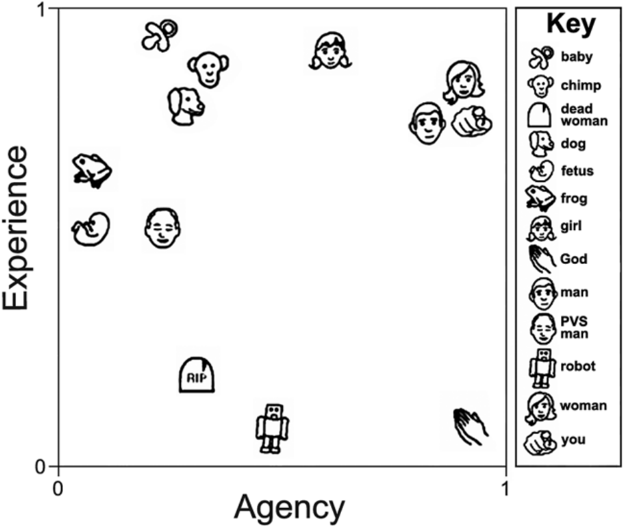
This paper argues that mind perception is not a single continuum but instead has two dimensions: Experience and Agency. Using 2,399 completed web-based surveys, the authors found that these dimensions explain how people judge minds across 13 characters and are differentially related to moral judgments.
## Key findings
- A principal components factor analysis of correlations among 18 mental capacities yielded two factors with eigenvalues over 1.0: Experience (eigenvalue 15.85, explaining 88% of variance) and Agency (eigenvalue 1.46, explaining 8% of variance); the rotated solution explained 97% of rating variance.
- Experience loaded on 11 capacities: hunger, fear, pain, pleasure, rage, desire, personality, consciousness, pride, embarrassment, and joy; Agency loaded on 7 capacities: self-control, morality, memory, emotion recognition, planning, communication, and thought.
- Personal judgments tracked the dimensions differently: liking, saving from destruction, making happy, and perceiving a soul correlated with both dimensions, with r ranging from 0.38 to 0.72.
- Punishment judgments correlated more with Agency than Experience (r = 0.82 vs. r = 0.22, z = 2.86, P < 0.05), while avoidance of harm correlated more with Experience than Agency (r = 0.85 vs. r = 0.26, z = 2.10, P < 0.05).
## Methods
- Web-based Mind Survey design: respondents saw pairwise comparisons of 13 characters across 18 mental capacities or 6 personal judgments, using five-point scales for 78 comparisons per survey.
- Sample: about 3,400 survey launches, with 2,399 completed surveys analyzed; respondents ranged from 12 to 75 years old (mean 30.44, SD 12.27) and were 64% female.
- Main analysis: character means were computed, correlations across capacities were submitted to principal components factor analysis with varimax rotation, and factor scores were estimated via regression; additional analyses examined correlations with personal judgments and individual-difference variables using z-statistics.
## Limitations
- The paper states that the surveys were largely independent and that respondent data came from web recruitment through other psychology sites, which makes the sample a convenience sample rather than a random population sample.
- Evident from the text: the factor structure is based on self-selected web respondents and on pairwise judgments of preselected characters and capacities, so generalizability beyond the survey context is not directly tested.
- The paper notes that about 25% of launched surveys were not completed, indicating noncompletion/missing-data attrition.
Model-written summary. Check it against the paper before relying on it.
Integrity signals
Registry
Cites
Statistics
Figures
Verification
Claims the paper makes
0 Valid · 0 Not valid · 0 Not checked · 18 Own results and interpretations
A result the paper reports from its own data — it cites no other source for it, so there is none to check. The quote shows it is in the paper.
In the paper
“Characters ' factor scores on these dimensions (Fig. 1) reveal interesting features; for example, God was perceived as having much Agency but little Experience.”
- Also stated in: § Dimensions of Mind Perception · plain
“for example, God was perceived as having much Agency but little Experience.”
plain- Asserted: passes — The authors put it forward as true.
- Checkable: passes — It can be checked against evidence.
- Load-bearing: unclear — It is unclear whether the paper’s conclusions depend on it.
- Based: passes — The paper gives a reason why it holds.
- Also stated in: § Dimensions of Mind Perception · plain
A result the paper reports from its own data — it cites no other source for it, so there is none to check. The quote shows it is in the paper.
In the paper
“A factor we termed Experience (eigenvalue = 15.85) accounted for 88% of the variance and included 11 capacities (from highest loading): hunger, fear, pain, pleasure, rage, desire, personality, consciousness, pride, embarrassment, and joy.”
plain- Asserted: passes — The authors put it forward as true.
- Checkable: passes — It can be checked against evidence.
- Load-bearing: passes — The paper’s conclusions depend on it.
- Based: passes — The paper gives a reason why it holds.
A result the paper reports from its own data — it cites no other source for it, so there is none to check. The quote shows it is in the paper.
In the paper
“Of 234 z -statistics (13 characters × 9 individual difference variables × 2 factors), 23 were statistically significant.”
plain- Asserted: passes — The authors put it forward as true.
- Checkable: passes — It can be checked against evidence.
- Load-bearing: unclear — It is unclear whether the paper’s conclusions depend on it.
- Based: passes — The paper gives a reason why it holds.
A result the paper reports from its own data — it cites no other source for it, so there is none to check. The quote shows it is in the paper.
In the paper
“whereas desire to avoid harming ( ' If you were forced to harm one of these characters, which one would it be more painful for you to harm? ' ) correlated more with Experience ( r = 0.85) than Agency ( r = 0.26, z = 2.10, P < 0.05).”
plainstates an association- Asserted: passes — The authors put it forward as true.
- Checkable: passes — It can be checked against evidence.
- Load-bearing: passes — The paper’s conclusions depend on it.
- Based: passes — The paper gives a reason why it holds.
A result the paper reports from its own data — it cites no other source for it, so there is none to check. The quote shows it is in the paper.
In the paper
“The rotated solution accounted for all 18 capacities (extraction communalities ranged from 0.82 to 0.99), explained 97% of rating variance, and yielded two factors with eigenvalues over 1.0.”
plainstates an association- Asserted: passes — The authors put it forward as true.
- Checkable: passes — It can be checked against evidence.
- Load-bearing: passes — The paper’s conclusions depend on it.
- Based: passes — The paper gives a reason why it holds.
5 more claims
Create a free account to see all 18 claims and every source verdict.
- It may state two separate claims as one. 8
- Probably not a substantial claim. 1
Claims other papers make about this one
Each is checked against this paper’s own text: does it say what the citing paper says it does?
The source backs part of the claim, not all of it — or backs it for a different population, condition or comparison.
In the citing paper
“People also anthropomorphize a range of inanimate objects and animals (Kwan & Fiske, 2008; Gray, Gray, & Wegner, 2007).”
From Dehumanized Perception: A Psychological Means to Facilitate Atrocities, Torture, and Genocide? (2011) · cites this paper as Gray, Gray, & Wegner, 2007
Experimental — accuracy not yet measuredThe source backs part of the claim, not all of it — or backs it for a different population, condition or comparison.
In the citing paper
“work in social psychology has demonstrated that mental state attribution is not a unitary concept, but rather involves distinct and independent dimensions of ‘intelligence’ and ‘experience’.”
From The influence of mental state attributions on trust in large language models (2025) · cites this paper as [19]
Experimental — accuracy not yet measuredThe source backs part of the claim, not all of it — or backs it for a different population, condition or comparison.
In the citing paper
“Participants’ ratings for each of the 65 traits (Supplementary Fig. S1a) were reduced via a principal component analysis to two main dimensions, which together explained 58% of the variance (Supplementary Fig. S1b) and mapped onto previously identified dimensions of ‘experience’ (e.g. experiencing pleasure or feeling fearful) and ‘intelligence’ (e.g. knowing things or making choices; Gray et al. 2”
From Folk psychological attributions of consciousness to large language models (2024) · cites this paper as Gray et al. 2007
Experimental — accuracy not yet measuredThe cited source says what the claim attributes to it.
In the citing paper
“This dissociation is supported by factor analyses of ratings of a variety of mental states, which reveal two fundamental factors: agency, or the capacity for high-level reasoning and planning, and experience, or the capacity for sensations and emotions19”
From The influence of mental state attributions on trust in large language models (2025) · cites this paper as [19]
The cited source says what the claim attributes to it.
In the citing paper
“Other work has systematically explored the dimensions underlying mental state attributions to various agents, revealing a two-dimensional structure distinguishing between ‘Experience’ (i.e. the capacity to feel pain, fear, joy, or pride) and ‘Agency’ (i.e. the capacity to have self-control, morality, planning, or communication) that is reminiscent of the distinction between phenomenal and non-phen”
From Folk psychological attributions of consciousness to large language models (2024) · cites this paper as Gray et al. 2007
Statistics recomputed
Every reported test result, recomputed from its test statistic and degrees of freedom. A result shows as not adding up only once an independent check has confirmed it.
- Consistentz = 2.86reported p < .05 · recomputed p = .004
“z = 2.86, p < .05”
- Consistentz = 2.1reported p < .05 · recomputed p = .036
“z = 2.10, p < .05”
Self-check
Percentages, sums and reported differences re-computed from the paper’s own numbers.
Self-check results appear here once an independent check has confirmed them.
Citations
Cites
I.—COMPUTING MACHINERY AND INTELLIGENCE
TURING, A. M. (1950) · Mind · doi:10.1093/mind/lix.236.433 · Cited by 10,290
Does the chimpanzee have a theory of mind?
Premack, D., & Woodruff, G. (1978) · Behavioral and Brain Sciences · doi:10.1017/s0140525x00076512 · Cited by 8,743
Mindblindness: An Essay on Autism and Theory of Mind
Baron-Cohen, S. (1995) · doi:10.7551/mitpress/4635.001.0001 · Cited by 3,428
Dennett, D. C. (1996) · Medical Entomology and Zoology · Cited by 314
Research works printed but not linked: 1
- A. Turing, Mind59, 433 (1950).
Cited by
Items 101–200 of 2,340
Texting with Humanlike Conversational Agents: Designing for Anthropomorphism
Seeger, A.-M., University of Mannheim, G., Pfeiffer, J., Justus Liebig University Giessen, G., Heinzl, A., & University of Mannheim, G. (2021) · Journal of the Association for Information Systems · doi:10.17705/1jais.00685 · Cited by 200
Doing Business with Strangers: Reputation in Online Service Marketplaces
Moreno, A., & Terwiesch, C. (2014) · Information Systems Research · doi:10.1287/isre.2014.0549 · Cited by 196
“are more willing to punish an agent that they consider mindful (Gray et al. 2007), and it has been suggested that anthropomorphizing agents results in increased trustworthiness (Waytz et al.”
BackgroundThe Relationship Between Mental Representations of Welfare Recipients and Attitudes Toward Welfare
Brown-Iannuzzi, J. L., Dotsch, R., Cooley, E., & Payne, B. K. (2017) · Psychological Science · doi:10.1177/0956797616674999 · Cited by 192
“We used items from Gray, Gray, and Wegner (2007) to assess agency and experience.”
Dehumanization: trends, insights, and challenges
Kteily, N. S., & Landry, A. P. (2022) · Trends in Cognitive Sciences · doi:10.1016/j.tics.2021.12.003 · Cited by 198
Virtually human: anthropomorphism in virtual influencer marketing
Dabiran, E., Farivar, S., Wang, F., & Grant, G. (2024) · Journal of Retailing and Consumer Services · doi:10.1016/j.jretconser.2024.103797 · Cited by 201
Can you sense without being human? Comparing virtual and human influencers endorsement effectiveness
Li, H., Lei, Y., Zhou, Q., & Yuan, H. (2023) · Journal of Retailing and Consumer Services · doi:10.1016/j.jretconser.2023.103456 · Cited by 198
Algorithmic discrimination causes less moral outrage than human discrimination
Bigman, Y. E., Wilson, D., Arnestad, M. N., Waytz, A., & Gray, K. (2023) · Journal of Experimental Psychology: General · doi:10.1037/xge0001250 · Cited by 198
Self-citationWhen Algorithms Fail: Consumers’ Responses to Brand Harm Crises Caused by Algorithm Errors
Srinivasan, R., & Sarial-Abi, G. (2021) · Journal of Marketing · doi:10.1177/0022242921997082 · Cited by 196
What Makes People Feel Empathy for AI Chatbots? Assessing the Role of Competence and Warmth
Kim, W. B., & Hur, H. J. (2024) · International Journal of Human–Computer Interaction · doi:10.1080/10447318.2023.2219961 · Cited by 196
“Based on mind perception theory (Gray et al., 2007) and the social judgment literature (Fiske et al., 2007), competence and warmth are two basic dimensions under which people perceive non-human entities as humanlike.”
Anthropomorphism and augmented reality in the retail environment
van Esch, P., Arli, D., Gheshlaghi, M. H., Andonopoulos, V., von der Heidt, T., & Northey, G. (2019) · Journal of Retailing and Consumer Services · doi:10.1016/j.jretconser.2019.03.002 · Cited by 193
Bastian, B., Laham, S. M., Wilson, S., Haslam, N., & Koval, P. (2011) · British Journal of Social Psychology · doi:10.1348/014466610x521383 · Cited by 187
Divergent effects of activating thoughts of God on self-regulation.
Laurin, K., Kay, A. C., & Fitzsimons, G. M. (2012) · Journal of Personality and Social Psychology · doi:10.1037/a0025971 · Cited by 185
AI increases unethical consumer behavior due to reduced anticipatory guilt
Kim, T., Lee, H., Kim, M. Y., Kim, S., & Duhachek, A. (2023) · Journal of the Academy of Marketing Science · doi:10.1007/s11747-021-00832-9 · Cited by 188
“Extending on the theory of mind (Gray et al., 2007), we posit that AI ’ s lack of certain human qualities (e.g., not being able to feel) could increase moral victimization and unethical behaviors toward the AI.”
BackgroundInfluentialWe Are Family: Viewing Pets as Family Members Improves Wellbeing
McConnell, A. R., Paige Lloyd, E., & Humphrey, B. T. (2019) · Anthrozoös · doi:10.1080/08927936.2019.1621516 · Cited by 184
Rethinking people’s conceptions of mental life
Weisman, K., Dweck, C. S., & Markman, E. M. (2017) · Proceedings of the National Academy of Sciences · doi:10.1073/pnas.1704347114 · Cited by 182
“We followed the original analyses as described in the supplementary materials for the original study (1) as exactly as possible: We first computed mean relative ratings for each of the 13 characters, for each of the 18 mental capacities, and then conducted a PCA via singular-value decomposition on…”
BackgroundMethodResultInfluentialUysal, E., Alavi, S., & Bezençon, V. (2022) · Journal of the Academy of Marketing Science · doi:10.1007/s11747-022-00856-9 · Cited by 182
“However, theory of mind perception is essential to understand user – AIA exchanges and interactions from a relationship perspective (Gray et al., 2007; Epley & Waytz, 2010; Waytz et al., 2010).”
BackgroundMethodThe cultural evolution of shamanism
Singh, M. (2018) · Behavioral and Brain Sciences · doi:10.1017/s0140525x17001893 · Cited by 170
“In line with this hypothesis, psychologists have found that Western people conceive of supernatural agents as differing fundamentally from humans, most often in possessing human-unique capabilities, such as thought and self-control, while lacking those shared with animals, such as hunger and pain (Demoulin et al. 2008…”
Dehumanized Perception: A Psychological Means to Facilitate Atrocities, Torture, and Genocide?
Harris, L. T., & Fiske, S. T. (2011) · Zeitschrift für Psychologie · doi:10.1027/2151-2604/a000065 · Cited by 173
Tamir, D. I., Thornton, M. A., Contreras, J. M., & Mitchell, J. P. (2016) · Proceedings of the National Academy of Sciences · doi:10.1073/pnas.1511905112 · Cited by 167
“Here, it derives from theories in the domain of social cognition, including primarily experience and agency (8), warmth vs.”
BackgroundWaytz, A., & Norton, M. I. (2014) · Emotion · doi:10.1037/a0036054 · Cited by 173
“Whereas people consider some entities (e.g., God) to be high-agency/low-experience and other entities (e.g., dogs) to be high-experience/low-agency, adult humans appear to be the only entities that people consider to have high agency and experience (Gray et al., 2007).”
BackgroundA Mind like Mine: The Exceptionally Ordinary Underpinnings of Anthropomorphism
Epley, N. (2018) · Journal of the Association for Consumer Research · doi:10.1086/699516 · Cited by 175
Seeing brands as humans: Development and validation of a brand anthropomorphism scale
Golossenko, A., Pillai, K. G., & Aroean, L. (2020) · International Journal of Research in Marketing · doi:10.1016/j.ijresmar.2020.02.007 · Cited by 171
Revenge: a multilevel review and synthesis
Jackson, J. C., Choi, V. K., & Gelfand, M. J. (2019) · Annual Review of Psychology · doi:10.1146/annurev-psych-010418-103305 · Cited by 172
“Mind perception is a key factor in these appraisals (Gray et al. 2007, Young et al. 2011).”
Do you mind if I ask you a personal question? How AI service agents alter consumer self-disclosure
Kim, T. W., Jiang, L., Duhachek, A., Lee, H., & Garvey, A. (2022) · Journal of Service Research · doi:10.1177/10946705221120232 · Cited by 177
“Self-reporting of one ’ s emotions is a validated method of measuring emotions (e.g., Harmon-Jones, Bastian, and Harmon-Jones 2016).”
MethodDang, J., & Liu, L. (2021) · Computers in Human Behavior · doi:10.1016/j.chb.2020.106612 · Cited by 170
Touré-Tillery, M., & McGill, A. L. (2015) · Journal of Marketing · doi:10.1509/jm.12.0166 · Cited by 167
Does Seeing Faces of Young Black Boys Facilitate the Identification of Threatening Stimuli?
Todd, A. R., Thiem, K. C., & Neel, R. (2016) · Psychological Science · doi:10.1177/0956797615624492 · Cited by 166
Disgust and perceived control in attitudes toward obese people
Vartanian, L. R. (2010) · International Journal of Obesity · doi:10.1038/ijo.2010.45 · Cited by 163
Money Helps When Money Feels: Money Anthropomorphism Increases Charitable Giving
Zhou, X., Kim, S., & Wang, L. (2019) · Journal of Consumer Research · doi:10.1093/jcr/ucy012 · Cited by 165
Perceiving Animacy and Intentionality
Scholl, B. J., & Gao, T. (2013) · Social Perception · doi:10.7551/mitpress/9780262019279.003.0009 · Cited by 160
“For example, recent years have seen the growth of " mind perception " as a distinct area of study, with review articles and even entire laboratories so named (e.g. Gray et al., 2007; for a review see Waytz et al., 2010).”
BackgroundIntergroup Perception and Cognition
Kawakami, K., Amodio, D. M., & Hugenberg, K. (2017) · Advances in Experimental Social Psychology · doi:10.1016/bs.aesp.2016.10.001 · Cited by 161
Hackel, L. M., Looser, C. E., & Bavel, J. J. V. (2013) · Journal of Experimental Social Psychology · doi:10.1016/j.jesp.2013.12.001 · Cited by 187
“…about the degree and kind of an entity's mental state capacities (e.g., the extent to which an entity is capable of feeling emotions or thinking; Gray et al., 2007), and theory of mind, which involves the attribution of mental content to a mind (e.g., attributing a specific belief or emotion to…”
BackgroundWho Gets Credit for AI-Generated Art?
Epstein, Z., Levine, S., Rand, D. G., & Rahwan, I. (2020) · iScience · doi:10.1016/j.isci.2020.101515 · Cited by 157
Attributions of morality and mind to artificial intelligence after real-world moral violations
Shank, D. B., & DeSanti, A. (2018) · Computers in Human Behavior · doi:10.1016/j.chb.2018.05.014 · Cited by 155
Rise of the machines: Delegating decisions to autonomous AI
Candrian, C., & Scherer, A. (2022) · Computers in Human Behavior · doi:10.1016/j.chb.2022.107308 · Cited by 150
Helping Fellow Beings: Anthropomorphized Social Causes and the Role of Anticipatory Guilt
Ahn, H.-K., Kim, H. J., & Aggarwal, P. (2014) · Psychological Science · doi:10.1177/0956797613496823 · Cited by 152
Jack, A. I., Friedman, J. P., Boyatzis, R. E., & Taylor, S. N. (2016) · PLoS ONE · doi:10.1371/journal.pone.0149989 · Cited by 171
Mental State Attribution to Robots: A Systematic Review of Conceptions, Methods, and Findings
Thellman, S., de Graaf, M., & Ziemke, T. (2022) · ACM Transactions on Human-Robot Interaction · doi:10.1145/3526112 · Cited by 152
“2017] (+) Stronger tendency to attribute experience-related mental states to human [Gray et al. 2007; Gray and Wegner 2012; Huebner 2010; Ishii and Watanabe 2019; Okanda et al. 2019; Peressini 2014] (–) Similar tendency to attribute agency-related mental states [Gray et al.”
BackgroundInfluentialWhen Closing the Human–Animal Divide Expands Moral Concern: The Importance of Framing
Bastian, B. B., Costello, K., Loughnan, S., & Hodson, G. (2011) · Social Psychological and Personality Science · doi:10.1177/1948550611425106 · Cited by 202
“Our central hypothesis is that when animals are perceived as relatively similar to humans, this will increase perceptions of shared qualities (i.e., capacity for sensation), in turn serving to increase moral concern (e.g., Gray et al., 2007).”
BackgroundResultInfluentialArtificial Intelligence, Trust, and Perceptions of Agency
Vanneste, B. S., & Puranam, P. (2025) · Academy of Management Review · doi:10.5465/amr.2022.0041 · Cited by 149
“A conceptual and empirical literature has identified two preconditions for agency perceptions: perceptions of intentionality and free will (e.g., Clarke, 1995; O’Connor, 1995; Kim & Hinds, 2006; Gray et al., 2007; Waytz et al., 2014).”
InfluentialKnobe, J., Buckwalter, W., Nichols, S., Robbins, P., Sarkissian, H., & Sommers, T. (2011) · Annual Review of Psychology · doi:10.1146/annurev-psych-120710-100350 · Cited by 195
“The studies by Gray and colleagues provide some evidence for this (Gray et al. 2007; see also Waytz et al. 2010).”
BackgroundResultInfluentialAshforth, B. E., Schinoff, B. S., & Brickson, S. (2018) · Academy of Management Review · doi:10.5465/amr.2016.0496 · Cited by 190
Abubshait, A., & Wiese, E. (2017) · Frontiers in Psychology · doi:10.3389/fpsyg.2017.01393 · Cited by 143
“Seeing minds in others is not exclusive to human agents, but intentionality can also be ascribed to agents who do not have minds (i.e., robots) or whose mind status is ambiguous (i.e., animals; Gray et al., 2007).”
BackgroundReducing the uncanny valley by dehumanizing humanoid robots
Yam, K. C., Bigman, Y., & Gray, K. J. (2021) · Computers in Human Behavior · doi:10.1016/j.chb.2021.106945 · Cited by 153
Self-citationZhu, Y., Zhang, J., Wu, J., & Liu, Y. (2022) · Journal of Business Research · doi:10.1016/j.jbusres.2022.06.044 · Cited by 173
Dehumanization in organizational settings: some scientific and ethical considerations
Christoff, K. (2014) · Frontiers in Human Neuroscience · doi:10.3389/fnhum.2014.00748 · Cited by 169
How to overcome algorithm aversion: Learning from mistakes
Reich, T., Kaju, A., & Maglio, S. J. (2022) · Journal of Consumer Psychology · doi:10.1002/jcpy.1313 · Cited by 184
Cameron, C. D., Harris, L. T., & Payne, B. K. (2015) · Social Psychological and Personality Science · doi:10.1177/1948550615604453 · Cited by 176
“Participants completed the Mind Scale as in Experiment 1.”
InfluentialArtificial empathy in healthcare chatbots: Does it feel authentic?
Seitz, L. (2024) · Computers in Human Behavior: Artificial Humans · doi:10.1016/j.chbah.2024.100067 · Cited by 137
Mind Meets Machine: Towards a Cognitive Science of Human–Machine Interactions
Cross, E. S., & Ramsey, R. (2021) · Trends in Cognitive Sciences · doi:10.1016/j.tics.2020.11.009 · Cited by 133
Social perception of brands: Warmth and competence define images of both brands and social groups
Kervyn, N. O., Fiske, S. T., & Malone, C. (2021) · Consumer Psychology Review · doi:10.1002/arcp.1074 · Cited by 184
Horstmann, A. C., & Krämer, N. C. (2019) · Frontiers in Psychology · doi:10.3389/fpsyg.2019.00939 · Cited by 135
“Also based on the statements of the interviewees and the assessment of mental capacities by Gray et al. (2007), people’s expectations about the skills and abilities of robots were assessed via 30 items ( robot skills and abilities ; The e.g., “Robots are able to feel pain.””
MethodMoral Judgments in the Age of Artificial Intelligence
Sullivan, Y. W., & Wamba, S. F. (2022) · Journal of Business Ethics · doi:10.1007/s10551-022-05053-w · Cited by 175
“Machines or AI systems are often seen to have some agency (Gray & Wegner, 2012; Gray et al., 2007).”
BackgroundMethodResultInfluentialEpley, N., & Waytz, A. (2010) · Handbook of Social Psychology · doi:10.1002/9780470561119.socpsy001014 · Cited by 132
Children’s Understanding of Ordinary and Extraordinary Minds
Lane, J. D., Wellman, H. M., & Evans, E. M. (2010) · Child Development · doi:10.1111/j.1467-8624.2010.01486.x · Cited by 130
Drivers are blamed more than their automated cars when both make mistakes
Awad, E., Levine, S., Kleiman-Weiner, M., Dsouza, S., Tenenbaum, J. B., Shariff, A., Bonnefon, J., & Rahwan, I. (2019) · Nature Human Behaviour · doi:10.1038/s41562-019-0762-8 · Cited by 212
Schroeder, J., Kardas, M., & Epley, N. (2017) · Psychological Science · doi:10.1177/0956797617713798 · Cited by 129
Carruthers, P. (2015) · Consciousness and Cognition · doi:10.1016/j.concog.2015.04.009 · Cited by 141
Supernatural Agents: Why We Believe in Souls, Gods, and Buddhas
Pyysiäinen, I. (2009) · doi:10.1093/acprof:oso/9780195380026.001.0001 · Cited by 188
Kuchenbrandt, D., Eyssel, F., Bobinger, S., & Neufeld, M. (2013) · International Journal of Social Robotics · doi:10.1007/s12369-013-0197-8 · Cited by 146
“In addition, perceiving a nonhuman agent as human and hence, as capable of acting intentionally or as being able to experience emotions makes such agent appear responsible for its actions and renders it worthy of moral consideration [9, 10].”
BackgroundExpanding the moral circle: Inclusion and exclusion mindsets and the circle of moral regard
Laham, S. M. (2008) · Journal of Experimental Social Psychology · doi:10.1016/j.jesp.2008.08.012 · Cited by 132
Vallacher, R. R., & Wegner, D. M. (2012) · SAGE Publications Ltd eBooks · doi:10.4135/9781446249215.n17 · Cited by 166
Self-citationWu, L., & Jing Wen, T. (2021) · Journal of Advertising Research · doi:10.2501/jar-2021-004 · Cited by 127
Moussawi, S., Koufaris, M., & Benbunan-Fich, R. (2023) · European Journal of Information Systems · doi:10.1080/0960085x.2021.2018365 · Cited by 125
“Alan Turing famously stated that a computer can be considered to have a mind if its interrogator cannot tell that it is not human (Gray et al., 2007; Turing, 1950).”
BackgroundCruel nature: Harmfulness as an important, overlooked dimension in judgments of moral standing
Piazza, J. R., Landy, J. F., & Goodwin, G. P. (2014) · Cognition · doi:10.1016/j.cognition.2013.12.013 · Cited by 141
“While Gray et al. (2007) did not report the overall correlation between the two factors in their original report (only the rotated factor loadings), re-examination of their data set (H. Gray, personal correspondence, August 28, 2013) revealed that Gray et al.’s ‘‘experience’’ and ‘‘agency’’…”
BackgroundMethodResultInfluentialYokoi, R., Eguchi, Y., Fujita, T., & Nakayachi, K. (2021) · International Journal of Human–Computer Interaction · doi:10.1080/10447318.2020.1861763 · Cited by 122
“Numerous studies have demonstrated that trust promotes the intention to accept and use diverse automation technologies, including medical AI (Alaiad & Zhou, 2014; Choi & Ji, 2015; Fan et al., 2018; Hegner et al., 2019; Zhang & Curley, 2018).”
BackgroundMangy mutt or furry friend? Anthropomorphism promotes animal welfare
Butterfield, M. E., Hill, S. E., & Lord, C. G. (2012) · Journal of Experimental Social Psychology · doi:10.1016/j.jesp.2012.02.010 · Cited by 103
Prato-Previde, E., Basso Ricci, E., & Colombo, E. S. (2022) · Animals · doi:10.3390/ani12202835 · Cited by 121
The 3 C's of anthropomorphism: Connection, comprehension, and competition
Yang, L. W., Aggarwal, P., & McGill, A. L. (2020) · Consumer Psychology Review · doi:10.1002/arcp.1054 · Cited by 120
“AI is perceived as highly competent, but it is also perceived as lacking the ability to experience pain and suffering and therefore unable to appreciate these expe‐ riences when assisting humans (Gray et al., 2007).”
BackgroundArıkan, E., Altınigne, N., Kuzgun, E., & Okan, M. (2022) · Journal of Retailing and Consumer Services · doi:10.1016/j.jretconser.2022.103175 · Cited by 133
Adults are intuitive mind-body dualists.
Forstmann, M., & Burgmer, P. (2015) · Journal of Experimental Psychology: General · doi:10.1037/xge0000045 · Cited by 116
Chugunova, M., & Sele, D. (2022) · Journal of Behavioral and Experimental Economics · doi:10.1016/j.socec.2022.101897 · Cited by 118
Laban, G., Kappas, A., Morrison, V., & Cross, E. S. (2024) · International Journal of Social Robotics · doi:10.1007/s12369-023-01076-z · Cited by 119
“To determine whether any differences in mind perception emerged across the testing sessions, participants were requested to evaluate Pepper in terms of agency and experience, after being introduced to these terms [adapted from 101].”
InfluentialWang, X., & Qiu, X. (2024) · Journal of Retailing and Consumer Services · doi:10.1016/j.jretconser.2024.103777 · Cited by 118
Meng, L. (., Bie, Y., Yang, M., & Wang, Y. (2025) · Tourism Management · doi:10.1016/j.tourman.2024.104978 · Cited by 123
The Chain of Being: A Hierarchy of Morality
Brandt, M. J., & Reyna, C. (2011) · Perspectives on Psychological Science · doi:10.1177/1745691611414587 · Cited by 143
Creepiness Creeps In: Uncanny Valley Feelings Are Acquired in Childhood
Brink, K. A., Gray, K., & Wellman, H. M. (2019) · Child Development · doi:10.1111/cdev.12999 · Cited by 114
“+ Item derived from Gray and Wegner (2012) and/or Gray et al. (2007).”
BackgroundInfluentialSelf-citationFrom automata to animate beings: the scope and limits of attributing socialness to artificial agents
Hortensius, R., & Cross, E. S. (2018) · Annals of the New York Academy of Sciences · doi:10.1111/nyas.13727 · Cited by 108
How Children and Adults Represent God's Mind
Heiphetz, L., Lane, J. D., Waytz, A. G., & Young, L. (2015) · Cognitive Science · doi:10.1111/cogs.12232 · Cited by 122
“Because adults’ explicit representations of God’s mind distinguish it from human minds (e.g., Gray et al., 2007; Luhrmann, 2012), adults may also seek to directly teach this distinction to children.”
Influentialde Visser, E. J., Monfort, S. S., Goodyear, K., Lu, L., O’Hara, M., Lee, M. R., Parasuraman, R., & Krueger, F. (2017) · Human Factors: The Journal of the Human Factors and Ergonomics Society · doi:10.1177/0018720816687205 · Cited by 113
The Flatland Fallacy: Moving Beyond Low–Dimensional Thinking
Jolly, E., & Chang, L. J. (2018) · Topics in Cognitive Science · doi:10.1111/tops.12404 · Cited by 112
Xie, Z., Yu, Y., Zhang, J., & Chen, M. (2022) · Psychology and Marketing · doi:10.1002/mar.21706 · Cited by 140
The conceptual structure of face impressions
Stolier, R. M., Hehman, E., Keller, M., Walker, M., & Freeman, J. B. (2018) · Proceedings of the National Academy of Sciences · doi:10.1073/pnas.1807222115 · Cited by 125
“This structure extends further to explain mental state inferences (23), as well as neural representations during social perception (24).”
Toward a Psychology of Moral Expansiveness
Crimston, C. R., Hornsey, M. J., Bain, P. G., & Bastian, B. (2018) · Current Directions in Psychological Science · doi:10.1177/0963721417730888 · Cited by 108
Adopting the intentional stance toward natural and artificial agents
Pérez-Osorio, J., & Wykowska, A. (2019) · Philosophical Psychology · doi:10.1080/09515089.2019.1688778 · Cited by 136
“The level of attribution can involve an assumption of mind, such as conscious experience, meta-cognition, and intentions (Gray, Gray, & Wegner, 2007), emotional states, behavioral characteristics, or human-like forms in non-human agents and in inanimate objects (Heider & Simmel, 1944; Epley et al.,…”
BackgroundBlame It on the Self-Driving Car: How Autonomous Vehicles Can Alter Consumer Morality
Gill, T. (2020) · Journal of Consumer Research · doi:10.1093/jcr/ucaa018 · Cited by 112
Anthropomorphism in human–robot interactions: a multidimensional conceptualization
Kühne, R., & Peter, J. (2023) · Communication Theory · doi:10.1093/ct/qtac020 · Cited by 112
More dead than dead: Perceptions of persons in the persistent vegetative state
Gray, K. J., Knickman, T. A., & Wegner, D. M. (2011) · Cognition · doi:10.1016/j.cognition.2011.06.014 · Cited by 131
“As mind is perceived to be an essential characteristic of people, both morally and practically (Dennett, 1978; Gray et al., 2007; Zagzebski, 2001), it may be that PVS is seen as a state worse than death.”
Self-citationSöderlund, M., & Oikarinen, E.-L. (2021) · European Journal of Marketing · doi:10.1108/ejm-09-2019-0748 · Cited by 111
“As formorality, Gray et al. (2007), Gray et al. (2012) and Morera et al. (2018) have used similar items.”
BackgroundMethodBankins, S., & Formosa, P. (2020) · European Journal of Work and Organizational Psychology · doi:10.1080/1359432x.2019.1620328 · Cited by 109
“…” dynamic, drawing on evidence that people do not always blindly apply human – human social rules when inter-acting with robots and suggesting that humans do not view them as “ having as much mind as humans ” (Broadbent, 2017, p. 645; see also Bartneck et al., 2008; Gray, Gray, & Wegner, 2007).”
BackgroundAnthropomorphism and its implications for advertising hotel brands
Lee, S. A., & Oh, H. (2019) · Journal of Business Research · doi:10.1016/j.jbusres.2019.09.053 · Cited by 131
Keep an Eye on the Task! How Gender Typicality of Tasks Influence Human–Robot Interactions
Kuchenbrandt, D., Häring, M., Eichberg, J., Eyssel, F., & André, E. (2014) · International Journal of Social Robotics · doi:10.1007/s12369-014-0244-0 · Cited by 134
“([24], see also [11,25]), we measured the extent to which participants attributed mind to the robot (mind attribution).”
BackgroundPuzakova, M., Kwak, H., & Rocereto, J. F. (2009) · ACR North American Advances · Cited by 109
Denying humanity: The distinct neural correlates of blatant dehumanization.
Bruneau, E., Jacoby, N., Kteily, N., & Saxe, R. R. (2018) · Journal of Experimental Psychology General · doi:10.1037/xge0000417 · Cited by 116
Consumer attitudes toward AI-generated ads: Appeal types, self-efficacy and AI’s social role
Chen, Y., Wang, H., Hill, S. R., & Li, B. (2024) · Journal of Business Research · doi:10.1016/j.jbusres.2024.114867 · Cited by 185
Malle, B. F., Scheutz, M., Forlizzi, J., & Voiklis, J. (2016) · 2016 11th ACM/IEEE International Conference on Human-Robot Interaction (HRI) · doi:10.1109/hri.2016.7451743 · Cited by 107
“Researchers are increasingly becoming aware of the impossibility to consistently replicate past findings, especially with the same strength of effect [35].”
BackgroundMcloughlin, N. C., & Over, H. (2017) · Psychological Science · doi:10.1177/0956797617710724 · Cited by 123
How anthropomorphism is changing the social context of modern wildlife conservation
Manfredo, M. J., Urquiza-Haas, E. G., Don Carlos, A. W., Bruskotter, J. T., & Dietsch, A. M. (2020) · Biological Conservation · doi:10.1016/j.biocon.2019.108297 · Cited by 91
Yun, J. H., Lee, E., & Kim, D. H. (2021) · Psychology and Marketing · doi:10.1002/mar.21445 · Cited by 122
Li, J., Huang, J., & Li, Y. (2022) · Journal of Retailing and Consumer Services · doi:10.1016/j.jretconser.2022.103230 · Cited by 125
Metadata
- Authors
- Gray, H. M., Gray, K., & Wegner, D. M.
- Affiliations
- Harvard University (US)
- Corresponding author
- Gray, Heather M.
- Venue
- Science
- Published
- 2007-02-02
- Volume
- 315
- Issue
- 5812
- Pages
- 619-619
- ISSN
- 0036-8075 (ISSN-L)
- 1095-9203
- OpenAlex
- W2131227926
- Cited by
- 2,342
- References
- 4
- Citations by year
- 2026: 359 · 2025: 326 · 2024: 249 · 2023: 220 · 2022: 198 · 2021: 156 · 2020: 157 · 2019: 107 · 2018: 91 · 2017: 86 · 2016: 96 · 2015: 66 · 2014: 52 · 2013: 44 · 2012: 45
- FWCI
- 10.81
- Type
- journal article
- Language
- en
- Open access
- closed
- Locations
- Science (publishedVersion)
- PubMed (publishedVersion)
- Funders
- National Institutes of Health (1f31mh071053-01)
- National Institute of Mental Health (MH-71053, MH 49127, R01MH049127)
- Topics
- Life Sciences › Neuroscience › Cognitive Neuroscience › Psychology of Moral and Emotional Judgment
- Social Sciences › Psychology › Social Psychology › Social Robot Interaction and HRI
- Social Sciences › Sociology and Political Science › Social and Intergroup Psychology
- Keywords
- mind perception, moral judgment, agency, experience, non-human animals, personification, moral status of animals, self-control, hunger
- MeSH terms
- Adolescent, Adult, Aged, Child, Emotions, Female, Humans, Male, Mental Processes, Middle Aged, Morals, Perception, Personality, Principal Component Analysis
About these checks
Registry, retraction, Cites and statistics results are computed, not judged, with one exception: a printed reference that no index lists is read once by a model before it counts as a citation error. Claims are extracted by a model and kept only when their quote appears verbatim in the text; each cited source is then checked, with a model’s help, for whether it says what the claim relies on. Those verdicts can be wrong — read the claim’s quote and the cited source before relying on one.
A language model drew the claims from the paper on 2026-09-28, under version 3 of the claim definition (model deepseek-v4.1-flash, prompt extract-v3).
A second model labelled each claim on 2026-09-28 (model jev-1.13-20260917, definition revision gold-guideline-v0.2).
Statistics and arithmetic are recomputed, not judged.
Confidence bands are shown only for fields calibrated on our annotated test set. None is calibrated yet, so no band is shown.
What counts as a claim ›How we measure confidence ›How we check this ›
Are you an author, or do you see a problem with this page? Request a review
Data sources
Bibliographic data: Semantic Scholar, OpenAlex, Crossref.
Contains information from the Semantic Scholar Academic Graph Datasets, made available under the ODC Attribution License (ODC-BY 1.0).
Semantic Scholar’s data is described in: Kinney, R., et al. (2023). The Semantic Scholar Open Data Platform. arXiv:2301.10140.
