

Dimensions of Mind Perception
The DOI matches its Crossref record; 4 of the 4 references it cites were found in a registry or an index.
Abstract
Participants compared the mental capacities of various human and nonhuman characters via online surveys. Factor analysis revealed two dimensions of mind perception, Experience (for example, capacity for hunger) and Agency (for example, capacity for self-control). The dimensions predicted different moral judgments but were both related to valuing of mind.
Overview
CoChat Summary
## TL;DR
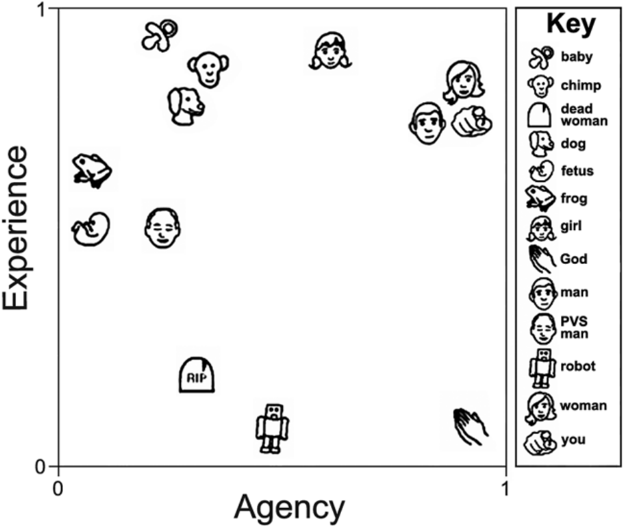
This paper argues that mind perception is not a single continuum but instead has two dimensions: Experience and Agency. Using 2,399 completed web-based surveys, the authors found that these dimensions explain how people judge minds across 13 characters and are differentially related to moral judgments.
## Key findings
- A principal components factor analysis of correlations among 18 mental capacities yielded two factors with eigenvalues over 1.0: Experience (eigenvalue 15.85, explaining 88% of variance) and Agency (eigenvalue 1.46, explaining 8% of variance); the rotated solution explained 97% of rating variance.
- Experience loaded on 11 capacities: hunger, fear, pain, pleasure, rage, desire, personality, consciousness, pride, embarrassment, and joy; Agency loaded on 7 capacities: self-control, morality, memory, emotion recognition, planning, communication, and thought.
- Personal judgments tracked the dimensions differently: liking, saving from destruction, making happy, and perceiving a soul correlated with both dimensions, with r ranging from 0.38 to 0.72.
- Punishment judgments correlated more with Agency than Experience (r = 0.82 vs. r = 0.22, z = 2.86, P < 0.05), while avoidance of harm correlated more with Experience than Agency (r = 0.85 vs. r = 0.26, z = 2.10, P < 0.05).
## Methods
- Web-based Mind Survey design: respondents saw pairwise comparisons of 13 characters across 18 mental capacities or 6 personal judgments, using five-point scales for 78 comparisons per survey.
- Sample: about 3,400 survey launches, with 2,399 completed surveys analyzed; respondents ranged from 12 to 75 years old (mean 30.44, SD 12.27) and were 64% female.
- Main analysis: character means were computed, correlations across capacities were submitted to principal components factor analysis with varimax rotation, and factor scores were estimated via regression; additional analyses examined correlations with personal judgments and individual-difference variables using z-statistics.
## Limitations
- The paper states that the surveys were largely independent and that respondent data came from web recruitment through other psychology sites, which makes the sample a convenience sample rather than a random population sample.
- Evident from the text: the factor structure is based on self-selected web respondents and on pairwise judgments of preselected characters and capacities, so generalizability beyond the survey context is not directly tested.
- The paper notes that about 25% of launched surveys were not completed, indicating noncompletion/missing-data attrition.
Model-written summary. Check it against the paper before relying on it.
Integrity signals
Registry
Cites
Statistics
Figures
Verification
Claims the paper makes
0 Valid · 0 Not valid · 0 Not checked · 18 Own results and interpretations
A result the paper reports from its own data — it cites no other source for it, so there is none to check. The quote shows it is in the paper.
In the paper
“Characters ' factor scores on these dimensions (Fig. 1) reveal interesting features; for example, God was perceived as having much Agency but little Experience.”
- Also stated in: § Dimensions of Mind Perception · plain
“for example, God was perceived as having much Agency but little Experience.”
plain- Asserted: passes — The authors put it forward as true.
- Checkable: passes — It can be checked against evidence.
- Load-bearing: unclear — It is unclear whether the paper’s conclusions depend on it.
- Based: passes — The paper gives a reason why it holds.
- Also stated in: § Dimensions of Mind Perception · plain
A result the paper reports from its own data — it cites no other source for it, so there is none to check. The quote shows it is in the paper.
In the paper
“A factor we termed Experience (eigenvalue = 15.85) accounted for 88% of the variance and included 11 capacities (from highest loading): hunger, fear, pain, pleasure, rage, desire, personality, consciousness, pride, embarrassment, and joy.”
plain- Asserted: passes — The authors put it forward as true.
- Checkable: passes — It can be checked against evidence.
- Load-bearing: passes — The paper’s conclusions depend on it.
- Based: passes — The paper gives a reason why it holds.
A result the paper reports from its own data — it cites no other source for it, so there is none to check. The quote shows it is in the paper.
In the paper
“Of 234 z -statistics (13 characters × 9 individual difference variables × 2 factors), 23 were statistically significant.”
plain- Asserted: passes — The authors put it forward as true.
- Checkable: passes — It can be checked against evidence.
- Load-bearing: unclear — It is unclear whether the paper’s conclusions depend on it.
- Based: passes — The paper gives a reason why it holds.
A result the paper reports from its own data — it cites no other source for it, so there is none to check. The quote shows it is in the paper.
In the paper
“whereas desire to avoid harming ( ' If you were forced to harm one of these characters, which one would it be more painful for you to harm? ' ) correlated more with Experience ( r = 0.85) than Agency ( r = 0.26, z = 2.10, P < 0.05).”
plainstates an association- Asserted: passes — The authors put it forward as true.
- Checkable: passes — It can be checked against evidence.
- Load-bearing: passes — The paper’s conclusions depend on it.
- Based: passes — The paper gives a reason why it holds.
A result the paper reports from its own data — it cites no other source for it, so there is none to check. The quote shows it is in the paper.
In the paper
“The rotated solution accounted for all 18 capacities (extraction communalities ranged from 0.82 to 0.99), explained 97% of rating variance, and yielded two factors with eigenvalues over 1.0.”
plainstates an association- Asserted: passes — The authors put it forward as true.
- Checkable: passes — It can be checked against evidence.
- Load-bearing: passes — The paper’s conclusions depend on it.
- Based: passes — The paper gives a reason why it holds.
5 more claims
Create a free account to see all 18 claims and every source verdict.
- It may state two separate claims as one. 8
- Probably not a substantial claim. 1
Claims other papers make about this one
Each is checked against this paper’s own text: does it say what the citing paper says it does?
The source backs part of the claim, not all of it — or backs it for a different population, condition or comparison.
In the citing paper
“People also anthropomorphize a range of inanimate objects and animals (Kwan & Fiske, 2008; Gray, Gray, & Wegner, 2007).”
From Dehumanized Perception: A Psychological Means to Facilitate Atrocities, Torture, and Genocide? (2011) · cites this paper as Gray, Gray, & Wegner, 2007
Experimental — accuracy not yet measuredThe source backs part of the claim, not all of it — or backs it for a different population, condition or comparison.
In the citing paper
“work in social psychology has demonstrated that mental state attribution is not a unitary concept, but rather involves distinct and independent dimensions of ‘intelligence’ and ‘experience’.”
From The influence of mental state attributions on trust in large language models (2025) · cites this paper as [19]
Experimental — accuracy not yet measuredThe source backs part of the claim, not all of it — or backs it for a different population, condition or comparison.
In the citing paper
“Participants’ ratings for each of the 65 traits (Supplementary Fig. S1a) were reduced via a principal component analysis to two main dimensions, which together explained 58% of the variance (Supplementary Fig. S1b) and mapped onto previously identified dimensions of ‘experience’ (e.g. experiencing pleasure or feeling fearful) and ‘intelligence’ (e.g. knowing things or making choices; Gray et al. 2”
From Folk psychological attributions of consciousness to large language models (2024) · cites this paper as Gray et al. 2007
Experimental — accuracy not yet measuredThe cited source says what the claim attributes to it.
In the citing paper
“This dissociation is supported by factor analyses of ratings of a variety of mental states, which reveal two fundamental factors: agency, or the capacity for high-level reasoning and planning, and experience, or the capacity for sensations and emotions19”
From The influence of mental state attributions on trust in large language models (2025) · cites this paper as [19]
The cited source says what the claim attributes to it.
In the citing paper
“Other work has systematically explored the dimensions underlying mental state attributions to various agents, revealing a two-dimensional structure distinguishing between ‘Experience’ (i.e. the capacity to feel pain, fear, joy, or pride) and ‘Agency’ (i.e. the capacity to have self-control, morality, planning, or communication) that is reminiscent of the distinction between phenomenal and non-phen”
From Folk psychological attributions of consciousness to large language models (2024) · cites this paper as Gray et al. 2007
Statistics recomputed
Every reported test result, recomputed from its test statistic and degrees of freedom. A result shows as not adding up only once an independent check has confirmed it.
- Consistentz = 2.86reported p < .05 · recomputed p = .004
“z = 2.86, p < .05”
- Consistentz = 2.1reported p < .05 · recomputed p = .036
“z = 2.10, p < .05”
Self-check
Percentages, sums and reported differences re-computed from the paper’s own numbers.
Self-check results appear here once an independent check has confirmed them.
Citations
Cites
I.—COMPUTING MACHINERY AND INTELLIGENCE
TURING, A. M. (1950) · Mind · doi:10.1093/mind/lix.236.433 · Cited by 10,290
Does the chimpanzee have a theory of mind?
Premack, D., & Woodruff, G. (1978) · Behavioral and Brain Sciences · doi:10.1017/s0140525x00076512 · Cited by 8,743
Mindblindness: An Essay on Autism and Theory of Mind
Baron-Cohen, S. (1995) · doi:10.7551/mitpress/4635.001.0001 · Cited by 3,428
Dennett, D. C. (1996) · Medical Entomology and Zoology · Cited by 314
Research works printed but not linked: 1
- A. Turing, Mind59, 433 (1950).
Cited by
Items 401–500 of 2,340
Does status affect intergroup perceptions of humanity?
Capozza, D., Andrighetto, L., Bernardo, G. A. D., & Falvo, R. (2011) · Group Processes & Intergroup Relations · doi:10.1177/1368430211426733 · Cited by 65
“Gray, Gray, and Wegner (2007), indeed, noted that this trait is correlated with self-control, planning, and responsibility, all uniquely human traits, and similar results were obtained by Haslam et al. (2008, p. 66).”
ResultSemantic Differential Scale Method Can Reveal Multi-Dimensional Aspects of Mind Perception
Takahashi, H., Ban, M., & Asada, M. (2016) · Frontiers in Psychology · doi:10.3389/fpsyg.2016.01717 · Cited by 52
“In the questionnaire used by Gray et al. (2007), the measurement included 18 questions and subjects rated the degree to which eighteen mental capacities were suitable to explain the capacity of a target character on a 5-point Likert scale where 1 was “not suitable” and 5 was “very suitable.””
BackgroundMethodResultInfluentialA Belief-Based Theory of Homophily
Kets, W., & Sandroni, A. (2016) · Games and Economic Behavior · doi:10.1016/j.geb.2019.04.002 · Cited by 67
It matters to me if you are human - Examining categorical perception in human and nonhuman agents
Wiese, E., & Weis, P. P. (2019) · International Journal of Human-Computer Studies · doi:10.1016/j.ijhcs.2019.08.002 · Cited by 66
van Straten, C. L., Peter, J., Kühne, R., & Barco, À. (2020) · ACM Transactions on Human-Robot Interaction · doi:10.1145/3365668 · Cited by 87
“Making children aware of teleoperation is particularly relevant to the agency dimension of mind perception [27].”
BackgroundInfluentialAgency and Identity in the Collective Self
Shteynberg, G., Hirsh, J. B., Garthoff, J., & Bentley, R. A. (2021) · Personality and Social Psychology Review · doi:10.1177/10888683211065921 · Cited by 65
“…of individual agency is a familiar and foundational idea in the field of human psychology that has received ample conceptual and empirical attention (e.g., Bandura, 2000; Baumeister et al., 2018; Epley & Waytz, 2010; Gray et al., 2007; Graziano, 2013; James, 1890; Mead, 1934; Pinel et al., 2006).”
Reduced empathic responses for sexually objectified women: An fMRI investigation
Cogoni, C., Carnaghi, A., & Silani, G. (2017) · Cortex · doi:10.1016/j.cortex.2017.11.020 · Cited by 61
Motivated Mind Perception: Treating Pets as People and People as Animals
Epley, N., Schroeder, J., & Waytz, A. G. (2013) · Nebraska Symposium on Motivation/The Nebraska symposium on motivation · doi:10.1007/978-1-4614-6959-9_6 · Cited by 69
“The other is the ability to feel—to suffer, to have inner conscious experiences like joy or shame or pride or guilt (Farah and Heberlein 2007; Gray et al. 2007; Haslam et al. 2013; Leyens et al. 2000; Waytz et al. 2010c).”
BackgroundScarcity disrupts the neural encoding of Black faces: A socioperceptual pathway to discrimination.
Krosch, A. R., & Amodio, D. M. (2019) · Journal of Personality and Social Psychology · doi:10.1037/pspa0000168 · Cited by 49
Parametric induction of animacy experience
Santos, N. S., David, N., Bente, G., & Vogeley, K. T. (2008) · Consciousness and Cognition · doi:10.1016/j.concog.2008.03.012 · Cited by 61
Douglas, Z. H., Maniscalco, B., Hallett, M., Wassermann, E. M., & He, B. J. (2015) · The Journal of Neuroscience · doi:10.1523/jneurosci.4894-14.2015 · Cited by 51
“The two cardinal dimensions of our day-to-day conscious experience are perception and volition (Gray et al., 2007).”
BackgroundThe faces of God in America: Revealing religious diversity across people and politics
Jackson, J. C., Hester, N., & Gray, K. J. (2018) · PLoS ONE · doi:10.1371/journal.pone.0198745 · Cited by 54
Self-citationSocial Cognition in the Internet Age: Same As It Ever Was?
Sparrow, B., & Chatman, L. (2013) · Psychological Inquiry · doi:10.1080/1047840x.2013.827079 · Cited by 60
Children’s Cognitive and Behavioral Reactions to an Autonomous Versus Controlled Social Robot Dog
Chernyak, N., & Gary, H. E. (2016) · Early Education and Development · doi:10.1080/10409289.2016.1158611 · Cited by 50
“Our findings join literature suggesting that people ’ s perceptions of and attributions to others depend on their beliefs in their autonomy (Gray et al., 2007; Somanader et al., 2011; Sytsma & Machery, 2012).”
BackgroundDing, Z., Sun, J., Wang, Y., Jiang, X., Liu, R., Sun, W., Mou, Y., Wang, D., & Liu, M. (2021) · Resources, Conservation and Recycling · doi:10.1016/j.resconrec.2020.105269 · Cited by 50
Empathic accuracy in artificial intelligence service recovery
Xu, X., Wen, N., & Liu, J. (2023) · Tourism Review · doi:10.1108/tr-06-2023-0394 · Cited by 62
Chen, C. (2024) · Journal of Business Research · doi:10.1016/j.jbusres.2024.114610 · Cited by 64
Helping Not Hurting: Applying the Stereotype Content Model and BIAS Map to Social Robotics
Mieczkowski, H., Liu, S. X., Hancock, J., & Reeves, B. (2019) · 2019 14th ACM/IEEE International Conference on Human-Robot Interaction (HRI) · doi:10.1109/hri.2019.8673307 · Cited by 49
“Why would people indicate a willingness to help these robots, but not hurt them, even if they feel negatively towards them? One explanation for this result revolves around the idea that robots do not possess the same type of agency that humans have [33].”
BackgroundLiu, B., & Wei, L. (2021) · Computers in Human Behavior · doi:10.1016/j.chb.2021.106926 · Cited by 58
A growth mindset about human minds promotes positive responses to intelligent technology
Dang, J., & Liu, L. (2021) · Cognition · doi:10.1016/j.cognition.2021.104985 · Cited by 62
The Moral Psychology of Artificial Intelligence
Ladak, A., Loughnan, S., & Wilks, M. (2023) · Current Directions in Psychological Science · doi:10.1177/09637214231205866 · Cited by 80
“By contrast, people attribute little moral patiency to AIs, reflecting that AIs are generally not perceived to have experiential capacities (H. M. Gray et al., 2007).”
BackgroundInfluentialAlgorithm fashion designer? ascribed mind and perceived design expertise of AI versus human
Lee, G., & Kim, H. (2024) · Psychology and Marketing · doi:10.1002/mar.22124 · Cited by 62
Häring, M., Kuchenbrandt, D., & André, E. (2014) · ACM/IEEE International Conference on Human-Robot Interaction (HRI) · doi:10.1145/2559636.2559673 · Cited by 89
“The items were adapted from Gray, Gray, and Wegner ([9], see also [5]): ’To what extent is the robot capable of feeling hun-gry/joy/pain/fear?’”
BackgroundFolk Psychology, Consciousness, and Context Effects
Arico, A. J. (2010) · Review of Philosophy and Psychology · doi:10.1007/s13164-010-0029-9 · Cited by 55
Markus, A., Pfister, J., Carolus, A., Hotho, A., & Wienrich, C. (2024) · Computers and Education Open · doi:10.1016/j.caeo.2024.100176 · Cited by 49
It’s a Match: Task Assignment in Human–Robot Collaboration Depends on Mind Perception
Wiese, E., Weis, P. P., Bigman, Y., Kapsaskis, K., & Gray, K. J. (2021) · International Journal of Social Robotics · doi:10.1007/s12369-021-00771-z · Cited by 69
Self-citationStuart, M. T., & Kneer, M. (2021) · Proceedings of the ACM on Human-Computer Interaction · doi:10.1145/3479507 · Cited by 48
“In a survey of 2,399 participants, Gray, Gray and Wegner found that a social robot was perceived to have more mental capacities (self-control, emotion recognition, planning, communication and thought) than chimps, dogs, babies and frogs [38].”
BackgroundWhen brand anthropomorphism alters perceptions of justice: The moderating role of self-construal
Kwak, H., Puzakova, M., & Rocereto, J. F. (2017) · International Journal of Research in Marketing · doi:10.1016/j.ijresmar.2017.04.002 · Cited by 59
Chen, F., Sengupta, J., & Adaval, R. (2018) · Journal of the Association for Consumer Research · doi:10.1086/698493 · Cited by 61
“For example, Gray et al. (2007) find that when nonhuman characters such as animals and robots are perceived to resemble humans, they are valued more, and people are less likely to harm them.”
BackgroundMapping Intelligence: Requirements and Possibilities
Bhatnagar, S., Alexandrova, A., Avin, S., Cave, S., Cheke, L., Crosby, M., Feyereisl, J., Halina, M., Loe, B. S., Ó hÉigeartaigh, S., et al. (2018) · Studies in Applied Philosophy, Epistemology and Rational Ethics · doi:10.1007/978-3-319-96448-5_13 · Cited by 46
“For instance, Gray et al. (2007) extract two principal components: agency and experience (what we could also refer to as ‘patiency’) in order to quantify how much mind people ascribe to different kinds of cognitive systems, from robots to dead people, as illustrated in Figure 7.”
BackgroundResultArshad, M., Abid, G., & Torres, F. V. C. (2020) · Quality & Quantity · doi:10.1007/s11135-020-00997-5 · Cited by 76
Seven Clarifications on the Psychology of Dehumanization
Vaes, J., Paladino, M. P., & Haslam, N. (2020) · Perspectives on Psychological Science · doi:10.1177/1745691620953767 · Cited by 60
The Moral Divide Between High- and Low-Status Animals: The Role of Human Supremacy Beliefs
Krings, V. C., Dhont, K., & Salmen, A. (2021) · Anthrozoös · doi:10.1080/08927936.2021.1926712 · Cited by 53
“Indeed, people rely on intelligence and sentience information to make moral judgements and attribute moral value to individuals (e.g., Bastian et al., 2012; Gray et al., 2007; Leach et al., 2021).”
BackgroundUysal, E., Alavi, S. H., & Bezençon, V. (2023) · Emerald Group Publishing Limited eBooks · doi:10.1108/s1548-643520230000020015 · Cited by 60
Cultural Variation in Attitudes Toward Social Chatbots
Folk, D. P., Wu, C., & Heine, S. J. (2025) · Journal of Cross-Cultural Psychology · doi:10.1177/00220221251317950 · Cited by 74
“More generally, past research finds both that people vary in their propensity for anthropomorphism (e.g., Waytz et al., 2010), and that anthropomorphism can influence people’s views toward technology and robots (e.g., Gray et al., 2007; Waytz et al., 2014).”
(Ir)relevance of Gender?: On the Influence of Gender Stereotypes on Learning with a Robot
Reich-Stiebert, N., & Eyssel, F. (2017) · Proceedings of the 2017 ACM/IEEE International Conference on Human-Robot Interaction · doi:10.1145/2909824.3020242 · Cited by 47
“To assess anthropomorphic inferences of the robot, we used two measures: First, we assessed the extent to which participants attributed agency – the capability to plan and to act – to the robot by adapting a scale provided by [38].”
MethodPreschoolers' and adults' animism tendencies toward a humanoid robot
Okanda, M., Taniguchi, K., Wang, Y., & Itakura, S. (2021) · Computers in Human Behavior · doi:10.1016/j.chb.2021.106688 · Cited by 45
Huebner, B. (2016) · Wiley eBooks · doi:10.1002/9781118661666.ch20 · Cited by 48
Moving Ahead With Human-Machine Communication
Fortunati, L., & Edwards, A. P. (2021) · Human-Machine Communication · doi:10.30658/hmc.2.1 · Cited by 57
Customer acceptance of service robots under different service settings
Li, Y., Wang, C., & Song, B. (2022) · Journal of Service Theory and Practice · doi:10.1108/jstp-06-2022-0127 · Cited by 50
Santoro, E., & Monin, B. (2023) · Journal of Experimental Social Psychology · doi:10.1016/j.jesp.2023.104464 · Cited by 60
Humanness, dehumanization, and moral psychology.
Haslam, N., Bastian, B. B., Laham, S. M., & Loughnan, S. (2011) · American Psychological Association eBooks · doi:10.1037/13091-011 · Cited by 72
Moral Transformation: Good and Evil Turn the Weak Into the Mighty
Gray, K. (2010) · Social Psychological and Personality Science · doi:10.1177/1948550610367686 · Cited by 46
Self-citationDo You Mind? User Perceptions of Machine Consciousness
Scott, A. E., Neumann, D., Niess, J., & Woźniak, P. W. (2023) · Proceedings of the 2023 CHI Conference on Human Factors in Computing Systems · doi:10.1145/3544548.3581296 · Cited by 46
“Gray et al. [38] explored two dimensions of the perception of mind: agency and experience .”
InfluentialThe Development of Children's Prelife Reasoning: Evidence From Two Cultures
Emmons, N. A., & Kelemen, D. (2014) · Child Development · doi:10.1111/cdev.12220 · Cited by 46
Human–robot interaction through the lens of social psychological theories of intergroup behavior.
Smith, E. R., Šabanović, S., & Fraune, M. R. (2020) · Technology Mind and Behavior · doi:10.1037/tmb0000002 · Cited by 58
“…of contact and perspective taking manipulations to in fl uence reactions to robots could re fl ect the perception that robots lack the right kind of “ mind ” or inner essence that one can relate to as a personal acquaintance or friend, or whose perspective can be adopted (e.g., Gray et al., 2007).”
Li, Y., Liang, Z., Wang, Y., & Chang, Y. (2023) · International Journal of Hospitality Management · doi:10.1016/j.ijhm.2023.103603 · Cited by 52
On the relationship between mind perception and social support of chatbots
Lee, I., & Hahn, S. (2024) · Frontiers in Psychology · doi:10.3389/fpsyg.2024.1282036 · Cited by 71
“…ability to think and behave, which operationalized the capacity related to agency (Gray et al., 2007), and two items from Gray and Wegner (2012) to assess the perception of the chatbot’s ability to feel pain and fear, which operationalized the capacity related to experience (Gray et al., 2007).”
BackgroundInfluentialLet’s Talk about AI: Talking about AI is Positively Associated with AI Crafting
Dong, X., Jiang, L., Li, W., Chen, C., Gan, Y., Xia, J., & Qin, X. (2024) · Asia Pacific Journal of Management · doi:10.1007/s10490-024-09975-z · Cited by 56
“Since people typically treat peers and AI using different moral rules (Gray et al., 2007; Gray et al., 2012) and AI talk may increase employees’ exposure to AI-related moral rules, AI talk may result in employees’ moral relativism and increase their subsequent unethical behavior.”
How does persuasion knowledge differ between humanlike virtual influencers and human influencers?
Willemsen, L. M., Withuis, I., Brom, M. K., & Boerman, S. C. (2024) · International Journal of Advertising · doi:10.1080/02650487.2024.2431440 · Cited by 54
“These findings align with mind perception theory (Gray, Gray, and Wegner 2007; Gray and Wegner 2012) as well as prior studies indicating that entities like robots are often seen as less minded, thereby scoring lower on the perceived capacity to intend and act (agency) and the ability to sense and…”
InfluentialExperimental Approaches to Moral Standing
Goodwin, G. P. (2015) · Philosophy Compass · doi:10.1111/phc3.12266 · Cited by 56
“For instance, Sytsma and Machery (2012) define their use of the term ‘ moral standing ’ in precisely this way: ‘ An entity has moral standing if and only if it can be morally wronged ’ (p. 304; see also Gray et al. 2007; Piazza et al. 2014, for similar usages).”
InfluentialMalle, B. F., Scheutz, M. J., Forlizzi, J., & Voiklis, J. (2016) · doi:10.5555/2906831.2906854 · Cited by 45
Discounting Humanity: When Consumers are Price Conscious, Employees Appear Less Human
Henkel, A. P., Boegershausen, J., Hoegg, J., Aquino, K. F., & Lemmink, J. G. A. M. (2018) · Journal of Consumer Psychology · doi:10.1002/jcpy.1023 · Cited by 51
Privacy matters… or does It? Algorithms, rationalization, and the erosion of concern for privacy
Fast, N. J., & Jago, A. S. (2019) · Current Opinion in Psychology · doi:10.1016/j.copsyc.2019.07.011 · Cited by 59
Abdi, E., Tojib, D., Seong, A. K., Pamarthi, Y., & Millington-Palmer, G. (2022) · Scientific Reports · doi:10.1038/s41598-022-19501-0 · Cited by 56
Choi, S., Song, M., & Jing, L. (2023) · Tourism Management · doi:10.1016/j.tourman.2023.104792 · Cited by 60
A Scoping Review of HRI Research on ‘Anthropomorphism’: Contributions to the Method Debate in HRI
Damholdt, M. F., Quick, O. S., Seibt, J., Vestergaard, C., & Hansen, M. (2023) · International Journal of Social Robotics · doi:10.1007/s12369-023-01014-z · Cited by 62
“Four studies used the “mind perception scale” developed by Grey and colleagues [82].”
MethodAre “people” or “animals” more attractive? Anthropomorphic images in green-product advertising
Wang, X., Ming, M., & Zhang, Y. (2020) · Journal of Cleaner Production · doi:10.1016/j.jclepro.2020.122719 · Cited by 62
When is it wrong to eat animals? The relevance of different animal traits and behaviours
Leach, S., Sutton, R. M., Dhont, K., & Douglas, K. M. (2020) · European Journal of Social Psychology · doi:10.1002/ejsp.2718 · Cited by 51
Komatsu, T., Malle, B. F., & Scheutz, M. (2021) · Proceedings of the 2021 ACM/IEEE International Conference on Human-Robot Interaction · doi:10.1145/3434073.3444672 · Cited by 43
“[22]: “Robots can feel fear” (E), “Robots can feel pain” (E), “Robots can feel joy” (E), “Robots can remember things” (A), “Robots can control themselves” (A),”
Huynh, M.-T., & Aichner, T. (2025) · AI & Society · doi:10.1007/s00146-025-02378-8 · Cited by 90
Eyssel, F., & Reich-Stiebert, N. (2013) · PUB – Publications at Bielefeld University (Bielefeld University) · doi:10.5555/2447556.2447597 · Cited by 43
Thinking things and feeling things: on an alleged discontinuity in folk metaphysics of mind
Phelan, M., Arico, A. J., & Nichols, S. (2012) · Phenomenology and the Cognitive Sciences · doi:10.1007/s11097-012-9278-7 · Cited by 47
“For instance, a number of researchers have recently suggested that attributions of conscious states and attributions of intentional states play fundamentally different roles in moral cognition (e.g., Knobe and Prinz 2008; Gray, Gray, and Wegner 2007; Robbins and Jack 2006).”
BackgroundMethodAnimals as Social Objects: Groups, Stereotypes, and Intergroup Threats
Sevillano, V., & Fiske, S. T. (2016) · European Psychologist · doi:10.1027/1016-9040/a000268 · Cited by 59
“…about another’s mental states and capacities—animals are perceived as especially high on the experience dimension (the capacity to feel pain, to be aware) but not on the agency dimension (the capacity of moral reasoning, memory) (Gray et al., 2007; Rasmussen, Rajecki, & Craft, 1993).”
BackgroundThe paradox of group mind: “People in a group” have more mind than “a group of people”.
Cooley, E., Payne, B. K., Cipolli, W., Cameron, C. D., Berger, A. L., & Gray, K. J. (2017) · Journal of Experimental Psychology General · doi:10.1037/xge0000293 · Cited by 49
Self-citationNeldner, K., Crimston, C. R., Wilks, M., Redshaw, J., & Nielsen, M. (2018) · PLoS ONE · doi:10.1371/journal.pone.0197819 · Cited by 47
“Finally, based on Crimston and colleagues’ work [3], we predicted that children would hold more moral concern for humans versus other forms of life, objects in comparison to villains, high versus low sentience animals [25], family members compared to PLOS ONE The developmental origins of moral concern”
BackgroundThe brain represents people as the mental states they habitually experience
Thornton, M. A., Weaverdyck, M. E., & Tamir, D. (2019) · Nature Communications · doi:10.1038/s41467-019-10309-7 · Cited by 42
Cogs in the machine: The prioritization of money and self-dehumanization
Ruttan, R. L., & Lucas, B. J. (2018) · Organizational Behavior and Human Decision Processes · doi:10.1016/j.obhdp.2018.08.007 · Cited by 47
“It Don’t Matter If You’re Black or White”?
Eyssel, F., & Loughnan, S. (2013) · Lecture notes in computer science · doi:10.1007/978-3-319-02675-6_42 · Cited by 48
One with the Cloud: Why People Mistake the Internet's Knowledge for Their Own
Ward, A. F. (2013) · Digital Access to Scholarship at Harvard (DASH) (Harvard University) · Cited by 72
Human-Like Movements of Industrial Robots Positively Impact Observer Perception
Hostettler, D., Mayer, S., & Hildebrand, C. (2022) · International Journal of Social Robotics · doi:10.1007/s12369-022-00954-2 · Cited by 49
Chi, R., Zhang, J., & Pan, M. (2023) · Current Psychology · doi:10.1007/s12144-023-04825-5 · Cited by 49
“Based on the theory of mind perception (Gray et al., 2007), this study divides the anthropomorphism of service robot into”
Hartmann, J., Bergner, A., & Hildebrand, C. (2023) · Journal of Consumer Psychology · doi:10.1002/jcpy.1381 · Cited by 42
Zhou, P., Xie, Y., & Liang, C. (2023) · Electronic Markets · doi:10.1007/s12525-023-00681-0 · Cited by 51
“This theory has discerned warmth and competence as two pivotal dimensions of human-like mind attribution in non-human entities (Gray & Wegner, 2010; Gray et al., 2007; Hu et al., 2021; Zhou et al., 2019).”
BackgroundWiese, E., Buzzell, G. A., Abubshait, A., & Beatty, P. J. (2018) · Cognitive Affective & Behavioral Neuroscience · doi:10.3758/s13415-018-0608-2 · Cited by 50
Service recovery by AI or human agents: Do failure and strategy context matter?
Fürst, A., Trißler, L., Friedrich, R., & Wirtz, J. (2025) · Journal of Service Management · doi:10.1108/josm-04-2024-0190 · Cited by 42
Deconstructing moral character judgments
Hartman, R., Blakey, W., & Gray, K. (2022) · Current Opinion in Psychology · doi:10.1016/j.copsyc.2021.07.008 · Cited by 41
Self-citationHey Siri, I love you: People feel more attached to gendered technology
Martin, A. E., & Mason, M. F. (2022) · Journal of Experimental Social Psychology · doi:10.1016/j.jesp.2022.104402 · Cited by 48
Liu, X., Wan, L. C., & Mattila, A. S. (2025) · International Journal of Contemporary Hospitality Management · doi:10.1108/ijchm-06-2024-0886 · Cited by 55
Function and feeling machines: a defense of the philosophical conception of subjective experience
Buckwalter, W., & Phelan, M. (2012) · Philosophical Studies · doi:10.1007/s11098-012-0039-9 · Cited by 42
Core Intuitions About Persons Coexist and Interfere With Acquired Christian Beliefs About God
Barlev, M., Mermelstein, S., & German, T. C. (2016) · Cognitive Science · doi:10.1111/cogs.12435 · Cited by 41
CEOs imbue organizations with feelings, increasing punishment satisfaction and apology effectiveness
Tang, S., & Gray, K. J. (2018) · Journal of Experimental Social Psychology · doi:10.1016/j.jesp.2018.06.002 · Cited by 50
Self-citationThe golden zone of AI’s emotional expression in frontline chatbot service failures
Chen, Q., Gong, Y. Y., Lu, Y., & Luo, X. (2024) · Internet Research · doi:10.1108/intr-07-2023-0551 · Cited by 52
The ABC of moral development: an attachment approach to moral judgment
Govrin, A. (2014) · Frontiers in Psychology · doi:10.3389/fpsyg.2014.00006 · Cited by 49
“Respondents evaluated both the mental capacities of diverse targets (e.g., adult humans, babies, animals, God) and their moral standing (Gray et al., 2007).”
BackgroundNaturalistic monitoring of the affect-heart rate relationship: A day reconstruction study.
Daly, M., Delaney, L. D., Doran, P., Harmon, C. P., & MacLachlan, M. (2010) · Health Psychology · doi:10.1037/a0017626 · Cited by 43
The neural basis of understanding the expression of the emotions in man and animals
Spunt, R. P., Ellsworth, E., & Adolphs, R. (2016) · Social Cognitive and Affective Neuroscience · doi:10.1093/scan/nsw161 · Cited by 53
“For instance, there are 2D schemes for experience and agency (Gray et al., 2007), or for competence and warmth (Fiske et al., 2007).”
BackgroundKraus, J., Nothdurft, F., Höck, P., Scholz, D. D., Minker, W., & Baumann, M. R. K. (2016) · International Conference on Automotive User Interfaces and Interactive Vehicular Applications (AutomotiveUI) · doi:10.1145/3004323.3004338 · Cited by 46
Understanding dehumanization: The role of agency and communion
Formanowicz, M., Goldenberg, A., Saguy, T., Pietraszkiewicz, A., Walker, M., & Gross, J. J. (2018) · Journal of Experimental Social Psychology · doi:10.1016/j.jesp.2018.04.003 · Cited by 48
Kellie, D., Blake, K. R., & Brooks, R. C. (2019) · PLoS ONE · doi:10.1371/journal.pone.0221388 · Cited by 82
“Previous research shows that when thinking about the mind of another person, people perceive them using two dimensions: mental agency and mental experience [17].”
BackgroundMethodInfluentialSharing Experiences to Help a Robot Present Its Mind and Sociability
Fu, C., Yoshikawa, Y., Iio, T., & Ishiguro, H. (2020) · International Journal of Social Robotics · doi:10.1007/s12369-020-00643-y · Cited by 45
“Our study and the related research on mind have evaluated this aspect based on the mind perception scale [22], which consists of experience and agency and has already been widely used in many related studies.”
BackgroundBeauty of the Beast: Beauty as an important dimension in the moral standing of animals
Klebl, C., Luo, Y., Tan, N. P., Teo, J. P. E., & Bastian, B. B. (2021) · Journal of Environmental Psychology · doi:10.1016/j.jenvp.2021.101624 · Cited by 54
Folk Psychology and Phenomenal Consciousness
Sytsma, J. (2010) · Philosophy Compass · doi:10.1111/j.1747-9991.2010.00315.x · Cited by 39
A social cognition perspective on autonomous technology
Frischknecht, R. (2021) · Computers in Human Behavior · doi:10.1016/j.chb.2021.106815 · Cited by 47
Two motivations for two dimensions of mind
Waytz, A. G., & Young, L. (2014) · Journal of Experimental Social Psychology · doi:10.1016/j.jesp.2014.08.001 · Cited by 42
Perceived Comfortableness of Anthropomorphized Robots in U.S. and Japan
Kamide, H., & Arai, T. (2017) · International Journal of Social Robotics · doi:10.1007/s12369-017-0409-8 · Cited by 48
“Previous research revealed that people generally use specific factors when evaluating anthropomorphism (e.g. [9,11]).”
BackgroundBernotat, J., & Eyssel, F. (2018) · IEEE RO-MAN · doi:10.1109/roman.2018.8525659 · Cited by 53
“12 items [32] tapped the two dimensions of mind perception, agency (“I think the robot can make plans and work towards a goal.”
BackgroundSevillano, V., & Fiske, S. T. (2019) · Group Processes & Intergroup Relations · doi:10.1177/1368430219851560 · Cited by 52
“Other research has successfully explored people’s perception of animals’ skills (Gray et al., 2007; Haslam, Kashima, Loughnan, Shi, & Suitner, 2008; Weisman, Dweck, & Markman, 2017).”
Robots as Malevolent Moral Agents: Harmful Behavior Results in Dehumanization, Not Anthropomorphism
Świderska, A., & Küster, D. (2020) · Cognitive Science · doi:10.1111/cogs.12872 · Cited by 40
“Moreover, they provided initial evidence that agency and experience are differentially ascribed to moral agents and patients (Gray et al., 2007).”
BackgroundIdentifying psychological features of robots that encourage and discourage trust
Plaks, J. E., Rodriguez, L. B., & Ayad, R. (2022) · Computers in Human Behavior · doi:10.1016/j.chb.2022.107301 · Cited by 45
The Motivational Underpinnings of Belief in God
Laurin, K., & Kay, A. C. (2017) · Advances in Experimental Social Psychology · doi:10.1016/bs.aesp.2017.02.004 · Cited by 38
Metadata
- Authors
- Gray, H. M., Gray, K., & Wegner, D. M.
- Affiliations
- Harvard University (US)
- Corresponding author
- Gray, Heather M.
- Venue
- Science
- Published
- 2007-02-02
- Volume
- 315
- Issue
- 5812
- Pages
- 619-619
- ISSN
- 0036-8075 (ISSN-L)
- 1095-9203
- OpenAlex
- W2131227926
- Cited by
- 2,342
- References
- 4
- Citations by year
- 2026: 359 · 2025: 326 · 2024: 249 · 2023: 220 · 2022: 198 · 2021: 156 · 2020: 157 · 2019: 107 · 2018: 91 · 2017: 86 · 2016: 96 · 2015: 66 · 2014: 52 · 2013: 44 · 2012: 45
- FWCI
- 10.81
- Type
- journal article
- Language
- en
- Open access
- closed
- Locations
- Science (publishedVersion)
- PubMed (publishedVersion)
- Funders
- National Institutes of Health (1f31mh071053-01)
- National Institute of Mental Health (MH-71053, MH 49127, R01MH049127)
- Topics
- Life Sciences › Neuroscience › Cognitive Neuroscience › Psychology of Moral and Emotional Judgment
- Social Sciences › Psychology › Social Psychology › Social Robot Interaction and HRI
- Social Sciences › Sociology and Political Science › Social and Intergroup Psychology
- Keywords
- mind perception, moral judgment, agency, experience, non-human animals, personification, moral status of animals, self-control, hunger
- MeSH terms
- Adolescent, Adult, Aged, Child, Emotions, Female, Humans, Male, Mental Processes, Middle Aged, Morals, Perception, Personality, Principal Component Analysis
About these checks
Registry, retraction, Cites and statistics results are computed, not judged, with one exception: a printed reference that no index lists is read once by a model before it counts as a citation error. Claims are extracted by a model and kept only when their quote appears verbatim in the text; each cited source is then checked, with a model’s help, for whether it says what the claim relies on. Those verdicts can be wrong — read the claim’s quote and the cited source before relying on one.
A language model drew the claims from the paper on 2026-09-28, under version 3 of the claim definition (model deepseek-v4.1-flash, prompt extract-v3).
A second model labelled each claim on 2026-09-28 (model jev-1.13-20260917, definition revision gold-guideline-v0.2).
Statistics and arithmetic are recomputed, not judged.
Confidence bands are shown only for fields calibrated on our annotated test set. None is calibrated yet, so no band is shown.
What counts as a claim ›How we measure confidence ›How we check this ›
Are you an author, or do you see a problem with this page? Request a review
Data sources
Bibliographic data: Semantic Scholar, OpenAlex, Crossref.
Contains information from the Semantic Scholar Academic Graph Datasets, made available under the ODC Attribution License (ODC-BY 1.0).
Semantic Scholar’s data is described in: Kinney, R., et al. (2023). The Semantic Scholar Open Data Platform. arXiv:2301.10140.
