

Dimensions of Mind Perception
The DOI matches its Crossref record; 4 of the 4 references it cites were found in a registry or an index.
Abstract
Participants compared the mental capacities of various human and nonhuman characters via online surveys. Factor analysis revealed two dimensions of mind perception, Experience (for example, capacity for hunger) and Agency (for example, capacity for self-control). The dimensions predicted different moral judgments but were both related to valuing of mind.
Overview
CoChat Summary
## TL;DR
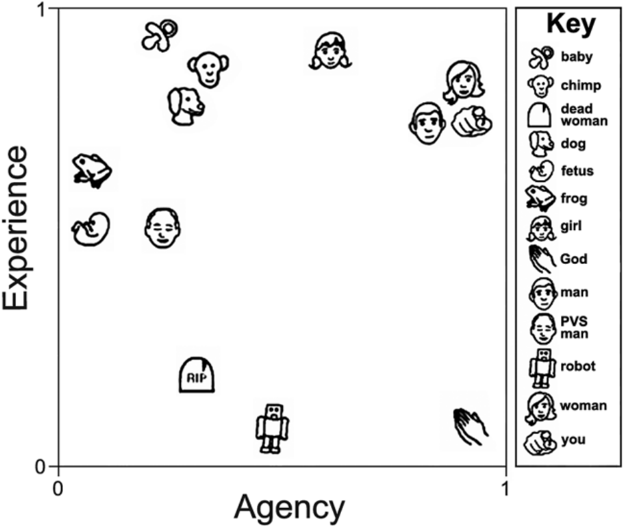
This paper argues that mind perception is not a single continuum but instead has two dimensions: Experience and Agency. Using 2,399 completed web-based surveys, the authors found that these dimensions explain how people judge minds across 13 characters and are differentially related to moral judgments.
## Key findings
- A principal components factor analysis of correlations among 18 mental capacities yielded two factors with eigenvalues over 1.0: Experience (eigenvalue 15.85, explaining 88% of variance) and Agency (eigenvalue 1.46, explaining 8% of variance); the rotated solution explained 97% of rating variance.
- Experience loaded on 11 capacities: hunger, fear, pain, pleasure, rage, desire, personality, consciousness, pride, embarrassment, and joy; Agency loaded on 7 capacities: self-control, morality, memory, emotion recognition, planning, communication, and thought.
- Personal judgments tracked the dimensions differently: liking, saving from destruction, making happy, and perceiving a soul correlated with both dimensions, with r ranging from 0.38 to 0.72.
- Punishment judgments correlated more with Agency than Experience (r = 0.82 vs. r = 0.22, z = 2.86, P < 0.05), while avoidance of harm correlated more with Experience than Agency (r = 0.85 vs. r = 0.26, z = 2.10, P < 0.05).
## Methods
- Web-based Mind Survey design: respondents saw pairwise comparisons of 13 characters across 18 mental capacities or 6 personal judgments, using five-point scales for 78 comparisons per survey.
- Sample: about 3,400 survey launches, with 2,399 completed surveys analyzed; respondents ranged from 12 to 75 years old (mean 30.44, SD 12.27) and were 64% female.
- Main analysis: character means were computed, correlations across capacities were submitted to principal components factor analysis with varimax rotation, and factor scores were estimated via regression; additional analyses examined correlations with personal judgments and individual-difference variables using z-statistics.
## Limitations
- The paper states that the surveys were largely independent and that respondent data came from web recruitment through other psychology sites, which makes the sample a convenience sample rather than a random population sample.
- Evident from the text: the factor structure is based on self-selected web respondents and on pairwise judgments of preselected characters and capacities, so generalizability beyond the survey context is not directly tested.
- The paper notes that about 25% of launched surveys were not completed, indicating noncompletion/missing-data attrition.
Model-written summary. Check it against the paper before relying on it.
Integrity signals
Registry
Cites
Statistics
Figures
Verification
Claims the paper makes
0 Valid · 0 Not valid · 0 Not checked · 18 Own results and interpretations
A result the paper reports from its own data — it cites no other source for it, so there is none to check. The quote shows it is in the paper.
In the paper
“Characters ' factor scores on these dimensions (Fig. 1) reveal interesting features; for example, God was perceived as having much Agency but little Experience.”
- Also stated in: § Dimensions of Mind Perception · plain
“for example, God was perceived as having much Agency but little Experience.”
plain- Asserted: passes — The authors put it forward as true.
- Checkable: passes — It can be checked against evidence.
- Load-bearing: unclear — It is unclear whether the paper’s conclusions depend on it.
- Based: passes — The paper gives a reason why it holds.
- Also stated in: § Dimensions of Mind Perception · plain
A result the paper reports from its own data — it cites no other source for it, so there is none to check. The quote shows it is in the paper.
In the paper
“A factor we termed Experience (eigenvalue = 15.85) accounted for 88% of the variance and included 11 capacities (from highest loading): hunger, fear, pain, pleasure, rage, desire, personality, consciousness, pride, embarrassment, and joy.”
plain- Asserted: passes — The authors put it forward as true.
- Checkable: passes — It can be checked against evidence.
- Load-bearing: passes — The paper’s conclusions depend on it.
- Based: passes — The paper gives a reason why it holds.
A result the paper reports from its own data — it cites no other source for it, so there is none to check. The quote shows it is in the paper.
In the paper
“Of 234 z -statistics (13 characters × 9 individual difference variables × 2 factors), 23 were statistically significant.”
plain- Asserted: passes — The authors put it forward as true.
- Checkable: passes — It can be checked against evidence.
- Load-bearing: unclear — It is unclear whether the paper’s conclusions depend on it.
- Based: passes — The paper gives a reason why it holds.
A result the paper reports from its own data — it cites no other source for it, so there is none to check. The quote shows it is in the paper.
In the paper
“whereas desire to avoid harming ( ' If you were forced to harm one of these characters, which one would it be more painful for you to harm? ' ) correlated more with Experience ( r = 0.85) than Agency ( r = 0.26, z = 2.10, P < 0.05).”
plainstates an association- Asserted: passes — The authors put it forward as true.
- Checkable: passes — It can be checked against evidence.
- Load-bearing: passes — The paper’s conclusions depend on it.
- Based: passes — The paper gives a reason why it holds.
A result the paper reports from its own data — it cites no other source for it, so there is none to check. The quote shows it is in the paper.
In the paper
“The rotated solution accounted for all 18 capacities (extraction communalities ranged from 0.82 to 0.99), explained 97% of rating variance, and yielded two factors with eigenvalues over 1.0.”
plainstates an association- Asserted: passes — The authors put it forward as true.
- Checkable: passes — It can be checked against evidence.
- Load-bearing: passes — The paper’s conclusions depend on it.
- Based: passes — The paper gives a reason why it holds.
5 more claims
Create a free account to see all 18 claims and every source verdict.
- It may state two separate claims as one. 8
- Probably not a substantial claim. 1
Claims other papers make about this one
Each is checked against this paper’s own text: does it say what the citing paper says it does?
The source backs part of the claim, not all of it — or backs it for a different population, condition or comparison.
In the citing paper
“People also anthropomorphize a range of inanimate objects and animals (Kwan & Fiske, 2008; Gray, Gray, & Wegner, 2007).”
From Dehumanized Perception: A Psychological Means to Facilitate Atrocities, Torture, and Genocide? (2011) · cites this paper as Gray, Gray, & Wegner, 2007
Experimental — accuracy not yet measuredThe source backs part of the claim, not all of it — or backs it for a different population, condition or comparison.
In the citing paper
“work in social psychology has demonstrated that mental state attribution is not a unitary concept, but rather involves distinct and independent dimensions of ‘intelligence’ and ‘experience’.”
From The influence of mental state attributions on trust in large language models (2025) · cites this paper as [19]
Experimental — accuracy not yet measuredThe source backs part of the claim, not all of it — or backs it for a different population, condition or comparison.
In the citing paper
“Participants’ ratings for each of the 65 traits (Supplementary Fig. S1a) were reduced via a principal component analysis to two main dimensions, which together explained 58% of the variance (Supplementary Fig. S1b) and mapped onto previously identified dimensions of ‘experience’ (e.g. experiencing pleasure or feeling fearful) and ‘intelligence’ (e.g. knowing things or making choices; Gray et al. 2”
From Folk psychological attributions of consciousness to large language models (2024) · cites this paper as Gray et al. 2007
Experimental — accuracy not yet measuredThe cited source says what the claim attributes to it.
In the citing paper
“This dissociation is supported by factor analyses of ratings of a variety of mental states, which reveal two fundamental factors: agency, or the capacity for high-level reasoning and planning, and experience, or the capacity for sensations and emotions19”
From The influence of mental state attributions on trust in large language models (2025) · cites this paper as [19]
The cited source says what the claim attributes to it.
In the citing paper
“Other work has systematically explored the dimensions underlying mental state attributions to various agents, revealing a two-dimensional structure distinguishing between ‘Experience’ (i.e. the capacity to feel pain, fear, joy, or pride) and ‘Agency’ (i.e. the capacity to have self-control, morality, planning, or communication) that is reminiscent of the distinction between phenomenal and non-phen”
From Folk psychological attributions of consciousness to large language models (2024) · cites this paper as Gray et al. 2007
Statistics recomputed
Every reported test result, recomputed from its test statistic and degrees of freedom. A result shows as not adding up only once an independent check has confirmed it.
- Consistentz = 2.86reported p < .05 · recomputed p = .004
“z = 2.86, p < .05”
- Consistentz = 2.1reported p < .05 · recomputed p = .036
“z = 2.10, p < .05”
Self-check
Percentages, sums and reported differences re-computed from the paper’s own numbers.
Self-check results appear here once an independent check has confirmed them.
Citations
Cites
I.—COMPUTING MACHINERY AND INTELLIGENCE
TURING, A. M. (1950) · Mind · doi:10.1093/mind/lix.236.433 · Cited by 10,290
Does the chimpanzee have a theory of mind?
Premack, D., & Woodruff, G. (1978) · Behavioral and Brain Sciences · doi:10.1017/s0140525x00076512 · Cited by 8,743
Mindblindness: An Essay on Autism and Theory of Mind
Baron-Cohen, S. (1995) · doi:10.7551/mitpress/4635.001.0001 · Cited by 3,428
Dennett, D. C. (1996) · Medical Entomology and Zoology · Cited by 314
Research works printed but not linked: 1
- A. Turing, Mind59, 433 (1950).
Cited by
Items 201–300 of 2,340
Saving the Robot or the Human? Robots Who Feel Deserve Moral Care
Nijssen, S. R. R., Müller, B. C. N., Baaren, R. B. V., & Paulus, M. (2019) · Social Cognition · doi:10.1521/soco.2019.37.1.41 · Cited by 102
News from Generative Artificial Intelligence Is Believed Less
Longoni, C., Fradkin, A., Cian, L., & Pennycook, G. (2022) · 2022 ACM Conference on Fairness Accountability and Transparency · doi:10.1145/3531146.3533077 · Cited by 120
Ward, A. F., Olsen, A. S., & Wegner, D. M. (2013) · Psychological Science · doi:10.1177/0956797612472343 · Cited by 104
“Attribution of general mental capacities was assessed using two 7-item scales (see Gray et al., 2007), one gauging capacities related to experience (desires, feelings, emotions, pleasure, fear, hunger, personality) and the other gauging capacities related to agency (planning, self-control, memory,…”
BackgroundMethodSelf-citationWomen as Animals, Women as Objects: Evidence for Two Forms of Objectification
Morris, K. L., Goldenberg, J. L., & Boyd, P. (2018) · Personality and Social Psychology Bulletin · doi:10.1177/0146167218765739 · Cited by 131
The Group-Member Mind Trade-Off: Attributing Mind to Groups Versus Group Members
Waytz, A., & Young, L. (2012) · Psychological Science · doi:10.1177/0956797611423546 · Cited by 103
“Indeed, future research should examine whether the types of minds (Gray et al., 2007) attributed to groups influence the moral evaluation and treatment of those groups.”
BackgroundResultSeeing human: Distinct and overlapping neural signatures associated with two forms of dehumanization
Jack, A. I., Dawson, A. J., & Norr, M. E. (2013) · NeuroImage · doi:10.1016/j.neuroimage.2013.04.109 · Cited by 117
“…is specifically tied to the attribution of experiential states (and hence the Phenomenal stance) is supported by behavioral evidence which shows that moral concern is linked to attributions of experiential states more than to attributions of agency (Gray et al., 2007, 2011; Jack and Robbins, 2012).”
Warmth and competence in animals
Sevillano, V., & Fiske, S. T. (2015) · Journal of Applied Social Psychology · doi:10.1111/jasp.12361 · Cited by 113
Race, Paternalism, and Foreign Aid: Evidence from U.S. Public Opinion
Baker, A. (2015) · American Political Science Review · doi:10.1017/s0003055414000549 · Cited by 129
“…paradigm has taken a cue from Allport by defining prejudice strictly as contempt or antipathy, but recent research on out-group perception shows that multiple dimensions are needed to fully classify the content of various stereotypes (Fiske, Cuddy, and Glick 2007; Gray, Gray, and Wegner 2007).”
BackgroundChandra, B. R., & Rahman, Z. (2023) · Journal of Service Theory and Practice · doi:10.1108/jstp-03-2023-0097 · Cited by 142
To escape blame, don't be a hero—Be a victim
Gray, K. J., & Wegner, D. M. (2010) · Journal of Experimental Social Psychology · doi:10.1016/j.jesp.2010.12.012 · Cited by 124
Self-citationApplicants’ Fairness Perceptions of Algorithm-Driven Hiring Procedures
Lavanchy, M., Reichert, P., Narayanan, J., & Savani, K. (2023) · Journal of Business Ethics · doi:10.1007/s10551-022-05320-w · Cited by 167
“As jobseekers are considered to have both high agency and experience, this distinction may lead people to perceive algorithms as lacking a “human mind” (Bigman & Gray, 2018; Gray et al., 2007).”
BackgroundSeeing Eye to Body: The Literal Objectification of Women
Heflick, N. A., & Goldenberg, J. L. (2014) · Current Directions in Psychological Science · doi:10.1177/0963721414531599 · Cited by 136
“Objects and machines are attributed less agency and experience than humans (H. M. Gray et al., 2007).”
BackgroundThe Sound of Intellect: Speech Reveals a Thoughtful Mind, Increasing a Job Candidate’s Appeal
Schroeder, J., & Epley, N. (2015) · Psychological Science · doi:10.1177/0956797615572906 · Cited by 101
An empirical study of consumers' intention to use biometric facial recognition as a payment method
Moriuchi, E. (2021) · Psychology and Marketing · doi:10.1002/mar.21495 · Cited by 121
Eyssel, F., & Reich, N. (2013) · 2013 8th ACM/IEEE International Conference on Human-Robot Interaction (HRI) · doi:10.1109/hri.2013.6483531 · Cited by 101
“, the capacity to feel pain, hunger, or to make plans) adapted from [9].”
BackgroundTipler, C. N., & Ruscher, J. B. (2017) · Journal of Gender Studies · doi:10.1080/09589236.2017.1411790 · Cited by 125
“Researchers that define dehumanization as a process of denying individuals mental states (Gray et al., 2007) argue that ascriptions of agency confer moral responsibility to the target (that they are deserving of punishment for wrongdoing) and ascriptions of experience (the ability to experience…”
BackgroundTheory of Mind in Social Robots: Replication of Five Established Human Tests
Banks, J. (2019) · International Journal of Social Robotics · doi:10.1007/s12369-019-00588-x · Cited by 127
The Moral Consideration of Artificial Entities: A Literature Review
Harris, J., & Anthis, J. R. (2021) · Science and Engineering Ethics · doi:10.1007/s11948-021-00331-8 · Cited by 101
“Evaluations of agency and patiency may be correlated, but artificial entities may be assigned high agency alongside low patiency (Gray et al. 2007; Akechi et al. 2018).”
BackgroundThe Folk Psychology of Consciousness*
ARICO, A., FIALA, B., GOLDBERG, R. F., & NICHOLS, S. (2011) · Mind & Language · doi:10.1111/j.1468-0017.2011.01420.x · Cited by 102
Men, Mammals, or Machines? Dehumanization Embedded in Organizational Practices
Väyrynen, T., & Laari‐Salmela, S. (2015) · Journal of Business Ethics · doi:10.1007/s10551-015-2947-z · Cited by 118
“…life (e.g., the Stereotype Content Model proposed by Fiske et al. 2002), as well on as the spontaneous disregard of the humanness of others based on the way that people attribute mind perceptions to objects and humans based on perceived dimensions of agency and experience (Gray et al. 2007).”
BackgroundTheories of Person Perception Predict Patterns of Neural Activity During Mentalizing
Thornton, M. A., & Mitchell, J. P. (2017) · Cerebral Cortex · doi:10.1093/cercor/bhx216 · Cited by 102
Our Robots, Our Team: Robot Anthropomorphism Moderates Group Effects in Human–Robot Teams
Fraune, M. R. (2020) · Frontiers in Psychology · doi:10.3389/fpsyg.2020.01275 · Cited by 98
“This may seem surprising, considering that prior work suggests that people favor anthropomorphic robots over mechanomorphic robots (Gray et al., 2007).”
BackgroundResultKim, T., & Song, H. (2021) · Telematics and Informatics · doi:10.1016/j.tele.2021.101595 · Cited by 101
The Big Bad Wolf: The Formation of a Stereotype
Jürgens, U. M., & Hackett, P. M. W. (2017) · Ecopsychology · doi:10.1089/eco.2016.0037 · Cited by 97
“Agency is a pivotal criterion for judging whether something is animate (Fiske et al., 2007; Gray et al., 2007; Waytz et al., 2010).”
Chaves, A. P., & Gerosa, M. A. (2020) · Figshare · doi:10.6084/m9.figshare.13207221.v1 · Cited by 97
Gray, K. J., & Schein, C. (2012) · Review of Philosophy and Psychology · doi:10.1007/s13164-012-0112-5 · Cited by 112
“It is also important to note that low-level agency is quite different from the high-level agency discussed so far (Gray et al. 2007), and we suggest that the qualities focused on by Arico et al.”
BackgroundMethodInfluentialSelf-citationBenefits and problems of health‐care robots in aged care settings: A comparison trial
Broadbent, E., Kerse, N. M., Peri, K., Robinson, H., Jayawardena, C., Kuo, T., Datta, C., Stafford, R. Q., Butler, H. F., Jawalkar, P., et al. (2015) · Australian Journal on Ageing · doi:10.1111/ajag.12190 · Cited by 127
Moral imagination: Facilitating prosocial decision-making through scene imagery and theory of mind
Gaesser, B., Keeler, K., & Young, L. (2017) · Cognition · doi:10.1016/j.cognition.2017.11.004 · Cited by 107
Social, psychological, and demographic characteristics of dehumanization toward immigrants
Markowitz, D. M., & Slovic, P. (2020) · Proceedings of the National Academy of Sciences · doi:10.1073/pnas.1921790117 · Cited by 106
Why do we prefer humans to artificial intelligence in telemarketing? A mind perception explanation
Li, S., Peluso, A. M., & Duan, J. (2022) · Journal of Retailing and Consumer Services · doi:10.1016/j.jretconser.2022.103139 · Cited by 118
Folk Psychological Attributions of Consciousness to Large Language Models
Colombatto, C., & Fleming, S. M. (2023) · doi:10.31234/osf.io/5cnrv · Cited by 96
God knows (but does God believe?)
Murray, D., Sytsma, J. M., & Livengood, J. (2012) · Philosophical Studies · doi:10.1007/s11098-012-0022-5 · Cited by 95
Keijsers, M., & Bartneck, C. (2018) · Proceedings of the 2018 ACM/IEEE International Conference on Human-Robot Interaction · doi:10.1145/3171221.3171266 · Cited by 92
When your boss is a robot: Workers are more spiteful to robot supervisors that seem more human
Yam, K. C., Goh, E.-Y., Fehr, R., Lee, R., Soh, H., & Gray, K. J. (2022) · Journal of Experimental Social Psychology · doi:10.1016/j.jesp.2022.104360 · Cited by 121
Self-citationHumans perceive warmth and competence in artificial intelligence
McKee, K. R., Bai, X., & Fiske, S. T. (2023) · iScience · doi:10.1016/j.isci.2023.107256 · Cited by 93
“Non-human actors, including robots, can elicit such judgments.(27,28) However, relatively few empirical studies have investigated the evaluations prompted by A.”
BackgroundOrazani, S. N., & Leidner, B. (2018) · European Journal of Social Psychology · doi:10.1002/ejsp.2526 · Cited by 116
The Positive Consequences of Pain: A Biopsychosocial Approach
Bastian, B., Jetten, J., Hornsey, M. J., & Leknes, S. (2014) · Personality and Social Psychology Review · doi:10.1177/1088868314527831 · Cited by 91
Tian, Q., Hilton, D., & Becker, M. (2015) · Appetite · doi:10.1016/j.appet.2015.09.009 · Cited by 98
Who Is Prejudiced, and Toward Whom? The Big Five Traits and Generalized Prejudice
Crawford, J. T., & Brandt, M. J. (2019) · Personality and Social Psychology Bulletin · doi:10.1177/0146167219832335 · Cited by 105
People's Explanations of Robot Behavior Subtly Reveal Mental State Inferences
de Graaf, M. M. A., & Malle, B. F. (2019) · 2019 14th ACM/IEEE International Conference on Human-Robot Interaction (HRI) · doi:10.1109/hri.2019.8673308 · Cited by 91
“To document and understand people’s ascriptions of mind to robots, previous research has mainly relied on direct questions [23]–[27], predictions of certain behaviors [18], [28]–[30], and judgments of robots’ mental capacities [31], [32].”
BackgroundConnell, P. M. (2013) · Psychology & Marketing · doi:10.1002/mar.20619 · Cited by 91
“The Mind Is Willing, but the Flesh Is Weak”: The Effects of Mind-Body Dualism on Health Behavior
Forstmann, M., Burgmer, P., & Mussweiler, T. (2012) · Psychological Science · doi:10.1177/0956797612442392 · Cited by 90
Gip, H., Guchait, P., Paşamehmetoğlu, A., & Khoa, D. T. (2022) · International Journal of Contemporary Hospitality Management · doi:10.1108/ijchm-02-2022-0155 · Cited by 106
Worth the Weight: The Objectification of Overweight Versus Thin Targets
Holland, E., & Haslam, N. (2013) · Psychology of Women Quarterly · doi:10.1177/0361684312474800 · Cited by 88
Folk psychological attributions of consciousness to large language models
Colombatto, C., & Fleming, S. M. (2024) · Neuroscience of Consciousness · doi:10.1093/nc/niae013 · Cited by 96
“…‘Experience’ (i.e. the capacity to feel pain, fear, joy, or pride) and ‘Agency’ (i.e. the capacity to have self-control, morality, planning, or communication) that is reminiscent of the distinction between phenomenal and non-phenomenal states (Gray et al. 2007; for a review, see Waytz et al. 2010).”
BackgroundYoung, A. D., & Monroe, A. E. (2019) · Journal of Experimental Social Psychology · doi:10.1016/j.jesp.2019.103870 · Cited by 88
Leichtmann, B., & Nitsch, V. (2020) · Journal of Environmental Psychology · doi:10.1016/j.jenvp.2019.101386 · Cited by 89
Brink, K. A., & Wellman, H. M. (2020) · Developmental Psychology · doi:10.1037/dev0000884 · Cited by 96
Zhang, X., Shi, Y., Li, T., Guan, Y., & Cui, X. (2023) · Information Systems Frontiers · doi:10.1007/s10796-023-10425-2 · Cited by 127
“A higher mind perception of a nonhuman entity indicates recognition of its greater capability to experience, plan, and act (Gray, 2007).”
How Culture Shapes What People Want From AI
Ge, X., Xu, C., Misaki, D., Markus, H. R., & Tsai, J. L. (2024) · Proceedings of the CHI Conference on Human Factors in Computing Systems · doi:10.1145/3613904.3642660 · Cited by 86
“Previous research suggests that people may perceive a given entity as having a mind if they impart agency and experience to this entity [35].”
Rai, T. S., & Diermeier, D. A. (2014) · Organizational Behavior and Human Decision Processes · doi:10.1016/j.obhdp.2014.10.001 · Cited by 101
“Agency, experience, and the mental capacities of companies Gray, Gray, and Wegner (2007) have argued that people actually perceive minds in terms of two fundamental dimensions.”
BackgroundMethodGuingrich, R. E., & Graziano, M. S. A. (2024) · Frontiers in Psychology · doi:10.3389/fpsyg.2024.1322781 · Cited by 87
“According to some, ToM can be divided into two distinct processes: attributing agency, or the ability to decide and act autonomously, and attributing experience, or the ability to have subjective states (Gray et al., 2007; Knobe and Prinz, 2007).”
BackgroundTrust in humans and robots: Economically similar but emotionally different
Schniter, E., Shields, T. W., & Sznycer, D. (2020) · Journal of Economic Psychology · doi:10.1016/j.joep.2020.102253 · Cited by 87
Kim, J. H., Kim, M., Kwak, D. W., & Lee, S. (2022) · Journal of Marketing Research · doi:10.1177/00222437211050351 · Cited by 85
“This is because algorithms are less effective than humans in recognizing human emotions and exhibiting appropriate responses (Gray, Gray, and Wegner 2007).”
Chatbot or human? The impact of online customer service on consumers' purchase intentions
Chen, S., Li, X., Liu, K., & Wang, X. (2023) · Psychology and Marketing · doi:10.1002/mar.21862 · Cited by 127
The blame shift: Robot service failures hold service firms more accountable
Ryoo, Y., Jeon, Y. A., & Kim, W. (2024) · Journal of Business Research · doi:10.1016/j.jbusres.2023.114360 · Cited by 89
Haslam, N., Loughnan, S., & Holland, E. (2013) · Nebraska Symposium on Motivation/The Nebraska symposium on motivation · doi:10.1007/978-1-4614-6959-9_2 · Cited by 112
Artificial intelligence or human: when and why consumers prefer AI recommendations
Jin, F., & Zhang, X. (2023) · Information Technology and People · doi:10.1108/itp-01-2023-0022 · Cited by 130
Cai, N., Gao, S., & Yan, J. (2024) · Humanities and Social Sciences Communications · doi:10.1057/s41599-024-03212-0 · Cited by 86
“The theory of mind perception suggests that thinking (agency) and feeling (experience) are the two dimensions of mental capacity that individuals attribute to human and non-human entities (Pitardi et al., 2021; Gray et al., 2007).”
Aroyo, A. M., Rea, F., Sandini, G., & Sciutti, A. (2018) · IEEE Robotics and Automation Letters · doi:10.1109/lra.2018.2856272 · Cited by 85
Mind attribution is for morality
Young, L., & Waytz, A. (2013) · Understanding Other Minds · doi:10.1093/acprof:oso/9780199692972.003.0006 · Cited by 85
The love of money results in objectification
Wang, X., & Krumhuber, E. G. (2016) · British Journal of Social Psychology · doi:10.1111/bjso.12158 · Cited by 95
Machine Authorship In Situ: Effect of news organization and news genre on news credibility
Liu, B., & Wei, L. (2019) · Digital Journalism · doi:10.1080/21670811.2018.1510740 · Cited by 85
“Consistent with past finding that suggest people attribute less mind and intentions to machine agents (e.g., Gray, Gray, and Wegner 2007; Kim and Sundar 2016; Liu and Wei 2018), we found news purported to be written by machine induced less emotional involvement among readers.”
BackgroundResultInfluentialThe longstanding view of workers as objects: antecedents and consequences of working objectification
Baldissarri, C., Andrighetto, L., & Volpato, C. (2021) · European Review of Social Psychology · doi:10.1080/10463283.2021.1956778 · Cited by 97
“The table integrates the dimensions of objectification outlined by Nussbaum with a Dimensions of mind (Gray et al., 2007), b Stereotype Content Model Dimensions (Fiske et al. 2002) and c Dimensions of Humanness (Haslam, 2006).”
BackgroundBai, B., Dai, H., Zhang, D. J., Zhang, F., & Hu, H. (2022) · Manufacturing & Service Operations Management · doi:10.1287/msom.2022.1120 · Cited by 96
Would an AI chatbot persuade you: an empirical answer from the elaboration likelihood model
Chen, Q., Yin, C., & Gong, Y. (2025) · Information Technology & People · doi:10.1108/itp-10-2021-0764 · Cited by 86
Eyssel, F., Kuchenbrandt, D., Hegel, F., & de Ruiter, L. (2012) · 2012 IEEE RO-MAN: The 21st IEEE International Symposium on Robot and Human Interactive Communication · doi:10.1109/roman.2012.6343858 · Cited by 86
Lindquist, K. A., Gendron, M., Oosterwijk, S., & Barrett, L. F. (2013) · Emotion · doi:10.1037/a0032283 · Cited by 82
Mind Perception of Robots Varies With Their Economic Versus Social Function
Wang, X., & Krumhuber, E. G. (2018) · Frontiers in Psychology · doi:10.3389/fpsyg.2018.01230 · Cited by 84
“, cognition and emotion, also map onto the two dimensions of mind perception (Gray et al., 2007), the conceptualization of humanness (Haslam, 2006; Haslam et al.”
BackgroundInfluentialAnthropomorphism of Nature, Environmental Guilt, and Pro-Environmental Behavior
Tam, K. (2019) · Sustainability · doi:10.3390/su11195430 · Cited by 98
“For example, because there are individual and cultural differences in the perception of the level of moral patiency in fetuses and animals [23], there are different moral judgments and emotional reactions with regard to abortion and animal use [22].”
BackgroundZhang, M., Li, L., Ye, Y., Qin, K., & Zhong, J. (2020) · Journal of Consumer Behaviour · doi:10.1002/cb.1835 · Cited by 84
Edible Insects as Food–Insect Welfare and Ethical Aspects from a Consumer Perspective
Delvendahl, N., Rumpold, B. A., & Langen, N. (2022) · Insects · doi:10.3390/insects13020121 · Cited by 95
“Specifically, living beings who are perceived to have more mental capacities are attributed higher moral standing [67].”
BackgroundEmotion Perception as Conceptual Synchrony
Gendron, M., & Barrett, L. F. (2018) · Emotion Review · doi:10.1177/1754073917705717 · Cited by 102
The effect of voice and humour on users’ perceptions of personal intelligent agents
Moussawi, S., & Benbunan-Fich, R. (2021) · Behaviour & Information Technology · doi:10.1080/0144929x.2020.1772368 · Cited by 83
“We tend to anthropomorphise objects with human-like features, emotions, cognition, or intention (Pfeu ff er et al. 2019; Epley, Waytz, and Cacioppo 2007, 2008; Kiesler et al. 2008; Du ff y 2003; Don et al. 1992; Walker, Sproull, and Subramani 1994; Aggarwal and McGill 2007; Fournier and Alvarez 2012; Puzakova, Kwak, and…”
BackgroundInfluentialA new sociology of humans and machines
Tsvetkova, M., Yasseri, T., Pescetelli, N., & Werner, T. (2024) · arXiv · doi:10.48550/arxiv.2402.14410 · Cited by 83
Attribution of intentional agency towards robots reduces one’s own sense of agency
Ciardo, F., Beyer, F., Tommaso, D. D., & Wykowska, A. (2019) · Cognition · doi:10.1016/j.cognition.2019.104109 · Cited by 91
Social robots are like real people: first impressions, attributes, and stereotyping of social robots
Reeves, B., Hancock, J., & Liu, X. (2020) · Technology, Mind, and Behavior · doi:10.1037/tmb0000018 · Cited by 63
“Gray et al. (2007) proposed two dimensions of perceptions of robots: agency and experience.”
BackgroundTakahashi, H., Terada, K., Morita, T., Suzuki, S., Haji, T., Kozima, H., Yoshikawa, M., Matsumoto, Y., Omori, T., Asada, M., et al. (2014) · Cortex · doi:10.1016/j.cortex.2014.03.011 · Cited by 89
“Furthermore, our findings elucidated the existence of two distinct functional networks in the social human brain.”
BackgroundMethodResultThe Two Sources of Moral Standing
Sytsma, J. M., & Machery, É. (2012) · Review of Philosophy and Psychology · doi:10.1007/s13164-012-0102-7 · Cited by 88
“Based on the correlation found by Gray et al. (2007), as well as the kind of reaction to animal experimentation illustrated by de Waal’s article discussed in Section 3, we also expected Agency to have an impact, albeit a smaller one.”
BackgroundMethodInfluentialTell me more! assessing interactions with social robots from speech
Laban, G., George, J.-N., Morrison, V., & Cross, E. S. (2020) · Paladyn, Journal of Behavioral Robotics · doi:10.1515/pjbr-2021-0011 · Cited by 81
A new sociology of humans and machines
Tsvetkova, M., Yasseri, T., Pescetelli, N., & Werner, T. (2024) · Nature Human Behaviour · doi:10.1038/s41562-024-02001-8 · Cited by 187
“Nevertheless, there are visible neurophysiological differences in the brain when humans interact with robots 40,41 , probably because humans do not attribute agency and morals to them 42,43 .”
When robots appear to have a mind: The human perception of machine agency and responsibility
van der Woerdt, S., & Haselager, P. (2017) · New Ideas in Psychology · doi:10.1016/j.newideapsych.2017.11.001 · Cited by 92
Lanz, L., Briker, R., & Gerpott, F. H. (2023) · Journal of Business Ethics · doi:10.1007/s10551-023-05393-1 · Cited by 104
“…evidence suggests people perceive AI’s level of mind (i.e., the ability to experience emotions and empathy or the ability to plan ahead; Gray et al., 2007) as comparably low and thus seem to disapprove of AI as a decision-maker in many (e.g., moral) situations (Bigman et al., 2019;…”
InfluentialSchadenfreude deconstructed and reconstructed: A tripartite motivational model
Wang, S., Lilienfeld, S. O., & Rochat, P. (2018) · New Ideas in Psychology · doi:10.1016/j.newideapsych.2018.09.002 · Cited by 101
“tions, attributes that distinguish humans from inanimate objects, such as intelligent but insentient machines (Gray et al., 2007; Haslam, 2006).”
BackgroundService robots with (perceived) theory of mind: An examination of humans’ reactions
Söderlund, M. (2022) · Journal of Retailing and Consumer Services · doi:10.1016/j.jretconser.2022.102999 · Cited by 97
The impact of AI identity disclosure on consumer unethical behavior: A social judgment perspective
Li, T.-G., Zhang, C., Chang, Y., & Zheng, W. T. (2023) · Journal of Retailing and Consumer Services · doi:10.1016/j.jretconser.2023.103606 · Cited by 97
Humans versus Computers: Impact of Emotion Expressions on People's Decision Making
de Melo, C. M., Gratch, J., & Carnevale, P. J. (2015) · IEEE Transactions on Affective Computing · doi:10.1109/taffc.2014.2332471 · Cited by 78
“Researchers have proposed that people think of other minds in terms of two dimensions [44], [36], [37], [62]: agency, which refers to the capacity to think, plan and act; and,”
BackgroundResultConway, J. R., Catmur, C., & Bird, G. (2019) · Psychonomic Bulletin & Review · doi:10.3758/s13423-018-1559-x · Cited by 100
Spatola, N., & Wykowska, A. (2021) · Computers in Human Behavior · doi:10.1016/j.chb.2021.106841 · Cited by 93
Similarities and differences in concepts of mental life among adults and children in five cultures
Weisman, K., Legare, C. H., Smith, R., Dzokoto, V. A. A., Aulino, F., Ng, E., Dulin, J. C., Ross-Zehnder, N., Brahinsky, J., & Luhrmann, T. M. (2021) · Nature Human Behaviour · doi:10.1038/s41562-021-01184-8 · Cited by 102
How inferred motives shape moral judgements
Carlson, R. W., Bigman, Y., Gray, K. J., Ferguson, M. J., & Crockett, M. J. (2022) · Nature Reviews Psychology · doi:10.1038/s44159-022-00071-x · Cited by 105
Self-citationAnthropomorphism-based artificial intelligence (AI) robots typology in hospitality and tourism
Saputra, F. E., Buhalis, D., Augustyn, M. M., & Marangos, S. (2024) · Journal of Hospitality and Tourism Technology · doi:10.1108/jhtt-03-2024-0171 · Cited by 107
Zhang, J., Wang, X., Lu, J., Liu, L., & Feng, Y. (2024) · Decision Support Systems · doi:10.1016/j.dss.2024.114347 · Cited by 115
The Impact of Power on Humanity: Self-Dehumanization in Powerlessness
Yang, W., Jin, S., He, S., Fan, Q., & Zhu, Y. (2015) · PLoS ONE · doi:10.1371/journal.pone.0125721 · Cited by 95
Ffab—the form function attribution bias in human-robot interaction
Haring, K. S., Watanabe, K., Velonaki, M., Tossell, C. C., & Finomore, V. (2018) · IEEE Transactions on Cognitive and Developmental Systems · doi:10.1109/tcds.2018.2851569 · Cited by 78
Attributing minds to vampires in Richard Matheson’s I Am Legend
Nuttall, L. (2015) · Language and Literature International Journal of Stylistics · doi:10.1177/0963947014561834 · Cited by 89
“People who hate it can’t stand being in Neville’s head.”
BackgroundCoordinating bodies and minds: Behavioral synchrony fosters mentalizing
Baimel, A., Birch, S., & Norenzayan, A. (2017) · Journal of Experimental Social Psychology · doi:10.1016/j.jesp.2017.10.008 · Cited by 85
“Additionally, the attribution of mental states to a target is often followed by an increase in moral concern (Gray et al., 2007; Loughnan et al., 2010).”
BackgroundDemeaning: Dehumanizing others by minimizing the importance of their psychological needs.
Schroeder, J., & Epley, N. (2020) · Journal of Personality and Social Psychology · doi:10.1037/pspa0000199 · Cited by 85
“Our theorizing predicts that evaluations of God’s needs will be superhumanized, with psychological needs being perceived as more important than physical needs, thereby showing the inverse pattern observed in evaluations nonhuman animals.”
InfluentialNayak, S. M., & Griffiths, R. R. (2022) · Frontiers in Psychology · doi:10.3389/fpsyg.2022.852248 · Cited by 73
“Although considerable research progress has been made in the field of mind perception, few studies have addressed the causes of mind perception (Gray et al., 2007; Waytz et al., 2010).”
BackgroundThe avatar will see you now: Support from a virtual human provides socio-emotional benefits
Pauw, L. S., Sauter, D. A., Kleef, G. A. V., Lucas, G., Gratch, J. S., & Fischer, A. H. (2022) · Computers in Human Behavior · doi:10.1016/j.chb.2022.107368 · Cited by 105
Metadata
- Authors
- Gray, H. M., Gray, K., & Wegner, D. M.
- Affiliations
- Harvard University (US)
- Corresponding author
- Gray, Heather M.
- Venue
- Science
- Published
- 2007-02-02
- Volume
- 315
- Issue
- 5812
- Pages
- 619-619
- ISSN
- 0036-8075 (ISSN-L)
- 1095-9203
- OpenAlex
- W2131227926
- Cited by
- 2,342
- References
- 4
- Citations by year
- 2026: 359 · 2025: 326 · 2024: 249 · 2023: 220 · 2022: 198 · 2021: 156 · 2020: 157 · 2019: 107 · 2018: 91 · 2017: 86 · 2016: 96 · 2015: 66 · 2014: 52 · 2013: 44 · 2012: 45
- FWCI
- 10.81
- Type
- journal article
- Language
- en
- Open access
- closed
- Locations
- Science (publishedVersion)
- PubMed (publishedVersion)
- Funders
- National Institutes of Health (1f31mh071053-01)
- National Institute of Mental Health (MH-71053, MH 49127, R01MH049127)
- Topics
- Life Sciences › Neuroscience › Cognitive Neuroscience › Psychology of Moral and Emotional Judgment
- Social Sciences › Psychology › Social Psychology › Social Robot Interaction and HRI
- Social Sciences › Sociology and Political Science › Social and Intergroup Psychology
- Keywords
- mind perception, moral judgment, agency, experience, non-human animals, personification, moral status of animals, self-control, hunger
- MeSH terms
- Adolescent, Adult, Aged, Child, Emotions, Female, Humans, Male, Mental Processes, Middle Aged, Morals, Perception, Personality, Principal Component Analysis
About these checks
Registry, retraction, Cites and statistics results are computed, not judged, with one exception: a printed reference that no index lists is read once by a model before it counts as a citation error. Claims are extracted by a model and kept only when their quote appears verbatim in the text; each cited source is then checked, with a model’s help, for whether it says what the claim relies on. Those verdicts can be wrong — read the claim’s quote and the cited source before relying on one.
A language model drew the claims from the paper on 2026-09-28, under version 3 of the claim definition (model deepseek-v4.1-flash, prompt extract-v3).
A second model labelled each claim on 2026-09-28 (model jev-1.13-20260917, definition revision gold-guideline-v0.2).
Statistics and arithmetic are recomputed, not judged.
Confidence bands are shown only for fields calibrated on our annotated test set. None is calibrated yet, so no band is shown.
What counts as a claim ›How we measure confidence ›How we check this ›
Are you an author, or do you see a problem with this page? Request a review
Data sources
Bibliographic data: Semantic Scholar, OpenAlex, Crossref.
Contains information from the Semantic Scholar Academic Graph Datasets, made available under the ODC Attribution License (ODC-BY 1.0).
Semantic Scholar’s data is described in: Kinney, R., et al. (2023). The Semantic Scholar Open Data Platform. arXiv:2301.10140.
