

Dimensions of Mind Perception
The DOI matches its Crossref record; 4 of the 4 references it cites were found in a registry or an index.
Abstract
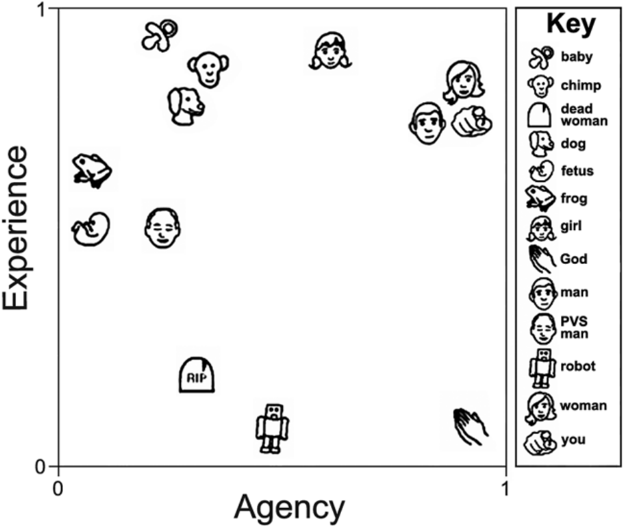
Participants compared the mental capacities of various human and nonhuman characters via online surveys. Factor analysis revealed two dimensions of mind perception, Experience (for example, capacity for hunger) and Agency (for example, capacity for self-control). The dimensions predicted different moral judgments but were both related to valuing of mind.
Overview
CoChat Summary
## TL;DR
This paper argues that mind perception is not a single continuum but instead has two dimensions: Experience and Agency. Using 2,399 completed web-based surveys, the authors found that these dimensions explain how people judge minds across 13 characters and are differentially related to moral judgments.
## Key findings
- A principal components factor analysis of correlations among 18 mental capacities yielded two factors with eigenvalues over 1.0: Experience (eigenvalue 15.85, explaining 88% of variance) and Agency (eigenvalue 1.46, explaining 8% of variance); the rotated solution explained 97% of rating variance.
- Experience loaded on 11 capacities: hunger, fear, pain, pleasure, rage, desire, personality, consciousness, pride, embarrassment, and joy; Agency loaded on 7 capacities: self-control, morality, memory, emotion recognition, planning, communication, and thought.
- Personal judgments tracked the dimensions differently: liking, saving from destruction, making happy, and perceiving a soul correlated with both dimensions, with r ranging from 0.38 to 0.72.
- Punishment judgments correlated more with Agency than Experience (r = 0.82 vs. r = 0.22, z = 2.86, P < 0.05), while avoidance of harm correlated more with Experience than Agency (r = 0.85 vs. r = 0.26, z = 2.10, P < 0.05).
## Methods
- Web-based Mind Survey design: respondents saw pairwise comparisons of 13 characters across 18 mental capacities or 6 personal judgments, using five-point scales for 78 comparisons per survey.
- Sample: about 3,400 survey launches, with 2,399 completed surveys analyzed; respondents ranged from 12 to 75 years old (mean 30.44, SD 12.27) and were 64% female.
- Main analysis: character means were computed, correlations across capacities were submitted to principal components factor analysis with varimax rotation, and factor scores were estimated via regression; additional analyses examined correlations with personal judgments and individual-difference variables using z-statistics.
## Limitations
- The paper states that the surveys were largely independent and that respondent data came from web recruitment through other psychology sites, which makes the sample a convenience sample rather than a random population sample.
- Evident from the text: the factor structure is based on self-selected web respondents and on pairwise judgments of preselected characters and capacities, so generalizability beyond the survey context is not directly tested.
- The paper notes that about 25% of launched surveys were not completed, indicating noncompletion/missing-data attrition.
Model-written summary. Check it against the paper before relying on it.
Integrity signals
Registry
Cites
Statistics
Figures
Verification
Claims the paper makes
0 Valid · 0 Not valid · 0 Not checked · 18 Own results and interpretations
A result the paper reports from its own data — it cites no other source for it, so there is none to check. The quote shows it is in the paper.
In the paper
“Characters ' factor scores on these dimensions (Fig. 1) reveal interesting features; for example, God was perceived as having much Agency but little Experience.”
- Also stated in: § Dimensions of Mind Perception · plain
“for example, God was perceived as having much Agency but little Experience.”
plain- Asserted: passes — The authors put it forward as true.
- Checkable: passes — It can be checked against evidence.
- Load-bearing: unclear — It is unclear whether the paper’s conclusions depend on it.
- Based: passes — The paper gives a reason why it holds.
- Also stated in: § Dimensions of Mind Perception · plain
A result the paper reports from its own data — it cites no other source for it, so there is none to check. The quote shows it is in the paper.
In the paper
“A factor we termed Experience (eigenvalue = 15.85) accounted for 88% of the variance and included 11 capacities (from highest loading): hunger, fear, pain, pleasure, rage, desire, personality, consciousness, pride, embarrassment, and joy.”
plain- Asserted: passes — The authors put it forward as true.
- Checkable: passes — It can be checked against evidence.
- Load-bearing: passes — The paper’s conclusions depend on it.
- Based: passes — The paper gives a reason why it holds.
A result the paper reports from its own data — it cites no other source for it, so there is none to check. The quote shows it is in the paper.
In the paper
“Of 234 z -statistics (13 characters × 9 individual difference variables × 2 factors), 23 were statistically significant.”
plain- Asserted: passes — The authors put it forward as true.
- Checkable: passes — It can be checked against evidence.
- Load-bearing: unclear — It is unclear whether the paper’s conclusions depend on it.
- Based: passes — The paper gives a reason why it holds.
A result the paper reports from its own data — it cites no other source for it, so there is none to check. The quote shows it is in the paper.
In the paper
“whereas desire to avoid harming ( ' If you were forced to harm one of these characters, which one would it be more painful for you to harm? ' ) correlated more with Experience ( r = 0.85) than Agency ( r = 0.26, z = 2.10, P < 0.05).”
plainstates an association- Asserted: passes — The authors put it forward as true.
- Checkable: passes — It can be checked against evidence.
- Load-bearing: passes — The paper’s conclusions depend on it.
- Based: passes — The paper gives a reason why it holds.
A result the paper reports from its own data — it cites no other source for it, so there is none to check. The quote shows it is in the paper.
In the paper
“The rotated solution accounted for all 18 capacities (extraction communalities ranged from 0.82 to 0.99), explained 97% of rating variance, and yielded two factors with eigenvalues over 1.0.”
plainstates an association- Asserted: passes — The authors put it forward as true.
- Checkable: passes — It can be checked against evidence.
- Load-bearing: passes — The paper’s conclusions depend on it.
- Based: passes — The paper gives a reason why it holds.
5 more claims
Create a free account to see all 18 claims and every source verdict.
- It may state two separate claims as one. 8
- Probably not a substantial claim. 1
Claims other papers make about this one
Each is checked against this paper’s own text: does it say what the citing paper says it does?
The source backs part of the claim, not all of it — or backs it for a different population, condition or comparison.
In the citing paper
“People also anthropomorphize a range of inanimate objects and animals (Kwan & Fiske, 2008; Gray, Gray, & Wegner, 2007).”
From Dehumanized Perception: A Psychological Means to Facilitate Atrocities, Torture, and Genocide? (2011) · cites this paper as Gray, Gray, & Wegner, 2007
Experimental — accuracy not yet measuredThe source backs part of the claim, not all of it — or backs it for a different population, condition or comparison.
In the citing paper
“work in social psychology has demonstrated that mental state attribution is not a unitary concept, but rather involves distinct and independent dimensions of ‘intelligence’ and ‘experience’.”
From The influence of mental state attributions on trust in large language models (2025) · cites this paper as [19]
Experimental — accuracy not yet measuredThe source backs part of the claim, not all of it — or backs it for a different population, condition or comparison.
In the citing paper
“Participants’ ratings for each of the 65 traits (Supplementary Fig. S1a) were reduced via a principal component analysis to two main dimensions, which together explained 58% of the variance (Supplementary Fig. S1b) and mapped onto previously identified dimensions of ‘experience’ (e.g. experiencing pleasure or feeling fearful) and ‘intelligence’ (e.g. knowing things or making choices; Gray et al. 2”
From Folk psychological attributions of consciousness to large language models (2024) · cites this paper as Gray et al. 2007
Experimental — accuracy not yet measuredThe cited source says what the claim attributes to it.
In the citing paper
“This dissociation is supported by factor analyses of ratings of a variety of mental states, which reveal two fundamental factors: agency, or the capacity for high-level reasoning and planning, and experience, or the capacity for sensations and emotions19”
From The influence of mental state attributions on trust in large language models (2025) · cites this paper as [19]
The cited source says what the claim attributes to it.
In the citing paper
“Other work has systematically explored the dimensions underlying mental state attributions to various agents, revealing a two-dimensional structure distinguishing between ‘Experience’ (i.e. the capacity to feel pain, fear, joy, or pride) and ‘Agency’ (i.e. the capacity to have self-control, morality, planning, or communication) that is reminiscent of the distinction between phenomenal and non-phen”
From Folk psychological attributions of consciousness to large language models (2024) · cites this paper as Gray et al. 2007
Statistics recomputed
Every reported test result, recomputed from its test statistic and degrees of freedom. A result shows as not adding up only once an independent check has confirmed it.
- Consistentz = 2.86reported p < .05 · recomputed p = .004
“z = 2.86, p < .05”
- Consistentz = 2.1reported p < .05 · recomputed p = .036
“z = 2.10, p < .05”
Self-check
Percentages, sums and reported differences re-computed from the paper’s own numbers.
Self-check results appear here once an independent check has confirmed them.
Citations
Cites
I.—COMPUTING MACHINERY AND INTELLIGENCE
TURING, A. M. (1950) · Mind · doi:10.1093/mind/lix.236.433 · Cited by 10,290
Does the chimpanzee have a theory of mind?
Premack, D., & Woodruff, G. (1978) · Behavioral and Brain Sciences · doi:10.1017/s0140525x00076512 · Cited by 8,743
Mindblindness: An Essay on Autism and Theory of Mind
Baron-Cohen, S. (1995) · doi:10.7551/mitpress/4635.001.0001 · Cited by 3,428
Dennett, D. C. (1996) · Medical Entomology and Zoology · Cited by 314
Research works printed but not linked: 1
- A. Turing, Mind59, 433 (1950).
Cited by
Items 601–700 of 2,340
Mind Attribution to Nature and Proenvironmental Behavior
Tam, K. (2015) · Ecopsychology · doi:10.1089/eco.2014.0054 · Cited by 32
“Gray et al. (2007) reported that their participants were more reluctant to harm an entity when they considered it to be able to sense and feel.”
InfluentialImmortal Objects: The Objectification of Women as Terror Management
Goldenberg, J. L. (2013) · Nebraska Symposium on Motivation · doi:10.1007/978-1-4614-6959-9_4 · Cited by 30
Development and validation of a social robot anthropomorphism scale (SRA) in a french sample
David, D., Hayotte, M., Thérouanne, P., d’Arripe-Longueville, F., & Milhabet, I. (2022) · International Journal of Human-Computer Studies · doi:10.1016/j.ijhcs.2022.102802 · Cited by 31
New dyads? The effect of social robots’ anthropomorphization on empathy towards human beings
Spaccatini, F., Corlito, G., & Sacchi, S. (2023) · Computers in Human Behavior · doi:10.1016/j.chb.2023.107821 · Cited by 35
Comparing the Willingness to Share for Human-generated vs. AI-generated Fake News
Bashardoust, A., Feuerriegel, S., & Shrestha, Y. R. (2024) · Proceedings of the ACM on Human-Computer Interaction · doi:10.1145/3687028 · Cited by 73
Approaching Social Robots Through Playfulness and Doing-It-Yourself: Children in Action
Fortunati, L., Esposito, A. A., Ferrin, G., & Viel, M. (2014) · Cognitive Computation · doi:10.1007/s12559-014-9303-y · Cited by 29
“Robots are seen as ‘‘moral agents,’’ according to Aristotle’s classical distinction between moral agents and moral patients [37] and children ascribed moral responsibility to them [36].”
BackgroundIt's not too late to do the right thing: Moral motivations for climate change action
Bain, P. G., & Bongiorno, R. (2019) · Wiley Interdisciplinary Reviews Climate Change · doi:10.1002/wcc.615 · Cited by 41
Chen, J., Chen, C., Walther, J. B., & Sundar, S. S. (2021) · CHI Conference Extended Abstracts on Human Factors in Computing Systems (CHI EA) · doi:10.1145/3411763.3451735 · Cited by 37
“Humans tend to attribute mind to others along two independent dimensions: agency (the capacity to act) and experience (the capacity to feel) [16, 17].”
BackgroundCan mind perception explain virtuous character judgments of artificial intelligence?
Shank, D. B., North, M., Arnold, C., & Gamez, P. (2021) · Technology Mind and Behavior · doi:10.1037/tmb0000047 · Cited by 46
Ashrafi, D. M., & Easmin, R. (2022) · International Journal of Innovation and Technology Management · doi:10.1142/s0219877023500049 · Cited by 35
You Are In My Way: Non-verbal Social Cues for Legible Robot Navigation Behaviors
Angelopoulos, G., Rossi, A., Napoli, C. D., & Rossi, S. (2022) · IEEE/RSJ International Conference on Intelligent Robots and Systems (IROS) · doi:10.1109/iros47612.2022.9981754 · Cited by 41
“To measure perceived robots’ agency and experience , participants were asked to compare the four cues in one questionnaire, at the end of all the experimental sessions, comprising seven scale questions that are based on the well-established Mind Attribution Scale [24].”
MethodEyssel, F., & Kuchenbrandt, D. (2011) · IEEE RO-MAN · doi:10.1109/roman.2011.6005233 · Cited by 35
“We did so by asking them to rate NAO with regard to 25 mental capacities (e. g., the capacity to feel pain, to have desires, intentions, or to make plans; α = .94), a scale we adapted from [ 11 ].Moreover, to assess human-robot acceptance, we asked participants to report how many hours per week they would be willing t…”
MethodIt Depends Who Is Watching You: 3-D Agent Cues Increase Fairness
Krátký, J., McGraw, J. J., Xygalatas, D., Mitkidis, P., & Reddish, P. (2016) · PLoS ONE · doi:10.1371/journal.pone.0148845 · Cited by 32
“Although our propensity to anthropomorphize may lead to frequent misattributions [20–22], the ability to perceive others as intentional and sentient beings [23] is an essential component of social and more moral cognition.”
BackgroundO’Brien, E. (2015) · Journal of Experimental Psychology General · doi:10.1037/xge0000064 · Cited by 32
Virtually in love: The role of anthropomorphism in virtual romantic relationships
Koike, M., Loughnan, S., & Stanton, S. C. E. (2022) · British Journal of Social Psychology · doi:10.1111/bjso.12564 · Cited by 43
Disentangling five dimensions of animacy in human brain and behaviour
Jozwik, K. M., Najarro, E., van den Bosch, J. J. F., Charest, I., Cichy, R. M., & Kriegeskorte, N. (2022) · Communications Biology · doi:10.1038/s42003-022-04194-y · Cited by 50
“The dimensions of animacy that have been explored include “being alive” (Connolly et al., 2012; Gray et al., 2007; Huth et al., 2012; Leib et al., 2016; Looser et al., 2013; Rogers et al., 2005; Wheatley et al., 2011), “looking The stimuli used in previous studies were mostly handpicked to…”
BackgroundYoganathan, V., & Osburg, V. (2024) · Journal of Business Research · doi:10.1016/j.jbusres.2024.114573 · Cited by 34
Yu, X., Hoggenmüeller, M., Tran, T. T. M., Wang, Y., & Tomitsch, M. (2024) · ACM Transactions on Human-Robot Interaction · doi:10.1145/3677615 · Cited by 34
“This process, known as mentalisation in psychology [28], has been found to exist in how people interpret robots, as suggested in previous research [58, 75].”
You, S., & Robert, L. (2024) · MIS Quarterly · doi:10.25300/misq/2023/17403 · Cited by 44
“For instance, Gray et al. (2007) found that social robots are perceived to be incapable of having experiences, which are the basis of achieved characteristics like work styles and personality.”
BackgroundLim, J. S., Schneider, E. J., Grover, M., Zhang, J., & Peters, D. (2024) · Public Relations Review · doi:10.1016/j.pubrev.2024.102520 · Cited by 42
Coping with Emotional Distress via Self-Disclosure to Robots: An Intervention with Caregivers
Laban, G., Morrison, V., Kappas, A., & Cross, E. S. (2025) · International Journal of Social Robotics · doi:10.1007/s12369-024-01207-0 · Cited by 57
“…• Length (number of words) • Subjective self-disclosure [127] Social perception and usability (O2) • Agency [the robot ability to plan and act; 132] Participants perceived Pepper as increasingly social (in terms of agency, and friendliness and warmth) and competent (in terms of communication…”
InfluentialIngredients of intelligence: From classic debates to an engineering roadmap
Lake, B. M., Ullman, T. D., Tenenbaum, J. B., & Gershman, S. J. (2017) · Behavioral and Brain Sciences · doi:10.1017/s0140525x17001224 · Cited by 31
“You Little Creep”: Evidence of Blatant Dehumanization of Short Groups
Kunst, J. R., Kteily, N., & Thomsen, L. (2017) · Social Psychological and Personality Science · doi:10.1177/1948550617740613 · Cited by 31
Brandi, M., Kaifel, D., Bolis, D., & Schilbach, L. (2019) · i-com · doi:10.1515/icom-2018-0018 · Cited by 32
Do I still like myself? Human-robot collaboration entails emotional consequences
Weis, P. P., & Herbert, C. (2021) · Computers in Human Behavior · doi:10.1016/j.chb.2021.107060 · Cited by 30
When Corporations Are People: Agent Talk and the Development of Organizational Actorhood, 1890–1934
Knight, C. R. (2022) · Sociological Methods & Research · doi:10.1177/00491241221122528 · Cited by 28
“Rather, I am noting that individuals more easily assign agency to human beings than to non-human entities or collectives (Gray, Gray, and Wegner 2007).”
BackgroundPeople's self-reported encounters of Perceiving Mind in Artificial Intelligence
Shank, D. B., & Gott, A. (2019) · Data in Brief · doi:10.1016/j.dib.2019.104220 · Cited by 27
“capacity to act, have intention, and plan, whereas experiential mind is the capacity to feel emotions or pain, desires, and experiences [4,6,13].”
BackgroundGuingrich, R. E., & Graziano, M. S. A. (2025) · Oxford Intersections: AI in Society · doi:10.1093/9780198945215.003.0011 · Cited by 28
“User ratings of the chatbot’s agency were not significantly different than non-user ratings ( p =0.16).”
InfluentialMind your meat: Religious differences in the social perception of animals
Manokara, K., Lee, A., Kamble, S. V., & Krumhuber, E. G. (2020) · International Journal of Psychology · doi:10.1002/ijop.12717 · Cited by 34
(Hu)man-Like Robots: The Impact of Anthropomorphism and Language on Perceived Robot Gender
Roesler, E., Heuring, M., & Onnasch, L. (2023) · International Journal of Social Robotics · doi:10.1007/s12369-023-00975-5 · Cited by 36
“, animals) [24] which trigger mind perception [44], we supposed that grammatical gender influences the gender perception of robots.”
BackgroundWhy can’t we help but love mobile banking chatbots? Perspective of stimulus-organism-response
Upadhyay, N., & Kamble, A. A. (2023) · Journal of Financial Services Marketing · doi:10.1057/s41264-023-00237-5 · Cited by 38
“Epley et al. (2007) and Gray et al. (2007) suggest anthro-pomorphism reflects human attributes onto non-human entities, and thereby such entities project human characteristics, emotions, and intentions.”
Lai, L., Pan, Y., Xu, R., & Jiang, Y. (2025) · Frontiers in Public Health · doi:10.3389/fpubh.2025.1580826 · Cited by 34
“This concise scale includes 11 items to measure mind agency and mind experience towards AI chatbots (47, 48).”
Consciousness science: where are we, where are we going, and what if we get there?
Cleeremans, A., Mudrik, L., & Seth, A. K. (2025) · Frontiers in Science · doi:10.3389/fsci.2025.1546279 · Cited by 50
Decomposing animacy reversals between agents and experiencers: An ERP study
Bourguignon, N. J., Drury, J. E., Valois, D., & Steinhauer, K. (2012) · Brain and Language · doi:10.1016/j.bandl.2012.05.001 · Cited by 32
Hart, W., & Albarracín, D. (2010) · Psychological Science · doi:10.1177/0956797610395393 · Cited by 55
The Acquisition of Person Knowledge
Anzellotti, S., & Young, L. (2019) · Annual Review of Psychology · doi:10.1146/annurev-psych-010419-050844 · Cited by 31
“Other dimensions capturing traits that have been proposed in the literature include warmth and competence (Fiske et al. 2002), agency and experience (Gray et al. 2007), and trustworthiness and social dominance (Oosterhof & Todorov 2008).”
BackgroundThe Many Roles of Dehumanization in Genocide
Haslam, N. (2019) · Oxford University Press eBooks · doi:10.1093/oso/9780190685942.003.0005 · Cited by 37
Cognition Beyond the Human: Cognitive Psychology and the New Animism
ojalehto, B., Seligman, R. A., & Medin, D. L. (2020) · Ethos · doi:10.1111/etho.12264 · Cited by 28
Leichtmann, B., & Nitsch, V. (2020) · International Journal of Social Robotics · doi:10.1007/s12369-020-00688-z · Cited by 28
“robot or not (see literature onmind perception [25,62,68,70]) or the degree of other social responses [24].”
BackgroundKüster, D., & Świderska, A. (2020) · International Journal of Psychology · doi:10.1002/ijop.12715 · Cited by 34
Kellie, D., Blake, K. R., & Brooks, R. C. (2021) · European Journal of Social Psychology · doi:10.1002/ejsp.2767 · Cited by 42
People May Punish, Not Blame, Robots
Lee, M., Ruijten, P. A. M., Frank, L. E., de Kort, Y. A. W., & IJsselsteijn, W. A. (2021) · CHI Conference on Human Factors in Computing Systems · doi:10.1145/3411764.3445284 · Cited by 37
“Agency refers to an agent’s ability to, e.g., think, plan, have goals; patiency refers to an agent’s capacity to have feelings like joy or anger, or experience biological states like hunger [21].”
BackgroundMethodInfluentialAdvancing the RDoC initiative through the assessment of caregiver social processes
King, L. S., Salo, V. C., Kujawa, A., & Humphreys, K. L. (2021) · Development and Psychopathology · doi:10.1017/s095457942100064x · Cited by 33
“…of various entities (e.g., adult, infant, beetle, robot), found that perceiving some-one, or something, as having greater emotional, perceptual, and cognitive abilities is associated with a greater desire to protect and care for that person or thing (Gray et al., 2007; Waytz et al., 2010).”
BackgroundPsychological Anthropomorphism of Robots
Kamide, H., Eyssel, F., & Arai, T. (2013) · Lecture notes in computer science · doi:10.1007/978-3-319-02675-6_20 · Cited by 39
Keep an Eye on the Task! How Gender Typicality of Tasks Influence Human–Robot Interactions
Kuchenbrandt, D., Häring, M., Eichberg, J., & Eyssel, F. (2012) · Lecture notes in computer science · doi:10.1007/978-3-642-34103-8_45 · Cited by 29
Perception of mind and dehumanization: Human, animal, or machine?
Morera, M. D., Quiles, M. N., Correa, A. D., Delgado, N., & Leyens, J. (2016) · International Journal of Psychology · doi:10.1002/ijop.12375 · Cited by 40
“For the first study, and on the basis of previous research concerning dimensions of agency and experience (Gray et al., 2007), we formed the following hypotheses.”
BackgroundMethodResultInfluentialExaggerated Meta-Perceptions Predict Intergroup Hostility Between American Political PartisansPreprint
Moore‐Berg, S. L., Karlinsky, L.-O. A., Hameiri, B., et al. (2020) · doi:10.31234/osf.io/d6bpe · Cited by 27
“…this measure fails to distinguish between the different ways in which target groups might be dehumanized — for instance, animalistic versus mechanistic dehumanization (27) or blatant dehumanization characterized by denying the mind (28) versus blatant dehuman-ization that endows savagery (29).”
Kim, T., & Song, H. (2022) · International Journal of Social Robotics · doi:10.1007/s12369-022-00951-5 · Cited by 36
“Perceived animacy and intelligence can make individuals think that the agent has a mind [48] and thus may lead to higher anthropomor-phism.”
BackgroundBorinca, I., McAuliffe, A., & Nightingale, A. (2023) · Asian Journal Of Social Psychology · doi:10.1111/ajsp.12578 · Cited by 32
Wang, J., Zhou, Z., Cao, S., Liu, L., Ren, J., & Morrison, A. M. (2024) · Tourism Management · doi:10.1016/j.tourman.2024.105003 · Cited by 33
Seeing Personhood in Machines: Conceptualizing Anthropomorphism of Social Robots
Chi, O. H., Chi, C. G., & Gürsoy, D. (2024) · Journal of Service Research · doi:10.1177/10946705241297196 · Cited by 36
“In a different approach, Gray, Gray, and Wegner (2007) conceptualize anthropomorphism through two fundamental dimensions of mind perception: Experience and Agency.”
Human touch vs. AI tech: Understanding user preferences in the future of education
Shao, A., Lü, Z., Zhong, B., Liu, S. Q., & Lu, W. (2024) · Computers in Human Behavior · doi:10.1016/j.chb.2024.108492 · Cited by 36
Can(’t) touch this: The effect of form realism and product domain in virtual influencer endorsements
Ozdemir, O., Karabulut, F., & Messinger, P. R. (2025) · Journal of Retailing · doi:10.1016/j.jretai.2025.04.002 · Cited by 32
Workers as objects: The nature of working objectification and the role of perceived alienation
Baldissarri, C., Valtorta, R. R., Andrighetto, L., & Volpato, C. (2017) · CINECA IRIS Institutial Research Information System (University of Genoa) · doi:10.4473/tpm24.2.1 · Cited by 31
When pain is pleasure: Identifying consumer psychopaths
Karampournioti, E., Hennigs, N., & Wiedmann, K. (2018) · Psychology and Marketing · doi:10.1002/mar.21085 · Cited by 27
Abubshait, A., Weis, P. P., & Wiese, E. (2020) · International Journal of Social Robotics · doi:10.1007/s12369-020-00675-4 · Cited by 27
Into the Animal Mind: Perceptions of Emotive and Cognitive Traits in Animals
Callahan, M., Satterfield, T. A., & Zhao, J. (2021) · Anthrozoös · doi:10.1080/08927936.2021.1914439 · Cited by 33
“Lastly, the capability to “experience” such things as pleasure, joy, or embarrassment was ranked higher than were intentional actions associated with “agency,” that is, a capacity for memory, planning, or recognition (Gray et al., 2007).”
BackgroundVanArsdall, J. E., & Blunt, J. R. (2022) · Memory & Cognition · doi:10.3758/s13421-021-01266-y · Cited by 32
Understanding Social Robots: Attribution of Intentional Agency to Artificial and Biological Bodies
Ziemke, T. (2023) · Artificial Life · doi:10.1162/artl_a_00404 · Cited by 41
“…so far relatively little agreement about what kinds of mental states people ascribe to robots (cf. Thellman & Ziemke, 2019): A classical study by Gray et al. (2007), for example, found that people tend to attribute agency to robots (e.g., memory or planning), but not experience (e.g., fear or…”
BackgroundChang, Y., & Wang, R. (2023) · Computers in Human Behavior · doi:10.1016/j.chb.2023.107872 · Cited by 37
Lost in the crowd: Entitative group membership reduces mind attribution
Morewedge, C. K., Chandler, J., Smith, R. W., Schwarz, N., & Schooler, J. W. (2013) · Consciousness and Cognition · doi:10.1016/j.concog.2013.08.002 · Cited by 28
“The other measured how distinct the target appeared from the other sea creatures on a 5-point scale with endpoints, Does NOT appear to be distinct from the group (1) and Definitely appears to be distinct from the group (5).”
Death awareness and body–self dualism: A why and how of afterlife belief
Heflick, N. A., Goldenberg, J. L., Hart, J., & Kamp, S. (2015) · European Journal of Social Psychology · doi:10.1002/ejsp.2075 · Cited by 35
The Group Mind: The Pervasive Influence of Social Identity on Cognition
Bavel, J. J. V., Hackel, L. M., & Xiao, Y. J. (2013) · Research and perspectives in neurosciences · doi:10.1007/978-3-319-02904-7_4 · Cited by 28
“…Perception 219The tendency to infer goals, thoughts, and feelings behind the faces of others – 220termed mind perception – is a reflexive and ubiquitous feature of human social 221cognition and influences the extent to which people see others as worthy of moral 222consideration (Gray et al. 2007).”
BackgroundYam, K. C., Fehr, R., Burch, T., Zhang, Y., & Gray, K. J. (2018) · Journal of Business Ethics · doi:10.1007/s10551-018-3940-0 · Cited by 30
Self-citationWang, Y., Liu, W., & Yao, M. Z. (2024) · New Media & Society · doi:10.1177/14614448231223517 · Cited by 40
Trafton, J. G., McCurry, J. M., Zish, K., & Frazier, C. R. (2024) · ACM Transactions on Human-Robot Interaction · doi:10.1145/3640011 · Cited by 32
“In their seminal work from 2007, Gray et al. [31] explored how people think about other people’s minds.”
BackgroundMethodInfluentialLu, L., Hua, M., Sun, X., Zou, R., & Lin, B. (2024) · International Journal of Hospitality Management · doi:10.1016/j.ijhm.2024.103879 · Cited by 29
People's judgments of humans and robots in a classic moral dilemma
Malle, B. F., Scheutz, M. J., Cusimano, C., Voiklis, J., Komatsu, T., Thapa, S., & Aladia, S. (2024) · Cognition · doi:10.1016/j.cognition.2024.105958 · Cited by 45
Brunswicker, S., Zhang, Y., Rashidian, C., & Linna, D. W. (2024) · Computers in Human Behavior · doi:10.1016/j.chb.2024.108516 · Cited by 38
Metaphors of AI indicate that people increasingly perceive AI as warm and human-like
Cheng, M., Lee, A. Y., Rapuano, K. M., Niederhoffer, K. G., Liebscher, A., & Hancock, J. T. (2026) · Communications Psychology · doi:10.1038/s44271-025-00376-6 · Cited by 75
“…our understanding of how the US population ’ s mental models of AI have shifted in terms of their similarity to humans, future research should further investigate shifts in additional dimensions of AI perceptions to obtain a fuller picture of how people ’ s views of AI may be changing 107 .”
The Importance of Cognition and Affect for Artificially Intelligent Decision Makers
Melo, C. D., Gratch, J. S., & Carnevale, P. J. D. (2014) · Proceedings of the AAAI Conference on Artificial Intelligence · doi:10.1609/aaai.v28i1.8748 · Cited by 25
“Research suggests that people perceive minds in (human and non-human) others according to two dimensions (Gray et al. 2007; Loughnan and Haslam 2007): agency, the capacity to plan and act, and experience, the capacity to sense and feel.”
BackgroundMethodResultInfluentialBalasubramaniam, K. N., Bliss‐Moreau, E., Beisner, B. A., Marty, P. R., Kaburu, S., & McCowan, B. (2021) · Biological Conservation · doi:10.1016/j.biocon.2021.109095 · Cited by 28
Acceptance of Medical Treatment Regimens Provided by AI vs. Human
Wu, J., Xu, L., Yu, F., & Peng, K. (2021) · Applied Sciences · doi:10.3390/app12010110 · Cited by 28
Humanizing dehumanization research
Maynard, J. L., & Luft, A. (2023) · Current Research in Ecological and Social Psychology · doi:10.1016/j.cresp.2023.100102 · Cited by 33
Cai, Z., He, H., Huo, W., & Xu, X. (2023) · International Journal of Human-Computer Interaction · doi:10.1080/10447318.2023.2291616 · Cited by 29
“…various theories of dehumanization when examining how people perceive AI, such as infrahumanization theory (Leyens et al., 2003), the dual model of dehumanization (Haslam, 2006), mind perception theory (Gray et al., 2007; Gray & Wegner, 2012), and stereotype content theory (Fiske et al., 2002).”
Eyssel, F., & Pfundmair, M. (2015) · IEEE RO-MAN · doi:10.1109/roman.2015.7333647 · Cited by 33
If I am free, you can’t own me: Autonomy makes entities less ownable
Starmans, C., & Friedman, O. (2016) · Cognition · doi:10.1016/j.cognition.2015.11.001 · Cited by 27
“Recent research suggests that people are unwilling to ascribe emotions or the capability of experiencing pain to entities without organic bodies, such as robots, computers, gods, or corporations, and as a consequence ascribe them fewer moral rights (Gray et al., 2007; Knobe & Prinz, 2008).”
BackgroundUnderstanding anthropomorphisation in social robotics
Zawieska, K., Duffy, B. R., & Strońska, A. (2012) · Pomiary, Automatyka, Robotyka · Cited by 42
The Confucian Matador: Three Defenses Against the Mechanical Bull
Williams, T., Zhu, Q., Wen, R., & de Visser, E. J. (2020) · ACM/IEEE International Conference on Human-Robot Interaction (HRI) · doi:10.1145/3371382.3380740 · Cited by 32
“The first is that people might not perceive the robot to have agency or experience feelings [9], two dimensions that are critical to mind perception [32], which is essential for perceived moral agency [33].”
BackgroundLefkeli, D., Ozbay, Y., Gürhan‐Canlı, Z., & Eskenazi, T. (2020) · International Journal of Social Robotics · doi:10.1007/s12369-020-00668-3 · Cited by 26
Wallkötter, S., Stower, R. E., Kappas, A., & Castellano, G. (2020) · ACM/IEEE International Conference on Human-Robot Interaction (HRI) · doi:10.1145/3319502.3374800 · Cited by 38
“states [33, 43]. Finally, mind perception, as the focus of this paper, is related to the intentional stance [43, 52] and refers to the extent to which agents are seen as possessing a mind and agency [21]. There is a general consensus that the more human-like the robot appears to be, the greater the degree of anthropom…”
BackgroundMethodInfluentialLiao, W., Oh, Y. J., Feng, B., & Zhang, J. (2023) · Communication Research · doi:10.1177/00936502221138427 · Cited by 26
“…models of social cognition (Abele & Wojciszke, 2014; Fiske et al., 2002, 2007; also see Wiggins, 1979) and does not assume human as the only target of perception, thus facilitating the study of stereotypical perceptions about both human and non-human entities (e.g., H. M. Gray et al., 2007).”
BackgroundFirst impressions of a financial AI assistant: differences between high trust and low trust users
Schreibelmayr, S., Moradbakhti, L., & Mara, M. (2023) · Frontiers in Artificial Intelligence · doi:10.3389/frai.2023.1241290 · Cited by 40
Can Chatbots Ever Provide More Social Connection Than Humans?
Folk, D., Yu, S., & Dunn, E. (2024) · Collabra: Psychology · doi:10.1525/collabra.117083 · Cited by 21
Oudah, M., Makovi, K., Gray, K. J., Battu, B., & Rahwan, T. (2024) · Scientific Reports · doi:10.1038/s41598-024-63360-w · Cited by 32
Self-citationHwang, A. H., Siy, J. O., Shelby, R. M., & Lentz, A. (2024) · Designing Interactive Systems Conference · doi:10.1145/3643834.3661555 · Cited by 42
“This perspective is relevant to Gray et al.’s two dimensions of mind perception [31].”
BackgroundDevelopmental changes in the perceived moral standing of robots
Reinecke, M. G., Wilks, M., & Bloom, P. (2024) · Cognition · doi:10.1016/j.cognition.2024.105983 · Cited by 35
“Here, we highlight the relationship between mental life and moral standing, echoing an expansive existing literature in moral psychology (e.g., Gray et al., 2007; Schein & Gray, 2018).”
InfluentialLi, J., & Kang, J. (2025) · Journal of Retailing and Consumer Services · doi:10.1016/j.jretconser.2025.104268 · Cited by 36
Anthis, J. R., Pauketat, J. V. T., Ladak, A., & Manoli, A. (2025) · Proceedings of the 2025 CHI Conference on Human Factors in Computing Systems · doi:10.1145/3706598.3713329 · Cited by 24
“Several authors have taxonomized the mental faculties perceived in human and nonhuman entities: Gray et al. [58] used principal component factor analysis to identify “experience” (e.g., hunger, fear, pain, pleasure) and “agency” (e.g., self-control, morality, memory, emotion recognition) as the…”
Social perspective-taking shapes brain hemodynamic activity and eye movements during movie viewing
Bacha‐Trams, M., Ryyppö, E., Glerean, E., Sams, M. E., & Jääskeläinen, I. P. (2020) · Social Cognitive and Affective Neuroscience · doi:10.1093/scan/nsaa033 · Cited by 28
“…the moral responsibility is differently assigned to different agents: the more mature, active, autonomous, capable and aware an acting agent is judged to be, the more this person is held responsible for her/his (moral) actions and therefore requires more cognitive processing (Gray et al., 2007).”
BackgroundOf like mind: The (mostly) similar mentalizing of robots and humans.
Banks, J. (2020) · Technology Mind and Behavior · doi:10.1037/tmb0000025 · Cited by 35
Gambino, A., & Liu, B. (2022) · Human-Machine Communication · doi:10.30658/hmc.4.6 · Cited by 29
“These secondary goals are premised on the target’s inner experience (e.g., face, social judgments, well-being), which machines lack (Gray et al., 2007).”
BackgroundMethodWho Made This? Algorithms and Authorship Credit
Jago, A. S., & Carroll, G. R. (2023) · Personality and Social Psychology Bulletin · doi:10.1177/01461672221149815 · Cited by 28
“…assumptions about assisting and/or (potentially) morally exploited agents could meaningfully deprive nonexperiential algorithms of authorship credit, as such agents do not necessarily socially, politically, or emotionally benefit from such attributions (Gray et al., 2007; Waytz & Norton, 2014).”
BackgroundMethodInfluentialJeong, H. J., & Kim, M. (2023) · Journal of Consumer Behaviour · doi:10.1002/cb.2222 · Cited by 29
Healing or hesitation? The impact of anthropomorphism on consumers' repair intentions for products
Qin, H., Xie, Z., Ding, C., Wang, J., & Xu, Y. (2024) · Journal of Retailing and Consumer Services · doi:10.1016/j.jretconser.2024.103805 · Cited by 28
Effects of robots’ appearance on guest service experiences
Bakırtaş, H., & Baser, S. H. (2024) · Journal of Hospitality Marketing & Management · doi:10.1080/19368623.2024.2337798 · Cited by 29
“Furthermore, according to mind perception theory, people have a greater capability of experiencing emotions compared with artificial intelligence (Gray et al., 2007), and robots with artificial intelligence are more appropriate for cognition-oriented tasks (Waytz & Norton, 2014).”
BackgroundOptimizing service encounters through mascot-like robot with a politeness strategy
Zhang, H., & Song, M. (2024) · Journal of Retailing and Consumer Services · doi:10.1016/j.jretconser.2024.103864 · Cited by 27
Seeing Cooperation or Competition: Ecological Interactions in Cultural Perspectives
ojalehto, B., Medin, D. L., Horton, W. S., García, S. G., & Kays, E. G. (2015) · Topics in Cognitive Science · doi:10.1111/tops.12156 · Cited by 30
Children’s Knowledge and Imaginary About Robots
Fortunati, L., Esposito, A. A., Sarrica, M., & Ferrin, G. (2015) · International Journal of Social Robotics · doi:10.1007/s12369-015-0316-9 · Cited by 36
“These results, which are coherent with previous research [18] show that children from the age of 9 are already aware of what the key characteristics of robots are.”
ResultAnthis, J. R., Pauketat, J. V. T., Ladak, A., & Manoli, A. (2024) · arXiv · doi:10.48550/arxiv.2407.08867 · Cited by 24
Metadata
- Authors
- Gray, H. M., Gray, K., & Wegner, D. M.
- Affiliations
- Harvard University (US)
- Corresponding author
- Gray, Heather M.
- Venue
- Science
- Published
- 2007-02-02
- Volume
- 315
- Issue
- 5812
- Pages
- 619-619
- ISSN
- 0036-8075 (ISSN-L)
- 1095-9203
- OpenAlex
- W2131227926
- Cited by
- 2,342
- References
- 4
- Citations by year
- 2026: 359 · 2025: 326 · 2024: 249 · 2023: 220 · 2022: 198 · 2021: 156 · 2020: 157 · 2019: 107 · 2018: 91 · 2017: 86 · 2016: 96 · 2015: 66 · 2014: 52 · 2013: 44 · 2012: 45
- FWCI
- 10.81
- Type
- journal article
- Language
- en
- Open access
- closed
- Locations
- Science (publishedVersion)
- PubMed (publishedVersion)
- Funders
- National Institutes of Health (1f31mh071053-01)
- National Institute of Mental Health (MH-71053, MH 49127, R01MH049127)
- Topics
- Life Sciences › Neuroscience › Cognitive Neuroscience › Psychology of Moral and Emotional Judgment
- Social Sciences › Psychology › Social Psychology › Social Robot Interaction and HRI
- Social Sciences › Sociology and Political Science › Social and Intergroup Psychology
- Keywords
- mind perception, moral judgment, agency, experience, non-human animals, personification, moral status of animals, self-control, hunger
- MeSH terms
- Adolescent, Adult, Aged, Child, Emotions, Female, Humans, Male, Mental Processes, Middle Aged, Morals, Perception, Personality, Principal Component Analysis
About these checks
Registry, retraction, Cites and statistics results are computed, not judged, with one exception: a printed reference that no index lists is read once by a model before it counts as a citation error. Claims are extracted by a model and kept only when their quote appears verbatim in the text; each cited source is then checked, with a model’s help, for whether it says what the claim relies on. Those verdicts can be wrong — read the claim’s quote and the cited source before relying on one.
A language model drew the claims from the paper on 2026-09-28, under version 3 of the claim definition (model deepseek-v4.1-flash, prompt extract-v3).
A second model labelled each claim on 2026-09-28 (model jev-1.13-20260917, definition revision gold-guideline-v0.2).
Statistics and arithmetic are recomputed, not judged.
Confidence bands are shown only for fields calibrated on our annotated test set. None is calibrated yet, so no band is shown.
What counts as a claim ›How we measure confidence ›How we check this ›
Are you an author, or do you see a problem with this page? Request a review
Data sources
Bibliographic data: Semantic Scholar, OpenAlex, Crossref.
Contains information from the Semantic Scholar Academic Graph Datasets, made available under the ODC Attribution License (ODC-BY 1.0).
Semantic Scholar’s data is described in: Kinney, R., et al. (2023). The Semantic Scholar Open Data Platform. arXiv:2301.10140.
