

Dimensions of Mind Perception
The DOI matches its Crossref record; 4 of the 4 references it cites were found in a registry or an index.
Abstract
Participants compared the mental capacities of various human and nonhuman characters via online surveys. Factor analysis revealed two dimensions of mind perception, Experience (for example, capacity for hunger) and Agency (for example, capacity for self-control). The dimensions predicted different moral judgments but were both related to valuing of mind.
Overview
CoChat Summary
## TL;DR
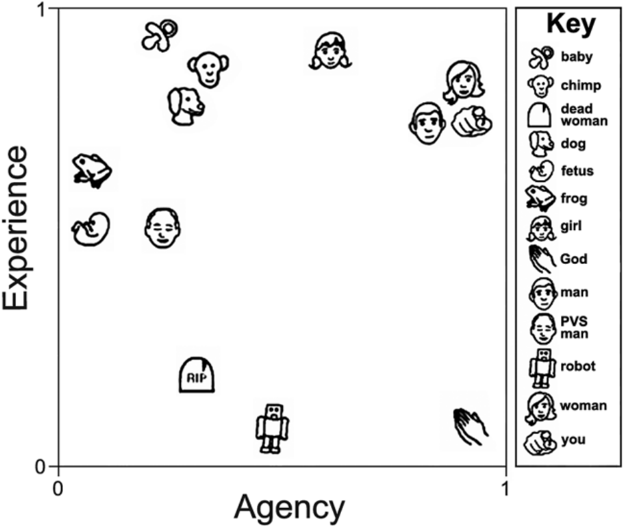
This paper argues that mind perception is not a single continuum but instead has two dimensions: Experience and Agency. Using 2,399 completed web-based surveys, the authors found that these dimensions explain how people judge minds across 13 characters and are differentially related to moral judgments.
## Key findings
- A principal components factor analysis of correlations among 18 mental capacities yielded two factors with eigenvalues over 1.0: Experience (eigenvalue 15.85, explaining 88% of variance) and Agency (eigenvalue 1.46, explaining 8% of variance); the rotated solution explained 97% of rating variance.
- Experience loaded on 11 capacities: hunger, fear, pain, pleasure, rage, desire, personality, consciousness, pride, embarrassment, and joy; Agency loaded on 7 capacities: self-control, morality, memory, emotion recognition, planning, communication, and thought.
- Personal judgments tracked the dimensions differently: liking, saving from destruction, making happy, and perceiving a soul correlated with both dimensions, with r ranging from 0.38 to 0.72.
- Punishment judgments correlated more with Agency than Experience (r = 0.82 vs. r = 0.22, z = 2.86, P < 0.05), while avoidance of harm correlated more with Experience than Agency (r = 0.85 vs. r = 0.26, z = 2.10, P < 0.05).
## Methods
- Web-based Mind Survey design: respondents saw pairwise comparisons of 13 characters across 18 mental capacities or 6 personal judgments, using five-point scales for 78 comparisons per survey.
- Sample: about 3,400 survey launches, with 2,399 completed surveys analyzed; respondents ranged from 12 to 75 years old (mean 30.44, SD 12.27) and were 64% female.
- Main analysis: character means were computed, correlations across capacities were submitted to principal components factor analysis with varimax rotation, and factor scores were estimated via regression; additional analyses examined correlations with personal judgments and individual-difference variables using z-statistics.
## Limitations
- The paper states that the surveys were largely independent and that respondent data came from web recruitment through other psychology sites, which makes the sample a convenience sample rather than a random population sample.
- Evident from the text: the factor structure is based on self-selected web respondents and on pairwise judgments of preselected characters and capacities, so generalizability beyond the survey context is not directly tested.
- The paper notes that about 25% of launched surveys were not completed, indicating noncompletion/missing-data attrition.
Model-written summary. Check it against the paper before relying on it.
Integrity signals
Registry
Cites
Statistics
Figures
Verification
Claims the paper makes
0 Valid · 0 Not valid · 0 Not checked · 18 Own results and interpretations
A result the paper reports from its own data — it cites no other source for it, so there is none to check. The quote shows it is in the paper.
In the paper
“Characters ' factor scores on these dimensions (Fig. 1) reveal interesting features; for example, God was perceived as having much Agency but little Experience.”
- Also stated in: § Dimensions of Mind Perception · plain
“for example, God was perceived as having much Agency but little Experience.”
plain- Asserted: passes — The authors put it forward as true.
- Checkable: passes — It can be checked against evidence.
- Load-bearing: unclear — It is unclear whether the paper’s conclusions depend on it.
- Based: passes — The paper gives a reason why it holds.
- Also stated in: § Dimensions of Mind Perception · plain
A result the paper reports from its own data — it cites no other source for it, so there is none to check. The quote shows it is in the paper.
In the paper
“A factor we termed Experience (eigenvalue = 15.85) accounted for 88% of the variance and included 11 capacities (from highest loading): hunger, fear, pain, pleasure, rage, desire, personality, consciousness, pride, embarrassment, and joy.”
plain- Asserted: passes — The authors put it forward as true.
- Checkable: passes — It can be checked against evidence.
- Load-bearing: passes — The paper’s conclusions depend on it.
- Based: passes — The paper gives a reason why it holds.
A result the paper reports from its own data — it cites no other source for it, so there is none to check. The quote shows it is in the paper.
In the paper
“Of 234 z -statistics (13 characters × 9 individual difference variables × 2 factors), 23 were statistically significant.”
plain- Asserted: passes — The authors put it forward as true.
- Checkable: passes — It can be checked against evidence.
- Load-bearing: unclear — It is unclear whether the paper’s conclusions depend on it.
- Based: passes — The paper gives a reason why it holds.
A result the paper reports from its own data — it cites no other source for it, so there is none to check. The quote shows it is in the paper.
In the paper
“whereas desire to avoid harming ( ' If you were forced to harm one of these characters, which one would it be more painful for you to harm? ' ) correlated more with Experience ( r = 0.85) than Agency ( r = 0.26, z = 2.10, P < 0.05).”
plainstates an association- Asserted: passes — The authors put it forward as true.
- Checkable: passes — It can be checked against evidence.
- Load-bearing: passes — The paper’s conclusions depend on it.
- Based: passes — The paper gives a reason why it holds.
A result the paper reports from its own data — it cites no other source for it, so there is none to check. The quote shows it is in the paper.
In the paper
“The rotated solution accounted for all 18 capacities (extraction communalities ranged from 0.82 to 0.99), explained 97% of rating variance, and yielded two factors with eigenvalues over 1.0.”
plainstates an association- Asserted: passes — The authors put it forward as true.
- Checkable: passes — It can be checked against evidence.
- Load-bearing: passes — The paper’s conclusions depend on it.
- Based: passes — The paper gives a reason why it holds.
5 more claims
Create a free account to see all 18 claims and every source verdict.
- It may state two separate claims as one. 8
- Probably not a substantial claim. 1
Claims other papers make about this one
Each is checked against this paper’s own text: does it say what the citing paper says it does?
The source backs part of the claim, not all of it — or backs it for a different population, condition or comparison.
In the citing paper
“People also anthropomorphize a range of inanimate objects and animals (Kwan & Fiske, 2008; Gray, Gray, & Wegner, 2007).”
From Dehumanized Perception: A Psychological Means to Facilitate Atrocities, Torture, and Genocide? (2011) · cites this paper as Gray, Gray, & Wegner, 2007
Experimental — accuracy not yet measuredThe source backs part of the claim, not all of it — or backs it for a different population, condition or comparison.
In the citing paper
“work in social psychology has demonstrated that mental state attribution is not a unitary concept, but rather involves distinct and independent dimensions of ‘intelligence’ and ‘experience’.”
From The influence of mental state attributions on trust in large language models (2025) · cites this paper as [19]
Experimental — accuracy not yet measuredThe source backs part of the claim, not all of it — or backs it for a different population, condition or comparison.
In the citing paper
“Participants’ ratings for each of the 65 traits (Supplementary Fig. S1a) were reduced via a principal component analysis to two main dimensions, which together explained 58% of the variance (Supplementary Fig. S1b) and mapped onto previously identified dimensions of ‘experience’ (e.g. experiencing pleasure or feeling fearful) and ‘intelligence’ (e.g. knowing things or making choices; Gray et al. 2”
From Folk psychological attributions of consciousness to large language models (2024) · cites this paper as Gray et al. 2007
Experimental — accuracy not yet measuredThe cited source says what the claim attributes to it.
In the citing paper
“This dissociation is supported by factor analyses of ratings of a variety of mental states, which reveal two fundamental factors: agency, or the capacity for high-level reasoning and planning, and experience, or the capacity for sensations and emotions19”
From The influence of mental state attributions on trust in large language models (2025) · cites this paper as [19]
The cited source says what the claim attributes to it.
In the citing paper
“Other work has systematically explored the dimensions underlying mental state attributions to various agents, revealing a two-dimensional structure distinguishing between ‘Experience’ (i.e. the capacity to feel pain, fear, joy, or pride) and ‘Agency’ (i.e. the capacity to have self-control, morality, planning, or communication) that is reminiscent of the distinction between phenomenal and non-phen”
From Folk psychological attributions of consciousness to large language models (2024) · cites this paper as Gray et al. 2007
Statistics recomputed
Every reported test result, recomputed from its test statistic and degrees of freedom. A result shows as not adding up only once an independent check has confirmed it.
- Consistentz = 2.86reported p < .05 · recomputed p = .004
“z = 2.86, p < .05”
- Consistentz = 2.1reported p < .05 · recomputed p = .036
“z = 2.10, p < .05”
Self-check
Percentages, sums and reported differences re-computed from the paper’s own numbers.
Self-check results appear here once an independent check has confirmed them.
Citations
Cites
I.—COMPUTING MACHINERY AND INTELLIGENCE
TURING, A. M. (1950) · Mind · doi:10.1093/mind/lix.236.433 · Cited by 10,290
Does the chimpanzee have a theory of mind?
Premack, D., & Woodruff, G. (1978) · Behavioral and Brain Sciences · doi:10.1017/s0140525x00076512 · Cited by 8,743
Mindblindness: An Essay on Autism and Theory of Mind
Baron-Cohen, S. (1995) · doi:10.7551/mitpress/4635.001.0001 · Cited by 3,428
Dennett, D. C. (1996) · Medical Entomology and Zoology · Cited by 314
Research works printed but not linked: 1
- A. Turing, Mind59, 433 (1950).
Cited by
Items 301–400 of 2,340
Minding the Gap: Narrative Descriptions about Mental States Attenuate Parochial Empathy
Bruneau, E., Cikara, M., & Saxe, R. R. (2015) · PLoS ONE · doi:10.1371/journal.pone.0140838 · Cited by 82
“Specifically, prior social cognition research has shown that a key component of being viewed as human is being endowed with a mind [12, 13].”
BackgroundThe happy virtual agent and its impact on the human customer in the service encounter
Soderlund, M., Oikarinen, E.-L., & Tan, T. M. (2021) · Journal of Retailing and Consumer Services · doi:10.1016/j.jretconser.2020.102401 · Cited by 76
“One central aspect of being human is the capability to experience emotions (Gray et al., 2007; Haslam and Bain, 2007; Haslam et al., 2008), but few contemporary VAs have this capability.”
BackgroundYoung children perceive less humanness in outgroup faces
Mcloughlin, N. C., Tipper, S. P., & Over, H. (2017) · Developmental Science · doi:10.1111/desc.12539 · Cited by 86
I, Robot: How Human Appearance and Mind Attribution Relate to the Perceived Danger of Robots
Müller, B. C. N., Gao, X., Nijssen, S. R. R., & Damen, T. G. E. (2020) · International Journal of Social Robotics · doi:10.1007/s12369-020-00663-8 · Cited by 93
Leite, A. C., Dhont, K., & Hodson, G. (2018) · European Journal of Social Psychology · doi:10.1002/ejsp.2497 · Cited by 87
Large, D. R., Harrington, K., Burnett, G., Luton, J., Thomas, P., & Bennett, P. (2019) · Proceedings of the 11th International Conference on Automotive User Interfaces and Interactive Vehicular Applications · doi:10.1145/3342197.3344545 · Cited by 74
“…is not simply the titivation of artefacts with superficial human features and characteristics, but rather the process of inductive inference whereby people are inspired to believe (at some level) that the artefact has capacity for rational thought (agency) and conscious feeling (experience) [31].”
BackgroundBuffer bots: The role of virtual service agents in mitigating negative effects when service fails
Sands, S., Campbell, C., Plangger, K., & Pitt, L. (2022) · Psychology & Marketing · doi:10.1002/mar.21723 · Cited by 74
Morality takes two: Dyadic morality and mind perception.
Gray, K. J., & Wegner, D. M. (2011) · American Psychological Association eBooks · doi:10.1037/13091-006 · Cited by 90
Self-citationAn experimental psychological perspective on social robotics
Eyssel, F. (2016) · Robotics and Autonomous Systems · doi:10.1016/j.robot.2016.08.029 · Cited by 86
Solving the (Real) Other Minds Problem
Epley, N. (2008) · Social and Personality Psychology Compass · doi:10.1111/j.1751-9004.2008.00115.x · Cited by 93
Facing humanness: facial width-to-height ratio predicts ascriptions of humanity.
Deska, J. C., Lloyd, E. P., & Hugenberg, K. (2018) · Journal of Personality and Social Psychology · doi:10.1037/pspi0000110 · Cited by 71
The stigma of perceived irrelevance: An affordance-management theory of interpersonal invisibility.
Neel, R., & Lassetter, B. (2019) · Psychological Review · doi:10.1037/rev0000143 · Cited by 85
Robots as Mirrors of the Human Mind
Wykowska, A. (2021) · Current Directions in Psychological Science · doi:10.1177/0963721420978609 · Cited by 79
“Several authors empirically addressed the issue of attribution of mind to various entities (e.g., Gray et al., 2007) or, more specifically, mental states to artificial agents (e.g., Chaminade et al., 2012; Thellman et al., 2017).”
BackgroundCommonsense concepts of phenomenal consciousness: does anyone care about functional zombies?
Huebner, B. (2010) · Phenomenology and the Cognitive Sciences · doi:10.1007/s11097-009-9126-6 · Cited by 72
“Fortunately, a number of recent studies (Arico 2007; Arico et al. submitted; Gray et al., 2007; Haslam et al., 2008; Huebner et al. 2009; Knobe and Prinz 2008; Sytsma and Machery, submitted) demonstrate that ascriptions of belief are ascribed to a wide variety of entities including humans,…”
BackgroundMethodInfluentialThe science of belief: A progress report
Porot, N., & Mandelbaum, E. (2020) · Wiley Interdisciplinary Reviews Cognitive Science · doi:10.1002/wcs.1539 · Cited by 108
Man up and take it: Gender bias in moral typecasting
Reynolds, T. A., Howard, C., Sjåstad, H., Zhu, L. L., Okimoto, T. G., Baumeister, R. F., Aquino, K. F., & Kim, J. (2020) · Organizational Behavior and Human Decision Processes · doi:10.1016/j.obhdp.2020.05.002 · Cited by 96
Do Robo-Advisors Make Us Better Investors?
Back, C., Morana, S., & Spann, M. (2021) · Journal of Behavioral and Experimental Economics · doi:10.1016/j.socec.2023.101984 · Cited by 108
Communicating climate science: The role of perceived communicator’s motives
Rabinovich, A., Morton, T. A., & Birney, M. E. (2011) · Journal of Environmental Psychology · doi:10.1016/j.jenvp.2011.09.002 · Cited by 91
Spontaneous Perspective Taking Toward Robots: The Unique Impact of Humanlike Appearance
Zhao, X., & Malle, B. F. (2019) · Cognition · doi:10.1016/j.cognition.2022.105076 · Cited by 76
The Link Between Self-Dehumanization and Immoral Behavior
Kouchaki, M., Dobson, K. S. H., Waytz, A. G., & Kteily, N. (2018) · Psychological Science · doi:10.1177/0956797618760784 · Cited by 75
Developing Self-Awareness in Robots via Inner Speech
Chella, A., Pipitone, A., Morin, A., & Racy, F. (2020) · Frontiers in Robotics and AI · doi:10.3389/frobt.2020.00016 · Cited by 68
“…views of what the aforementioned concepts constitute, as well as different suggestions on how to implement them in artificial agents (see among others, Tononi and Edelman, 1998; Gray et al., 2007; Seth, 2010; Edlund et al., 2011; Oizumi et al., 2014; Tononi et al., 2016; Juel et al., 2019).”
BackgroundBaldissarri, C., & Andrighetto, L. (2021) · Human Performance · doi:10.1080/08959285.2021.1878182 · Cited by 80
Assumptions About Algorithms’ Capacity for Discrimination
Jago, A. S., & Laurin, K. (2021) · Personality and Social Psychology Bulletin · doi:10.1177/01461672211016187 · Cited by 54
“Although people may judge algorithms as relatively agentic and unemotional (Gray et al., 2007), making salient direct, unambiguous information about how algorithms learn from human judgments might give them the opportunity to instead reflect on their potential for replicating human bias.”
BackgroundSpatola, N., Marchesi, S., & Wykowska, A. (2022) · Frontiers in Robotics and AI · doi:10.3389/frobt.2022.863319 · Cited by 93
“Interestingly, in HRI, individuals differ in the extent they attribute mentalistic/ mechanistic properties to understand robot actions (Gray et al., 2007).”
BackgroundDehumanization and the lack of social connection
Haslam, N. (2021) · Current Opinion in Psychology · doi:10.1016/j.copsyc.2021.08.013 · Cited by 69
Social robots as depictions of social agents
Clark, H. H., & Fischer, K. (2022) · Behavioral and Brain Sciences · doi:10.1017/s0140525x22000668 · Cited by 126
Service robots and hotel guests’ perceptions: anthropomorphism and stereotypes
Song, X., Li, Y., Leung, X. Y., & Mei, D. (2023) · Tourism Review · doi:10.1108/tr-04-2023-0265 · Cited by 78
The Eyes Are the Windows to the Mind: Direct Eye Gaze Triggers the Ascription of Others’ Minds
Khalid, S., Deska, J. C., & Hugenberg, K. (2016) · Personality and Social Psychology Bulletin · doi:10.1177/0146167216669124 · Cited by 77
“In Studies 1a and 1b, participants viewed a series of human faces displaying direct or averted eye gaze and rated their perceived agentic and experiential capacities using a measure adapted from the literature on mind perception (Gray et al., 2007).”
BackgroundMethodInfluentialMentalizing during social InterAction: A four component model
Wu, H., Liu, X., Hagan, C. C., & Mobbs, D. (2020) · Cortex · doi:10.1016/j.cortex.2019.12.031 · Cited by 87
Children’s perceptions of the moral worth of live agents, robots, and inanimate objects
Sommer, K., Nielsen, M., Draheim, M., Redshaw, J., Vanman, E. J., & Wilks, M. (2019) · Journal of Experimental Child Psychology · doi:10.1016/j.jecp.2019.06.009 · Cited by 72
Counteracting dark sides of robo-advisors: justice, privacy and intrusion considerations
Aw, E. C., Leong, L.-Y., Hew, J.-J., Rana, N. P., Tan, T. M., & Jee, T. W. (2023) · International Journal of Bank Marketing · doi:10.1108/ijbm-10-2022-0439 · Cited by 88
Dimensions of anthropomorphism: from humanness to humanlikeness
Złotowski, J., Strasser, E., & Bartneck, C. (2014) · Proceedings of the 2014 ACM/IEEE international conference on Human-robot interaction · doi:10.1145/2559636.2559679 · Cited by 67
“[9] found that the mind perception of human and nonhuman agents was explained by two factors: Agency and Experience.”
BackgroundMoradbakhti, L., Schreibelmayr, S., & Mara, M. (2022) · Frontiers in Psychology · doi:10.3389/fpsyg.2022.855091 · Cited by 67
“Agency refers to the (perceived) capacity for self-control of an AI assistant (e.g., Gray et al., 2007).”
BackgroundA neurocognitive investigation of the impact of socializing with a robot on empathy for pain
Cross, E. S., Riddoch, K., Pratts, J., Titone, S., Chaudhury, B., & Hortensius, R. (2019) · Philosophical Transactions of the Royal Society B Biological Sciences · doi:10.1098/rstb.2018.0034 · Cited by 76
Anthropomorphic brand management: An integrated review and research agenda
Sharma, M. P., & Rahman, Z. (2022) · Journal of Business Research · doi:10.1016/j.jbusres.2022.05.039 · Cited by 92
The Age of Em: Work, Love, and Life when Robots Rule the Earth
Hanson, R. (2016) · doi:10.1093/oso/9780198754626.001.0001 · Cited by 210
Ideological Differences in the Expanse of Empathy
Waytz, A. G., Iyer, R., Young, L., & Graham, J. (2016) · Routledge eBooks · doi:10.4324/9781315644387-4 · Cited by 73
Untangling the Animacy Organization of Occipitotemporal Cortex
Ritchie, J. B., Zeman, A. A., Bosmans, J., Sun, S., Verhaegen, K. A., & de Beeck, H. O. (2021) · Journal of Neuroscience · doi:10.1523/jneurosci.2628-20.2021 · Cited by 76
Metaperception benefits of service robots in uncomfortable service encounters
Pitardi, V., Wirtz, J., Paluch, S., & Kunz, W. H. (2024) · Tourism Management · doi:10.1016/j.tourman.2024.104939 · Cited by 87
That uncanny valley of mind: when anthropomorphic AI agents disrupt personalized advertising
Kim, W., Ryoo, Y., & Choi, Y. K. (2024) · International Journal of Advertising · doi:10.1080/02650487.2024.2411669 · Cited by 94
Agency's Role in Dehumanization: Non‐human Metaphors of Out‐groups
Tipler, C. N., & Ruscher, J. B. (2014) · Social and Personality Psychology Compass · doi:10.1111/spc3.12100 · Cited by 80
Wang, Y., & Quadflieg, S. (2015) · Social Cognitive and Affective Neuroscience · doi:10.1093/scan/nsv043 · Cited by 77
“This neural difference has been argued to reflect perceivers’ divergent outlooks on robots and people, with the former being generally expected to lack agency and inner experience (Gray et al., 2007).”
BackgroundInfluentialPerceiving the agency of harmful agents: A test of dehumanization versus moral typecasting accounts
Khamitov, M., Rotman, J., & Piazza, J. R. (2015) · Cognition · doi:10.1016/j.cognition.2015.09.009 · Cited by 77
Artificial intelligence and moral dilemmas: Perception of ethical decision-making in AI
Zhang, Z., Chen, Z., & Xu, L. (2022) · Journal of Experimental Social Psychology · doi:10.1016/j.jesp.2022.104327 · Cited by 93
Generative AIPreprint
Feuerriegel, S., Hartmann, J., Janiesch, C., & Zschech, P. (2023) · SSRN Electronic Journal · doi:10.2139/ssrn.4443189 · Cited by 65
Schiller, D., Yu, A. N. C., Alia‐Klein, N., Becker, S., Cromwell, H. C., Dolcos, F., Eslinger, P. J., Frewen, P., Kemp, A. H., Pace-Schott, E. F., et al. (2023) · Neuroscience & Biobehavioral Reviews · doi:10.1016/j.neubiorev.2023.105450 · Cited by 101
Teammates first: Favoring ingroup robots over outgroup humans
Fraune, M. R., Šabanović, S., & Smith, E. R. (2017) · IEEE RO-MAN · doi:10.1109/roman.2017.8172492 · Cited by 76
“Because people typically consider robots to have low experience [21, 22], they indicate that robots deserve fewer moral rights than humans [23] and that it is worse to violate moral responsibility towards humans than robots [24].”
BackgroundDiniz, E., Castro, P., Bousfield, A., & Figueira Bernardes, S. (2020) · British Journal of Health Psychology · doi:10.1111/bjhp.12399 · Cited by 62
“Towards a comprehensive taxonomy of dehumanization: Integrating two senses of humanness, Mind Perception Theory, and Stereotype Content Model.”
BackgroundMethodInfluentialImplicit theories of the human mind predict competitive and cooperative responses to AI robots
Dang, J., & Liu, L. (2022) · Computers in Human Behavior · doi:10.1016/j.chb.2022.107300 · Cited by 83
Jin, J., Walker, J., & Reczek, R. W. (2024) · Journal of Consumer Psychology · doi:10.1002/jcpy.1414 · Cited by 78
People Do Not Feel Guilty About Exploiting Machines
Melo, C. D., Marsella, S., & Gratch, J. (2016) · ACM Transactions on Computer-Human Interaction · doi:10.1145/2890495 · Cited by 61
“These findings are compatible with research that shows that people perceive less mind in machines than in humans [Gray et al. 2007; Waytz et al. 2010].”
BackgroundResultLefkeli, D., Karataş, M., & Gürhan-Canli, Z. (2024) · International Journal of Research in Marketing · doi:10.1016/j.ijresmar.2023.08.011 · Cited by 62
“Sorry, it was my fault”: Repairing trust in human-robot interactions
Zhang, X., Lee, S. K., Kim, W., & Hahn, S. (2023) · International Journal of Human-Computer Studies · doi:10.1016/j.ijhcs.2023.103031 · Cited by 62
Yao, Q., Kuai, L., & Jiang, L. (2023) · Journal of Research in Interactive Marketing · doi:10.1108/jrim-06-2022-0164 · Cited by 79
Li, Y., Zhou, X., Jiang, X., Fan, F., & Song, B. (2024) · International Journal of Contemporary Hospitality Management · doi:10.1108/ijchm-06-2023-0845 · Cited by 75
The Face of Humanity: Configural Face Processing Influences Ascriptions of Humanness
Hugenberg, K., Young, S. G., Rydell, R. J., Almaraz, S. M., Stanko, K. A., See, P. E., & Wilson, J. P. (2015) · Social Psychological and Personality Science · doi:10.1177/1948550615609734 · Cited by 73
Orlowski, M., Bufquin, D., & Nalley, M. E. (2020) · Cornell Hospitality Quarterly · doi:10.1177/1938965520910119 · Cited by 76
“Interestingly, these three traits are associated with humanness perceptions (Gray et al., 2007; Harris & Fiske, 2009; Haslam, 2006).”
BackgroundBartneck, C., Belpaeme, T., Eyssel, F., Kanda, T., Keijsers, M., & Šabanović, S. (2020) · Cambridge University Press eBooks · doi:10.1017/9781108676649.006 · Cited by 61
Predicting the moral consideration of artificial intelligences
Pauketat, J. V. T., & Anthis, J. R. (2022) · Computers in Human Behavior · doi:10.1016/j.chb.2022.107372 · Cited by 60
The Problem with Morality: Impeding Progress and Increasing Divides
Kovacheff, C., Schwartz, S., Inbar, Y., & Feinberg, M. (2018) · Social Issues and Policy Review · doi:10.1111/sipr.12045 · Cited by 69
Psychedelics and Consciousness: Distinctions, Demarcations, and Opportunities
Yaden, D. B., Johnson, M. W., Griffiths, R. R., Doss, M. K., Garcia‐Romeu, A., Nayak, S. M., Gukasyan, N., Mathur, B. N., & Barrett, F. S. (2021) · The International Journal of Neuropsychopharmacology · doi:10.1093/ijnp/pyab026 · Cited by 76
“Changes to cognitive modules related to mind perception (Gray et al., 2007), which involves the attribution of the capacity for experience and agency to entities/ objects, during some altered states of consciousness may also impact one’s beliefs related to what else (other than human beings) has phenomenal consciousne…”
BackgroundOn the realness of people who do not exist: The social processing of artificial faces
Tucciarelli, R., Vehar, N., Chandaria, S., & Tsakiris, M. (2022) · iScience · doi:10.1016/j.isci.2022.105441 · Cited by 57
Threatening Flocks and Mindful Snowflakes
Fraune, M. R., 裕作, 西., Šabanović, S., Smith, E. R., & Okada, M. (2017) · ACM/IEEE International Conference on Human-Robot Interaction (HRI) · doi:10.1145/2909824.3020248 · Cited by 61
“Robots are often perceived to have low mind compared to humans [29].”
BackgroundPredicting human behavior toward members of different social groups
Jenkins, A. C., Karashchuk, P., Zhu, L., & Hsu, M. (2018) · Proceedings of the National Academy of Sciences · doi:10.1073/pnas.1719452115 · Cited by 58
“Little is known about the predictive value of measures beyond warmth and competence, including those drawn from other social perception frameworks (18, 19) or as captured by implicit measures (39), or about how these effects vary across individuals and cultures (27).”
BackgroundResultXu, Y., Zhang, J., Chi, R., & Deng, G. (2023) · Nankai Business Review International · doi:10.1108/nbri-06-2021-0041 · Cited by 58
Yang, D., Zhang, J., Sun, Y., & Huang, Z. (2024) · Journal of Retailing and Consumer Services · doi:10.1016/j.jretconser.2024.103859 · Cited by 76
Schroeder, J., Waytz, A. G., & Epley, N. (2017) · Journal of Experimental Psychology General · doi:10.1037/xge0000320 · Cited by 68
Roberts, S. O., Weisman, K., Lane, J. D., Williams, A. D., Camp, N. P., Wang, M., Robison, M., Sanchez, K., & Griffiths, C. M. (2020) · Journal of Personality and Social Psychology · doi:10.1037/pspi0000233 · Cited by 60
Broadbent, E., Peri, K., Kerse, N., Jayawardena, C., Kuo, I., Datta, C., & MacDonald, B. (2014) · Lecture Notes in Computer Science · doi:10.1007/978-3-319-11973-1_7 · Cited by 60
Humanizing machines: Anthropomorphization of slot machines increases gambling.
Riva, P., Sacchi, S., & Brambilla, M. (2015) · Journal of Experimental Psychology Applied · doi:10.1037/xap0000057 · Cited by 70
I saw it on YouTube! How online videos shape perceptions of mind, morality, and fears about robots
Küster, D., Swiderska, A., & Gunkel, D. (2021) · New Media & Society · doi:10.1177/1461444820954199 · Cited by 56
“The ascription of these roles in a moral interaction is in turn associated with moral judgment—malevolent agents are seen to be deserving of punishment, while patients are entitled to protection (Gray et al., 2007).”
BackgroundResultInfluentialRottman, J., Crimston, C. R., & Syropoulos, S. (2021) · Cognitive Science · doi:10.1111/cogs.12967 · Cited by 69
“Prior research has found that mental capacities exist along different dimensions, such as agency and experience (Gray et al., 2007) or physiological, social-emotional, and perceptualcognitive abilities (Weisman, Dweck, & Markman, 2017).”
BackgroundBrondi, S., Pivetti, M., Battista, S. D., & Sarrica, M. (2021) · Technology in Society · doi:10.1016/j.techsoc.2021.101663 · Cited by 75
Deployment of algorithms in management tasks reduces prosocial motivation
Granulo, A., Caprioli, S., Fuchs, C., & Puntoni, S. (2023) · Computers in Human Behavior · doi:10.1016/j.chb.2023.108094 · Cited by 77
Virtual versus human: Unraveling consumer reactions to service failures through influencer types
Zhao, T., Ran, Y., Wu, B., Wang, V. L., Zhou, L., & Wang, C. L. (2024) · Journal of Business Research · doi:10.1016/j.jbusres.2024.114657 · Cited by 67
Kiilavuori, H., Sariola, V., Peltola, M. J., & Hietanen, J. K. (2020) · Biological Psychology · doi:10.1016/j.biopsycho.2020.107989 · Cited by 73
Attitudes Toward Attributed Agency: Role of Perceived Control
Zafari, S., & Koeszegi, S. T. (2020) · International Journal of Social Robotics · doi:10.1007/s12369-020-00672-7 · Cited by 71
“Mind perception has two dimensions: experience (the ability to feel emotions such as pleasure) and agency(theabilitytoactinwayssuchasself-control)[25,26].”
BackgroundAnthropomorphic God Concepts Engender Moral Judgment
Morewedge, C. K., & Clear, M. E. (2008) · Social Cognition · doi:10.1521/soco.2008.26.2.182 · Cited by 57
“People report perceiving God as an entity possessing agency as well as phenomenal experiences such as feelings and desires (Demoulin, Saroglou, & Van Pachterbeke, 2008, this issue; Gray, Gray, & Wegner, 2007; Rossano, 2006).”
BackgroundThe Phenomenal Stance Revisited
Jack, A. I., & Robbins, P. (2012) · Review of Philosophy and Psychology · doi:10.1007/s13164-012-0104-5 · Cited by 84
“With minded things, the situation is more complex, because not all attributions of mindedness are of a piece (Robbins and Jack 2006; Gray et al. 2007).”
Animal Images Database: Validation of 120 Images for Human-Animal Studies
Possidónio, C., Graça, J., Piazza, J. R., & Prada, M. (2019) · Animals · doi:10.3390/ani9080475 · Cited by 74
Wu, M., Wang, N., & Yuen, K. F. (2022) · Computers in Human Behavior · doi:10.1016/j.chb.2022.107614 · Cited by 63
The Crazyist Metaphysics of Mind
Schwitzgebel, E. (2014) · Australasian Journal of Philosophy · doi:10.1080/00048402.2014.910675 · Cited by 61
Tan, H., Zhao, Y., Li, S., Wang, W., Zhu, M., Hong, J., & Yuan, X. (2020) · Advanced Robotics · doi:10.1080/01691864.2020.1831699 · Cited by 62
Poverty and pain: Low-SES people are believed to be insensitive to pain
Summers, K. M., Deska, J. C., Almaraz, S. M., Hugenberg, K., & Lloyd, E. P. (2021) · Journal of Experimental Social Psychology · doi:10.1016/j.jesp.2021.104116 · Cited by 68
Leach, S., Piazza, J. R., Loughnan, S., Sutton, R. M., Kapantai, I., Dhont, K., & Douglas, K. M. (2022) · Appetite · doi:10.1016/j.appet.2022.105935 · Cited by 67
Lin, M., Cui, X., Wang, J., Wu, G., & Lin, J. (2022) · Journal of Hospitality Marketing & Management · doi:10.1080/19368623.2022.2062693 · Cited by 66
“One explanation is that according to mind perception theory (Gray et al., 2007), LARs are more appropriate for engaging in mechanical tasks than MARs.”
BackgroundInfluentialBernard, P., Gervais, S. J., Allen, J. M., Delmée, A., & Klein, O. (2015) · Psychology of Women Quarterly · doi:10.1177/0361684315580125 · Cited by 69
Distinct neural patterns of social cognition for cooperation versus competition
Tsoi, L., Dungan, J. A., Waytz, A. G., & Young, L. (2016) · NeuroImage · doi:10.1016/j.neuroimage.2016.04.069 · Cited by 62
“…that these two different types of motivation lead to preferential focus on two different dimensions of mind perception (Waytz and Young, 2014): agency (i.e., capacity for planning, thinking, intending) and experience (i.e., capacity for emotion, feeling) (Gray et al., 2007; Gray andWegner, 2009).”
BackgroundZhu, H., Wong, N., & Huang, M. (2018) · Journal of Business Research · doi:10.1016/j.jbusres.2018.10.008 · Cited by 63
Assistive robots for socialization in elderly people: results pertaining to the needs of the users
D’Onofrio, G., Fiorini, L., Hoshino, H., Matsumori, A., Okabe, Y., Tsukamoto, M., Limosani, R., Vitanza, A., Greco, F., Greco, A., et al. (2018) · Aging Clinical and Experimental Research · doi:10.1007/s40520-018-1073-z · Cited by 63
Under Pressure: Examining Social Conformity With Computer and Robot Groups
Hertz, N., & Wiese, E. (2018) · Human Factors The Journal of the Human Factors and Ergonomics Society · doi:10.1177/0018720818788473 · Cited by 69
“…conformist behavior based on expertise (i.e., informational) rather than social approval (i.e., normative) would be in line with observations by Gray, Gray, and Wegner (2007), who showed that although robots are ascribed the general ability to plan (i.e., agency), they are denied the ability…”
ResultThe theory of mind and human–robot trust repair
Esterwood, C. T., & Robert, L. (2023) · Scientific Reports · doi:10.1038/s41598-023-37032-0 · Cited by 72
“Intentional agency – sometimes referred to as agentic mind 51 – relates to the perception that an agent has the capacity to engage in goal-directed behavior, reasoned action, self-control, learning, and, strategic planning 42,49,50 .”
BackgroundInfluentialKim, H., & McGill, A. L. (2024) · Journal of Consumer Psychology · doi:10.1002/jcpy.1441 · Cited by 94
Tan, K. P.-S., Liu, Y. V., & Litvin, S. W. (2024) · Tourism Management · doi:10.1016/j.tourman.2024.105057 · Cited by 69
We perceive a mind in a robot when we help it
Tanibe, T., Hashimoto, T., & Karasawa, K. (2017) · PLOS ONE · doi:10.1371/journal.pone.0180952 · Cited by 53
Power and decision making: new directions for research in the age of artificial intelligence
Fast, N. J., & Schroeder, J. (2019) · Current Opinion in Psychology · doi:10.1016/j.copsyc.2019.07.039 · Cited by 69
Military veterans are morally typecast as agentic but unfeeling: Implications for veteran employment
Shepherd, S., Kay, A. C., & Gray, K. J. (2019) · Organizational Behavior and Human Decision Processes · doi:10.1016/j.obhdp.2019.06.003 · Cited by 58
Self-citationParental Acceptance of Children’s Storytelling Robots: A Projection of the Uncanny Valley of AI
Lin, C., Šabanović, S., Dombrowski, L. S., Miller, A., Brady, E. L., & MacDorman, K. F. (2021) · Frontiers in Robotics and AI · doi:10.3389/frobt.2021.579993 · Cited by 81
“Factors than a humanlike appearance in fl uence mind perception (Gray et al., 2007; Gray et al., 2012).”
BackgroundMind ascribed to AI and the appreciation of AI-generated art
Messingschlager, T. V., & Appel, M. (2023) · New Media & Society · doi:10.1177/14614448231200248 · Cited by 74
“Mind ascribed to the artist was measured with a German translation of the mental capacities measured by Gray et al. (2007), which were adapted to fit the topic of this study.”
InfluentialGong, X., & Sun, P. (2024) · Journal of Retailing and Consumer Services · doi:10.1016/j.jretconser.2024.104148 · Cited by 61
Metadata
- Authors
- Gray, H. M., Gray, K., & Wegner, D. M.
- Affiliations
- Harvard University (US)
- Corresponding author
- Gray, Heather M.
- Venue
- Science
- Published
- 2007-02-02
- Volume
- 315
- Issue
- 5812
- Pages
- 619-619
- ISSN
- 0036-8075 (ISSN-L)
- 1095-9203
- OpenAlex
- W2131227926
- Cited by
- 2,342
- References
- 4
- Citations by year
- 2026: 359 · 2025: 326 · 2024: 249 · 2023: 220 · 2022: 198 · 2021: 156 · 2020: 157 · 2019: 107 · 2018: 91 · 2017: 86 · 2016: 96 · 2015: 66 · 2014: 52 · 2013: 44 · 2012: 45
- FWCI
- 10.81
- Type
- journal article
- Language
- en
- Open access
- closed
- Locations
- Science (publishedVersion)
- PubMed (publishedVersion)
- Funders
- National Institutes of Health (1f31mh071053-01)
- National Institute of Mental Health (MH-71053, MH 49127, R01MH049127)
- Topics
- Life Sciences › Neuroscience › Cognitive Neuroscience › Psychology of Moral and Emotional Judgment
- Social Sciences › Psychology › Social Psychology › Social Robot Interaction and HRI
- Social Sciences › Sociology and Political Science › Social and Intergroup Psychology
- Keywords
- mind perception, moral judgment, agency, experience, non-human animals, personification, moral status of animals, self-control, hunger
- MeSH terms
- Adolescent, Adult, Aged, Child, Emotions, Female, Humans, Male, Mental Processes, Middle Aged, Morals, Perception, Personality, Principal Component Analysis
About these checks
Registry, retraction, Cites and statistics results are computed, not judged, with one exception: a printed reference that no index lists is read once by a model before it counts as a citation error. Claims are extracted by a model and kept only when their quote appears verbatim in the text; each cited source is then checked, with a model’s help, for whether it says what the claim relies on. Those verdicts can be wrong — read the claim’s quote and the cited source before relying on one.
A language model drew the claims from the paper on 2026-09-28, under version 3 of the claim definition (model deepseek-v4.1-flash, prompt extract-v3).
A second model labelled each claim on 2026-09-28 (model jev-1.13-20260917, definition revision gold-guideline-v0.2).
Statistics and arithmetic are recomputed, not judged.
Confidence bands are shown only for fields calibrated on our annotated test set. None is calibrated yet, so no band is shown.
What counts as a claim ›How we measure confidence ›How we check this ›
Are you an author, or do you see a problem with this page? Request a review
Data sources
Bibliographic data: Semantic Scholar, OpenAlex, Crossref.
Contains information from the Semantic Scholar Academic Graph Datasets, made available under the ODC Attribution License (ODC-BY 1.0).
Semantic Scholar’s data is described in: Kinney, R., et al. (2023). The Semantic Scholar Open Data Platform. arXiv:2301.10140.
