

A systematic review, meta-analysis and meta-regression of the effect of protein supplementation on resistance training-induced gains in muscle mass and strength in healthy adults
Open accessThe DOI matches its Crossref record; 89 of the 95 references it cites were found in a registry or an index; 39 of the 62 sources its claims cite were checked for support.
Abstract
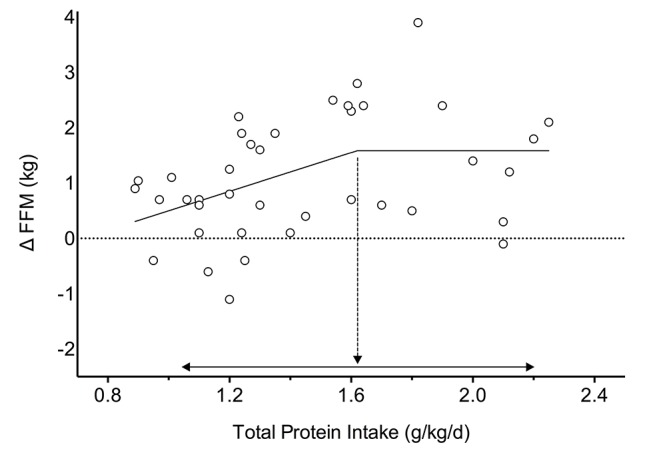
Objective We performed a systematic review, meta-analysis and meta-regression to determine if dietary protein supplementation augments resistance exercise training (RET)-induced gains in muscle mass and strength. Data sources A systematic search of Medline, Embase, CINAHL and SportDiscus. Eligibility criteria Only randomised controlled trials with RET ≥6 weeks in duration and dietary protein supplementation. Design Random-effects meta-analyses and meta-regressions with four a priori determined covariates. Two-phase break point analysis was used to determine the relationship between total protein intake and changes in fat-free mass (FFM). Results Data from 49 studies with 1863 participants showed that dietary protein supplementation significantly (all p<0.05) increased changes (means (95% CI)) in: strength—one-repetition-maximum (2.49 kg (0.64, 4.33)), FFM (0.30 kg (0.09, 0.52)) and muscle size—muscle fibre cross-sectional area (CSA; 310 µm 2 (51, 570)) and mid-femur CSA (7.2 mm 2 (0.20, 14.30)) during periods of prolonged RET. The impact of protein supplementation on gains in FFM was reduced with increasing age (−0.01 kg (−0.02,–0.00), p=0.002) and was more effective in resistance-trained individuals (0.75 kg (0.09, 1.40), p=0.03). Protein supplementation beyond total protein intakes of 1.62 g/kg/day resulted in no further RET-induced gains in FFM. Summary/conclusion Dietary protein supplementation significantly enhanced changes in muscle strength and size during prolonged RET in healthy adults. Increasing age reduces and training experience increases the efficacy of protein supplementation during RET. With protein supplementation, protein intakes at amounts greater than ~1.6 g/kg/day do not further contribute RET-induced gains in FFM.
Overview
CoChat Summary
TL;DR
Dietary protein supplementation significantly augmented resistance training-induced gains in muscle strength and fat-free mass in healthy adults, with benefits attenuated by increasing age and greater in resistance-trained individuals. Protein supplementation beyond a total intake of ~1.6 g/kg/day provided no further benefit for fat-free mass gains.
Key findings
- In 49 RCTs with 1863 participants, protein supplementation significantly increased 1RM strength by 2.49 kg (95% CI 0.64, 4.33), fat-free mass by 0.30 kg (0.09, 0.52), muscle fibre CSA by 310 µm² (51, 570), and mid-femur CSA by 7.2 mm² (0.20, 14.30); it had no significant effect on MVC (SMD 0.04, −0.09, 0.16) or total body mass (0.11 kg, −0.23, 0.46), but reduced fat mass by −0.41 kg (−0.70, −0.13).
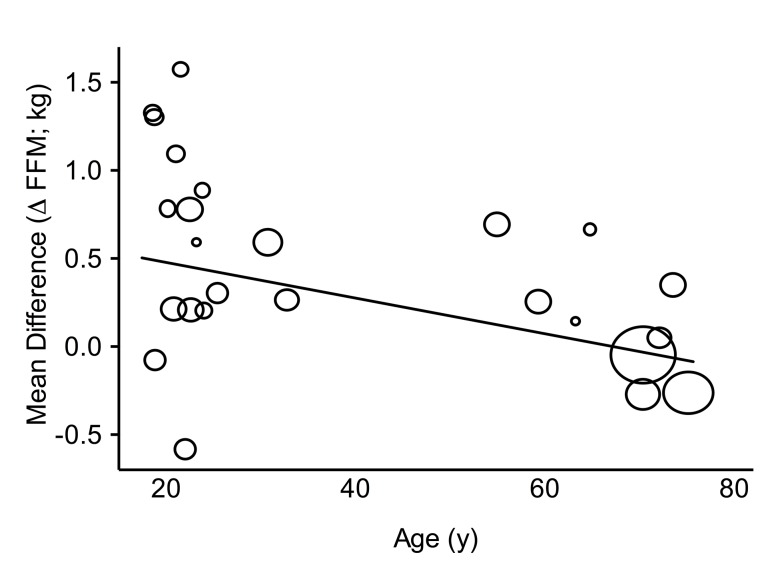
- The effect on fat-free mass was reduced with increasing age (−0.01 kg, −0.02, −0.00; p=0.002 in abstract) and greater in resistance-trained individuals (0.75 kg, 0.09, 1.40; p=0.03).
- Biphasic regression found a break point at 1.62 g/kg/day total protein intake (95% CI 1.03, 2.20), beyond which no further resistance training-induced fat-free mass gains were observed; this analysis was not statistically significant (p=0.079).
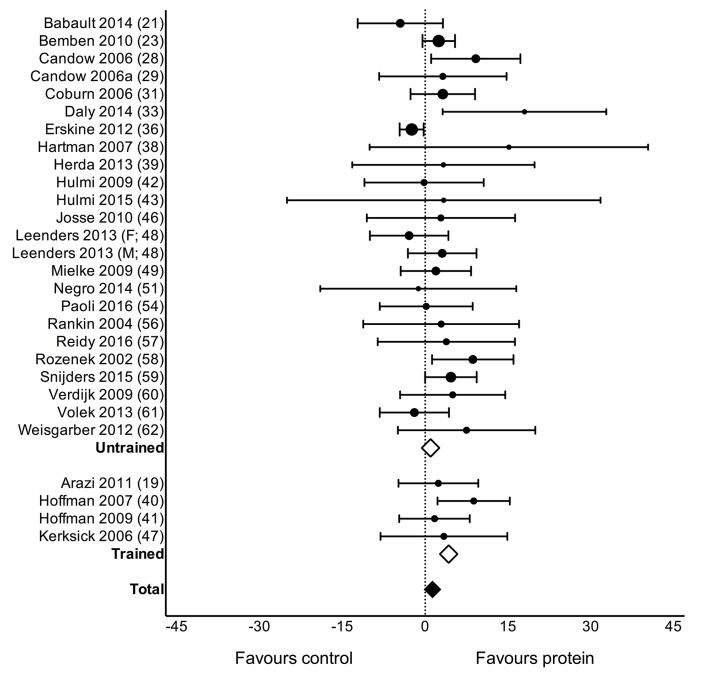
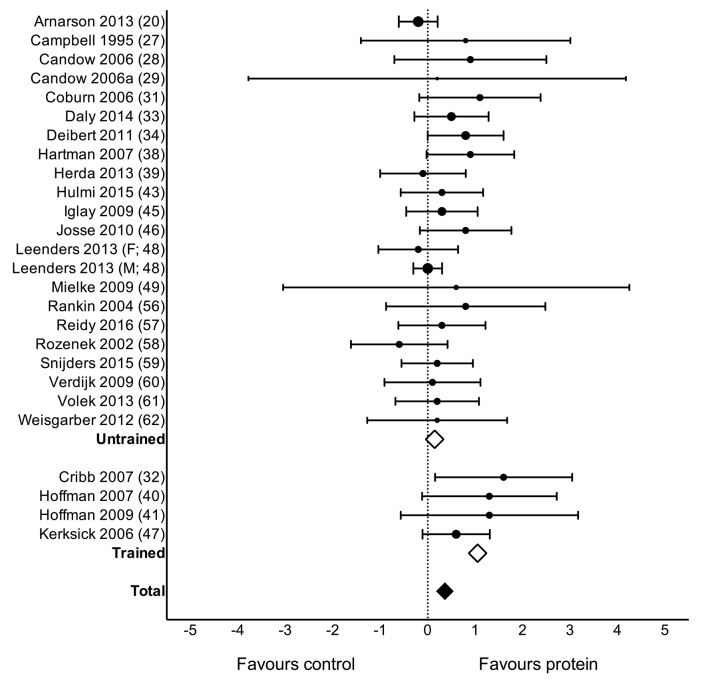
- Subgroup forest plots showed protein supplementation effects in trained participants for 1RM (4.27 kg, 0.61, 7.94) and FFM (1.05 kg, 0.61, 1.50), versus untrained 1RM (0.99 kg, −0.27, 2.25) and FFM (0.15 kg, −0.02, 0.31).
Methods
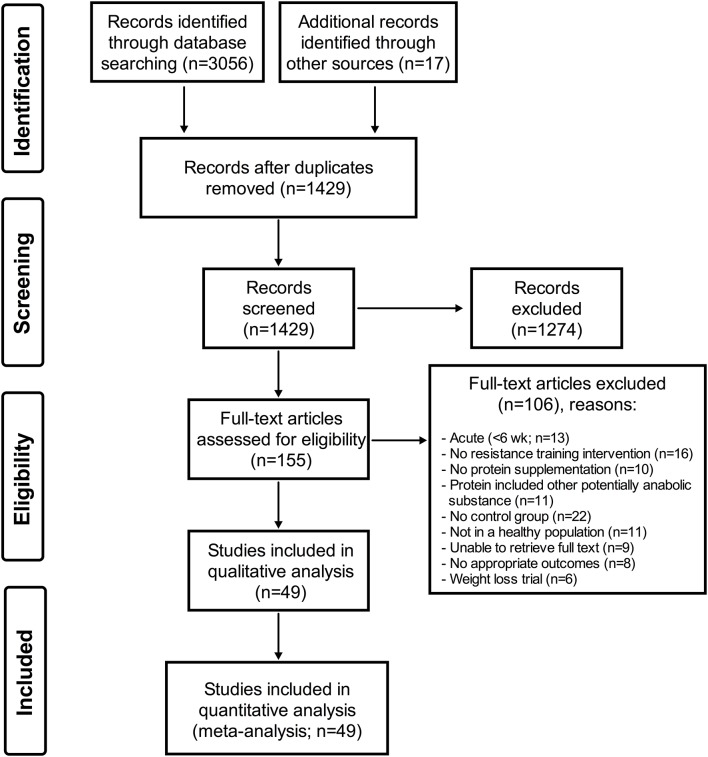
- Systematic review, random-effects meta-analysis, and meta-regression of RCTs combining resistance exercise training (RET) ≥6 weeks with dietary protein supplementation in healthy, non-energy-restricted adults; search of Medline, Embase, CINAHL, and SportDiscus current to January 2017 yielded 49 included RCTs (1863 participants, mean±SD age 35±20 years).
- Primary outcomes were amalgamated into 1RM and MVC for performance, and total body mass, fat-free mass, fat mass, muscle fibre CSA, and mid-femur CSA for body composition; effect sizes were mean differences or standardised mean differences with 95% CIs.
- Four a priori covariates were meta-regressed individually and together: baseline protein intake (g/kg/day), postexercise protein dose (g), chronological age, and training status; two-phase break point analysis examined total protein intake versus fat-free mass change.
Limitations
- The paper states that older adults were understudied: only 13 included studies were in participants >45 years, only six reported baseline protein intakes with FFM changes, only four had total protein intakes near ~1.2–1.6 g/kg/day, and only two provided a postexercise protein dose near ~35–40 g.
- The paper states that additional univariate meta-regressions were hypothesis-generating, that participants at or above energy requirements were included (omitting weight-loss contexts), and that postexercise protein dose did not affect FFM efficacy.
- Evident from the text: the break point analysis was not statistically significant (p=0.079); the fibre CSA effect was eliminated when Mitchell et al was included (153 µm², −137, 443; p=0.30); and significant heterogeneity was present for 1RM (I²=33%) and fibre CSA (I²=68%).
Model-written summary. Check it against the paper before relying on it.
Integrity signals
Registry
Cites
Statistics
Figures
Verification
Claims the paper makes
22 Valid · 2 Not valid · 12 Not checked · 78 Own results and interpretations
Some cited sources support this claim and some don’t — read each source’s verdict below.
In the paper
“The average RET-induced increase, with all measures of 1RM included, was 27 kg (mean±SD; 27±22 kg22 32).”
§ A systematic review, meta-analysis and meta-regression of the effect of protein supplementation on resistance training-induced gains in muscle mass and strength in healthy adults > Discussion > Strength
What the sources say
- Disputedcites [22] Babault N, Païzis C, Deley G, et al Pea proteins oral supplementation promotes muscle thickness gains during resistance training: a double-blind, randomized, Placebo-controlled clinical trial vs. whey protein. J Int Soc Sports Nutr 2015; 12: 3 10.1186/s12970-014-0064-5 25628520 PMC4307635 sourceExperimental — accuracy not yet measured
Table 1 (Methods > Participants – ethics statement; page unavailable) lists 27.0 ± 6.3 kg as the pea group's arm-curl 1-RM at inclusion, not an increase. Results > Muscle strength (page unavailable) reports a 12-week 1-RM increase of 46.1 ± 22.4% for the placebo group; it does not report a 27 ± 22 kg increase across all 1-RM measures. (LLM, conf=0.88)
Checked by a reasoning model — may be wrong.
- Partly supportedcites [32] Cribb PJ, Williams AD, Stathis CG, et al Effects of whey isolate, creatine, and resistance training on muscle hypertrophy. Med Sci Sports Exerc 2007; 39: 298– 307. 10.1249/01.mss.0000247002.32589.ef 17277594 sourceExperimental — accuracy not yet measured
The 1RM strength-results passage (paragraph 15; page unavailable) reports that all groups improved on bench press, pulldown and squat after resistance training. It does not report an average increase of 27 kg across the 1RM measures or the cited 27 ± 22 kg statistic. (LLM, conf=0.83)
plainstates a cause- Asserted: passes — The authors put it forward as true.
- Checkable: passes — It can be checked against evidence.
- Load-bearing: unclear — It is unclear whether the paper’s conclusions depend on it.
- Based: passes — The paper gives a reason why it holds.
- Disputed
Every source the paper cites for this claim was checked and supports it.
In the paper
“The present meta-analysis includes more than double the number of studies and participants than the largest published comprehensive meta-analysis on protein supplementation during RET to date.7ST1”
§ A systematic review, meta-analysis and meta-regression of the effect of protein supplementation on resistance training-induced gains in muscle mass and strength in healthy adults > Introduction
What the sources say
- Supportedcites [7] Cermak NM, Res PT, de Groot LC, et al Protein supplementation augments the adaptive response of skeletal muscle to resistance-type exercise training: a meta-analysis. Am J Clin Nutr 2012; 96: 1454– 64. 10.3945/ajcn.112.037556 23134885 source
The cited paper is a meta-analysis of protein supplementation during resistance-type exercise training. Its Study characteristics section reports 22 included studies, and its Subject characteristics section reports 680 participants. The sentence uses it as the earlier meta-analysis for comparison; the claim about the citing authors’ own larger analysis is not a finding attributed to this source. (LLM, conf=0.88)
plain- Asserted: passes — The authors put it forward as true.
- Checkable: passes — It can be checked against evidence.
- Load-bearing: unclear — It is unclear whether the paper’s conclusions depend on it.
- Based: passes — The paper gives a reason why it holds.
- Supported
The cited sources support only part of this claim — read each source’s verdict below.
In the paper
“This lack of agreement on the efficacy of protein supplementation6–12 is likely due to the use of divergent study inclusion criteria and inclusion of subjects with differing: ages, training statuses, total protein intakes, protein sources and protein doses.”
§ A systematic review, meta-analysis and meta-regression of the effect of protein supplementation on resistance training-induced gains in muscle mass and strength in healthy adults > Introduction
What the sources say
- Partly supportedcites [6] Schoenfeld BJ, Aragon AA, Krieger JW The effect of protein timing on muscle strength and hypertrophy: a meta-analysis. J Int Soc Sports Nutr 2013; 10: 53 10.1186/1550-2783-10-53 24299050 PMC3879660 sourceExperimental — accuracy not yet measured
The Background (page unavailable) says mixed findings on protein timing are difficult to interpret because studies differ in age, training status, protein intake and essential-amino-acid supplementation. The Methodology (page unavailable) also shows variation in protein sources and doses. The paper does not, however, identify divergent inclusion criteria or differences in protein sources as reasons for disagreement about the efficacy of protein supplementation generally; its discussion concerns protein timing. (LLM, conf=0.83)
- Partly supportedcites [7] Cermak NM, Res PT, de Groot LC, et al Protein supplementation augments the adaptive response of skeletal muscle to resistance-type exercise training: a meta-analysis. Am J Clin Nutr 2012; 96: 1454– 64. 10.3945/ajcn.112.037556 23134885 sourceExperimental — accuracy not yet measured
The Introduction (page not provided) attributes conflicting findings to differences in participants’ ages and training status and in the amount and type of protein supplementation. It does not identify divergent study inclusion criteria or differences in total protein intake as reasons for that disagreement; the amount of a supplement is not necessarily total protein intake. (LLM, conf=0.85)
- Supportedcites [8] Naclerio F, Larumbe-Zabala E Effects of Whey protein alone or as part of a Multi-ingredient Formulation on strength, Fat-Free Mass, or lean Body Mass in Resistance-Trained individuals: a Meta-analysis. Sports Med 2016; 46: 125– 37. 10.1007/s40279-015-0403-y 26403469 source
The Introduction (page unavailable) attributes controversies and inconsistencies about whey supplementation to differences in study design and supplementation strategies. It also contrasts earlier reviews’ inclusion of different ages, training backgrounds, and protein sources; the Discussion identifies participant characteristics and supplement doses as potential sources of variation and notes differences in total protein intake. (LLM, conf=0.87)
- Not checked — no full text of the sourcecites [9] Finger D, Goltz FR, Umpierre D, et al Effects of protein supplementation in older adults undergoing resistance training: a systematic review and meta-analysis. Sports Med 2015; 45: 245– 55. 10.1007/s40279-014-0269-4 25355074 source
- Not checked — no full text of the sourcecites [10] Nissen SL, Sharp RL Effect of dietary supplements on lean mass and strength gains with resistance exercise: a meta-analysis. J Appl Physiol 2003; 94: 651– 9. 10.1152/japplphysiol.00755.2002 12433852 source
- Partly supportedcites [11] Thomas DK, Quinn MA, Saunders DH, et al Protein supplementation does not significantly augment the effects of resistance exercise training in older adults: a systematic review. J Am Med Dir Assoc 2016; 17: 959.e1– 959.e9. 10.1016/j.jamda.2016.07.002 PMC5065619 27670605 sourceExperimental — accuracy not yet measured
The Discussion (page unavailable) attributes contrasting review findings chiefly to different age and study-inclusion criteria. The Results and Methods describe variation in baseline protein intake, protein source, and dose, but the paper does not identify differing training statuses as a reason for the lack of agreement; its Limitations also say results generally did not differ by protocol characteristics apart from baseline protein intake. (LLM, conf=0.82)
- Not checked — no full text of the sourcecites [12] Miller PE, Alexander DD, Perez V Effects of whey protein and resistance exercise on body composition: a meta-analysis of randomized controlled trials. J Am Coll Nutr 2014; 33: 163– 75. 10.1080/07315724.2013.875365 24724774 source
hedgedstates a possible cause- Asserted: passes — The authors put it forward as true.
- Checkable: passes — It can be checked against evidence.
- Load-bearing: passes — The paper’s conclusions depend on it.
- Based: passes — The paper gives a reason why it holds.
- Partly supported
The cited sources support only part of this claim — read each source’s verdict below.
In the paper
“Despite a large volume of work in this area, narrative reviews1–5 and even meta-analyses6–12 yield conflicting results as to the actual effectiveness of protein supplementation to enhance RET-mediated gains in muscle mass and strength.”
§ A systematic review, meta-analysis and meta-regression of the effect of protein supplementation on resistance training-induced gains in muscle mass and strength in healthy adults > Introduction
What the sources say
- Supportedcites [1] Dideriksen K, Reitelseder S, Holm L Influence of amino acids, dietary protein, and physical activity on muscle mass development in humans. Nutrients 2013; 5: 852– 76. 10.3390/nu5030852 23486194 PMC3705323 source
This source is cited among the narrative reviews, not the meta-analyses. In §6, it describes longitudinal studies finding both additional muscle-mass gains and no additional gains from protein supplementation with resistance exercise, and explicitly calls the findings conflicting. It reports one meta-analysis as finding an additive effect; the claim about conflicting meta-analyses rests on the sentence’s other citations. (LLM, conf=0.88)
- Partly supportedcites [2] Hulmi JJ, Lockwood CM, Stout JR Effect of protein/essential amino acids and resistance training on skeletal muscle hypertrophy: a case for whey protein. Nutr Metab 2010; 7: 51 10.1186/1743-7075-7-51 PMC2901380 20565767 sourceExperimental — accuracy not yet measured
The Review section (page unavailable) says most human studies suggest protein or essential amino acid intake enhances hypertrophy with resistance training. The protein-source section (page unavailable) describes studies with differing results for muscle mass, supporting some uncertainty. It does not establish conflicting meta-analytic findings or address conflicting results for strength gains. (LLM, conf=0.82)
- Partly supportedcites [3] Morton RW, McGlory C, Phillips SM Nutritional interventions to augment resistance training-induced skeletal muscle hypertrophy. Front Physiol 2015; 6: 245 10.3389/fphys.2015.00245 26388782 PMC4558471 sourceExperimental — accuracy not yet measured
In “Timing of protein ingestion” (page unavailable), the review reports that only 3 of 16 studies in a meta-analysis found statistically significant lean-mass gains with protein supplementation, supporting mixed findings on muscle mass. It also describes a study with strength gains, but does not establish conflicting review or meta-analysis results for strength. (LLM, conf=0.82)
- Supportedcites [4] Reidy PT, Rasmussen BB Role of Ingested amino acids and protein in the Promotion of Resistance Exercise-Induced Muscle protein anabolism. J Nutr 2016; 146: 155– 83. 10.3945/jn.114.203208 26764320 PMC4725426 source
Our copy of Reidy & Rasmussen (J Nutr 2016;146:155-83) is itself a narrative review that states the literature conflicts on exactly this point: 'Although a number of studies have shown no effect of added protein/AA supplementation (169, 178-191), other studies with a high-quality protein supplement during RET occasionally showed improved lean mass and, more infrequently, strength... The reasons for the confusion in the literature...' (opening of the supplementation critique). The same section treats the pooled/meta-analytic evidence as unresolved as well — it credits Cermak et al. (169) with showing enhanced muscle CSA and strength concomitantly while elsewhere listing 169 among the no-effect references, calls the Cermak and Schoenfeld (171) effect sizes 'very weak', and concludes 'there is no clear pattern' and that the protein/AA effect after RET is 'moderate to low at best', with the Abstract summarising 'a negligible effect on muscle mass; and a negligible to no additional effect on strength'. The only mild shift is that the source voices the disagreement mainly at the level of individual trials and pooled analyses rather than naming narrative reviews as such, which does not alter the attributed content. (LLM, conf=0.80)
- Partly supportedcites [5] Phillips SM, Chevalier S, Leidy HJ Protein "requirements" beyond the RDA: implications for optimizing health. Appl Physiol Nutr Metab 2016; 41: 565– 72. 10.1139/apnm-2015-0550 26960445 sourceExperimental — accuracy not yet measured
The “Optimizing adaptations to exercise” section reviews protein intake and muscle responses to resistance exercise, so this paper fits the citing sentence’s group of narrative reviews. But the passages found do not say that reviews or meta-analyses conflict about whether supplementation improves training-related muscle mass and strength gains. The conflicting meta-analysis findings described in “Protein quantity and weight loss” concern weight-loss diets, not resistance training; page numbers were unavailable in our copy. (LLM, conf=0.78)
- Partly supportedcites [6] Schoenfeld BJ, Aragon AA, Krieger JW The effect of protein timing on muscle strength and hypertrophy: a meta-analysis. J Int Soc Sports Nutr 2013; 10: 53 10.1186/1550-2783-10-53 24299050 PMC3879660 sourceExperimental — accuracy not yet measured
The Background says studies of peri-workout protein consumption had mixed results for strength and hypertrophy. The Discussion reports an apparent hypertrophy benefit that disappeared after adjustment, but this meta-analysis specifically tests protein timing, not whether protein supplementation itself enhances resistance-training gains. It therefore supports the claim about mixed findings only in that narrower context. (LLM, conf=0.83)
- Supportedcites [7] Cermak NM, Res PT, de Groot LC, et al Protein supplementation augments the adaptive response of skeletal muscle to resistance-type exercise training: a meta-analysis. Am J Clin Nutr 2012; 96: 1454– 64. 10.3945/ajcn.112.037556 23134885 source
The Discussion identifies this work as a meta-analytic review of protein supplementation during resistance-type exercise training and reports greater gains in muscle mass and strength. The Introduction also describes conflicting evidence in the literature about those benefits. As one citation in a group of meta-analyses, this source supports the citing sentence’s characterization. (LLM, conf=0.88)
- Supportedcites [8] Naclerio F, Larumbe-Zabala E Effects of Whey protein alone or as part of a Multi-ingredient Formulation on strength, Fat-Free Mass, or lean Body Mass in Resistance-Trained individuals: a Meta-analysis. Sports Med 2016; 46: 125– 37. 10.1007/s40279-015-0403-y 26403469 source
The Introduction (page unavailable) describes controversies and inconsistencies in evidence on whey protein supplementation and resistance-training gains. This paper is itself a meta-analysis; its Discussion (page unavailable) reports beneficial effects on lean mass and strength in resistance-trained individuals while noting limitations and the need for more consistent results. It therefore supports the citing sentence’s characterization of a contested evidence base, within the paper’s narrower focus on whey-containing supplements. (LLM, conf=0.84)
- Not checked — no full text of the sourcecites [9] Finger D, Goltz FR, Umpierre D, et al Effects of protein supplementation in older adults undergoing resistance training: a systematic review and meta-analysis. Sports Med 2015; 45: 245– 55. 10.1007/s40279-014-0269-4 25355074 source
- Not checked — no full text of the sourcecites [10] Nissen SL, Sharp RL Effect of dietary supplements on lean mass and strength gains with resistance exercise: a meta-analysis. J Appl Physiol 2003; 94: 651– 9. 10.1152/japplphysiol.00755.2002 12433852 source
plain- Asserted: passes — The authors put it forward as true.
- Checkable: passes — It can be checked against evidence.
- Load-bearing: passes — The paper’s conclusions depend on it.
- Based: passes — The paper gives a reason why it holds.
- Supported
Every source the paper cites for this claim was checked and supports it.
In the paper
“we recognised that the process of muscle protein synthesis (MPS), as the primary determinant of muscle hypertrophy,13 shows a saturable dose-response relationship with increasing protein intake.14”
§ A systematic review, meta-analysis and meta-regression of the effect of protein supplementation on resistance training-induced gains in muscle mass and strength in healthy adults > Introduction
What the sources say
- Supportedcites [14] Moore DR, Churchward-Venne TA, Witard O, et al Protein ingestion to stimulate myofibrillar protein synthesis requires greater relative protein intakes in healthy older versus younger men. J Gerontol A Biol Sci Med Sci 2015; 70: 57– 62. 10.1093/gerona/glu103 25056502 source
The Results state that the data conformed to a saturatable dose-response relationship between protein intake and MPS. The finding concerns postprandial MPS after a single protein bolus in healthy younger and older men; the copy does not provide a page number for this passage. (LLM, conf=0.94)
plainstates an association- Asserted: passes — The authors put it forward as true.
- Checkable: passes — It can be checked against evidence.
- Load-bearing: passes — The paper’s conclusions depend on it.
- Based: passes — The paper gives a reason why it holds.
- Supported
88 more claims · 15 with their cited sources checked
Create a free account to see all 114 claims and to verify the 2 references still open.
- Probably not a substantial claim. 12
- It may state two separate claims as one. 12
Claims other papers make about this one
Each is checked against this paper’s own text: does it say what the citing paper says it does?
The cited source doesn’t support the claim as written.
In the citing paper
“PS in combination with resistance-type MSE has been identified as an efficient intervention for LM and strength gain in elderly individuals [11,13,15,19,59,64].”
From The Role of Muscle Mass Gain Following Protein Supplementation Plus Exercise Therapy in Older Adults with Sarcopenia and Frailty Risks: A Systematic Review and Meta-Regression Analysis of Randomized Trials (2019) · cites this paper as [13]
Checked by a reasoning model — may be wrong.
Experimental — accuracy not yet measuredThe cited source doesn’t support the claim as written.
In the citing paper
“This question is relevant as protein supplementation rarely substantially affects strength outcomes, 14 , 21 , 22 , 23 which highlights that the extra LBM gain stimulated by protein supplementation may not be muscle, 111 or at least not sufficient muscle that is contributing to increases in strength.”
From Systematic review and meta-analysis of protein intake to support muscle mass and function in healthy adults (2022) · cites this paper as [14]
Checked by a reasoning model — may be wrong.
Experimental — accuracy not yet measuredThe cited source doesn’t support the claim as written.
In the citing paper
“Still, a meta‐analysis conducted by our group showed that protein ingestion could significantly increase the RE training‐induced gains in lean mass in young (<45 years old) and old (≥45 years old) healthy subjects. 14”
From Systematic review and meta-analysis of protein intake to support muscle mass and function in healthy adults (2022) · cites this paper as [14]
Checked by a reasoning model — may be wrong.
Experimental — accuracy not yet measuredThe source backs part of the claim, not all of it — or backs it for a different population, condition or comparison.
In the citing paper
“Most meta‐analyses have reported consistently positive results regarding the effect of additional protein ingestion on RE training‐induced increases in LBM. 13 , 14 , 21 , 23”
From Systematic review and meta-analysis of protein intake to support muscle mass and function in healthy adults (2022) · cites this paper as [14]
Experimental — accuracy not yet measuredThe source backs part of the claim, not all of it — or backs it for a different population, condition or comparison.
In the citing paper
“In this respect, Morton and investigators [83] performed a meta-review and meta-regression involving 49 studies and 1863 participants and concluded that a daily protein intake of 1.62 g/kg/day may be an ideal place to start, with intakes beyond that providing no further contribution to increases in fat-free mass.”
From ISSN exercise & sports nutrition review update: research & recommendations (2018) · cites this paper as [83]
Experimental — accuracy not yet measured
40 more claims about this paper
Create a free account to see every claim other papers make about this one.
Self-check
Percentages, sums and reported differences re-computed from the paper’s own numbers.
Each contradiction between two passages listed here was confirmed by an independent check.
Rated minor: it would not touch a result — a value no result rests on, a p-value that stays on the same side of the significance level, or a conflict that is clerical, resolved elsewhere in the paper, or outside its own findings.
In the paper
§ A systematic review, meta-analysis and meta-regression of the effect of protein supplementation on resistance training-induced gains in muscle mass and strength in healthy adults > Results > Meta-regression.
“When combined, baseline protein intake, protein dose, age and training status did not explain any of the variance in the changes in 1RM (15 studies, 1216 subjects, p=0.77) or FFM (15 studies, 642 participants, p=0.12).”
§ A systematic review, meta-analysis and meta-regression of the effect of protein supplementation on resistance training-induced gains in muscle mass and strength in healthy adults > Results > Meta-regression.
“| All covariates | 15 | | 5.36 | 10% | 0% | 0.77 | 15 | | 0 | 100% | 0% | 0.12 |”
Rated minor: it would not touch a result — a value no result rests on, a p-value that stays on the same side of the significance level, or a conflict that is clerical, resolved elsewhere in the paper, or outside its own findings.
In the paper
“| Training status | 28 | 5.77 (-2.96 to 7.13) | 5.77 | 5% | 31% | 0.40”
§ A systematic review, meta-analysis and meta-regression of the effect of protein supplementation on resistance training-induced gains in muscle mass and strength in healthy adults > Results > Meta-regression.
Reported 5.77 · recomputed 2.085
Rated minor: it would not touch a result — a value no result rests on, a p-value that stays on the same side of the significance level, or a conflict that is clerical, resolved elsewhere in the paper, or outside its own findings.
In the paper
“| Training status | 15 | −2.81 (-20.80 to 15.17) | | | | 0.63 | 15 | 1.19 (-1.34 to 2.19) | | | | 0.48 |”
§ A systematic review, meta-analysis and meta-regression of the effect of protein supplementation on resistance training-induced gains in muscle mass and strength in healthy adults > Results > Meta-regression.
Reported 1.19 · recomputed 0.425
Rated minor: it would not touch a result — a value no result rests on, a p-value that stays on the same side of the significance level, or a conflict that is clerical, resolved elsewhere in the paper, or outside its own findings.
In the paper
§ A systematic review, meta-analysis and meta-regression of the effect of protein supplementation on resistance training-induced gains in muscle mass and strength in healthy adults > Abstract > Results
“The impact of protein supplementation on gains in FFM was reduced with increasing age (−0.01 kg (−0.02,–0.00), p=0.002)”
§ A systematic review, meta-analysis and meta-regression of the effect of protein supplementation on resistance training-induced gains in muscle mass and strength in healthy adults > Results > Meta-regression.
“age (25 studies, 1033 participants, p=0.02; figure 4)”
Citations
Cites
Cochrane Handbook for Systematic Reviews of Interventions: Cochrane Book Series
(2008) · doi:10.1002/9780470712184 · Cited by 25,048
Trumbo, P., Schlicker, S., Yates, A. A., & Poos, M. (2002) · Journal of the American Dietetic Association · doi:10.1016/s0002-8223(02)90346-9 · Cited by 5,993 · cited 1×
“…baseline protein intake for the 1863 participants was ~1.4 g protein/kg/day, which is 75% greater than the current US/Canadian recommended dietary allowance (RDA), 78 an average supplementation of ~35 g protein/day still augmented RET-stimulated gain in FFM (figure 3) and 1RM strength (figure 2).”
BackgroundInfluentialThe Handbook of Research Synthesis and Meta-Analysis
(2019) · doi:10.7758/9781610448864 · Cited by 4,553
Bauer, J., Biolo, G., Cederholm, T., Cesari, M., Cruz-Jentoft, A. J., Morley, J. E., Phillips, S., Sieber, C., Stehle, P., Teta, D., et al. (2013) · Journal of the American Medical Directors Association · doi:10.1016/j.jamda.2013.05.021 · Cited by 2,553
Self-citationControlling the risk of spurious findings from meta-regression
Higgins, J. P. T., & Thompson, S. G. (2004) · Statistics in Medicine · doi:10.1002/sim.1752 · Cited by 1,267
Moore, D. R., Robinson, M. J., Fry, J. L., Tang, J. E., Glover, E. I., Wilkinson, S. B., Prior, T., Tarnopolsky, M. A., & Phillips, S. M. (2009) · The American Journal of Clinical Nutrition · doi:10.3945/ajcn.2008.26401 · Cited by 973 · cited 7×
“Older individuals are anabolically resistant 74 and require higher per-meal protein doses to achieve similar rates of MPS, the primary variable regulating changes in skeletal muscle mass, 75 compared with younger participants.”
MethodInfluentialSelf-citationHarbord, R. M., & Higgins, J. P. T. (2008) · The Stata Journal: Promoting communications on statistics and Stata · doi:10.1177/1536867x0800800403 · Cited by 897
Cermak, N. M., Res, P. T., de Groot, L. C., Saris, W. H., & van Loon, L. J. (2012) · The American Journal of Clinical Nutrition · doi:10.3945/ajcn.112.037556 · Cited by 827
Frey, S., Rauf Mir, A., & Lucas, M. (1999) · Journal of Renal Nutrition · doi:10.1016/s1051-2276(99)90003-1 · Cited by 805
Moore, D. R., Churchward-Venne, T. A., Witard, O., Breen, L., Burd, N. A., Tipton, K. D., & Phillips, S. M. (2015) · The Journals of Gerontology: Series A · doi:10.1093/gerona/glu103 · Cited by 770 · cited 6×
“Instead, our results indicate that a daily protein intake of ~1.6 g/kg/day, separated into ~0.25 g/ kg doses, 14 is more influential on adaptive changes with RET, at least for younger individuals.”
BackgroundMethodInfluentialSelf-citation
Cited by
Items 401–500 of 1,131
Dietary Supplement Use in the United States: Prevalence, Trends, Pros, and Cons
Moore, J. M., McClain, A. C., & Hong, M. Y. (2020) · Nutrition Today · doi:10.1097/nt.0000000000000402 · Cited by 20
Jacobs, R. A., & Lundby, C. (2021) · Acta Physiologica · doi:10.1111/apha.13625 · Cited by 19
Gomes, R. L., Lixandrão, M. E., Ugrinowitsch, C., Moreira, A., Tricoli, V., & Roschel, H. (2020) · The Journal of Strength and Conditioning Research · doi:10.1519/jsc.0000000000003568 · Cited by 21
“In short, s-RPE estimates the global stress related to an exercise session, accounting for exercise volume and intensity (7,11,22,25).”
BackgroundNilsson, M. I., Crozier, M., Carlo, A. D., Xhuti, D., Manta, K., Roik, L. J., Bujak, A. L., Nederveen, J. P., Tarnopolsky, M. G., Hettinga, B. P., et al. (2022) · Molecular Genetics and Metabolism · doi:10.1016/j.ymgme.2022.06.001 · Cited by 18
Active Women Across the Lifespan: Nutritional Ingredients to Support Health and Wellness
Smith‐Ryan, A. E., Cabre, H. E., & Moore, S. R. (2022) · Sports Medicine · doi:10.1007/s40279-022-01755-3 · Cited by 22
Ortega, D. R., Peña, J., Berral-Aguilar, A. J., & de la Rosa, F. J. B. (2022) · Biology of Sport · doi:10.5114/biolsport.2023.121320 · Cited by 22
Kostrakiewicz-Gierałt, K. (2024) · Nutrients · doi:10.3390/nu16111706 · Cited by 22
“The investigations of other researchers concentrated on the effects of protein supplementation on muscle mass and strength [7,8].”
BackgroundA Surface Electromyography (sEMG) System Applied for Grip Force Monitoring
Wu, D., Tian, P., Zhang, S., Wang, Q., Yu, K., Wang, Y., Gao, Z., Huang, L., Li, X., Zhai, X., et al. (2024) · Sensors · doi:10.3390/s24123818 · Cited by 17
Nabuco, H. C. G., Tomeleri, C. M., Sugihara, P., Fernandes, R. R., Cavalcante, E. F., dos Santos, L., Silva, A. M., Sardinha, L. B., & Cyrino, E. S. (2019) · Archives of Gerontology and Geriatrics · doi:10.1016/j.archger.2019.03.007 · Cited by 16
Bell, K. E., Brook, M. S., Snijders, T., Kumbhare, D., Parise, G., Smith, K., Atherton, P. J., & Phillips, S. M. (2019) · Frontiers in Nutrition · doi:10.3389/fnut.2019.00040 · Cited by 15
“Although this combined strategy has yet to be proven with protein alone (4), multi-nutrient supplementation combined with RET may be effective in preventing and treating sarcopenia (5).”
BackgroundSelf-citationStahn, A. C., Maggioni, M. A., Gunga, H., & Terblanche, E. (2020) · Journal of the International Society of Sports Nutrition · doi:10.1186/s12970-020-0336-1 · Cited by 17
Protein for the Pre-Surgical Cancer Patient: a Narrative Review
Gillis, C., & Phillips, S. M. (2021) · Current anesthesiology reports · doi:10.1007/s40140-021-00494-x · Cited by 15
Self-citationNutrition and physical activity countermeasures for sarcopenia: Time to get personal?
Murphy, C. H., & Roche, H. M. (2018) · Nutrition Bulletin · doi:10.1111/nbu.12351 · Cited by 16
“Nevertheless, a recently published meta-regression and subgroup analysis showed that protein supplementation during resistance training becomes less effective with increasing age and does not influence changes in fat-free mass in older individuals (Morton et al. 2018).”
BackgroundMatsuda, T., Kato, H., Suzuki, H., Mizugaki, A., Ezaki, T., & Ogita, F. (2018) · Nutrients · doi:10.3390/nu10111809 · Cited by 18
“2 g·kg−1·day−1 reported in the literature [34] spread out over the same four meals would necessitate a maximum of 0.”
BackgroundNo effect of HMB or α‐HICA supplementation on training‐induced changes in body composition
Teixeira, F. J., Matias, C. N., Monteiro, C. P., Valamatos, M. J., Reis, J. F., Batista, A., de Oliveira, A. C. C., Alves, F., Sardinha, L. B., & Phillips, S. M. (2018) · European Journal of Sport Science · doi:10.1080/17461391.2018.1552723 · Cited by 18
“6 g of protein per kg/body weight per day (Morton et al., 2017) and at least 45 kcal per kg of FFM (Loucks, Kiens, & Wright, 2011), a registered dietitian would provide counselling on foods to consume in order to adjust the protein and/or energy intake.”
BackgroundInfluentialSelf-citationEffects of branched-chain amino acid supplementation and resistance training in postmenopausal women
Bagheri, R., Forbes, S. C., Candow, D. G., & Wong, A. (2020) · Experimental Gerontology · doi:10.1016/j.exger.2020.111185 · Cited by 20
de Lorenzo, A., Bomback, A. S., & Mihic, N. (2024) · Sports Medicine · doi:10.1007/s40279-024-02086-1 · Cited by 21
“Nevertheless, Morton et al., in their meta-analysis, concluded that muscle mass did not increase with any further increase in PI over 1.6 g/kg/day (twice the RDA), while negative consequences on kidney function may still ensue [91].”
InfluentialProtein-Restricted Diets and Their Impact on Metabolic Health and Aging
Kim, S. Q., Spann, R. A., Hill, C. M., Berryman, C. E., Berthoud, H., McDougal, D. H., He, Y., Münzberg, H., Yu, S., & Morrison, C. D. (2025) · Annual Review of Nutrition · doi:10.1146/annurev-nutr-121624-114918 · Cited by 21
Hamarsland, H., Johansen, M. K., Seeberg, F., Brochmann, M., Garthe, I., Benestad, H. B., & Raastad, T. (2019) · Nutrients · doi:10.3390/nu11092094 · Cited by 15
“Similar findings were reported by a more recent meta-analysis by Morton and colleagues [35] for young but not elderly individuals.”
ResultWhey protein supplementation does not accelerate recovery from a single bout of eccentric exercise
Hilkens, L., Bock, J. D., Kretzers, J., Kardinaal, A. F. M., Vollenbroek, E. G. M., Scholtens, P. A. M. J., Horstman, A. M. H., van Loon, L. J. C., & van Dijk, J. (2020) · Journal of Sports Sciences · doi:10.1080/02640414.2020.1820184 · Cited by 18
Cost-effectiveness analysis of sarcopenia management interventions in Iran
Darvishi, A., Shafiee, G., Balajam, N. Z., Hemami, M. R., Ostovar, N., & Heshmat, R. (2023) · BMC Public Health · doi:10.1186/s12889-023-15693-w · Cited by 15
“Thus, based on the positive effects of protein on muscle systems, it has been investigated as a hypothetical therapeutic intervention for sarcopenia [23, 24].”
BackgroundHelms, E. R., Spence, A., Sousa, C. A., Kreiger, J., Taylor, S., Oranchuk, D. J., Dieter, B. P., & Watkins, C. M. (2023) · Sports Medicine - Open · doi:10.1186/s40798-023-00651-y · Cited by 21
“For example, consuming a sufficiently high daily protein intake can augment gains in lean mass in response to RT [7–9].”
BackgroundSelf-citationProtein – a scoping review for Nordic Nutrition Recommendations 2023
Geirsdóttir, Ó. G., & Pajari, A. (2023) · Food & Nutrition Research · doi:10.29219/fnr.v67.10261 · Cited by 19
“According to Morton et al. (109), after reviewing 49 studies with 1,863 participants, it was found that dietary protein supplementation can greatly improve muscle strength and size changes during prolonged resistance exercise in healthy adults.”
BackgroundEffectiveness of combining microcurrent with resistance training in trained males
Naclerio, F., Seijo, M., Karsten, B., Brooker, G., Carbone, L., Thirkell, J. E., & Larumbe‐Zabala, E. (2019) · European Journal of Applied Physiology · doi:10.1007/s00421-019-04243-1 · Cited by 18
Patel, B., Pauk, M., Amigo‐Benavent, M., Nongonierma, A. B., Fitzgerald, R. J., Jakeman, P. M., & Carson, B. P. (2019) · PLoS ONE · doi:10.1371/journal.pone.0220757 · Cited by 15
Lobo, P. C. B., Vieira, I. P., Pichard, C., Marques, B. S., Gentil, P., da Silva, E. L., & Pimentel, G. D. (2020) · Clinical Nutrition · doi:10.1016/j.clnu.2020.06.004 · Cited by 17
Effects of Three Resistance Exercise Orders on Muscular Function and Body Composition in Older Women
Dib, M. M., Tomeleri, C. M., Nunes, J. P., Cunha, P. M., Ribeiro, A. S., Bortoloti, D. S., Cavalcante, E. F., Kunevaliki, G., Teixeira, D. D. C., de Oliveira, A. R., et al. (2020) · International Journal of Sports Medicine · doi:10.1055/a-1192-5205 · Cited by 21
“Therefore, because we observed a daily protein intake below what has been recommended for this population [34, 35], the diminished effect for SMM (and possibly muscular strength) may be attributable to suboptimal intake of protein.”
BackgroundNegro, M., Cerullo, G., Parimbelli, M., Ravazzani, A., Feletti, F., Berardinelli, A. L., Cena, H., & D’Antona, G. (2021) · Frontiers in Physiology · doi:10.3389/fphys.2021.704290 · Cited by 17
Binet, E. R., McKenna, C. F., Salvador, A. F., Martinez, I. G., Alamilla, R. A., Collao, N., Bodnariuc, G., Khan, N. A., Paluska, S. A., Burd, N. A., et al. (2022) · Journal of Applied Physiology · doi:10.1152/japplphysiol.00274.2022 · Cited by 16
Forbes, S. C., & Bell, G. J. (2019) · Frontiers in Nutrition · doi:10.3389/fnut.2019.00019 · Cited by 16
“Protein supplementation following resistance training enhances muscle mass accretion and strength gains (32), however, the effects of protein supplementation to enhance endurance training adaptations are less known.”
BackgroundTritto, A. C., Bueno, S., Rodrigues, R. M. P., Gualano, B., Roschel, H., & Artioli, G. G. (2019) · International Journal of Sport Nutrition and Exercise Metabolism · doi:10.1123/ijsnem.2018-0337 · Cited by 15
Fargnoli, M. C., SIMONE, C. D., Gisondi, P., et al. (2023) · Dermatology and Therapy · doi:10.1007/s13555-023-01024-9 · Cited by 13
“…search according to a pertinent keyword combination; (3) critical appraisal of literature according to an adapted form of the Downs and Black checklist (see the paragraph below for description) [16–18]; (4) a narrative review of each included study, according to the defined research questions.”
MethodInfluentialBAGHERI, N., Bagheri, R., Mesinovic, J., Ghobadi, H., Scott, D. S., Kargarfard, M., & Dutheil, F. (2024) · Medicine & Science in Sports & Exercise · doi:10.1249/mss.0000000000003592 · Cited by 20
Khani, Y., Salmani, A. S., Elahi, M., Vahed, I. E., Rad, E. S., Samani, A. B., Karami, S., Nouroozi, M., & Mehrvar, A. (2025) · Journal of Orthopaedic Surgery and Research · doi:10.1186/s13018-025-05847-4 · Cited by 18
“Regarding the different PS options, studies in the field of arthroplasty are focused mainly on EAAs, including leucine [29–32, 35, 41, 43, 45].”
Adaptations to strength training differ between endurance-trained and untrained women
Vikmoen, O., Raastad, T., Ellefsen, S., & Rønnestad, B. R. (2020) · European Journal of Applied Physiology · doi:10.1007/s00421-020-04381-x · Cited by 17
Hansen, M., Oxfeldt, M., Larsen, A. E., Thomsen, L. S., Rokkedal-Lausch, T., Christensen, B., Rittig, N., De Paoli, F. V., Bangsbo, J., Ørtenblad, N., et al. (2020) · Journal of the International Society of Sports Nutrition · doi:10.1186/s12970-020-00376-3 · Cited by 13
“Additionally, within the last decade attention has been given to protein (PRO), due to its possible role in maximizing the adaptational responses to endurance training (3), similarly to enhanced protein intake has been shown to improve adaptations to resistance training (4).”
BackgroundJohnson, N., Kotarsky, C. J., Mahoney, S. J., Sawyer, B., Stone, K. A., Byun, W., Hackney, K. J., Mitchell, S. L., & Stastny, S. (2022) · Nutrition and Metabolic Insights · doi:10.1177/11786388221101829 · Cited by 15
Ji, X., Ye, X., Ji, S., Zhang, S., Wang, Y., Zhou, Z., Xiang, D., & Luo, B. (2025) · Nutrients · doi:10.3390/nu17162579 · Cited by 12
“The ingestion of protein in quantities exceeding 1.6 g per day per kilogram of body weight does not appear to promote additional increases in fat-free mass resulting from exercise [8].”
InfluentialBridging the gap: evidence-based practice guidelines for sports nutritionists
Ritson, A. J., Hearris, M. A., & Bannock, L. G. (2023) · Frontiers in Nutrition · doi:10.3389/fnut.2023.1118547 · Cited by 12
Carbone, J. W., Phillips, S. M., Weaver, C. M., Hughes, J. M., & Pasiakos, S. M. (2024) · Advances in Nutrition · doi:10.1016/j.advnut.2024.100347 · Cited by 15
Self-citationGalán, B. S. M., de Carvalho, F. G., Carvalho, S. C. S., Brandão, C., Terrazas, S. I. B. M., Abud, G. F., Meirelles, M. S., Sakagute, S., Ortiz, G. U., Marchini, J. S., et al. (2021) · Nutrients · doi:10.3390/nu13072153 · Cited by 13
“2 g per kilogram of body weight, including milk, meat, or other sources of animal and vegetarian proteins, as well as protein supplements when necessary [5,6].”
BackgroundSpoelder, M., Koopmans, L., Hartman, Y., Bongers, C. C. W. G., Schoofs, M. C. A., Eijsvogels, T. M. H., & Hopman, M. T. E. (2023) · Nutrients · doi:10.3390/nu15020342 · Cited by 13
Ayar, M., Yetgin, M. K., Agopyan, A., & Elmacıoğlu, F. (2023) · Sport Sciences for Health · doi:10.1007/s11332-023-01059-7 · Cited by 13
“However, it was reported that a protein-rich diet (1.6 to 2.2 g/kg/day) might reduce the FM, while maintaining the FFM [37].”
BackgroundInfluentialPiñero, A., Burke, R., Augustin, F., Mohan, A. E., Dejesus, K., Sapuppo, M., Weisenthal, M., Coleman, M., Androulakis‐Korakakis, P., Grgić, J., et al. (2024) · European Journal of Sport Science · doi:10.1002/ejsc.12074 · Cited by 23
“It is well ‐ documented that both total daily energy and protein consumption influences the hypertrophic response to RT (Aragon & Schoen-feld, 2020; Morton et al., 2017).”
BackgroundSelf-citationMuscella, A., Felline, M., & Marsigliante, S. (2024) · Sports · doi:10.3390/sports12100275 · Cited by 14
“The suggested baseline for women is 1.6 g/kg/day, compared to a lower baseline of 1.2 g/kg/day for men [61,62].”
BackgroundInfluentialMcleod, J. C., Lim, C., Stokes, T., Sharif, J.-A., Zeynalli, V., Wiens, L., D’Souza, A. C., Colenso‐Semple, L. M., McKendry, J., Morton, R. W., et al. (2024) · NAR Molecular Medicine · doi:10.1093/narmme/ugae016 · Cited by 12
Self-citationNutritional Strategies for Enhancing Performance and Training Adaptation in Weightlifters
Hwang, D.-J., & Yang, H.-J. (2024) · International Journal of Molecular Sciences · doi:10.3390/ijms26010240 · Cited by 22
“However, the ideal timing for optimal MPS and prevention of loss of muscle mass, along with protein intake, depends on individual tolerance, as it may diminish over time after activity [45,66].”
Yasuda, J., Kondo, E., Takai, E., Eda, N., Azuma, Y., Motonaga, K., Dohi, M., & Kamei, A. (2021) · Sports · doi:10.3390/sports9070095 · Cited by 15
“Dietary intake, especially energy [13] and protein intake [14], have been reported to affect body composition changes with training interventions.”
BackgroundJia, S., Wu, Q., Wang, S., Kan, J., Zhang, Z., Zhang, X., Zhang, X., Li, J., Xu, W., Du, J., et al. (2022) · Frontiers in Nutrition · doi:10.3389/fnut.2022.878229 · Cited by 12
Options for substantiating protein content claims for conventional foods
House, J. D., Brodkorb, A., Messina, M. J., Braun, M. M., & Krul, E. S. (2023) · Applied Physiology, Nutrition, and Metabolism · doi:10.1139/apnm-2023-0243 · Cited by 18
Carlson, L., Jonker, B., Westcott, W. L., Steele, J., & Fisher, J. P. (2018) · Applied Physiology, Nutrition, and Metabolism · doi:10.1139/apnm-2018-0376 · Cited by 16
Nabuco, H. C. G., Tomeleri, C. M., Fernandes, R. R., Sugihara Junior, P., Cavalcante, E. F., Venturini, D., Barbosa, D. S., Silva, A. M., Sardinha, L. B., & Cyrino, E. S. (2019) · Journal of Aging and Physical Activity · doi:10.1123/japa.2018-0370 · Cited by 12
Aragon, A. A., & Schoenfeld, B. J. (2020) · Strength & Conditioning Journal · doi:10.1519/ssc.0000000000000539 · Cited by 10
Self-citationOwen, P. J., Armbrecht, G., Bansmann, M. P., Zange, J., Pohle-Fröhlich, R., Felsenberg, D., & Belavý, D. L. (2020) · Journal of Applied Physiology · doi:10.1152/japplphysiol.00125.2020 · Cited by 13
Grootswagers, P., de Regt, M. F., Domić, J., Dronkers, J., Visser, M., Witteman, B. J. M., Hopman, M. T. E., & Mensink, M. (2020) · Experimental Gerontology · doi:10.1016/j.exger.2020.111094 · Cited by 14
“In young volunteers, protein supplementation can improve responses to resistance exercise training (Morton et al., 2018) and early evidence suggests that it can also improve responses to aerobic exercise training (Knuiman et al.”
Kim, H., Kojima, N., Uchida, R., Somekawa, S., Inoue, N., Kobayashi, H., & Osuka, Y. (2020) · Aging Clinical and Experimental Research · doi:10.1007/s40520-020-01713-x · Cited by 13
Brook, M. S., Scaife, P. J., Bass, J. J., Cegielski, J., Watanabe, S., Wilkinson, D. J., Smith, K., Phillips, B. E., & Atherton, P. J. (2021) · Clinical Nutrition · doi:10.1016/j.clnu.2021.01.002 · Cited by 17
“Further, despite dietary protein consumption alongside resistance-type exercise being arguably the most effective countermeasure to mitigate age related declines in muscle mass and strength, anabolic deficits with age remain [9].”
BackgroundThams, L., Hvid, L. G., Stounbjerg, N. G., Brønd, J. C., Mølgaard, C., Damsgaard, C. T., & Hansen, M. (2022) · European Journal of Nutrition · doi:10.1007/s00394-022-02912-0 · Cited by 12
“Hence, we speculate that a ceiling effect of protein ingestion exists in growing children in energy balance, comparable to what has been observed in adults [50] or that concomitant physical training is needed to evoke an effect.”
Cho, E., Choi, S. J., Kang, D.-H., Kalantar‐Zadeh, K., & Ko, G.-J. (2021) · Current Opinion in Nephrology & Hypertension · doi:10.1097/mnh.0000000000000755 · Cited by 14
Pavis, G. F., Jameson, T. S. O., Blackwell, J. R., Fulford, J., Abdelrahman, D. R., Murton, A. J., Alamdari, N., Mikus, C. R., Wall, B. T., & Stephens, F. B. (2022) · American Journal of Physiology-Endocrinology and Metabolism · doi:10.1152/ajpendo.00328.2021 · Cited by 15
A Sarcopenia Index Derived from Malnutrition Parameters in Elderly Haemodialysis Patients
Tocino, M. L. S., Mas, S., Gracia-Iguacel, C., Pereira, M., González-Ibarguren, I., Ortíz, A., Arenas, M. D., & Parra, E. G. (2023) · Nutrients · doi:10.3390/nu15051115 · Cited by 12
“2 g/kg/day) improved muscle health and prevented sarcopenia in elderly people with normal renal function [58,59].”
BackgroundJe, M., Kang, K., Yoo, J., & Kim, Y. (2023) · Nutrients · doi:10.3390/nu15204386 · Cited by 10
Davis, E. W., Attwood, K. M., Prunier, J., Paragh, G., Joseph, J. M., Klein, A., Roche, C. L., Barone, N., Etter, J. L., Ray, A. D., et al. (2024) · JNCI Journal of the National Cancer Institute · doi:10.1093/jnci/djae112 · Cited by 13
Aussieker, T., KAISER, J., Hermans, W. J. H., Hendriks, F. K., Holwerda, A. M., Senden, J. M., van Kranenburg, J. M. X., Goessens, J. P. B., Braun, U., Baar, K., et al. (2024) · Medicine & Science in Sports & Exercise · doi:10.1249/mss.0000000000003596 · Cited by 15
“Consuming protein during recovery from exercise can further increase muscle protein synthesis rates (8 – 10), thereby supporting greater gains in muscle mass and strength following more prolonged resistance exercise training (11,12).”
The effect of protein intake on athletic performance: a systematic review and meta-analysis
Zhao, S., Zhang, H., Xu, Y., Liu, J., Du, S., & Ning, Z. (2024) · Frontiers in Nutrition · doi:10.3389/fnut.2024.1455728 · Cited by 31
Precision Medicine for Obesity Treatment
Espinosa, M. A., Gutiérrez, R. D. J. R., Villamarin, J. L., & Acosta, A. J. (2025) · Journal of the Endocrine Society · doi:10.1210/jendso/bvaf102 · Cited by 17
“Moreover, low-carbohydrate, high-protein diets enhance changes in muscle strength and size and can increase energy expenditure [72, 73].”
Macpherson, H., Brownell, S., Duckham, R. L., Meyer, B. J., Mirzaee, S., & Daly, R. M. (2019) · BMJ Open · doi:10.1136/bmjopen-2018-024145 · Cited by 14
“A recent meta-analysis has confirmed that dietary protein can augment the effects of resistance training exercise on muscle mass and strength, although the findings indicate that resistance training is the more potent stimulus for increasing muscle strength than protein intake.(48) Protein dose may be an important con…”
BackgroundKhan, Y., Hammarström, D., Rønnestad, B. R., Ellefsen, S., & Ahmad, R. (2020) · BMC Bioinformatics · doi:10.1186/s12859-020-03866-y · Cited by 9
de Almeida, J. A., Santana, H. A. D. P., Motta‐Santos, D., Nogueira, M. E., Silva, K. K. S., Miotto, H., Medeiros, C. S. D. A., Coelho‐Ravagnani, C. D. F., Voltarelli, F. A., & Guimarães, R. D. C. A. (2019) · Journal of Medicinal Food · doi:10.1089/jmf.2019.0072 · Cited by 12
Mori, T., & Yoshioka, K. (2020) · BMC Emergency Medicine · doi:10.1186/s12873-020-00351-w · Cited by 12
Evaluation of Protein Content in the Diet of Amateur Male Bodybuilder
Karpik, A., Machniak, M., & Chwałczyńska, A. (2020) · American Journal of Men s Health · doi:10.1177/1557988320970267 · Cited by 18
“Many specialists say that one should not increase the amount of protein in food as energy expenditure increases, but the amount of fats and carbohydrates (Celejowa, 2008; Jäger et al., 2017; Jeszka, 2003; Morton et al., 2018; Thomas et al., 2016).”
BackgroundLuder, G., Aeberli, D., Mebes, C. M., Haupt-Bertschy, B., Baeyens, J., & Verra, M. L. (2021) · BMC Sports Science Medicine and Rehabilitation · doi:10.1186/s13102-021-00238-8 · Cited by 15
Johnson, K. O., Mistry, N., Holliday, A., & Ispoglou, T. (2021) · Appetite · doi:10.1016/j.appet.2021.105271 · Cited by 16
Ribeiro, A. S., PEREIRA, L. C., Schoenfeld, B. J., Nunes, J. P., Kassiano, W., Nabuco, H. C. G., Sugihara, P., Fernandes, R. R., Antunes, M., Aguiar, A. F., et al. (2022) · Medicine & Science in Sports & Exercise · doi:10.1249/mss.0000000000002855 · Cited by 19
“(25) showed that age influences the effect of protein supplementation in free-fat mass changes.”
BackgroundSelf-citationRadak, Z. O., & Taylor, A. W. (2022) · Frontiers in Physiology · doi:10.3389/fphys.2021.790196 · Cited by 11
“Results suggest that sensitivity of tension-mediated signaling pathways and the number of androgen receptors could make the difference between responders and non-responders (Morton et al., 2018b).”
BackgroundDoes Androgen Deprivation for Prostate Cancer Affect Normal Adaptation to Resistance Exercise?
Nilsen, T. S., Johansen, S. H., Thorsen, L., Fairman, C. M., Wisløff, T. F., & Raastad, T. (2022) · International Journal of Environmental Research and Public Health · doi:10.3390/ijerph19073820 · Cited by 11
“Specifically, creatine supplementation might lead to an increased training volume [51], and optimizing participants diets by ensuring sufficient protein content [52] holds the potential to further improve lean body mass responses to RT.”
BackgroundOikawa, S. Y., Brisbois, T. D., van Loon, L. J. C., & Rollo, I. (2021) · GeroScience · doi:10.1007/s11357-021-00419-w · Cited by 13
“Further, a recent meta-analysis showed that protein supplementation accounted for 9% of total strength gained during resistance exercise (RE) training [11].”
BackgroundNutrition in CrossFit® – scientific evidence and practical perspectives: a systematic scoping review
Martinho, D. V., Rebelo, A., Clemente, F. M., Costa, R., Gouveia, É. R., Field, A., Casonatto, J., van den Hoek, D., Durkalec‐Michalski, K., Ormsbee, M. J., et al. (2025) · Journal of the International Society of Sports Nutrition · doi:10.1080/15502783.2025.2509674 · Cited by 18
“Regarding protein ingestion, the International Society of Sports Nutrition recommends intakes of 1.4–2.0 g.kg −1 for maintaining and building muscle mass [103], whereas 1.6 g.kg −1 is defined as the upper cutoff value to promote changes in fat-free mass [104].”
InfluentialSuzuki, Y., Kushimoto, Y., Ishizawa, H., Kawai, H., Ito, A., Matsuda, Y., & Hoshikawa, Y. (2022) · Surgery Today · doi:10.1007/s00595-022-02564-x · Cited by 13
“reported that dietary pro‐ tein supplementation and resistance training enhanced SMM significantly in healthy adults [23].”
BackgroundKurmaev, D. P., Bulgakova, S. V., Treneva, E. V., Сергеевна, Ч. И., Kosareva, O. V., Sharonova, L. A., & Dolgikh, Y. A. (2023) · Бюллетень Восточно-Сибирского научного центра Сибирского отделения Российской академии медицинских наук · doi:10.29413/abs.2023-8.3.11 · Cited by 13
Kong, D., Kang, Z., Jiang, C., Zhang, Z., Wang, X., Han, Q., & Shi, Y. (2023) · Materials & Design · doi:10.1016/j.matdes.2023.112184 · Cited by 10
Paulussen, K. J. M., Askow, A. T., Deutz, M. T., McKenna, C. F., Garvey, S. M., Guice, J. L., Kesler, R. M., Barnes, T. M., Tinker, K. M., Paluska, S. A., et al. (2024) · Journal of Nutrition · doi:10.1016/j.tjnut.2024.03.009 · Cited by 13
Uchida, M., Park, J., Fujie, S. J., Hosomi, K., Horii, N., Watanabe, K., Sanada, K., Shinohara, Y., Mizuguchi, K., Kunisawa, J., et al. (2024) · Physiological Reports · doi:10.14814/phy2.16100 · Cited by 13
“A meta-analysis of the combined effects of resistance exercise and protein intake in the elderly showed that the combined use of high-protein diets was more effective in increasing LBM and muscle strength than resistance exercise alone (Liao et al., 2017).”
BackgroundInfluentialHarlow, J., Blodgett, K., Stedman, J., & Pojednic, R. M. (2024) · Nutrients · doi:10.3390/nu16162746 · Cited by 12
“When consumed pre-or post-exercise, protein helps optimize muscle protein turnover, thereby enhancing performance over time [28,29].”
BackgroundHoekstra, S. P., King, J. A., Fenton, J., Kirk, N., Willis, S. A., Phillips, S. M., Webborn, N., Tolfrey, K., den Bosch, J. D. V., & Goosey-Tolfrey, V. L. (2024) · Physiological Reports · doi:10.14814/phy2.70073 · Cited by 13
“Whether the magnitude of its effect is reduced in this population, as appears to be the case with aging and for those with a limited training history (Morton et al., 2018), cannot be discerned from these data and requires further study.”
BackgroundResultSelf-citationUnderpowered studies in muscle metabolism research: Determinants and considerations
Houtvast, D. C. J., Betz, M. W., Hooren, B. V., Vanbelle, S., Verdijk, L. B., van Loon, L. J. C., & Trommelen, J. (2024) · Clinical Nutrition ESPEN · doi:10.1016/j.clnesp.2024.10.152 · Cited by 14
Deng, B., Yan, R., He, T., Lin, G., Liu, T., Chen, W., He, J., & Li, D. (2025) · Frontiers in Nutrition · doi:10.3389/fnut.2025.1636970 · Cited by 20
Importance of Cheese Whey Processing: Supplements for Sports Activities – a Review
Fassina, P., Nunes, G. Q., Adami, F. S., Goettert, M. I., & de Souza, C. F. V. (2019) · Polish Journal of Food and Nutrition Sciences · doi:10.31883/pjfns-2019-0008 · Cited by 14
Sefton, J. M., Lyons, K. D., Beck, D. T., Haun, C. T., Romero, M. A., Mumford, P. W., Roberson, P. A., Young, K. C., Roberts, M. D., & McAdam, J. S. (2020) · Nutrients · doi:10.3390/nu12082225 · Cited by 12
Fenton, J. M., King, J. A., Hoekstra, S. P., Valentino, S. E., Phillips, S. M., & Goosey-Tolfrey, V. L. (2022) · Disability and Rehabilitation · doi:10.1080/09638288.2022.2063420 · Cited by 11
Self-citationSkoglund, E., Stål, P., Lundberg, T. R., Gustafsson, T. P., Tesch, P. A., & Thornell, L. (2022) · Journal of Applied Physiology · doi:10.1152/japplphysiol.00343.2022 · Cited by 10
Johri, N., Vengat, M., Kumar, D., Nagar, P., John, D., Dutta, S., & Mittal, P. (2023) · Journal of Diabetes & Metabolic Disorders · doi:10.1007/s40200-023-01262-w · Cited by 17
“A study by Morton et al. demonstrated that protein supplementation improved lean mass in resistance-trained individuals but had limited impact on older persons [108].”
BackgroundColombo, G. E., Pirotta, S., & Sabag, A. (2023) · Seminars in Reproductive Medicine · doi:10.1055/s-0043-1777116 · Cited by 28
Of sound mind and body: Exploring the diet-strength interaction in healthy aging
Askow, A. T., McKenna, C. F., Box, A. G., Khan, N. A., Petruzzello, S. J., De Lisio, M., Phillips, S. M., & Burd, N. A. (2020) · Frontiers in Nutrition · doi:10.3389/fnut.2020.00145 · Cited by 10
“effective strategy to potentiate the resistance training-induced skeletal muscle adaptive response (8, 9).”
BackgroundMilk Consumption for the Prevention of Fragility Fractures
Byberg, L., & Lemming, E. W. (2020) · Nutrients · doi:10.3390/nu12092720 · Cited by 11
“Dietary protein supplements increase the skeletal muscle mass during resistance training, especially among those already trained and younger individuals [43].”
BackgroundWatanabe, K., Holobar, A., Uchida, K., & Mita, Y. (2021) · Frontiers in Nutrition · doi:10.3389/fnut.2021.645747 · Cited by 12
Dorhout, B. G., Doets, E. L., van Dongen, E. J. I., de Groot, C. P. G. M., & Haveman‐Nies, A. (2021) · The Journals of Gerontology Series A · doi:10.1093/gerona/glab104 · Cited by 13
“However, the number of studies investigating the effects of RE and PS in women is limited, which complicates adequate comparison (14,20,21).”
InfluentialSawan, S. A., Hodson, N. W., Tinline‐Goodfellow, C. T., West, D. W. D., Malowany, J. M., Kumbhare, D. A., & Moore, D. R. (2021) · Journal of Nutrition · doi:10.1093/jn/nxab261 · Cited by 13
Weight Gain Recommendations for Athletes and Military Personnel: a Critical Review of the Evidence
Larson‐Meyer, D. E., Krason, R. K., & Meyer, L. M. (2022) · Current Nutrition Reports · doi:10.1007/s13668-022-00395-3 · Cited by 14
de Branco, F. M. S., Rinaldi, A. E. M., Pereira, J. L., Roschel, H., Azeredo, C. M., & de Oliveira, E. P. (2022) · Clinical Nutrition · doi:10.1016/j.clnu.2022.11.014 · Cited by 11
Metadata
- Authors
- Morton, R. W., Murphy, K. T., McKellar, S. R., Schoenfeld, B. J., Henselmans, M., Helms, E., Aragon, A. A., Devries, M. C., Banfield, L., Krieger, J. W., & Phillips, S. M.
- Affiliations
- McMaster University (CA)
- Lehman College (US)
- Bayesian Bodybuilding, Gorinchem, Netherlands
- Auckland University of Technology (NZ)
- California State University, Northridge (US)
- University of Waterloo (CA)
- Weightology, LLC, Issaquah, Washington, USA
- Corresponding author
- Phillips, Stuart M
- ORCID
- Venue
- British Journal of Sports Medicine
- Publisher
- BMJ
- Published
- 2017-07-11
- Volume
- 52
- Issue
- 6
- Pages
- 376-384
- ISSN
- 0306-3674 (ISSN-L)
- 1473-0480
- PMC
- PMC5867436
- OpenAlex
- W2735395116
- Semantic Scholar
- bbdcc8461f35affbaf2a4cdaa7c0a231258b8558
- Cited by
- 1,269
- References
- 95
- Citations by year
- 2026: 228 · 2025: 172 · 2024: 155 · 2023: 123 · 2022: 124 · 2021: 142 · 2020: 134 · 2019: 111 · 2018: 75 · 2017: 5
- FWCI
- 8.86
- Type
- journal article
- Language
- en
- Update notices
- correction (2020-09-17)
- Open access
- hybrid
- doi.org
- Licence
- cc-by-nc
- Locations
- British Journal of Sports Medicine (publishedVersion, cc-by-nc)
- Europe PMC (PubMed Central) (publishedVersion, cc-by-nc)
- PubMed Central (publishedVersion, cc-by-nc)
- PubMed (publishedVersion)
- Tuwhera (Auckland University of Technology) (submittedVersion, cc-by-nc)
- CUNY Academic Works (City University of New York) (submittedVersion, cc-by-nc)
- HighWire Press Open Archive (submittedVersion)
- Funders
- Canada Research Chairs
- Topics
- Health Sciences › Nursing › Nutrition and Dietetics › Muscle metabolism and nutrition
- Health Sciences › Medicine › Orthopedics and Sports Medicine › Sports Performance and Training
- Health Sciences › Medicine › Physiology (medical) › Nutrition and Health in Aging
- Keywords
- protein supplementation, resistance training, muscle mass, muscle strength, fat-free mass, muscle fiber cross-sectional area, one-repetition maximum, age effects, resistance-trained individuals, healthy adults
- MeSH terms
- Adult, Dietary Proteins, Humans, Regression Analysis, Randomized Controlled Trials as Topic, Muscle, Skeletal, Dietary Supplements, Muscle Strength, Resistance Training
About these checks
Registry, retraction, Cites and statistics results are computed, not judged, with one exception: a printed reference that no index lists is read once by a model before it counts as a citation error. Claims are extracted by a model and kept only when their quote appears verbatim in the text; each cited source is then checked, with a model’s help, for whether it says what the claim relies on. Those verdicts can be wrong — read the claim’s quote and the cited source before relying on one.
The claim verdicts this report counts are experimental: their accuracy is not yet measured.
A language model drew the claims from the paper on 2026-10-10, under version 3 of the claim definition (model deepseek-v4.1-flash, prompt extract-v3).
A second model labelled each claim on 2026-10-10 (model jev-1.13-20260917, definition revision gold-guideline-v0.2).
Cited sources are checked with a language model’s help (gpt-6-sol and qwen3.8-omni-flash).
Statistics and arithmetic are recomputed, not judged.
Confidence bands are shown only for fields calibrated on our annotated test set. None is calibrated yet, so no band is shown.
What counts as a claim ›How we measure confidence ›How we check this ›
Are you an author, or do you see a problem with this page? Request a review
Data sources
Bibliographic data: Semantic Scholar, OpenAlex, Crossref.
Contains information from the Semantic Scholar Academic Graph Datasets, made available under the ODC Attribution License (ODC-BY 1.0).
Semantic Scholar’s data is described in: Kinney, R., et al. (2023). The Semantic Scholar Open Data Platform. arXiv:2301.10140.
