

Association of social isolation, loneliness and genetic risk with incidence of dementia: UK Biobank Cohort Study
Open accessPublished version of a preprint
The DOI matches its Crossref record; 55 of the 55 references it cites were found in a registry or an index.
Abstract
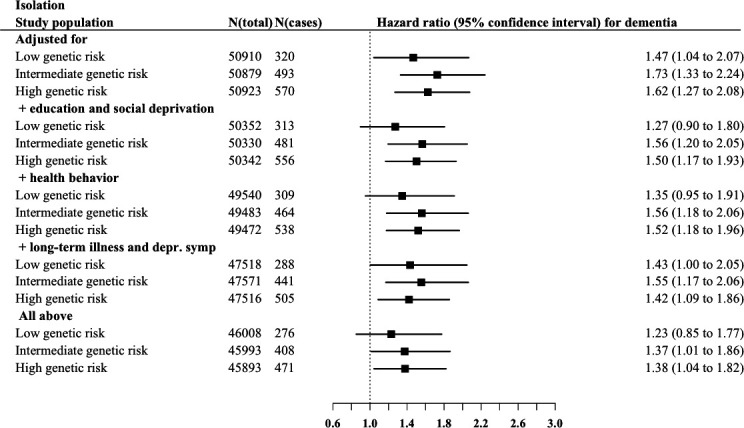
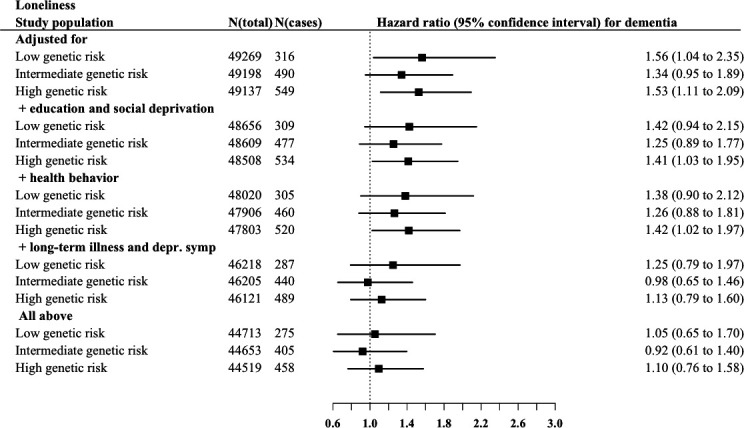
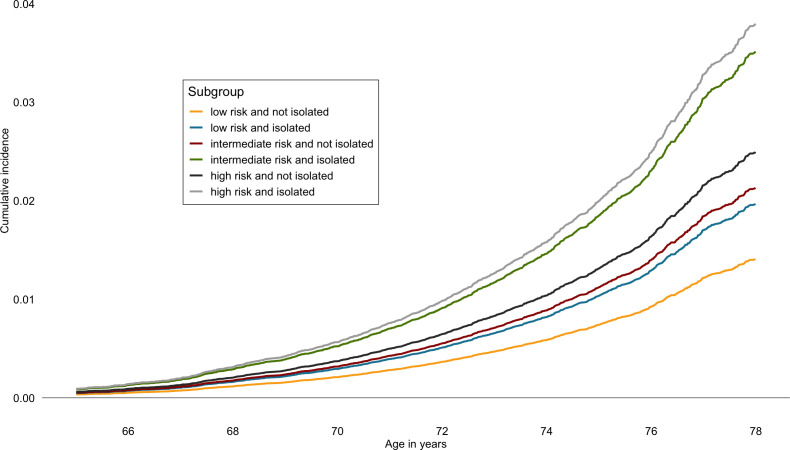
Background: Social isolation and loneliness have been associated with increased risk of dementia, but it is not known whether this risk is modified or confounded by genetic risk of dementia. Methods: We used the prospective UK Biobank study with 155 070 participants (mean age 64.1 years), including self-reported social isolation and loneliness. Genetic risk was indicated using the polygenic risk score for Alzheimer’s disease and the incident dementia ascertained using electronic health records. Results: Overall, 8.6% of participants reported that they were socially isolated and 5.5% were lonely. During a mean follow-up of 8.8 years (1.36 million person years), 1444 (0.9% of the total sample) were diagnosed with dementia. Social isolation, but not loneliness, was associated with increased risk of dementia (HR 1.62, 95% CI 1.38 to 1.90). There were no interaction effects between genetic risk and social isolation or between genetic risk and loneliness predicting incident dementia. Of the participants who were socially isolated and had high genetic risk, 4.4% (95% CI 3.4% to 5.5%) were estimated to developed dementia compared with 2.9% (95% CI 2.6% to 3.2%) of those who were not socially isolated but had high genetic risk. Comparable differences were also in those with intermediate and low genetic risk levels. Conclusions: Socially isolated individuals are at increased risk of dementia at all levels of genetic risk.
Overview
The claims and statistics of this paper haven’t been checked yet.
Free: it reads the open-access text and checks the first 5 claims that cite a source we can check. Create a free account to check every claim.
Integrity signals
Registry
Cites
Statistics
Figures
Verification
Claims the paper makes
The claims and statistics of this paper haven’t been checked yet.
Free: it reads the open-access text and checks the first 5 claims that cite a source we can check. Create a free account to check every claim.
Claims other papers make about this one
Each is checked against this paper’s own text: does it say what the citing paper says it does?
The cited source says what the claim attributes to it.
In the citing paper
“However, two subsequent studies of participants in UKB, with 9 (215) and 12(216) years mean follow-up, found that dementia risk was higher in those who were more socially isolated at baseline.”
From Dementia prevention, intervention, and care: 2024 report of the Lancet standing Commission (2024) · cites this paper as [215]
Self-check
Percentages, sums and reported differences re-computed from the paper’s own numbers.
The self-check needs the paper’s full text.
Citations
Cites
PLINK: a tool set for whole-genome association and population-based linkage analyses.
Purcell, S., Neale, B., Todd-Brown, K., Thomas, L., Ferreira, M. A. R., Bender, D., Maller, J., Sklar, P., de Bakker, P. I. W., Daly, M. J., et al. (2007) · The American Journal of Human Genetics · doi:10.1086/519795 · Cited by 34,089
Spitzer, R. L. (1999) · JAMA · doi:10.1001/jama.282.18.1737 · Cited by 9,802
The UK Biobank resource with deep phenotyping and genomic data
Bycroft, C., Freeman, C., Petkova, D., Band, G., Elliott, L. T., Sharp, K., Motyer, A., Vukcevic, D., Delaneau, O., O’Connell, J., et al. (2018) · Nature · doi:10.1038/s41586-018-0579-z · Cited by 8,876
Dementia prevention, intervention, and care
Livingston, G., Sommerlad, A., Orgeta, V., Costafreda, S. G., Huntley, J., Ames, D., Ballard, C., Banerjee, S., Burns, A., Cohen-Mansfield, J., et al. (2017) · The Lancet · doi:10.1016/s0140-6736(17)31363-6 · Cited by 6,072
Loneliness matters: a theoretical and empirical review of consequences and mechanisms
Hawkley, L. C., & Cacioppo, J. T. (2010) · Annals of Behavioral Medicine · doi:10.1007/s12160-010-9210-8 · Cited by 4,782
A Short Scale for Measuring Loneliness in Large Surveys: Results From Two Population-Based Studies
Hughes, M. E., Waite, L. J., Hawkley, L. C., & Cacioppo, J. T. (2004) · Research on Aging · doi:10.1177/0164027504268574 · Cited by 4,781
Jack, C. R., Knopman, D. S., Jagust, W. J., Petersen, R. C., Weiner, M. W., Aisen, P. S., Shaw, L. M., Vemuri, P., Wiste, H. J., Weigand, S. D., et al. (2013) · The Lancet Neurology · doi:10.1016/s1474-4422(12)70291-0 · Cited by 4,396
Meta-Analysis of 74,046 Individuals Identifies 11 New Susceptibility Loci for Alzheimer’s Disease
(EADI), E. A. D. I., Lambert, J.-C., (GERAD), G. A. E. R. I. A. D., Alzheimer's Disease Genetic Consortium (ADGC), (CHARGE), C. F. H. A. A. R. I. G. E., Ibrahim-Verbaas, C. A., Harold, D., Naj, A. C., Sims, R., Bellenguez, C., et al. (2013) · Nature Genetics · doi:10.1038/ng.2802 · Cited by 4,336
Fry, A., Littlejohns, T. J., Sudlow, C., Doherty, N., Adamska, L., Sprosen, T., Collins, R., & Allen, N. E. (2017) · American Journal of Epidemiology · doi:10.1093/aje/kwx246 · Cited by 3,979
Alzheimer Disease Genetics Consortium (ADGC), Kunkle, B. W., The European Alzheimer’s Disease Initiative (EADI), Cohorts for Heart and Aging Research in Genomic Epidemiology Consortium (CHARGE), Genetic and Environmental Risk in AD/Defining Genetic, P. A. E. R. F. A. D. C. (., Grenier-Boley, B., Sims, R., Bis, J. C., Damotte, V., Naj, A. C., et al. (2019) · Nature Genetics · doi:10.1038/s41588-019-0358-2 · Cited by 2,946
Cacioppo, J. T., Hawkley, L. C., & Thisted, R. A. (2010) · Psychology and Aging · doi:10.1037/a0017216 · Cited by 1,757
The personal and clinical utility of polygenic risk scores
Torkamani, A., Wineinger, N. E., & Topol, E. J. (2018) · Nature Reviews Genetics · doi:10.1038/s41576-018-0018-x · Cited by 1,623
PRSice-2: Polygenic Risk Score software for biobank-scale data
Choi, S. W., & O'Reilly, P. F. (2019) · GigaScience · doi:10.1093/gigascience/giz082 · Cited by 1,532
Diniz, B. S., Butters, M. A., Albert, S. M., Dew, M. A., & Reynolds, C. F. (2013) · British Journal of Psychiatry · doi:10.1192/bjp.bp.112.118307 · Cited by 1,290
Loneliness: clinical import and interventions
Cacioppo, S., Grippo, A. J., London, S., Goossens, L., & Cacioppo, J. T. (2015) · Perspectives on Psychological Science · doi:10.1177/1745691615570616 · Cited by 1,206
PRSice: Polygenic Risk Score software
Euesden, J., Lewis, C. M., & O’Reilly, P. F. (2015) · Bioinformatics · doi:10.1093/bioinformatics/btu848 · Cited by 1,191
Kuiper, J. S., Zuidersma, M., Oude Voshaar, R. C., Zuidema, S. U., van den Heuvel, E. R., Stolk, R. P., & Smidt, N. (2015) · Ageing Research Reviews · doi:10.1016/j.arr.2015.04.006 · Cited by 1,090
Imputing missing covariate values for the Cox model
White, I. R., & Royston, P. (2009) · Statistics in Medicine · doi:10.1002/sim.3618 · Cited by 985
Competing risks in epidemiology: possibilities and pitfalls
Andersen, P. K., Geskus, R. B., de Witte, T., & Putter, H. (2012) · International Journal of Epidemiology · doi:10.1093/ije/dyr213 · Cited by 985
Association of Lifestyle and Genetic Risk With Incidence of Dementia
Lourida, I., Hannon, E., Littlejohns, T. J., Langa, K. M., Hyppönen, E., Kuzma, E., & Llewellyn, D. J. (2019) · JAMA · doi:10.1001/jama.2019.9879 · Cited by 881
Cognitive Reserve and Lifestyle
Scarmeas, N., & Stern, Y. (2003) · Journal of Clinical and Experimental Neuropsychology · doi:10.1076/jcen.25.5.625.14576 · Cited by 865
Batty, G. D., Gale, C. R., Kivimäki, M., Deary, I. J., & Bell, S. (2020) · BMJ · doi:10.1136/bmj.m131 · Cited by 635
Self-citationLoneliness predicts reduced physical activity: Cross-sectional & longitudinal analyses.
Hawkley, L. C., Thisted, R. A., & Cacioppo, J. T. (2009) · Health Psychology · doi:10.1037/a0014400 · Cited by 608
Penninkilampi, R., Casey, A.-N., Singh, M. F., & Brodaty, H. (2018) · Journal of Alzheimer's Disease · doi:10.3233/jad-180439 · Cited by 520
Loneliness, Social Isolation, and Cardiovascular Health
Xia, N., & Li, H. (2018) · Antioxidants & Redox Signaling · doi:10.1089/ars.2017.7312 · Cited by 493
Biobank, O. B. O. D. P. U. A. U., Wilkinson, T., Schnier, C., Bush, K., Rannikmäe, K., Henshall, D. E., Lerpiniere, C., Allen, N. E., Flaig, R., Russ, T. C., et al. (2019) · European Journal of Epidemiology · doi:10.1007/s10654-019-00499-1 · Cited by 452
Are loneliness and social isolation associated with cognitive decline?
Lara, E., Caballero, F. F., Rico‐Uribe, L. A., Olaya, B., Haro, J. M., Ayuso‐Mateos, J. L., & Miret, M. (2019) · International Journal of Geriatric Psychiatry · doi:10.1002/gps.5174 · Cited by 423
Common polygenic variation enhances risk prediction for Alzheimer’s disease
Escott-Price, V., Sims, R., Bannister, C., Harold, D., Vronskaya, M., Majounie, E., Badarinarayan, N., GERAD/PERADES, consortia, I., Morgan, K., et al. (2015) · Brain · doi:10.1093/brain/awv268 · Cited by 414
Elovainio, M., Hakulinen, C., Pulkki-Råback, L., Virtanen, M., Josefsson, K., Jokela, M., Vahtera, J., & Kivimäki, M. (2017) · The Lancet Public Health · doi:10.1016/s2468-2667(17)30075-0 · Cited by 411
Self-citationPalmer, L. J. (2007) · The Lancet · doi:10.1016/s0140-6736(07)60924-6 · Cited by 373
Hakulinen, C., Pulkki-Råback, L., Virtanen, M., Jokela, M., Kivimäki, M., & Elovainio, M. (2018) · Heart · doi:10.1136/heartjnl-2017-312663 · Cited by 355
Self-citationLara, E., Martín-María, N., De la Torre-Luque, A., Koyanagi, A., Vancampfort, D., Izquierdo, A., & Miret, M. (2019) · Ageing Research Reviews · doi:10.1016/j.arr.2019.03.002 · Cited by 351
Social Support, Social Networks, Social Cohesion and Health
Berkman, L. F. (2000) · Social Work in Health Care · doi:10.1300/j010v31n02_02 · Cited by 348
Loneliness predicts pain, depression, and fatigue: Understanding the role of immune dysregulation
Jaremka, L. M., Fagundes, C. P., Glaser, R., Bennett, J. M., Malarkey, W. B., & Kiecolt-Glaser, J. K. (2013) · Psychoneuroendocrinology · doi:10.1016/j.psyneuen.2012.11.016 · Cited by 316
Interpretation of risk loci from genome-wide association studies of Alzheimer's disease
Andrews, S. J., Fulton-Howard, B., & Goate, A. (2020) · The Lancet Neurology · doi:10.1016/s1474-4422(19)30435-1 · Cited by 314
Kivimäki, M., Singh-Manoux, A., Pentti, J., Sabia, S., Nyberg, S. T., Alfredsson, L., Goldberg, M., Knutsson, A., Koskenvuo, M., Koskinen, A., et al. (2019) · BMJ · doi:10.1136/bmj.l1495 · Cited by 313
Self-citationAhmadi-Abhari, S., Guzman-Castillo, M., Bandosz, P., Shipley, M. J., Muniz-Terrera, G., Singh-Manoux, A., Kivimäki, M., Steptoe, A., Capewell, S., O’Flaherty, M., et al. (2017) · BMJ · doi:10.1136/bmj.j2856 · Cited by 301
Self-citationKuiper, J. S., Zuidersma, M., Zuidema, S. U., Burgerhof, J. G. M., Stolk, R. P., Oude Voshaar, R. C., & Smidt, N. (2016) · International Journal of Epidemiology · doi:10.1093/ije/dyw089 · Cited by 301
Loneliness Promotes Inflammation During Acute Stress
Jaremka, L. M., Fagundes, C. P., Peng, J., Bennett, J. M., Glaser, R., Malarkey, W. B., & Kiecolt-Glaser, J. K. (2013) · Psychological Science · doi:10.1177/0956797612464059 · Cited by 255
Scarmeas, N., Zarahn, E., Anderson, K. E., Habeck, C. G., Hilton, J., Flynn, J., Marder, K. S., Bell, K. L., Sackeim, H. A., Van Heertum, R. L., et al. (2003) · Archives of Neurology · doi:10.1001/archneur.60.3.359 · Cited by 254
Loneliness impairs daytime functioning but not sleep duration.
Hawkley, L. C., Preacher, K. J., & Cacioppo, J. T. (2010) · Health Psychology · doi:10.1037/a0018646 · Cited by 247
Licher, S., Ahmad, S., Karamujić-Čomić, H., Voortman, T., Leening, M. J. G., Ikram, M. A., & Ikram, M. K. (2019) · Nature Medicine · doi:10.1038/s41591-019-0547-7 · Cited by 233
Loneliness Increases the Risk of All-Cause Dementia and Alzheimer’s Disease
Sundström, A., Adolfsson, A. N., Nordin, M., & Adolfsson, R. (2020) · The Journals of Gerontology: Series B · doi:10.1093/geronb/gbz139 · Cited by 215
Interpretability and importance of functionals in competing risks and multistate models
Andersen, P. K., & Keiding, N. (2012) · Statistics in Medicine · doi:10.1002/sim.4385 · Cited by 207
Sabia, S., Fayosse, A., Dumurgier, J., Schnitzler, A., Empana, J.-P., Ebmeier, K. P., Dugravot, A., Kivimäki, M., & Singh-Manoux, A. (2019) · BMJ · doi:10.1136/bmj.l4414 · Cited by 205
Self-citationSommerlad, A., Sabia, S., Singh-Manoux, A., Lewis, G., & Livingston, G. (2019) · PLOS Medicine · doi:10.1371/journal.pmed.1002862 · Cited by 201
What Are Polygenic Scores and Why Are They Important?
Sugrue, L. P., & Desikan, R. S. (2019) · JAMA · doi:10.1001/jama.2019.3893 · Cited by 174
McEwen, B. S. (2000) · Neurochemical Research · doi:10.1023/a:1007687911139 · Cited by 169
Absolute risk regression for competing risks: interpretation, link functions, and prediction
Gerds, T. A., Scheike, T., & Andersen, P. K. (2012) · Statistics in Medicine · doi:10.1002/sim.5459 · Cited by 141
Association of midlife diet with subsequent risk for dementia
Akbaraly, T. N., Singh-Manoux, A., Dugravot, A., Brunner, E. J., Kivimäki, M., & Sabia, S. (2019) · JAMA · doi:10.1001/jama.2019.1432 · Cited by 121
Self-citationAlzheimer Disease Genetics Consortium (ADGC), Kunkle, B. W., (EADI), T. E. A. D. I., Cohorts for Heart and Aging Research in Genomic Epidemiology Consortium (CHARGE), Genetic and Environmental Risk in AD/Defining Genetic, P. A. E. R. F. A. D. C. (., Grenier-Boley, B., Sims, R., Bis, J. C., Damotte, V., Naj, A. C., et al. (2019) · Nature Genetics · doi:10.1038/s41588-019-0495-7 · Cited by 84
Polygenic Risk Score Analysis of Alzheimer's Disease in Cases without APOE4 or APOE2 Alleles
Escott-Price, V., Myers, A., Huentelman, M., Shoai, M., & Hardy, J. (2019) · The Journal of Prevention of Alzheimer's Disease · doi:10.14283/jpad.2018.46 · Cited by 52
Projecting Burden of Dementia in Spain, 2010–2050: Impact of Modifying Risk Factors
Soto-Gordoa, M., Arrospide, A., Moreno-Izco, F., Martínez-Lage, P., Castilla, I., & Mar, J. (2015) · Journal of Alzheimer's Disease · doi:10.3233/jad-150233 · Cited by 51
Kunkle, B., Grenier-Boley, B., Sims, R., Bis, J., Naj, A., Boland, A., Vronskaya, M., van der Lee, S., Amlie-Wolf, A., Bellenguez, C., et al. (2018) · doi:10.1101/294629 · Cited by 35
Wu, J., Hasselgren, C., Zettergren, A., Zetterberg, H., Blennow, K., Skoog, I., & Halleröd, B. (2020) · Aging & Mental Health · doi:10.1080/13607863.2018.1531368 · Cited by 18
Cited by
Dementia prevention, intervention, and care: 2024 report of the Lancet standing Commission
Livingston, G., Huntley, J., Liu, K. Y., Costafreda, S. G., Selbæk, G., Alladi, S., Ames, D., Banerjee, S., Burns, A., Brayne, C., et al. (2024) · The Lancet · doi:10.1016/s0140-6736(24)01296-0 · Cited by 3,860
Self-citationSocial participation and risk of developing dementia
Sommerlad, A., Kivimäki, M., Larson, E. B., Röhr, S., Shirai, K., Singh-Manoux, A., & Livingston, G. (2023) · Nature Aging · doi:10.1038/s43587-023-00387-0 · Cited by 207
“Two studies of participants in the UK Biobank study with 9 42 and 12 years 43 mean follow-up found that dementia risk was higher for those who were more socially isolated, with this finding consistent across different levels of genetic risk 42 and linked to lower grey matter volume 43 .”
Self-citationThe Impact of Loneliness and Social Isolation on Cognitive Aging: A Narrative Review
Guarnera, J., Yuen, E., & Macpherson, H. (2023) · Journal of Alzheimer's Disease Reports · doi:10.3233/adr-230011 · Cited by 161
“A recent cohort study using the UK Biobank investigated how loneliness and social isolation differently contribute to genetic risk for dementia [62].”
BackgroundRen, Y. L., Savadlou, A., Park, S., Siska, P., Epp, J. R., & Sargin, D. (2023) · Frontiers in Neuroendocrinology · doi:10.1016/j.yfrne.2023.101061 · Cited by 149
Elovainio, M., Komulainen, K., Sipilä, P. N., Pulkki-Råback, L., Cachón Alonso, L., Pentti, J., Nyberg, S. T., Suominen, S., Vahtera, J., Lipsanen, J., et al. (2023) · The Lancet Public Health · doi:10.1016/s2468-2667(22)00253-5 · Cited by 96
Self-citation
Metadata
- Authors
- Elovainio, M., Lahti, J., Pirinen, M., Pulkki-Råback, L., Malmberg, A., Lipsanen, J., Virtanen, M., Kivimäki, M., & Hakulinen, C.
- Affiliations
- University of Helsinki (FI)
- Department of Psychology and Logopedics, University of Helsinki, Helsinki, Finland
- University of Eastern Finland (FI)
- Department of Public Health, University of Helsinki, Helsinki, Finland
- Corresponding author
- Elovainio, Marko
- ORCID
- Venue
- BMJ Open
- Publisher
- BMJ
- Published
- 2022-02
- Volume
- 12
- Issue
- 2
- Pages
- e053936
- ISSN
- 2044-6055 (ISSN-L)
- PMC
- PMC8867309
- OpenAlex
- W4220934992
- Cited by
- 85
- References
- 54
- Citations by year
- 2026: 12 · 2025: 23 · 2024: 30 · 2023: 13 · 2022: 4
- FWCI
- 11.35
- Type
- journal article
- Language
- en
- Open access
- gold
- doi.org
- Locations
- BMJ Open (publishedVersion, cc-by)
- medRxiv (acceptedVersion, cc-by-nc-nd)
- PubMed Central (publishedVersion, cc-by)
- PubMed (publishedVersion)
- UTUPub (University of Turku) (submittedVersion, other-oa)
- UTUPub (University of Turku) (submittedVersion, cc-by)
- DOAJ (DOAJ: Directory of Open Access Journals) (submittedVersion, cc-by-sa)
- UCL Discovery (University College London) (submittedVersion)
- Työväentutkimus Vuosikirja (submittedVersion)
- STM:n Hallinnonalan avoin julkaisuarkisto (Julkari) (submittedVersion)
- Funders
- Academy of Finland (310591(CH), 311492, 339390)
- NordForsk (70521)
- Federal Ministry of Education and Research (01GI0102, 01GI0420, 01GI0711)
- NHLBI (R01 HL105756)
- NIA (AG081220, N01–AG–12100, R01 AG033193, R01AG056477, U01 AG016976, U01 AG032984, U24 AG021886)
- MRC (S011676)
- Alzheimer's Association (ADGC–10–196728)
- Alzheimer's Research UK (503176)
- Wellcome Trust (082604/2/07/Z)
- Medical Research Council (503480)
- Topics
- Health Sciences › Medicine › Psychiatry and Mental health › Dementia and Cognitive Impairment Research
- Social Sciences › Health › Health disparities and outcomes
- Life Sciences › Neuroscience › Cellular and Molecular Neuroscience › Alzheimer's disease research and treatments
- Keywords
- social isolation, loneliness, dementia, genetic risk, polygenic risk score, Alzheimer's disease, dementia incidence, gene-environment interaction, UK Biobank
- MeSH terms
- Dementia, United Kingdom, Humans, Loneliness, Middle Aged, Prospective Studies, Risk Factors, Social Isolation, Cohort Studies, Incidence, Biological Specimen Banks
About these checks
Registry, retraction, Cites and statistics results are computed, not judged, with one exception: a printed reference that no index lists is read once by a model before it counts as a citation error. Claims are extracted by a model and kept only when their quote appears verbatim in the text; each cited source is then checked, with a model’s help, for whether it says what the claim relies on. Those verdicts can be wrong — read the claim’s quote and the cited source before relying on one.
Statistics and arithmetic are recomputed, not judged.
Confidence bands are shown only for fields calibrated on our annotated test set. None is calibrated yet, so no band is shown.
What counts as a claim ›How we measure confidence ›How we check this ›
Are you an author, or do you see a problem with this page? Request a review
Data sources
Bibliographic data: Semantic Scholar, OpenAlex, Crossref.
Contains information from the Semantic Scholar Academic Graph Datasets, made available under the ODC Attribution License (ODC-BY 1.0).
Semantic Scholar’s data is described in: Kinney, R., et al. (2023). The Semantic Scholar Open Data Platform. arXiv:2301.10140.
