

Holographic spacetime, black holes and quantum error correcting codes: a review
Open accessThe DOI matches its Crossref record; 360 of the 376 references it cites were found in a registry or an index; 88 of the 172 sources its claims cite were checked for support.
Abstract
This article reviews the progress in our understanding of the reconstruction of the bulk spacetime in the holographic correspondence from the dual field theory including an account of how these developments have led to the reproduction of the Page curve of the Hawking radiation from black holes. We review quantum error correction and relevant recovery maps with toy examples based on tensor networks, and discuss how it provides the desired framework for bulk reconstruction in which apparent inconsistencies with properties of the operator algebra in the dual field theory are naturally resolved. The importance of understanding the modular flow in the dual field theory has been emphasized. We discuss how the state-dependence of reconstruction of black hole microstates can be formulated in the framework of quantum error correction with inputs from extremal surfaces along with a quantification of the complexity of encoding of bulk operators. Finally, we motivate and discuss a class of tractable microstate models of black holes which can illuminate how the black hole complementarity principle can emerge operationally without encountering information paradoxes, and provide new insights into generation of desirable features of encoding into the Hawking radiation.
Overview
CoChat Summary
TL;DR
This review synthesizes how holographic bulk reconstruction and black hole information are understood through quantum extremal surfaces, islands, and quantum error-correcting codes, including reproduction of the Page curve. It also surveys approximate recovery maps such as the Petz/twirled Petz map and tractable microstate models for black hole complementarity and encoding in Hawking radiation.
Key findings
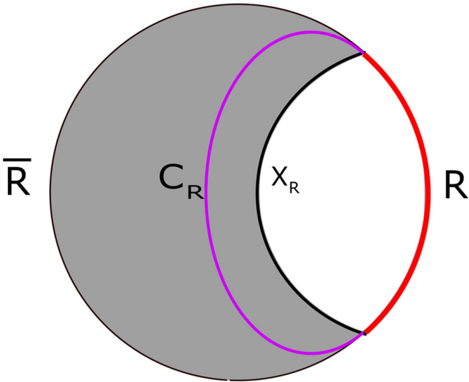
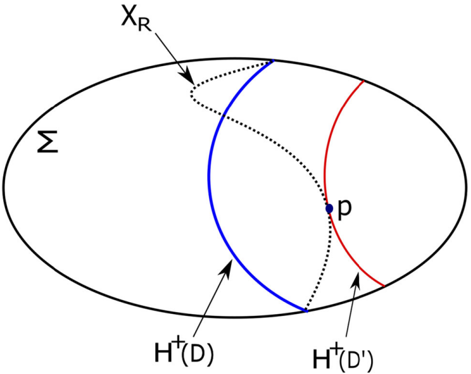
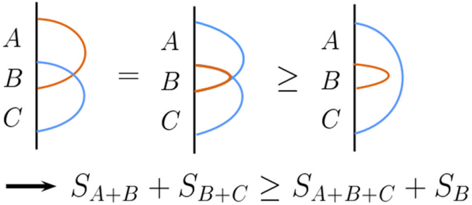
- The quantum extremal surface (QES) proposal gives holographic entanglement entropy as generalized entropy, \(S(R)=S_{\rm gen}(\chi_R)\), and passes consistency checks: it agrees with RT/HRT at leading order and FLM at next-to-leading order, the entanglement wedge contains the causal wedge, and it satisfies strong subadditivity and entanglement wedge nesting via maximin surfaces.
- Bulk reconstruction is formulated as quantum error correction: the JLMS equality \(S(\rho_A|\sigma_A)=S(\rho_a|\sigma_a)\) plus operator-algebra QEC yields a reconstruction theorem, while approximate reconstruction uses the Petz map with a fidelity bound \(-2\log F(\rho_a,(\mathcal R_{\sigma_a,N}\circ N)(\rho_a))\le S(\rho_a|\sigma_a)-S(N(\rho_a)|N(\sigma_a))\).
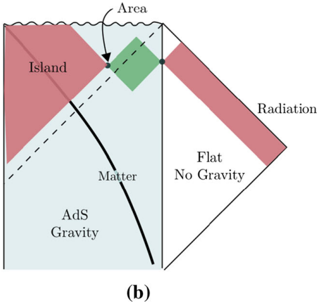
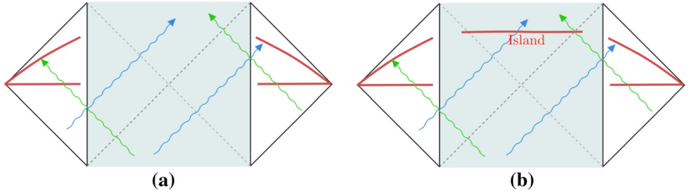
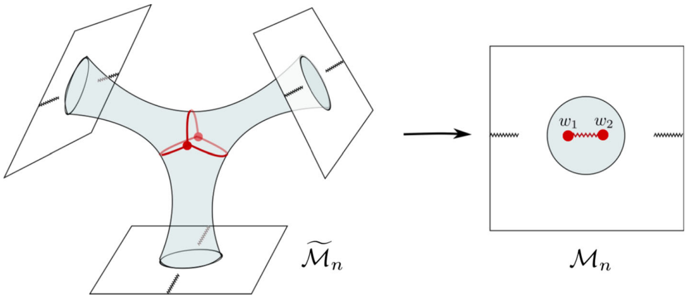
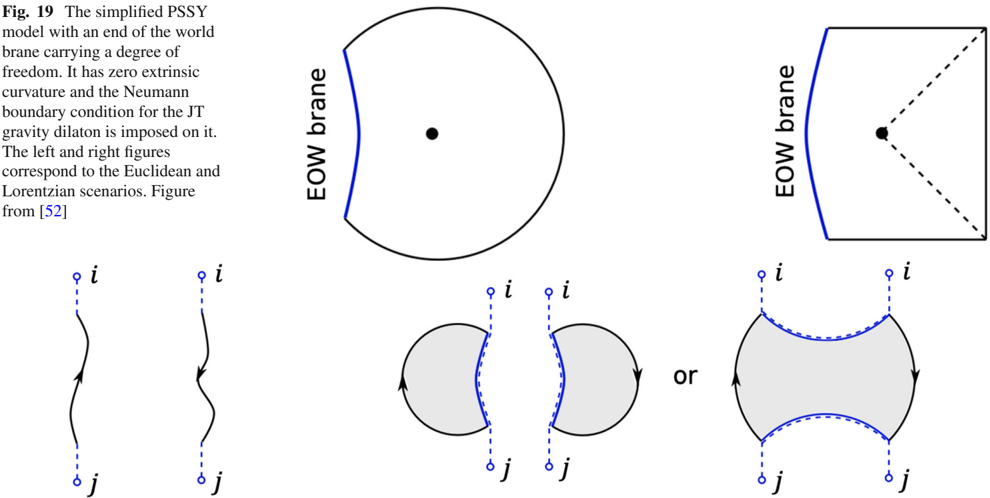
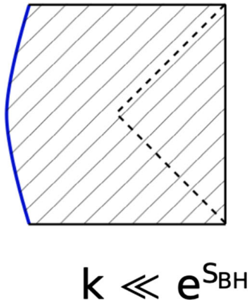
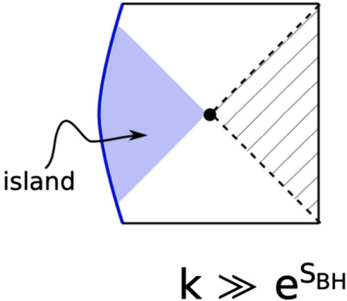
- Islands and the Page curve emerge from replica wormholes: the island rule is \(S(R)=\min_I \operatorname{ext}_I [S_{\rm ent-bulk}(R\cup I)+A(\partial I)/4G]\), and in the PSSY toy model \(\operatorname{Tr}(\rho_R^2)=1/k+Z^{(2)}/Z^{(1)2}\), with an island when \(k\gg e^{S_{BH}}\) and no island when \(k\ll e^{S_{BH}}\).
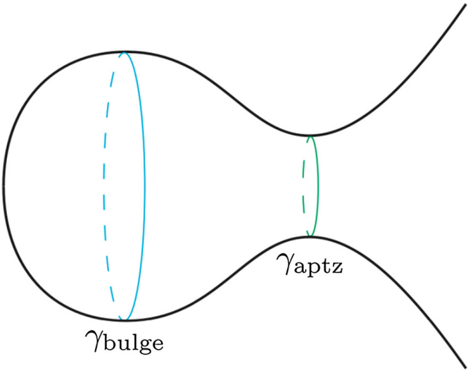
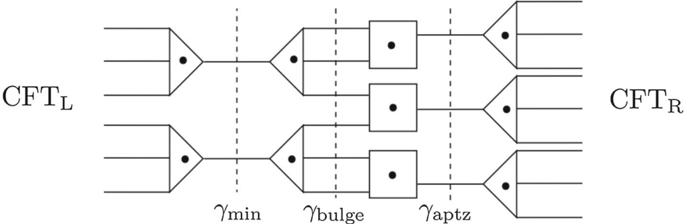
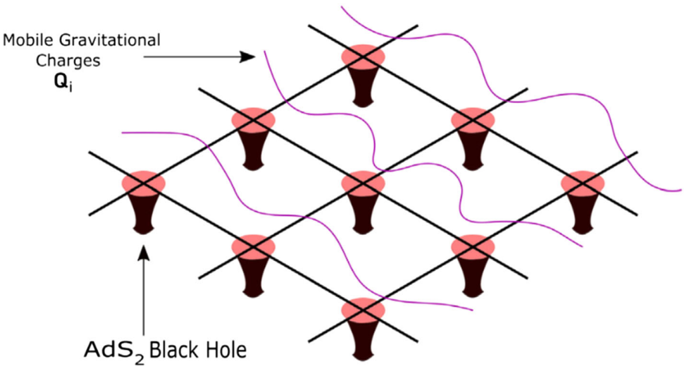
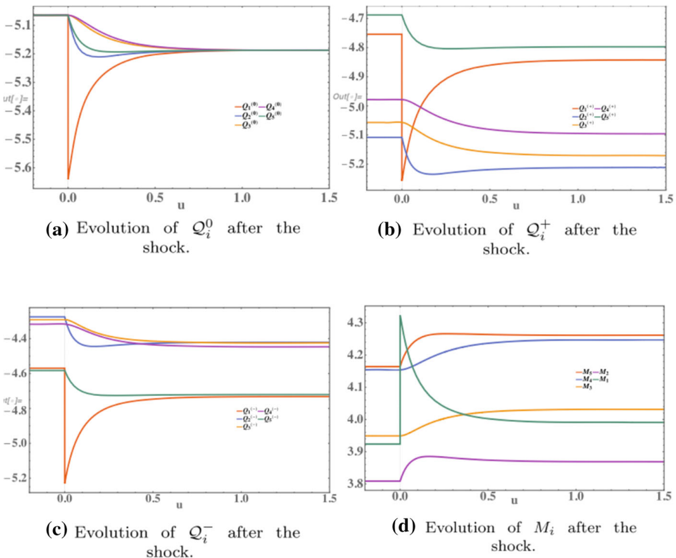
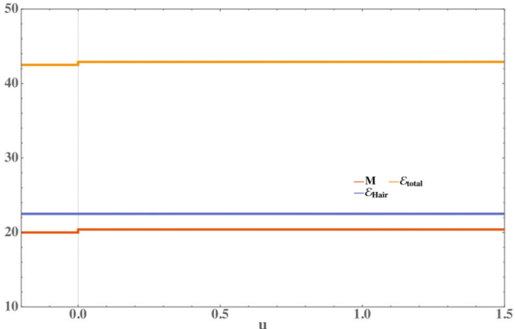
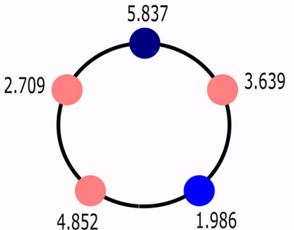
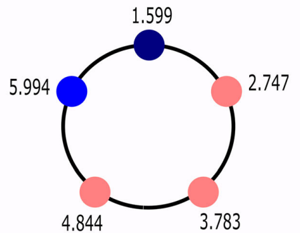
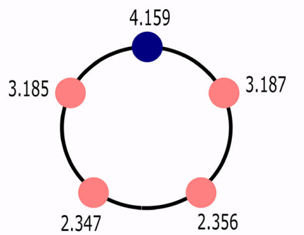
- Microstate models of a lattice of AdS\(_2\) throats with mobile hair show information mirroring and pseudorandom dynamics; for five lattice sites, less than 1 percent of shock energy is transferred to the hair, and decoding can use phase differences of positive normal modes. Python’s lunch decoding complexity is estimated as \(C=O(C\exp[\frac12(S_{\rm gen}(\gamma_{\rm bulge})-S_{\rm gen}(\gamma_{\rm aptz}))])\).
Methods
- Review article; the paper states it has no associated data and that all relevant data are in the cited references.
- Synthesizes AdS/CFT, quantum extremal surfaces, quantum error correction, tensor-network toy models (3-qutrit code, [[5,1,3]] code, holographic pentagon code, random tensor networks), replica wormholes, and microstate models.
- Main analysis is conceptual and derivational, with toy examples and numerical simulation of a five-site microstate lattice reported from cited work.
Limitations
- Stated in the paper: the QES proposal has not been proven, though it is believed correct; modular Hamiltonians are generically non-local and hard to compute; tensor networks may not reproduce all information-theoretic aspects beyond RT-type extremal surfaces; the review is restricted to asymptotically anti-de Sitter space.
- Stated for microstate models: it is not clear whether they have the shortest possible scrambling time, the bath region is fragmented into two-dimensional spaces, and further improvements are needed to glue baths into a connected flat asymptotic region.
- Evident from the text: as a review, it does not present new primary data or experiments, so its conclusions rest on the cited literature and toy-model arguments.
Model-written summary. Check it against the paper before relying on it.
Integrity signals
Registry
Cites
Statistics
Figures


Verification
Claims the paper makes
67 Valid · 8 Not valid · 63 Not checked · 211 Own results and interpretations
At least one cited source doesn’t support this claim or points to a different paper, and none confirmed it — see the verdicts below.
In the paper
“Theorem 2 (Operator Algebra QEC Condition) The algebra of observables A on a codespace C with projector P is correctable against noise N with operators {E i } if and only if [E i P, X ] = 0 for all errors E i associated with the noise N and all observables X ∈ A .”
§ Holographic spacetime, black holes and quantum error correcting codes: a review > 4.1 Preliminaries: quantum error correction
What the sources say
- Disputedcites [175] 175. D. Harlow, The Ryu-Takayanagi formula from quantum error correction. Commun. Math. Phys. 354(3), 865 (2017) 185. sourceExperimental — accuracy not yet measured
On p. 2, Theorem 1 gives [EₐP, X] = 0 as the condition for an algebra to be conserved by the noise channel, not corrected after recovery. Theorem 2 separately addresses correctability and says the operators E†cEᵦ play a key role; its displayed condition is not decoded in our copy. The citing sentence labels the conservation condition as the correctability condition. (LLM, conf=0.88)
Checked by a reasoning model — may be wrong.
plainstates an association- Asserted: passes — The authors put it forward as true.
- Checkable: passes — It can be checked against evidence.
- Load-bearing: passes — The paper’s conclusions depend on it.
- Based: passes — The paper gives a reason why it holds.
- Disputed
The cited sources support only part of this claim — read each source’s verdict below.
In the paper
“The generalized entropy is computed on a Cauchy slice (at some “time”), the GSL then states that the variation of this generalized entropy along any future directed normal to the Cauchy slice is non negative.”
§ Holographic spacetime, black holes and quantum error correcting codes: a review > 2.2 The entanglement wedge contains the causal wedge
What the sources say
- Partly supportedcites [83] 83. A.C. Wall, The generalized second law implies a quantum singu- larity theorem. Class. Quantum Gravity 30(16), 165003 (2013). https://doi.org/10.1088/0264-9381/30/16/165003 sourceExperimental — accuracy not yet measured
Section 2.2 states that generalized entropy is defined on a spatial slice and does not decrease when a later slice is compared with it. But its GSL inequality concerns the observer-side exterior of a horizon; it does not state non-negative variation along any future-directed normal to a Cauchy slice. The indexed passage provides no page number. (LLM, conf=0.88)
plainstates a cause- Asserted: passes — The authors put it forward as true.
- Checkable: passes — It can be checked against evidence.
- Load-bearing: passes — The paper’s conclusions depend on it.
- Based: passes — The paper gives a reason why it holds.
- Partly supported
The cited sources support only part of this claim — read each source’s verdict below.
In the paper
“The RT proposal was shown to be correct at the leading order in h by Lewkowycz and Maldacena (LM) [63].”
§ Holographic spacetime, black holes and quantum error correcting codes: a review > 2.1 Partial proof of the quantum extremal surface proposal
What the sources say
- Partly supportedcites [63] 63. A. Lewkowycz, J. Maldacena, Generalized gravitational entropy. J. High Energy Phys. 2013(8), 90 (2013). https://doi.org/10.1007/ JHEP08(2013)090 sourceExperimental — accuracy not yet measured
The Introduction (p. 4) treats the Ryu–Takayanagi formula as a statement about classical gravity and says the authors give an argument for it. The Conclusions (p. 26) say that argument depends on assumptions about analytic continuation for which they have no further justification. Thus the paper supports a leading-order derivation under those assumptions, but “shown to be correct” overstates its conclusion. (LLM, conf=0.88)
plainstates a cause- Asserted: passes — The authors put it forward as true.
- Checkable: passes — It can be checked against evidence.
- Load-bearing: unclear — It is unclear whether the paper’s conclusions depend on it.
- Based: passes — The paper gives a reason why it holds.
- Partly supported
The cited sources support only part of this claim — read each source’s verdict below.
In the paper
“The inclusion of this spatially disconnected island leads to reproduction the Page curve [47,48] for the timedependence of the von Neumann entropy of the Hawking radiation in consistency with unitarity without invalidating the effective semiclassical description of bulk”
§ Holographic spacetime, black holes and quantum error correcting codes: a review > 1 Introduction
What the sources say
- Partly supportedcites [47] 47. D.N. Page, Information in black hole radiation. Phys. Rev. Lett. 71(23), 3743 (1993). https://doi.org/10.1103/physrevlett.71.3743 sourceExperimental — accuracy not yet measured
Split into 2 atoms — 1 confirmed, 1 partially supported, 0 disputed, 0 misattributed, 0 unverifiable. Expand the claim to see per-atom verdicts.
- Partly supportedcites [48] 48. D.N. Page, Time dependence of hawking radiation entropy. J. Cosmol. Astropart. Phys. 2013(09), 028 (2013). https://doi.org/ 10.1088/1475-7516/2013/09/028 sourceExperimental — accuracy not yet measured
Split into 2 atoms — 1 confirmed, 0 partially supported, 0 disputed, 0 misattributed, 1 unverifiable. Expand the claim to see per-atom verdicts.
- Not matchedcites [49][50][51][52][53]
A range of references, not one source.
plainstates a cause- Asserted: passes — The authors put it forward as true.
- Checkable: passes — It can be checked against evidence.
- Load-bearing: passes — The paper’s conclusions depend on it.
- Based: passes — The paper gives a reason why it holds.
- Partly supported
The cited sources support only part of this claim — read each source’s verdict below.
In the paper
“They found that the entanglement entropy correct to O(h 0 ) is given by”
§ Holographic spacetime, black holes and quantum error correcting codes: a review > 2.1 Partial proof of the quantum extremal surface proposal
What the sources say
- Partly supportedcites [28] 28. T. Faulkner, A. Lewkowycz, J. Maldacena, Quantum correc- tions to holographic entanglement entropy. J. High Energy Phys. 2013(11), 74 (2013). https://doi.org/10.1007/JHEP11(2013)074 sourceExperimental — accuracy not yet measured
Section 1 (pp. 2–3) supports the leading area term and identifies bulk entanglement entropy as the leading quantum correction. But section 2.2 (p. 9) says the full correction also includes an area shift, a Wald-like term, and counterterm contributions. The claimed equality omits these terms without specifying conditions under which they vanish or are absorbed. (LLM, conf=0.88)
plainstates an association- Asserted: passes — The authors put it forward as true.
- Checkable: passes — It can be checked against evidence.
- Load-bearing: passes — The paper’s conclusions depend on it.
- Based: passes — The paper gives a reason why it holds.
- Partly supported
210 more claims · 39 with their cited sources checked
Create a free account to see all 349 claims and to verify the 66 references still open.
- Probably not a substantial claim. 51
- It may state two separate claims as one. 91
- The quote only partly states this claim. 5
Self-check
Percentages, sums and reported differences re-computed from the paper’s own numbers.
Each contradiction between two passages listed here was confirmed by an independent check.
Rated minor: it would not touch a result — a value no result rests on, a p-value that stays on the same side of the significance level, or a conflict that is clerical, resolved elsewhere in the paper, or outside its own findings.
In the paper
§ Holographic spacetime, black holes and quantum error correcting codes: a review > 4.1 Preliminaries: quantum error correction
“an [[n, k, t]] quantum code can correct perfectly for the loss of any set of t ≤ n qudits”
§ Holographic spacetime, black holes and quantum error correcting codes: a review > 4.2.3 Tensor network toy model for bulk reconstruction
“Such a tensor can then be thought of as a linear map from 1 (d-dimensional) system to 2n -1 (d-dimensional) systems, encoding a single quantum system is such a way that it is protected against the erasure of any n -1 subsystems.In QEC terminology, a perfect tensor with 2n indices corresponds to a [[2n -1, 1, n]] code”
Rated minor: it would not touch a result — a value no result rests on, a p-value that stays on the same side of the significance level, or a conflict that is clerical, resolved elsewhere in the paper, or outside its own findings.
In the paper
§ Holographic spacetime, black holes and quantum error correcting codes: a review > 3.3.1 The JLMS smearing function
“Since the bulk modular flow is the same as boundary modular flow as seen in Eq. ( 38), it follows that [φ ω , H σ ] = ωφ ω .”
§ Holographic spacetime, black holes and quantum error correcting codes: a review > 3.3.1 The JLMS smearing function
“[H σ , O ω ] = ωO ω ,(46)”
Rated minor: it would not touch a result — a value no result rests on, a p-value that stays on the same side of the significance level, or a conflict that is clerical, resolved elsewhere in the paper, or outside its own findings.
In the paper
§ Holographic spacetime, black holes and quantum error correcting codes: a review > 3.2 The equivalence of bulk and boundary relative entropies and its consequences
“S(ρ A∪B∪C |ρ A ⊗ ρ B∪C ) ≤ S(ρ A∪B |ρ A ⊗ ρ B ),(30)”
§ Holographic spacetime, black holes and quantum error correcting codes: a review > 3.2 The equivalence of bulk and boundary relative entropies and its consequences
“S(N (ρ)|N (σ )) ≤ S(ρ|σ ) (29”
Rated minor: it would not touch a result — a value no result rests on, a p-value that stays on the same side of the significance level, or a conflict that is clerical, resolved elsewhere in the paper, or outside its own findings.
In the paper
§ Holographic spacetime, black holes and quantum error correcting codes: a review > 3.2 The equivalence of bulk and boundary relative entropies and its consequences
“p i = Tr(A i σ ) and q i = Tr(A i ρ), and use the classical Kullback-Liebler divergence between p and q to define S 1 := S 1 (ρ|σ ) = sup A i i p i (log p i -log q i )”
§ Holographic spacetime, black holes and quantum error correcting codes: a review > 3.2 The equivalence of bulk and boundary relative entropies and its consequences
“S(ρ|σ ) = lim n→∞ S n .”
Citations
Cites
Items 201–361 of 361
Islands in asymptotically flat 2D gravity
Hartman, T., Shaghoulian, E., & Strominger, A. (2020) · Journal of High Energy Physics · doi:10.1007/jhep07(2020)022 · Cited by 147
Islands in Asymptotically Flat 2D Gravity
Hartman, T., Shaghoulian, E., & Strominger, A. (2020) · arXiv · doi:10.48550/arxiv.2004.13857 · Cited by 147
Thermodynamics of quantum systems with multiple conserved quantities
Guryanova, Y., Popescu, S., Short, A. J., Silva, R., & Skrzypczyk, P. (2016) · Nature Communications · doi:10.1038/ncomms12049 · Cited by 145
Island in the presence of higher derivative terms
Alishahiha, M., Astaneh, A. F., & Naseh, A. (2021) · Journal of High Energy Physics · doi:10.1007/jhep02(2021)035 · Cited by 145
BoundarySMatrix and the Anti–de Sitter Space to Conformal Field Theory Dictionary
Giddings, S. B. (1999) · Physical Review Letters · doi:10.1103/physrevlett.83.2707 · Cited by 143 · cited 1×
“This extrapolate dictionary has been shown to be equivalent to the GKPW prescription (20) in [102,103].”
MethodINTRODUCTION TO QUANTUM FISHER INFORMATION
PETZ, D., & GHINEA, C. (2011) · Quantum Probability and Related Topics · doi:10.1142/9789814338745_0015 · Cited by 143 · cited 1×
“Quantum Fisher information is important in the study of quantum metrology and state estimation, where it bounds the amount of information that can be obtained about a state by generalized measurements [116].”
BackgroundTASI Lectures on the Emergence of the Bulk in AdS/CFTPreprint
Harlow, D. (2018) · arXiv (Cornell University) · doi:10.48550/arxiv.1802.01040 · Cited by 143 · cited 1×
“The smearing function KRindler is known explicitly in terms of the mode functions obtained from the semi-classical quantization of the bulk field in Rindler wedge (see [58]).”
BackgroundReview of AdS/CFT Integrability
Beisert, N., Ahn, C., Alday, L. F., et al. (2011) · edoc Publication server (Humboldt University of Berlin) · doi:10.18452/2839 · Cited by 143
Hartman, T. (2023) · OSTI OAI (U.S. Department of Energy Office of Scientific and Technical Information) · doi:10.1007/jhep11%282020%29111 · Cited by 141
Black hole entanglement and quantum error correction
Verlinde, E., & Verlinde, H. (2013) · Journal of High Energy Physics · doi:10.1007/jhep10(2013)107 · Cited by 139 · cited 2×
“28 In [267], one can find a general discussion on how effective field theory observables in a semiclassical but not necessarily smooth horizon geometry can decode the black hole interior.”
BackgroundModular Hamiltonians on the null plane and the Markov property of the vacuum state
Casini, H., Testé, E., & Torroba, G. (2017) · Journal of Physics A: Mathematical and Theoretical · doi:10.1088/1751-8121/aa7eaa · Cited by 139
A stereoscopic look into the bulk
Czech, B. (2022) · OSTI OAI (U.S. Department of Energy Office of Scientific and Technical Information) · doi:10.1007/jhep07%282016%29129 · Cited by 134
Holographic Renyi entropy from quantum error correction
Akers, C., & Rath, P. (2019) · Journal of High Energy Physics · doi:10.1007/jhep05(2019)052 · Cited by 132 · cited 1×
“In [263] it has been argued that existing quantum error correcting tensor networks in the toy models discussed in section 4.”
BackgroundBalasubramanian, V., Kar, A., & Ugajin, T. (2021) · Journal of High Energy Physics · doi:10.1007/jhep02(2021)072 · Cited by 131
Holographic BCFTs and communicating black holes
Geng, H., Lüst, S., Mishra, R. K., & Wakeham, D. (2021) · Journal of High Energy Physics · doi:10.1007/jhep08(2021)003 · Cited by 131 · cited 1×
“Islands in the context of de-Sitter and cosmological spacetimes have been studied in [161–167] and also in [168] in the context of AdS/BCFT duality.”
BackgroundBlack Hole Entropy and Induced Gravity
Ted Jacobson, A. (1994) · arXiv (Cornell University) · doi:10.48550/arxiv.gr-qc/9404039 · Cited by 127
Operator Dictionaries and Wave Functions in AdS/CFT and dS/CFT
Harlow, D., & Stanford, D. (2011) · arXiv · doi:10.48550/arxiv.1104.2621 · Cited by 127 · cited 1×
“This extrapolate dictionary has been shown to be equivalent to the GKPW prescription (20) in [102,103].”
MethodInformation paradox and its resolution in de Sitter holography
Geng, H., Nomura, Y., & Sun, H.-Y. (2021) · Physical Review D · doi:10.1103/physrevd.103.126004 · Cited by 127
Learning the Alpha-bits of black holes
Hayden, P., & Penington, G. (2019) · Journal of High Energy Physics · doi:10.1007/jhep12(2019)007 · Cited by 125
Models of AdS_2 Backreaction and Holography
Almheiri, A., & Polchinski, J. (2014) · arXiv (Cornell University) · doi:10.48550/arxiv.1402.6334 · Cited by 125
The Python’s Lunch: geometric obstructions to decoding Hawking radiation
Brown, A. R., Gharibyan, H., Penington, G., & Susskind, L. (2020) · Journal of High Energy Physics · doi:10.1007/jhep08(2020)121 · Cited by 124
Notes on islands in asymptotically flat 2d dilaton black holes
Anegawa, T., & Iizuka, N. (2020) · Journal of High Energy Physics · doi:10.1007/jhep07(2020)036 · Cited by 124
Entanglement, holography and causal diamonds
de Boer, J., Haehl, F. M., Heller, M. P., & Myers, R. C. (2016) · Journal of High Energy Physics · doi:10.1007/jhep08(2016)162 · Cited by 123
Quantum information in holographic duality
Chen, B., Czech, B., & Wang, Z.-Z. (2022) · Reports on Progress in Physics · doi:10.1088/1361-6633/ac51b5 · Cited by 122
Krishnan, C. (2021) · Journal of High Energy Physics · doi:10.1007/jhep01(2021)179 · Cited by 121
A general proof of the quantum null energy condition
Balakrishnan, S., Faulkner, T., Khandker, Z. U., & Wang, H. (2019) · Journal of High Energy Physics · doi:10.1007/jhep09(2019)020 · Cited by 120 · cited 1×
“This postulate has not only been proven in holographic field theories [37], but also in generic two-dimensional CFTs [38] and free field theories [39,40], and is also expected to hold generally.”
BackgroundIslands and Page curves for evaporating black holes in JT gravity
Hollowood, T. J., & Kumar, S. P. (2020) · Journal of High Energy Physics · doi:10.1007/jhep08(2020)094 · Cited by 120
Balasubramanian, V. (2023) · OSTI OAI (U.S. Department of Energy Office of Scientific and Technical Information) · doi:10.1007/jhep02%282021%29072 · Cited by 120
Universal Recovery Maps and Approximate Sufficiency of Quantum Relative Entropy
Junge, M., Renner, R., Sutter, D., Wilde, M. M., & Winter, A. (2018) · Annales Henri Poincaré · doi:10.1007/s00023-018-0716-0 · Cited by 118
Islands in asymptotically flat 2D gravity
Hartman, T. (2022) · OSTI OAI (U.S. Department of Energy Office of Scientific and Technical Information) · doi:10.1007/jhep07%282020%29022 · Cited by 117
The gravity duals of modular Hamiltonians
Jafferis, D. L., & Suh, S. J. (2016) · Journal of High Energy Physics · doi:10.1007/jhep09(2016)068 · Cited by 115 · cited 1×
“13) can be written as an equivalence between the bulk and boundary modular Hamiltonians as [113]:”
BackgroundThe generalized second law implies a quantum singularity theorem
Wall, A. C. (2013) · Classical and Quantum Gravity · doi:10.1088/0264-9381/30/16/165003 · Cited by 106 · cited 2×
“The GSL is a statement about the monotonicity of the generalized entropy [83].”
BackgroundHolographic proof of the quantum null energy condition
Koeller, J., & Leichenauer, S. (2016) · Physical Review D · doi:10.1103/physrevd.94.024026 · Cited by 105
Quantum renormalization group and holography
Lee, S.-S. (2014) · Journal of High Energy Physics · doi:10.1007/jhep01(2014)076 · Cited by 104
Possible resolution of the black hole information puzzle
Polchinski, J., & Strominger, A. (1994) · Physical Review D · doi:10.1103/physrevd.50.7403 · Cited by 103
Holographic tensor network models and quantum error correction: a topical review
Jahn, A., & Eisert, J. (2021) · Quantum Science and Technology · doi:10.1088/2058-9565/ac0293 · Cited by 103
Entanglement Negativity Spectrum of Random Mixed States: A Diagrammatic Approach
Shapourian, H., Liu, S., Kudler-Flam, J., & Vishwanath, A. (2021) · PRX Quantum · doi:10.1103/prxquantum.2.030347 · Cited by 102 · cited 1×
“The Page curve for other entanglement measures such as entanglement negativity (which is a more suitable measure than the von Neumann entropy in the case of mixed states) of the Hawking radiation leaking to a bath has also been recently reproduced in these two-dimensional setups [209,210] developing on prescriptions o…”
ResultSimple holographic models of black hole evaporation
Akers, C., Engelhardt, N., & Harlow, D. (2020) · Journal of High Energy Physics · doi:10.1007/jhep08(2020)032 · Cited by 101
Simple holographic models of black hole evaporation
Akers, C., Engelhardt, N., & Harlow, D. (2019) · arXiv · doi:10.48550/arxiv.1910.00972 · Cited by 101
Holographic QCD: Past, present, and future
Kim, Y., Shin, I. J., & Tsukioka, T. (2012) · Progress in Particle and Nuclear Physics · doi:10.1016/j.ppnp.2012.09.002 · Cited by 100
Universal Recovery Maps and Approximate Sufficiency of Quantum Relative Entropy
Junge, M., Renner, R., Sutter, D. F., Wilde, M. M., & Winter, A. J. (2018) · Civil War Book Review · doi:10.3929/ethz-b-000289930 · Cited by 99
Holographic entanglement negativity and replica symmetry breaking
Dong, X., Qi, X.-L., & Walter, M. (2021) · Journal of High Energy Physics · doi:10.1007/jhep06(2021)024 · Cited by 96
Geometric secret sharing in a model of Hawking radiation
Balasubramanian, V. (2023) · OSTI OAI (U.S. Department of Energy Office of Scientific and Technical Information) · doi:10.1007/jhep01%282021%29177 · Cited by 95
Generalization of Quantum Error Correction via the Heisenberg Picture
Bény, C., Kempf, A., & Kribs, D. W. (2007) · Physical Review Letters · doi:10.1103/physrevlett.98.100502 · Cited by 91
Information flow in black hole evaporation
Chen, H. Z., Fisher, Z., Hernandez, J., Myers, R. C., & Ruan, S.-M. (2020) · Journal of High Energy Physics · doi:10.1007/jhep03(2020)152 · Cited by 91 · cited 1×
“The doubly holographic setups have been further analyzed in [151] where the Page transition has been studied after excising intervals in the bath CFT .”
Canonical energy is quantum Fisher information
Lashkari, N., & Van Raamsdonk, M. (2016) · Journal of High Energy Physics · doi:10.1007/jhep04(2016)153 · Cited by 90 · cited 2×
“perturbation of the density matrix in the CFT is dual to the bulk canonical energy of the dual linearized gravitational perturbation [121].”
BackgroundIslands for entanglement negativity
Basak, J. K., Basu, D., Malvimat, V., Parihar, H., & Sengupta, G. (2022) · SciPost Physics · doi:10.21468/scipostphys.12.1.003 · Cited by 88 · cited 2×
“oping on prescriptions obtained in [215,217,218] and are consistent with results obtained from random matrix theory [219].”
BackgroundResultLeading order corrections to the quantum extremal surface prescription
Akers, C., & Penington, G. (2021) · DSpace@MIT (Massachusetts Institute of Technology) · doi:10.1007/jhep04%282021%29062 · Cited by 88
Simple approach to approximate quantum error correction based on the transpose channel
Ng, H. K., & Mandayam, P. (2010) · Physical Review A · doi:10.1103/physreva.81.062342 · Cited by 87 · cited 1×
“Subsequently, a variant of the Petz map – defined over a codespace C, rather than a specific state ρ – has been shown to be a universal, near-optimal recovery map in terms of the worst-case fidelity [184].”
BackgroundSelf-citationPulling out the island with modular flow
Chen, Y. (2020) · Journal of High Energy Physics · doi:10.1007/jhep03(2020)033 · Cited by 87 · cited 1×
“See [216] for advances made in this direction.”
BackgroundDirichlet baths and the not-so-fine-grained Page curve
Ghosh, K., & Krishnan, C. (2021) · Journal of High Energy Physics · doi:10.1007/jhep08(2021)119 · Cited by 87 · cited 5×
“In setups where the holographic system 2 Following [46], we should call it the “not-so-fine-grained entropy” actually.”
BackgroundInfluentialLeading order corrections to the quantum extremal surface prescription
Akers, C., & Penington, G. (2020) · arXiv · doi:10.48550/arxiv.2008.03319 · Cited by 86
Null geodesics, local CFT operators, and AdS/CFT for subregions
Bousso, R., Freivogel, B., Leichenauer, S., Rosenhaus, V., & Zukowski, C. (2013) · Physical Review D · doi:10.1103/physrevd.88.064057 · Cited by 85
Beyond heat baths: Generalized resource theories for small-scale thermodynamics
Yunger Halpern, N., & Renes, J. M. (2016) · Physical Review E · doi:10.1103/physreve.93.022126 · Cited by 85
Leading order corrections to the quantum extremal surface prescription
Akers, C., & Penington, G. (2021) · Journal of High Energy Physics · doi:10.1007/jhep04(2021)062 · Cited by 85
Bousso, R., Leichenauer, S., & Rosenhaus, V. (2012) · Physical Review D · doi:10.1103/physrevd.86.046009 · Cited by 84
Modular Hamiltonian for Excited States in Conformal Field Theory
Lashkari, N. (2016) · Physical Review Letters · doi:10.1103/physrevlett.117.041601 · Cited by 83
Geometric secret sharing in a model of Hawking radiation
Balasubramanian, V., Kar, A., Parrikar, O., Sárosi, G., & Ugajin, T. (2021) · Journal of High Energy Physics · doi:10.1007/jhep01(2021)177 · Cited by 81
Geometric secret sharing in a model of Hawking radiation
Balasubramanian, V., Kar, A., Parrikar, O., Sárosi, G., & Ugajin, T. (2020) · arXiv · doi:10.48550/arxiv.2003.05448 · Cited by 81
Akers, C., Engelhardt, N., Penington, G., & Usatyuk, M. (2019) · arXiv · doi:10.48550/arxiv.1912.02799 · Cited by 80
Akers, C., Engelhardt, N., Penington, G., & Usatyuk, M. (2020) · Journal of High Energy Physics · doi:10.1007/jhep08(2020)140 · Cited by 79
Entanglement Entropies of Equilibrated Pure States in Quantum Many-Body Systems and Gravity
Liu, H., & Vardhan, S. (2021) · PRX Quantum · doi:10.1103/prxquantum.2.010344 · Cited by 77 · cited 1×
“The late-time self-averaging in many-body dynamics which justifies the Euclidean computation of Rènyi entropies leading to an universal approximation has been discussed in [217].”
BackgroundThe central dogma and cosmological horizons
Shaghoulian, E. (2022) · Journal of High Energy Physics · doi:10.1007/jhep01(2022)132 · Cited by 77 · cited 1×
“For interesting discussions especially on how islands (entanglement wedges) may or may not generalize consistently for other asymptotic boundary conditions see [270,271] (an explicit discussion on de-Sitter space is in [271]).”
BackgroundPure de Sitter space and the island moving back in time
Sybesma, W. (2021) · Classical and Quantum Gravity · doi:10.1088/1361-6382/abff9a · Cited by 74
The Holographic Entropy Arrangement
Hubeny, V. E., Rangamani, M., & Rota, M. (2019) · Fortschritte der Physik · doi:10.1002/prop.201900011 · Cited by 73
Comments on wormholes, ensembles, and cosmology
Van Raamsdonk, M. (2021) · Journal of High Energy Physics · doi:10.1007/jhep12(2021)156 · Cited by 73
Unitarity and fuzzball complementarity: “Alice fuzzes but may not even know it!”
Avery, S. G., Chowdhury, B. D., & Puhm, A. (2013) · Journal of High Energy Physics · doi:10.1007/jhep09(2013)012 · Cited by 70
Hubeny, V. E., Rangamani, M., & Rota, M. (2018) · Fortschritte der Physik · doi:10.1002/prop.201800067 · Cited by 68
The Witten-Sakai-Sugimoto model: A brief review and some recent results
Rebhan, A. K. (2015) · EPJ Web of Conferences · doi:10.1051/epjconf/20149502005 · Cited by 68
Modular Hamiltonians of excited states, OPE blocks and emergent bulk fields
Sárosi, G., & Ugajin, T. (2018) · Journal of High Energy Physics · doi:10.1007/jhep01(2018)012 · Cited by 66 · cited 4×
“Let the excited state be ρ = σ + δσ , then the modular Hamiltonian is [133]:”
BackgroundMethodInfluentialBlack Hole Information Revisited
Strominger, A. (2019) · Jacob Bekenstein · doi:10.1142/9789811203961_0010 · Cited by 65 · cited 1×
“One key aspect of this class of models is to give prominence to hair degrees of freedom on the horizon which are essentially (approximately) conserved (non-)gravitational charges whose role in the information paradox have been emphasised in [261,262].”
BackgroundEfficient decoding for the Hayden-Preskill protocol
Yoshida, B., & Kitaev, A. (2017) · arXiv · doi:10.48550/arxiv.1710.03363 · Cited by 64 · cited 1×
“This can be done via Grover search algorithm in the manner discussed first in [237] – we need to do sequential unitary transformations such that we bring the qubits that are supposed to be postselected already in |0〉 state.”
MethodA world without pythons would be so simple
Engelhardt, N., Penington, G., & Shahbazi-Moghaddam, A. (2021) · Classical and Quantum Gravity · doi:10.1088/1361-6382/ac2de5 · Cited by 64
Exploring the BTZ bulk with boundary conformal blocksPreprint
da Cunha, B. C., & Guica, M. (2016) · arXiv (Cornell University) · doi:10.48550/arxiv.1604.07383 · Cited by 64
The ghost in the radiation: robust encodings of the black hole interior
Kim, I., Tang, E., & Preskill, J. (2020) · Journal of High Energy Physics · doi:10.1007/jhep06(2020)031 · Cited by 63 · cited 2×
“should connect the Python’s lunch geometric mechanism of generating exponential complexity [228] in encoding with the pseudorandomness mechanism discussed in [249].”
BackgroundEntanglement Negativity Spectrum of Random Mixed States: A Diagrammatic Approach
Shapourian, H., Liu, S., Kudler-Flam, J., & Vishwanath, A. (2021) · University of Chicago · doi:10.6082/w43qs-stw91 · Cited by 61
Holographic description of quantum field theory
Lee, S.-S. (2010) · Nuclear Physics B · doi:10.1016/j.nuclphysb.2010.02.022 · Cited by 60
Entanglement wedge reconstruction using the Petz map
Chen, C.-F. (2023) · OSTI OAI (U.S. Department of Energy Office of Scientific and Technical Information) · doi:10.1007/jhep01%282020%29168 · Cited by 60
The information paradox and the infall problem
Mathur, S. D. (2011) · Classical and Quantum Gravity · doi:10.1088/0264-9381/28/12/125010 · Cited by 58 · cited 1×
“The notion of fuzzball complementarity [268,269] which advocate emergent holographic descriptions for local measurements by an infalling observer could be useful.”
BackgroundLocalization and AdS/CFT correspondence *
Zarembo, K. (2017) · Journal of Physics A Mathematical and Theoretical · doi:10.1088/1751-8121/aa585b · Cited by 58 · cited 1×
“Over more than two decades, the correspondence has also been subjected to stringent tests, where non-trivial dual quantities such as the anomalous dimensions of single-trace gauge-invariant operators and the spectrum of strings in antide Sitter space have been matched using techniques like integrability [19] and local…”
MethodA toy model of black hole complementarity
Banerjee, S., Bryan, J.-W., Papadodimas, K., & Raju, S. (2016) · Journal of High Energy Physics · doi:10.1007/jhep05(2016)004 · Cited by 56 · cited 1×
“(A similar technical computation in a different context was done in [123].”
MethodLarge breakdowns of entanglement wedge reconstruction
Akers, C., Levine, A., & Leichenauer, S. (2019) · Physical Review D · doi:10.1103/physrevd.100.126006 · Cited by 56 · cited 1×
“Such issues in bulk reconstruction arise not only in the case of black holes but also when such competing extremal surfaces enclose bulk matter with high entropy – we refer the reader to [234,240] for extensive discussions.”
BackgroundEntanglement Wedge Reconstruction and the Information Paradox
Penington, G. (2019) · arXiv · doi:10.48550/arxiv.1905.08255 · Cited by 56
Entanglement Hamiltonians for Chiral Fermions with Zero Modes
Klich, I., Vaman, D., & Wong, G. (2017) · Physical Review Letters · doi:10.1103/physrevlett.119.120401 · Cited by 54
Entanglement wedge reconstruction using the Petz map
Chen, C.-F., Penington, G., & Salton, G. (2020) · Journal of High Energy Physics · doi:10.1007/jhep01(2020)168 · Cited by 54 · cited 4×
“In this section, we review some recent works [35,180,181] that formulate the bulk reconstruction argument using ideas and techniques from approximate QEC.”
BackgroundMethodResultInfluentialExploring the tensor networks/AdS correspondence
Bhattacharyya, A., Gao, Z.-S., Hung, L.-Y., & Liu, S.-N. (2016) · Journal of High Energy Physics · doi:10.1007/jhep08(2016)086 · Cited by 53 · cited 1×
“For a discussion on how such tensor network models can reproduce correlation functions and entropy of a three-dimensional black hole geometry see [176].”
BackgroundCode Properties from Holographic Geometries
Pastawski, F., & Preskill, J. (2017) · Physical Review X · doi:10.1103/physrevx.7.021022 · Cited by 52 · cited 2×
“In such a situation, the erasure is said to locally correctable [178].”
BackgroundBulk entanglement entropy in perturbative excited states
Belin, A., Iqbal, N., & Lokhande, S. F. (2018) · SciPost Physics · doi:10.21468/scipostphys.5.3.024 · Cited by 52
The Holographic Entropy Arrangement
Hubeny, V. E., Rangamani, M., & Rota, M. (2019) · eScholarship (California Digital Library) · Cited by 52
Modular Berry Connection for Entangled Subregions in AdS/CFT
Czech, B., Lamprou, L., McCandlish, S., & Sully, J. (2018) · Physical Review Letters · doi:10.1103/physrevlett.120.091601 · Cited by 51 · cited 1×
“These modular zero modes have been used to define the modular Berry connection for the boundary CFT [124], which has been related to the Riemann curvature in the bulk [125].”
MethodWormholes and holography: an introduction
Kundu, A. (2022) · The European Physical Journal C · doi:10.1140/epjc/s10052-022-10376-z · Cited by 48
Algebraic and information-theoretic conditions for operator quantum error correction
Nielsen, M. A., & Poulin, D. (2007) · Physical Review A · doi:10.1103/physreva.75.064304 · Cited by 47 · cited 1×
“Moving beyond states, the framework of QEC can be easily extended to operator error correction [169,170].”
BackgroundA modular sewing kit for entanglement wedges
Czech, B., de Boer, J., Ge, D., & Lamprou, L. (2019) · Journal of High Energy Physics · doi:10.1007/jhep11(2019)094 · Cited by 47
String Dual to Free N = 4 Supersymmetric Yang-Mills Theory
B, M. R. G., & Gopakumar, R. (2021) · Physical Review Letters · doi:10.1103/physrevlett.127.131601 · Cited by 45
Aspects of the Papadodimas-Raju proposal for the black hole interior
Harlow, D. (2014) · Journal of High Energy Physics · doi:10.1007/jhep11(2014)055 · Cited by 44 · cited 1×
“Its consistency with the framework of quantum mechanics has been debated, see [224] for an instance.”
BackgroundIsland finder and entropy bound
Bousso, R., & Shahbazi-Moghaddam, A. (2021) · Physical Review D · doi:10.1103/physrevd.103.106005 · Cited by 44
Finding pythons in unexpected places
Engelhardt, N., Penington, G., & Shahbazi-Moghaddam, A. (2022) · Classical and Quantum Gravity · doi:10.1088/1361-6382/ac3e75 · Cited by 43
Replica wormholes and holographic entanglement negativity
Dong, X., McBride, S., & Weng, W. W. (2022) · Journal of High Energy Physics · doi:10.1007/jhep06(2022)094 · Cited by 43 · cited 1×
“The entanglement negativity has also been studied in the context of a generalized version of the PSSY model with a bipartite (non-gravitating) reservoir in [214].”
Warped information and entanglement islands in AdS/WCFT
Caceres, E., Kundu, A., Patra, A. K., & Shashi, S. (2021) · Journal of High Energy Physics · doi:10.1007/jhep07(2021)004 · Cited by 42
Towards black hole evaporation in Jackiw-Teitelboim gravity
Mertens, T. G. (2019) · Journal of High Energy Physics · doi:10.1007/jhep07(2019)097 · Cited by 41 · cited 1×
“Similar models for black hole evaporation were studied in [137,138].”
MethodCosmological singularities, entanglement and quantum extremal surfaces
Manu, A., Narayan, K., & Paul, P. (2021) · Journal of High Energy Physics · doi:10.1007/jhep04(2021)200 · Cited by 41 · cited 1×
“also explains absence of islands [208] found in the context of AdS-Kasner spacetimes coupled to non-gravitating reservoirs.”
BackgroundApproximate Quantum Error Correction Revisited: Introducing the Alpha-Bit
Hayden, P., & Penington, G. (2020) · Communications in Mathematical Physics · doi:10.1007/s00220-020-03689-1 · Cited by 40
The unconditional RG flow of the relativistic holographic fluid
Kuperstein, S., & Mukhopadhyay, A. (2011) · Journal of High Energy Physics · doi:10.1007/jhep11(2011)130 · Cited by 39 · cited 2×
“Here we will focus on the highly efficient RG flow construction developed in [190,191] based on earlier works in the context of the fluid/gravity correspondence [196, 197].”
MethodSelf-citationPage curves and bath deformations
Caceres, E., Kundu, A., Patra, A., & Shashi, S. (2022) · SciPost Physics Core · doi:10.21468/scipostphyscore.5.2.033 · Cited by 39
Inside the hologram: reconstructing the bulk observer’s experience
Jafferis, D. L., & Lamprou, L. (2022) · Journal of High Energy Physics · doi:10.1007/jhep03(2022)084 · Cited by 38 · cited 1×
“Recent discussions of the reconstruction of the experience of a bulk observer in the dual conformal field theory can be found in [249] via the use of modular flow and through emergent properties of von-Neumann algebras in [250] .”
BackgroundQuantum information scrambling: from holography to quantum simulators
Bhattacharyya, A., Joshi, L. K., & Sundar, B. (2022) · The European Physical Journal C · doi:10.1140/epjc/s10052-022-10377-y · Cited by 38 · cited 1×
“For a detailed review of the Hayden-Preskill protocol and progress on experimental realization of quantum simulators which achieves the scrambling needed to realize it see [253].”
BackgroundNegativity spectra in random tensor networks and holography
Kudler-Flam, J., Narovlansky, V., & Ryu, S. (2022) · Journal of High Energy Physics · doi:10.1007/jhep02(2022)076 · Cited by 37 · cited 1×
“The entanglement negativity has also been studied in the context of a generalized version of the PSSY model with a bipartite (non-gravitating) reservoir in [220,221].”
Quantum Information Processing: From Theory to Experiment
Angelakis, D. G., Christandl, M., EKERT, A. K., et al. (2006) · Medical Entomology and Zoology · Cited by 32
Quantum Extremal Surfaces and the Holographic Entropy Cone
Akers, C., Hernández-Cuenca, S., & Rath, P. (2021) · Journal of High Energy Physics · doi:10.1007/jhep11(2021)177 · Cited by 32 · cited 1×
“These inequalities haven’t been shown to hold when we include quantum corrections via the QES prescription, however exploration in this direction was initiated in [87] where it was shown that if the bulk entropies obey the monogamy of mutual information [64] then the dual boundary entropies also obey the same.”
BackgroundQuantum Error Correction and Fault Tolerance
Gottesman, D. (2006) · Elsevier eBooks · doi:10.1016/b0-12-512666-2/00273-x · Cited by 31 · cited 1×
“Quantum error correction (QEC) is a mathematical framework that allows for partial or complete recovery of quantum information that is corrupted or lost by noise arising due to unwanted interactions of the quantum system with the environment [169].”
BackgroundPage curve for entanglement negativity through geometric evaporation
Basak, J. K., Basu, D., Malvimat, V., Parihar, H., & Sengupta, G. (2022) · SciPost Physics · doi:10.21468/scipostphys.12.1.004 · Cited by 30
Spacetime emergence via holographic RG flow from incompressible Navier-Stokes at the horizon
Kuperstein, S., & Mukhopadhyay, A. (2013) · Journal of High Energy Physics · doi:10.1007/jhep11(2013)086 · Cited by 29 · cited 4×
“How do we then determine the transport coefficients? This was solved in [197].”
BackgroundMethodInfluentialSelf-citationBulk entanglement entropy for photons and gravitons in AdS$_3$
Belin, A., Iqbal, N., & Kruthoff, J. (2020) · SciPost Physics · doi:10.21468/scipostphys.8.5.075 · Cited by 29
A prescription for holographic Schwinger-Keldysh contour in non-equilibrium systemsPreprint
Glorioso, P., Crossley, M., & Liu, H. (2018) · arXiv (Cornell University) · doi:10.48550/arxiv.1812.08785 · Cited by 28
Gauss’ Law and string-localized quantum field theory
Mund, J., Rehren, K.-H., & Schroer, B. (2020) · Journal of High Energy Physics · doi:10.1007/jhep01(2020)001 · Cited by 28
A toy model of black hole complementarity
Banerjee, S., Bryan, J.-W., Papadodimas, K., & Raju, S. (2016) · University of Groningen research database (University of Groningen / Centre for Information Technology) · Cited by 27
Entanglement Hamiltonians and entropy in (1+1)-dimensional chiral fermion systems
Klich, I., Vaman, D., & Wong, G. (2018) · Physical review. B./Physical review. B · doi:10.1103/physrevb.98.035134 · Cited by 26
Bound Entanglement in Thermalized States and Black Hole Radiation
Vardhan, S., Kudler-Flam, J., Shapourian, H., & Liu, H. (2022) · Physical Review Letters · doi:10.1103/physrevlett.129.061602 · Cited by 24 · cited 1×
“21 See also [225] for a related discussion on how such equilibrium approximation of chaotic many-body dynamics makes novel predictions for entanglement in Hawking radiation before Page time.”
BackgroundHolography as a highly efficient renormalization group flow. I. Rephrasing gravity
Behr, N., Kuperstein, S., & Mukhopadhyay, A. (2016) · Physical review. D/Physical review. D. · doi:10.1103/physrevd.94.026001 · Cited by 23 · cited 2×
“Here we will focus on the highly efficient RG flow construction developed in [190,191] based on earlier works in the context of the fluid/gravity correspondence [196, 197].”
MethodSelf-citationGauss’ Law and string-localized quantum field theory
Mund, J., Rehren, K.-H., & Schroer, B. (2020) · Refubium (Universitätsbibliothek der Freien Universität Berlin) · doi:10.17169/refubium-26447 · Cited by 23
Necessary and Sufficient Conditions for Carlson's Theorem on Entire Functions
Rubel, L. A. (1956) · Transactions of the American Mathematical Society · doi:10.2307/1992882 · Cited by 23
A holographic form for Wilson's RG
Sathiapalan, B., & Sonoda, H. (2017) · Nuclear Physics B · doi:10.1016/j.nuclphysb.2017.09.018 · Cited by 21
Levine, A., Shahbazi-Moghaddam, A., & Soni, R. M. (2021) · Journal of High Energy Physics · doi:10.1007/jhep06(2021)134 · Cited by 21 · cited 1×
“See also [240] for a related discussion.”
Proof of the quantum null energy condition for free fermionic field theories
Malik, T. A., & Lopez-Mobilia, R. (2020) · Physical Review D · doi:10.1103/physrevd.101.066028 · Cited by 20 · cited 1×
“This postulate has not only been proven in holographic field theories [37], but also in generic two-dimensional CFTs [38] and free field theories [39,40], and is also expected to hold generally.”
BackgroundReal-space RG, error correction and Petz map
Furuya, K., Lashkari, N., & Ouseph, S. (2020) · arXiv · doi:10.48550/arxiv.2012.14001 · Cited by 19
Nonperturbative gravity corrections to bulk reconstruction
Gesteau, E., & Kang, M. J. (2023) · Journal of Physics A Mathematical and Theoretical · doi:10.1088/1751-8121/acef7d · Cited by 18 · cited 1×
“Non-perturbative gravity corrections imply only an approximate recovery of the entanglement wedge is possible (with exponentially small errors and even in absence of horizons) and the generalization of the present discussion can be found in [179](11).”
BackgroundBootstrapping quantum extremal surfaces. Part I. The area operator
Belin, A., & Colin-Ellerin, S. (2021) · Journal of High Energy Physics · doi:10.1007/jhep11(2021)021 · Cited by 17
Kibe, T., Mukhopadhyay, A., & Roy, P. (2022) · Physical Review Letters · doi:10.1103/physrevlett.128.191602 · Cited by 16 · cited 1×
“Recently, even within the classical approximation in the bulk (with classical bulk matter) and assuming an infinite memoryless bath, it has been shown in [279] that for an instantaneous transition between thermal rotating states in holography, the quantum null energy condition [36] of the boundary theory bounds the gr…”
BackgroundSelf-citationUnderstanding the holographic principle via RG flow
Mukhopadhyay, A. (2016) · International Journal of Modern Physics A · doi:10.1142/s0217751x16300593 · Cited by 15
Self-citationRestricted Maximin surfaces and HRT in generic black hole spacetimes
Marolf, D., Wall, A. C., & Wang, Z. (2019) · Journal of High Energy Physics · doi:10.1007/jhep05(2019)127 · Cited by 15 · cited 2×
“Using results from [27, 85, 86], then it has been argued that due to blueshift of the entropy gradients when extrapolated in the past there would be nucleations of non-minimal (highly non-classical) extremal surfaces (since it can compete with the leading order 1/G term) behind the horizon ensuring that they do exist…”
BackgroundRestricted Maximin surfaces and HRT in generic black hole spacetimes
Marolf, D. M., Wall, A. C., & Wang, Z. (2019) · eScholarship (California Digital Library) · Cited by 15
Levine, A. (2023) · OSTI OAI (U.S. Department of Energy Office of Scientific and Technical Information) · doi:10.1007/jhep06%282021%29134 · Cited by 14
Ghodrati, M. (2021) · Physical Review D · doi:10.1103/physrevd.104.046004 · Cited by 14 · cited 1×
“Interestingly, the real space RG has been already discussed explicitly from the quantum error correction perspective [186, 187] and the Petz map also naturally emerges in this context.”
BackgroundErasure Tolerant Quantum Memory and the Quantum Null Energy Condition in Holographic Systems
Banerjee, A., Kibe, T., Mittal, N., Mukhopadhyay, A., & Roy, P. (2022) · Physical Review Letters · doi:10.1103/physrevlett.129.191601 · Cited by 13 · cited 1×
“Furthermore, one can recover the Landauer erasure principle and also understand how to construct erasure tolerant quantum memory [280].”
BackgroundSelf-citationHolography as a highly efficient renormalization group flow. II. An explicit construction
Behr, N., & Mukhopadhyay, A. (2016) · Physical Review D · doi:10.1103/physrevd.94.026002 · Cited by 12
Self-citationPetz reconstruction in random tensor networks
Jia, H. F., & Rangamani, M. (2020) · Journal of High Energy Physics · doi:10.1007/jhep10(2020)050 · Cited by 12
The infinite-dimensional HaPPY code: entanglement wedge reconstruction and dynamics
Gesteau, E., & Kang, M. J. (2020) · arXiv · doi:10.48550/arxiv.2005.05971 · Cited by 11 · cited 1×
“Infinite dimensional HaPPY codes have been discussed in [186].”
BackgroundTime-dependent NAdS2 holography with applications
Joshi, L. K., Mukhopadhyay, A., & Soloviev, A. (2020) · Physical Review D · doi:10.1103/physrevd.101.066001 · Cited by 10 · cited 2×
“Starting from a random microstate with the (conserved) monopole charge α > 0 and simulating the system via methods of [257], one finds that”
BackgroundMethodSelf-citationZhao, Y. (2020) · Journal of High Energy Physics · doi:10.1007/jhep11(2020)038 · Cited by 9
Recent Progress on the Black Hole Information Paradox: Computation of the Page Curve
Mahajan, R. (2021) · Resonance · doi:10.1007/s12045-020-1103-y · Cited by 8 · cited 1×
“As instances of focused reviews on subtopics covered here, we would especially like to mention [54] which reviews the holographic entanglement entropy proposal, [55–57] which review the black hole information puzzles and their possible resolutions, [58–60] which review aspects of bulk reconstruction, and [61] (see [62…”
Background(2020) · doi:10.1103/physrevd.102.086008 · Cited by 7 · cited 1×
“This class of models described in [251] essentially simplify some of the otherwise untractable aspects of quantum gravity in a suitable way, and can be studied in the same spirit as the setups described earlier in this review.”
ResultSelf-citationRevisiting AdS/CFT at a finite radial cut-off
Mandal, G., & Nayak, P. (2016) · Journal of High Energy Physics · doi:10.1007/jhep12(2016)125 · Cited by 6
Endpoint contributions to excited-state modular Hamiltonians
Kabat, D., Lifschytz, G., Nguyen, P., & Sarkar, D. (2020) · Journal of High Energy Physics · doi:10.1007/jhep12(2020)128 · Cited by 6 · cited 1×
“See [135, 136] for an explicit evaluation of Eq.”
BackgroundNonperturbative gravity corrections to bulk reconstruction
Gesteau, E., & Kang, M. J. (2021) · arXiv · doi:10.48550/arxiv.2112.12789 · Cited by 6 · cited 1×
“Non-perturbative gravity corrections imply only an approximate recovery of the entanglement wedge is possible (with exponentially small errors and even in absence of horizons) and the generalization of the present discussion can be found in [179](11).”
BackgroundLight-ray moments as endpoint contributions to modular Hamiltonians
Kabat, D., Lifschyt, G., Nguyen, P., & Sarkar, D. (2021) · Journal of High Energy Physics · doi:10.1007/jhep09(2021)074 · Cited by 5 · cited 1×
“See [133, 134] for an explicit evaluation of Eq.”
BackgroundReal-space renormalization, error correction and conditional expectationsPreprint
Furuya, K., Lashkari, N., & Ouseph, S. (2020) · arXiv (Cornell University) · Cited by 3
Light-ray moments as endpoint contributions to modular Hamiltonians
Kabat, D., Lifschytz, G., Nguyen, P., & Sarkar, D. (2021) · CUNY Academic Works (City University of New York) · Cited by 2
Barbero (2014) · doi:10.1016/j · Cited by 1
Causal Holographic Information
Hubeny, V. E., & Rangamani, M. (2012) · Durham Research Online (Durham University) · doi:10.1007/jhep06%282012%29114
Quantum Extremal Surfaces and the Holographic Entropy Cone
Akers, C., Hernández-Cuenca, S., & Rath, P. (2021) · arXiv · doi:10.48550/arxiv.2108.07280
Replica Wormholes and Holographic Entanglement Negativity
Dong, X., McBride, S., & Weng, W. W. (2021) · arXiv · doi:10.48550/arxiv.2110.11947
Page Curves and Bath Deformations
Caceres, E., Kundu, A., Patra, A. K., et al. (2021) · arXiv · doi:10.48550/arxiv.2107.00022
Finding Pythons in Unexpected Places
Engelhardt, N., Penington, G., & Shahbazi-Moghaddam, A. (2021) · arXiv · doi:10.48550/arxiv.2105.09316
A World without Pythons would be so Simple
Engelhardt, N., Penington, G., & Shahbazi-Moghaddam, A. (2021) · arXiv · doi:10.48550/arxiv.2102.07774
Quantum Information Scrambling: From Holography to Quantum Simulators
Bhattacharyya, A., Joshi, L. K., & Sundar, B. (2021) · arXiv · doi:10.48550/arxiv.2111.11945
Kibe, T., Mukhopadhyay, A., & Roy, P. (2021) · arXiv · doi:10.48550/arxiv.2109.09914
Self-citationErasure tolerant quantum memory and the quantum null energy condition in holographic systems
Banerjee, A., Kibe, T., Mittal, N., et al. (2022) · arXiv · doi:10.48550/arxiv.2202.00022
Self-citationIslands for Entanglement Negativity
Basak, J. K., Basu, D., Malvimat, V., et al. (2020) · arXiv · doi:10.48550/arxiv.2012.03983
Bootstrapping Quantum Extremal Surfaces I: The Area Operator
Belin, A., & Colin-Ellerin, S. (2021) · arXiv · doi:10.48550/arxiv.2107.07516
Comments on wormholes, ensembles, and cosmology
Raamsdonk, M. V. (2020) · arXiv · doi:10.48550/arxiv.2008.02259
Necessary and sufficient conditions for Carlson’s theorem on entire functions
Rubel, L. A. (1956) · Transactions of the American Mathematical Society · doi:10.1090/s0002-9947-1956-0081944-8
Research works printed but not linked: 4
- 80. B. Czech, J.L. Karczmarek, F. Nogueira, M. Van Raamsdonk, The gravity dual of a density matrix. Class. Quantum Grav- ity 29, 155009 (2012). https://doi.org/10.1088/0264-9381/29/15/ 155009 · doi:10.1088/0264-9381/29/15/
- 141. A. Almheiri, R. Mahajan, J. Maldacena, Islands outside the hori- zon. arXiv:9101.1077 (2019) 151.
- 175. D. Harlow, The Ryu-Takayanagi formula from quantum error correction. Commun. Math. Phys. 354(3), 865 (2017) 185. · DOI · Paper page
- L. Susskind, J. Uglum, Black hole entropy in canonical quantum gravity and superstring theory. Phys. Rev. D 50, 2700 (1994). https://doi.org/10.1103/PhysRevD.50.2700 · DOI · Paper page
Cited by
Quantum computational complexity from quantum information to black holes and back
Chapman, S., & Policastro, G. (2022) · The European Physical Journal C · doi:10.1140/epjc/s10052-022-10037-1 · Cited by 176
From Time-Reversal Symmetry to Quantum Bayes’ Rules
Parzygnat, A. J., & Fullwood, J. (2023) · PRX Quantum · doi:10.1103/prxquantum.4.020334 · Cited by 99
Construction and the ergodicity properties of dual unitary quantum circuits
Borsi, M., & Pozsgay, B. (2022) · Physical review. B./Physical review. B · doi:10.1103/physrevb.106.014302 · Cited by 59
Quantum Error Correction: Noise-Adapted Techniques and Applications
Jayashankar, A., & Mandayam, P. (2022) · Journal of the Indian Institute of Science · doi:10.1007/s41745-022-00332-x · Cited by 53
“We will conclude with a quick survey of some recent results in this area and refer to [29] for a detailed review of this emerging field.”
BackgroundSelf-citationQuantum information scrambling: from holography to quantum simulators
Bhattacharyya, A., Joshi, L. K., & Sundar, B. (2022) · The European Physical Journal C · doi:10.1140/epjc/s10052-022-10377-y · Cited by 38
“entanglement, have provided a more profound insight into the inner workings of AdS/CFT, see a recent review [129] on bulk emergence and quantum error correction in holography.”
Background
Metadata
- Authors
- Kibe, T., Mandayam, P., & Mukhopadhyay, A.
- Affiliations
- Indian Institute of Technology Madras (IN)
- Corresponding author
- Mukhopadhyay, Ayan
- Venue
- The European Physical Journal C
- Published
- 2022-05
- Volume
- 82
- Issue
- 5
- ISSN
- 1434-6044 (ISSN-L)
- 1434-6052
- OpenAlex
- W3210654464
- Semantic Scholar
- 43bf3e8b6bbf26ad88546bf4c0948e9e4ef726f4
- Cited by
- 44
- References
- 376
- Citations by year
- 2026: 4 · 2025: 8 · 2024: 8 · 2023: 12 · 2022: 12
- FWCI
- 1.25
- Type
- journal article
- Language
- en
- Open access
- diamond
- doi.org
- Licence
- cc-by
- creativecommons.org/licenses/by/4.0 (tdm)
- creativecommons.org/licenses/by/4.0 (vor, 19 d)
- Locations
- The European Physical Journal C (publishedVersion, cc-by)
- arXiv (Cornell University) (submittedVersion)
- DOAJ (DOAJ: Directory of Open Access Journals) (submittedVersion)
- arXiv (Cornell University) (cc-by)
- Funders
- Indo-French Centre for the Promotion of Advanced Research
- Topics
- Physical Sciences › Physics and Astronomy › Nuclear and High Energy Physics › Black Holes and Theoretical Physics
- Physical Sciences › Physics and Astronomy › Nuclear and High Energy Physics › Noncommutative and Quantum Gravity Theories
- Physical Sciences › Physics and Astronomy › Atomic and Molecular Physics, and Optics › Quantum many-body systems
- Keywords
- holographic correspondence, bulk reconstruction, black hole microstates, Page curve, Hawking radiation, quantum error correction, tensor networks, modular flow, extremal surfaces, black hole complementarity, black hole information paradox
About these checks
Registry, retraction, Cites and statistics results are computed, not judged, with one exception: a printed reference that no index lists is read once by a model before it counts as a citation error. Claims are extracted by a model and kept only when their quote appears verbatim in the text; each cited source is then checked, with a model’s help, for whether it says what the claim relies on. Those verdicts can be wrong — read the claim’s quote and the cited source before relying on one.
The claim verdicts this report counts are experimental: their accuracy is not yet measured.
A language model drew the claims from the paper on 2026-10-10, under version 3 of the claim definition (model deepseek-v4.1-flash, prompt extract-v3).
A second model labelled each claim on 2026-10-10 (model jev-1.13-20260917, definition revision gold-guideline-v0.2).
Cited sources are checked with a language model’s help (gpt-6-sol).
Statistics and arithmetic are recomputed, not judged.
Confidence bands are shown only for fields calibrated on our annotated test set. None is calibrated yet, so no band is shown.
What counts as a claim ›How we measure confidence ›How we check this ›
Are you an author, or do you see a problem with this page? Request a review
Data sources
Bibliographic data: Semantic Scholar, OpenAlex, Crossref.
Contains information from the Semantic Scholar Academic Graph Datasets, made available under the ODC Attribution License (ODC-BY 1.0).
Semantic Scholar’s data is described in: Kinney, R., et al. (2023). The Semantic Scholar Open Data Platform. arXiv:2301.10140.
