

Holographic spacetime, black holes and quantum error correcting codes: a review
Open accessThe DOI matches its Crossref record; 360 of the 376 references it cites were found in a registry or an index; 88 of the 172 sources its claims cite were checked for support.
Abstract
This article reviews the progress in our understanding of the reconstruction of the bulk spacetime in the holographic correspondence from the dual field theory including an account of how these developments have led to the reproduction of the Page curve of the Hawking radiation from black holes. We review quantum error correction and relevant recovery maps with toy examples based on tensor networks, and discuss how it provides the desired framework for bulk reconstruction in which apparent inconsistencies with properties of the operator algebra in the dual field theory are naturally resolved. The importance of understanding the modular flow in the dual field theory has been emphasized. We discuss how the state-dependence of reconstruction of black hole microstates can be formulated in the framework of quantum error correction with inputs from extremal surfaces along with a quantification of the complexity of encoding of bulk operators. Finally, we motivate and discuss a class of tractable microstate models of black holes which can illuminate how the black hole complementarity principle can emerge operationally without encountering information paradoxes, and provide new insights into generation of desirable features of encoding into the Hawking radiation.
Overview
CoChat Summary
TL;DR
This review synthesizes how holographic bulk reconstruction and black hole information are understood through quantum extremal surfaces, islands, and quantum error-correcting codes, including reproduction of the Page curve. It also surveys approximate recovery maps such as the Petz/twirled Petz map and tractable microstate models for black hole complementarity and encoding in Hawking radiation.
Key findings
- The quantum extremal surface (QES) proposal gives holographic entanglement entropy as generalized entropy, \(S(R)=S_{\rm gen}(\chi_R)\), and passes consistency checks: it agrees with RT/HRT at leading order and FLM at next-to-leading order, the entanglement wedge contains the causal wedge, and it satisfies strong subadditivity and entanglement wedge nesting via maximin surfaces.
- Bulk reconstruction is formulated as quantum error correction: the JLMS equality \(S(\rho_A|\sigma_A)=S(\rho_a|\sigma_a)\) plus operator-algebra QEC yields a reconstruction theorem, while approximate reconstruction uses the Petz map with a fidelity bound \(-2\log F(\rho_a,(\mathcal R_{\sigma_a,N}\circ N)(\rho_a))\le S(\rho_a|\sigma_a)-S(N(\rho_a)|N(\sigma_a))\).
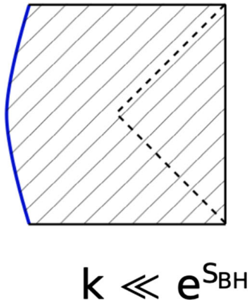
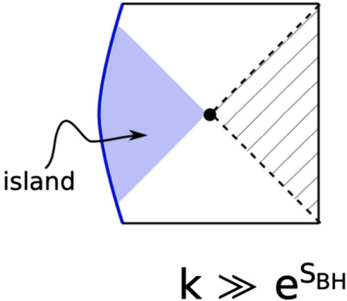
- Islands and the Page curve emerge from replica wormholes: the island rule is \(S(R)=\min_I \operatorname{ext}_I [S_{\rm ent-bulk}(R\cup I)+A(\partial I)/4G]\), and in the PSSY toy model \(\operatorname{Tr}(\rho_R^2)=1/k+Z^{(2)}/Z^{(1)2}\), with an island when \(k\gg e^{S_{BH}}\) and no island when \(k\ll e^{S_{BH}}\).
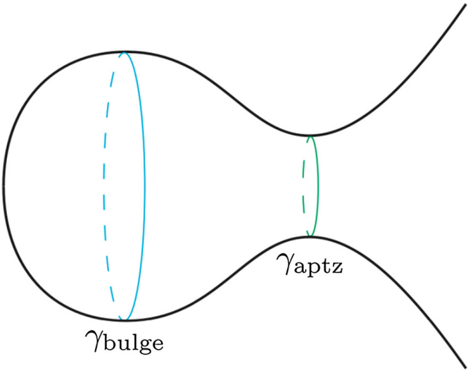
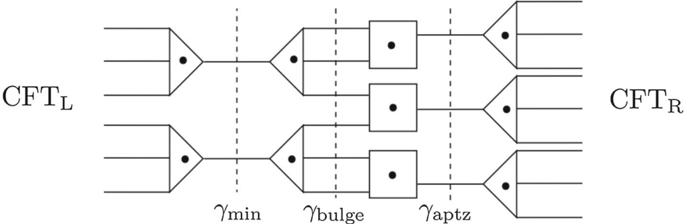
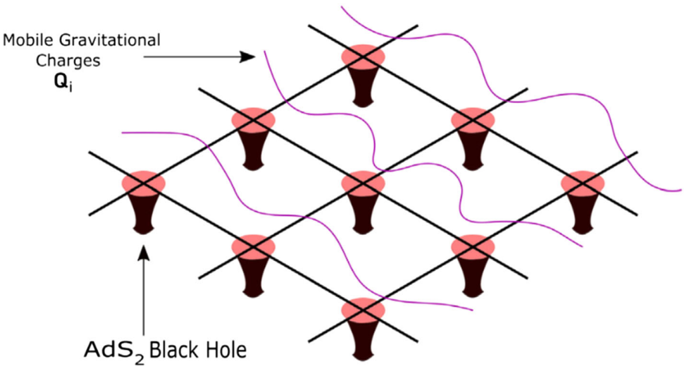
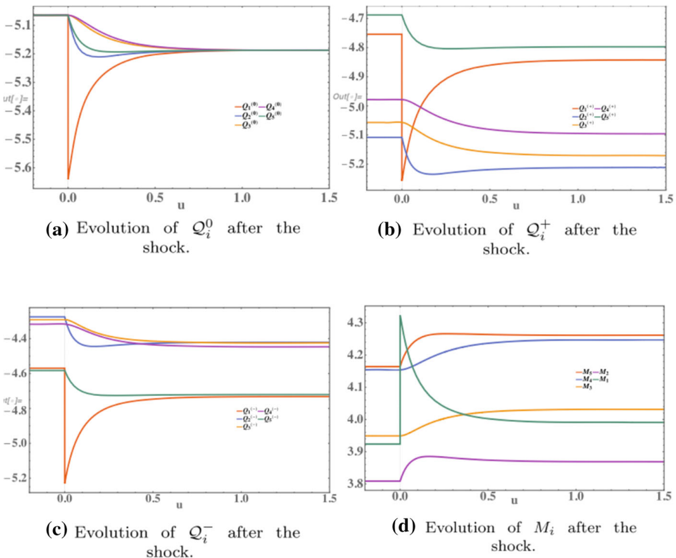
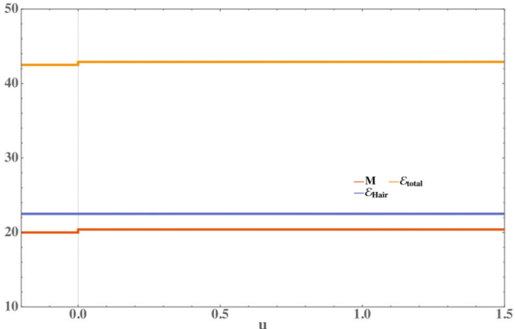
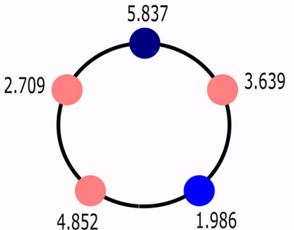
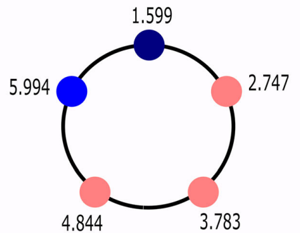
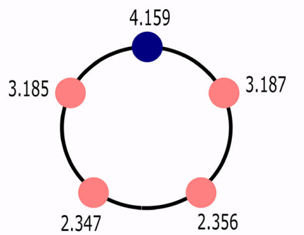
- Microstate models of a lattice of AdS\(_2\) throats with mobile hair show information mirroring and pseudorandom dynamics; for five lattice sites, less than 1 percent of shock energy is transferred to the hair, and decoding can use phase differences of positive normal modes. Python’s lunch decoding complexity is estimated as \(C=O(C\exp[\frac12(S_{\rm gen}(\gamma_{\rm bulge})-S_{\rm gen}(\gamma_{\rm aptz}))])\).
Methods
- Review article; the paper states it has no associated data and that all relevant data are in the cited references.
- Synthesizes AdS/CFT, quantum extremal surfaces, quantum error correction, tensor-network toy models (3-qutrit code, [[5,1,3]] code, holographic pentagon code, random tensor networks), replica wormholes, and microstate models.
- Main analysis is conceptual and derivational, with toy examples and numerical simulation of a five-site microstate lattice reported from cited work.
Limitations
- Stated in the paper: the QES proposal has not been proven, though it is believed correct; modular Hamiltonians are generically non-local and hard to compute; tensor networks may not reproduce all information-theoretic aspects beyond RT-type extremal surfaces; the review is restricted to asymptotically anti-de Sitter space.
- Stated for microstate models: it is not clear whether they have the shortest possible scrambling time, the bath region is fragmented into two-dimensional spaces, and further improvements are needed to glue baths into a connected flat asymptotic region.
- Evident from the text: as a review, it does not present new primary data or experiments, so its conclusions rest on the cited literature and toy-model arguments.
Model-written summary. Check it against the paper before relying on it.
Integrity signals
Registry
Cites
Statistics
Figures


Verification
Claims the paper makes
67 Valid · 8 Not valid · 63 Not checked · 211 Own results and interpretations
At least one cited source doesn’t support this claim or points to a different paper, and none confirmed it — see the verdicts below.
In the paper
“Theorem 2 (Operator Algebra QEC Condition) The algebra of observables A on a codespace C with projector P is correctable against noise N with operators {E i } if and only if [E i P, X ] = 0 for all errors E i associated with the noise N and all observables X ∈ A .”
§ Holographic spacetime, black holes and quantum error correcting codes: a review > 4.1 Preliminaries: quantum error correction
What the sources say
- Disputedcites [175] 175. D. Harlow, The Ryu-Takayanagi formula from quantum error correction. Commun. Math. Phys. 354(3), 865 (2017) 185. sourceExperimental — accuracy not yet measured
On p. 2, Theorem 1 gives [EₐP, X] = 0 as the condition for an algebra to be conserved by the noise channel, not corrected after recovery. Theorem 2 separately addresses correctability and says the operators E†cEᵦ play a key role; its displayed condition is not decoded in our copy. The citing sentence labels the conservation condition as the correctability condition. (LLM, conf=0.88)
Checked by a reasoning model — may be wrong.
plainstates an association- Asserted: passes — The authors put it forward as true.
- Checkable: passes — It can be checked against evidence.
- Load-bearing: passes — The paper’s conclusions depend on it.
- Based: passes — The paper gives a reason why it holds.
- Disputed
The cited sources support only part of this claim — read each source’s verdict below.
In the paper
“The generalized entropy is computed on a Cauchy slice (at some “time”), the GSL then states that the variation of this generalized entropy along any future directed normal to the Cauchy slice is non negative.”
§ Holographic spacetime, black holes and quantum error correcting codes: a review > 2.2 The entanglement wedge contains the causal wedge
What the sources say
- Partly supportedcites [83] 83. A.C. Wall, The generalized second law implies a quantum singu- larity theorem. Class. Quantum Gravity 30(16), 165003 (2013). https://doi.org/10.1088/0264-9381/30/16/165003 sourceExperimental — accuracy not yet measured
Section 2.2 states that generalized entropy is defined on a spatial slice and does not decrease when a later slice is compared with it. But its GSL inequality concerns the observer-side exterior of a horizon; it does not state non-negative variation along any future-directed normal to a Cauchy slice. The indexed passage provides no page number. (LLM, conf=0.88)
plainstates a cause- Asserted: passes — The authors put it forward as true.
- Checkable: passes — It can be checked against evidence.
- Load-bearing: passes — The paper’s conclusions depend on it.
- Based: passes — The paper gives a reason why it holds.
- Partly supported
The cited sources support only part of this claim — read each source’s verdict below.
In the paper
“The RT proposal was shown to be correct at the leading order in h by Lewkowycz and Maldacena (LM) [63].”
§ Holographic spacetime, black holes and quantum error correcting codes: a review > 2.1 Partial proof of the quantum extremal surface proposal
What the sources say
- Partly supportedcites [63] 63. A. Lewkowycz, J. Maldacena, Generalized gravitational entropy. J. High Energy Phys. 2013(8), 90 (2013). https://doi.org/10.1007/ JHEP08(2013)090 sourceExperimental — accuracy not yet measured
The Introduction (p. 4) treats the Ryu–Takayanagi formula as a statement about classical gravity and says the authors give an argument for it. The Conclusions (p. 26) say that argument depends on assumptions about analytic continuation for which they have no further justification. Thus the paper supports a leading-order derivation under those assumptions, but “shown to be correct” overstates its conclusion. (LLM, conf=0.88)
plainstates a cause- Asserted: passes — The authors put it forward as true.
- Checkable: passes — It can be checked against evidence.
- Load-bearing: unclear — It is unclear whether the paper’s conclusions depend on it.
- Based: passes — The paper gives a reason why it holds.
- Partly supported
The cited sources support only part of this claim — read each source’s verdict below.
In the paper
“The inclusion of this spatially disconnected island leads to reproduction the Page curve [47,48] for the timedependence of the von Neumann entropy of the Hawking radiation in consistency with unitarity without invalidating the effective semiclassical description of bulk”
§ Holographic spacetime, black holes and quantum error correcting codes: a review > 1 Introduction
What the sources say
- Partly supportedcites [47] 47. D.N. Page, Information in black hole radiation. Phys. Rev. Lett. 71(23), 3743 (1993). https://doi.org/10.1103/physrevlett.71.3743 sourceExperimental — accuracy not yet measured
Split into 2 atoms — 1 confirmed, 1 partially supported, 0 disputed, 0 misattributed, 0 unverifiable. Expand the claim to see per-atom verdicts.
- Partly supportedcites [48] 48. D.N. Page, Time dependence of hawking radiation entropy. J. Cosmol. Astropart. Phys. 2013(09), 028 (2013). https://doi.org/ 10.1088/1475-7516/2013/09/028 sourceExperimental — accuracy not yet measured
Split into 2 atoms — 1 confirmed, 0 partially supported, 0 disputed, 0 misattributed, 1 unverifiable. Expand the claim to see per-atom verdicts.
- Not matchedcites [49][50][51][52][53]
A range of references, not one source.
plainstates a cause- Asserted: passes — The authors put it forward as true.
- Checkable: passes — It can be checked against evidence.
- Load-bearing: passes — The paper’s conclusions depend on it.
- Based: passes — The paper gives a reason why it holds.
- Partly supported
The cited sources support only part of this claim — read each source’s verdict below.
In the paper
“They found that the entanglement entropy correct to O(h 0 ) is given by”
§ Holographic spacetime, black holes and quantum error correcting codes: a review > 2.1 Partial proof of the quantum extremal surface proposal
What the sources say
- Partly supportedcites [28] 28. T. Faulkner, A. Lewkowycz, J. Maldacena, Quantum correc- tions to holographic entanglement entropy. J. High Energy Phys. 2013(11), 74 (2013). https://doi.org/10.1007/JHEP11(2013)074 sourceExperimental — accuracy not yet measured
Section 1 (pp. 2–3) supports the leading area term and identifies bulk entanglement entropy as the leading quantum correction. But section 2.2 (p. 9) says the full correction also includes an area shift, a Wald-like term, and counterterm contributions. The claimed equality omits these terms without specifying conditions under which they vanish or are absorbed. (LLM, conf=0.88)
plainstates an association- Asserted: passes — The authors put it forward as true.
- Checkable: passes — It can be checked against evidence.
- Load-bearing: passes — The paper’s conclusions depend on it.
- Based: passes — The paper gives a reason why it holds.
- Partly supported
210 more claims · 39 with their cited sources checked
Create a free account to see all 349 claims and to verify the 66 references still open.
- Probably not a substantial claim. 51
- It may state two separate claims as one. 91
- The quote only partly states this claim. 5
Self-check
Percentages, sums and reported differences re-computed from the paper’s own numbers.
Each contradiction between two passages listed here was confirmed by an independent check.
Rated minor: it would not touch a result — a value no result rests on, a p-value that stays on the same side of the significance level, or a conflict that is clerical, resolved elsewhere in the paper, or outside its own findings.
In the paper
§ Holographic spacetime, black holes and quantum error correcting codes: a review > 4.1 Preliminaries: quantum error correction
“an [[n, k, t]] quantum code can correct perfectly for the loss of any set of t ≤ n qudits”
§ Holographic spacetime, black holes and quantum error correcting codes: a review > 4.2.3 Tensor network toy model for bulk reconstruction
“Such a tensor can then be thought of as a linear map from 1 (d-dimensional) system to 2n -1 (d-dimensional) systems, encoding a single quantum system is such a way that it is protected against the erasure of any n -1 subsystems.In QEC terminology, a perfect tensor with 2n indices corresponds to a [[2n -1, 1, n]] code”
Rated minor: it would not touch a result — a value no result rests on, a p-value that stays on the same side of the significance level, or a conflict that is clerical, resolved elsewhere in the paper, or outside its own findings.
In the paper
§ Holographic spacetime, black holes and quantum error correcting codes: a review > 3.3.1 The JLMS smearing function
“Since the bulk modular flow is the same as boundary modular flow as seen in Eq. ( 38), it follows that [φ ω , H σ ] = ωφ ω .”
§ Holographic spacetime, black holes and quantum error correcting codes: a review > 3.3.1 The JLMS smearing function
“[H σ , O ω ] = ωO ω ,(46)”
Rated minor: it would not touch a result — a value no result rests on, a p-value that stays on the same side of the significance level, or a conflict that is clerical, resolved elsewhere in the paper, or outside its own findings.
In the paper
§ Holographic spacetime, black holes and quantum error correcting codes: a review > 3.2 The equivalence of bulk and boundary relative entropies and its consequences
“S(ρ A∪B∪C |ρ A ⊗ ρ B∪C ) ≤ S(ρ A∪B |ρ A ⊗ ρ B ),(30)”
§ Holographic spacetime, black holes and quantum error correcting codes: a review > 3.2 The equivalence of bulk and boundary relative entropies and its consequences
“S(N (ρ)|N (σ )) ≤ S(ρ|σ ) (29”
Rated minor: it would not touch a result — a value no result rests on, a p-value that stays on the same side of the significance level, or a conflict that is clerical, resolved elsewhere in the paper, or outside its own findings.
In the paper
§ Holographic spacetime, black holes and quantum error correcting codes: a review > 3.2 The equivalence of bulk and boundary relative entropies and its consequences
“p i = Tr(A i σ ) and q i = Tr(A i ρ), and use the classical Kullback-Liebler divergence between p and q to define S 1 := S 1 (ρ|σ ) = sup A i i p i (log p i -log q i )”
§ Holographic spacetime, black holes and quantum error correcting codes: a review > 3.2 The equivalence of bulk and boundary relative entropies and its consequences
“S(ρ|σ ) = lim n→∞ S n .”
Citations
Cites
Quantum Computation and Quantum Information
Nielsen, M. A., Chuang, I., & Grover, L. K. (2002) · American Journal of Physics · doi:10.1119/1.1463744 · Cited by 21,895
Quantum computation and quantum information
Law, J. (2001) · ACM SIGSOFT Software Engineering Notes · doi:10.1145/505482.505499 · Cited by 18,842
Particle creation by black holes
Hawking, S. W. (1975) · Communications In Mathematical Physics · doi:10.1007/bf02345020 · Cited by 13,106 · cited 1×
“The most fundamental test of our understanding of the AdS/CFT correspondence is whether we can find explicit mechanisms for the resolution of black hole information paradoxes which are further refinements of Hawking’s original result that a semi-classical black hole should lose its mass to thermal (Hawking) radiation…”
BackgroundAnti de Sitter space and holography
Witten, E. (1998) · Advances in Theoretical and Mathematical Physics · doi:10.4310/atmp.1998.v2.n2.a2 · Cited by 13,070 · cited 2×
“The Euclidean partition function (Z) of the boundary theory is related to the on-shell bulk gravitational action (I) as follows [2, 3]:”
BackgroundMethodThe Large N Limit of Superconformal Field Theories and SupergravityPreprint
Maldacena, J. (1998) · Cited by 11,908
Gauge theory correlators from non-critical string theory
Gubser, S. S., Klebanov, I. R., & Polyakov, A. M. (1998) · Physics Letters B · doi:10.1016/s0370-2693(98)00377-3 · Cited by 9,307
Bekenstein, J. D. (1973) · Physical Review D · doi:10.1103/physrevd.7.2333 · Cited by 7,555
An Alternative to Compactification
Randall, L., & Sundrum, R. (1999) · Physical Review Letters · doi:10.1103/physrevlett.83.4690 · Cited by 7,217
The Large-N Limit of Superconformal Field Theories and Supergravity
Maldacena, J. (1999) · International Journal of Theoretical Physics · doi:10.1023/a:1026654312961 · Cited by 6,704 · cited 2×
“In QEC terminology, a perfect tensor with 2n indices corresponds to a [[2n−1, 1, n]] code, as exemplified by the well known [[5, 1, 3]] stabilizer code [177].”
BackgroundMethodLarge N field theories, string theory and gravity
Aharony, O., Gubser, S. S., Maldacena, J., Ooguri, H., & Oz, Y. (2000) · Physics Reports · doi:10.1016/s0370-1573(99)00083-6 · Cited by 5,515 · cited 1×
“The AdS/CFT correspondence and its generalizations are often called gauge/gravity dualities [13].”
BackgroundA single quantum cannot be cloned
Wootters, W. K., & Zurek, W. H. (1982) · Nature · doi:10.1038/299802a0 · Cited by 5,406 · cited 1×
“Since the no-cloning theorem prevents perfect copying of an arbitrary quantum state [170], QEC aims to protect against the effects of noise by encoding the information into entangled states of a larger Hilbert space.”
BackgroundHolographic Derivation of Entanglement Entropy from AdS/CFT
Ryu, S., & Takayanagi, T. (2006) · arXiv · doi:10.48550/arxiv.hep-th/0603001 · Cited by 4,321
Ryu, S., & Takayanagi, T. (2006) · Physical Review Letters · doi:10.1103/physrevlett.96.181602 · Cited by 4,302 · cited 5×
“Although tensor networks do model many aspects of holography, it is unclear if they reproduce all information theoretic aspects beyond the Ryu-Takanayagi type extremal surface which computes entanglement entropy.”
BackgroundMethodInfluentialSusskind, L. (1995) · Journal of Mathematical Physics · doi:10.1063/1.531249 · Cited by 4,085 · cited 1×
“The heuristic reasoning for the holographic principle of gravity is simply that if we stuff in enough matter in a box, then eventually it will collapse to form a black hole whose maximum possible size would be that of the box [4].”
BackgroundSusskind, L. (1994) · arXiv · doi:10.48550/arxiv.hep-th/9409089 · Cited by 4,085
The four laws of black hole mechanics
Bardeen, J. M., Carter, B., & Hawking, S. W. (1973) · Communications in Mathematical Physics · doi:10.1007/bf01645742 · Cited by 3,932
M theory as a matrix model: A conjecture
Banks, T., Fischler, W., Shenker, S. H., & Susskind, L. (1997) · Physical Review D · doi:10.1103/physrevd.55.5112 · Cited by 2,748
M Theory As A Matrix Model: A Conjecture
Banks, T., Fischler, W., Shenker, S. H., & Susskind, L. (1996) · arXiv · doi:10.48550/arxiv.hep-th/9610043 · Cited by 2,748
Breakdown of predictability in gravitational collapse
Hawking, S. W. (1976) · Physical Review D · doi:10.1103/physrevd.14.2460 · Cited by 2,554 · cited 1×
“The most fundamental test of our understanding of the AdS/CFT correspondence is whether we can find explicit mechanisms for the resolution of black hole information paradoxes which are further refinements of Hawking’s original result that a semi-classical black hole should lose its mass to thermal (Hawking) radiation…”
BackgroundHaag, R. (1996) · doi:10.1007/978-3-642-61458-3 · Cited by 2,443
Generalized second law of thermodynamics in black-hole physics
Bekenstein, J. D. (1974) · Physical Review D · doi:10.1103/physrevd.9.3292 · Cited by 2,166
Gapless spin-fluid ground state in a random quantum Heisenberg magnet
Sachdev, S., & Ye, J. (1993) · Physical Review Letters · doi:10.1103/physrevlett.70.3339 · Cited by 1,910 · cited 1×
“Essentially ti (u) is the timereparametrization mode of the i-th throat which determines the correlation functions in the localized state in terms of the vacuum correlation functions as in the Sachdev–Ye–Kitaev model [264,265] which could be the (UV complete) theory governing the quantum dots.”
MethodSrednicki, M. (1993) · Physical Review Letters · doi:10.1103/physrevlett.71.666 · Cited by 1,858
A covariant holographic entanglement entropy proposal
Hubeny, V. E., Rangamani, M., & Takayanagi, T. (2007) · Journal of High Energy Physics · doi:10.1088/1126-6708/2007/07/062 · Cited by 1,822 · cited 17×
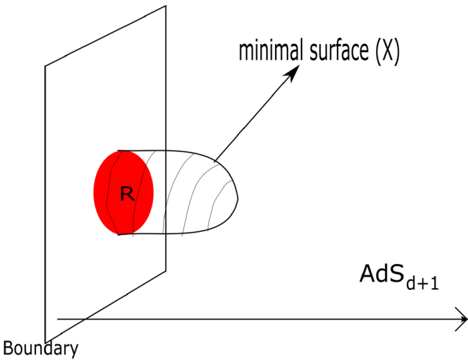
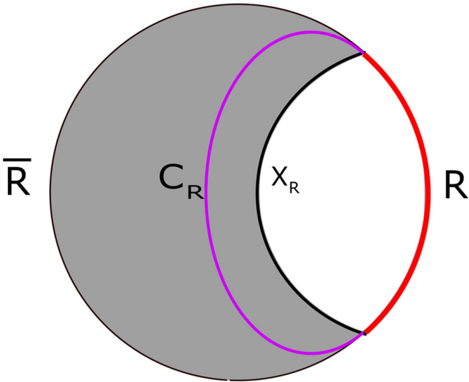
“The RT/HRT formula states that the entanglement entropy of a subregion R of the boundary theory is proportional to the area of the classical, bulk co-dimension two3 extremal surface that is anchored to the boundary of R and is homologous to R (see Fig.”
BackgroundInfluentialA Covariant Holographic Entanglement Entropy Proposal
Hubeny, V. E., Rangamani, M., & Takayanagi, T. (2007) · arXiv · doi:10.48550/arxiv.0705.0016 · Cited by 1,822 · cited 17×
“The RT/HRT formula states that the entanglement entropy of a subregion R of the boundary theory is proportional to the area of the classical, bulk co-dimension two3 extremal surface that is anchored to the boundary of R and is homologous to R (see Fig.”
BackgroundInfluentialSome properties of the Noether charge and a proposal for dynamical black hole entropy
Iyer, V., & Wald, R. M. (1994) · Physical Review D · doi:10.1103/physrevd.50.846 · Cited by 1,736 · cited 1×
“Then the change in the bulk relative entropy can be reproduced essentially from the variation of the gravitational action according to [117] which further develops results in [118].”
BackgroundEntanglement entropy and conformal field theory
Calabrese, P., & Cardy, J. (2009) · Journal of Physics A: Mathematical and Theoretical · doi:10.1088/1751-8113/42/50/504005 · Cited by 1,688 · cited 2×
“dimensional CFT which can be obtained using the methods of Cardy and Calabrese [142].”
MethodA Stress Tensor for Anti-de Sitter Gravity
Balasubramanian, V., & Kraus, P. (1999) · Communications in Mathematical Physics · doi:10.1007/s002200050764 · Cited by 1,658
Shear Viscosity of Strongly CoupledN=4Supersymmetric Yang-Mills Plasma
Policastro, G., Son, D. T., & Starinets, A. O. (2001) · Physical Review Letters · doi:10.1103/physrevlett.87.081601 · Cited by 1,658
Theory of quantum error-correcting codes
Knill, E., & Laflamme, R. (1997) · Physical Review A · doi:10.1103/physreva.55.900 · Cited by 1,593
Holographic Reconstruction of Spacetime¶and Renormalization in the AdS/CFT Correspondence
de Haro, S., Skenderis, K., & Solodukhin, S. N. (2001) · Communications in Mathematical Physics · doi:10.1007/s002200100381 · Cited by 1,536
Black holes and the butterfly effect
Shenker, S. H., & Stanford, D. (2014) · Journal of High Energy Physics · doi:10.1007/jhep03(2014)067 · Cited by 1,533 · cited 3×
“The latter has been computed based on growth of thermal commutators by Shenker and Stanford [243].”
MethodInfluentialBlack Holes: Complementarity or Firewalls?
Almheiri, A., Marolf, D., Polchinski, J., & Sully, J. (2012) · arXiv · doi:10.48550/arxiv.1207.3123 · Cited by 1,471
Black holes: complementarity or firewalls?
Almheiri, A., Marolf, D., Polchinski, J., & Sully, J. (2013) · Journal of High Energy Physics · doi:10.1007/jhep02(2013)062 · Cited by 1,470
Lecture notes on holographic renormalization
Skenderis, K. (2002) · Classical and Quantum Gravity · doi:10.1088/0264-9381/19/22/306 · Cited by 1,427
Cleve, R., Gottesman, D., & Lo, H.-K. (1999) · Physical Review Letters · doi:10.1103/physrevlett.83.648 · Cited by 1,373 · cited 1×
“The first example is provided the 3-qutrit code [173], defined by the span of the following three qutrit (3-dimensional) quantum states.”
BackgroundHenningson, M., & Skenderis, K. (1998) · Journal of High Energy Physics · doi:10.1088/1126-6708/1998/07/023 · Cited by 1,373
Quantum error correction for quantum memories
Terhal, B. M. (2015) · Reviews of Modern Physics · doi:10.1103/revmodphys.87.307 · Cited by 1,354 · cited 1×
“[168] for further details and references.”
Towards a derivation of holographic entanglement entropy
Casini, H., Huerta, M., & Myers, R. C. (2011) · Journal of High Energy Physics · doi:10.1007/jhep05(2011)036 · Cited by 1,347 · cited 3×
“5 The key to this result is the map of the bulk Rindler wedge dual to the domain of dependence DB of the ball shaped region at the boundary B to a hyperbolic black hole using [107] (the Casini-Huerta-Myers (CHM) map).”
BackgroundMethodInfluentialBlack holes as mirrors: quantum information in random subsystems
Hayden, P., & Preskill, J. (2007) · Journal of High Energy Physics · doi:10.1088/1126-6708/2007/09/120 · Cited by 1,332
Cool horizons for entangled black holes
Maldacena, J., & Susskind, L. (2013) · arXiv · doi:10.48550/arxiv.1306.0533 · Cited by 1,310
Cool horizons for entangled black holes
Maldacena, J., & Susskind, L. (2013) · Fortschritte der Physik · doi:10.1002/prop.201300020 · Cited by 1,304
Minkowski-space correlators in AdS/CFT correspondence: recipe and applications
Son, D. T., & Starinets, A. O. (2002) · Journal of High Energy Physics · doi:10.1088/1126-6708/2002/09/042 · Cited by 1,303
Chitambar, E., & Gour, G. (2019) · Reviews of Modern Physics · doi:10.1103/revmodphys.91.025001 · Cited by 1,276
Generalized gravitational entropy
Lewkowycz, A., & Maldacena, J. (2013) · Journal of High Energy Physics · doi:10.1007/jhep08(2013)090 · Cited by 1,183
Universal upper bound on the entropy-to-energy ratio for bounded systems
Bekenstein, J. D. (1981) · Physical Review D · doi:10.1103/physrevd.23.287 · Cited by 1,182
Information in black hole radiation
Page, D. N. (1993) · Physical Review Letters · doi:10.1103/physrevlett.71.3743 · Cited by 1,172 · cited 3×
“This is a consequence of Page’s theorem [47,48] which states that for a typical pure state in a bipartite system with one system being much smaller than the other, the trace distance between the density matrix of the smaller subsystem and the microcanonical ensemble is of the order of e−S/2 with S being the number of…”
BackgroundMethodNonlinear fluid dynamics from gravity
Bhattacharyya, S., Minwalla, S., Hubeny, V. E., & Rangamani, M. (2008) · Journal of High Energy Physics · doi:10.1088/1126-6708/2008/02/045 · Cited by 1,170
A Covariant Holographic Entanglement Entropy ProposalPreprint
Hubeny, V. E., Rangamani, M., & Takayanagi, T. (2008) · Cited by 1,164
Review of AdS/CFT Integrability: An Overview
Beisert, N., Ahn, C., Alday, L. F., Bajnok, Z., Drummond, J. M., Freyhult, L., Gromov, N., Janik, R. A., Kazakov, V., Klose, T., et al. (2012) · Letters in Mathematical Physics · doi:10.1007/s11005-011-0529-2 · Cited by 1,115
Sekino, Y., & Susskind, L. (2008) · Journal of High Energy Physics · doi:10.1088/1126-6708/2008/10/065 · Cited by 1,112
Jackiw, R. (1985) · Nuclear Physics B · doi:10.1016/0550-3213(85)90448-1 · Cited by 1,111
The stretched horizon and black hole complementarity
Susskind, L., Thorlacius, L., & Uglum, J. (1993) · Physical Review D · doi:10.1103/physrevd.48.3743 · Cited by 1,081 · cited 1×
“A simple way to resolve this paradox is to invoke the philosophy of black hole complementarity [245,246] which postulates that the violation cannot be observed operationally via a quantum complexity conjecture due to Harlow and Hayden [247] (see [248] for a nice discussion).”
BackgroundGravitation and hamiltonian structure in two spacetime dimensions
Teitelboim, C. (1983) · Physics Letters B · doi:10.1016/0370-2693(83)90012-6 · Cited by 1,064
Holographic Reconstruction of Spacetime and Renormalization in the AdS/CFT Correspondence
Haro, S. D., Skenderis, K., & Solodukhin, S. N. (2000) · CERN Document Server (European Organization for Nuclear Research) · Cited by 983
The information paradox: a pedagogical introduction
Mathur, S. D. (2009) · Classical and Quantum Gravity · doi:10.1088/0264-9381/26/22/224001 · Cited by 975
Entanglement wedge reconstruction and the information paradox
Penington, G. (2020) · Journal of High Energy Physics · doi:10.1007/jhep09(2020)002 · Cited by 968 · cited 2×
“Following the QES proposal by Engelhardt and Wall [25], the Page curve [46,47] for an evaporating black hole in AdS2 was computed in [48,49].”
BackgroundMethodPerfect Quantum Error Correcting Code
Laflamme, R., Miquel, C., Paz, J. P., & Zurek, W. H. (1996) · Physical Review Letters · doi:10.1103/physrevlett.77.198 · Cited by 963
Holographic quantum error-correcting codes: toy models for the bulk/boundary correspondence
Pastawski, F., Yoshida, B., Harlow, D., & Preskill, J. (2015) · Journal of High Energy Physics · doi:10.1007/jhep06(2015)149 · Cited by 958 · cited 4×
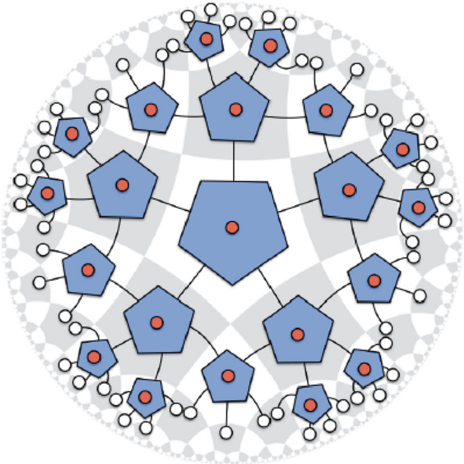
“We refer to [172] for a detailed discussion of the error correction properties of the pentagon code.”
BackgroundMethodInfluentialRenormalization group flows from holography: Supersymmetry and a $c$-theorem
Freedman, D. Z., Gubser, S. S., Pilch, K., & Warner, N. P. (1999) · Advances in Theoretical and Mathematical Physics · doi:10.4310/atmp.1999.v3.n2.a7 · Cited by 949
Quantum corrections to holographic entanglement entropy
Faulkner, T., Lewkowycz, A., & Maldacena, J. (2013) · Journal of High Energy Physics · doi:10.1007/jhep11(2013)074 · Cited by 945
The fuzzball proposal for black holes: an elementary review
Mathur, S. D. (2005) · Fortschritte der Physik · doi:10.1002/prop.200410203 · Cited by 937
The role of quantum information in thermodynamics—a topical review
Goold, J., Huber, M., Riera, A., Rio, L. D., & Skrzypczyk, P. (2016) · Journal of Physics A: Mathematical and Theoretical · doi:10.1088/1751-8113/49/14/143001 · Cited by 918
Entanglement renormalization and holography
Swingle, B. (2012) · Physical Review D · doi:10.1103/physrevd.86.065007 · Cited by 915 · cited 1×
“The latter was established first [260] in the context of multiscale-entanglement-renormalization (MERA) tensor networks.”
BackgroundReplica Wormholes and the Entropy of Hawking Radiation
Almheiri, A., Hartman, T., Maldacena, J., Shaghoulian, E., & Tajdini, A. (2019) · arXiv · doi:10.48550/arxiv.1911.12333 · Cited by 913
Replica wormholes and the entropy of Hawking radiation
Almheiri, A., Hartman, T., Maldacena, J., Shaghoulian, E., & Tajdini, A. (2020) · Journal of High Energy Physics · doi:10.1007/jhep05(2020)013 · Cited by 910
The Page curve of Hawking radiation from semiclassical geometry
Almheiri, A., Mahajan, R., Maldacena, J., & Zhao, Y. (2020) · Journal of High Energy Physics · doi:10.1007/jhep03(2020)149 · Cited by 898 · cited 3×
“Based on the above computation the authors of [50] proposed a new rule for computing entanglement entropies in setups that involve reference systems coupled to gravitational systems.”
BackgroundInfluentialRelativistic viscous hydrodynamics, conformal invariance, and holography
Baier, R., physik, F. F., Romatschke, P., Son, D. T., Stephanov, M., & Stephanov, M. A. (2008) · PUB – Publications at Bielefeld University (Bielefeld University) · Cited by 873
Zur Formulierung quantisierter Feldtheorien
Lehmann, H., Symanzik, K., & Zimmermann, W. (1955) · Il Nuovo Cimento · doi:10.1007/bf02731765 · Cited by 866 · cited 1×
“3) is more precisely the AdS analogue of the Lehmann-SymanzikZimmermann (LSZ) reduction [99] of S-matrices in flat space.”
BackgroundHolographic Complexity Equals Bulk Action?
Brown, A. R., Roberts, D. A., Susskind, L., Swingle, B., & Zhao, Y. (2016) · Physical Review Letters · doi:10.1103/physrevlett.116.191301 · Cited by 852
A covariant entropy conjecture
Bousso, R. (1999) · Journal of High Energy Physics · doi:10.1088/1126-6708/1999/07/004 · Cited by 850
Quantum extremal surfaces: holographic entanglement entropy beyond the classical regime
Engelhardt, N., & Wall, A. C. (2015) · Journal of High Energy Physics · doi:10.1007/jhep01(2015)073 · Cited by 836 · cited 17×
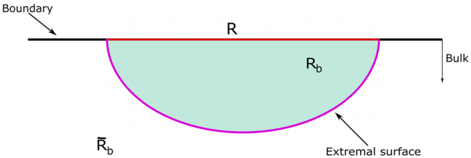
“The Engelhardt–Wall prescription states that for any boundary subregion R S(R)bdy = A(χR) 4G + Sent-bulk (32) where χR is the quantum extremal surface which extremizes the generalized entropy with Sent-bulk the entanglement entropy of the bulk matter within the corresponding entanglement wedge.”
BackgroundMethodInfluentialProof of the strong subadditivity of quantum-mechanical entropy
Lieb, E. H., & Ruskai, M. B. (1973) · Journal of Mathematical Physics · doi:10.1063/1.1666274 · Cited by 831
The entropy of bulk quantum fields and the entanglement wedge of an evaporating black hole
Almheiri, A., Engelhardt, N., Marolf, D., & Maxfield, H. (2019) · Journal of High Energy Physics · doi:10.1007/jhep12(2019)063 · Cited by 818 · cited 6×
“Although a Page curve was seen for the entropy of the quantum dot (dual to the evaporating black hole), the entropy of the Hawking radiation computed semi-classically in [48] was shown to grow monotonically as seen in Hawking’s original computation.”
BackgroundMethodInfluentialReplica wormholes and the black hole interior
Penington, G., Shenker, S. H., Stanford, D., & Yang, Z. (2019) · arXiv · doi:10.48550/arxiv.1911.11977 · Cited by 809
Replica wormholes and the black hole interior
Penington, G., Shenker, S. H., Stanford, D., & Yang, Z. (2022) · Journal of High Energy Physics · doi:10.1007/jhep03(2022)205 · Cited by 807 · cited 2×
“More recently, it has been shown that a Petz-like map can be used to demonstrate bulk reconstruction in random tensor network toy models [51,180] of holography.”
BackgroundRelativistic viscous hydrodynamics, conformal invariance, and holography
Baier, R., Romatschke, P., Son, D. T., Starinets, A. O., & Stephanov, M. A. (2008) · Journal of High Energy Physics · doi:10.1088/1126-6708/2008/04/100 · Cited by 806
Bulk Locality and Quantum Error Correction in AdS/CFT
Almheiri, A., Dong, X., & Harlow, D. (2014) · arXiv · doi:10.48550/arxiv.1411.7041 · Cited by 803
Bulk locality and quantum error correction in AdS/CFT
Almheiri, A., Dong, X., & Harlow, D. (2015) · Journal of High Energy Physics · doi:10.1007/jhep04(2015)163 · Cited by 802 · cited 3×
“subspaces of the states of the CFT at the boundary [32,176].”
BackgroundInfluentialHolographic entanglement entropy: an overview
Nishioka, T., Ryu, S., & Takayanagi, T. (2009) · Journal of Physics A: Mathematical and Theoretical · doi:10.1088/1751-8113/42/50/504008 · Cited by 790
Holography from conformal field theory
Heemskerk, I., Penedones, J., Polchinski, J., & Sully, J. (2009) · Journal of High Energy Physics · doi:10.1088/1126-6708/2009/10/079 · Cited by 787
Computational complexity and black hole horizons
Susskind, L. (2016) · Fortschritte der Physik · doi:10.1002/prop.201500092 · Cited by 767
Hawking, S. W., Perry, M. J., & Strominger, A. (2016) · Physical Review Letters · doi:10.1103/physrevlett.116.231301 · Cited by 764
Black hole entropy in canonical quantum gravity and superstring theory
Susskind, L., & Uglum, J. (1994) · Physical Review D · doi:10.1103/physrevd.50.2700 · Cited by 754 · cited 1×
“A simple way to resolve this paradox is to invoke the philosophy of black hole complementarity [245,246] which postulates that the violation cannot be observed operationally via a quantum complexity conjecture due to Harlow and Hayden [247] (see [248] for a nice discussion).”
BackgroundThe Page curve of Hawking radiation from semiclassical geometry
Almheiri, A., Mahajan, R., Maldacena, J., & Zhao, Y. (2019) · arXiv · doi:10.48550/arxiv.1908.10996 · Cited by 748
The entropy of bulk quantum fields and the entanglement wedge of an evaporating black hole
Almheiri, A., Engelhardt, N., Marolf, D. M., & Maxfield, H. (2019) · eScholarship (California Digital Library) · Cited by 734
Purans, J., Afify, N., Dalba, G., Grisenti, R., Sanson, A., Fornasini, P., de Panfilis, S., Kuzmin, A., Ozhogin, V., Rocca, F., et al. (2004) · HAL (Le Centre pour la Communication Scientifique Directe) · doi:10.1103/physrevlett · Cited by 731
The entropy of Hawking radiation
Almheiri, A., Hartman, T., Maldacena, J., Shaghoulian, E., & Tajdini, A. (2021) · Reviews of Modern Physics · doi:10.1103/revmodphys.93.035002 · Cited by 706
The entropy of Hawking radiation
Almheiri, A., Hartman, T., Maldacena, J., Shaghoulian, E., & Tajdini, A. (2020) · arXiv · doi:10.48550/arxiv.2006.06872 · Cited by 706
Haag, R. (1992) · doi:10.1007/978-3-642-97306-2 · Cited by 694
Models of AdS2 backreaction and holography
Almheiri, A., & Polchinski, J. (2015) · Journal of High Energy Physics · doi:10.1007/jhep11(2015)014 · Cited by 678
Karch, A., & Randall, L. (2001) · Journal of High Energy Physics · doi:10.1088/1126-6708/2001/05/008 · Cited by 674 · cited 1×
“This is essentially the same as the setup in [143,144] where the dynamical boundary was called the Planck brane.”
Gauge/String Duality, Hot QCD and Heavy Ion Collisions
Casalderrey-Solana, J., Liu, H., Mateos, D., Rajagopal, K., & Wiedemann, U. A. (2014) · Cambridge University Press eBooks · doi:10.1017/cbo9781139136747 · Cited by 664 · cited 1×
“This has led to an enormous impact in understanding the collective description of many strongly interacting systems, including strongly correlated quantum materials [15], non-perturbative dynamics of QCD [16, 17] and its various phases such as the quark-gluon plasma [18].”
BackgroundOn the duality condition for quantum fields
Bisognano, J. J., & Wichmann, E. H. (1976) · Journal of Mathematical Physics · doi:10.1063/1.522898 · Cited by 642
Complexity, action, and black holes
Brown, A. R., Roberts, D. A., Susskind, L., Swingle, B., & Zhao, Y. (2016) · Physical Review D · doi:10.1103/physrevd.93.086006 · Cited by 640
Monogamy of quantum entanglement and other correlations
Koashi, M., & Winter, A. (2004) · Physical Review A · doi:10.1103/physreva.69.022309 · Cited by 609 · cited 1×
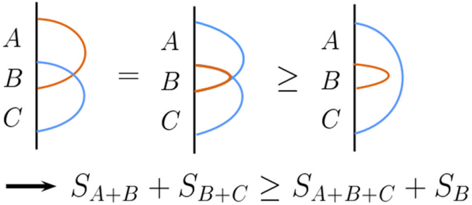
“The strong sub-additivity property of the entanglement entropy would prevent simultaneous maximal entanglement of a system with two other systems [204].”
BackgroundThe Holographic Bound in Anti-de Sitter Space
Susskind, L., & Witten, E. (1998) · arXiv · doi:10.48550/arxiv.hep-th/9805114 · Cited by 604 · cited 1×
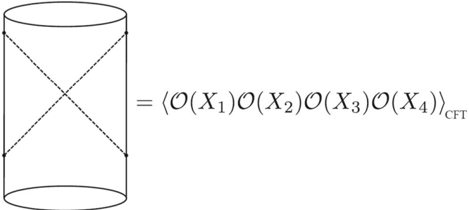
“An extrapolate dictionary stated in [97,98] relates correlation functions of the boundary theory in the state ρB to scattering S-matrices of the semiclassical bulk fields in the geometry B as follows:(2)”
MethodHolographic duality from random tensor networks
Hayden, P., Nezami, S., Qi, X.-L., Thomas, N., Walter, M., & Yang, Z. (2016) · Journal of High Energy Physics · doi:10.1007/jhep11(2016)009 · Cited by 599 · cited 1×
“Moving beyond holographic codes based on perfect tensors, toy models of holography have been proposed using random tensor networks [178].”
BackgroundWitten, E. (2018) · Reviews of Modern Physics · doi:10.1103/revmodphys.90.045003 · Cited by 567
Maldacena, J., Michelson, J., & Strominger, A. (1999) · Journal of High Energy Physics · doi:10.1088/1126-6708/1999/02/011 · Cited by 548
Maximin surfaces, and the strong subadditivity of the covariant holographic entanglement entropy
Wall, A. C. (2014) · Classical and Quantum Gravity · doi:10.1088/0264-9381/31/22/225007 · Cited by 545 · cited 5×
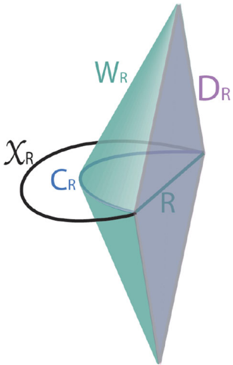
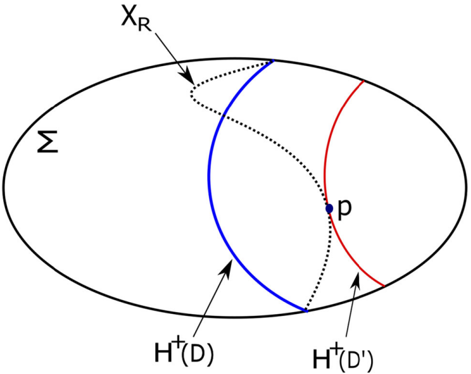
“was shown for the covariant HRT prescription in [27] using the maximin surfaces defined as follows.”
BackgroundMethodInfluentialReconstruction of Bulk Operators within the Entanglement Wedge in Gauge-Gravity Duality
Dong, X., Harlow, D., & Wall, A. C. (2016) · Physical Review Letters · doi:10.1103/physrevlett.117.021601 · Cited by 541 · cited 2×
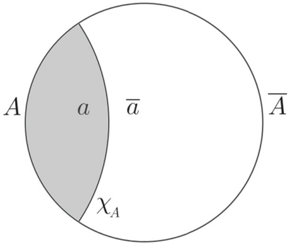
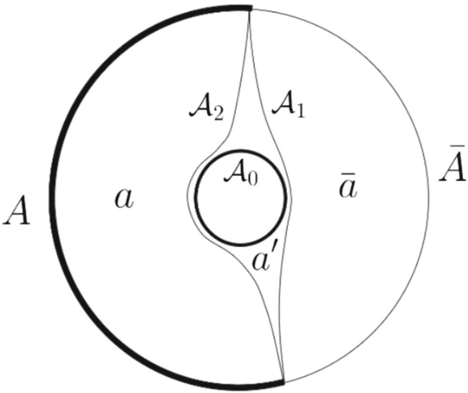
“Formally, following the discussion in [34], we may consider a factorization of the boundary CFT H into HA ⊗HĀ as shown in Fig.”
BackgroundMethodReconstruction of Bulk Operators within the Entanglement Wedge in Gauge-Gravity Duality
Dong, X., Harlow, D., & Wall, A. C. (2016) · arXiv · doi:10.48550/arxiv.1601.05416 · Cited by 541 · cited 2×
“Formally, following the discussion in [34], we may consider a factorization of the boundary CFT H into HA ⊗HĀ as shown in Fig.”
BackgroundMethodRelative entropy equals bulk relative entropy
Jafferis, D. L., Lewkowycz, A., Maldacena, J., & Suh, S. J. (2016) · Journal of High Energy Physics · doi:10.1007/jhep06(2016)004 · Cited by 539 · cited 16×
“Jafferis, Lewkowycz, Maldacena and Suh (JLMS) [30] proposed that this inconsistency can be resolved if the bulk reconstruction equation takes the form:”
BackgroundInfluentialRelative entropy equals bulk relative entropy
Jafferis, D. L., Lewkowycz, A., Maldacena, J., & Suh, S. J. (2015) · arXiv · doi:10.48550/arxiv.1512.06431 · Cited by 534 · cited 16×
“Jafferis, Lewkowycz, Maldacena and Suh (JLMS) [30] proposed that this inconsistency can be resolved if the bulk reconstruction equation takes the form:”
BackgroundInfluentialThe proper formula for relative entropy and its asymptotics in quantum probability
Hiai, F., & Petz, D. (1991) · Communications in Mathematical Physics · doi:10.1007/bf02100287 · Cited by 522 · cited 1×
“The result of Hiai and Petz is that [108]:”
BackgroundGravitation from entanglement in holographic CFTs
Faulkner, T., Guica, M., Hartman, T., Myers, R. C., & Van Raamsdonk, M. (2014) · Journal of High Energy Physics · doi:10.1007/jhep03(2014)051 · Cited by 520
Holographic representation of local bulk operators
Hamilton, A., Kabat, D., Lifschytz, G., & Lowe, D. A. (2006) · Physical Review D · doi:10.1103/physrevd.74.066009 · Cited by 509 · cited 1×
“HKLL showed that the reconstruction of the bulk operator in a Rindler wedge can be made manifestly consistent with the extrapolate dictionary if we work in Rindler coordinates (which covers WR) instead of the global coordinates of AdS [102, 103].”
MethodJerusalem lectures on black holes and quantum information
Harlow, D. (2016) · Reviews of Modern Physics · doi:10.1103/revmodphys.88.015002 · Cited by 480 · cited 1×
“26 An illustration of the Hayden–Preskill thought experiment which argues for quantum information mirroring in old black holes – figure taken from [56].”
BackgroundSchwinger-Keldysh propagators from AdS/CFT correspondence
Herzog, C. P., & Son, D. T. (2003) · Journal of High Energy Physics · doi:10.1088/1126-6708/2003/03/046 · Cited by 479
Better Late than Never: Information Retrieval from Black Holes
Braunstein, S. L., Pirandola, S., & Życzkowski, K. (2013) · Physical Review Letters · doi:10.1103/physrevlett.110.101301 · Cited by 460
JT gravity as a matrix integral
Saad, P., Shenker, S. H., & Stanford, D. (2019) · arXiv · doi:10.48550/arxiv.1903.11115 · Cited by 442 · cited 1×
“22 In fact JT gravity has a full non-perturbative dual description in terms of an ensemble of random matrices [226,227].”
BackgroundRelative entropy and the Wigner-Yanase-Dyson-Lieb concavity in an interpolation theory
Uhlmann, A. (1977) · Communications in Mathematical Physics · doi:10.1007/bf01609834 · Cited by 431 · cited 1×
“This is often referred to as Uhlmann’s theorem [111] in quantum information theory.”
BackgroundStructure of States Which Satisfy Strong Subadditivity of Quantum Entropy with Equality
Hayden, P., Jozsa, R., Petz, D., & Winter, A. (2004) · Communications in Mathematical Physics · doi:10.1007/s00220-004-1049-z · Cited by 429
The gravity dual of a density matrix
Czech, B., Karczmarek, J. L., Nogueira, F., & Van Raamsdonk, M. (2012) · Classical and Quantum Gravity · doi:10.1088/0264-9381/29/15/155009 · Cited by 428
Renormalization group running of the entanglement entropy of a circle
Casini, H., & Huerta, M. (2012) · Physical Review D · doi:10.1103/physrevd.85.125016 · Cited by 424
Holographic and Wilsonian renormalization groups
Heemskerk, I., & Polchinski, J. (2011) · Journal of High Energy Physics · doi:10.1007/jhep06(2011)031 · Cited by 424
Causality & holographic entanglement entropy
Headrick, M., Hubeny, V. E., Lawrence, A., & Rangamani, M. (2014) · Journal of High Energy Physics · doi:10.1007/jhep12(2014)162 · Cited by 418
Seeing a c-theorem with holography
Myers, R. C., & Sinha, A. (2010) · Physical Review D · doi:10.1103/physrevd.82.046006 · Cited by 417
Holography in general space-times
Bousso, R. (1999) · Journal of High Energy Physics · doi:10.1088/1126-6708/1999/06/028 · Cited by 410
The Ryu–Takayanagi Formula from Quantum Error Correction
Harlow, D. (2017) · Communications in Mathematical Physics · doi:10.1007/s00220-017-2904-z · Cited by 384 · cited 1×
“Such random tensor networks are known to successfully demonstrate several holographic properties [184] and have been recently used to demonstrate approximate bulk reconstruction [185] via the universal recovery map described in Sect.”
MethodRelative entropy and holography
Blanco, D. D., Casini, H., Hung, L.-Y., & Myers, R. C. (2013) · Journal of High Energy Physics · doi:10.1007/jhep08(2013)060 · Cited by 375 · cited 1×
“This implies the first law of entanglement entropy [112]”
BackgroundAnti De Sitter Space And Holography
Witten, E. (1998) · arXiv · doi:10.48550/arxiv.hep-th/9802150 · Cited by 374 · cited 2×
“The Euclidean partition function (Z) of the boundary theory is related to the on-shell bulk gravitational action (I) as follows [2, 3]:”
BackgroundMethodTime dependence of Hawking radiation entropy
Page, D. N. (2013) · Journal of Cosmology and Astroparticle Physics · doi:10.1088/1475-7516/2013/09/028 · Cited by 354 · cited 3×
“This is a consequence of Page’s theorem [47,48] which states that for a typical pure state in a bipartite system with one system being much smaller than the other, the trace distance between the density matrix of the smaller subsystem and the microcanonical ensemble is of the order of e−S/2 with S being the number of…”
BackgroundMethodAdS Dynamics from Conformal Field Theory
Banks, T., Douglas, M. R., Horowitz, G. T., & Martinec, E. (1998) · arXiv · doi:10.48550/arxiv.hep-th/9808016 · Cited by 342
Chatrchyan, S., Clerbaux, B., Lentdecker, G. D., Hreus, T., Marage, P., Thomas, L., Velde, C. V., & Vanlaer, P. (2011) · Dépôt institutionnel de l'Université libre de Bruxelles (Université Libre de Bruxelles) · doi:10.1007/jhep09 · Cited by 338
An infalling observer in AdS/CFT
Papadodimas, K., & Raju, S. (2013) · Journal of High Energy Physics · doi:10.1007/jhep10(2013)212 · Cited by 335 · cited 2×
“It was argued by Papadodimas and Raju [56,222,223] that the reconstruction of the black hole interior in the dual boundary theory has to be”
BackgroundHolographic Entanglement Entropy
Rangamani, M., & Takayanagi, T. (2017) · Lecture Notes in Physics · doi:10.1007/978-3-319-52573-0 · Cited by 333
Bousso, R., Fisher, Z., Leichenauer, S., & Wall, A. C. (2016) · Physical Review D · doi:10.1103/physrevd.93.064044 · Cited by 330 · cited 2×
“One example of such a connection is the postulate of the quantum null-energy condition which states that the expectation value of a null projection of the energy-momentum tensor is bounded from below by a specific null variation of the entanglement entropy [36].”
BackgroundJT Gravity and the Ensembles of Random Matrix Theory
Stanford, D., & Witten, E. (2019) · arXiv · doi:10.48550/arxiv.1907.03363 · Cited by 327
Holographic mutual information is monogamous
Hayden, P., Headrick, M., & Maloney, A. (2013) · Physical Review D · doi:10.1103/physrevd.87.046003 · Cited by 326 · cited 1×
“These inequalities haven’t been shown to hold when we include quantum corrections via the QES prescription, however exploration in this direction was initiated in [87] where it was shown that if the bulk entropies obey the monogamy of mutual information [64] then the dual boundary entropies also obey the same.”
BackgroundReal-time gauge/gravity duality: prescription, renormalization and examples
Skenderis, K., & Rees, B. C. V. (2009) · Journal of High Energy Physics · doi:10.1088/1126-6708/2009/05/085 · Cited by 323
The Page curve of Hawking radiation from semiclassical geometry
Almheiri, A. (2023) · OSTI OAI (U.S. Department of Energy Office of Scientific and Technical Information) · doi:10.1007/jhep03%282020%29149 · Cited by 323
Quantum computation vs. firewalls
Harlow, D., & Hayden, P. (2013) · Journal of High Energy Physics · doi:10.1007/jhep06(2013)085 · Cited by 310 · cited 10×
“A simple way to resolve this paradox is to invoke the philosophy of black hole complementarity [254,255] which postulates that the violation cannot be observed operationally via a quantum complexity conjecture due to Harlow and Hayden [256] (see [257] for a nice discussion).”
BackgroundInfluentialThe Complexity of Quantum States and Transformations: From Quantum Money to Black HolesPreprint
Aaronson, S. (2016) · arXiv (Cornell University) · doi:10.48550/arxiv.1607.05256 · Cited by 305
JT gravity and the ensembles of random matrix theory
Stanford, D., & Witten, E. (2020) · Advances in Theoretical and Mathematical Physics · doi:10.4310/atmp.2020.v24.n6.a4 · Cited by 303 · cited 1×
“16 In fact JT gravity has a full non-perturbative dual description in terms of an ensemble of random matrices [218,219].”
BackgroundHolographic proof of the strong subadditivity of entanglement entropy
Headrick, M., & Takayanagi, T. (2007) · Physical Review D · doi:10.1103/physrevd.76.106013 · Cited by 299
Baby universe, third quantization and the cosmological constant
Giddings, S. B., & Strominger, A. (1989) · Nuclear Physics B · doi:10.1016/0550-3213(89)90353-2 · Cited by 295
Black hole entropy and entropy of entanglement
Kabat, D. (1995) · Nuclear Physics B · doi:10.1016/0550-3213(95)00443-v · Cited by 284
Unified and Generalized Approach to Quantum Error Correction
Kribs, D., Laflamme, R., & Poulin, D. (2005) · Physical Review Letters · doi:10.1103/physrevlett.94.180501 · Cited by 283 · cited 1×
“Moving beyond states, the framework of QEC can be easily extended to operator error correction [169,170].”
BackgroundGravitational dynamics from entanglement “thermodynamics”
Lashkari, N., McDermott, M. B., & Van Raamsdonk, M. (2014) · Journal of High Energy Physics · doi:10.1007/jhep04(2014)195 · Cited by 281 · cited 1×
“It was shown in [117, 118] using results from [109, 119] that at the leading and”
ResultReversing quantum dynamics with near-optimal quantum and classical fidelity
Barnum, H., & Knill, E. (2002) · Journal of Mathematical Physics · doi:10.1063/1.1459754 · Cited by 280 · cited 3×
“(68) was shown to be a universal, near-optimal recovery map, where optimality was characterized using the average entanglement fidelity [189].”
BackgroundMethodResultInfluentialRelative entropy and the Bekenstein bound
Casini, H. (2008) · Classical and Quantum Gravity · doi:10.1088/0264-9381/25/20/205021 · Cited by 280
Structure of states which satisfy strong subadditivity of quantum entropy with equality
Hayden, P. M., Jozsa, R., Petz, D., & Winter, A. (2003) · CERN Document Server (European Organization for Nuclear Research) · Cited by 279
41Ca: past, present and future
Fink, D., Klein, J., & Middleton, R. (1990) · Nuclear Instruments and Methods in Physics Research Section B: Beam Interactions with Materials and Atoms · doi:10.1016/0168-583x(90)90479-e · Cited by 275
Modular structure of the local algebras associated with the free massless scalar field theory
Hislop, P. D., & Longo, R. (1982) · Communications in Mathematical Physics · doi:10.1007/bf01208372 · Cited by 269
Deriving covariant holographic entanglement
Dong, X., Lewkowycz, A., & Rangamani, M. (2016) · Journal of High Energy Physics · doi:10.1007/jhep11(2016)028 · Cited by 268
State-dependent bulk-boundary maps and black hole complementarity
Papadodimas, K., & Raju, S. (2014) · Physical Review D · doi:10.1103/physrevd.89.086010 · Cited by 267 · cited 2×
“It was argued by Papadodimas and Raju [56,222,223] that the reconstruction of the black hole interior in the dual boundary theory has to be”
BackgroundHartnoll, S. A., Lucas, A., & Sachdev, S. (2016) · arXiv (Cornell University) · doi:10.48550/arxiv.1612.07324 · Cited by 258
An Infalling Observer in AdS/CFTPreprint
Papadodimas, K., & Raju, S. (2016) · Cited by 255
Geng, H., & Karch, A. (2020) · Journal of High Energy Physics · doi:10.1007/jhep09(2020)121 · Cited by 251
Anti–de Sitter Space from Optimization of Path Integrals in Conformal Field Theories
Caputa, P., Kundu, N., Miyaji, M., Takayanagi, T., & Watanabe, K. (2017) · Physical Review Letters · doi:10.1103/physrevlett.119.071602 · Cited by 243 · cited 1×
“See also [262] for a path integral formulation in which the continuum version of the tensor network is reformulated as an optimization problem.”
BackgroundRelative entropy and holography
Blanco, D., Casini, H., Lin Yang, H., & Myers, R. C. (2013) · Americanae (AECID Library) · Cited by 242
Quantum extremal islands made easy. Part I. Entanglement on the brane
Chen, H. Z., Myers, R. C., Neuenfeld, D., Reyes, I. A., & Sandor, J. (2020) · Journal of High Energy Physics · doi:10.1007/jhep10(2020)166 · Cited by 241
A Fundamental Property of Quantum-Mechanical Entropy
Lieb, E. H., & Ruskai, M. B. (1973) · Physical Review Letters · doi:10.1103/physrevlett.30.434 · Cited by 240 · cited 1×
“The strong sub-additivity condition states that [82,83]”
Information transfer with a gravitating bath
Geng, H., Karch, A., Perez-Pardavila, C., Raju, S., Randall, L., Riojas, M., & Shashi, S. (2021) · SciPost Physics · doi:10.21468/scipostphys.10.5.103 · Cited by 239
Lessons from the Information Paradox
Raju, S. (2020) · arXiv · doi:10.48550/arxiv.2012.05770 · Cited by 234
Modular Hamiltonians for deformed half-spaces and the averaged null energy condition
Faulkner, T., Leigh, R. G., Parrikar, O., & Wang, H. (2016) · Journal of High Energy Physics · doi:10.1007/jhep09(2016)038 · Cited by 230
Entanglement islands in higher dimensions
Almheiri, A., Mahajan, R., & Santos, J. (2020) · SciPost Physics · doi:10.21468/scipostphys.9.1.001 · Cited by 230
Entanglement Renormalization and Holography
Swingle, B. G. (2009) · DSpace@MIT (Massachusetts Institute of Technology) · doi:10.48550/arxiv.0905.1317 · Cited by 227 · cited 1×
“The latter was established first [260] in the context of multiscale-entanglement-renormalization (MERA) tensor networks.”
BackgroundLessons from the information paradox
Raju, S. (2022) · Physics Reports · doi:10.1016/j.physrep.2021.10.001 · Cited by 227 · cited 2×
“It was argued by Papadodimas and Raju [56,222,223] that the reconstruction of the black hole interior in the dual boundary theory has to be”
BackgroundHydrodynamic Gradient Expansion in Gauge Theory Plasmas
Heller, M. P., Janik, R. A., & Witaszczyk, P. (2013) · Physical Review Letters · doi:10.1103/physrevlett.110.211602 · Cited by 223
Entanglement Wedge Reconstruction via Universal Recovery Channels
Cotler, J., Hayden, P., Penington, G., Salton, G., Swingle, B., & Walter, M. (2019) · Physical Review X · doi:10.1103/physrevx.9.031011 · Cited by 221
Entanglement Wedge Reconstruction via Universal Recovery Channels
Cotler, J., Hayden, P., Penington, G., Salton, G., Swingle, B., & Walter, M. (2017) · arXiv · doi:10.48550/arxiv.1704.05839 · Cited by 221
Bulk locality from modular flow
Faulkner, T., & Lewkowycz, A. (2017) · Journal of High Energy Physics · doi:10.1007/jhep07(2017)151 · Cited by 217
Proof of the quantum null energy condition
Bousso, R., Fisher, Z., Koeller, J., Leichenauer, S., & Wall, A. C. (2016) · Physical Review D · doi:10.1103/physrevd.93.024017 · Cited by 215 · cited 1×
“This postulate has not only been proven in holographic field theories [37], but also in generic two-dimensional CFTs [38] and free field theories [39,40], and is also expected to hold generally.”
BackgroundModular Hamiltonians for deformed half-spaces and the averaged null energy condition
Faulkner, T. R. (2022) · OSTI OAI (U.S. Department of Energy Office of Scientific and Technical Information) · doi:10.1007/jhep09%282016%29038 · Cited by 215
A stereoscopic look into the bulk
Czech, B., Lamprou, L., McCandlish, S., Mosk, B., & Sully, J. (2016) · Journal of High Energy Physics · doi:10.1007/jhep07(2016)129 · Cited by 207
Bao, N., Nezami, S., Ooguri, H., Stoica, B., Sully, J., & Walter, M. (2015) · Journal of High Energy Physics · doi:10.1007/jhep09(2015)130 · Cited by 205
Deriving the AdS3/CFT2 correspondence
Eberhardt, L., Gaberdiel, M. R., & Gopakumar, R. (2020) · Journal of High Energy Physics · doi:10.1007/jhep02(2020)136 · Cited by 205
Entanglement islands in higher dimensions
Almheiri, A., Mahajan, R., & Santos, J. E. (2020) · Apollo (University of Cambridge) · doi:10.17863/cam.55249 · Cited by 204
Information radiation in BCFT models of black holes
Rozali, M., Sully, J., Van Raamsdonk, M., Waddell, C., & Wakeham, D. (2020) · Journal of High Energy Physics · doi:10.1007/jhep05(2020)004 · Cited by 194 · cited 1×
“Similar models for black hole evaporation were studied in [137,138].”
MethodRenormalization of black hole entropy and of the gravitational coupling constant
Larsen, F., & Wilczek, F. (1996) · Nuclear Physics B · doi:10.1016/0550-3213(95)00548-x · Cited by 192
Almheiri, A., Mahajan, R., & Maldacena, J. (2019) · arXiv · doi:10.48550/arxiv.1910.11077 · Cited by 191 · cited 1×
“It has also been shown that islands can extend outside of event horizons [148].”
BackgroundCausal holographic information
Hubeny, V. E., & Rangamani, M. (2012) · Journal of High Energy Physics · doi:10.1007/jhep06(2012)114 · Cited by 190
Precision holography for non-conformal branes
Kanitscheider, I., Skenderis, K., & Taylor, M. (2008) · Journal of High Energy Physics · doi:10.1088/1126-6708/2008/09/094 · Cited by 188 · cited 1×
“This procedure is called holographic renormalization [90–93] (see [94] for implementation in more general cases).”
MethodEntanglement negativity and minimal entanglement wedge cross sections in holographic theories
Kudler-Flam, J., & Ryu, S. (2019) · Physical Review D · doi:10.1103/physrevd.99.106014 · Cited by 188 · cited 1×
“The Page curve for other entanglement measures such as entanglement negativity (which is a more suitable measure than the von Neumann entropy in the case of mixed states) of the Hawking radiation leaking to a bath has also been recently reproduced in these two-dimensional setups [209,210] developing on prescriptions o…”
ResultHolographic Entanglement Entropy
Rangamani, M., & Takayanagi, T. (2017) · Lecture Notes in Physics · doi:10.1007/978-3-319-52573-0_4 · Cited by 188
Page curve for an evaporating black hole
Gautason, F. F., Schneiderbauer, L., Sybesma, W., & Thorlacius, L. (2020) · Journal of High Energy Physics · doi:10.1007/jhep05(2020)091 · Cited by 187
Quantum extremal islands made easy. Part II. Black holes on the brane
Chen, H. Z., Myers, R. C., Neuenfeld, D., Reyes, I. A., & Sandor, J. (2020) · Journal of High Energy Physics · doi:10.1007/jhep12(2020)025 · Cited by 187
Emergent times in holographic dualityPreprint
Leutheusser, S., & Liu, H. (2021) · arXiv (Cornell University) · doi:10.48550/arxiv.2112.12156 · Cited by 186 · cited 1×
“Recent discussions of the reconstruction of the experience of a bulk observer in the dual conformal field theory can be found in [249] via the use of modular flow and through emergent properties of von-Neumann algebras in [250] .”
BackgroundSurface/state correspondence as a generalized holography
Miyaji, M., & Takayanagi, T. (2015) · Progress of Theoretical and Experimental Physics · doi:10.1093/ptep/ptv089 · Cited by 184 · cited 3×
“The latter was established first [270] in the context of multiscaleentanglement-renormalization (MERA) tensor networks.29 In [273] it has been argued that existing quantum error correcting tensor networks in the toy models discussed in Sect.”
BackgroundInfluentialDeriving the AdS3/CFT2 correspondence
Eberhardt, L., B, M. R. G., & Gopakumar, R. (2020) · Repository for Publications and Research Data (ETH Zurich) · doi:10.3929/ethz-b-000403147 · Cited by 183
Stability of Black Holes and Black Branes
Hollands, S., & Wald, R. M. (2013) · Communications in Mathematical Physics · doi:10.1007/s00220-012-1638-1 · Cited by 182 · cited 4×
“The perturbations of the vacuum is dual to gravitational perturbations of the hyperbolic black hole with a bifurcate horizon which can be analyzed by the method of Wald and Hollands in [119].”
BackgroundMethodInfluentialInconsistency of islands in theories with long-range gravity
Geng, H., Karch, A., Perez-Pardavila, C., Raju, S., Randall, L., Riojas, M., & Shashi, S. (2022) · Journal of High Energy Physics · doi:10.1007/jhep01(2022)182 · Cited by 181
Local bulk operators in AdS/CFT correspondence: A holographic description of the black hole interior
Hamilton, A., Kabat, D., Lifschytz, G., & Lowe, D. A. (2007) · Physical Review D · doi:10.1103/physrevd.75.106001 · Cited by 180
Quantum computational complexity from quantum information to black holes and back
Chapman, S., & Policastro, G. (2022) · The European Physical Journal C · doi:10.1140/epjc/s10052-022-10037-1 · Cited by 176 · cited 1×
“For a recent review on quantum complexity and its holographic description see [244].”
BackgroundTASI Lectures on the Emergence of Bulk Physics in AdS/CFT
Harlow, D. (2018) · Proceedings of Theoretical Advanced Study Institute Summer School 2017 "Physics at the Fundamental Frontier" — PoS(TASI2017) · doi:10.22323/1.305.0002 · Cited by 169 · cited 1×
“The smearing function KRindler is known explicitly in terms of the mode functions obtained from the semi-classical quantization of the bulk field in Rindler wedge (see [58]).”
BackgroundIslands in Schwarzschild black holes
Hashimoto, K., Iizuka, N., & Matsuo, Y. (2020) · Journal of High Energy Physics · doi:10.1007/jhep06(2020)085 · Cited by 168
A general proof of the quantum null energy condition
Balakrishnan, S. (2022) · OSTI OAI (U.S. Department of Energy Office of Scientific and Technical Information) · doi:10.1007/jhep09%282019%29020 · Cited by 167
MONOTONICITY OF QUANTUM RELATIVE ENTROPY REVISITED
PETZ, D. (2003) · Reviews in Mathematical Physics · doi:10.1142/s0129055x03001576 · Cited by 164 · cited 2×
“The Petz map was originally conceived in the context of understanding the monotonicity of quantum relative entropy [175,185].”
BackgroundMethodBra-ket wormholes in gravitationally prepared states
Chen, Y. [. U. (2023) · OSTI OAI (U.S. Department of Energy Office of Scientific and Technical Information) · doi:10.1007/jhep02%282021%29009 · Cited by 163
Hartman, T., Jiang, Y., & Shaghoulian, E. (2020) · Journal of High Energy Physics · doi:10.1007/jhep11(2020)111 · Cited by 162
Bra-ket wormholes in gravitationally prepared states
Chen, Y., Gorbenko, V., & Maldacena, J. (2021) · Journal of High Energy Physics · doi:10.1007/jhep02(2021)009 · Cited by 162
String theory and quantum chromodynamics
Mateos, D. (2007) · Classical and Quantum Gravity · doi:10.1088/0264-9381/24/21/s01 · Cited by 160
Sewell, G. L. (1995) · Progress in Quantum Electronics · doi:10.1016/0079-6727(95)90032-2 · Cited by 159
Monotonicity of Quantum Relative Entropy Revisited
Araki, H., & Petz, D. (2002) · Cited by 154
Yunger Halpern, N., Faist, P., Oppenheim, J., & Winter, A. (2016) · Nature Communications · doi:10.1038/ncomms12051 · Cited by 152
Derivation of Holographic Negativity in AdS 3 / CFT 2
Kusuki, Y., Kudler-Flam, J., & Ryu, S. (2019) · Physical Review Letters · doi:10.1103/physrevlett.123.131603 · Cited by 150 · cited 1×
“The Page curve for other entanglement measures such as entanglement negativity (which is a more suitable measure than the von Neumann entropy in the case of mixed states) of the Hawking radiation leaking to a bath has also been recently reproduced in these two-dimensional setups [209,210] developing on prescriptions o…”
ResultHolography for inflation using conformal perturbation theory
Bzowski, A., McFadden, P. L., & Skenderis, K. (2013) · Journal of High Energy Physics · doi:10.1007/jhep04(2013)047 · Cited by 148 · cited 1×
“In the latter context, the approach of [272], as for instance, may lead to promising results by extrapolating our existing understanding of anti-de Sitter spaces after incorporating extremal surfaces and consistent entanglement wedges.”
Result
Research works printed but not linked: 4
- 80. B. Czech, J.L. Karczmarek, F. Nogueira, M. Van Raamsdonk, The gravity dual of a density matrix. Class. Quantum Grav- ity 29, 155009 (2012). https://doi.org/10.1088/0264-9381/29/15/ 155009 · doi:10.1088/0264-9381/29/15/
- 141. A. Almheiri, R. Mahajan, J. Maldacena, Islands outside the hori- zon. arXiv:9101.1077 (2019) 151.
- 175. D. Harlow, The Ryu-Takayanagi formula from quantum error correction. Commun. Math. Phys. 354(3), 865 (2017) 185. · DOI · Paper page
- L. Susskind, J. Uglum, Black hole entropy in canonical quantum gravity and superstring theory. Phys. Rev. D 50, 2700 (1994). https://doi.org/10.1103/PhysRevD.50.2700 · DOI · Paper page
Cited by
Quantum computational complexity from quantum information to black holes and back
Chapman, S., & Policastro, G. (2022) · The European Physical Journal C · doi:10.1140/epjc/s10052-022-10037-1 · Cited by 176
From Time-Reversal Symmetry to Quantum Bayes’ Rules
Parzygnat, A. J., & Fullwood, J. (2023) · PRX Quantum · doi:10.1103/prxquantum.4.020334 · Cited by 99
Construction and the ergodicity properties of dual unitary quantum circuits
Borsi, M., & Pozsgay, B. (2022) · Physical review. B./Physical review. B · doi:10.1103/physrevb.106.014302 · Cited by 59
Quantum Error Correction: Noise-Adapted Techniques and Applications
Jayashankar, A., & Mandayam, P. (2022) · Journal of the Indian Institute of Science · doi:10.1007/s41745-022-00332-x · Cited by 53
“We will conclude with a quick survey of some recent results in this area and refer to [29] for a detailed review of this emerging field.”
BackgroundSelf-citationQuantum information scrambling: from holography to quantum simulators
Bhattacharyya, A., Joshi, L. K., & Sundar, B. (2022) · The European Physical Journal C · doi:10.1140/epjc/s10052-022-10377-y · Cited by 38
“entanglement, have provided a more profound insight into the inner workings of AdS/CFT, see a recent review [129] on bulk emergence and quantum error correction in holography.”
Background
Metadata
- Authors
- Kibe, T., Mandayam, P., & Mukhopadhyay, A.
- Affiliations
- Indian Institute of Technology Madras (IN)
- Corresponding author
- Mukhopadhyay, Ayan
- Venue
- The European Physical Journal C
- Published
- 2022-05
- Volume
- 82
- Issue
- 5
- ISSN
- 1434-6044 (ISSN-L)
- 1434-6052
- OpenAlex
- W3210654464
- Semantic Scholar
- 43bf3e8b6bbf26ad88546bf4c0948e9e4ef726f4
- Cited by
- 44
- References
- 376
- Citations by year
- 2026: 4 · 2025: 8 · 2024: 8 · 2023: 12 · 2022: 12
- FWCI
- 1.25
- Type
- journal article
- Language
- en
- Open access
- diamond
- doi.org
- Licence
- cc-by
- creativecommons.org/licenses/by/4.0 (tdm)
- creativecommons.org/licenses/by/4.0 (vor, 19 d)
- Locations
- The European Physical Journal C (publishedVersion, cc-by)
- arXiv (Cornell University) (submittedVersion)
- DOAJ (DOAJ: Directory of Open Access Journals) (submittedVersion)
- arXiv (Cornell University) (cc-by)
- Funders
- Indo-French Centre for the Promotion of Advanced Research
- Topics
- Physical Sciences › Physics and Astronomy › Nuclear and High Energy Physics › Black Holes and Theoretical Physics
- Physical Sciences › Physics and Astronomy › Nuclear and High Energy Physics › Noncommutative and Quantum Gravity Theories
- Physical Sciences › Physics and Astronomy › Atomic and Molecular Physics, and Optics › Quantum many-body systems
- Keywords
- holographic correspondence, bulk reconstruction, black hole microstates, Page curve, Hawking radiation, quantum error correction, tensor networks, modular flow, extremal surfaces, black hole complementarity, black hole information paradox
About these checks
Registry, retraction, Cites and statistics results are computed, not judged, with one exception: a printed reference that no index lists is read once by a model before it counts as a citation error. Claims are extracted by a model and kept only when their quote appears verbatim in the text; each cited source is then checked, with a model’s help, for whether it says what the claim relies on. Those verdicts can be wrong — read the claim’s quote and the cited source before relying on one.
The claim verdicts this report counts are experimental: their accuracy is not yet measured.
A language model drew the claims from the paper on 2026-10-10, under version 3 of the claim definition (model deepseek-v4.1-flash, prompt extract-v3).
A second model labelled each claim on 2026-10-10 (model jev-1.13-20260917, definition revision gold-guideline-v0.2).
Cited sources are checked with a language model’s help (gpt-6-sol).
Statistics and arithmetic are recomputed, not judged.
Confidence bands are shown only for fields calibrated on our annotated test set. None is calibrated yet, so no band is shown.
What counts as a claim ›How we measure confidence ›How we check this ›
Are you an author, or do you see a problem with this page? Request a review
Data sources
Bibliographic data: Semantic Scholar, OpenAlex, Crossref.
Contains information from the Semantic Scholar Academic Graph Datasets, made available under the ODC Attribution License (ODC-BY 1.0).
Semantic Scholar’s data is described in: Kinney, R., et al. (2023). The Semantic Scholar Open Data Platform. arXiv:2301.10140.
