

Translation and mRNA Stability Control
The DOI matches its Crossref record; 43 of the 43 references it cites were found in a registry or an index.
Abstract
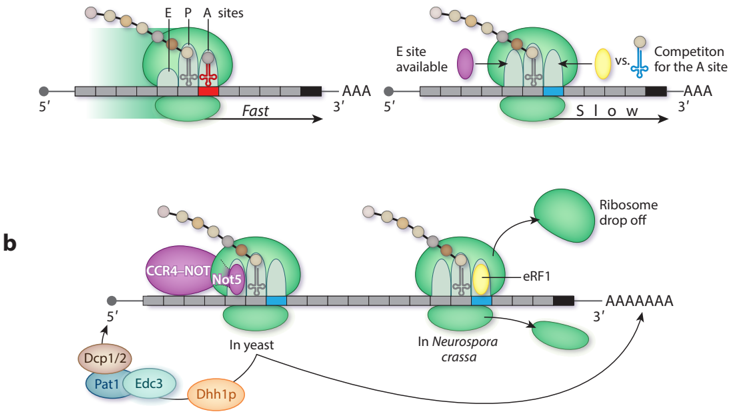
Messenger RNA (mRNA) stability and translational efficiency are two crucial aspects of the post-transcriptional process that profoundly impact protein production in a cell. While it is widely known that ribosomes produce proteins, studies during the past decade have surprisingly revealed that ribosomes also control mRNA stability in a codon-dependent manner, a process referred to as codon optimality. Therefore, codons, the three-nucleotide words read by the ribosome, have a potent effect on mRNA stability and provide cis -regulatory information that extends beyond the amino acids they encode. While the codon optimality molecular mechanism is still unclear, the translation elongation rate appears to trigger mRNA decay. Thus, transfer RNAs emerge as potential master gene regulators affecting mRNA stability. Furthermore, while few factors related to codon optimality have been identified in yeast, the orthologous genes in vertebrates do not necessary share the same functions. Here, we discuss codon optimality findings and gene regulation layers related to codon composition in different eukaryotic species.
Overview
The claims and statistics of this paper haven’t been checked yet.
Free: it reads the open-access text and checks the first 5 claims that cite a source we can check. Create a free account to check every claim.
Integrity signals
Registry
Cites
Statistics
Figures
Verification
Claims the paper makes
The claims and statistics of this paper haven’t been checked yet.
Free: it reads the open-access text and checks the first 5 claims that cite a source we can check. Create a free account to check every claim.
Claims other papers make about this one
Each is checked against this paper’s own text: does it say what the citing paper says it does?
The cited source says what the claim attributes to it.
In the citing paper
“However, this view has shifted toward an understanding that the ribosome and translation activity play a pivotal role in global mRNA homeostasis for the degradation of distinct transcripts species and also for individual problematic mRNAs [16, 17].”
From The ribosome as a platform to coordinate mRNA decay (2025) · cites this paper as [17]
The cited source says what the claim attributes to it.
In the citing paper
“Global and specific mRNA decay can be licensed and executed directly on the translating ribosome.”
From The ribosome as a platform to coordinate mRNA decay (2025) · cites this paper as [17]
In the citing paper
“This can be triggered by the presence of nonoptimal codons in the mRNA which have been shown to determine to a large extent the mRNA half-life in yeast, trypanosomatides, and several metazoans [17, 35, 36, 37].”
From The ribosome as a platform to coordinate mRNA decay (2025) · cites this paper as [17]
In the citing paper
“Recent advances have revealed that the ribosome plays a central role in coordinating mRNA decay, challenging the traditional view that free mRNA is the primary substrate for degradation.”
From The ribosome as a platform to coordinate mRNA decay (2025) · cites this paper as [17]
Self-check
Percentages, sums and reported differences re-computed from the paper’s own numbers.
The self-check needs the paper’s full text.
Citations
Cites
Comprehensive Analysis of mRNA Methylation Reveals Enrichment in 3′ UTRs and near Stop Codons
Meyer, K. D., Saletore, Y., Zumbo, P., Elemento, O., Mason, C. E., & Jaffrey, S. R. (2012) · Cell · doi:10.1016/j.cell.2012.05.003 · Cited by 4,223
Sharp, P. M., & Li, W.-H. (1987) · Nucleic Acids Research · doi:10.1093/nar/15.3.1281 · Cited by 3,992
The mechanism of eukaryotic translation initiation and principles of its regulation
Jackson, R. J., Hellen, C. U. T., & Pestova, T. V. (2010) · Nature Reviews Molecular Cell Biology · doi:10.1038/nrm2838 · Cited by 2,759
Listening to silence and understanding nonsense: exonic mutations that affect splicing
Cartegni, L., Chew, S. L., & Krainer, A. R. (2002) · Nature Reviews Genetics · doi:10.1038/nrg775 · Cited by 2,209
Zebrafish MiR-430 Promotes Deadenylation and Clearance of Maternal mRNAs
Giraldez, A. J., Mishima, Y., Rihel, J., Grocock, R. J., Van Dongen, S., Inoue, K., Enright, A. J., & Schier, A. F. (2006) · Science · doi:10.1126/science.1122689 · Cited by 1,647
The highways and byways of mRNA decay
Garneau, N. L., Wilusz, J., & Wilusz, C. J. (2007) · Nature Reviews Molecular Cell Biology · doi:10.1038/nrm2104 · Cited by 1,294
Codon Optimality Is a Major Determinant of mRNA Stability
Presnyak, V., Alhusaini, N., Chen, Y.-H., Martin, S., Morris, N., Kline, N., Olson, S., Weinberg, D., Baker, K. E., Graveley, B. R., et al. (2015) · Cell · doi:10.1016/j.cell.2015.02.029 · Cited by 1,078
Understanding the contribution of synonymous mutations to human disease
Sauna, Z. E., & Kimchi-Sarfaty, C. (2011) · Nature Reviews Genetics · doi:10.1038/nrg3051 · Cited by 1,022
Codon optimality, bias and usage in translation and mRNA decay
Hanson, G., & Coller, J. (2018) · Nature Reviews Molecular Cell Biology · doi:10.1038/nrm.2017.91 · Cited by 825
Ribosome Profiling Shows That miR-430 Reduces Translation Before Causing mRNA Decay in Zebrafish
Bazzini, A. A., Lee, M. T., & Giraldez, A. J. (2012) · Science · doi:10.1126/science.1215704 · Cited by 709
Self-citationThiol-linked alkylation for the metabolic sequencing of RNA
Herzog, V. A., Reichholf, B., Neumann, T., Rescheneder, P., Bhat, P., Burkard, T. R., Wlotzka, W., von Haeseler, A., Zuber, J., & Ameres, S. L. (2017) · doi:10.1101/177642 · Cited by 622
Tissue-Specific Differences in Human Transfer RNA Expression
Dittmar, K. A., Goodenbour, J. M., & Pan, T. (2006) · PLoS Genetics · doi:10.1371/journal.pgen.0020221 · Cited by 601
A public genome-scale lentiviral expression library of human ORFs
Yang, X., Boehm, J. S., Yang, X., Salehi-Ashtiani, K., Hao, T., Shen, Y., Lubonja, R., Thomas, S. R., Alkan, O., Bhimdi, T., et al. (2011) · Nature Methods · doi:10.1038/nmeth.1638 · Cited by 570
Efficient and quantitative high-throughput tRNA sequencing
Zheng, G., Qin, Y., Clark, W. C., Dai, Q., Yi, C., He, C., Lambowitz, A. M., & Pan, T. (2015) · Nature Methods · doi:10.1038/nmeth.3478 · Cited by 550
Ribosome Collisions Trigger General Stress Responses to Regulate Cell Fate
Wu, C. C.-C., Peterson, A., Zinshteyn, B., Regot, S., & Green, R. (2020) · Cell · doi:10.1016/j.cell.2020.06.006 · Cited by 539
High-Resolution View of the Yeast Meiotic Program Revealed by Ribosome Profiling
Brar, G. A., Yassour, M., Friedman, N., Regev, A., Ingolia, N. T., & Weissman, J. S. (2012) · Science · doi:10.1126/science.1215110 · Cited by 533
Gene Expression Regulation by Upstream Open Reading Frames and Human Disease
Barbosa, C., Peixeiro, I., & Romão, L. (2013) · PLoS Genetics · doi:10.1371/journal.pgen.1003529 · Cited by 525
Dynamics of Translation of Single mRNA Molecules In Vivo
Yan, X., Hoek, T. A., Vale, R. D., & Tanenbaum, M. E. (2016) · Cell · doi:10.1016/j.cell.2016.04.034 · Cited by 490
A triple helix stabilizes the 3′ ends of long noncoding RNAs that lack poly(A) tails
Wilusz, J. E., JnBaptiste, C. K., Lu, L. Y., Kuhn, C.-D., Joshua-Tor, L., & Sharp, P. A. (2012) · Genes & Development · doi:10.1101/gad.204438.112 · Cited by 486
Ribosome stalling induced by mutation of a CNS-specific tRNA causes neurodegeneration
Ishimura, R., Nagy, G., Dotu, I., Zhou, H., Yang, X.-L., Schimmel, P., Senju, S., Nishimura, Y., Chuang, J. H., & Ackerman, S. L. (2014) · Science · doi:10.1126/science.1249749 · Cited by 455
Combinatorial optimization of mRNA structure, stability, and translation for RNA-based therapeutics
Leppek, K., Byeon, G. W., Kladwang, W., Wayment-Steele, H. K., Kerr, C. H., Xu, A. F., Kim, D. S., Topkar, V. V., Choe, C., Rothschild, D., et al. (2021) · doi:10.1101/2021.03.29.437587 · Cited by 399
Combinatorial optimization of mRNA structure, stability, and translation for RNA-based therapeutics
Leppek, K., Byeon, G. W., Kladwang, W., Wayment-Steele, H. K., Kerr, C. H., Xu, A. F., Kim, D. S., Topkar, V. V., Choe, C., Rothschild, D., et al. (2022) · Nature Communications · doi:10.1038/s41467-022-28776-w · Cited by 399
Translation drives mRNA quality control
Shoemaker, C. J., & Green, R. (2012) · Nature Structural & Molecular Biology · doi:10.1038/nsmb.2301 · Cited by 395
Upstream ORFs are prevalent translational repressors in vertebrates
Johnstone, T. G., Bazzini, A. A., & Giraldez, A. J. (2016) · The EMBO Journal · doi:10.15252/embj.201592759 · Cited by 346
Self-citationBazzini, A. A., del Viso, F., Moreno‐Mateos, M. A., Johnstone, T. G., Vejnar, C. E., Qin, Y., Yao, J., Khokha, M. K., & Giraldez, A. J. (2016) · The EMBO Journal · doi:10.15252/embj.201694699 · Cited by 305
Self-citationSynonymous mutations in representative yeast genes are mostly strongly non-neutral
Shen, X., Song, S., Li, C., & Zhang, J. (2022) · Nature · doi:10.1038/s41586-022-04823-w · Cited by 298
Codon Usage and 3′ UTR Length Determine Maternal mRNA Stability in Zebrafish
Mishima, Y., & Tomari, Y. (2016) · Molecular Cell · doi:10.1016/j.molcel.2016.02.027 · Cited by 293
The Ccr4-Not complex monitors the translating ribosome for codon optimality
Buschauer, R., Matsuo, Y., Sugiyama, T., Chen, Y.-H., Alhusaini, N., Sweet, T., Ikeuchi, K., Cheng, J., Matsuki, Y., Nobuta, R., et al. (2020) · Science · doi:10.1126/science.aay6912 · Cited by 290
The DEAD-Box Protein Dhh1p Couples mRNA Decay and Translation by Monitoring Codon Optimality
Radhakrishnan, A., Chen, Y.-H., Martin, S., Alhusaini, N., Green, R., & Coller, J. (2016) · Cell · doi:10.1016/j.cell.2016.08.053 · Cited by 289
Chen, Y., Boland, A., Kuzuoğlu-Öztürk, D., Bawankar, P., Loh, B., Chang, C.-T., Weichenrieder, O., & Izaurralde, E. (2014) · Molecular Cell · doi:10.1016/j.molcel.2014.03.034 · Cited by 286
Translation affects mRNA stability in a codon-dependent manner in human cells
Wu, Q., Medina, S. G., Kushawah, G., DeVore, M. L., Castellano, L. A., Hand, J. M., Wright, M., & Bazzini, A. A. (2019) · eLife · doi:10.7554/elife.45396 · Cited by 283
Self-citationWidespread disruption of host transcription termination in HSV-1 infection
Rutkowski, A. J., Erhard, F., L’Hernault, A., Bonfert, T., Schilhabel, M., Crump, C., Rosenstiel, P., Efstathiou, S., Zimmer, R., Friedel, C. C., et al. (2015) · Nature Communications · doi:10.1038/ncomms8126 · Cited by 275
Webster, M. W., Chen, Y.-H., Stowell, J. A. W., Alhusaini, N., Sweet, T., Graveley, B. R., Coller, J., & Passmore, L. A. (2018) · Molecular Cell · doi:10.1016/j.molcel.2018.05.033 · Cited by 260
A code within the genetic code: codon usage regulates co-translational protein folding
Liu, Y. (2020) · Cell Communication and Signaling · doi:10.1186/s12964-020-00642-6 · Cited by 252
GC content shapes mRNA storage and decay in human cells
Courel, M., Clément, Y., Bossevain, C., Foretek, D., Vidal Cruchez, O., Yi, Z., Bénard, M., Benassy, M.-N., Kress, M., Vindry, C., et al. (2019) · eLife · doi:10.7554/elife.49708 · Cited by 250
Translation Termination and Ribosome Recycling in Eukaryotes
Hellen, C. U. T. (2018) · Cold Spring Harbor Perspectives in Biology · doi:10.1101/cshperspect.a032656 · Cited by 240
Cytoplasmic RNA decay pathways - Enzymes and mechanisms
Łabno, A., Tomecki, R., & Dziembowski, A. (2016) · Biochimica et Biophysica Acta (BBA) - Molecular Cell Research · doi:10.1016/j.bbamcr.2016.09.023 · Cited by 230
Gogakos, T., Brown, M., Garzia, A., Meyer, C., Hafner, M., & Tuschl, T. (2017) · Cell Reports · doi:10.1016/j.celrep.2017.07.029 · Cited by 209
The endonuclease Cue2 cleaves mRNAs at stalled ribosomes during No Go Decay
D'Orazio, K. N., Wu, C. C.-C., Sinha, N., Loll-Krippleber, R., Brown, G. W., & Green, R. (2019) · eLife · doi:10.7554/elife.49117 · Cited by 207
Coding regions affect mRNA stability in human cells
Narula, A., Ellis, J., Taliaferro, J. M., & Rissland, O. S. (2019) · RNA · doi:10.1261/rna.073239.119 · Cited by 127
Codon and amino acid content are associated with mRNA stability in mammalian cells
Forrest, M. E., Pinkard, O., Martin, S., Sweet, T. J., Hanson, G., & Coller, J. (2020) · PLOS ONE · doi:10.1371/journal.pone.0228730 · Cited by 116
Codon usage bias controls mRNA and protein abundance in trypanosomatids
Jeacock, L., Faria, J., & Horn, D. (2018) · eLife · doi:10.7554/elife.32496 · Cited by 97
A minimal role for synonymous variation in human disease
Dhindsa, R. S., Wang, Q., Vitsios, D., Burren, O. S., Hu, F., DiCarlo, J. E., Kruglyak, L., MacArthur, D. G., Hurles, M. E., & Petrovski, S. (2022) · The American Journal of Human Genetics · doi:10.1016/j.ajhg.2022.10.016 · Cited by 38
Research works printed but not linked: 75
- Bazzini AA, Johnstone TG, Christiano R, Mackowiak SD, Obermayer B, et al. 2014. Identification of small ORFs in vertebrates using ribosome footprinting and evolutionary conservation. EMBO J. 33:981- 93 · DOI · Paper page
- Ingolia NT, Brar GA, Stern-Ginossar N, Harris MS, Talhouarne GJ, et al. 2014. Ribosome profiling reveals pervasive translation outside of annotated protein-coding genes. Cell Rep. 8:1365-79 · DOI · Paper page
- Chew GL, Pauli A, Rinn JL, Regev A, Schier AF, Valen E. 2013. Ribosome profiling reveals resemblance between long non-coding RNAs and 5 ′ leaders of coding RNAs. Development 140:2828-34 · DOI · Paper page
- van Heesch S, Witte F, Schneider-Lunitz V, Schulz JF, Adami E, et al. 2019. The translational landscape of the human heart. Cell 178:242-60.e29 · DOI · Paper page
- Calviello L, Mukherjee N, Wyler E, Zauber H, Hirsekorn A, et al. 2016. Detecting actively translated open reading frames in ribosome profiling data. Nat. Methods 13:165-70 · DOI · Paper page
- Pauli A, Norris ML, Valen E, Chew GL, Gagnon JA, et al. 2014. Toddler: an embryonic signal that promotes cell movement via Apelin receptors. Science 343:1248636 · DOI · Paper page
- 10.15252/embj.2020104763 · DOI
- Wu Q, Bazzini AA. 2018. Systems to study codon effect on post-transcriptional regulation of gene expression. Methods 137:82-89 · DOI
- Richter JD, Coller J. 2015. Pausing on polyribosomes: Make way for elongation in translational control. Cell 163:292-300 · DOI · Paper page
- Harigaya Y, Parker R. 2016. Analysis of the association between codon optimality and mRNA stability in Schizosaccharomyces pombe. BMC Genom. 17:895 · DOI · Paper page
- Boel G, Letso R, Neely H, Price WN, Wong KH, et al. 2016. Codon influence on protein expression in E. coli correlates with mRNA levels. Nature 529:358-63 · DOI · Paper page
- 10.7554/eLife.32467 · DOI · Paper page
- 10.1016/j.celrep.2018.07.039 · DOI · Paper page
- Chu D, Wei L. 2021. Direct in vivo observation of the effect of codon usage bias on gene expression in Arabidopsis hybrids. J. Plant Physiol. 265:153490 · DOI
- Shu H, Donnard E, Liu B, Jung S, Wang R, Richter JD. 2020. FMRP links optimal codons to mRNA stability in neurons. PNAS 117:30400-11 · DOI
- 10.1073/pnas.1719375115 · DOI · Paper page
- Diez M, Medina-Munoz SG, Castellano LA, da Silva Pescador G, Wu Q, Bazzini AA. 2022. iCodon customizes gene expression based on the codon composition. Sci. Rep. 12:12126 · DOI · Paper page
- Barrington CL, Koch AL, Galindo G, Larkin-Gero E, Morrison EJ, et al. 2022. Synonymous codon usage regulates translation initiation. bioRxiv 2022.05.13.491887. https://doi.org/10.1101/ 2022.05.13.491887 · doi:10.1101/2022.05.13.491887
- Zhou Z, Dang Y, Zhou M, Li L, Yu CH, et al. 2016. Codon usage is an important determinant of gene expression levels largely through its effects on transcription. PNAS 113:E6117-25 · DOI · Paper page
- Zhou Z, Dang Y, Zhou M, Yuan H, Liu Y. 2018. Codon usage biases co-evolve with transcription termination machinery to suppress premature cleavage and polyadenylation. eLife 7:e33569 · DOI
- Yang Q, Lyu X, Zhao F, Liu Y. 2021. Effects of codon usage on gene expression are promoter context dependent. Nucleic Acids Res. 49:818-31 · DOI
- Mordstein C, Savisaar R, Young RS, Bazile J, Talmane L, et al. 2020. Codon usage and splicing jointly influence mRNA localization. Cell Syst. 10:351-62.e8 · DOI · Paper page
- Yu CH, Dang Y, Zhou Z, Wu C, Zhao F, et al. 2015. Codon usage influences the local rate of translation elongation to regulate co-translational protein folding. Mol. Cell 59:744-54 · DOI · Paper page
- Zhou M, Guo J, Cha J, Chae M, Chen S, et al. 2013. Non-optimal codon usage affects expression, structure and function of clock protein FRQ. Nature 495:111-15 · DOI · Paper page
- Liu Y, Yang Q, Zhao F. 2021. Synonymous but not silent: the codon usage code for gene expression and protein folding. Annu. Rev. Biochem. 90:375-401 · DOI · Paper page
- dos Reis M, Savva R, Wernisch L. 2004. Solving the riddle of codon usage preferences: a test for translational selection. Nucleic Acids Res. 32:5036-44 · DOI · Paper page
- Hia F, Yang SF, Shichino Y, Yoshinaga M, Murakawa Y, et al. 2019. Codon bias confers stability to human mRNAs. EMBO Rep. 20:e48220 · DOI · Paper page
- Herzog VA, Reichholf B, Neumann T, Rescheneder P, Bhat P, et al. 2017. Thiol-linked alkylation of RNA to assess expression dynamics. Nat. Methods 14:1198-204 · DOI · Paper page
- Schofield JA, Duffy EE, Kiefer L, Sullivan MC, Simon MD. 2018. TimeLapse-seq: adding a temporal dimension to RNA sequencing through nucleoside recoding. Nat. Methods 15:221-25 · DOI · Paper page
- Imamachi N, Tani H, Mizutani R, Imamura K, Irie T, et al. 2014. BRIC-seq: a genome-wide approach for determining RNA stability in mammalian cells. Methods 67:55-63 · DOI
- 10.15252/embj.2021109256 · DOI
- 10.1186/s13059-020-02251-5 · DOI
- Harigaya Y, Parker R. 2017. The link between adjacent codon pairs and mRNA stability. BMC Genom. 18:364 · DOI
- Bartel DP. 2004. MicroRNAs: genomics, biogenesis, mechanism, and function. Cell 116:281-97 · DOI
- Despic V, Neugebauer KM. 2018. RNA tales -how embryos read and discard messages from mom. J. Cell Sci. 131:jcs201996 · DOI · Paper page
- Diez M, Medina-Muñoz SG, Castellano LA, da Silva Pescador G, Wu Q, Bazzini AA. 2021. iCodon customizes gene expression based on the codon composition. Sci. Rep. 12:12126 · DOI · Paper page
- Cottrell KA, Szczesny P, Djuranovic S. 2017. Translation efficiency is a determinant of the magnitude of miRNA-mediated repression. Sci. Rep. 7:14884 · DOI
- Dever TE, Dinman JD, Green R. 2018. Translation elongation and recoding in eukaryotes. Cold Spring Harb. Perspect. Biol. 10:a032649 · DOI · Paper page
- Chu D, Kazana E, Bellanger N, Singh T, Tuite MF, von der Haar T. 2014. Translation elongation can control translation initiation on eukaryotic mRNAs. EMBO J. 33:21-34 · DOI · Paper page
- Kornblihtt AR, de la Mata M, Fededa JP, Munoz MJ, Nogues G. 2004. Multiple links between transcription and splicing. RNA 10:1489-98 · DOI · Paper page
- Thornlow BP, Armstrong J, Holmes AD, Howard JM, Corbett-Detig RB, Lowe TM. 2020. Predicting transfer RNA gene activity from sequence and genome context. Genome Res. 30:85-94 · DOI
- Suzuki T. 2021. The expanding world of tRNA modifications and their disease relevance. Nat. Rev. Mol. Cell Biol. 22:375-92 · DOI · Paper page
- Phizicky EM, Hopper AK. 2010. tRNA biology charges to the front. Genes Dev. 24:1832-60 · DOI · Paper page
- Kirchner S, Ignatova Z. 2015. Emerging roles of tRNA in adaptive translation, signalling dynamics and disease. Nat. Rev. Genet. 16:98-112 · DOI · Paper page
- Rak R, Dahan O, Pilpel Y. 2018. Repertoires of tRNAs: the couplers of genomics and proteomics. Annu. Rev. Cell Dev. Biol. 34:239-64 · DOI
- Goodarzi H, Nguyen HCB, Zhang S, Dill BD, Molina H, Tavazoie SF. 2016. Modulated expression of specific tRNAs drives gene expression and cancer progression. Cell 165:1416-27 · DOI · Paper page
- Gingold H, Tehler D, Christoffersen NR, Nielsen MM, Asmar F, et al. 2014. A dual program for translation regulation in cellular proliferation and differentiation. Cell 158:1281-92 · DOI · Paper page
- Passarelli MC, Pinzaru AM, Asgharian H, Liberti MV, Heissel S, et al. 2022. Leucyl-tRNA synthetase is a tumour suppressor in breast cancer and regulates codon-dependent translation dynamics. Nat. Cell Biol. 24:307-15 · DOI
- Orellana EA, Liu Q, Yankova E, Pirouz M, De Braekeleer E, et al. 2021. METTL1-mediated m 7 G modification of Arg-TCT tRNA drives oncogenic transformation. Mol. Cell 81:3323-38.e14 · DOI · Paper page
- Huang SQ, Sun B, Xiong ZP, Shu Y, Zhou HH, et al. 2018. The dysregulation of tRNAs and tRNA derivatives in cancer. J. Exp. Clin. Cancer Res. 37:101 · DOI
- Schimmel P. 2018. The emerging complexity of the tRNA world: mammalian tRNAs beyond protein synthesis. Nat. Rev. Mol. Cell Biol. 19:45-58 · DOI · Paper page
- Torrent M, Chalancon G, de Groot NS, Wuster A, Madan Babu M. 2018. Cells alter their tRNA abundance to selectively regulate protein synthesis during stress conditions. Sci. Signal. 11:eaat6409 · DOI · Paper page
- Pinkard O, McFarland S, Sweet T, Coller J. 2020. Quantitative tRNA-sequencing uncovers metazoan tissue-specific tRNA regulation. Nat. Commun. 11:4104 · DOI · Paper page
- Schaffer AE, Pinkard O, Coller JM. 2019. tRNA metabolism and neurodevelopmental disorders. Annu. Rev. Genom. Hum. Genet. 20:359-87 · DOI
- Evans ME, Clark WC, Zheng G, Pan T. 2017. Determination of tRNA aminoacylation levels by high- throughput sequencing. Nucleic Acids Res. 45:e133 · DOI · Paper page
- Allen GE, Panasenko OO, Villanyi Z, Zagatti M, Weiss B, et al. 2021. Not4 and Not5 modulate transla- tion elongation by Rps7A ubiquitination, Rli1 moonlighting, and condensates that exclude eIF5A. Cell Rep. 36:109633 · DOI
- Yang Q, Yu CH, Zhao F, Dang Y, Wu C, et al. 2019. eRF1 mediates codon usage effects on mRNA translation efficiency through premature termination at rare codons. Nucleic Acids Res. 47:9243-58 · DOI
- Wu CC, Zinshteyn B, Wehner KA, Green R. 2019. High-resolution ribosome profiling defines discrete ribosome elongation states and translational regulation during cellular stress. Mol. Cell 73:959-70.e5 · DOI · Paper page
- Sinha NK, Ordureau A, Best K, Saba JA, Zinshteyn B, et al. 2020. EDF1 coordinates cellular responses to ribosome collisions. eLife 9:e58828 · DOI · Paper page
- Veltri AJ, D'Orazio KN, Lessen LN, Loll-Krippleber R, Brown GW, Green R. 2021. Dis- tinct ribosome states trigger diverse mRNA quality control pathways. bioRxiv 2021.12.01.470814. https://doi.org/10.1101/2021.12.01.470814 · doi:10.1101/2021.12.01.470814
- Young DJ, Guydosh NR, Zhang F, Hinnebusch AG, Green R. 2015. Rli1/abce1 recycles terminating ribosomes and controls translation reinitiation in 3 ′ UTRs in vivo. Cell 162:872-84 · DOI · Paper page
- Wahle E, Winkler GS. 2013. RNA decay machines: deadenylation by the Ccr4-Not and Pan2-Pan3 complexes. Biochim. Biophys. Acta Gene Regul. Mach. 1829:561-70 · DOI · Paper page
- Freimer JW, Hu TJ, Blelloch R. 2018. Decoupling the impact of microRNAs on translational repression versus RNA degradation in embryonic stem cells. eLife 7:e38014 99. Mishima Y, Tomari Y. 2017. Pervasive yet nonuniform contributions of Dcp2 and Cnot7 to maternal mRNA clearance in zebrafish. Genes Cells 22:670-78 100. · DOI · Paper page
- 10.1111/gtc.12504 · DOI · Paper page
- Huntzinger E, Kashima I, Fauser M, Sauliere J, Izaurralde E. 2008. SMG6 is the catalytic endonuclease that cleaves mRNAs containing nonsense codons in metazoan. RNA 14:2609-17 102. · DOI · Paper page
- Eberle AB, Lykke-Andersen S, Muhlemann O, Jensen TH. 2009. SMG6 promotes endonucleolytic cleavage of nonsense mRNA in human cells. Nat. Struct. Mol. Biol. 16:49-55 103. · DOI · Paper page
- Marzluff WF, Wagner EJ, Duronio RJ. 2008. Metabolism and regulation of canonical histone mRNAs: life without a poly(A) tail. Nat. Rev. Genet. 9:843-54 105. · DOI · Paper page
- Tauber D, Tauber G, Parker R. 2020. Mechanisms and regulation of RNA condensation in RNP granule formation. Trends Biochem. Sci. 45:764-78 107. · DOI · Paper page
- Anderson P, Kedersha N. 2009. RNA granules: post-transcriptional and epigenetic modulators of gene expression. Nat. Rev. Mol. Cell Biol. 10:430-36 108. · DOI · Paper page
- Minshall N, Kress M, Weil D, Standart N. 2009. Role of p54 RNA helicase activity and its C-terminal domain in translational repression, P-body localization and assembly. Mol. Biol. Cell 20:2464-72 109. · DOI · Paper page
- Allen G, Weiss B, Panasenko O, Huch S, Villanyi Z, et al. 2022. Not1 and Not4 inversely deter- mine mRNA solubility that sets the dynamics of co-translational events. bioRxiv 2022.03.14.484207. https://doi.org/10.1101/2022.03.14.484207 110. Sharp PM, Emery LR, Zeng K. 2010. Forces that influence the evolution of codon bias. Philos. Trans. R. Soc. B 365:1203-12 111. · DOI
- 10.1098/rstb.2009.0305 · DOI · Paper page
- Kim A, Le Douce J, Diab F, Ferovova M, Dubourg C, et al. 2020. Synonymous variants in holoprosencephaly alter codon usage and impact the Sonic Hedgehog protein. Brain 143:2027-38 113. · DOI
- Supek F, Minana B, Valcarcel J, Gabaldon T, Lehner B. 2014. Synonymous mutations frequently act as driver mutations in human cancers. Cell 156:1324-35 115. · DOI · Paper page
- Plotkin JB, Kudla G. 2011. Synonymous but not the same: the causes and consequences of codon bias. Nat. Rev. Genet. 12:32-42 116. · DOI · Paper page
Cited by
The ribosome as a platform to coordinate mRNA decay
Müller, M. B. D., Becker, T., Denk, T., Hashimoto, S., Inada, T., & Beckmann, R. (2025) · Nucleic Acids Research · doi:10.1093/nar/gkaf049 · Cited by 38
“This can be triggered by the presence of nonoptimal codons in the mRNA which have been shown to determine to a large extent the mRNA half-life in yeast, trypanosomatides, and several metazoans [ 17 , 35 , 36 , 37 ].”
Structural basis of mRNA decay by the human exosome–ribosome supercomplex
Kögel, A., Keidel, A., Loukeri, M.-J., Kuhn, C. C., Langer, L. M., Schäfer, I. B., & Conti, E. (2024) · Nature · doi:10.1038/s41586-024-08015-6 · Cited by 25
Metadata
- Authors
- Wu, Q., & Bazzini, A. A.
- Affiliations
- Stowers Institute for Medical Research, Kansas City, Missouri, USA;
- Venue
- Annual Review of Biochemistry
- Publisher
- Annual Reviews
- Published
- 2023-06-20
- Volume
- 92
- Issue
- 1
- Pages
- 227-245
- ISSN
- 0066-4154
- 1545-4509
- Semantic Scholar
- c23d6790006f2f4e8a6803393ce0c28d901cd07a
- Cited by
- 117
- References
- 43
- Language
- en
About these checks
Registry, retraction, Cites and statistics results are computed, not judged, with one exception: a printed reference that no index lists is read once by a model before it counts as a citation error. Claims are extracted by a model and kept only when their quote appears verbatim in the text; each cited source is then checked, with a model’s help, for whether it says what the claim relies on. Those verdicts can be wrong — read the claim’s quote and the cited source before relying on one.
Statistics and arithmetic are recomputed, not judged.
Confidence bands are shown only for fields calibrated on our annotated test set. None is calibrated yet, so no band is shown.
What counts as a claim ›How we measure confidence ›How we check this ›
Are you an author, or do you see a problem with this page? Request a review
Data sources
Bibliographic data: Semantic Scholar, OpenAlex, Crossref.
Contains information from the Semantic Scholar Academic Graph Datasets, made available under the ODC Attribution License (ODC-BY 1.0).
Semantic Scholar’s data is described in: Kinney, R., et al. (2023). The Semantic Scholar Open Data Platform. arXiv:2301.10140.
