

The Regulation of Entry
Open accessThe DOI matches its Crossref record, with a small difference in title or year; 39 of the 39 references it cites were found in a registry or an index; none of the 13 sources its claims cite is checked for support yet.
Abstract
1%(5 :25.,1* 3$3(5 6(5,(6 7+( 5(*8/$7,21 2) (175< 6LPHRQ 'MDQNRY 5DIDHO /D 3RUWD )ORUHQ.LR /RSH]GH6LODQHV $QGUHL 6KOHLIHU :RUNLQJ 3DSHU KWWSZZZQEHURUJSDSHUVZ 1$7,21$/ %85($8 2) (&2120,& 5(6($5&+ 0DVVD.KXVHWWV $YHQXH &DPEULGJH 0$ 6HSWHPEHU :H WKDQN 2OJD ,RIIH 7DWLDQD 1HQRYD DQG (NDWHULQD 7UL]ORYD IRU DEOH UHVHDU.K DVVLVWDQ.H DQG +DPLG $ODYL ,ULQD $VWUDNKDQ $EKLMLW %DQHUMHH 5L.KDUG &DYHV -D.TXHOLQH &RROLGJH -DPHV (PHU\ 1LKDO (O0DJKDUEHO -HDQ 3DXO *DXWKLHU (G *ODHVHU 6LPRQ -RKQVRQ /DZUHQ.H .DW] 3HWHU .X.HUD 'DYLG /DLEVRQ ,UD /LHEHUPDQ 'DYLQ 0D.NLQ]LH 0DULH )UDQ.RLVH 0DULH1HOO\ 0DU.HOR 2ODUUHDJD *X\ 3IHIIHUPDQQ 6DQWLDJR 6HGD.D /HLOD :HEVWHU 3HWHU :ULJKW DQG VHPLQDU SDUWL.LSDQWV DW WKH 8QLYHUVLW\ RI 0DU\ODQG DW &ROOHJH 3DUN IRU KHOSIXO .RPPHQWV 7KH .ROOH.WLRQ RI GDWD IRU WKLV SDSHU ZDV RUJDQL]HG DQG ILQDQ.HG E\ WKH :RUOG %DQN $Q DSSHQGL[ GHV
Overview
CoChat Summary
TL;DR
This paper assembles a new cross-country dataset on business entry regulation in 75 countries and uses it to compare the helping-hand, capture, and tollbooth theories of regulation. The evidence is most consistent with the tollbooth view: heavier entry regulation is associated with more corruption, a larger unofficial economy, and less representative, more autocratic governments.
Key findings
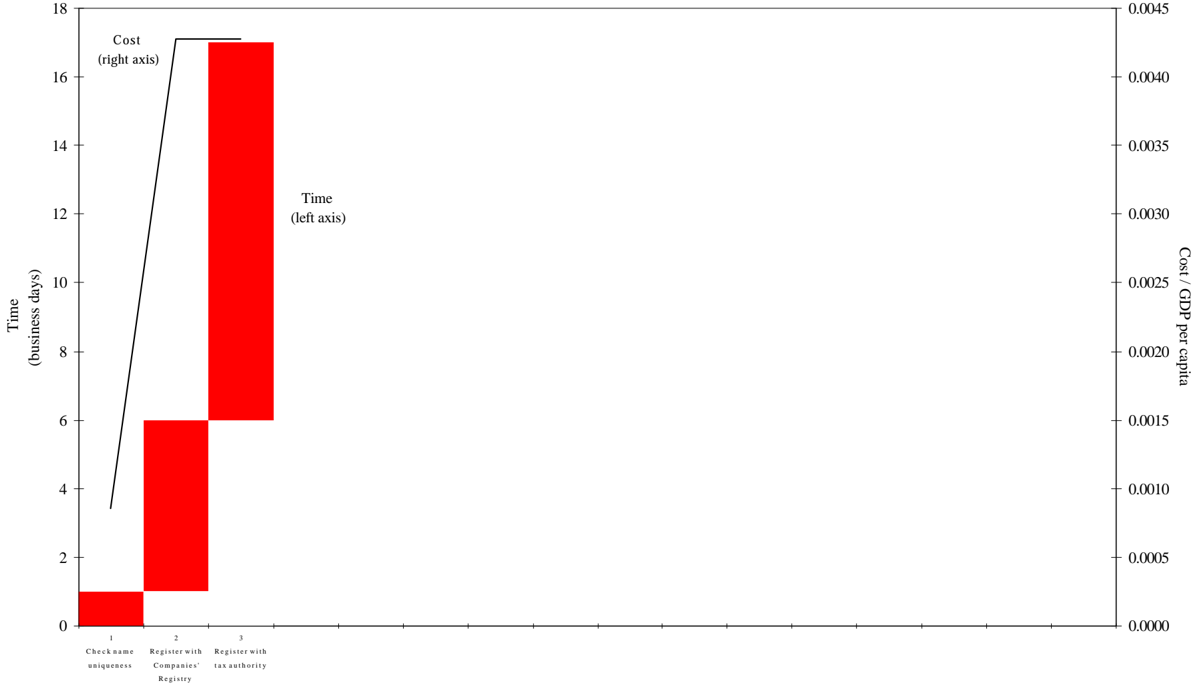
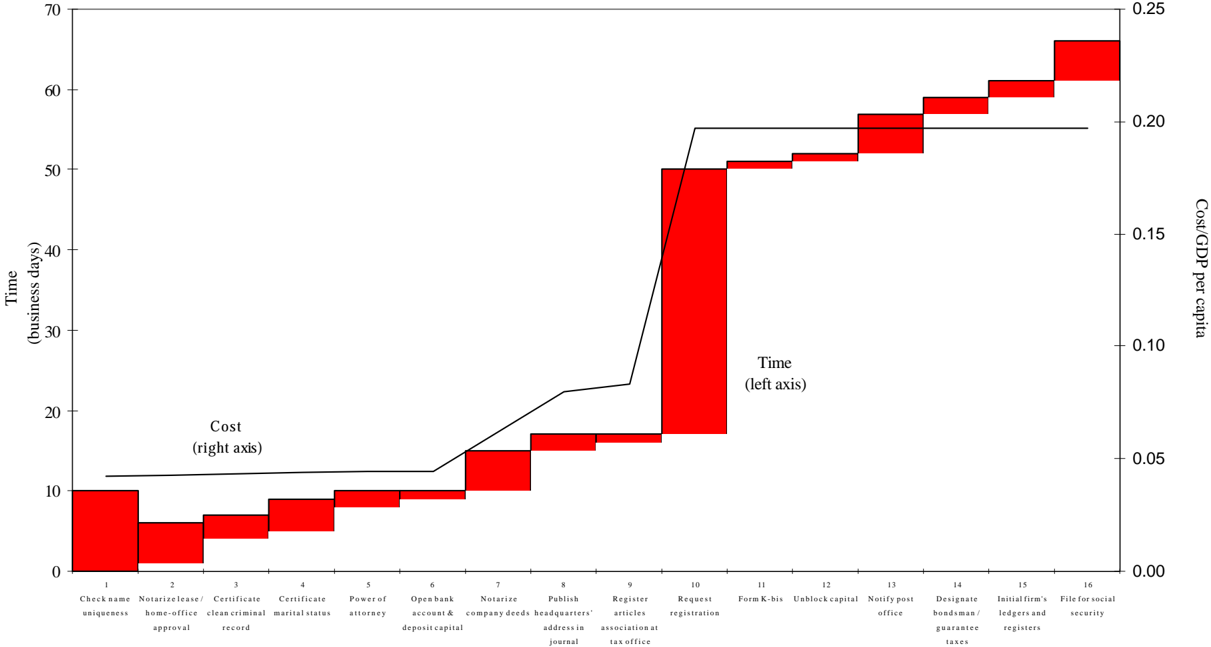
- Across the 75-country sample, the number of entry procedures ranges from 2 in Canada to 20 in Bolivia, with a sample average of 10.17 procedures; the average official time is 63.05 business days and the average cost is 0.34 of GDP per capita.
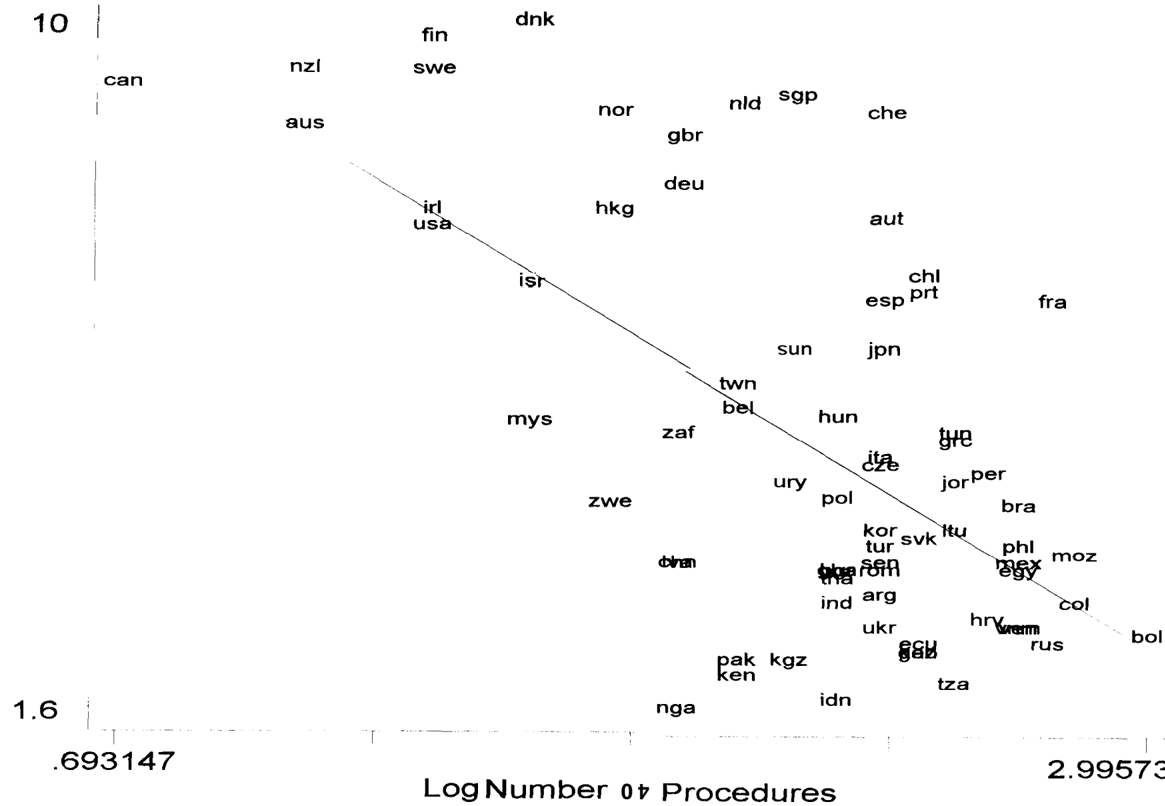
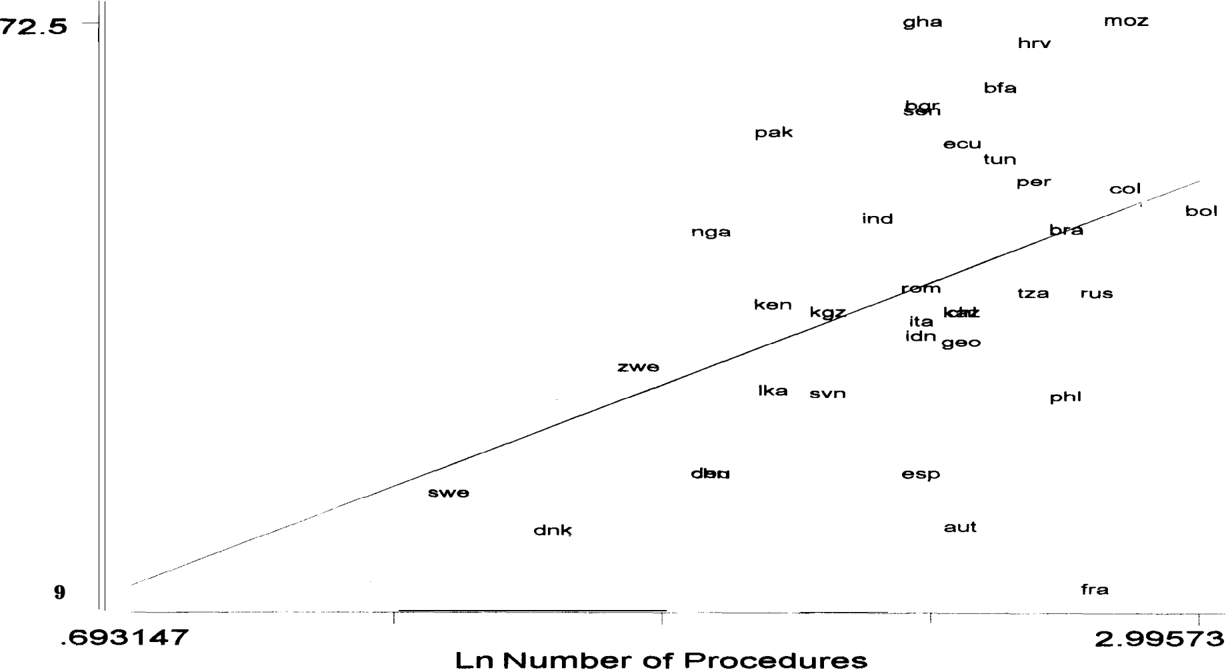
- The number of procedures is strongly correlated with time and cost: the paper reports correlations of 0.75 with log time and 0.62 with log cost.
- The helping-hand tests do not support a beneficial-regulation story: in Table IV, more procedures are associated with lower ISO quality standards (e.g. coefficient -0.2646) and larger unofficial economy measures (e.g. coefficient 13.6277 for size of unofficial economy; 19.8763 for employment in the unofficial economy), while pollution and health outcomes do not improve.
- The tollbooth evidence is stronger: Table VI reports that more procedures are associated with worse corruption scores, with a coefficient of -3.2809 (and -1.7249 with GDP per capita controls) for the corruption regressions.
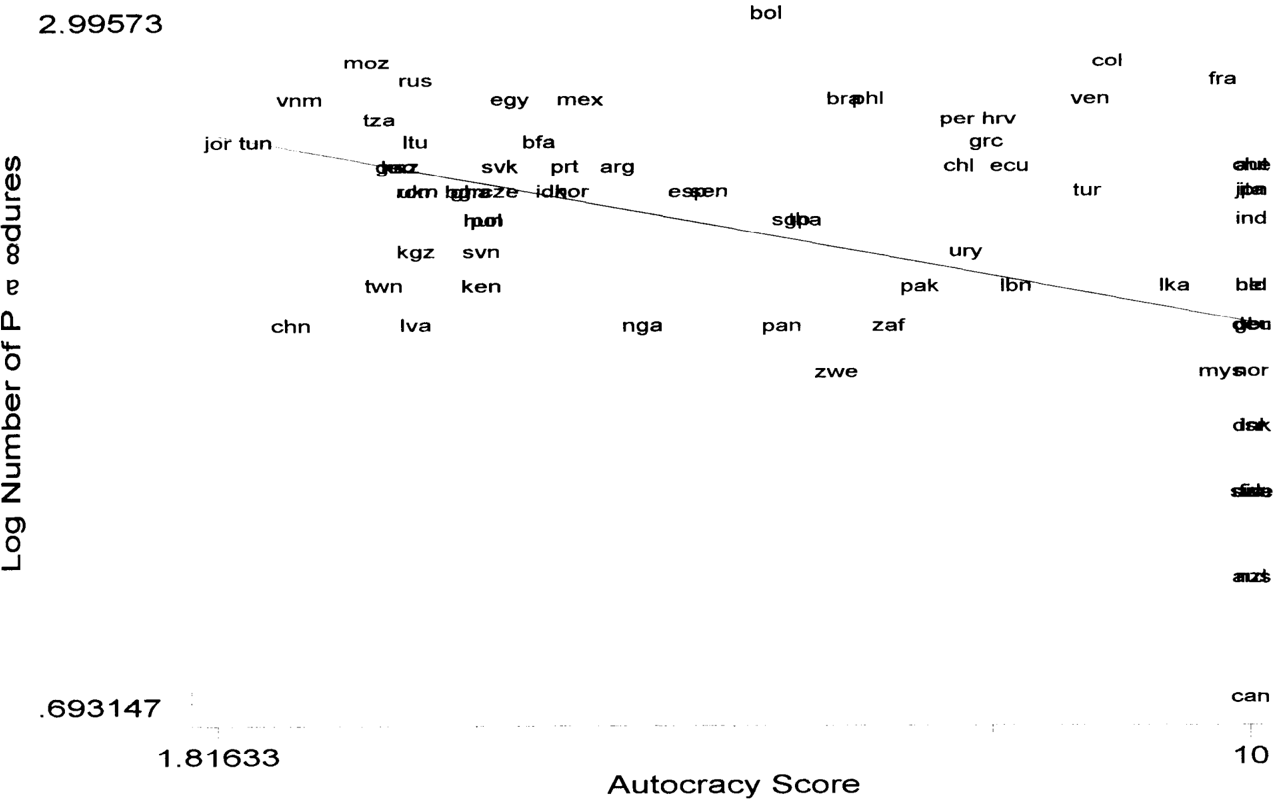
- In Table VIII, better government is associated with lighter regulation; the paper states that countries with more limited and representative governments have statistically significantly fewer procedures using 5 out of 6 measures of better government, and that more autocratic countries regulate more heavily.
Methods
- The paper builds a new database on entry regulation for 75 countries, focusing on the legal requirements, official time, and official cost for a standardized start-up firm.
- Data were gathered from written government sources, World Bank- and USAID-sponsored studies, government web pages, direct contacts with agencies, and independent double-checks in 73 countries via local consulting reports; the remaining 2 countries were double-checked through government contacts.
- The main analysis uses cross-country OLS regressions relating entry regulation measures to outcomes such as quality, pollution, unofficial economy, corruption, political institutions, legal origin, and GDP per capita; the paper also reports correlations and test-of-means comparisons across income quartiles.
Limitations
- The paper itself notes that the capture-theory tests are based on crude measures and that the data are probably least suited to test the capture hypothesis.
- The authors say the data almost surely underestimate the cost and complexity of entry because they focus on the capital city, omit industry-specific requirements and foreign-ownership steps, and ignore some informal delays and bribes.
- Evident from the text: the study is cross-sectional and based on official procedures/costs, so causal interpretation is limited and informal corruption/bureaucratic delays are not directly measured except indirectly through correlations.
Model-written summary. Check it against the paper before relying on it.
Integrity signals
Registry
Cites
Statistics
Figures
Verification
Claims the paper makes
0 Valid · 3 Not valid · 13 Not checked · 114 Own results and interpretations
A result the paper reports from its own data — it cites no other source for it, so there is none to check. The quote shows it is in the paper.
In the paper
“Very few entry regulations cover tax and labor issues.”
plain- Asserted: passes — The authors put it forward as true.
- Checkable: passes — It can be checked against evidence.
- Load-bearing: unclear — It is unclear whether the paper’s conclusions depend on it.
- Based: passes — The paper gives a reason why it holds.
In the paper
“The data show that the numbers of entry and of labor market regulations are positively correlated across countries, contrary to the substitutes hypothesis.”
What the sources say
- Not matchedcites Djankov et al., 2000
An author–year citation the paper’s reference list doesn’t settle. We don’t search these by name.
plainstates an association- Asserted: passes — The authors put it forward as true.
- Checkable: passes — It can be checked against evidence.
- Load-bearing: unclear — It is unclear whether the paper’s conclusions depend on it.
- Based: passes — The paper gives a reason why it holds.
- Not matched
A result the paper reports from its own data — it cites no other source for it, so there is none to check. The quote shows it is in the paper.
In the paper
“It often takes the form of screening procedures.”
- Also stated in: § III. Basic Results. · plain
“Instead, much of what governments do to regulate entry falls into the category of screening procedures.”
plain- Asserted: passes — The authors put it forward as true.
- Checkable: passes — It can be checked against evidence.
- Load-bearing: unclear — It is unclear whether the paper’s conclusions depend on it.
- Based: passes — The paper gives a reason why it holds.
- Also stated in: § III. Basic Results. · plain
A result the paper reports from its own data — it cites no other source for it, so there is none to check. The quote shows it is in the paper.
In the paper
“First, the cost-to-per-capita-GDP ratio decreases uniformly with GDP per capita.”
plainstates an association- Asserted: passes — The authors put it forward as true.
- Checkable: passes — It can be checked against evidence.
- Load-bearing: unclear — It is unclear whether the paper’s conclusions depend on it.
- Based: passes — The paper gives a reason why it holds.
A result the paper reports from its own data — it cites no other source for it, so there is none to check. The quote shows it is in the paper.
In the paper
“In contrast, countries in the other three quartiles of per capita income are not statistically different from each other in terms of the number of procedures and the time required to fulfill them.”
plain- Asserted: passes — The authors put it forward as true.
- Checkable: passes — It can be checked against evidence.
- Load-bearing: passes — The paper’s conclusions depend on it.
- Based: passes — The paper gives a reason why it holds.
49 more claims
Create a free account to see all 130 claims and every source verdict.
- Probably not a substantial claim. 21
- It may state two separate claims as one. 54
- The quote only partly states this claim. 26
Claims other papers make about this one
Each is checked against this paper’s own text: does it say what the citing paper says it does?
The source backs part of the claim, not all of it — or backs it for a different population, condition or comparison.
In the citing paper
“Our findings suggest an explanation for the low level of incorporation in Italy: the average direct cost associated with fulfilling the bureaucratic regulations for registering a new corporation in Italy is 20% of per capita GNP compared to 10% of per capita GNP on average for other G-7 European countries.”
From Entry regulation as a barrier to entrepreneurship (2006) · cites this paper as Djankov et al. (2002)
Experimental — accuracy not yet measuredThe cited source says what the claim attributes to it.
In the citing paper
“Given the explicit link made by Djankov et al . (2002) between the speed and ease with which businesses may be established in a country and its economic performance - and the enthusiasm with which this link has been grasped by European Union policy makers - our findings imply this link needs reconsidering.”
From The Effect of Business Regulations on Nascent and Young Business Entrepreneurship (2007) · cites this paper as Djankov et al . (2002)
Citations
Cites
La Porta, R., Lopez‐de‐Silanes, F., Shleifer, A., & Vishny, R. W. (1998) · Journal of Political Economy · doi:10.1086/250042 · Cited by 18,025
Self-citationThe Theory of Economic Regulation
Stigler, G. J. (1971) · The Bell Journal of Economics and Management Science · doi:10.2307/3003160 · Cited by 8,098
Journal of Economic Literature
(2019) · AEA Papers and Proceedings · doi:10.1257/pandp.109.633 · Cited by 7,468
The Quarterly Journal of Economics
Kuznets, S. (2024) · Business Cycle Theory, Part I Volume 4 · doi:10.4324/9781003549741-8 · Cited by 7,176
La Porta, R. (1999) · Journal of Law, Economics, and Organization · doi:10.1093/jleo/15.1.222 · Cited by 5,699 · cited 2×
“Legal origin has been viewed as a proxy for the government’s proclivity to intervene in the economy and the stance of the law toward the security of property rights in a country [La Porta et al. 1999].”
The Theory of Economic Regulation
Stigler, G. J. (2021) · The Political Economy · doi:10.4324/9781315495811-8 · Cited by 5,483
Pigou, A. C. (1933) · The Economic Journal · doi:10.2307/2224491 · Cited by 5,137
Toward a More General Theory of Regulation
Peltzman, S. (1976) · The Journal of Law and Economics · doi:10.1086/466865 · Cited by 4,729
Moffitt, R. A. (2009) · American Economic Review · doi:10.1257/aer.99.2.660 · Cited by 4,694
Shleifer, A., & Vishny, R. W. (1993) · The Quarterly Journal of Economics · doi:10.2307/2118402 · Cited by 3,778
Self-citation
Research works printed but not linked: 7
- McLiesh Caralee, 2001, NBER Working Paper No., 8288
- Kasnako lu, Zehra, and Münür Yayla, 'Unrecorded Economy in Turkey: A Monetary Approach', 1999. "Unrecorded Economy in Turkey (A Monetary Approach)" in Informal Sector in Turkey (I), Tuncer Bulutay (ed.), SIS, Ankara, forthcoming.
- Fred, 1987, Journal of Legal Studies, 101
- Olson, Mancur, 1991, 'Autocracy, Democracy, and Prosperity,' in Richard Zeckhauser, ed., Strategy of Choice, Cambridge, MA: MIT Press.
- 1967, Western Economic Journal, 232
- World Economic Forum (1999), The Global Competitiveness Report 1999 , Schwab, Klaus et al., eds., New York: Oxford University Press.
- World Economic Forum, The Global Competitiveness Report 2001, Klaus Schwab et al., eds. (New York, NY: Oxford University Press, 2001).
Cited by
Items 1,701–1,800 of 3,986
Aghion, P. (2005) · Empirica · doi:10.1007/s10663-005-1976-8 · Cited by 23
Governance and foreign aid in Pacific Island countries
Gani, A. (2008) · Journal of International Development · doi:10.1002/jid.1480 · Cited by 17
Rule of law and economic development
Peerenboom, R. (2002) · Cambridge University Press eBooks · doi:10.1017/cbo9780511493737.011 · Cited by 14
The Role of Financial Development on Private Entrepreneurship in Cameroon
Wujung, V. A., & Fonchamnyo, D. C. (2016) · Journals & Books Hosting (International Knowledge Sharing Platform) · Cited by 14
Does Social Pressure Hinder Entrepreneurship in Africa? The Forced Mutual Help Hypothesis
Alby, P., Auriol, E., & Nguimkeu, P. (2019) · Economica · doi:10.1111/ecca.12330 · Cited by 20
Tax Neutrality: Illusion or Reality? The Case of Entrepreneurship
Kanniainen, V., & Panteghini, P. M. (2013) · FinanzArchiv Public Finance Analysis · doi:10.1628/001522113x666926 · Cited by 14
Sáez, Á. E., Guasch, J. L., Ramírez, M. D. O., et al. (2008) · RePEc: Research Papers in Economics · Cited by 14
Georgiou, M. N. (2009) · SSRN Electronic Journal · doi:10.2139/ssrn.1527466 · Cited by 14
Selection and Market Reallocation: Productivity Gains from Multinational ProductionPreprint
Alfaro, L., & Chen, M. X. (2012) · SSRN Electronic Journal · doi:10.2139/ssrn.2101302 · Cited by 13
Does Greater Accountability Improve the Quality of Delivery of Public Services? Evidence from Uganda
Mpuga, P., & Deininger, K. (2004) · World Bank, Washington, DC eBooks · doi:10.1596/1813-9450-3277 · Cited by 19
“Domestic firms are likely to move abroad to escape the net of regulations which many countries require to register a business (Djankov 2002), or in order to escape the demands of a corrupt bureaucracy and a weak legal system, they often”
InfluentialProduct Market Regulation, Firm Size, Unemployment and Informality in Developing EconomiesPreprint
Charlot, O., Malherbet, F., & Terra, C. (2011) · SSRN Electronic Journal · doi:10.2139/ssrn.1765685 · Cited by 14
“Moreover, Brazil has relatively high barriers to entry in the product market (Djankov et al., 2002), while labor legislations appear relatively moderate compared to some other Latin American countries (Botero et al., 2004).”
Spatial stratification of street vendors in downtown Mexico City
Baroni, B. N. (2007) · DSpace@MIT (Massachusetts Institute of Technology) · Cited by 19
Hornuf, L., Eidenmueller, H. G. M., Engert, A., et al. (2012) · SSRN Electronic Journal · doi:10.2139/ssrn.1990189 · Cited by 14
Conscription as RegulationPreprint
Mulligan, C. B., & Shleifer, A. (2004) · SSRN Electronic Journal · doi:10.2139/ssrn.556152 · Cited by 14
Self-citationA Flexible Economy? Entrepreneurship and Productivity in New ZealandPreprint
McMillan, J. (2004) · SSRN Electronic Journal · doi:10.2139/ssrn.571481 · Cited by 14
“New Zealand’s regulatory costs of starting a business are among the world’s lowest, according to Djankov et al. (2002), who described the country’s procedures for registering a new firm as “streamlined.”
Hampel-Milagrosa, A., Loewe, M., & Reeg, C. (2013) · RePEc: Research Papers in Economics · Cited by 14
Analysing trends, opportunities and challenges
Dubois, C., McKee, M., & Nolte, E. (2005) · LSHTM Research Online (London School of Hygiene and Tropical Medicine) · Cited by 14
Household Responses to the Tax Treatment of Income from Solar PV Feed-in in GermanyPreprint
Fleiter, J., Atasoy, A. T., & Madlener, R. (2023) · SSRN Electronic Journal · doi:10.2139/ssrn.4650278 · Cited by 14
The Case for Business Registration Reform in Latin America
Jansson, T., & Chalmers, G. (2001) · doi:10.18235/0008849 · Cited by 14
“At the end of the day, the primary beneficiaries of an extensive and demanding business registration process are not the entrepreneurs or the general public, but the politicians and bureaucrats (Djankov et al. 2000).”
Efficient informal trade: Theory and experimental evidence from the Cape Town taxi market
Bengtsson, N. (2015) · Journal of Development Economics · doi:10.1016/j.jdeveco.2015.02.003 · Cited by 14
Barriers to Entry, Entrepreneurship, and Income Inequality within the United States
O’Reilly, C. (2022) · Journal of Entrepreneurship and Public Policy · doi:10.1108/jepp-06-2022-0069 · Cited by 13
Economic development, corruption, and income inequality: The role of the informal sector
Wong, M. Y. H. (2023) · Politics · doi:10.1177/02633957221148951 · Cited by 24
“In addition, stricter regulation of market entry (number of procedures, time and cost required) is found to be associated with more corruption and a larger informal economy (Djankov et al., 2002).”
Incentivizing knowledge institutions for entrepreneurship and society
Aparicio, S., Hughes, M., Audretsch, D. B., & Urbano, D. (2023) · International Journal of Entrepreneurial Behaviour & Research · doi:10.1108/ijebr-07-2022-0652 · Cited by 16
Entrepreneurial Political Action in the Informal Economy: The Case of the Kumasi Petty Traders
Newman, A. B., & Barney, J. B. (2023) · Entrepreneurship Theory and Practice · doi:10.1177/10422587221136075 · Cited by 16
Does the administrative approval reform impact firm's investment decisions?
Cheng, B., Guo, Z., Xiong, T., & Qiu, B. (2023) · International Review of Economics & Finance · doi:10.1016/j.iref.2023.07.034 · Cited by 18
Haddoud, M. Y., Nowiński, W., Onjewu, A.-K. E., Souleh, S., & Elbaz, A. M. (2024) · Journal of Business Research · doi:10.1016/j.jbusres.2024.114523 · Cited by 19
Chang, T., Wu, Y., Deng, X., Wang, X., & Yan, Y. (2024) · Frontiers in Psychology · doi:10.3389/fpsyg.2024.1395400 · Cited by 23
The taxed informal economy: Fiscal burdens and inequality in Accra
Anyidoho, N. A., Gallien, M., Rogan, M., & van den Boogaard, V. (2024) · World Development · doi:10.1016/j.worlddev.2024.106879 · Cited by 26
Demirel, P., & Mazzucato, M. (2013) · Medical Entomology and Zoology · Cited by 13
Democratic institutions and regulatory reforms
Amin, M., & Djankov, S. (2014) · Journal of Comparative Economics · doi:10.1016/j.jce.2014.08.005 · Cited by 23
Self-citationBarriers to entry index: a ranking of starting a business difficulties for the United States
Teague, M. V. (2016) · Journal of Entrepreneurship and Public Policy · doi:10.1108/jepp-02-2016-0007 · Cited by 13
Erkut, B. (2016) · Studia Oeconomica Posnaniensia · doi:10.18559/soep.2016.5.6 · Cited by 13
EU Accession: A Boon or Bane for Corruption?
Alfano, V., Capasso, S., & Goel, R. K. (2020) · Journal of Economics and Finance · doi:10.1007/s12197-020-09522-8 · Cited by 17
Rosenberg, D. Y., & Tarasenko, G. (2020) · Energy Research & Social Science · doi:10.1016/j.erss.2020.101543 · Cited by 16
Economic and Social Sustainability: The Influence of Oligopolies on Inequality and Growth
Kumar, R. R., & Stauvermann, P. J. (2020) · Sustainability · doi:10.3390/su12229378 · Cited by 17
“[84] show empirically, that regulation, including barriers to entry, is an obstacle for economic growth.”
Search, product market competition and CEO pay
Jung, H. W., & Subramanian, A. (2021) · Journal of Corporate Finance · doi:10.1016/j.jcorpfin.2021.101981 · Cited by 12
Effect of political corruption on municipal tax revenues
Guillamón, M., Cifuentes‐Faura, J., Martínez, Ú. F., & Benito, B. (2021) · Revista de Contabilidad · doi:10.6018/rcsar.410581 · Cited by 24
Export entrepreneurship promotion: The role of regulation-induced time delays and institutions
Munemo, J. (2022) · International Review of Economics and Finance · doi:10.1016/j.iref.2021.10.009 · Cited by 9
The Fiscal Response to the Italian COVID-19 Crisis: A Counterfactual Analysis
Bartolomeo, G. D., D’Imperio, P., & Felici, F. (2021) · Journal of Macroeconomics · doi:10.1016/j.jmacro.2022.103447 · Cited by 17
How to design institutional frameworks for markets
Brousseau, É., & Nicita, A. (2010) · Revue d économie industrielle · doi:10.4000/rei.4144 · Cited by 16
Market as a Weapon: Domination by Virtue of a Constellation of Interests
Олейник, А. (2010) · Forum for Social Economics · doi:10.1007/s12143-010-9081-6 · Cited by 30
“It consists in eliminating or neutralizing the competitors of Bs (Tilly 1985: 175–180; Djankov et al. 2002).”
Law, Finance and Investment: does legal origin matter?
Asongu Simplice, A. (2011) · Munich Personal RePEc Archive (Ludwig Maximilian University of Munich) · Cited by 13
Unbundling institutional determinants of multinational investments
Xu, X., Voon, J. P., & Shang, Y. (2016) · Applied Economics · doi:10.1080/00036846.2016.1237754 · Cited by 13
“The colonial history has been identified, as in Djankov et al. (2002, 2003), Acemoglu and Johnson (2005) and Acemoglu, Johnson and Robinson (2001, 2002), to be an important exogenous source of variations affecting the development of both PI and CI, and it is quite impossible for a direct feedback…”
Compound Voids and Unproductive Entrepreneurship: The Rise of the “English Fever” in China
Fish, R. J., Parris, D. L., & Troilo, M. (2017) · Journal of Economic Issues · doi:10.1080/00213624.2017.1287506 · Cited by 14
Will Strangers Help you Enter? The Effect of Foreign Bank Presence on New Firm Entry
Bermpei, T., Kalyvas, A. N., Neri, L., & Russo, A. (2018) · Journal of Financial Services Research · doi:10.1007/s10693-017-0286-1 · Cited by 13
“Firstly, we add to the entrepreneurship determinants literature (e.g. Djankov et al., 2002; Klapper et al., 2015; Belitski et al., 2016) and specifically to the literature that relates financing conditions to new firm formation (e.g. Aghion et al., 2007; Havrylchyk, 2012).”
Owner–manager perceptions of regulation and micro-firm performance: An exploratory view
Betton, M. E., Branston, J. R., & Tomlinson, P. R. (2020) · Competition & Change · doi:10.1177/1024529420926082 · Cited by 17
Salinas, A., Ortiz, C. A., Muffatto, M., & Changoluisa, J. (2020) · Entrepreneurship Research Journal · doi:10.1515/erj-2020-0013 · Cited by 32
Hobijn, B., & Şahin, A. (2011) · Economic Inquiry · doi:10.1111/j.1465-7295.2011.00375.x · Cited by 21
9 Pollution across Chinese Provinces
Co, C. Y., Kong, F., & Lin, S. (2010) · Oxford University Press eBooks · doi:10.1093/acprof:oso/9780199575077.003.0009 · Cited by 14
Balalaeva, D. (2015) · Review of Policy Research · doi:10.1111/ropr.12130 · Cited by 14
Growth in an Oil Abundant Economy: The Case of Venezuela
Agnani, B., & Iza, A. (2011) · Journal of Applied Economics · doi:10.1016/s1514-0326(11)60005-6 · Cited by 13
Union power, entrepreneurial risk, and entrepreneurship
Kanniainen, V., & Leppämäki, M. (2008) · Small Business Economics · doi:10.1007/s11187-008-9120-3 · Cited by 13
LEGAL STANDARDS, ENFORCEMENT, AND CORRUPTION
Immordino, G., & Pagano, M. (2010) · Journal of the European Economic Association · doi:10.1111/j.1542-4774.2010.tb00549.x · Cited by 23
Shy, O. (2001) · Cambridge University Press eBooks · doi:10.1017/cbo9780511754401.008 · Cited by 11
The Strategy of Air Cargo Operators: About Carpet Sellers and Cargo Stars
Dewulf, W., Meersman, H., & de Voorde, E. E. V. (2019) · Emerald Group Publishing Limited eBooks · doi:10.1108/s2212-160920190000008008 · Cited by 20
Khemani, R. S. (2007) · Cited by 13
Intermediation costs and capital flows
İmrohoroğlu, A., & Kumar, K. B. (2003) · Review of Economic Dynamics · doi:10.1016/j.red.2003.10.002 · Cited by 11
Centre on Regulation and Competition
Thomas, T. (2002) · Cited by 13
Institutions and Entry: A Cross-Regional Analysis in RussiaPreprint
Bruno, R. L., Bytchkova, M., & Estrin, S. (2011) · SSRN Electronic Journal · doi:10.2139/ssrn.1765670 · Cited by 13
Equity in Educational Expenditures: Can Government Subsidies Help?
Das, J. (2004) · World Bank, Washington, DC eBooks · doi:10.1596/1813-9450-3249 · Cited by 13
Entry and exit of firms in a global economy: A cross-country and industry analysis
Colantone, I., & Sleuwaegen, L. E. (2007) · Lirias · Cited by 18
Institutional Quality and Trade in Pacific Island CountriesPreprint
Gani, A., & Prasad, B. C. (2006) · RePEc: Research Papers in Economics · Cited by 13
DEREGULATION OF BUSINESSPreprint
Yakovlev, E., & Zhuravskaya, E. V. (2007) · RePEc: Research Papers in Economics · Cited by 25
Do subsidiaries of foreign MNEs invest more in R&D than domestic firms?
Un, C. A., & Cuervo-Cazurra, Á. (2008) · RePEc: Research Papers in Economics · Cited by 12
Innovation and the Elasticity of Trade Volumes to Tariff Reductions
Rubini, L. (2009) · Munich Personal RePEc Archive (Ludwig Maximilian University of Munich) · Cited by 20
Tax Effort: The Impact of Corruption, Voice and AccountabilityPreprint
Bird, R. M., Martínez-Vázquez, J., & Torgler, B. (2007) · RePEc: Research Papers in Economics · Cited by 13
Innovation Policy InstrumentsPreprint
Johansson, B., Karlsson, C., & Bäckman, M. (2007) · RePEc: Research Papers in Economics · Cited by 48
Governance of the Single Supervisory Mechanism: Some ReflectionsPreprint
Masciandaro, D., & Nieto, M. J. (2014) · SSRN Electronic Journal · doi:10.2139/ssrn.2384594 · Cited by 16
Volchek, D. (2013) · LUTPub (LUT University) · Cited by 42
Bank internationalization and firm exports: evidence from matched firm-bank dataPreprint
Bronzini, R., & D'Ignazio, A. (2016) · SSRN Electronic Journal · doi:10.2139/ssrn.2777973 · Cited by 50
Adams, R. B., & Licht, A. N. (2019) · SSRN Electronic Journal · doi:10.2139/ssrn.3766934 · Cited by 20
“business by men, from the World Bank’s Doing Business database, which is based on Djankov et al.’s (2002) regulation of entry methodology.”
Patterns of Business Creation, Survival and Growth: Evidence from Africa
Richmond, C., & Klapper, L. F. (2011) · The World Bank Open Knowledge Repository (World Bank) · doi:10.1596/1813-9450-5828 · Cited by 14
Demand Risk and Diversification through International TradePreprint
Esposito, F. (2020) · SSRN Electronic Journal · doi:10.2139/ssrn.3617802 · Cited by 13
“pdf 2For tractability, I rule out aggregate shocks that affect all varieties, as in Eaton et al. (2011) and Nguyen (2012). This is consistent with the recent empirical evidence that firm-destination specific shocks, rather than aggregate shocks, account for the overwhelming majority of the variation in firms’ sales ac…”
InfluentialPre-Crisis Credit Standards: Monetary Policy or the Savings Glut?Preprint
Penalver, A. (2014) · SSRN Electronic Journal · doi:10.2139/ssrn.2524364 · Cited by 13
Legal efficiency and consistency
Anderlini, L., Felli, L., & Riboni, A. (2019) · European Economic Review · doi:10.1016/j.euroecorev.2019.103323 · Cited by 26
Regulatory Restrictions Across U.S. Protein Supply Chains
Staples, A. J., Chambers, D., Melstrom, R. T., & Malone, T. (2021) · Journal of Agricultural and Applied Economics · doi:10.1017/aae.2021.28 · Cited by 11
“First, we complement existing research (Al-Ubaydli and McLaughlin, 2017; Dawson and Seater, 2013; Djankov et al., 2002; Stigler, 1971) by examining the number of federal regulatory restrictions affecting the beef, pig, poultry, sheep, goat, and seafood industries, which reveals the potential for…”
A Network Analysis of Judicial Cross-Citations in Europe
Siems, M. (2022) · Law & Social Inquiry · doi:10.1017/lsi.2022.22 · Cited by 16
Ashaley-Nikoi, J., & Abbey, E. (2023) · Cities · doi:10.1016/j.cities.2023.104359 · Cited by 21
Registration system reform and initial public offering ownership preference: Evidence from China
Wu, X., Zhang, D., & Wu, Z. (2024) · China Journal of Accounting Research · doi:10.1016/j.cjar.2024.100343 · Cited by 13
Beju, D.-G., Ciupac-Ulici, M.-L., & Breşfelean, V. P. (2024) · The Journal of Risk Finance · doi:10.1108/jrf-10-2023-0261 · Cited by 22
Autio, E., Komlosi, E. S., Szerb, L., Tiszberger, M. G., Park, D., & Jinjarak, Y. (2024) · European Journal of Innovation Management · doi:10.1108/ejim-02-2024-0121 · Cited by 29
Regulatory Quality and Foreign Direct Investment: A Case Analysis of North Macedonia
Mirkovikj, B. K., Gkasis, P., & Golitsis, P. (2024) · Theoretical Economics Letters · doi:10.4236/tel.2024.145095 · Cited by 14
Policy, economic federalism, and product market entry: the Indian experience
Bhaumik, S., Gangopadhyay, S., & Krishnan, S. (2008) · European Journal of Development Research · doi:10.1080/09578810701853124 · Cited by 12
EU Prospectus Law: New Perspectives on Regulatory Competition in Securities Markets
Schammo, P. (2011) · Cambridge University Press eBooks · doi:10.1017/cbo9780511862700 · Cited by 41
Development and the Labor Share
Maarek, P., & Orgiazzi, E. (2019) · The World Bank Economic Review · doi:10.1093/wber/lhy001 · Cited by 21
The impact of institutional quality on social networks and performance of entrepreneurs
Bastian, B. L., & Zali, M. R. (2016) · Small Enterprise Research · doi:10.1080/13215906.2016.1221361 · Cited by 16
Business Corruption and Economic Prosperity
Amir, E., Danziger, S., & Levi, S. (2017) · Journal of Accounting Auditing & Finance · doi:10.1177/0148558x17732249 · Cited by 20
“Regulation can serve the public’s interest, or it can benefit bureaucrats and politicians (Djankov et al., 2002; Pinotti, 2012).”
Hou, X., & Li, S. (2019) · China Finance Review International · doi:10.1108/cfri-07-2018-0114 · Cited by 14
Callais, J. T. (2020) · Journal of Institutional Economics · doi:10.1017/s1744137420000661 · Cited by 16
Nascent entrepreneurship in university students: the role of the context
Leiva, J. C., Mora-Esquivel, R., & Solís, M. (2023) · Venture Capital · doi:10.1080/13691066.2023.2171318 · Cited by 17
“This construct, composed of aspects such as market framework and policy intervention, could impact the start-up process in different ways (North 1990; Djankov et al. 2002; Verheul et al. 2002; Amorós, Poblete, and Mandakovic 2019; Lafuente et al. 2020).”
Rauch, J. E., & Watson, J. S. (2014) · The Journal of Law Economics and Organization · doi:10.1093/jleo/ewt023 · Cited by 12
“Djankov et al. (2002) find that the monetary cost of satisfying government regulatory requirements to establish a new business in the United States is less than one-half of one percent of per capita GDP.”
Entrepreneurial firms’ choice of ownership forms
Baik, Y., Lee, S., & Lee, C. (2013) · International Entrepreneurship and Management Journal · doi:10.1007/s11365-013-0289-9 · Cited by 23
Was Weber Right? City Autonomy, Political Oligarchy, and the Rise of Europe
Stasavage, D. (2012) · Cited by 15
Effects of governance on entrepreneurship: European Union vs non-European Union
Rodríguez‐Gulías, M. J., Gabriel, V. M. D. S., & Pazos, D. R. (2017) · Competitiveness Review An International Business Journal incorporating Journal of Global Competitiveness · doi:10.1108/cr-06-2016-0035 · Cited by 12
A new measure of private rental market regulation index and its effects on housing rents
Weber, J. P., & Lee, G. S. (2020) · International Journal of Housing Markets and Analysis · doi:10.1108/ijhma-12-2019-0118 · Cited by 12
Regulation’s influence on EU banking efficiency: An evaluation post crisis
Bace, E., & Ferreira, A. (2020) · Cogent Economics & Finance · doi:10.1080/23322039.2020.1838735 · Cited by 12
“By being responsible for licensing banks and specifying the permitted activities, regulators become more powerful which gives them more opportunities to pursue economic gains (Djankov et al., 2002).”
Entry Barriers, Idiosyncratic Distortions, and the Firm Size Distribution
Jaef, R. N. F. (2022) · American Economic Journal Macroeconomics · doi:10.1257/mac.20200234 · Cited by 13
Entrepreneurship Policies: Principles, Problems, and Opportunities
Karlsson, C., & Andersson, M. (2009) · International studies in entrepreneurship · doi:10.1007/978-1-4419-0249-8_6 · Cited by 25
BACKGROUND PAPER--BARRIERS TO PARTICIPATION: THE INFORMAL SECTOR IN EMERGING DEMOCRACIES
Staff, C., & Sullivan, J. D. (2000) · Cited by 12
9 Land Reform and Land Holdings in Brazil
Assunção, J. J. (2008) · Oxford University Press eBooks · doi:10.1093/acprof:oso/9780199548880.003.0009 · Cited by 16
Metadata
- Authors
- Djankov, S., La Porta, R., Lopez-de-Silanes, F., & Shleifer, A.
- Affiliations
- World Bank (US)
- National Bureau of Economic Research (US)
- ORCID
- Djankov, S.
- Venue
- The Quarterly Journal of Economics
- Publisher
- Oxford University Press (OUP)
- Published
- 2002-02-01
- Volume
- 117
- Issue
- 1
- Pages
- 1-37
- ISSN
- 0033-5533
- 1531-4650
- OpenAlex
- W2139896179
- Cited by
- 3,956
- References
- 30
- Citations by year
- 2026: 223 · 2025: 185 · 2024: 157 · 2023: 120 · 2022: 140 · 2021: 150 · 2020: 151 · 2019: 161 · 2018: 157 · 2017: 162 · 2016: 166 · 2015: 193 · 2014: 200 · 2013: 183 · 2012: 193
- Type
- report
- Language
- en
- Open access
- green
- doi.org
- Licence
- other-oa
- Locations
- World Bank, Washington, DC eBooks (publishedVersion)
- The Quarterly Journal of Economics (publishedVersion)
- The World Bank Open Knowledge Repository (World Bank) (publishedVersion)
- National Bureau of Economic Research (publishedVersion, other-oa)
- RePEc: Research Papers in Economics (submittedVersion)
- Digital Access to Scholarship at Harvard (DASH) (Harvard University) (submittedVersion, cc-by)
- SSRN Electronic Journal (submittedVersion)
- OpenGrey (Institut de l'Information Scientifique et Technique) (submittedVersion)
- The World Bank Open Knowledge Repository (World Bank) (submittedVersion, cc-by)
- Topics
- Social Sciences › Sociology and Political Science › Corruption and Economic Development
- Social Sciences › Economics, Econometrics and Finance › Economics and Econometrics › Taxation and Compliance Studies
- Social Sciences › Business, Management and Accounting › Strategy and Management › Political Influence and Corporate Strategies
- Keywords
- start-up firms, bureaucratic procedures, corruption, informal economy, democracy, government size, public choice theory, public interest theory
About these checks
Registry, retraction, Cites and statistics results are computed, not judged, with one exception: a printed reference that no index lists is read once by a model before it counts as a citation error. Claims are extracted by a model and kept only when their quote appears verbatim in the text; each cited source is then checked, with a model’s help, for whether it says what the claim relies on. Those verdicts can be wrong — read the claim’s quote and the cited source before relying on one.
A language model drew the claims from the paper on 2026-10-01, under version 3 of the claim definition (model deepseek-v4.1-flash, prompt extract-v3).
A second model labelled each claim on 2026-10-01 (model jev-1.13-20260917, definition revision gold-guideline-v0.2).
Statistics and arithmetic are recomputed, not judged.
Confidence bands are shown only for fields calibrated on our annotated test set. None is calibrated yet, so no band is shown.
What counts as a claim ›How we measure confidence ›How we check this ›
Are you an author, or do you see a problem with this page? Request a review
Data sources
Bibliographic data: Semantic Scholar, OpenAlex, Crossref.
Contains information from the Semantic Scholar Academic Graph Datasets, made available under the ODC Attribution License (ODC-BY 1.0).
Semantic Scholar’s data is described in: Kinney, R., et al. (2023). The Semantic Scholar Open Data Platform. arXiv:2301.10140.
