

The Regulation of Entry
Open accessThe DOI matches its Crossref record, with a small difference in title or year; 39 of the 39 references it cites were found in a registry or an index; none of the 13 sources its claims cite is checked for support yet.
Abstract
1%(5 :25.,1* 3$3(5 6(5,(6 7+( 5(*8/$7,21 2) (175< 6LPHRQ 'MDQNRY 5DIDHO /D 3RUWD )ORUHQ.LR /RSH]GH6LODQHV $QGUHL 6KOHLIHU :RUNLQJ 3DSHU KWWSZZZQEHURUJSDSHUVZ 1$7,21$/ %85($8 2) (&2120,& 5(6($5&+ 0DVVD.KXVHWWV $YHQXH &DPEULGJH 0$ 6HSWHPEHU :H WKDQN 2OJD ,RIIH 7DWLDQD 1HQRYD DQG (NDWHULQD 7UL]ORYD IRU DEOH UHVHDU.K DVVLVWDQ.H DQG +DPLG $ODYL ,ULQD $VWUDNKDQ $EKLMLW %DQHUMHH 5L.KDUG &DYHV -D.TXHOLQH &RROLGJH -DPHV (PHU\ 1LKDO (O0DJKDUEHO -HDQ 3DXO *DXWKLHU (G *ODHVHU 6LPRQ -RKQVRQ /DZUHQ.H .DW] 3HWHU .X.HUD 'DYLG /DLEVRQ ,UD /LHEHUPDQ 'DYLQ 0D.NLQ]LH 0DULH )UDQ.RLVH 0DULH1HOO\ 0DU.HOR 2ODUUHDJD *X\ 3IHIIHUPDQQ 6DQWLDJR 6HGD.D /HLOD :HEVWHU 3HWHU :ULJKW DQG VHPLQDU SDUWL.LSDQWV DW WKH 8QLYHUVLW\ RI 0DU\ODQG DW &ROOHJH 3DUN IRU KHOSIXO .RPPHQWV 7KH .ROOH.WLRQ RI GDWD IRU WKLV SDSHU ZDV RUJDQL]HG DQG ILQDQ.HG E\ WKH :RUOG %DQN $Q DSSHQGL[ GHV
Overview
CoChat Summary
TL;DR
This paper assembles a new cross-country dataset on business entry regulation in 75 countries and uses it to compare the helping-hand, capture, and tollbooth theories of regulation. The evidence is most consistent with the tollbooth view: heavier entry regulation is associated with more corruption, a larger unofficial economy, and less representative, more autocratic governments.
Key findings
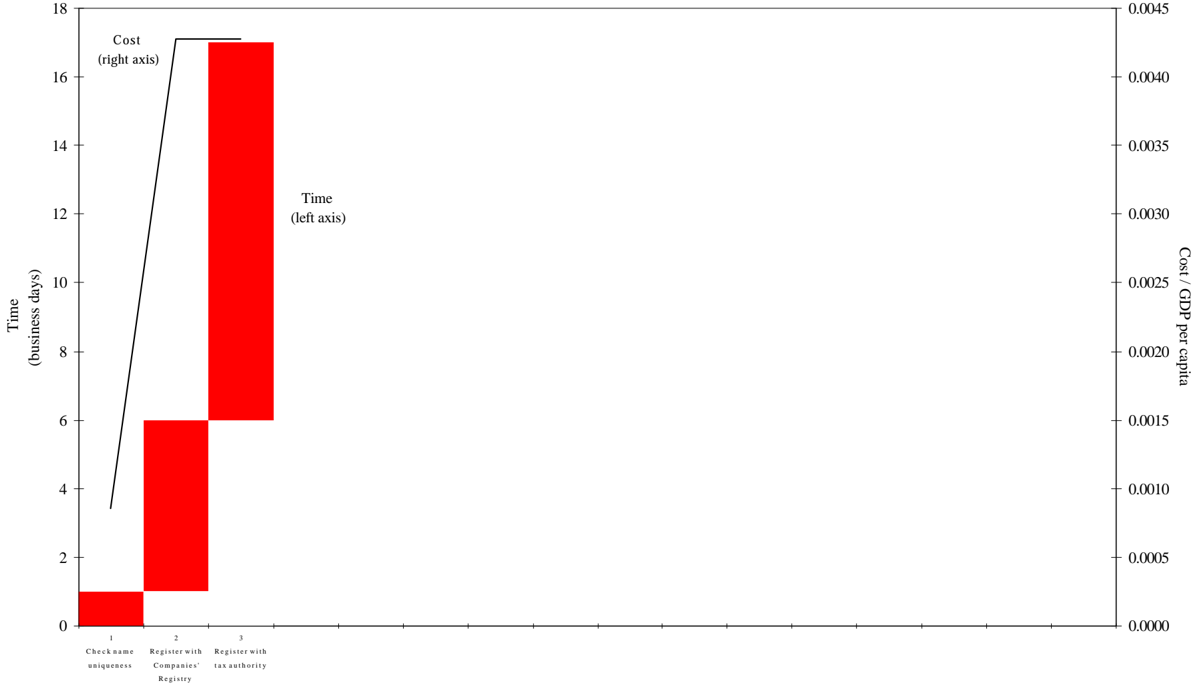
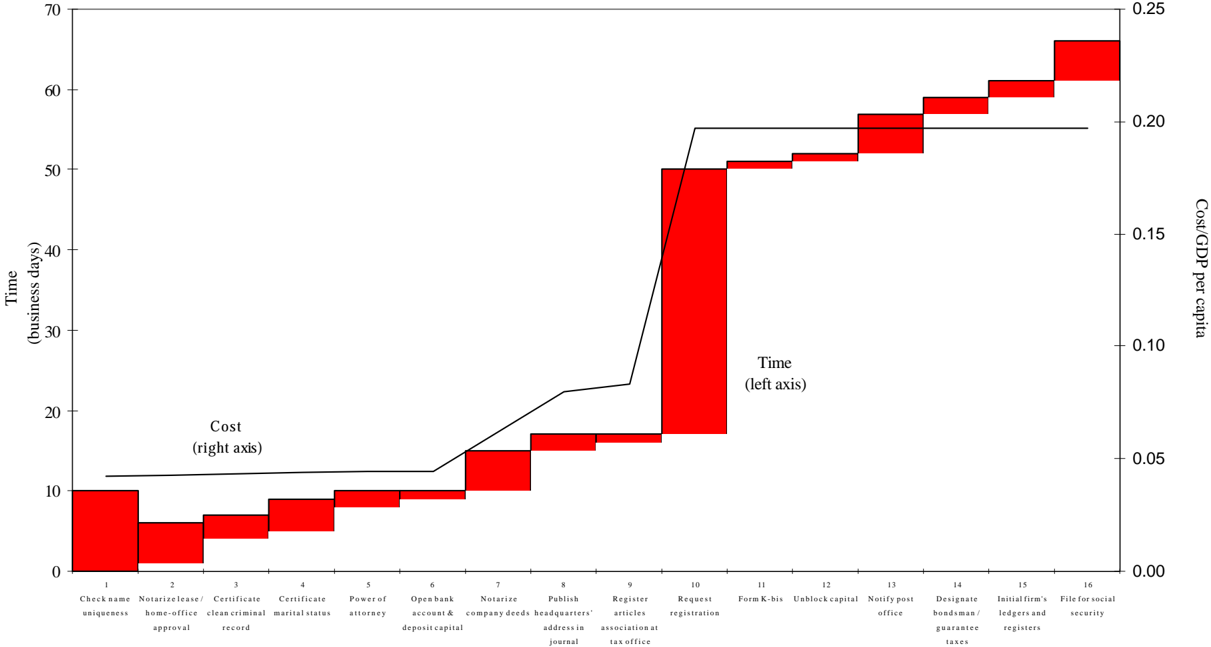
- Across the 75-country sample, the number of entry procedures ranges from 2 in Canada to 20 in Bolivia, with a sample average of 10.17 procedures; the average official time is 63.05 business days and the average cost is 0.34 of GDP per capita.
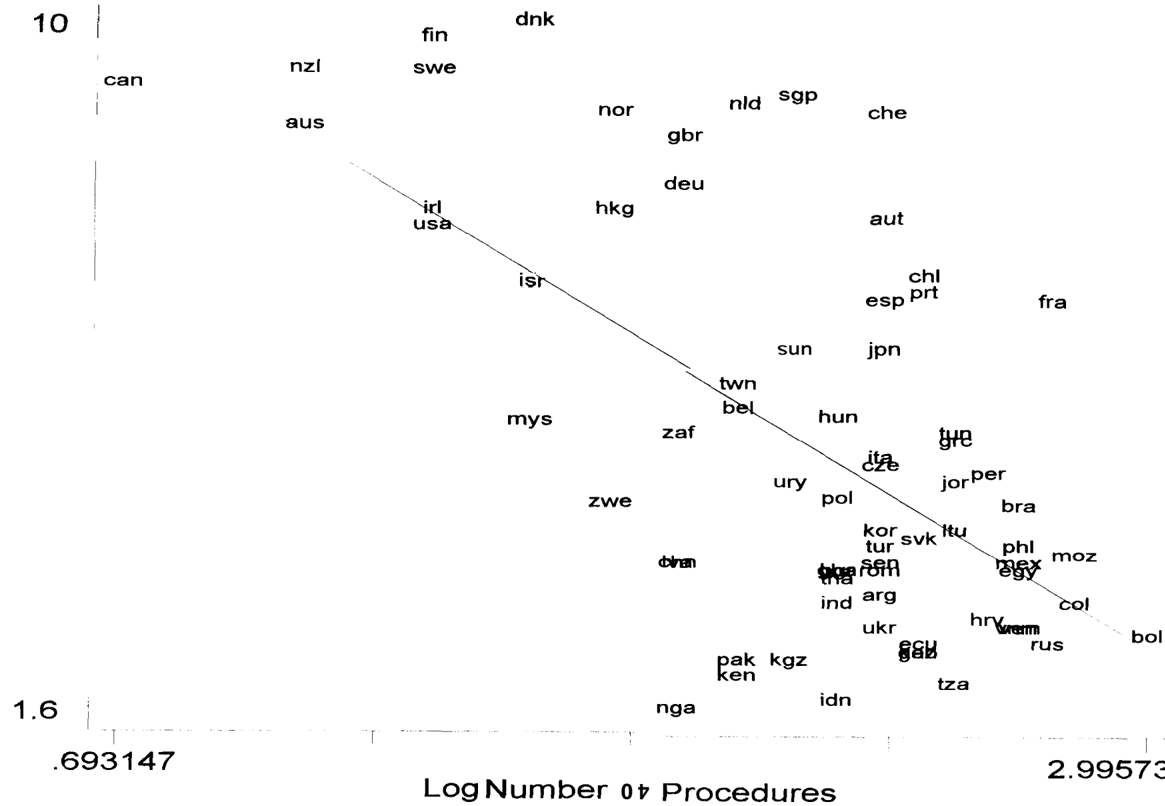
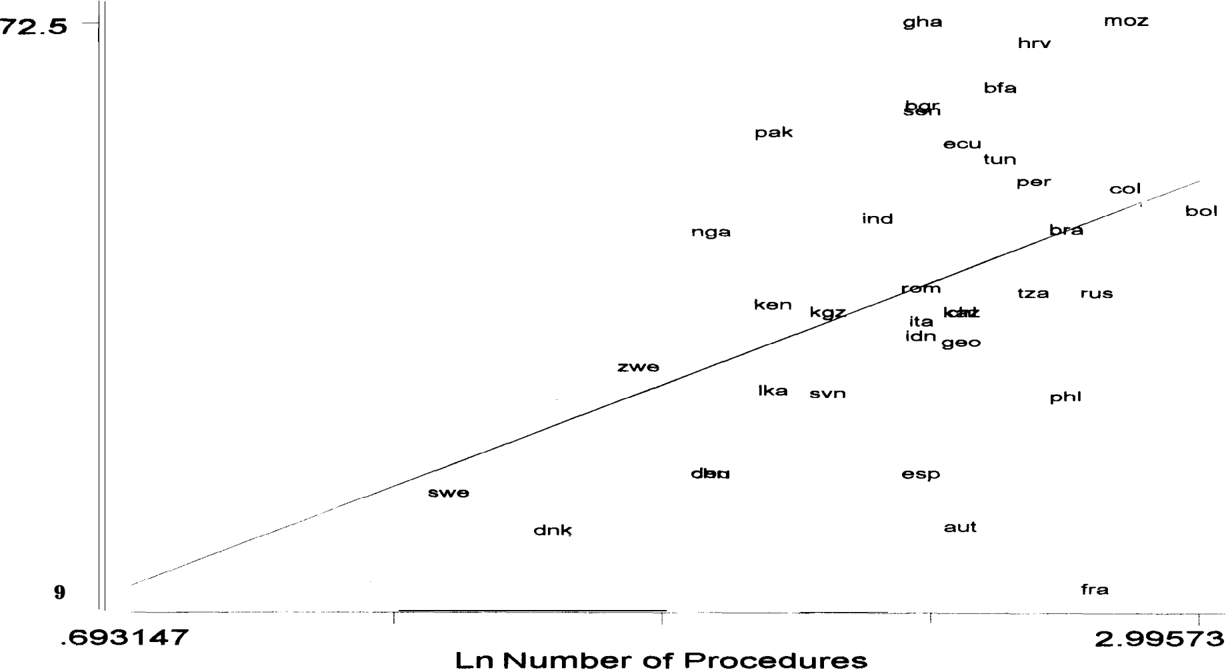
- The number of procedures is strongly correlated with time and cost: the paper reports correlations of 0.75 with log time and 0.62 with log cost.
- The helping-hand tests do not support a beneficial-regulation story: in Table IV, more procedures are associated with lower ISO quality standards (e.g. coefficient -0.2646) and larger unofficial economy measures (e.g. coefficient 13.6277 for size of unofficial economy; 19.8763 for employment in the unofficial economy), while pollution and health outcomes do not improve.
- The tollbooth evidence is stronger: Table VI reports that more procedures are associated with worse corruption scores, with a coefficient of -3.2809 (and -1.7249 with GDP per capita controls) for the corruption regressions.
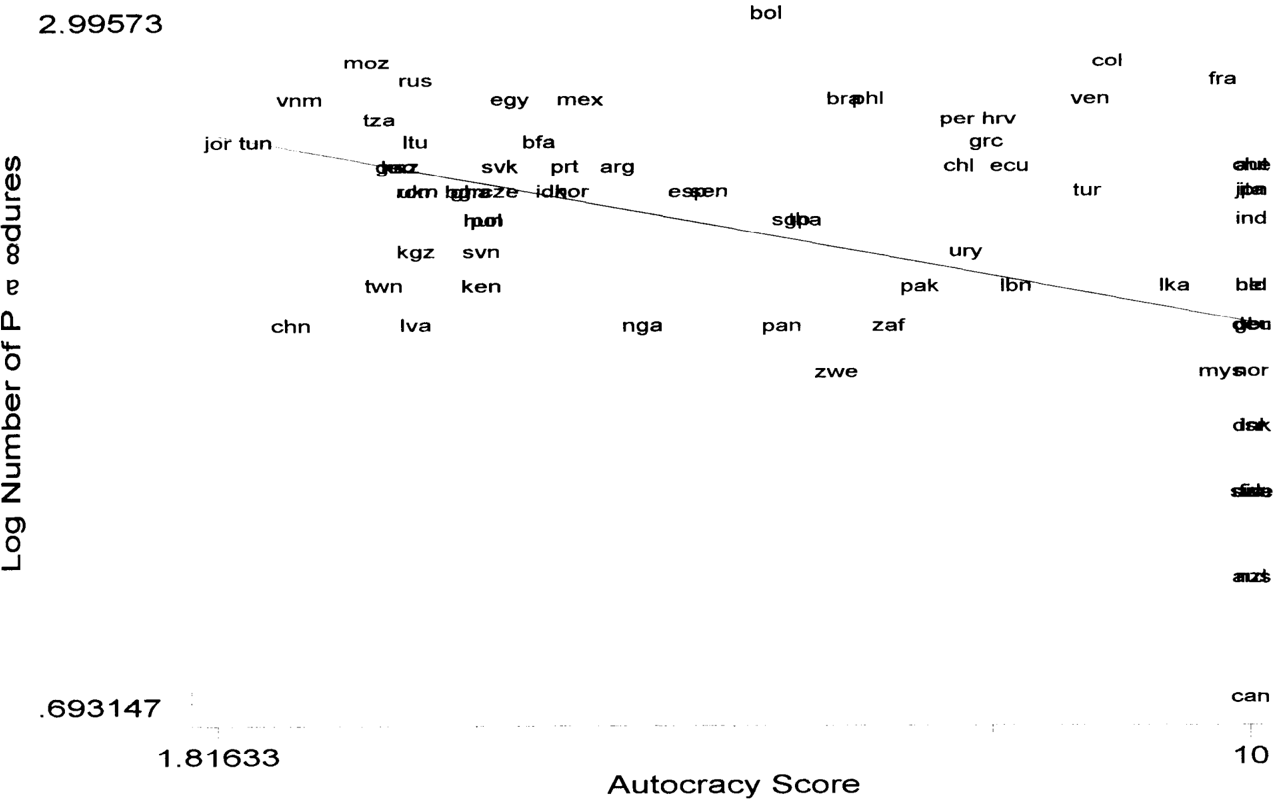
- In Table VIII, better government is associated with lighter regulation; the paper states that countries with more limited and representative governments have statistically significantly fewer procedures using 5 out of 6 measures of better government, and that more autocratic countries regulate more heavily.
Methods
- The paper builds a new database on entry regulation for 75 countries, focusing on the legal requirements, official time, and official cost for a standardized start-up firm.
- Data were gathered from written government sources, World Bank- and USAID-sponsored studies, government web pages, direct contacts with agencies, and independent double-checks in 73 countries via local consulting reports; the remaining 2 countries were double-checked through government contacts.
- The main analysis uses cross-country OLS regressions relating entry regulation measures to outcomes such as quality, pollution, unofficial economy, corruption, political institutions, legal origin, and GDP per capita; the paper also reports correlations and test-of-means comparisons across income quartiles.
Limitations
- The paper itself notes that the capture-theory tests are based on crude measures and that the data are probably least suited to test the capture hypothesis.
- The authors say the data almost surely underestimate the cost and complexity of entry because they focus on the capital city, omit industry-specific requirements and foreign-ownership steps, and ignore some informal delays and bribes.
- Evident from the text: the study is cross-sectional and based on official procedures/costs, so causal interpretation is limited and informal corruption/bureaucratic delays are not directly measured except indirectly through correlations.
Model-written summary. Check it against the paper before relying on it.
Integrity signals
Registry
Cites
Statistics
Figures
Verification
Claims the paper makes
0 Valid · 3 Not valid · 13 Not checked · 114 Own results and interpretations
A result the paper reports from its own data — it cites no other source for it, so there is none to check. The quote shows it is in the paper.
In the paper
“Very few entry regulations cover tax and labor issues.”
plain- Asserted: passes — The authors put it forward as true.
- Checkable: passes — It can be checked against evidence.
- Load-bearing: unclear — It is unclear whether the paper’s conclusions depend on it.
- Based: passes — The paper gives a reason why it holds.
In the paper
“The data show that the numbers of entry and of labor market regulations are positively correlated across countries, contrary to the substitutes hypothesis.”
What the sources say
- Not matchedcites Djankov et al., 2000
An author–year citation the paper’s reference list doesn’t settle. We don’t search these by name.
plainstates an association- Asserted: passes — The authors put it forward as true.
- Checkable: passes — It can be checked against evidence.
- Load-bearing: unclear — It is unclear whether the paper’s conclusions depend on it.
- Based: passes — The paper gives a reason why it holds.
- Not matched
A result the paper reports from its own data — it cites no other source for it, so there is none to check. The quote shows it is in the paper.
In the paper
“It often takes the form of screening procedures.”
- Also stated in: § III. Basic Results. · plain
“Instead, much of what governments do to regulate entry falls into the category of screening procedures.”
plain- Asserted: passes — The authors put it forward as true.
- Checkable: passes — It can be checked against evidence.
- Load-bearing: unclear — It is unclear whether the paper’s conclusions depend on it.
- Based: passes — The paper gives a reason why it holds.
- Also stated in: § III. Basic Results. · plain
A result the paper reports from its own data — it cites no other source for it, so there is none to check. The quote shows it is in the paper.
In the paper
“First, the cost-to-per-capita-GDP ratio decreases uniformly with GDP per capita.”
plainstates an association- Asserted: passes — The authors put it forward as true.
- Checkable: passes — It can be checked against evidence.
- Load-bearing: unclear — It is unclear whether the paper’s conclusions depend on it.
- Based: passes — The paper gives a reason why it holds.
A result the paper reports from its own data — it cites no other source for it, so there is none to check. The quote shows it is in the paper.
In the paper
“In contrast, countries in the other three quartiles of per capita income are not statistically different from each other in terms of the number of procedures and the time required to fulfill them.”
plain- Asserted: passes — The authors put it forward as true.
- Checkable: passes — It can be checked against evidence.
- Load-bearing: passes — The paper’s conclusions depend on it.
- Based: passes — The paper gives a reason why it holds.
49 more claims
Create a free account to see all 130 claims and every source verdict.
- Probably not a substantial claim. 21
- It may state two separate claims as one. 54
- The quote only partly states this claim. 26
Claims other papers make about this one
Each is checked against this paper’s own text: does it say what the citing paper says it does?
The source backs part of the claim, not all of it — or backs it for a different population, condition or comparison.
In the citing paper
“Our findings suggest an explanation for the low level of incorporation in Italy: the average direct cost associated with fulfilling the bureaucratic regulations for registering a new corporation in Italy is 20% of per capita GNP compared to 10% of per capita GNP on average for other G-7 European countries.”
From Entry regulation as a barrier to entrepreneurship (2006) · cites this paper as Djankov et al. (2002)
Experimental — accuracy not yet measuredThe cited source says what the claim attributes to it.
In the citing paper
“Given the explicit link made by Djankov et al . (2002) between the speed and ease with which businesses may be established in a country and its economic performance - and the enthusiasm with which this link has been grasped by European Union policy makers - our findings imply this link needs reconsidering.”
From The Effect of Business Regulations on Nascent and Young Business Entrepreneurship (2007) · cites this paper as Djankov et al . (2002)
Citations
Cites
La Porta, R., Lopez‐de‐Silanes, F., Shleifer, A., & Vishny, R. W. (1998) · Journal of Political Economy · doi:10.1086/250042 · Cited by 18,025
Self-citationThe Theory of Economic Regulation
Stigler, G. J. (1971) · The Bell Journal of Economics and Management Science · doi:10.2307/3003160 · Cited by 8,098
Journal of Economic Literature
(2019) · AEA Papers and Proceedings · doi:10.1257/pandp.109.633 · Cited by 7,468
The Quarterly Journal of Economics
Kuznets, S. (2024) · Business Cycle Theory, Part I Volume 4 · doi:10.4324/9781003549741-8 · Cited by 7,176
La Porta, R. (1999) · Journal of Law, Economics, and Organization · doi:10.1093/jleo/15.1.222 · Cited by 5,699 · cited 2×
“Legal origin has been viewed as a proxy for the government’s proclivity to intervene in the economy and the stance of the law toward the security of property rights in a country [La Porta et al. 1999].”
The Theory of Economic Regulation
Stigler, G. J. (2021) · The Political Economy · doi:10.4324/9781315495811-8 · Cited by 5,483
Pigou, A. C. (1933) · The Economic Journal · doi:10.2307/2224491 · Cited by 5,137
Toward a More General Theory of Regulation
Peltzman, S. (1976) · The Journal of Law and Economics · doi:10.1086/466865 · Cited by 4,729
Moffitt, R. A. (2009) · American Economic Review · doi:10.1257/aer.99.2.660 · Cited by 4,694
Shleifer, A., & Vishny, R. W. (1993) · The Quarterly Journal of Economics · doi:10.2307/2118402 · Cited by 3,778
Self-citation
Research works printed but not linked: 7
- McLiesh Caralee, 2001, NBER Working Paper No., 8288
- Kasnako lu, Zehra, and Münür Yayla, 'Unrecorded Economy in Turkey: A Monetary Approach', 1999. "Unrecorded Economy in Turkey (A Monetary Approach)" in Informal Sector in Turkey (I), Tuncer Bulutay (ed.), SIS, Ankara, forthcoming.
- Fred, 1987, Journal of Legal Studies, 101
- Olson, Mancur, 1991, 'Autocracy, Democracy, and Prosperity,' in Richard Zeckhauser, ed., Strategy of Choice, Cambridge, MA: MIT Press.
- 1967, Western Economic Journal, 232
- World Economic Forum (1999), The Global Competitiveness Report 1999 , Schwab, Klaus et al., eds., New York: Oxford University Press.
- World Economic Forum, The Global Competitiveness Report 2001, Klaus Schwab et al., eds. (New York, NY: Oxford University Press, 2001).
Cited by
Items 401–500 of 3,986
Entrepreneurs and innovation: The contingent role of institutional factors
Fuentelsaz, L., Maícas, J. P., & Montero, J. (2018) · International Small Business Journal Researching Entrepreneurship · doi:10.1177/0266242618766235 · Cited by 173
“A context with low economic freedom is characterised by weak protection of property rights, high levels of entry regulations, a lack of finance for entrepreneurial activities and a large government (Aidis et al., 2012; Dau and Cuerzo-Cazurra, 2014; Djankov et al., 2002; La Porta et al., 1999).”
InfluentialClarifying the relationships between institutions and global strategy
Cuervo-Cazurra, Á., Mudambi, R., & Pedersen, T. (2019) · Global Strategy Journal · doi:10.1002/gsj.1342 · Cited by 173
The Role of Regulation on Entry: Evidence from the Italian Provinces
Bripi, F. (2015) · The World Bank Economic Review · doi:10.1093/wber/lhv063 · Cited by 164
Bank Internationalization and Firm Exports: Evidence from Matched Firm–Bank Data
Bronzini, R., & D’Ignazio, A. (2016) · Review of International Economics · doi:10.1111/roie.12264 · Cited by 181
Innovation input, governance and climate change: Evidence from emerging countries
Afrifa, G. A., Tingbani, I., Yamoah, F. A., & Appiah, G. (2020) · Technological Forecasting and Social Change · doi:10.1016/j.techfore.2020.120256 · Cited by 143
Institutional Barriers to Growth: Entrepreneurship, Human Capital and Institutional Change
Eesley, C. (2016) · Organ. Sci. · doi:10.1287/orsc.2016.1077 · Cited by 122
“1There is an extensive literature on entry barriers such as deregulation of industries that examines established firms and a variety of outcomes (e.g., Delmas et al. 2007, Djankov et al. 2002, Gruca and Nath 1994).”
Trade facilitation, regulatory quality and export performance
Iwanow, T., & Kirkpatrick, C. H. (2007) · Journal of International Development · doi:10.1002/jid.1399 · Cited by 176
Taxes, start-up costs, and innovative entrepreneurship
Darnihamedani, P., Block, J., Hessels, J., & Simonyan, A. (2018) · Small Business Economics · doi:10.1007/s11187-018-0005-9 · Cited by 164
“Djankov et al. (2002) show that countries with high start-up regulations have high levels of corruption and low qualities of public or private goods.”
InfluentialNistotskaya, M., & Cingolani, L. (2015) · Journal of Public Administration Research and Theory · doi:10.1093/jopart/muv026 · Cited by 172
Regulating away competition: the effect of regulation on entrepreneurship and employment
Bailey, J. B., & Thomas, D. W. (2017) · Journal of Regulatory Economics · doi:10.1007/s11149-017-9343-9 · Cited by 157
“One of the first empirical tests of these two competing theories by Djankov et al. (2002) finds that for a sample of 85 countries, stricter regulation of entry is not associated with higher-quality products, better pollution records or health outcomes, or livelier competition, as the…”
InfluentialLaw, Trust, and the Development of CrowdfundingPreprint
Rau, P. R. (2017) · SSRN Electronic Journal · doi:10.2139/ssrn.2989056 · Cited by 186
Ayyagari, M., Demirgüç‐Kunt, A., & Maksimovic, V. (2014) · Journal of Financial and Quantitative Analysis · doi:10.1017/s002210901400026x · Cited by 139
“Panel B of Table 1 reports summary statistics depending on the level of bu-reaucratic regulation, as measured by entry regulation in the economy (De Soto (1989), Djankov et al. (2002)).”
Firm entry, trade, and welfare in Zipf's world
di Giovanni, J., & Levchenko, A. A. (2012) · Journal of International Economics · doi:10.1016/j.jinteco.2012.08.002 · Cited by 158
“As first shown by Djankov et al. (2002), the differences in these fixed costs are substantial across countries.”
Capelleras, J., Mole, K. F., Greene, F. J., & STOREY, D. J. (2007) · Journal of International Business Studies · doi:10.1057/palgrave.jibs.8400340 · Cited by 179
“Country Djankov et al (2002) Cost + Time of meeting government requirements.”
InfluentialNon-performing loans, prospective bailouts, and Japan's slowdown
Barseghyan, L. (2010) · Journal of Monetary Economics · doi:10.1016/j.jmoneco.2010.08.002 · Cited by 152
Does economic freedom cause prosperity? An IV approach
Faria, H. J., & Montesinos-Yufa, H. M. (2009) · Public Choice · doi:10.1007/s11127-009-9440-0 · Cited by 141
“These findings are consistent with Easterly and Levine (2003), Rodrik et al.”
Institutional environment and entrepreneurship: An empirical study across countries
Sambharya, R. B., & Musteen, M. (2014) · Journal of International Entrepreneurship · doi:10.1007/s10843-014-0137-1 · Cited by 167
Pro‐market reforms and developing country multinational corporations
Dau, L. A. (2012) · Global Strategy Journal · doi:10.1111/j.2042-5805.2012.01033.x · Cited by 146
Kim, Y.-H., Kim, W., & Yang, T. (2011) · Research Policy · doi:10.1016/j.respol.2011.08.003 · Cited by 184
Democracy, Technology, and Growth
Aghion, P., Alesina, A., & Trebbi, F. (2007) · National Bureau of Economic Research · doi:10.3386/w13180 · Cited by 184
What Drives Successful Economic Diversification in Resource-Rich Countries?
Lashitew, A. A., Ross, M. L., & Werker, E. D. (2020) · The World Bank Research Observer · doi:10.1093/wbro/lkaa001 · Cited by 204
Institutions and Entrepreneurship Development in Russia: A Comparative PerspectivePreprint
Estrin, S., Aidis, R., & Mickiewicz, T. M. (2007) · SSRN Electronic Journal · doi:10.2139/ssrn.1017252 · Cited by 128
Regulatory impact assessment and regulatory governance in developing countries
Kirkpatrick, C. H., & Parker, D. (2004) · Public Administration and Development · doi:10.1002/pad.310 · Cited by 174
Corruption: Costs and Mitigating Strategies
Fund, I. M., & Dept., I. M. F. L. (2016) · IMF staff discussion note · doi:10.5089/9781513594330.006 · Cited by 196
Business Environment and the Incorporation Decision
Love, I., Kunt, A. T., & Maksimovic, V. (2004) · World Bank, Washington, DC eBooks · doi:10.1596/1813-9450-3317 · Cited by 132
Public Procurement and Rent-Seeking: The Case of Paraguay
Auriol, E., Straub, S., & Flochel, T. (2015) · World Development · doi:10.1016/j.worlddev.2015.09.001 · Cited by 154
“In practice entry fees are higher, in percentage of per capita GDP, in poor countries than in rich ones (Djankov et al., 2002). operating in the formal sector is Cf(q) = F + cfq, where by assumption A1 cf is independently and uniformly distributed in [0, c].”
Regulation and welfare: evidence from paragraph IV generic entry in the pharmaceutical industry
Branstetter, L., Chatterjee, C., & Higgins, M. J. (2016) · The RAND Journal of Economics · doi:10.1111/1756-2171.12157 · Cited by 140
Finance and Inequality: Channels and EvidencePreprint
Claessens, S., & Perotti, E. C. (2007) · SSRN Electronic Journal · doi:10.2139/ssrn.998468 · Cited by 125
Das, S. B. (2011) · ISEAS Publishing eBooks · doi:10.1355/9789814311694-019 · Cited by 124
Trade, Firm Selection and Innovation: The Competition Channel
Impullitti, G., & Licandro, O. (2017) · The Economic Journal · doi:10.1111/ecoj.12466 · Cited by 153
Ownership, investment climate and firm performance: Evidence from Chinese firms1
Hallward-Driemeier, M. C., Wallsten, S., & Xu, L. C. (2006) · Economics of Transition · doi:10.1111/j.1468-0351.2006.00267.x · Cited by 162
Institutional Obstacles to Entrepreneurship
Fogel, K., Hawk, A. L., Mørck, R., & Yeung, B. Y. (2009) · Oxford University Press eBooks · doi:10.1093/oxfordhb/9780199546992.003.0020 · Cited by 159
Technology and Financial Development
Ilyina, A., & Samaniego, R. M. (2011) · Journal of money credit and banking · doi:10.1111/j.1538-4616.2011.00401.x · Cited by 137
“Hence, we check whether our results concerning RND are robust to including interactions of RND with the entry cost measure of Djankov et al (2002), and the employment regulation intensity measure of Botero et al (2004).”
Product market deregulation and the US employment miracle
Ebell, M., & Haefke, C. (2008) · Review of Economic Dynamics · doi:10.1016/j.red.2008.11.002 · Cited by 154
INSTABILITY AND THE INCENTIVES FOR CORRUPTION
Campante, F. R., Chor, D., & Do, Q.-A. (2009) · Economics and Politics · doi:10.1111/j.1468-0343.2008.00335.x · Cited by 150
“We first use a measure of the regulatory barriers to starting a business, from the World Bank’s Doing Business database, which is based on the data methodology developed by Djankov et al. (2002). Specifically, this σ proxy is the number of days (averaged over 20032005, and re-scaled to lie between 0 and 1) needed to s…”
Consequences and causes of corruption: What do we know from a cross-section of countries?Preprint
Lambsdorff, J. G. (2005) · RePEc: Research Papers in Economics · Cited by 235
Transnational ties and performance of immigrant entrepreneurs: the role of home-country conditions
Brzozowski, J., Cucculelli, M., & Surdej, A. (2014) · Entrepreneurship and Regional Development · doi:10.1080/08985626.2014.959068 · Cited by 147
“A burgeoning literature initiated in the mid1990s has studied the relationship between various dimensions of governance and the business dynamics (La Porta et al. 1999; Djankov et al. 2002).”
Global entrepreneurship and institutions: an introduction
Levie, J., Autio, E., Ács, Z. J., & Hart, M. (2013) · Small Business Economics · doi:10.1007/s11187-013-9516-6 · Cited by 149
“Drawing mostly on the institutional economics tradition (Djankov et al., 2002; Djankov at al., 2003; Peng, 2002), this work assumes that entrepreneurial processes are both regulated by, and in return influence, regional and countrylevel attributes such as formal and informal institutions and…”
Friends with Benefits: How Political Connections Help to Sustain Private Enterprise Growth in China
Kung, J. K., & Ma, C. (2016) · Economica · doi:10.1111/ecca.12212 · Cited by 127
Gender, Entrepreneurship, and the Formal–Informal Dilemma: Evidence from Indonesia
Babbitt, L. G., Brown, D. K., & Mazaheri, N. (2015) · World Development · doi:10.1016/j.worlddev.2015.02.019 · Cited by 159
“Quantitative research ties the size of the informal economy to the degree of regulatory barriers to formal market entry (Djankov et al., 2002).”
Brieger, S. A., & Gielnik, M. M. (2020) · Small Business Economics · doi:10.1007/s11187-019-00314-x · Cited by 167
“We focus on two institutions that have been shown to be important requirements of entrepreneurship: business-friendly regulation and the rule of law (e.g., Djankov et al. 2002; Chowdhury et al. 2015; McMullen et al. 2008; Estrin et al. 2013).”
Institutional factors affecting entrepreneurship: A QCA analysis
Sendra-Pons, P., Comeig, I., & Mas‐Tur, A. (2022) · European Research on Management and Business Economics · doi:10.1016/j.iedeen.2021.100187 · Cited by 169
Financial Development, Fixed Costs, and International Trade
Becker, B., Chen, J., & Greenberg, D. (2012) · The Review of Corporate Finance Studies · doi:10.1093/rcfs/cfs005 · Cited by 134
Does Oil Wealth Affect Democracy in Africa?
Anyanwu, J. C., & Erhijakpor, A. E. O. (2014) · African Development Review · doi:10.1111/1467-8268.12061 · Cited by 141
“Legal origins affect judicial independence and this has an effect on the protection of property rights; legal origins influence the regulation of entry and this affect corruption (Djankov et al., 2002); the quality of government and political rights impinge on the legal origins (La Porta et al.”
The happiness gap in Eastern Europe
Djankov, S., Nikolova, E., & Zilinsky, J. (2015) · Journal of Comparative Economics · doi:10.1016/j.jce.2015.10.006 · Cited by 143
“For definitions, see Djankov et al. (2002) and Botero et al. (2004).”
Self-citationEntrepreneurs’ age, institutions, and social value creation goals: A multi-country study
Brieger, S. A., Bäro, A., Criaco, G., & Terjesen, S. A. (2020) · Small Business Economics · doi:10.1007/s11187-020-00317-z · Cited by 166
“Such favorable conditions typically reduce transaction costs of entrepreneurial activity, i.e., cheap and less time-consuming entry regulations reduce barriers to new firm creation (Djankov et al. 2002; Klapper et al. 2006).”
Informality costs: Informal entrepreneurship and innovation in emerging economies
Bu, J., & Cuervo-Cazurra, Á. (2020) · Strategic Entrepreneurship Journal · doi:10.1002/sej.1358 · Cited by 146
The Real Effect of Foreign Banks
Bruno, V. G., & Hauswald, R. B. H. (2009) · European Finance Review · doi:10.1093/rof/rft041 · Cited by 142
Monopoly Money: Foreign Investment and Bribery in Vietnam, a Survey Experiment
Malesky, E. J., Gueorguiev, D. D., & Jensen, N. M. (2014) · American Journal of Political Science · doi:10.1111/ajps.12126 · Cited by 133
The impact of institutional change on entrepreneurship in a crisis-hit economy: the case of Greece
Williams, N., & Vorley, T. (2015) · Entrepreneurship and Regional Development · doi:10.1080/08985626.2014.995723 · Cited by 148
“However, where formal institutions are weak, they impose costly bureaucratic burdens on entrepreneurs and increase uncertainty as well as the operational and transaction costs of firms (Djankov et al. 2002; Puffer, McCarthy, and Boisot 2010).”
Configurational conditions of national innovation capability: A fuzzy set analysis approach
Khedhaouria, A., & Thurik, R. (2017) · Technological Forecasting and Social Change · doi:10.1016/j.techfore.2017.04.005 · Cited by 133
Measuring Transaction Costs: An Incomplete Survey
Wang, N. (2003) · Cited by 195
Trade Liberalization, Labor-Market Institutions, and Poverty Reduction: Evidence from Indian States
Hasan, R., Mitra, D., & Marchand, B. U. (2007) · India Policy Forum · Cited by 118
FIRM PRODUCTIVITY AND INSTITUTIONAL QUALITY: EVIDENCE FROM ITALIAN INDUSTRY
Lasagni, A., Nifo, A., & Vecchione, G. (2015) · Journal of Regional Science · doi:10.1111/jors.12203 · Cited by 148
Kalmenovitz, J. (2019) · Review of Financial Studies · doi:10.1093/rfs/hhad001 · Cited by 129
de Andrade, G. H., Bruhn, M., & McKenzie, D. J. (2014) · The World Bank Economic Review · doi:10.1093/wber/lhu008 · Cited by 149
“Fink et al. (2012) provide more detail on this method and the need for its use in analysis of development experiments.”
Growing and Slowing Down Like China
Zilibotti, F. (2017) · Journal of the European Economic Association · doi:10.1093/jeea/jvx018 · Cited by 129
“In AAZ, countries are classified into having high or low barriers to entry according to the “number of procedures to open a new business” variable from Djankov et al. (2002).”
EMPLOYMENT PROTECTION, TECHNOLOGY CHOICE, AND WORKER ALLOCATION
Bartelsman, E. J., Gautier, P. A., & de Wind, J. (2016) · International Economic Review · doi:10.1111/iere.12176 · Cited by 188
Formal and informal institutional effects on entrepreneurship: a synthesis of nation‐level research
Salimath, M. S., & Cullen, J. B. (2010) · International journal of organizational analysis · doi:10.1108/19348831011062175 · Cited by 156
Debt Enforcement Around the WorldPreprint
Djankov, S., Hart, O., McLiesh, C., et al. (2006) · SSRN Electronic Journal · doi:10.2139/ssrn.953000 · Cited by 117
Self-citationSocial institutions, corporate governance and firm-performance in the MENA region
Mertzanis, C., Basuony, M. A. K., & Mohamed, E. K. A. (2019) · Research In International Business and Finance · doi:10.1016/j.ribaf.2018.12.005 · Cited by 107
The impact of banking development on the size of shadow economies
Bose, N., Capasso, S., & Wurm, M. A. (2012) · Journal of Economic Studies · doi:10.1108/01443581211274584 · Cited by 139
Cumming, D. J., & Schwienbacher, A. (2016) · Corporate Governance An International Review · doi:10.1111/corg.12256 · Cited by 149
Besley, T., Burgess, R., Khan, A., & Xu, G. (2022) · Annual Review of Economics · doi:10.1146/annurev-economics-080521-011950 · Cited by 213
The pace of MNEs’ sequential entries: Cumulative entry experience and the dynamic process
Gao, G. Y., & Pan, Y. (2010) · Journal of International Business Studies · doi:10.1057/jibs.2010.15 · Cited by 126
Firm lobbying and influence in developing countries: a multilevel approach
Weymouth, S. J. (2012) · Business and Politics · doi:10.1515/bap-2012-0030 · Cited by 134
“For instance, incumbent oligopolists may push for expansive licensing requirements and other forms of entry regulations in order to restrict competition (Djankov et al. 2002).”
How do pro-market reforms impact firm profitability? The case of India under reform
Chari, M. D. R., & Banalieva, E. R. (2014) · Journal of World Business · doi:10.1016/j.jwb.2014.05.004 · Cited by 121
Caste and Entrepreneurship in India
Iyer, L. S., Khanna, T., & Varshney, A. (2015) · Cited by 146
Perceived public support and entrepreneurship attitudes: A little reciprocity can go a long way!
Nowiński, W., Haddoud, M. Y., Wach, K., & Schaefer, R. (2020) · Journal of Vocational Behavior · doi:10.1016/j.jvb.2020.103474 · Cited by 146
“Moreover, since previous research linking entrepreneurship policies with entrepreneurial intentions provide d mixed findings (Djankov et al., 2002; Engle, Schlaegel, & Dimitriadi, 2011; Van Stel, Storey, & Thurik, 2007), attitudinal variables and entrepreneurial self - efficacy beliefs could…”
Varieties of entrepreneurship: institutional drivers across entrepreneurial activity and country
Chowdhury, F., Terjesen, S. A., & Audretsch, D. B. (2014) · European Journal of Law and Economics · doi:10.1007/s10657-014-9464-x · Cited by 143
Aid, Aid for Trade, and bilateral trade: An empirical study
Pettersson, J., & Johansson, L. (2011) · Journal of International Trade & Economic Development · doi:10.1080/09638199.2011.613998 · Cited by 126
“Helpman, Melitz, and Rubinstein (2008) use regulation costs of firm entry from Djankov et al. (2002) as excluded variables.”
Growth Empirics without Parameters
Henderson, D. J., Papageorgiou, C., & Parmeter, C. F. (2011) · The Economic Journal · doi:10.1111/j.1468-0297.2011.02460.x · Cited by 123
Barriers to absorptive capacity in emerging market firms
Cuervo-Cazurra, Á., & Rui, H. (2017) · Journal of World Business · doi:10.1016/j.jwb.2017.06.004 · Cited by 134
US–Europe differences in technology-driven growth: quantifying the role of education
Krueger, D., & Kumar, K. (2003) · Journal of Monetary Economics · doi:10.1016/j.jmoneco.2003.07.005 · Cited by 115
“In this paradigm, (8) can be interpreted as the expected number of bugs that are discovered this period and will be fixed by the next period.”
InfluentialEvaluating the effects of entry regulations and firing costs on international income differences
Boedo, H. J. M., & Mukoyama, T. (2012) · Journal of Economic Growth · doi:10.1007/s10887-011-9077-y · Cited by 106
Taking the Measure of Law: The Case of the Doing Business Project
Davis, K. E., & Kruse, M. B. (2007) · Law & Social Inquiry · doi:10.1111/j.1747-4469.2007.00088.x · Cited by 136
Dynamics of pro-market institutions and firm performance
Banalieva, E. R., Cuervo-Cazurra, Á., & Sarathy, R. (2018) · Journal of International Business Studies · doi:10.1057/s41267-018-0155-7 · Cited by 127
Russia: Firm entry and survival barriers
Aidis, R., & Adachi, Y. (2007) · Economic Systems · doi:10.1016/j.ecosys.2007.08.003 · Cited by 158
The role of firm characteristics in pharmaceutical product launches
Kyle, M. (2006) · The RAND Journal of Economics · doi:10.1111/j.1756-2171.2006.tb00033.x · Cited by 132
“In addition to competition, the regulatory environment has a significant bearing on prevailing prices (Danz?n and Chao, 2000a, 2000b) and entry costs (Djankov et al., 2002).”
The mix of international banks’ foreign claims: Determinants and implications
García-Herrero, A., & Pería, M. S. M. (2007) · Journal of Banking & Finance · doi:10.1016/j.jbankfin.2006.11.002 · Cited by 106
Competencies and Institutions Fostering High-growth Firms
Henrekson, M., & Johansson, D. (2007) · Foundations and Trends® in Entrepreneurship · doi:10.1561/0300000026 · Cited by 106
Logistics performance, exports, and growth: Evidence from Asian economies
Tang, C., & Abosedra, S. (2019) · Research in Transportation Economics · doi:10.1016/j.retrec.2019.100743 · Cited by 106
Entrepreneurship and Public Policy
Henrekson, M., & Stenkula, M. (2010) · Springer eBooks · doi:10.1007/978-1-4419-1191-9_21 · Cited by 160
Banking system control, capital allocation, and economy performance☆
Mørck, R., Yavuz, M. D., & Yeung, B. Y. (2010) · Journal of Financial Economics · doi:10.1016/j.jfineco.2010.12.004 · Cited by 140
Managing innovation under competitive pressure from informal producers
Mendi, P., & Costamagna, R. (2016) · Technological Forecasting and Social Change · doi:10.1016/j.techfore.2016.08.013 · Cited by 112
Regulations, institutional quality and entrepreneurship
Chambers, D., & Munemo, J. (2019) · Journal of Regulatory Economics · doi:10.1007/s11149-019-09377-w · Cited by 153
Bank regulation, risk and return: Evidence from the credit and sovereign debt crises
Hoque, H., Andriosopoulos, D., Andriosopoulos, K. D., & Douady, R. (2014) · Journal of Banking & Finance · doi:10.1016/j.jbankfin.2014.06.003 · Cited by 126
Law and Finance After a Decade of Research
Porta, R. L., López‐de‐Silanes, F., & Shleifer, A. (2013) · Handbook of the economics of finance · doi:10.1016/b978-0-44-453594-8.00006-9 · Cited by 131
Self-citationConditioning factors for corporate entrepreneurship: an in(ex)ternal approach
Urbano, D., & Turró, A. (2013) · International Entrepreneurship and Management Journal · doi:10.1007/s11365-013-0261-8 · Cited by 144
A future global economy to be built by BRICs
Cheng, H., Gutierrez, M., Mahajan, A., Shachmurove, Y., & Shahrokhi, M. (2007) · Global Finance Journal · doi:10.1016/j.gfj.2006.04.003 · Cited by 133
Current debates in global strategy
Peng, M. W., & Pleggenkuhle‐Miles, E. G. (2009) · International Journal of Management Reviews · doi:10.1111/j.1468-2370.2008.00249.x · Cited by 138
“Interestingly, both national culture and institutional heritage have been used as variables impacting major business activities, from capital structure (Chui et al. 2002) to entrepreneurial foundings (Djankov et al. 2002) to internationalization (Guillen 2002).”
Trade, inequality, and the political economy of institutions
Do, Q.-T., & Levchenko, A. A. (2008) · Journal of Economic Theory · doi:10.1016/j.jet.2008.11.007 · Cited by 120
“[15] document large differences in the amount of time and money it requires to start a business in a large sample of countries.”
Government Policy in the Formal and Informal Sectors
Prado, M. A. (2008) · European Economic Review · doi:10.1016/j.euroecorev.2011.04.010 · Cited by 117
Drobetz, W., Schilling, D. C., & Schröder, H. (2014) · European Financial Management · doi:10.1111/eufm.12048 · Cited by 118
All in the family: State capture in Tunisia
Rijkers, B., Freund, C. L., & Nucifora, A. M. D. (2016) · Journal of Development Economics · doi:10.1016/j.jdeveco.2016.08.002 · Cited by 148
By Choice and by Necessity: Entrepreneurship and Self-Employment in the Developing World
Margolis, D. N. (2014) · European Journal of Development Research · doi:10.1057/ejdr.2014.25 · Cited by 151
18 The Informal Sector in Developing Countries: Output, Assets, and Employment
Pratap, S., & Quintin, E. (2008) · Oxford University Press eBooks · doi:10.1093/acprof:oso/9780199548880.003.0018 · Cited by 111
“For instance, standard household surveys provide a good estimate of the fraction of workers who fail to receive the benefits which labour law mandates in a given nation (see e.g. Pratap and Quintin 2006).”
InfluentialTransport Construction, Corruption and Developing Countries
Kenny, C. J. (2008) · Transport Reviews · doi:10.1080/01441640802075760 · Cited by 101
“See Djankov et al. (2000) for a broader discussion of the limited impact of regulation of entry on quality of service provision, but its stronger link with the extent of corruption, across a range of sectors.”
Self-employment and well-being across institutional contexts
Fritsch, M., Sorgner, A., & Wyrwich, M. (2019) · Journal of Business Venturing · doi:10.1016/j.jbusvent.2019.105946 · Cited by 100
What drives productivity in Tanzanian manufacturing firms: technology or business environment?
Goedhuys, M., Janz, N., & Mohnen, P. (2008) · European Journal of Development Research · doi:10.1080/09578810802060785 · Cited by 99
“Following earlier documents by Fransman (1985), Katz (1987), Lall (1992), a rich literature developed studying the characteristics of innovation and technological change in developing economies.”
Metadata
- Authors
- Djankov, S., La Porta, R., Lopez-de-Silanes, F., & Shleifer, A.
- Affiliations
- World Bank (US)
- National Bureau of Economic Research (US)
- ORCID
- Djankov, S.
- Venue
- The Quarterly Journal of Economics
- Publisher
- Oxford University Press (OUP)
- Published
- 2002-02-01
- Volume
- 117
- Issue
- 1
- Pages
- 1-37
- ISSN
- 0033-5533
- 1531-4650
- OpenAlex
- W2139896179
- Cited by
- 3,956
- References
- 30
- Citations by year
- 2026: 223 · 2025: 185 · 2024: 157 · 2023: 120 · 2022: 140 · 2021: 150 · 2020: 151 · 2019: 161 · 2018: 157 · 2017: 162 · 2016: 166 · 2015: 193 · 2014: 200 · 2013: 183 · 2012: 193
- Type
- report
- Language
- en
- Open access
- green
- doi.org
- Licence
- other-oa
- Locations
- World Bank, Washington, DC eBooks (publishedVersion)
- The Quarterly Journal of Economics (publishedVersion)
- The World Bank Open Knowledge Repository (World Bank) (publishedVersion)
- National Bureau of Economic Research (publishedVersion, other-oa)
- RePEc: Research Papers in Economics (submittedVersion)
- Digital Access to Scholarship at Harvard (DASH) (Harvard University) (submittedVersion, cc-by)
- SSRN Electronic Journal (submittedVersion)
- OpenGrey (Institut de l'Information Scientifique et Technique) (submittedVersion)
- The World Bank Open Knowledge Repository (World Bank) (submittedVersion, cc-by)
- Topics
- Social Sciences › Sociology and Political Science › Corruption and Economic Development
- Social Sciences › Economics, Econometrics and Finance › Economics and Econometrics › Taxation and Compliance Studies
- Social Sciences › Business, Management and Accounting › Strategy and Management › Political Influence and Corporate Strategies
- Keywords
- start-up firms, bureaucratic procedures, corruption, informal economy, democracy, government size, public choice theory, public interest theory
About these checks
Registry, retraction, Cites and statistics results are computed, not judged, with one exception: a printed reference that no index lists is read once by a model before it counts as a citation error. Claims are extracted by a model and kept only when their quote appears verbatim in the text; each cited source is then checked, with a model’s help, for whether it says what the claim relies on. Those verdicts can be wrong — read the claim’s quote and the cited source before relying on one.
A language model drew the claims from the paper on 2026-10-01, under version 3 of the claim definition (model deepseek-v4.1-flash, prompt extract-v3).
A second model labelled each claim on 2026-10-01 (model jev-1.13-20260917, definition revision gold-guideline-v0.2).
Statistics and arithmetic are recomputed, not judged.
Confidence bands are shown only for fields calibrated on our annotated test set. None is calibrated yet, so no band is shown.
What counts as a claim ›How we measure confidence ›How we check this ›
Are you an author, or do you see a problem with this page? Request a review
Data sources
Bibliographic data: Semantic Scholar, OpenAlex, Crossref.
Contains information from the Semantic Scholar Academic Graph Datasets, made available under the ODC Attribution License (ODC-BY 1.0).
Semantic Scholar’s data is described in: Kinney, R., et al. (2023). The Semantic Scholar Open Data Platform. arXiv:2301.10140.
