

The Regulation of Entry
Open accessThe DOI matches its Crossref record, with a small difference in title or year; 39 of the 39 references it cites were found in a registry or an index; none of the 13 sources its claims cite is checked for support yet.
Abstract
1%(5 :25.,1* 3$3(5 6(5,(6 7+( 5(*8/$7,21 2) (175< 6LPHRQ 'MDQNRY 5DIDHO /D 3RUWD )ORUHQ.LR /RSH]GH6LODQHV $QGUHL 6KOHLIHU :RUNLQJ 3DSHU KWWSZZZQEHURUJSDSHUVZ 1$7,21$/ %85($8 2) (&2120,& 5(6($5&+ 0DVVD.KXVHWWV $YHQXH &DPEULGJH 0$ 6HSWHPEHU :H WKDQN 2OJD ,RIIH 7DWLDQD 1HQRYD DQG (NDWHULQD 7UL]ORYD IRU DEOH UHVHDU.K DVVLVWDQ.H DQG +DPLG $ODYL ,ULQD $VWUDNKDQ $EKLMLW %DQHUMHH 5L.KDUG &DYHV -D.TXHOLQH &RROLGJH -DPHV (PHU\ 1LKDO (O0DJKDUEHO -HDQ 3DXO *DXWKLHU (G *ODHVHU 6LPRQ -RKQVRQ /DZUHQ.H .DW] 3HWHU .X.HUD 'DYLG /DLEVRQ ,UD /LHEHUPDQ 'DYLQ 0D.NLQ]LH 0DULH )UDQ.RLVH 0DULH1HOO\ 0DU.HOR 2ODUUHDJD *X\ 3IHIIHUPDQQ 6DQWLDJR 6HGD.D /HLOD :HEVWHU 3HWHU :ULJKW DQG VHPLQDU SDUWL.LSDQWV DW WKH 8QLYHUVLW\ RI 0DU\ODQG DW &ROOHJH 3DUN IRU KHOSIXO .RPPHQWV 7KH .ROOH.WLRQ RI GDWD IRU WKLV SDSHU ZDV RUJDQL]HG DQG ILQDQ.HG E\ WKH :RUOG %DQN $Q DSSHQGL[ GHV
Overview
CoChat Summary
TL;DR
This paper assembles a new cross-country dataset on business entry regulation in 75 countries and uses it to compare the helping-hand, capture, and tollbooth theories of regulation. The evidence is most consistent with the tollbooth view: heavier entry regulation is associated with more corruption, a larger unofficial economy, and less representative, more autocratic governments.
Key findings
- Across the 75-country sample, the number of entry procedures ranges from 2 in Canada to 20 in Bolivia, with a sample average of 10.17 procedures; the average official time is 63.05 business days and the average cost is 0.34 of GDP per capita.
- The number of procedures is strongly correlated with time and cost: the paper reports correlations of 0.75 with log time and 0.62 with log cost.
- The helping-hand tests do not support a beneficial-regulation story: in Table IV, more procedures are associated with lower ISO quality standards (e.g. coefficient -0.2646) and larger unofficial economy measures (e.g. coefficient 13.6277 for size of unofficial economy; 19.8763 for employment in the unofficial economy), while pollution and health outcomes do not improve.
- The tollbooth evidence is stronger: Table VI reports that more procedures are associated with worse corruption scores, with a coefficient of -3.2809 (and -1.7249 with GDP per capita controls) for the corruption regressions.
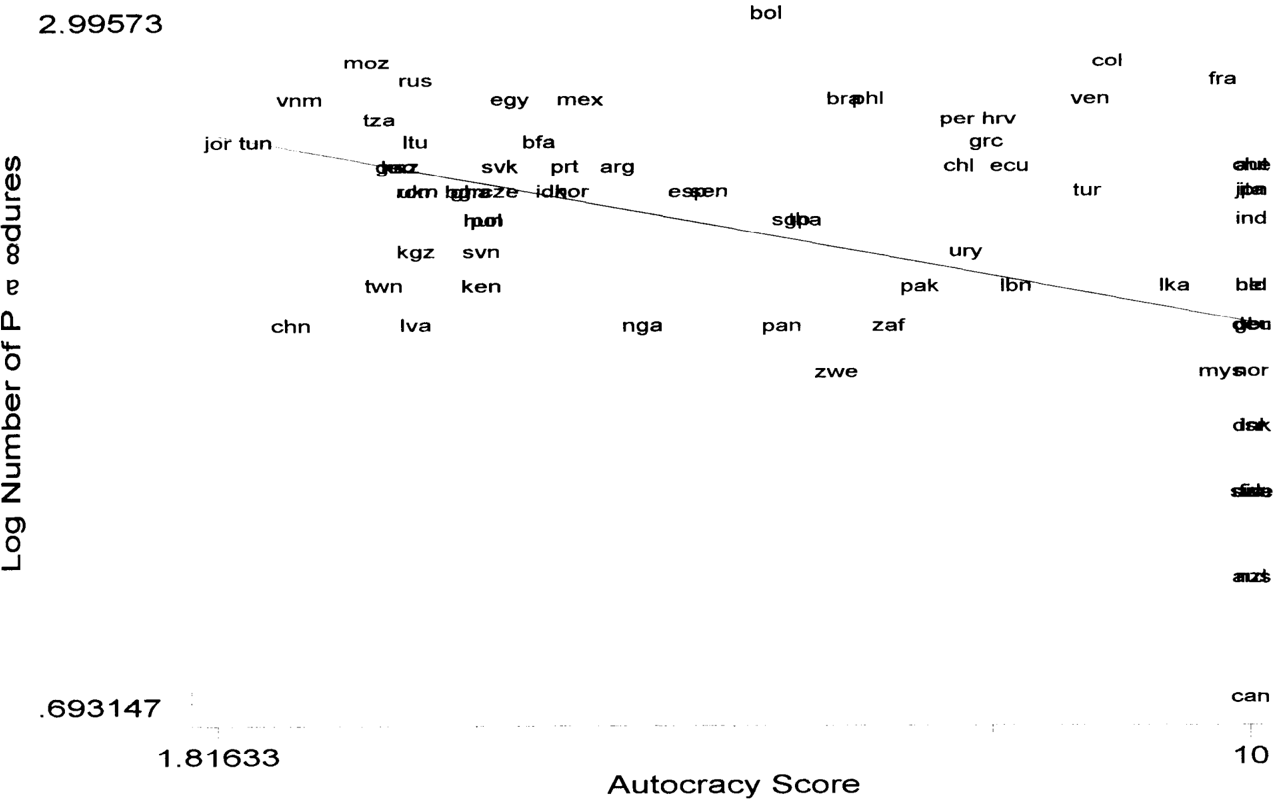
- In Table VIII, better government is associated with lighter regulation; the paper states that countries with more limited and representative governments have statistically significantly fewer procedures using 5 out of 6 measures of better government, and that more autocratic countries regulate more heavily.
Methods
- The paper builds a new database on entry regulation for 75 countries, focusing on the legal requirements, official time, and official cost for a standardized start-up firm.
- Data were gathered from written government sources, World Bank- and USAID-sponsored studies, government web pages, direct contacts with agencies, and independent double-checks in 73 countries via local consulting reports; the remaining 2 countries were double-checked through government contacts.
- The main analysis uses cross-country OLS regressions relating entry regulation measures to outcomes such as quality, pollution, unofficial economy, corruption, political institutions, legal origin, and GDP per capita; the paper also reports correlations and test-of-means comparisons across income quartiles.
Limitations
- The paper itself notes that the capture-theory tests are based on crude measures and that the data are probably least suited to test the capture hypothesis.
- The authors say the data almost surely underestimate the cost and complexity of entry because they focus on the capital city, omit industry-specific requirements and foreign-ownership steps, and ignore some informal delays and bribes.
- Evident from the text: the study is cross-sectional and based on official procedures/costs, so causal interpretation is limited and informal corruption/bureaucratic delays are not directly measured except indirectly through correlations.
Model-written summary. Check it against the paper before relying on it.
Integrity signals
Registry
Cites
Statistics
Figures
Verification
Claims the paper makes
0 Valid · 3 Not valid · 13 Not checked · 114 Own results and interpretations
A result the paper reports from its own data — it cites no other source for it, so there is none to check. The quote shows it is in the paper.
In the paper
“Very few entry regulations cover tax and labor issues.”
plain- Asserted: passes — The authors put it forward as true.
- Checkable: passes — It can be checked against evidence.
- Load-bearing: unclear — It is unclear whether the paper’s conclusions depend on it.
- Based: passes — The paper gives a reason why it holds.
In the paper
“The data show that the numbers of entry and of labor market regulations are positively correlated across countries, contrary to the substitutes hypothesis.”
What the sources say
- Not matchedcites Djankov et al., 2000
An author–year citation the paper’s reference list doesn’t settle. We don’t search these by name.
plainstates an association- Asserted: passes — The authors put it forward as true.
- Checkable: passes — It can be checked against evidence.
- Load-bearing: unclear — It is unclear whether the paper’s conclusions depend on it.
- Based: passes — The paper gives a reason why it holds.
- Not matched
A result the paper reports from its own data — it cites no other source for it, so there is none to check. The quote shows it is in the paper.
In the paper
“It often takes the form of screening procedures.”
- Also stated in: § III. Basic Results. · plain
“Instead, much of what governments do to regulate entry falls into the category of screening procedures.”
plain- Asserted: passes — The authors put it forward as true.
- Checkable: passes — It can be checked against evidence.
- Load-bearing: unclear — It is unclear whether the paper’s conclusions depend on it.
- Based: passes — The paper gives a reason why it holds.
- Also stated in: § III. Basic Results. · plain
A result the paper reports from its own data — it cites no other source for it, so there is none to check. The quote shows it is in the paper.
In the paper
“First, the cost-to-per-capita-GDP ratio decreases uniformly with GDP per capita.”
plainstates an association- Asserted: passes — The authors put it forward as true.
- Checkable: passes — It can be checked against evidence.
- Load-bearing: unclear — It is unclear whether the paper’s conclusions depend on it.
- Based: passes — The paper gives a reason why it holds.
A result the paper reports from its own data — it cites no other source for it, so there is none to check. The quote shows it is in the paper.
In the paper
“In contrast, countries in the other three quartiles of per capita income are not statistically different from each other in terms of the number of procedures and the time required to fulfill them.”
plain- Asserted: passes — The authors put it forward as true.
- Checkable: passes — It can be checked against evidence.
- Load-bearing: passes — The paper’s conclusions depend on it.
- Based: passes — The paper gives a reason why it holds.
49 more claims
Create a free account to see all 130 claims and every source verdict.
- Probably not a substantial claim. 21
- It may state two separate claims as one. 54
- The quote only partly states this claim. 26
Claims other papers make about this one
Each is checked against this paper’s own text: does it say what the citing paper says it does?
The source backs part of the claim, not all of it — or backs it for a different population, condition or comparison.
In the citing paper
“Our findings suggest an explanation for the low level of incorporation in Italy: the average direct cost associated with fulfilling the bureaucratic regulations for registering a new corporation in Italy is 20% of per capita GNP compared to 10% of per capita GNP on average for other G-7 European countries.”
From Entry regulation as a barrier to entrepreneurship (2006) · cites this paper as Djankov et al. (2002)
Experimental — accuracy not yet measuredThe cited source says what the claim attributes to it.
In the citing paper
“Given the explicit link made by Djankov et al . (2002) between the speed and ease with which businesses may be established in a country and its economic performance - and the enthusiasm with which this link has been grasped by European Union policy makers - our findings imply this link needs reconsidering.”
From The Effect of Business Regulations on Nascent and Young Business Entrepreneurship (2007) · cites this paper as Djankov et al . (2002)
Citations
Cites
La Porta, R., Lopez‐de‐Silanes, F., Shleifer, A., & Vishny, R. W. (1998) · Journal of Political Economy · doi:10.1086/250042 · Cited by 18,025
Self-citationThe Theory of Economic Regulation
Stigler, G. J. (1971) · The Bell Journal of Economics and Management Science · doi:10.2307/3003160 · Cited by 8,098
Journal of Economic Literature
(2019) · AEA Papers and Proceedings · doi:10.1257/pandp.109.633 · Cited by 7,468
The Quarterly Journal of Economics
Kuznets, S. (2024) · Business Cycle Theory, Part I Volume 4 · doi:10.4324/9781003549741-8 · Cited by 7,176
La Porta, R. (1999) · Journal of Law, Economics, and Organization · doi:10.1093/jleo/15.1.222 · Cited by 5,699 · cited 2×
“Legal origin has been viewed as a proxy for the government’s proclivity to intervene in the economy and the stance of the law toward the security of property rights in a country [La Porta et al. 1999].”
The Theory of Economic Regulation
Stigler, G. J. (2021) · The Political Economy · doi:10.4324/9781315495811-8 · Cited by 5,483
Pigou, A. C. (1933) · The Economic Journal · doi:10.2307/2224491 · Cited by 5,137
Toward a More General Theory of Regulation
Peltzman, S. (1976) · The Journal of Law and Economics · doi:10.1086/466865 · Cited by 4,729
Moffitt, R. A. (2009) · American Economic Review · doi:10.1257/aer.99.2.660 · Cited by 4,694
Shleifer, A., & Vishny, R. W. (1993) · The Quarterly Journal of Economics · doi:10.2307/2118402 · Cited by 3,778
Self-citation
Research works printed but not linked: 7
- McLiesh Caralee, 2001, NBER Working Paper No., 8288
- Kasnako lu, Zehra, and Münür Yayla, 'Unrecorded Economy in Turkey: A Monetary Approach', 1999. "Unrecorded Economy in Turkey (A Monetary Approach)" in Informal Sector in Turkey (I), Tuncer Bulutay (ed.), SIS, Ankara, forthcoming.
- Fred, 1987, Journal of Legal Studies, 101
- Olson, Mancur, 1991, 'Autocracy, Democracy, and Prosperity,' in Richard Zeckhauser, ed., Strategy of Choice, Cambridge, MA: MIT Press.
- 1967, Western Economic Journal, 232
- World Economic Forum (1999), The Global Competitiveness Report 1999 , Schwab, Klaus et al., eds., New York: Oxford University Press.
- World Economic Forum, The Global Competitiveness Report 2001, Klaus Schwab et al., eds. (New York, NY: Oxford University Press, 2001).
Cited by
Items 501–600 of 3,986
The Regulation of Entry and Aggregate Productivity
Poschke, M. (2010) · The Economic Journal · doi:10.1111/j.1468-0297.2010.02367.x · Cited by 109
“11 For the substitution elasticity, we adopt the functional form ξ(μ̄) = ξ̄μ̄, following Ebell and Haefke (2009).12 The model can then be solved for a value of ξ taken from the data, and ξ̄ backed out using the endogenous equilibrium measure of firms.”
Corruption in Asia: Pervasiveness and arbitrariness
Lee, S., & Oh, K. (2007) · Asia Pacific Journal of Management · doi:10.1007/s10490-006-9027-y · Cited by 126
Trust, Regulation and Market Failures
Pinotti, P. (2011) · The Review of Economics and Statistics · doi:10.1162/rest_a_00209 · Cited by 121
“Given that all variables from Djankov et al. (2002) refer to the 1990s, I combined data from the second and third wave of the survey, which span the periods 1990–1993 and 1994– 1999, respectively.”
InfluentialThe impact of business environment reforms on new firm registration
Love, I., & Klapper, L. F. (2010) · The World Bank Open Knowledge Repository (World Bank) · doi:10.1596/1813-9450-5493 · Cited by 115
Evaluating and comparing entrepreneurial ecosystems using SMAA and SMAA-S
Corrente, S., Greco, S., Nicotra, M., Romano, M., & Schillaci, C. E. (2018) · The Journal of Technology Transfer · doi:10.1007/s10961-018-9684-2 · Cited by 117
Regulation and Welfare: Evidence from Paragraph IV Generic Entry in the Pharmaceutical Industry
Branstetter, L., Chatterjee, C., & Higgins, M. J. (2011) · National Bureau of Economic Research · doi:10.3386/w17188 · Cited by 100
Cumming, D. J., Grilli, L., & Murtinu, S. (2013) · SSRN Electronic Journal · doi:10.2139/ssrn.2294746 · Cited by 99
Institutions, Capital Constraints and Entrepreneurial Firm Dynamics: Evidence from EuropePreprint
Desai, M. A., Gompers, P. A., & Lerner, J. (2004) · SSRN Electronic Journal · doi:10.2139/ssrn.479982 · Cited by 99
The Determinants of International Commercial Real Estate Investment
Lieser, K., & Groh, A. P. (2011) · The Journal of Real Estate Finance and Economics · doi:10.1007/s11146-012-9401-0 · Cited by 145
“(2001), and Djankov et al. (2003 and 2005) suggest that parties in common-law countries have greater ease in enforcing their rights arising from commercial contracts. Even so, Knack and Keefer (1995), Mauro (1995), and Svensson (1998)”
Structural Reform and Firm Exports
Cuervo-Cazurra, Á., & Dau, L. A. (2009) · Management International Review · doi:10.1007/s11575-009-0005-8 · Cited by 121
The Form of Property Rights: Oligarchic vs. Democratic Societies
Acemoğlu, D. (2003) · National Bureau of Economic Research · doi:10.3386/w10037 · Cited by 141
THE UNEQUAL ENFORCEMENT OF LIBERALIZATION: EVIDENCE FROM RUSSIA'S REFORM OF BUSINESS REGULATION
Yakovlev, E., & Zhuravskaya, E. V. (2013) · Journal of the European Economic Association · doi:10.1111/jeea.12026 · Cited by 104
“In contrast, we expect local bureaucrats to be interested in maintaining high levels of regulation and opposing liberalization because they benefited from excessive regulations and liberalization takes their rents away (according to the public choice theory of regulation, e.g., Tullock, 1967; Shleifer and Vishny, 1993…”
Kim, P. H., & Li, M. (2013) · Organization Studies · doi:10.1177/0170840613499566 · Cited by 109
“This is a fairly well-accepted argument, as illustrated by prior research in this area (e.g., Djankov et al., 2002; Klapper et al., 2006); we treat this as the “null” hypothesis in our study.”
InfluentialCorporate Venture Capital: Past Evidence and Future Directions
Dushnitsky, G. (2009) · Oxford University Press eBooks · doi:10.1093/oxfordhb/9780199546992.003.0015 · Cited by 125
Ravallion, M. D. (2010) · The World Bank Open Knowledge Repository (World Bank) · doi:10.1596/1813-9450-5432 · Cited by 103
International Franchise Expansion: The Role of Institutions and Transaction Costs
Hoffman, R. C., Munemo, J., & Watson, S. (2016) · Journal of International Management · doi:10.1016/j.intman.2016.01.003 · Cited by 118
Leveraging digital technologies to boost productivity in the informal sector in Sub‐Saharan Africa
Nguimkeu, P., & Okou, C. (2021) · Review of Policy Research · doi:10.1111/ropr.12441 · Cited by 118
A quantitative model for cyclin-dependent kinase control of the cell cycle: revisited
Uhlmann, F., Bouchoux, C., & López‐Avilés, S. (2011) · Philosophical Transactions of the Royal Society B Biological Sciences · doi:10.1098/rstb.2011.0082 · Cited by 123
Paik, Y. (2013) · Strategic Entrepreneurship Journal · doi:10.1002/sej.1161 · Cited by 115
Mulligan, C. B., & Shleifer, A. (2005) · American Law and Economics Review · doi:10.1093/aler/ahi009 · Cited by 116
“As a consequence, compared to the common law countries, civil law countries tended to use heavier government regulation of a whole range of activities from entry by new firms (Djankov et al. 2002) to labor markets (Botero et al. 2003).”
InfluentialMobile Broadband: A Key Enabling Technology for Entrepreneurship?
Alderete, M. V. (2017) · Journal of Small Business Management · doi:10.1111/jsbm.12314 · Cited by 113
ICT and entrepreneurship: A comparative analysis of developing, emerging and developed countries
Afawubo, K., & Noglo, Y. A. (2021) · Technological Forecasting and Social Change · doi:10.1016/j.techfore.2021.121312 · Cited by 114
Kim, P. H., & Li, M. (2012) · Journal of Business Venturing · doi:10.1016/j.jbusvent.2012.10.004 · Cited by 115
Institutional Determinants of Capital Structure Adjustment SpeedsPreprint
Öztekin, Ö., & Flannery, M. J. (2009) · SSRN Electronic Journal · doi:10.2139/ssrn.1364273 · Cited by 95
Electoral Systems and the Balance of Consumer-Producer Power
Chang, E. C. C., Kayser, M. A. L. A. D., Linzer, D. A., & Rogowski, R. L. (2010) · Cambridge University Press eBooks · doi:10.1017/cbo9780511761423 · Cited by 121
Framework for the Evaluation of SME and Entrepreneurship Policies and Programmes 2023
OECD (2023) · OECD studies on SMEs and entrepreneurship · doi:10.1787/a4c818d1-en · Cited by 133
Regulatory capture and banking supervision reform
Boyer, P., & Ponce, J. (2011) · Journal of Financial Stability · doi:10.1016/j.jfs.2011.07.002 · Cited by 112
The well-being of women entrepreneurs: the role of gender inequality and gender roles
Love, I., Nikolaev, B., & Dhakal, C. (2023) · Small Business Economics · doi:10.1007/s11187-023-00769-z · Cited by 131
“…business regulations such as licensing restrictions, administrative requirements, bureau-cracy costs, and tax compliance increase the cost of doing business (Djankov et al., 2002) and reduce new venture creation and growth rates (De Soto & Diaz, 2002; Dean & Meyer, 1996; Djankov et al., 2002).”
Entrepreneurship in China: The role of localisation and urbanisation economies
Guo, Q., He, C., & Li, D. (2016) · Urban Studies · doi:10.1177/0042098015595598 · Cited by 105
“A higher entry rate of new businesses is a fundamental driver of sustainable economic growth (Djankov et al., 2002).”
Ngo, V. D., Janssen, F., Leonidou, L. C., & Christodoulides, P. (2016) · Journal of Business Research · doi:10.1016/j.jbusres.2015.12.060 · Cited by 112
Law and Finance Matter: Lessons from Externally Imposed Courts
Brown, J. R., Cookson, J. A., & Heimer, R. Z. (2016) · Review of Financial Studies · doi:10.1093/rfs/hhw030 · Cited by 101
The impact of regulation on growth and informality: cross-country evidence
Loayza, N., Oviedo, A. M., & Servén, L. (2006) · Oxford University Press eBooks · doi:10.1093/0199204764.003.0007 · Cited by 121
The Unequal Effects of Liberalization: Evidence from Dismantling the License Raj in India
Aghion, P., Burgess, R., Redding, S. J., & Zilibotti, F. (2006) · National Bureau of Economic Research · doi:10.3386/w12031 · Cited by 119
Government regulation, corruption, and FDI
Mudambi, R., Navarra, P. M., & Delios, A. (2012) · Asia Pacific Journal of Management · doi:10.1007/s10490-012-9311-y · Cited by 116
The impact of regulation on market risk
Grout, P. A., & Zalewska, A. (2005) · Journal of Financial Economics · doi:10.1016/j.jfineco.2005.02.006 · Cited by 104
The Environment for Women's Entrepreneurship in the Middle East and North Africa
Chamlou, N., Klapper, L. F., & Muzi, S. (2008) · World Bank, Washington, DC eBooks · doi:10.1596/978-0-8213-7495-5 · Cited by 105
Out of the Gray: The Impact of Provincial Institutions on Business Formalization in Vietnam
Malesky, E. J., & Taussig, M. D. (2009) · Journal of East Asian Studies · doi:10.1017/s1598240800003003 · Cited by 118
“Scholars have highlighted property rights (North 1991; North and Weingast 1989; Grief 2006), contract enforcement institutions (Coase 1937; Laeven and Woodruff 2007), and regulatory institutions (Djankov et al. 2002).”
Growth with Quality-Improving Innovations: An Integrated Framework ∗Preprint
Aghion, P., & Howitt, P. W. (2004) · RePEc: Research Papers in Economics · Cited by 94
Small and Medium Enterprises, Growth, and Poverty: Cross-Country Evidence
Levine, R. E., Beck, T., & Demirgüç‐Kunt, A. (2003) · World Bank, Washington, DC eBooks · doi:10.1596/1813-9450-3178 · Cited by 130
“Cost of entry Cost in terms of legal fees to formally register a new firm Relative to GNI per capita Djankov et al. (2002) Efficiency of Bankruptcy Cost, duration , observance of priority claims and efficiency of an insolvency http://rru.worldbank.org/doingbusiness/ Process with higher values…”
InfluentialEntrepreneurship: Productive, unproductive, and destructive—Relative to what?
Lucas, D. S., & Fuller, C. S. (2017) · Journal of Business Venturing Insights · doi:10.1016/j.jbvi.2017.03.001 · Cited by 111
Entrepreneurial participation and performance: the role of financial literacy
Li, R., & Qian, Y. (2019) · Management Decision · doi:10.1108/md-11-2018-1283 · Cited by 157
Taxation and Dividend Policy: The Muting Effect of Agency Issues and Shareholder Conflicts
Jacob, M., & Michaely, R. (2017) · Review of Financial Studies · doi:10.1093/rfs/hhx041 · Cited by 125
The Quality of the Legal System, Firm Ownership, and Firm Size
Laeven, L. A., & Woodruff, C. (2004) · World Bank, Washington, DC eBooks · doi:10.1596/1813-9450-3246 · Cited by 97
Democracy and Economic Growth: A Meta-AnalysisPreprint
Doucouliagos, H., & Ulubaşoğlu, M. (2007) · SSRN Electronic Journal · doi:10.2139/ssrn.1014333 · Cited by 101
Unbundled institutions, human capital and growth
Bhattacharyya, S. (2008) · Journal of Comparative Economics · doi:10.1016/j.jce.2008.08.001 · Cited by 115
“Rule of Law (RULE): Source: Rodrik et al. (2004). Expropriation Risk (EXPR): Source: ICRG, The PRS Group.”
CORRUPTION AND THE EFFICIENCY OF CAPITAL INVESTMENT IN DEVELOPING COUNTRIES
O’Toole, C. M., & Tarp, F. (2014) · Journal of International Development · doi:10.1002/jid.2997 · Cited by 113
“In a similar vein to Wei (2000a) and Edgardo Campos et al. (1999), we model the effect of corruption on investment by imposing a bribery factor on corporate revenues within a partial equilibrium neoclassical investment model. This is similar to the mechanism by which a corporation tax on dividends is modelled (Poterba…”
Trade policy uncertainty and new firm entry: Evidence from China
Cui, C., & Li, L. S. (2023) · Journal of Development Economics · doi:10.1016/j.jdeveco.2023.103093 · Cited by 118
Shleifer, A. (2009) · Journal of Economic Literature · doi:10.1257/jel.47.1.123 · Cited by 109
“Finally, figure 11 presents much more recent data on trends in regulation, using the number of procedures an entrepreneur must follow before he can legally start a business (Simeon Djankov et al. 2002).”
Self-citationDoing Business 2007 : How to Reform.
Hakeem, P. (2016) · Books | Encyclopedia of Canadian Laws · Cited by 89
Charfeddine, L., & Zaouali, S. (2022) · Journal of Business Research · doi:10.1016/j.jbusres.2022.01.014 · Cited by 119
Merchants of Corruption: How Entrepreneurs Manufacture and Supply Bribes
Ufere, N., Perelli, S. J., Boland, R., & Carlsson, B. (2012) · World Development · doi:10.1016/j.worlddev.2012.05.025 · Cited by 106
The Effects of Business Environments on Development: Surveying New Firm-level Evidence
Xu, L. C. (2010) · The World Bank Research Observer · doi:10.1093/wbro/lkq012 · Cited by 106
“In Canada, it takes only two procedures, two days, and US$280 (Djankov et al. 2002).”
Do Bank Regulation, Supervision and Monitoring Enhance or Impede Bank Efficiency?Preprint
Barth, J. R., Lin, C., Ma, Y., et al. (2010) · SSRN Electronic Journal · doi:10.2139/ssrn.1579352 · Cited by 88
Legal Origins: Reconciling Law & Finance and Comparative LawPreprint
Siems, M. (2006) · SSRN Electronic Journal · doi:10.2139/ssrn.920690 · Cited by 98
Hallward-Driemeier, M. C., & Gajigo, O. (2015) · World Development · doi:10.1016/j.worlddev.2015.01.008 · Cited by 101
“…increased focus on expanding economic opportunities by arguing for the importance of addressing regulatory restrictions, red tape and frictions in the economy that can limit the ability of businesses to grow and be more productive (Djankov et al 2002; Botero et al. 2004; Hsieh and Klenow 2009).”
Buying Voters with Dirty Money: The Relationship between Clientelism and CorruptionPreprint
Singer, M. (2009) · SSRN Electronic Journal · Cited by 103
The Economic Effects of Employment Protection: Evidence from International Industry-Level Data
Pagés, C., & Micco, A. (2007) · doi:10.18235/0010723 · Cited by 103
Do Informal Businesses Gain From Registration and How? Panel Data Evidence from Vietnam
Demenet, A., Razafindrakoto, M., & Roubaud, F. (2015) · World Development · doi:10.1016/j.worlddev.2015.09.002 · Cited by 119
Diverging Pathways in Central and Eastern Europe
Knell, M. S., & Srholec, M. (2007) · Palgrave Macmillan UK eBooks · doi:10.1057/9780230627574_3 · Cited by 107
Griffith, D. A. (2009) · Journal of World Business · doi:10.1016/j.jwb.2009.04.006 · Cited by 94
A Bundle Perspective to Comparative Corporate Governance
Aguilera, R. V., Desender, K. A., & de Castro, L. R. K. (2012) · SAGE Publications Ltd eBooks · doi:10.4135/9781446200995.n18 · Cited by 114
Lajqi, S., & Krasniqi, B. A. (2017) · Strategic Change · doi:10.1002/jsc.2139 · Cited by 114
Incorporating under European Law: The Societas Europaea as a Vehicle for Legal Arbitrage
Eidenmüller, H., Engert, A., & Hornuf, L. (2009) · European Business Organization Law Review · doi:10.1017/s1566752909000019 · Cited by 118
“8 See Djankov et al. (2002) for the proposition that the regulatory burden on firm entry leads to a growing shadow economy and greater corruption.”
Do Complicated Tax Systems Prevent Foreign Direct Investment?
Lawless, M. (2012) · Economica · doi:10.1111/j.1468-0335.2012.00934.x · Cited by 90
Institutional Determinants of New Firm Entry in Russia: A Cross-Regional Analysis
Bruno, R. L., Bytchkova, M., & Estrin, S. (2012) · The Review of Economics and Statistics · doi:10.1162/rest_a_00322 · Cited by 105
“Previous studies of institutions and entry across countries have faced problems of unobserved heterogeneity (Djankov et al., 2002).”
Influential17 Gender and the Distribution of Wealth in Developing Countries
Deere, C. D., & Doss, C. R. (2008) · Oxford University Press eBooks · doi:10.1093/acprof:oso/9780199548880.003.0017 · Cited by 88
Hampel-Milagrosa, A., Loewe, M., & Reeg, C. (2014) · World Development · doi:10.1016/j.worlddev.2014.08.005 · Cited by 101
Organizational Isomorphism and Corruption: An Empirical Research in Russia
Venard, B. (2008) · Journal of Business Ethics · doi:10.1007/s10551-008-9984-9 · Cited by 96
Economic Regulations, Red Tape, and Bureaucratic Corruption in Post-Communist Economies
Duvanova, D. (2014) · World Development · doi:10.1016/j.worlddev.2014.01.028 · Cited by 136
How Do Institutions Affect Corruption and the Shadow Economy?Preprint
Dreher, A., Kotsogiannis, C., & McCorriston, S. (2005) · SSRN Electronic Journal · doi:10.2139/ssrn.670662 · Cited by 84
The Political Economy of Institutions and Corruption in American StatesPreprint
Lassen, D. D., & Alt, J. Ε. (2002) · SSRN Electronic Journal · doi:10.2139/ssrn.353880 · Cited by 87
Trust and the regulation of corporate self-dealing
Cline, B. N., & Williamson, C. R. (2016) · Journal of Corporate Finance · doi:10.1016/j.jcorpfin.2016.07.016 · Cited by 83
“Arguably, democratic institutions lead to better rules and regulations supporting economic exchange (Djankov et al., 2002).”
InfluentialLatin American Entrepreneurs: Many Firms but Little Innovation
Lederman, D., Messina, J., Pienknagura, S., & Rigolini, J. (2013) · World Bank, Washington, DC eBooks · doi:10.1596/978-1-4648-0012-2 · Cited by 169
BARRIERS TO ENTRY AND DEVELOPMENT*
Herrendorf, B., & Teixeira, A. (2011) · International Economic Review · doi:10.1111/j.1468-2354.2011.00639.x · Cited by 86
Bank competition and stability in the CIS markets
Clark, E., Radić, N., & Sharipova, A. (2017) · Journal of International Financial Markets Institutions and Money · doi:10.1016/j.intfin.2017.12.005 · Cited by 99
Mandatory dividend rules: Do they make it harder for firms to invest?
Martins, T., & Novaes, W. (2012) · Journal of Corporate Finance · doi:10.1016/j.jcorpfin.2012.05.002 · Cited by 94
A real options based model and its application to China's overseas oil investment decisions
Fan, Y., & Zhu, L. (2009) · Energy Economics · doi:10.1016/j.eneco.2009.08.021 · Cited by 95
Institutions, education, and development: The role of entrepreneurs
Dias, J., & McDermott, J. H. (2005) · Journal of Development Economics · doi:10.1016/j.jdeveco.2005.04.004 · Cited by 104
Bank Supervision, Regulation, and Instability During the Great Depression
Mitchener, K. J. (2005) · The Journal of Economic History · doi:10.1017/s0022050705050060 · Cited by 125
The binding constraint on firms' growth in developing countries
Mavridis, D. A., Dinh, H. T., & Nguyen, H. (2010) · The World Bank Open Knowledge Repository (World Bank) · doi:10.1596/1813-9450-5485 · Cited by 108
The Unofficial Economy and Economic DevelopmentPreprint
Porta, R. L., & Shleifer, A. (2008) · SSRN Electronic Journal · doi:10.2139/ssrn.1304760 · Cited by 102
Self-citationBlock, J., Thurik, R., van der Zwan, P., & Walter, S. G. (2013) · Entrepreneurship Theory and Practice · doi:10.1111/j.1540-6520.2012.00521.x · Cited by 108
“…to the different cultural factors, countries may also differ in their regulations and institutions (Audretsch, Grilo, & Thurik, 2007; Nicoletti & Pryor, 2006) and in the administrative steps required to set up a new venture (Djankov et al., 2002; Grilo & Irigoyen, 2006; Levie & Autio, 2011).”
Halabí, C. E., & Lussier, R. N. (2014) · Journal of Small Business and Enterprise Development · doi:10.1108/jsbed-10-2013-0141 · Cited by 160
The determinants and growth implications of venture creation speed
Capelleras, J., & Greene, F. J. (2008) · Entrepreneurship and Regional Development · doi:10.1080/08985620701855683 · Cited by 123
“This finding may also give support to practical attempts of governments to reduce the time (and cost) of business entry (Djankov et al. 2002).”
Foreign Direct Investment and Investment Climate
Bayraktar, N. (2013) · Procedia Economics and Finance · doi:10.1016/s2212-5671(13)00013-0 · Cited by 112
Measuring Entrepreneurship in Developing Countries
Desai, S. (2011) · Palgrave Macmillan UK eBooks · doi:10.1057/9780230295155_4 · Cited by 109
“Similarly, Djankov et al. (2002) find the higher (more costly) regulations can hinder the establishment of new firms.”
Corruption, institutions and regulation
Breen, M., & Gillanders, R. (2012) · Economics of Governance · doi:10.1007/s10101-012-0111-0 · Cited by 100
Regulation and Economic Performance: Product Market Reforms and Productivity in the OECD
Nicoletti, G., & Scarpetta, S. (2005) · OECD Economics Department working papers · doi:10.1787/726517007575 · Cited by 108
Competencies and Institutions Fostering High-Growth FirmsPreprint
Henrekson, M., & Johansson, D. (2008) · SSRN Electronic Journal · doi:10.2139/ssrn.1155480 · Cited by 81
Ambitious Entrepreneurship, High-Growth Firms, and Macroeconomic Growth
Stam, E., Hartog, C., Stel, A. V., & Thurik, R. (2011) · The Dynamics of Entrepreneurship · doi:10.1093/acprof:oso/9780199580866.003.0011 · Cited by 79
Spamann, H. (2015) · Annual Review of Law and Social Science · doi:10.1146/annurev-lawsocsci-110413-030807 · Cited by 94
Financial and Legal Institutions and Firm Size
Maksimovic, V., Beck, T., & Demirgüç‐Kunt, A. (2003) · World Bank, Washington, DC eBooks · doi:10.1596/1813-9450-2997 · Cited by 101
Cuervo-Cazurra, Á., Grosman, A., & Megginson, W. L. (2021) · Journal of International Business Studies · doi:10.1057/s41267-022-00522-w · Cited by 92
Taussig, M. D., & Delios, A. (2014) · Strategic Management Journal · doi:10.1002/smj.2312 · Cited by 87
Labor regulation and employment in India's retail stores
Amin, M. (2008) · Journal of Comparative Economics · doi:10.1016/j.jce.2008.07.001 · Cited by 86
“The NSSO routinely conducts nationally representative household surveys of expenditure levels which are reported at the district level.(9) Controlling for literacy, sex ratio and expenditure level along with all the variables discussed above, we find that the estimated coefficient of the Regulation index does not chan…”
Bjorvatn, K., & Søreide, T. (2005) · European Journal of Political Economy · doi:10.1016/j.ejpoleco.2005.02.001 · Cited by 100
Quid Pro Quo: Builders, Politicians, and Election Finance in IndiaPreprint
Kapur, D., & Vaishnav, M. (2011) · SSRN Electronic Journal · doi:10.2139/ssrn.1972987 · Cited by 80
Informal Economy and the World Bank
Recanatini, F., Benjamín, N., Santini, M., et al. (2014) · World Bank, Washington, DC eBooks · doi:10.1596/1813-9450-6888 · Cited by 79
Greasing the Wheels of Entrepreneurship? Impact of Regulations and Corruption on Firm EntryPreprint
Dreher, A., & Gassebner, M. (2007) · SSRN Electronic Journal · doi:10.2139/ssrn.989301 · Cited by 92
Mapping entrepreneurial activity and entrepreneurial attitudes in European regions
Bosma, N. S., & Schutjens, V. A. J. M. (2009) · International Journal of Entrepreneurship and Small Business · doi:10.1504/ijesb.2009.022806 · Cited by 95
Metadata
- Authors
- Djankov, S., La Porta, R., Lopez-de-Silanes, F., & Shleifer, A.
- Affiliations
- World Bank (US)
- National Bureau of Economic Research (US)
- ORCID
- Djankov, S.
- Venue
- The Quarterly Journal of Economics
- Publisher
- Oxford University Press (OUP)
- Published
- 2002-02-01
- Volume
- 117
- Issue
- 1
- Pages
- 1-37
- ISSN
- 0033-5533
- 1531-4650
- OpenAlex
- W2139896179
- Cited by
- 3,956
- References
- 30
- Citations by year
- 2026: 223 · 2025: 185 · 2024: 157 · 2023: 120 · 2022: 140 · 2021: 150 · 2020: 151 · 2019: 161 · 2018: 157 · 2017: 162 · 2016: 166 · 2015: 193 · 2014: 200 · 2013: 183 · 2012: 193
- Type
- report
- Language
- en
- Open access
- green
- doi.org
- Licence
- other-oa
- Locations
- World Bank, Washington, DC eBooks (publishedVersion)
- The Quarterly Journal of Economics (publishedVersion)
- The World Bank Open Knowledge Repository (World Bank) (publishedVersion)
- National Bureau of Economic Research (publishedVersion, other-oa)
- RePEc: Research Papers in Economics (submittedVersion)
- Digital Access to Scholarship at Harvard (DASH) (Harvard University) (submittedVersion, cc-by)
- SSRN Electronic Journal (submittedVersion)
- OpenGrey (Institut de l'Information Scientifique et Technique) (submittedVersion)
- The World Bank Open Knowledge Repository (World Bank) (submittedVersion, cc-by)
- Topics
- Social Sciences › Sociology and Political Science › Corruption and Economic Development
- Social Sciences › Economics, Econometrics and Finance › Economics and Econometrics › Taxation and Compliance Studies
- Social Sciences › Business, Management and Accounting › Strategy and Management › Political Influence and Corporate Strategies
- Keywords
- start-up firms, bureaucratic procedures, corruption, informal economy, democracy, government size, public choice theory, public interest theory
About these checks
Registry, retraction, Cites and statistics results are computed, not judged, with one exception: a printed reference that no index lists is read once by a model before it counts as a citation error. Claims are extracted by a model and kept only when their quote appears verbatim in the text; each cited source is then checked, with a model’s help, for whether it says what the claim relies on. Those verdicts can be wrong — read the claim’s quote and the cited source before relying on one.
A language model drew the claims from the paper on 2026-10-01, under version 3 of the claim definition (model deepseek-v4.1-flash, prompt extract-v3).
A second model labelled each claim on 2026-10-01 (model jev-1.13-20260917, definition revision gold-guideline-v0.2).
Statistics and arithmetic are recomputed, not judged.
Confidence bands are shown only for fields calibrated on our annotated test set. None is calibrated yet, so no band is shown.
What counts as a claim ›How we measure confidence ›How we check this ›
Are you an author, or do you see a problem with this page? Request a review
Data sources
Bibliographic data: Semantic Scholar, OpenAlex, Crossref.
Contains information from the Semantic Scholar Academic Graph Datasets, made available under the ODC Attribution License (ODC-BY 1.0).
Semantic Scholar’s data is described in: Kinney, R., et al. (2023). The Semantic Scholar Open Data Platform. arXiv:2301.10140.
