

The Regulation of Entry
Open accessThe DOI matches its Crossref record, with a small difference in title or year; 39 of the 39 references it cites were found in a registry or an index; none of the 13 sources its claims cite is checked for support yet.
Abstract
1%(5 :25.,1* 3$3(5 6(5,(6 7+( 5(*8/$7,21 2) (175< 6LPHRQ 'MDQNRY 5DIDHO /D 3RUWD )ORUHQ.LR /RSH]GH6LODQHV $QGUHL 6KOHLIHU :RUNLQJ 3DSHU KWWSZZZQEHURUJSDSHUVZ 1$7,21$/ %85($8 2) (&2120,& 5(6($5&+ 0DVVD.KXVHWWV $YHQXH &DPEULGJH 0$ 6HSWHPEHU :H WKDQN 2OJD ,RIIH 7DWLDQD 1HQRYD DQG (NDWHULQD 7UL]ORYD IRU DEOH UHVHDU.K DVVLVWDQ.H DQG +DPLG $ODYL ,ULQD $VWUDNKDQ $EKLMLW %DQHUMHH 5L.KDUG &DYHV -D.TXHOLQH &RROLGJH -DPHV (PHU\ 1LKDO (O0DJKDUEHO -HDQ 3DXO *DXWKLHU (G *ODHVHU 6LPRQ -RKQVRQ /DZUHQ.H .DW] 3HWHU .X.HUD 'DYLG /DLEVRQ ,UD /LHEHUPDQ 'DYLQ 0D.NLQ]LH 0DULH )UDQ.RLVH 0DULH1HOO\ 0DU.HOR 2ODUUHDJD *X\ 3IHIIHUPDQQ 6DQWLDJR 6HGD.D /HLOD :HEVWHU 3HWHU :ULJKW DQG VHPLQDU SDUWL.LSDQWV DW WKH 8QLYHUVLW\ RI 0DU\ODQG DW &ROOHJH 3DUN IRU KHOSIXO .RPPHQWV 7KH .ROOH.WLRQ RI GDWD IRU WKLV SDSHU ZDV RUJDQL]HG DQG ILQDQ.HG E\ WKH :RUOG %DQN $Q DSSHQGL[ GHV
Overview
CoChat Summary
TL;DR
This paper assembles a new cross-country dataset on business entry regulation in 75 countries and uses it to compare the helping-hand, capture, and tollbooth theories of regulation. The evidence is most consistent with the tollbooth view: heavier entry regulation is associated with more corruption, a larger unofficial economy, and less representative, more autocratic governments.
Key findings
- Across the 75-country sample, the number of entry procedures ranges from 2 in Canada to 20 in Bolivia, with a sample average of 10.17 procedures; the average official time is 63.05 business days and the average cost is 0.34 of GDP per capita.
- The number of procedures is strongly correlated with time and cost: the paper reports correlations of 0.75 with log time and 0.62 with log cost.
- The helping-hand tests do not support a beneficial-regulation story: in Table IV, more procedures are associated with lower ISO quality standards (e.g. coefficient -0.2646) and larger unofficial economy measures (e.g. coefficient 13.6277 for size of unofficial economy; 19.8763 for employment in the unofficial economy), while pollution and health outcomes do not improve.
- The tollbooth evidence is stronger: Table VI reports that more procedures are associated with worse corruption scores, with a coefficient of -3.2809 (and -1.7249 with GDP per capita controls) for the corruption regressions.
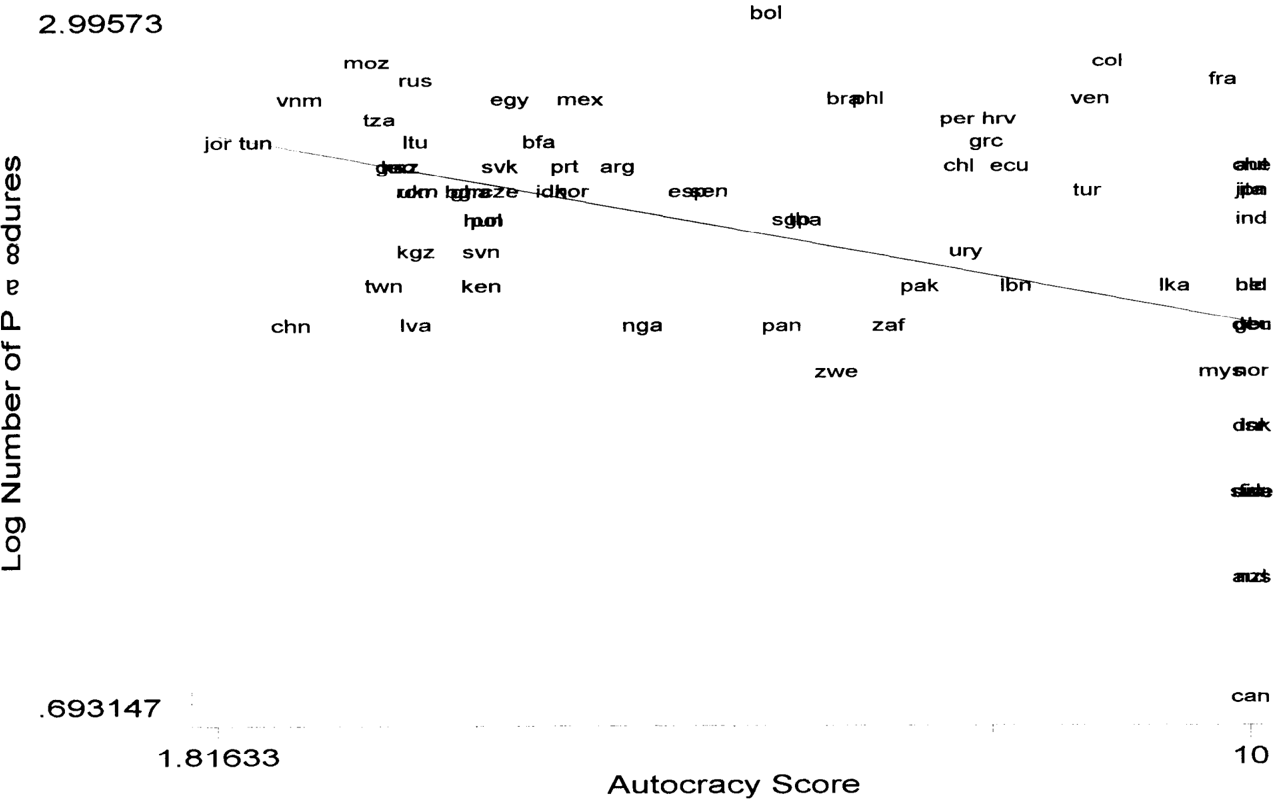
- In Table VIII, better government is associated with lighter regulation; the paper states that countries with more limited and representative governments have statistically significantly fewer procedures using 5 out of 6 measures of better government, and that more autocratic countries regulate more heavily.
Methods
- The paper builds a new database on entry regulation for 75 countries, focusing on the legal requirements, official time, and official cost for a standardized start-up firm.
- Data were gathered from written government sources, World Bank- and USAID-sponsored studies, government web pages, direct contacts with agencies, and independent double-checks in 73 countries via local consulting reports; the remaining 2 countries were double-checked through government contacts.
- The main analysis uses cross-country OLS regressions relating entry regulation measures to outcomes such as quality, pollution, unofficial economy, corruption, political institutions, legal origin, and GDP per capita; the paper also reports correlations and test-of-means comparisons across income quartiles.
Limitations
- The paper itself notes that the capture-theory tests are based on crude measures and that the data are probably least suited to test the capture hypothesis.
- The authors say the data almost surely underestimate the cost and complexity of entry because they focus on the capital city, omit industry-specific requirements and foreign-ownership steps, and ignore some informal delays and bribes.
- Evident from the text: the study is cross-sectional and based on official procedures/costs, so causal interpretation is limited and informal corruption/bureaucratic delays are not directly measured except indirectly through correlations.
Model-written summary. Check it against the paper before relying on it.
Integrity signals
Registry
Cites
Statistics
Figures
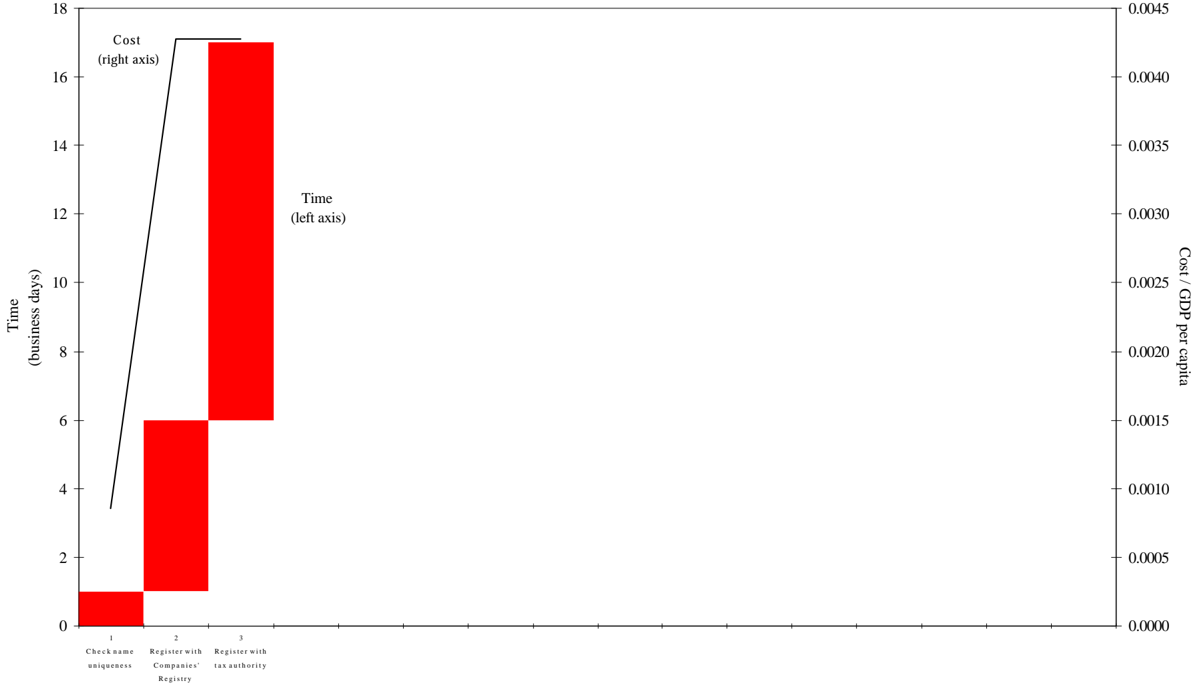
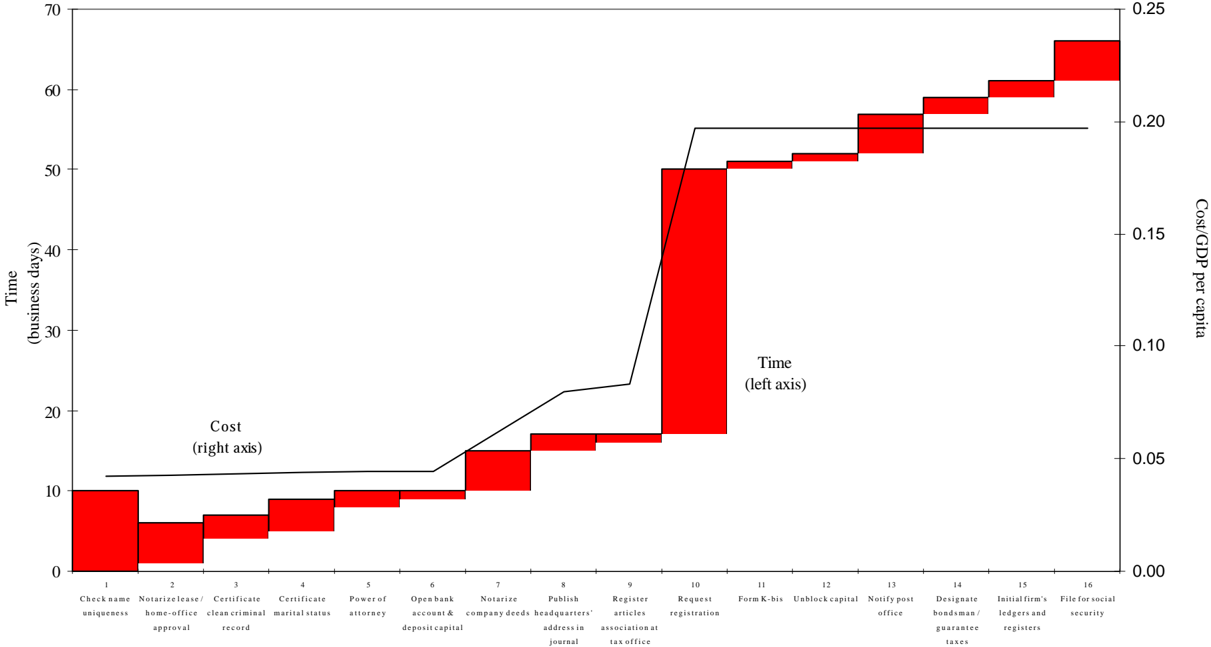
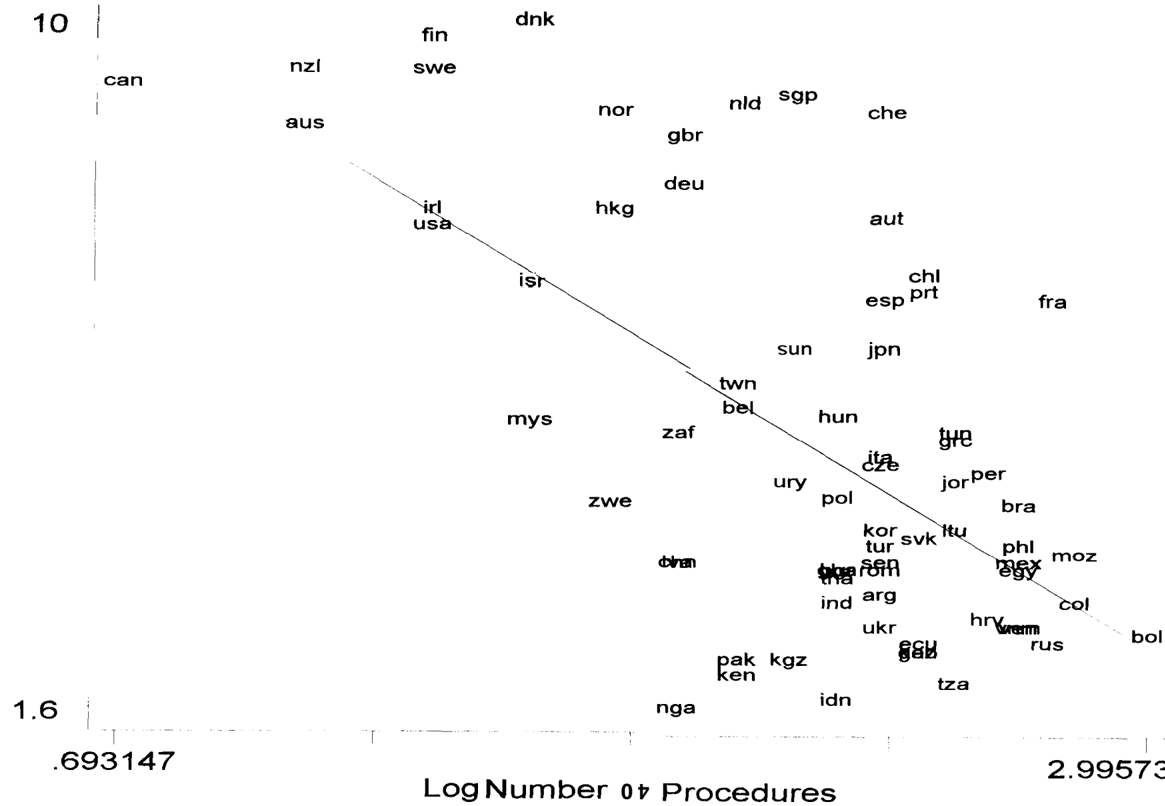
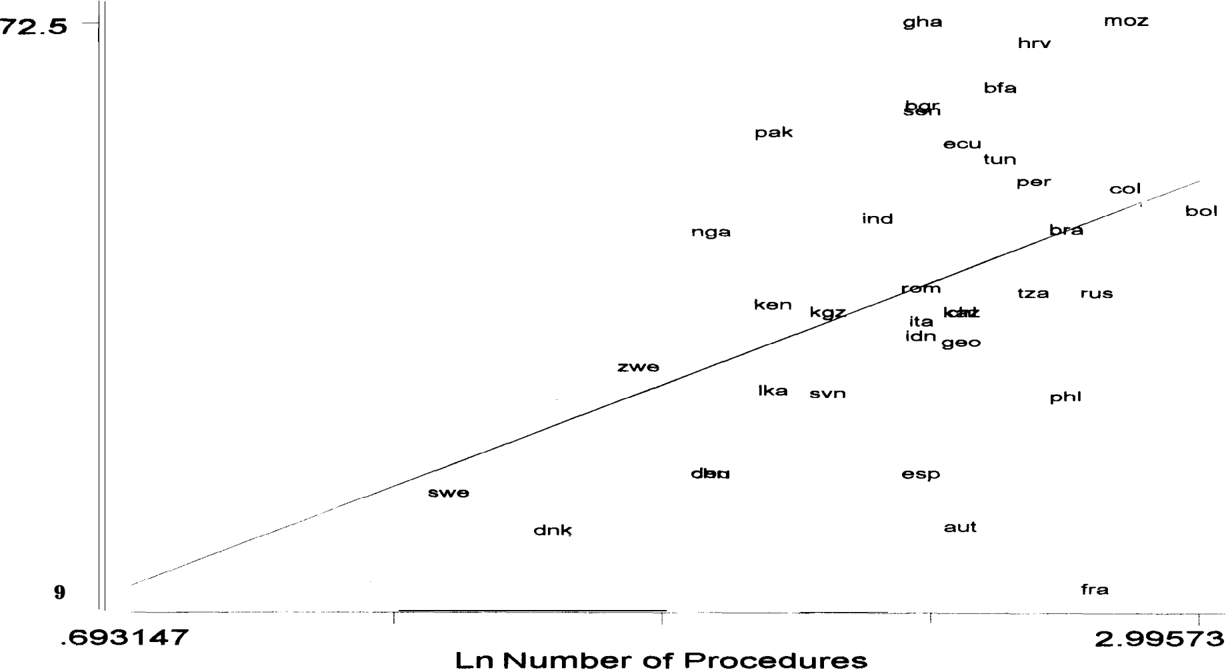
Verification
Claims the paper makes
0 Valid · 3 Not valid · 13 Not checked · 114 Own results and interpretations
A result the paper reports from its own data — it cites no other source for it, so there is none to check. The quote shows it is in the paper.
In the paper
“Very few entry regulations cover tax and labor issues.”
plain- Asserted: passes — The authors put it forward as true.
- Checkable: passes — It can be checked against evidence.
- Load-bearing: unclear — It is unclear whether the paper’s conclusions depend on it.
- Based: passes — The paper gives a reason why it holds.
In the paper
“The data show that the numbers of entry and of labor market regulations are positively correlated across countries, contrary to the substitutes hypothesis.”
What the sources say
- Not matchedcites Djankov et al., 2000
An author–year citation the paper’s reference list doesn’t settle. We don’t search these by name.
plainstates an association- Asserted: passes — The authors put it forward as true.
- Checkable: passes — It can be checked against evidence.
- Load-bearing: unclear — It is unclear whether the paper’s conclusions depend on it.
- Based: passes — The paper gives a reason why it holds.
- Not matched
A result the paper reports from its own data — it cites no other source for it, so there is none to check. The quote shows it is in the paper.
In the paper
“It often takes the form of screening procedures.”
- Also stated in: § III. Basic Results. · plain
“Instead, much of what governments do to regulate entry falls into the category of screening procedures.”
plain- Asserted: passes — The authors put it forward as true.
- Checkable: passes — It can be checked against evidence.
- Load-bearing: unclear — It is unclear whether the paper’s conclusions depend on it.
- Based: passes — The paper gives a reason why it holds.
- Also stated in: § III. Basic Results. · plain
A result the paper reports from its own data — it cites no other source for it, so there is none to check. The quote shows it is in the paper.
In the paper
“First, the cost-to-per-capita-GDP ratio decreases uniformly with GDP per capita.”
plainstates an association- Asserted: passes — The authors put it forward as true.
- Checkable: passes — It can be checked against evidence.
- Load-bearing: unclear — It is unclear whether the paper’s conclusions depend on it.
- Based: passes — The paper gives a reason why it holds.
A result the paper reports from its own data — it cites no other source for it, so there is none to check. The quote shows it is in the paper.
In the paper
“In contrast, countries in the other three quartiles of per capita income are not statistically different from each other in terms of the number of procedures and the time required to fulfill them.”
plain- Asserted: passes — The authors put it forward as true.
- Checkable: passes — It can be checked against evidence.
- Load-bearing: passes — The paper’s conclusions depend on it.
- Based: passes — The paper gives a reason why it holds.
49 more claims
Create a free account to see all 130 claims and every source verdict.
- Probably not a substantial claim. 21
- It may state two separate claims as one. 54
- The quote only partly states this claim. 26
Claims other papers make about this one
Each is checked against this paper’s own text: does it say what the citing paper says it does?
The source backs part of the claim, not all of it — or backs it for a different population, condition or comparison.
In the citing paper
“Our findings suggest an explanation for the low level of incorporation in Italy: the average direct cost associated with fulfilling the bureaucratic regulations for registering a new corporation in Italy is 20% of per capita GNP compared to 10% of per capita GNP on average for other G-7 European countries.”
From Entry regulation as a barrier to entrepreneurship (2006) · cites this paper as Djankov et al. (2002)
Experimental — accuracy not yet measuredThe cited source says what the claim attributes to it.
In the citing paper
“Given the explicit link made by Djankov et al . (2002) between the speed and ease with which businesses may be established in a country and its economic performance - and the enthusiasm with which this link has been grasped by European Union policy makers - our findings imply this link needs reconsidering.”
From The Effect of Business Regulations on Nascent and Young Business Entrepreneurship (2007) · cites this paper as Djankov et al . (2002)
Citations
Cites
La Porta, R., Lopez‐de‐Silanes, F., Shleifer, A., & Vishny, R. W. (1998) · Journal of Political Economy · doi:10.1086/250042 · Cited by 18,025
Self-citationThe Theory of Economic Regulation
Stigler, G. J. (1971) · The Bell Journal of Economics and Management Science · doi:10.2307/3003160 · Cited by 8,098
Journal of Economic Literature
(2019) · AEA Papers and Proceedings · doi:10.1257/pandp.109.633 · Cited by 7,468
The Quarterly Journal of Economics
Kuznets, S. (2024) · Business Cycle Theory, Part I Volume 4 · doi:10.4324/9781003549741-8 · Cited by 7,176
La Porta, R. (1999) · Journal of Law, Economics, and Organization · doi:10.1093/jleo/15.1.222 · Cited by 5,699 · cited 2×
“Legal origin has been viewed as a proxy for the government’s proclivity to intervene in the economy and the stance of the law toward the security of property rights in a country [La Porta et al. 1999].”
The Theory of Economic Regulation
Stigler, G. J. (2021) · The Political Economy · doi:10.4324/9781315495811-8 · Cited by 5,483
Pigou, A. C. (1933) · The Economic Journal · doi:10.2307/2224491 · Cited by 5,137
Toward a More General Theory of Regulation
Peltzman, S. (1976) · The Journal of Law and Economics · doi:10.1086/466865 · Cited by 4,729
Moffitt, R. A. (2009) · American Economic Review · doi:10.1257/aer.99.2.660 · Cited by 4,694
Shleifer, A., & Vishny, R. W. (1993) · The Quarterly Journal of Economics · doi:10.2307/2118402 · Cited by 3,778
Self-citation
Research works printed but not linked: 7
- McLiesh Caralee, 2001, NBER Working Paper No., 8288
- Kasnako lu, Zehra, and Münür Yayla, 'Unrecorded Economy in Turkey: A Monetary Approach', 1999. "Unrecorded Economy in Turkey (A Monetary Approach)" in Informal Sector in Turkey (I), Tuncer Bulutay (ed.), SIS, Ankara, forthcoming.
- Fred, 1987, Journal of Legal Studies, 101
- Olson, Mancur, 1991, 'Autocracy, Democracy, and Prosperity,' in Richard Zeckhauser, ed., Strategy of Choice, Cambridge, MA: MIT Press.
- 1967, Western Economic Journal, 232
- World Economic Forum (1999), The Global Competitiveness Report 1999 , Schwab, Klaus et al., eds., New York: Oxford University Press.
- World Economic Forum, The Global Competitiveness Report 2001, Klaus Schwab et al., eds. (New York, NY: Oxford University Press, 2001).
Cited by
Items 901–1,000 of 3,986
Export discoveries, diversification and barriers to entry
Klinger, B., & Lederman, D. (2011) · Economic Systems · doi:10.1016/j.ecosys.2010.12.001 · Cited by 65
Entrepreneurship policy: Trade-offs and impact in the EU
Murdock, K. A. (2012) · Entrepreneurship and Regional Development · doi:10.1080/08985626.2012.742324 · Cited by 60
The Distribution of Legal Traditions around the World: A Contribution to the Legal-Origins Theory
Oto‐Peralías, D., & Romero‐Ávila, D. (2014) · The Journal of Law and Economics · doi:10.1086/676556 · Cited by 48
“Beck, Demirgüç-Kunt, and Levine (2003b) and Levine (2005) provide empirical evidence showing that both legal traditions and initial endowments 1 It has also been shown that governments in common-law countries intervene and regulate, to a lesser extent, the economy (La Porta, Lopez-de-Silanes, and Shleifer 2002; Djanko…”
How (not) to measure Russian regional institutions
Baranov, A., Malkov, E., Polishchuk, L., Rochlitz, M., & Syunyaev, G. (2015) · Russian Journal of Economics · doi:10.1016/j.ruje.2015.11.005 · Cited by 52
“…are situations include common administrative procedures (e.g., opening a business, access to utilities, and issuance of permits and licenses (Djankov et al., 2002)), settlements of comparable commercial disputes (World Bank, 2014), and frequency of the occurrence of certain institutional…”
The impact of corruption and local content policy in on firm performance: Evidence from Kazakhstan
Kalyuzhnova, Y., & Belitski, M. (2019) · Resources Policy · doi:10.1016/j.resourpol.2019.01.016 · Cited by 59
“Our first contribution is built on institutional literature (Djankov et al. 2002).”
Natural disasters and entrepreneurship activity
Boudreaux, C. J., Escaleras, M. P., & Skidmore, M. L. (2019) · Economics Letters · doi:10.1016/j.econlet.2019.06.010 · Cited by 45
Female ownership, firm age and firm growth: a study of South Asian firms
Belitski, M., & Desai, S. (2019) · Asia Pacific Journal of Management · doi:10.1007/s10490-019-09689-7 · Cited by 62
Corruption, regulation, and growth: an empirical study of the United States
Johnson, N. D., Ruger, W. P., Sorens, J., & Yamarik, S. J. (2013) · Economics of Governance · doi:10.1007/s10101-013-0132-3 · Cited by 57
Oil price uncertainty, CSR and institutional quality: A cross-country evidence
Phan, D. H. B., Tran, V. T., Tee, C.-M., & Nguyen, D. T. (2021) · Energy Economics · doi:10.1016/j.eneco.2021.105339 · Cited by 49
Rougier, É. (2015) · World Development · doi:10.1016/j.worlddev.2015.10.005 · Cited by 53
“In developing countries, however, subsidies and administrative barriers are often used by governm nts to control economic resources and limit entry to the benefit of politically connected firms (Ades and di Tella, 1997; Djankov et al., 2002; Faccio, 2006)4.”
Contracting institutions and vertical integration: Evidence from China’s manufacturing firms
Du, J., Lu, Y., & Tao, Z. (2011) · Journal of Comparative Economics · doi:10.1016/j.jce.2011.10.002 · Cited by 46
“[15] Djankov, Simeon, Rafael La Porta, Florencio Lopez-de-Silanes, and Andrei Shleifer.”
Should continued family firms face lower taxes than other estates?
Grossmann, V., & Strulik, H. (2009) · Journal of Public Economics · doi:10.1016/j.jpubeco.2009.10.005 · Cited by 58
15 Housing Privatization and Household Wealth in Transition
Yemtsov, R. (2008) · Oxford University Press eBooks · doi:10.1093/acprof:oso/9780199548880.003.0015 · Cited by 52
Product Market Deregulation and the U.S. Employment MiraclePreprint
Ebell, M., & Haefke, C. (2006) · SSRN Electronic Journal · doi:10.2139/ssrn.879761 · Cited by 45
Firm- and Country-Level Determinants of Corporate Leverage: Some New International EvidencePreprint
Gungoraydinoglu, A., & Öztekin, Ö. (2011) · SSRN Electronic Journal · doi:10.2139/ssrn.1841628 · Cited by 45
Lacking Information or Condoning Corruption: When Will Voters Support Corrupt Politicians?Preprint
Winters, M. S., & Weitz‐Shapiro, R. (2013) · SSRN Electronic Journal · Cited by 45
When Arm's Length is Too Far. Relationship Banking Over the Business CyclePreprint
Beck, T., Degryse, H., Haas, R. D., & van Horen, N. (2014) · SSRN Electronic Journal · doi:10.2139/ssrn.2489017 · Cited by 69
The central banker as prudential supervisor: Does independence matter?
Pellegrina, L. D., Masciandaro, D., & Pansini, R. V. (2013) · Journal of Financial Stability · doi:10.1016/j.jfs.2013.01.006 · Cited by 52
Natural disasters, entrepreneurship activity, and the moderating role of country governance
Boudreaux, C. J., Jha, A., & Escaleras, M. P. (2022) · Small Business Economics · doi:10.1007/s11187-022-00657-y · Cited by 52
“We also adjusted our model to reflect the fact that different countries have varying entry regulations associated with starting a new business based on work by Djankov et al. (2002).”
Investigating the Relationship between Public Governance and the Corruption Perception Index
Koeswayo, P. S., Handoyo, S., & Hasyir, D. A. (2024) · Cogent Social Sciences · doi:10.1080/23311886.2024.2342513 · Cited by 139
Endogenous contest success functions: a mechanism design approach
Polishchuk, L., & Tonis, A. (2011) · Economic Theory · doi:10.1007/s00199-011-0622-x · Cited by 44
“…sheds new light on the causes of entry barriers that owners of small assets face: in addition to political economy/public choice explanations (Djankov et al. 2002; Polishchuk 2008) and inequality of stakes arguments (Hillman and Riley 1989), such discrimination could also have…”
ASSESSING THE IMPACT OF REGULATORY REFORM IN DEVELOPING COUNTRIES
Kirkpatrick, C. H. (2014) · Public Administration and Development · doi:10.1002/pad.1693 · Cited by 44
Escandón‐Barbosa, D., Urbano, D., Ayala, A. H., Salas-Paramo, J. A., & Domínguez, Á. Z. (2019) · Journal of Urban Management · doi:10.1016/j.jum.2019.06.002 · Cited by 55
Rosenthal, H. L., & Voeten, E. (2007) · Journal of Comparative Economics · doi:10.1016/j.jce.2007.08.001 · Cited by 69
Subsidizing firm entry in open economies
Pflüger, M., & Suedekum, J. (2012) · Journal of Public Economics · doi:10.1016/j.jpubeco.2012.07.002 · Cited by 60
“Subsidizing firm entry in open economies Michael Pflüger a,⁎, Jens Suedekum b,1 a University of Passau, DIW Berlin, IZA, Germany b University of Duisburg–Essen, Ruhr Graduate School of Economics, IZA, CESifo, Germany a b s t r a c ta r t i c l e i n f o”
6 The Distribution of Household Wealth in India
Subramanian, S., & Jayaraj, D. (2008) · Oxford University Press eBooks · doi:10.1093/acprof:oso/9780199548880.003.0006 · Cited by 55
Kinda, T., Plane, P., & Véganzonès‐Varoudakis, M. (2011) · The Developing Economies · doi:10.1111/j.1746-1049.2011.00146.x · Cited by 62
“Botero et al (2004); Haltiwanger et al. (2006); on employment regulation and firms adjustment; Djankov et al. (2002) on regulations of entry of firms on firm’s creation and growth.”
The impact of governance and transparency on firm investment in Vietnam
Malesky, E. J., McCulloch, N., & Nhat, N. D. (2015) · Economics of Transition · doi:10.1111/ecot.12068 · Cited by 58
Economics and Politics of Alternative Institutional Reforms*
Caselli, F., & Gennaioli, N. (2008) · The Quarterly Journal of Economics · doi:10.1162/qjec.2008.123.3.1197 · Cited by 51
“…some of these costs are deadweight losses to society, but several others are transfers from entrepreneurs to government officials, not least because entrepreneurs overcome the waste associated with entry regulation by negotiating appropriate side payments with bureaucrats [Djankov et al. (2002)].”
Development Strategies for Inclusive Growth in Developing Asia
Lin, J. Y. (2004) · Asian Development Review · doi:10.1142/s0116110504000053 · Cited by 50
“Dewatripont and Maskin (1995) argue that the soft budget constraint arises from banks’ imperfect information on investment projects and the timeinconsistent problem of the project.”
Allocating lawmaking powers: Self-regulation vs government regulation
Grajzl, P., & Murrell, P. (2007) · Journal of Comparative Economics · doi:10.1016/j.jce.2007.01.001 · Cited by 53
Ayyagari, M., Demirgüç‐Kunt, A., & Maksimovic, V. (2010) · The World Bank Open Knowledge Repository (World Bank) · doi:10.1596/1813-9450-5389 · Cited by 55
Corporate Governance Theories: From Micro Theories to National Systems TheoriesPreprint
Charreaux, G. (2004) · SSRN Electronic Journal · doi:10.2139/ssrn.486522 · Cited by 69
López-Martín, B. (2018) · Macroeconomic Dynamics · doi:10.1017/s1365100517001055 · Cited by 53
“…labor-market restrictions, heavier regulation of entry, and the tax burden of the formal sector and decreases with enforcement of legal obligations [Djankov et al. (2002), Antunes and Cavalcanti (2007), Perry et al. (2007), Prado (2011), Leal-Ordoñez (2014)].5 Busso et al. (2012) emphasize…”
InfluentialEnergy efficiency barriers in commercial and industrial firms in Ukraine: An empirical analysis
Hochman, G., & Timilsina, G. R. (2017) · Energy Economics · doi:10.1016/j.eneco.2017.01.013 · Cited by 51
“The literature suggests that regulation can become a barrier to the adoption of new technologies (Djankov et al., 2002; Graff et al., 2009).”
Dávid‐Barrett, E., Yakis‐Douglas, B., Moss‐Cowan, A., & Nguyen, Y. (2017) · Journal of Management Inquiry · doi:10.1177/1056492617696885 · Cited by 49
“…to privileged information (Della Porta & Vannucci, 1999), credit and other public resources (Barth et al., 2009), relief from heavy regulations and red tape (Rose-Ackerman, 1999), or speedy access to operating permits in highly regulated markets with tight government control (Djankov et al., 2002).”
Impact of country-level corporate governance on entrepreneurial conditions
Almaqtari, F. A., Farhan, N. H. S., Al‐Hattami, H. M., et al. (2020) · Cogent Business & Management · doi:10.1080/23311975.2020.1797261 · Cited by 43
“The literature review establishes a piece of evidence on the negative effect of regulations (Djankov et al., 2002; Klapper et al., 2006).”
Happiness—Concept, Measurement and Promotion
Ng, Y. (2021) · Springer eBooks · doi:10.1007/978-981-33-4972-8 · Cited by 61
Trade liberalization and institutional development
Bhattacharyya, S. (2011) · Journal of Policy Modeling · doi:10.1016/j.jpolmod.2011.08.005 · Cited by 57
Structural reforms and the potential effects on the Italian economy
Annicchiarico, B., Dio, F. D., & Felici, F. (2012) · Journal of Policy Modeling · doi:10.1016/j.jpolmod.2012.03.002 · Cited by 52
“38 Djankov et al. (2002) Overhead labor (%), FCL 1.”
The political economy of mobile telecommunications liberalization: Evidence from the OECD countries
Duso, T., & Seldeslachts, J. (2009) · Journal of Comparative Economics · doi:10.1016/j.jce.2009.09.001 · Cited by 52
Corruption And Foreign Direct Investment: What Have We Learned?
Żurawicki, L., & Habib, M. (2010) · International Business & Economics Research Journal (IBER) · doi:10.19030/iber.v9i7.593 · Cited by 54
REGULATION ,I NVESTMENT, AND GROWTH ACROSS COUNTRIESPreprint
Dawson, J. W. (2006) · RePEc: Research Papers in Economics · Cited by 43
The Incidence Of Graft On Developing-Country Firms
González, A. S., López-Córdova, J. E., & Valladares, E. E. (2007) · World Bank, Washington, DC eBooks · doi:10.1596/1813-9450-4394 · Cited by 50
“In Table 5 we observe that the estimated coefficient for regulation falls when we account for the level of democracy, which is consistent with the evidence in Djankov et al (2002).”
InfluentialSegmented market economies in the Arab world: the political economy of insider–outsider divisions
Hertog, S. (2020) · Socio-Economic Review · doi:10.1093/ser/mwaa016 · Cited by 42
“A range of economic studies has indeed linked the each of these three factors to low economic growth (Mincer, 1984; Djankov et al. , 2002; Klapper et al. , 2006; Chong D o w n l oaded f r o m h tt p s :/ / a c ade m i c . oup . c o m / s e r / a r t i c l e - ab s t r a c t/ do i / 10 .”
What drives ICT clustering in European cities?
Belitski, M., & Desai, S. (2015) · The Journal of Technology Transfer · doi:10.1007/s10961-015-9422-y · Cited by 48
“…effect for financial costs of starting a business with ICT product firms: the initial result is positive, possibly reflective of the level of financial commitment and quality of business (Djankov et al. 2002), but as financial costs increase, the relationship changes direction and becomes negative.”
Akinboade, O. A. (2015) · African Journal of Economic and Management Studies · doi:10.1108/ajems-03-2013-0033 · Cited by 42
The Mortality Cost of Political Connections
Fisman, R. J., & Wang, Y. (2015) · The Review of Economic Studies · doi:10.1093/restud/rdv020 · Cited by 119
Does (average) size matter? Court enforcement, business demography and firm growth
García-Posada, M., & Mora‐Sanguinetti, J. S. (2014) · Small Business Economics · doi:10.1007/s11187-014-9615-z · Cited by 52
“Second, entry rates and economic development are jointly determined by institutional factors and, more specifically, by regulations on entry (Djankov et al. 2002; Klapper et al. 2004).”
A multisectorial matching model of unions
Delacroix, A. (2006) · Journal of Monetary Economics · doi:10.1016/j.jmoneco.2005.02.002 · Cited by 42
The impact of home-country institutions and competition on firm profitability
Cherchye, L., & Verriest, A. (2015) · International Business Review · doi:10.1016/j.ibusrev.2015.10.005 · Cited by 47
Baum, D. R., Cooper, R. A., & Lusk-Stover, O. (2017) · International Journal of Educational Development · doi:10.1016/j.ijedudev.2017.10.020 · Cited by 57
Asakawa, K., Cuervo-Cazurra, Á., & Un, C. A. (2019) · Long Range Planning · doi:10.1016/j.lrp.2019.04.001 · Cited by 70
The Changing Role of Social Capital During the Venture Creation Process: A Multilevel Study
Kleinhempel, J., Beugelsdijk, S., & Klasing, M. J. (2020) · Entrepreneurship Theory and Practice · doi:10.1177/1042258720913022 · Cited by 58
“These country fixed effects control for differences in formal institutions which influence entrepreneurship (Djankov et al., 2002; Estrin et al., 2017; Levie & Autio, 2011), such as property rights protection, rule of law, or formal entry barriers, as well as a host of other potentially confounding…”
Institutions and concentration
Mitton, T. (2007) · Journal of Development Economics · doi:10.1016/j.jdeveco.2007.10.001 · Cited by 51
D'Auria, F., Pagano, A., Ratto, M., & Varga, J. (2009) · RePEc: Research Papers in Economics · doi:10.2765/30743 · Cited by 55
“We did not nd appropriate estimates on entry barriers for speci c sectors, therefore we rely on the aggregate estimates provided by Djankov et al. (2002) who estimate the costs of procedures and time that a start-up must bear before the rm can operate legally.”
Which Institutions Encourage Entrepreneurs to Create Larger Firms?Preprint
Estrin, S., Korosteleva, J. A., & Mickiewicz, T. M. (2011) · SSRN Electronic Journal · doi:10.2139/ssrn.1765646 · Cited by 47
“Both freedom from corruption and property rights provide the basis for voluntary exchange and the market economy and have been identified empirically as a critical determinant of entrepreneurial activity (Djankov et al 2002; McMillan 11 and Woodruff 2002; Aidis et al. 2010).”
Mullainathan, S., & Schnabl, P. (2010) · RePEc: Research Papers in Economics · doi:10.7208/9780226473109-007 · Cited by 42
Pica‐Ciamarra, U., & Pica-Ciamarra, U. (2005) · RePEc: Research Papers in Economics · doi:10.22004/ag.econ.23772 · Cited by 69
Does Corruption Produce Unsafe Drivers?
Bertrand, M., Djankov, S., Hanna, R., & Mullainathan, S. (2006) · National Bureau of Economic Research · doi:10.3386/w12274 · Cited by 47
Self-citationEfrat, A. (2016) · International Studies Quarterly · doi:10.1093/isq/sqw012 · Cited by 49
Economic modeling of innovation in the creative industries and its implications
Bae, S. H., & Yoo, K. (2015) · Technological Forecasting and Social Change · doi:10.1016/j.techfore.2015.02.010 · Cited by 66
Schumpeterian growth theory, Schumpeter, and growth policy design
Aghion, P., & Festré, A. (2016) · Journal of Evolutionary Economics · doi:10.1007/s00191-016-0465-5 · Cited by 64
Regulation and corporate corruption: New evidence from the telecom sector
Berg, S. V., Jiang, L., & Lin, C. (2011) · Journal of Comparative Economics · doi:10.1016/j.jce.2011.12.001 · Cited by 42
“For example, Djankov et al. (2002) find that countries with heavier regulation of entry (involving more procedures, costs, and delays in obtaining permission for entry) are associated with higher corruption levels.”
Schwerhoff, G., Edenhofer, O., & Fleurbaey, M. (2019) · Journal of Economic Surveys · doi:10.1111/joes.12340 · Cited by 65
Braun, R., Eidenmüller, H., Engert, A., & Hornuf, L. (2012) · JCMS Journal of Common Market Studies · doi:10.1111/jcms.12003 · Cited by 70
Importance of country factors for global differences in audit pricing: New empirical evidence
Eierle, B., Hartlieb, S., Hay, D. C., Niemi, L., & Ojala, H. (2021) · International Journal of Auditing · doi:10.1111/ijau.12222 · Cited by 45
Values Versus Regulations: How Culture Plays Its Role
Jing, R., & Graham, J. L. (2007) · Journal of Business Ethics · doi:10.1007/s10551-007-9469-2 · Cited by 54
Optimal Regulation in the Presence of Reputation Concerns *
Atkeson, A. G., Hellwig, C., & Ordoñez, G. L. (2014) · The Quarterly Journal of Economics · doi:10.1093/qje/qju034 · Cited by 44
Where does regulation hurt? Evidence from new businesses across countries
Ardagna, S., & Lusardi, A. (2009) · doi:10.3386/w14747 · Cited by 41
Creditor Rights and Capital Structure: Evidence from International DataPreprint
Suh, J., Ghoul, S. E., Guedhami, O., & Cho, S.-S. (2012) · SSRN Electronic Journal · doi:10.2139/ssrn.1985166 · Cited by 43
Do Legal Origins Predict Legal Substance?
Bradford, A., Chang, Y., Chilton, A. S., & Garoupa, N. M. (2021) · The Journal of Law and Economics · doi:10.1086/712420 · Cited by 43
Bank regulation, supervision and liquidity creation
Kladakis, G., Chen, L., & Bellos, S. K. (2022) · Journal of International Money and Finance · doi:10.1016/j.jimonfin.2022.102629 · Cited by 48
Estrin, S., Guerrero, M., & Mickiewicz, T. M. (2024) · Journal of Business Venturing · doi:10.1016/j.jbusvent.2024.106404 · Cited by 54
8 Household Wealth in Latin America
Torche, F., & Spilerman, S. (2008) · Oxford University Press eBooks · doi:10.1093/acprof:oso/9780199548880.003.0008 · Cited by 48
Political connections, entry barriers, and firm performance
Ying, C., Luo, D., & Li, W. (2014) · Chinese Management Studies · doi:10.1108/cms-08-2013-0148 · Cited by 49
Institutional Distance and Cross-Border Venture Capital Investment Flows
Moore, C. B., Payne, G. T., Bell, R. G., & Davis, J. L. (2013) · Journal of Small Business Management · doi:10.1111/jsbm.12079 · Cited by 52
Contextualizing Corruption: A Cross-Disciplinary Approach to Studying Corruption in Organizations
Pertiwi, K. (2018) · Administrative Sciences · doi:10.3390/admsci8020012 · Cited by 53
Natural Resource Dependency and Entrepreneurship: Are Nations with High Resource Rents Cursed?
Chambers, D., & Munemo, J. (2018) · Journal of International Development · doi:10.1002/jid.3397 · Cited by 42
Political Determinants of Competition in the Mobile Telecommunication Industry
Faccio, M., & Zingales, L. (2017) · Review of Financial Studies · doi:10.1093/rfs/hhab074 · Cited by 66
Trust, perceptions of corruption, and demand for regulation: Evidence from post-socialist countries
Dimitrova-Grajzl, V. P., Grajzl, P., & Guse, A. J. (2012) · The Journal of Socio-Economics · doi:10.1016/j.socec.2012.01.005 · Cited by 48
Do financial regulations matters for sustainable green economy: evidence from Turkey
Odugbesan, J. A., Rjoub, H., Ifediora, C. U., & Iloka, C. B. (2021) · Environmental Science and Pollution Research · doi:10.1007/s11356-021-14645-4 · Cited by 62
“Additionally, the study conducted by Dridi (2013) which focused on 82 countries, both developing and developed, in the course of 1980– 2002 suggested that corruption has an inverse effect on economic growth and this is basically transmitted through its impact on political instability and…”
Do macroprudential policies affect bank efficiency? Evidence from emerging economies
Chen, M., Kang, Q., Wu, J., & Jeon, B. N. (2022) · Journal of International Financial Markets Institutions and Money · doi:10.1016/j.intfin.2022.101529 · Cited by 53
Regulation, firm dynamics and entrepreneurship
Braunerhjelm, P., Desai, S., & Eklund, J. E. (2015) · European Journal of Law and Economics · doi:10.1007/s10657-015-9498-8 · Cited by 55
“…the regulatory environment, especially entry regulation (Stenholm et al. 2013; Klapper et al. 2006), as a driver of entrepreneurship (Ciccone and Papaioannou 2006; Acs et al. 2008; Ardagna and Lusardi 2009; Djankov et al. 2002), the literature on regulations and entrepreneurship is still young.”
The persistence of corruption : evidence from the 1992 presidential impeachment in Brazil
Ramalho, R. (2007) · Cited by 52
PATTERNS OF PROMISING ENTREPRENEURIAL ACTIVITY IN EUROPEAN REGIONS
Bosma, N. S., & Schutjens, V. A. J. M. (2007) · Tijdschrift voor Economische en Sociale Geografie · doi:10.1111/j.1467-9663.2007.00433.x · Cited by 56
Tax Morale and Tax Evasion in Latin AmericaPreprint
Alm, J. R., & Martínez-Vázquez, J. (2007) · RePEc: Research Papers in Economics · Cited by 99
Barriers to Entry, Deregulation and Workplace TrainingPreprint
Bassanini, A. P., & Brunello, G. (2007) · SSRN Electronic Journal · doi:10.2139/ssrn.982598 · Cited by 40
Public Investment in Developing Countries: A Blessing or a Curse?Preprint
Cavallo, E. A., & Daude, C. (2011) · SSRN Electronic Journal · doi:10.2139/ssrn.1820935 · Cited by 43
Regulation and Internet Use in Developing CountriesPreprint
Wallsten, S. (2003) · SSRN Electronic Journal · doi:10.2139/ssrn.366100 · Cited by 40
The Impact of Exports on Innovation: Theory and EvidencePreprint
Aghion, P., Bergeaud, A., Lequien, M., & Melitz, M. J. (2018) · SSRN Electronic Journal · doi:10.2139/ssrn.3171084 · Cited by 307
Venture Capital and Private Equity Country Attractiveness Index
Groh, A. P., Liechtenstein, H., Lieser, K., & Biesinger, M. (2023) · Springer eBooks · doi:10.1007/978-3-030-38738-9_94-1 · Cited by 41
Business resilience skills for SMEs
Kotsios, P. (2023) · Journal of Innovation and Entrepreneurship · doi:10.1186/s13731-023-00304-0 · Cited by 78
Institutions, Finance and the Level of Development: the Impact on Entrepreneurship in Transition
Aidis, R., Estrin, S., & Mickiewicz, T. M. (2010) · Review of Economics and Institutions · doi:10.5202/rei.v1i1.3 · Cited by 50
“This is also consistent with Djankov et al. (2002), who demonstrate that countries of French, German and Socialist legal origin have more entry regulations”
InfluentialDo legal origins affect cross-country incarceration rates?
D’Amico, D. J., & Williamson, C. R. (2014) · Journal of Comparative Economics · doi:10.1016/j.jce.2014.11.002 · Cited by 42
“…works show correlation with legal origins and the extent of regulation effecting start-up firms, labor markets, and doing business more generally (Djankov et al., 2002; Botero et al., 2004; Mulligan and Shleifer, 2005b), as well as the organizational features of government courts and judicial…”
Chari, A. (2011) · American Economic Journal Economic Policy · doi:10.1257/pol.3.2.66 · Cited by 51
Regulation, awareness, compliance and SME performance in Cameroon's manufacturing and retail sectors
Akinboade, O. A., & Kinfack, E. C. (2012) · International Journal of Social Economics · doi:10.1108/03068291211269073 · Cited by 39
“Given that it is highly unlikely, that the regulator will receive all of the information required to regulate optimally to maximize social welfare, the results of regulation, in terms of outputs and prices remain “second best” to those of a competitive market, which centres attention on barriers to entry (Djankov et a…”
Barriers to Exit, Experimentation and comparative advantage
Aghion, P., Bartelsman, E. J., Perotti, E. C., & Scarpetta, S. (2008) · Cited by 39
Quality and Gravity in International Trade
Flach, L., & Unger, F. (2016) · Journal of International Economics · doi:10.1016/j.jinteco.2022.103578 · Cited by 44
Metadata
- Authors
- Djankov, S., La Porta, R., Lopez-de-Silanes, F., & Shleifer, A.
- Affiliations
- World Bank (US)
- National Bureau of Economic Research (US)
- ORCID
- Djankov, S.
- Venue
- The Quarterly Journal of Economics
- Publisher
- Oxford University Press (OUP)
- Published
- 2002-02-01
- Volume
- 117
- Issue
- 1
- Pages
- 1-37
- ISSN
- 0033-5533
- 1531-4650
- OpenAlex
- W2139896179
- Cited by
- 3,956
- References
- 30
- Citations by year
- 2026: 223 · 2025: 185 · 2024: 157 · 2023: 120 · 2022: 140 · 2021: 150 · 2020: 151 · 2019: 161 · 2018: 157 · 2017: 162 · 2016: 166 · 2015: 193 · 2014: 200 · 2013: 183 · 2012: 193
- Type
- report
- Language
- en
- Open access
- green
- doi.org
- Licence
- other-oa
- Locations
- World Bank, Washington, DC eBooks (publishedVersion)
- The Quarterly Journal of Economics (publishedVersion)
- The World Bank Open Knowledge Repository (World Bank) (publishedVersion)
- National Bureau of Economic Research (publishedVersion, other-oa)
- RePEc: Research Papers in Economics (submittedVersion)
- Digital Access to Scholarship at Harvard (DASH) (Harvard University) (submittedVersion, cc-by)
- SSRN Electronic Journal (submittedVersion)
- OpenGrey (Institut de l'Information Scientifique et Technique) (submittedVersion)
- The World Bank Open Knowledge Repository (World Bank) (submittedVersion, cc-by)
- Topics
- Social Sciences › Sociology and Political Science › Corruption and Economic Development
- Social Sciences › Economics, Econometrics and Finance › Economics and Econometrics › Taxation and Compliance Studies
- Social Sciences › Business, Management and Accounting › Strategy and Management › Political Influence and Corporate Strategies
- Keywords
- start-up firms, bureaucratic procedures, corruption, informal economy, democracy, government size, public choice theory, public interest theory
About these checks
Registry, retraction, Cites and statistics results are computed, not judged, with one exception: a printed reference that no index lists is read once by a model before it counts as a citation error. Claims are extracted by a model and kept only when their quote appears verbatim in the text; each cited source is then checked, with a model’s help, for whether it says what the claim relies on. Those verdicts can be wrong — read the claim’s quote and the cited source before relying on one.
A language model drew the claims from the paper on 2026-10-01, under version 3 of the claim definition (model deepseek-v4.1-flash, prompt extract-v3).
A second model labelled each claim on 2026-10-01 (model jev-1.13-20260917, definition revision gold-guideline-v0.2).
Statistics and arithmetic are recomputed, not judged.
Confidence bands are shown only for fields calibrated on our annotated test set. None is calibrated yet, so no band is shown.
What counts as a claim ›How we measure confidence ›How we check this ›
Are you an author, or do you see a problem with this page? Request a review
Data sources
Bibliographic data: Semantic Scholar, OpenAlex, Crossref.
Contains information from the Semantic Scholar Academic Graph Datasets, made available under the ODC Attribution License (ODC-BY 1.0).
Semantic Scholar’s data is described in: Kinney, R., et al. (2023). The Semantic Scholar Open Data Platform. arXiv:2301.10140.
