

The Regulation of Entry
Open accessThe DOI matches its Crossref record, with a small difference in title or year; 39 of the 39 references it cites were found in a registry or an index; none of the 13 sources its claims cite is checked for support yet.
Abstract
1%(5 :25.,1* 3$3(5 6(5,(6 7+( 5(*8/$7,21 2) (175< 6LPHRQ 'MDQNRY 5DIDHO /D 3RUWD )ORUHQ.LR /RSH]GH6LODQHV $QGUHL 6KOHLIHU :RUNLQJ 3DSHU KWWSZZZQEHURUJSDSHUVZ 1$7,21$/ %85($8 2) (&2120,& 5(6($5&+ 0DVVD.KXVHWWV $YHQXH &DPEULGJH 0$ 6HSWHPEHU :H WKDQN 2OJD ,RIIH 7DWLDQD 1HQRYD DQG (NDWHULQD 7UL]ORYD IRU DEOH UHVHDU.K DVVLVWDQ.H DQG +DPLG $ODYL ,ULQD $VWUDNKDQ $EKLMLW %DQHUMHH 5L.KDUG &DYHV -D.TXHOLQH &RROLGJH -DPHV (PHU\ 1LKDO (O0DJKDUEHO -HDQ 3DXO *DXWKLHU (G *ODHVHU 6LPRQ -RKQVRQ /DZUHQ.H .DW] 3HWHU .X.HUD 'DYLG /DLEVRQ ,UD /LHEHUPDQ 'DYLQ 0D.NLQ]LH 0DULH )UDQ.RLVH 0DULH1HOO\ 0DU.HOR 2ODUUHDJD *X\ 3IHIIHUPDQQ 6DQWLDJR 6HGD.D /HLOD :HEVWHU 3HWHU :ULJKW DQG VHPLQDU SDUWL.LSDQWV DW WKH 8QLYHUVLW\ RI 0DU\ODQG DW &ROOHJH 3DUN IRU KHOSIXO .RPPHQWV 7KH .ROOH.WLRQ RI GDWD IRU WKLV SDSHU ZDV RUJDQL]HG DQG ILQDQ.HG E\ WKH :RUOG %DQN $Q DSSHQGL[ GHV
Overview
CoChat Summary
TL;DR
This paper assembles a new cross-country dataset on business entry regulation in 75 countries and uses it to compare the helping-hand, capture, and tollbooth theories of regulation. The evidence is most consistent with the tollbooth view: heavier entry regulation is associated with more corruption, a larger unofficial economy, and less representative, more autocratic governments.
Key findings
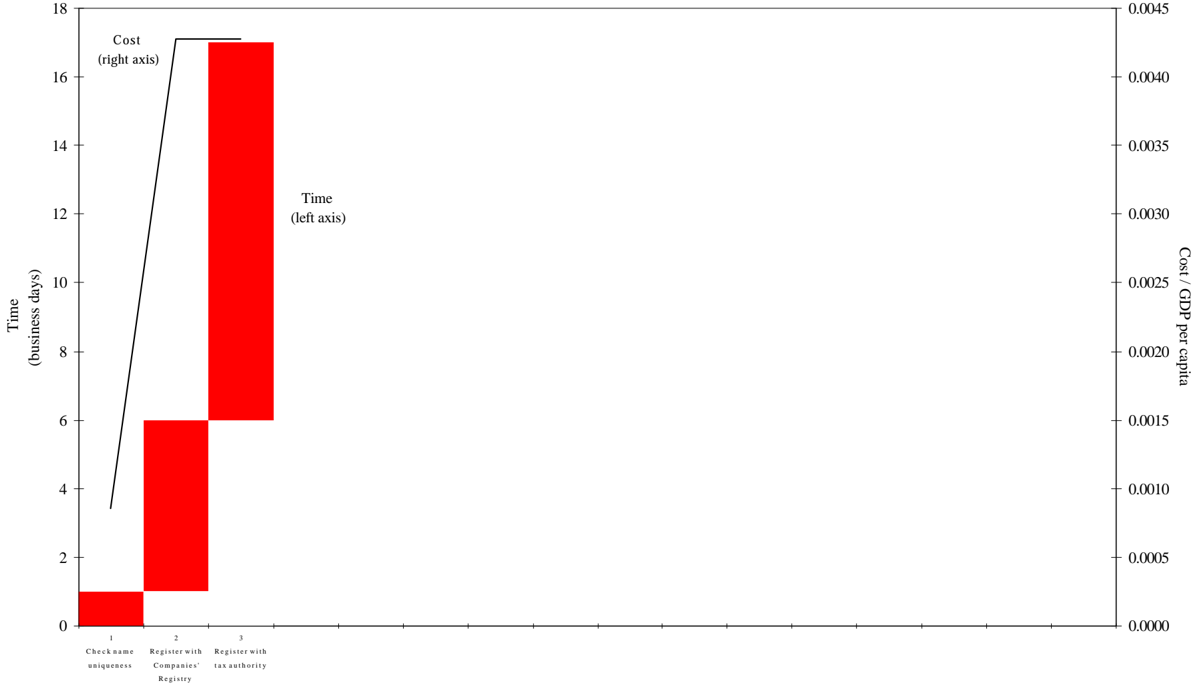
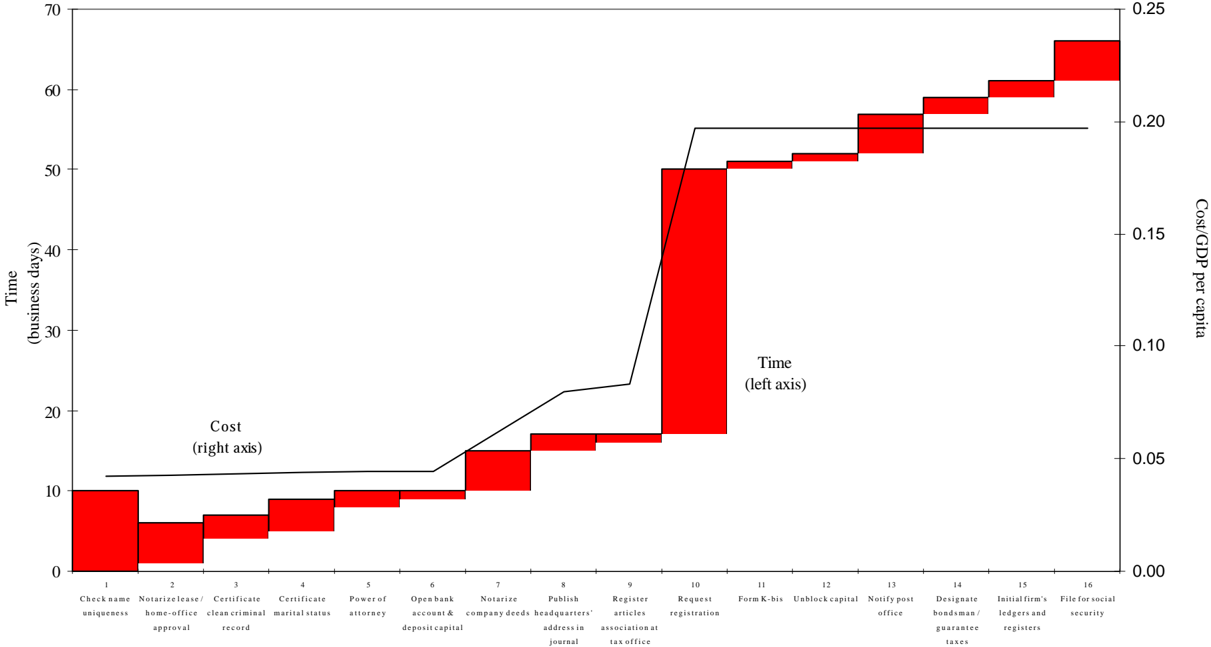
- Across the 75-country sample, the number of entry procedures ranges from 2 in Canada to 20 in Bolivia, with a sample average of 10.17 procedures; the average official time is 63.05 business days and the average cost is 0.34 of GDP per capita.
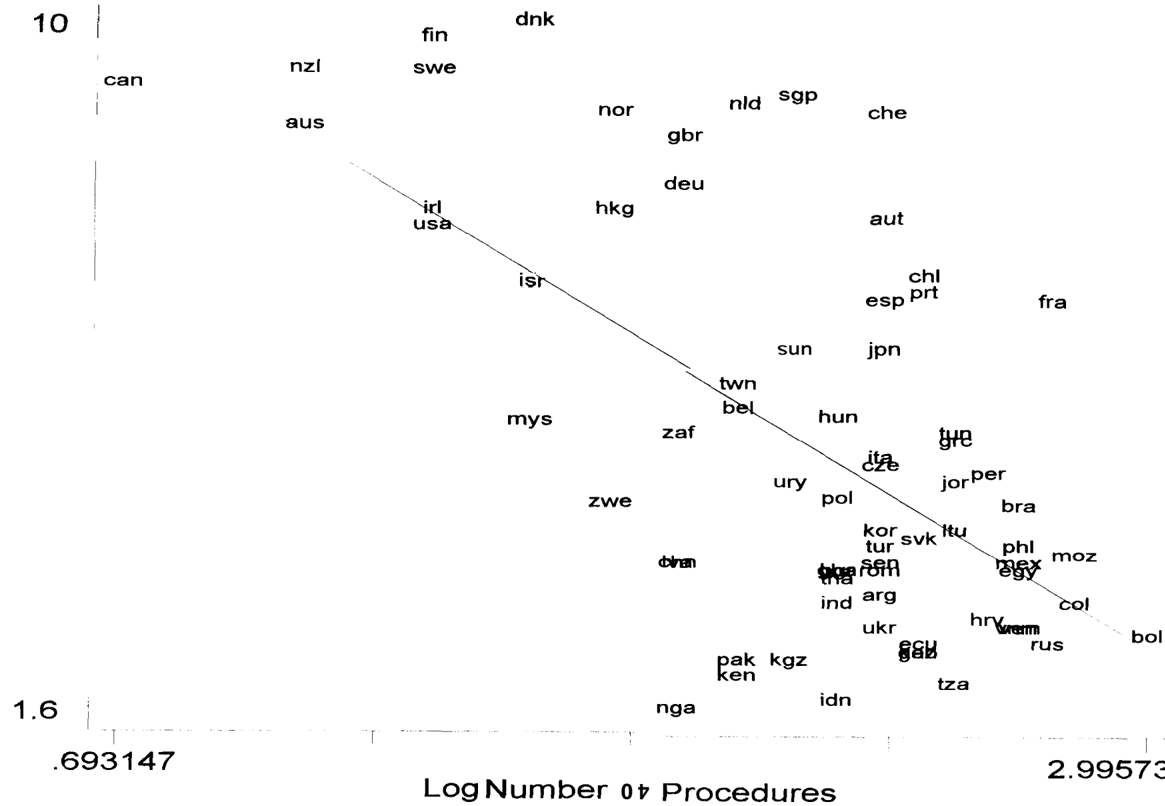
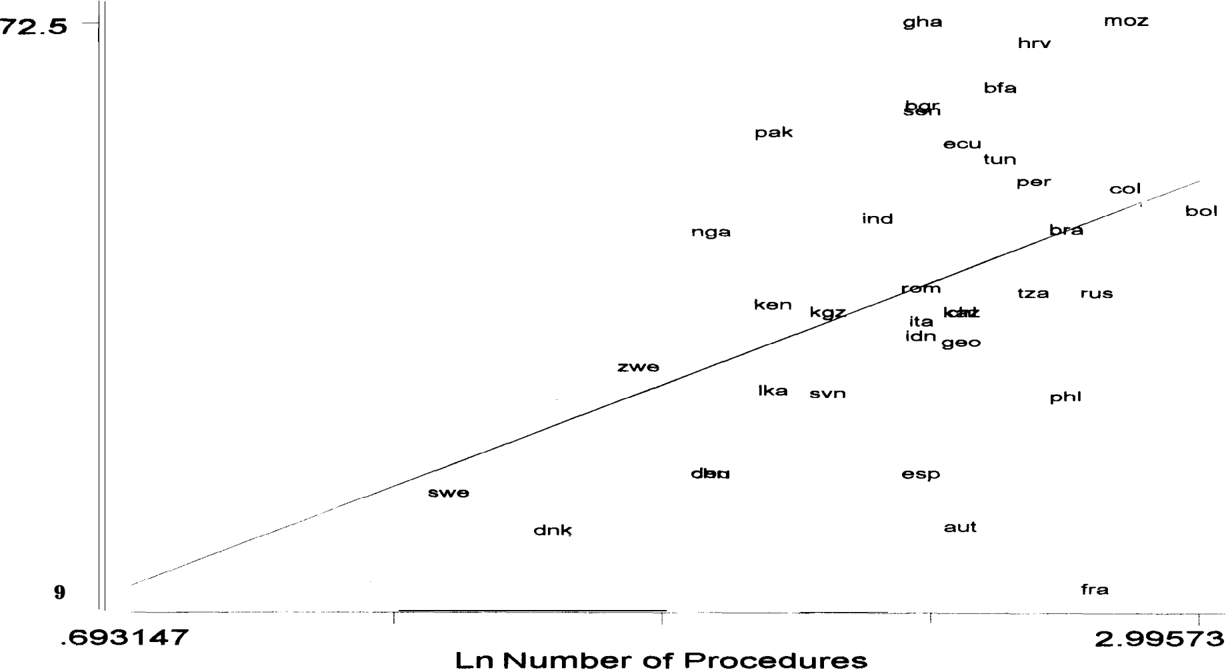
- The number of procedures is strongly correlated with time and cost: the paper reports correlations of 0.75 with log time and 0.62 with log cost.
- The helping-hand tests do not support a beneficial-regulation story: in Table IV, more procedures are associated with lower ISO quality standards (e.g. coefficient -0.2646) and larger unofficial economy measures (e.g. coefficient 13.6277 for size of unofficial economy; 19.8763 for employment in the unofficial economy), while pollution and health outcomes do not improve.
- The tollbooth evidence is stronger: Table VI reports that more procedures are associated with worse corruption scores, with a coefficient of -3.2809 (and -1.7249 with GDP per capita controls) for the corruption regressions.
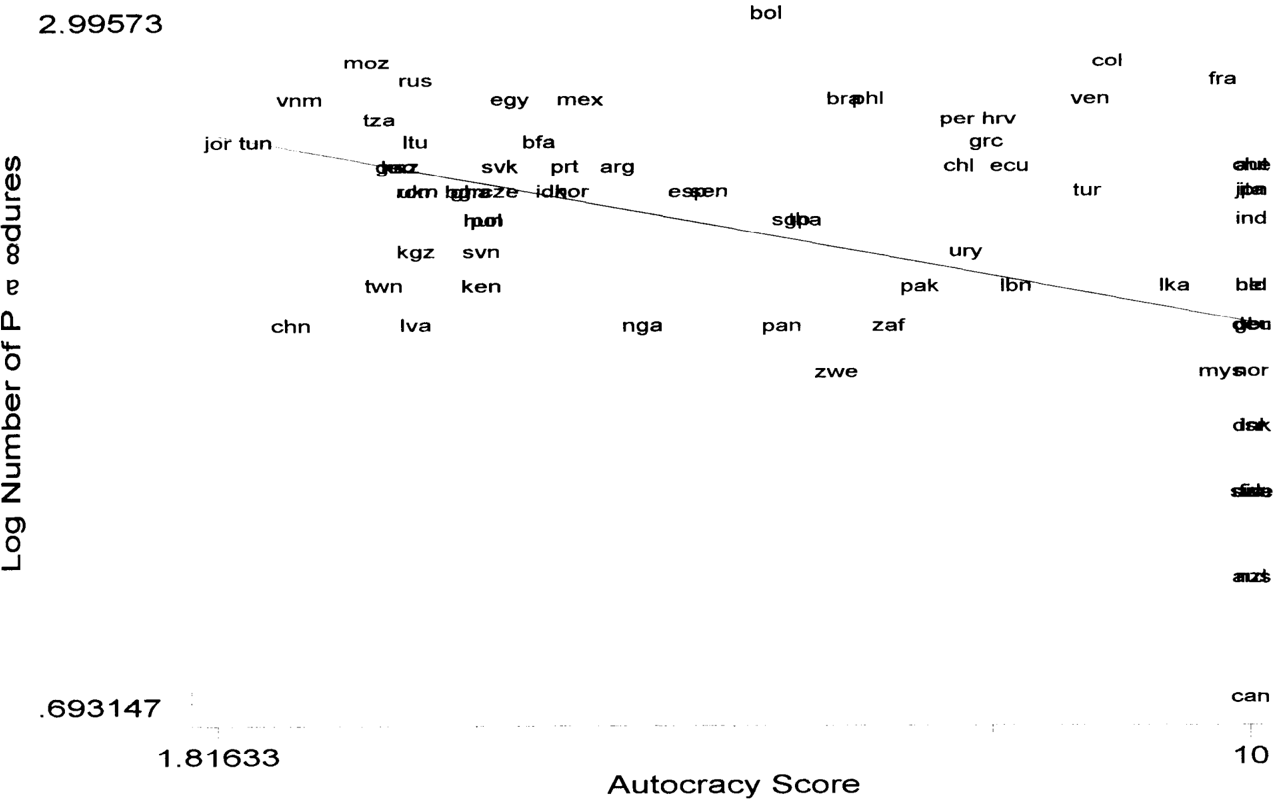
- In Table VIII, better government is associated with lighter regulation; the paper states that countries with more limited and representative governments have statistically significantly fewer procedures using 5 out of 6 measures of better government, and that more autocratic countries regulate more heavily.
Methods
- The paper builds a new database on entry regulation for 75 countries, focusing on the legal requirements, official time, and official cost for a standardized start-up firm.
- Data were gathered from written government sources, World Bank- and USAID-sponsored studies, government web pages, direct contacts with agencies, and independent double-checks in 73 countries via local consulting reports; the remaining 2 countries were double-checked through government contacts.
- The main analysis uses cross-country OLS regressions relating entry regulation measures to outcomes such as quality, pollution, unofficial economy, corruption, political institutions, legal origin, and GDP per capita; the paper also reports correlations and test-of-means comparisons across income quartiles.
Limitations
- The paper itself notes that the capture-theory tests are based on crude measures and that the data are probably least suited to test the capture hypothesis.
- The authors say the data almost surely underestimate the cost and complexity of entry because they focus on the capital city, omit industry-specific requirements and foreign-ownership steps, and ignore some informal delays and bribes.
- Evident from the text: the study is cross-sectional and based on official procedures/costs, so causal interpretation is limited and informal corruption/bureaucratic delays are not directly measured except indirectly through correlations.
Model-written summary. Check it against the paper before relying on it.
Integrity signals
Registry
Cites
Statistics
Figures
Verification
Claims the paper makes
0 Valid · 3 Not valid · 13 Not checked · 114 Own results and interpretations
A result the paper reports from its own data — it cites no other source for it, so there is none to check. The quote shows it is in the paper.
In the paper
“Very few entry regulations cover tax and labor issues.”
plain- Asserted: passes — The authors put it forward as true.
- Checkable: passes — It can be checked against evidence.
- Load-bearing: unclear — It is unclear whether the paper’s conclusions depend on it.
- Based: passes — The paper gives a reason why it holds.
In the paper
“The data show that the numbers of entry and of labor market regulations are positively correlated across countries, contrary to the substitutes hypothesis.”
What the sources say
- Not matchedcites Djankov et al., 2000
An author–year citation the paper’s reference list doesn’t settle. We don’t search these by name.
plainstates an association- Asserted: passes — The authors put it forward as true.
- Checkable: passes — It can be checked against evidence.
- Load-bearing: unclear — It is unclear whether the paper’s conclusions depend on it.
- Based: passes — The paper gives a reason why it holds.
- Not matched
A result the paper reports from its own data — it cites no other source for it, so there is none to check. The quote shows it is in the paper.
In the paper
“It often takes the form of screening procedures.”
- Also stated in: § III. Basic Results. · plain
“Instead, much of what governments do to regulate entry falls into the category of screening procedures.”
plain- Asserted: passes — The authors put it forward as true.
- Checkable: passes — It can be checked against evidence.
- Load-bearing: unclear — It is unclear whether the paper’s conclusions depend on it.
- Based: passes — The paper gives a reason why it holds.
- Also stated in: § III. Basic Results. · plain
A result the paper reports from its own data — it cites no other source for it, so there is none to check. The quote shows it is in the paper.
In the paper
“First, the cost-to-per-capita-GDP ratio decreases uniformly with GDP per capita.”
plainstates an association- Asserted: passes — The authors put it forward as true.
- Checkable: passes — It can be checked against evidence.
- Load-bearing: unclear — It is unclear whether the paper’s conclusions depend on it.
- Based: passes — The paper gives a reason why it holds.
A result the paper reports from its own data — it cites no other source for it, so there is none to check. The quote shows it is in the paper.
In the paper
“In contrast, countries in the other three quartiles of per capita income are not statistically different from each other in terms of the number of procedures and the time required to fulfill them.”
plain- Asserted: passes — The authors put it forward as true.
- Checkable: passes — It can be checked against evidence.
- Load-bearing: passes — The paper’s conclusions depend on it.
- Based: passes — The paper gives a reason why it holds.
49 more claims
Create a free account to see all 130 claims and every source verdict.
- Probably not a substantial claim. 21
- It may state two separate claims as one. 54
- The quote only partly states this claim. 26
Claims other papers make about this one
Each is checked against this paper’s own text: does it say what the citing paper says it does?
The source backs part of the claim, not all of it — or backs it for a different population, condition or comparison.
In the citing paper
“Our findings suggest an explanation for the low level of incorporation in Italy: the average direct cost associated with fulfilling the bureaucratic regulations for registering a new corporation in Italy is 20% of per capita GNP compared to 10% of per capita GNP on average for other G-7 European countries.”
From Entry regulation as a barrier to entrepreneurship (2006) · cites this paper as Djankov et al. (2002)
Experimental — accuracy not yet measuredThe cited source says what the claim attributes to it.
In the citing paper
“Given the explicit link made by Djankov et al . (2002) between the speed and ease with which businesses may be established in a country and its economic performance - and the enthusiasm with which this link has been grasped by European Union policy makers - our findings imply this link needs reconsidering.”
From The Effect of Business Regulations on Nascent and Young Business Entrepreneurship (2007) · cites this paper as Djankov et al . (2002)
Citations
Cites
La Porta, R., Lopez‐de‐Silanes, F., Shleifer, A., & Vishny, R. W. (1998) · Journal of Political Economy · doi:10.1086/250042 · Cited by 18,025
Self-citationThe Theory of Economic Regulation
Stigler, G. J. (1971) · The Bell Journal of Economics and Management Science · doi:10.2307/3003160 · Cited by 8,098
Journal of Economic Literature
(2019) · AEA Papers and Proceedings · doi:10.1257/pandp.109.633 · Cited by 7,468
The Quarterly Journal of Economics
Kuznets, S. (2024) · Business Cycle Theory, Part I Volume 4 · doi:10.4324/9781003549741-8 · Cited by 7,176
La Porta, R. (1999) · Journal of Law, Economics, and Organization · doi:10.1093/jleo/15.1.222 · Cited by 5,699 · cited 2×
“Legal origin has been viewed as a proxy for the government’s proclivity to intervene in the economy and the stance of the law toward the security of property rights in a country [La Porta et al. 1999].”
The Theory of Economic Regulation
Stigler, G. J. (2021) · The Political Economy · doi:10.4324/9781315495811-8 · Cited by 5,483
Pigou, A. C. (1933) · The Economic Journal · doi:10.2307/2224491 · Cited by 5,137
Toward a More General Theory of Regulation
Peltzman, S. (1976) · The Journal of Law and Economics · doi:10.1086/466865 · Cited by 4,729
Moffitt, R. A. (2009) · American Economic Review · doi:10.1257/aer.99.2.660 · Cited by 4,694
Shleifer, A., & Vishny, R. W. (1993) · The Quarterly Journal of Economics · doi:10.2307/2118402 · Cited by 3,778
Self-citation
Research works printed but not linked: 7
- McLiesh Caralee, 2001, NBER Working Paper No., 8288
- Kasnako lu, Zehra, and Münür Yayla, 'Unrecorded Economy in Turkey: A Monetary Approach', 1999. "Unrecorded Economy in Turkey (A Monetary Approach)" in Informal Sector in Turkey (I), Tuncer Bulutay (ed.), SIS, Ankara, forthcoming.
- Fred, 1987, Journal of Legal Studies, 101
- Olson, Mancur, 1991, 'Autocracy, Democracy, and Prosperity,' in Richard Zeckhauser, ed., Strategy of Choice, Cambridge, MA: MIT Press.
- 1967, Western Economic Journal, 232
- World Economic Forum (1999), The Global Competitiveness Report 1999 , Schwab, Klaus et al., eds., New York: Oxford University Press.
- World Economic Forum, The Global Competitiveness Report 2001, Klaus Schwab et al., eds. (New York, NY: Oxford University Press, 2001).
Cited by
Items 301–400 of 3,986
Monteiro, J. C. M., & Assunção, J. J. (2012) · Journal of Development Economics · doi:10.1016/j.jdeveco.2011.10.002 · Cited by 174
Entrepreneurship and Firm Formation across Countries
Klapper, L., Amit, R., & Guillén, M. F. (2010) · International Differences in Entrepreneurship · doi:10.7208/chicago/9780226473109.003.0005 · Cited by 174
Capital is not enough: opportunity entrepreneurship and formal institutions
Boudreaux, C. J., & Nikolaev, B. (2019) · Small Business Economics · doi:10.1007/s11187-018-0068-7 · Cited by 175
“This is because institutions shape the relative rewards from different productive and unproductive market and non-market activities and thus shape the allocation of entrepreneurial talent towards these activities (Boudreaux et al. 2018; Djankov et al. 2002).”
OECD Framework for the Evaluation of SME and Entrepreneurship Policies and Programmes
OECD (2008) · OECD eBooks · doi:10.1787/9789264040090-en · Cited by 174
Big business stability and economic growth: Is what's good for General Motors good for America?☆
FOGEL, K., MORCK, R., & YEUNG, B. (2008) · Journal of Financial Economics · doi:10.1016/j.jfineco.2007.06.004 · Cited by 166
National Systems of Entrepreneurship: Measurement Issues and Policy Implications
Acs, Z. J., Autio, E., & Szerb, L. (2012) · SSRN Electronic Journal · doi:10.2139/ssrn.2008160 · Cited by 172
Does Greater Accountability Improve the Quality of Public Service Delivery? Evidence from Uganda
Deininger, K., & Mpuga, P. (2005) · World Development · doi:10.1016/j.worlddev.2004.09.002 · Cited by 172
“1 Problems in public financial management have been identified as an important constraint to further growth which, together with low levels of transparency and accountability are potential obstacles to continued progress in reducing poverty (Francis & James, 2003; World Bank, 2003).”
InfluentialCan Entrepreneurial Activity be Taught? Quasi-Experimental Evidence from Central America
Klinger, B., & Schündeln, M. (2011) · World Development · doi:10.1016/j.worlddev.2011.04.021 · Cited by 171
Why is corruption less harmful in some countries than in others?
Blackburn, K., & Forgues-Puccio, G. F. (2009) · Journal of Economic Behavior & Organization · doi:10.1016/j.jebo.2009.08.009 · Cited by 171
“…in Blackburn and Forgues-Puccio (2007), together with demonstrating how corruption can foster inequality by 9Various examples from around the world can be found in Bhagwati (1993), De Soto (1990), Djankov et al. (2000), Kau¤man (1997), Mbaku (2000), Sjaifudian (1997) and the World Bank (2002).”
The Schumpeterian Growth Paradigm
Aghion, P., Akcigit, U., & Howitt, P. (2015) · Annual Review of Economics · doi:10.1146/annurev-economics-080614-115412 · Cited by 170
Nikolaev, B. N., Boudreaux, C. J., & Palich, L. (2018) · Journal of Small Business Management · doi:10.1111/jsbm.12400 · Cited by 170
“For example, Djankov et al. (2002) examined the number of steps that entrepreneurs had to complete in order to start a business legally, which they found to vary from a total of two in Australia and Canada to 22 in the Dominican republic.”
Does bribery in the home country promote or dampen firm exports?
Lee, S., & Weng, D. H. (2013) · Strategic Management Journal · doi:10.1002/smj.2075 · Cited by 167
“The presence of government regulations may make it difficult to obtain such permits (Djankov et al., 2002).”
Institutional Quality and Economic Growth: The Case of Emerging Economies
Nguyen, C. P., Su, T. D., & Nguyen, T. V. H. (2018) · Theoretical Economics Letters · doi:10.4236/tel.2018.811127 · Cited by 169
“High institutional quality has been argued as an economic growth momentum by incentivizing economic activities such as consumption and investment [8] [9], improving effiHow to cite this paper: Nguyen, C.”
Amin, M., & Islam, A. (2015) · World Development · doi:10.1016/j.worlddev.2015.05.008 · Cited by 168
The Real Effects of U.S. Banking Deregulation
Strahan, P. E. (2003) · Review · doi:10.20955/r.85.111-128 · Cited by 162
“Figure 1 Similarly, Djankov et al. (2002) find that entry regulations also tend to be most prevalent in countries with corrupt political institutions.”
China's Financial System: Opportunities and Challenges
Allen, F., Qian, J. "., Zhang, C., & Zhao, M. (2012) · National Bureau of Economic Research · doi:10.3386/w17828 · Cited by 166
Computational Substrates of Social Value in Interpersonal Collaboration
Fareri, D. S., Chang, L. J., & Delgado, M. R. (2015) · The Journal of Neuroscience · doi:10.1523/jneurosci.4775-14.2015 · Cited by 161
Untapped Riches of Meso-Level Applications in Multilevel Entrepreneurship Mechanisms
Kim, P. H., Wennberg, K., & Croidieu, G. (2016) · Academy of Management Perspectives · doi:10.5465/amp.2015.0137 · Cited by 165
Shining a light on the shadows: Identifying robust determinants of the shadow economy
Goel, R. K., & Nelson, M. A. (2016) · Economic Modelling · doi:10.1016/j.econmod.2016.06.009 · Cited by 165
State Ownership and Corporate Cash Holdings
Chen, R., Ghoul, S. E., Guedhami, O., & Nash, R. (2018) · Journal of Financial and Quantitative Analysis · doi:10.1017/s0022109018000236 · Cited by 177
Entrepreneurship, firm entry, and the taxation of corporate income: Evidence from Europe
Da Rin, M., Di Giacomo, M., & Sembenelli, A. (2011) · Journal of Public Economics · doi:10.1016/j.jpubeco.2010.06.010 · Cited by 170
Bonini, S., & Capizzi, V. (2019) · Venture Capital · doi:10.1080/13691066.2019.1608697 · Cited by 164
“The authors use the following proxies as measures of entrepreneurship-friendliness of a country: (i) the depth of the venture capital market as a fraction of the domestic GDP and (ii) the number of regulatory procedures while incorporating a firm (consistent with Djankov et al. 2002).”
Audretsch, D. B., Belitski, M., Chowdhury, F., & Desai, S. (2022) · Small Business Economics · doi:10.1007/s11187-021-00497-2 · Cited by 165
Personal Wealth from a Global Perspective
(2008) · doi:10.1093/acprof:oso/9780199548880.001.0001 · Cited by 164
Entry costs, industry structure, and cross-country income and TFP differences
Barseghyan, L., & DiCecio, R. (2011) · Journal of Economic Theory · doi:10.1016/j.jet.2011.05.010 · Cited by 163
“Djankov et al. [2002] construct a broader measure of entry costs that accounts for the costs associated with regulation compliance in addition to the entry fees.”
Besley, T. (2015) · Journal of Economic Perspectives · doi:10.1257/jep.29.3.99 · Cited by 160
Innovation across Europe: How important are institutional differences?
Barbosa, N., & Faria, A. P. (2011) · Research Policy · doi:10.1016/j.respol.2011.05.017 · Cited by 164
“For instance, Djankov et al. (2002) and Desai et al. (2003) investigate the impact of institutions on entrepreneurial activity and firm dynamics, Alesina et al. (2005) on investment, Griffith et al. (2007) on unemployment, Coe et al. (2008) on productivity and international R&D spillovers.”
A Unified Theory of the Evolution of International Income Levels
Parente, S. L., & Prescott, E. C. (2005) · Handbook of Economic Growth · doi:10.1016/s1574-0684(05)01021-x · Cited by 175
“For example, Djankov et al. (2002) calculate the costs associated with the legal requirements in 75 countries that an entrepreneur must meet in order to start a business.”
Trading Partners and Trading VolumesPreprint
Helpman, E., Melitz, M. J., & Rubinstein, Y. (2006) · RePEc: Research Papers in Economics · Cited by 213
Mathew, V. (2010) · International Entrepreneurship and Management Journal · doi:10.1007/s11365-010-0144-1 · Cited by 164
Pasiouras, F., Gaganis, C., & Zopounidis, C. (2006) · Review of Quantitative Finance and Accounting · doi:10.1007/s11156-006-0045-0 · Cited by 160
Pitfalls to avoid when measuring institutions: Is Doing Business damaging business?
Arruñada, B. (2007) · Journal of Comparative Economics · doi:10.1016/j.jce.2007.08.003 · Cited by 162
“1 These are based on a survey method drawn up by Djankov et al. (2002) inspired by the ideas of Hernando de Soto (1986, 2000), and estimate, amongst many other indicators on obstacles to business activity, how many procedures are needed and the costs incurred in starting-up a business in each of…”
Human Resources for Health in Europe
Dubois, C., McKee, M., & Nolte, E. (2005) · Cited by 169
Entry costs and cross-country differences in productivity and output
Barseghyan, L. (2008) · Journal of Economic Growth · doi:10.1007/s10887-008-9026-6 · Cited by 159
Business environment and the incorporation decision
Demirguc-Kunt, A., Love, I., & Maksimovic, V. (2006) · Journal of Banking & Finance · doi:10.1016/j.jbankfin.2006.05.007 · Cited by 158
Judicial Checks and BalancesPreprint
Porta, R. L., de Silanes, F. L., Pop-Eleches, C., & Shleifer, A. (2003) · SSRN Electronic Journal · doi:10.2139/ssrn.410821 · Cited by 179
Self-citationChapter 2 Growth with Quality-Improving Innovations: An Integrated Framework
Aghion, P., & Howitt, P. (2005) · Handbook of Economic Growth · doi:10.1016/s1574-0684(05)01002-6 · Cited by 158
Enforcement and Good Corporate Governance in Developing Countries and Transition Economies
Berglof, E. (2006) · The World Bank Research Observer · doi:10.1093/wbro/lkj005 · Cited by 158
LETTER GRADING GOVERNMENT EFFICIENCY
Chong, A., La Porta, R., Lopez-de-Silanes, F., & Shleifer, A. (2014) · Journal of the European Economic Association · doi:10.1111/jeea.12076 · Cited by 155
“If one believed that the better governments would curtail the mail service, or its marginal aspects such as returning letters from abroad, one would expect exactly the opposite (see Djankov et al. 2002).”
Self-citationThe impact of business regulatory reforms on economic growth
Haidar, J. I. (2012) · Journal of the Japanese and International Economies · doi:10.1016/j.jjie.2012.05.004 · Cited by 158
“HAL Id: halshs-00717423 https://shs.hal.science/halshs-00717423 Submitted on 12 Jul 2012 HAL is a multi-disciplinary open access archive for the deposit and dissemination of scientific research documents, whether they are published or not.”
InfluentialNational systems of entrepreneurship
Ács, Z. J., Audretsch, D. B., Lehmann, E. E., & Licht, G. (2016) · Small Business Economics · doi:10.1007/s11187-016-9705-1 · Cited by 274
Towards a Better Understanding of the Informal Economy
Andrews, D., Sánchez, A. C., & Johansson, Å. (2011) · OECD Economics Department working papers · doi:10.1787/5kgb1mf88x28-en · Cited by 235
What Do We Learn from Schumpeterian Growth Theory?Preprint
Aghion, P., Akcigit, U., & Howitt, P. W. (2013) · SSRN Electronic Journal · doi:10.2139/ssrn.2274704 · Cited by 183
Eight Questions About Corruption
Svensson, J. (2006) · Gospodarka Narodowa · doi:10.33119/gn/101466 · Cited by 172
Who Are The Microenterprise Owners? Evidence From Sri Lanka On Tokman V. De Soto
de Mel, S., McKenzie, D., & Woodruff, C. (2008) · World Bank, Washington, DC eBooks · doi:10.1596/1813-9450-4635 · Cited by 158
“Djankov et al (2002) measure the time and monetary costs of registering a business in 75 countries.”
Law and Finance: Why Does Legal Origin Matter?
Beck, T., Demirguc-Kunt, A., & Levine, R. (2002) · National Bureau of Economic Research · doi:10.3386/w9379 · Cited by 150
Does bribery help or hurt firm growth around the world?
Zhou, J. Q., & Peng, M. W. (2011) · Asia Pacific Journal of Management · doi:10.1007/s10490-011-9274-4 · Cited by 176
“These data also provide valuable firm-level evidence of bribery, instead of country-level aggregate analysis as is often the case in institutional economics literature (Djankov et al., 2002; Mauro, 1995).”
The stained China miracle: Corruption, regulation, and firm performance
Jiang, T. X., & Nie, H. (2014) · Economics Letters · doi:10.1016/j.econlet.2014.03.026 · Cited by 180
Bribery solicitations and firm performance in the Latin America and Caribbean region
Şeker, M., & Yang, J. S. (2013) · Journal of Comparative Economics · doi:10.1016/j.jce.2013.05.004 · Cited by 165
Do lower taxes reduce informality? Evidence from Brazil
Rocha, R., Ulyssea, G., & Rachter, L. (2018) · Journal of Development Economics · doi:10.1016/j.jdeveco.2018.04.003 · Cited by 174
Kummitha, R. K. R., & Crutzen, N. (2019) · Technological Forecasting and Social Change · doi:10.1016/j.techfore.2018.12.001 · Cited by 155
Chemin, M. (2008) · Journal of Public Economics · doi:10.1016/j.jpubeco.2008.05.005 · Cited by 186
“Djankov et al. (2003) have made an important contribution to the study of the courts by collecting data on judicial formalism from 109 countries. Acemoglu and Johnson (2005) related this data to economic outcomes using legal origin as an instrumental variable. They found that contracting institutions have no impact on…”
The Firm Size Distribution across Countries and Skill-Biased Change in Entrepreneurial Technology
Poschke, M. (2018) · American Economic Journal Macroeconomics · doi:10.1257/mac.20140181 · Cited by 200
“For instance, entry regulation, which is more burdensome in poorer countries (Djankov et al. 2002), would imply fewer entrepreneurs and larger firms in poorer countries.”
Djankov, S., Porta, R. L., López‐de‐Silanes, F., & Shleifer, A. (2010) · American Economic Journal Applied Economics · doi:10.1257/app.2.2.179 · Cited by 262
Self-citationThe evolution of labour law: Calibrating and comparing regulatory regimes
Deakin, S. F., Lele, P. P., & Siems, M. (2007) · International Labour Review · doi:10.1111/j.1564-913x.2007.00011.x · Cited by 187
Why Not a Political Coase Theorem? Social Conflict, Commitment and PoliticsPreprint
Acemoğlu, D. (2002) · SSRN Electronic Journal · doi:10.2139/ssrn.355900 · Cited by 148
“…a few examples, Knack and Keefer (1995) look at measures of property rights enforcement compiled by international business organizations (in particular Political and Risk Services), Mauro (1995) looks at measures of corruption, and Djankov, La Porta, Lopez-De-Silanes and Shleifer (2002) compile…”
Aid with multiple personalities
Djankov, S., Montalvo, J. G., & Reynal‐Querol, M. (2008) · Journal of Comparative Economics · doi:10.1016/j.jce.2008.09.005 · Cited by 184
Self-citationRussian attitudes toward paying taxes – before, during, and after the transition
Alm, J. R., Martinez‐Vazque, J., & Torgler, B. (2006) · International Journal of Social Economics · doi:10.1108/03068290610714670 · Cited by 199
Legitimacy and the Benefits of Firm Formalization
Assenova, V., & Sorenson, O. (2017) · Organization Science · doi:10.1287/orsc.2017.1146 · Cited by 170
Djankov, S., Porta, R. L., Lopez-de-Silane, F., & Shleifer, A. (2002) · National Bureau of Economic Research · doi:10.3386/w8890 · Cited by 184
Self-citationThe Economic Effects of Employment Protection: Evidence from International Industry-Level DataPreprint
Micco, A., & Pagés, C. (2006) · SSRN Electronic Journal · doi:10.2139/ssrn.947097 · Cited by 224
The globalization of angel investments: Evidence across countries
Lerner, J., Schoar, A., Sokolinski, S., & Wilson, K. (2018) · Journal of Financial Economics · doi:10.1016/j.jfineco.2017.05.012 · Cited by 142
Understanding the Transaction Costs of Transition: it's the Culture, Stupid
Pejovich, S. (2003) · The Review of Austrian Economics · doi:10.1023/a:1027397122301 · Cited by 150
Belitski, M., Chowdhury, F., & Desai, S. (2016) · Small Business Economics · doi:10.1007/s11187-016-9724-y · Cited by 170
“Tax policy and corruption are important institutional considerations for entry (see Djankov et al. 2002, 2010), and their relationship has implications for public revenues as well.”
InfluentialEnvironmental conditions and entrepreneurial activity: a regional comparison in Spain
Álvarez, C., Urbano, D., Coduras, A., & Ruíz‐Navarro, J. (2011) · Journal of Small Business and Enterprise Development · doi:10.1108/14626001111106460 · Cited by 210
Institutional development and hypercompetition in emerging economies
Hermelo, F. D., & Vassolo, R. S. (2010) · Strategic Management Journal · doi:10.1002/smj.898 · Cited by 167
Regulation and Internet Use in Developing Countries
Wallsten, S. (2005) · Economic Development and Cultural Change · doi:10.1086/425376 · Cited by 146
Trading on TimePreprint
Djankov, S., Freund, C. L., & Pham, C. S. (2006) · SSRN Electronic Journal · Cited by 147
Self-citationCalhoun, M. A. (2002) · Journal of International Management · doi:10.1016/s1075-4253(02)00072-8 · Cited by 185
Was Weber Right? The Role of Urban Autonomy in Europe's Rise
STASAVAGE, D. (2014) · American Political Science Review · doi:10.1017/s0003055414000173 · Cited by 140
What is the role of legal systems in financial intermediation? Theory and evidence
Bottazzi, L., Rin, M. D., & Hellmann, T. F. (2008) · Journal of Financial Intermediation · doi:10.1016/j.jfi.2008.04.003 · Cited by 189
The macroeconomic effects of goods and labor markets deregulation
Cacciatore, M., & Fiori, G. (2015) · Review of Economic Dynamics · doi:10.1016/j.red.2015.10.002 · Cited by 183
National Business Regulations and City Entrepreneurship in Europe: A Multilevel Nested Analysis
Audretsch, D. B., Belitski, M., & Desai, S. (2018) · Entrepreneurship Theory and Practice · doi:10.1177/1042258718774916 · Cited by 172
“In contrast, public choice theory argues that regulation is used by powerful agents to improve their own economic gains (see Djankov et al., 2002; Peltzman, 1976; Tullock, 1967).”
InfluentialFinance and Development: A Tale of Two Sectors
Buera, F., Kaboski, J. P., & Shin, Y. (2009) · National Bureau of Economic Research · doi:10.3386/w14914 · Cited by 162
What Do We Learn From Schumpeterian Growth Theory?
Aghion, P., Akcigit, U., & Howitt, P. W. (2013) · National Bureau of Economic Research · doi:10.3386/w18824 · Cited by 225
A multilevel analysis of innovation in developing countries
Srholec, M. (2011) · Industrial and Corporate Change · doi:10.1093/icc/dtr024 · Cited by 177
Informal institutions and international entrepreneurship
Muralidharan, E., & Pathak, S. (2017) · International Business Review · doi:10.1016/j.ibusrev.2016.07.006 · Cited by 119
Barriers to rural women entrepreneurs in Oman
Ghouse, S. M., McElwee, G., Meaton, J., & Durrah, O. (2017) · International Journal of Entrepreneurial Behaviour & Research · doi:10.1108/ijebr-02-2017-0070 · Cited by 192
Has the anti-corruption campaign decreased air pollution in China?
Zhou, M., Wang, B., & Chen, Z. (2020) · Energy Economics · doi:10.1016/j.eneco.2020.104878 · Cited by 149
Can Unemployment Insurance Spur Entrepreneurial Activity? Evidence from France
HOMBERT, J., SCHOAR, A., SRAER, D., & THESMAR, D. (2020) · The Journal of Finance · doi:10.1111/jofi.12880 · Cited by 200
Corruption And Productivity : Firm-Level Evidence From The BEEPS Survey
Rosa, D. D., Gooroochurn, N., & Görg, H. (2010) · The World Bank Open Knowledge Repository (World Bank) · doi:10.1596/1813-9450-5348 · Cited by 171
Kellenberg, D. K. (2012) · Journal of Environmental Economics and Management · doi:10.1016/j.jeem.2012.02.003 · Cited by 200
Asymmetric Effects of Corruption on FDI: Evidence from Swedish Multinational Firms
Hakkala, K. N., Norbäck, P., & Svaleryd, H. (2008) · The Review of Economics and Statistics · doi:10.1162/rest.90.4.627 · Cited by 187
Public policy, entrepreneurship, and venture capital in the United States
Cumming, D. J., & Li, D. (2013) · Journal of Corporate Finance · doi:10.1016/j.jcorpfin.2013.09.005 · Cited by 160
Openness Can Be Good For Growth : The Role Of Policy Complementarities
Chang, R., Kaltani, L., & Loayza, N. (2005) · World Bank, Washington, DC eBooks · doi:10.1596/1813-9450-3763 · Cited by 169
Testing, monitoring, and dating structural changes in exchange rate regimes
Zeileis, A., Shah, A., & Patnaik, I. (2009) · Computational Statistics & Data Analysis · doi:10.1016/j.csda.2009.12.005 · Cited by 159
Governance and Growth in Developing Countries
Gani, A. (2011) · Journal of Economic Issues · doi:10.2753/jei0021-3624450102 · Cited by 185
On the Welfare Effects and Political Economy of Competition‐Enhancing Policies
Aghion, P., & Schankerman, M. (2004) · The Economic Journal · doi:10.1111/j.1468-0297.2004.00244.x · Cited by 160
“…enforcement (McMillan, 1997; McMillan and Woodruff, 1999) and corporate governance (Pistor et al., 2000), policies to reduce regulatory barriers to the entry of new firms (Djankov et al., 2002), and other aspects of good government (Weingast, 1995; Knack and Keefer, 1995; Acemoglu et al., 2001).”
Institutions and Financial Development: Evidence from International Migrants in the United States
Osili, U., & Paulson, A. L. (2008) · The Review of Economics and Statistics · doi:10.1162/rest.90.3.498 · Cited by 190
Hoinaru, R., Buda, D., Borlea, S. N., Văidean, V. L., & Achim, M. V. (2020) · Sustainability · doi:10.3390/su12020481 · Cited by 206
China's anti-corruption campaign and firm productivity: Evidence from a quasi-natural experiment
Kong, D., Tao, Y., & Wang, Y. (2020) · China Economic Review · doi:10.1016/j.chieco.2020.101535 · Cited by 154
Ault, J. K., & Spicer, A. H. (2013) · Strategic Management Journal · doi:10.1002/smj.2185 · Cited by 151
Latin America in the rearview mirror
Cole, H. L., Ohanian, L. E., Riascos, A. J., & Schmitz, J. A. (2004) · Journal of Monetary Economics · doi:10.1016/j.jmoneco.2004.09.002 · Cited by 186
Entrepreneurship and income inequality
Halvarsson, D., Korpi, M., & Wennberg, K. J. (2017) · Journal of Economic Behavior & Organization · doi:10.1016/j.jebo.2017.11.003 · Cited by 170
Technology transfer and entrepreneurship: cross-national analysis
Audretsch, D. B., & Caiazza, R. (2015) · The Journal of Technology Transfer · doi:10.1007/s10961-015-9441-8 · Cited by 151
“…supports (such as risk oriented culture, social norms, lows for property protection, regulation of entry) that positively influence knowledge creation, technology transfer and entrepreneurship (Caiazza and Volpe 2015a, b; Levie and Autio 2011; Djankov et al. 2002; Stephan and Uhlaner 2010).”
The Power of Ranking: The Ease of Doing Business Indicator and Global Regulatory Behavior
Doshi, R., Kelley, J. G., & Simmons, B. A. (2019) · International Organization · doi:10.1017/s0020818319000158 · Cited by 180
Rural women entrepreneurs in Oman: problems and opportunities
Ghouse, S. M., Durrah, O., & McElwee, G. (2021) · International Journal of Entrepreneurial Behaviour & Research · doi:10.1108/ijebr-03-2021-0209 · Cited by 179
A theory of entry into and exit from export markets
Impullitti, G., Irarrazabal, A. A., & Opromolla, L. D. (2012) · Journal of International Economics · doi:10.1016/j.jinteco.2012.11.005 · Cited by 166
“Given X = w(1) C=w, this pins down the wage w and, using (21), Y .”
Political environment, financial intermediation costs, and financing patterns
Gungoraydinoglu, A., Çolak, G., & Öztekin, Ö. (2017) · Journal of Corporate Finance · doi:10.1016/j.jcorpfin.2017.03.007 · Cited by 148
Construction, Corruption, And Developing Countries
Kenny, C. J. (2007) · World Bank, Washington, DC eBooks · doi:10.1596/1813-9450-4271 · Cited by 135
Metadata
- Authors
- Djankov, S., La Porta, R., Lopez-de-Silanes, F., & Shleifer, A.
- Affiliations
- World Bank (US)
- National Bureau of Economic Research (US)
- ORCID
- Djankov, S.
- Venue
- The Quarterly Journal of Economics
- Publisher
- Oxford University Press (OUP)
- Published
- 2002-02-01
- Volume
- 117
- Issue
- 1
- Pages
- 1-37
- ISSN
- 0033-5533
- 1531-4650
- OpenAlex
- W2139896179
- Cited by
- 3,956
- References
- 30
- Citations by year
- 2026: 223 · 2025: 185 · 2024: 157 · 2023: 120 · 2022: 140 · 2021: 150 · 2020: 151 · 2019: 161 · 2018: 157 · 2017: 162 · 2016: 166 · 2015: 193 · 2014: 200 · 2013: 183 · 2012: 193
- Type
- report
- Language
- en
- Open access
- green
- doi.org
- Licence
- other-oa
- Locations
- World Bank, Washington, DC eBooks (publishedVersion)
- The Quarterly Journal of Economics (publishedVersion)
- The World Bank Open Knowledge Repository (World Bank) (publishedVersion)
- National Bureau of Economic Research (publishedVersion, other-oa)
- RePEc: Research Papers in Economics (submittedVersion)
- Digital Access to Scholarship at Harvard (DASH) (Harvard University) (submittedVersion, cc-by)
- SSRN Electronic Journal (submittedVersion)
- OpenGrey (Institut de l'Information Scientifique et Technique) (submittedVersion)
- The World Bank Open Knowledge Repository (World Bank) (submittedVersion, cc-by)
- Topics
- Social Sciences › Sociology and Political Science › Corruption and Economic Development
- Social Sciences › Economics, Econometrics and Finance › Economics and Econometrics › Taxation and Compliance Studies
- Social Sciences › Business, Management and Accounting › Strategy and Management › Political Influence and Corporate Strategies
- Keywords
- start-up firms, bureaucratic procedures, corruption, informal economy, democracy, government size, public choice theory, public interest theory
About these checks
Registry, retraction, Cites and statistics results are computed, not judged, with one exception: a printed reference that no index lists is read once by a model before it counts as a citation error. Claims are extracted by a model and kept only when their quote appears verbatim in the text; each cited source is then checked, with a model’s help, for whether it says what the claim relies on. Those verdicts can be wrong — read the claim’s quote and the cited source before relying on one.
A language model drew the claims from the paper on 2026-10-01, under version 3 of the claim definition (model deepseek-v4.1-flash, prompt extract-v3).
A second model labelled each claim on 2026-10-01 (model jev-1.13-20260917, definition revision gold-guideline-v0.2).
Statistics and arithmetic are recomputed, not judged.
Confidence bands are shown only for fields calibrated on our annotated test set. None is calibrated yet, so no band is shown.
What counts as a claim ›How we measure confidence ›How we check this ›
Are you an author, or do you see a problem with this page? Request a review
Data sources
Bibliographic data: Semantic Scholar, OpenAlex, Crossref.
Contains information from the Semantic Scholar Academic Graph Datasets, made available under the ODC Attribution License (ODC-BY 1.0).
Semantic Scholar’s data is described in: Kinney, R., et al. (2023). The Semantic Scholar Open Data Platform. arXiv:2301.10140.
